Today, I am also going to suggest you book the profit on the HOG debit spread.
One of the reasons is that the stock is approaching the midband on the daily chart and I do not want to run the risk of a pullback if it cannot clear it.
Here is how you close the position:
Sell to Close September 4th - $26.00 Call for $2.80
Buy to Close September 4th - $29.50 Call for $.65
The net credit will be $2.15 per spread. This results in a profit of $450 if you traded the suggested 5 lot.
The gain is 72% for 15 days.
https://madhedgefundtrader.com/wp-content/uploads/2019/05/cropped-mad-hedge-logo-transparent-192x192_f9578834168ba24df3eb53916a12c882.png00Mad Hedge Fund Traderhttps://madhedgefundtrader.com/wp-content/uploads/2019/05/cropped-mad-hedge-logo-transparent-192x192_f9578834168ba24df3eb53916a12c882.pngMad Hedge Fund Trader2020-08-18 12:28:562020-08-18 12:28:56August 18, 2020 - MDT Alert (HOG)
Another biotechnology company is cashing in on its COVID-19 vaccine efforts: CureVac (CVAC).
CureVac, which has a market capitalization of $9.9 billion, is hoping to follow the footsteps of Moderna (MRNA) and BioNTech (BNTX).
Earlier this year, both small-cap companies saw their value skyrocket, with Moderna now reporting a market capitalization of $27.3 billion while BioNTech is at $16.3 billion.
While the jump in their market capitalization is definitely newsworthy, what is even more impressive is that neither company has a product out in the market today. That is, up until the pandemic struck.
Now, CureVac is looking into raking in the same benefits from its own COVID-19 vaccine work.
Here is a snapshot of how well this stock is doing so far.
CureVac, which raised $213.13 million in its IPO, initially priced its shares at $16 each, started trading at $44 per share and ended the day at $55.90 per share.
The week after, CureVac shares started trading at $79.33 in the premarket hours of Monday, with the price expected to reach an all-time high of approximately $85 per share.
Aside from the Bill and Melinda Gates Foundation, CureVac also attracted backing for its COVID-19 vaccine candidates from the German government and GlaxoSmithKline (GSK). So far, the company has recorded $640 million in funding for its coronavirus program.
What we know about CureVac’s vaccine candidate is that it utilizes the same mRNA-based technology as Moderna and Pfizer (PFE).
While the newly minted biotechnology company is behind competitors, the results of their study are expected to be released by the next quarter.
Prior to prioritizing its COVID-19 vaccine work, CureVac has been focusing on developing cancer and rare disease treatments.
CureVac is also developing CV8102, which is a treatment that can target four different kinds of tumors.
Another frontrunner in its pipeline is CV7202, which is its rabies drug candidate. Its second-generation lipid nanoparticle (LNP) flu vaccine, called CV6301, is also a promising treatment.
Apart from CureVac, another small-cap biotechnology company has been competing against the COVID-19 vaccine frontrunners like AstraZeneca (AZN) and Johnson & Johnson (JNJ).
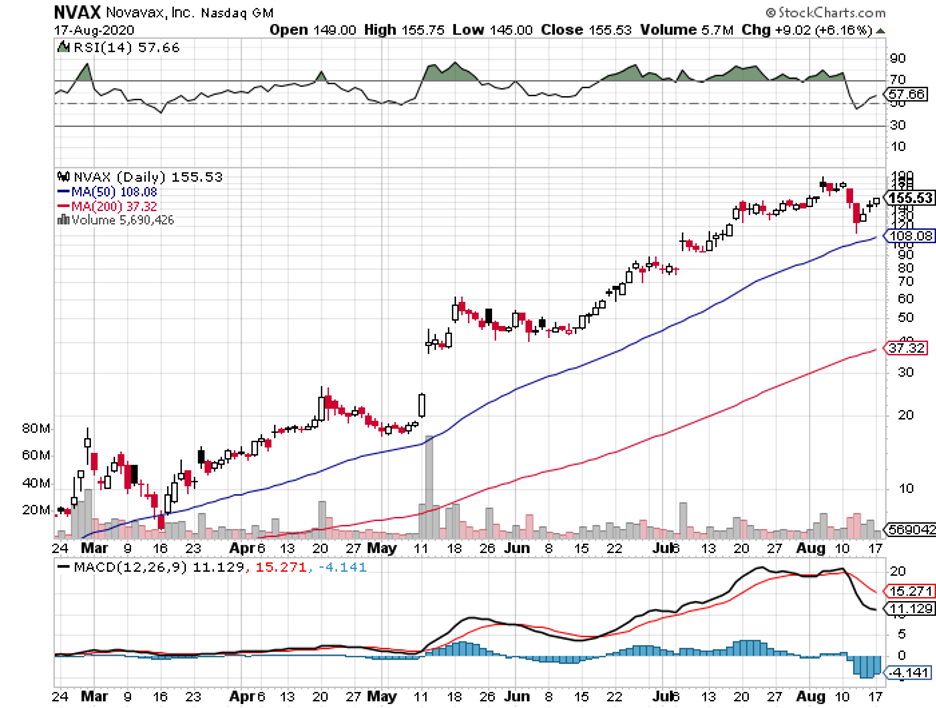
Earlier this month, Novavax (NVAX) announced the launch of the Phase 2B clinical trial of its COVID-19 vaccine.
The trial for the coronavirus vaccine, called NVX-CoV2373, is set in South Africa and is anticipated to not only provide the company with a larger group but also test the vaccine’s efficacy in an environment where the disease is currently surging.
Although Novavax is also behind the leaders, the level of transmission rate in South Africa, which accounts for half of the COVID-19 cases in Africa, is expected to provide the company a better chance of evaluating its candidate.
Other than that, Novavax has also secured manufacturing deals that can handle more than 2 billion doses.
Novavax has been working on a COVID-19 vaccine since February, with the company receiving $388 million in funding from the Coalition for Epidemic Preparedness Innovations.
By July, the company received a $1.6 billion investment from the US government courtesy of Trump’s Operation Warp Speed project.
If Novavax’s vaccine candidate earns approval, then the company could realistically expect over $10 billion in annual sales.
Riding the momentum, Novavax has also been working on a flu vaccine candidate, called NanoFlu, which can record as much as $1.7 billion in yearly sales.
With the current financial climate, the unprecedented demand for a vaccine will unsurprisingly drive the shares of companies like Novavax and CureVac even higher.
However, it is better to err on the side of caution when it comes to these ultra risky biotechnology companies.
The biotechnology industry has no shortage of investors on the lookout for stocks that can easily make them filthy rich. Although these high-profile stocks can definitely result in massive gains, there are still a number of critical caveats to bear in mind.
While waiting for the actual candidates to get launched, it is safer to bet on tested and proven businesses for now and perhaps dip your toe in the unfamiliar water currently dominated by these small-cap biotechnology companies.
https://madhedgefundtrader.com/wp-content/uploads/2019/05/cropped-mad-hedge-logo-transparent-192x192_f9578834168ba24df3eb53916a12c882.png00Mad Hedge Fund Traderhttps://madhedgefundtrader.com/wp-content/uploads/2019/05/cropped-mad-hedge-logo-transparent-192x192_f9578834168ba24df3eb53916a12c882.pngMad Hedge Fund Trader2020-08-18 12:00:112020-08-19 20:24:40More Dark Horses in the Covid-19 Vaccine Race
While the Diary of a Mad Hedge Fund Trader focuses on investment over a one week to a six-month time frame, Mad Day Trader, provided by Bill Davis, will exploit money-making opportunities over a brief ten minute to three-day window. It is ideally suited for day traders, but can also be used by long-term investors to improve market timing for entry and exit points.Read more
https://madhedgefundtrader.com/wp-content/uploads/2019/05/cropped-mad-hedge-logo-transparent-192x192_f9578834168ba24df3eb53916a12c882.png00Mad Hedge Fund Traderhttps://madhedgefundtrader.com/wp-content/uploads/2019/05/cropped-mad-hedge-logo-transparent-192x192_f9578834168ba24df3eb53916a12c882.pngMad Hedge Fund Trader2020-08-18 09:53:052020-08-18 09:53:05August 18, 2020 - MDT Pro Tips
Let’s say you absolutely love a stock but despise the currency of the country it comes from.
The United States comes to mind.
The US Federal Reserve has announced they don’t expect to raise interest rates for three years. The US government is running record budget deficits. Debt to GDP is now at the highest level since WWII.
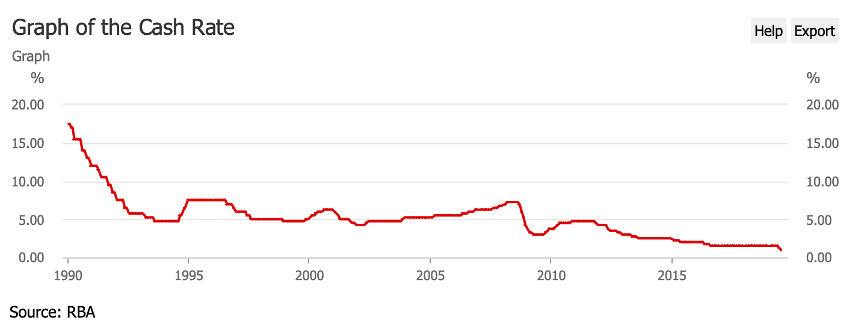
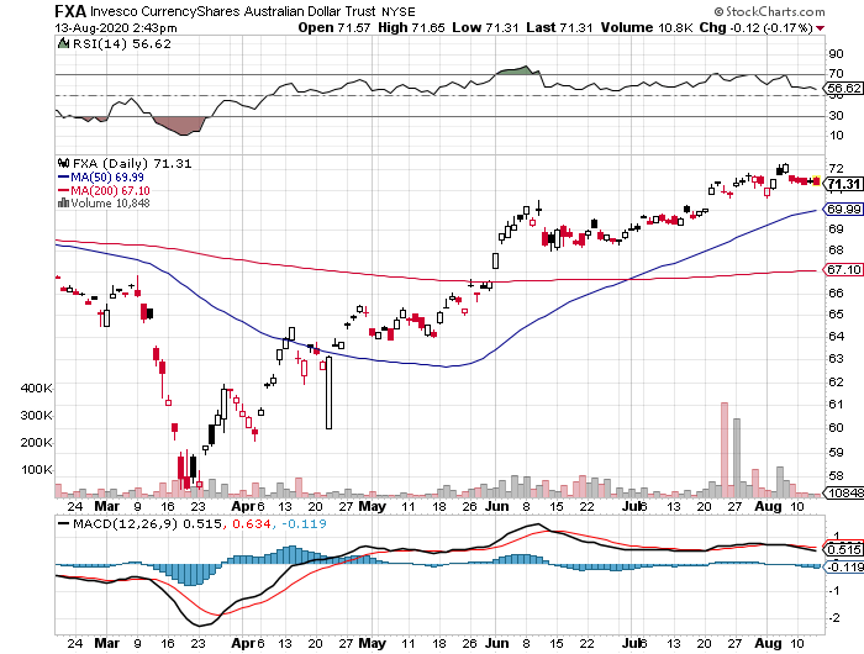
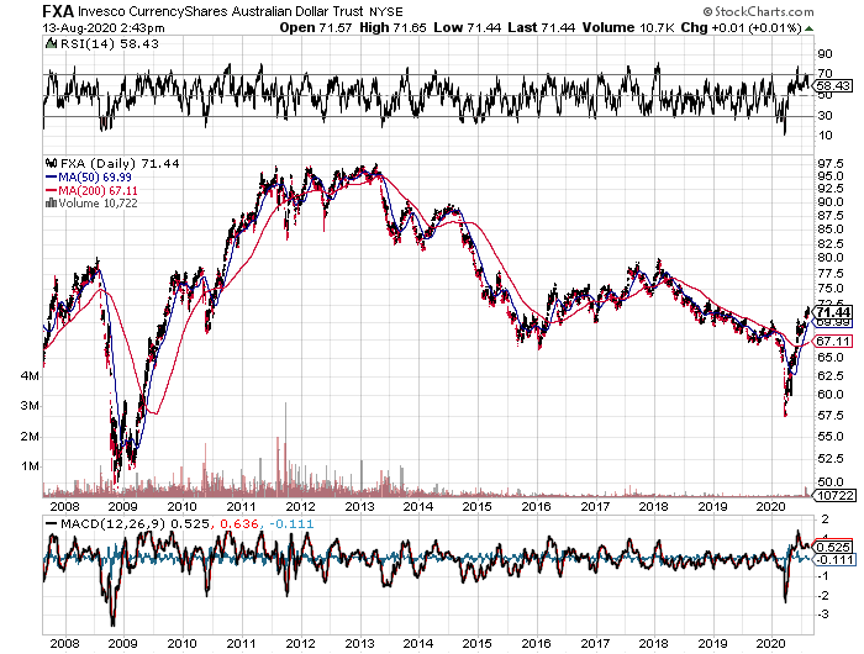
That means the greenback is about to become the weakest currency in the world. Look at the ten-year chart below and you’ll see that a major double bottom for the Aussie may be taking place.
Most American technology stocks are likely to gain 30% or more over the next two years. However, it’s entirely possible that the US dollar declines by 30% or more against the Australian (FXA) and Canadian (FXC) dollars during the same period. Making 30% and then losing 30% leaves you with precisely zero profit.
There is a way to avoid this dilemma that would vex Solomon. Simply hedge out your currency risk. I’ll use the example of the Australian dollar, as we have recently had a large influx of new subscribers from the land down under.
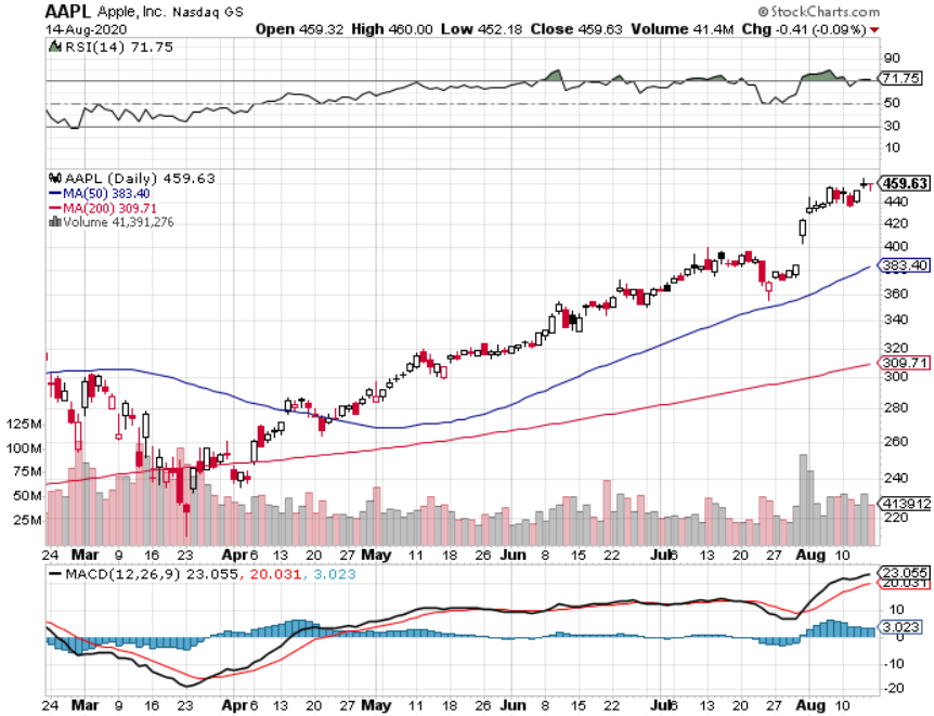
Let’s say you want to buy AUS$100,000 worth of Apple (AAPL), the world’s most widely owned stock.
Since Apple is listed on the New York Stock Exchange, its shares are denominated in US dollars. When you buy Apple in Australia, your local broker will automatically buy the US dollars for your account to settle this trade in the US, taking out a small commission along the way. You are now long US dollars, thus creating a currency risk.
Getting rid of this currency risk is quite simple. You need to offset your US dollar long with a US dollar short of equal value. Long dollars/short dollars give the Australian investor a currency-neutral position. The US dollar can go to hell in a handbasket and you won’t care.
There are several financial instruments with which you can do this. Buying Invesco Currency Shares Australian Dollar Trust ETF (FXA) is the easiest. This ETF invests 100% of its assets in long Australian dollar/short US dollar futures and overnight cash positions.
I’ll do the math for you on the final hedged position assuming that the Australian dollar is worth 70 US cents.
BUY AUS$100,000 long US dollars X US$0.70 cents/dollar = US$70,000.
US$70,000/$210 per share for Apple = 333 Apple shares
BUY US$70,000/$70 (FXA) price = US$1,000 shares of the (FXA)
Thus, by owning AUS$100,000 shares of Apple shares and 1,000 shares of the (FXA) you have completely removed the currency risk in owning Apple. You have, in effect, turned Apple into an Australian dollar-denominated stock. Apple can rise, the US dollar will fall, and you will make twice as much money in Australian dollars.
There are a few problems with this precise trade. The liquidity in the (FXA) is not great, especially during US trading hours. Understandably, the bulk of Aussie liquidity takes place during Australian business hours.
There are other instruments with which you can hedge out the currency risk of Apple, or any other US dollar-denominated investment.
You can take out your own short dollar position in the futures market. You can ask your bank to create a short position in the US dollar in the cash market. Or, you can simply ask your broker to hedge out your US dollar currency risk, for which they will charge you another small commission.
Hedging out currency risk not only is free, the market will pay you to do it. That’s because Australian dollar overnight interest rates at 1.00% are lower than US dollar overnight interest rates at 2.50%. By shorting Aussie against the buck, you get to keep this 1.50% interest differential.
You don’t have to be Australian to want your Apple shares denominated in Australian dollars. In fact, hedge funds do this all day long. They pursue a strategy of keeping their long position in the world’s strongest securities (Apple), and their shorts positions in the world’s weakest securities (the US dollar). This, by the way, is also the strategy of the Mad Hedge Fund Trader. It’s called “global long/short macro.”
The better ones often make money on both sides of the equation, with the longs rising and the shorts falling. You can do the same in your own personal online trading platform.
I should urge a word of caution here. What happens if you hedge out your US dollar risk, and the dollar continues to appreciate? Then you will get none of the gains from that appreciation and will end up losing money in Australian dollars if Apple shares remain unchanged.
In the worst case, if both Apple and the Aussie could go down, this accelerates your losses. So, currency hedging can be a double-edged sword. Yes, this may be irrational given the fundamentals of the Aussie and Apple. But as any experienced long term trader will tell you, “Markets can remain irrational longer than you can remain liquid.”
Many thanks to John Maynard Keynes.
Looks Like a Good Bet to Me
https://www.madhedgefundtrader.com/wp-content/uploads/2019/07/john-thomas-3-e1589907952307.png421450Mad Hedge Fund Traderhttps://madhedgefundtrader.com/wp-content/uploads/2019/05/cropped-mad-hedge-logo-transparent-192x192_f9578834168ba24df3eb53916a12c882.pngMad Hedge Fund Trader2020-08-18 09:02:512020-08-18 09:23:11How to Hedge Your Currency Risk
When John identifies a strategic exit point, he will send you an alert with specific trade information as to what security to sell, when to sell it, and at what price. Most often, it will be to TAKE PROFITS, but, on rare occasions, it will be to exercise a STOP LOSS at a predetermined price to adhere to strict risk management discipline.Read more
https://www.madhedgefundtrader.com/wp-content/uploads/2016/02/Alert-e1457452190575.jpg135150Mad Hedge Fund Traderhttps://madhedgefundtrader.com/wp-content/uploads/2019/05/cropped-mad-hedge-logo-transparent-192x192_f9578834168ba24df3eb53916a12c882.pngMad Hedge Fund Trader2020-08-17 10:44:372020-08-17 10:44:37Trade Alert - (FB) August 17, 2020 - SELL-TAKE PROFITS
Stay away from Chinese tech companies listed on the U.S. exchanges. I wouldn’t touch them with a 10-foot pole.
Not only are these firms unscrupulous, but the U.S. administration is specifically attacking them as a cornerstone campaign strategy as we close in on the November election.
The blitzkrieg has been increasing at a rapid clip with U.S. President Donald Trump banning social media asset TikTok and chat app WeChat.
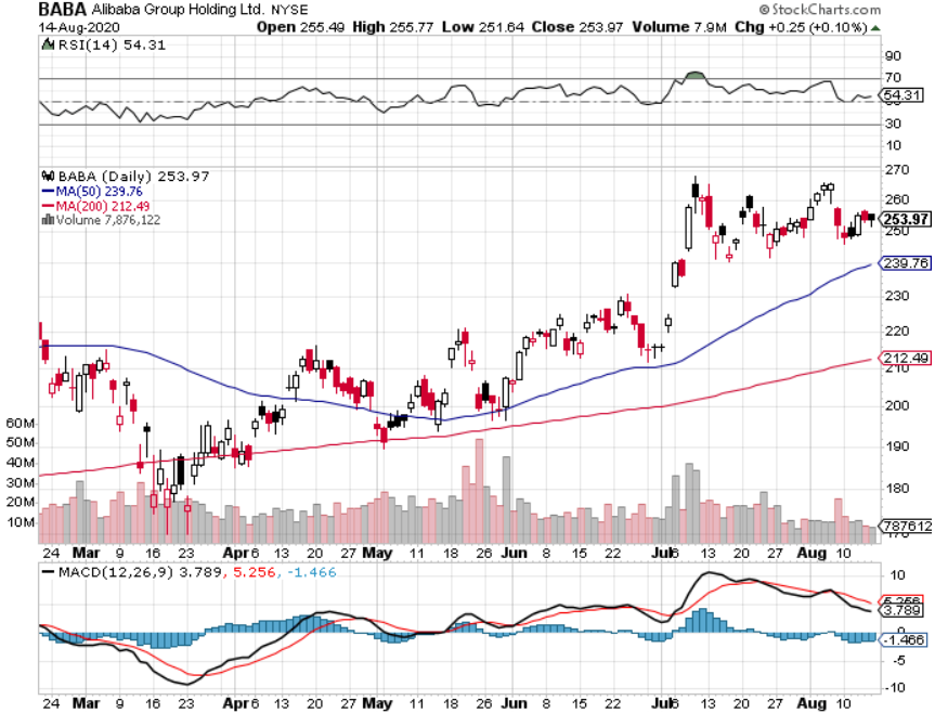
Just in the last few hours, the U.S. administration has said they are also “looking at” going after Chinese eCommerce firm Alibaba (BABA) who is the Chinese Amazon.
If the trends continue, there could be no Chinese tech companies freely extracting American revenue by this November.
Things will only get worse.
No doubt the coronavirus fiasco has exacerbated tensions between the countries with both sides dealing with a plunging economy.
The only reason we do not hear about the depths of despair going on in the Chinese economy is because the media is suppressed there.
Chinese media is tightly controlled disabling any negative news that shines an unfavorable light on the Chinese communist party.
Then there is the immoral fraud aspect of Chinese tech companies as every mainland Chinese firm wishes to go public in New York because company financials are never audited, and they are immune from any criminal liability.
This is a recipe to enable reckless Chinese management who state opaque numbers in their financials in the hope that American investors will take the bait.
Another cheater has been unearthed by Wolfpack Research who along with Muddy Waters have made it their mission to root out the bad actors.
The supposed “Netflix (NFLX) of China” Chinese streaming service iQiyi (IQ) plunged in after-hours trade in the U.S. after it announced the Securities and Exchange Commission (SEC) has launched a probe into the company.
The case revolves around iQiyi falsifying their subscription numbers which everyone knows is the key to exhibiting growth in the company.
iQiyi said the SEC is “seeking the production of certain financial and operating records dating from January 1, 2018, as well as documents related to certain acquisitions and investments that were identified in a report issued by short-seller firm Wolfpack Research in April 2020.”
Wolfpack Research has accused iQiyi of inflating 2019 revenue by around 44%.
Wolfpack also said iQiyi artificially overexaggerated expenses among other data.
The SEC probe into iQiyi comes amid rising scrutiny on U.S.-listed Chinese companies following the Luckin Coffee debacle in which they committed the same act of falsifying numbers.
This copycat crime is clearly seen as a big winner in Mainland China encouraging a slew of companies to decide on the same strategy.
The Coffee company admitted to fabricating sales numbers for 2019. The company was subsequently delisted from the Nasdaq in June.
China and its tech firms are one of the few bipartisan issues with strong support from both sides of the aisle and I can only see the temperature in the kitchen getting hotter.
The side effect of purging the Chinese tech out of the U.S. is that it bolsters the investor case for American tech.
Not that they needed help in the first place.
If the government won’t allow foreign companies to compete with Silicon Valley, then the monopolies built by the likes of Apple (AAPL), Facebook (FB), Google (GOOGL), and Amazon (AMZN) will feel protected because of the government effectively widening their moats.
One might argue that the crimes these American companies have committed are just as bad as the Chinese firms, but they get a free pass for being American.
Remember this is the age of de-globalization with national governments protecting national companies and not the other way around.
Silicon Valley companies have tried to pervert the U.S. employment situation by maneuvering around U.S. nationals by applying for the foreign HB-1 visas in droves and underpaying mostly Chinese and Indian nationals to work for the likes of Google and Facebook.
We can’t say these Silicon Valley companies are saints. They certainly are not, but that doesn’t matter in today’s climate when government, billionaires, and tech moguls are assumed as scum from the get-go.
Then there is the personal data issue that can’t be said to be much better than what the Chinese companies are doing.
The double standard is not surprising, and a heavy dose of politics has been injected into the global tech ecosphere to the detriment of cross border trade.
In the fog of war, this is why I have largely focused on U.S. software companies with subscription revenue because it offers more visibility than an unstable revenue model like Uber or Lyft.
In any case, nobody can blame the U.S. government for going this route since, after all, Facebook, Google, Amazon, and Netflix are all banned in China as well.
You don’t see U.S. tech companies trading on the Shenzhen tech index for a reason and after this monster run-up from the March nadir, it’s obvious why Chinese tech firms want to keep that funnel to U.S. investor capital clear.
This series of events that effectively coddles American big tech will insulate them from any real share weakness. The trend is your friend and I am bullish on American big tech.
https://madhedgefundtrader.com/wp-content/uploads/2019/05/cropped-mad-hedge-logo-transparent-192x192_f9578834168ba24df3eb53916a12c882.png00Mad Hedge Fund Traderhttps://madhedgefundtrader.com/wp-content/uploads/2019/05/cropped-mad-hedge-logo-transparent-192x192_f9578834168ba24df3eb53916a12c882.pngMad Hedge Fund Trader2020-08-17 10:02:352020-08-19 19:57:23U.S. Stymies the Advancement of Foreign Bad Actors
Legal Disclaimer
There is a very high degree of risk involved in trading. Past results are not indicative of future returns. MadHedgeFundTrader.com and all individuals affiliated with this site assume no responsibilities for your trading and investment results. The indicators, strategies, columns, articles and all other features are for educational purposes only and should not be construed as investment advice. Information for futures trading observations are obtained from sources believed to be reliable, but we do not warrant its completeness or accuracy, or warrant any results from the use of the information. Your use of the trading observations is entirely at your own risk and it is your sole responsibility to evaluate the accuracy, completeness and usefulness of the information. You must assess the risk of any trade with your broker and make your own independent decisions regarding any securities mentioned herein. Affiliates of MadHedgeFundTrader.com may have a position or effect transactions in the securities described herein (or options thereon) and/or otherwise employ trading strategies that may be consistent or inconsistent with the provided strategies.