Global Market Comments
May 27, 2020
Fiat Lux
Featured Trade:
(JOIN THE JUNE 4 TRADERS & INVESTORS SUMMIT),
(IT’S NOT YOU FATHER’S MARINE CORPS)

Global Market Comments
May 27, 2020
Fiat Lux
Featured Trade:
(JOIN THE JUNE 4 TRADERS & INVESTORS SUMMIT),
(IT’S NOT YOU FATHER’S MARINE CORPS)

This being the week for Memorial Day, I think I will be forgiven for posting one more military piece.
Most Americans don’t know that the US Marine Corps is the oldest government institution in the United States. It was founded at Tun Tavern on Water Street in Philadelphia on November 10, 1775, nearly eight months before the establishment of the country itself on July 4, 1776.
Their original mission was to act as snipers from the top of ships’ masts against British ships, engage in hand-to-hand combat when boarding the enemy, and preventing mutinies by press-ganged crews. It was truly a different age.
Having been involved with the USMC for nearly 50 years in many forms, following in the footsteps of my father in WWII and my grandfather in WWI, I can tell you than many Marines have not strayed far from a bar since.
During the past 245 years, the Marine Corps has built a storied reputation as an elite force of shock troops which will fight anywhere at any time. They literally went into battle from the “shores of Montezuma to the shores of Tripoli”, according to the Marine Corps Hymn.
Over the past century, my own family has served at Belleau Wood, France, where the Germans gave them their nickname, the “Devil Dogs.” Dad was at Guadalcanal, Bougainville, Samoa, and New Zealand.
My own contribution included Cambodia, Guam, Japan, Thailand, Burma, Laos, Croatia, Serbia, Iraq, Kuwait, Saudi Arabia, and most recently, Guadalcanal. We have a family footlocker of war souvenirs to die for. Yes, three months ago I was digging out Japanese bullets fired at dad from his foxhole at the base of Hill 27 (click here for the link).
Now, for the first time in nearly three centuries, the Corps is undergoing radical change. Since 1990, it has been primarily engaged in desert warfare in the Middle East, far from its naval roots. Now that the US has largely withdrawn from this part of the world, it is remaking itself to meet future challenges. In short, it is going back to sea.
In 2018, the Pentagon engaged in a ground-up rethink of its mission. It concluded that “great power competition with China and Russia” would become its primary mission. The consequences are earth-shaking for both the USMC and the country as a whole.
The emergence of high-precision Chinese long-range missiles has rendered an American WWII style dominance of the Western Pacific by our ten aircraft carriers obsolete. These massive, majestic ships manned by 5,000 men each have become white elephants and liabilities in future warfare.
They will be replaced by fast-moving commando-type companies of 50-150 Marines moving atoll to island and bottling up the Chinese Navy with high tech drones, rockets, and anti-ship missiles. The traditional 12-man rifle company platoon is gone. The costly carriers will be reduced to safer support roles thousands of miles at sea.
The implications for the USMC are far-reaching. General David H. Berger, the gentleman who sent me to Guadalcanal, has proposed cutting the Corps from 186,000 to 170,000 men. He will eliminate most artillery, all tanks, and cut the number of F-35 fighters by 30%. The new structure would be designed to work anywhere in the world at a moment’s notice. You can never predict the next crisis, so you have to prepared for all contingencies.
During my reserve days, I once commanded a Marine tank battalion on maneuvers. The indestructible M-1 Abrams tanks were powered by turbine engines, possessed a faultless laser sighting system, and drove like a Cadillac right of the assembly line over the cruelest desert terrain.
But at 50 tons each, they are hard to move around in a hurry. During Desert Shield and Desert Storm, we had to enlist a coal-fired WWII mothball fleet to get them to Saudi Arabia and even that took six months.
As for the 155 mm howitzer, they have been outmoded since WWII. All-weather Boeing AH64D Apache Longbow helicopters are far more mobile and effective and can refuel air to air. But every weapons system breeds its own constituency. Everyone agrees with me except artillerymen.
In the end, it will be politics that determines the future of the Marine Corps. Constancies fight bitterly to hold on to antiquated weapons system to preserve jobs. I remember that during Desert Storm, a Florida congressman fought tooth and nail to keep a massive Humvee contract even though with no armor, they were helpless against IEDs. Hundreds of Marines died as a result.
The same will be true for M1 tanks built in Ohio, the F-35 Lightning II manufactured in Texas, and nuclear-powered aircraft carriers in Virginia.
Notice these are all battleground states in this election. How you vote may determine where I next serve. So, vote carefully.
To participate in the discussion of our future national defense, please click here.
Semper Fidelis.


“By the time you spot a bandwagon, it is too late to get on,” said Sir Martin Franklin, co-chairman of the APi Group.

Today, I would like to make a suggestion on a stock that appears to be ready to bounce.
The stock is Citrix Systems, Inc. (CTXS).
I am going to suggest a debit spread, but I will suggest using short-dated options.
Here is the trade:
Buy to Open July 12th - $138.00 call @ $3.40
Sell to Open July 12th - $142.00 call @ $2.05
The net debit will be $1.35 per spread, with a maximum gain of $2.65 per spread.
Based on the nominal portfolio, limit the trade to 6 spreads or about .8% of the portfolio.
I am suggesting you limit the buy in to less than 1% of the nominal portfolio because the expiration date is only two and one-half weeks away.
Mad Hedge Biotech & Healthcare Letter
May 26, 2020
Fiat Lux
Featured Trade:
(WHY SORRENTO THERAPEUTICS WENT NUTS)
(SRNE), (REGN), (LLY)
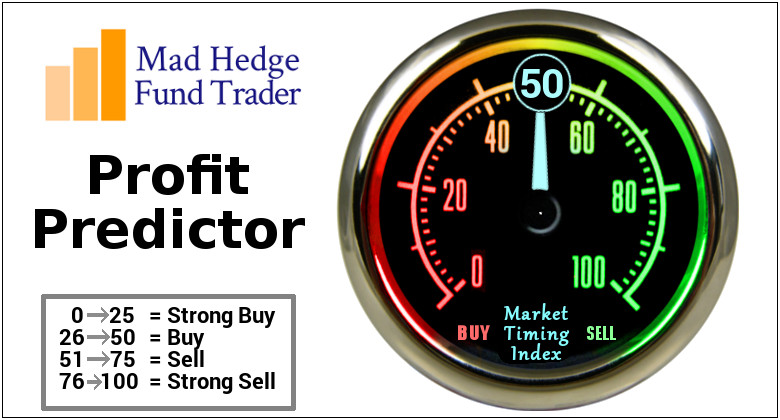

Eyes were popping when Sorrento Therapeutics (SRNE) shares went ballistic in mid-May. The price shot up from $2.62 per share to $9.96 in a single day, a gain of 380%. Unfortunately, Sorrento’s climb was halted just as fast when the stock sank 11.5% two days after.
From the look of it, investors eventually sobered up after the initial excitement and realized that the announcement on Sorrento’s pre-clinical results promised too much too soon for a Covid-19 vaccine.
What does this mean for this company?
This rollercoaster situation is par for the course when it comes to small biotechnology companies such as Sorrento, which has a market capitalization of only $1.15 billion.
Extreme volatility is commonplace, with investors getting all riled up the moment a bit of positive news gets out only to balk the moment they fully digest the nitty-gritty of the announcement.
Get used to it. It is a new factor in the market that is roiling prices daily.
Before I discuss Sorrento’s merits and downsides further, here’s a brief background on the good news that got everyone all excited in May.
As you must have guessed by now, the company’s announcement centered on the coronavirus disease (COVID-19).
According to Sorrento, they have hit upon an “exceptionally potent antibody” for this deadly disease. The experimental “cure” is currently dubbed STI-1499.
The breakthrough hit the airwaves after Sorrento’s CEO contacted a Fox News reporter to discuss their discovery, with the executive saying that they have “a solution that works 100%.”
The company is working with Mount Sinai Health System to assess whether STI-1499 can function as a stand-alone therapy as well as a component of an antibody cocktail designed to fight off the SARS-CoV-2 virus, which causes COVID-19.
STI-1499 works by blocking the virus from attaching itself to the body, thereby effectively protecting the cells from infection.
Needless to say, the success of this antibody means big bucks for Sorrento.
It’s critical to bear in mind that results from tests conducted via test tubes and Petri dishes do not guarantee success when applied to human clinical trials -- and this is exactly the problem with Sorrento’s recent results. Cancer has been cured in rates over 100 times.
The STI-1499 trial results were all collected from lab tests. Sorrento has yet to advance to the early-stage clinical study phase. This means that the experimental vaccine is from a slam dunk at this point.
Simply put, STI-1499 has yet to be tested on living things like a mouse and then of course, on humans.
If history is any indication, then Sorrento should be prepared to handle questions about STI-1499’s efficacy. After all, less than 1 in every 5 experimental drugs designed for infectious diseases actually receives FDA approval.
To make things even more challenging for Sorrento, the company isn’t alone in thinking that an antibody regimen could be used against COVID-19.
Prior to this announcement, news has already broken out that Eli Lilly (LLY) and Regeneron Pharmaceuticals (REGN) are also studying similar kinds of approach for this disease.
Beyond its COVID-19 efforts, Sorrento only has one approved product: topical medication ZTlido. This drug, commercially released in 2018, is used to ease the pain brought about by shingles.
Since its launch, ZTlido hasn’t turned out to be a big moneymaker for Sorrento. In the first quarter, this treatment has raked in only $5.2 million in revenue.
Looking at the company’s recent earnings report, it’s clear that Sorrento has been spending more than it’s making so far.
In the first quarter of 2020 alone, the biotechnology company reported $69.2 million in net loss.
Compounding this situation is Sorrento’s fast-depleting cash to fund its operations, with the drugmaker posting a total of $21.9 million in cash and cash equivalents in the year’s first quarter.
Without coming up with more ways to generate additional capital, Sorrento doesn’t have enough bandwidth to keep the lights on any longer much less fund an aggressive coronavirus program.
As for its pipeline, the biotechnology company has two experimental oncology drugs ready for Phase 2 of their clinical trials. Sorrento also has a number of early-stage studies focusing on cancer and pain.
With all these in mind, the question remains: Is Sorrento stock worth buying today?
Although it can be tempting, exhilarating even, to run after a high-flying biotechnology stock plastered all over the news, the wise move would arguably be to restrain yourself and stay on the sidelines -- for now.
If STI-1499 fails in the clinical trials, then all of Sorrento’s gains would be wiped out instantaneously.
What I know so far in terms of the company’s plans to raise more funds is that a public offering might happen soon. If that happens, then the value of the existing Sorrento shares will be diluted.
So if you’re confident to take this gamble of either losing half your money or making it multiple times your initial investment, then this might just be your cup of tea.
However, I can see too many unknown variables for Sorrento to be a compelling stock to buy at the moment.
While Sorrento looks to be offering promising products and is on its way to fueling growth through capital fundraising methods, I have doubts on its ability to cash in big on COVID-19.
One reason is that I find the company’s timing a bit off. On top of that, I’m also not convinced on their capacity to execute particularly in terms of manufacturing.
Most importantly, Sorrento’s is not even considered as the frontrunner in the COVID-19 vaccine race.
I would prefer to wait and see how STI-1499 performs in at least two more stages of clinical trials.
At the very least, these studies would be able to give us a hint at how safe and effective the experimental vaccine is. Right now, I think there are a number of other biotechnology stocks that can provide more reasonable and even attractive risk-reward propositions.
While the Diary of a Mad Hedge Fund Trader focuses on investment over a one week to a six-month time frame, Mad Day Trader, provided by Bill Davis, will exploit money-making opportunities over a brief ten minute to three-day window. It is ideally suited for day traders, but can also be used by long-term investors to improve market timing for entry and exit points. Read more
Global Market Comments
May 26, 2020
Fiat Lux
Featured Trade:
(MARKET OUTLOOK FOR THE WEEK AHEAD, or LOOKING FOR THE NEW AMERICA),
(FB), (AAPL), (NFLX), (GOOGL), (MSFT), (TSLA), (VIX)
We are getting some tantalizing tastes of the new America that will soon arise from the wreckage of the pandemic.
Companies are evolving their business models at an astonishing rate, digitizing what’s left and abandoning the rest, and taking a meat cleaver to costs.
The corporate America that makes it through to the other side of the Great Depression will earn far more money on far fewer sales. That has been the pattern of every recession for the past 100 years.
While the pandemic may take earnings down from $162 per S&P 500 share in 2019 to only $50 in 2020, it sets up a run at a staggering $500 a share during the coming Roaring Twenties and Golden Age. All surprises will be to the upside and anything you touch will make you look like a genius.
For example, Target’s online sales have exploded 153%, allowing customers to order their groceries online and pick them up at curbside. (TGT) pulled this off in a mere three weeks. Without a pandemic, it would have taken three years to implement such a radical idea, if ever.
Survival is a great motivator.
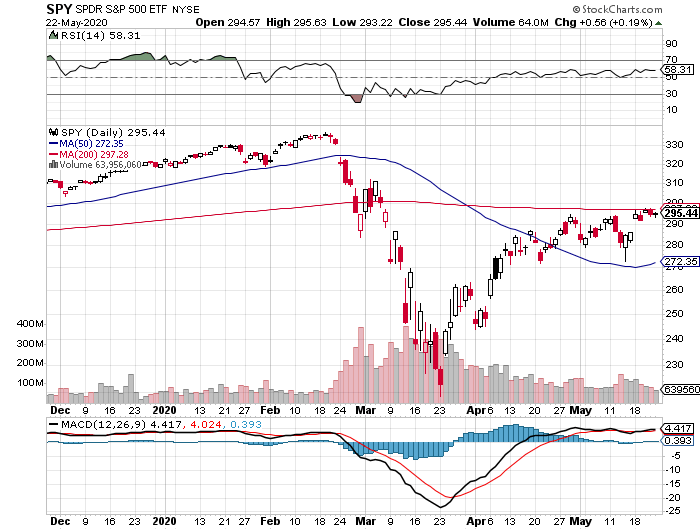
The (SPY) has been greatly exaggerating the public’s understanding of the stock market. Five FANGs and Tesla (TSLA) with 50%-200% moves off the bottom have made the index look irrationally strong.
The fact is that the majority who have shares have not even made a 50% retracement of this year’s losses. A lot of stocks, especially the reopening ones, are still crawling back of subterranean bottoms.
Investors now have the choice of chasing wildly expensive stocks that have already had spectacular runs, or cheap ones that will go bankrupt by the end of the year. It is a Hobson’s choice for the ages. I expect 10% of the S&P 500 to go under by the end of 2020.
I am spending a lot of time on the ground talking to businesses in California and Nevada and have come to two conclusions. They cannot fathom the true depth of the Depression we are now in and are greatly underestimating the length of time it may take to recover. We may not see the headline unemployment rate under 10% for years unless the government redefines the statistics, which they always do.
The S&P 500 is not the economy. It only employs 25% of America’s private sector labor force accounting for 20% of its total costs. Real estate accounts for another 15%. That leaves 35% of costs that can be completely eliminated or reengineered. This creates enormous share price upside possibilities.
The concentration of the market is the most extreme I have ever seen, with five stocks getting most of the action, (FB), (AAPL), (NFLX), (GOOGL), and (MSFT).
There is a staggering $3.6 trillion in equity allocations sitting on the sidelines in cash. All those who got out at the March bottom are now desperately trying to get back in at the May top. Algorithms are making sure you get out cheap and get back expensive.
It will all end in tears.
One of the stunning developments of the crash has been the near doubling of retail stock trading. Options trading has increased even more. Millions of stimulus check recipients have poured their newfound wealth into the stock market instead of spending it on consumer goods, like they were supposed to.
This explains the over-concentration on the five FANG stocks, (FB), (AAPL), (NFLX), (GOOGL), and (MSFT), the greatest momentum stocks are out age, but in high speculative ones like Tesla (TSLA). The lowest cost online platforms like Robin Hood (click here).
All of this is completely irrevocably changing the character of the stock market, perhaps permanently. This may also explain why the Volatility Index remains stuck above$26.
Fed Governor Jerome Powell said no recovery without vaccine, and that’s without a second wave. It could be a long wait. In the meantime, the Atlanta Fed said Q2 US GDP will be down -42%, the weakest quarter in American history. We find out mid-July.
Housing Starts collapsed by 30.2% in April, in the sharpest drop on record. But prices aren’t falling. There is still a massive bid under the market from still-employed millennials. Your home could be you best performing asset this year. The 30-year fixed rate mortgage at 3.0% is a big help.
Weekly Jobless Claims topped 2.4 million, taking the two-month total to a breathtaking 39 million. One out of four Americans is now unemployed, matching the Great Depression peak. US deaths just topped 98,000, 21 times China’s fatality rate where the disease originated and with four times our population. People will keep losing jobs until the death rate peaks, which could be many months, or years.
Leading Economic Indicators crashed by 4.4% for April, showing the economy is still in free fall. So, how much more stock do you want to buy here?
Up to 60% of mall tenants aren’t paying rent, with $7.4 billion skipped in April alone. See my earlier “Death of the Mall” piece. It’s another harsh example of the epidemic accelerating all existing trends.
The market is not reflecting the long-term damage to the economy, says my old buddy and Morgan Stanley colleague David Gerstenhaber. When the bailouts run out, the economy could go into free fall. It could take years to get below 10% unemployment rate again, as many of the layoffs and furloughs are permanent. Keep positions small. Anything could happen. I spent the 1987 crash with David.
Existing Home Sales cratered an incredible 17.8% in April to an annualized 4.88 million units, the largest one-month drop since 2010. Inventory dropped to an all-time low of only 1.7 million, down 19.7%, presenting a 4.1-month supply. Sellers failed to list and those who had a home took them off. Unbelievably, this pushed median home prices to a new all-time high of 286,000, up 7.4% YOY. The biggest sales fall in the west, where the US epidemic started.
China took over Hong Kong, suspending most civil liberties in response to Trump’s multiple attacks. And you know what? There is nothing we can do about it that hasn’t already been done. Talk about going into battle with no dry powder. I’m sure the US 7th Fleet will be out there soon to provoke an attack. Anything to distract attention from the 100,000 Americans who died from Covid-19 on Trump’s watch. As if markets didn’t already have enough to worry about.
When we come out on the other side of this, we will be perfectly poised to launch into my new American Golden Age, or the next Roaring Twenties. With interest rates at zero, oil at $0 a barrel, and many stocks down by three quarters, there will be no reason not to. The Dow Average will rise by 400% or more in the coming decade.
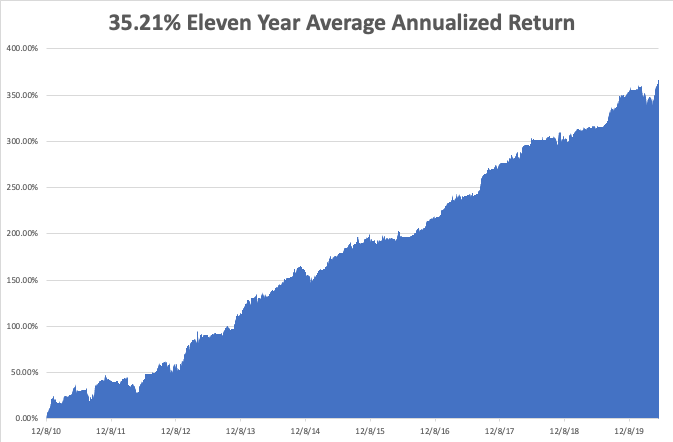
My Global Trading Dispatch performance had another fabulous week, up an awesome +4.97%, and blasting us up to a new eleven-year all-time high of 77%. It has been one of the most heroic performance comebacks of all time.
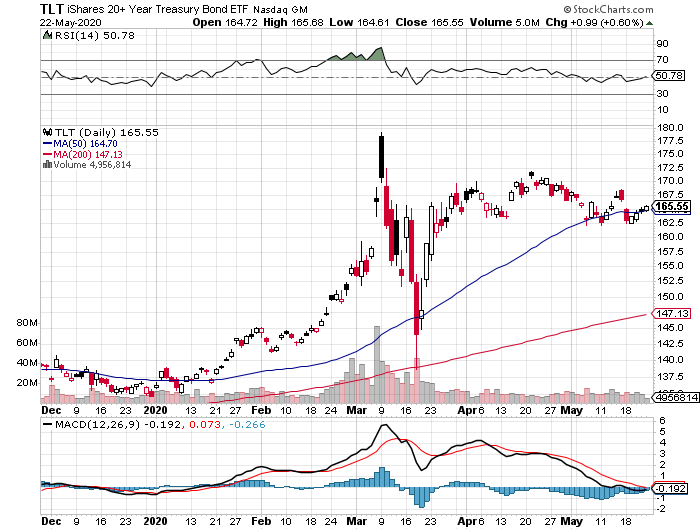
My aggressive short bond positions really delivered some nice profits, despite the fact the bond market went almost nowhere. That’s because time decay for the June 19 expiration is really starting to kick in. I also got away with a small long in the bond market for the second time in two weeks.
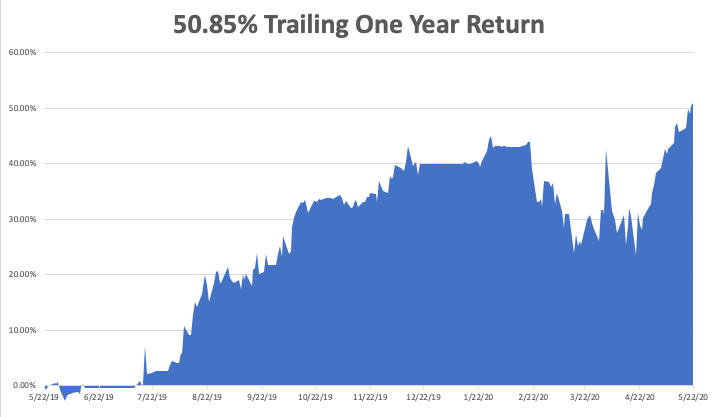
That takes my 2020 YTD return up to +10.86%. That compares to a loss for the Dow Average of -12.6%. My trailing one-year return exploded to 50.85%, nearly an all-time high. My eleven-year average annualized profit exploded to +35.21%.
The only numbers that count for the market are the number of US Coronavirus cases and deaths, which you can find here at https://coronavirus.jhu.edu.
On Monday, May 25, I’ll be leading the neighborhood veterans parade for Memorial Day. Markets are closed.
On Tuesday, May 26 at 9:00 AM, the S&P Case Shiller National Home Price Index is released.
On Wednesday, May 27, at 4:30 PM, weekly EIA Crude Oil Stocks are published.
On Thursday, May 28 at 8:30 AM, Weekly Jobless Claims are announced. We also get the second estimate for the Q1 GDP is printed. At 10:00 AM, April Pending Home Sales are announced.
On Friday, May 29, at 2:00 PM, the Baker Hughes Rig Count follows at 2:00 PM.
As for me, I will be hitting the town beaches at Lake Tahoe for the first time this spring, mask in hand, where waitresses serve you mixed drinks on order. Outdoors will be the only safe place this year.
Stay healthy.
John Thomas
CEO & Publisher
The Diary of a Mad Hedge Fund Trader

With the short week coming up next week, I would like to make a suggestion on a weekly covered call.
The stock is Mosiac Co. (MOS).
As I write this, MOS is trading around $11.52.
My suggestion is to buy MOS at the market.
Then Sell to Open (1) May 29th - $12 call for every 100 shares you buy.
You should be able to sell them for $.25.
If these calls are assigned next Friday, the return will be 6.3% for one week.
Based on the nominal portfolio, limit the stock buy in to 500 shares or 5.7% of the portfolio.
Assuming you buy 500 shares, you will sell 5 of the May 29th - $12 calls.