Mad Hedge Technology Letter
January 21, 2022
Fiat Lux
Featured Trade:
(FIVE TECH STOCKS TO LAP UP AT THE BOTTOM)
(MSFT), (TSLA), (GOOGL), (AAPL), (AMZN)
Mad Hedge Technology Letter
January 21, 2022
Fiat Lux
Featured Trade:
(FIVE TECH STOCKS TO LAP UP AT THE BOTTOM)
(MSFT), (TSLA), (GOOGL), (AAPL), (AMZN)
Tech has led the way to the downside as the macro picture sours in the short term.
Valuations have come down from the nosebleed levels and now is the time to pick and choose where to allocate capital for the next leg up in tech.
Avoiding growth tech is something that should be stapled to your bedpost, loss-making companies won’t be able to compete with more established revenue models.
You don’t want to catch a falling knife, but at the same time, diligently prepare yourself to buy the best discounts of the year.
Here are the names of five of the best stocks to slip into your portfolio in no particular order when we find a bottom.
Remember, tech ALWAYS comes back.
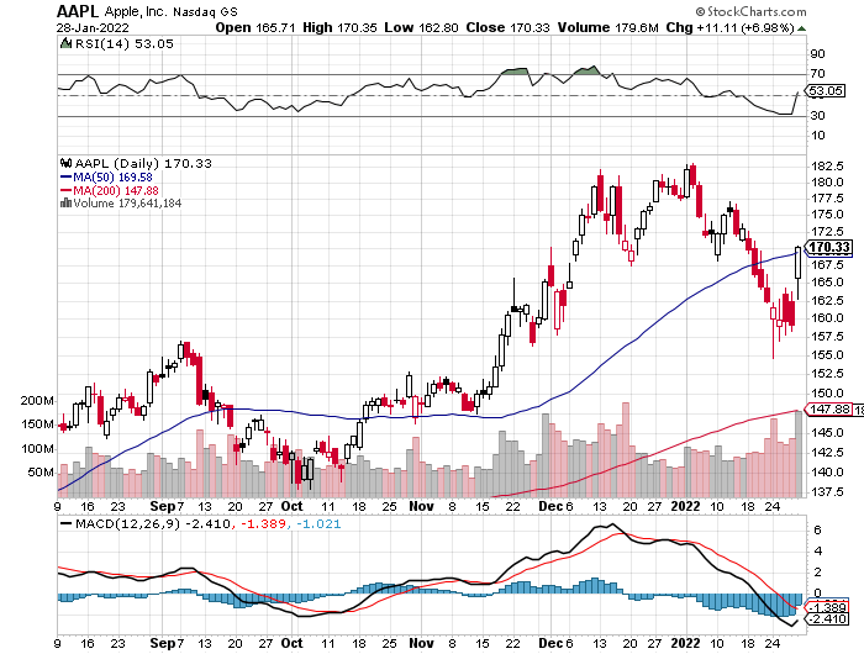
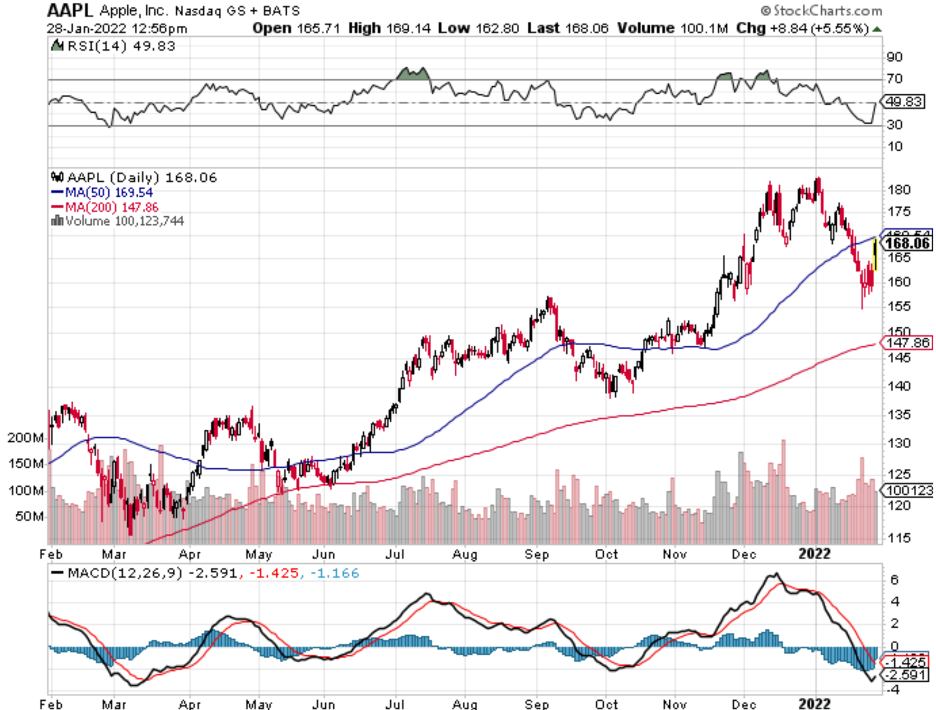
Apple
Steve Job’s creation is weathering the gale-force storm quite well. Apple has been on a tear reconfirming its smooth pivot to a software service tilted tech company. The timing is perfect as China has enhanced its smartphone technology by leaps and bounds.
Even though China cannot produce the top-notch quality phones that Apple can, they have caught up to the point local Chinese are reasonably content with its functionality.
That hasn’t stopped Apple from vigorously growing revenue in greater China 20% YOY during a feverishly testy political climate that has their supply chain in Beijing’s crosshairs.
The pivot is picking up steam and Apple’s revenue will morph into a software company with software and services eventually contributing 25% to total revenue.
They aren’t just an iPhone company anymore. Apple has led the charge with stock buybacks and will gobble up a total of $200 billion in shares by the end of 2021. Get into this stock while you can, as entry points are few and far between.
Oh, and their 5G phone is selling like hotcakes. Some one billion need to be replaced to bring consumers into the new high speed 5G world.
Amazon (AMZN)
This is the best company in America, hands down, and commands 5% of total American retail sales or 49% of American e-commerce sales. The pandemic has vastly accelerated the growth of their business.
It became the second company to eclipse a market capitalization of over $1 trillion. Its Amazon Web Services (AWS) cloud business pioneered the cloud industry and had an almost 10-year head start to craft it into its cash cow. Amazon has branched off into many other businesses since then, oozing innovation, and is a one-stop wrecking ball.
The newest direction is the smart home where they seek to place every single smart product around the Amazon Echo, the smart speaker sitting nicely inside your house. A smart doorbell was the first step along with recently investing in a pre-fab house start-up aimed at building smart homes.
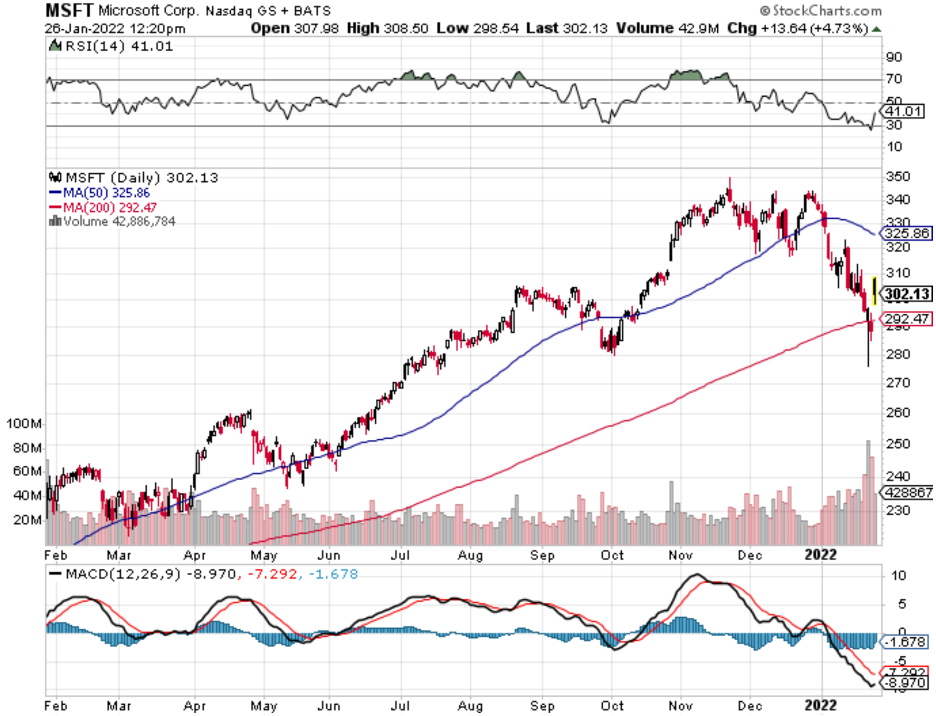
Microsoft (MSFT)
The optics in 2021 look utterly different from when Bill Gates was roaming around the corridors in the Redmond, Washington headquarter -- and that is a good thing.
Current CEO Satya Nadella has turned this former legacy company into the 2nd largest cloud competitor to Amazon and then some.
Microsoft Azure is rapidly catching up to Amazon in the cloud space because of the Amazon effect working in reverse. Companies don’t want to store proprietary data to Amazon’s server farm when they could possibly destroy them down the road. Microsoft is mainly a software company and gained the trust of many big companies, especially retailers.
Microsoft is also on the vanguard of the gaming industry and deals like the $86 billion purchase of Activision (ATVI) mean that it will be difficult for another company to loosen MSFTs stranglehold at the top of the gaming ladder.
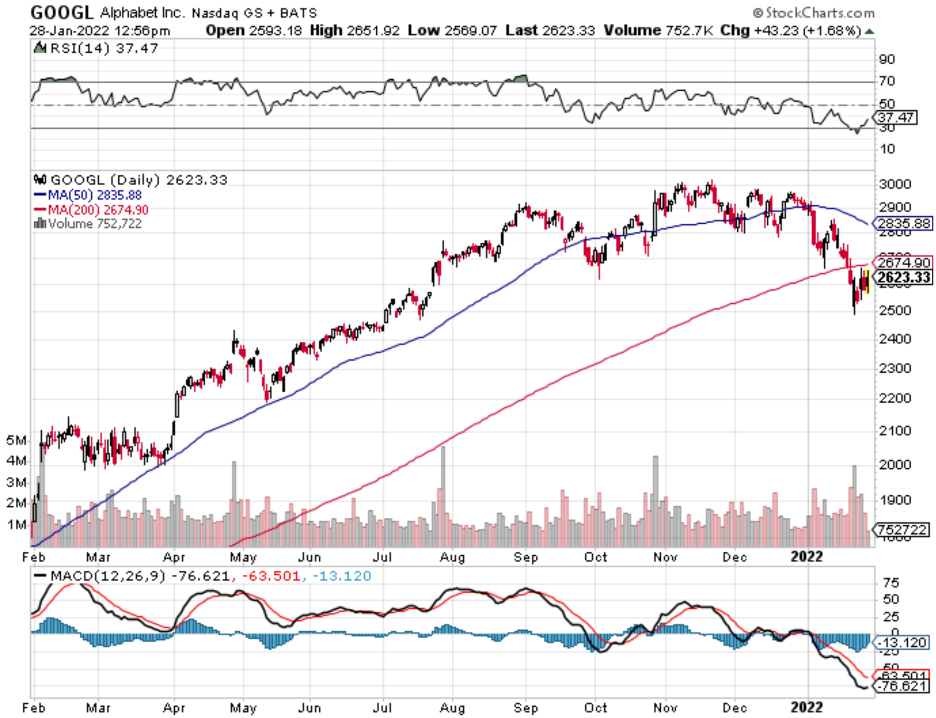
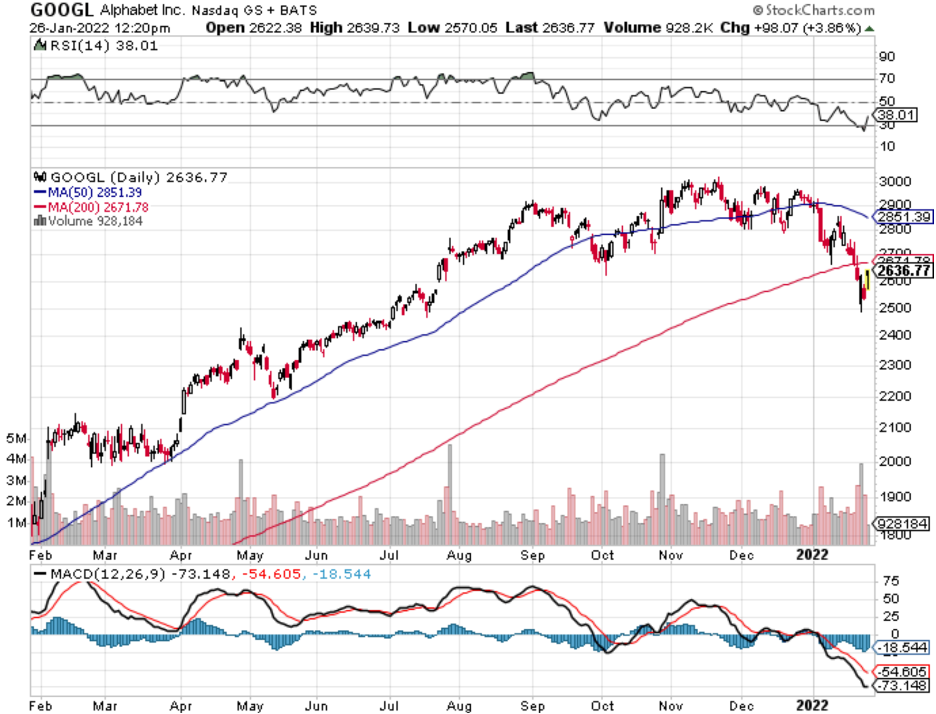
Alphabet (GOOGL)
Alphabet and Facebook boast a strong duopoly of ad technology. Alphabet generated 80% of its revenue from Google's advertising services in 2020. Google's non-advertising businesses (including subscriptions and hardware) accounted for 12%, while another 7% came from Google Cloud.
Alphabet's total revenue rose 13% in 2020, even as the pandemic throttled the growth of Google's advertising business in the first half of the year. The growth of Google Cloud throughout the year also cushioned that blow.
Google's advertising business recovered in the second half of the year, and Alphabet's operating margin expanded from 21% in 2019 to 23% in 2020. Its diluted earnings per share (EPS) also grew 19%.
In the first nine months of 2021, Alphabet's revenue rose 45% year over year as Google's advertising and cloud business grew in tandem.
Its array of different businesses like LinkedIn, YouTube, and Google Maps means this revenue pipeline is as fertile as can be.
Google’s robust balance sheet will protect itself from any downtrend in business that they might ever suffer.
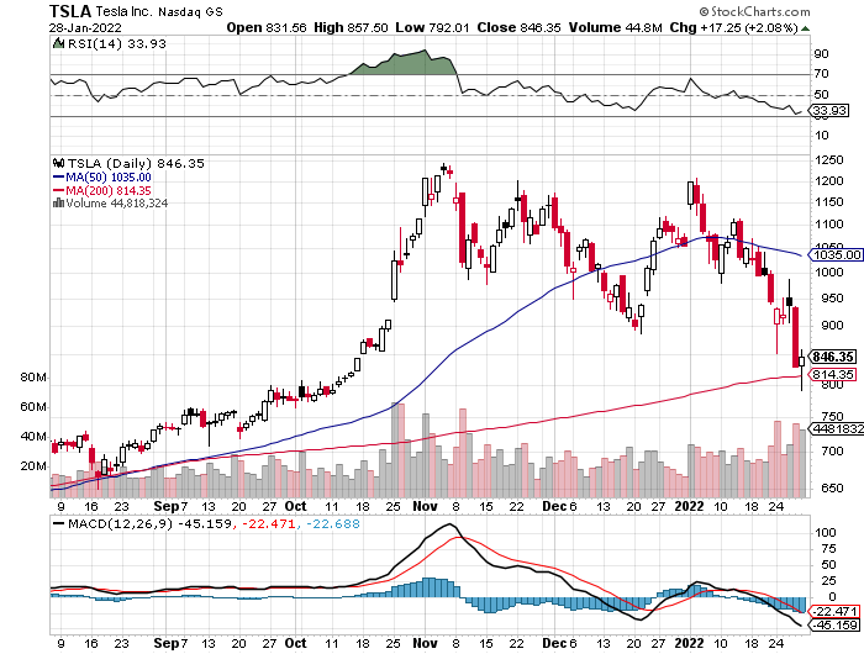
Tesla (TSLA)
The influential EV leader has really surged ahead of the competition during the pandemic.
Demand for its product is off the charts as they delivered 184,800 Model 3 and Model Y cars in the first quarter, beating expectations and setting a record for Tesla.
However, the company also said it produced none of its higher-end Model S sedans or Model X SUVs for the period ending March. It delivered 2,020 older Model S sedans and Model X SUVs from inventory.
Supply chain issues are likely to remain a challenge for Tesla this year as many EV makers are having a hard time sourcing semiconductor chips.
Tesla is now aiming to produce 2,000 Model S and X vehicles per week later this year.
The company said Monday it expects more than 50% vehicle delivery growth in 2021 overall, which implies minimum deliveries of around 750,000 vehicles this year.
This stock is a must-buy when tech reverses.
Mad Hedge Technology Letter
January 19, 2022
Fiat Lux
Featured Trade:
(MICROSOFT TAKES A GIANT LEAP FORWARD)
(MSFT), (ATVI), (PINS), (GOOGL), (AAPL), (AMZN)
CEO of Microsoft (MSFT), Satya Nadella, and his management team have made an aggressive step towards making inroads to the metaverse.
Gaming will be the launching pad to the metaverse that will first start as digital communities and later evolve into interoperable and integrated digital worlds.
The rest of the metaverse will germinate via these gaming communities and Microsoft knows that which is why they purchased Activision (ATVI) in cash for $68 billion and change.
The price was 3X higher than what they paid for LinkedIn but equally as strategic as many tech behemoths look forward to the next “big thing.”
The deal will mean MSFT will be one of the biggest gaming companies in the world just nudging out China’s Tencent and Japan’s Sony.
In the U.S., they will be by far the biggest gaming company and Nadella has made it a point of emphasis to navigate the gaming world by tapping M&A.
Remember, it was Nadella who built the MSFT cloud from scratch and Microsoft possessing its own stand-alone cloud asset dovetails nicely with their deep dive into gaming.
There are intrinsic synergies resulting from owning both.
The lack of native cloud infrastructure was a critical reason why ATVI gave up, as Chief Executive Officer Bobby Kotick said in an interview, “You look at companies like Facebook and Google and Amazon and Apple, and especially companies like Tencent — they're enormous and we realized that we needed a partner in order to be able to realize the dreams and aspirations we have,” he said.
This was the best Kotick could have wished for and I’ve mentioned this overarching trend of the best Silicon Valley companies getting stronger and now it’s even more pronounced as we are on the verge of exiting this pandemic this year.
In a higher interest rate environment, cash hoarders like Microsoft, Apple (AAPL), and Amazon (AMZN) simply have more ammunition than these smaller outfits who get penalized because of a harder route to access cheap capital making future cash flows costlier.
Now many of these smaller companies are realizing that they need to stand on their own two feet and that’s a scary thought for many CEOs who have been accustomed to tapping the capital markets to paper over the cracks.
What’s good about ATVI?
Activision owns mobile-gaming studio King, maker of Candy Crush, one of the most popular mobile games of all time.
Microsoft has almost zero presence in mobile gaming.
Nadella wants his gaming empire to facilitate direct payment like Apple’s App Store.
That’s effectively the holy grail of today’s gaming.
Microsoft has been at war with Apple and Google, over the fees the app stores charge for games.
It’s no surprise that Microsoft wants complete control over its ability to distribute games and content.
The deal also allows Microsoft an access point to secure an influential pool of gamers creating their own gaming content and worlds.
After adding Minecraft, LinkedIn, and GitHub, Nadella has been on the hunt for a game-changing asset that will drive the bottom line of MSFT via a large community of creators.
He failed to land social video service TikTok, while negotiations with Pinterest (PINS) and Discord were rebuffed.
ATVI is really a feather in the cap for Nadella, who won’t stop there and knows it’s just one battle of a greater war for tech supremacy.
These high-quality assets don’t get cheaper over time either.
Simply put, Microsoft loves subscription businesses, and gaming is among the best of them, and they are the stickiest around with recurring revenue that makes predicting future cash flows that much easier.
The ATVI pickup will raise the price of buying gaming assets across the board as I foresee a rush into these types of assets where not only can a company purchase the content, licenses, and gaming platform, but they can also add top-notch gaming developers which are equally as important as Microsoft tries to outmuscle Apple and Google.
This move is highly bullish for MSFT, so much so, that anti-trust regulators might cast a suspicious eye on this deal.
Global Market Comments
January 18, 2022
Fiat Lux
Featured Trades:
(MARKET OUTLOOK FOR THE WEEK AHEAD, or SOARING WITH THE EAGLES)
(SPY), (TLT), (MSFT), (JPM), (AAPL)
Here I am, locked up again. Another day, another pandemic. There is nothing left for me to do but think.
When I turned negative on technology stocks at the end of November, many readers protested, accusing me of high treason, sedition, perfidy, and insisted I be hung from the nearest lamppost.
After last week’s drubbing on technology stocks, those claims are fading fast.
As a math graduate from UCLA, I can tell you it’s not about incompetence, delusion, or dementia, it’s simply all about the numbers.
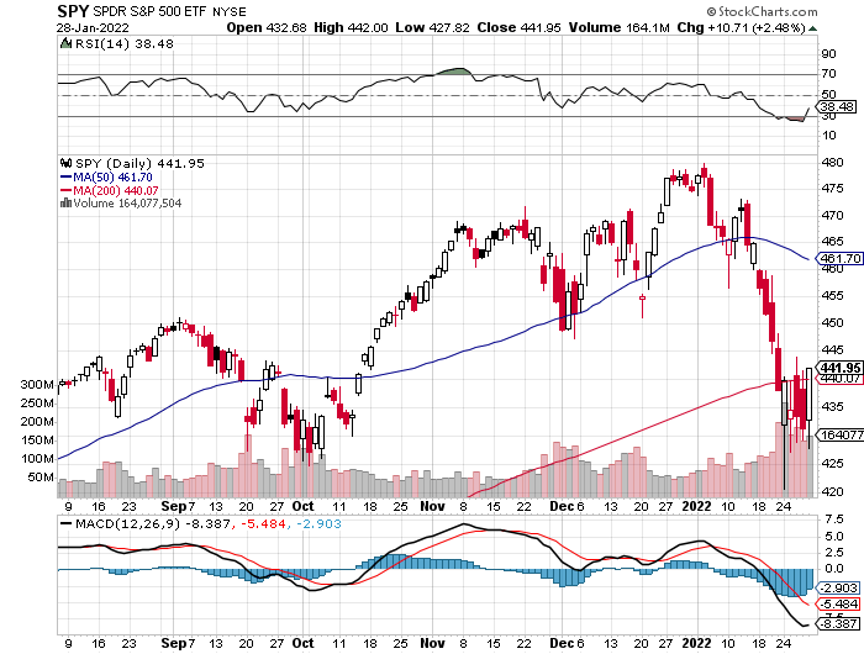
Over the last five years, the S&P 500 (SPY) rose by 2X, while NASDAQ jumped by 3X, a 50% premium to the main market.
Most of this outperformance was due to multiple expansions. As interest rates fell further and further, investors were willing to pay ever more for tech stocks. As a result, 30% of tech stocks lose money and 30% trade for a nosebleed 10X sales or more.
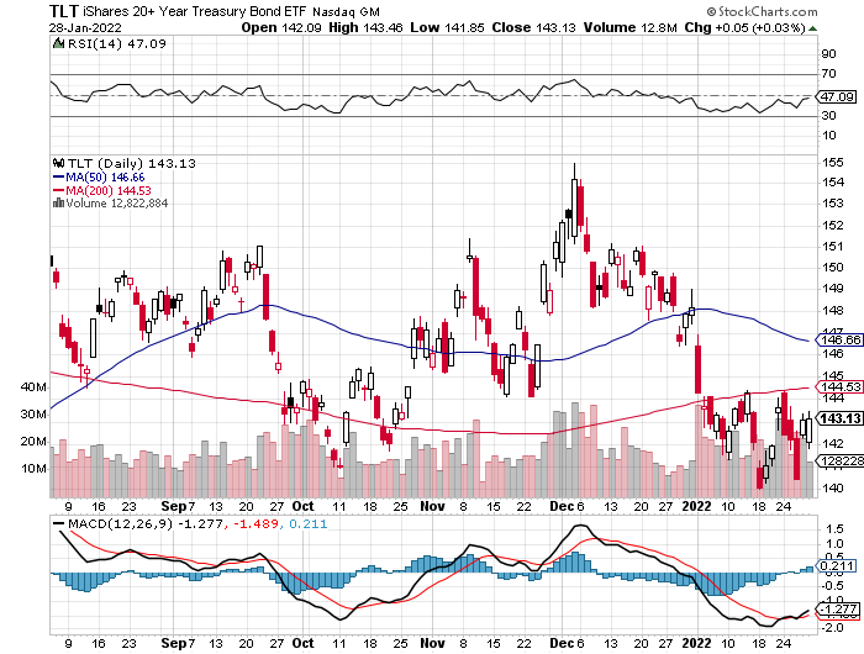
Roll the interest rate move in reverse, and the tech premium disappears in a puff of smoke. And that has been happening with a vengeance since early December, with yields on the ten-year US Treasury bond soaring an eye-popping 58 basis points, from 1.34% to 1.82%.
Tech stocks are also coming off a pandemic tailwind of hurricane force. Now that every home in the country is equipped with four home offices and the hardware and software to support them, the turbocharger is failing.
Apple (AAPL) is a perfect example. From 2015 to 2019, Steve Jobs creation grew earnings by an average of 4% a year. Then the perfect storm hit, and earnings grew by an astonishing 60% in 2021. That delivered a gobsmacking 58% gain in the share price since March.
Tech momentum is now dead. In two-thirds of the tech market, a Dotcom bust has already played out, with non-earning pandemic darlings like Peloton (PTON) and Zoom (ZM) falling by 60%-70%.
It is not, however, the end of the world (usually, the world doesn’t end). If you are a long-term investor, big (earning) tech won’t fall enough to make it worth selling out and buying back lower. Non-earning small tech has already fallen so much it's no longer worth selling down here.
Back to the numbers, me the mathematician.
It’s all about margins, which are still expanding, and will be up by another 40-basis point in 2022 for the S&P 500 as a whole. For big tech, it’s just a matter of time before earnings catch up with valuations and it's off to the races again. It will take longer for small tech, possibly a lot longer.
The Economy is the Strongest in Decades, according to JP Morgan CEO Jamie Diamond. I agree. That’s because banks prosper most early in an interest-raising cycle. The Fed could raise rates four times this year. Keep buying financials on dips.
Quantitative Tightening to Start in July, says Goldman Sachs. That’s when the Fed starts selling its vast holdings of US Treasury bonds, about $8.5 trillion worth. They will continue QT until the pain becomes too great. Four rate hikes in 2022 are in the bag. It’s not a stock market-friendly scenario.
This is Not the Year to Own Money-Losing Tech, says my friend Goldman’s David Kostin. For investors, the glass has gone from half full to half empty. The big ones will be OK but are still due for a pullback. NASDAQ price-earnings are still at a 20 year high at 38X. Rising interest rates were the stick that broke the camel’s back. Don’t buy the dip too soon.
What is the Cheapest Sector in the Market? Biotech and Healthcare, which are at valuation lows not seen since the 2009 and 2000 lows. It also has the best decade-long growth outlook after technology. The problem is that no one wants to buy them on the back nine of a global pandemic. They will rally hard….someday.
Inflation Hits 7.0%, with the Consumer Price Index hitting a 39-year high. Bonds ended a $3.00 rally and resumed a downtrend. Rents and used cars led the gains. I remember 1982 well. My first home mortgage had an 18% interest rate. Expect worse to come.
S&P 500 Profits Jump 22.4% in Q4, possibly taking the full-year figure up an incredible 49%. It makes stocks look like a bargain, which were up only 27% in 2021. Expect cooler numbers and a quieter stock market in 2022.
Wholesale Prices Soar 9.7% YOY, the most in 11 years. It augers for more interest rate hikes sooner, with overnight rates targeting 1.25% by yearend.
Weekly Jobless Claims Hit Two-Month High at 230,000. No doubt it is due to the omicron surge. A million cases a day is certainly going to make a dent in the workforce. Some people are afraid to get sick, while others know they can get away with it.
Auto Stocks Will Be Top Performers in 2022, says value legend Mario Gabelli. Dealers are extremely short of inventory and demanding more production. Used car prices are soaring. Average industry sales prices have soared from $40,000 to $45,000 in a year. Buy (F) on a dip. (TSLA) has topped out for now with the rest of the tech stocks.
Bitcoin Breaks $40,000, as the flight from all interest-bearing securities continues. Don’t buy the dip yet.
China Posts Record Trade Surplus in 2021 at $676 billion on global economic recovery. The US ran a massive deficit with the Middle Kingdom last year, which is clearly dollar negative. None of the trade deals negotiated by Trump were honored. Exports were up 21% YOY in December.
My Ten-Year View
When we come out the other side of pandemic, we will be perfectly poised to launch into my new American Golden Age, or the next Roaring Twenties. With interest rates still at zero, oil cheap, there will be no reason not to. The Dow Average will rise by 800% to 240,000 or more in the coming decade. The American coming out the other side of the pandemic will be far more efficient and profitable than the old. Dow 240,000 here we come!
With a new year at hand, it’s off to the races once again. I exploded out of the gate with a hardy 2.5% profit last week. I used fleeting rallies to sell short the S&P 500, Microsoft (MSFT), and the bond market (TLT). The Friday collapse in JP Morgan (JPM) tempted me into a long position there.
Yes, last year’s mighty 90.02% performance is a lot to top. But even the highest mountain is climbed with the first step (been there, done that).
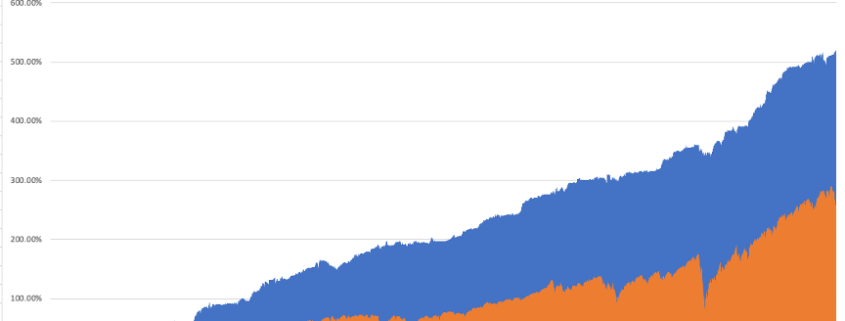
That brings my 12-year total return to a record 515.11%, some 2.00 times the S&P 500 (SPX) over the same period. My 12-year average annualized return has ratcheted up to a record 42.62%, easily the highest in the industry.
We need to keep an eye on the number of US Coronavirus cases at 66 million and rising quickly and deaths topping 851,000, which you can find here.
On Monday, January 17 markets are closed for Martin Luther King Day.
On Tuesday, January 18 at 7:00 AM, the NAHB Housing Index for January is released.
On Wednesday, January 19 at 8:30 AM, Housing Starts for December are announced.
On Thursday, January 20 at 7:00 AM, the Existing Homes Sales for December are printed. At 8:30 AM, the Weekly Jobless Claims are disclosed.
On Friday, January 21 at 2:00 PM, the Baker Hughes Oil Rig Count is out.
As for me, during the 1980s, my late wife and I embarked on a National Geographic Expedition to the remote Greek islands, including Santorini, which in those days didn’t have an airport.
At dinner, we sat at our assigned table and I noticed that the elderly gentleman next to me spoke the same unique form of High German as I. I asked his name and he replied “Adolph.”
And what did Adolph do for a living? He was a pilot. And what kind of plane did he fly?
A Messerschmitt 262, the world’s first jet fighter.
What was his last name? Galland. Adolph Galland.
I couldn’t believe my luck. Adolph Galland was the most senior Luftwaffe general to survive WWII. He was one of Germany’s top aces and is credited with 109 kills. He only survived the war because he was shot down during the final weeks and ended up in a military hospital.
And that was the end of the cruise for the rest of the table, as Galland and I spent the rest of the week discussing the finer points of aviation history.
It was made especially interesting by the fact that I had already flown most of the allied planes that Galland went up against, including the P51 Mustang and the Spitfire.
Galland started life as a Versailles Treaty glider pilot and joined the civilian airline Lufthansa in 1932. He transferred to the Luftwaffe in 1937 to fight with Franco in the Spanish Civil War and participated in the invasion of Poland in 1939.
He flew a Messerschmitt 109 as cover for German bombers during the Battle of Britain. In 1941, he was promoted to the general in charge of Germany’s fighter force until 1945 when he was sidelined due to his opposition to Goring and Hitler.
It was a fascinating opportunity for me to learn many undisclosed historical anecdotes. Germany actually had a functioning jet fighter in 1939. But Hitler, with a WWI mindset, diverted development money to twin-engine bombers and artillery.
The army eventually produced a canon that fired a monster one-meter-wide shell but was so heavy that it needed double railroad tracks to move anywhere. The canon was virtually useless in a modern war and was a colossal waste of money. Galland believed the decision cost Germany the war.
The ME 262 was a fabulous plane. But it was too little too late. Of the 1,000 produced, 500 were destroyed on the ground and most of the rest during takeoff and landing.
A big problem with the plane was that its jet engines were made out of steel and would only last ten hours. Turkish titanium needed for longer-lived engines was embargoed by the allies.
Today, a beautiful example hangs from the ceiling of the Deutsches Museum in Munich.
Galland negotiated the handover of his jet fighter wing to the Americans from a hospital bed so they could be used in an imminent war against the Russians. The atomic bomb ended that idea.
Galland was one of the few German generals never subjected to a war crimes trial. Pilots on both sides saw themselves as modern knights of the air with their own code of conduct. Parachuting pilots were never attacked and lowering your landing gear was a respected sign of surrender.
After the war, Galland emigrated to Argentina to train Juan Peron’s Air Force. He also test flew Gloster Meteor jets for the Royal Air Force. He participated in the 1972 film, The Battle of Britain and many WWII memorials. By the time I met him, his eyesight was failing. He died in 1996 at 84 of natural causes.
I give thanks to the good luck I had in meeting him, and that I had the history behind me to understand the historical figure I was sitting next to. It isn’t everyone that gets six dinners with Germany’s top fighter ace.
A year later saw me on a top-secret mission flying from Cyprus back to the American airbase at Ramstein. I plotted my course directly over Santorini.
When I approached the volcanic island, I put my Cessna 340 into a steep descent, dove straight into the mouth of the volcano, and leveled out at 100 feet above the water, no doubt terrifying the many yachts at anchor.
Greek Military Air Control gave me hell, but it was my own private way of honoring the principlals of Adolph Galland.
Stay Healthy.
John Thomas
CEO & Publisher
The Diary of a Mad Hedge Fund Trader
Global Market Comments
January 11, 2022
Fiat Lux
Featured Trades:
(THE BARBELL PLAY WITH BERKSHIRE HATHAWAY),
(BRKA), (BRKA), (BAC), (KO), (AXP), (VZ), (BK) (USB), (TLT), (AAPL), (MRK), (ABBV), (CVX), (GM), (PCC), (BNSF)
Global Market Comments
January 10, 2022
Fiat Lux
Featured Trades:
(MARKET OUTLOOK FOR THE WEEK AHEAD, or WHY I FEEL SO MUCH BETTER)
(TSLA), (AAPL)
A month ago, I was wringing my hands, pacing the floor, and tossing and turning at night. I had no idea what the stock market was going to do in 2022.
Now, I feel so much better. For while getting snowed in at Lake Tahoe for two weeks, I dove into the deep research. Slowly, the fog cleared, the clouds lifted, and everything became crystal clear.
The markets vindicating my views with a sledgehammer, I feel so much better.
A year behind schedule, the great bond market crash has begun in earnest, taking ten-year US Treasury yields up an eye-popping 45 basis points in a month. Financial stocks have caught on fire. Technology stocks are getting mercilessly dumped. Any non-yielding security, be it gold, silver, Bitcoin, or small-cap tech stocks, have been taken to the woodshed.
So what happens next? More of the same. The out-of-tech into financials trade could continue for another three to five months.
Then the Fed’s cycle of rising interest rates will take a break by summer. Financials will be super-heated and at all-time highs. Technology stocks will be below their 200-day moving averages. So you reverse the trade. Tech will lead in the second half.
All I can say is that I am really glad that I am not the Chairman of the Federal Reserve right now. If Omicron convinces Jay Powell to delay interest rate hikes, he risks inflation getting out of control. If he continues to accelerate the rate high schedule he could kill the recovery.
And here’s the 800-pound gorilla in the room that no one is talking about. What is the biggest threat to the US and the global economy? No, it’s not Covid. It isn’t inflation. It’s not even a tempestuous midterm election, which has already begun.
It’s a stock market crash. Remember that stock market crash that took the Dow Average down 40%, as we saw in March-April 2020? That is first and foremost what is in Powell’s mind.
So if we breach the 10% correction that now appears underway, Jay may quietly pull back on the rate hike throttle. The folder making the argument will be quietly lost behind the radiator at 20th street and Constitution Avenue in Washington DC, the home of the Federal Reserve.
The Fed Minutes were a bombshell, indicating a serious acceleration of interest rate hikes is in the cards this year. The Fed may flip to a net seller of Treasury bonds by the fall. Bonds sold off hard and may break to new 2-year lows. Take profits on all short-dated bond plays, with the (TLT) down $14.00 in a month. Technology got crushed, posting the worst day in 11 months. Sell all tech option plays. You can buy them back cheaper later. But keep big tech stocks. They can only go don so much with 30% earnings growth this year.
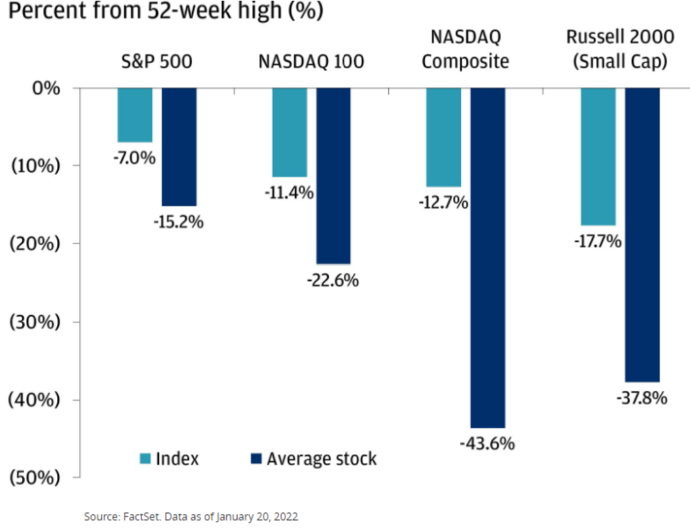
NASDAQ Stocks down 50% hits record from one-year highs. It’s a Dotcom bust echo. Traders are selling first and doing the research later. That means half of all tech stocks are in bear markets. Soaring interest rates aren’t helping.
Nonfarm Payroll Report disappoints at 199,000 in December. But the Headline Unemployment Rate plunged from 4.2% to 3.9%, approaching a new century low. The U-6 “discouraged worker” rate dropped to 7.3%. Leisure & Hospitality led at 53,000, followed by Professional & Business Service at 43,000, and Manufacturing at 26,000. The government lost 12,000 jobs. Some 650,000 people gain jobs, with self-employment surging. Once again, the data is wildly contradictory as a post-pandemic America remakes itself. Bonds and tech were crushed, financials soared.
Apartment Occupancy hits all-time high, as growing numbers are priced out of home ownership. As a result, rental rates are now rising faster than home prices. Occupancy is now at 97.5%.
Tesla delivers a record 308,600 EVs in Q4, blasting all expectations, taking them nearly to Elon Musk’s 2021 target of one million. They managed to beat all supply chain challenges. In a brilliant move, when other car makers cancelled chip orders in 2020, Tesla bought them all up. Tesla remains far and away the mass production leader in EVs, and I am maintaining my $10,000 target. In addition, Musk is done selling the stock for another year.
US Dollar clocks best year in six, up 7%, powered by rising interest rate fears that never came. The Turkish lira was the worst-performing, down 44%, thanks to government mismanagement there.
Apple tops $3 trillion market cap, the shares rising above $183, well on the way to my $250 target for 2022. The stock is getting extended short term to raise cash to buy on the next selloff. I am hanging on to my own long term holding with a split-adjusted cost basis of 25 cents.
US Home Prices soar 18% in October according to S&P Case Shiller. Phoenix (32.3%), Tampa (28.1%), and Miami (25.7%) led. 30-year fixed rate mortgages at 3.05% were a huge help.
Bitcoin gets crushed, approaching a one-year low at $40,000, and will continue to do so. Not interest-bearing instruments like gold and crypto don’t do well during rapidly rising interest rates. In the meantime, some $3.2 billion in crypto was stolen in 2021, a rise of 516% from the previous year, mostly from those who don’t know how to protect their Defi platforms with no central exchange authority.
My Ten-Year View
When we come out the other side of pandemic, we will be perfectly poised to launch into my new American Golden Age, or the next Roaring Twenties. With interest rates still at zero, oil cheap, there will be no reason not to. The Dow Average will rise by 800% to 240,000 or more in the coming decade. The American coming out the other side of the pandemic will be far more efficient and profitable than the old. Dow 240,000 here we come!
With the pandemic-driven meltdown on Friday, my December month-to-date performance bounced back hard to 11.26%. My 2021 final performance ended at 90.02%. The Dow Average was up 18.4% in 2021.
I have a 100% cash position, waiting for the ideal entry point to enter the market. With the 500-point crash today, suddenly the requests for new trade alerts have faded.
That brings my 12-year total return to 512.56%, some 2.00 times the S&P 500 (SPX) over the same period. My 12-year average annualized return has ratcheted up to 42.41% easily the highest in the industry.
We need to keep an eye on the number of US Coronavirus cases at 60 million and rising quickly and deaths going up t0 840,000, which you can find here at https://coronavirus.jhu.edu.
On Monday, January 10 at 8:00 AM, Consumer Inflation Expectations are announced.
On Tuesday, January 11 at 10:00 AM, Jay Powell testifies in front of Congress.
On Wednesday, January 12 at 8:30 AM, the Core Inflation Rate for December is released.
On Thursday, January 13 at 8:30 AM the Weekly Jobless Claims are disclosed.
On Friday, January 14 at 8:30 AM, the Retail Sales for December are out.
As for me, as this pandemic winds down, I am reminded of a previous one in which I played a role in ending.
After a 30-year effort, the World Health Organization was on the verge of wiping out smallpox, a scourge that had been ravaging the human race since its beginning. I have seen Egyptian mummies at the Museum of Cairo that showed the scarring that is the telltale evidence of smallpox, which is fatal in 50% of cases.
By the early 1970s, the dread disease was almost gone but still remained in some of the most remote parts of the world. So, they offered a reward to anyone who could find live cases.
To join the American Bicentennial Mt. Everest Expedition in 1976, I took a bus to the eastern edge of Katmandu and started walking. That was the farthest roads went in those days. It was only 150 miles to basecamp and a climb of 14,000 feet.
Some 100 miles in I was hiking through a remote village, which was a page out of the 14th century, back when families threw buckets of sewage into the street. The trail was lined with mud-brick two-story homes with wood shingle roofs, with the second story overhanging the first.
As I entered the town, every child ran to their windows to wave, as visitors were so rare. Every smiling face was covered with healing but still bleeding smallpox sores. I was immune, since I received my childhood vaccination, but I kept walking.
Two months later, I returned to Katmandu and wrote to the WHO headquarters in Geneva about the location of the outbreak. A year later I received a letter of thanks at my California address and a check for $100 telling me they had sent in a team to my valley in Nepal and vaccinated the entire population.
Some 15 years later, while on customer calls in Geneva for Morgan Stanley, I stopped by the WHO to visit a scientist I went the school with. It turned out I had become quite famous, as my smallpox cases in Nepal were the last ever discovered.
The WHO certified the world free of smallpox in 1980. The US stopped vaccinating children for smallpox in 1972, as the risks outweighed the reward.
Today, smallpox samples only exist at the CDC in Atlanta frozen in liquid nitrogen at minus 346 degrees Fahrenheit in a high-security level 5 biohazard storage facility. China and Russia probably have the same.
That's because scientists fear that terrorists might dig up the bodies of some British sailors who were known to have died of smallpox in the 19th century and were buried on the north coast of Greenland remaining frozen ever since. If you need a new smallpox vaccine, you have to start from somewhere.
As for me, I am now part of the 34% of Americans who remain immune to the disease. I’m glad I could play my own small part in ending it.
Stay Healthy,
John Thomas
CEO & Publisher
The Diary of a Mad Hedge Fund Trader
Mt. Everest in 1976
Global Market Comments
January 7, 2022
Fiat Lux
Featured Trades:
(JANUARY 5 BIWEEKLY STRATEGY WEBINAR Q&A),
(IWM), (RUA), (TSLA), (NVDA), (USO), (TBT), (ROM), (SDS), (ZM), (AAPL), (FCX), (HOOD), (BRKB)
Legal Disclaimer
There is a very high degree of risk involved in trading. Past results are not indicative of future returns. MadHedgeFundTrader.com and all individuals affiliated with this site assume no responsibilities for your trading and investment results. The indicators, strategies, columns, articles and all other features are for educational purposes only and should not be construed as investment advice. Information for futures trading observations are obtained from sources believed to be reliable, but we do not warrant its completeness or accuracy, or warrant any results from the use of the information. Your use of the trading observations is entirely at your own risk and it is your sole responsibility to evaluate the accuracy, completeness and usefulness of the information. You must assess the risk of any trade with your broker and make your own independent decisions regarding any securities mentioned herein. Affiliates of MadHedgeFundTrader.com may have a position or effect transactions in the securities described herein (or options thereon) and/or otherwise employ trading strategies that may be consistent or inconsistent with the provided strategies.