
Mad Hedge Technology Letter
January 22, 2019
Fiat Lux
Featured Trade:
(HOW TO PLAY TECHNOLOGY STOCKS IN 2019),
(NFLX), (AAPL), (TSLA), (STT), (BLK)


Mad Hedge Technology Letter
January 22, 2019
Fiat Lux
Featured Trade:
(HOW TO PLAY TECHNOLOGY STOCKS IN 2019),
(NFLX), (AAPL), (TSLA), (STT), (BLK)
In the past week, the tech sector has received information allowing investors to sketch a concise roadmap of what to expect in the tech sector for the rest of 2019.
One – the bull story in technology isn’t dead and the December sell-off in tech growth stocks was overdone.
Two – the path to tech profits is filled with more booby traps than in year’s past.
Three – the migration to digital is becoming more pronounced by the millisecond.
If you go back about a month ago when tech stocks were at their trough, traders were pricing in about a 60% chance of a recession in 2019 or early 2020 and the data didn’t support it.
What people were confusing themselves with was slowing growth instead of a lack of growth.
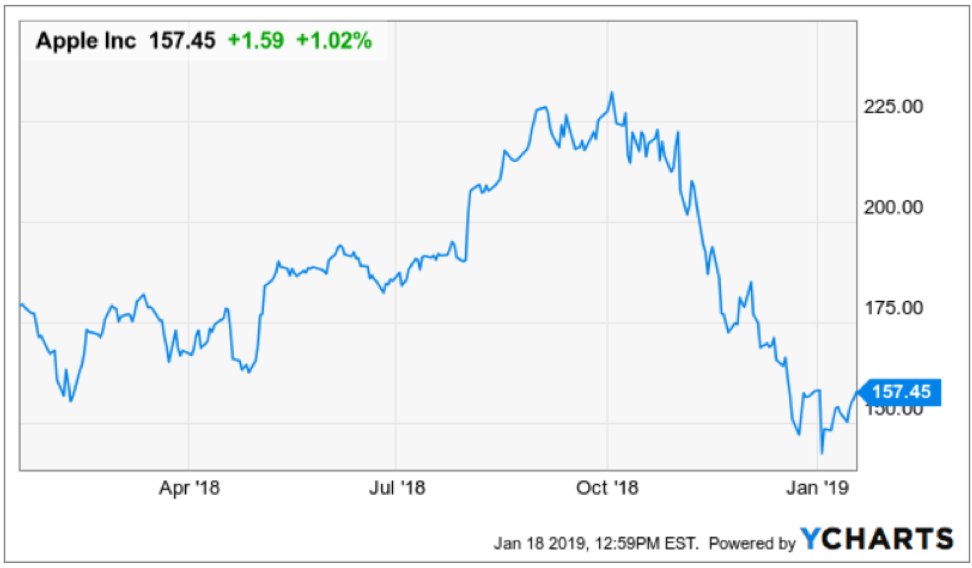
Then we got the disastrous news from Apple (AAPL) indicating business in China was petering out forcing them to change tactics cutting iPhone prices.
The tech market went into full-on panic mode and the revelation of weak China data did not help either.
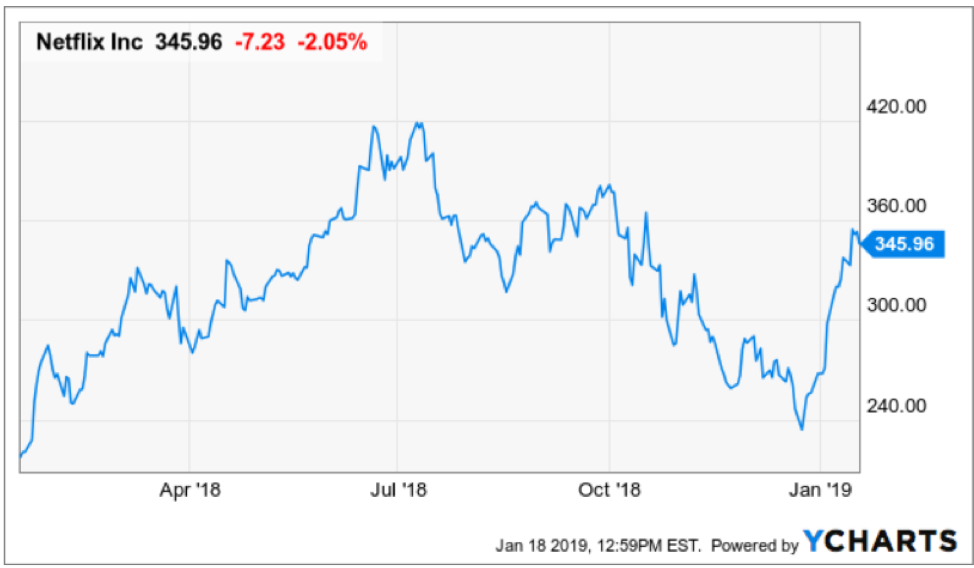
Netflix (NFLX) reported and the online streaming app offered some respite with outperforming growth numbers.
Netflix has been a favorite of the Mad Hedge Technology Letter since its inception but the caveat with Founder and CEO of Netflix Reed Hastings brainchild is that the extreme volatility makes it difficult to trade around on a short-term basis.
The stock is up 50% from its nadir and its growth story is solid and will perpetuate.
The next bastion of juiced-up growth for Netflix is the international audience and these numbers are examined closely with a fine-tooth comb by investors attempting to understand the direction of the company.
The company audaciously added 8.8 million in new international subscribers last quarter which handily beat the 7.6 million estimates by 1.2 million.
Netflix also announced a few days earlier that it would raise the price of a monthly subscription between 13%-18%, and investors treated the news with celebratory shots of tequila.
It has been consensus for years that Netflix was severely underpricing their premium content, and analysts have been screaming and kicking trying to get Hastings to push up their monthly prices.
The price hike coincides with a year where I believe Netflix can grow revenue over 30%.
The mix of these two developments illuminate a few things about Netflix.
Netflix has the content that consumers want and even if competition rears its ugly head, they aren’t even in the same ballpark in terms of breadth and potency of content.
They are the king of contents and I don’t see anyone knocking them off their elevated perch in 2019.
In many ways, the Netflix long-term thesis mirrors the tech industry’s long-term thesis emphasizing supercharged growth by any means possible.
Even though this strategy is risky, it is working for Netflix and the capital isn’t drying up to go after the best content producers money can buy.
This earnings report should put to rest the growth warning sirens for now, tech will grow this year, but earnings results will be more of a mixed bag with the occasional miss.
This is in stark comparison to early 2018 where every tech company and their mother were scorching earnings forecasts by a magnitude of two or three.
Last September, the tech market looked above its head and saw a few boulders about to crush the herd, but investors shrugged it off.
As we move forward, the tech sector and the overall market is inching closer to a recession.
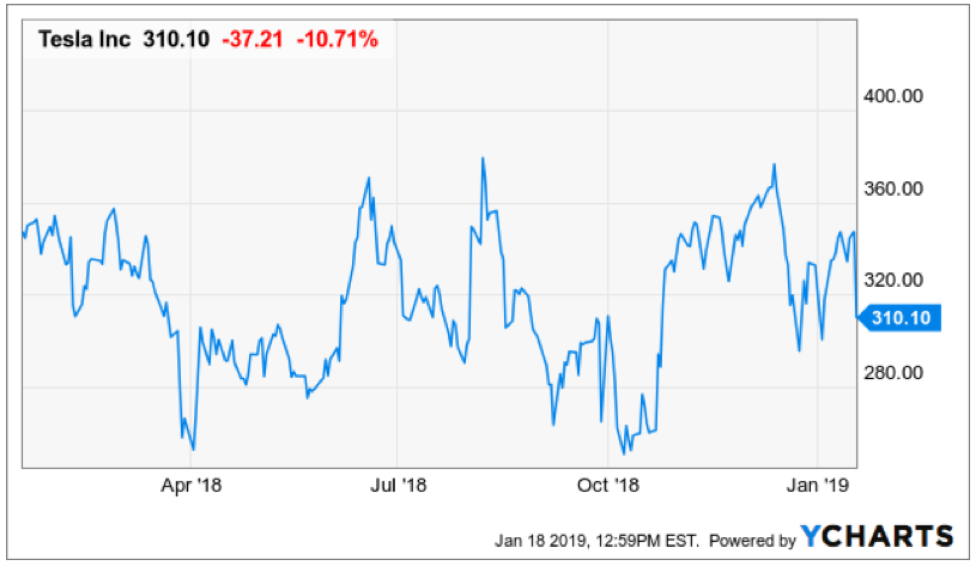
The low-hanging fruit has been pocketed and incremental gains aren’t no-brainers anymore – this can be gleaned from Tesla (TSLA) curtailing their workforce by 7%.
This news was delivered by a letter from CEO of Tesla Elon Musk noting that these decisions have been made with the goal of “increasing the Model 3 production rate and making many manufacturing engineering improvements in the coming months.”
Basically, Musk has telegraphed that staff needs to perform better, identify efficiencies that will save costs which in turn will boost profit margins.
This doesn’t mean that the era of tech growth is over, but this signals that tech companies are becoming more fidgety about loss-making operations and have ultimately targeted profits which shout at investors' late-cycle economics.
Musk needs to turn Tesla into a perennial profit machine to prove naysayers wrong, and now is the time to turn the page and max out his rocket fuel.
If the recession hits, investors could turn against Tesla and capital could dry up.
This newfound modesty towards the e-car business model is, in no doubt, exacerbated by the ratcheting up of fierce competition from the traditional automobile makers.
Tesla is in the e-car lead for battery technology, revolutionary production processes, and have a treasure trove of data that German companies would do anything to get their hands on.
Musk knows Tesla has fought this hard to get to this point, and he'd rather have the ball in his hands with 10 seconds left and a tie game just like Michael Jordan of the Chicago Bulls did.
Shaving off the excess has meant removing the customer referral program that was too costly that included benefits like half a year of free charging.
Part of this also has to do with Tesla losing their tax credit at the end of the year as well as giving more impetus to trimming costs.
Becoming a mass-market car manufacturer means it is important to price the car at affordable price points and that will be extremely difficult.
The goal is to deliver a $35,000 e-car that performs comparably to the rest of the fleet but produced with 7% less hands.
Can Musk do it?
I wouldn’t bet against him.
Musk means business and is hellbent for revenge against his arch enemies – the Tesla short community who he has habitually dragged under the bus through the media.
Piggybacking on this tougher profit-making climate is Boston-based finance company State Street Corporation’s (STT) announcement reducing headcount by 1,500 amounting to 6% of the global workforce.
The firm cited the urgent need to automate processes that will give the company a bigger foothold into the digital sphere.
The same theme was echoed at BlackRock Inc. (BLK), the world’s largest asset manager, who will eliminate 3% of its global workforce, or 500 people, amid an existential threat from the temporary ineffectiveness of passive investing.
In a rising market, it is guaranteed that assets at these types of funds almost always go up.
However, with an injection of recent volatility, passive investors have seen their balances dwindle with the market spawning abrupt outflows.
The need to zig and zag with the market is now painfully obvious and using technology to plug in the gaps will be cheaper and more appropriate for late cycle price action.
This is a suitable segue way into the third point – the fluid follow-through of the digital migration and the debacle of Sears prove my point.
Hedge fund manager Eddie Lampert and his firm ESL have navigated this famous American retailer into the ground.
This is what happens when the entire retail industry goes online when you don’t.
To make matters worse, Lampert has probably never set foot into his own investment.
Each time I roam the aisles of Sears, it’s about as crowded as a mortuary at midnight – an elementary story of a mismanaged enterprise.
Sears is an example of digital ignorance and it’s not the only one.
Gymboree Group, the baby clothing company, is another one to put on the list – the firm filed for Chapter 11 bankruptcy protection.
The company will close more than 800 Gymboree and Crazy 8 stores, this is the second time they have filed for bankruptcy protection in the past two years.
Unsurprisingly, the firm cited a sudden decrease in mall traffic and a surge in online alternatives as the reason for the economic softness.
The economy does not operate in a vacuum and any analog company who voluntarily misses the pivot to digital is voluntarily digging their own grave.
These three trends will only become more exaggerated moving forward threatening companies like Apple who fail to innovate after more than a decade of selling the same product, other companies don’t have the balance sheets to handle the same weakness.

Mad Hedge Technology Letter
July 17, 2018
Fiat Lux
Featured Trade:
(THE PATH AHEAD),
(IBM), (AMZN), (FB), (MSFT), (NFLX), (QQQ), (AAPL), (DBX), (BLK)

The Red Sea has parted, and the path has opened up.
Technology has been a beacon of light providing comfort to the equity market, when a trade war could have purged the living daylights out of bullish investor sentiment.
If an increasingly hostile, tit-for-tat trade skirmish threatening overseas revenue can't bring tech equities to its knees, what can?
It seems the more bellicose the administration becomes, the higher technology stocks balloon.
Does this all add up?
The Nasdaq (QQQ) continues its processional march skyward. If you were a portfolio manager at the beginning of the year without technology exposure, then polish off the resume before it picks up too much dust.
The Nasdaq has set all-time highs even after a brutal 700-point sell-off at the end of January.
Apple (AAPL), Microsoft (MSFT), Netflix (NFLX), and Amazon (AMZN) can take credit for 83% of the S&P 500's gains in 2018.
And that fearsome four does not even include Facebook (FB), which has left the shorts in the dust.
Each momentous sell-off has proved to be a golden buying opportunity, propelling tech stocks to higher highs and retracing to higher lows.
And now the path to tech profits is gaping wide, luring in the marginal investor after two highly bullish events for the tech world boding well for the rest of fiscal year 2018.
Xiaomi, one of China's precious unicorns, which sells upmarket smartphones, went public on the Hong Kong Hang Seng market last week.
The timing couldn't be poorer.
The rhetoric between the two global leaders reached fever pitch with the administration proposing $200 billion worth of tariffs levied on Chinese imports.
China reiterated its entrenched stance of not backing down, triggering a tense war of words between the two global powers.
The beginning of March saw the Shanghai stock market nosedive through any remnants of support levels.
The 50-day moving average, 100-day, and 200-day were smashed to bits and Shanghai kept trending lower.
The trade skirmish has had the reverse effect on Chinese equities compared to the Nasdaq's brilliance, and combined with the strong dollar, has seen emerging markets hammered like the Croatian soccer team in Moscow.
Xiaomi's IPO was priced in the range of HK$17 to $22, and when it opened up on the first day at HK$16.60, investors were holding their breath.
Take the recent IPO triumph of cloud company Dropbox (DBX), whose IPO was priced in the expected range of US$18 to $20. The first day of trading showed how much appetite there is for to- quality cloud companies, with Dropbox starting its trading day at US$29, 40% higher than the expected range.
Dropbox finished its first day at a lofty US$28.48, a nice 35% return in one trading day.
No doubt Xiaomi's shares were not expected to perform like Dropbox, but it held its own.
Astonishingly, this company did not even exist nine years ago and is now the fourth-largest smartphone manufacturer in the world, grossing $18 billion in revenue in 2017.
The unimaginable pace of development highlights the speed at which the Chinese economy and consumer zigs and zags.
Chinese retail sales were up a staggering 9% YOY for the month of June 2018. Its overall economy met its 6.7% target for the second quarter of 2018.
The price range settled for the IPO gave Xiaomi a valuation of $54 billion.
Instead of getting roiled, Xiaomi came through with flying colors posting a 26% gain after the first week of trading.
Poor price action could have given Beijing ammunition to cry foul, laying blame for the underperformance on the U.S. tariffs.
The healthy price action underscores there is still room for Chinese and American companies to flourish in 2018, albeit through a highly politicized environment.
Specifically, Apple comes through unscathed as a disastrous Xiaomi IPO could have resulted in negative local press stoking higher operational risks in greater China.
Apple is in the eye of the storm, but untouchable because it employs more than 4 million local Chinese employees throughout its expansive ecosystem and has been praised by Beijing as the model foreign company.
Apple earned $13 billion in revenue from China in Q2 2018, a 21% YOY increase.
Hounding Apple out of China will be the inflection point when tech investors know there is a serious problem going on and need to hit the eject button.
If this ever happens, The Mad Hedge Technology Letter will be the first to resort to risk off strategies.
BlackRock's (BLK) CEO Larry Fink let everyone know his piece saying, "the lack of breadth in the equity markets is troubling."
Investors cannot blame tech companies for executing their way to the top behind the tailwind of the biggest technological transformation in mankind.
And even in the tech industry, winners can turn into losers in a blink of an eye, such as legacy tech company IBM (IBM).
Someone better tell Fink that this is the beginning.
Amazon recorded 44% of total U.S. e-commerce sales in 2017, equaling 4% of total retail sales in the U.S.
This number is expected to breach 50% by the end of 2018.
The second piece of bullish tech news was lifting the ban on Chinese telecommunications company ZTE.
It is open for business again.
From a national security front, this is an unequivocal loss. However, it saved 75,000 Chinese jobs and gave a small victory to American regulators attempting to patrol the mischievous behemoth.
The U.S. Department of Commerce lifted the seven-year ban even after ZTE sold telecommunication products to North Korea and Iran.
ZTE was fined $1 billion, changed the senior management team, and put into place an American compliance team that will monitor its business for the next 10 years.
Diluting the penalty lowers the operational risk for American tech companies because it shows the administration is willing to reach compromises even if the compromise isn't perfect.
China is a lot less willing to ransack Micron and Intel's China revenues, if America allows China to save face and 75,000 local jobs.
This is a big deal for them and their employees.
America has a strong hand to play with against China because China still requires Uncle Sam's semiconductor components to build its future.
This hand is only effective if Chinese still thirst for American technology. As of today, America is higher on the technological food chain than China.
The move is also a model of what the U.S. Department of Commerce will do if Chinese companies run amok, which Chinese tech companies often do because of the lack of corporate governance and transparency.
These two recent China events empower the overall American tech sector, and the market will need a berserk shock to the tech ecosphere foundations to make it crumble.
As it stands, the tech sector is handling the trade war fine, and with expected blowout tech earnings right around the corner, short tech stocks at your own peril.


________________________________________________________________________________________________
Quote of the Day
"All of the biggest technological inventions created by man - the airplane, the automobile, the computer - says little about his intelligence, but speaks volumes about his laziness," - said author Mark Kennedy.
