Below please find subscribers’ Q&A for the June 7 Mad Hedge Fund Trader Global Strategy Webinar, broadcast from Lake Tahoe, NV.
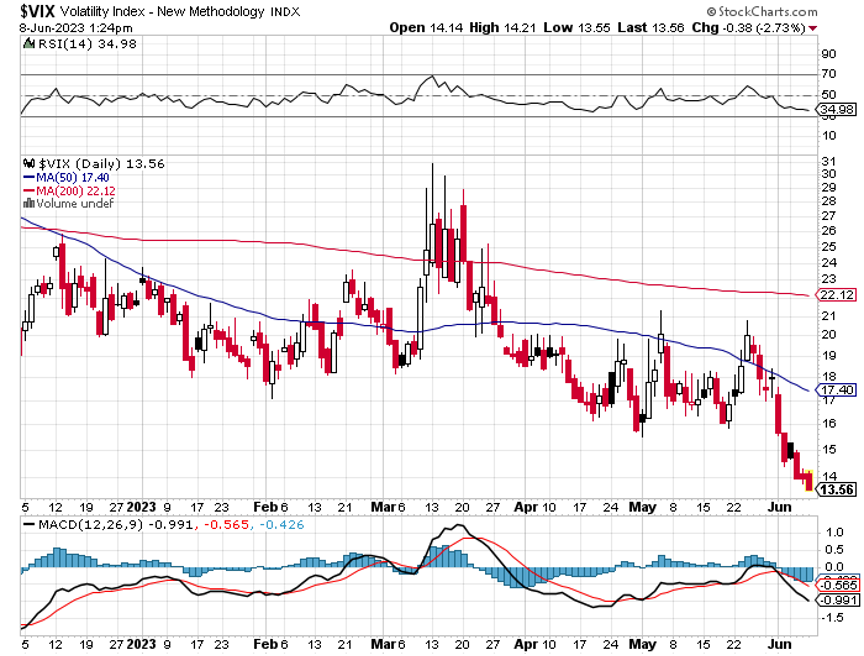
Q: Do you ever trade the CBOE Volatility Index ($VIX)?
A: No, I used to, but I got hit a few times. That’s because 95% of the year is spent seeing the ($VIX) go down, and then the other 5% basically doubles overnight. It’s a short play only. With a long ($VIX), the time decay is enormous, and it’s just not worth owning. The only way to make money in ($VIX) is to buy it right before a giant VIX spike. And the floor traders in Chicago have a huge inside advantage in that market. So, I finally gave up and decided there's better things to do.
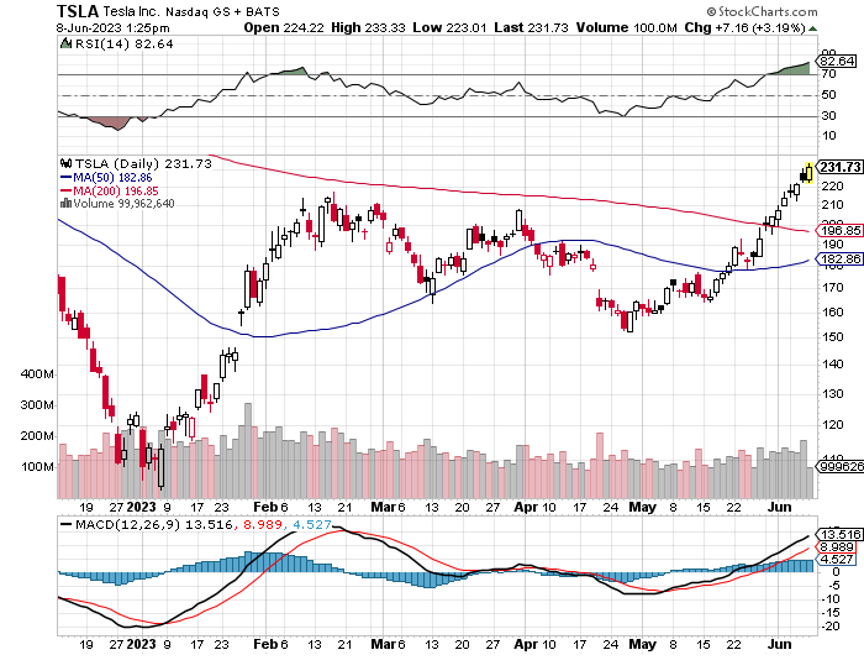
Q: Buy the price dip for Tesla (TSLA)?
A: I’d have to look at the charts, but if it gets back down to $200, I would start hoovering it up again. The fundamentals are really arriving for Tesla big time, as is the long-term bull case.
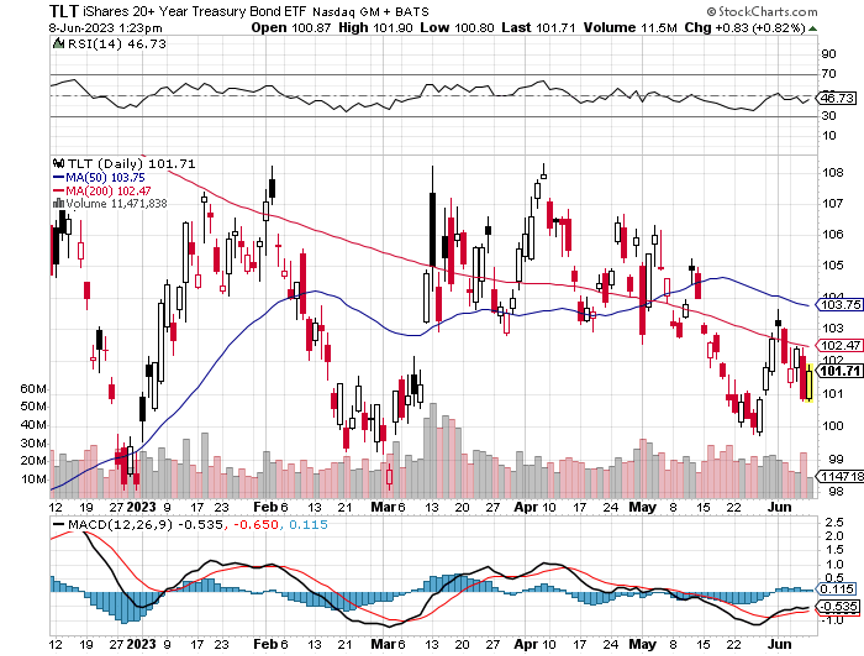
Q: With the debt crisis over, how low will the iShares 20 Plus Year Treasury Bond ETF (TLT) go in the short term?
A: Well, we know they have to issue a trillion dollars of 90-day T-bills in the next few weeks. The debt ceiling crisis stopped Treasury bill issuance for several months and now they have a lot of catch-up to do. So, best case scenario, the (TLT) drops to $95, then you load the boat for the rest of your life in (TLT) LEAPS, like a $95-$100 2024 LEAPS. And that should double about every year.
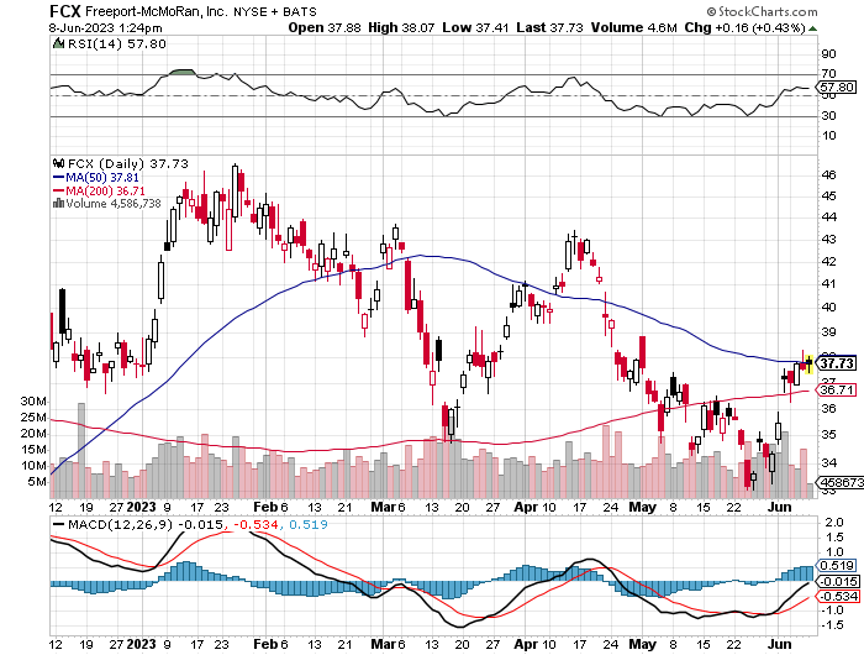
Q: Are you concerned about commodities given the weakness in the Chinese economy?
A: Yes, it’s definitely slowing the commodities recovery, but is also giving you a fantastic opportunity to get into things like Freeport McMoRan (FCX) at a cheaper price, where it was just a couple of weeks ago. All of the commodities look like they’re bottoming now, it’s time to buy them.
Q: It seems like you really love the Russell 2000 (RUT).
A: I hate the Russell. You only want to own big money stocks because that's where the big money goes first. Big money doesn’t go into the Russell, and as long as there's any doubt of a recession coming, they’ll perform poorly.
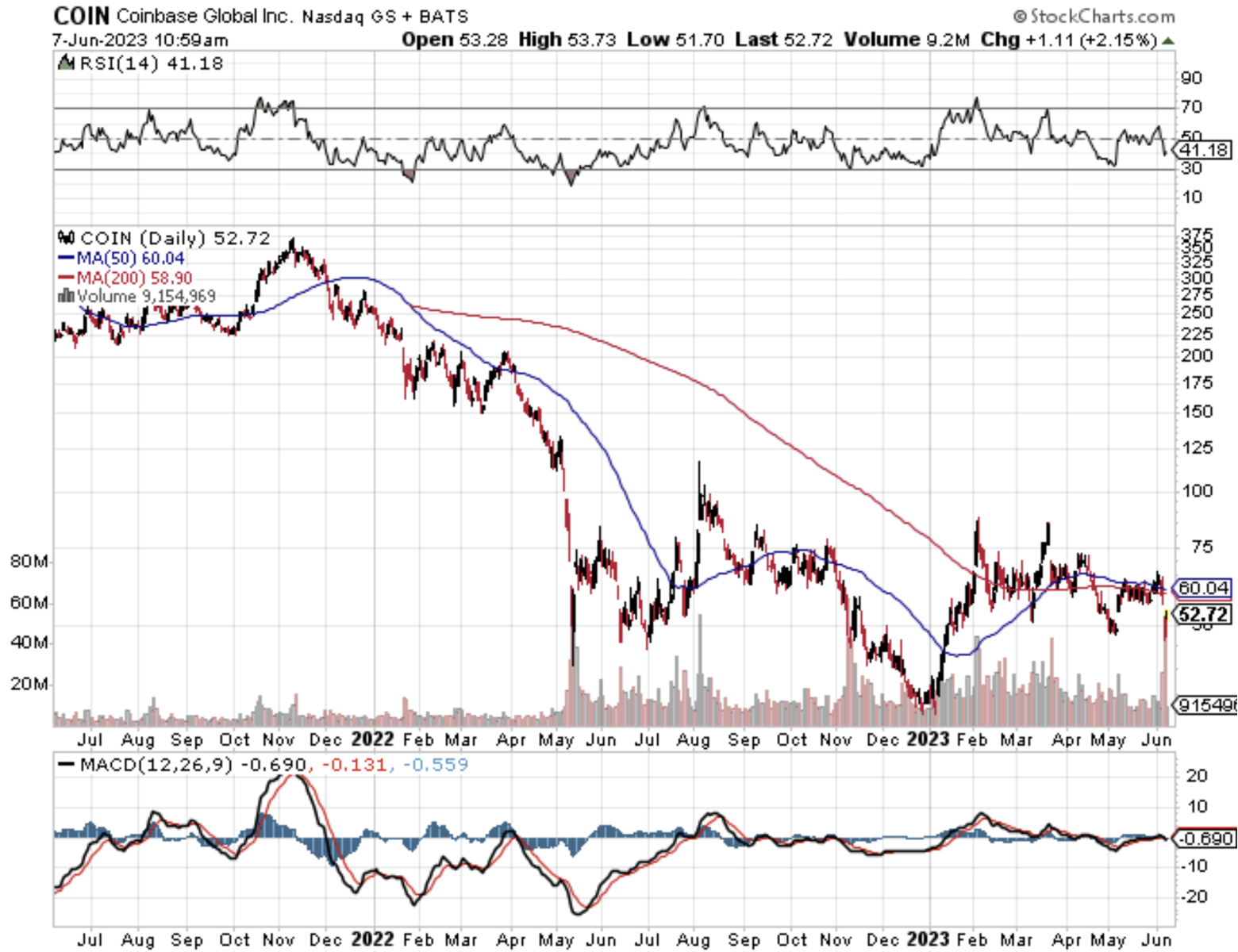
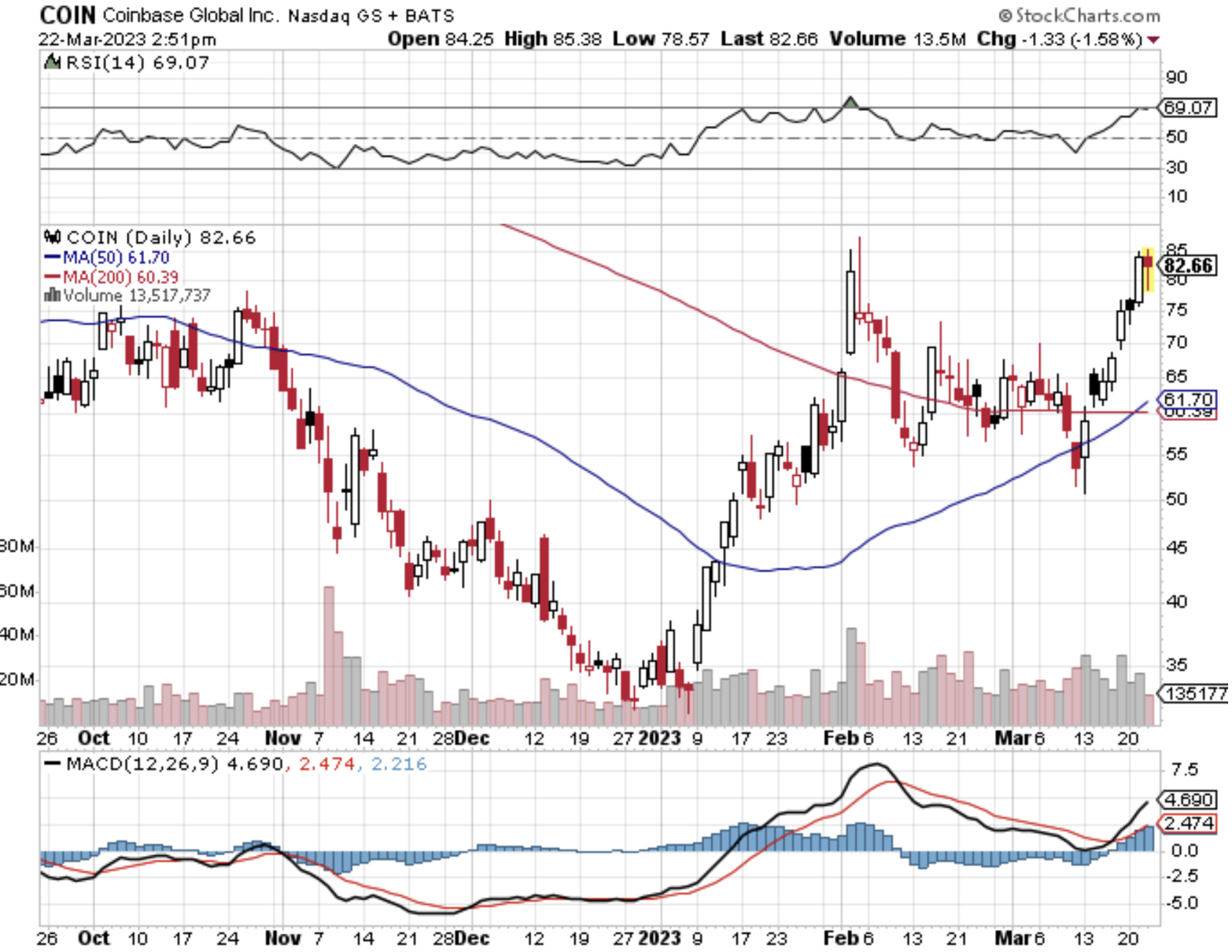
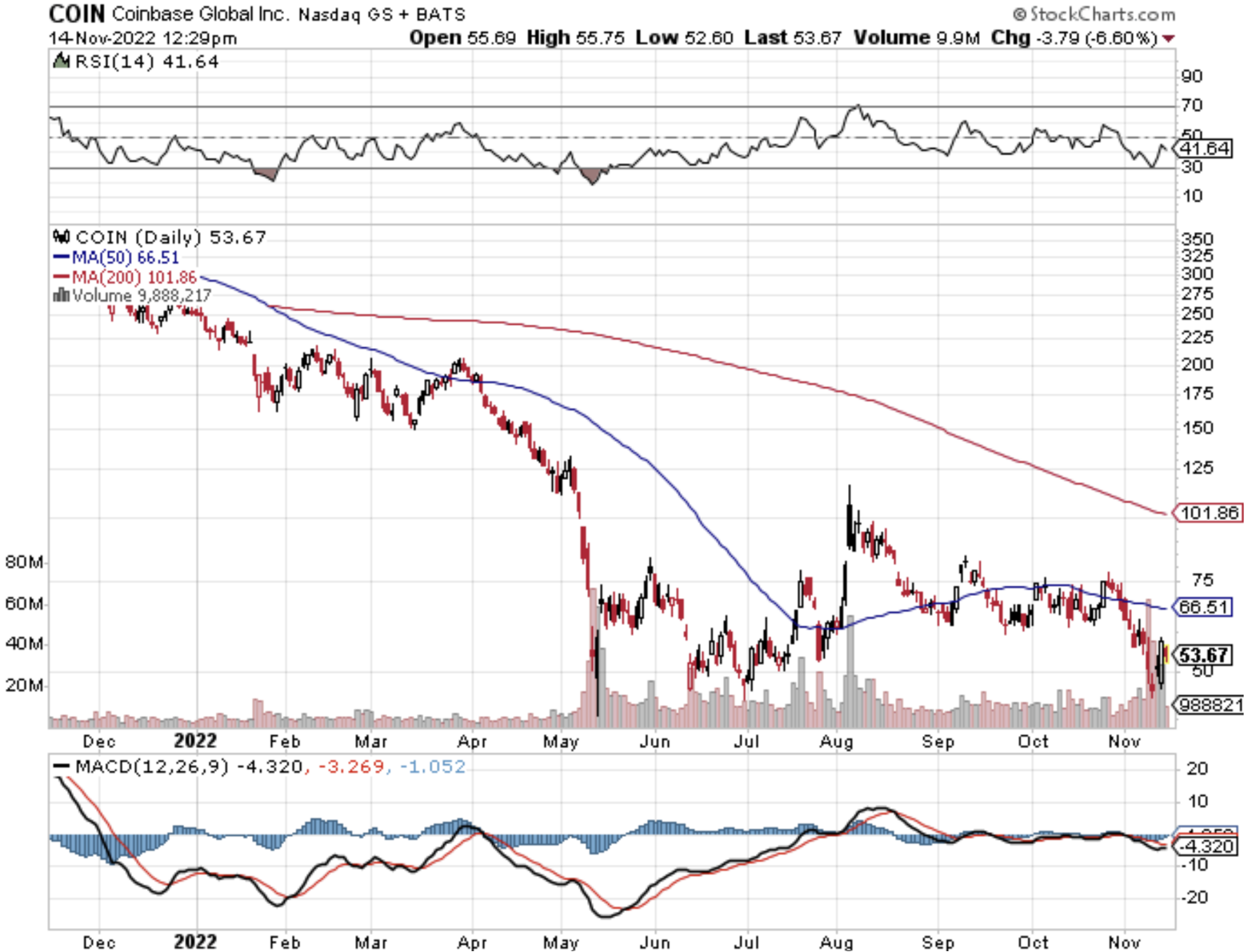
Q: Coinbase (COIN) is getting sued by the SEC, should I buy on the dip?
A: No, the whole crypto infrastructure is getting sued out of existence and disappearing. They went after Binance also. It seems like the SEC just doesn’t like crypto very much. That kind of shrinks the whole industry back down to hot wallets, where you slowly have direct control of your bitcoin on the network and you don't use any outside brokers to buy and sell it because there may not be any left shortly.
Q: Should we still hold the Apple (AAPL) bull call spread?
A: Yes, I think we have enough room on our call spread in the next 7 trading days to take max profit. However, if you have any doubts, no one ever gets fired for taking a profit.
Q: Is the ProShares Ultra Technology ETF (ROM) a buy at this time?
A: No, if anything, ROM is a sell. It almost had a near-double move. So no, wait for a 20% or 30% correction this summer in ROM and then go in. It has actually led most tech because it's a 2X long ETF. Sometimes I just want to shoot myself. You buy before stocks double, not afterwards.
Q: What will trigger a correction this summer?
A: The risk of a further rise in interest rates, which we may get. Other than that, the market is running out of negatives.
Q: What is the risk of US currency not being the world reserve?
A: Zero. I have been asked this question every day for the last 50 years and so far, I have been right. What would you rather keep your savings in Chinese Yuan, Russian rubles, or Euros? I would say none of those. And US currency will remain the reserve currency for this century, easily, until a digital US dollar comes out.
Q: Do you want to buy the cellphone companies?
A: No, not really. They weren’t very interesting before—it's a low margin, highly competitive cutthroat business—and now you have one of the world's largest companies, Amazon (AMZN), potentially offering phones for free? I think I'll pass on that one.
Q: Do you have any interest in pairs trading?
A: No, they blow up too often.
Q: Did you say you sent out a one-year LEAPS on Freeport McMoRan (FCX), the $35-$38?
A: Yes, if you didn’t get it, email customer support.
Q: Are investing in 90-day Treasury bills until the next one or two Fed meetings are over a good idea?
A: Yes, that is a good idea. Cash has a high-value night now. Remember, a dollar at a market top is worth $10 at a market bottom, and we now have a rare opportunity to get paid 5.2% or 5.3% while we wait. That hasn’t happened in almost 20 years.
Q: Will the new Apple VR headset be a boon to the stock price?
A: Yes, adding 10% to your earnings is always good, but it won’t happen immediately. You need a few thousand third-party app developers to come through with services before the earnings really get going. That's what happened with iTunes when the iPhone came out. Growth was slow when Apple only allowed its in-house apps to be sold—when they opened to the public, the business went up 100 times. That's maybe what will happen with the virtual headset.
Q: PayPal (PYPL) has dropped a lot, should I buy it here?
A: No, cutthroat competition in the sector is destroying the share price. There are too many other better things to buy.
Q: Why do so many professional analysts say the market will go down this year, but it goes up every day?
A: Professional analysts are just that—they're analysts, not traders. And often these days, to save money, your professional analyst is 26 years old, so they don’t have much market experience. I like to think that 50 years of trading experience backed with algorithms helps.
Q: Do you think oil could hit $100 a barrel next year?
A: Yes, definitely. Especially if we get a decent economic recovery and Saudi Arabia doesn’t immediately bring back 3 million barrels a day that they’ve cut.
Q: Should I chase NVIDIA (NVDA) here?
A: No, better to own cash here than Nvidia. Buy Nvidia on the next dip, or another Nvidia wannabe company, which will almost certainly arrive shortly.
Q: When will we get peace in Ukraine?
A: Within a year, I would say. Russia has literally run out of ammunition, and Ukraine is getting more. Ukraine is also getting F16s, our older fighter planes, and many other advanced weapons and parts—those are a big help. They can beat anything the Russians throw up.
Q: Is Global X Copper Miners ETF (COPX) a good copper play?
A: Yes it is, but you don’t get the leverage that you do with an FCX LEAP. I don’t know how far the top will go, but that would be a great trade one to two years out.
Q: Can you explain why there is a short squeeze in copper?
A: There are 200 pounds of copper needed for each EV, and EV production is exploding both here and in China. Tesla is expected to make 2 million EVs this year, especially with the $33,000 price point. China manufactures this many EVs as well. Four million EVS and 200 pounds of copper per EV equals the entire annual production of copper right now. At some point, people will notice that and they’ll take copper as much as they took lithium up last year.
Q: What do you mean when you say LEAPS one or two years?
A: It really depends on your risk. When you buy a two-year LEAPS, you usually get the extra year for free or almost nothing, and if you get a rapid increase in the underlying share price, the two-year LEAP will go up almost as much as the one year. So for most people who don’t want to watch the market every day, the two-year LEAPS is probably a better choice.
Q: Why did you buy only one LEAPS contracts?
A: All of my LEAPS recommendations are only for one contract. It is up to you to decide what your risk tolerance and experience level is, whether you buy 1, 100, or 1,000 contracts, so I leave the size up to you because it can vary tremendously depending on the person. Also, one contract makes the math really easy for people to understand.
Q: At what point do you sell your LEAPS?
A: Well, if you get a rapid 500% profit, which happened with many of the LEAPS that we did in October as well as the ones we did in March, I would take it. However, the goal on these is to go for the 10 baggers, or the 100% return in a year, and you usually need to hold it for the full year to get that. But, if the stock takes off like a rocket, I would take the profit. How many times in your life do you get a 500% profit in a month or two? I would say none. So, when you get that with these LEAPS recommendations, take it and run like a madman, move to a different country, and change your name.
Q: With the ($VIX) this low and many great companies for the second half down, would you buy single LEAPS instead of spreads?
A: I would; the problem with the call spread strategy is that it’s not the best thing to do at big market bottoms, down 20%, 30%, and 40%. The better thing to do is the LEAPS, but the LEAPS is a one- or two-year position, and I have to be sending out trade alerts every day. At market bottoms, you definitely want to get the most market leverage possible on the upside, and LEAPS does that for you in spades. They essentially turn your stock into a synthetic futures contract with a 10x leverage.
Q: When do we expect China (FXI) to take over Taiwan?
A: Never, because if they invade Taiwan, China loses its food supply from the US, which cannot be replaced anywhere. They also lose their international trade, so they won’t have the profits with which to buy food elsewhere. I’ve been in China when millions died during a famine and let me tell you, there is NO substitute for food. Not all the money in the world can buy it when it just plain isn’t available. But China will keep threatening and bluffing as they have done for 74 years.
To watch a replay of this webinar with all the charts, bells, whistles, and classic rock music, just log in to www.madhedgefundtrader.com, go to MY ACCOUNT, click on GLOBAL TRADING DISPATCH or TECHNOLOGY LETTER then WEBINARS, and all the webinars from the last 12 years are there in all their glory.
Good Luck and Stay Healthy,
John Thomas
CEO & Publisher
The Diary of a Mad Hedge Fund Trader
Sometimes the Market Can be Tough to Figure Out
https://www.madhedgefundtrader.com/wp-content/uploads/2023/06/john-thomas-mourning.jpg177171Mad Hedge Fund Traderhttps://madhedgefundtrader.com/wp-content/uploads/2019/05/cropped-mad-hedge-logo-transparent-192x192_f9578834168ba24df3eb53916a12c882.pngMad Hedge Fund Trader2023-06-09 09:02:352023-06-09 14:38:45June 7 Biweekly Strategy Webinar Q&A
I’ll never forget when Mad Money’s Jim Cramer boasted that he “liked Coinbase (COIN) to $475” and to keep “doubling down” as the stock went lower.
Funny how things you say come back to haunt you.
COIN is the American crypto exchange that just got charged with operating as an unregistered broker, operating an unregistered exchange, and operating as an unregistered clearing agency.
Not only that, the SEC specifically scolded them for selling digital tokens with no value such as offering the sale of unregistered securities (SOL, ADA, MATIC, FIL, SAND, AXS, CHZ, FLOW, ICP, NEAR, VGX, DASH, and NEXO).
COIN was at the right place at the right time when crypto blew up to $65,000 and now it is certainly the inverse of that situation.
COIN is now languishing at $51 per share after a 12% selloff and a far cry from the $475 price that Jim Cramer lusted over and gushed to viewers about how much value there was at almost 500 per pop.
The crackdown is certainly not over and SEC commissioner Gary Genseler appears to be on a mission to make digital tokens and the industry supporting it a living hell.
Gensler warned banks to steer clear of crypto because of potential risks to the financial system, making it harder for US citizens to invest.
Paul Grewal, the company’s top lawyer, has previously said that those tokens aren’t securities.
A federal regulator also alleged that Coinbase acted as an exchange, broker-dealer, and clearinghouse all without registering with the SEC for any of those roles.
A virtual currency may fall under the SEC’s remit if investors buy it to fund a company or project with the intention of profiting from those efforts. That determination is based on a 1946 US Supreme Court decision defining investment contracts.
The big takeaway here is the extent to which the SEC thinks crypto is just an utter fraud.
The future appears dim if the SEC keeps bashing this nascent industry.
Digital tokens offer no intrinsic value and deliver no cash flow to shareholders simply because there is nothing to cash flow from.
How can an investor cash flow from a piece of stored code that doesn’t offer actionable software like a photo viewer or music editor?
It’s software that doesn’t do anything but then packages itself as a store of value because we should trust it for no apparent reason--and it’s not even backed by any government.
The SEC goes into the specific coins which they think aren’t securities; and the list is long, which is highly detrimental to COIN’s business.
The tech sector has been roaring in 2023 and the biggest and strongest companies have seen their valuations shoot to the sky.
The knock-on effect is that the bar has been set extremely low for tech companies, but COIN has failed to jump over the low bar.
Tech firms can’t do IPOs easily at 5% interest rates hence even smaller companies like Roblox (RBLX) and Uber (UBER) performing admirably this year in the Nasdaq.
I am still highly bullish on technology stocks, but COIN and Robinhood or anyone else getting investigated by the SEC or Federal government is a hard pass for me.
https://madhedgefundtrader.com/wp-content/uploads/2019/05/cropped-mad-hedge-logo-transparent-192x192_f9578834168ba24df3eb53916a12c882.png00Mad Hedge Fund Traderhttps://madhedgefundtrader.com/wp-content/uploads/2019/05/cropped-mad-hedge-logo-transparent-192x192_f9578834168ba24df3eb53916a12c882.pngMad Hedge Fund Trader2023-06-07 15:02:522023-06-28 22:59:11Bringing Up The Tech Rear
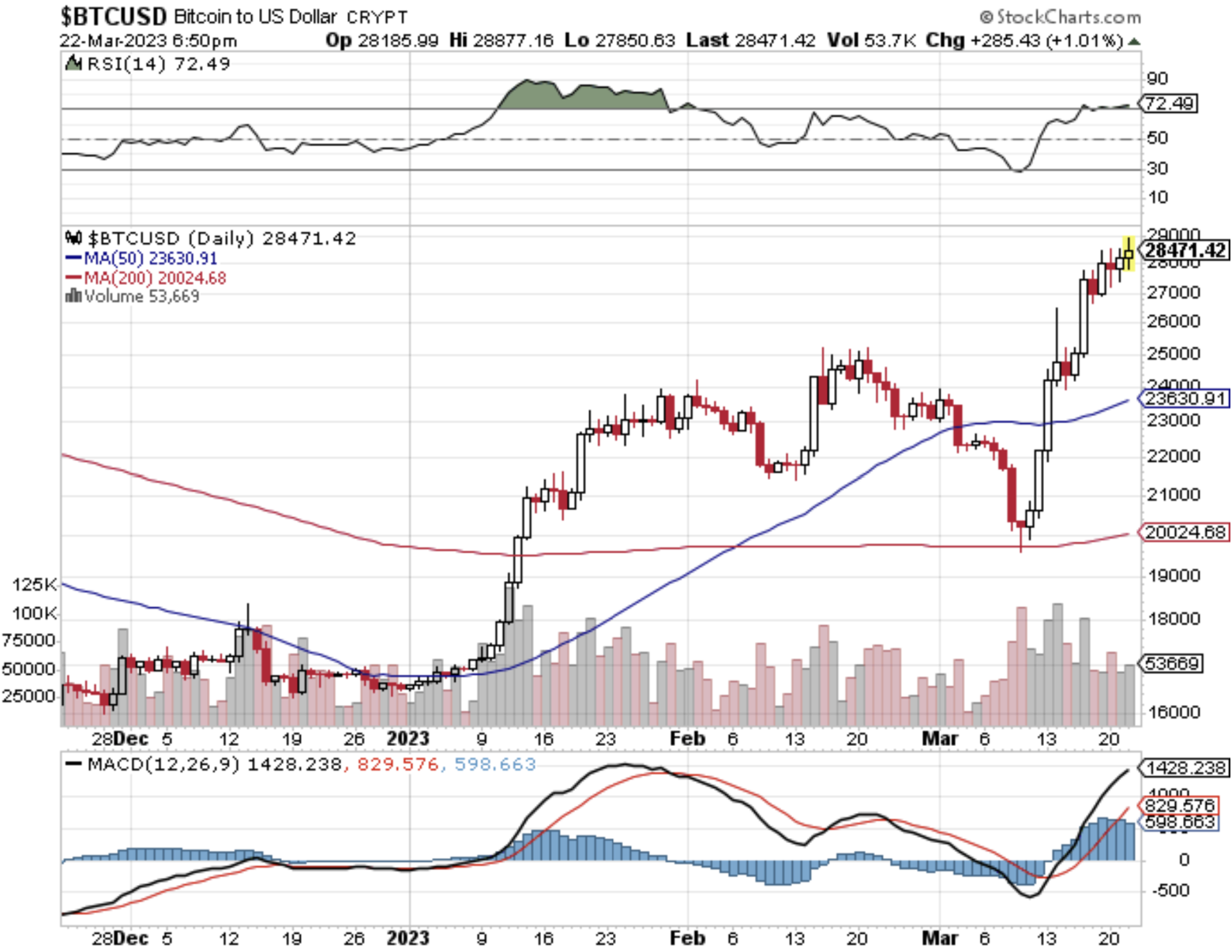
We are closing in on $27,000 and that’s quite the performance for the digital gold Bitcoin (BTC).
It just was last year when Bitcoin was down in the dumps.
I am not here flogging crypto but tech investors should take heed of what is happening in the riskier parts of the asset markets.
Yes, tech growth is quite volatile, but bitcoin even more so.
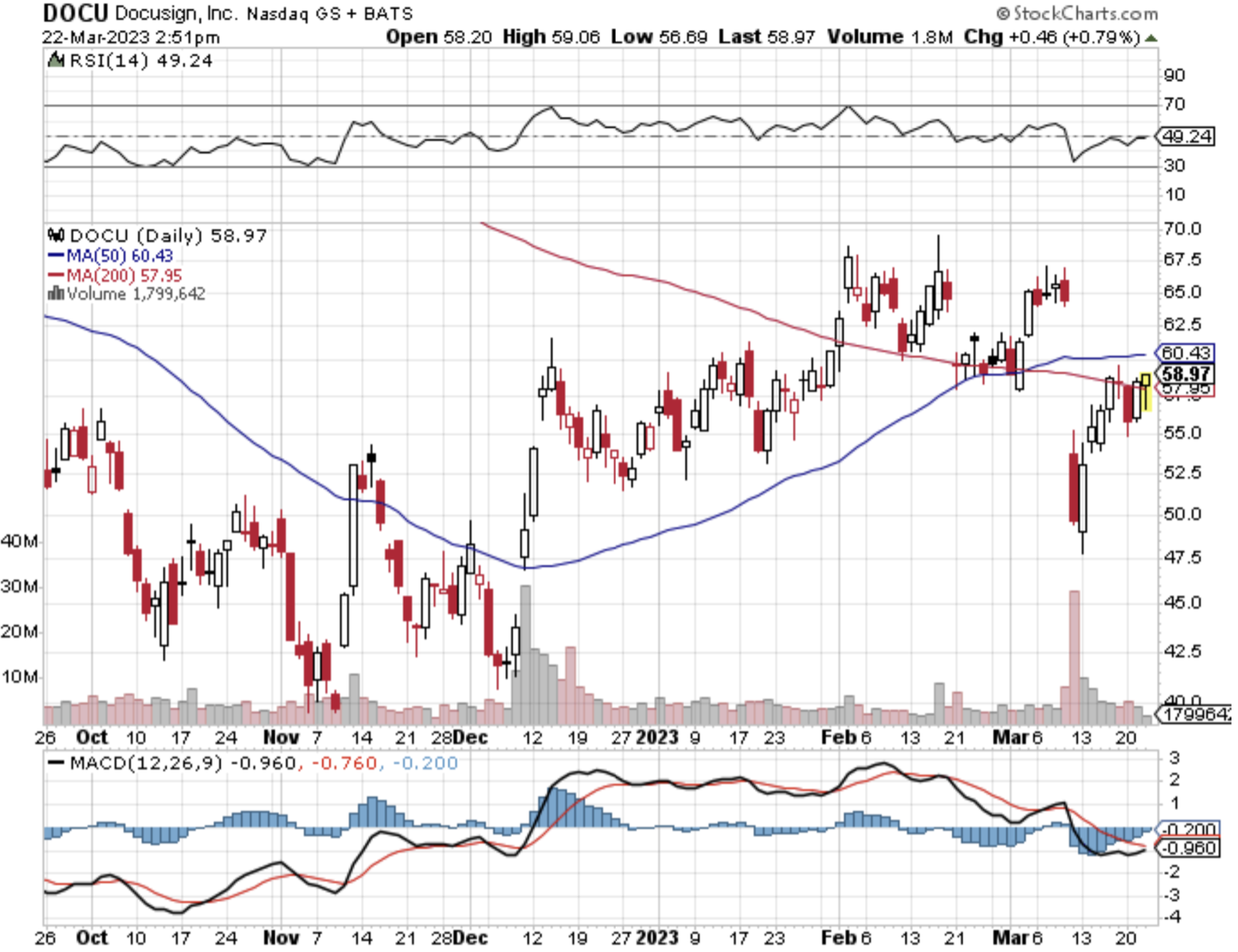
The price of Bitcoin is already up 72% this year and that will beat most tech growth stocks including the Teledocs and DocuSigns of the world.
This last strong surge is correlated with global banking contagion with even very liberal-based CNBC stating that Switzerland has become a financial “banana republic.”
Bitcoin is often advertised as the alternative asset class to fiat banking precisely because fiat banking has a history of going to zero.
The blowups at Silicon Valley Bank, First Republic, and Credit Suisse offer credible evidence that the strength of the fiat money banking system is trending down rather than up.
Hence the monster rally and this will just make banking more expensive for the unbanked and give the big banks more power and more “too big to fail” status.
Narratives are more powerful in crypto in generating real price movements than any other asset class and no matter what your thoughts on how powerful that narrative is, people actually believe this.
Cryptocurrency initially attracted interest from a niche group of investors following bank failures and government rescues.
While its popularity has grown among speculative investors in the roughly decade-and-a-half since, it has retained a status among some as being an asset more removed from the banking system than stocks and government bonds.
If the Fed decides to slow down the pace of interest rate hikes this is highly bullish for the crypto and tech growth sector.
Crypto investors have been particularly sensitive to regulatory and interest-rate developments.
They tend to pull money from long-bitcoin funds while adding to short-bitcoin products after the Federal Reserve announces interest-rate increases and regulators take action against crypto companies.
Since regulators started to crack down on some of the biggest crypto players, investors have pulled about $424 million from global exchange-traded products.
It’s been a terrible year to short bitcoin as that trade was last year’s rich uncle.
An important part of investing is to avoid searching for that boat that has left the dock.
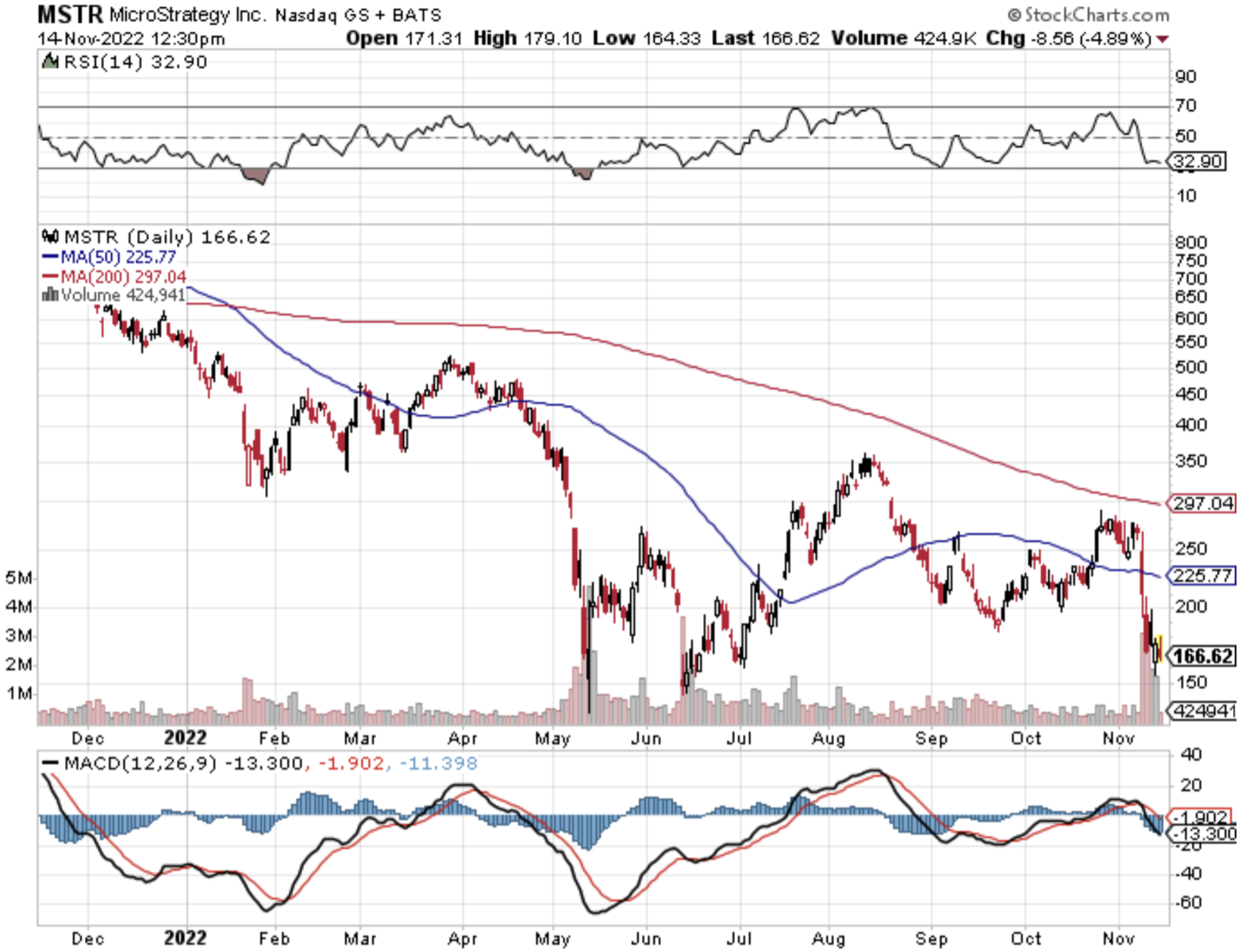
Investors betting against crypto exchange, Coinbase (COIN), and bitcoin-buying software intelligence firm, MicroStrategy (MSTR), were down 76% and 62%, respectively, this year.
Some investors remain cautiously optimistic about the trajectory of bitcoin’s price, especially as it has surged against the backdrop of a banking crisis.
Although there could be a vicious pullback from the epic surge so far this year, Bitcoin will likely do well along with tech growth stocks in a paused or lower rate interest environment.
Throw in the bank contagion as a supercharger and 2023 is shaping up to be a great year to buy bitcoin and growth tech on the dips.
https://madhedgefundtrader.com/wp-content/uploads/2019/05/cropped-mad-hedge-logo-transparent-192x192_f9578834168ba24df3eb53916a12c882.png00Mad Hedge Fund Traderhttps://madhedgefundtrader.com/wp-content/uploads/2019/05/cropped-mad-hedge-logo-transparent-192x192_f9578834168ba24df3eb53916a12c882.pngMad Hedge Fund Trader2023-03-22 15:02:492023-04-01 17:15:49If Bitcoin Then Growth Tech Too
It’s been a historic and unprecedented last few weeks in the world of technology.
99.9% of crypto projects are effectively a zero after this weekend.
Cryptocurrency has now descended into a death spiral due to a fraud so large that it makes many who got caught up in the mess sick to their stomach.
This “trigger” event has massive ramifications for the technology industry and is highly positive for the health of the tech sector.
Enter Former CEO of FTX, the former second biggest crypto exchange, Sam Bankman-Fried or SBF.
His crypto exchange FTX filed for bankruptcy just days ago.
SBF was stealing customer deposits to invest in his lifestyle and bought off everyone he thought was useful, including politicians, regulators, sports athletes, and famous actors.
SBF even bailed out many crypto-related companies during the recent downturn that were confirmed Ponzi schemes or frauds just to onboard them onto an even bigger scam.
In the end, a bank run collapsed SBF’s crypto empire and exchange.
It was only after the house was on fire that normal investors found out that his business was rotten to the core.
How did SBF hide this?
FTX and SBF literally replaced these funds on their balance sheet with their own in-house crypto coin that was produced and created by FTX.
This self-made coin was called FTT and FTT represented $7.4 billion of “liquid” funds for FTX on their balance sheet.
Therefore, when mass demands for withdrawals took place, FTX didn’t have the capital to distribute back to account holders because the value of FTT had sunk 95%.
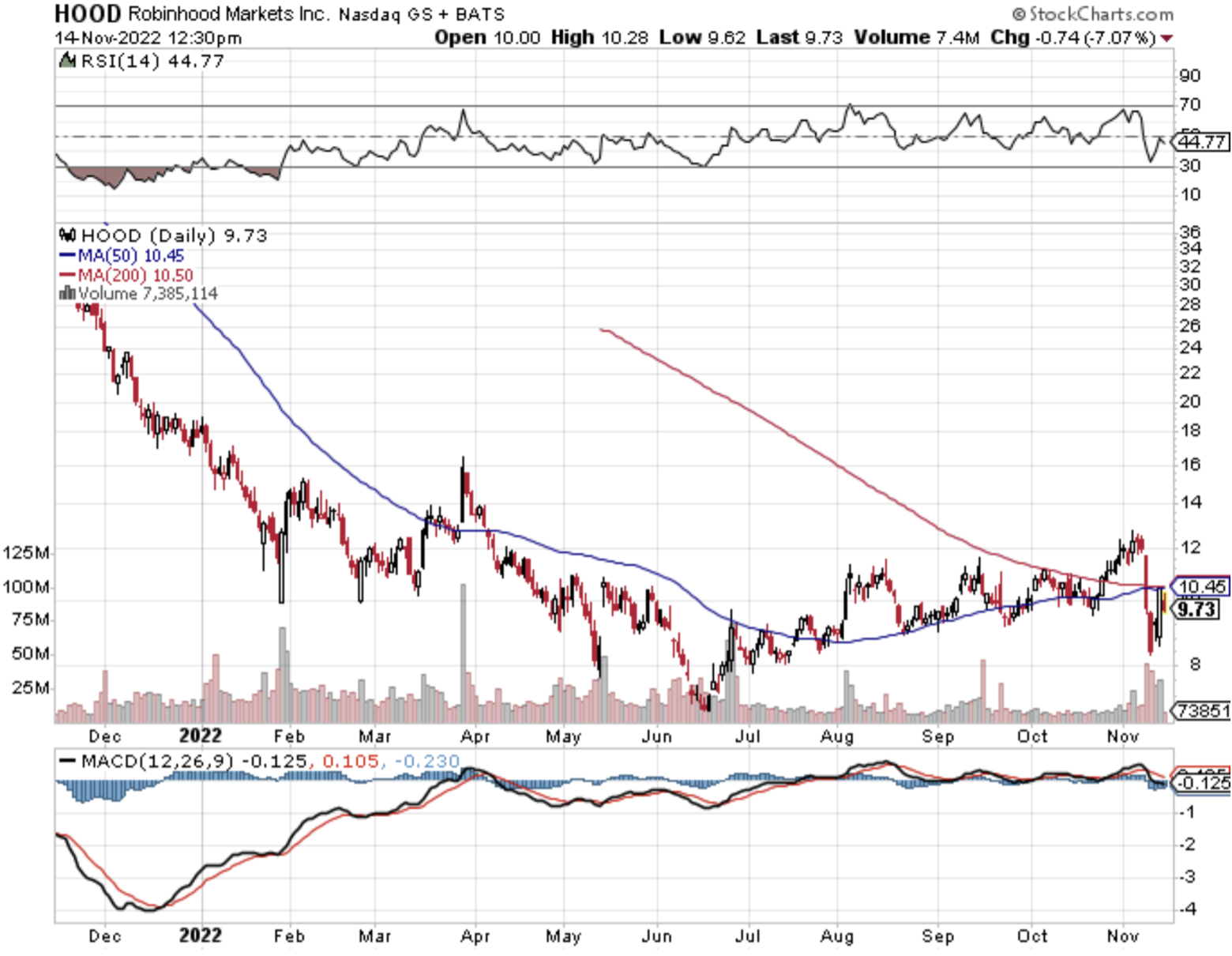
The $18 billion in liabilities was only propped up by $900 million of real liquidity with $470 million comprising of Robinhood (HOOD) stock shares.
Ultimately, FTX faced an $8 billion shortfall to fill in short notice or go under.
Any reader holding any crypto on any exchange should request immediate withdrawal of funds as soon as possible.
Don’t be the last one to ask for your money back. Get out while you can!
There is a good chance that every crypto exchange was faking their balance sheet with fake coins that have fake values while claiming these coins are liquid as US dollars.
That means weak balance sheets could plant the seeds of more bank runs putting extreme stress on liquidity and forcing them to halt withdrawals.
Any project related to FTX is now a zero.
This industry is truly broken and will take a generation to heal itself or might never come back.
I understand the FTX debacle as a highly positive event for the tech sector and tech stocks moving forward because it makes legitimate tech stocks look great.
FTX has set a low bar for tech stocks to jump over.
The Nasdaq market needed the fluff removed after the tech bubble had a 2-year accelerated bull market until 2022 and that came after a 10-year garden variety bull market in tech stocks.
FTX was the fluff. Avoid stocks such as Coinbase (COIN), Robinhood (HOOD), and MicroStrategy (MSTR).
Normal tech stocks will benefit after many incremental investors now believe crypto is completely fake.
This will forever be known as the colossal event that brought crypto to its knees.
I do believe that many of the leftover Bitcoin survivors will migrate into tech stocks moving forward because that’s the closest derivative to crypto.
Tech companies need to go through a lot of soul-searching to get their mojo back and a recession is always a good time to separate the good from the bad. Now, this is even better.
Crypto’s demise means venture capitalists will start to open the checkbook for non-crypto tech instead of spilling their money down a black hole.
https://madhedgefundtrader.com/wp-content/uploads/2019/05/cropped-mad-hedge-logo-transparent-192x192_f9578834168ba24df3eb53916a12c882.png00Mad Hedge Fund Traderhttps://madhedgefundtrader.com/wp-content/uploads/2019/05/cropped-mad-hedge-logo-transparent-192x192_f9578834168ba24df3eb53916a12c882.pngMad Hedge Fund Trader2022-11-14 15:02:592022-12-02 03:12:59Low Bar Has Been Set
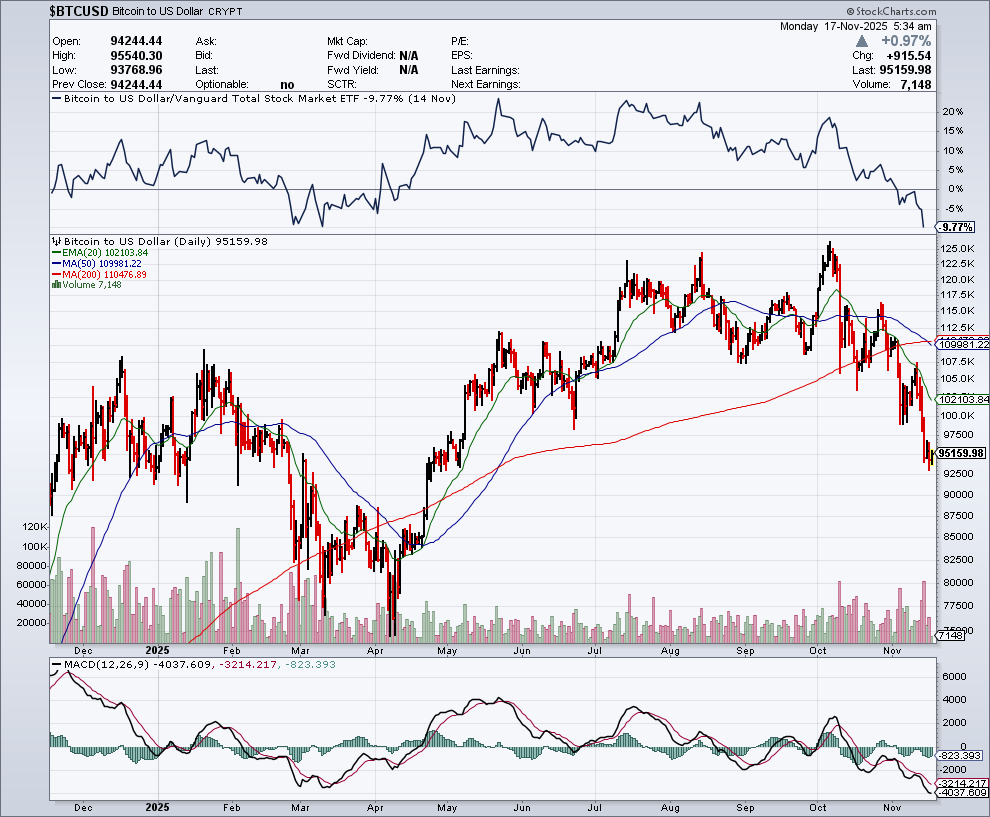
Bitcoin slipped to around $95,000 this week after a delayed U.S. inflation print and hawkish Federal Reserve commentary raised doubts about a near-term rate cut.
The result means that another modest adjustment in interest rates is already priced into the markets; traders are now focused on whether further cuts or hikes will follow.
There was some fleeting hope back in 2022 that the Federal Reserve wouldn’t need to tighten further, but those ideas were dashed as inflation surged.
A similar dynamic persists in 2025: markets still swing whenever inflation surprises, even though today’s debate is about the timing of cuts rather than large hikes.
Let me remind readers that the US Central Bank employs over 10,000 Ivy League-trained economists earning well over $150,000, yet they are navigating a policy landscape still shaped by earlier missteps.
The longer the Fed allows persistent inflation to erode the health of the US economy, it could be argued that we might be living in an America with only rich and poor people in the future. While “hyperinflation” never arrived, multi-year price increases still stoke that concern.
How does this affect cryptocurrency?
In one word – devastating.
Crypto is reliant on low rates to fuel overperformance.
High liquidity is necessary too.
However, we diverged from those two pillars through 2023–2024, and only recently has easing begun to appear on the horizon.
Crypto, like physical gold, needs rates to be low to represent an attractive investment because of its speculative nature.
The uncertainty now centers on whether the Federal Reserve will delay rate cuts into early 2026.
So what did the price of Bitcoin do upon hearing this news?
In 2022, Bitcoin slid toward $18,000 on similar macro fears. Today, it fell toward $95,000 as traders reassessed the timing of future rate cuts rather than hikes.
Cryptocurrencies had been trading mostly sideways at times earlier in 2025, but Bitcoin’s consolidation ranges now span tens of thousands of dollars, not hundreds.
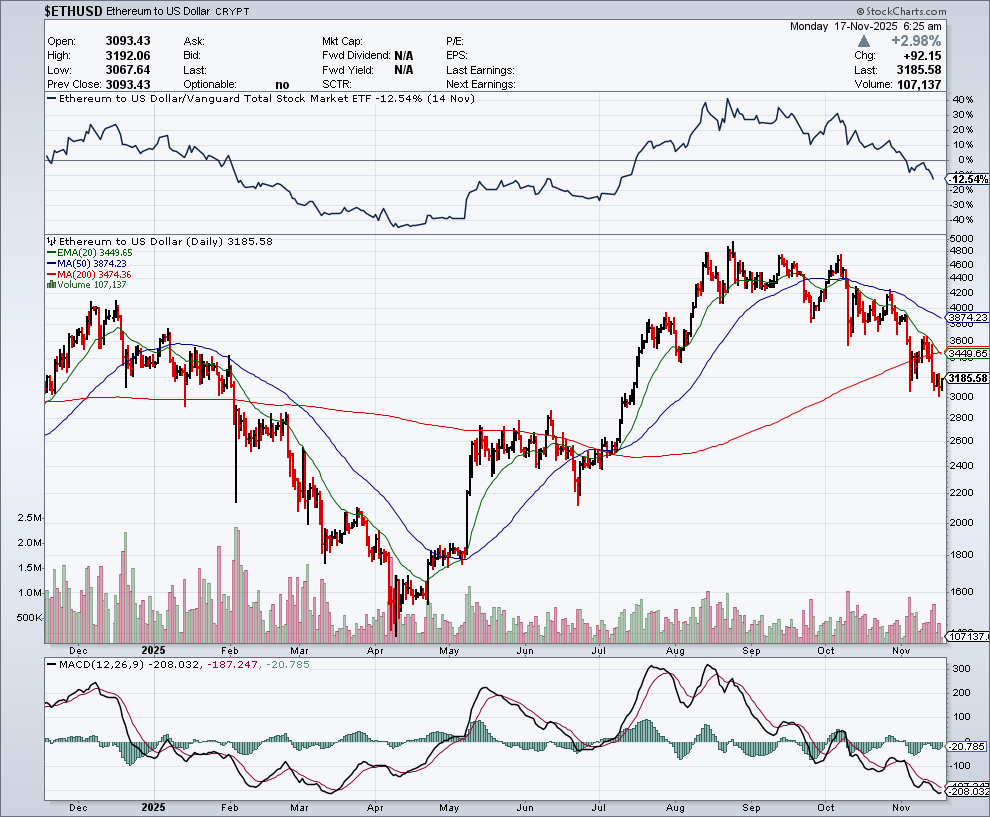
That’s been a key shift, and a clear move lower this year led to correction lows near $74,000 for Bitcoin. Ether’s mid-2025 lows were near $3,500.
Clearly, there is a lot to worry about for readers who are heavy crypto traders.
Moderating but sticky inflation still leaves the economy vulnerable to price spikes heading into winter.
My guess is that upcoming high inflation data will show up in the form of elevated utility bills, particularly in natural gas.
The sabotage and geopolitical tensions that disrupted energy supply in prior years still echo through markets, and OPEC’s decisions continue to have global effects.
The negative events are just piling on top of each other at this point.
I just don’t see how Bitcoin sustains itself above six-figure territory in the short term.
If it does surpass $120,000 because of a bear-market rally, traders will take profits yet again, rinse and repeat.
Although equity markets may rally through the day, this remains another reminder of the strategic fragility of this alternative asset that once offered so much hope.
Crypto has turned into nothing more than an ultra-speculative asset that, in times of tight liquidity, goes on life support.
It remains volatile, and although institutional adoption and ETFs have added legitimacy, its price still fails many traditional store-of-value tests.
Sell any rally over $120,000 because it won’t last there long.
https://madhedgefundtrader.com/wp-content/uploads/2019/05/cropped-mad-hedge-logo-transparent-192x192_f9578834168ba24df3eb53916a12c882.png00Mad Hedge Fund Traderhttps://madhedgefundtrader.com/wp-content/uploads/2019/05/cropped-mad-hedge-logo-transparent-192x192_f9578834168ba24df3eb53916a12c882.pngMad Hedge Fund Trader2022-10-13 15:02:212025-11-17 02:28:22Looking For A Savior
Mad Hedge Bitcoin Letter October 11, 2022 Fiat Lux
Featured Trade:
(KOWTOWS TO THE INSTITUTIONS) (BTC), (ETH), (COIN), (GOOGL)
https://madhedgefundtrader.com/wp-content/uploads/2019/05/cropped-mad-hedge-logo-transparent-192x192_f9578834168ba24df3eb53916a12c882.png00Mad Hedge Fund Traderhttps://madhedgefundtrader.com/wp-content/uploads/2019/05/cropped-mad-hedge-logo-transparent-192x192_f9578834168ba24df3eb53916a12c882.pngMad Hedge Fund Trader2022-10-11 16:04:572022-10-11 16:26:34October 11, 2022
Legal Disclaimer
There is a very high degree of risk involved in trading. Past results are not indicative of future returns. MadHedgeFundTrader.com and all individuals affiliated with this site assume no responsibilities for your trading and investment results. The indicators, strategies, columns, articles and all other features are for educational purposes only and should not be construed as investment advice. Information for futures trading observations are obtained from sources believed to be reliable, but we do not warrant its completeness or accuracy, or warrant any results from the use of the information. Your use of the trading observations is entirely at your own risk and it is your sole responsibility to evaluate the accuracy, completeness and usefulness of the information. You must assess the risk of any trade with your broker and make your own independent decisions regarding any securities mentioned herein. Affiliates of MadHedgeFundTrader.com may have a position or effect transactions in the securities described herein (or options thereon) and/or otherwise employ trading strategies that may be consistent or inconsistent with the provided strategies.