
• support@madhedgefundtrader.com
  • Member Login
Mad Hedge Fund Trader
  • Home
  • About
  • Store
  • Luncheons
  • Testimonials
  • Contact Us
  • Click to open the search input field Click to open the search input field Search
  • Menu Menu

Tag Archive for: (FXI)

Mad Hedge Fund Trader

China?s Firecracker Surprise

Diary, Newsletter, Research

Don?t waste your time trying to analyze financial markets right now.

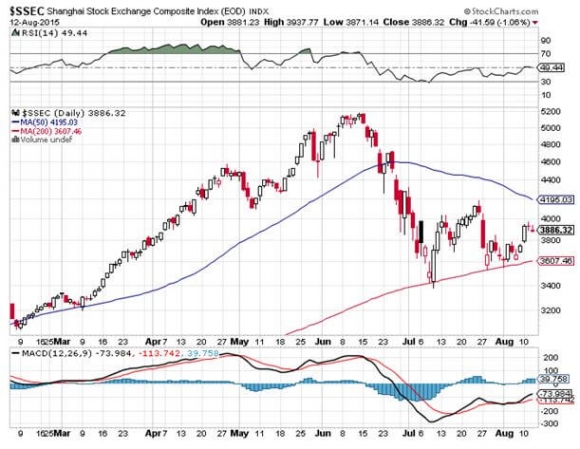
There is only one ticker symbol you need to know about, that for the Shanghai Stock Exchange Composite Index, the ($SSEC).

When Shanghai goes up, the rest of the world?s risk assets happily join the party. When it drops, ?RISK OFF? fever goes pandemic.

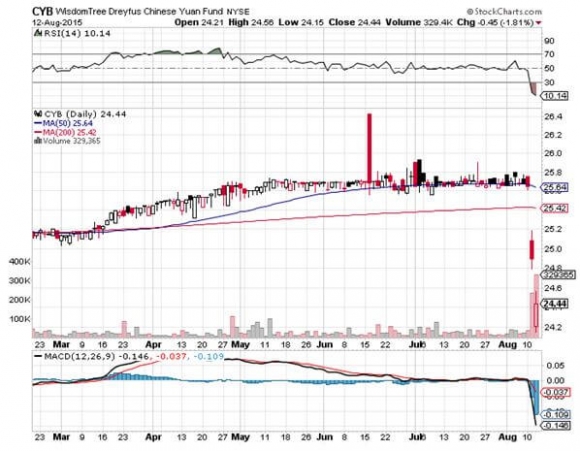
China upped the ante this week when it allowed its currency, the Yuan, or the renminbi as it is known locally (the people?s currency), to float freely for the first time in 25 years. That produced a two-day devaluation of 3.6%.

In the very long history of currency debasements, this one was barely a whimper.

Ancient Sumerians used to shave the edges off of gold and silver coins 5,000 years ago.

When President Nixon took the US off of the gold standard in 1973, the dollar eventually fell 75% against the European currencies.

More recently, the Euro has given up 37% against the greenback, moving from a position of grotesque over valuation to dealing with the Greek credit crisis.

So Beijing?s move this week barely tips the needle in the official history of devaluations.

What it does do is create a giant psychological effect, and therein lies the problem.

Since June, the Mandarins in China have been pulling out all the stops to halt a free fall in the country?s share prices.

It has cut interest rates and relaxed reserve requirements. It banned high frequency trading, blaming the collapse on foreign short sellers (sound familiar?). It has even made stock selling illegal in roughly 94% of the country?s free float.

Still, the bears remain emboldened by their recent success.

By cutting the value of the Yuan, the government is providing a modest boost to the economy. A cheaper currency means less expensive exports and more of them, thus, making local businesses more profitable and creating jobs.

But not by much.

There are not a lot of products that live or die on a 3.6% margin. America has not just lost a chunk of its own exports from the additional competition, contrary to the claims of the TV networks and bogus newsletters with which I compete.

But by taking the first such move to undercut the Yuan in 25 years, it is showing the world how serious a problem is the stock crash.

Will the stock collapse feed into the main economy? Is 10% of the world?s GDP going into a Great Recession? Yikes!

SELL, SELL!

There are a few other problems with the Chinese firecracker.

It violates a secret agreement with the US government, made a decade ago, to allow a steady 3-4% a year appreciation of the Yuan against the dollar.

This was designed to slowly eliminate the artificial under valuation of the Yuan that gave the Middle Kingdom an unfair export advantage. The arrangement was responsible for the 20% rise of the Yuan since 2009.

(Sorry Donald, but you?re holding the chart upside down. Yes, I know, stock charts can be pesky things).

Reneging on the deal is ruffling feathers at the US Treasury in Washington. But it won?t amount to more than that, as long as it is temporary.

Which it will be.

China still has a massive trade surplus with the United States. In 2014, it totaled a staggering $343 billion. It maintained that heady pace, totaling $171 billion during the first half of 2015.

There are an awful lot of Chinese clothes, electronics, and toys sitting on the shelves of American retailers.

Its imports are falling, thanks to the collapse of the price of oil and other bulk commodities.

The natural state of the currency of any country running such huge surpluses is for it to rise in value. That will continue in China?s case for the foreseeable future.

Once the waters settle in the stock market, you can count on the Yuan to regain its upward path.

However, this isn?t going to happen in a day. It could be weeks or months until order returns to Chinese equity markets. Until then, expect some scary days there and here as well.

Compound these problems with the uncertainty over the Federal Reserve?s decision on interest rates in September and slower than expected US growth.

It certainly leaves traders and investors alike, with a full plate of issues to consider.

As if we didn?t have enough to worry about.

For some background on my 45 year coverage of the Middle Kingdom, please click here for my 2011 SPECIAL CHINA ISSUE.
CYB 8-12-15

SSEC 8-12-15

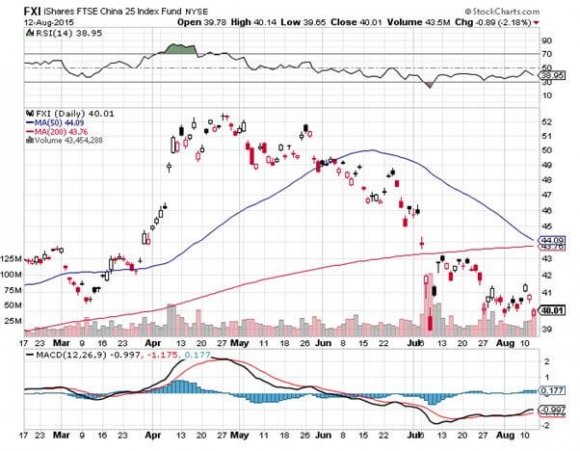
FXI 8-12-15

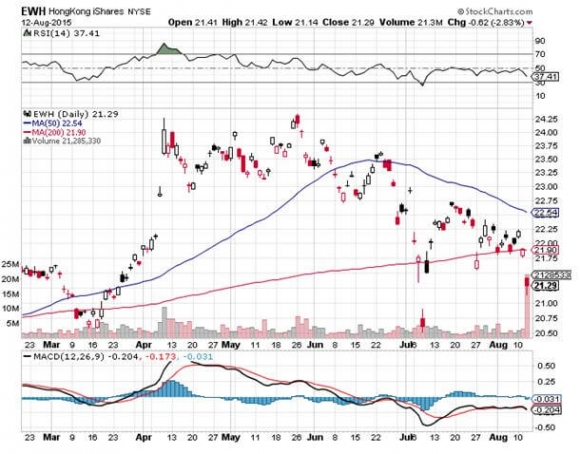
EWH 8-12-15

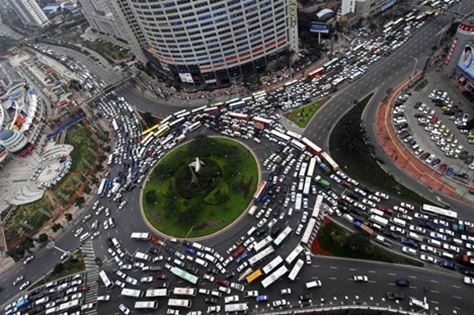
China - FirecrackerSurprise!

https://www.madhedgefundtrader.com/wp-content/uploads/2015/08/China-Firecracker-e1439470828256.jpg 272 400 Mad Hedge Fund Trader https://madhedgefundtrader.com/wp-content/uploads/2019/05/cropped-mad-hedge-logo-transparent-192x192_f9578834168ba24df3eb53916a12c882.png Mad Hedge Fund Trader2015-08-13 01:05:262015-08-13 01:05:26China?s Firecracker Surprise
Mad Hedge Fund Trader

The China View from 30,000 Feet

Diary, Newsletter

I have long sat beside the table of McKinsey & Co., the best management consulting company in Asia, hoping to catch some crumbs of wisdom (click here for their home page). So, I jumped at the chance to have breakfast with Shanghai based Worldwide Managing Director, Dominic Barton, when he passed through San Francisco visiting clients.

These are usually sedentary affairs, but Dominic spit out fascinating statistics so fast I had to write furiously to keep up. Sadly, my bacon and eggs grew cold and congealed. Asia has accounted for 50% of world GDP for most of human history. It dipped down to only 10% over the last two centuries, but is now on the way back up. That implies that China?s GDP will triple relative to our own from current levels.

A $500 billion infrastructure oriented stimulus package enabled the Middle Kingdom to recover faster from the Great Recession than the West, and if this didn?t work, they had another $500 billion package sitting on the shelf. But with GDP of only $6.5 trillion today, don?t count on China bailing out our $16.5 trillion economy.

China is trying to free itself from an overdependence on exports by creating a domestic demand driven economy. The result will be 900 million Asians joining the global middle class who are all going to want cell phones, PC?s, and to live in big cities. Asia has a huge edge over the West with a very pro-growth demographic pyramid. China needs to spend a further $2 trillion in infrastructure spending, and a new 75-story skyscraper is going up there every three hours!

Some 1,000 years ago, the Silk Road was the world?s major trade route, and today intra-Asian trade exceeds trade with the West. The commodity boom will accelerate as China withdraws supplies from the market for its own consumption, as it has already done with the rare earths.

Climate change is going to become a contentious political issue, with per capita carbon emission at 19 tons in the US, compared to only 4.6 tons in China, but with all of the new growth coming from the latter. Protectionism, pandemics, huge food and water shortages, and rising income inequality are other threats to growth.

To me, this all adds up to buying on the next substantial dip big core longs in China (FXI), commodities (DBC) and the 2X (DYY), food (DBA), and water (PHO). A quick Egg McMuffin next door filled my other needs.

Egg McMuffin

FXI 4-23-14

DBA 4-23-14

PHO 4-23-14

Great Wall of China

https://www.madhedgefundtrader.com/wp-content/uploads/2014/04/Great-Wall-of-China-e1428328303137.jpg 400 284 Mad Hedge Fund Trader https://madhedgefundtrader.com/wp-content/uploads/2019/05/cropped-mad-hedge-logo-transparent-192x192_f9578834168ba24df3eb53916a12c882.png Mad Hedge Fund Trader2014-04-25 01:03:492014-04-25 01:03:49The China View from 30,000 Feet
Mad Hedge Fund Trader

Why Jim Chanos is Wrong on China

Diary, Newsletter

Hedge fund titan, Jim Chanos, is well known for his extremely bearish views on China. He says that the cracks are spreading on the fa?ade, real estate sales are falling, and that the economic engine is starting to sputter.

This will be bad news for the rest of us, as China imports 50%-80% of the world?s commodities. Commodity exporting countries will be especially hard hit, like Canada, Australia, and parts of the US. Modern China has only seen a bull market, and he doubts their ability to manage a true crisis.

There is a widespread misperception that the government will step in and provide any bailouts that will be needed. The domestic Chinese banking system has in fact already been bailed out two times. The harsh reality is that while Chinese companies are selling billions of dollars? worth of new stock issues in the US through IPO?s, a privileged elite is getting their money out of the country as rapidly as they can.

Jim says that he already has short positions in the Middle Kingdom that are profitable. There is no way that even a wrinkle in a market of this size is without global implications, and on that point Jim is right.

However, I think that Jim, who confesses to having never visited China, is missing the broader long-term picture here. China has literally been building a Rome a day, the ancient kind, and the modern size every two weeks. In a year, it builds the equivalent of the entire housing stock of Spain, and in 15 years the equivalent for all of Europe.

While a lot of apartment buildings have been constructed, the country is rapidly creating the middle class to fill them. Even allowing for a pull back from its past blistering 11% per annum GDP growth rate to only 7.7%, urban disposable income per person is expected to grow by 2.5 times to $7,500 by 2020.

Over the same time frame, some 160 million are expected to move from the hinterlands to urban areas. Rising standard of livings mean that residential floor space per person will jump from 270 square feet to 369 square feet, still tiny by Western standards. That is a lot of housing demand.

China has already taken steps to head off a housing crisis, unlike the US. Many banks are now demanding cash deposits of 40%, well over the official requirement of 30%. The government is in effect forcing the banks to deleverage before hard times hit. Too bad they didn?t think of that here.

I think China still has several good years ahead of it, and I am going to pile into the stock ETF (FXI) and the Yuan ETF (CYB) as soon as the current bout of malaise selling exhausts itself. The Country?s real challenge arises when its demographic pyramid starts to invert in about five years, the result of a then 35 year old ?one child? policy, when too many single children have to start supporting two retiring parents.

FXI 4-3-14

CYB 4-3-14

CHL 4-3-14

ChinaChina: Not Enough Demand?

https://www.madhedgefundtrader.com/wp-content/uploads/2013/05/China.jpg 316 474 Mad Hedge Fund Trader https://madhedgefundtrader.com/wp-content/uploads/2019/05/cropped-mad-hedge-logo-transparent-192x192_f9578834168ba24df3eb53916a12c882.png Mad Hedge Fund Trader2014-04-04 01:04:232014-04-04 01:04:23Why Jim Chanos is Wrong on China
Mad Hedge Fund Trader

India is Catching Up With China

Diary, Newsletter

When I first visited Calcutta in 1976, more than 800,000 people were sleeping on the sidewalks, I was hauled everywhere by a very lean, barefoot rickshaw driver, and drinking the water out of a tap was tantamount to committing suicide.

Some 36 years later, and the subcontinent is poised to overtake China's white hot growth rate.

My friends at the International Monetary Fund just put out a report predicting that India will grow by 8.5% this year. While the country's total GDP is only a quarter of China's $5 trillion, its growth could exceed that in the Middle Kingdom as early as 2013. Many hedge funds believe that India will be the top growing major emerging market for the next 25 years, and are positioning themselves accordingly.

India certainly has a lot of catching up to do. According to the World Bank, its per capita income is $3,275, compared to $6,800 in China and $46,400 in the US. This is with the two populations close in size, at 1.3 billion for China and 1.2 billion for India.

But India has a number of advantages that China lacks. To paraphrase hockey great, Wayne Gretzky, you want to aim not where the puck is, but where it's going to be. The massive infrastructure projects that have powered much of Chinese growth for the past three decades, such as the Three Gorges Dam, are missing in India. But financing and construction for huge transportation, power generation, water, and pollution control projects are underway.

A large network of private schools is boosting education levels, enabling the country to capitalize on its English language advantage. When planning the expansion of my own business, I was presented with the choice of hiring a website designer here for $60,000 a year, or in India for $5,000. That's why booking a ticket on United Airlines or calling technical support at Dell Computer gets you someone in Bangalore.

India is also a huge winner on the demographic front, with one of the lowest ratios of social service demanding retirees in the world. China's 30-year-old 'one child' policy is going to drive it into a wall in ten years, when the number of retirees starts to outnumber their children.

There is one more issue out there that few are talking about. The reform of the Chinese electoral process at the People's Congress in 2013 could lead to posturing and political instability, which the markets could find unsettling. India is the world's largest democracy, and much of its current prosperity can be traced to wide ranging deregulation and modernization that took place 20 years ago.

I have been a big fan of India for a long time, and not just because they constantly help me fix my computers, make my travel reservations, and tell me how to work my new altimeter watch. In August, I recommended Tata Motors (TTM), and it has gone up in a straight line since, instantly making it one of my top picks of the year. On the next decent dip take a look at the Indian ETF's (INP), (PIN), and (EPI).

PIN 12-11-13

FXI 12-11-13

TTM 12-11-13

India 2010 PopulationBetter to Own This Pyramid


China 2010 PopulationThan This Pyramid


RickshawTaxi! Taxi!

https://www.madhedgefundtrader.com/wp-content/uploads/2013/08/Rickshaw.jpg 338 454 Mad Hedge Fund Trader https://madhedgefundtrader.com/wp-content/uploads/2019/05/cropped-mad-hedge-logo-transparent-192x192_f9578834168ba24df3eb53916a12c882.png Mad Hedge Fund Trader2013-12-26 01:05:172013-12-26 01:05:17India is Catching Up With China
Mad Hedge Fund Trader

India is Catching Up With China

Diary, Newsletter

When I first visited Calcutta in 1976, more than 800,000 people were sleeping on the sidewalks, I was hauled everywhere by a very lean, barefoot rickshaw driver, and drinking the water out of a tap was tantamount to committing suicide. Some 36 years later, and the subcontinent is poised to overtake China's white hot growth rate.

My friends at the International Monetary Fund just put out a report predicting that India will grow by 8.5% this year. While the country's total GDP is only a quarter of China's $5 trillion, its growth could exceed that in the Middle Kingdom as early as 2014.

Many hedge funds believe that India will be the top growing major emerging market for the next 25 years, and are positioning themselves accordingly. Investors are now taking a harder look at the country ETF?s, including India (INP) and China (FXI), which have recently suffered gut churning selloffs.

India certainly has a lot of catching up to do. According to the World Bank, its per capita income is $3,275, compared to $6,800 in China and $46,400 in the US. This is with the two populations close in size, at 1.3 billion for China and 1.2 billion for India.

But India has a number of advantages that China lacks. To paraphrase hockey great, Wayne Gretzky, you want to aim not where the puck is, but where it's going to be. The massive infrastructure projects that have powered much of Chinese growth for the past three decades, such as the Three Gorges Dam, are missing in India. But financing and construction for huge transportation, power generation, water, and pollution control projects are underway.

A large network of private schools is boosting education levels, enabling the country to capitalize on its English language advantage. When planning the expansion of my own business, I was presented with the choice of hiring a website designer here for $60,000 a year, or in India for $5,000. That's why booking a ticket on United Airlines or calling technical support at Dell Computer gets you someone in Bangalore.

India is also a huge winner on the demographic front, with one of the lowest ratios of social service demanding retirees in the world. China's 30 year old 'one child' policy is going to drive it into a wall in ten years, when the number of retirees starts to outnumber their children.

There is one more issue out there that few are talking about. The reform of the Chinese electoral process at the next People's Congress in 2013 could lead to posturing and political instability which the markets could find unsettling. India is the world's largest democracy, and much of its current prosperity can be traced to wide ranging deregulation and modernization than took place 20 years ago.

I have been a big fan of India for a long time, and not just because they constantly help me fix my computers. In the past, I recommended Tata Motors (TTM), which has since doubled, making it one of my best, all-time single stock picks (click here for ?Take Tata Motors Out for a Spin?). On the next decent dip take a look at the Indian ETF?s (INP), (PIN), and (EPI).

INP 12-5-13


FXI 12-5-13

TTM 12-5-13

India 2010 PopulationBetter to Own This Pyramid


China 2010 PopulationThan This Pyramid


RickshawTaxi! Taxi!

https://www.madhedgefundtrader.com/wp-content/uploads/2013/08/Rickshaw.jpg 338 454 Mad Hedge Fund Trader https://madhedgefundtrader.com/wp-content/uploads/2019/05/cropped-mad-hedge-logo-transparent-192x192_f9578834168ba24df3eb53916a12c882.png Mad Hedge Fund Trader2013-12-06 01:03:242013-12-06 01:03:24India is Catching Up With China
Mad Hedge Fund Trader

How US Job Losses Will End

Newsletter

I was researching comparative Asian wage data the other day and was astounded with what I found. Textile workers earn $2.99 an hour in India (PIN), $1.84 in China (FXI), and $0.49 in Vietnam (VNM). This is an 18 fold increase in labor costs from ten cents an hour since Chinese industrialization launched in 1978.

This compares to the $8 an hour our much abused illegals get at sweat shops in Los Angeles, and $10 in some of the nicer places. What?s more, the Indian wage is up 17% in a year, meaning that inflation is casting a lengthening shadow over the sub continent?s economic miracle. A series of strikes and a wave of suicides have brought wage settlements with increases as high as 20% in China.

This is how the employment drain in the US is going to end. When foreign labor costs reach half of those at home, manufacturers quit exporting jobs because the cost advantages gained are not worth the headaches and risk involved in managing a foreign language work force, the shipping expense, political risk, import duties, and supply disruptions, just to get lower quality goods. Chinese wage growth at this rate takes them up to half our minimum wage in only five years.

This has already happened in South Korea (EWY), where wage costs are 60% of American ones. As a result, Korea?s GDP growth is half that seen in China. These numbers are also a powerful argument for investing in Vietnam, where wages are only 27% of those found in the Middle Kingdom, and where Chinese companies are increasingly doing their own offshoring. This is why I have pushed the Vietnam ETF (VNM) on many occasions. I know every time I do this I get torrents of emails bitterly complaining how difficult it is to do business there, and how the hardwood trees are still full of shrapnel left over from the war, and why I shouldn?t buy a 50 acre industrial park there.? But, the numbers don?t lie.

FXI 8-22-13

EWY 8-22-13

PIN 8-22-13

VNM 8-22-13

Vietnam Flag

https://www.madhedgefundtrader.com/wp-content/uploads/2013/08/Vietnam-Flag.jpg 287 446 Mad Hedge Fund Trader https://madhedgefundtrader.com/wp-content/uploads/2019/05/cropped-mad-hedge-logo-transparent-192x192_f9578834168ba24df3eb53916a12c882.png Mad Hedge Fund Trader2013-08-23 01:05:552013-08-23 01:05:55How US Job Losses Will End
Mad Hedge Fund Trader

India vs. China

Diary, Newsletter

When I first visited Calcutta in 1976, 800,000 people were sleeping on the sidewalks, I was hauled everywhere by a very lean, barefoot rickshaw driver, and drinking the water out of a tap was tantamount to committing suicide. Some 35 years later, and the subcontinent is poised to overtake China?s white hot growth rate.

My friends at the International Monetary Fund issued a report predicting that India will grow by 6.5% this year. While the country?s total GDP is only a quarter of China?s $6 trillion, its growth could exceed that in the Middle Kingdom as early as 2014.

Many hedge funds believe that India will be the top growing major emerging market for the next 25 years, and are positioning themselves accordingly. Investors are now taking a harder look at the country ETF?s, including India (INP) and China (FXI), which have recently suffered gut churning selloffs.

India certainly has a lot of catching up to do. According to the World Bank, its per capita income is $3,275, compared to $6,800 in China and $46,400 in the US. This is with the two populations close, at 1.3 billion for China and 1.2 billion for India.

But India has a number of advantages that China lacks. To paraphrase hockey great, Wayne Gretzky, you want to aim not where the puck is, but where it?s going to be. The massive infrastructure projects that have powered much of Chinese growth for the past three decades, such as the Three Gorges dam, are missing in India. But financing and construction for huge transportation, power generation, water, and pollution control projects are underway.

A large network of private schools is boosting education levels, enabling the country to capitalize on its English language advantage. When planning the expansion of my own business, I was presented with the choice of hiring a website designer here for $60,000 a year, or in India for $5,000. That?s why booking a ticket on United Airlines or calling technical support at Dell Computer gets you someone in Bangalore.

India is also a huge winner on the demographic front, with one of the lowest ratios of social service demanding retirees in the world. China?s 30-year-old ?one child? policy is going to drive it into a wall in ten years, when the number of retirees starts to outnumber their children.

There is one more issue out there that few are talking about. The reform of the Chinese electoral process at the next People?s Congress could lead to posturing and political instability which the markets could find unsettling. India is the world?s largest democracy, and much of its current prosperity can be traced to wide ranging deregulation and modernization that took place 20 years ago.

I have been a big fan of India for a long time, and not just because they constantly help me fix my computers. In the past, I recommended Tata Motors (TTM), which has since doubled, making it one of my best, all-time single stock picks (click here for ?Take Tata Motors Out for a Spin?). On the next decent dip take a look at the Indian ETF?s (INP), (PIN), and (EPI).

INP 8-8-13

FXI 8-8-13

TTM 8-8-13

India 2010 Population Better to Own This Pyramid

China 2010 Population Than This Pyramid

Rickshaw Taxi! Taxi!

https://www.madhedgefundtrader.com/wp-content/uploads/2013/08/Rickshaw.jpg 338 454 Mad Hedge Fund Trader https://madhedgefundtrader.com/wp-content/uploads/2019/05/cropped-mad-hedge-logo-transparent-192x192_f9578834168ba24df3eb53916a12c882.png Mad Hedge Fund Trader2013-08-13 01:03:352013-08-13 01:03:35India vs. China
Mad Hedge Fund Trader

The Future of Consumer Spending?

Diary, Newsletter

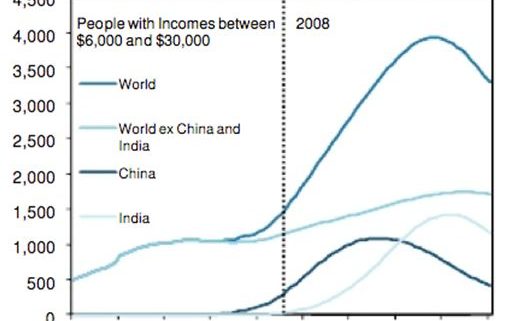
As part of my never ending campaign to get you to move more money into emerging markets, please take a look at the chart below from Goldman Sachs. It shows that the global middle class will rise from 1.8 billion today to 4 billion by 2040, with the overwhelming portion of the increase occurring in emerging markets.

The chart defines middle class as those earning between $6,000 and $30,000 a year. Adding 2.2 billion new consumers in these countries is creating immense new demand for all things and the commodities needed to produce them. This explains why these countries will account for 90% of GDP growth for at least the next ten years. It's all a great argument for using this dip to boost your presence in ETF's for emerging markets (EEM), China (FXI), Brazil (EWZ), and India (PIN).

Of course, you don't want to rush out and buy these things today. Emerging markets have been one of the worst performing asset classes of the year. But the selloff off is creating a once in a generation opportunity to get into the highest growing sector of the global economy on the cheap. I'll let you know when it is time to pull the trigger.

In the meantime, store this chart in your data base so when people ask why your portfolio is packed with Mandarin, Portuguese, and Hindi names, you can just whip it out.

World Middle Class

EEM 6-18-13

FXI 6-18-13

PIN 6-18-13

IDX 6-18-13

https://www.madhedgefundtrader.com/wp-content/uploads/2013/06/World-Middle-Class1.jpg 441 515 Mad Hedge Fund Trader https://madhedgefundtrader.com/wp-content/uploads/2019/05/cropped-mad-hedge-logo-transparent-192x192_f9578834168ba24df3eb53916a12c882.png Mad Hedge Fund Trader2013-06-20 10:42:522013-06-20 10:42:52The Future of Consumer Spending?
Mad Hedge Fund Trader

The China View from 30,000 Feet

Diary, Newsletter

I have long sat beside the table of McKinsey & Co., the best management consulting company in Asia, hoping to catch some crumbs of wisdom. So, I jumped at the chance to have breakfast with Shanghai based Worldwide Managing Director, Dominic Barton, when he passed through San Francisco visiting clients.

These are usually sedentary affairs, but Dominic spit out fascinating statistics so fast I had to write furiously to keep up. Sadly, my bacon and eggs grew cold and congealed. Asia has accounted for 50% of world GDP for most of human history. It dipped down to only 10% over the last two centuries, but is now on the way back up. That implies that China?s GDP will triple relative to our own from current levels.

A $500 billion infrastructure oriented stimulus package enabled the Middle Kingdom to recover faster from the Great Recession than the West, and if this didn?t work, they had another $500 billion package sitting on the shelf. But with GDP of only $5.5 trillion today, don?t count on China bailing out our $15.5 trillion economy.

China is trying to free itself from an overdependence on exports by creating a domestic demand driven economy. The result will be 900 million Asians joining the global middle class who are all going to want cell phones, PC?s, and to live in big cities. Asia has a huge edge over the West with a very pro-growth demographic pyramid. China needs to spend a further $2 trillion in infrastructure spending, and a new 75-story skyscraper is going up there every three hours!

Some 1,000 years ago, the Silk Road was the world?s major trade route, and today intra-Asian trade exceeds trade with the West. The commodity boom will accelerate as China withdraws supplies from the market for its own consumption, as it has already done with the rare earths.

Climate change is going to become a contentious political issue, with per capita carbon emission at 19 tons in the US, compared to only 4.6 tons in China, but with all of the new growth coming from the later. Protectionism, pandemics, huge food and water shortages, and rising income inequality are other threats to growth.

To me, this all adds up to buying on the next substantial dip big core longs in China (FXI), commodities (DBC) and the 2X (DYY), food (DBA), and water (PHO). A quick Egg McMuffin next door filled my other needs.

FXI 6-12-13

DBA 6-12-13

PHO 6-12-13

Great Wall of China

https://www.madhedgefundtrader.com/wp-content/uploads/2013/06/FXI-6-12-13.jpg 477 609 Mad Hedge Fund Trader https://madhedgefundtrader.com/wp-content/uploads/2019/05/cropped-mad-hedge-logo-transparent-192x192_f9578834168ba24df3eb53916a12c882.png Mad Hedge Fund Trader2013-06-13 09:04:472013-06-13 09:04:47The China View from 30,000 Feet
Mad Hedge Fund Trader

Why Jim Chanos is Wrong on China

Diary, Newsletter

Hedge fund titan, Jim Chanos, is well known for his extremely bearish views on China. He says that the cracks are spreading on the fa?ade, real estate sales are falling, and that the economic engine is starting to sputter.

This will be bad news for the rest of us, as China imports 50%-80% of the world?s commodities. Commodity exporting countries will be especially hard hit, like Canada, Australia, and parts of the US. Modern China has only seen a bull market, and he doubts their ability to manage a true crisis.

There is a widespread misperception that the government will step in and provide any bailouts that will be needed. The domestic Chinese banking system has in fact already been bailed out two times. The harsh reality is that while Chinese companies are selling billions of dollars? worth of new stock issues in the US through IPO?s, a privileged elite is getting their money out of the country as rapidly as they can. Jim says that he already has short positions in the Middle Kingdom that are profitable. There is no way that even a wrinkle in a market of this size is without global implications, and on that point Jim is right.

However, I think that Jim, who confesses to having never visited China, is missing the broader long-term picture here. China has literally been building a Rome a day, the ancient kind, and the modern size every two weeks. In a year, it builds the equivalent of the entire housing stock of Spain, and in 15 years the equivalent for all of Europe.

While a lot of apartment buildings have been constructed, the country is rapidly creating the middle class to fill them. Even allowing for a pull back from its past blistering 11% per annum GDP growth rate to only 7.7%, urban disposable income per person is expected to grow by 2.5 times to $7,500 by 2020.

Over the same time frame, some 160 million are expected to move from the hinterlands to urban areas. Rising standard of livings mean that residential floor space per person will jump from 270 square feet to 369 square feet, still tiny by Western standards. That is a lot of housing demand.

China has already taken steps to head off a housing crisis, unlike the US. The People?s Bank of China has raised bank reserve requirements five times, taking them to among the most stringent levels in the world. That is almost Canadian in its conservatism. Many banks are now demanding cash deposits of 40%, well over the official requirement of 30%. The government is in effect forcing the banks to deleverage before hard times hit. Too bad they didn?t think of that here.

I think China still has several good years ahead of it, and I am going to pile into the stock ETF (FXI) and the Yuan ETF (CYB) as soon as the current bout of malaise selling exhausts itself. The Country?s real challenge arises when its demographic pyramid starts to invert in about five years, the result of a then 35 year old ?one child? policy, when too many single children have to start supporting two retiring parents.

FXI 5-30-13

CYB 5-30-13

CHL 5-30-13

China China: Not Enough Demand?

https://www.madhedgefundtrader.com/wp-content/uploads/2013/05/China.jpg 316 474 Mad Hedge Fund Trader https://madhedgefundtrader.com/wp-content/uploads/2019/05/cropped-mad-hedge-logo-transparent-192x192_f9578834168ba24df3eb53916a12c882.png Mad Hedge Fund Trader2013-05-31 08:23:202013-05-31 08:23:20Why Jim Chanos is Wrong on China
Page 13 of 14«‹11121314›

Legal Disclaimer

There is a very high degree of risk involved in trading. Past results are not indicative of future returns. MadHedgeFundTrader.com and all individuals affiliated with this site assume no responsibilities for your trading and investment results. The indicators, strategies, columns, articles and all other features are for educational purposes only and should not be construed as investment advice. Information for futures trading observations are obtained from sources believed to be reliable, but we do not warrant its completeness or accuracy, or warrant any results from the use of the information. Your use of the trading observations is entirely at your own risk and it is your sole responsibility to evaluate the accuracy, completeness and usefulness of the information. You must assess the risk of any trade with your broker and make your own independent decisions regarding any securities mentioned herein. Affiliates of MadHedgeFundTrader.com may have a position or effect transactions in the securities described herein (or options thereon) and/or otherwise employ trading strategies that may be consistent or inconsistent with the provided strategies.

Copyright © 2026. Mad Hedge Fund Trader. All Rights Reserved. support@madhedgefundtrader.com
Scroll to top