
• support@madhedgefundtrader.com
  • Member Login
Mad Hedge Fund Trader
  • Home
  • About
  • Store
  • Luncheons
  • Testimonials
  • Contact Us
  • Click to open the search input field Click to open the search input field Search
  • Menu Menu

Tag Archive for: (PLTR)

Mad Hedge Fund Trader

The Best Way to Streamline Your Portfolio

Tech Letter

Overperformance is mainly about the art of taking complicated data and finding perfect solutions for it. Trading in technology stocks is no different.

Investing in software-based cloud stocks has been one of the seminal themes I have promulgated since the launch of the Mad Hedge Technology Letter way back in February 2018.

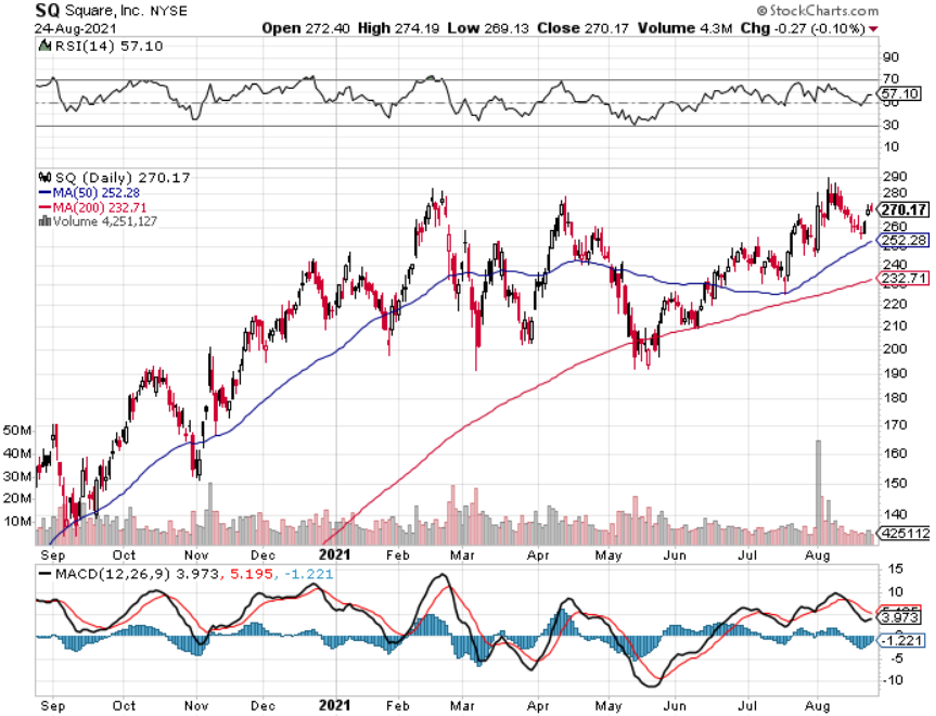
I hit the nail on the head and many of you have prospered from my early calls on AMD, Micron to growth stocks like Square, PayPal, and Roku. I’ve hit on many of the cutting-edge themes.

Well, if you STILL thought every tech letter until now has been useless, this is the one that should whet your appetite.

Instead of racking your brain to find the optimal cloud stock to invest in, I have a quick fix for you and your friends.

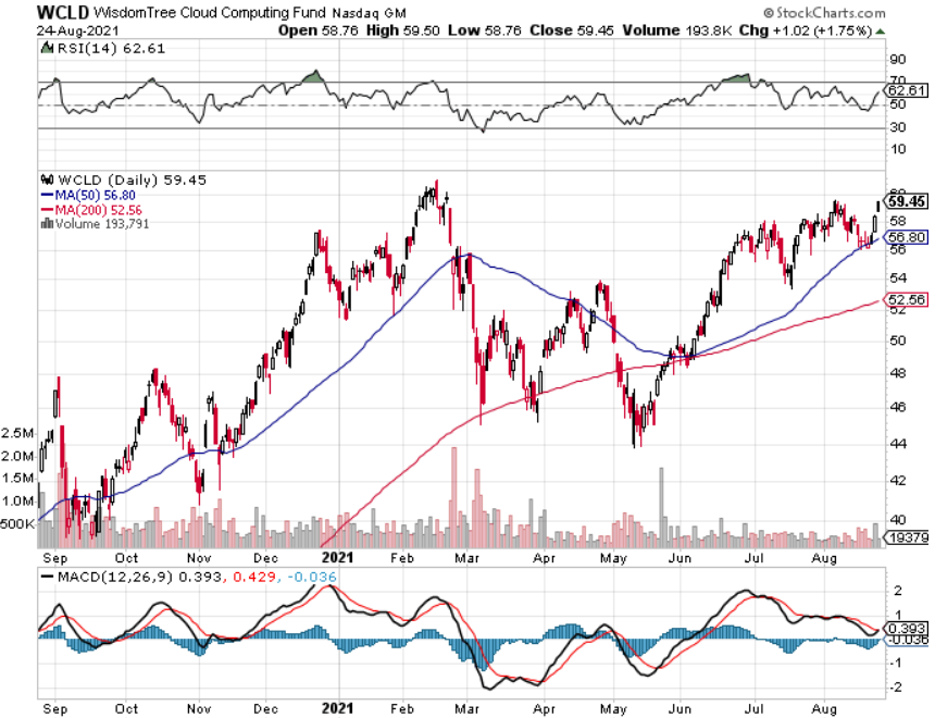
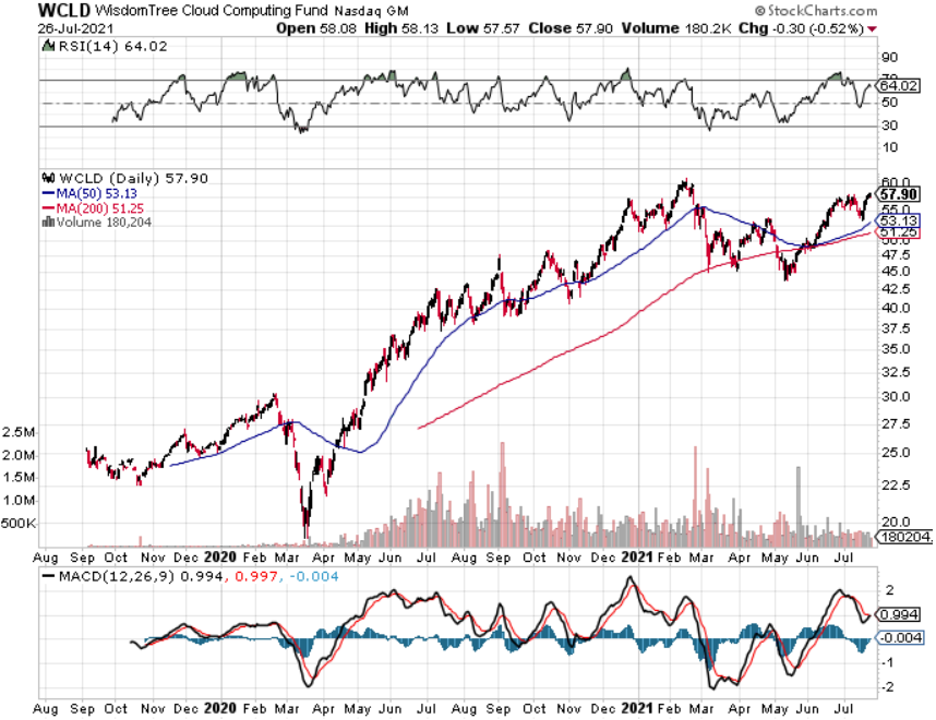
Invest in The WisdomTree Cloud Computing Fund (WCLD) which aims to track the price and yield performance, before fees and expenses, of the BVP Nasdaq Emerging Cloud Index (EMCLOUD).

What Is Cloud Computing?

The “cloud” refers to the aggregation of information online that can be accessed from anywhere, on any device remotely.

Yes, something like this does exist and we have been chronicling the development of the cloud since this tech letter’s launch.

The cloud is the concept powering the “shelter-at-home” trade which has been hotter than hot since March 2020.

Cloud companies provide on-demand services to a centralized pool of information technology (IT) resources via a network connection.

Even though cloud computing already touches a significant portion of our everyday lives, the adoption is on the verge of overwhelming the rest of the business world due to advancements in artificial intelligence and the Internet of Things (IoT) hyper-improving efficiencies.

The Cloud Software Advantage

Cloud computing has particularly transformed the software industry.

Over the last decade, cloud Software-as-a-Service (SaaS) businesses have dominated traditional software companies as the new industry standard for deploying and updating software. Cloud-based SaaS companies provide software applications and services via a network connection from a remote location, whereas traditional software is delivered and supported on-premise and often manually. I will give you a list of differences to several distinct fundamental advantages for cloud versus traditional software.

Product Advantages

Speed, Ease, and Low Cost of Implementation – cloud software is installed via a network connection; it doesn’t require the higher cost of on-premise infrastructure setup maintenance, and installation.

Efficient Software Updates – upgrades and support are deployed via a network connection, which shifts the burden of software maintenance from the client to the software provider.

Easily Scalable – deployment via a network connection allows cloud SaaS businesses to grow as their units increase, with the ability to expand services to more users or add product enhancements with ease. Client acquisition can happen 24/7 and cloud SaaS companies can easily expand into international markets.

Business Model Advantages

High Recurring Revenue – cloud SaaS companies enjoy a subscription-based revenue model with smaller and more frequent transactions, while traditional software businesses rely on a single, large, upfront transaction. This model can result in a more predictable, annuity-like revenue stream making it easy for CFOs to solve long-term financial solutions.

High Client Retention with Longer Revenue Periods – cloud software becomes embedded in client workflow, resulting in higher switching costs and client retention. Importantly, many clients prefer the pay-as-you-go transaction model, which can lead to longer periods of recurring revenue as upselling product enhancements does not require an additional sales cycle.

Lower Expenses – cloud SaaS companies can have lower R&D costs because they don’t need to support various types of networking infrastructure at each client location.

I believe the product and business model advantages of cloud SaaS companies have historically led to higher margins, growth, higher free cash flow, and efficiency characteristics as compared to non-cloud software companies.

How does the WCLD ETF select its indexed cloud companies?

Each company must satisfy critical criteria such as they must derive the majority of revenue from business-oriented software products, as determined by the following checklist.

+ Provided to customers through a cloud delivery model – e.g., hosted on remote and multi-tenant server architecture, accessed through a web browser or mobile device, or consumed as an application programming interface (API).

+ Provided to customers through a cloud economic model – e.g., as a subscription-based, volume-based, or transaction-based offering Annual revenue growth, of at least:

+ 15% in each of the last two years for new additions

+ 7% for current securities in at least one of the last two years

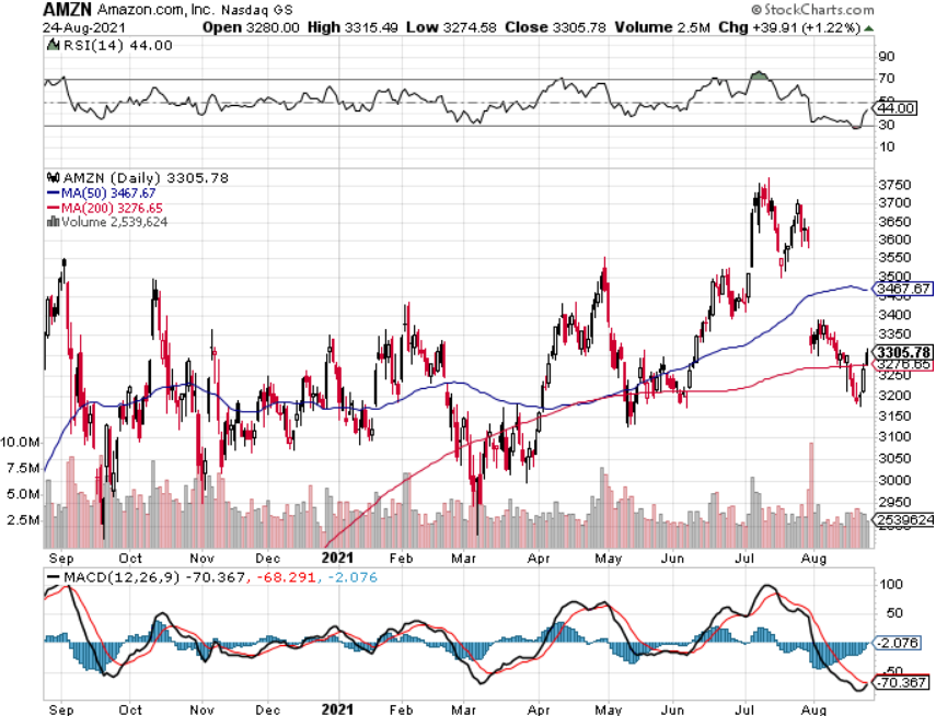
Some of the stocks that would epitomize the characteristics of a WCLD component are Salesforce, Microsoft, Amazon-- I mean, they are all up, you know, well over 100% from the nadir we saw in March 2020 and contain the emerging growth traits that make this ETF so robust.

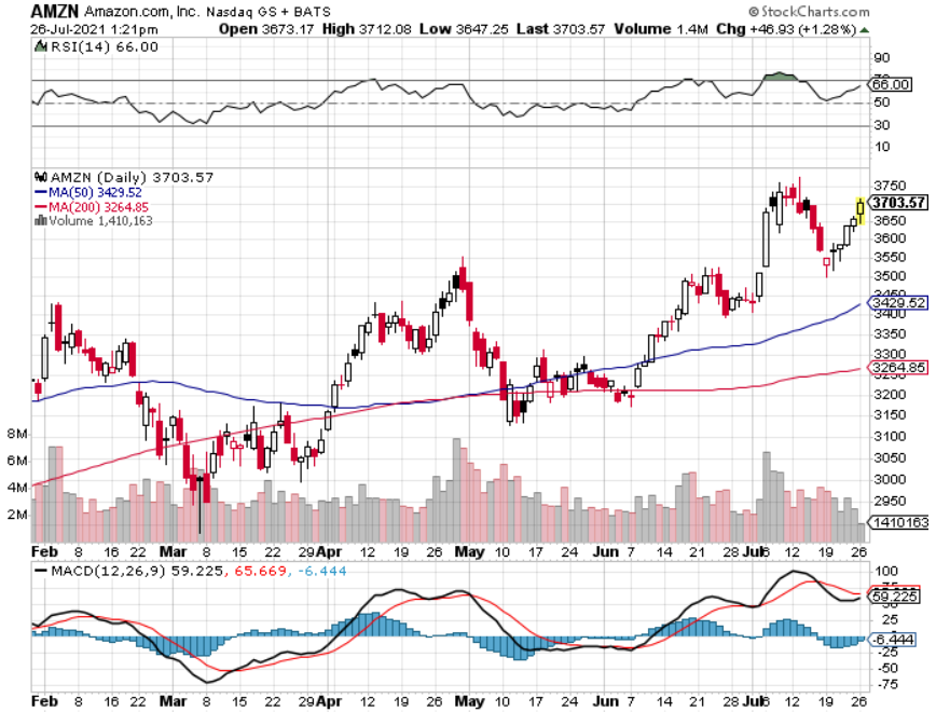
If you peel back the label and you look at the contents of many tech portfolios, they tend to favor some of the large-cap names like Amazon, not because they are “big” but because the numbers behave like emerging growth companies even when the law of large numbers indicate that to push the needle that far in the short-term is a gravity-defying endeavor.

We all know quite well that Amazon isn't necessarily a pure play on cloud computing software, because they do have other hybrid-sort of businesses, but the elements of its cloud business are nothing short of brilliant.

ETF funds like WCLD, what they look to do is to cue off of pure plays and include pure plays that are growing faster than the broader tech market at large. So, you're not going to necessarily see the vanilla tech of the world in that portfolio. You're going to see a portfolio that's going to have a little bit more sort of explosive nature to it, names with a little more mojo, a little bit more chutzpah because you're focusing on smaller names that have the possibility to go parabolic and gift you a 10-bagger precisely because they take advantage of the law of small numbers.

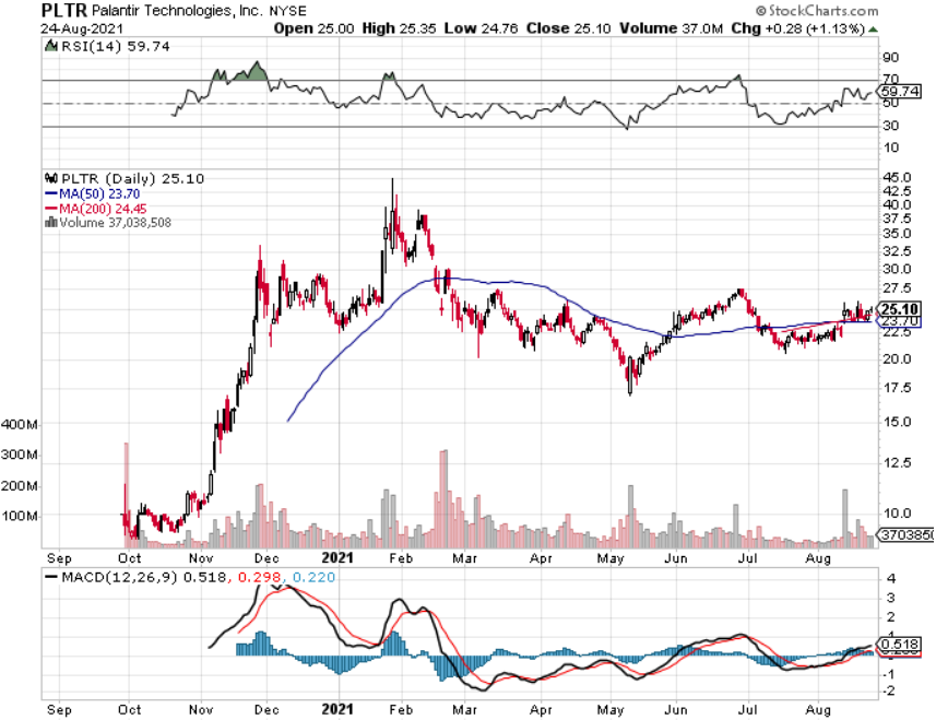
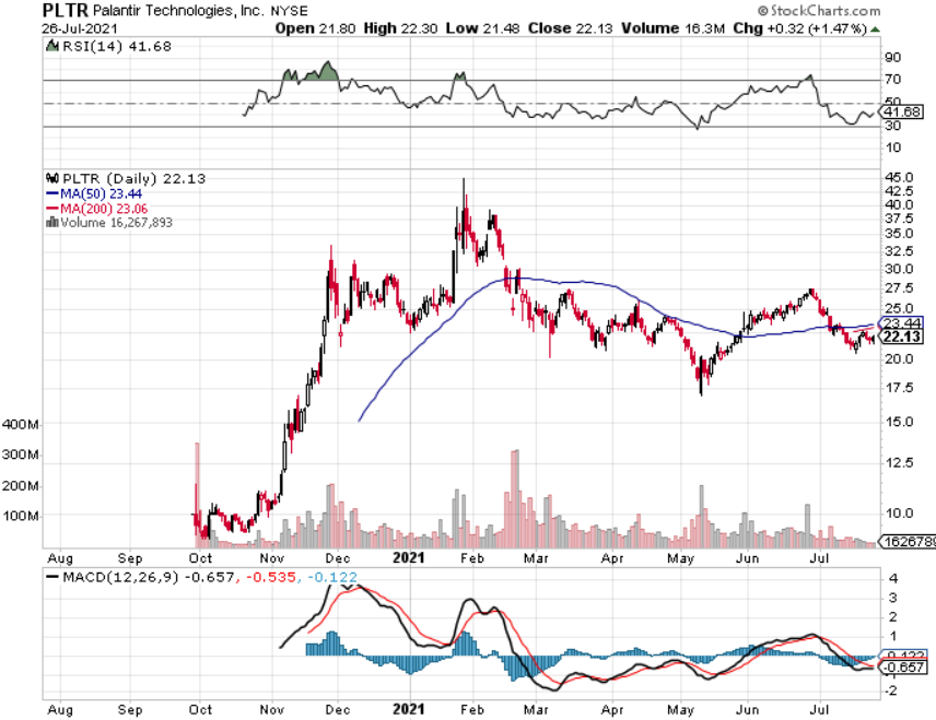
One stock that has the chance for a legitimate 10-bagger is my call on Palantir (PLTR).

Palantir is a tech firm that builds and deploys software platforms for the intelligence community in the United States to assist in counterterrorism investigations and operations.

This is one of the no-brainers that procure revenue from Democrat and Republican administrations.

In a global market where the search for yield couldn’t be tougher right now, right-sizing a tech portfolio to target those extraordinary, extra-salacious tech growth companies is one of the few ways to produce alpha without overleveraging.

No doubt there will be periods of volatility, but if a long-term horizon is something suited for you, this super-growth strategy is a winner, and don’t forget about PLTR while you’re at it.


cloud computing


cloud computing


https://madhedgefundtrader.com/wp-content/uploads/2019/05/cropped-mad-hedge-logo-transparent-192x192_f9578834168ba24df3eb53916a12c882.png 0 0 Mad Hedge Fund Trader https://madhedgefundtrader.com/wp-content/uploads/2019/05/cropped-mad-hedge-logo-transparent-192x192_f9578834168ba24df3eb53916a12c882.png Mad Hedge Fund Trader2021-07-30 15:02:502021-08-03 01:47:18The Best Way to Streamline Your Portfolio
Mad Hedge Fund Trader

July 7, 2021

Tech Letter

Mad Hedge Technology Letter
July 7, 2021
Fiat Lux

Featured Trade:

(SHOULD YOU BUY THE ROBINHOOD IPO?)
(HOOD), (COIN), (PLTR)

https://madhedgefundtrader.com/wp-content/uploads/2019/05/cropped-mad-hedge-logo-transparent-192x192_f9578834168ba24df3eb53916a12c882.png 0 0 Mad Hedge Fund Trader https://madhedgefundtrader.com/wp-content/uploads/2019/05/cropped-mad-hedge-logo-transparent-192x192_f9578834168ba24df3eb53916a12c882.png Mad Hedge Fund Trader2021-07-07 13:04:312021-07-07 15:36:04July 7, 2021
Mad Hedge Fund Trader

Should You Buy the Robinhood IPO?

Tech Letter

Robinhood (HOOD) is an American financial services company headquartered in Menlo Park, California, known for offering commission-free trades of stocks, exchange-traded, and cryptocurrencies via a mobile app introduced in March 2015.

After perusing their S-1, I can’t help but offer the same recommendation I gave readers for the Coinbase (COIN) listing, which proved to be spot on.

Although this is a real company with real revenues, the growth rates are particularly high because of a one-off phenomenon in alternative asset classes.

I would urge readers to not buy shares of HOOD directly after they are public but instead wait for an entry point sometime after the lock-up period expiration which usually coincides with the insiders and long-time employees unloading shares or a partial trove of them.

The same happened to Palantir (PLTR) which saw a meaningful sell-off upon the lock-up expiration and although PLTR shares are higher today than they were the day of lock-up expiration, it’s better to avoid that dip if you can. PLTR had a big dip when the lock-up expired presenting a great entry point into shares.

Lock-up periods are usually 180 days and I firmly believe this company that will be trading under the ticker symbol HOOD, is not worth paying a premium before that 180-day lock-up period is over.

Don’t be that sucker.

To dovetail with my thesis of not buying HOOD too early is the analysis of their inherent high stakes/ high rewards nature of the business.

Let’s not fudge the details, this is a high-risk business and as of now, they have been handsomely rewarded for it, but that might not always be the case.

They pioneered commission-free trading when the likes of Fidelity and Charles Schwab were still charging $15 to execute one side of a trade.

Why can they offer free trading?

Order history is paid for by third-party high-frequency traders, namely Citadel.

Citadel accounts for 27% of payments for Robinhood retail order flow, and Payment for order flow is 81% of total Robinhood revenue.

The thinking behind buying order flow is to then apply the data through machine learning to even front-run orders of normal retail traders and profit off the spread or micromovements in shares.

They even make markets with their liquidity and trade their own proprietary books.

And yes, this is legal in the United States and companies have gone gangbusters in high-frequency trading (HFT) like Virtu Financial founded by Vincent Viola who owns the NHL franchise Florida Panthers and is big into competing for his horses at the Kentucky Derby.

It obviously pays to do HFT, and if done properly, are great businesses and these are the companies propping up HOOD today.

Robinhood has taken advantage of the Millennial lust to go crypto or go home.

The numbers back me up — $11.6 billion of crypto under custody by the end of Q1.

Bitcoin was the HOOD’s most traded asset in 2020 and the first quarter of 2021 and 17% of total revenue came from crypto in Q1, (compared to 4% in Q420)

In the S-1, it said that HOOD’s business “may be adversely affected, and growth in our net revenue earned from cryptocurrency transactions may slow or decline, if the markets for Dogecoin deteriorate or if the price of Dogecoin declines.”

HOOD and its future success are now uniquely levered towards alternative coin Dogecoin which is now 34% of their total crypto revenue in Q1.

This is the altcoin that Elon Musk joked about, and it explains the 54% growth of 2020 revenue in the first 3 months of 2021.

This is an incredibly high-risk growth strategy that won’t work out every quarter.

HOOD now has 18 million cumulative funded accounts showing the popularity of the business and did $522M in 1Q21 revenue vs. $127.6M in 1Q20 and did $958.8M in revenue in '20 reporting $7.5M in net income.

The median age of customers on HOOD’s platform is 31 and over 50% are first-time investors so if they nurture this customer base, this could be a sticky business moving forward.

If they lead them down this treacherous Dogecoin cliff, it could be trouble and result in terrible quarterly earnings.

A few other risks I felt notable was that Robinhood users went from holding/trading $400M of crypto to $11.5B of crypto from March 2020 to 2021, but HOOD intends to potentially never offer delivery of customer crypto purchases.

This means they are exposed to derivative contracts which just layers on high risk on top of high risk.

Robinhood said there is tremendous regulatory risk for its stock with the company fined $70 million by the securities industry's self-regulator, FINRA, for misleading customers and system outages that the agency said hurt Robinhood's customers.

They said they will likely incur similar fines in the future and investors will need to stomach its predisposition to skirt the law.

There is nothing low-risk about HOOD, and I would wait for a big sell-off after the lock-up expiration to get in at a certain discounted price. Readers shouldn’t blindly pay a premium for HOOD, the risk isn’t worth it.


HOOD

https://madhedgefundtrader.com/wp-content/uploads/2019/05/cropped-mad-hedge-logo-transparent-192x192_f9578834168ba24df3eb53916a12c882.png 0 0 Mad Hedge Fund Trader https://madhedgefundtrader.com/wp-content/uploads/2019/05/cropped-mad-hedge-logo-transparent-192x192_f9578834168ba24df3eb53916a12c882.png Mad Hedge Fund Trader2021-07-07 13:02:032021-07-13 19:17:01Should You Buy the Robinhood IPO?
Mad Hedge Fund Trader

May 28, 2021

Diary, Newsletter, Summary

Global Market Comments
May 28, 2021
Fiat Lux

Featured Trade:

(MAY 26 BIWEEKLY STRATEGY WEBINAR Q&A),
(SPY), (DIS), (AMZN), (FCX), (X), (PLTR), (FXE), (FXA), (TLT), (TBT), (AMC), (GME), (ZM), (DAL), (AXP), (LEN), (TOL), (KBH), (DOCO), (ZM), (TSLA), (NVDA), (ROM)

https://madhedgefundtrader.com/wp-content/uploads/2019/05/cropped-mad-hedge-logo-transparent-192x192_f9578834168ba24df3eb53916a12c882.png 0 0 Mad Hedge Fund Trader https://madhedgefundtrader.com/wp-content/uploads/2019/05/cropped-mad-hedge-logo-transparent-192x192_f9578834168ba24df3eb53916a12c882.png Mad Hedge Fund Trader2021-05-28 10:33:542021-05-28 10:33:54May 28, 2021
Mad Hedge Fund Trader

May 26 Biweekly Strategy Webinar Q&A

Diary, Newsletter

Below please find subscribers’ Q&A for the May 26 Mad Hedge Fund Trader Global Strategy Webinar broadcast from Lake Tahoe, NV.

Q: Do you expect a longer pullback for the (SPY) through the summer and into the last quarter?

A: No, this market is chomping at the bit and go up and won’t do any more than a 5% correction. We’ve already tested this pullback twice. We could stay in this 5% range for a few more weeks or months, but no longer. If we make it to August before we take off to the upside, that would be a miracle. It seems to want to break out right now and if you look at the tech stocks charts you can see what I'm talking about.

Q: Why do day orders with spreads not good ‘til canceled (GTC)?

A: Actually, you can do good ‘til canceled on these spreads, it just depends on how your platform is set up. Good ‘til canceled won't hurt you—only if we get a sudden reversal on a stop out which has only happened four times this year.

Q: Disney (DIS) seems to be struggling to get back over $180; am I still safe with my January 2023 $250 LEAPS?

A: Yes, out to 2023 we’ll have two summers until those expire, so those look pretty good—that's a pretty aggressive trade, and I’m betting you’re looking at a 500% profit on those LEAPS. And by the way, I always urge people to go out long on these LEAPS, because the second year is almost free when you check the pricing. So, take the gift and that will also greatly reduce your risk. We could have a whole recession and recovery, and still have those LEAPS make it to $250 in Disney.

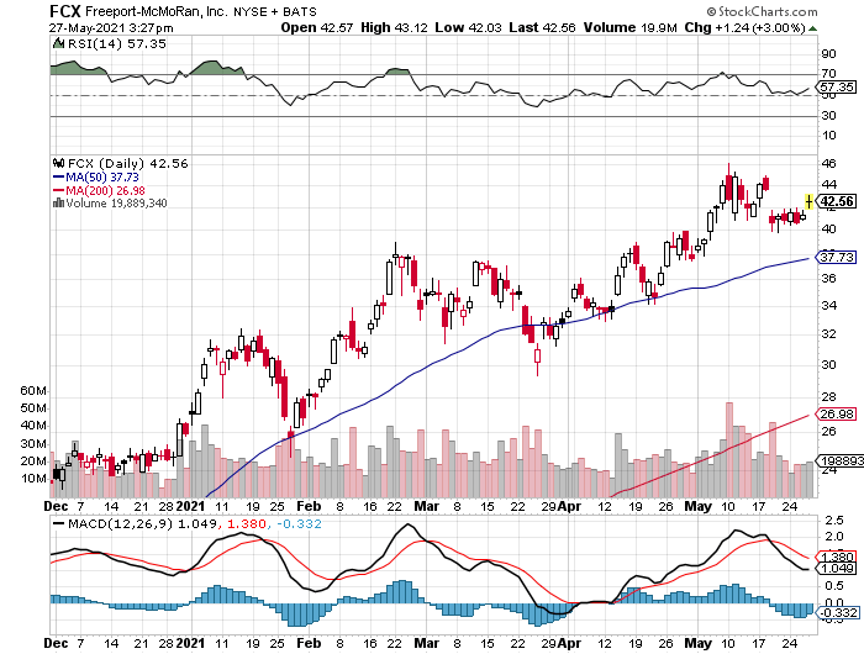
Q: Should I add to Freeport McMoRan (FCX)?

A: (FCX) I would not add—in fact, I would have a stop loss if we closed below $40 on (FCX) if you’re a short-term trader. There is a slowdown in the Chinese economy going on as well as a clampdown on commodity speculation. This has affected the whole base metal space, including steel and palladium. If you have the long-term LEAPS, keep them, because I think (FCX) doubles from here. The whole “green revolution story” is still good.

Q: Do you think the United States Treasury Bond Fund (TLT) is going up?

A: No, I think the (TLT) has been going down. I've been buying puts spreads like crazy, and I have a huge chunk of my own retirement fund in long-dated (TLT) LEAPS, so I am praying it will go down. We’ll talk about that when we get to the bond section.

Q: Prospects for U.S. Steel (X)?

A: It’s tied in with the whole rest of the base commodity complex—I think it is due for a rest after a terrific run, which is why I have such tight stop losses on Freeport McMoRan (FCX).

Q: Do you buy the “transitory” explanation for the hot inflation read two weeks ago that the Fed is handing out, or do you think inflation is bad and here to stay?

A: I go with the transitory argument because you’re getting a lot of one-time-only price rises off of the bottom a year ago when the economy completely shut down. Once those price rises work through the system, the inflation rate should go from 4.2% back down to 2% or so. So, I don't see inflation as a risk, which is why I think the stock markets can reach my 30% up target this year. You may get another hot month as the year-on-year comparisons are enormous. But betting on inflation is betting on the reversal of a 40-year trend, which usually doesn’t work out so well.

Q: On your spread trade alerts can we buy less than 25 contracts?

A: You can buy one contract. In fact, I recommend people start with one contract and test out where the real market is. Put a bid for one contract in the middle of the market, and if it doesn’t get done, raise your bid 5 cents, and eventually, your order gets done. Then you can add more if you want to. I always recommend this even for people who buy thousands of contracts, that they test the market with one contract order just to make sure the market is actually there.

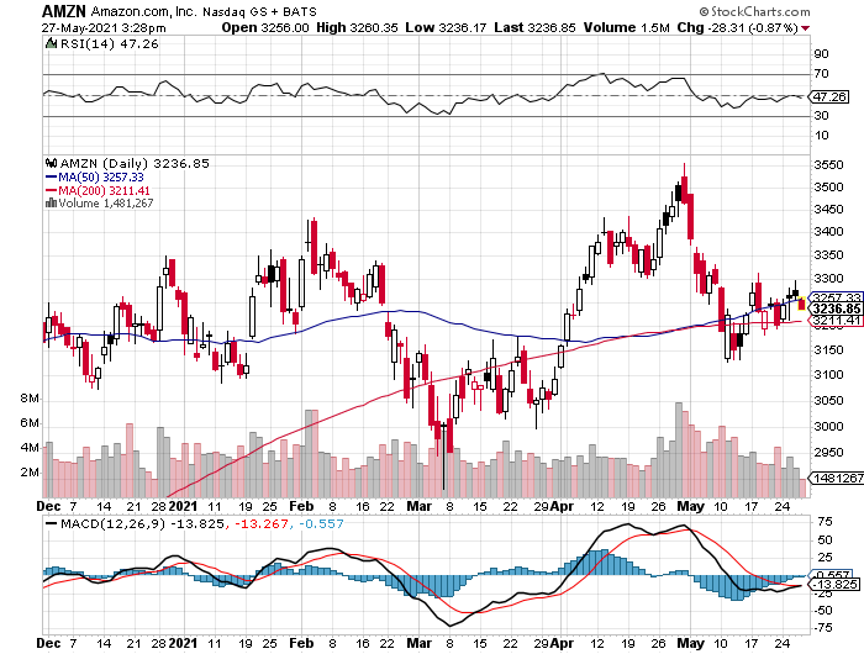
Q: Can you recommend a LEAPS for Amazon (AMZN)?

A: The Amazon LEAPS spread is the January 2022 $3150-3300 vertical call debit spread going out 8 months.

Q: When you short the (TLT), how do you do it?

A: I do vertical bear put debit spreads. I buy a near-money put and sell short and an out-of-the-money put so I can reduce the cost, and therefore triple my size. This strategy triples the leverage on the most likely part of the stock move to take place, which is the at the money. For example, a great one to buy here would be a January 2021 (TLT) $135/140 vertical bear put debit spread where you’re buying the $140 and selling short the $135. The potential 8-month profit on this is around 100%. You’ll make far more money on that kind of trade than you ever would just buying puts outright. Some 80% of the time the single option trades expire worthless. You don’t want to become one of those worthless people.

Q: What’s your best idea for avoiding a U.S. Dollar drop?

A: Buy the Invesco Currency Shares Euro Trust (FXE) or buy the Invesco Currency Shares Australian Dollar Trust Trust (FXA), the Australian Dollar to hedge some of your US Dollar risk. The Australian dollar is basically a call option on a global economic recovery.

Q: I’m a new subscriber, but I don’t get all the recommendations that you mention.

A: Please email customer support at support@madhedgefundtrader.com , tell them you’re not getting trade alerts, and she'll set you up. We have to get you into a different app in order for you to get all those alerts.

Q: How about the ProShares UltraShort 20 Year Treasury ETF (TBT)—is that a bet on declining (TLT)?

A: Absolutely yes, that is a great bet and we’re at a great entry point right now on the (TBT) so that is something I would start scaling into today.

Q: Do you still like Palantir (PLTR)?

A: Yes, but the reason I haven't been pushing it is because the CEO says he could care less about the stock market, and when the CEO says that it tends to be a drag on the stock. Palantir has an easy double or triple on it on a three-year view though. However, small tech has been out of favor since February as it is overpriced.

Q: How far down can the (TLT) go in the next 30 days?

A: It could go down to $135 and maybe $132 on an extreme move, especially if we get another hot CPI read on June 10. However, if you hear the word “taper” from a Fed official, then you’re looking at high $120’s in days.

Q: With the TLT going up, why have you not sent out an alert to double up on put spreads?

A: I tend to be a bit of a perfectionist since I’m a scientist and an engineer, so I’m hanging on for an absolute top to prove itself and start on the way down. On the shorts, I like selling them on the way down, and buying my longs on the way up, because there are always surprises, there’s always the unknown, and heaven forbid, I might actually be wrong sometimes! So, I’m still waiting on this one. And we do already have one position that is fairly close to the money now, the June 2021 $141-144 vertical bear put debit spread, so I don't want to double up on that until we have a reversal in the intermediate term trend.

Q: I see GameStop (GME) is spiking again now up to $230—should I get in for a short-term profit?

A: No. With these meme stocks, the trading is totally random. If anything, I would be selling short, but I would do it in a limited risk way by buying a put spread. However, the implied volatility in the options on these meme stocks are so high that it's almost impossible to make any money on options; you’re paying enormous amounts of money up front, so that's my opinion on GameStop and on AMC Entertainment Holdings (AMC), the other big meme stock.

Q: Will business travel come back after the world is vaccinated?

A: Absolutely. Companies don't want to send people on the road, but customers will demand it. All you need is one competitor to land an order because they visited the customer instead of doing a Zoom (ZM) meeting, and all of a sudden business travel will come roaring back. So that's why I was dabbling in Delta Airlines (DAL) and that's why I like American Express (AXP), where 8% of transactions are for first class airline tickets.

Q: As the work-from-home economy stops and workers go back to the office, do you see a 10% correction in the housing market?

A: Actually, in the housing market with real houses, I don't see prices dropping for years, because 30% of the people who went home to work are staying there for good—that the trend out of the cities into the hinterlands is a long-term trend that will continue for decades, now that Zoom has freed us of the obligations to commute and be near big cities. And of course, I’m a classic example of that; I've been working either in my basement in San Francisco or at Lake Tahoe for the last 14 years. Housing stocks on the other hand like Lennar (LEN), Toll Brothers (TOL) and KB Home (KBH) have had a tremendous run and are basically out of homes. Could they have a 10% correction at any time? Absolutely, yes.

Q: Should I avoid buying dips in last year's work-from-home stocks?

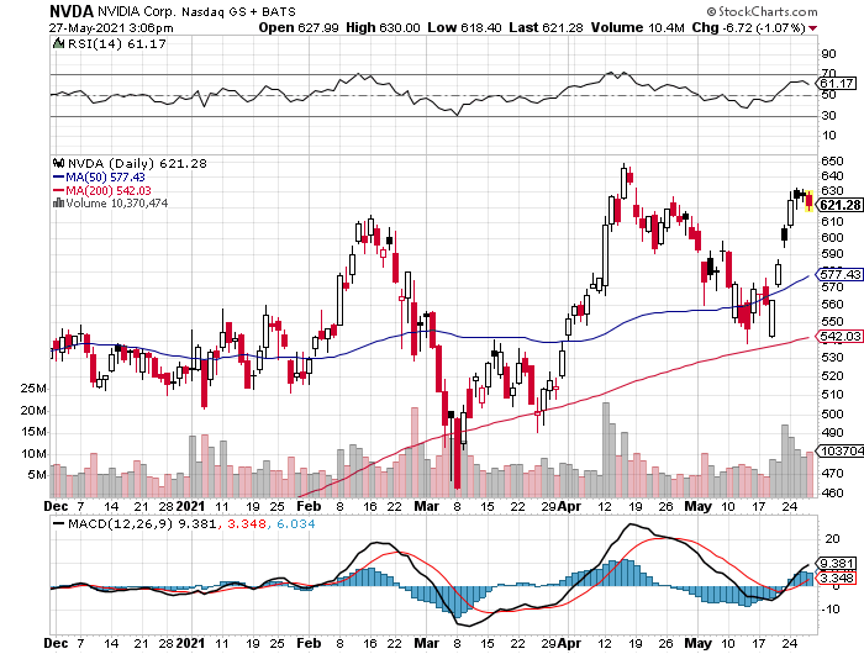
A: Yes I would. DocuSign (DOCO) and Zoom (ZM) are the two best ones because they were both up 12X from their lows, and I tend not to chase things that are up 12X unless they are a Tesla (TSLA) or an Nvidia (NVDA) or something like that. In the end, Tesla went up 295 times.

Q: Are you looking at the carbon credits market?

A: No, but I probably should. That market shut down last year. It’s alive again, and it looks like it's growing like crazy.

Q: What’s the ideal volatility for individual options? What do you use to compare?

A: Always look at the implied volatility of the option compared to the realized volatility of the underlying stock; and when the difference gets too big, you get ideal conditions for putting on call and put spreads, which take advantage of this.  These are almost volatility neutral because you’re long on one batch of volatility and short on the other.

Q: Is it too late to get involved in the ProShares Ultra Technology ETF (ROM), the 2X long ETF in a spread?

A: The November 2021 $121-125 vertical bull call spread, the farthest expiration you can get for the (ROM), was kind of aggressive—I would go closer to the money. We’re right around mid $80s right now, so maybe do a January 2022 $95-100, and even that will get you something like a 400% gain by November.

To watch a replay of this webinar with all the charts, bells, whistles, and classic rock music, just log in to go to MY ACCOUNT, click on GLOBAL TRADING DISPATCH (or Tech Letter as the case may be), then WEBINARS, and all the webinars from the last ten years are there in all their glory.

Good Luck and Stay Healthy.

John Thomas
CEO & Publisher
The Diary of a Mad Hedge Fund Trader

Summit of Mount Rose at 10,778 feet with Lake Tahoe on the Right


https://www.madhedgefundtrader.com/wp-content/uploads/2020/12/john-thomas-skyline-e1608829740615.png 375 500 Mad Hedge Fund Trader https://madhedgefundtrader.com/wp-content/uploads/2019/05/cropped-mad-hedge-logo-transparent-192x192_f9578834168ba24df3eb53916a12c882.png Mad Hedge Fund Trader2021-05-28 09:02:502021-05-28 10:34:22May 26 Biweekly Strategy Webinar Q&A
Douglas Davenport

May 14, 2021

Diary, Newsletter, Summary
    • Global Market Comments
      May 14, 2021
      Fiat Lux

      Featured Trade:
      (MAY 12 BIWEEKLY STRATEGY WEBINAR Q&A),
      (FCX), (QQQ), (JWN), (DAL), (MSFT), (PLTR), (V), (MA), (AXP), (UUP), (FXA), (SPWR), (FSLR), (TSLA), (ARKK), (CLX), (NIO), (EPEV), (SOX), (VIX), (USO), (XLE)


https://madhedgefundtrader.com/wp-content/uploads/2019/05/cropped-mad-hedge-logo-transparent-192x192_f9578834168ba24df3eb53916a12c882.png 0 0 Douglas Davenport https://madhedgefundtrader.com/wp-content/uploads/2019/05/cropped-mad-hedge-logo-transparent-192x192_f9578834168ba24df3eb53916a12c882.png Douglas Davenport2021-05-14 08:04:142021-05-13 19:28:46May 14, 2021
Mad Hedge Fund Trader

March 19, 2021

Diary, Newsletter, Summary

Global Market Comments
March 19, 2021
Fiat Lux

Featured Trade:

(MARCH 17 BIWEEKLY STRATEGY WEBINAR Q&A),
 (JPM), (TLT), (TBT), (SQ), (MMM), (SIL), (QQQ), (WMP), (CCIV), (TSLA), (USO), (CRSP), (PLTR), (HYG), (FCX), (XME)

https://madhedgefundtrader.com/wp-content/uploads/2019/05/cropped-mad-hedge-logo-transparent-192x192_f9578834168ba24df3eb53916a12c882.png 0 0 Mad Hedge Fund Trader https://madhedgefundtrader.com/wp-content/uploads/2019/05/cropped-mad-hedge-logo-transparent-192x192_f9578834168ba24df3eb53916a12c882.png Mad Hedge Fund Trader2021-03-19 10:04:122021-03-19 12:25:35March 19, 2021
Mad Hedge Fund Trader

March 17 Biweekly Strategy Webinar Q&A

Diary, Newsletter

Below please find subscribers’ Q&A for the March 17 Mad Hedge Fund Trader Global Strategy Webinar broadcast from frozen Incline Village, NV.

Q: I’ve heard that the COVID-19 cases are being understated by 16 million. Do you think this is true?

A: Yeah, I've always argued that the previous government's numbers were vastly underestimating the true number of cases out there for political purposes, but we are on the downslide regardless, so that’s good.

Q: When are tech stocks going to bottom out and when can I buy them?

A: I knew I would get this question. This is the question of the day. Picking bottoms is always tough because these are momentum plays and not valuation plays. I’ll give you a couple of levels though. The tech (QQQ) multiple is now at 25X earnings and the S&P 500 (SPY) is at 22X, so your first bottom will be down about 10% from here, or a 22X multiple. And I don’t think we will get much lower than that because tech stocks are growing at 20-25% a year, versus the (SPY) growing at maybe 10%, and I don’t think tech goes to much of a discount in that situation. So, you’re just waiting for interest rates to top out and start to go down, which will be the other indicator of a tech bottom. We had a slowdown in the rise of rates for just a couple of days this week, and tech stocks took off like a rocket. Those are your two big signals.

Q: With the Fed announcement, are you still in the Invesco QQQ Trust NASDAQ ETF (QQQ) bear put spread?

A: Yes, one of them expires in two days so that’s a piece of cake. The other one expires in a month, but it is way out-of-the-money—the April $240-$245 bear put spread, so I’ll keep that for a real meltdown day. But if it looks like we’re getting a breakout, I will come out of that short position so fast it will make your head spin. 

Q: Do you like Palantir (PLTR)?

A: Absolutely yes—screaming LEAP candidate. It traded all the way down to $20 two weeks ago and is trading around $25 now. It’s a huge data firm, lots of CIA and defense work, huge government contracts extending out for years, cutting edge technology, and run by a nut job, so yes screaming buy at this level.

Q: Freeport McMoRan (FCX) is taking some pain here, is this still a buy and hold?

A: Yes, it’s taking the pain along with all the other domestic stocks, which is natural. In their case though, it’s up almost 10x from its bottom a year ago where we recommended it, so yeah I'd say time for a rest. So I’m still a buyer of the metals and (FCX) on dips, but like all other metals, it did get overextended. EV manufacturing is doubling this year, which uses a ton of copper. The same is true with solar panels and Chinese industrial recovery. When all your major markets are doubling in size, it’s usually good for the stock. I peaked at $50 in the last cycle and could touch $100 in this one.

Q: What are your thoughts about the Lucid EV SPAC, Churchill Capital IV (CCIV)?

A: Don’t touch it with a ten-foot pole. They only have 1 or 2 concept vehicles for high-end investors to test drive. The rumor is that their main factory will be in Saudi Arabia where the bulk of the seed capital came from. They’ll never catch up with Tesla (TSLA) on the technology. There's always going to be a few niche $250,000 cars out there, and they have no proof they can actually make these things. When they get to a million vehicles a year, then I might be interested. But they haven't done the hard part yet, which is mass-producing battery packs for a million cars. They've only done the easy part which is designing one sexy prototype to raise money. So, stay away from Lucid, I don’t think they’re going to make it.

Q: What about oil?

A: I am avoiding oil plays like the plague.

Q: When do you anticipate your luncheons to be back?

A: Maybe in 2023. I don’t want to scare off my customers by inviting them to a lunch where they all get COVID-19. If I did have a lunch, I’d have a vaccine requirement and a temperature gun to hit them at the door like everywhere else. I really miss meeting subscribers in person.

Q: Should I buy banks like JP Morgan (JPM) at this level?

A: I would say no. That ship has sailed. Wait for a steeper selloff or just let it run. We’ve already had an enormous move and you don’t want to chase it with a low discipline trade, which is what that would be.

Q: What do you think of silver (SLV)?

A: It’s a buy long term, short term it’s in the grim spiral of death along with the other precious metals, which absolutely hate rising interest rates. A silver long here is the equivalent of a bond (TLT) long. When you do go into silver, buy Wheaton Precious Metals (WPM) for the leveraged long play.

Q: Is 3M (MMM) going to extend the upside?

A: Probably yes, that's a classic American industrial play and a great company. I have friends who work there. How could we live without Post-it notes, Scotch Tape, and Covid-19 N-95 masks?

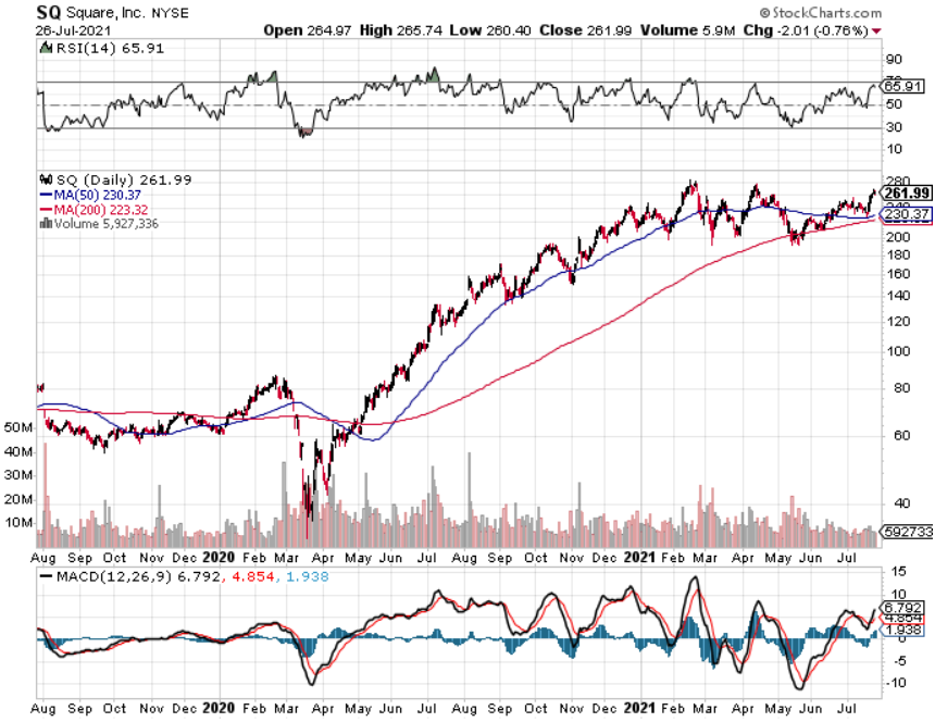
Q: What about Square (SQ)?

A: I love it in the long term, buy on the dips and buy it through LEAPS (long term equity anticipation securities).

Q: Should I unwind my leveraged financial ETF?

A: I’d say take a piece off, yeah; you never get fired for taking a profit. And they have had a tremendous move. Plus of course, the flip side of taking profits on domestic recovery stocks is to buy tech with that money. And eventually, that's what the entire market will do, it just may still be a little bit early.

Q: What’s a good target for LEAPS for CRISPR (CRSP) and Palantir (PLTR)?

A: Put your first strike 30% higher than today’s stock price and go 2 years out in maturity. I noticed on some names, the June 2023’s are starting to trade, but they’re highly illiquid. But if you put a bid in there and you get a market meltdown, you will get hit.

Q: If the long-term future for oil (USO) is so bad, why is it $65?

A: A few reasons. #1, huge short covering action. #2, economy recovery faster than people expected because of the stimulus. #3, a lot of people, mostly in Texas, Oklahoma, and Louisiana, don’t believe that there will be an all-electric grid in 20 years and think that oil will be in demand forever, including the entire oil industry, so they’re in there buying. And #4, the Saudis have held back with production increases to push the price up, so they’re letting it run so they can sell at a higher price. When they do sell, oil crashes again.

Q: Can we re-watch this presentation?

A: Yes, we post it about 2 hours later on the website so all our people in about 135 countries can access it whenever they like. Just log in to www.madhedgefundtrader.com, go to MY ACCOUNT, click on GLOBAL TRADING DISPATCH, then WEBINARS, and all the webinars from the last ten years are there in all their glory.

Q: How often do you have these webinars?

A: Every two weeks, and if you need help accessing it on your account page, email customer support at support@madhedgefundtrader.com.

Q: Is it time to initiate short positions on oil companies?

A: Not yet but keep it in the back of your mind. When some of the super-hot economic data come out after Q2, that may be your short in oil—then we may get into the $70’s a barrel. But not yet, there’s still too much upward momentum.

Q: Do you think we will see the 30-year fix below a 3.00% yield again?

A: Yes, in the next recession, which may be 5 or 10 years off because we’re starting at such a low base.

Q: Regarding copper, EV motors require a ton of copper. Doesn’t that make the metals a BUY?

A: That is true, and why we recommended Freeport McMoRan at $4 a year ago and recommended buying every dip. Each one of these rotor motors on each wheel of a Tesla weighs about 100 lbs—I’ve lifted them. Remember I tore apart a Tesla once just to see what made it tick, and they’re really heavy, and they use a lot of copper, and silver as well. So that has always been the bull market case for copper, as well as the fact that China re-emerged as a major buyer for their industrial buildout. That’s why we had a long in the SPDR S&P Metals and Mining ETF (XME).

Q: Do you foresee a good opportunity to go heavy into margin again?

A: Maybe if we get a decent selloff this summer, but you’ll never get the opportunity we had a year ago when you really wanted to put 100% of your portfolio into 2-year LEAPS. The people who did that made many tens of millions of dollars, which is why I get a free bottle of Bourbon every month. That was a once in 20 years event.

Q: What is your 2021 target for the S&P 500 (SPX)?

A: $4,860. It’s in my strategy letter which I sent out on January 6th, and that is all still posted on the website, click here for it. 

Q: How do I renew my subscription with your company, and how do I figure out what I bought?

A: Email customer support at support@madhedgefundtrader.com and they will answer you immediately.

Q: Do you follow the iShares IBoxx High Yield Corporate Bond ETF (HYG)?

A: Yes, that is the high yield junk bond fund, but I have been avoiding long bond plays, as you may have noticed with my screaming short of the past year. We list (HYG) in these slides in the Bonds section.

To watch a replay of this webinar, just log in to www.madhedgefundtrader.com , go to MY ACCOUNT, click on GLOBAL TRADING DISPATCH or TECHNOLOGY LETTER (as the case may be), then WEBINARS, and all the webinars from the last ten years are there in all their glory.

Good Luck and Stay Healthy.

John Thomas
CEO & Publisher
The Diary of a Mad Hedge Fund Trader


https://www.madhedgefundtrader.com/wp-content/uploads/2016/08/John-in-Cap-e1473378948252.jpg 400 301 Mad Hedge Fund Trader https://madhedgefundtrader.com/wp-content/uploads/2019/05/cropped-mad-hedge-logo-transparent-192x192_f9578834168ba24df3eb53916a12c882.png Mad Hedge Fund Trader2021-03-19 10:02:222021-03-19 11:34:22March 17 Biweekly Strategy Webinar Q&A
Mad Hedge Fund Trader
March 5, 2021

Tech Letter

Mad Hedge Technology Letter
March 5, 2021
Fiat Lux

Featured Trade:

(THE NEXT BIG TECH GROWTH NAME)
(PLTR)

https://madhedgefundtrader.com/wp-content/uploads/2019/05/cropped-mad-hedge-logo-transparent-192x192_f9578834168ba24df3eb53916a12c882.png 0 0 Mad Hedge Fund Trader https://madhedgefundtrader.com/wp-content/uploads/2019/05/cropped-mad-hedge-logo-transparent-192x192_f9578834168ba24df3eb53916a12c882.png Mad Hedge Fund Trader2021-03-05 15:04:042021-03-05 17:15:00March 5, 2021

Mad Hedge Fund Trader

The Next Big Tech Growth Name

Tech Letter

They are the tech company that beat out Lockheed Martin, BAE Systems, and 14 other unique systems to snatch an NSA contract to provide data analytics to the Five Eyes Alliance in 2011. Palantir has never looked back.

This could become the next 10-bagger.

It’s been that type of overperformance for Palantir since its inception in 2003.

By 2009, they had already amassed over $1.2 billion worth of government contracts and Palantir has already gone through 18 years of product development and spent more than $3 billion on R&D.

Palantir has an unswerving mandate to serve the U.S. government and its allies which has been an effective way to market its services.

This narrow message has effectively knocked out competition from Microsoft, Google, Facebook, Amazon, and Apple who have taken a “friends with everyone but friends with no one” approach to their business empires.

Their companies’ employees have protested against any type of government work with the U.S. army, withering at the thought that they would be responsible for blood on their hands.

Palantir makes sure that prospective employees understand where revenue is procured from and make no apologies for it.

Summing up Palantir is hard to do, but they really are the swiss army knife of data analytics that provide a platform in order to carry out executive decisions that put together trillions of data points from public, private, and secret sources into an easy to use, integrated, one-stop shop system.

This has worked wonders for the U.S. defense agencies and why CEO Alex Carp doubled down with Palantir’s five-year outlook of greater than $4 billion in revenue in 2025.

Starting in 2021, Palantir expects greater than 30% annual revenue growth each year for the next five years.

And in Q1 of this year, Palantir expects revenue growth of 45% or $332 million.

The strong outlook fuses with a sensational full-year 2020 performance of $1.93 billion in revenue, up 47% year over year. Fourth-quarter revenue was $322 million, up 40% year over year, and roughly $21 million above a prior guidance range.

Government revenue accelerated in the fourth quarter growing 85% year over year to $190 million.

Palantir signed several large deals in the quarter including a three-year $44 million expansion with the U.S. Food and Drug Administration and a two-year $31 million agreement with the NHS.

Some of the other deals signed were a multi-year contract with Pacific Gas and Electric to help it streamline operations across the company.

PG&E will now be able to perform root cause analysis and upgrade monitoring.

This should improve PG&Es electric operations and asset management, resulting in enhanced safety and grid reliability.

Palantir has deepened a partnership with BP. And in the fourth quarter, they signed a five-year nine-figure enterprise renewal and have an ongoing relationship with BP since 2014.

The largest part of Palantir’s annual revenue comes from the U.S. military with full-year government revenue rising 77% to $610 million, led by ongoing momentum in the U.S., which grew 91%.

Its Army operation continues to expand.

Palantir recently won a pair of new contracts with the Army to accelerate its modernization efforts.

Palantir was also the beneficiary of the U.S. Army executing its first option year with approximately $114 million as part of a partnership on the Army Vantage program.

Under the $8.5 million Phase 1 contract, Palantir will collaborate with the Army to demonstrate a solution that integrates space, high altitude, aerial, and terrestrial sensors for use in intelligence command and control.

In November 2020, Palantir was selected to provide a prototype for the Army's common data fabric and data security solutions.

Palantir provides an integrated solution that will ultimately improve access to critical data for commanders and soldiers, deliver efficient use of networks and denied integrated environments, and increase the collaboration with joint and allied partners.

The strength isn’t just relegating to U.S. government contracts, Palantir is experiencing intensive growth of existing customers with average revenue per customer growing 41% to $7.9 million.

They grew the number of accounts with $10 million of annual revenue or more by 50%.

For the full year 2020, 43% of Palantir’s revenue was generated from new customers in 2018 or later symbolizing their improving ability to rapidly onboard customers.

Palantir is also just scratching the surface of their commercial business heading into 2021 that saw a revenue rise of 107% year over year in fiscal 2020.

Growth tech firms typically preside over a margin problem at this early stage but Palantir exhibits some of the best margins around with full-year adjusted gross margin of 81%, up 1,000 basis points, compared with full-year 2019.

The year-over-year improvement in gross margin was driven by increased automation and efficiency in the delivery of our software.

Palantir is at the cutting edge of data analytics and whether it’s helping Fortune 500 companies navigate climate change headwinds, implementing Brexit policies for British companies, or modernizing U.S. military operations, they have seized the highest quality revenue possible.

The data analytic company is certainly a play on cyber espionage that is poised to explode on the sovereign and economic level as adversaries have bold plans to weaponize 5G.

One pain point is the overreliance of government contracts; however, I would argue that they are scratching the surface with the commercial operations and the path of least resistance for commercial revenue is up.

The pathway to grow from today’s $38 billion to $200 billion is wide open and if Palantir deploys their best of breed management to grow revenue 30% for the next 5 years, this is easily a $100 stock in the next 2 years.


palantir

https://madhedgefundtrader.com/wp-content/uploads/2019/05/cropped-mad-hedge-logo-transparent-192x192_f9578834168ba24df3eb53916a12c882.png 0 0 Mad Hedge Fund Trader https://madhedgefundtrader.com/wp-content/uploads/2019/05/cropped-mad-hedge-logo-transparent-192x192_f9578834168ba24df3eb53916a12c882.png Mad Hedge Fund Trader2021-03-05 15:02:302021-03-06 18:31:57The Next Big Tech Growth Name
Page 5 of 7«‹34567›»

tastytrade, Inc. (“tastytrade”) has entered into a Marketing Agreement with Mad Hedge Fund Trader (“Marketing Agent”) whereby tastytrade pays compensation to Marketing Agent to recommend tastytrade’s brokerage services. The existence of this Marketing Agreement should not be deemed as an endorsement or recommendation of Marketing Agent by tastytrade and/or any of its affiliated companies. Neither tastytrade nor any of its affiliated companies is responsible for the privacy practices of Marketing Agent or this website. tastytrade does not warrant the accuracy or content of the products or services offered by Marketing Agent or this website. Marketing Agent is independent and is not an affiliate of tastytrade. 
Legal Disclaimer

There is a very high degree of risk involved in trading. Past results are not indicative of future returns. MadHedgeFundTrader.com and all individuals affiliated with this site assume no responsibilities for your trading and investment results. The indicators, strategies, columns, articles and all other features are for educational purposes only and should not be construed as investment advice. Information for futures trading observations are obtained from sources believed to be reliable, but we do not warrant its completeness or accuracy, or warrant any results from the use of the information. Your use of the trading observations is entirely at your own risk and it is your sole responsibility to evaluate the accuracy, completeness and usefulness of the information. You must assess the risk of any trade with your broker and make your own independent decisions regarding any securities mentioned herein. Affiliates of MadHedgeFundTrader.com may have a position or effect transactions in the securities described herein (or options thereon) and/or otherwise employ trading strategies that may be consistent or inconsistent with the provided strategies.

Copyright © 2025. Mad Hedge Fund Trader. All Rights Reserved. support@madhedgefundtrader.com
Scroll to top