Global Market Comments
March 19, 2021
Fiat Lux
Featured Trade:
(MARCH 17 BIWEEKLY STRATEGY WEBINAR Q&A),
(JPM), (TLT), (TBT), (SQ), (MMM), (SIL), (QQQ), (WMP), (CCIV), (TSLA), (USO), (CRSP), (PLTR), (HYG), (FCX), (XME)


Global Market Comments
March 19, 2021
Fiat Lux
Featured Trade:
(MARCH 17 BIWEEKLY STRATEGY WEBINAR Q&A),
(JPM), (TLT), (TBT), (SQ), (MMM), (SIL), (QQQ), (WMP), (CCIV), (TSLA), (USO), (CRSP), (PLTR), (HYG), (FCX), (XME)

Below please find subscribers’ Q&A for the March 17 Mad Hedge Fund Trader Global Strategy Webinar broadcast from frozen Incline Village, NV.
Q: I’ve heard that the COVID-19 cases are being understated by 16 million. Do you think this is true?
A: Yeah, I've always argued that the previous government's numbers were vastly underestimating the true number of cases out there for political purposes, but we are on the downslide regardless, so that’s good.
Q: When are tech stocks going to bottom out and when can I buy them?
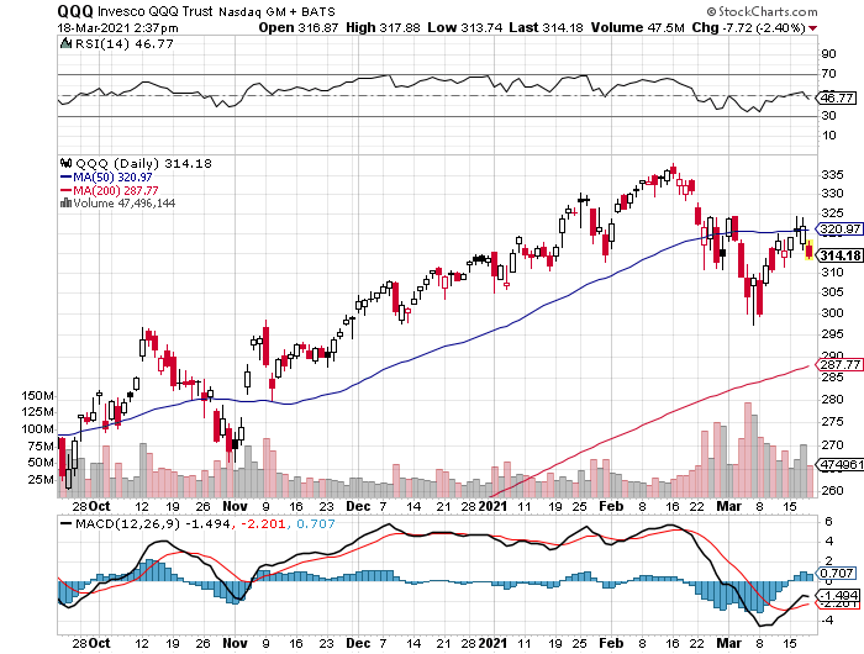
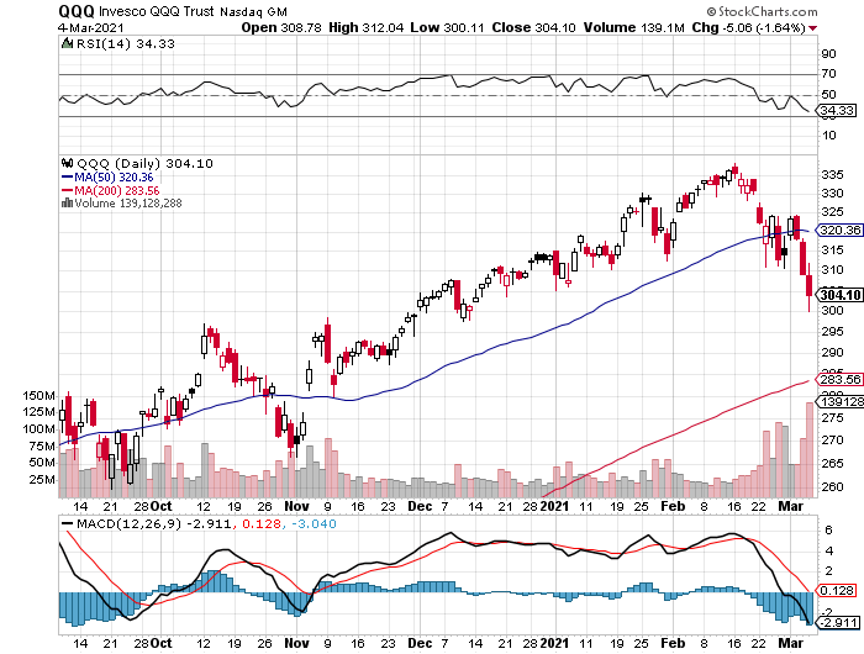
A: I knew I would get this question. This is the question of the day. Picking bottoms is always tough because these are momentum plays and not valuation plays. I’ll give you a couple of levels though. The tech (QQQ) multiple is now at 25X earnings and the S&P 500 (SPY) is at 22X, so your first bottom will be down about 10% from here, or a 22X multiple. And I don’t think we will get much lower than that because tech stocks are growing at 20-25% a year, versus the (SPY) growing at maybe 10%, and I don’t think tech goes to much of a discount in that situation. So, you’re just waiting for interest rates to top out and start to go down, which will be the other indicator of a tech bottom. We had a slowdown in the rise of rates for just a couple of days this week, and tech stocks took off like a rocket. Those are your two big signals.
Q: With the Fed announcement, are you still in the Invesco QQQ Trust NASDAQ ETF (QQQ) bear put spread?
A: Yes, one of them expires in two days so that’s a piece of cake. The other one expires in a month, but it is way out-of-the-money—the April $240-$245 bear put spread, so I’ll keep that for a real meltdown day. But if it looks like we’re getting a breakout, I will come out of that short position so fast it will make your head spin.
Q: Do you like Palantir (PLTR)?
A: Absolutely yes—screaming LEAP candidate. It traded all the way down to $20 two weeks ago and is trading around $25 now. It’s a huge data firm, lots of CIA and defense work, huge government contracts extending out for years, cutting edge technology, and run by a nut job, so yes screaming buy at this level.
Q: Freeport McMoRan (FCX) is taking some pain here, is this still a buy and hold?
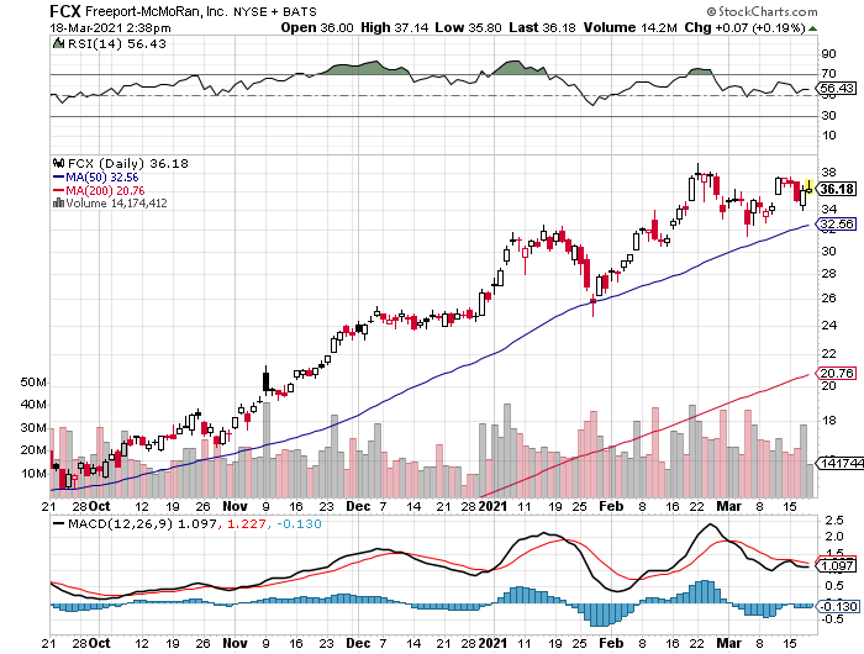
A: Yes, it’s taking the pain along with all the other domestic stocks, which is natural. In their case though, it’s up almost 10x from its bottom a year ago where we recommended it, so yeah I'd say time for a rest. So I’m still a buyer of the metals and (FCX) on dips, but like all other metals, it did get overextended. EV manufacturing is doubling this year, which uses a ton of copper. The same is true with solar panels and Chinese industrial recovery. When all your major markets are doubling in size, it’s usually good for the stock. I peaked at $50 in the last cycle and could touch $100 in this one.
Q: What are your thoughts about the Lucid EV SPAC, Churchill Capital IV (CCIV)?
A: Don’t touch it with a ten-foot pole. They only have 1 or 2 concept vehicles for high-end investors to test drive. The rumor is that their main factory will be in Saudi Arabia where the bulk of the seed capital came from. They’ll never catch up with Tesla (TSLA) on the technology. There's always going to be a few niche $250,000 cars out there, and they have no proof they can actually make these things. When they get to a million vehicles a year, then I might be interested. But they haven't done the hard part yet, which is mass-producing battery packs for a million cars. They've only done the easy part which is designing one sexy prototype to raise money. So, stay away from Lucid, I don’t think they’re going to make it.
Q: What about oil?
A: I am avoiding oil plays like the plague.
Q: When do you anticipate your luncheons to be back?
A: Maybe in 2023. I don’t want to scare off my customers by inviting them to a lunch where they all get COVID-19. If I did have a lunch, I’d have a vaccine requirement and a temperature gun to hit them at the door like everywhere else. I really miss meeting subscribers in person.
Q: Should I buy banks like JP Morgan (JPM) at this level?
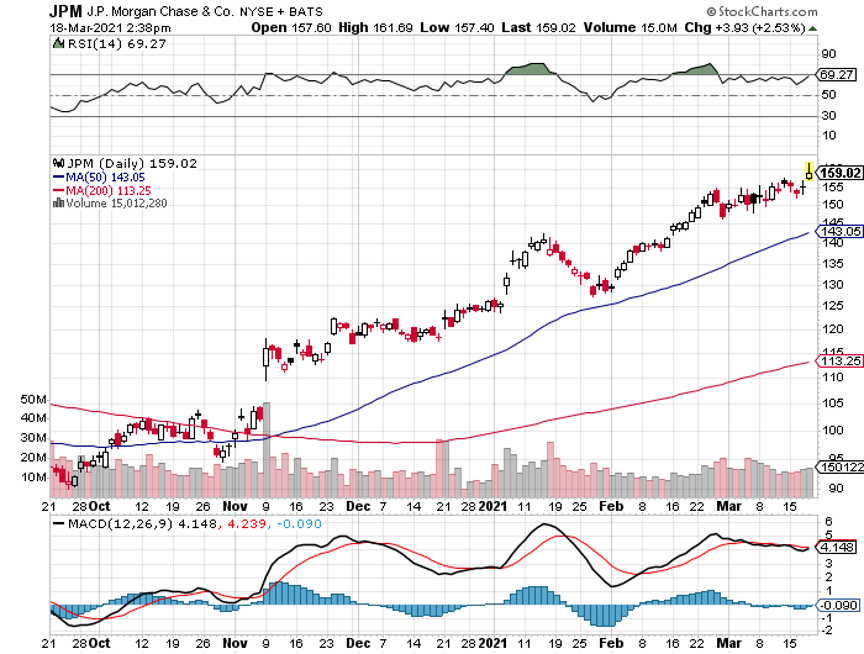
A: I would say no. That ship has sailed. Wait for a steeper selloff or just let it run. We’ve already had an enormous move and you don’t want to chase it with a low discipline trade, which is what that would be.
Q: What do you think of silver (SLV)?
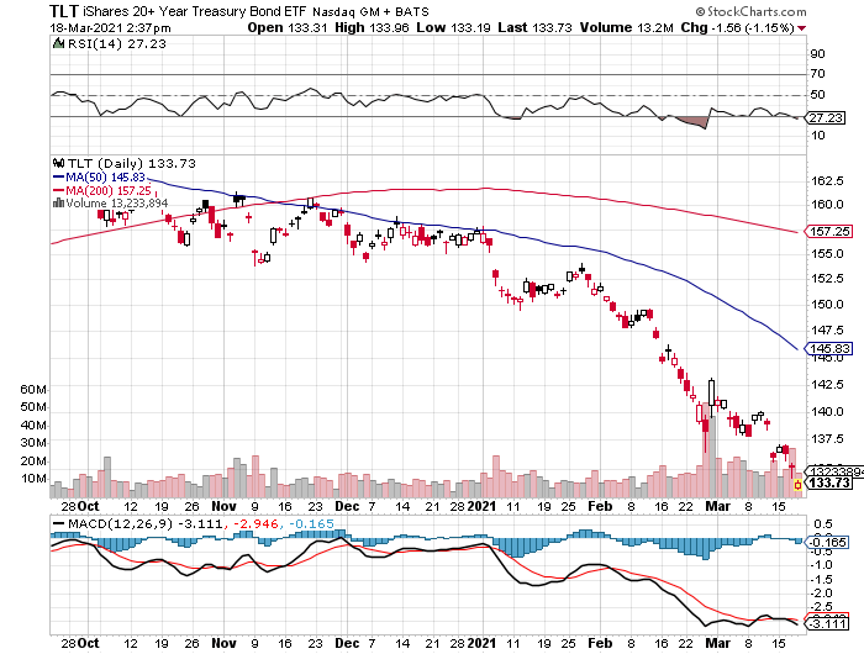
A: It’s a buy long term, short term it’s in the grim spiral of death along with the other precious metals, which absolutely hate rising interest rates. A silver long here is the equivalent of a bond (TLT) long. When you do go into silver, buy Wheaton Precious Metals (WPM) for the leveraged long play.
Q: Is 3M (MMM) going to extend the upside?
A: Probably yes, that's a classic American industrial play and a great company. I have friends who work there. How could we live without Post-it notes, Scotch Tape, and Covid-19 N-95 masks?
Q: What about Square (SQ)?
A: I love it in the long term, buy on the dips and buy it through LEAPS (long term equity anticipation securities).
Q: Should I unwind my leveraged financial ETF?
A: I’d say take a piece off, yeah; you never get fired for taking a profit. And they have had a tremendous move. Plus of course, the flip side of taking profits on domestic recovery stocks is to buy tech with that money. And eventually, that's what the entire market will do, it just may still be a little bit early.
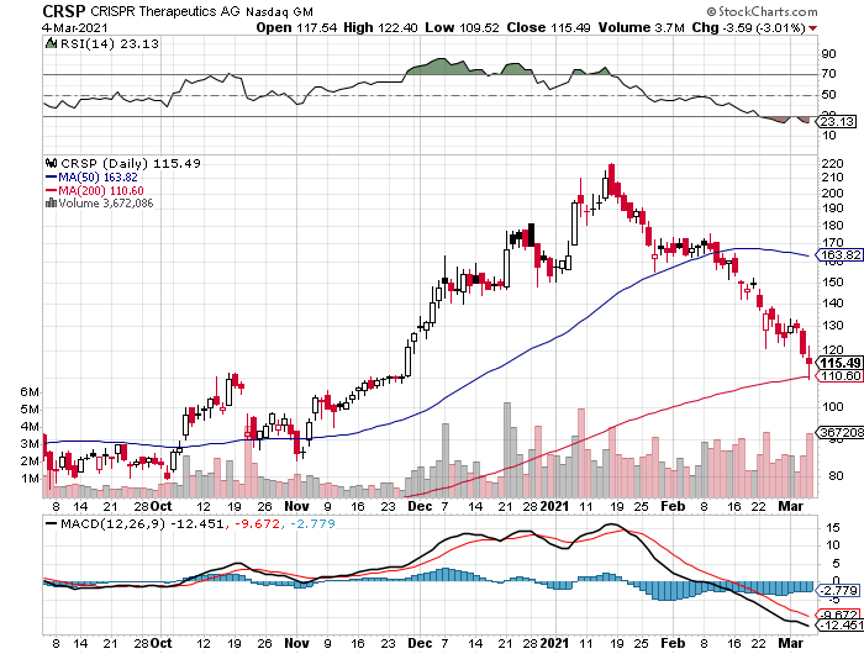
Q: What’s a good target for LEAPS for CRISPR (CRSP) and Palantir (PLTR)?
A: Put your first strike 30% higher than today’s stock price and go 2 years out in maturity. I noticed on some names, the June 2023’s are starting to trade, but they’re highly illiquid. But if you put a bid in there and you get a market meltdown, you will get hit.
Q: If the long-term future for oil (USO) is so bad, why is it $65?
A: A few reasons. #1, huge short covering action. #2, economy recovery faster than people expected because of the stimulus. #3, a lot of people, mostly in Texas, Oklahoma, and Louisiana, don’t believe that there will be an all-electric grid in 20 years and think that oil will be in demand forever, including the entire oil industry, so they’re in there buying. And #4, the Saudis have held back with production increases to push the price up, so they’re letting it run so they can sell at a higher price. When they do sell, oil crashes again.
Q: Can we re-watch this presentation?
A: Yes, we post it about 2 hours later on the website so all our people in about 135 countries can access it whenever they like. Just log in to www.madhedgefundtrader.com, go to MY ACCOUNT, click on GLOBAL TRADING DISPATCH, then WEBINARS, and all the webinars from the last ten years are there in all their glory.
Q: How often do you have these webinars?
A: Every two weeks, and if you need help accessing it on your account page, email customer support at support@madhedgefundtrader.com.
Q: Is it time to initiate short positions on oil companies?
A: Not yet but keep it in the back of your mind. When some of the super-hot economic data come out after Q2, that may be your short in oil—then we may get into the $70’s a barrel. But not yet, there’s still too much upward momentum.
Q: Do you think we will see the 30-year fix below a 3.00% yield again?
A: Yes, in the next recession, which may be 5 or 10 years off because we’re starting at such a low base.
Q: Regarding copper, EV motors require a ton of copper. Doesn’t that make the metals a BUY?
A: That is true, and why we recommended Freeport McMoRan at $4 a year ago and recommended buying every dip. Each one of these rotor motors on each wheel of a Tesla weighs about 100 lbs—I’ve lifted them. Remember I tore apart a Tesla once just to see what made it tick, and they’re really heavy, and they use a lot of copper, and silver as well. So that has always been the bull market case for copper, as well as the fact that China re-emerged as a major buyer for their industrial buildout. That’s why we had a long in the SPDR S&P Metals and Mining ETF (XME).
Q: Do you foresee a good opportunity to go heavy into margin again?
A: Maybe if we get a decent selloff this summer, but you’ll never get the opportunity we had a year ago when you really wanted to put 100% of your portfolio into 2-year LEAPS. The people who did that made many tens of millions of dollars, which is why I get a free bottle of Bourbon every month. That was a once in 20 years event.
Q: What is your 2021 target for the S&P 500 (SPX)?
A: $4,860. It’s in my strategy letter which I sent out on January 6th, and that is all still posted on the website, click here for it.
Q: How do I renew my subscription with your company, and how do I figure out what I bought?
A: Email customer support at support@madhedgefundtrader.com and they will answer you immediately.
Q: Do you follow the iShares IBoxx High Yield Corporate Bond ETF (HYG)?
A: Yes, that is the high yield junk bond fund, but I have been avoiding long bond plays, as you may have noticed with my screaming short of the past year. We list (HYG) in these slides in the Bonds section.
To watch a replay of this webinar, just log in to www.madhedgefundtrader.com , go to MY ACCOUNT, click on GLOBAL TRADING DISPATCH or TECHNOLOGY LETTER (as the case may be), then WEBINARS, and all the webinars from the last ten years are there in all their glory.
Good Luck and Stay Healthy.
John Thomas
CEO & Publisher
The Diary of a Mad Hedge Fund Trader

Mad Hedge Technology Letter
March 5, 2021
Fiat Lux
Featured Trade:
(THE NEXT BIG TECH GROWTH NAME)
(PLTR)

They are the tech company that beat out Lockheed Martin, BAE Systems, and 14 other unique systems to snatch an NSA contract to provide data analytics to the Five Eyes Alliance in 2011. Palantir has never looked back.
This could become the next 10-bagger.
It’s been that type of overperformance for Palantir since its inception in 2003.
By 2009, they had already amassed over $1.2 billion worth of government contracts and Palantir has already gone through 18 years of product development and spent more than $3 billion on R&D.
Palantir has an unswerving mandate to serve the U.S. government and its allies which has been an effective way to market its services.
This narrow message has effectively knocked out competition from Microsoft, Google, Facebook, Amazon, and Apple who have taken a “friends with everyone but friends with no one” approach to their business empires.
Their companies’ employees have protested against any type of government work with the U.S. army, withering at the thought that they would be responsible for blood on their hands.
Palantir makes sure that prospective employees understand where revenue is procured from and make no apologies for it.
Summing up Palantir is hard to do, but they really are the swiss army knife of data analytics that provide a platform in order to carry out executive decisions that put together trillions of data points from public, private, and secret sources into an easy to use, integrated, one-stop shop system.
This has worked wonders for the U.S. defense agencies and why CEO Alex Carp doubled down with Palantir’s five-year outlook of greater than $4 billion in revenue in 2025.
Starting in 2021, Palantir expects greater than 30% annual revenue growth each year for the next five years.
And in Q1 of this year, Palantir expects revenue growth of 45% or $332 million.
The strong outlook fuses with a sensational full-year 2020 performance of $1.93 billion in revenue, up 47% year over year. Fourth-quarter revenue was $322 million, up 40% year over year, and roughly $21 million above a prior guidance range.
Government revenue accelerated in the fourth quarter growing 85% year over year to $190 million.
Palantir signed several large deals in the quarter including a three-year $44 million expansion with the U.S. Food and Drug Administration and a two-year $31 million agreement with the NHS.
Some of the other deals signed were a multi-year contract with Pacific Gas and Electric to help it streamline operations across the company.
PG&E will now be able to perform root cause analysis and upgrade monitoring.
This should improve PG&Es electric operations and asset management, resulting in enhanced safety and grid reliability.
Palantir has deepened a partnership with BP. And in the fourth quarter, they signed a five-year nine-figure enterprise renewal and have an ongoing relationship with BP since 2014.
The largest part of Palantir’s annual revenue comes from the U.S. military with full-year government revenue rising 77% to $610 million, led by ongoing momentum in the U.S., which grew 91%.
Its Army operation continues to expand.
Palantir recently won a pair of new contracts with the Army to accelerate its modernization efforts.
Palantir was also the beneficiary of the U.S. Army executing its first option year with approximately $114 million as part of a partnership on the Army Vantage program.
Under the $8.5 million Phase 1 contract, Palantir will collaborate with the Army to demonstrate a solution that integrates space, high altitude, aerial, and terrestrial sensors for use in intelligence command and control.
In November 2020, Palantir was selected to provide a prototype for the Army's common data fabric and data security solutions.
Palantir provides an integrated solution that will ultimately improve access to critical data for commanders and soldiers, deliver efficient use of networks and denied integrated environments, and increase the collaboration with joint and allied partners.
The strength isn’t just relegating to U.S. government contracts, Palantir is experiencing intensive growth of existing customers with average revenue per customer growing 41% to $7.9 million.
They grew the number of accounts with $10 million of annual revenue or more by 50%.
For the full year 2020, 43% of Palantir’s revenue was generated from new customers in 2018 or later symbolizing their improving ability to rapidly onboard customers.
Palantir is also just scratching the surface of their commercial business heading into 2021 that saw a revenue rise of 107% year over year in fiscal 2020.
Growth tech firms typically preside over a margin problem at this early stage but Palantir exhibits some of the best margins around with full-year adjusted gross margin of 81%, up 1,000 basis points, compared with full-year 2019.
The year-over-year improvement in gross margin was driven by increased automation and efficiency in the delivery of our software.
Palantir is at the cutting edge of data analytics and whether it’s helping Fortune 500 companies navigate climate change headwinds, implementing Brexit policies for British companies, or modernizing U.S. military operations, they have seized the highest quality revenue possible.
The data analytic company is certainly a play on cyber espionage that is poised to explode on the sovereign and economic level as adversaries have bold plans to weaponize 5G.
One pain point is the overreliance of government contracts; however, I would argue that they are scratching the surface with the commercial operations and the path of least resistance for commercial revenue is up.
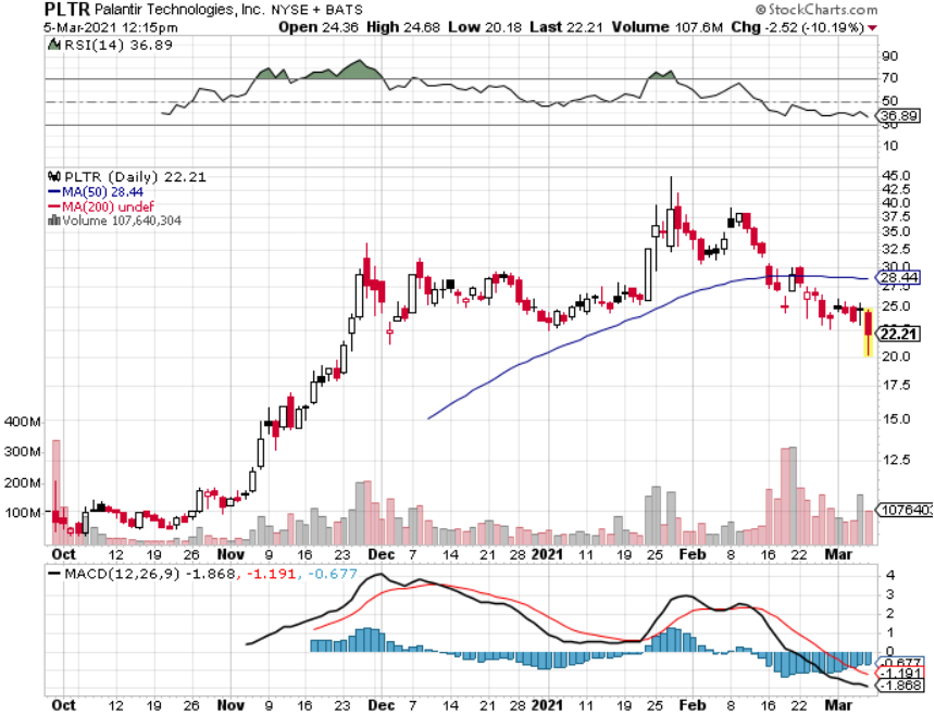
The pathway to grow from today’s $38 billion to $200 billion is wide open and if Palantir deploys their best of breed management to grow revenue 30% for the next 5 years, this is easily a $100 stock in the next 2 years.
Global Market Comments
March 5, 2021
Fiat Lux
Featured Trade:
(MARCH 3 BIWEEKLY STRATEGY WEBINAR Q&A),
(BRKB), (CRM), (ZM), (AAPL), (AMD), (DIS), (CRSP),
(BRKB), (PLTR), (NVDA), (TLT), (TSLA), (GLD),
(SLV), (VSAT), (EUO), (GME)

Below please find subscribers’ Q&A for the March 3 Mad Hedge Fund Trader Global Strategy Webinar broadcast from frozen Incline Village, NV.
Q: Are SPACs here to stay?
A: Yes, but I think that in the next bear market, 80% of these SPACs (Special Purpose Acquisition Companies) will disappear, will deliver large losses, and will continue charging you enormous fees until then. It’s either that or they won’t invest their money at all and give it back, net of the fees. So, I’m avoiding the SPAC craze unless it's associated with a very specific investment play that I know well. The problem with SPACs is that they all come out expensive—there are no bargain basement SPACs on launch day. Me, being the eternal cheapskate that I am, always want to get a great bargain on everything. The time to buy these is actually in the next bear market, if they still exist, because then investors will be throwing their positions away at 10 or 20% discounts. That’s always what happens with specialized ETF, closed-end funds, and so on. They are roach motel investments; you can check-in, but you can never check out.
Q: What do you think of Elizabeth Warren's asset tax idea?
A: It’s idiotic. It would take years to figure out how much Jeff Bezos is worth. And even then, you probably couldn't come within ten billion dollars of a true number. We already pay asset taxes, our local county real estate taxes, and those are bad enough, delivering valuations that are miles from true market prices. There are many other ways to fix the tax system and get billionaires paying their fair share. There are only three things you really have to do: get rid of carried interest so hedge funds can’t operate tax-free, get rid of real estate loss carry forwards which allow the real estate industry to basically operate tax-free, and get rid of the oil depletion allowance, which has enabled the oil industry to operate tax-free for nearly 90 years. So those would be three easy ones to increase the fairness of the tax system without any immense restructuring of our accounting system.
Q: When will share buybacks start?
A: They’ve already started and have been happening all year. There are two ways the companies do this: they either have an outside accounting firm, buying religiously every day or at the end of every month or something like that, so they can’t be accused of insider trading; or they are in there buying on every dip. Certainly, all the big cash-heavy companies like Berkshire Hathaway (BRKB) or Apple (AAPL) were buying their shares like crazy last March and April because they were trading such enormous discounts. So that is another trillion dollars sitting under the market, waiting to come in on any dip, which is yet another reason that we are not going to see any major sell-offs this year—just the 5%-10% variety that I have been predicting.
Q: Is it time to buy Salesforce (CRM)?
A: Yes, Marc Benioff’s goal is to double sales in two years, and the stock is relatively cheap right now because they’ve had a couple of weak quarters and are still digesting some big acquisitions.
Q: Is CRISPR Therapeutics (CRSP) good buy?
A: Yes, I would be buying right here; it’s a good LEAP candidate because the stock could easily double from here. We’ve only scratched the surface on CRISPR technology being adopted and the potential growth in this company is enormous—I'm surprised they haven’t been taken over already.
Q: Will you start a letter for investing advisors on how to deal with the prolific numbers of Bitcoin?
A: There are already too many Bitcoin newsletters; there are literally hundreds of them and thousands of experts on Bitcoin now because there’s nothing to know and nothing to analyze. It’s all a belief system; there are no earnings, there are no dividends, and there is no interest. So, you purely have to invest in the belief that somebody else is going to take you out at a higher price. I think there is a big overhang of selling in that when they raise the number of Bitcoin, we’ll get another one of those 90% crashes that Bitcoin is prone to. So, go elsewhere for your Bitcoin advice; your choices are essentially unlimited now, and they are much cheaper than me. In fact, people are literally giving away Bitcoin advice for free, which means you’re getting what you’re paying for. I buy Bitcoin when they have a customer support telephone number.
Q: Zoom (ZM) has come down a lot after a big earnings report—do you like it?
A: Long term, yes. Short term, no. You want to avoid all the stay-at-home stocks because no one is staying at home anymore. However, there is a long-term story in Zoom once they find their bottom because even after we come out of the pandemic, we’re all still using Zoom. I have like five or ten Zoom meetings a day, and my kids go to school on Zoom all day long. They’re also bringing out new products like telephone servers. They’re also raising their prices—I happen to be one of Zoom’s largest customers. I’m paying $1,100/month now, and that’s rising at 10% a year.
Q: What would be the best LEAP for Salesforce (CRM)?
A: The rule of thumb is that you want to go 30% out of the money on your first strike. So, find a current stock price; your first strike is up 30%, and then your second strike is up 35%. And all you need to double your money on that is a bounce back to the highs for this year, which is not unrealistic. That’s the lay-up there with Salesforce. That’s the basic formula; Advanced Micro Devices (AMD), Walt Disney (DIS), Berkshire Hathaway (BRKB), Palantir (PLTR), and Nvidia (NVDA) are all good candidates for LEAPS.
Q: How often do you update the long-term stock portfolio?
A: Twice a year, and we just updated in January, which is posted on the website in your membership area. If you can't find it, just email customer support at support@madhedgefundtrader.com and they’ll tell you where to find it. And we only do this twice a year because there just aren't enough changes in the economy in six months to justify a more frequent update.
Q: When do you think real estate will come back?
A: It never left. We’ve had the hottest real estate market in history, with 20% annual gains in many cities in 2020. And that will continue, but not at the 20% rate, probably at a more sustainable 5% or 6% rate. Guess what the best inflation play in the world is? Real estate. If you’re worried about inflation, you want to run out and buy a house or two. The only thing that will really kill that market is a rise in 30-year fixed-rate mortgages to 5%, and that is years off. Or a rise in the ten-year treasury to 5% or 6%—that is several years off also. So, I think we’ve got a couple of good years of gains ahead of us. I at least want the market to stay hot until my kids get out of high school, and then I can sell my house and go live on some exotic tropical island with great broadband.
Q: When you’re doing LEAPS, do you just do the calls only or do you do these as spreads?
A: You can do both. Just do the math and see what works for you on a risk/reward basis. You can do a 30% out of the money call 2 years out and get anywhere from a 1,000% to a 10,000% return—people did get 10,000% returns buying deep out of the money LEAPS in Tesla (TSLA) a year ago (that’s where all the vintage bourbon is coming from). Or you can do it more conservatively and only make 500% in two years on Tesla spread. For example; do something like a Tesla January 2023 $900-$950 call spread. If Tesla shares rise to $950, that position is an easy quadruple. But do the numbers, figure out the cost today, what the expiration value is in two years, and there you go.
Q: Do you think overnight rates could go negative as some people predict?
A: Not for a long time. They will go negative at the next recession because we’re starting off such a low base—or when we get the next pandemic, which could be as early as next year. We could get another one at any time from a completely different virus, and it would generate the same stock market results that we got last time—down 40% in a month. We’re not out of the pandemic business, we’re just having a temporary break waiting for the next one to come along out of China or some other country, or even right here in the USA. So that may be a permanent aspect of investing in the future. It could be the price we pay having a global population that's at 7 billion heading to 9 billion.
Q: Expiration on LEAPS?
A: I always go out two years. The second year is almost free, that’s why. So why not go for the second year? It gives you twice as much time to be right, always useful.
Q: My two-year United States Treasury Bond Fund (TLT) $125 put LEAPS have turned very positive. Is this a good trade?
A: That is a good trade, which you should put on during the next (TLT) rally. If you think we’re going to $105 in 2 years, do something like a $127-$130 two-year put LEAP, and there's a nice four bagger right there.
Q: Your Amazon (AMZN) price target was recently listed at $3,500, below last year's high, but I’ve also seen a $5,000 forecast in two years. Are you sticking with that?
A: Yes, I think when you get a major recovery in the economy, Amazon will be one of the only pandemic plays that keeps on going. It’s just taking a rest here with the rest of big tech. The breakup value of Amazon is easily $5,000 a share or more. Plus, they’re still going gangbusters growing into new industries that they’ve barely touched so far, like pharmaceuticals, healthcare, and so on. So yes, I would definitely be a buyer of LEAPS, and you could do something like the January 2023 $3700-$4000 LEAP two years out and make a killing on that.
Q: Anything you can do in gold (GLD)?
A: Not really. Although gold and silver (SLV) have been a huge disappointment this year, I think this could be the beginning of a capitulation selloff in gold which will bring us a final bottom, but it may take another month or two to get there.
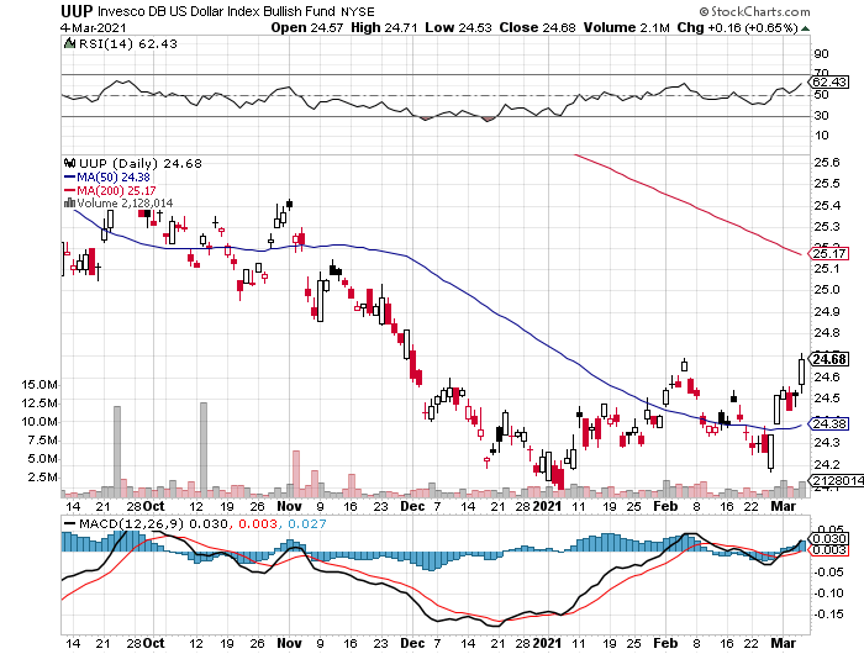
Q: How can I sell short the dollar?
A: You sell short the (UUP), or there are several 1X and 2X short ETFs in the currencies that you can do, like the ProShares Ultra Short Euro ETF (EUO). That is the way to do it.
Q: What is the best timing for buying LEAPS?
A: Buy at market bottoms. A year ago, I was sending out lists of 10 LEAPS at a time saying please buy all of these. You need both a short-term selloff in the stock, and then an upside target much higher than the current price so your LEAP expires at its maximum profit point. And if you’re in the right names, pretty much all the names that we talk about here, you will have 30%, if not 300% or 3,000% gains in them in the next two years.
Q: Do you think Tesla’s Starlink global satellite system will disrupt the cell tower industry?
A: Yes, that is the goal of Starlink—to wipe out all ground communication for WIFI and for cell phones. It may take them several years to do it, but if they do pull it off, then it just becomes a matter of pricing. The last Starlink pricing I looked at cost about $500 to set up, open the account, and get your dish installed. And the only flaw I see in the Starlink system is that the satellite dishes are tracking dishes, which means they lock onto satellites and then follow them as they pass overhead. Then when that signal leaves, it locks onto a new satellite; at any given time they’re locked onto four different satellites. That means moving parts, and you want to be careful of any industry that has moving parts—they wear out. That’s the great thing about software and online businesses; no moving parts, so they don’t wear out. And that’s also why Tesla has been a success; they eliminated the number of moving parts in cars by 80%. I’m waiting for Starlink to get working so I can use it, because I need Internet access 24 hours a day, even if all the local hubs are out because of a power outage. I’m now using something called Viasat (VSAT), which guarantees 100 megabyte/second service for $55 a month. It's not enough for me because I use a gigabyte service landline, but when that’s not available then I can go to satellite as a backup.
Q: Is there too much Fed liquidity in the market already? Why is the $1.9 trillion rescue package still positive for the market?
A: Firstly, there is too much liquidity in the market; that is screamingly obvious. If you look at liquidity over the decades, we are just staggeringly high right now. M2 is growing at 26% against the normal rate of 5%-6%. What the stimulus package does is get money to the people who did not participate in the bull market from last year. Those are low-income people, cities, and municipalities that are broke and can’t pay teachers, firemen, and policemen. It also goes to individual states which were not invested in the stock market. It turns out that states that were invested in the stock market like California have money coming out of their ears right now. And it gets money to low wage workers with kids who are certainly struggling right now. So, it is rather efficiently designed to get the money to people who need it the most. There is still half the country that doesn't own any stocks or even have savings of any kind. One or two people might get it who don’t deserve it but try doing anything in a 330 million population country and have it be 100% efficient.
Q: Is inflation coming?
A: Only incrementally in tiny pieces, so not enough to affect the stock market probably for several years. I still believe technology is advancing so fast that it wipes out any effort to raise prices or increase wages, and that may be what the perennially high 730,000 weekly jobless claims is all about. Those jobs that might have been there a year ago have been replaced by machines, have been outsourced overseas, or the demand for the product no longer exists. So, as long as you have a 10% unemployment rate and a weekly jobless claim at 730, inflation is the last thing you need to worry about.
Q: Is there any way to cash in on Reddit’s Wall Street Bets action?
A: No, and I would bet the majority of people who are trading off of these emojis and Reddit posts are losing money. You only hear about these things after it’s too late to do anything about them. I don't think you’ll get any more $4 to $450 moves like you did with GameStop (GME) because in that one case only, there was a short interest of 160%, which should have been illegal. All the other high short interest stocks have already been hit, with short interests all the way down to 30%, so I think that ship has sailed. It has no real investing merit whatsoever.
Good Luck and Stay Healthy.
John Thomas
CEO & Publisher
The Diary of a Mad Hedge Fund Trader

Mad Hedge Technology Letter
February 26, 2021
Fiat Lux
Featured Trade:
(EV INDUSTRY GOES FROM HOT TO HOTTER)
(TSLA), (GM), (EV), (SAIC), (PLTR), (ROKU)

The electric vehicle market is blossoming into a mega tech growth industry and we are just entering the sweet spot of it.
Just take a look at the variety of options now on the market.
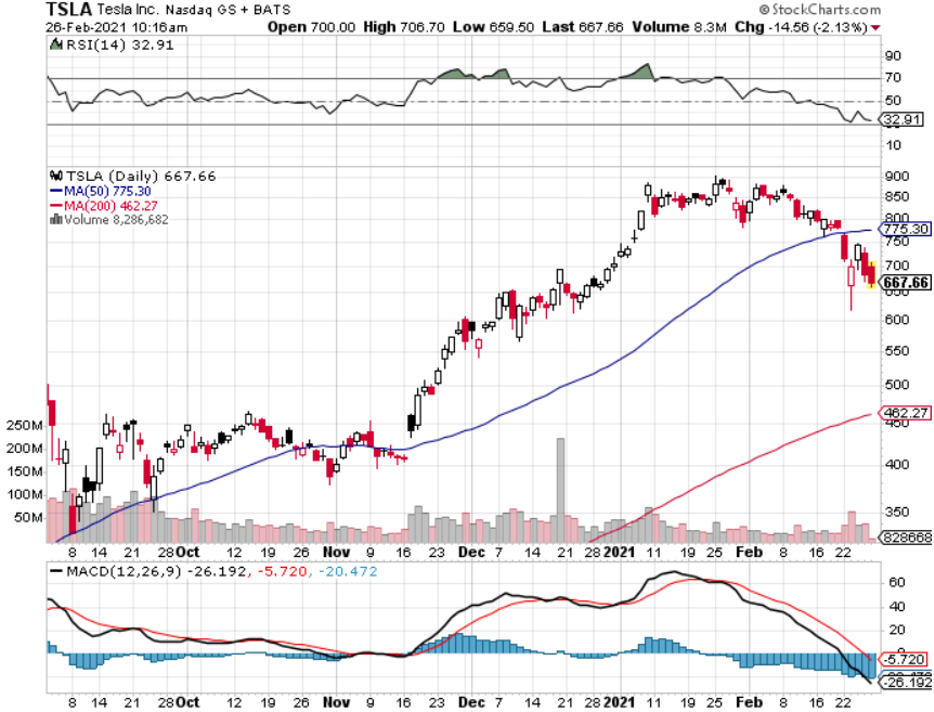
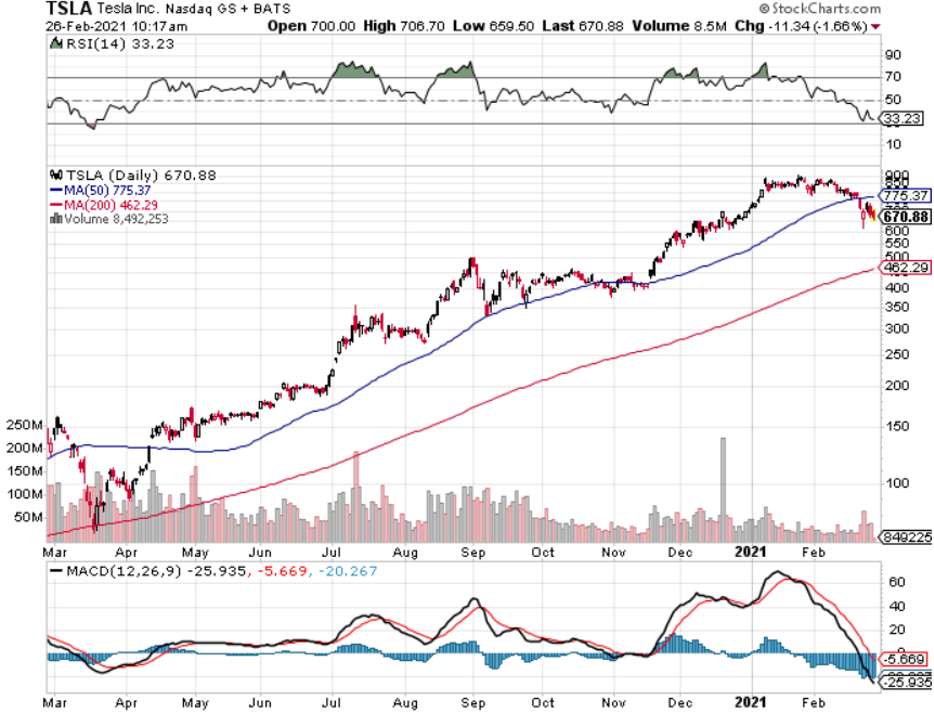
China has been doing its best to catch up to the standard bearer Tesla (TSLA) with generous government subsidies spawning a tidal wave of new investment.
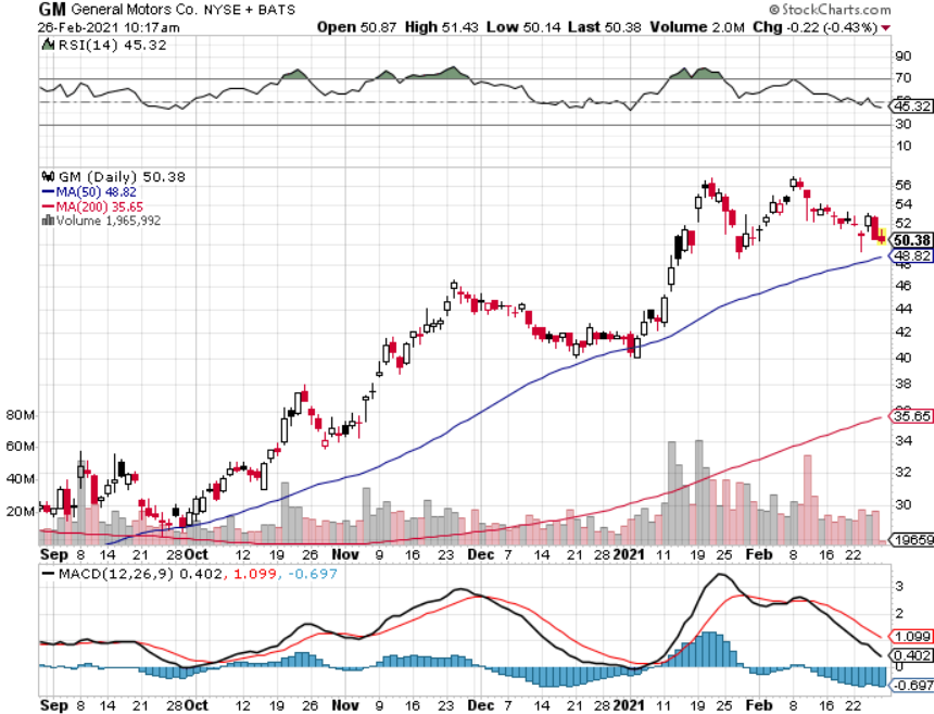
A Chinese company partnering with GM has been able to introduce an electric vehicle (EV) selling in China for $4,500 and is now miraculously outselling Tesla's posher cars.
The compact car is proving a home run for state-owned SAIC Motor, China's top automaker.
The Hong Guang Mini EV is being built as part of a joint venture with US car giant General Motors (GM) and yes, this is the same joint venture where Chinese companies “borrow” the proprietary intellectual property.
This is just another example of the breadth of options out there and the insatiable popularity of the mode of transport in a world of climate change and the broad-based pivot to sustainable ecological business.
According to Fortune Business Insights, the global electric vehicle market will be worth $985.72 billion by 2027, growing at a compound annual growth rate (CAGR) of 17.4% over the next six years.
Electric vehicle sales are poised to surpass the highest level on record in 2021.
Edmunds data shows that EV sales made up 1.9% of retail sales in the United States in 2020 and that number is expected to surge to 2.5% this year.
Edmunds analysts anticipate that 30 EVs from 21 brands will become available for sale this year, compared to 17 vehicles from 12 brands in 2020.
Notably, this will be the first year that these offerings represent all three major vehicle categories: Consumers will have the choice among 11 cars, 13 SUVs, and six trucks in 2021, whereas only 10 cars and seven SUVs were available last year.
As it is true that compact vehicles will rule the road in China, Americans have a love affair with trucks and SUVs, to the detriment of compact cars.
Each EV manufacturing decision will need to have localization in mind.
This isn’t to say that China can produce EVs at the quality of Tesla, but it shows that alternative models of EV battery capabilities, range, and performance also have a strong place in the consumer world.
This isn’t just a Tesla world with everyone living in it.
The Chinese government has bet the ranch on EVs as it reduces the smog-induced megacity pollution that has been public enemy one, two, and three.
Clean air is a sensitive topic among Chinese urban dwellers.
The Chinese communist party offers EV license plates for free and they are guaranteed. In many cities, it can take years to receive a license plate for a petrol engine through various lottery systems.
The Tesla Model 3 sells for about $39,000 in China factoring in price cuts due to its local production.
So what does this mean for the short-term future of EVs?
First, they are showing growth numbers that almost every cloud executive would love to put on the radar for many tech investors.
Second, Elon Musk’s Tesla and The Hong Guang Mini EV are primed to be flooded in all markets overseas creating an ironic situation where Europeans are buying a cheaper EV from China instead of the homegrown stalwarts of BMW, Audi, and Mercedes.
China has been adamant that they want to secure higher manufacturing ground and this phenomenon is coming hard and fast for the Europeans and everyone else who have continuously kowtowed to Chinese business.
Reports have linked these Chinese mini EVs to a Latvian automaker who could sell an iteration of the car in Europe. However, the price is likely to be twice as high due to European environmental requirements.
This also paves the way for Tesla to eventually roll out a compact car to sell in the German market and the entire European Union.
Tesla Gigafactory Berlin-Brandenburg is a European manufacturing plant under construction in Grünheide, Germany and the campus is 20 miles south-east of central Berlin on the Berlin–Wrocław railway.
Of course, at first, they will produce the American models of the Tesla, but my guess after that is they will start right-sizing their models for the local market in all shapes and sizes.
This would be the new contact point in terms of funneling Tesla products into Europe and instead of SUV/Pick-up trucks, they will create something more akin to a Fiat-sized car to suit the European market.
Although the EV market is still in its infancy, Tesla not only has first-mover advantage and the best of breed stamp of quality, but has the manufacturing prowess in terms of battery and knowhow that others don’t.
That being said, beneath the robustness of Tesla, a lot of movement is taking place as we speak and we still do not have the 2nd or 3rd Teslas emerging from the pack and we will gain more insight into who that is in the next few years.
For the next 10X bagger, potential start-ups that could take the EV market by storm is where readers should put their money, but this comes with great risk.
But I’ve been pretty good at guessing 10 baggers with recommendations such as Roku (ROKU) and Palantir (PLTR) on the way to achieve 10 bagger status.
As many understood from the first pandemic year of 2020, just throw money into Tesla and watch it explode higher.
Tesla is still an incredibly bullish tech story and I wouldn’t want to get in the way of its up moves.
The moment Tesla’s quality starts to erode and Chinese low-quality EVs catch up, that would be the cue to take profits on Tesla, but that day is long off.
Mad Hedge Technology Letter
February 17, 2021
Fiat Lux
Featured Trade:
(THE TECH COMPANY COZYING UP WITH THE WHITE HOUSE)
(PLTR)

I hate to be a cheerleader but that is what I am about to do for the secretive big-data firm Palantir, co-founded by billionaire venture capitalist Peter Thiel.
With funding from the CIA’s non-profit venture capital arm In-Q-Tel, Palantir (PLTR) is named after mystical orbs in J.R.R. Tolkien’s “The Lord of the Rings” universe that can see both the past and present and allow users to communicate over vast distances.
To be concise, PLTR is the gold standard of data mining stocks and I urged readers to pile into this stock at $10.
That was then and this is now.
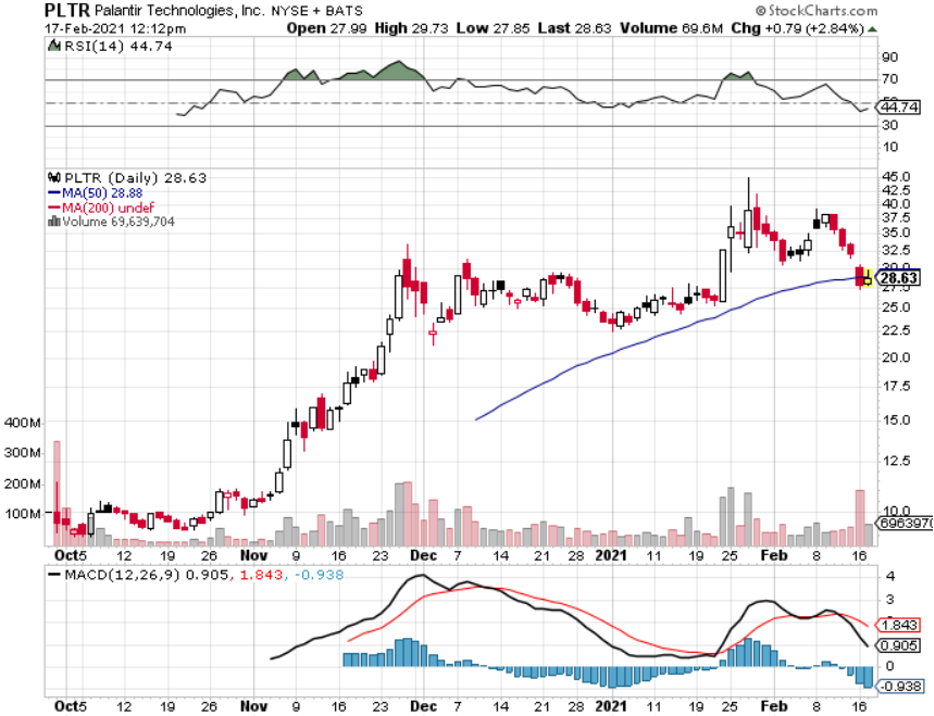
This stock is clearly a 10-bagger and after surging past $44 in January, the stock has consolidated to $28 today.
The fundamentals supporting this narrative is ironclad with the CIA delivering premium opportunity to accrue recurring government revenue.
We aren’t going into the semantics of how PLTR runs its business but in short, it basically provides customized software to clients analyzing large tranches of data for reasons ranging from finding suspected criminals to improving companies’ manufacturing capabilities.
The company acknowledges that government customers use its technology to kill people, so investors not comfortable with the deeper meaning behind the technology and revenue should steer away from this one and go with the softball versions of big tech.
Palantir gets both criticism and praise for the powerful nature of its data analytics software.
For example, critics allege Palantir's profiling tools used by intelligence and immigration agencies sometimes operate under a cloak of secrecy with zero oversight.
Palantir’s tools are not just for killing bad guys, they have also signed up companies from sectors that include healthcare, energy, and manufacturing.
Palantir has two main services that analyze data: Palantir Gotham and Palantir Foundry.
A customized option, Palantir Gotham is used by companies, government agencies, and law enforcement to combine information to decipher previously unseen patterns and identify relationships between sets of data ranging from social media posts and addresses to license plate numbers and personal relationships.
The algorithm then summarizes content together to make broader conclusions from the data.
Meanwhile, Foundry is a ready-made solution focusing on clients ranging from pharmaceutical and automotive businesses to aviation companies like Airbus and is meant to cut down on the costs associated with Gotham, such as the need for multiple on-site engineers.
Who is the CEO?
Alex Karp.
A graduate of Stanford Law School.
Karp has been explicit in his belief in the need for Silicon Valley companies to work with the U.S. government and law enforcement agencies precisely because they are American companies.
Palantir refers to effective applications of its software such as combatting Ponzi scheme conman Bernie Madoff to disaster recovery to thwarting cyberattacks and fighting child exploitation.
Not only that, Palantir’s software was deployed in the aftermath of Hurricane Florence in 2018 alongside Team Rubicon, an organization of military veterans that responds to disaster areas. With Palantir’s Gotham Operations module, the group identified and responded to neighborhoods in the greatest need of assistance.
How does the software directly help real-time U.S. soldiers in the field?
Its software helped the U.S. military track insurgents in Afghanistan planting improvised explosive devices (IEDs) by finding correlations between weather patterns, command wire IED attacks, and biometric information found on explosive devices.
Palantir has also sold its software to the Salt Lake City Police Department, helping officers reduce the time it takes to perform complex investigations by 95%.
Granted, this tech company is not for everyone, which is why many global brands such as Hershey’s, Coca-Cola, Home Depot, and American Express have terminated relationships.
In the short term, PLTR blistering rally will face an expiration of a lockup that allows 80% of total shares to be sold which could unleash a wave of selling from insiders tempted to cash in their shares.
The company’s market valuation at 39 times 2021 sales estimates implies revenue growth well in excess of 40%, at this pricy level, it makes PLTR an easy sell the news victim.
PLTR has tanked for two consecutive weeks and shares are down 18% from a record high late last month.
The overheating of shares has come back to reality with a tepid annual sales growth forecast of at least 30%. That suggests a significant slowdown from last year.
By comparison, sales growth in 2020 reached 47%, even surpassing $1.1 billion.
The silver lining is that government sales jumped 85% reassuring investors that the quality of sales could not be higher.
The company insiders have waited years to unload shares, and if there is a significant dip, I would put money to work in PLTR.
Shares are going to $100 and readers should ride the ladder up with them.