I am really happy with the performance of the Mad Hedge Long Term Portfolio since the last update on February 2, 2021. In fact, not only did we nail the best sectors to go heavily overweight, we also completely dodged the bullets in the worst-performing ones.
For new subscribers, the Mad Hedge Long Term Portfolio is a “buy and forget” portfolio of stocks and ETFs. If trading is not your thing and you don’t want to remain glued to a screen all day, these are the investments you can make. Then don’t touch them until you start drawing down your retirement funds at age 72.
For some of you, that is not for another 50 years. For others, it was yesterday.
There is only one thing you need to do now and that is to rebalance. Buy or sell what you need to reweight every position to its appropriate 5% or 10% weighting. Rebalancing is one of the only free lunches out there and always adds performance over time. You should follow the rules assiduously.
Despite the seismic changes that have taken place in the global economy over the past nine months, I only need to make minor changes to the portfolio, which I have highlighted in red on the spreadsheet.
To download the entire new portfolio in an excel spreadsheet, please go to www.madhedgefundtrader.com, log in, go “My Account”, then “Global Trading Dispatch”, the click on the “Long Term Portfolio” button, then “Download.”
Changes
Biotech
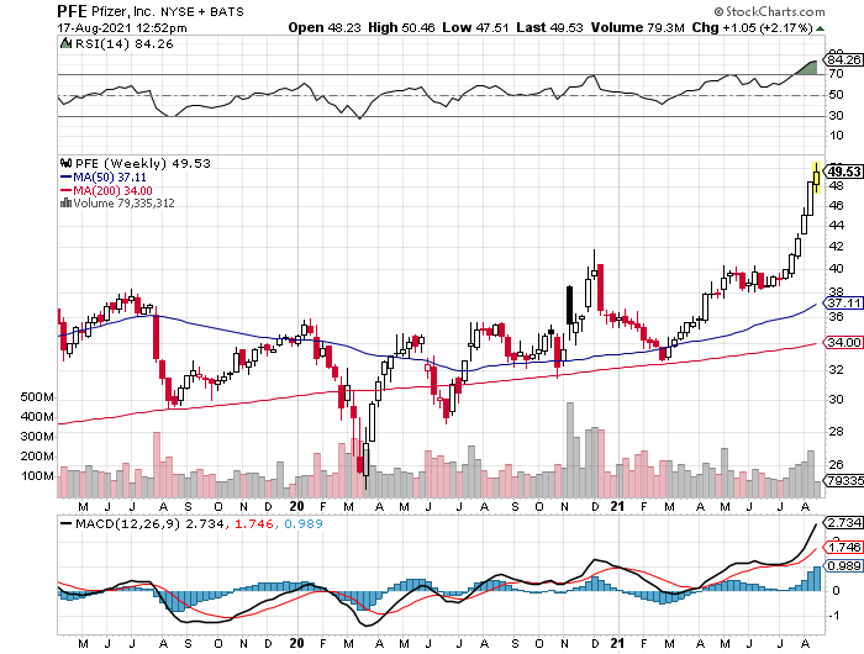
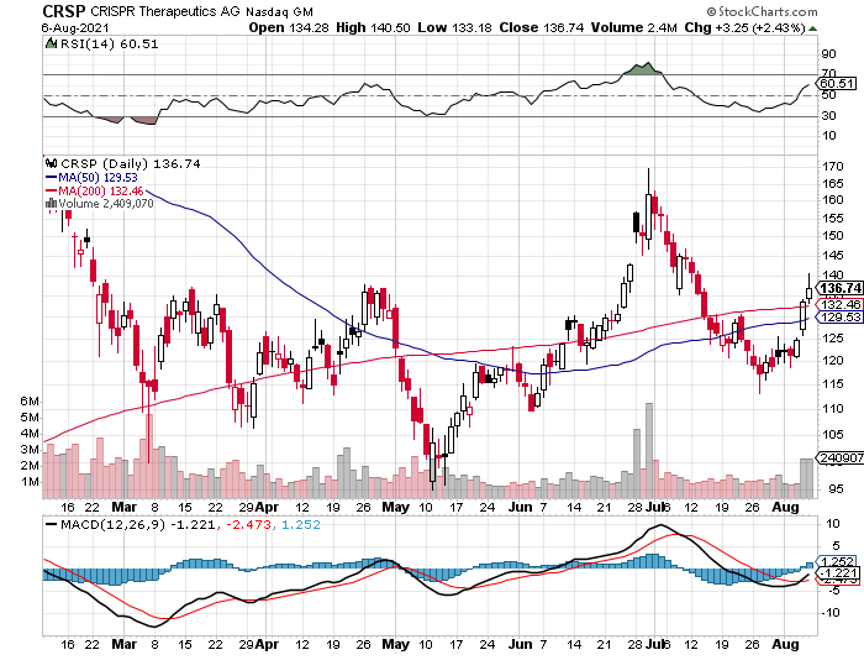
Pfizer (PFE) has nearly doubled in six months, while Crisper Therapeutics (CRSP) has almost halved. Since the pandemic, which Pfizer made fortunes on, is peaking and we are still at the dawn of the CRISPR gene editing revolution, the natural switch here is to take profits in (PFE) and double up on (CRSP).
Technology
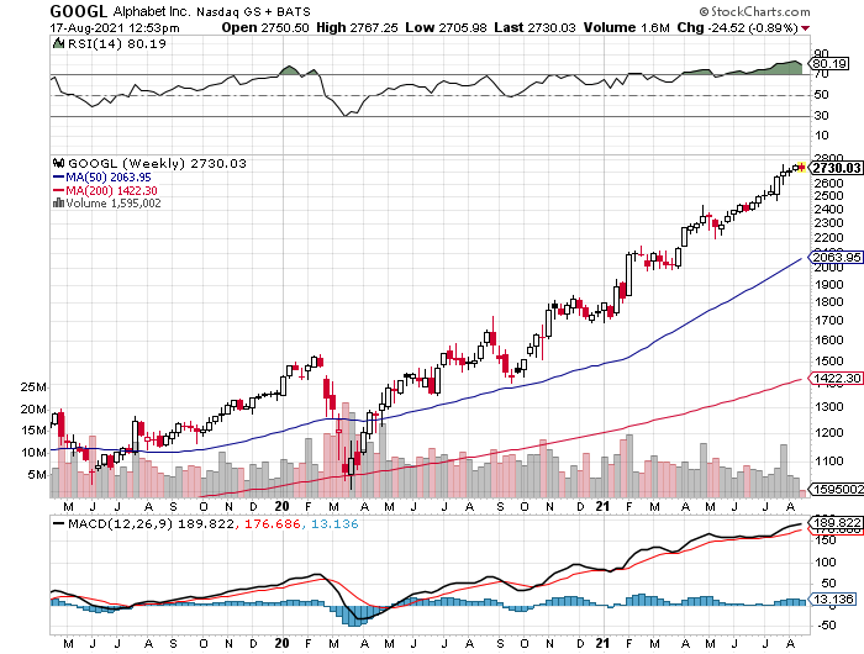
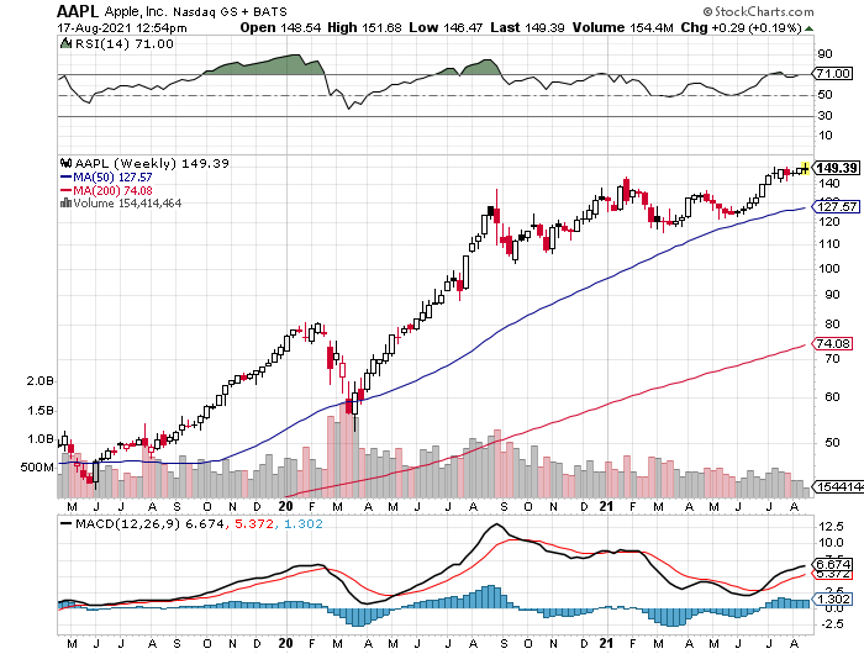
I am maintaining my 20% in technology which are all close to all-time highs. I believe that Apple (AAPL), (Amazon (AMZN), Google (GOOGL), and Square (SQ) have a double or more over the next three years, so I am keeping all of them.
Banks
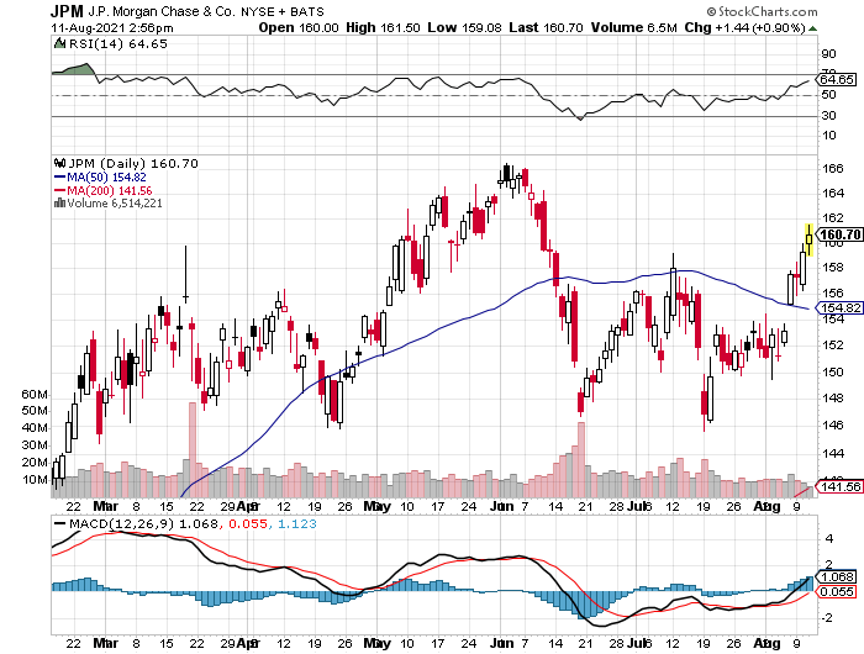
I am also keeping my weighting in banks at 20%. Interest rates are imminently going to rise, with a Fed taper just over the horizon, setting up a perfect storm in favor of bank earnings. Loan default rates are falling. Banks are overcapitalized, thanks to Dodd-Frank. And because of the trillions in government stimulus loans they are disbursing, they are now the most subsidized sector of the economy. So, keep Morgan Stanley (MS), Goldman Sachs (GS), JP Morgan (JPM), and Bank of America, which will profit enormously from a continuing bull market in stocks. They are also a key part of my” barbell” portfolio.
International
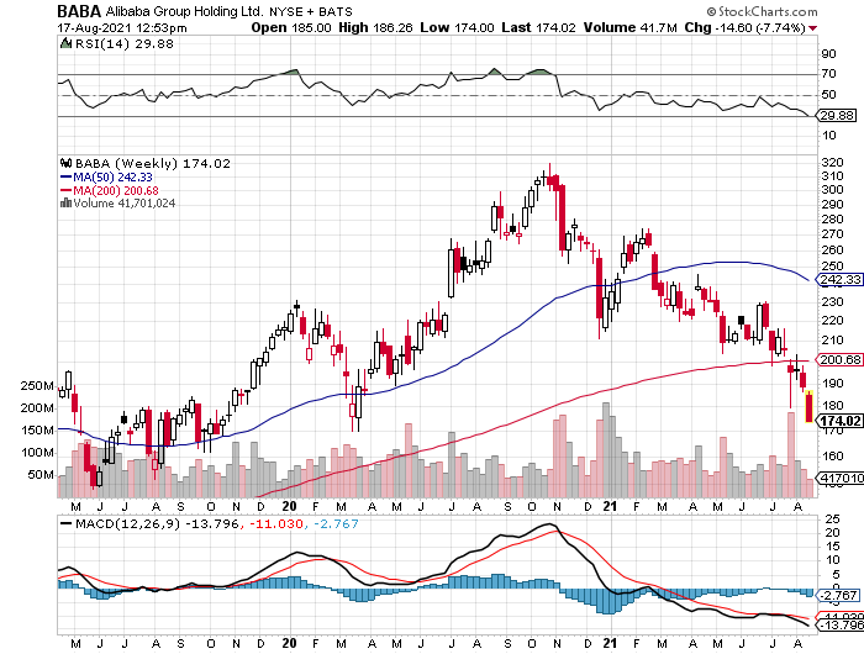
China has been a disaster this year, with Alibaba (BABA) dropping by half, while emerging markets (EEM) have gone nowhere. I am keeping my positions because it makes no sense to sell down here. There is a limit to how much the Middle Kingdom will destroy its technology crown jewels. Emerging markets are a call option on a global synchronized recovery which will take place next year.
Bonds
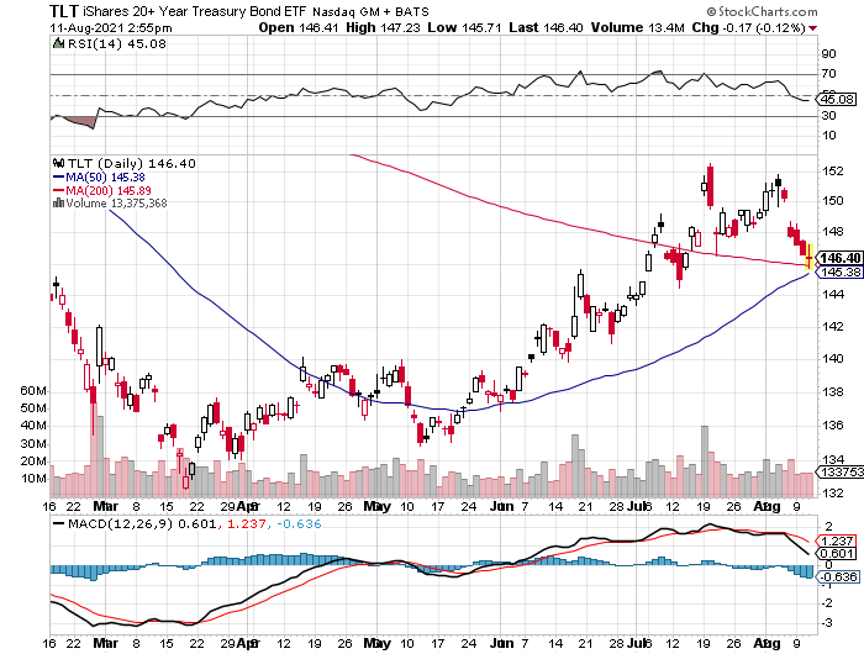
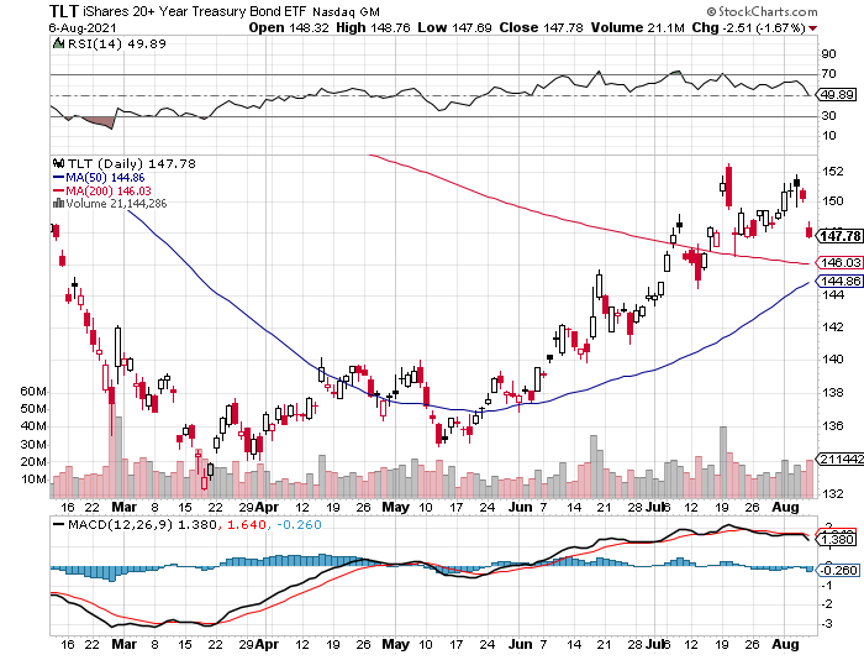
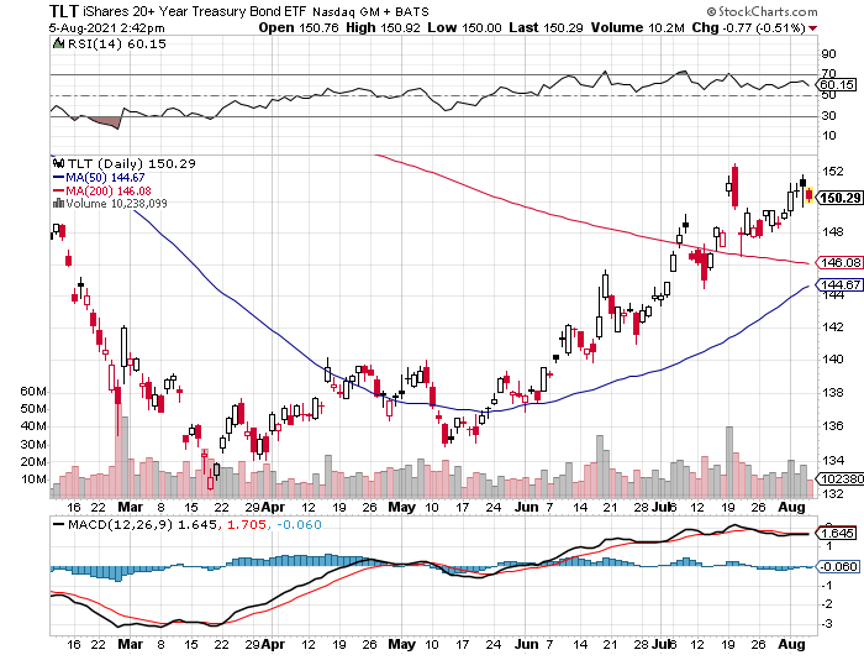
Along the same vein, I am keeping 10% of my portfolio in a short position in the United States Treasury Bond Fund (TLT) as I think bonds are about to go to hell in a handbasket. I rant on this sector on an almost daily basis so go read Global Trading Dispatch. Eventually, massive over-issuance of bonds by the US government will destroy this entire sector.
Foreign Exchange
I am also keeping my foreign currency exposure unchanged, maintaining a double long in the Australian dollar (FXA). Eventually, the US dollar will become toast and could be your next decade-long trade. The Aussie will be the best performing currency against the US dollar.
Australia will be a leveraged beneficiary of the synchronized global economic recovery through strong commodity prices which have already started to rise, and the post-pandemic return of Chinese tourism and investment. I argue that the Aussie will eventually make it to parity with the US dollar, or 1:1.
Precious Metals
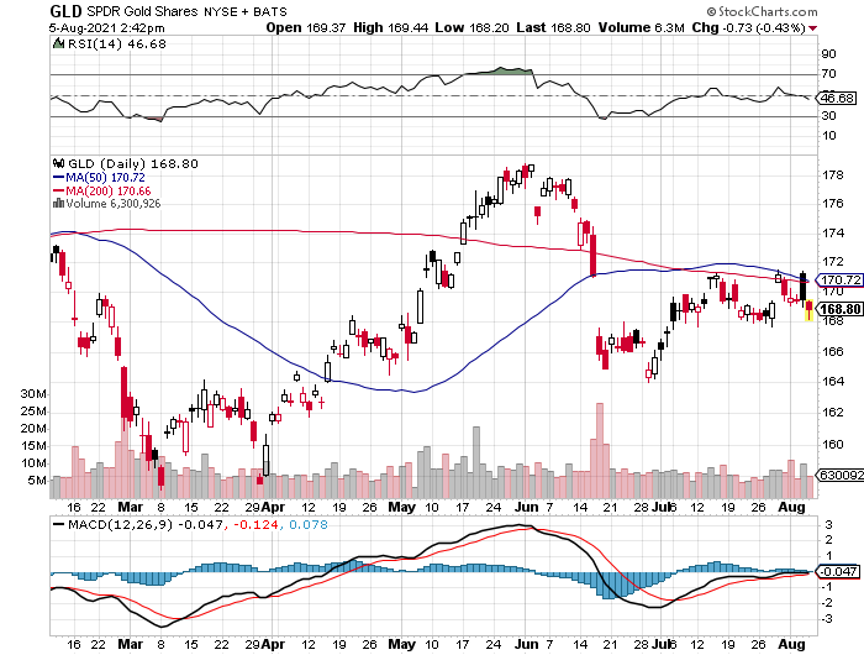
As for precious metals, I’m keeping my 0% holding in gold (GLD). From here, it is having trouble keeping up with other alternative assets, like Bitcoin, and there are better fish to fry.
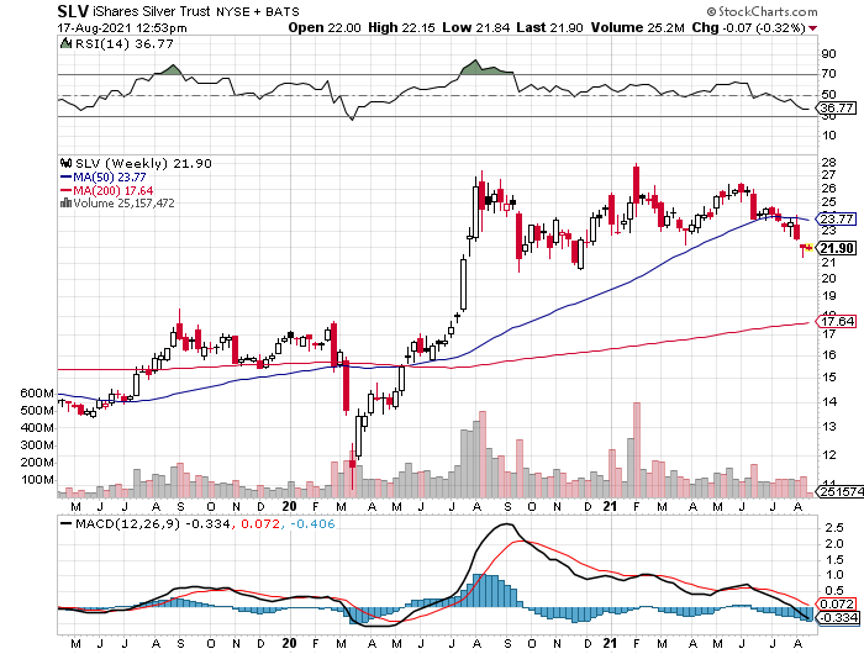
I am keeping a 5% weighting in the higher beta and more volatile iShares Silver Trust (SLV), which has far wider industrial uses in solar panels and electric vehicles. The arithmetic is simple. EV production will rocket from 700,000 in 2020 to 25 million in 2030 and each one needs two ounces of silver.
Energy
As for energy, I will keep my weighting at zero. Never confuse “gone down a lot” with “cheap”. I think the bankruptcies have only just started and will stretch on for a decade. Thanks to hyper-accelerating technology, the adoption of electric cars, and less movement overall in the new economy, energy is about to become free. You are looking at the next buggy whip industry.
The Economy
My ten-year assumption for the US and the global economy remains the same. I’m looking at 3%-5% a year growth for the next decade after this year’s superheated 7% performance.
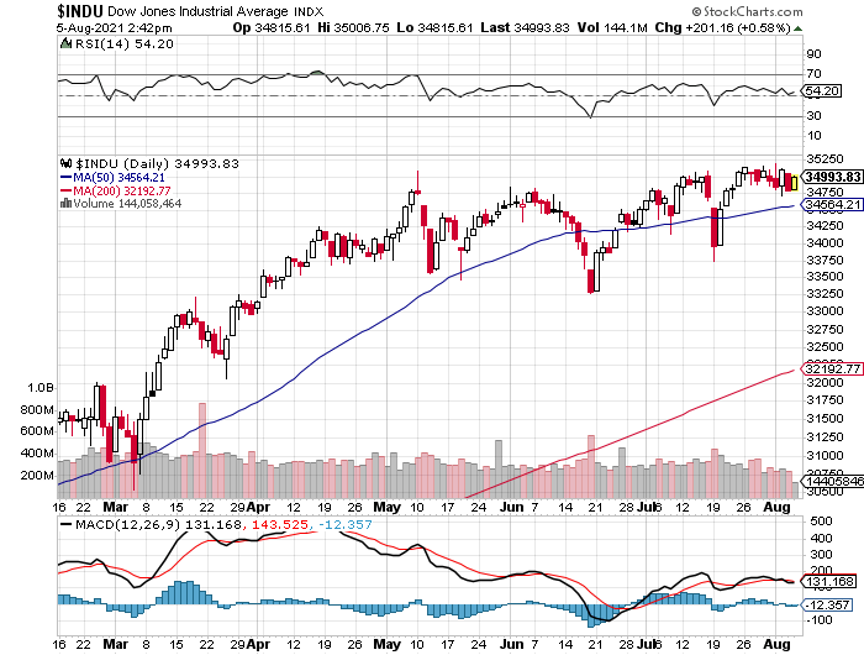
When we come out the other side of this, we will be perfectly poised to launch into my new American Golden Age, or the next Roaring Twenties. With interest rates still at zero, oil cheap, there will be no reason not to. The Dow Average will rise by 700% or more from 35,000 to 240,000 in the coming decade. The American coming out the other side of the pandemic will be far more efficient, productive, and profitable than the old.
You won’t believe what’s coming your way!
I hope you find this useful and I’ll be sending out another update in six months so you can rebalance once again. If I forget, please remind me.
Stay healthy.
John Thomas
CEO & Publisher
The Diary of a Mad Hedge Fund Trader
https://madhedgefundtrader.com/wp-content/uploads/2019/05/cropped-mad-hedge-logo-transparent-192x192_f9578834168ba24df3eb53916a12c882.png00Mad Hedge Fund Traderhttps://madhedgefundtrader.com/wp-content/uploads/2019/05/cropped-mad-hedge-logo-transparent-192x192_f9578834168ba24df3eb53916a12c882.pngMad Hedge Fund Trader2021-08-19 10:02:182021-08-19 12:09:09My Newly Updated Long-Term Portfolio
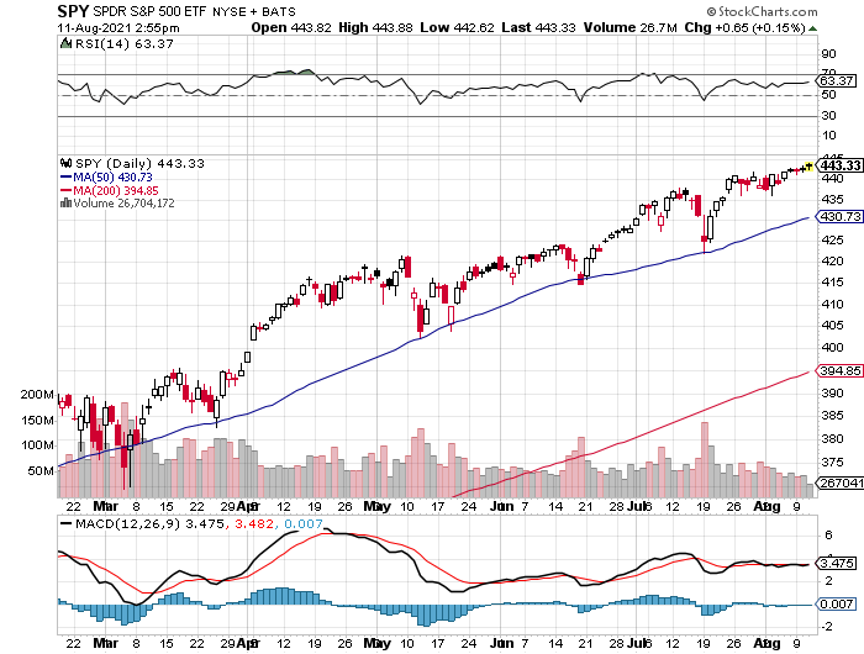
Friday saw the stock market’s lowest volume day of the year, and shares rose almost every day last week to new all-time highs.
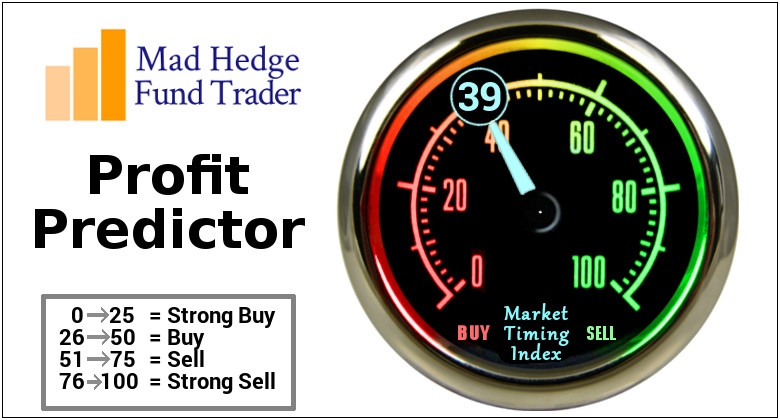
The way this usually ends is that the slow grind explodes into a high-volume spike marking an interim market top. That makes new investment now extremely risky.
August usually markets the best buying opportunity of the year with a cataclysmic selloff. Remember the 2010 flash crash, down 1,100 points in two hours? So far, no cigar.
I have tons of people asking me what to buy right now. That is usually another market-topping indicator. I tell them to keep their cash. Cash is a position. A dollar at a market top is worth $10 at a market bottom.
Under an index that is making excruciatingly slow gains are constant sector rotations bring pretty dramatic moves. Play those dramatic moves.
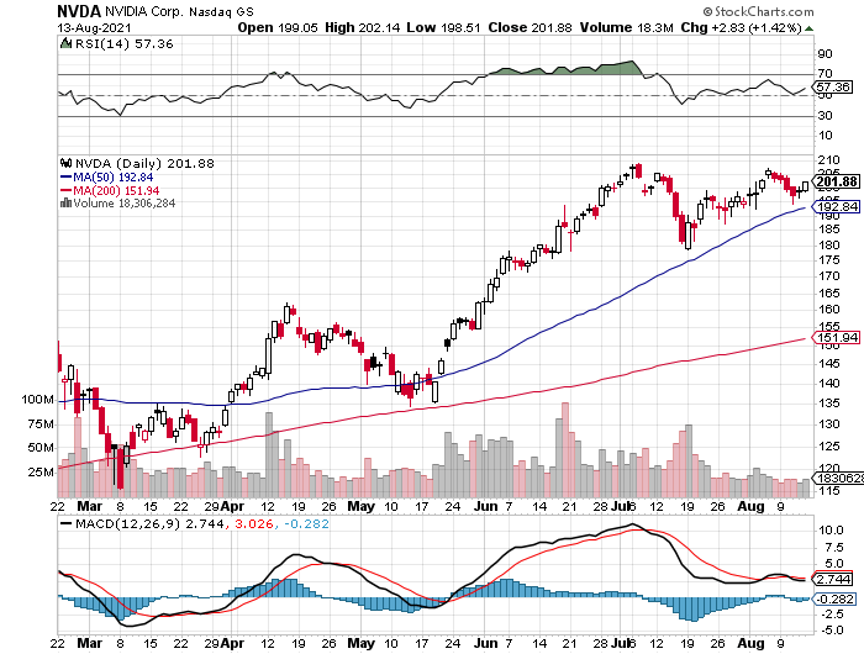
May saw money suddenly shift into tech stocks, with the best, like NVIDIA (NVDA) leaping 56%.
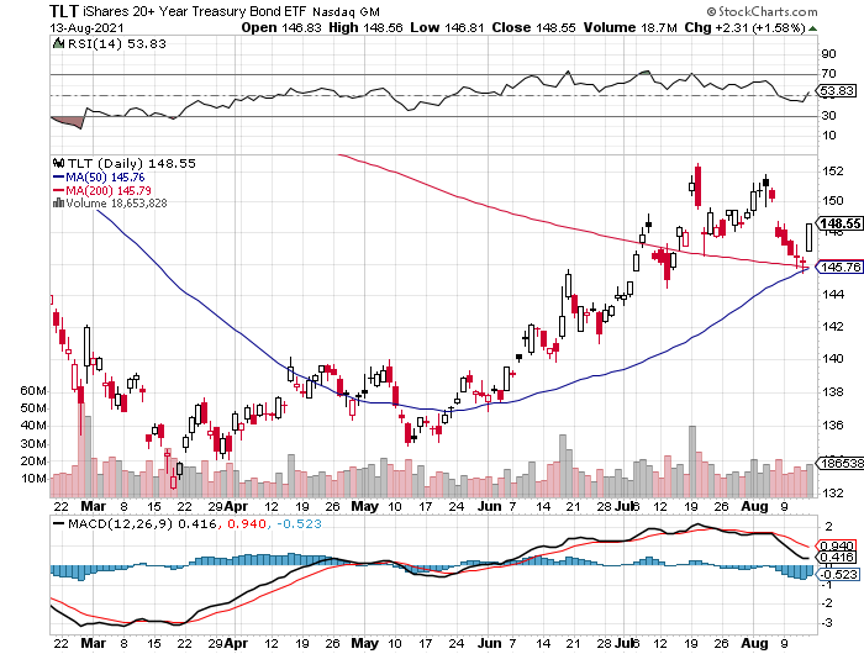
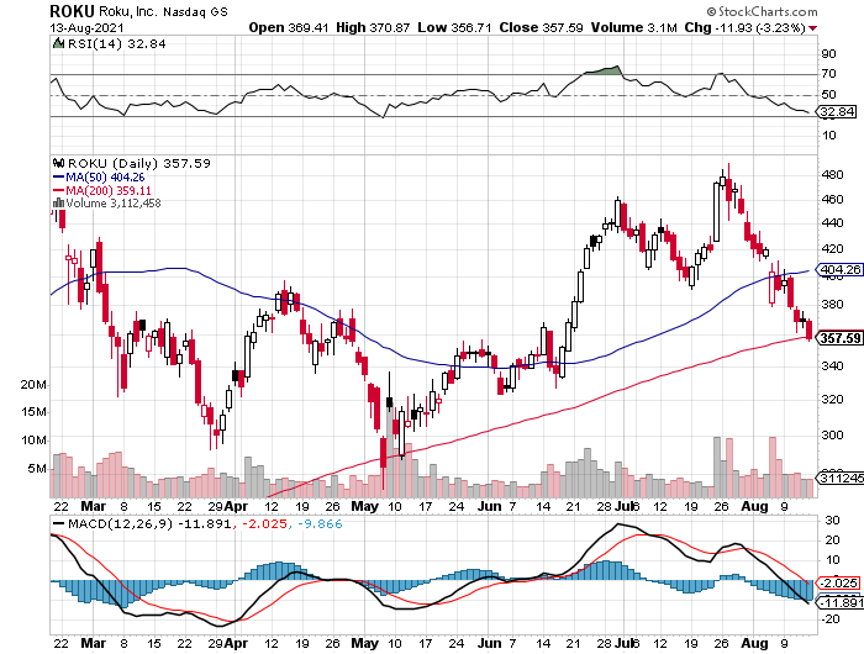
The day the ten-year US Treasury yield (TLT) bottomed at 1.10%, tech went back to sleep. While big tech ground sideways, small tech brought more heart-rending downside moves, such as the 27% plunge in Roku (ROKU).
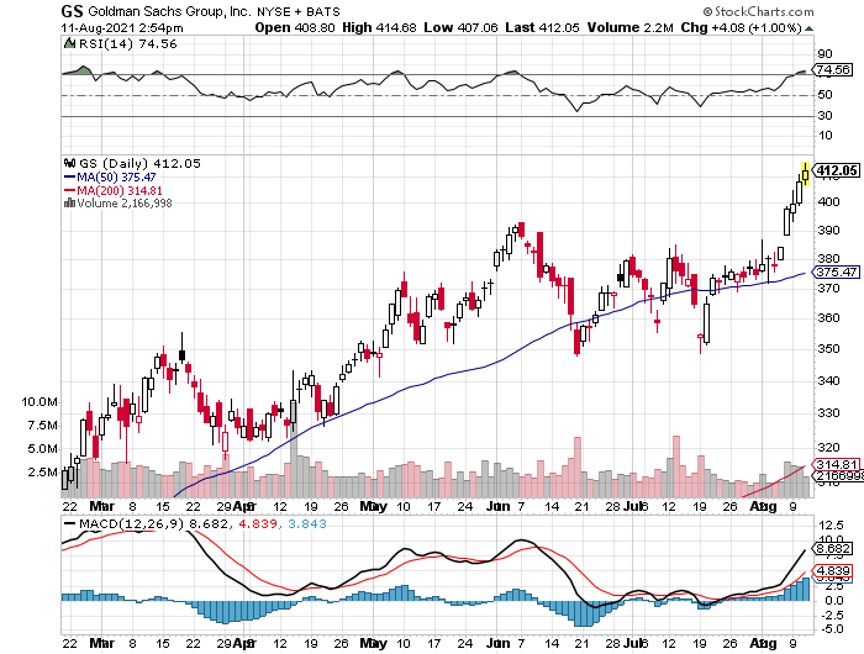
In the meantime, financials and commodities have moved to the fore. Goldman Sachs (GS) melted up 20% off of blockbuster earnings, while Freeport McMoRan popped 26%, thanks to a Chilean copper union strike.
Let me propose a revolutionary new investment strategy to you. It’s called “buy low, sell high.” Everybody talks about it but actually executes the opposite.
I employ this money-making ploy through my “barbell” strategy, with equal weightings in technology and domestic recovery stocks like financials, industrials, and commodities.
It's quite simple. You just sell whatever has just delivered the most recent spectacular upside gains and roll that money into what has recently become ignored, cheap, and out of favor.
It is a market approach that is really devoid of the thought process.
All eyes will be on Jackson Hole, Wyoming next week, the annual meeting of the world’s top central bankers. That is when we get the next hint about the intentions of the Federal Reserve as to, not "if", but "when" they reduce quantitative easing.
You would think that a 6.5% GDP growth rate and a 5.4% inflation rate would do it, but these days, nothing is certain. A hot jobs report in September would do it for sure.
We may have to wait until then before we see any serious move in stocks and a return of volatility (VIX). In the meantime, catch up on reading your research, pay your bills, and work on your golf swing.
Bitcoin staged a recovery for the ages, rallying 55% in two weeks. The “battle of $30,000” is over and the cryptocurrency won. It really is becoming too big to fail. I might have to do something about that. July InflationRead at a hot 5.4%, but core inflation showed a small decline. In June, used car prices accounted for a third of the total price increases, but last month, it was zero. So far, there is no move in rents, but it’s coming. All Fed eyes will remain laser-focused on this number.
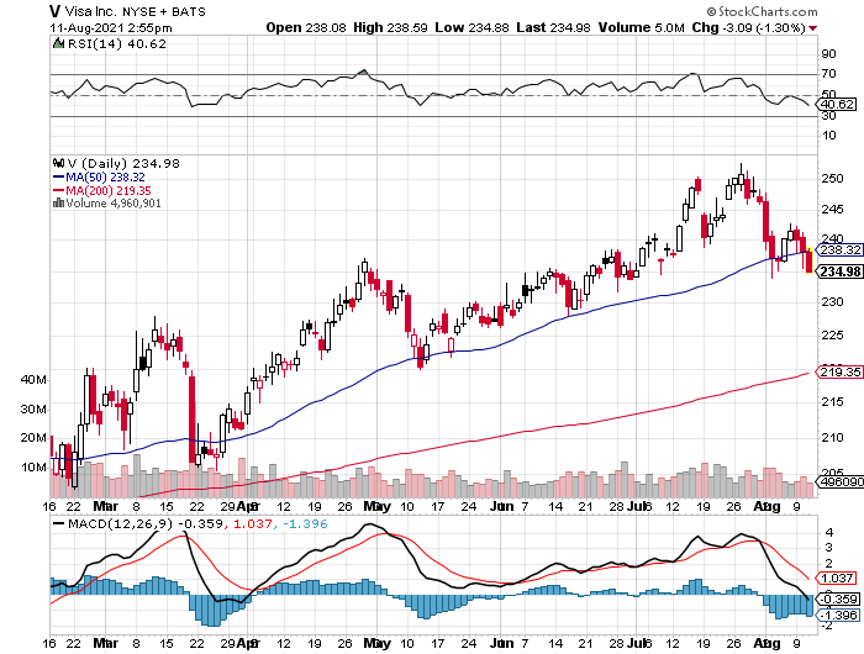
Taper talk is back! With the ballistic increase in the July Nonfarm Payroll report and the 2 ½ point dive in the bond market. I think the top is in for finds and the bottom for long term rates. It means tech stocks will lag from now, while interest rate sensitives like banks, brokers, and fund managers will lead. Buy (JPM), (MS), (V), and (GS) on dips.
US Budget Deficit hits a record $302 Billion in July. Covid benefits are remaining high, while tax revenues are lagging YOY. Keep selling those (TLT) rallies. The generational crash may have just begun.
Fed’s Rosengren Says QE is not creating jobs, causing bonds to drop a full point in the after-market. No kidding. I have been arguing that our nation’s central bank has been pushing on a string all year. Atlanta Fed governor Bostic couldn’t agree more. Time for more action than words? Gold Hits four-month low, breaking key support. Bitcoin is clearly stealing its thunder, which has risen by 50% in two weeks. If you’re considering gold, go take a long nap first. Oil dives on delta surge, off $9, or 12% in a week, the lowest in three weeks. Delta is now rampaging throughout China, the world’s largest consumer of Texas tea., putting $63 in play. Weekly Jobless Claims hit 375,000, down 12,000 on the week. Moving in the right direction but still incredibly high.
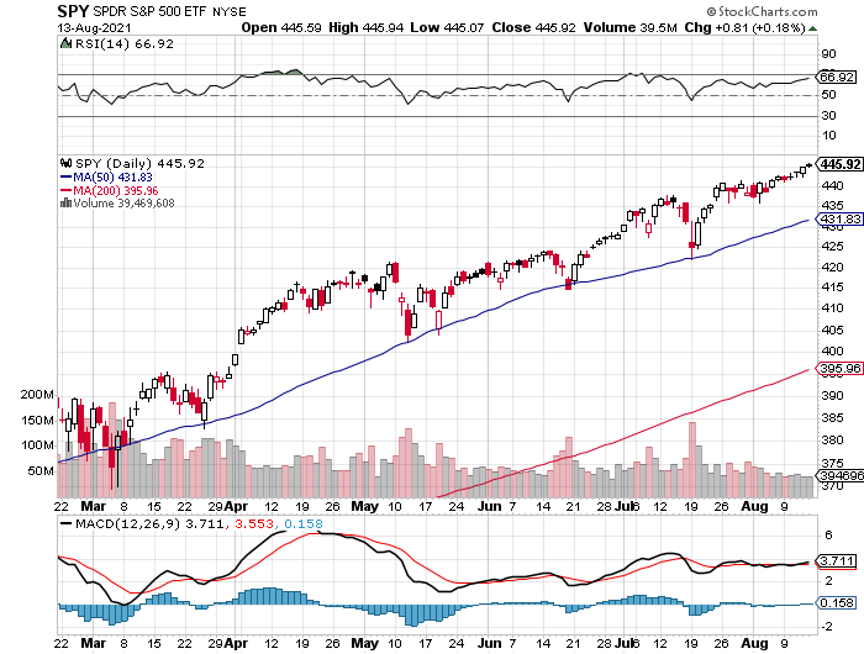
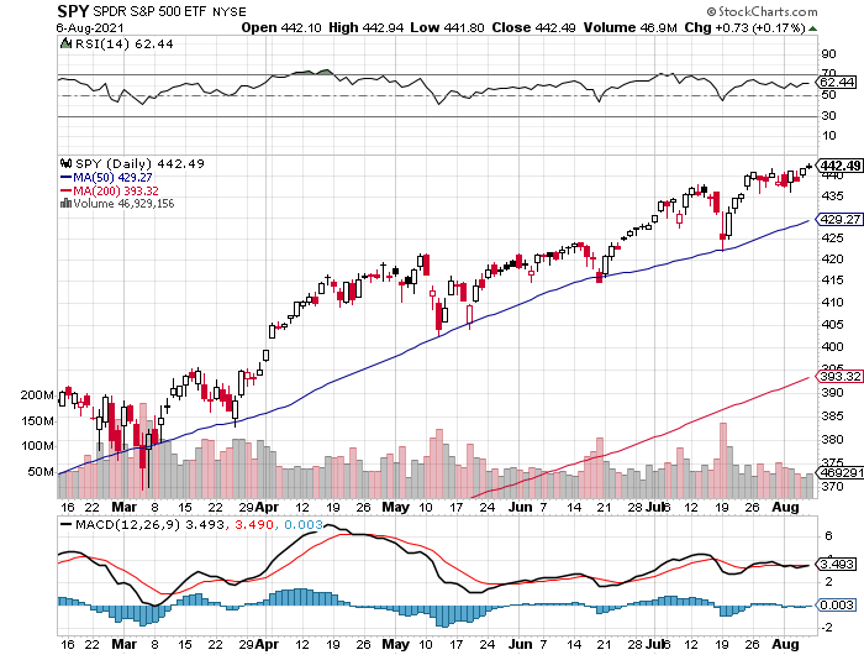
Berkshire Hathaway announces solid earnings, but scales back share buybacks at these elevated levels. Oracle of Omaha Warren Buffett bought back $6 billion of his own stock in Q2, leaving him with a staggering $144 billion in cash. Almost no stocks meet Buffett’s value standards in the current environment. Buy (BRKB) on dips. It’s a high-class problem to have. Ed Yardeni is bullish, along with David Kostin, and is the only manager who comes close to my own $475 target for the (SPY) by the end of the year. The U.S. economy will be in nominal terms around 8% higher this year than pre-pandemic 2019. Sales for the S&P 500 companies will be 15% higher and earnings will be 34% higher. That is a representation of the operating leverage that exists in so many companies. The Roaring Twenties lives!
My Ten-Year View
When we come out the other side of pandemic, we will be perfectly poised to launch into my new American Golden Age, or the next Roaring Twenties. With interest rates still at zero, oil cheap, there will be no reason not to. The Dow Average will rise by 800% to 240,000 or more in the coming decade. The American coming out the other side of the pandemic will be far more efficient and profitable than the old. Dow 240,000 here we come!
My Mad Hedge Global Trading Dispatch saw a modest +4.86% in July. My 2021 year-to-date performance appreciated to 74.07%. The Dow Average was up 16.00% so far in 2021.
I stuck with three positions, a long in (JPM) and a double short in the (TLT), all of which expire on Friday. My double short in the (SPY) punched me in the nose, forcing me to stop out for losses when I hit the lowest strike prices.
I then jumped into a very deep in-the-money call spread in Robinhood (HOOD) made possible only by the stock’s astronomically high volatility. Its 44% drop helped too. I also added a third short in the bond market.
That leaves me 30% in cash. I’m keeping positions small as long as we are at extreme overbought conditions.
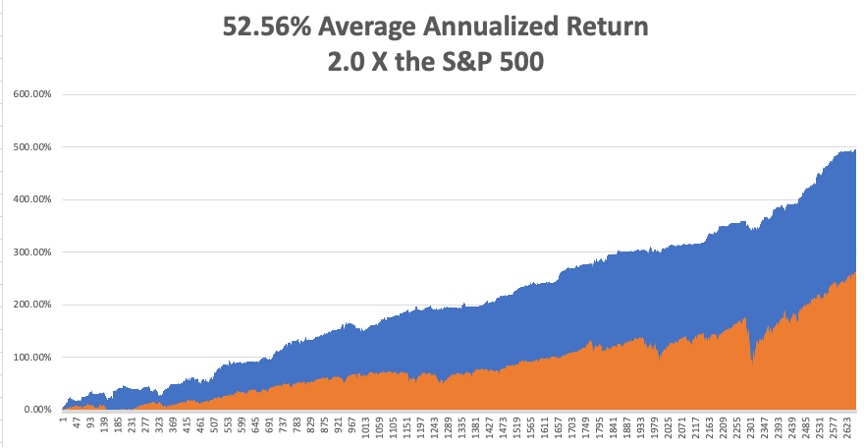
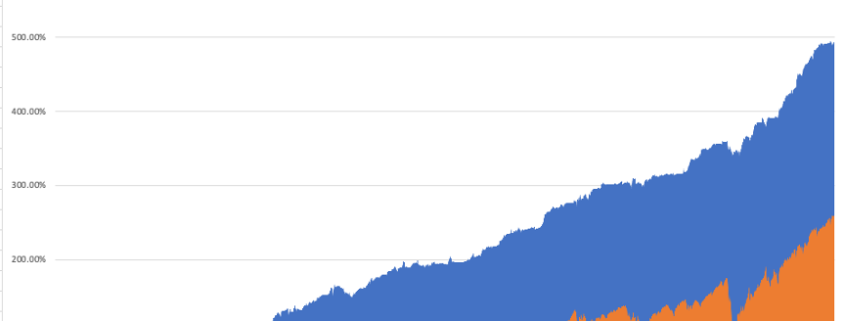
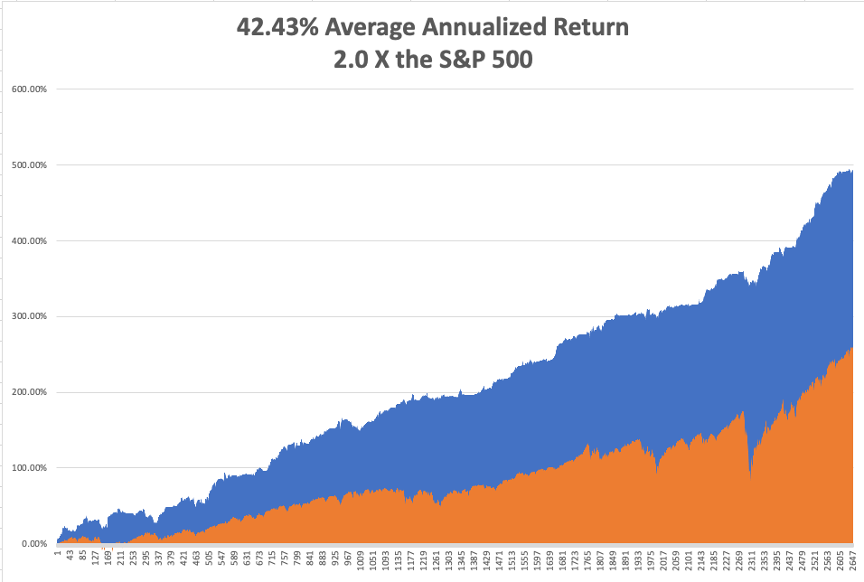
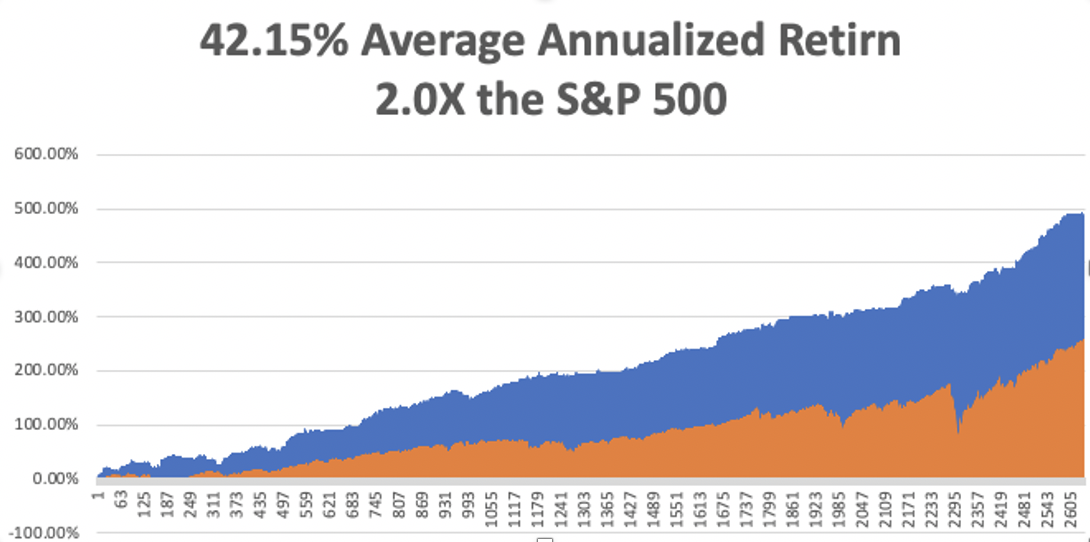
That brings my 11-year total return to 496.62%, some 2.00 times the S&P 500 (SPX) over the same period. My 12-year average annualized return now stands at an unbelievable 12.56%, easily the highest in the industry.
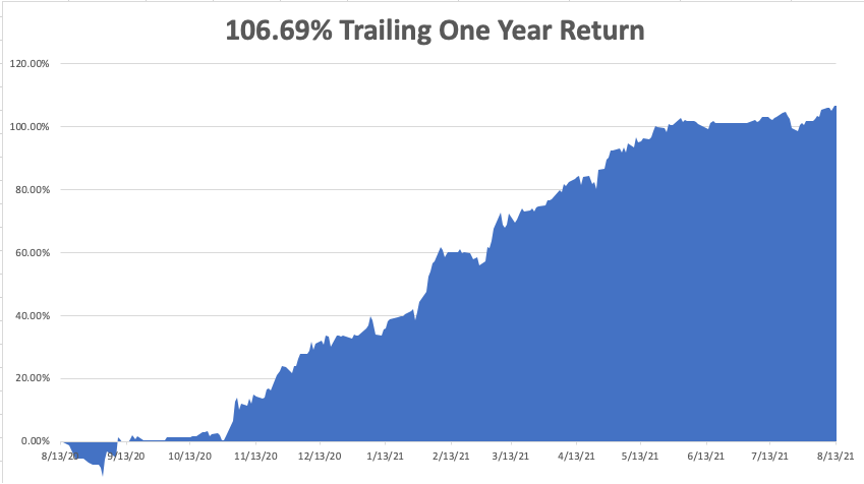
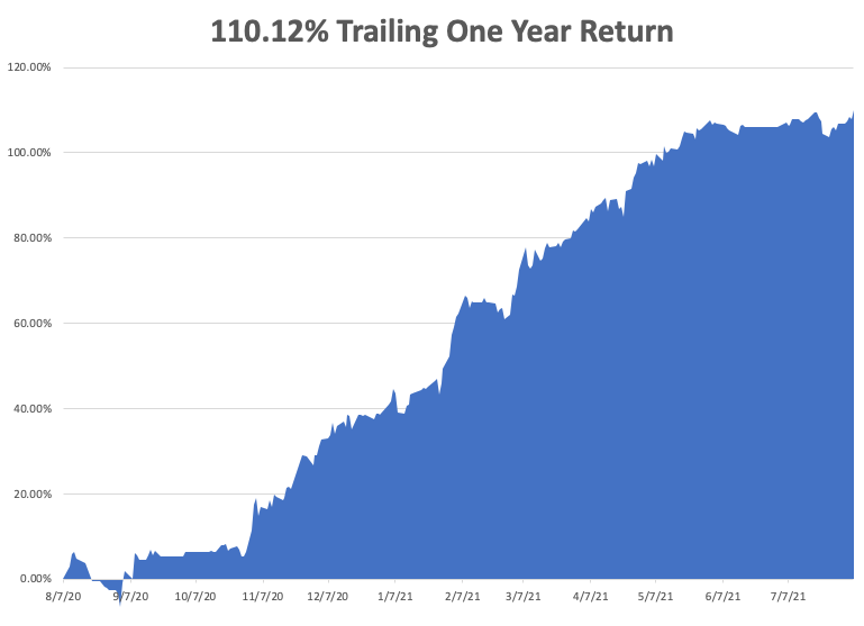
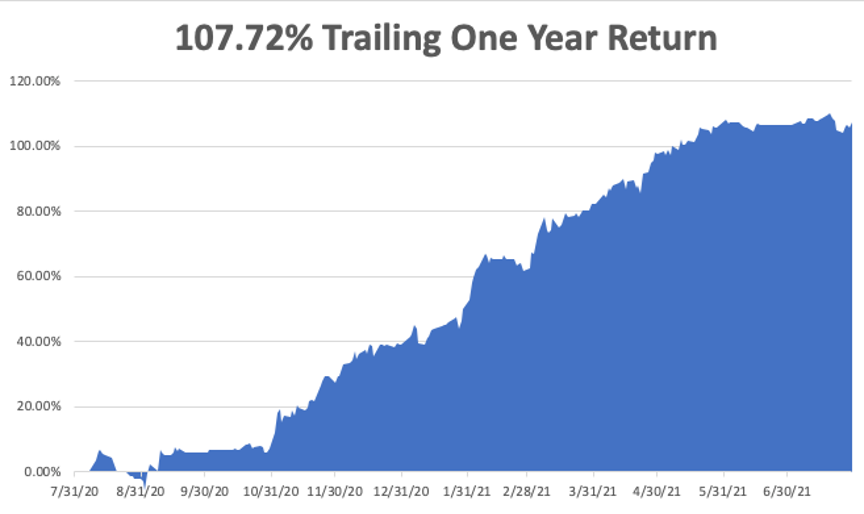
My trailing one-year return retreated to positively eye-popping 106.69%. I truly have to pinch myself when I see numbers like this. I bet many of you are making the biggest money of your long lives.
We need to keep an eye on the number of US Coronavirus cases at 36.7 million and rising quickly and deaths topping 622,000, which you can find here at https://coronavirus.jhu.edu.
The coming week will bring our monthly blockbuster jobs reports on the data front.
On Monday, August 16 at 7:00 AM, the New York Empire State Manufacturing Index is out.
On Tuesday, August 17 at 7:30 AM, US Retail Sales for July are published.
On Wednesday, August 18 at 5:30 AM, the Housing Starts for July are printed. At 2:00 PM, the minutes from the last FOMC are released.
On Thursday, August 19 at 8:30 AM, Weekly Jobless Claims are announced. Square (SQ) reports.
On Friday, August 20 at 2:00 PM, the Baker Hughes Oil Rig Count are disclosed.
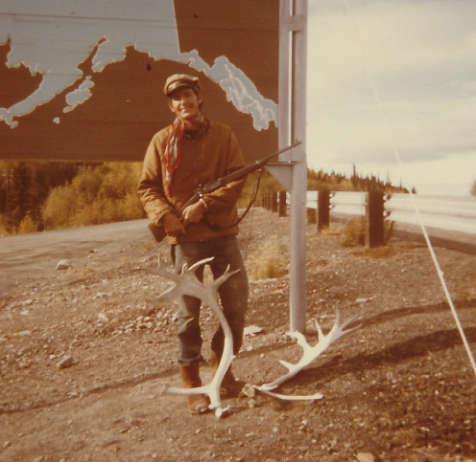
As for me, upon graduation from high school in 1970, I received a plethora of scholarships, one of which was for the then astronomical sum of $300 in cash from the Arc Foundation.
By age 18, I had hitchhiked in every country in Europe and North Africa, more than 50. The frozen wasteland of the North and the Land of Jack London beckoned.
After all, it was only 4,000 miles away. How hard could it be? Besides, oil had just been discovered on the North Slope and there were stories of abundant high-paying jobs.
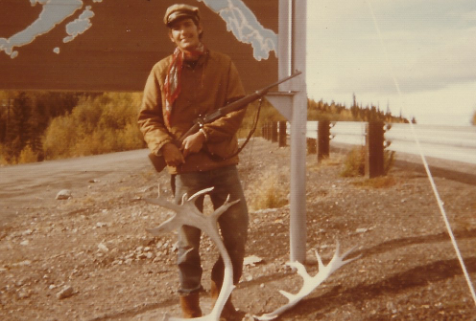
I started hitching to the Northwest, using my grandfather’s 1892 30-40 Krag & Jorgenson rifle to prop up my pack and keeping a Smith & Wesson .38 revolver in my coat pocket. Hitchhikers with firearms were common in those days and they always got rides. Drivers wanted the extra protection.
No trouble crossing the Canadian border either. I was just another hunter.
The Alcan Highway started in Dawson Creek, British Columbia, and was built by an all-black construction crew during the summer of 1942 to prevent the Japanese from invading Alaska. It had not yet been paved and was considered the great driving challenge in North America.
The rain started almost immediately. The legendary size of the mosquitoes turned out to be true. Sometimes, it took a day to catch a ride. But the scenery was magnificent and pristine.
At one point, a Grizzley bear approached me. I let loose a shot over his head at 100 yards and he just turned around and lumbered away. It was too beautiful to kill.
I passed through historic Dawson City in the Yukon, the terminus of the 1898 Gold Rush. There, abandoned steamboats lie rotting away on the banks, being reclaimed by nature. The movie theater was closed but years later was found to have hundreds of rare turn-of-the-century nitrate movie prints frozen in the basement, a true gold mine.
Eventually, I got a ride with a family returning to Anchorage hauling a big RV. I started out in the back of the truck in the rain, but when I came down with pneumonia, they were kind enough to let me move inside. Their kids sang “Raindrops keep falling on my head” the entire way, driving me nuts. In Anchorage, they allowed me to camp out in their garage.
Once in Alaska, there were no jobs. The permits required to start the big pipeline project wouldn’t be granted for four more years. There were 10,000 unemployed.
The big event that year was the opening of the first McDonald’s in Alaska. To promote the event, the company said they would drop dollar bills from a helicopter. Thousands of homesick showed up and a riot broke out, causing the stand to burn down. It was rumored their burgers were made of moose meat anyway.
I made it all the way to Fairbanks to catch my first sighting of the wispy green contrails of the northern lights, impressive indeed. Then began the long trip back.
I lucked out catching an Alaska Airlines promotional truck headed for Seattle. That got me free ferry rides through the inside passage. The driver wanted the extra protection as well. The gaudy, polished tourist destinations of today were back then pretty rough ports inhabited by tough, deeply tanned commercial fishermen and loggers who were heavy drinkers always short of money. Alcohol features large in the history of Alaska.
From Seattle, it was just a quick 24-hour hop down to LA. I still treasure this trip. The Alaska of 1970 no longer exists, as it is now overrun with summer tourists. It now has more than one McDonald’s. And with runaway global warming, the climate is starting to resemble that of California than the polar experience it once was.
Good Luck and Good Trading.
John Thomas
CEO & Publisher
The Diary of a Mad Hedge Fund Trader
The Alcan Highway Midpoint
The Alaska-Yukon Border in 1970
https://www.madhedgefundtrader.com/wp-content/uploads/2021/08/alcan-yukon-border.png462476Mad Hedge Fund Traderhttps://madhedgefundtrader.com/wp-content/uploads/2019/05/cropped-mad-hedge-logo-transparent-192x192_f9578834168ba24df3eb53916a12c882.pngMad Hedge Fund Trader2021-08-16 09:02:342021-08-16 11:11:58The Market Outlook for the Week Ahead, or My Revolutionary New Strategy
I know all of this may sound confusing at first. But once you get the hang of it, this is the greatest way to make money since sliced bread.
I still have six positions left in my model trading portfolio, they are all deep in-the-money, and about to expire in six trading days. That opens up a set of risks unique to these positions.
I call it the “Screw up risk.”
As long as the markets maintain current levels, ALL of these positions will expire at their maximum profit values.
They include:
Risk On (World is Getting Better)
(TLT) 8/$157-$160 put spread 10.00%
(TLT) 8/$156-$159 put spread. 10.00%
(JPM) 8/$300-$320 call spread 10.00%
(V) 8/$220-$225 call spread 10.00%
(GS) $355-$365 call spread 10.00%
Risk Off (World is Getting Worse)
(SPY) 8/$445-$450 put spread -10.00%
Total Net Position 40.00%
With the August 20 options expiration upon us, there is a heightened probability that your short position in the options may get called away.
If it happens, there is only one thing to do: fall down on your knees and thank your lucky stars. You have just made the maximum possible profit for your position instantly.
Most of you have short option positions, although you may not realize it. For when you buy an in-the-money vertical option spread, it contains two elements: a long option and a short option.
The short options can get “assigned,” or “called away” at any time, as it is owned by a third party, the one you initially sold the put option to when you initiated the position.
You have to be careful here because the inexperienced can blow their newfound windfall if they take the wrong action, so here’s how to handle it correctly.
Let’s say you get an email from your broker telling you that your call options have been assigned away.
I’ll use the example of the Goldman Sachs (GS) call spread.
For what the broker had done in effect is allow you to get out of your call spread position at the maximum profit point days before the August 20 expiration date. In other words, what you bought for $8.60 on August 4 is now worth $10.00, giving you a near-instant profit of 16.27%!
In the case of the Goldman Sachs (GS) August 20 $200-$210 in-the-money vertical Bull Call spread, all you have to do is call your broker and instruct them to “exercise your long position in your (GS) August 20 $355 calls to close out your short position in the (GS) August 20 $365 calls.”
You must do this in person. Brokers are not allowed to exercise options automatically, on their own, without your expressed permission. This is a perfectly hedged position, with both options having the same name and the same expiration date, so there is no risk. The name, number of shares, and number of contracts are all identical, so you have no exposure at all.
Calls are a right to buy shares at a fixed price before a fixed date, and one options contract is exercisable into 100 shares.
Short positions usually only get called away for dividend-paying stocks or interest-paying ETFs like the (TLT). There are strategies out there that try to capture dividends the day before they are payable. Exercising an option is one way to do that.
Weird stuff like this happens in the run-up to options expiration like we have coming.
A call owner may need to buy a long (GS) position after the close, and exercising his long (GS) $365 call is the only way to execute it.
Adequate shares may not be available in the market, or maybe a limit order didn’t get done by the market close.
There are thousands of algorithms out there which may arrive at some twisted logic that the puts need to be exercised.
Many require a rebalancing of hedges at the close every day which can be achieved through option exercises.
And yes, options even get exercised by accident. There are still a few humans left in this market to blow it by writing shoddy algorithms.
And here’s another possible outcome in this process.
Your broker will call you to notify you of an option called away, and then give you the wrong advice on what to do about it.
This generates tons of commissions for the broker but is a terrible thing for the trader to do from a risk point of view, such as generating a loss by the time everything is closed and netted out.
There may not even be an evil motive behind the bad advice. Brokers are not investing a lot in training staff these days. In fact, I think I’m the last one they really did train.
Avarice could have been an explanation here but I think stupidity and poor training and low wages are much more likely.
Brokers have so many ways to steal money legally that they don’t need to resort to the illegal kind.
This exercise process is now fully automated at most brokers but it never hurts to follow up with a phone call if you get an exercise notice. Mistakes do happen.
Some may also send you a link to a video of what to do about all this.
If any of you are the slightest bit worried or confused by all of this, come out of your position RIGHT NOW at a small profit! You should never be worried or confused about any position tying up YOUR money.
Professionals do these things all day long and exercises become second nature, just another cost of doing business.
If you do this long enough, eventually you get hit. I bet you don’t.
Calling All Options
https://www.madhedgefundtrader.com/wp-content/uploads/2018/11/Call-Options.png345522Mad Hedge Fund Traderhttps://madhedgefundtrader.com/wp-content/uploads/2019/05/cropped-mad-hedge-logo-transparent-192x192_f9578834168ba24df3eb53916a12c882.pngMad Hedge Fund Trader2021-08-12 09:02:262021-08-12 16:10:27A Note on Assigned Options, or Options Called Away
According to the legendary economist John Maynard Keynes: “Markets can remain irrational longer than you can remain liquid.”
Keynes should know. After making a fortune trading foreign currency, he was almost wiped out by the 1929 crash when markets fell 90%.
I keep that quote taped to my monitor to instill humility, discipline, self-control, and to avoid hubris. It works most of the time. It is the father of my aggressive stop-loss strategy.
However large the wall of money was before; it is getting bigger. People are making more money, their home values have soared, more are working, the Fed’s quantitative easing continues unabated, and Washington deficit spending is breaking all records, and federal benefits continue to pour through the system.
A very large part of this new money has gone into the stock market, and it will continue to do so. August usually presents the best buying opportunity of the year with a frightful, gut-churning selloff. It’s not happening this time, baby.
If we get another hot payroll report for August, then happy days are here again and it’s off to the races for the rest of 2021. A 100% trading profit for the year comes into range for me, as well as you.
It gets better.
The delta variant has taken new Covid cases from 15,000 a day to 100,000, pushing back the reopening and slowing the economy. ALL of that growth gets pushed back into 2022, making it another hot year. We won’t see the current historic 12% growth rate, but 5% could be doable. Stocks will love it.
Could 2022 be another 100% return year? Maybe.
One thing is for sure. The market could care less about Covid, closing at an all-time high on Friday. Covid is now a known quantity. A year ago, it looked like the end of the world.
If you are vaccinated, it’s now just an inconvenience. It’s currently only killing unvaccinated Republicans and sadly, children.
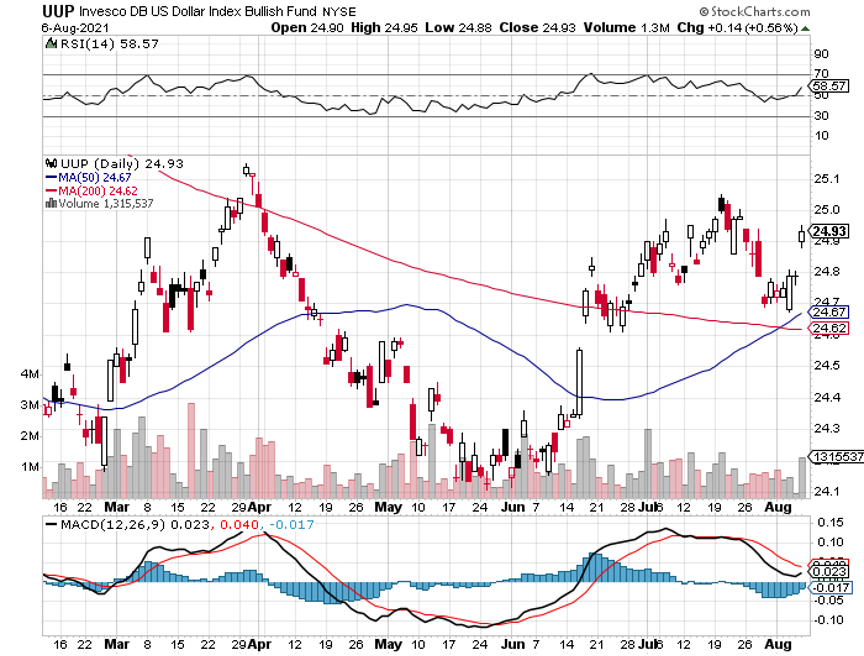
The next big thing to happen will be for new cases to peak out and begin a sharp decline, causing stocks to rocket. That’s how traders are positioning themselves now. July Nonfarm PayrollReport explodes to 943,000, taking the Headline Unemployment Rate down an amazing half-point to 5.4%. Leisure & Hospitality was up a staggering 380,000. Bonds (TLT) were crushed, down two full points and yields up 19 basis points from the low to 1.29%, gold (GLD) was destroyed, and the US dollar (UUP) popped. The hot number could bring forward a Fed tapper and interest rate rise. Certainly, makes this month’s Jackson Hole meeting interesting. New Covid Cases hit 100,000 daily, 86% of which are the delta variant, 1,000 times more powerful than the original strain. That’s still a fraction of the 2.5 million cases a day seen in January. The vaccines seem powerless against the onslaught, although they eliminate the possibility of death. The unvaccinated are the walking dead. Companies like Wells Fargo, Amazon, and JP Morgan have delayed reopening. We’re all helpless until a new booster shot comes out in months. Infrastructure Deal to be signed, at $550 billion worth of road, bridge, water, and power projects. It should generate 2.75 million jobs, if you can find the workers. Expect your local freeways to start getting tied up in a few months when the projects begin in all 50 states. Per capital, Alaska and Hawaii will get the most money.
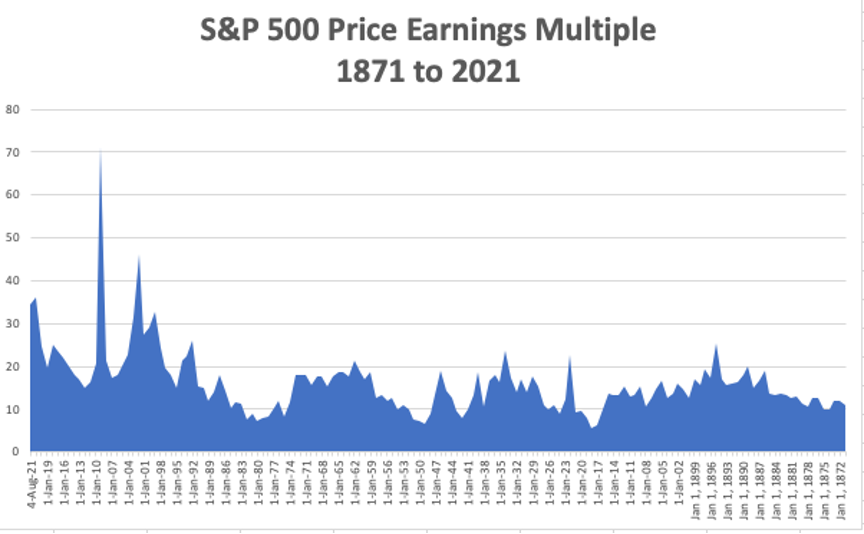
Copper Unions Vote to strike in Chile, cutting off 33% of the global supply. This is just when the green economy, especially electric cars, is driving demand through the roof. Great news for Freeport McMoRan, which predominantly mines in the US. By (FCX) on dips. US Treasury to sell $126 billion in bonds this week. It also sees rising demand for Treasury Inflation-Protected Securities (TIPS). Am I the only one seeing the contradiction? Fed governor Clarida said the taper could start in November. Don’t buy bonds here on pain of death. ADP disappoints in its monthly read of private job openings, coming in at only 330,000 instead of an expected 690,000. Leisure & Hospitality saw the biggest decline, with only 139,000. Could Friday’s July Nonfarm Payroll report be a bust? Weekly Jobless Claims come in at 385,000, taking another run at post-pandemic lows. This number should really collapse once kids go back to school for the first time in 17 months. Most large companies are now requiring proof of vaccination to return to the office. The same will soon be true for airlines. Think the market is expensive now? After the last pandemic ended in 1919, price earnings multiple for the S&P 500 soared 3.09 times from 5.74X to 17.77X. So, today’s 34.39X looks rich indeed but is only half of the 70.91 peak seen at the bottom of the 2009 Great Recession, back when investors were throwing stocks out the window with both hands. The Index started at a lowly 11.1X back when America was still an emerging market. Could we get the 3X move up seen in the last pandemic? One can only hope.
My Ten Year View
When we come out the other side of pandemic, we will be perfectly poised to launch into my new American Golden Age, or the next Roaring Twenties. With interest rates still at zero, oil cheap, there will be no reason not to. The Dow Average will rise by 800% to 240,000 or more in the coming decade. The American coming out the other side of the pandemic will be far more efficient and profitable than the old. Dow 240,000 here we come!
My Mad Hedge Global Trading Dispatch saw a healthy gain of +3.36% so far in August. My 2021 year-to-date performance appreciated to 72.57%. The Dow Average is up 15.06% so far in 2021.
I stuck with my four positions, a long in (JPM) and a short in the (TLT) and a short in the (SPY). Since stocks refused to go down, I added longs in Goldman Sachs (GS) and Visa (V). I doubled up my short in the (TLT) after it spiked to a 1.10% yield. The market surge off the back of the July Nonfarm Payroll report also forced me to stop out of my second (SPY) short for a loss.
That brings my 11-year total return to 495.12%, some 2.00 times the S&P 500 (SPX) over the same period. My 12-year average annualized return now stands at an unbelievable 42.43%, easily the highest in the industry.
My trailing one-year return retreated to positively eye-popping 110.12%. I truly have to pinch myself when I see numbers like this. I bet many of you are making the biggest money of your long lives.
We need to keep an eye on the number of US Coronavirus cases at 35.8 million and rising quickly and deaths topping 617,000, which you can find here.
The coming week will be slow one on the data front.
On Monday, August 9 at 8:00 AM, US Consumer InflationExpectations are out. AMC (AMC) reports.
On Tuesday, August 10 at 7:30 AM, the NFIB Business Optimism Index for July is printed. Coinbase (COIN) and Softbank (SFTBY) report.
On Wednesday, August 11 at 5:30 AM, the US Core Inflation Rate is released. eBay (EBAY) reports.
On Thursday, August 12 at 8:30 AM, Weekly Jobless Claims are announced. Disney (DIS) and Airbnb (ABNB) report.
On Friday, August 13 at 7:00 AM, we get the University of Michigan Consumer Expectations.
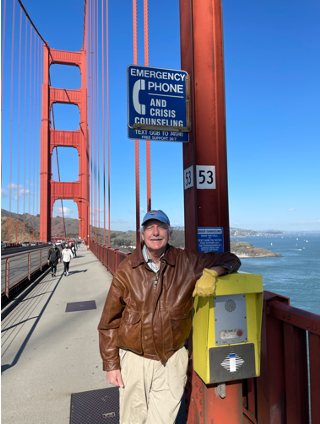
As for me, with the 34th anniversary of the 1987 crash coming up, when shares dove 20% in one day, I thought I’d part with a few memories.
I was in Paris visiting Morgan Stanley’s top banking clients, who then were making a major splash in Japanese equity warrants, my particular area of expertise.
When we walked into our last appointment, I casually asked how the market was doing (Paris is six hours ahead of New York). We were told the Dow Average was down a record 300 points. Stunned, I immediately asked for a private conference room so I could call the equity trading desk in New York to buy some stock.
A woman answered the phone, and when I said I wanted to buy, she burst into tears and threw the handset down on the floor. Redialing found all transatlantic lines jammed.
I never bought my stock, nor found out who picked up the phone. I grabbed a taxi to Charles de Gaulle airport and flew my twin Cessna as fast as the turbocharged engines take me back to London, breaking every known air traffic control rule.
By the time I got back, the Dow had closed down 512 points. Then I learned that George Soros asked us to bid on a $250 million blind portfolio of US stocks after the close. He said he had also solicited bids from Goldman Sachs, Merrill Lynch, JP Morgan, and Solomon Brothers, and would call us back if we won.
We bid 10% below the final closing prices for the lot. Ten minutes later, he called us back and told us we won the auction. How much did the others bid? He told us that we were the only ones who bid at all!
Then you heard that great sucking sound. Oops!
What has never been disclosed to the public is that after the close, Morgan Stanley received a margin call from the exchange for $100 million, as volatility had gone through the roof, as did every firm on Wall Street. We ordered JP Morgan to send the money from our account immediately. Then they lost it! After some harsh words at the top, it was found. That’s when I discovered the wonderful world of Fed wire numbers.
The next morning, the Dow continued its plunge but, after an hour, managed a U-turn and launched on a monster rally that lasted for the rest of the year. We made $75 million on that one trade from Soros.
It was the worst investment decision I have seen in the markets in 53 years, executed by its most brilliant player. Go figure. Maybe it was George’s risk control discipline kicking in?
At the end of the month, we then took a $75 million hit on our share of the British Petroleum privatization, because Prime Minister Margaret Thatcher refused to postpone the issue, believing that the banks had already made too much money. That gave Morgan Stanley’s equity division a break-even P&L for the month of October 1987, the worst in market history. Even now, I refuse to gas up at a BP station on the very rare occasions I am driving an internal combustion engine.
Good Luck and Good Trading.
John Thomas
CEO & Publisher
The Diary of a Mad Hedge Fund Trader
https://www.madhedgefundtrader.com/wp-content/uploads/2021/08/average-aug9.png582864Mad Hedge Fund Traderhttps://madhedgefundtrader.com/wp-content/uploads/2019/05/cropped-mad-hedge-logo-transparent-192x192_f9578834168ba24df3eb53916a12c882.pngMad Hedge Fund Trader2021-08-09 11:02:222021-08-09 11:41:27The Market Outlook for the Week Ahead, or The Wall of Money Continues
I finally managed to carve out a few hours to analyze my 2021 H1 trades, and what a year it’s been!
From January 1 to June 30, the Mad Hedge Fund Trader sent you 124 trade alerts completing 64 round trips in four asset classes. These generated a profit of 70.59% in six months, more than we made all of last year.
It is the most prolific performance since we launched Mad Hedge Fund Trader 14 years ago.
In my January 6 Mad Hedge Annual Asset Class Review (click here for the link--you must be logged in to the site), I predicted that the Dow Average ($INDU) would rise 30% for the end of the year. This proved immensely valuable.
That view enabled me to go maximum aggressive, full speed ahead, damn the torpedoes. It’s not that I was so certain that the stock market would go ballistic to the upside. But with the Federal Reserve pumping trillions of dollars of quantitative easing into the economy, record deficit spending, and the pandemic coming under control, I was certain that markets would not go down.
So, I looked into my bag of tricks and pulled out a strategy ideal for this scenario, the in-the-moneyvertical bull call debit spread (click here for the video on how to execute one of these). Such an approach allowed me to make a maximum profit even if the underlying security went up, sideways, or down small. It worked like a charm.
2021 was definitely the year of equities. In fact, the risk/reward for equities was so compelling that it was almost a waste of time to look at anything else. Equity trades accounted for 62.53% of my total profits.
I split my equity selections with my well-known “barbell strategy” with equal allocations split between big technology and domestic recovery stocks. That way, I always had positions that were going up.
Short positions in the bond market (I had only one long trade) accounted for another 34.17% of my performance. This was basically a first-quarter trade where I caught the collapsing bond market by both lapels and shook it for all it was worth, catching a dive from $162 to $132 in the United States Treasury Bond Fund (TLT). I mostly quit bond trading in March, not wanting to visit the trough too many times in an extremely oversold condition. That was a great call.
Commodities delivered another 2.15% of return with a single trade in the SPDR S&P Metals & Mining ETF (XME). I thought exploding economic growth would cause commodity prices to soar, and they did. But there were better plays to be had buying key stocks in the sector directly, such as Freeport McMoRan (FCX).
As an afterthought, I made another 1.15% in precious metals with two trades long gold. I thought gold would go up this year but so far, no luck. The gold (GLD) faded away when US Treasury bonds became the asset class of choice from March onward.
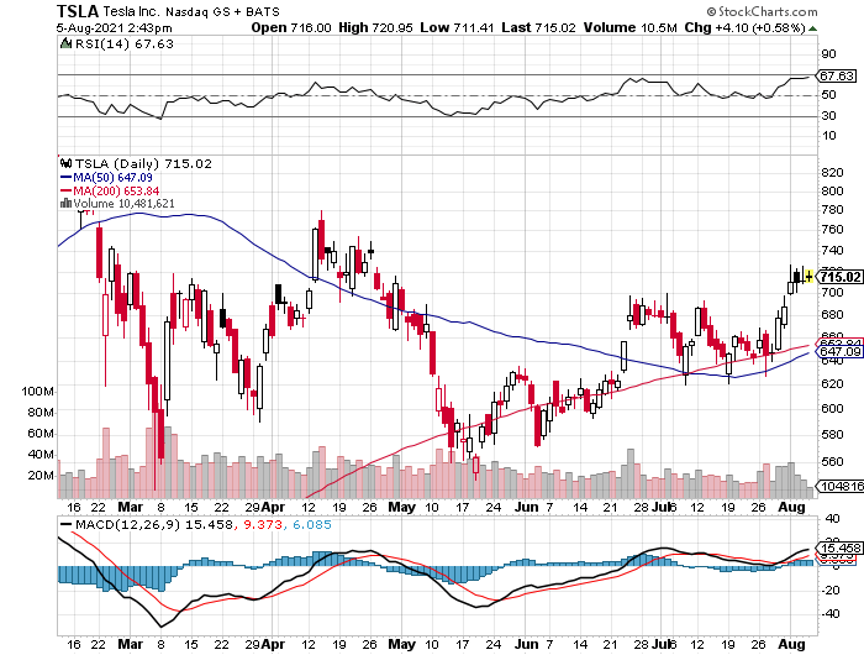
Of 64 round trips, I lost money on only four, giving me a success rate of 93.75%, far and away the best in the industry. One was a short in Tesla (TSLA) in the $800s. It later fell to $550. The next was a long in Tesla. I got stopped out when it fell below $600. That’s OK because I made a 10X return trading Tesla in 2020.
Welcome to show business.
The next hickey came from a long in Microsoft (MSFT) which I got stopped out of. It went straight up afterwards. Then I took a small hit in Delta Airlines (DAL) for the same reason. The higher the market goes, the faster I stop out as part of my risk control discipline.
All in all, it’s been one hell of a year. I cut back my trading dramatically in June and July partly because the market was so incredibly high, but also to give my loyal staff a rest. Imagine working double overtime for a year and a half! How about sending out 13 trade alerts out in one day!
We are now all refreshed and well-rested ready to take on all comers in H2. The harder I work, the luckier I get. It really is true.
As I tell my beginning traders, work in, money out.
To download the entire 2021 H1 trade history, please click here.
Good Luck and Good Trading
John Thomas
CEO & Publisher
The Diary of a Mad Hedge Fund Trader
Capturing Peak Profits
https://madhedgefundtrader.com/wp-content/uploads/2019/05/cropped-mad-hedge-logo-transparent-192x192_f9578834168ba24df3eb53916a12c882.png00Mad Hedge Fund Traderhttps://madhedgefundtrader.com/wp-content/uploads/2019/05/cropped-mad-hedge-logo-transparent-192x192_f9578834168ba24df3eb53916a12c882.pngMad Hedge Fund Trader2021-08-06 11:02:572021-08-06 11:29:22Mad Hedge 2021 H1 Trade Analysis
Legal Disclaimer
There is a very high degree of risk involved in trading. Past results are not indicative of future returns. MadHedgeFundTrader.com and all individuals affiliated with this site assume no responsibilities for your trading and investment results. The indicators, strategies, columns, articles and all other features are for educational purposes only and should not be construed as investment advice. Information for futures trading observations are obtained from sources believed to be reliable, but we do not warrant its completeness or accuracy, or warrant any results from the use of the information. Your use of the trading observations is entirely at your own risk and it is your sole responsibility to evaluate the accuracy, completeness and usefulness of the information. You must assess the risk of any trade with your broker and make your own independent decisions regarding any securities mentioned herein. Affiliates of MadHedgeFundTrader.com may have a position or effect transactions in the securities described herein (or options thereon) and/or otherwise employ trading strategies that may be consistent or inconsistent with the provided strategies.