Mad Hedge Technology Letter
July 6, 2020
Fiat Lux
Featured Trade:
(WHY AN OFFICE IN BELGRADE MAKES SO MUCH SENSE)
(OKTA), (SPLK), (CRM), (WKDAY), (TWLO), (NOW)


Mad Hedge Technology Letter
July 6, 2020
Fiat Lux
Featured Trade:
(WHY AN OFFICE IN BELGRADE MAKES SO MUCH SENSE)
(OKTA), (SPLK), (CRM), (WKDAY), (TWLO), (NOW)
My nephew paid nothing for phone, transport, internet, utilities during the coronavirus. I’ll tell you how he did it and no, he did not live with his parents or anyone else footing the bills. The future and a massive deflationary wave of technology can be found in how my nephew lives his life.
This is a story about James.
His life is the reason why the U.S. economy will never be the same and highlights the level of metamorphosis going on in our newfound home offices.
The usual culprit of the element inciting change is tech with the aftermath a catalyst for another wave of gigantic deflation.
The statisticians need to check what they are doing because nothing adds up in the deflationary world anymore.
This downward pressure on inflation is likely to be relentless, not just transitory offering central banks more flexibility with corporate accommodative policies without threatening to invoke the specter of inflation.
This is part of the reason why the bull market in tech stocks will be infinite.
Many economists and officials are befuddled, and such worries have never been far from the surface in the period after the financial crisis, the Great Recession, and now Covid-19.
The only thing constant right now is uncertainty.
Technologies are spawning “supply side shocks” in many areas of the global economy by permitting a more intense and efficient utilization of resources.
Also, replacement often leads to the betterment of people’s lives as software disrupts and cannibalizes many established goods and services.
One recent example that couldn’t illustrate this better for the “have nots” is car rental company Hertz, who woke up one day and found their business model shattered into oblivion and obsolete.
James has a modest U.S. income of $4,000 per month, which does not get you anywhere in megacities like New York or San Francisco.
After taking into account car maintenance, gas bills, car insurance, utilities, and rent, there might be $1,000 left over if luck is on the right side.
This type of income just doesn’t cut it in many American cities.
James faced a daunting challenge to acquire the quality of life he desired in most American megacities.
James works for a small start-up tech company, and after he proved to management that he was a legitimate contributor, he quickly asserted his leverage by requesting his manager to sanction a move to a full-time remote position.
Management didn’t want to lose him and reluctantly agreed contingent on a rolling 6-month review.
But James didn’t settle on Bakersfield, California, or even Klamath Falls, Oregon where he could significantly cut his bills.
He chose to take his talents to Belgrade, Serbia.
Deflationary impulse is pervasively spread across economic sectors where its presence has been difficult to note and with James’ housing budget now abroad, his dollars are partially taken out of the U.S. financial picture.
How can such “supply-side shock” manifest itself so quickly? Surely, the supply of land is largely fixed, particularly in areas that have already been urbanized.
The answer lies with technology that created additional capacity of the second industrial revolution, such as increasingly taller high-rise buildings.
Fast forward to today.
A company like Airbnb showcases how digital technologies are allowing more intensive resource utilization. There was abundant accommodation capacity hidden in the world’s cities — but it was not accessible until the internet, smartphone adoption, and Airbnb’s founders’ ingenuity unlocked it.
James is taking advantage of these wrinkles cutting his housing and office bill and crashing his monthly budget to the bare minimum.
James didn’t even feel the need to pay a deposit on a 1-year rental lease choosing to forego rental stability for the optionality of movement.
His Belgrade Airbnb space doubled as his home office.
Airbnb usually offers a 28-day discounted price which is classified as a “long stay.”
Many of these discounts are 30% or more, meaning James only paid $350 per 28 days to live in the Belgrade city center and would move around to different neighborhoods he felt were palatable.
He especially liked the Austrian-Hungarian historical district Zemun and the hipster vibe in Dorchol near the Belgrade City Center.
After the coronavirus hit, these “long term” rentals went from $350 to $200 per 28 days as tourists fled the city centers of Europe, and Airbnb prices crashed with cratering demand.
Why doesn’t James pay for internet, phone, and utilities?
Utilities and Wi-Fi are included in the price of the Airbnb covered by the host along with the furniture and amenities like air conditioning, fully equipped kitchen, microwave, dishwasher, iron, and washing machine.
James has substituted his phone bill opting for chat apps WhatsApp, Skype, FaceTime, Signal, and calls over Wi-Fi.
He keeps a Google Fi phone account to maintain a U.S. number, but keeps it permanently “paused” and only uses it to receive security and verification codes from his U.S. bank, IRS to pay taxes, and mortgage service provider to pay his mortgage online.
He manages to log on to these important portals via a virtual private network (VPN) that routes through a U.S.-based server.
He leases his U.S. house, which he owns, out to a tenant who covers 100% of James’ monthly mortgage costs and handed over his property to a local property manager to be managed.
James doesn’t pay for any transport fees because his city center apartment is walking distance to every main artery in Belgrade giving him access to Turkish-style coffee houses, to Cevapi grilled barbecue shops, to designer Hookah lounges all within a 15-minute walk.
The 2 to 3 times he needs to jump on the tram network to attend a party or night event, he borrows his friend’s yearly transit pass or just skips the fare completely. If he needs to pay, it is 75 cents for a 1-way ticket anywhere in Belgrade.
James has been living out of 2 suitcases for as long as I can remember and has never owned a car, despite growing up in the U.S. and graduating high school and university here.
Although many in the family think he is overly extreme, his intensely minimalistic lifestyle is food for thought; even though he was the first I had ever seen live in such a simplistic, draconian way.
The fallout from the coronavirus and the trends of deflationary technology show that James was ahead of his times when nobody knew it and recently accelerating trends validate his life choices.
James has effectively been planning for a pandemic his whole life which is why he has successfully navigated it, while many Millennials his age have been wiped out, drowned into debt they can never get out of.
If the U.S. suddenly gets tens of millions of James living a variation of his life, many services and products just wouldn't sell in the U.S. anymore. And if they are as extreme as James, housing will crash in all American megacities.
The reality is somewhere in between.
Reinvention is the U.S.’s strong point, but now young people are arbitraging literally everything in their lives, applying a global perspective with a good dose of software to support ultimate goals.
I will assume that most goals end up with obtaining a higher life quality.
Moving forward, investors will need to reprogram their technology compasses around firms that support a “James” type of lifestyle simply because there will be more people like this every day.
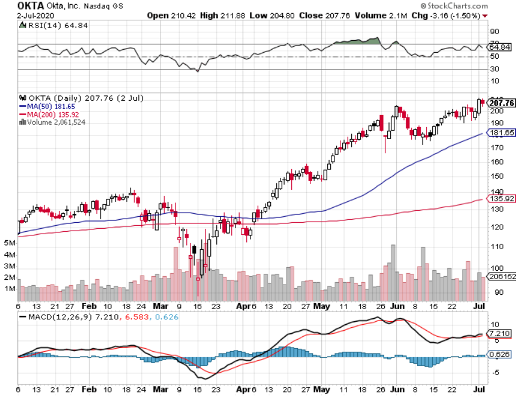
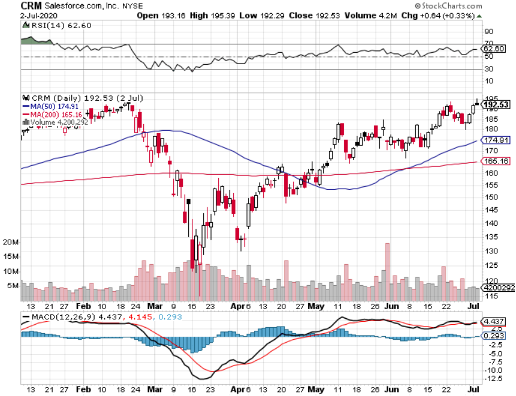
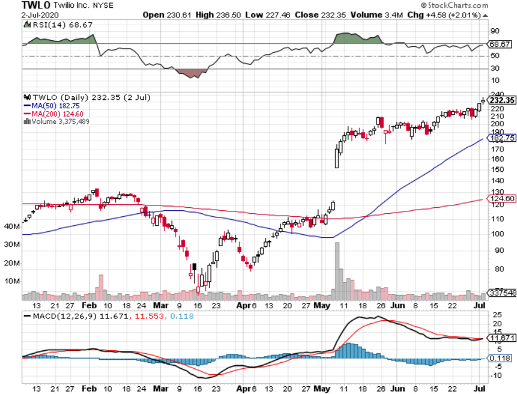
Software companies that mesh with this overarching thesis are Okta (OKTA), Splunk (SPLK), Salesforce (CRM), Workday (WKDAY), Twilio (TWLO), and ServiceNow (NOW).
The broader conclusion is that high-quality software stocks will outperform any other sub-sector or sector from now until forever.
As for James, I heard he finally decided to cough up money for local phone data which comes in at a mind-boggling $1 per 1 GB in Belgrade only 10% the cost of the same GB in inexpensive western countries.
Mad Hedge Technology Letter
November 20, 2019
Fiat Lux
Featured Trade:
(MY CURRENT TECHNOLOGY TRADING STRATEGY),
(GOOGL), (MSFT), (APPL), (ADBE), (AKAM), (VEEV), (FTNT), (WKDAY), (TTD)

Some might say that we were due for a revaluation of growth tech stocks.
They have contributed greatly in this nine-year bull market.
Profit-generating software stocks are the order of the day.
Tech has led the overall market higher after projected quarterly earnings growth of -9% came in better than expected at -5%.
We have ebbed and flowed from pricing in a full-out recession in mid-2020 to now believing a recession is further off than first thought.
The pendulum swing ruptured many growth stocks from Workday (WKDAY) to The Trade Desk, Inc. (TTD) plummeting 30%.
We have retraced some of those losses but momentum in share appreciation has shifted to the perceived safer variation of tech stocks.
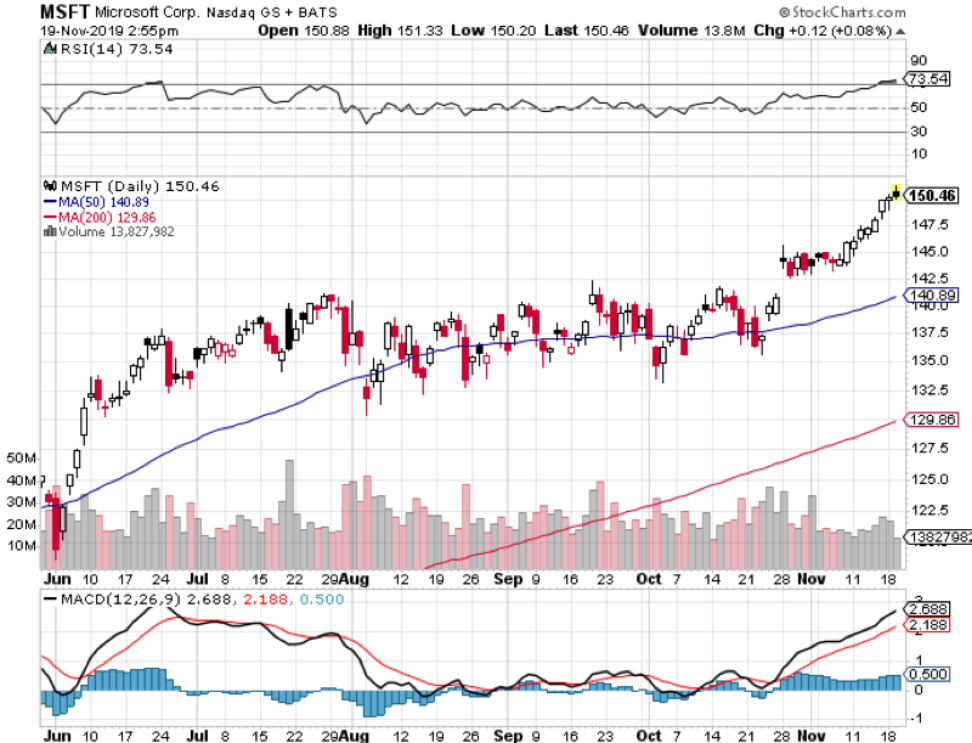
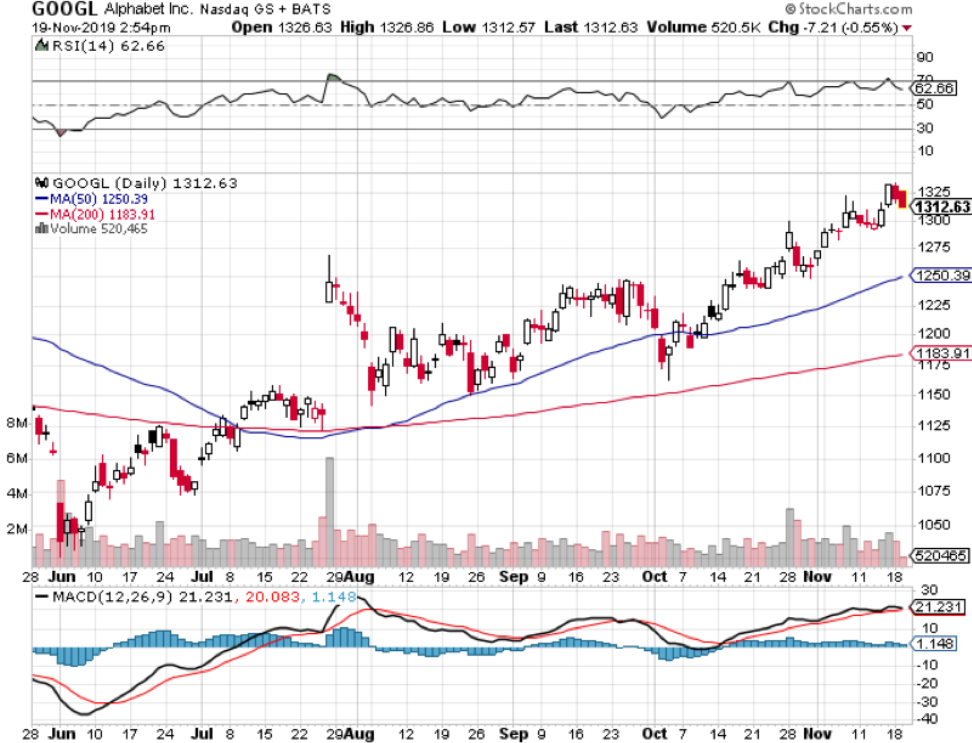
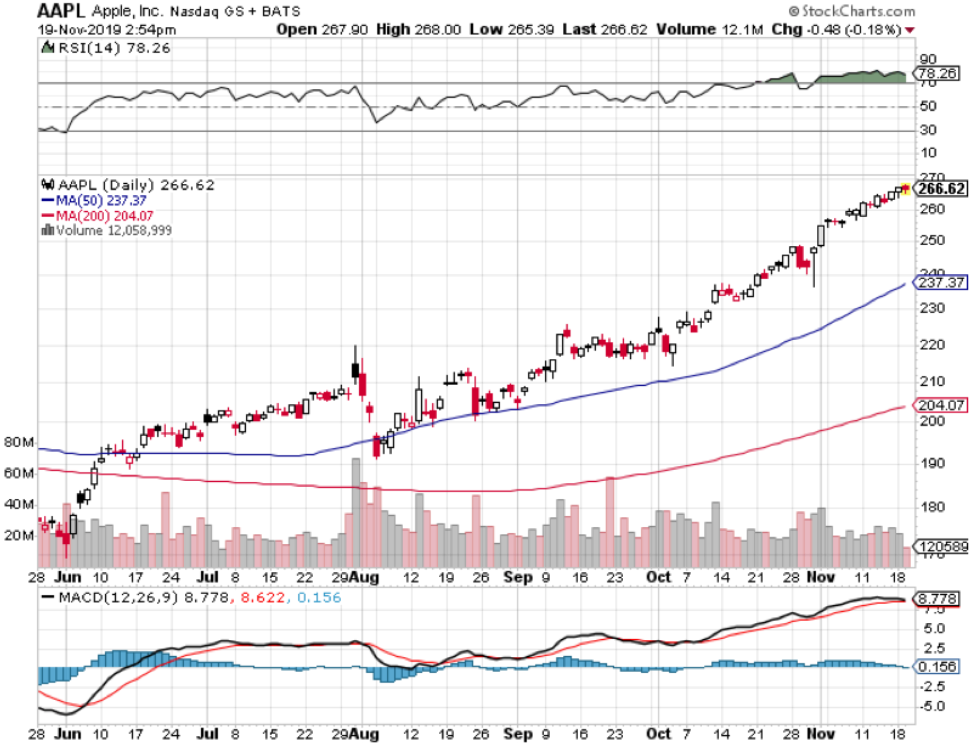
Investors have cut volatility and headed into bulletproof companies of Apple (AAPL), Google (GOOGL), and Microsoft (MSFT).
These companies have significant competitive advantages, Teflon balance sheets, and print money.
The tech markets just about priced in the U.S - China trade war in the fall as broad-based volatility plummeted because of optimism around making a deal.
This, in turn, has boosted chips stocks along with investors front running the 5G revolution and the administration granting Huawei a reprieve was a cherry on top.
The Mad Hedge Technology Letter has taken every dip to initiate new longs in safe trades like software companies Adobe (ADBE) and Veeva Systems (VEEV).
Tech is at the point that all loss-making companies are out of the running for tech alerts because the moment there is a recession scare, these shares drop 10% and often don’t stop until they lose 30%.
Now there is a deeply embedded set of narrow tech leadership by a few dominant tech companies buttressed by a select set of second-tier software stocks.
I would put PayPal (PYPL) and Twitter (TWTR), which I currently have open trades on, in the ranks of the second tier and they should do well as long as economic growth does better than expected.
Their share prices dipped on weak guidance and the bad news appears to have been shaken out of these names.
Professional investors could also be hanging on to meet end-of-year performance targets.
I do expect unique entry points on software stocks that drop after bad future guidance.
Profitability has moved to the fore as the biggest factor in holding a name or not.
Newly minted IPOs have fared even worse showing the markets' waning appetite for loss makers like Uber (UBER) and Lyft (LYFT).
Loss-making companies often tout their ability to change the world and disrupt industry, but that has been discovered as nothing more than a ruse.
They aren’t disrupting the way we change the world. For example, Uber is a dressed-up taxi service and the new CEO has failed to create any new momentum in the unit economics that spectacularly fail by any type of metric.
Even worse for these growth stocks, as the economy starts to falter, there will be even less appetite for them, and even more appetite for safer tech stocks.
A worst-case scenario would see Uber drop to $10 and Lyft to $20.
New all-time highs have crystalized with Google (GOOGL) under the gauntlet of regulation hysteria displaying the domination of these big tech machines.
The ongoing, consistent rotation out of growth and into value hasn’t run its course yet and fortunately, by identifying this important trend, our readers will be well placed to advantageously position themselves going into 2020.
Growth stocks won’t make a comeback anytime soon and deteriorating conditions could trigger renewed synchronized global monetary policy easing and central bank stimulus.
And yes, more negative rates.
I believe Oracle (ORCL), Fortinet (FTNT), Akamai Technologies, Inc. (AKAM) could weather the storm next year.
Tech growth is slowing and trade uncertainty is high, and readers must have a sense of urgency to avoid the losers in this scenario.
U.S. economic growth could slow to 1.3% next year, avoiding a recession, and the lack of enterprise spend will reduce software sales and combine that with peak smartphone growth and it won’t be smooth sailing.
The Mad Hedge Technology Letter has the pulse of the tech market and will show you how to navigate this minefield.