(MARKET OUTLOOK FOR THE WEEK AHEAD, or THE TAIL WAGGING THE DOG)
($INDU), (SPY), ($VIX), (GOOGL), (GS), (MS), (RKT),(NFLX), (AMZN), (GOOGL), (APPL), (NFLX), (GS), (ZM), (MS), (BLK)
(MARKET OUTLOOK FOR THE WEEK AHEAD, or IT’S ALL ABOUT INTEREST RATES),
(HOOD), (CRWV), (BTC), (ORCL), (NFLX), (GS), (ZM), (MS), (BLK),
(GT), (WHR), ORCL), (INTC), (BABA)
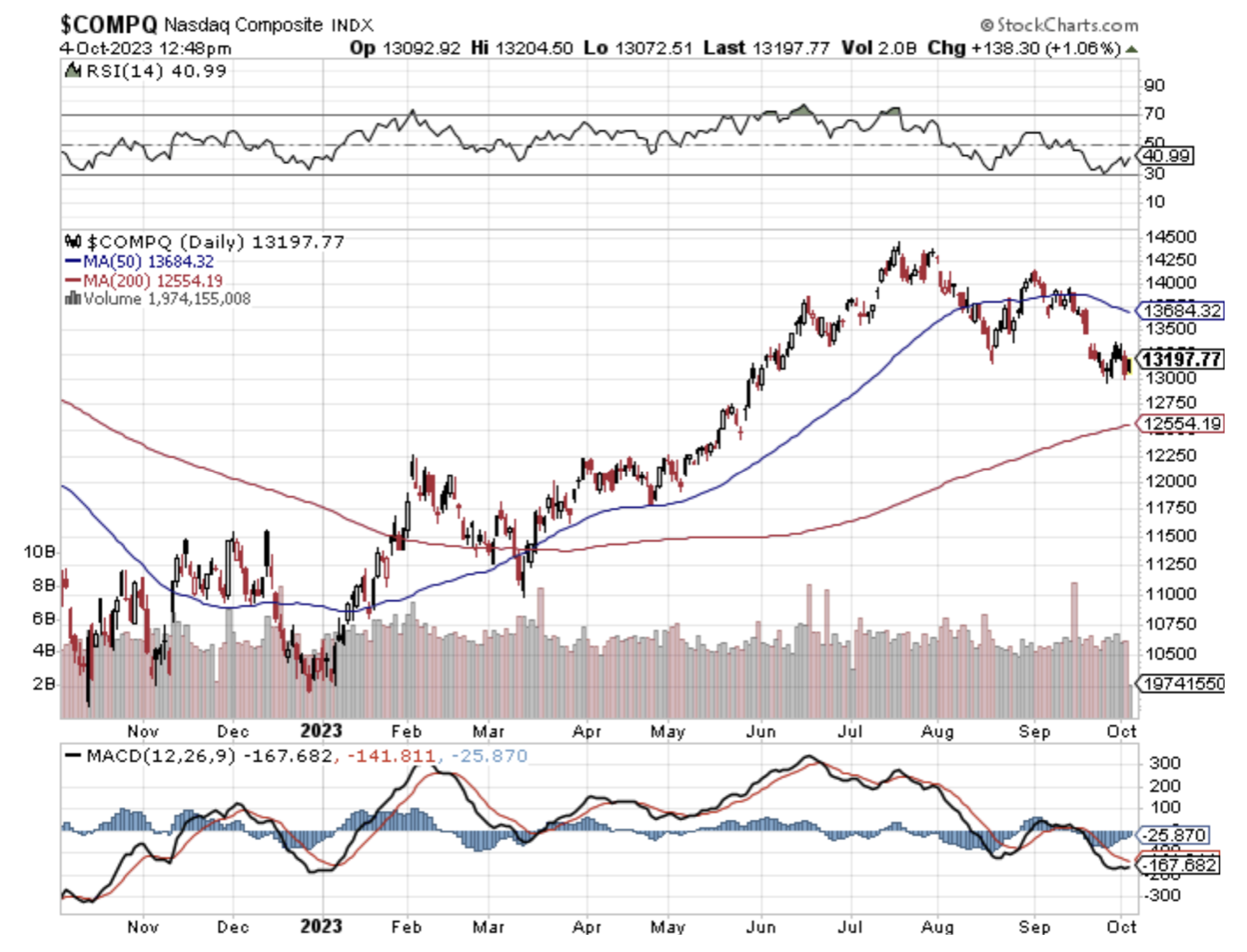
Today’s price action in technology stocks ($COMPQ) offers us one oversized takeaway – an increased recession scare and a lower chance of the mythical “soft landing.”
Remember, for so long, trading models priced in almost no recession in 2024 and that has quickly changed recently with souring fundamentals.
That’s why Airbnb (ABNB) was down 7% yesterday, not because more people will travel in 6 months, but less.
Whether a recession will hit or not is a big deal, because consumers and corporations tighten up purse strings and contracts don’t get done.
That means a reduced budget for cyber security, cloud space, semiconductor chips, and less money to buy iPhones.
What are some of the warning signs I am talking about?
An entrenched inflation problem which many would agree has been incredibly sticky.
Price inflation soared to a four-decade high in the summer of 2022. While it has cooled in recent months, the CPI began creeping up again in July and continued to rise in August.
The second canary in the coal mine is an inverted yield curve.
This happens when longer-term bonds offer higher yields than short-term bonds.
A 10-year US Treasury generally features a lower yield than a 30-year.
When this reverses and short-term bonds start yielding more than long-term bonds, it’s called a yield curve inversion.
Traders still expect the front end of the curve to drop which will result in the Fed cutting rates to save the day.
Until then, there is no reason to borrow at 30-year durations when investors aren’t rewarded and capital projects are harder to finance when 30-year rates are artificially expensive.
The US Federal Reserve has hiked rates by more than 5% in just 18 months, but it hasn’t had the desired effect because fiscal spending is out of control.
The economy is built on a foundation of cheap money. It’s not just the economy; it’s every facet of it.
The government, the deficits, and the government budget are built on cheap money. And it’s not just the federal government that’s been gorging on this cheap money.
Tech stocks have every reason to want a soft landing to happen or an orderly, short, and shallow recession.
Panic and chaotic unwinding can result in scaring away the dip buyers and after that, it’s free fall.
As volatility creeps up, tech investors need to be on red alert to observe whether fear and panic manifest inside the price action of tech stocks.
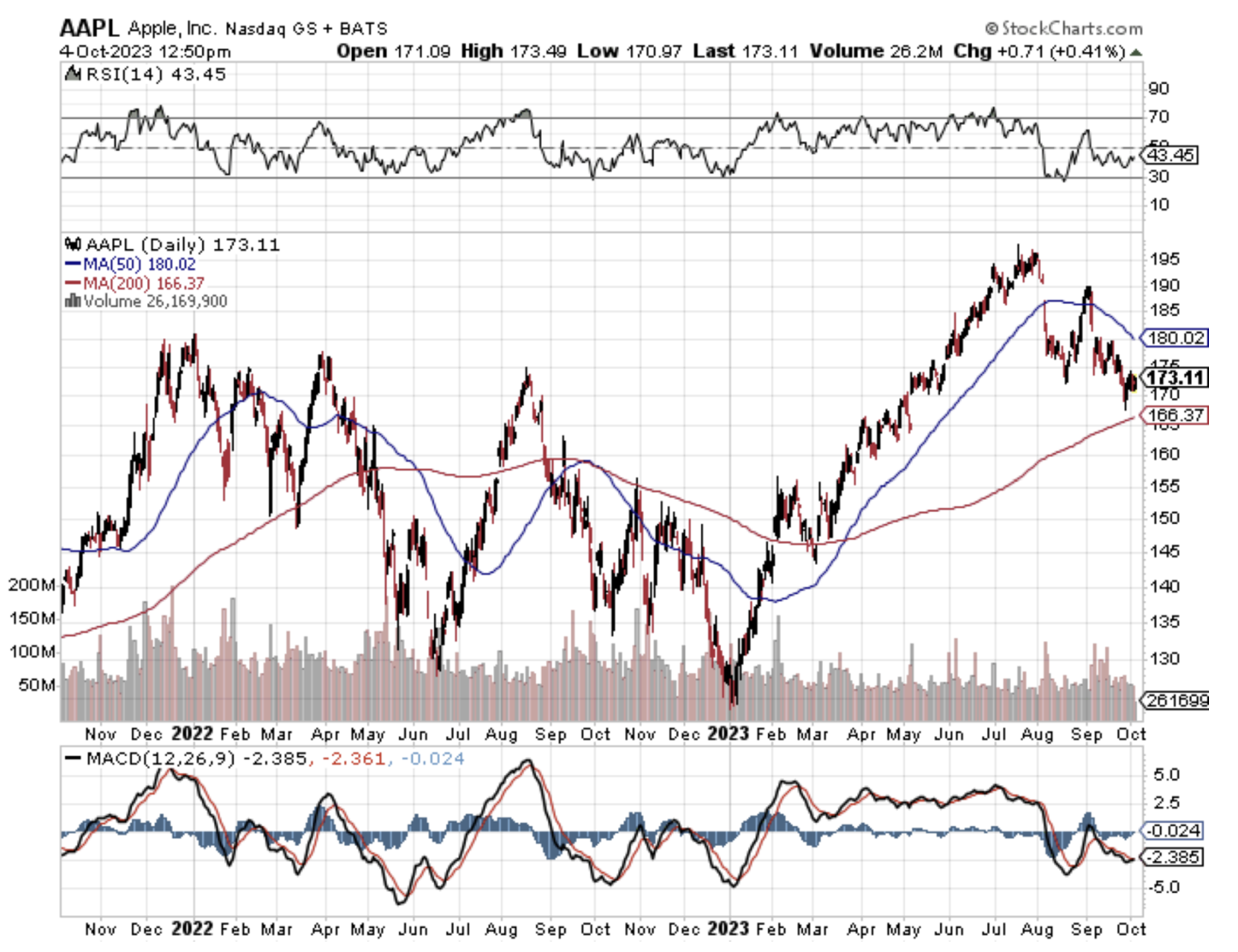
If Apple (AAPL) could pull itself out of the short-term doldrums, that would go a long way to delaying the 2024 recession since it comprises a big chunk of tech indices.
Right now, I believe the consensus is a short recession at the end of 2024 and what occurs in the next 2 months will tell investors whether that is moved up or moved back.
If a hard landing rears its ugly head, smaller tech stocks will get hammered.
I have no doubt that these smaller balance sheets won’t be able to endure the roughness of market mayhem.
It could all lead to smaller tech firms selling themselves at fire sale prices to tech behemoths for pennies on the dollar making big tech even bigger.
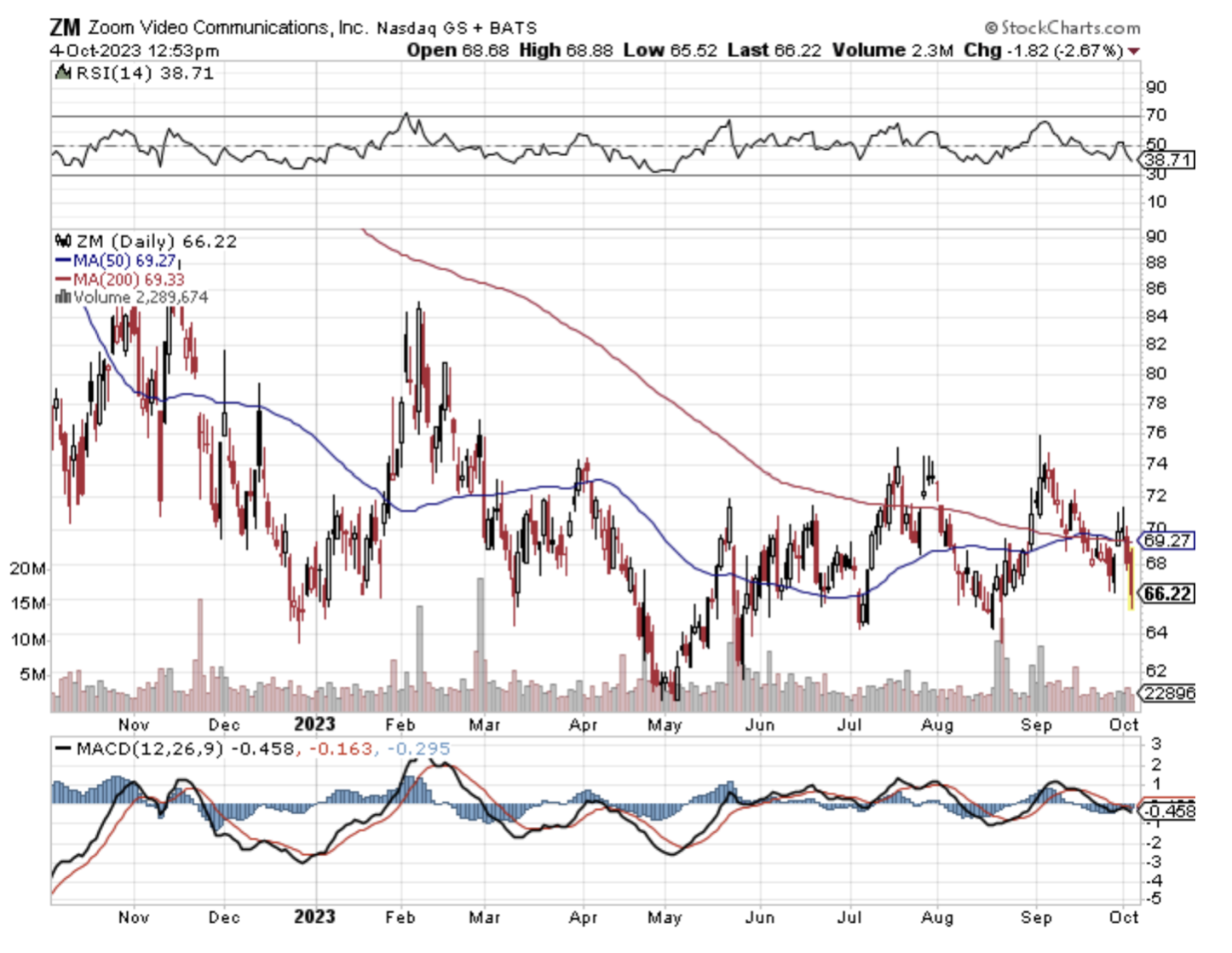
In the short term, sell any rip in small tech like Zoom Technologies (ZM) and buy and buy large dips in big tech.
https://madhedgefundtrader.com/wp-content/uploads/2019/05/cropped-mad-hedge-logo-transparent-192x192_f9578834168ba24df3eb53916a12c882.png00april@madhedgefundtrader.comhttps://madhedgefundtrader.com/wp-content/uploads/2019/05/cropped-mad-hedge-logo-transparent-192x192_f9578834168ba24df3eb53916a12c882.pngapril@madhedgefundtrader.com2023-10-04 15:02:212023-10-04 17:10:31Hard Landing Risk Blows Up Small Tech
In the trader's guidebook of how to trade, it’s quite common to cement the nostrum "don’t fight the Fed" into one’s brain.
Many know this.
In 2022, this nostrum served traders quite well as interest rate increases left the tech market in the dust.
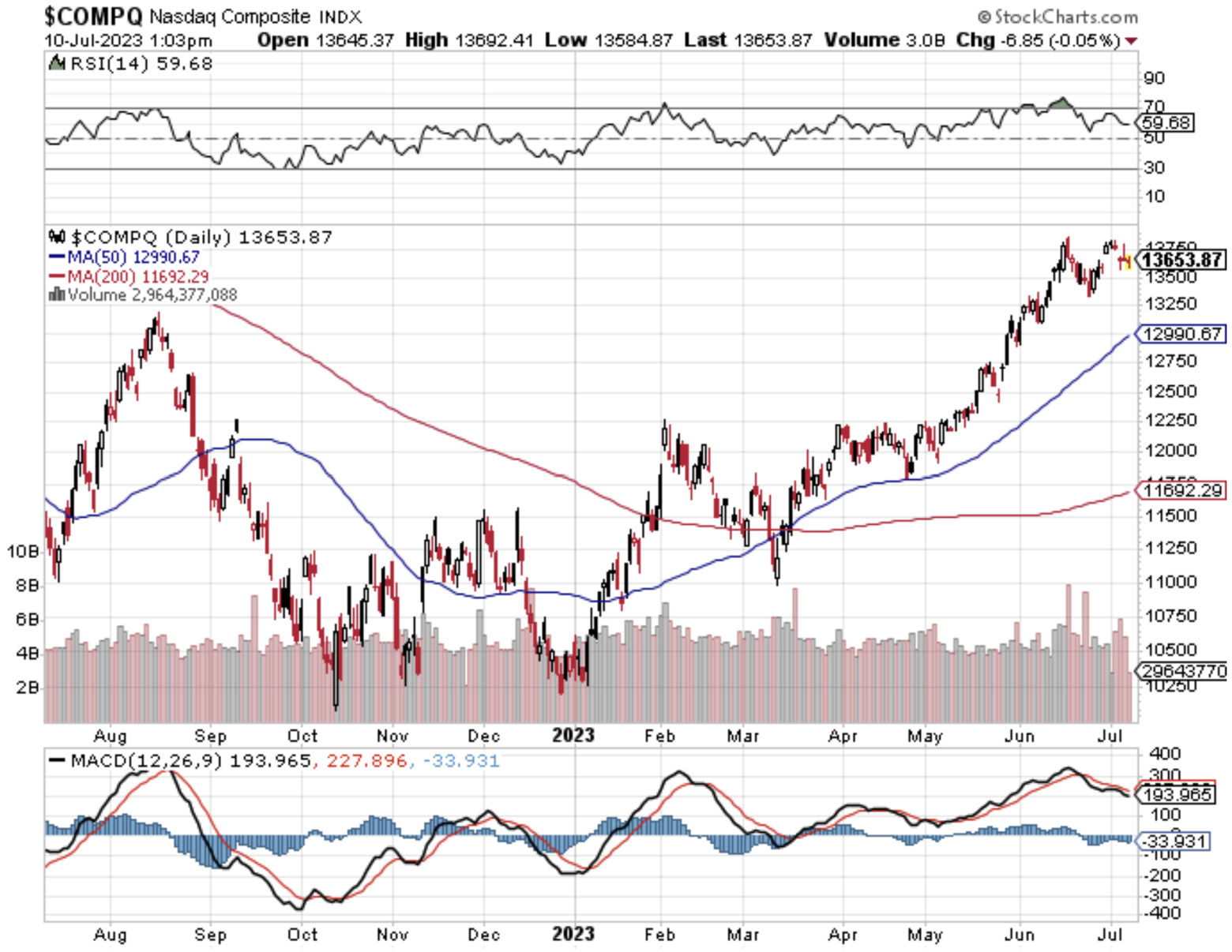
Major tech stocks ($COMPQ) from Meta (META) to small-cap Zoom Video Communications (ZM) fell flat on their face.
That was when "don’t fight the Fed" was the smart thing to do.
Fast forward to 2023 and the Fed is still marching towards more interest rate tightening, but astonishingly the opposite has happened, it has paid to fight the Fed this year.
Not only that, the tech-based Nasdaq has gone parabolic, delivering gains of already over 30% in just the first 7 months.
Anyone that hasn’t fought the Fed has been left bloody in the streets like a standard Parisian riot.
One piece of the puzzle that often gets overlooked is one major catalyst to this trade which is the Japanese yen carry trade.
This is how the trade has worked for many hedge funds this year.
Borrow in Japanese yen because the cost of borrowing is still puny compared to yields in Western countries.
Take that yen back over to the Western equity markets and pour them into stocks like Nvidia, Meta, Apple, Tesla, Microsoft, and Amazon.
The strategy has worked like clockwork and I know many traders that have made second and third fortunes off of the back of this trade so far this year.
Traders have boosted short positions on the yen as the currency moved steadily lower this year amid widening divergence between the Bank of Japan’s easy policy and aggressive hiking cycles for other central banks, notably in the US and Europe.
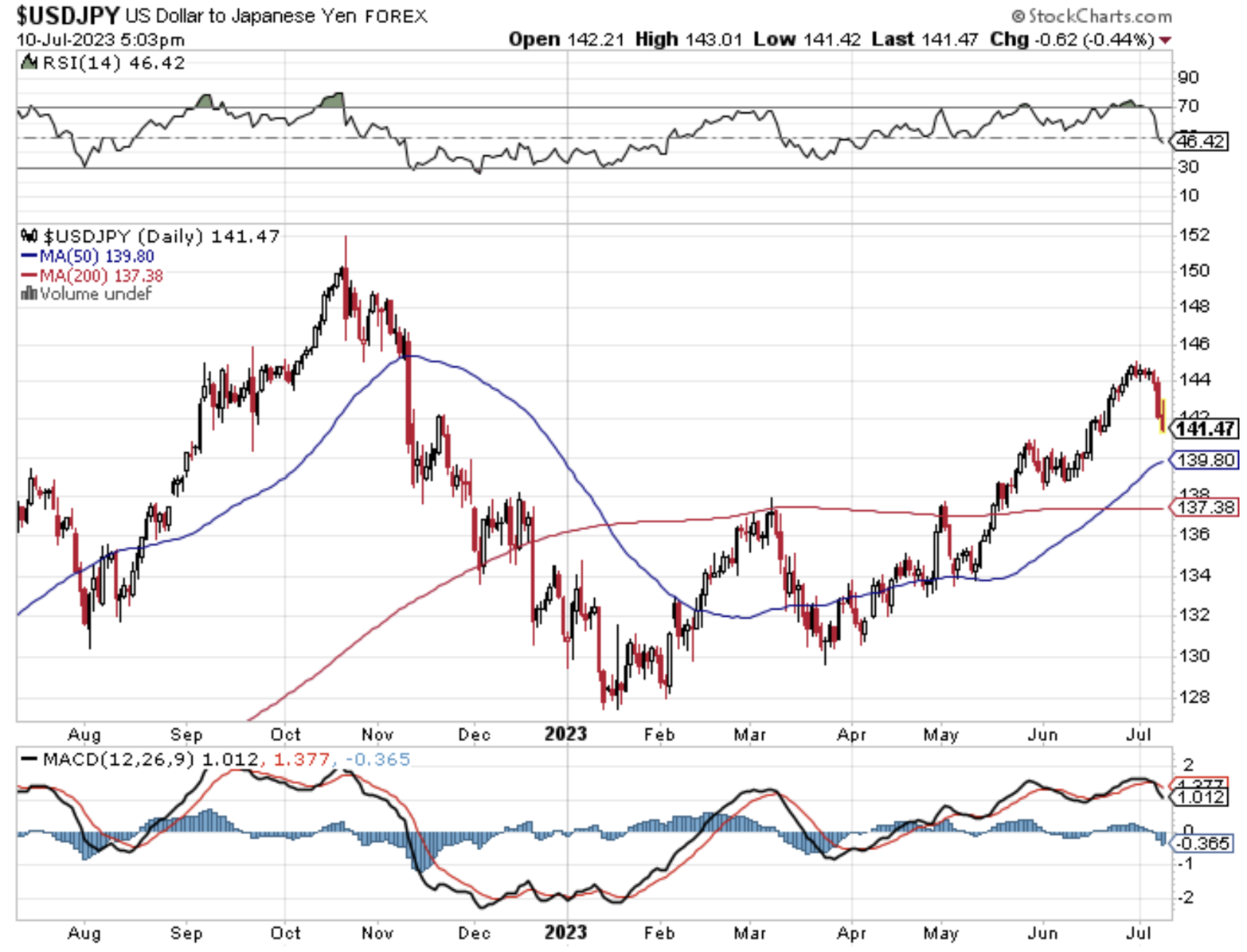
Talking about the Yen is timely as reports of lower US job numbers and increased Japanese wage gains triggered a one-day selloff in the dollar.
We won’t see a complete unwind of the yen carry trade just yet but the carry trade had gotten a little too long in the tooth, so this is profit-taking to readjust positioning.
If volatility stays high then it will continue to unwind, but if volatility stabilizes then the Japanese yen carry trade parade will continue unabashed.
The yen is one of the worst-performing Group-of-10 this year, reaching 145 per dollar last month, a level unseen since November.
What’s next?
Nothing has fundamentally changed.
The US isn’t going into a recession this year and even if credit card delinquencies are up and household net worth is struggling in America, it’s not enough to move the needle to deter the Japanese yen carry trade.
The mild pullback against the US dollar is in fact a golden opportunity for traders to pour back into the short Japanese yen trade.
As long as the Japanese yen remains weak, tech stocks won’t crack because this liquidity is the lifeblood to many tech stocks.
We have been crowbarred into this goldilocks environment of higher equities, higher bond yields, and now US housing is starting to bounce back.
The Nasdaq has been ironclad this year and even if I don’t think it will deliver another 30% to finish the year, the pain trader is higher in tech stocks, marginally higher in bond yields, higher in US housing, and short Japanese yen.
Until we receive some type of concrete confirmation that this pain trade is over, I expect to grind up in the aforementioned asset classes.
https://madhedgefundtrader.com/wp-content/uploads/2019/05/cropped-mad-hedge-logo-transparent-192x192_f9578834168ba24df3eb53916a12c882.png00Mad Hedge Fund Traderhttps://madhedgefundtrader.com/wp-content/uploads/2019/05/cropped-mad-hedge-logo-transparent-192x192_f9578834168ba24df3eb53916a12c882.pngMad Hedge Fund Trader2023-07-10 16:02:452023-07-11 21:05:22The Yen Tailwind to Tech Stocks
That is what artificial intelligence has done to their business model and we are in the early innings.
The company said to kiss growth goodbye.
Artificial intelligence is already putting a massive dent in some industries.
Education has changed dramatically in the past generation where more than half of Americans say a 4-year degree is not worth the price of admission anymore.
Now, moving forward, the little value extracted in terms of workable knowledge in the classroom is effectively zilch as generative artificial intelligence will do the job of a million university teachers for free.
There simply is no use case for taking geography studies or getting a basket weaving degree from Wesleyan College.
It doesn’t make sense anymore.
The scary thing is this is just the beginning and other industries are about to get t-boned as well.
Only the nimblest will survive.
Workers need to retrain, network, and preserve and expand skill levels.
Shares of virtual language-learning company Duolingo fell 9% while American depositary receipts tied to shares of London-based Pearson fell 12.5%.
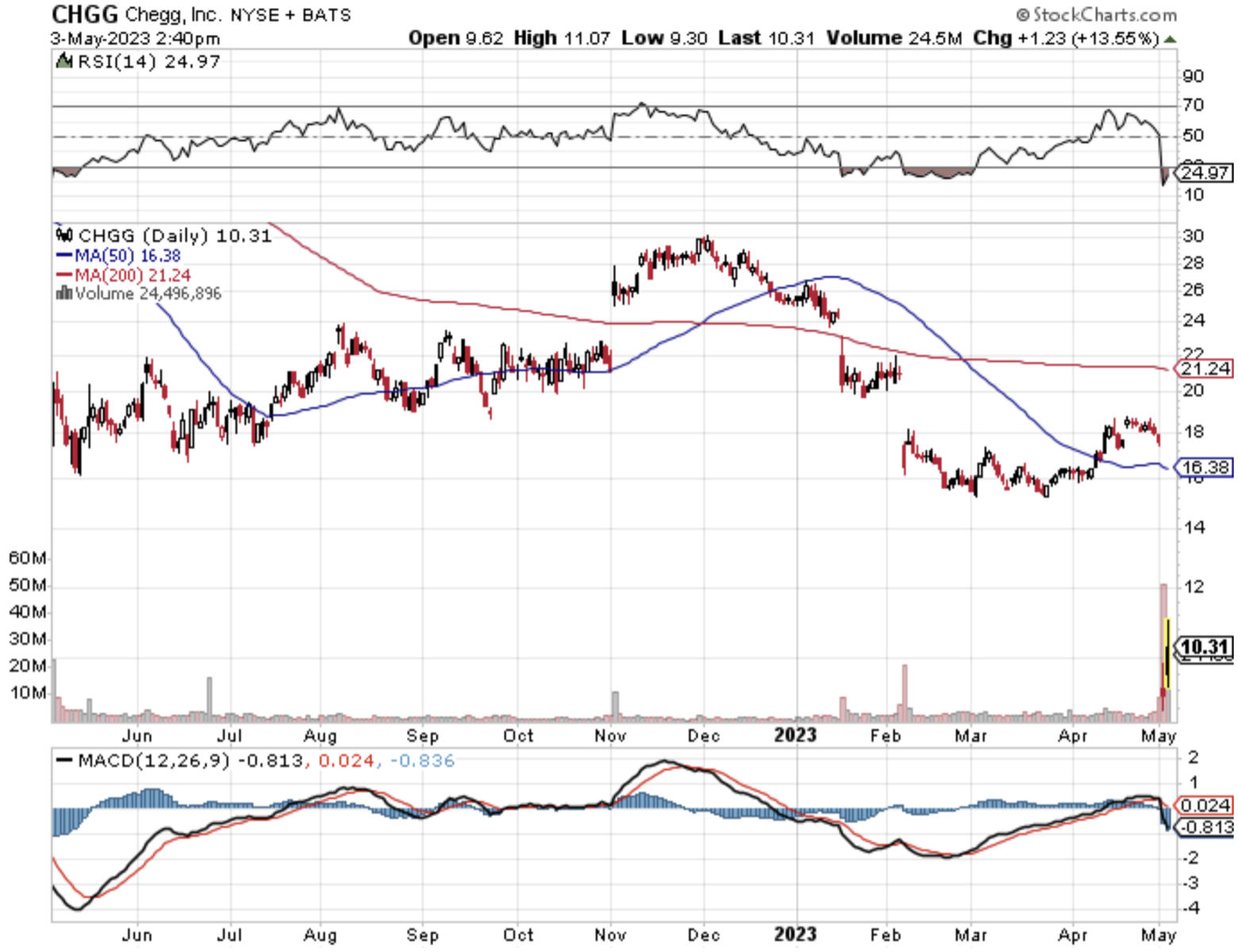
Chegg offers subscription-based academic services that help students with writing and math assignments as well as study materials.
Management said the company didn’t see a significant effect on its business from ChatGPT until March, when the company behind the product, OpenAI, launched GPT-4.
Chegg said the popularity of ChatGPT among students is affecting its customer-growth rate.
The red alarm from Chegg and the subsequent selloff are among the most glaring indications that this isn’t some cute niche thing that can be downplayed or diminished.
AI is coming for most white-collar jobs and workers should be scared if not mortified.
Many of the job losses will occur in big corporations and America has some of the biggest and most profitable.
The tailwind for corporate management is that they don’t need to pay benefits or social payments to AI so big cost savings that will fall down to the bottom line.
Wall Street will be applying this technology to the utmost too.
To say this technology is transformative doesn’t do justice to the word transformative.
This isn’t going to be an all tides lift all boats scenario.
Bloomberg news noted that nearly 40% said that children currently in elementary school will be best off with a job in health care if they want to avoid being displaced by artificial intelligence.
What about tech?
There will be serious winners and losers as this shakes out. It’ll be like a slow-motion car crash for workers while tech firms profit in real-time.
Technology stocks will hollow out similar to how we see the behemoths pull ahead lately muscling out smaller companies with their solid balance sheets.
This has essentially become a 7-stock tech sector.
Tech companies will absolutely be chomping at the bit to fire computer engineers whom many command in excess of $150,000 in pre-tax gross salary.
Of course, the lower-level computer engineers will be thrown by the wayside first then slowly the terminations will reach higher up the value chain.
If a computer engineer wants to survive in the future, they will need to dive into generative artificial intelligence themselves which will easily offer the highest salaries in technology.
AI is now the new bitcoin and the best talent will flood that space. It’s easy to see how starting salaries with start with a 3 and end with 5 more numbers.
As for tech investors, this shows that getting into these little micro tech stocks is more and more treacherous as the landscape has dictated a hard future ahead.
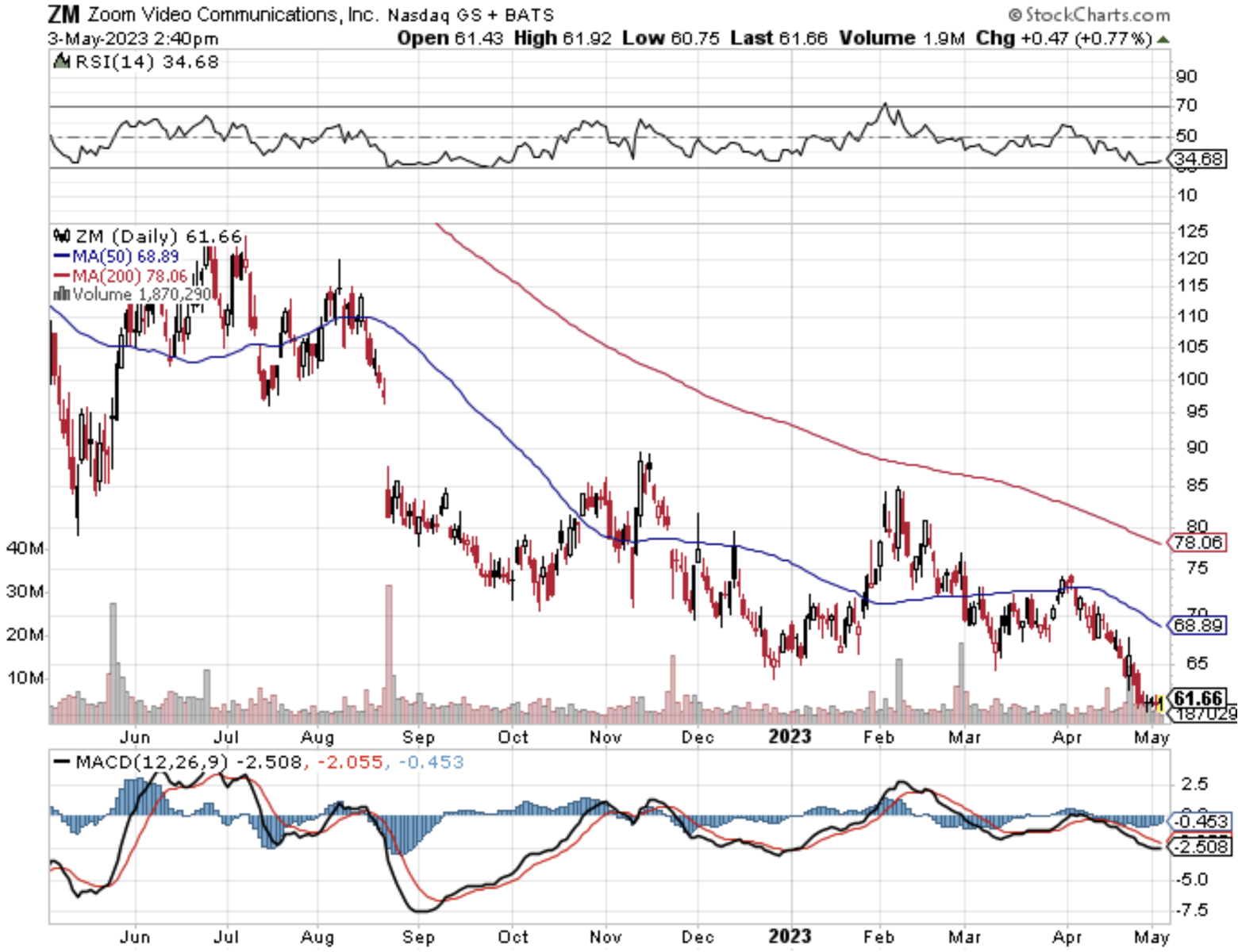
That is why I tripled up on a bearish position in Zoom technologies (ZM). All big tech companies have some sort of version of video conferencing tech and it is easy to replicate. Stay with the strongest during this bank crisis.
https://madhedgefundtrader.com/wp-content/uploads/2019/05/cropped-mad-hedge-logo-transparent-192x192_f9578834168ba24df3eb53916a12c882.png00Mad Hedge Fund Traderhttps://madhedgefundtrader.com/wp-content/uploads/2019/05/cropped-mad-hedge-logo-transparent-192x192_f9578834168ba24df3eb53916a12c882.pngMad Hedge Fund Trader2023-05-03 14:02:452023-06-07 00:02:34Algorithms Take Out Ed Tech
Legal Disclaimer
There is a very high degree of risk involved in trading. Past results are not indicative of future returns. MadHedgeFundTrader.com and all individuals affiliated with this site assume no responsibilities for your trading and investment results. The indicators, strategies, columns, articles and all other features are for educational purposes only and should not be construed as investment advice. Information for futures trading observations are obtained from sources believed to be reliable, but we do not warrant its completeness or accuracy, or warrant any results from the use of the information. Your use of the trading observations is entirely at your own risk and it is your sole responsibility to evaluate the accuracy, completeness and usefulness of the information. You must assess the risk of any trade with your broker and make your own independent decisions regarding any securities mentioned herein. Affiliates of MadHedgeFundTrader.com may have a position or effect transactions in the securities described herein (or options thereon) and/or otherwise employ trading strategies that may be consistent or inconsistent with the provided strategies.