Mad Hedge Technology Letter
December 6, 2021
Fiat Lux
Featured Trade:
(THE HAWKS ARE HERE)
(ROKU), (ZM), (TWLO), (SNAP), (SQ), (MSFT), (CRM), (ADBE)


Mad Hedge Technology Letter
December 6, 2021
Fiat Lux
Featured Trade:
(THE HAWKS ARE HERE)
(ROKU), (ZM), (TWLO), (SNAP), (SQ), (MSFT), (CRM), (ADBE)
Higher inflation is something this tech bull cycle hasn’t dealt with, and it’s starting to rear its ugly head in the form of volatility and spades of it.
The Fed will have to increase interest rates or face runaway inflation that will crash the economy, but increasing interest rates will also make lives harder for tech companies.
As we try to understand the pace of interest hikes, certain tech companies will fare much better in this inflationary environment than others. To deduce the winners from the losers, investors should understand exactly how inflation affects each particular tech company.
Talk has gone from the Fed moving early to raise short-term rates, to the Fed moving even in early spring which in turn is spooking risk markets from cryptocurrencies, the S&P, and the Nasdaq.
Fed Chair Jerome Fed has done a poor job communicating his sudden hawkish tone and the market has had to quickly reprice risk assets because of the surprising nature of the hawkishness.
In the short-term, tech stocks will need some time to digest this new expectation, which I see as quite healthy, but short-term tough to swallow.
Fed Cleveland President Loretta Mester told the media she is “very open” to scaling back the Fed’s asset purchases at a faster pace so it can raise interest rates a couple of times next year if needed so this isn’t just one guy in Powell trying to move the needle.
Clearly, the Fed is moving in unison, and they threaten to become a major force in moving markets which is all we care about.
All that pressure is causing component and labor costs to rise. Companies that don't have enough pricing power to pass those costs on to their customers will likely see their gross and operating margins shrink.
This matters because tech companies offer some of the most generous salaries in the U.S. and substantial increases in pay hurts them the most.
Higher interest rates attract more consumers and businesses to put more money in higher-yield bonds and savings accounts.
There are 3 ways that higher rates are actually a gut punch to tech growth companies.
First, they increase the costs of borrowing incremental capital to expand a business. In more cases than not, tech growth companies rely on borrowed money because their operation is not yet sustainably profitable. That's bad news for high-growth tech companies, which are burning cash with widening losses.
Second, it reduces the long-term estimates for a company's earnings and free cash flow (FCF) growth meaning their underlying stock price is rerated downwards in the anticipation of this new reality.
Loss accruing tech companies commonly suffer an exodus as their underlying shares are repriced to reflect higher costs.
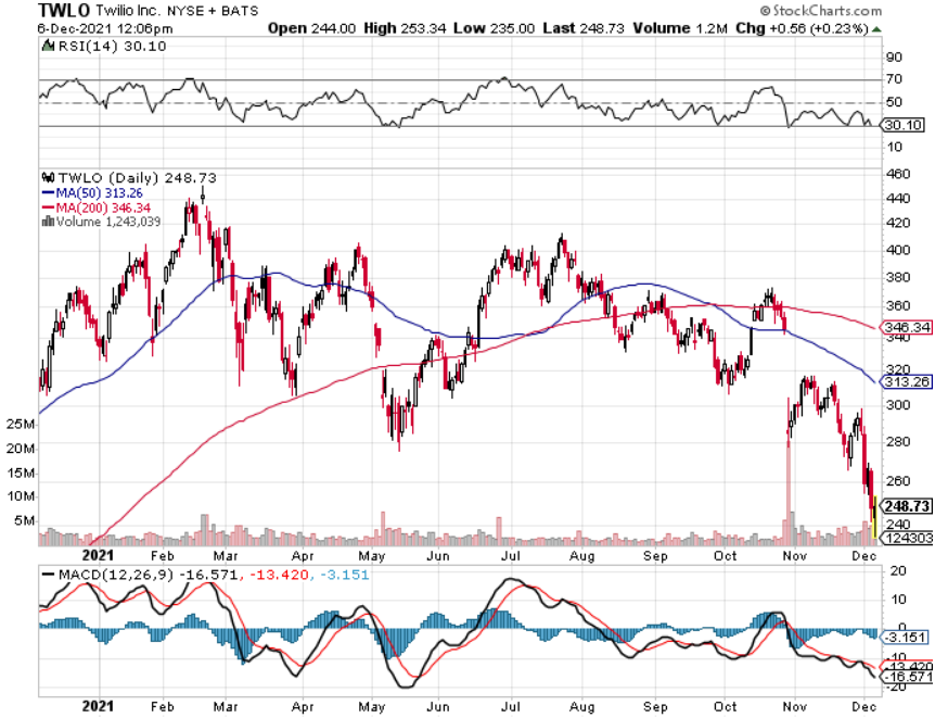
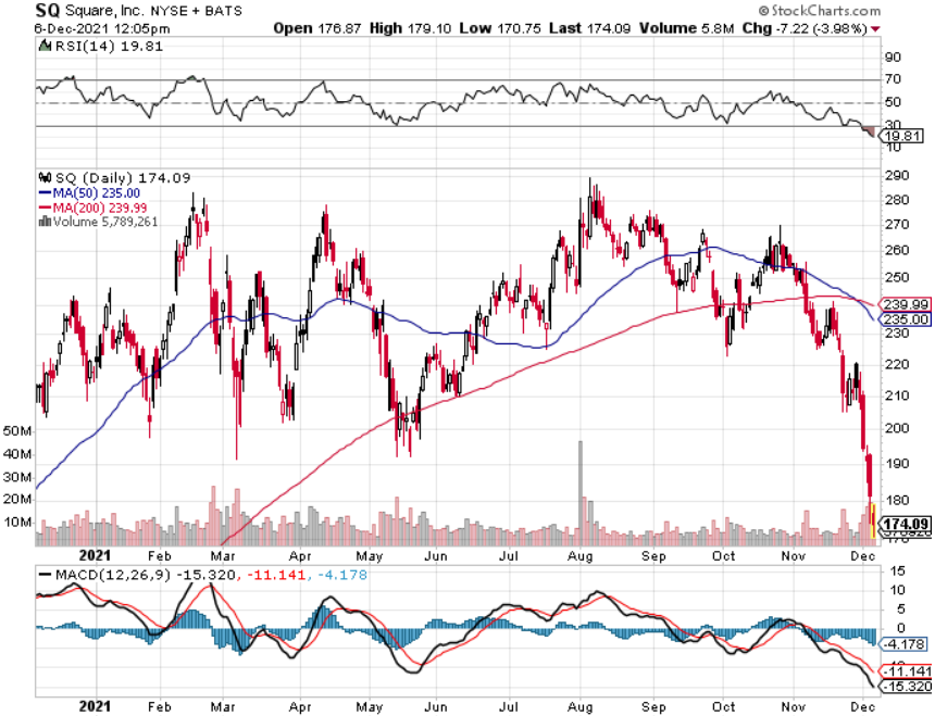
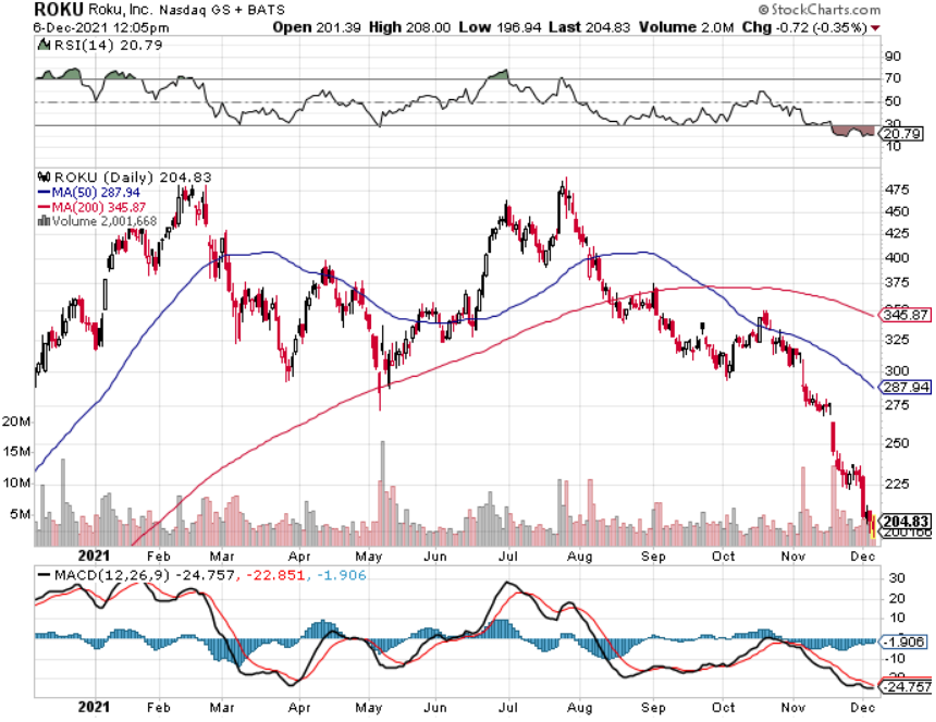
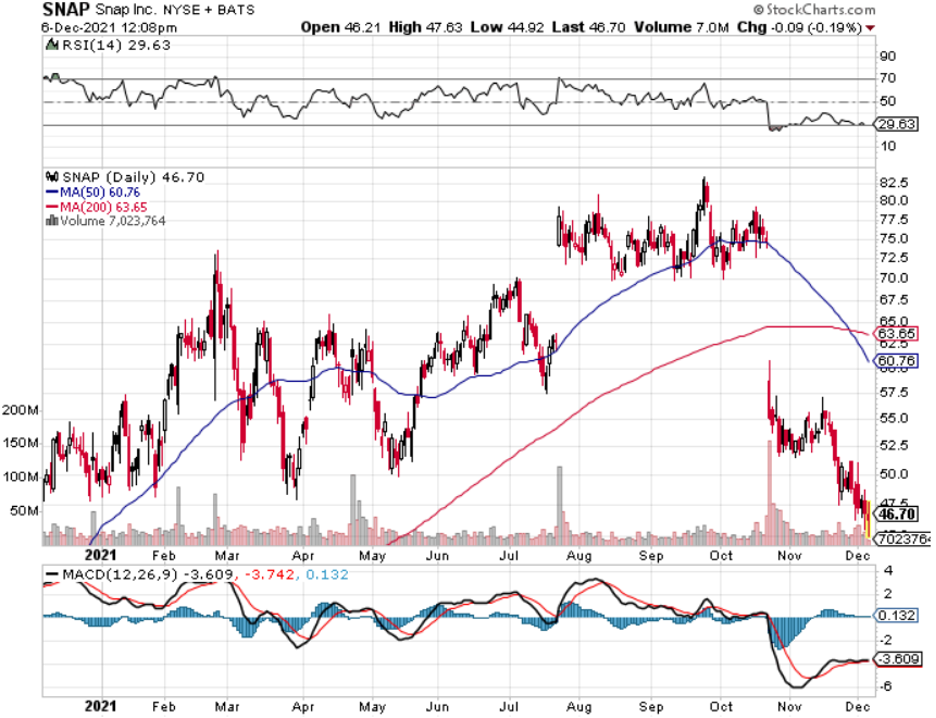
Just this morning we saw Roku (ROKU), Zoom Video Communications (ZM), Snap (SNAP), Twilio (TWLO), Square (SQ) breach 52-week lows.
The breadth of the market has been hollowed and the goalposts have indeed narrowed because of the hawkish tone at the Fed.
Lastly, higher interest rates drive institutional money into fixed income.
They do this largely by taking profits from crypto, tech stocks, or moving their stash on the sidelines then resurfacing the money into “safer” assets that anticipate weakening bond yields at the longer end of the curve.
So I won’t sit here and say sell all and every tech stock, it’s more nuanced than that.
I executed one position in December and that was Microsoft (MSFT) and it got pulled down with the broader market.
More importantly, I didn’t bet the ranch.
Ultimately, we still bask in the ideology that the tech bull market isn’t over yet because it isn’t, but this aggressiveness out of the blue has forced the overall tech market to temporarily rest with growth tech suffering major drawdowns.
In doing that, the ceiling for a Santa Claus rally is somewhat capped to the upside.
The Fed could have waited until January.
Sure, there will still be winners in tech and the odds of these winners are driven firmly behind the biggest and best like Microsoft, Amazon, Google, and Apple.
These are the type of companies that have the pricing power to raise prices and get away with it because consumers will be willing to pay it.
Other potential winners include cloud service giants like Salesforce (CRM) and Adobe (ADBE). These again are top-quality software stocks that can pass up higher enterprise software costs to the firms that can pay for it.
It’s entirely possible that the Fed could end up walking back some of these aggressive stances in the interest-raising process next year.
Don’t fight the Fed and don’t expect tech growth stocks to reverse until we receive more clarity with interest rate policy, if a reverse is triggered, it will play out with Apple, Amazon, Google, and Facebook, and Microsoft leading the way higher.
Mad Hedge Technology Letter
September 22, 2021
Fiat Lux
Featured Trade:
(SHOP UNTIL YOU DROP)
(SHOP), (ZM), (TDOC), (TIKTOK)

E-commerce is now happening absolutely everywhere except the pipes in your house, and Shopify’s (SHOP) plan is to ensure that merchants using Shopify can sell pretty much everywhere.
That’s just how it is these days.
The internet town squares of modern day are social media and that corresponds to everywhere as people take social media to the streets in droves.
And so, it's important that wherever consumers could be potentially looking to purchase that Shopify merchants continue to show up there.
And from a merchant perspective, that it all neatly feeds back into a centralized back office where they can run their business.
So whether it's Google Search or it's on Instagram or it's on all the other channel integrations Spotify has, that is essential.
Now, again, over time, you are going to see more of these surfaces show up where commerce is happening, and Shopify is also integrating there to make sure that merchants can access those customers.
It’s SHOP’s job to stay one step ahead and that’s what they are exactly doing.
And of course, as more of those services come to life, that increases the complexity of commerce and running a business, a modern-day business, and that also increased the value Shopify provides to their customers.
Shopify and its platform do internet selling at a world-class level.
And yes, there are sometimes where it's faster, better, and more effective for them to partner with another technology company. They’ve developed a solid reputation for being a company that builds incredible software and particularly are renowned for having trustful partners.
But there are other times where SPOT needs to build it themselves because it's just mission-critical, and I have full confidence in them that they can actually deliver the best product on the planet.
This story and numbers are backed up by the latest short-term performance showing that SHOP is turning into an e-commerce juggernaut.
The latest earnings showed that year-over-year GMV growth in the rest of the world actually outpaced North America in Q2 2021.
We are seeing more international merchants that are joining and are succeeding on Shopify.
And fortunately, SHOP is stepping up its growth marketing, sales, and support efforts in places like Brazil and all over the world.
It isn't necessarily any particular focus on Brazil per se, but there are merchants around the world who are looking for a retail operating system and Shopify certainly is the priority.
Revenue in the second quarter was up 57% year over year to $1.1 billion, marking the first time Shopify exceeded $1 billion in a single quarter.
This was driven by strong performance from subscription solutions and merchant solutions segments.
The combined strength in revenue, improved margin profile, and lower overall opex spend as a percent of revenue contributed to strong adjusted operating earnings in Q2 compared to the same period last year.
Adjusted operating income was $236.8 million in the second quarter compared with adjusted operating income of $113.7 million in the second quarter of 2020, as revenue growth outpaced growth in spend.
Echoing the bit I said about social media being the townhall of ecommerce — this is something management takes personally, which is why they announced a partnership with TikTok to launch new in-app shopping features.
The deal will allow a select group of Shopify merchants to add a shopping tab to TikTok profiles and link directly to their online stores for checkout.
The understanding of buying things is now transforming shopping into an experience that's rooted in discovery, connection, and entertainment, creating unparalleled opportunities for brands to capture consumers' attention.
TikTok is uniquely placed at the center of content and commerce, and these new solutions make it even easier for businesses of all sizes to create engaging content that drives consumers directly to the digital point of purchase.
Social commerce is a rapidly booming market.
Sales on social media apps will surge 34.8% to more than $36 billion in 2021, according to eMarketer.
Partnering with the wildly popular short form video platform TikTok is a brilliant move for Shopify — one that’s likely to pay off quite quickly.
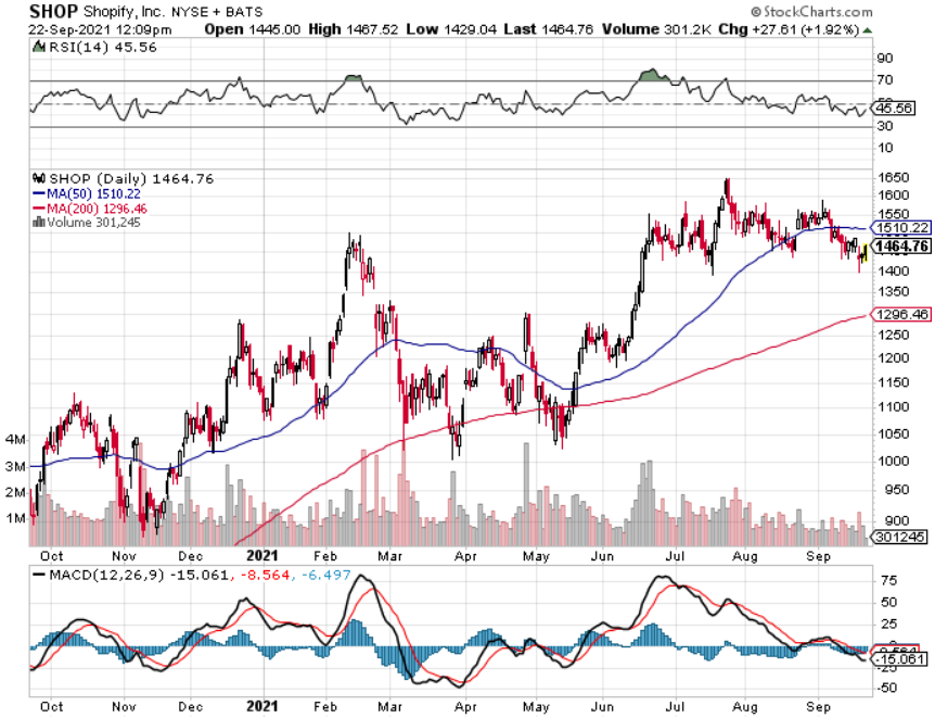
Back to the stock market — the stock today sits at $1,450 and has gone through a time correction shifting sideways for the past 3 months.
These levels still mean that SHOP is trading at PE levels around 75, but they are a growth stock so who cares about PE levels!
The past quarter’s sensational performance translated into expanding revenue by 57%.
No doubt that beating the comparable data from a covid year is turning out to be arduous with almost the effect of turning 2021 into a consolidation year.
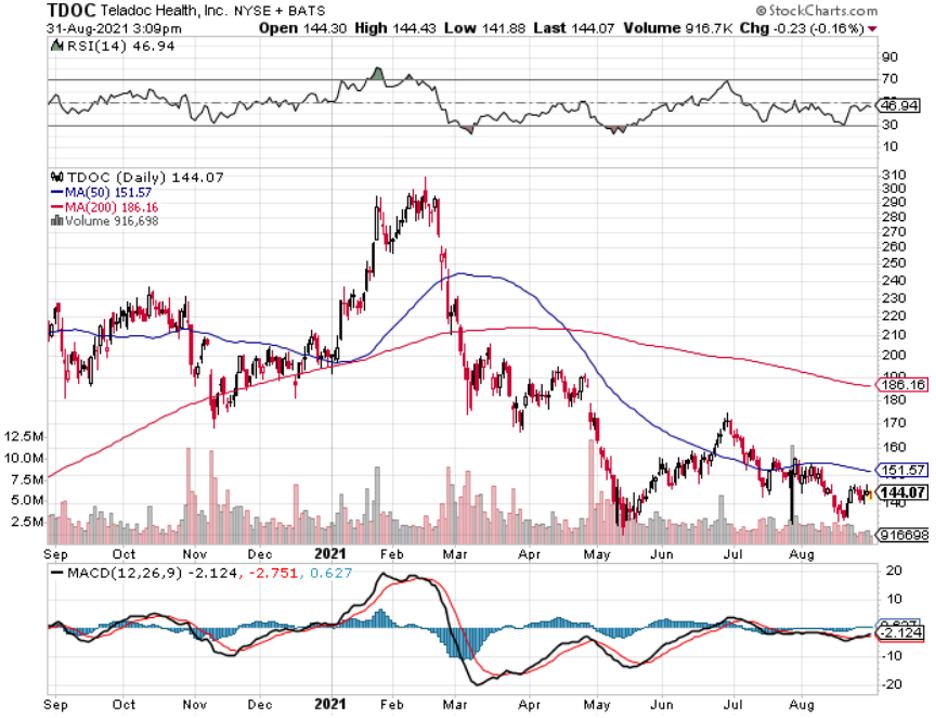
That has certainly been the case for Zoom Video (ZM) and Teledoc (TDOC).
Management indicated that revenue won’t be growing at the same pace as last year, but readers shouldn’t stress because this lack of pace doesn’t suggest anything is wrong with the business model.
As long as Shopify sustains a growth rate of over 40% for the next few years which is easily attainable for a company accruing only $3 billion of revenue per year, the stock will go up.
That will surely happen, and I am guessing they can maintain a 50% growth rate.
Once the lower growth rates are digested, I envision this stock turning the corner and will rise to $1,800 by the middle of 2022.

Mad Hedge Technology Letter
September 1, 2021
Fiat Lux
Featured Trade:
(DOOM AND GLOOM FOR THE PANDEMIC TECH DARLINGS)
(ZM), (TDOC), (DOCU), (FSLY)

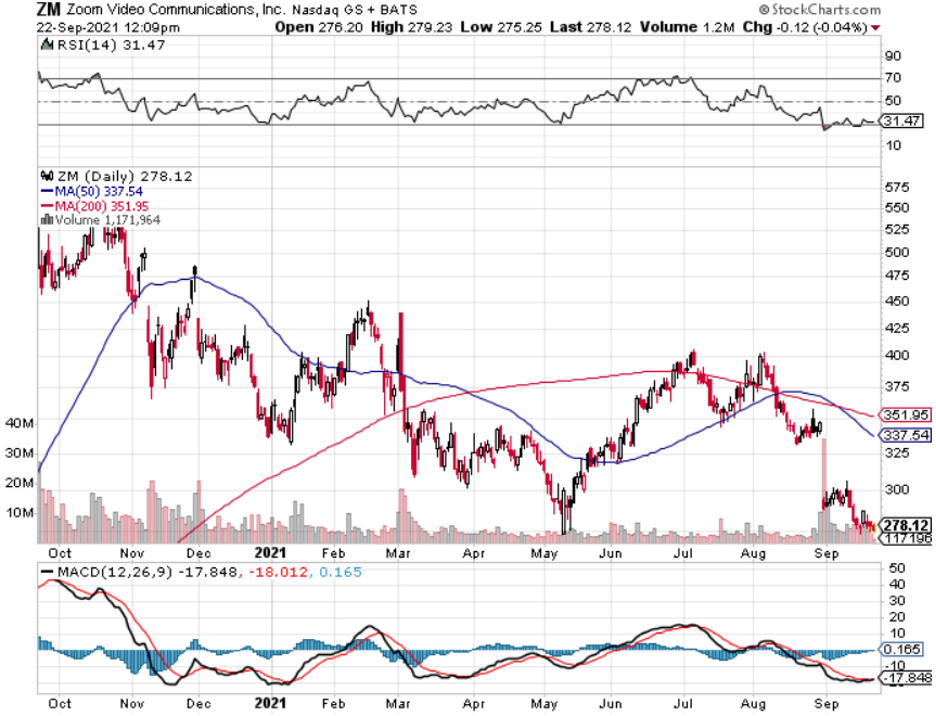
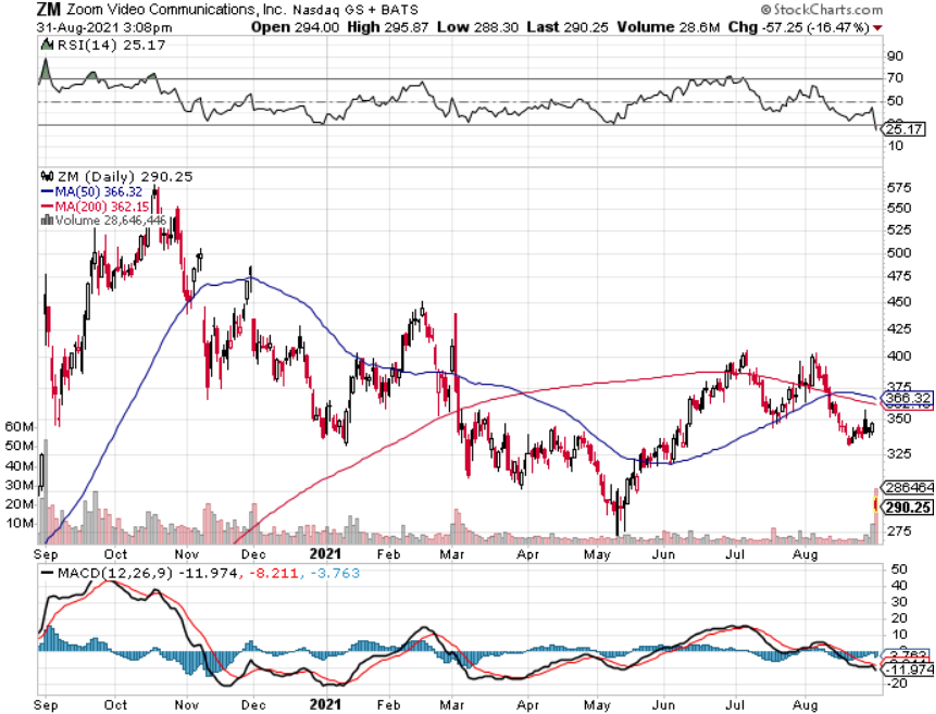
Zoom (ZM) shares are getting crushed today — down around 17%.
This tanking might even signal the event that as a society, we are done with this public health crisis, at least the shelter-at-home darling tech stocks are and will be down in the dumps for the short-term.
I have to give it to the company that Eric Yuan built.
He simply had better video technology than others at the time and was ready to roll it out when everything closed down — a perfect intersection of opportunity and preparation.
The first-mover advantage meant something, but that didn’t mean it was going to be the x-factor, and this massive sell-off has a little bit of the feeling that Yuan has given that advantage all back in one go.
This first-mover effect gives management time to figure out how to stay ahead of the game whether that means moving in a different direction or doubling down on the thing that got them there in the first place.
Zoom failed.
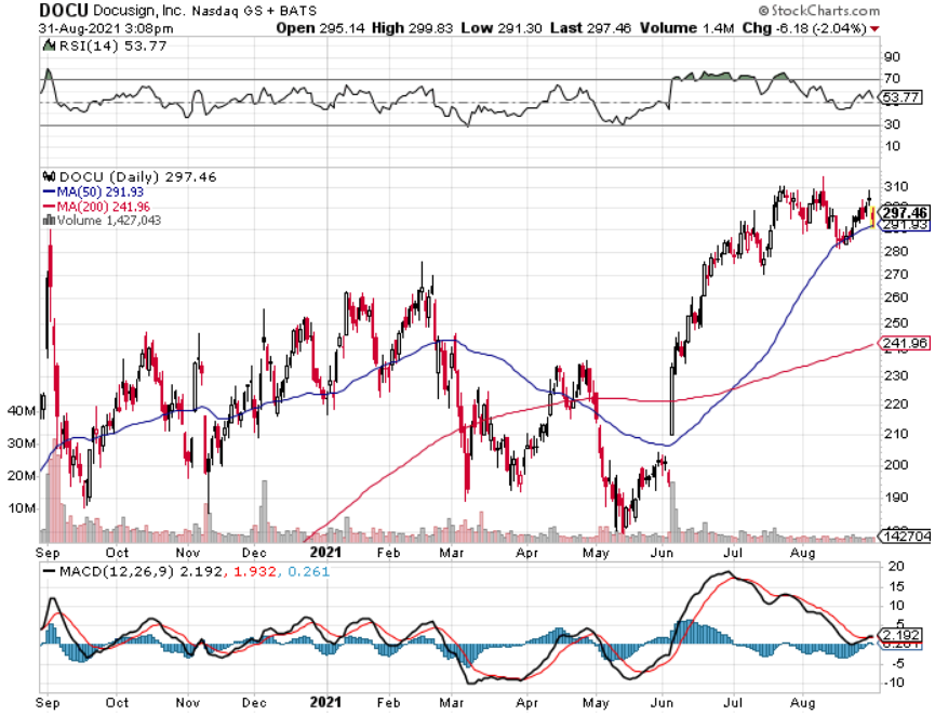
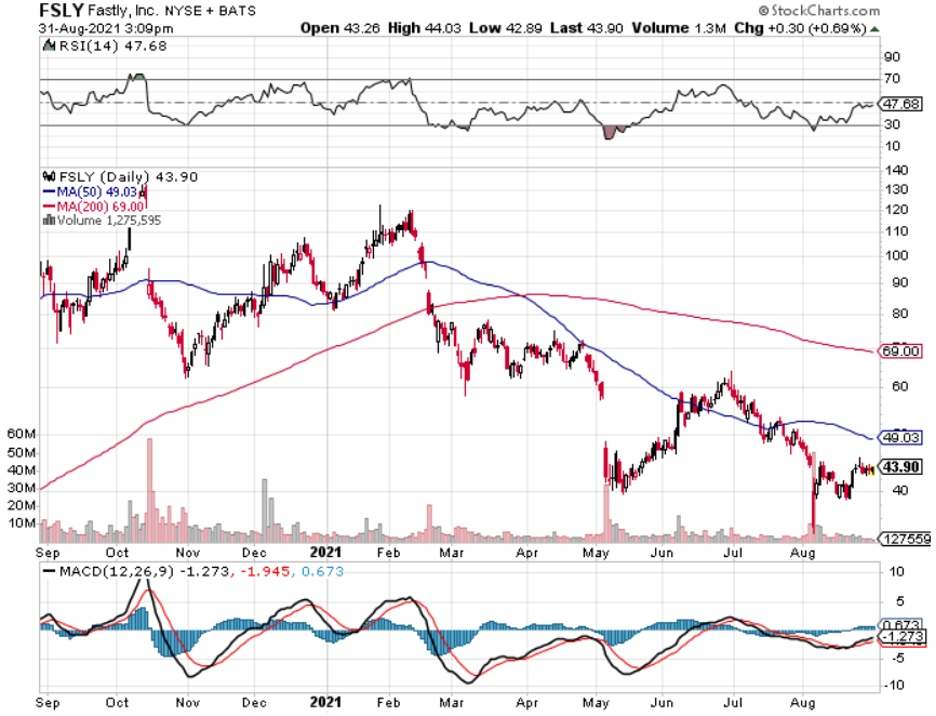
The tepid forecasts are also bad news for the other tech darlings of 2020 like DocuSign (DOCU), Teladoc (TDOC) and I would even lump Fastly, Inc. (FSLY) in there too.
It’s highly likely that these companies have peaked and will never see a conflation of bullish tailwinds that supercharges their business models ever again like in 2020.
They will just need to ride the solo secular tailwind of the pivot to digital migration which is ok, but not a supercharger.
I mean come on! Zoom is a video conferencing software company and that’s all they had going for them; they are still a video conferencing software company.
There is only so much that can do for them.
They would have had to move mountains to reboot its growth rates.
History will likely agree with me that Zoom was just a one-hit wonder and there’s no second hit coming from any album in the future.
That’s not a bad thing if you own the company, that one great year made the founder Yuan massively rich. Well done to him.
However, buying Zoom at the peak of the pandemonium at $560 will prove to be an expensive mistake.
If it ever does rise above $560 again from the $290 today, it will take 3-5 years and that opportunity cost incurred will be painful when there are so many other alternative tech stocks besides Zoom shares.
Revenue increased by 54% year over year in the quarter and in the previous quarter revenue had grown 191%.
Next quarter, Zoom is guiding to 31% growth.
The company has stuck with what it does best — video conferencing software while many other companies have raced to deploy their own Zoom copies.
The earnings weren’t all that bad with gross margin widened to 74.4% from 72.3% in the previous quarter.
Also in the quarter Zoom announced the availability of Zoom Events, which gives organizations the ability to hold premium online meetings. And Zoom said it invested in event software maker Cvent as Cvent sought to go public through a merger with a special purpose acquisition company.
Zoom now has 2 million seats for the Zoom Phone cloud-based phone service, up from 1.5 million three months earlier.
The company increased its forecast for the year as coronavirus case counts have increased, including from the Covid delta variant, and some companies delayed plans to reopen offices.
“What we’re seeing ... is headwinds in our mass markets, so these are individual consumers and small businesses. And, as you say, they are now moving around the world. People are taking vacations again, they’re going to happy hours in person,” Said Zoom CFO Kelly Steckelberg.
This roughly translates into an admission that Zoom will never do as well as it did during the pandemic.
And if you want to create a tier of “premium” meetings, they are still meetings with a glossier title — it doesn’t move the needle one millimeter.
Acquiring an events software maker is incredibly underwhelming — sounds like a niche company becoming even more niche and what investor wants to hear that?
Why not go for a cocktail party events software platform next?
We are just in the early innings of people taking vacations around the world and that will accelerate as overseas gets its handle over the delta variant which is looking like this winter to next spring.
I am also planning my Vietnam on a motorbike vacation when they finally open back up like many others.
I would also like to point out that tough comparable numbers are an issue faced by almost every tech company, not just Zoom, but tech companies like all the FANGs.
The key here is that FANGs have more than just a shelter-in-place business and have hit the ball out of the park on earnings plus more.
In fact, the re-opening of the US economy has shown that other tech companies can’t compete with the behemoths, they might as well get acquired by them.
Even with a massive first-mover advantage, the speed at which the likes of Microsoft and Apple move to smother anything like a DocuSign is lightning quick.
The fact that the likes of Zoom are one-trick ponies is really the death knell to them and why I advocate selling themselves to a tech company that can do more with them.
The little time they had to move in a different direction was wasted in just buying a few more data centers, a marginal events software company, adding “premium” meetings, and by and large, accepting the status quo which is just not good enough when there are a bunch of 800-pound gorillas in the room.
Ultimately, Zoom forecasting 31% of revenue growth next year is pitiful and a massive let down, it honestly might as well have been -31% growth.
This stock is going to have to solve itself out in the short-term and is it worth getting into Zoom long term when others can figure out video conferencing so easily?
The moat around the castle has been removed and the enemy is at the gate.
Zoom had a chance to run with the momentum but their stagnant ideas are coming back to haunt them where it hurts — the stock price.
I would put this one on the backburner even if there is a good chance for a dead cat bounce or 2 in this stock short-term and that goes for the rest of the shelter-in-place tech stocks.
Global Market Comments
May 28, 2021
Fiat Lux
Featured Trade:
(MAY 26 BIWEEKLY STRATEGY WEBINAR Q&A),
(SPY), (DIS), (AMZN), (FCX), (X), (PLTR), (FXE), (FXA), (TLT), (TBT), (AMC), (GME), (ZM), (DAL), (AXP), (LEN), (TOL), (KBH), (DOCO), (ZM), (TSLA), (NVDA), (ROM)


Below please find subscribers’ Q&A for the May 26 Mad Hedge Fund Trader Global Strategy Webinar broadcast from Lake Tahoe, NV.
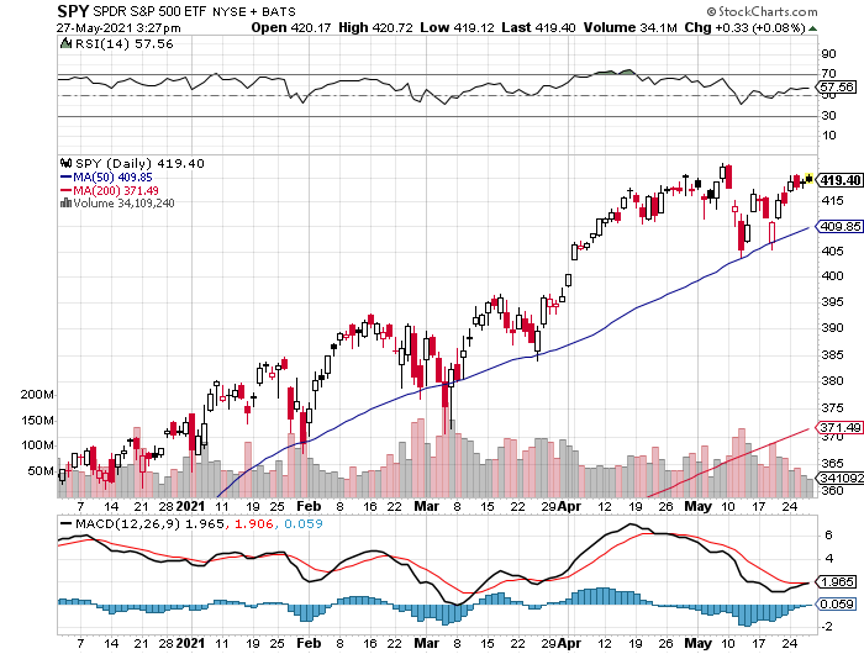
Q: Do you expect a longer pullback for the (SPY) through the summer and into the last quarter?
A: No, this market is chomping at the bit and go up and won’t do any more than a 5% correction. We’ve already tested this pullback twice. We could stay in this 5% range for a few more weeks or months, but no longer. If we make it to August before we take off to the upside, that would be a miracle. It seems to want to break out right now and if you look at the tech stocks charts you can see what I'm talking about.
Q: Why do day orders with spreads not good ‘til canceled (GTC)?
A: Actually, you can do good ‘til canceled on these spreads, it just depends on how your platform is set up. Good ‘til canceled won't hurt you—only if we get a sudden reversal on a stop out which has only happened four times this year.
Q: Disney (DIS) seems to be struggling to get back over $180; am I still safe with my January 2023 $250 LEAPS?
A: Yes, out to 2023 we’ll have two summers until those expire, so those look pretty good—that's a pretty aggressive trade, and I’m betting you’re looking at a 500% profit on those LEAPS. And by the way, I always urge people to go out long on these LEAPS, because the second year is almost free when you check the pricing. So, take the gift and that will also greatly reduce your risk. We could have a whole recession and recovery, and still have those LEAPS make it to $250 in Disney.
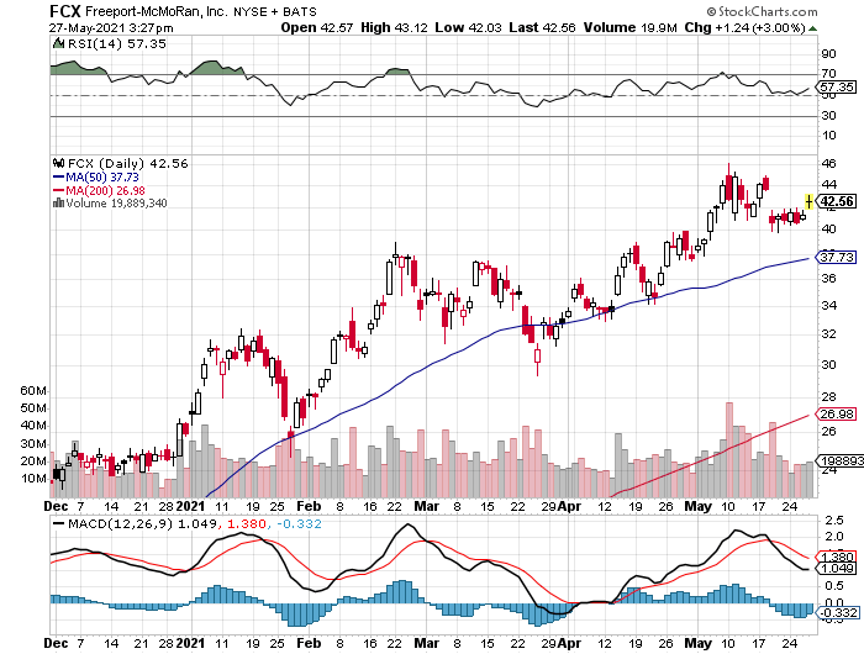
Q: Should I add to Freeport McMoRan (FCX)?
A: (FCX) I would not add—in fact, I would have a stop loss if we closed below $40 on (FCX) if you’re a short-term trader. There is a slowdown in the Chinese economy going on as well as a clampdown on commodity speculation. This has affected the whole base metal space, including steel and palladium. If you have the long-term LEAPS, keep them, because I think (FCX) doubles from here. The whole “green revolution story” is still good.
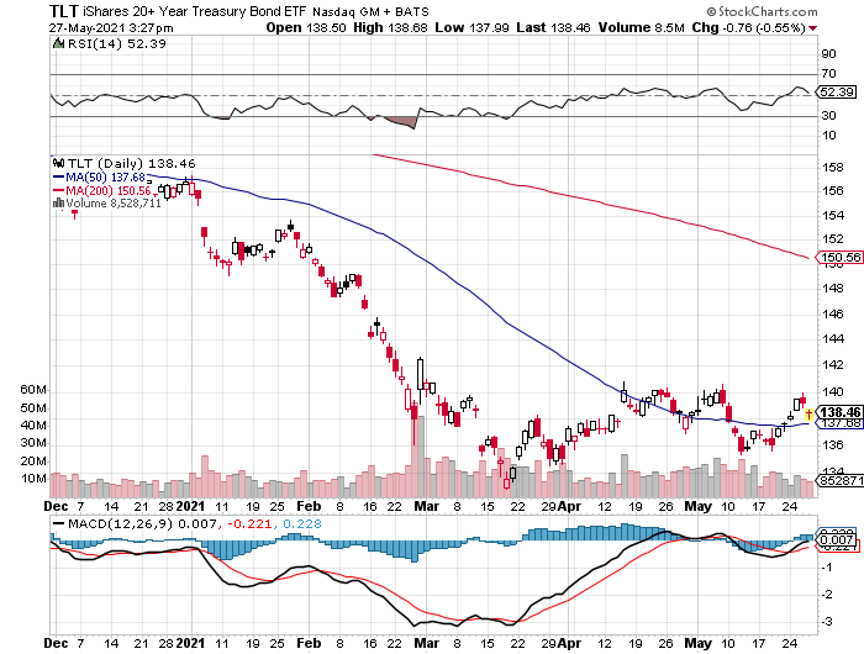
Q: Do you think the United States Treasury Bond Fund (TLT) is going up?
A: No, I think the (TLT) has been going down. I've been buying puts spreads like crazy, and I have a huge chunk of my own retirement fund in long-dated (TLT) LEAPS, so I am praying it will go down. We’ll talk about that when we get to the bond section.
Q: Prospects for U.S. Steel (X)?
A: It’s tied in with the whole rest of the base commodity complex—I think it is due for a rest after a terrific run, which is why I have such tight stop losses on Freeport McMoRan (FCX).
Q: Do you buy the “transitory” explanation for the hot inflation read two weeks ago that the Fed is handing out, or do you think inflation is bad and here to stay?
A: I go with the transitory argument because you’re getting a lot of one-time-only price rises off of the bottom a year ago when the economy completely shut down. Once those price rises work through the system, the inflation rate should go from 4.2% back down to 2% or so. So, I don't see inflation as a risk, which is why I think the stock markets can reach my 30% up target this year. You may get another hot month as the year-on-year comparisons are enormous. But betting on inflation is betting on the reversal of a 40-year trend, which usually doesn’t work out so well.
Q: On your spread trade alerts can we buy less than 25 contracts?
A: You can buy one contract. In fact, I recommend people start with one contract and test out where the real market is. Put a bid for one contract in the middle of the market, and if it doesn’t get done, raise your bid 5 cents, and eventually, your order gets done. Then you can add more if you want to. I always recommend this even for people who buy thousands of contracts, that they test the market with one contract order just to make sure the market is actually there.
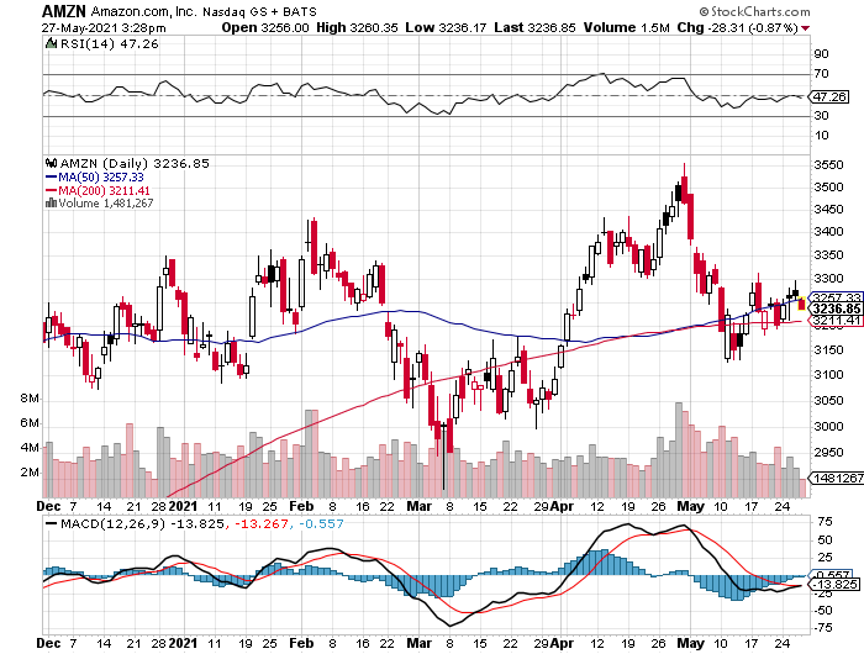
Q: Can you recommend a LEAPS for Amazon (AMZN)?
A: The Amazon LEAPS spread is the January 2022 $3150-3300 vertical call debit spread going out 8 months.
Q: When you short the (TLT), how do you do it?
A: I do vertical bear put debit spreads. I buy a near-money put and sell short and an out-of-the-money put so I can reduce the cost, and therefore triple my size. This strategy triples the leverage on the most likely part of the stock move to take place, which is the at the money. For example, a great one to buy here would be a January 2021 (TLT) $135/140 vertical bear put debit spread where you’re buying the $140 and selling short the $135. The potential 8-month profit on this is around 100%. You’ll make far more money on that kind of trade than you ever would just buying puts outright. Some 80% of the time the single option trades expire worthless. You don’t want to become one of those worthless people.
Q: What’s your best idea for avoiding a U.S. Dollar drop?
A: Buy the Invesco Currency Shares Euro Trust (FXE) or buy the Invesco Currency Shares Australian Dollar Trust Trust (FXA), the Australian Dollar to hedge some of your US Dollar risk. The Australian dollar is basically a call option on a global economic recovery.
Q: I’m a new subscriber, but I don’t get all the recommendations that you mention.
A: Please email customer support at support@madhedgefundtrader.com , tell them you’re not getting trade alerts, and she'll set you up. We have to get you into a different app in order for you to get all those alerts.
Q: How about the ProShares UltraShort 20 Year Treasury ETF (TBT)—is that a bet on declining (TLT)?
A: Absolutely yes, that is a great bet and we’re at a great entry point right now on the (TBT) so that is something I would start scaling into today.
Q: Do you still like Palantir (PLTR)?
A: Yes, but the reason I haven't been pushing it is because the CEO says he could care less about the stock market, and when the CEO says that it tends to be a drag on the stock. Palantir has an easy double or triple on it on a three-year view though. However, small tech has been out of favor since February as it is overpriced.
Q: How far down can the (TLT) go in the next 30 days?
A: It could go down to $135 and maybe $132 on an extreme move, especially if we get another hot CPI read on June 10. However, if you hear the word “taper” from a Fed official, then you’re looking at high $120’s in days.
Q: With the TLT going up, why have you not sent out an alert to double up on put spreads?
A: I tend to be a bit of a perfectionist since I’m a scientist and an engineer, so I’m hanging on for an absolute top to prove itself and start on the way down. On the shorts, I like selling them on the way down, and buying my longs on the way up, because there are always surprises, there’s always the unknown, and heaven forbid, I might actually be wrong sometimes! So, I’m still waiting on this one. And we do already have one position that is fairly close to the money now, the June 2021 $141-144 vertical bear put debit spread, so I don't want to double up on that until we have a reversal in the intermediate term trend.
Q: I see GameStop (GME) is spiking again now up to $230—should I get in for a short-term profit?
A: No. With these meme stocks, the trading is totally random. If anything, I would be selling short, but I would do it in a limited risk way by buying a put spread. However, the implied volatility in the options on these meme stocks are so high that it's almost impossible to make any money on options; you’re paying enormous amounts of money up front, so that's my opinion on GameStop and on AMC Entertainment Holdings (AMC), the other big meme stock.
Q: Will business travel come back after the world is vaccinated?
A: Absolutely. Companies don't want to send people on the road, but customers will demand it. All you need is one competitor to land an order because they visited the customer instead of doing a Zoom (ZM) meeting, and all of a sudden business travel will come roaring back. So that's why I was dabbling in Delta Airlines (DAL) and that's why I like American Express (AXP), where 8% of transactions are for first class airline tickets.
Q: As the work-from-home economy stops and workers go back to the office, do you see a 10% correction in the housing market?
A: Actually, in the housing market with real houses, I don't see prices dropping for years, because 30% of the people who went home to work are staying there for good—that the trend out of the cities into the hinterlands is a long-term trend that will continue for decades, now that Zoom has freed us of the obligations to commute and be near big cities. And of course, I’m a classic example of that; I've been working either in my basement in San Francisco or at Lake Tahoe for the last 14 years. Housing stocks on the other hand like Lennar (LEN), Toll Brothers (TOL) and KB Home (KBH) have had a tremendous run and are basically out of homes. Could they have a 10% correction at any time? Absolutely, yes.
Q: Should I avoid buying dips in last year's work-from-home stocks?
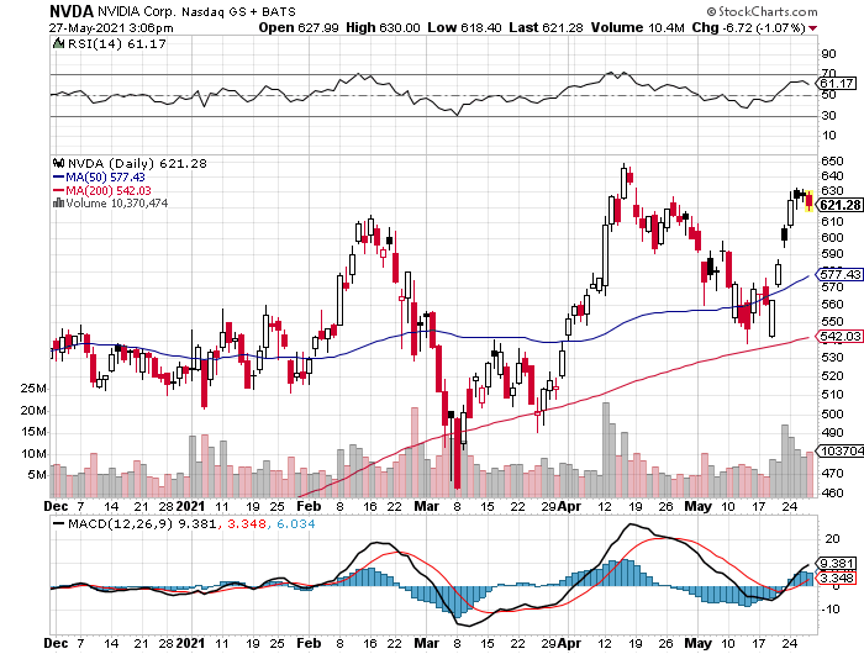
A: Yes I would. DocuSign (DOCO) and Zoom (ZM) are the two best ones because they were both up 12X from their lows, and I tend not to chase things that are up 12X unless they are a Tesla (TSLA) or an Nvidia (NVDA) or something like that. In the end, Tesla went up 295 times.
Q: Are you looking at the carbon credits market?
A: No, but I probably should. That market shut down last year. It’s alive again, and it looks like it's growing like crazy.
Q: What’s the ideal volatility for individual options? What do you use to compare?
A: Always look at the implied volatility of the option compared to the realized volatility of the underlying stock; and when the difference gets too big, you get ideal conditions for putting on call and put spreads, which take advantage of this. These are almost volatility neutral because you’re long on one batch of volatility and short on the other.
Q: Is it too late to get involved in the ProShares Ultra Technology ETF (ROM), the 2X long ETF in a spread?
A: The November 2021 $121-125 vertical bull call spread, the farthest expiration you can get for the (ROM), was kind of aggressive—I would go closer to the money. We’re right around mid $80s right now, so maybe do a January 2022 $95-100, and even that will get you something like a 400% gain by November.
To watch a replay of this webinar with all the charts, bells, whistles, and classic rock music, just log in to go to MY ACCOUNT, click on GLOBAL TRADING DISPATCH (or Tech Letter as the case may be), then WEBINARS, and all the webinars from the last ten years are there in all their glory.
Good Luck and Stay Healthy.
John Thomas
CEO & Publisher
The Diary of a Mad Hedge Fund Trader

Summit of Mount Rose at 10,778 feet with Lake Tahoe on the Right
Mad Hedge Technology Letter
April 21, 2021
Fiat Lux
Featured Trade:
(BUY OR SELL FIRST QUARTER TECH EARNINGS?)
(IBM), (MU), (SAMSUNG), (ZM), (GOOGL)

We are on the cusp of tech earnings which could either take us on the next leg up or leg down.
Going off of data points that we are getting from around the world, it’s clear that the secular bull market in big technology is as healthy as ever.
A few weeks ago, South Korea’s behemoth Samsung Electronics sounded off when it said first-quarter profit likely rose 44% because of the surge in sales of smartphones and TVs.
The work-from-home economy has made technology stocks the ultimate winner and now we need to assess what will happen to these very stocks in 2021.
Many analysts out there see an ongoing correction in names such as videoconferencing software company Zoom (ZM) which is going through a drawn-out consolidation phase after hyper-growth in their products last year.
That is not a bad thing, but frustrating in the short-term.
Tech stocks are renowned for getting ahead of itself.
Waiting for tech stocks to grow into their valuation is no fun, however, ultimately, there is an avalanche of money piling into this sector because it is fundamentally underpinned by cash cow secular trends.
Part of that thesis also is applied internationally to giants like Samsung, the South Korean technology giant forecast January-March operating profit at $8.32 billion.
Samsung’s flagship Galaxy S21 smartphone series outsold the previous version by a two-to-one margin in the six weeks since its January launch.
Profit in Samsung’s television set and home appliance business also likely more than doubled due to continued stay-at-home demand.
Cross-town TV and home appliance rival LG Electronics announced its largest-ever preliminary quarterly operating profit for January-March.
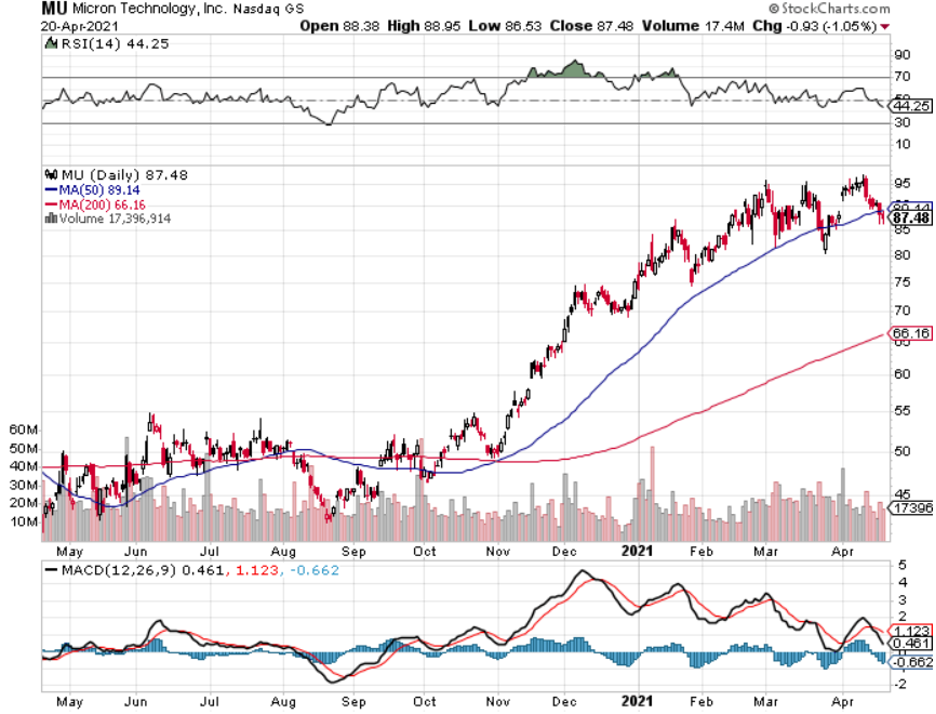
The secular health is not only confined to Korea, as U.S. memory chip peer Micron Technology last month forecast third-quarter revenue above analyst estimates due to rising demand brought about by a global shift to remote work.
The price of DRAM chips widely used in laptops and other computing devices rose 5.3% in January-March from the previous three months.
Samsung will invest about 10 trillion won in its chip contract manufacturing business this year, compared to about 6 trillion won last year.
In addition to the performance, regulation is now set to offer another helping hand to U.S. tech with two top White House aides hosting a meeting on how to better equip the state of the U.S. supply chain.
Samsung is considering a new $17 billion chip plant in the United States.
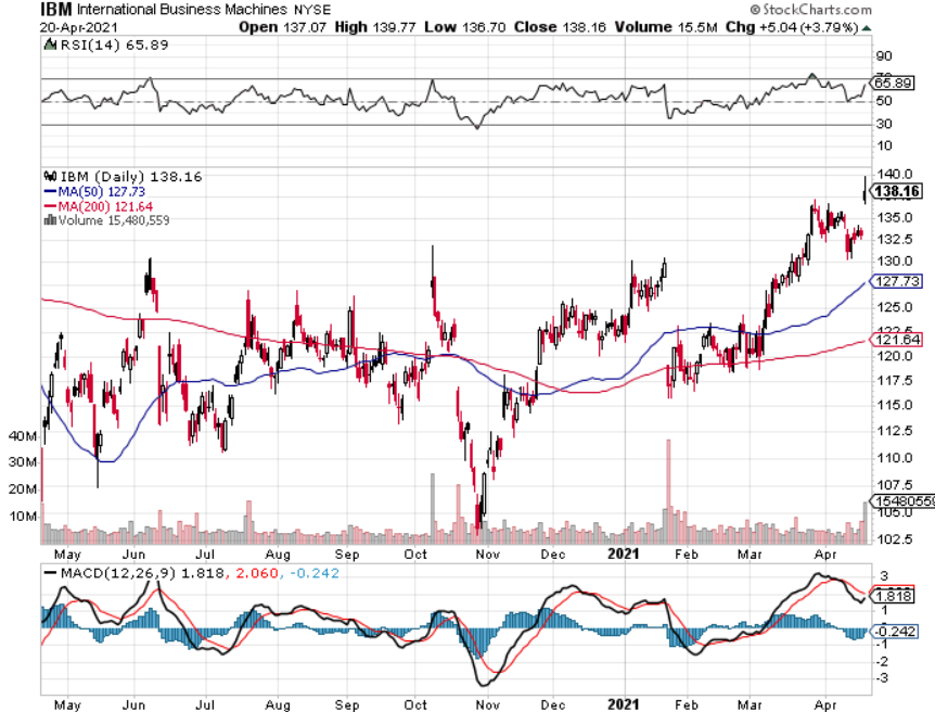
On the night before an earnings flurry, we also got word from IBM that they finally reversed 4 years of declining revenue to post 1% revenue growth.
Like many big tech groups, IBM has jumped on the bandwagon of clients digitally transforming their businesses, using hybrid cloud and AI to capture new growth opportunities, increase productivity and create operating flexibility.
Their revenue performance this quarter reflects this. Global business service (GBS) cloud revenue growth accelerated to almost 30%, doubling its growth rate from the prior quarter with strong growth across the portfolio.
The numbers reflect expanding practices with ecosystem partners like Salesforce and Adobe and strong momentum in their acquisition of Red Hat.
IBM has doubled the number of Red Hat client engagements from the prior year to over 150, working with companies such as HBO, Marriott, Vodafone, and Honda.
They’ve now signed $2 billion of business in their Red Hat practice inception to date.
Across these, IBM's cloud revenue was up 18% in the quarter and over the last 12 months and now stands at over $26 billion for the last year.
Like many other tech firms, employment hiring is expanding with IBM hiring thousands of people in the past quarter.
Like other firms as well, M&A is an often-utilized growth strategy with IBM closing on six acquisitions since mid-December.
They are adding go-to-market and delivery capabilities in GBS, and technical skills in Red Hat. And they’re increasing R&D in areas like AI and quantum to drive innovation.
Across cloud and cognitive software, IBM continues to increase subscription and support renewal rates, driving the record deferred income levels.
Red Hat continued solid performance with normalized revenue growth of 15%, led by Red Hat Enterprise Linux and OpenShift, both of which continue to gain share.
Even IBM, the laggard of tech, is improving their balance sheet by whittling down $3 billion from year-end, their debt was down $5 billion. They have now reduced debt by about $17 billion from the peak.
IBM even still delivers shareholders a nice dividend.
The takeaways from IBM and Samsung will largely apply to many of the tech companies that are about to report earnings.
Hiring is up because the business is doing so well.
Even if these legacy operations are only growing minimally in IBM, their cloud operations are far and away the highest growth element in their portfolio, and the performance of Red Hat indicates that.
The secular tailwinds are indeed helped by the business environment undergirded by a work-from-home assumption which is why companies like Samsung are posting record sales in tablets, smartphones, and can’t keep up with the demand for chips.
We are getting indication that much of the transformation into the 2020 digital economy is here to stay, but the issue in April is that although companies are as healthy as could be, firms are now facing Himalayan-like comparisons with last year.
Last year, April was a time when technology took off like a scalded chimp, and fast forward to 2021, many tech firms won’t be able to beat those year-over-year numbers they posted during peak lockdown business.
What I expect is for many tech firms to announce that comparisons were tough to beat because of a once in a 100-year event that locked down most of the world, but many tech firms will reaccelerate growth after a period of earnings consolidation.
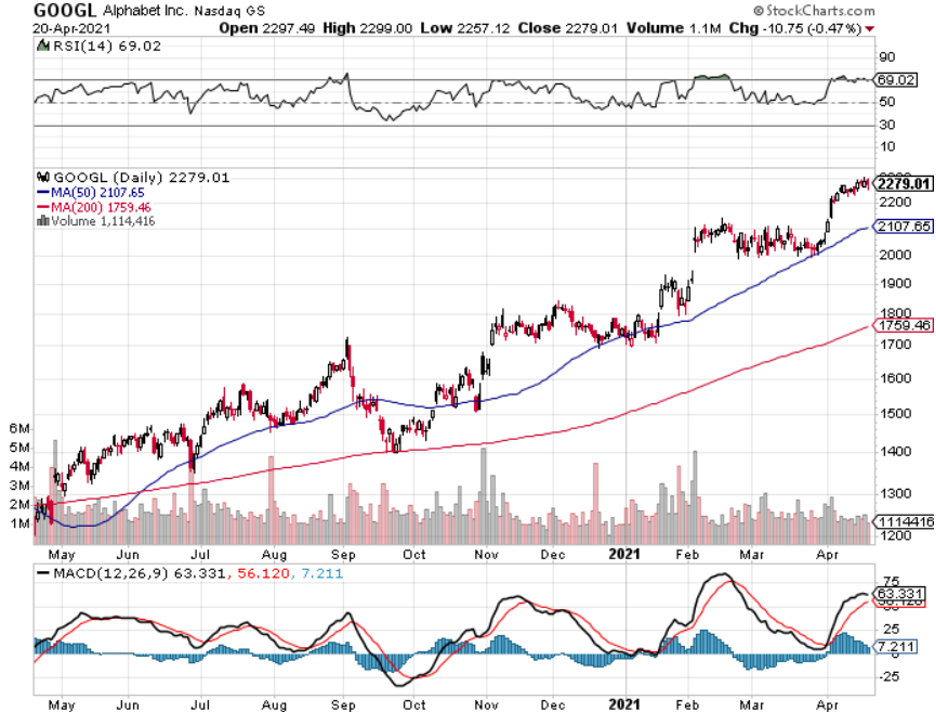
Expectations have gotten a little stretched and outperformers like Alphabet (GOOGL) are already up 25% year to date, but I can argue that the guys at Google are making miracles and are surpassing even astronomically high expectations.
That won’t be the case for other tech companies that will need miracle performance to outdo exorbitant forecasts, but just quite aren’t there like Google.
Consolidation through sideways price action could take hold in the second quarter as many tech firms need time to recalibrate so they can reaccelerate in the second half of the year which they indeed will.