
“The car business is hell,” said founder Elon Musk, when announcing he would sleep in the Fremont Tesla factory until Model S production reached 2,500 units a week.
Mad Hedge Technology Letter
September 15, 2021
Fiat Lux
Featured Trade:
(TRY THIS RELIABLE DATA CENTER STOCK)
(EQIX)
One of the seismic outcomes from the current rollout of 5G is the plethora of generated data and data storage that will be needed from it.
In the land of tech stocks — more data means more money.
If one fashions themselves as a cloud purist and wants to bet the ranch on data being the new oil (and one would be daft not to realize it is) then look no further than Equinix (EQIX).
This is a tech firm that connects the world's leading businesses to their customers, employees, and partners inside the most interconnected data centers.
We are really talking about the backbone of the internet.
This is what the company represents and without this spine, the internet would be way more primitive and not as robust.
On this global platform for digital business, companies fuse together worldwide on five continents to reach everywhere, interconnect everyone and integrate everything they need to reap a digital windfall.
And whether we like it or not, the future will be more interconnected than ever because of the explosion of data and the 5G that harnesses the data.
This is precisely why the data will motivate businesses to extend their reach across the globe and expand their addressable audience.
It’s not me just talking up these bunch of overachievers; the numbers back me up fully.
This past quarter Q2 revenues were $1.658 billion, up 8% over the same quarter last year due to strong business performance across EQIXs platform, led by the Americas region.
And as expected, nonrecurring revenues increased quarter-over-quarter to 7% of revenues due to a meaningful step-up in joint venture fees in Asia and Europe and custom installation work across all three regions.
As we must grapple with, nonrecurring revenues are inherently lumpy and therefore, as a result, EQIX expects Q3 nonrecurring revenues to decrease by $8 million compared to Q2. Cloud and IT verticals also captured strong bookings led by SaaS as the cloud diversifies towards a hybrid multi-cloud architecture.
High single digits might not look so glossy at first, but this is not a $1 billion per year in revenue company.
It’s probably one of the most stable businesses around since, unlike software, they can go out of fashion quite quickly if the next version bombs, yet storage space is more about economies of scale.
Other won deals lately include a leading SaaS provider expanding to support growth in new markets and with the Federal Government as well as an AI-powered commerce platform upgrading to enhance user experience support a rapidly growing customer base.
As digital transformation accelerates, the enterprise vertical continues to be Equinix’s sweet spot led by healthcare, legal, and travel sub-segments this quarter and the main catalysts to why I keep recommending readers this data storage company.
Other expansions this quarter included Zoom, a leading video communications platform, expanding coverage and scale to support market demand, and a cloud-delivered enterprise network security provider deploying infrastructure to support offerings in new locations.
EQIX’s enterprise vertical achieved record bookings, with broad global strength punctuated by an exceptionally strong quarter in the Americas across several subsegments, including healthcare, consumer services, business and professional services, and retail. New wins and expansions included Red Bull, a major sports energy drink manufacturer, deploying infrastructure across all three regions to take advantage of EQIX's cloud ecosystem.
EQIX can boast 65 consecutive quarters of increasing revenues, which eclipses every other company in the S&P 500, and it anticipates 8%-10% in annual revenue growth through 2022.
But now they are rolling out upgraded 2021 guidance by $15 million, forecasting to grow 10% to 12% year over year.
This represents a company that cuts across every nook and cranny of the tech sector by taking advantage of the unifying demand and storage requirements of big data.
This company will only become more vital once 5G goes blooms and being the global wizards of the data center will mean the stock goes higher in the long-term.
The momentum behind digital transformation is as robust as ever and shows no signs of letting up.
As a world digital infrastructure company, Equinix plays a unique role in this evolving story and is positioned to be both a catalyst and a key beneficiary as they partner with customers to unlock the enormous promise of digital.
They will continue to scale, doubling down on the strength of their core business, investing to further scale a go-to-market machine to win new customers, putting capital to work to add capacity in existing markets, and executing on targeted operational improvements to standardize, simplify and automate, driving expanded operating margins and providing a better experience for customers and partners.
Delivering advanced features to sustain momentum in EQIXs market-leading interconnection franchise and driving adoption of digital infrastructure services to deepen our relevance to customers is still paramount for the firms’ prospects.
I recommended this stock at $491 and now it sits nicely at $840.
My premise of buying and holding long term still holds true and any dip should be bought to take advantage of dollar-cost averaging.
I expect Equinix to be a slow and steady climb because let’s face it, it’s not a 40% per year growth story, but the stock does the job and rarely declines while providing a stable dividend.
“Capitalism has worked very well. Anyone who wants to move to North Korea is welcome.” – Said Founder and Former CEO of Microsoft Bill Gates
Mad Hedge Technology Letter
September 13, 2021
Fiat Lux
Featured Trade:
(THE DATABASE MOST WANTED BY DEVELOPERS 4 YEARS RUNNING)
(MDB), (MSFT), (IBM), (SAP), (ORCL), (CLDR)
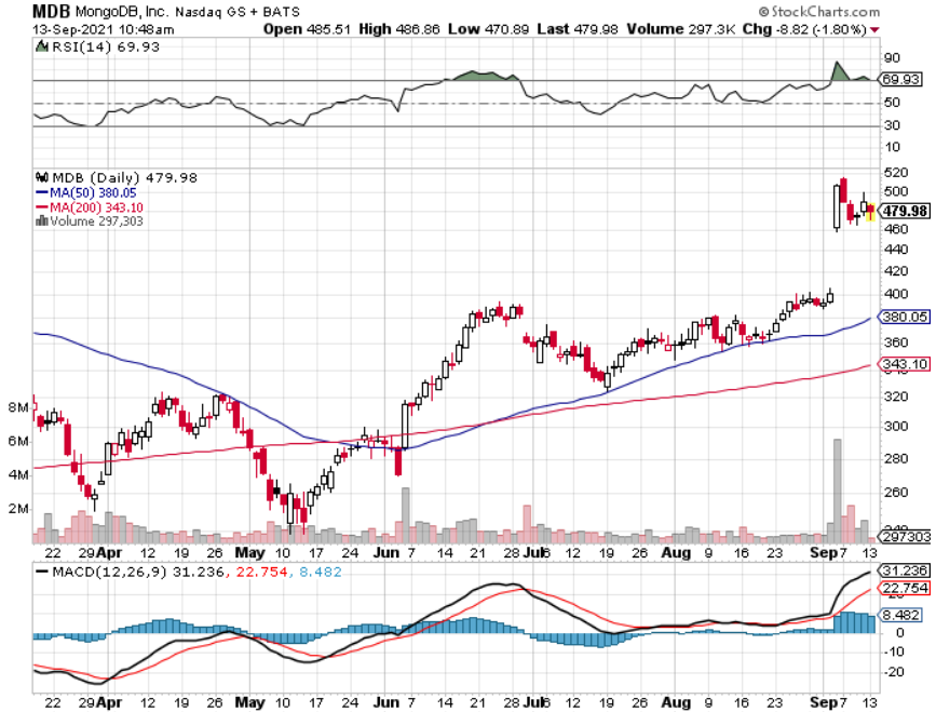
MongoDB’s latest earnings’ results validate the concept open source software as a rival to the opposed closed-source software grid.
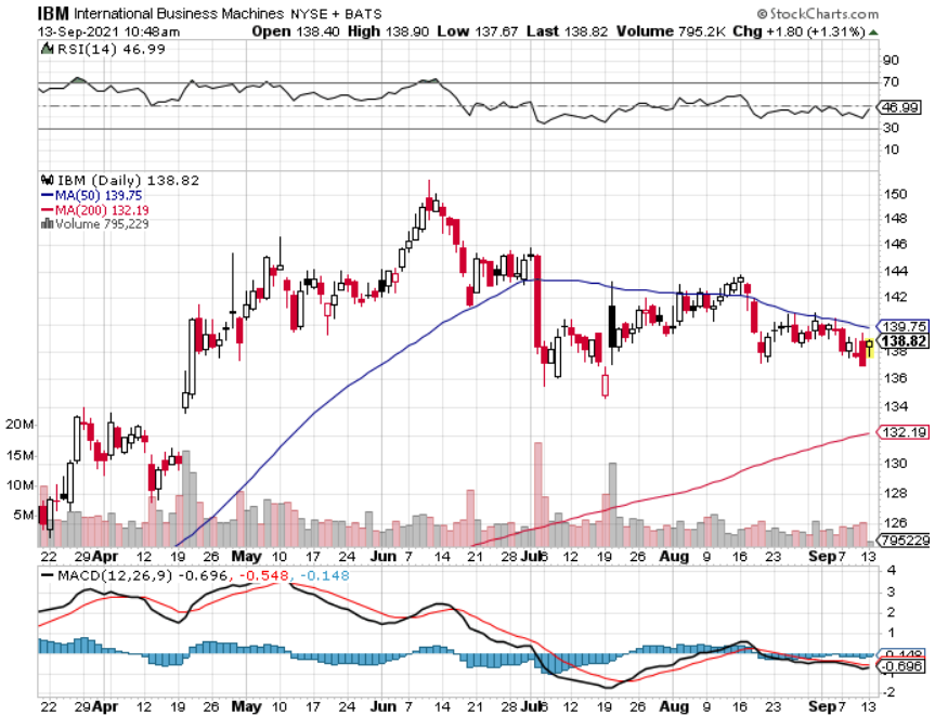
A keen rival of MongoDB’s RedHat was also acquired by IBM (IBM) a few years ago showing the vitality of the sub-sector.
Don’t sleep on these companies as another one Cloudera (CLDR) were taken private by private equity firms KKR and Clayton, Dubilier & Rice.
These are highly valuable assets and I’m not the only one shouting from the rooftops.
How did this all first start?
The first open-source projects were not really businesses, they were counter attacks against the unfair profits that closed-source software companies were reaping.
Microsoft (MSFT), Oracle (ORCL), SAP (SAP), to name a few, were enforcing monopoly-like “rents” for software that were substandard in quality.
The latest evolution of open source came when developers evolved the projects with two important elements.
The first is that the open-source software is now developed largely within the confines of businesses.
Often, more than 90% of the lines of code in these projects are written by the employees of the company that commercialized the software.
Second, these businesses offer their own software as a cloud service from inception.
In a sense, these are Open Core / Cloud service hybrid businesses that can obtain multiple pathways to monetize their product and that is exactly what MongoDB did.
By offering the products as SaaS, these businesses can interweave open-source software with commercial software so customers no longer have to worry about which license they should be taking.
MongoDB Atlas is a great example of this evolution and can become the dominant business model for software infrastructure.
This is their hottest product which is a fully-managed cloud database and Atlas handles all the complexity of deploying, managing, and healing deployments on the cloud service provider of your choice like Amazon or Google.
MongoDB changed how open-source software is licensed, and they introduced the new cloud service that required them and partners to compete with the largest cloud providers.
Looking quickly at second-quarter financial results, they generated revenue of $199 million, a 44% year-over-year increase and above the high-end of guidance. They grew subscription revenue 44% year over year.
Mongo Atlas revenue grew 83% year over year and now represents 56% of revenue, and they had another strong quarter of customer growth, ending the quarter with over 29,000 customers.
Businesses that can develop software faster are able to ultimately outgrow their competition.
MongoDB’s results are a clear indication that customers view MongoDB as a critical platform to accelerate their digital innovation agenda.
Customers of all types are choosing MongoDB because they can develop so much faster using this platform to build new applications and replatform legacy applications across a broad range of use cases to drive business forward.
Even though MongoDB open-source software is lower cost per unit, it makes up the total market size by leveraging the elasticity in the market. When something is cheaper, more people buy it. That’s why open-source companies have such massive and rapid adoption when they achieve product-market fit.
The model now is that companies are venturing as far as actually open sourcing all their software but applying a commercial license to parts of the software base. The premise being that real enterprise customers would pay whether the software is open or closed, and they are more incentivized to use commercial software if they can actually read the code.
Observing how airline JetBlue deployed MongoDB is how these new approaches and improved products manifest themselves in the topline revenue.
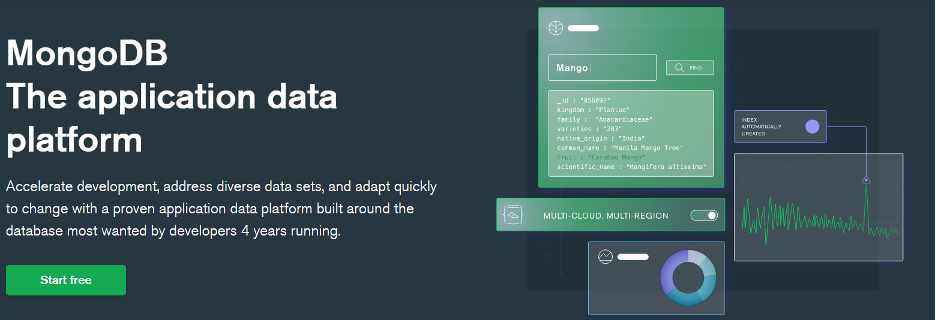
JetBlue came to the decision to overhaul their core e-commerce app, and JetBlue chose the MongoDB application data platform.
MongoDB's flexible data model allowed JetBlue to build a dynamic customer experience with modern ticketing applications, as well as predictive analytics in real-time.
An avalanche of firms is leveraging the tools of MongoDB tools to up their digital game.
Management has steered the narrative to include the ease of use and expanding the capabilities of the MongoDB platform to make it more compelling for customers to standardize on MongoDB.
For example, a serverless, customer can get started with MongoDB without having to pick a specific machine type or size. The application connects to Atlas, and they handle the elastic scaling of compute and storage seamlessly, whether an application scales fast or becomes popular. Customers no longer must do capacity planning or manual intervention to adjust the size of the deployment.
The verdict is in and deploying MongoDB to harness in-house developers to build unique commercial applications has been a winning formula.
Not only are they sheltered from rigid closed-source software, but customers can even integrate the code first, then pay later when it is deployed, and this licensing model has been extremely beneficial for developers who need to test out whether certain code is valuable or not.
Atlas is now the cash cow for MongoDB and forecasts predict acceleration in top-line growth.
Yes, this company is still small procuring revenue of just $166 million in 2018, but 2023 will see annual revenue surpass $1 billion which is why everyone wants to hop on MondoDB’s train.
I would consider any dips to deploy capital in MongoDB, I would call it a rising star of the software world, and a gem in the developers’ world.
“The computer is my favorite invention. I feel lucky to be part of the global village. I don't mean to brag, but I'm so fast with technology. People think it all seems too much, but we'll get used to it. I'm sure it all seemed too much when we were learning to walk.” – Said Japanese Singer Yoko Ono
Mad Hedge Technology Letter
September 10, 2021
Fiat Lux
Featured Trade:
(YOUR GUIDE TO THE METAVERSE)
(RBLX), (FB), (MSFT), (APPL), (AMZN), (EPIC GAMES)
People have no idea what the Metaverse is, so I will be the one to fill you in.
What is the Metaverse? Simply put, the Metaverse is the next mega-phase of the internet, a merging of the physical world with XR, AR, and VR that is just beginning to revolutionize.
It is an extensive online world transcending individual tech platforms, where people exist in immersive, shared virtual spaces. Through avatars, people would be able to try on items available in stores or attend concerts with friends, just as they would offline.
On a recent earnings call, Facebook (FB) CEO Mark Zuckerberg detailed the Metaverse: “It's a virtual environment where you can be present with people in digital spaces,” he said. “You can kind of think about this as an embodied internet that you're inside of rather than just looking at. We believe that this is going to be the successor to the mobile internet.”
Does the Metaverse exist anywhere yet? The answer is yes, early versions of it. The closest approximations of it right now include the likes of digital game platforms Roblox (RBLX) and Fortnite.
The internet era was defined by the computer being in the living room and the connection to the internet being occasional.
The shift to mobile computing is defined by moving the computer from the living room to the office and into your pocket and changing access to the internet from occasional to continuous and persistent.
Metaverse is the idea of computing everywhere, ubiquitous, ambient. In a simplified sense, think about the Metaverse as a series of interconnected and persistent simulations.
One could almost describe it as the next internet, web 3.0.
And crypto, or some sort of crypto offspring or cousin of it, will be the coin of this new realm which is why crypto in its form now is so important.
Consider the internet and mobile internet. Over time it disrupted nearly every industry in nearly every geography.
It changed how consumers patronized, business models, products, behaviors. This produces an extraordinary economic opportunity overall.
The same will happen via the Metaverse.
In the future, instead of just doing calls over a phone call, you’ll be able to sit as a hologram on a couch, or I’ll be able to sit as a hologram on your couch, and it’ll actually feel like we’re in the same place even though it is remote.
Sharing space is what humans perceive as closer to something real.
There’s spatial audio in which distance can change the meaning of a sentence.
This has been in the works for years, ever since Zuckerberg bought Oculus in 2014 and Oculus is effectively the gateway to the Metaverse that Zuckerberg wants to spawn.
Other power Silicon Valley elite are also moving forward into the Metaverse for their own objectives. Microsoft (MSFT) CEO Satya Nadella commented at his earnings call, “As the digital and physical worlds converge, we are leading in a new layer of the infrastructure stack, the enterprise Metaverse."
Many Metaverse believers say the economy of the Metaverse will be larger than that of the physical world.
Personally, I believe it will be 100X larger than the physical world’s economies and much more dynamic.
One of the biggest winners of this Metaverse race will be Epic Games —owner of Fortnite —founded by CEO Tim Sweeney.
Epic released "Fortnite" just five years ago. The game now has 350 million registered players, with anywhere from six to 12 million people playing at any given time.
The Metaverse is a great example of a technology that will likely bring huge benefits to people but there will be unintended, unanticipated costs and harms.
Right now, the Metaverse operates with zero regulations, while its previous iteration, the internet, operates with the least number of regulations out of any major industry in 2021.
The bottom line is that every power Silicon Valley has skin in the game such as Facebook, Apple, Amazon, Microsoft, and Netflix after Epic Games, and they will receive another supercharger to accelerating revenue growth.
The revenue growth in the Metaverse for these companies will make what they earn in the physical world look like a pittance.
We are driving to that point in tech development through hell or high water, and like how every company became a tech company to survive, when the Metaverse and an operable iteration of it become good enough for people to transact smoothly, every company will have to become a Metaverse company or die.
This is the future and it’s creeping closer by the day.
Mad Hedge Technology Letter
September 8, 2021
Fiat Lux
Featured Trade:
(THE GLUE OF SILICON VALLEY)
(DDOG)
Legal Disclaimer
There is a very high degree of risk involved in trading. Past results are not indicative of future returns. MadHedgeFundTrader.com and all individuals affiliated with this site assume no responsibilities for your trading and investment results. The indicators, strategies, columns, articles and all other features are for educational purposes only and should not be construed as investment advice. Information for futures trading observations are obtained from sources believed to be reliable, but we do not warrant its completeness or accuracy, or warrant any results from the use of the information. Your use of the trading observations is entirely at your own risk and it is your sole responsibility to evaluate the accuracy, completeness and usefulness of the information. You must assess the risk of any trade with your broker and make your own independent decisions regarding any securities mentioned herein. Affiliates of MadHedgeFundTrader.com may have a position or effect transactions in the securities described herein (or options thereon) and/or otherwise employ trading strategies that may be consistent or inconsistent with the provided strategies.