Mad Hedge Technology Letter
July 27, 2020
Fiat Lux
Featured Trade:
(IS BIG TECH JUST A FLASH IN THE PAN?),
(MSFT), (AMZN), (AAPL), (GOOGL), (FB)


Mad Hedge Technology Letter
July 27, 2020
Fiat Lux
Featured Trade:
(IS BIG TECH JUST A FLASH IN THE PAN?),
(MSFT), (AMZN), (AAPL), (GOOGL), (FB)
Today’s tech newsletter might be the most important one you will ever read.
It’s my job to distill exactly what is going on in tech and disburse this information in a way that readers can take advantage of it in real-time.
The tech market is all about striking when the soil is fertile.
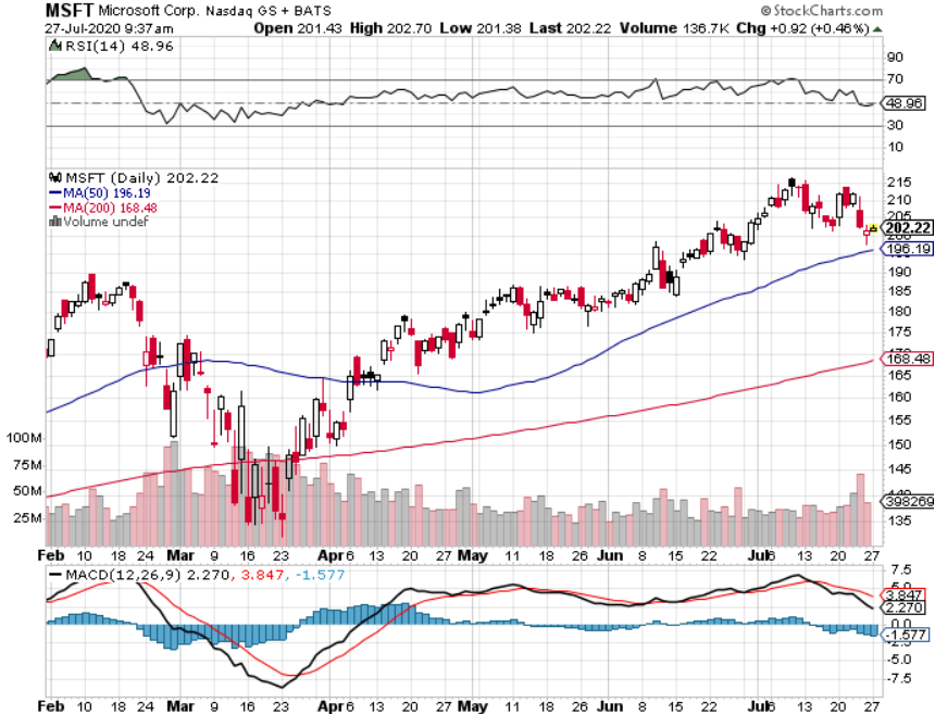
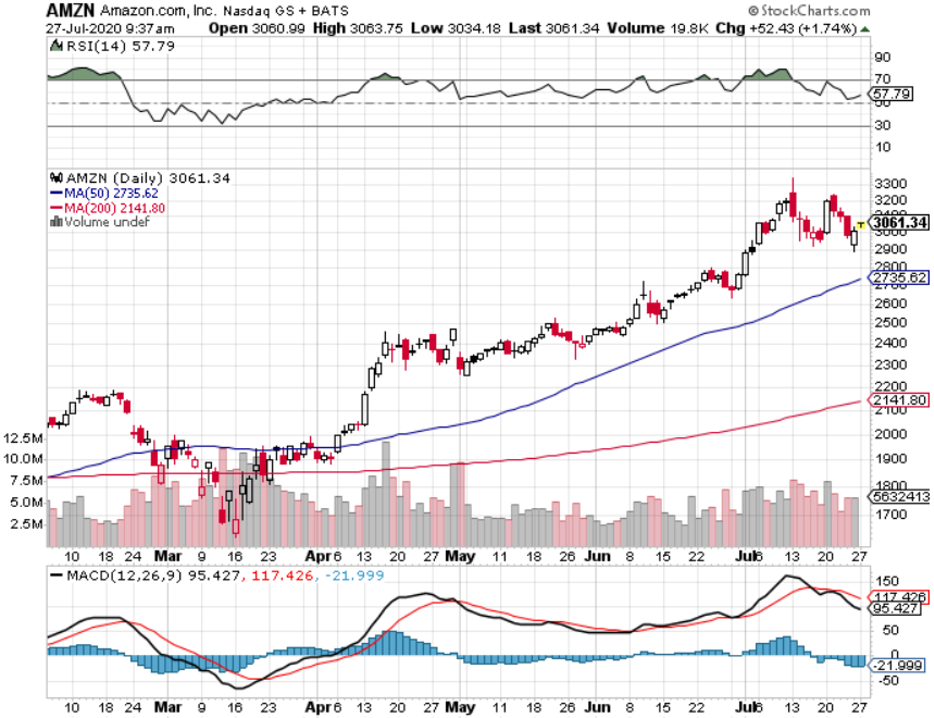
The five largest stocks in the S&P 500, Microsoft (MSFT), Amazon (AMZN), Apple (AAPL), Google (GOOGL), and Facebook (FB) have accrued a combined valuation that surpasses the valuations of the stocks at the bottom 350 of the index.
This means that if you weren’t in tech the past few years, chances are that your portfolio significantly underperformed the broader market.
Even in August 2018, many active managers could have thrown in the towel and said the late economic cycle was way too frothy for their taste and time to take profits.
Little did they know that betting against the best growth industry in the last 2 generations would equate to self-firing themselves, because to replicate the same type of performance would have meant staying in tech through the coronavirus scare.
Many in the trading community would even go as far as to say to wait for the bear market, then big tech would get hammered first and deepest because of their lofty valuations.
These tech companies were in for a rude awakening and shares had to consolidate, right?
Well, anyone who doesn’t live under a rock is seeing the exact opposite play out with Amazon, Microsoft, and Apple valued above $1 trillion and still soaring as we speak.
This goes to show that betting against something because they are “too expensive” or “too cheap” is a fool’s game.
Just take oil for instance, that many retail investors bought because they came to the conclusion that oil could never go below zero.
Then playing oil through an ETF with massive contango meant that the index is likely to go down even if the price of oil is up.
Not only do investors bear insanely high risk in these trading vehicles, but also a systemic risk of oil ETFs blowing up.
Oil is cheap, and it can get cheaper, while tech is expensive and can get a lot more expensive.
Until there are structural changes, there is no point to bet on a sudden reversal out of thin air.
The “reversion to the mean” trade can blow up in your face if used irresponsibly.
Betting against things that an individual perceives as unsustainable and secretly hoping that they cannot continue to go on is probably the worst strategy that I have ever heard of in my life.
The reality is that these things are sustainable, and tech shares will keep moving higher uninterrupted until they don’t.
"Until they don’t" would mean meaningful structural damage to big tech’s business model, which I do not see one iota in today’s business climate.
In fact, these companies just keep going from strength to strength.
Active managers are the ones who set market prices and they help the momentum accelerate in tech with full knowledge that if they miss out, there is likely no other solution to hit yearend targets.
What active manager doesn’t want their year-end bonus?
Even analyze the value investors who, in a normal world, would not even consider tech companies because they avoid the traditional “growth” profile.
Funnily enough, these “value” investors have Microsoft in their portfolios now, even though it is not close to a value stock.
So what has Microsoft accomplished recently?
CEO of Microsoft Satya Nadella has rebuilt a company Microsoft that is now equal in value to The Financial Times Stock Exchange 100 Index, the share index of the 100 companies listed on the London Stock Exchange with the highest market capitalization.
That’s right, one American company is just as valuable as the top 100 public companies in England.
Even more hilarious, Jeff Bezos’s wealth is greater than the entire European country of Hungary.
Yes, the one south of Poland that serves goulash as the national cuisine.
An even broader view of tech would give us an even more stunning snapshot of the success showing that the Top 5 tech stocks are now worth more than the entire developed stock market outside the U.S. such as Europe, Canada, Japan, Hong Kong combined.
Then take into consideration that these companies are on the cusp of penetrating high margin industries like medicine and healthcare which will translate into another golden decade of accelerating revenue and elevated profits relative to the rest of the S&P index.
The U.S. is a place where unfettered capitalism is promoted and implemented, and tech’s outperformance manifests itself by pouncing on the winner-takes-all mentality.
Americans like winners and the rules are no different in corporate America.
These 5 tech names have contributed over 20% of the gains in the past month and until they falter, there will be no tech sell-off.

"We are unicorn hunters." - Said Founder and CEO of SoftBank’s Masayoshi Son

Mad Hedge Technology Letter
July 24, 2020
Fiat Lux
Featured Trade:
(IS ESTONIA YOUR OFFICE?)

Digital nomads are frequently typecast as tech-savvy Millennials remotely working via an Internet connection while living as an expatriate.
However, they come in all shapes and sizes.
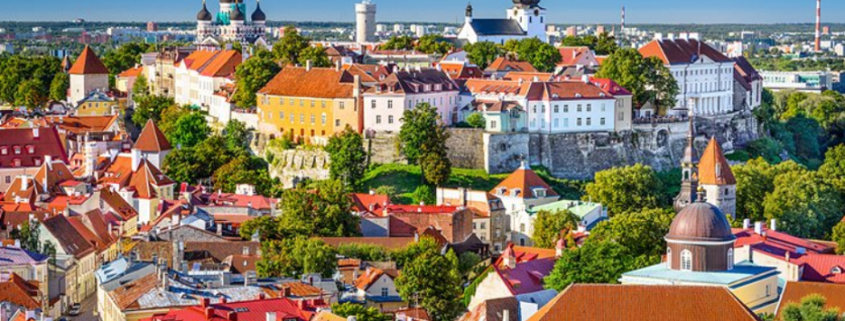
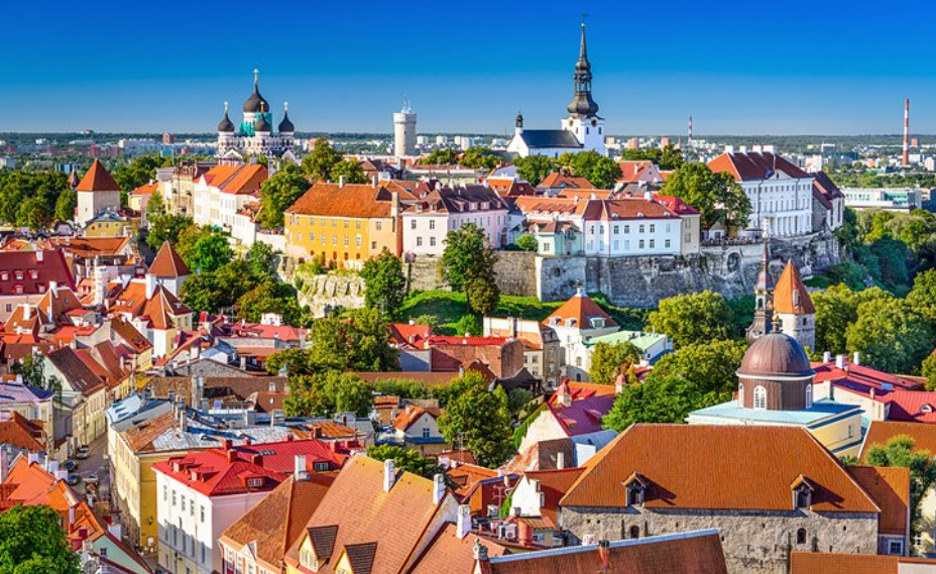
The charming Baltic country of Estonia is offering a visa targeted at Non-EU passport holder digital nomads, and other countries will likely copy this progressive type of visa.
Estonia’s revolutionary visa allows digital nomads to work in Estonia all year round.
This visa also includes 90 days of travel in the Schengen Zone of mainland Europe which could be a vital negotiating point in a new era of closed borders and stringent immigration policies.
U.S. citizens are currently banned from entering Europe with no end in sight, thanks to the pitiful handling of the unfortunate health crisis.
This visa origination stems from the Central and Eastern European countries losing their educated youth as they book it out of Latvia, Lithuania, Hungary, and Poland as soon as they first realize that salaries are orders of magnitude higher in Germany.
Estonia has no choice but to pull from Non-EU countries.
More importantly, jacking up the volume of tech workers is becoming an existential issue for many sovereign countries as developed countries reap the monetary rewards from such new cutting-edge technology.
The Baltic nation of Estonia was an architect of tech innovation in the past, rolling out Skype before Facebook and Twitter even existed.
Skype is now owned by Microsoft who acquired them for $8.5 billion in 2011 which is peanuts compared to today’s market valuation.
Skype was entirely comprised of local Estonian developers who achieved this in the early 2000s.
Quite a feat for such a small population.
These digital nomads create communities that harness an enormous flow of tech know-how.
Tallinn, Estonia has erupted into a top 10 digital stronghold attracting hordes of digital nomads.
If technical issues arise, help is on the way!
The message is that simple.
Estonia does not care if you drink kombucha lattes or if you eat green tea ice cream.
Their main concern is if you know how to use a computer well or not - plain and simple.
The global tech talent shortage is a leading issue in many megacities, and this is just the beginning of a world led by digital nomads.
Although the recent wave of Silicon Valley layoffs has offered some slack to the labor market, the onus is on Estonia to convince tech talent to relocate to Tallinn.
The world has moved on from outdated visa policies and Estonia understands it needs to evolve to survive.
Expect more exotic residence visas targeting immigrants who bring value-added computer skills in topics such as machine learning, software engineering, and fintech.
The Estonian government has been bold and is, in some ways, acting with a start-up mentality itself.
This young, audacious government looks to scale up as fast as possible. The visionary policy is seen as the solution to maneuvering around long-lasting social problems.
These pro-growth tech policies could invigorate local youth offering them a lifeline in their own country.
Rebranding itself as the digital nomad epicenter is a risky move that most governments wouldn't dare to do.
It's easy to ignore the brain drain in the Baltics while I am based in the Bay Area.
Silicon Valley has been drawing in the Rolls Royce of tech talent from Estonia for generations.
One of our IT guys is from Estonia himself so I can vouch for the quality there.
How can diminutive Estonia engineer tech growth?
They must learn how to crawl before they can walk.
If this visa experiment gains momentum, it could be a game-changer while nudging the Baltics closer into the developed West’s orbit of influence, reinvigorating the local birth rate, and spurring a rise in income levels.
A win-win situation, but easier said than done.
As for me, I won't be taking a Wizz Air flight to Estonia to work in a coffee shop anytime soon.
I prefer Incline Village, Nevada, and Zermatt, Switzerland, as my go-to digital nomad hideouts.
If it's not broke, don't fix it.
"We are unicorn hunters." - Said Founder and CEO of SoftBank’s Masayoshi Son
Mad Hedge Technology Letter
July 22, 2020
Fiat Lux
Featured Trade:
(THE FUTURE IS HERE)
(USHIO)

Transistor capacity has always put the kibosh on semiconductor chip performance.
Chipmakers have for decades drained investment into a revolutionary Japanese technique to stretch the limits of physics and cram more transistors onto pieces of silicon.
A secretive Japanese company that mastered the skill of manipulating light for applications is about to go mainstream with cutting edge technology.
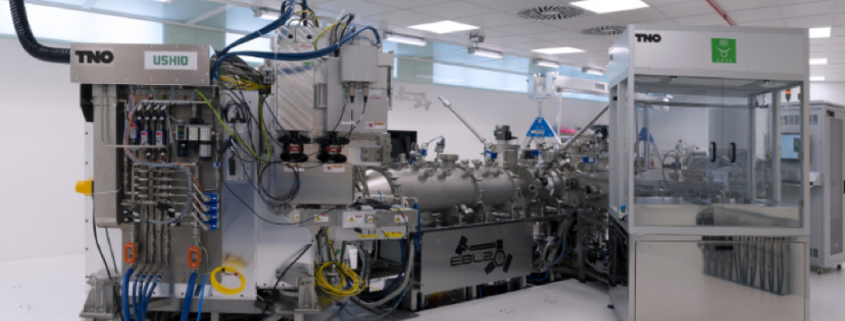
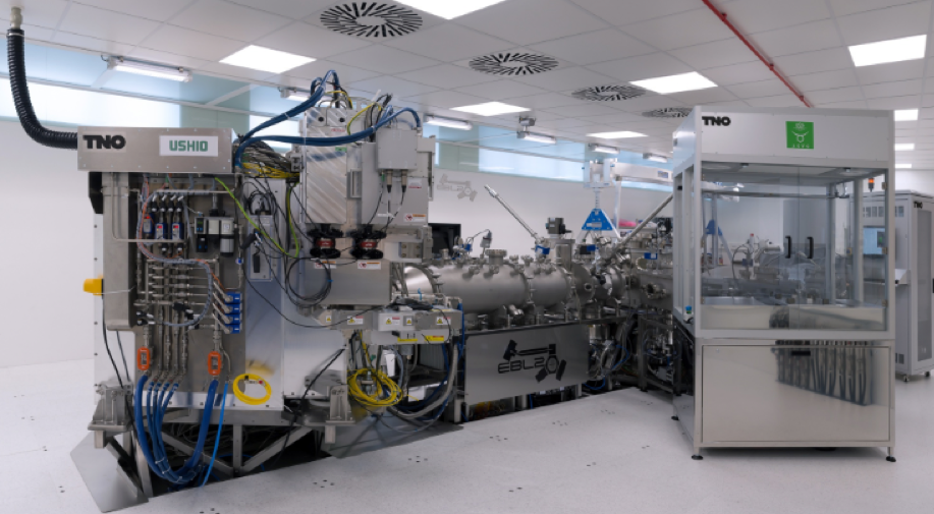
Ushio Inc. achieved the once thought impossible task of refining powerful, ultra-precise lights needed to test chip designs based on extreme ultraviolet lithography (EUV), a process through which the next generation of semiconductors will be made.
The milestone means that the Japanese company will become a prominent player in future chipmaking and the technology that harnesses it.
“The infrastructure is now mostly ready,” said CEO Koji Naito in an interview.
Testing equipment was primarily holding back extreme ultraviolet lithography (EUV), but with that hold-up dealt with, production efficiency and yields can finally go up setting the stage for electronic manufacturers with the possibilities of producing substantially better consumer products.
The Tokyo-based company developed a light source for equipment used to test what are known as masks: glass squares slightly bigger than a CD case that act as a stencil for chip designs. These templates must be picture-perfect, even an iota of error in one of them can render every chip in a large batch unfit.
That’s where Ushio seamlessly slots in.
Its technology operates lasers to vaporize liquid tin into plasma and produce light closer in wavelength to X-rays than the spectrum visible to the human eye.
That light aids chipmakers in detecting errors in the product.
This process takes a room-sized machine that looks like a sci-fi death ray and requires a phalanx of workers to operate.
After 15 years of industrious development, the EUV business will generate profits next year.
Only Intel Corp. (INTC), Samsung Electronics Co., and Taiwan Semiconductor Manufacturing Co. (TSM) desire to go smaller than the 7-nanometer processes that are the current status quo of central processing unit (CPU) design.
The focus on niche areas and creating things that others can’t is set to pay dividends for Ushio.
Ushio is poised to seize control of the market for light sources used in the testing of patterned EUV masks, there are several boutique tech companies in the Tokyo area that are incessantly focused on high-precision manufacturing.
Ushio dominates lithography lamps used to make liquid crystal displays with 80% market share and controls 95% of the supply of excimer lamps used in silicon wafer cleaning.
Their secret sauce is balancing mass production with craftsmanship.
Materials like quartz glass are arduous to work with and possess peculiar thermal expansion properties from metals like the molybdenum in which they are housed.
I know this stuff seems like out of the realm of science fiction, but Japanese-specialized firms have always been at the vanguard of the semiconductor technology and that is still the same today.
Ushio was established in 1964, and it was the first Japanese company to develop and produce halogen lamps.
Starting from 1973, fishermen used its lights to catch squid in Tokyo Bay.
The firm has succeeded in more than tripling its sales over the past 25 years.
The company is now venturing into the use of sodium lamps to nurture plants and using ultraviolet light calibrated to such a precise wavelength to kill bacteria without damaging human skin.

“If you can't make it good, at least make it look good.” – Said Founder of Microsoft Bill Gates

Mad Hedge Technology Letter
July 20, 2020
Fiat Lux
Featured Trade:
(THE RACE TO THE BOTTOM),
(SCHW), (FB), (SQ), (WMT), (AMZN), (FFIDX), (BOX)