
Mad Hedge Technology Letter
April 6, 2020
Fiat Lux
Featured Trade:
(AVOID THE GIG ECONOMY LIKE THE PLAGUE)
(UBER), (LYFT), (UPWK)


Mad Hedge Technology Letter
April 6, 2020
Fiat Lux
Featured Trade:
(AVOID THE GIG ECONOMY LIKE THE PLAGUE)
(UBER), (LYFT), (UPWK)
I assume many believe that stock-picking is the path to riches, and the post-coronavirus environment will eventually appear to offer investors new opportunities.
It’s also important for investors to avoid the rotten parts of the tech market.
The gig economy could enter the post-health crisis tech economy as huge losers, as already weak business models must absorb even more pressure.
Let me remind you that this pocket of the economy is not the gold standard of Silicon Valley and exists primarily because of the never-ending capital that propped up many poor business models.
Well, that funding is gone in this new world.
The health scare has already crushed the 2020 IPO market and the newly public companies are next in the crosshairs whom many are nothing more than labor arbitrage companies masquerading as real tech companies.
Examples such as Uber (UBER) and Lyft (LYFT) are predatory in behavior, feasting off contractors who do not have a unified voice.
An investor wouldn’t be wrong to say these are nothing more than glorified taxi companies utilizing a functioning app.
The gig economy effectively matches the digital workforce with a suitable “tech” company, but they do not deliver anything else of value.
These types of “broker” services can be eliminated quickly if tech companies choose to hire gig workers directly.
Even tech companies that only hire gig workers do it themselves - ask Uber drivers how easy it is to start working for them.
I reference Uber because they were responsible for 58% of gig worker payouts reaching $204 billion in 2018.
Payout volume is expected to double by 2023, but that was until the worst economic recession since the Great Depression of 1929 hit U.S. shores.
Let’s quickly analyze a weak gig economy company that wasn’t doing great before the health scare called Upwork.
Upwork (UPWK), formerly Elance-oDesk, is a global freelancing platform where businesses and independent professionals connect and collaborate remotely.
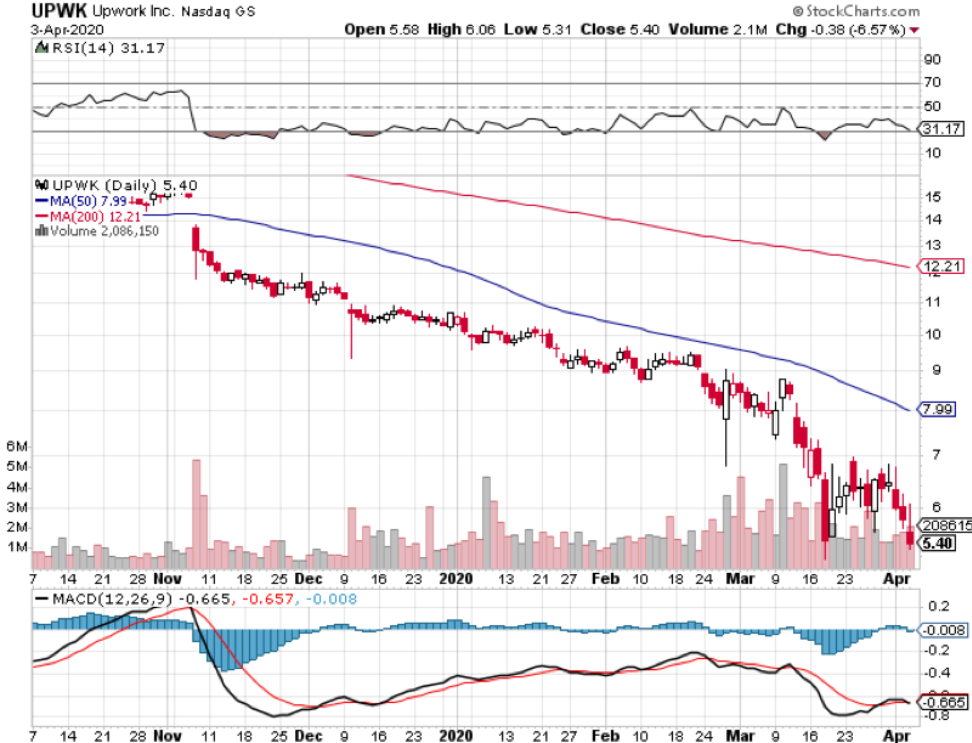
Upwork’s life as a public company has only seen the share price decline -hitting a high of $24 per share in February 2019 and currently sitting at $5 today.
Why have shares declined precipitously since going public?
Wasn’t the gig economy working miracles and was a slice of life I needed to become a part of?
Even as the freelance employee hiring platform grew revenue 19% in 2019, shares have tumbled nearly 75% from their all-time high.
Granted, the market needed to reexamine the business based on current expectations, and yes, the coronavirus market sell-off hasn't helped matters.
Economic activity is about to nosedive, many businesses have already begun to cut spending and reduce staff.
The swiftest way of reducing expenditures is by eliminating business contractors or non-employee workers that get hired on a freelance basis from Upwork.
Upwork receives a commission by liaising workers with tech companies and that business is sure to be severely damaged.
Since Upwork went public, the company increased sales and marketing spend by more than 31% in 2019 to promote growth because the company is simply not relevant.
Making the story even worse, the general and administrative costs also grew 36% year over year.
Upwork's revenue is not rising at the same type of rate that justifies higher administrative and marketing spend.
This business model simply never worked and now that a monstrous recession has hit, imagine how terrible future prospects look now.
The only silver lining is that industry will migrate to digital spaces quicker but that in no way guarantees that Upwork will harvest the benefits from this massive migration.
Work-from-home just got a massive shot in the arm, and many organizations are suddenly scrambling to invest in the ability to allow employees to work remotely and could a possible use case enrich Upwork?
But why can’t these same companies hire directly?
Nobody really knows Upwork anyway and since the shortage of jobs will become acute, directly communicating about possible jobs could harvest more than enough qualified candidates without the help of unknown Upwork.
Another imminent problem is the balance sheet.
Upwork had $133.9 million in cash, equivalents, and short-term investments on its balance sheet at the end of 2019, but if that is frittered away, is this company attractive enough to receive another round of funding?
I would say probably not and if yes, only on disadvantageous debt terms.
This firm is merely treading water before it gets shot out of its misery.
Upwork overspends and under delivers; a toxic combination and that was its performance in a period of favorable economic times.
What about other gig economy firms?
There is not one I like, again, they overspend and underdeliver with illogical revenue acquisition costs, but the silver lining for Uber and Lyft is that everyone knows who they are so they will be able to survive on poor unit economics for a while until they cannot.
Time is money and the risk of not getting torpedoed in one second is valuable in the current climate as revenues have gone to 0% for hotels and bars.
These glorified taxi companies have one ace up their sleeve and that is pushing the self-driving service revolution because that is their get-out-of-jail free card.
Upwork doesn’t have that luxury as they will look to survive now before their stock becomes a zero with a brand name that doesn’t resonate with investors.
Avoid the stock of all companies that are tied to the gig economy.


“Our goal was never to create a better taxi.” – Said CEO of Lyft Logan Green

Mad Hedge Technology Letter
April 3, 2020
Fiat Lux
Featured Trade:
(THE MUST-HAVE APPS FOR NEW HOME WORKERS)

Here are a few hacks as millions enter the new world of digital nomadism – home as an office is now a sink-or-swim proposition.
I can tell you that after the 6.6 million unemployment claim number dropped like a bomb, many more people will be forced to get trained up as aspiring remote workers.
Sure, groceries stores are still hiring, but the health scare will funnel many future workers to stay in the confines and cleanliness of their own homes to generate income.
Another lasting effect will be supercharging the digital economy by forcing both supply and demand onto the internet.
Think about how much the cloud has helped us already and now the industry has developed to the point where digital nomads are using these services to underpin their daily operations.
First, I will make a few assumptions such as businesses have already discovered certain “can’t miss” services such as Microsoft Teams Office 365 that delivers us the beauty of Microsoft Word, Excel, PowerPoint.
G Suite’s array of highly powered instruments are another assumption I will imbed into this discussion as most people have integrated them into their lives.
These tools consist of Google Docs, a cloud-based Microsoft Word alternative; Google Sheets, a cloud-based Microsoft Excel alternative; Google Slides, a cloud-based Microsoft PowerPoint alternative; and Google Drive, a cloud storage app.
Google Docs and Google Drive are particularly useful collaboration software for remote teams who need storage and teamwork rolled into once set of services.
Many businesses are reliant on Facebook to sell their physical products, therefore, taking advantage of a News Feed Eradicator for Facebook will come in handy.
After the Facebook’s login, users are thrown into the insane vortex of streaming jargon that is now Facebook’s news feed and hours can be wasted for months on end.
Sure, it’s nice to catch up with a high school girlfriend, but that won’t generate outperformance.
Klokki for Mac is an automatic time-tracking app that will boost productivity by maximizing the thing we never have enough of - time.
With its ability to create custom tracking rules, you will be able to track time by automating this process.
Besides the Auto-Tracking technology, Klokki delivers the power of a massive tool packed in one small and beautiful Mac app that lives and breathes on your menu bar.
Also, these functions can be useful for upper management who can track employees who are now all working at home.
It’s not a secret that this migration to 100% digital work from home doesn’t sit well with many managers who thrive by micromanaging, this software puts the control back into the managers’ hands.
1Password is a name that's representative of password managers. It's been around since 2006, offering support for a growing list of devices.
Right now, you can access your 1Password and the software will store and fill your passwords.
Even for a company of 10 people, management will not want crucial passwords floating around gifting hackers an easy way into their fortress who then might destroy the inner workings of a business.
vidIQ is a robust tool for the creative companies out there since many media products have offshored onto YouTube to leverage uploading free videos to a monetizable audience.
Of course, Adobe photoshop is great for those who actually need to create the media content, but with the vidIQ Competitors Tool, you’ll get a unique peek behind the curtain at what your competitors are doing to rank highly and attract those golden views and subscribers.
That’s the beauty of data analytics and this hack will enable you to measure up your rivals.
You’ll be able to instantly track the video creators who are important to your channel, whether they are big influencers setting trends in your sub-sector, or channels delivering breakthrough content.
The Competitor Tool allows you to piggyback on the competition and leverage what they do right for your own YouTube strategy.
Weirdly enough, tracking others to keep tabs on the competition is important to understand the changing dynamics of the internet and sub-sectors in it.
And the best way to track your own keywords are by Google Alerts – if a news article trends with selected keywords then an email it sent with direct links to the relevant article.
Email Hunter is another app that is self-explanatory.
If you cannot find someone’s email, then plug in the name and this app will scrape the internet to find public places that could retrieve this information.
In a digital world where email is the best way to get to know a customer, this app is a diamond in the rough.
Since every company is now turning into a media company, cloud storage and ample space is needed to import and export big media files.
Services that are reliable are Dropbox, Box, Google Drive and many others.
Slack is a potent app that is email on steroids and is more widely used than ever. Another alternative is Microsoft Teams that has also been easily integrated into its set of products.
Lastly, video conferencing apps are the closest service that can provide a meeting to hash out those hard-to-quantify issues.
A company can almost not function if it doesn’t have Zoom and at the end of December last year, the maximum number of daily meetings conducted on Zoom was approximately 10 million, according to the company. In March this year, they recorded more than 200 million daily users.
Zoom is now ranked as the number two app in the UK and number one in the US, after its surge in popularity.
With these optimal apps supporting remote business, many will be able to survive this deep recession and even up-skill themselves and enjoy a fruitful recovery as they work from home.

“I'd rather Apple cannibalize Apple than somebody else cannibalize Apple.” – Said CEO of Apple Tim Cook

Mad Hedge Technology Letter
April 1, 2020
Fiat Lux
Featured Trade:
(BROKEN GLOBAL SUPPLY CHAINS AND YOUR PORTFOLIO)
($COMPQ)

The sushi has hit the fan – supply chains are broken.
Let’s gaze East to the inner workings of the tech world and it is clear that the supply chain has been under pressure since the onset of the trade war but the coronavirus is now making operations untenable.
China was the first to lockdown, but now the rest of Asia has followed suit smothering the rest of the region which is economic suicide.
Feeling out the situation, I picked up the blower to get a better understanding of what was going on in the center of the tech manufacturing world and the outlook appears bleak.
The electronic manufacturing sector in South East Asia is hit hardest by the coronavirus as many of the test equipment and chip producers face an imminent drastic shortage of raw materials, an unprecedented situation that has disrupted production.
One manager whose company produces 5G radio frequency (RF) chips have bottlenecked due to the disruption in the supply chain.
They use raw materials from the United States but also import from China and although they have 85% of materials to make the RF chips, they still have to put operations on ice because the suppliers in China can’t ship the essential 15% of material needed to complete manufacturing.
This batch of shipments is supposed to be the largest quantity of 5G chips from South East Asia in the first quarter and has now been officially delayed until logistic problems can be solved.
The company can still fulfill its quota for 3G and 4G RF chips, but it’s really hit or miss at this point.
And for manufacturing the older chips, they have sufficient stock of raw materials lasting three to four months, and by then they hope to solve the logistic headwinds from China.
In general, if the virus coerces South East Asian societies to shutdown their economy for another 5 months, the entire Southeast Asian electronic manufacturing sector will be decimated as bills and debt payments come due.
In fact, a current shortage of components is forcing prices to surge 10%-20% for active and passive electronic components.
Another prominent manufacturer who produces about 30% of the RF chips for the worldwide market told me that this is the “biggest disaster to ever hit the local electronic manufacturing sector.”
He continued to say that his supply chain has been hit between “30%-40%.”
About 50% of their raw materials come from Japan, and the rest from the United States and China, and because of an ensuing lockdown in Japan, shipment delays will happen for customers in Singapore, China, and the United States.
To make matters worse, testing engineers cannot travel abroad to install test equipment for customers because of international border closures.
This manufacturer projected revenue annual growth of -5% after initially forecasting for +10% in January.
Another executive at a semiconductor test equipment company told me that he fully expects sales to dissipate by 15% in the first quarter compared to last year.
Customers around the world, not only in the U.S., are delaying orders because they aren’t sure whether there will be new equipment to test because of the delay in the production and shipment of electronic components manufactured in China.
The executive sees a turnaround in June if shipping lanes and borders open, which is still a big IF.
How does this affect the end electronic device market like your iPhone or Amazon Echo?
Smartphone manufacturers need to come out with new products by mid-2020 to sneak in that yearly iteration before that window shuts and that timeline will certainly be pushed back.
Building a smartphone is usually done on a razor-tight deadline, but this puts off anything until they can finally get their hands on the parts needed to build out the phone.
If you think the 3rd quarter would be the time that these new phones could hit the market, then think again. It is likely that the coronavirus domino effect will force smartphone makers to sell these devices next year instead of pushing back a whole refresh cycle of revenue.
Apple is coming to the same conclusion with their 5G phone as well.
The tech world is dangerously close to missing one full year of refresh products and the scarring effects could last much longer.
Then there is the issue of demand and the lack of it moving forward for these products.
We must ask ourselves how scarred are tech consumers?
How scarred are tech companies?
What regulations should shape how businesses should be working as we enter into a new tech world and U.S. economy?
The first order of the day after the coronavirus passes is businesses and consumers will need to restock cash reserves for a rainy day.
The first reaction we will see are small tech companies decline quite dramatically in the second quarter because of the nature of high yields not being able to receive financing because of their low credit grades which could result in an initial barrage of defaults.
It will be just a small blip for the behemoth as they can take the financing if they truly need it and many don’t.
Tech balance sheets also need healing after this bout of craziness.
Not getting caught off guard will now be the new normal.
Even if tech dips into the $2 trillion relief package – it has a long-term cost associated with it that tech businesses must absorb.
How that impacts economic growth is tough to decipher now but it most likely will punish tech growth companies whose mantra is growth at any cost.
There will be a massive rebalancing and redefinition of what outperformance means because the government inherently will be playing an outsized role in our lives for years to come and what that means to lower tech profits and worsening stock multiples will play out in the tech markets.


“Technology is the knack of so arranging the world that we do not experience it.” – Said American existential psychologist Rollo May
Mad Hedge Technology Letter
March 30, 2020
Fiat Lux
Featured Trade:
(THE NEW CROWN JEWELS OF SOCIAL DISTANCING)
(DOCU), (SIRI), (ZNGA), (NOK), (AMZN), (WORK), (MSFT), (ZM)
