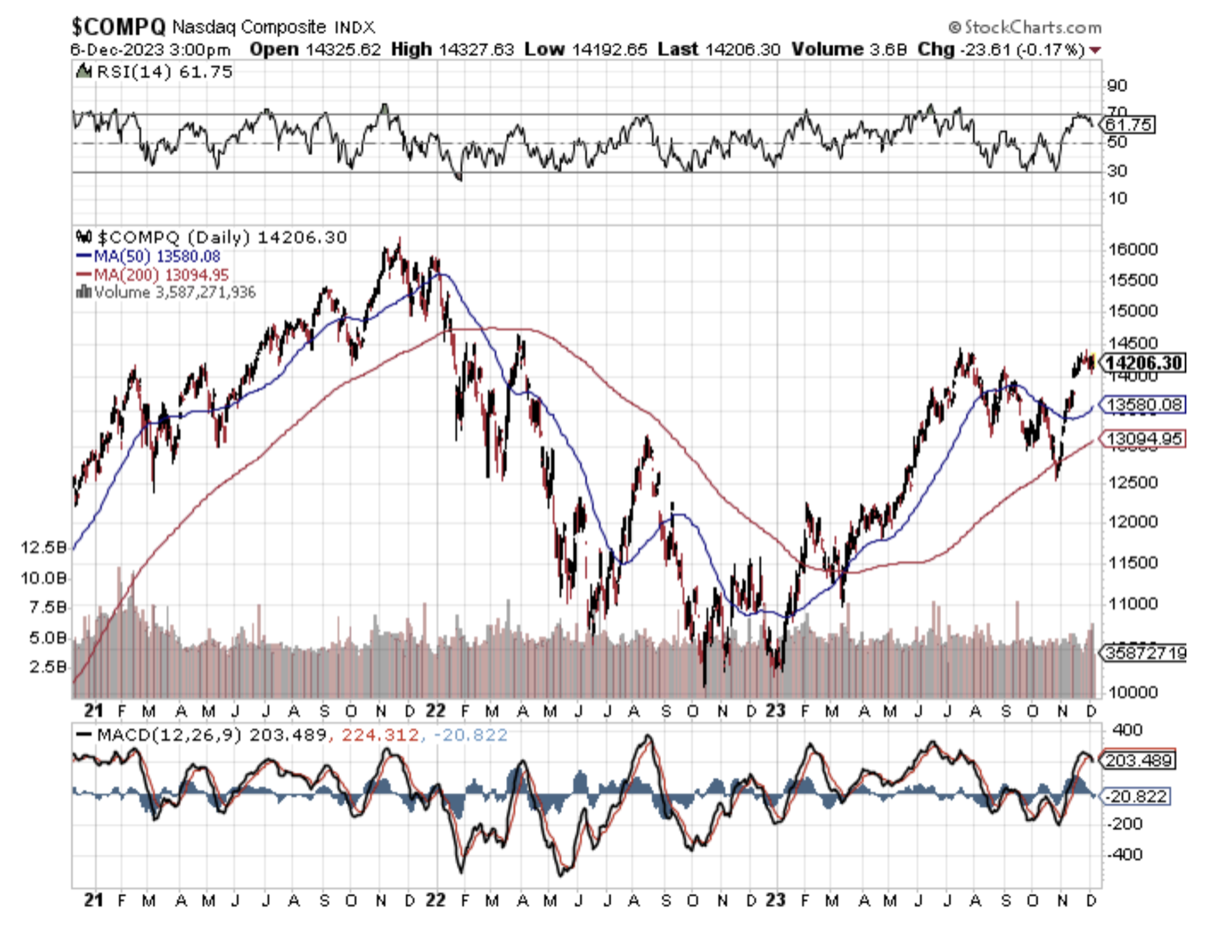
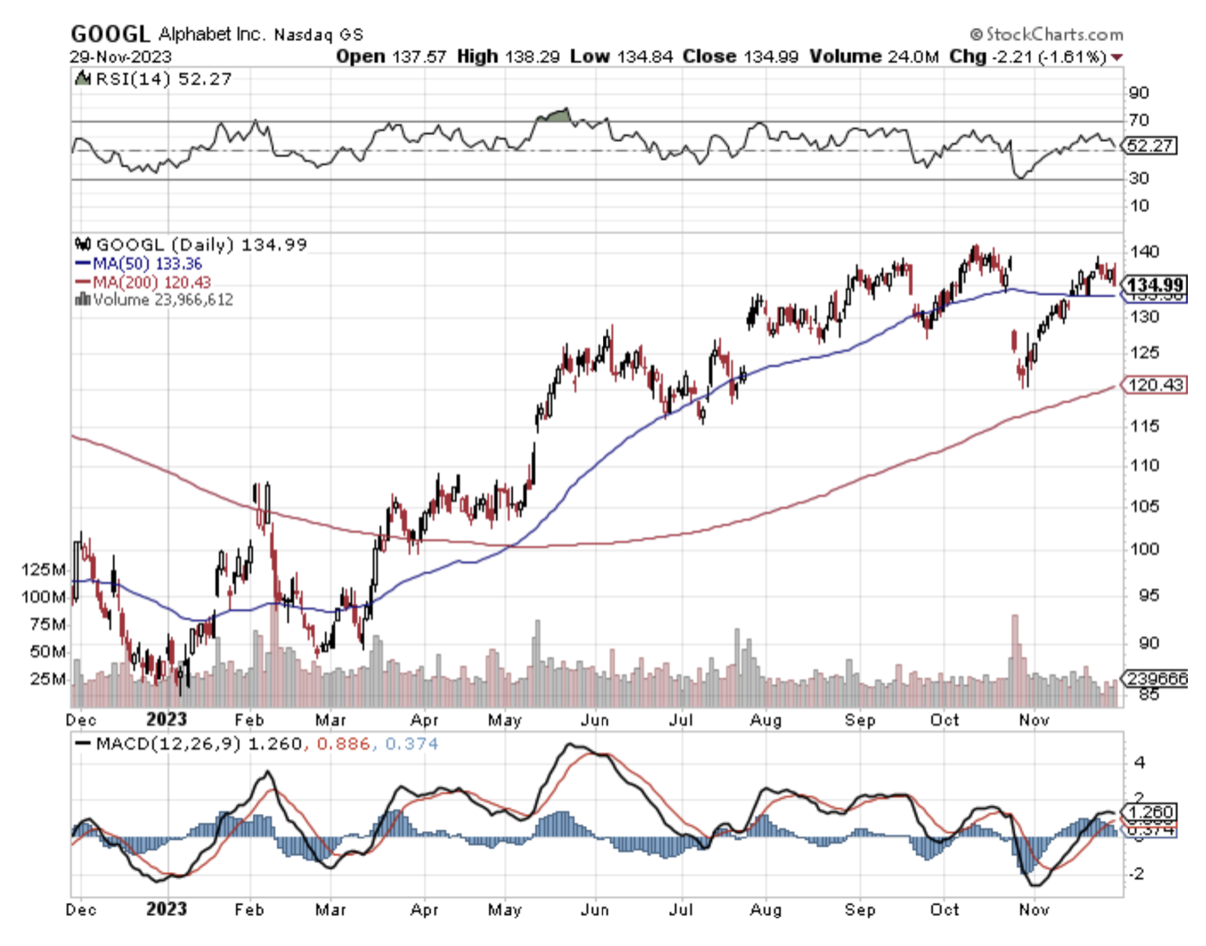
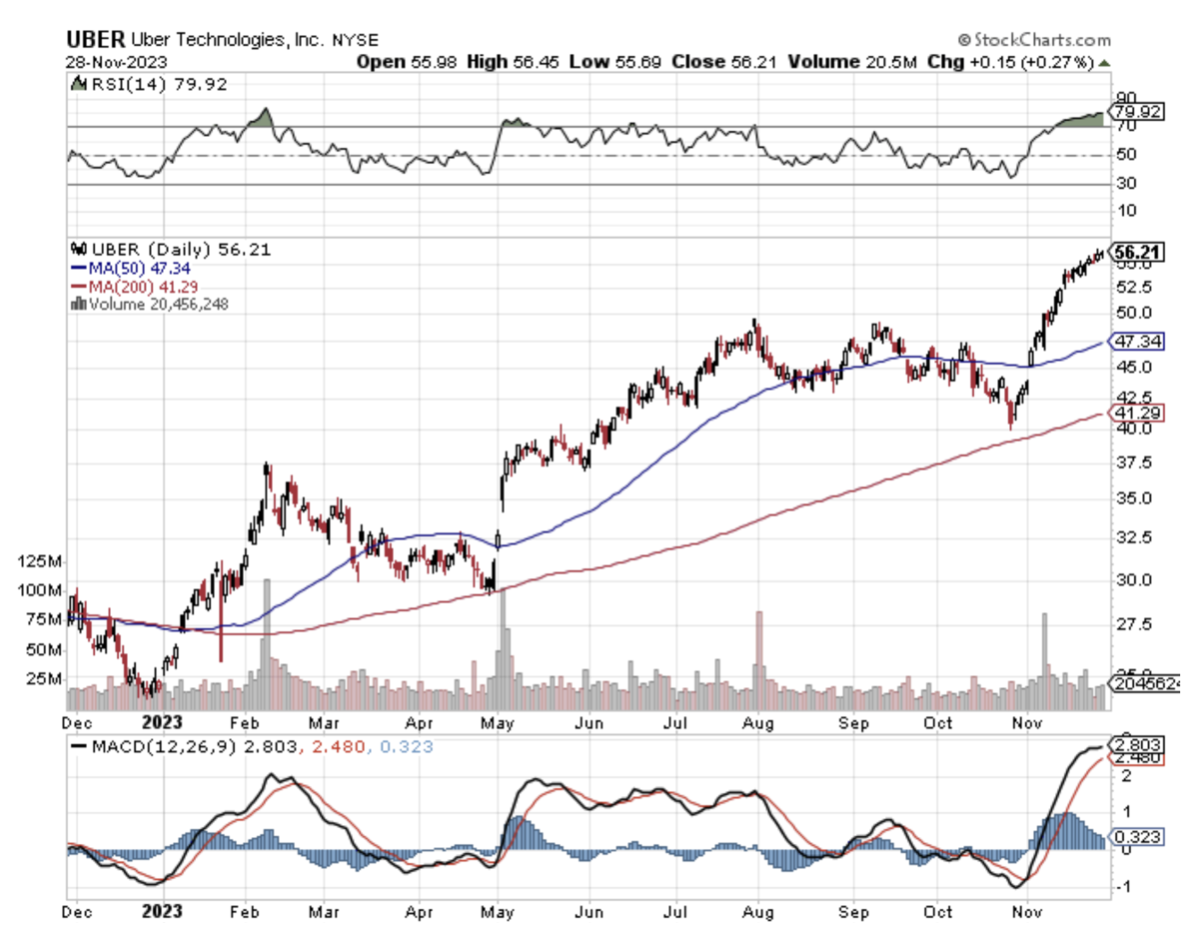
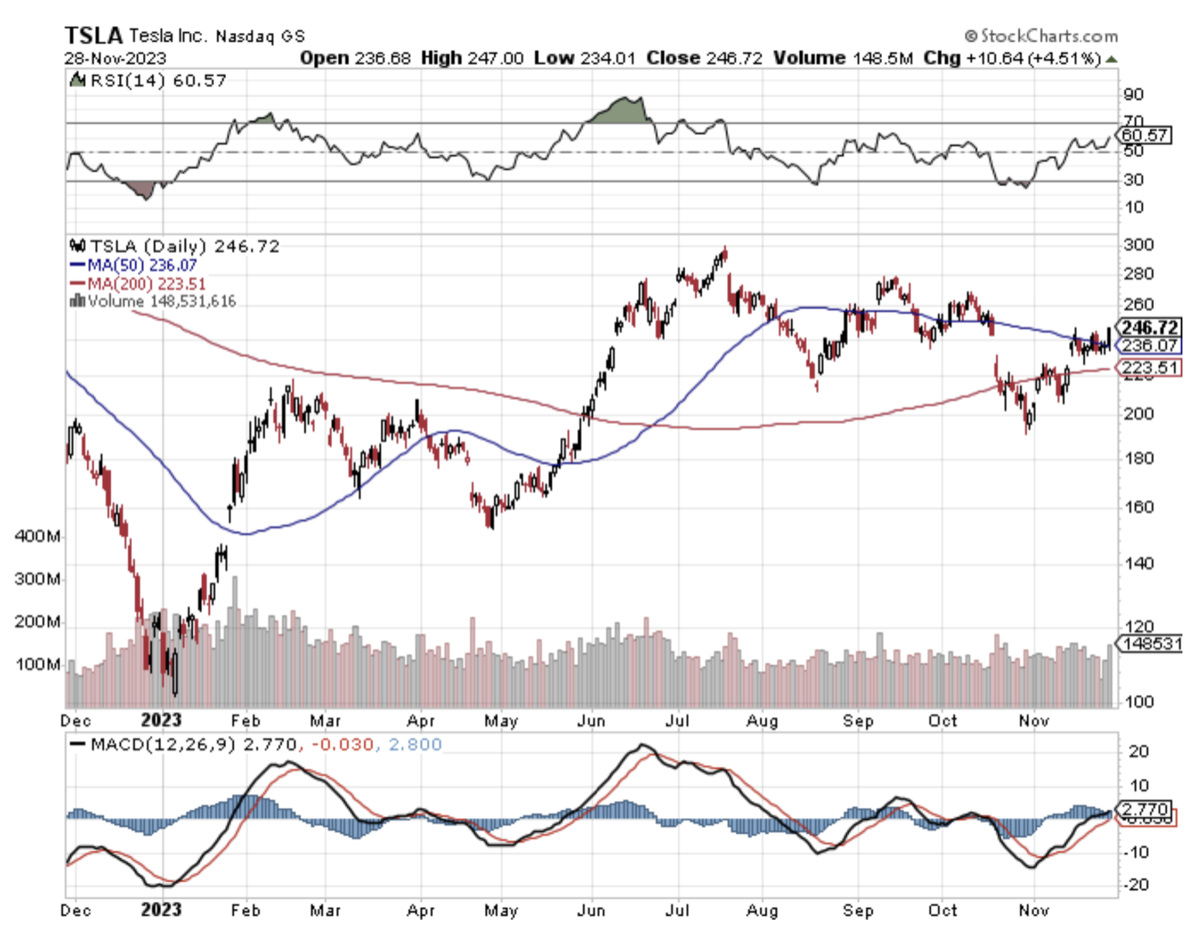
There have been a lot of whispers as to who the tech leadership group could be in 2024.
The notion that for the tech rally to continue, more participation is needed is unequivocally false.
A strong but narrow group of tech stocks coined the magnificent seven don’t need smaller stocks to help buoy the broader tech indices.
The law of large numbers also dictates price action meaning even if smaller stocks have the time of their life next year, they still won’t make a dent compared to the absurdly expensive tech stocks that are aiming at $4 trillion in market cap.
Therefore, I believe there is a high likelihood that these potent 7 stocks outperform the rest of tech yet again and I will explain why.
Faster growth rates and reasonable valuations bode well for mega-cap tech stocks.
The seven stocks I am talking about refer to Apple, Amazon, Alphabet, Meta, Microsoft, Tesla, and Nvidia, are responsible for 76% of the S&P 500's 2023 gain of nearly 20%.
Nvidia is up more than 200% year-to-date, and even Apple, the world's largest company, saw its stock price surge nearly 50% this year. The seven companies represent a collective $11.5 trillion in market value
The fundamentals are superior.
The seven mega-cap tech stocks have more attractive fundamentals when compared to the S&P 500's bottom 493 stocks.
They boast faster growth, higher profit margins, stronger balance sheets, and reasonable valuations on a relative basis.
And while price-to-earnings valuations are elevated for the tech stocks, when accounting for growth, they're actually in line with the rest of the market.
Mega-cap tech stocks cratered in 2022.
The sharp outperformance in the mega-cap tech stocks this year comes after a brutal 2022 in which a number of the stocks were severely punished because of the Fed hiking like they have never hiked before.
From their peak, Meta fell more than 70%, Nvidia dropped more than 60%, and Amazon's share price was cut in half in 2022.
The dominance of mega-cap tech in 2023 largely reflected a reversal of meaningful underperformance in 2022 so much so that the group of tech stocks fell a collective 39% that painful year.
The pullback was a healthy consolidation and psychologically, it feels like this bullish year means we are back to neutral.
There is a high chance that tech stocks rally on the belief that a recession will cause the Fed to drop interest rates.
Indicators are starting to look a little sluggish suggesting that earnings could come somewhat soft in the first quarter.
No doubt that the US consumer is stretched to its limit and thinking twice before spending.
The knock-on effect will be delayed iPhone purchases, delayed Tesla purchases and the other 5 of the Magnificent 7 could feel the slowdown as well.
Tech’s path to the recession could cause another rally into the recession when investors are likely to take profits when we finally arrive at the recession that every investor has been waiting for years.
In the meantime, there is a high likelihood that these 7 stocks will continue success in the short-term.
https://madhedgefundtrader.com/wp-content/uploads/2019/05/cropped-mad-hedge-logo-transparent-192x192_f9578834168ba24df3eb53916a12c882.png00april@madhedgefundtrader.comhttps://madhedgefundtrader.com/wp-content/uploads/2019/05/cropped-mad-hedge-logo-transparent-192x192_f9578834168ba24df3eb53916a12c882.pngapril@madhedgefundtrader.com2023-12-06 14:02:522023-12-06 16:32:14Positive Signs For 2024
“Honesty is a very expensive gift, Don't expect it from cheap people.” – Said American Investor Warren Buffett
https://madhedgefundtrader.com/wp-content/uploads/2019/05/cropped-mad-hedge-logo-transparent-192x192_f9578834168ba24df3eb53916a12c882.png00april@madhedgefundtrader.comhttps://madhedgefundtrader.com/wp-content/uploads/2019/05/cropped-mad-hedge-logo-transparent-192x192_f9578834168ba24df3eb53916a12c882.pngapril@madhedgefundtrader.com2023-12-06 14:00:572023-12-06 16:32:10December 6, 2023 - Quote of the Day
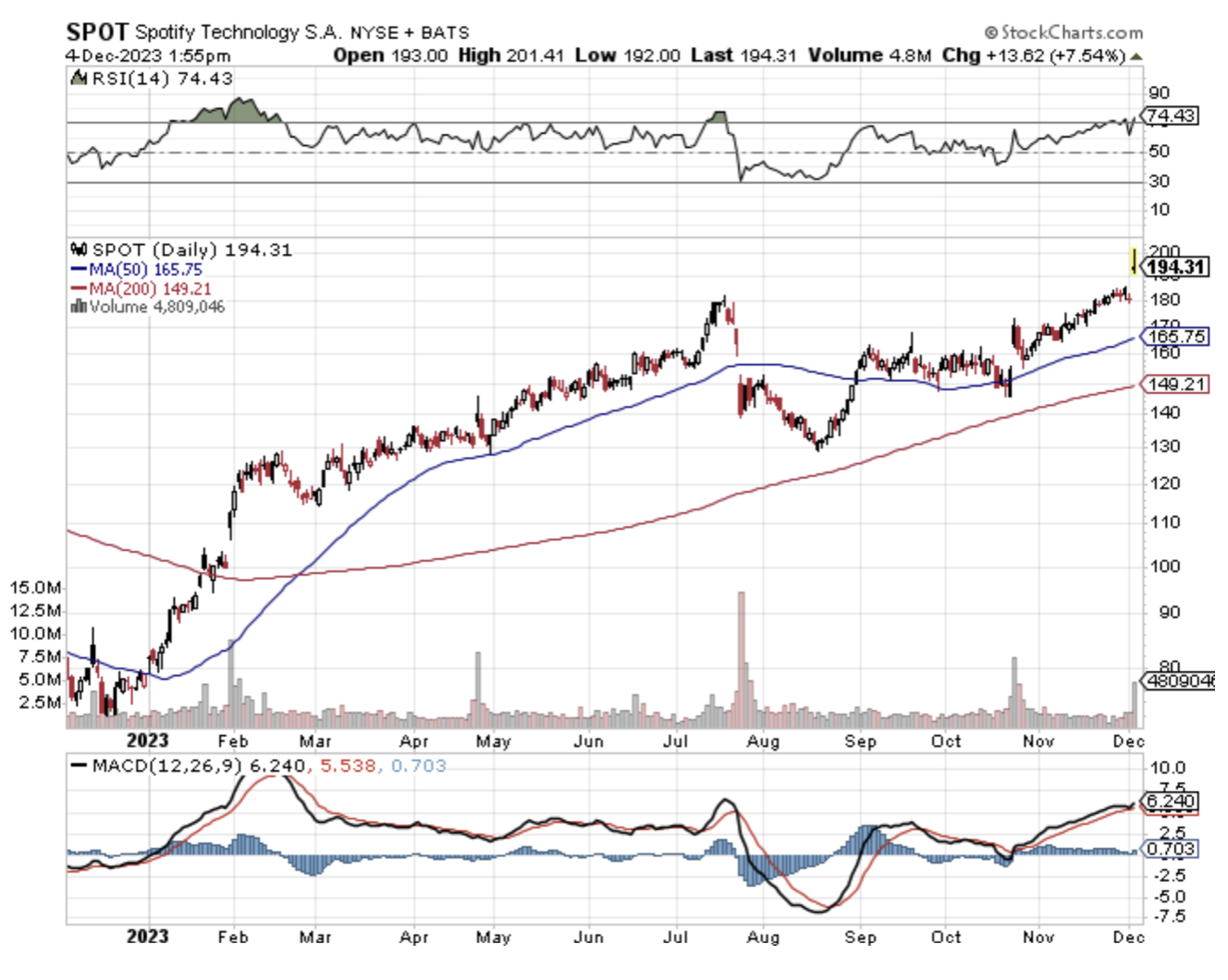
The music streaming service Spotify (SPOT) is living in the future and by that I mean they are cutting 17% of staff.
Silicon Valley will be a lot leaner in the future and this is just one of many firms that will shed to become more efficient.
The announcement was made today and is making shockwaves through the industry.
Many ponder what might be the catalyst to the next move up in the tech sector.
Well, look no further than Spotify which is delivering the playbook to squeeze out higher earnings at a time when tech earnings are exposed to potential downgrades.
It’s no joke that tech salaries are exorbitant and gutting the froth is the next stage of Silicon Valley.
Elon Musk delivered us a preview when he dumped 80% of Twitter’s staff realizing that most of his staff didn’t meaningfully contribute or justify what they earned.
Spotify is next to take a magnifying glass to its balance sheet as it hopes to appease shareholders as we head into a 2024 interest rate-cutting year.
It’s my guess that CEO Daniel Ek wants to get his show to benefit from that slingshot effect next year for Spotify shares.
In an email sent out to staff, Ek said that Spotify was taking “substantial action to rightsize our costs,” adding that the company took on too many employees over the years 2020 and 2021 when the capital was cheap and tech companies could invest significant sums into team expansion.
The latest round of cuts equates to roughly 1,500 jobs.
It comes after Spotify reported a 65 million euros ($70.7 million) profit in the third quarter, citing lower spending on marketing and personnel.
Spotify raised the prices of its subscription plans earlier this year and has been expanding into podcasts and audiobooks.
Spotify cut 6% of its workforce, or about 600 employees, at the start of the year. Spotify then laid off 2% of staff, equivalent to roughly 200 roles, in June.
This isn’t the first time they have shed staff and won’t be the last.
Europe has barreled straight into an economic recession and the macroeconomic backdrop has given a great reason for Ek to downsize.
With the way generative AI is going, I don’t believe any further staff cuts will be followed by a hiring bump, because AI will get the job done instead of humans.
Around 2021, we blasted through peak tech hiring and we will never see not only that type of volume hiring, but gone are the days of sweet salaries.
It’s a lot cheaper to plug in software and tech firms will continue to downsize even though economic growth waves come and go.
No economic growth wave in the future will prompt a massive uptick in fresh faces.
AI and its advancement of will effectively mean that Spotify will be run by a few people running servers, infrastructure, and algorithms.
Eventually, the entire tech sector will be run by a handful of people and software underpinning their investments and Ek of Spotify will be included in one of the handful in this exclusive group.
Buy SPOT on the dip.
https://madhedgefundtrader.com/wp-content/uploads/2019/05/cropped-mad-hedge-logo-transparent-192x192_f9578834168ba24df3eb53916a12c882.png00april@madhedgefundtrader.comhttps://madhedgefundtrader.com/wp-content/uploads/2019/05/cropped-mad-hedge-logo-transparent-192x192_f9578834168ba24df3eb53916a12c882.pngapril@madhedgefundtrader.com2023-12-04 14:02:292023-12-04 14:39:21Spotify Shows Us The Way
Dealing with the Cloud works, and for every relevant tech company, this division serves as the pipeline to the CEO position.
If this isn’t the case for a tech company, then there’s something egregiously wrong with them!
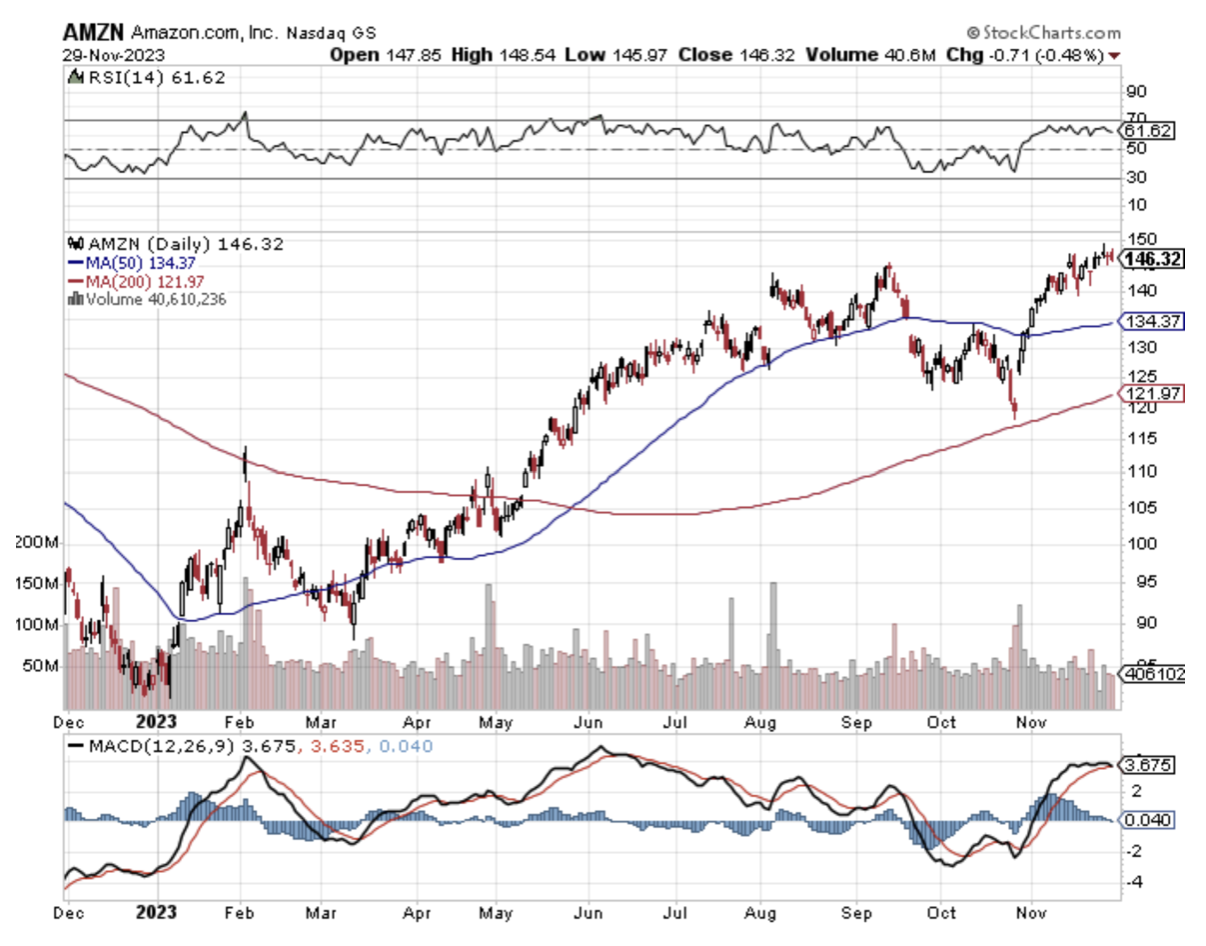
Take Andy Jassy, the mastermind behind Amazon’s (AMZN) lucrative cloud computing division and the man who succeeded company founder Jeff Bezos.
He was rewarded with this important position based on his performance in the cloud and faced the daunting proposition of following Bezos as CEO.
Bezos incorporated Amazon almost 30 years ago.
Jassy developed a highly profitable and market-leading business, Amazon Web Services, that runs data centers serving a wide range of corporate computing needs.
Cloud 101
If you've been living under a rock for the past few years, the cloud phenomenon hasn't passed you by and you still have time to cash in.
You want to hitch your wagon to cloud-based investments in any way, shape, or form.
Amazon leads the cloud industry it created.
It still maintains more than 30% of the cloud market. Microsoft would need to gain a lot of ground to even come close to this jewel of a business.
Amazon relies on AWS to underpin the rest of its businesses and that is why AWS contributes most of Amazon's total operating income.
Total revenue for just the AWS division would operate as a healthy stand-alone tech company if need be.
The future is about the cloud.
These days, the average investor probably hears about the cloud a dozen times a day.
If you work in Silicon Valley, you can quadruple that figure.
So, before we get deep into the weeds with this letter on cloud services, cloud fundamentals, cloud plays, and cloud Trade Alerts, let's get into the basics of what the cloud actually is.
Think of this as a cloud primer.
It's important to understand the cloud, both its strengths and limitations.
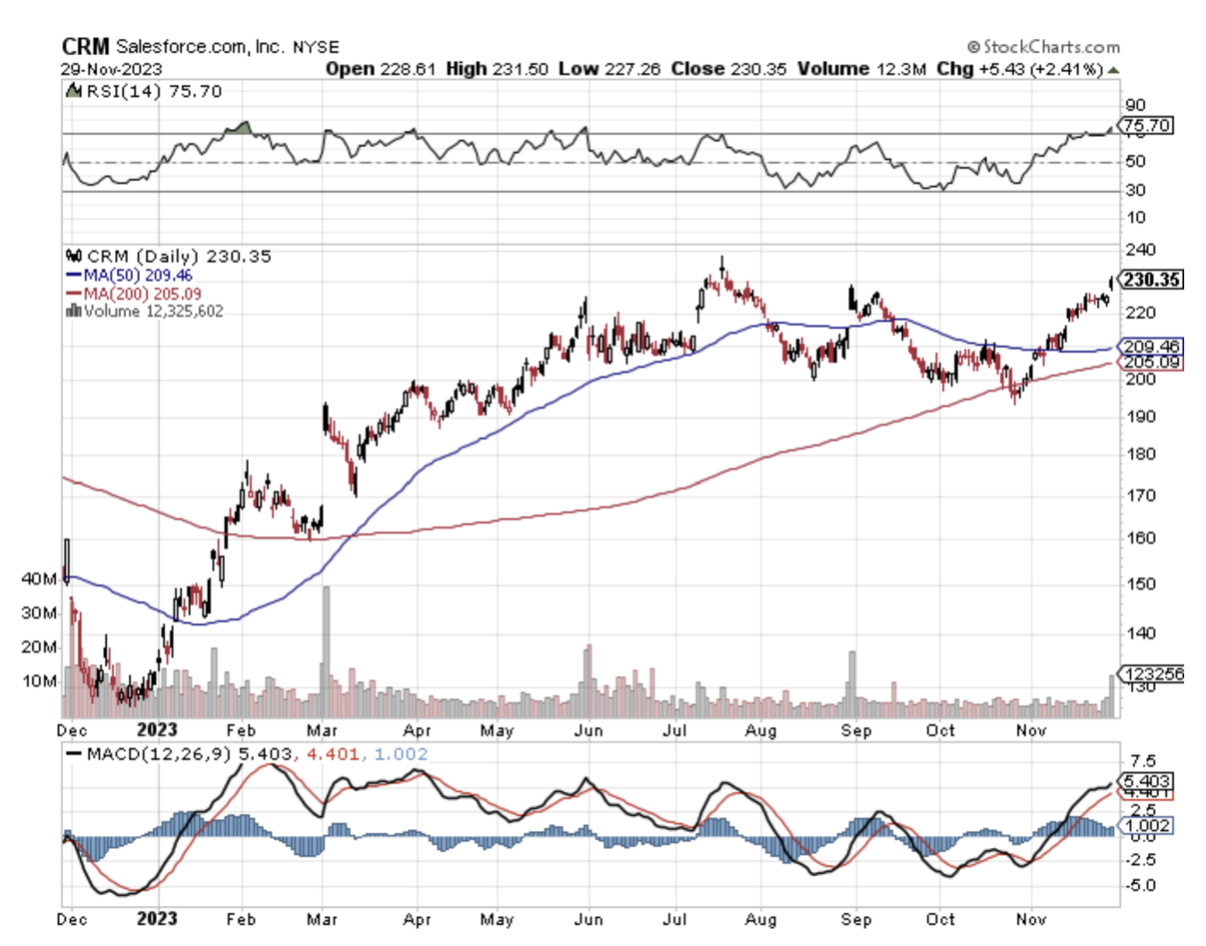
Giant companies that have it figured out, such as Salesforce (CRM) and Zscaler (ZS), are some of the fastest-growing companies in the world.
Understand the cloud and you will readily identify its bottlenecks and bulges that can lead to extreme investment opportunities. And that is where I come in.
Cloud storage refers to the online space where you can store data. It resides across multiple remote servers housed inside massive data centers all over the country, some as large as football fields, often in rural areas where land, labor, and electricity are cheap.
They are built using virtualization technology, which means that storage space spans many different servers and multiple locations. If this sounds crazy, remember that the original Department of Defense packet-switching design was intended to make the system atomic bomb-proof.
As a user, you can access any single server at any one time anywhere in the world. These servers are owned, maintained, and operated by giant third-party companies such as Amazon, Microsoft, and Alphabet (GOOGL), which may or may not charge a fee for using them.
The most important features of cloud storage are:
1) It is a service provided by an external provider.
2) All data is stored outside your computer residing inside an in-house network.
3) A simple Internet connection will allow you to access your data at any time from anywhere.
4) Because of all these features, sharing data with others is vastly easier, and you can even work with multiple people online at the same time, making it the perfect, collaborative vehicle for our globalized world.
Once you start using the cloud to store a company's data, the benefits are many.
No Maintenance
Many companies, regardless of their size, prefer to store data inside in-house servers and data centers.
However, these require constant 24-hour-a-day maintenance, so the company has to employ a large in-house IT staff to manage them - a costly proposition.
Thanks to cloud storage, businesses can save costs on maintenance since their servers are now the headache of third-party providers.
Instead, they can focus resources on the core aspects of their business where they can add the most value, without worrying about managing the IT staff of prima donnas.
Greater Flexibility
Today's employees want to have a better work/life balance and this goal can be best achieved by letting them work remotely which effectively happened because of the public health situation. Increasingly, workers are bending their jobs to fit their lifestyles, and that is certainly the case here at Mad Hedge Fund Trader.
How else can I send off a Trade Alert while hanging from the face of a Swiss Alp?
Cloud storage services, such as Google Drive, offer exactly this kind of flexibility for employees.
With data stored online, it's easy for employees to log into a cloud portal, work on the data they need to, and then log off when they're done. This way a single project can be worked on by a global team, the work handed off from time zone to time zone until it's done.
It also makes them work more efficiently, saving money for penny-pinching entrepreneurs.
Better Collaboration and Communication
In today's business environment, it's common practice for employees to collaborate and communicate with co-workers located around the world.
For example, they may have to work on the same client proposal together or provide feedback on training documents. Cloud-based tools from DocuSign, Dropbox, and Google Drive make collaboration and document management a piece of cake.
These products, which all offer free entry-level versions, allow users to access the latest versions of any document so they can stay on top of real-time changes which can help businesses to better manage workflow, regardless of geographical location.
Data Protection
Another important reason to move to the cloud is for better protection of your data, especially in the event of a natural disaster. Hurricane Sandy wreaked havoc on local data centers in New York City, forcing many websites to shut down their operations for days.
And we haven’t talked about the ransomware attacks by Eastern Europeans on energy company Colonial Pipeline and meat producer JBS Foods.
The cloud simply routes traffic around problem areas as if, yes, they have just been destroyed by a nuclear attack.
It's best to move data to the cloud, to avoid such disruptions because there your data will be stored in multiple locations.
This redundancy makes it so that even if one area is affected, your operations don't have to capitulate, and data remains accessible no matter what happens. It's a system called deduplication.
Lower Overhead
The cloud can save businesses a lot of money.
By outsourcing data storage to cloud providers, businesses save on capital and maintenance costs, money that in turn can be used to expand the business. Setting up an in-house data center requires tens of thousands of dollars in investment, and that's not to mention the maintenance costs it carries.
Plus, considering the security, reduced lag, up-time, and controlled environments that providers such as Amazon's AWS have, creating an in-house data center seems about as contemporary as a buggy whip, a corset, or a Model T.
The cloud is where you want to be.
https://madhedgefundtrader.com/wp-content/uploads/2019/05/cropped-mad-hedge-logo-transparent-192x192_f9578834168ba24df3eb53916a12c882.png00april@madhedgefundtrader.comhttps://madhedgefundtrader.com/wp-content/uploads/2019/05/cropped-mad-hedge-logo-transparent-192x192_f9578834168ba24df3eb53916a12c882.pngapril@madhedgefundtrader.com2023-12-01 14:02:292023-12-01 11:13:43The Place To Be
“Don’t confuse schooling with education. I didn’t go to Harvard but the people that work for me did.” – Said Founder of Tesla Elon Musk
https://www.madhedgefundtrader.com/wp-content/uploads/2022/07/elon-musk-1.png660526Mad Hedge Fund Traderhttps://madhedgefundtrader.com/wp-content/uploads/2019/05/cropped-mad-hedge-logo-transparent-192x192_f9578834168ba24df3eb53916a12c882.pngMad Hedge Fund Trader2023-12-01 14:00:192023-12-01 11:13:32December 1, 2023 - Quote of the Day
Who is responsible when artificial intelligence harms someone?
The California jury may soon have to make a decision. In December 2019, a man driving a Tesla (TSLA) with an AI navigation system killed two people in an accident. The driver faces up to 12 years in prison.
These events were bound to happen as teething pains are quite common with new technology especially one that is ambitious enough to transport machines in a human world.
Multiple federal agencies are investigating Tesla crashes, and The California Department of Motor Vehicles is investigating the use of AI-controlled driving functions.
Our current liability system used to determine liability and compensation for injuries is not AI-friendly.
Liability rules were designed for a time when humans caused most injuries.
However, with AI, errors can occur without direct human intervention. The liability system must be adjusted accordingly. Poor accountability won't just stifle AI innovation. It will also harm patients and consumers.
It's time to start thinking about accountability as AI becomes ubiquitous but remains under-regulated. AI-based systems have already contributed to injuries.
The right accountability approach is critical to unlocking the potential of AI. Uncertain regulations and the prospect of costly litigation will deter investment, development, and deployment of AI in industries ranging from healthcare to autonomous vehicles.
Currently, liability claims typically begin and end with the person using the algorithm. Of course, if someone abuses the AI system or ignores its warnings, that person should be held accountable.
But AI errors are often not the user's fault. Who can blame an emergency doctor for letting an AI algorithm miss papilledema — a swelling of part of the retina?
AI's failure to detect the disease could delay care and potentially cause the patient to lose their eyesight. Papilledema is difficult to diagnose without an ophthalmologist.
AI is constantly self-learning, which means it takes in information and looks for patterns in it. This is a "black box" that makes it difficult to understand which variables affect the outcome.
The key is to ensure that everyone involved - users, developers, and everyone else in the chain - has been vetted to keep AI safe and effective.
First, insurers should protect policyholders from AI injury litigation costs by testing and validating new AI algorithms before deploying them.
Car insurers have also been comparing and testing cars for years. An independent security system can provide AI stakeholders with a predictable system of accountability that adapts to new technologies and practices.
Second, some AI errors should be challenged in courts that specialize in uncommon cases. These tribunals may specialize in particular technologies or topics.
Third, proper regulatory standards from federal agencies can offset the excessive liability of developers and users. For example, some forms of medical device liability have been superseded by federal regulations and laws. Regulators should focus on standard AI development processes early on.
Regulation can make or break AI in the upcoming years and I lean towards the laissez-faire attitude of deregulation.
Too many regulations will stifle development and bring about undue costs.
No company will continue with loss-making operations unless they see a light at the end of the tunnel.
If allowed to develop with light regulation, AI will be that supercharger to tech stocks that investors dreamed of.
Transportation-based tech stocks such as Uber and Lyft will be one of the largest winners from the widespread implementation of driverless technology.
Also, throw in there the food delivery companies like DoorDash (DASH).
Another group with immense expense-saving possibilities is all the airline firms around the world because theoretically, self-driving technology will become good enough to deploy in short and long-haul flights.
Getting to the point of consumers and regulators fully trust self-driving technology is still a long and windy path, but I do believe we will arrive there.
When we do get there, the tech companies underwriting these benefits will feel a 10X boost to their share price.
https://madhedgefundtrader.com/wp-content/uploads/2019/05/cropped-mad-hedge-logo-transparent-192x192_f9578834168ba24df3eb53916a12c882.png00april@madhedgefundtrader.comhttps://madhedgefundtrader.com/wp-content/uploads/2019/05/cropped-mad-hedge-logo-transparent-192x192_f9578834168ba24df3eb53916a12c882.pngapril@madhedgefundtrader.com2023-11-29 14:02:042023-11-29 14:49:41Dealing With A Black Box
“Most entrepreneurial ideas will sound crazy, stupid and uneconomic, and then they’ll turn out to be right.” – Said CEO of Netflix Reed Hastings
https://www.madhedgefundtrader.com/wp-content/uploads/2023/03/reed-hastings.png510390Mad Hedge Fund Traderhttps://madhedgefundtrader.com/wp-content/uploads/2019/05/cropped-mad-hedge-logo-transparent-192x192_f9578834168ba24df3eb53916a12c882.pngMad Hedge Fund Trader2023-11-29 14:00:132023-11-29 14:49:26November 29, 2023 - Quote of the Day
Legal Disclaimer
There is a very high degree of risk involved in trading. Past results are not indicative of future returns. MadHedgeFundTrader.com and all individuals affiliated with this site assume no responsibilities for your trading and investment results. The indicators, strategies, columns, articles and all other features are for educational purposes only and should not be construed as investment advice. Information for futures trading observations are obtained from sources believed to be reliable, but we do not warrant its completeness or accuracy, or warrant any results from the use of the information. Your use of the trading observations is entirely at your own risk and it is your sole responsibility to evaluate the accuracy, completeness and usefulness of the information. You must assess the risk of any trade with your broker and make your own independent decisions regarding any securities mentioned herein. Affiliates of MadHedgeFundTrader.com may have a position or effect transactions in the securities described herein (or options thereon) and/or otherwise employ trading strategies that may be consistent or inconsistent with the provided strategies.