Global Market Comments
February 12, 2019
Fiat Lux
Featured Trade:
(HOW TO HANDLE THE FRIDAY, APRIL 20 OPTIONS EXPIRATION), (TLT),
(PLEASE SIGN UP NOW FOR MY FREE TEXT ALERT SERVICE NOW),
(BRING BACK THE UPTICK RULE!),


Global Market Comments
February 12, 2019
Fiat Lux
Featured Trade:
(HOW TO HANDLE THE FRIDAY, APRIL 20 OPTIONS EXPIRATION), (TLT),
(PLEASE SIGN UP NOW FOR MY FREE TEXT ALERT SERVICE NOW),
(BRING BACK THE UPTICK RULE!),
Mad Hedge Technology Letter
February 12, 2019
Fiat Lux
Featured Trade:
(MEET YOUR HOME OF THE FUTURE),
(KASITA),
(PLEASE SIGN UP NOW FOR MY FREE TEXT ALERT SERVICE NOW)

Enter the home of the future – the iPhone of housing fused with Swedish furniture maker Ikea.
It is a progressive way to live lightly in 352 feet of space for a final bill of $139,000 or rent the space for a sum substantially lower than today’s market rates.
Sounds too good to be true?
If you look at houses now, technology is an afterthought and with the explosion of new architectural techniques and a smorgasbord of IoT products available now – why should it be?
Kasita is an Austin, Texas-based company attempting to transform housing options with one revolutionary product.
Aptly named Kasita after the company that constructs the product, this house is a rendition of a tiny home but fitted with high-end finishes and layered with all the newest tech gadgets.
The firm isn’t competing against the stereotypical urban high-rise or single-family home.
They are targeting the areas of opportunity in between.
On the software side of things, over 60 integrated IoT products deployed together provide a cozy and clutter-free experience resulting in the Marie Kondo of tiny homes.
The team has built in-house software that bridges the IoT products working together simultaneously in one cohesive manner.
Gradually, Kasita hopes to produce one microunit every 57 seconds under one roof.
The first finished units were installed in backyards in Austin and were a resounding success and that was just the beginning.
Aiming to go ultra-dense long-term will make this company and its products sustainable.
The ultimate vision entails building microunits on small parcels of lands then building vertically whether it be 10 or 100 stories high.
The vertical construction would be possible with a rack structure enabling kasita units to be interchangeably installed into the rack structure.
Think about it as an RV park that pays for each slot, but the rack structure would allow building to commence upward minimizing the allotment of required land maximizing resources.
Theoretically, since these units will be interchangeable, CEO Jeff Wilson envisions being able to transport units to other vertical racks with the ability to slot one in seamlessly.
Effectively, dwellers would no longer be bound to the land they resided on and would be able to transport a kasita unit anywhere in the world.
This company wants to remake the concept of manufacturing houses into a process that echoes the automobile or smartphone production method.
Designing the kasita from the ground up took over 5,000 man-hours of precise engineering by BMW-experienced engineers.
They borrowed the blueprint of making a finely tuned German car and instilled many elements into the kasita allowing them to build a beautiful and modern micro home.
The design has natural light, high ceilings, clean surfaces which adds up to making this space feel larger than it actually is.
Also, by designing extra high ceilings, it created additional functions such as sliding a bed underneath for pull-out as well as positioning parts of the house together without wasting space.
During the meticulous research process, engineers found they could enlarge the house by about 25% because of the space-saving methods.
The design avoids wood and is made on a production line like a model T.
Migrating to an assembly line production method able to realize the efficiency of scale will suppress manufacturing costs resulting in a profitable enterprise.
Solving the acute housing crisis on the two coasts is an imminent threat to American social stability.
Pockets of friction can be spotted all over the Golden State and educators in California are fed up with the status quo with rents rising faster than inflation and wages.
Sara Kimberlin, senior policy analyst at the California Budget & Policy Center, recently chimed in saying, “In every part of California, housing is unaffordable for many people.”
The urban districts closest to San Francisco and Los Angeles are the epicenters of housing unaffordability.
A recent strike of thousands of teachers in the Los Angeles Unified School District magnified the dire situation at hand.
A small one-bedroom flat is $2,000 to $3,000 per month in Los Angeles and rises to $4,000 in parts of San Francisco, equivalent to a teacher's take-home pay for one month.
Using small parcels of lands to deploy these small microunits would not entail applying for special permits for these urban spaces.
These two urban centers would relish more housing reply and could use plots of lands that currently occupy errant garbage dumpsters or space too small to develop on.
Realistically, the economics spearheading this project would gravitate towards the level of affordability to drop to the point where a person working in a fast food restaurant or as a house cleaner could afford the monthly cost of living inside of one.
At this point, suburban-type houses have been shunned by the younger generations.
Young people desire an experiential life that includes living on less but still with premium access to creative arteries in dense urban districts.
But there isn’t enough space for housing.
Clearly, this isn’t a home for a family of 5, but recent converging trends signal this is the clear-cut direction society, housing, and the economy is headed whether we love it or hate it.
The company first started selling in Texas and has recently branched off into California, and Nevada.
Will this ultimately fix the housing crisis in California?
No, but it could give single workers more options if they have a job that forces them to move around every few months and are tech savvy.
To view their official design, please click here.



“Never trust a computer you can't throw out a window.” – Co-Founder of Apple Steve Wozniak
While the Diary of a Mad Hedge Fund Trader focuses on investment over a one week to the six-month time frame, Mad Day Trader, provided by Bill Davis, will exploit money-making opportunities over a brief ten minute to three-day window. It is ideally suited for day traders, but can also be used by long-term investors to improve market timing for entry and exit points. Read more

When John identifies a strategic exit point, he will send you an alert with specific trade information as to what security to sell, when to sell it, and at what price. Most often, it will be to TAKE PROFITS, but, on rare occasions, it will be to exercise a STOP LOSS at a predetermined price to adhere to strict risk management discipline. Read more
Mad Hedge Hot Tips
February 11, 2019
Fiat Lux
The Five Most Important Things That Happened Today
(and what to do about them)

1) What a Round Trip it has Been! Since the tax bill passed in December 2017, the return on the stock market has been ABSOLUTELY ZERO! What we gained in tax breaks we lost in trade wars. Except that now the bill is due with $1.8 trillion in new government borrowing this year. Oops! That is NOT what they promised.
2) NY Fed Slashes Q1 GDP Estimates, to below 2% with more cuts to come. Trade war uncertainty cited as the number one reason. Click here.
3) Remember Those Puerto Rican Bonds? A hedge fund, Tilden Park Capital Management LP, just made an $18 million killing off of the latest restructuring while another got tagged for $6 million. That’s what you get for playing in the deep end of the pool. Leave this high risk/high return game to the pros. Click here.
4) You Finally Got Your Tesla. Now, how do you get it fixed? Some 400,000 new cars this year will perilously overload the company’s infrastructure. Use every piece of bad news to buy more stock. The upside breakout is coming. Click here.
5) Put on Your Hard Hat, Consumer Spending is slowing. That means the recession is near. Fund managers are universally moving into defensive and value stocks. So should you. Click here.
Published today in the Mad Hedge Global Trading Dispatch and Mad Hedge Technology Letter:
(THE MARKET FOR THE WEEK AHEAD, or DON’T STAND NEXT TO THE DUMMY),
(AAPL), (MSFT), (TSLA), (VIX), (TLT), (TBT), (FXI)
(HOW FORTNITE IS TAKING OVER THE GAMING WORLD),
(TTWO), (EA), (ATVI), (NFLX), (FORTNITE)
While the Diary of a Mad Hedge Fund Trader focuses on investment over a one week to a six-month time frame, Mad Day Trader, provided by Bill Davis, will exploit money-making opportunities over a brief ten minute to three-day window. It is ideally suited for day traders, but can also be used by long-term investors to improve market timing for entry and exit points. Read more
Mad Hedge Technology Letter
February 11, 2019
Fiat Lux
Featured Trade:
(HOW FORTNITE IS TAKING OVER THE GAMING WORLD),
(TTWO), (EA), (ATVI), (NFLX), (FORTNITE)

One idyllic content company reshaping the content landscape as we know it is Epic Games who is the producer of the video game phenomenon Fortnite.
Not only is Epic Games rapidly altering the video game industry by itself, it is also starting to take a bite out of Netflix’s subscriber growth momentum.
The company was established by Tim Sweeney as Potomac Computer Systems in 1991, originally founded in his parents' house in Potomac, Maryland.
The most fascinating nugget of information that came out of Netflix’s most recent earnings call was not that Netflix has already corralled 10% of television screen time in America, but the reason why this percentage is lower abroad is because of Fortnite taking away Netflix’s mojo.
Netflix (NFLX) has lately been asked to measure their content lead to the likes of Hulu, HBO, and the potential Disney streaming product about to hit the market.
But they explicitly confessed they were more worried about Fortnite and the revolution it is spawning.
The key takeaway is that Netflix is not only competing with fellow online content streamers, but video games are more of a threat to them than ever as they compete for the cord cutters and the elusive “cord nevers”.
Cord nevers are consumers who are digital natives who bypassed traditional media channels altogether.
Echoing the stickiness that Netflix has with its younger demographics, the company has targeted mobile screen time as a core driver usurping around 8% of American mobile phone screen time.
And if you thought Netflix was trying to sort out its own Fortnite problem, then how do you think the traditional American video game cohort felt about their own Fortnite problem?
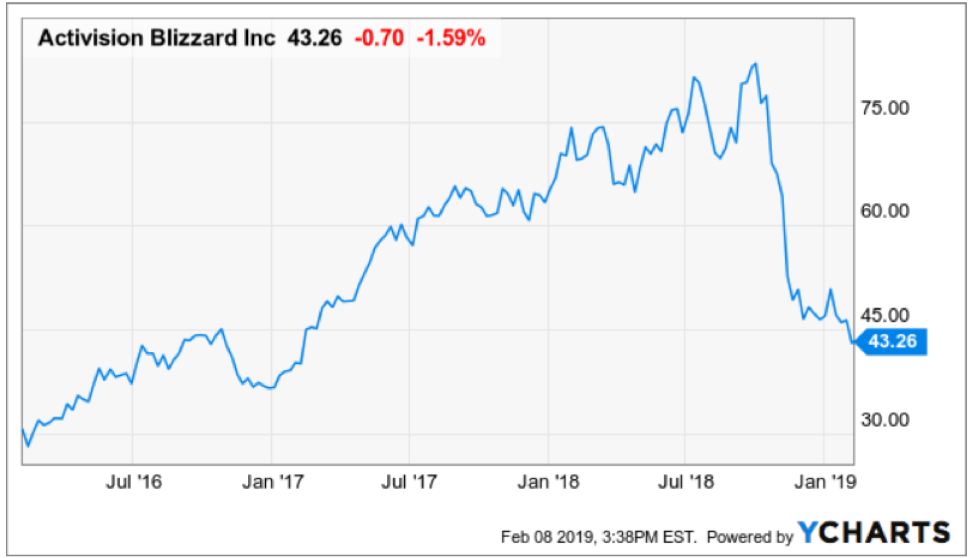
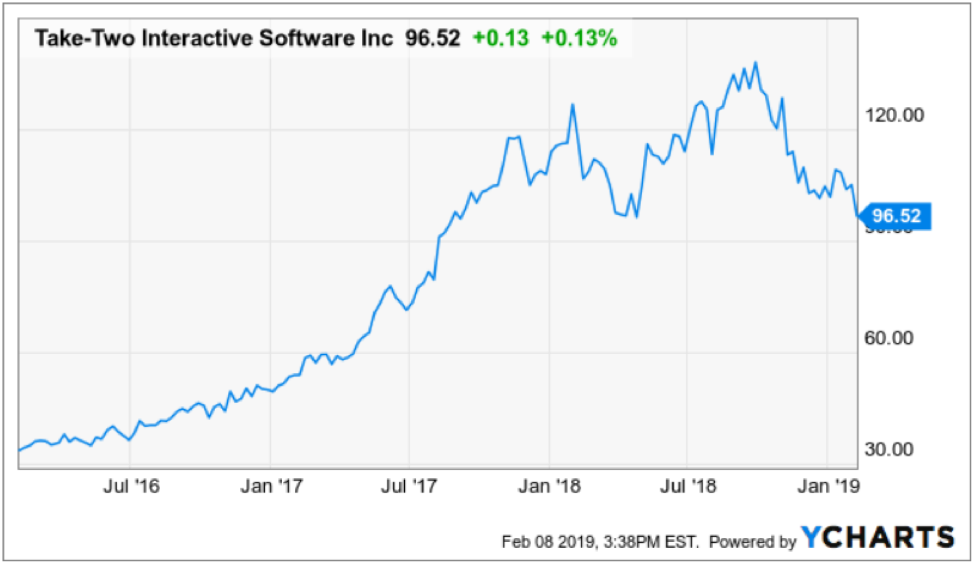
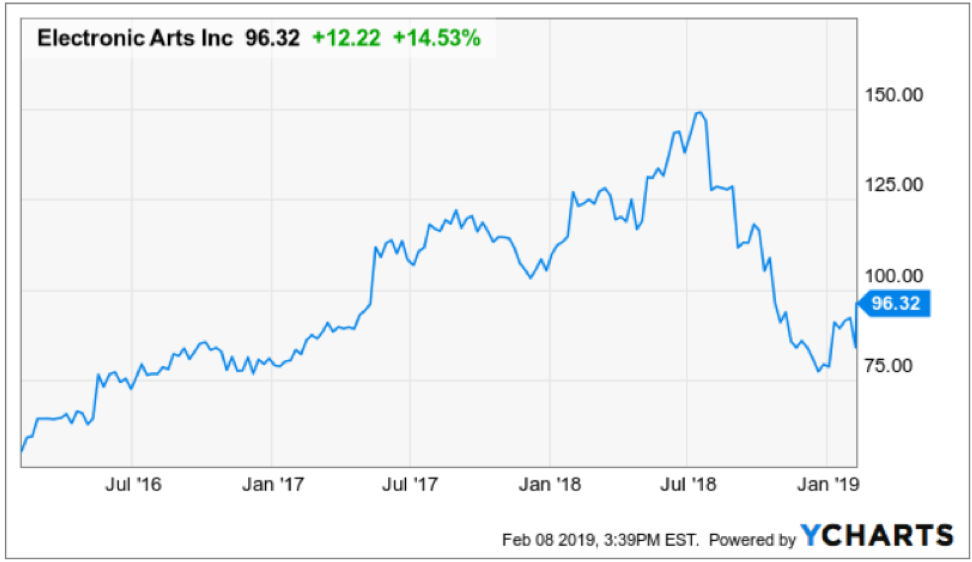
The traditional trio of EA Sports (EA), Activision (ATVI), and Take Two Interactive (TTWO) have been shredded to bits by Fortnite.
Late last year, I gave readers a steer clear synopsis of this company and the latest dead cat bounce in EA and Take Two Interactive should be chances to cut your losses instead of putting more money to work in these names.
Yes, the momentum in Fortnite is that palpable that you stay away from any name that this phenomenon affects.
Activision had no dead cat bounce being the weakest of the three and the stock has gone awry almost halving from $83 to $43 today.
EA’s earnings report was a disaster with their lead title, Battlefield V, doing 1 million fewer sales than the 7.3 million management expected.
During the same holiday season, Take Two Interactive issued a follow-up to a classic that was better than EA’s holiday flagship game called Red Dead Redemption 2 and Activision rolled out another iteration of Call of Duty: Black Ops 4.
Even between the three, the competition was fierce, then throw Fortnite into the mix and comps are getting killed with huge earnings misses penalizing the share prices of this once-vaunted trio.
With the explosion of content in the past several years, consumers are absorbing more content than ever.
Most of this avalanche of content is consumed on mobile phones or televisions, but the behavior varies when you look closer at the different demographics.
Cord cutters total in the low 20 million and are growing 30% annually.
Cord nevers amount to about 30 million growing at 66%.
This all amounts to Americans spending about 12 hours accessing content every day running up to the barrier of natural limits.
That might give consumers some allocated time to sleep, eat, and work, but not much else. We are robotically reliant on content providers to deliver us our fill of daily content.
When automotive technology comes online, it could potentially eke out an incremental 1-2 hours that Americans can stare at their content while being chauffeured around.
How is Fortnite doing financially?
Fortnite earned $2.5 billion in 2018 from a mix of in-game items and passes.
A seasonal Battle Pass is $10, and over 30% of American gamers have purchased this product.
Unlike traditional video gamers who are tied to certain consoles, Fortnite is available on seven platforms: PlayStation 4, Nintendo Switch, Xbox One, PC, Mac, iOS, and Android.
In a time of $60 video games, this new freemium model must shake the foundations of the video gaming establishment.
The rise of freemium games could eradicate the console completely.
A $200-300 console seems expensive if games are free on your $100 Android phone.
The worst side-effect of Fortnite for the traditional video game producers is not Fortnite itself.
It’s the fact that this new model has opened up a new can of worms proving this freemium model with no consoles is the key to unlocking gaming audiences with a 24-hour battle royale, free to play, on-demand, in-game currency, season pass model that was thought to be a hopeful wish by industry analysts.
Then the next question is when will the next Fortnite-esque freemium go viral and can these legacy gaming companies alter their model to accommodate this new business model?
Indeed, management must be freaking out. They thought they had a monopoly on the gaming industry but the nimbler and forward-thinking firm has won-out.
Even the most subscribed YouTuber PewDiePie from Sweden is using Fortnite to keep him in the lead for most YouTube subscribers as Indian music YouTube channel T-Series has caught up with his subscriber count that currently totals 84.3 million.
PewDiePie’s lead was cut down to 20,000 and decided to leverage playing Fortnite squad matches to boost his subs.
The upload got over seven million views in a day backing up my thesis that Fortnite has become the hottest media content asset for cord cutters and cord nevers around the world.
As for the video game stocks, don’t touch them until Fortnite trails off.
And if another freemium game comes to the fore that they aren’t on, run for the hills.