“Bitcoin will do to banks what email did to the postal industry.” – Said Swedish information technology entrepreneur Rick Falkvinge


“Bitcoin will do to banks what email did to the postal industry.” – Said Swedish information technology entrepreneur Rick Falkvinge
Global Market Comments
March 17, 2022
Fiat Lux
Featured Trade:
(WHY DOCTORS, PILOTS, AND ENGINEERS MAKE TERRIBLE TRADERS)

Mad Hedge Technology Letter
March 16, 2022
Fiat Lux
Featured Trade:
(THE GENIUS AT SOFTBANK GETS EXPOSED)
(SFTBY), (ARKK), (DIDI), (BABA), (CPNG)
Softbank’s (SFTBY) Masayoshi Son has been heralded as the consensus aficionado on all things artificial intelligence and a venture capitalist who has effectively bet the ranch on transformational technology.
It also sounds like a page out of the Cathy Woods ARK funds (ARKK) fiasco to be honest with you.
Leveraging a portfolio with borrowed money works well during good times, but Son is finding out that it isn’t all rosy on the downside.
His vast fortune has crumbled along with the performance of the Nasdaq index, and it’s Son who owns many of the low-quality tech names.
His wealth has cratered, going from $25 billion last year to around $14 billion today.
Body bags are starting to pile up, such as the fiascos at German’s Wirecard AG and Greensill Capital.
Investments that go to zero aren’t the hallmark of a stock market picking genius.
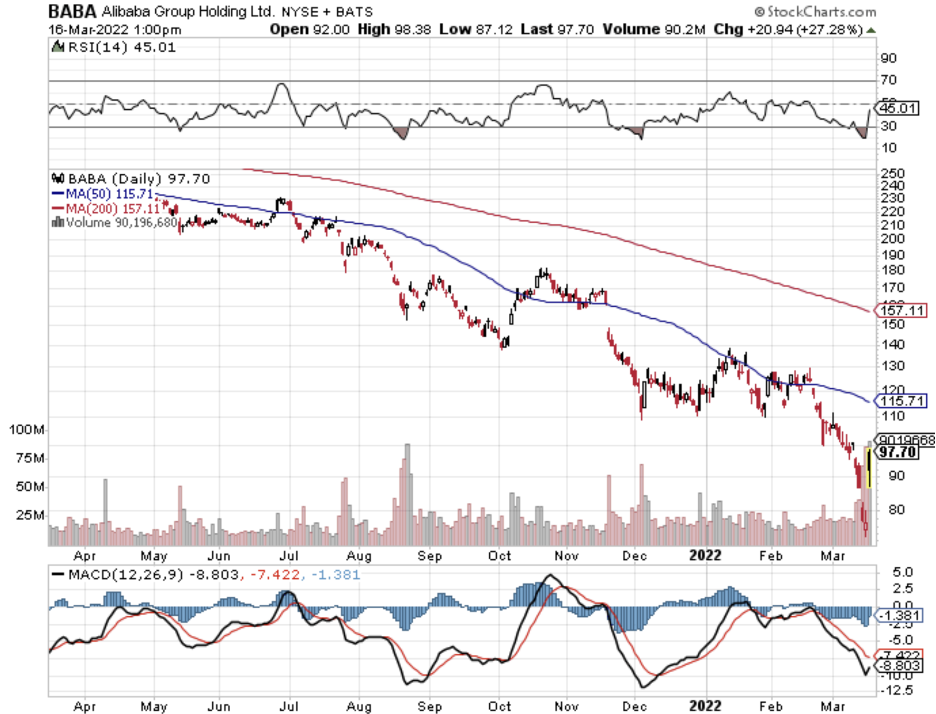
Then what about Son’s China bet, Alibaba (BABA), that, has been taken back behind the woodshed and beaten to a pulp.
Then the Russia/Ukraine conflict happened, giving the flight to safety bid more life and inflation hedged assets even more time in the sun.
This has been the worse environment to invest in technology companies since the dot com bust of 2001.
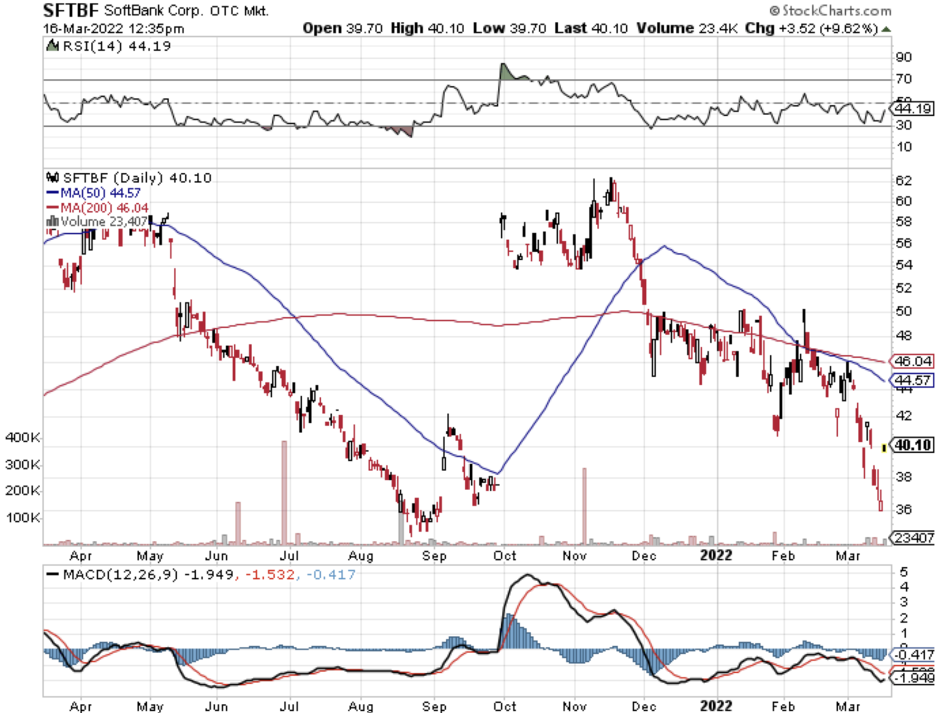
Softbank’s parent stock in Japan is also down 60% and questions have arisen whether at some point soon there will be margin calls.
At the very minimum, Son is lurching towards a liquidity crisis of epic proportions.
If Son thought somebody will come in to swoop him out of his troubles, then I would love to hear the escape plan.
There just isn’t that much bright news ahead if we consider that the international conflict has brought forward a chance of recession at the same time the Fed plans to hike rates.
These 2 macro events are highly negative for tech valuations.
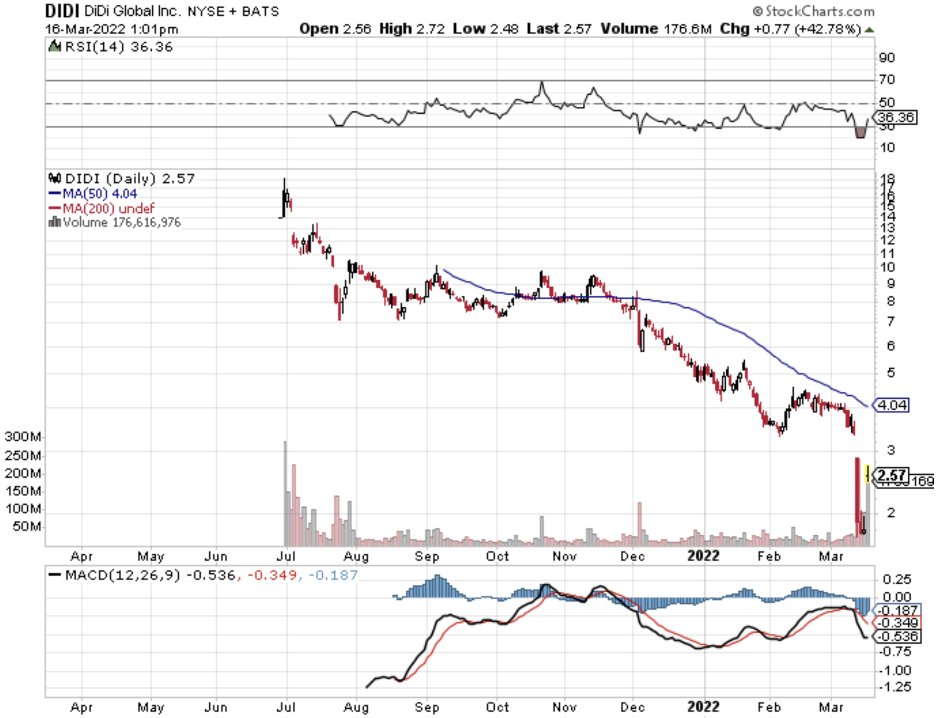
Son has also presided over more disasters like Chinese ride sharer DiDi (DIDI) which sold off 44% in just one day last week and South Korean ecommerce company Coupang (CPNG) whose stock has more than halved since its IPO.
The Japanese firm depends on financing to maintain its investment pace and support its share buyback program. It will need as much as $45 billion in cash this year.
The onerous funding is now a problem when the sails aren’t with Softbank’s back and he will need to cut losses just to pay off debt.
Serious red flags of Son overextending could eventually take the whole company down.
Son also has personal loans tied to company stock after pledging shares worth $5.7 billion to 18 lenders including Bank Julius Baer & Co., Mizuho Bank Ltd., and Daiwa Securities Group Inc.
More importantly, the IPO market is now morbid making it impossible for Softbank to capitalize on exciting new offerings because there are none.
I hiatus of new IPOs makes Son’s high growth strategy null and void.
There simply is no appetite now for high-growth stocks amid this poor macro backdrop.
Whispers of stagflation are cropping up all over the place and it could easily become a self-fulfilling prophecy.
Son’s image has also taken a massive hit as his poor investment decisions make him look like a novice investor.
It’s plausible to believe he won’t get that sort of leash to lock and load in the future with other people’s money.
The Saudis have already soured on a second $100 billion vision fund, and one might question why Son didn’t take profits in an Alibaba position when he could have.
Son might be so stubborn that he believes all his investments will become successful through hell or high water.
I don’t believe investors want that type of defiant attitude with their hard-earned money.
The Mad Hedge Technology Letter saw this upcoming weakness a mile away, and the fact that Son has buried his head in the sand makes us question who his trusted advisors are.
Volatile markets need more tacticians to get out of potential catastrophes.
The sad takeaway is that while Masayoshi Son might believe he is always the smartest guy in the room, he is just surrounded by "yes men" who provide a unique echo chamber that helps him execute disastrous investment decisions.
Low-quality tech is being penalized by the bucket load and Son is the poster child for owning overhyped tech that sometimes isn’t even tech--like the office sharing company, WeWork.
Avoid Son’s investment monologues because the proof is in the pudding at the point; and when it comes down to it, he doesn’t know more than the next guy.
Global Market Comments
March 16, 2022
Fiat Lux
Featured Trade:
(HOW TO HANDLE THE FRIDAY, MARCH 18 OPTIONS EXPIRATION),
(TLT), (TSLA)
“The stock market is not expensive at 0.25% Fed funds and 1.68% government bonds,” said my old investor and mentor Leon Cooperman of Omega Advisors.

Mad Hedge Biotech and Healthcare Letter
March 15, 2022
Fiat Lux
Featured Trade:
(AN UNDER-APPRECIATED STOCK WITH A BOATLOAD OF CASH)
(BMY), (CRSP), (VRTX), (BLUE), (GILD), (NVS)

Warren Buffett is nothing but a dyed-in-the-wool type of investor. A key strategy in his success is to target companies with notably solid fundamental businesses but with shares trading at a bargain or at least a discount in relation to their intrinsic value.
Needless to say, this value-oriented tactic has worked well for roughly six decades, with Berkshire’s stock delivering total returns of 6,450% on its capital.
Taking a cue from the Oracle of Omaha’s playbook, let’s take a look at one of the cheapest biotechnology and healthcare stocks in Berkshire’s portfolio to date and see how it has been performing.
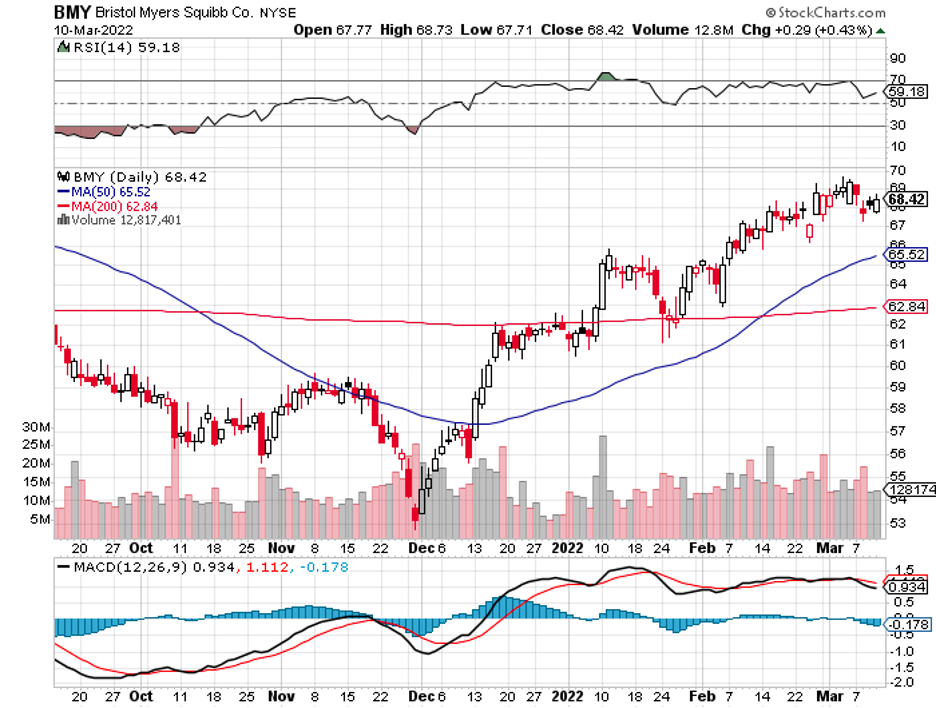
At a hair below eight times its forward earnings, Bristol Myers Squibb (BMY) comes out as Berkshire’s third-cheapest stock holding overall.
This pharmaceutical giant, which has a market capitalization of $144 billion, is the sixth-biggest in the list of what is informally called the “Big 8” US pharma firms.
However, BMY’s stock had fallen by -2% in the past 12 months after experiencing some genuine momentum in 2021 when it reached $69 in August. The share price fell to $54 in December. It has since recovered and is now at $65.
A primary reason for investors snubbing this pharmaceutical giant is the impending loss of market exclusivity of three of its best-selling treatments, Revlimid, Opdivo, and Eliquis.
Although it’s reasonable to be anxious over these patent expirations, BMY has developed a great plan to not simply offset the future decline in sales but also to sustain the momentum of its top line all the way until 2030.
Basically, BMY has lined up multiple new drug launches spaced in the following years, with a number of these candidates expected to become potential blockbusters.
Another key part of the company’s growth strategy is acquisitions.
One of the significant moves BMY executed in recent years is its whopping $74 billion acquisition of Celgene in 2019, which is expected to bolster its immunology and oncology sectors. This was immediately followed by a $13 billion buyout of MyoKardia in 2020, which would expand its cardiovascular roster.
Celgene's deal granted BMY a valuable collection of pipeline assets, which the company has been leveraging in preparation for the patent cliffs.
Aside from the added $15 billion in annual revenue stream from Revlimid, which BMY used to boost its cash flow and pay off some debts, the company also inherited Reblozyl.
Since the acquisition, Reblozyl has gained approval for beta-thalassemia and anemia patients.
While this is not as groundbreaking as the gene therapies offered by CRISPR Therapeutics (CRSP), Vertex (VRTX), and even bluebird bio (BLUE), this treatment can still reach peak sales of $2 to $4 billion annually.
Another Celgene candidate poised to become an additional revenue stream for BMY is Inrebic, a JAK2 inhibitor created for myelofibrosis and polycythemia vera. This is projected to rake in $400 million in peak sales.
Zeposia, a treatment for autoimmune conditions, has already gained approval for multiple sclerosis and is queued for clinical trials for Crohn’s disease and ulcerative colitis.
If it receives the green light for all three, this is another $3 billion opportunity for BMY.
The inherited assets from Celgene are Breyanzi, a CAR-T therapy approved for large B-cell lymphoma, and Abecma, which is also an approved treatment for multiple myeloma.
These last two treatments are potential blockbusters as well.
Breyanzi’s list price is $410,000, with the therapy estimated to reach $3 billion in peak sales. Meanwhile, Abecma is listed at $491,500 and is projected to peak at $1 billion.
By 2029, BMY expects to develop new revenue streams worth $25 billion from its current portfolio and growing assets.
Looking at the above assets, BMY’s strategy becomes evident.
When BMY acquired Celgene for an exorbitant amount three years ago, the bigger company’s management team showed just how prepared they were to take the hit in the form of substantial debts in exchange for massive steps forward.
Adding to its expansion efforts, BMY has recently completed a deal with Century Therapeutics.
This marks BMY’s major foray into the promising cell therapy space.
While BMY has not concentrated on this sector before, it already has promising candidates in the form of its Celgene assets, Breyanzi and Abecma.
So far, Century and BMY have agreed to develop four different CAR-T cancer therapies on top of expanding the indications for Breyanzi and Abecma.
At the moment, the big pharma names focusing on this sector include Gilead Sciences (GILD) and Novartis (NVS).
This means BMY has a fighting chance to dominate in this market following its strategic collaboration with Century.
If all goes according to plan, BMY’s work with this cell therapy company might even turn out to be as lucrative as its deal with Celgene acquisition.
Overall, BMY has proven itself to be a reliable money-making titan in the biotechnology and healthcare industry.
BMY is a growth machine that consistently comes up with ingenious plans to grow over the years.
From $20.8 billion in 2017, its profits skyrocketed to an impressive $46.4 billion in 2021, indicating a remarkable 123% increase.
Moreover, the company anticipates that its free cash flow will surpass $50 billion by 2024, implying that it’s not worried over the impending loss of patent exclusivities and flexing its ability to generate a boatload of cash to complete even more collaborations and acquisitions.
Mad Hedge Bitcoin Letter
March 15, 2022
Fiat Lux
Featured Trade:
(CRYPTO GETS A PASS FOR NOW)
(BTC), (MICA)
Europe has to be considered the King of regulation. They boast the highest tax regimes of the developed world, and I am not referring to loophole countries like Cyprus.
Why does that matter?
The EU went after and still goes after big tech with a vengeance.
Alphabet and Facebook have been on the receiving ends of many billions of dollars in fines and more will head their way in the future.
Tech fines don’t matter in terms of the health of crypto but don’t think that the Europeans are any different when they set their sights on digital currency.
If they see it, they will try to tax it to oblivion.
Just look at Belgium which charges a robust 11.3% in annual property taxes and Spain which registers right behind them at 8%.
The Europeans don’t discriminate and love to tax everything.
So it wasn’t out of the ordinary that The Markets in Crypto Assets (MiCA) legislation included a clause pledging to make crypto assets traded or issued within the bloc ‘subject to minimum environmental sustainability standards’.
Even if this wasn’t a direct tax on crypto, the design of the legislation would amount to a de facto ban on crypto assets because there is nothing environmentally sustainable about mining crypto.
In fact, mining crypto is terrible for the environment and requires large sums of energy to produce digital coins.
That energy is usually dirty energy in the form of fossil fuels.
An element of this has to do with spiking energy costs which has been induced by Russia’s Vladimir Putin’s war on Ukraine.
Many countries have experienced a doubling of energy prices and for the supply left over, do we as a society want to allocate energy to crypto mining when apartment is going dark?
Energy and inflation have become the modern-day battlefield for politicians duking it out and dragging crypto into this game is overwhelmingly negative for crypto.
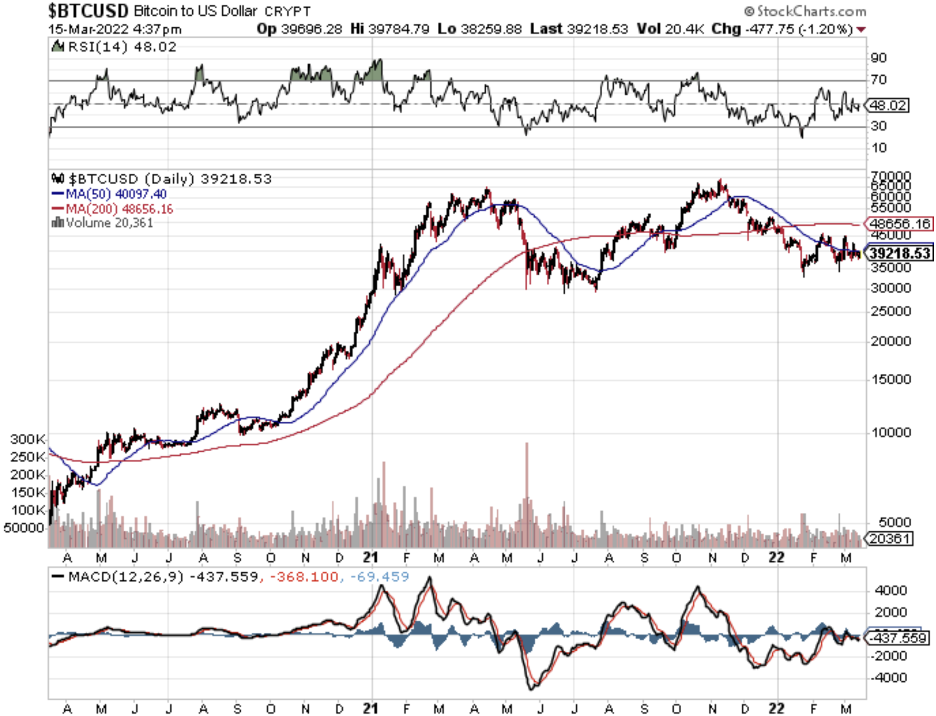
Crypto has experienced poor price action lately and this adds fuel to the fire.
Banning crypto in Europe would be cataclysmic to the currency after China slammed the door shut on it.
The EU’s Economic and Monetary Affairs Committee voted on a final draft of the Markets in Crypto-assets (MiCA) which included a clause pledging to make crypto assets traded or issued within the bloc “subject to minimum environmental sustainability standards.” A final tally of the committee’s voting showed the proposed clause was defeated with 23 votes in favor, 30 against and six abstentions.
Demand for Bitcoin (BTC) and other tokens has pushed up their carbon footprint significantly in the last year. Data from the Cambridge Centre for Alternative Finance put Bitcoin’s estimated power consumption at an annual rate of 138 terawatt-hours in early 2022, more than the size of a country like Norway.
Miners, much like car drivers, aren’t interested in unreliable renewable energy.
Intermittent supply of energy would cripple a crypto miners’ business much like if a truck driver would rely on sparse electric refill stations to drive cross country.
Although many have boiled down this decision to a landmark victory, I don’t believe this is the end of the regulation circus that is Europe.
If exorbitant energy prices are here to stay, Europe might not have any other choice but to go after crypto for another source of revenue.
And if crypto mining is taxed using sustainability criteria, it will cause many miners to shut down and the crypto industry itself will be shut down because they won’t pass the clean energy criteria needed to operate.
High energy prices have many unintended consequences are crypto could be another martyr to it.
Let’s hope the crypto regulation is pushed out into the long term so the industry has time to develop its foundation and obviously that won’t be possible if the mining business gets killed.
Can the Europeans singlehandedly crash the crypto industry?
No, but it doesn’t help the adoption rate for an emerging industry making it that much harder to mature.
America’s pro-business climate has been a godsend to multinational corporations, and it will be the same way for crypto if it is allowed to develop in America.