

SPECIAL BOND BUBBLE ISSUE
Featured Trades: (TREASURY BONDS)
4) Its Official: China is Unloading its Treasury Bonds. It looks like the smart money these days is found in China. While American investors have been scrambling over each other to buy more Treasury bonds at historically low yields, China has begun quietly unloading some of its own enormous holdings. In June, the Middle Kingdom sold $21.2 billion of?? paper, reducing its net long to $839.7 billion. This is little more than 10% of the total $8.18 trillion in federal debt that Uncle Sam has outstanding.
Total foreign ownership of US Treasury bonds amounts to $4 trillion, up from $2.4 trillion in three years.?? Instead, the Chinese have been buying Japanese government bonds, which today carry a paltry 0.9% yield, but have the merit that they are denominated in a rapidly appreciating currency. The Mandarins in Beijing have also been picking up a variety of bonds in Europe which have seen yields pushed to near records, thanks to the debt crisis there.
Officials at the People's Bank of China say that it is all part of a broader diversification effort away from the greenback. PIMCO's Bill Gross has apparently been taking Mandarin lessons on the sly because he has also been paring back his own massive holdings in longer dated Treasuries. To understand why, take a look at the chart below of the spread between the Dow dividend yield and the ten year Treasury yield which has turned positive for the first time since 1955.


China Can't Unload Those Treasury Bonds Fast Enough
'If you look at previous times in US history when bond yields were this low, the returns have been quite poor. Bonds now have many elements of a bubble. We're at the end of the debt super cycle. First we had a large banking crisis. The next step is a large sovereign crisis. This means that government bonds are a pretty bad bet over a five to ten year period,' said Jonathan Tepper, partner and chief editor of Variant Perception, an economic research boutique.

Featured Trades: (BEHAVIORAL TARGETING)
1) So You Think They're Not Watching You on Your PC? Hey! You there, staring at this monitor. This is your PC talking to you. No, not you over there standing in the background. I'm talking to the guy sitting in front of me poking at my keys. Ouch! That one hurt!
So you thought no one was watching, did you? Let me straighten you out. About a month ago you clicked on a certain website, and I installed myself as a cookie on your computer, which is an innocuous little text file that you can't see. Since then, I have been tracking your every move, recording websites you clicked on, the pages you visited, and the stuff you ordered. I then used this handy little algorithm to build a profile of exactly who you are. I now know you better than your own mother. In fact, I know you better than you know yourself.
For example, I am aware that you make more than $250,000 a year, live in a posh zip code in San Francisco, belong to a fancy country club, and drive a Mercedes. You donate to Republican political causes, send your kids to a prestigious private school, and bill it all to an American Express Platinum Card. Did I leave anything out?
Because I know every detail of your life, down to your inside leg measurement, I am able to harness the power of this machine to more precisely service your every need. That includes directing advertising to you, which you have a high probability of clicking on. The more you click on my ads, the higher prices I can realize for those ads. The ad campaigns you now see are unique to your own personal computer because they are tied to your IP address. My program, called 'behavioral targeting' is the next 'big thing' in online advertising. It's all part of the brave new world.
I see you have been shopping for a new car. Check out the new Hyundai at http://www.hyundaiusa.com/ , which offers the same quality as your existing ride, at half the price. Your clicks this morning suggest you're taking your 'significant other' out to dinner tonight. Might I suggest Gary Danko's on Bay Street at http://www.garydanko.com/site/bio.html ? The rack of lamb is to die for there. Your visits to http://www.travelocity.com/ and http://www.expedia.com/ tell me you're planning a vacation. I bet you didn't know you can find incredible deals in Las Vegas at http://www.visitlasvegas.com/vegas/index.jsp . Thinking about buying a condo there? They'll even pay for the trip if you promise to check one out while you're there.
Since we're chatting here mano a mano, I noticed that that last pair of jeans you ordered from http://us.levi.com/home/index.jsp had a 42-inch waist, up from the 40's in your last order. Better lay off those cheeseburgers. Pretty soon, they'll be calling you 'tubby' or 'fatso'. Better visit http://www.weightwatchers.com/Index.aspx soon, or the legs on that chair might buckle out from under you.
Worried about privacy? Privacy, shmivacy. There hasn't been privacy in this country since the first social security number was handed out in 1936. And don't expect any relief from Congress. I doubt half those dummies even know how to turn on their own PC's.
Don't even think about trying to delete me. I'm a 'flash cookie', an insidious little piece of code that reinstalls every time you try that. Think of me as a toenail fungus. Once you catch me, I'm almost impossible to get rid of.
I hope you don't mind, but I've been passing your personal details around to some of my buddies at other websites. That's why when you clicked on http://www.nfl.com/ you got deluged with product offers from your local team, the San Francisco 49ers.?? I've got friends at Google, Facebook, MySpace, and pretty much everywhere. Can I help it if I'm a popular guy? I bet the view from those 50 yard seats is great, isn't it?
I noticed that your spending habits don't exactly match with the income you reported on your last tax return. Do you think the IRS would like to know about that? I bet you didn't know the agency offers a 10% reward for turning in tax cheats.
How did you like those triple X DVD's you bought last week? Whoa! Hot, hot, hot! I hope your employer never finds out about those. It might not go down too well at your next performance review.
I thought it was lovely that you bought your spouse a two carat, yellow, vvs1, round cut diamond ring for $26,000 from http://www.bluenile.com/ for your 30th wedding anniversary. But who is Lolita, the Argentine firecracker, in Miami Beach? Does the old wifey know you sent her a $2,000 pair of diamond stud earrings? What's it worth to you for me to keep mum on this? Maybe you should take a quick peak at http://www.divorcelawfirms.com/ and see what you're in for?
Naw, I'm just pulling your leg. This is all just between friends, right? Think of it as a doctor/patient relationship. I'll tell you what. See that leaderboard ad at the top of the page? Just click on that and we'll call it even. Oooh that felt good! Click it again. Oh, baby! Not too many times. You'll trigger my anti click fraud program.
Now you see that wide skyscraper add over on the right? Click on that too. Oh baby! Click it again! And there's a little button ad at the bottom of the page. No, not that one. A little lower. What was that little cutie's name in Miami again? Aaaaah.


Featured Trades: (RARE EARTHS), (MCB), (LYSCF)
2) It's Off to the Races at Molycorp. I just wanted to follow up on the rare earths piece which I recently published (click here for "Rare Earths Are Becoming A Lot More Rare"). Despite lackluster market conditions at best, Molycorp (MCP) managed to raise $394 million through its July IPO at $14/share. The company will use the funds to reopen a rare earths mine at Mountain Pass, California, making it the largest such producer in the world outside of China. The company will start production by the end of the year, and go full scale by 2012.
This is important because China, supplier of 97% of the world's supply of rare earths, has cut back export quotas by 40% this year. These incredibly expensive metals are crucial for the manufacture of a variety of alternative energy hardware, as well as a number of military applications. Since the launch, the stock has risen 11%, making it one of the best performing stocks in the market this summer.
So far, the Australian miner Lynas Corp (LYSCF) has been the big beneficiary of the stampede into rare earths shares, doubling since I first recommended it in May (click here for the call). Lynas offers established production and experienced management, higher grade ore with a 9.7% yield, higher levels of the more valuable rare earths, realizations per ton that are 57% higher, and a book value of 1.87.
MCP is expected to have a 8.24% yield, is easier to trade with a US listing, has better liquidity, and prospects of greater profitability down the road through vertical integration and economies of scale, at the price of a 2.61 book value. MCP may also receive a political boost in the fall if a group of 20 senators and congressmen are successful in getting the Department of Energy to provide $280 million in loan guarantees. Look at these companies as an alternative energy, national defense, commodity play, a win-win-win.


There's Cerium in Them Thar Hills
Featured Trades: (THD), (TF), (F), (NSANY), (TM)
iShares MSCI Thailand Investable Market Index ETF
Thai Capital Fund
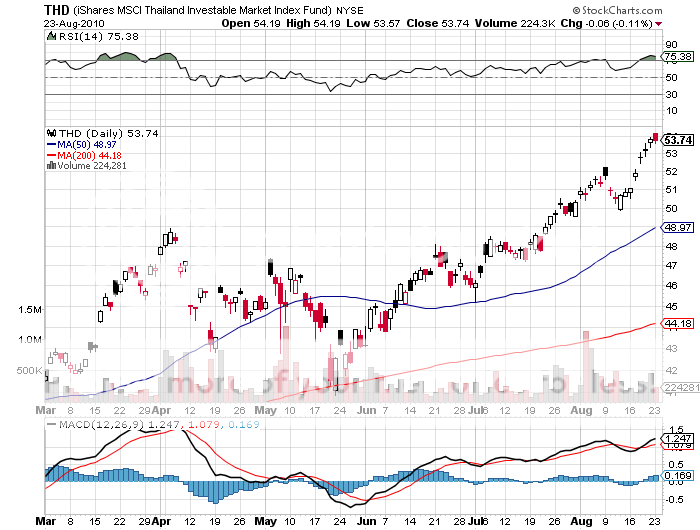
3) Thailand Punches Through to New Highs. With hotel occupancy in the dumps at 20%-30%, and parts of downtown Bangkok still in ruins from the May riots, you would think the call to buy Thailand (THD), (TF) two months ago was a complete bust (click here for the piece).
You would be wrong. Since then, the Thai ETF has tacked on an amazing 20%, the Thai Capital Fund is up 24%, and the Thai Baht has strengthened, making it one of the top performing stock markets of 2010. Even with the collapse of tourism, GDP is expected to come in at a healthy 6% this year, a figure American economists would kill for.
The country's robust manufacturing sector, which accounts for 66% of Thai GDP, versus only 6% for tourism, continues to drive the country onward and upward. Think of Thailand as China, with the infrastructure already built out. Ford Motors (F) has announced the construction of a $450 million plant to build the Focus, while Nissan (NSANY) says it will assemble its compact. Toyota (TM) and GM are expected to follow suit with the expansion of existing facilities.
Carl Van Horne, then the chief investment officer of JP Morgan, once taught me a rule that I have found incredibly useful: follow the direct investment; the stocks markets always play catch up. Thailand continues to be a place where international investors want to be. Buy on dips, if we get any.

Featured Trades: (BAIDU), (GOOG)
4) Make Another Visit to the Trough for Baidu. Just like buying a drink for an old flame when passing through town, there is no better feeling than revisiting winning trades. I first recommended Baidu (BIDU) at split adjusted $12.5 in December, 2008 (click here for the call). It hit $88 earlier this month, a 700% gain. The current bout of global equity market angst has since knocked 11% off of the shares, and there may still be more downside to go. It may be worth making another visit to the trough. Baidu has incredible momentum selling into the world's fastest growing market for online services, where it has a 65% market share for Chinese language paid search. It has recently expanded into Japan with a powerful Japanese language search engine there. Baidu also brings in peripheral revenues through community based e-commerce, communication, and entertainment. YOY revenues are growing at a 70% rate. No surprise then that Baidu is a favorite trading vehicle for the BSD hedge funds. It is benefiting hugely from the Chinese government's onslaught on rival Google. Sure, a PE multiple of 83 sounds rich, compared to Google's 20, but how much should you pay for a hyper growth company in a country where Q2 GDP came in at 10.3%? Add Baidu to your buy on meltdowns list to get a high beta play in the Middle Kingdom.


'When I look at the Treasury market, I get a really 1998 sort of dotcom feeling. You knew they were going higher, you knew that it would end badly; you just didn't know the timing. At a certain point this becomes a disaster,' said Barry Ritholtz, CEO of hedge fund Fusion IQ.

Featured Trades: (THE RANGEBOUND MARKET),
(SPX), (FCX), (VIX), (USO), (GLD)
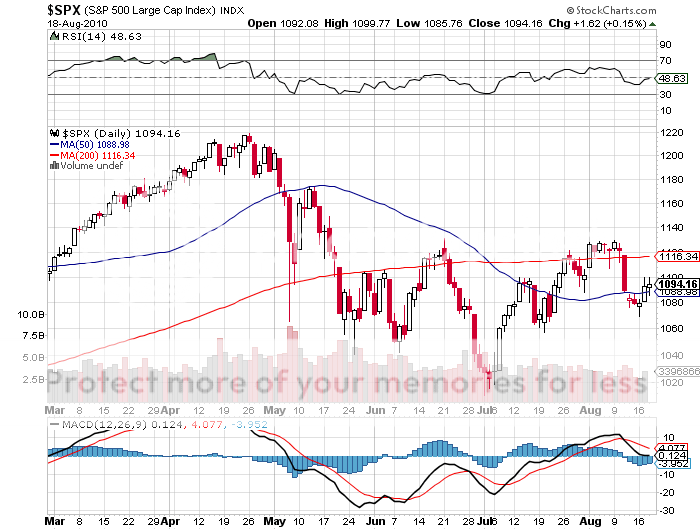
1) Why We're on the Slow Boat to Nowhere. After speaking to a gaggle of economists, portfolio managers, and traders the last few days, I've had one of those 'Eureka' moments, as the markets have shown their hands. Those that delivered the dramatic, heart stopping moves last year, like stocks, commodities, oil, and precious metals, are on the slow boat to nowhere. Last year's wall flowers, like currencies and their crosses, will trend nicely, delivering plungers some serious coin.
What's more, I think these trends, or non trends, will continue for the next several months, probably until the November election. That means that the S&P 500 (SPX) will remain around a tedious 1010-1140 range, and that implied volatilities for relevant options will continue to bleed to lower levels. The VIX is probably an outright short here.
This market is a portfolio manager's worst nightmare, and a trader's dream come true. Zero interest rates assure that we aren't going to crash any time soon, and flagging economic data and chronically high unemployment guarantee that we are not blasting out to the upside. They, the nimble and click happy, can confidently sell into every rally and buy each dip. Selling out-of-the-money straddles, last year's suicide trade, could be this year's steady earner. They say markets have to climb a wall of worry. This one has to climb Mount Everest.
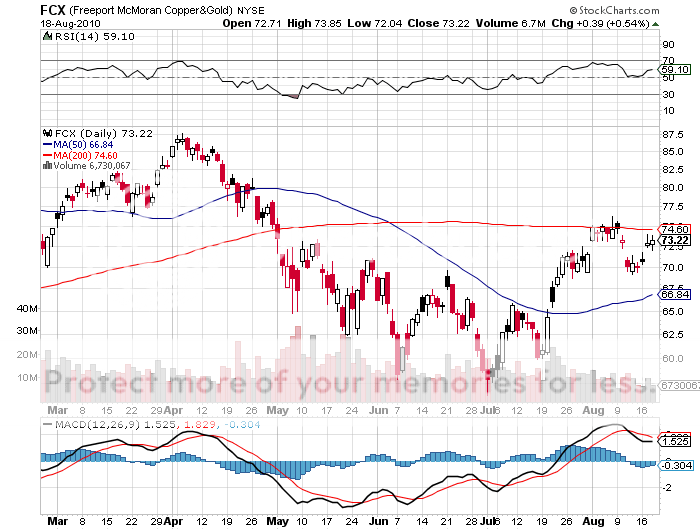
Commodities (FCX), oil (USO), and precious metals (GLD) are showing the same indecisive behavior. The cross trades I have been recommending, long Aussie/euro, Canadian/euro, and short the euro/yen, have been delivering reliably all year.
This is all happening because the markets are now transitioning from last year's parabolic 5.7% Q4 GDP rate to the more somnolencent 2%-2.5% growth scenario that I am predicting for this decade. Political gridlock and the attendant noise level don't help either.
You've got to work with the market you have, not the one you want, and these short volatility trades could be your bread and butter for the next several months.

Climbing a Wall of Worry
Featured Trades: (COAL VS. NATURAL GAS),
(BTU), (RTP), (ACI), (CHK), (BNR)
2) Peabody Energy (BTU) Takes a Hatchet to the Natural Gas Industry. After my year in the White House Press Corps, I vowed never to return, and took a really long shower, hoping to scrub every last spec of prejudice, self interest, and institutionalized corruption off of my battered carcass. But sometimes I see some maneuvering that is so unprincipled, crooked, and against the national interest that I am unable to restrain my fingers from the keyboard. For shorthand, let's call them lies.
I'm talking about the absolutely merciless hatchet job the coal producers are inflicting on the natural gas industry. Coal today accounts for 50% of America's 3.7 trillion kilowatts in annual power production. That's a lot of vested interest. Chesapeake Energy's (CHK) Aubrey McClendon says correctly that if we just shut down aging conventional power plants that are over 35 years old, and replace them with modern gas fired plants, the US would achieve one third of its ambitious 2020 carbon reduction goals. The share of relatively clean burning natural gas of the national power load would pop up from the current 23% to 50%. Even the Sierra Club's Carl Pope says this is the fastest and cheapest way to make a serious dent in greenhouse gas emissions.
So what do we get? The press has recently been flooded with exaggerated or untrue reports of widespread well poisonings and forest destruction caused by the fracting processes that was used to recently discover a new 100 year supply of ultra cheap CH4. While the coal industry has had 200 years to build a formidable lobby in Washington, the gas industry is a neophyte, their only public champions being McClendon and T. Boone Pickens.
But memories in Washington are long, and Obama & Co. recall all too clearly that this was the pair that financed the Swift Boat Veterans for Truth that torpedoed Democrat John Kerry's 2004 presidential campaign. What goes around, comes around.
Whose hands are dripping with blood here? Peabody Energy (BTU),? which ripped 200 million short tons of the black stuff out of the ground in 2008, followed by Rio Tinto (RTP) at 140 million tons, and Arch Coal (ARCH) with 134 million tons, poured millions of dollars into Washington to lavishly finance lobbyists. Their mission is to render toothless Cap & Trade legislation, block subsidies for natural gas which both parties seem to agree on, dilute environmental legislation, and promote the myth that the whole global warming thing is nothing more than a leftist hoax, thus keeping hands off King Coal.
Senators and congressmen from the top three coal producing states have been the eager facilitators: Wyoming at 467 million short tons in 2008 (Thanks Dick Cheney!), West Virginia at 157 million tons, and Pennsylvania at 65 million tons. That dinosaur of a union, the United Mine Workers, is another guilty party. You might even blame Warren Buffet's Burlington Northern (BNR), which earns 70% of its revenues from shipping coal across the country for export to China. This is the wellspring for the money that is financing all those conservative initiatives, energy related, or not.
This will be unhappy news for the 23,000 the American Lung Association expects coal emissions to kill this year. How many will clean burning natural gas bump off? None. Can't the coal industry be happy selling everything they rip out of the ground to China? If you are lacking an ounce of conscience and are willing to turn a blind eye to where your trading profits come from, then use the current sell off in all hard assets to pick up (BTU), (RTP), and (ACI). China's demand for our coal remains insatiable, and domestic demand isn't about to go up in smoke overnight either. You can always donate your profits to the Sierra Club. After all, I recommended Russia, why not King Coal.
There! I've had my say. Now I'm going to go have another long shower.


It's a Long Way to Washington
'The good news is that the rash on my penis finally went away,' wrote a child to his parents, about to return from summer camp.
