
“You may think using Google's great, but I still think it's terrible.” – Said Co-Founder of Google Larry Page

“You may think using Google's great, but I still think it's terrible.” – Said Co-Founder of Google Larry Page
While the Diary of a Mad Hedge Fund Trader focuses on investment over a one week to a six-month time frame, Mad Day Trader, provided by Bill Davis, will exploit money-making opportunities over a brief ten minute to three-day window. It is ideally suited for day traders, but can also be used by long-term investors to improve market timing for entry and exit points. Read more
Global Market Comments
December 6, 2019
Fiat Lux
Featured Trade:
(DECEMBER 4 BIWEEKLY STRATEGY WEBINAR Q&A),
(SPY), (TSLA), (TLT), (BABA), (CCI), (VIX)
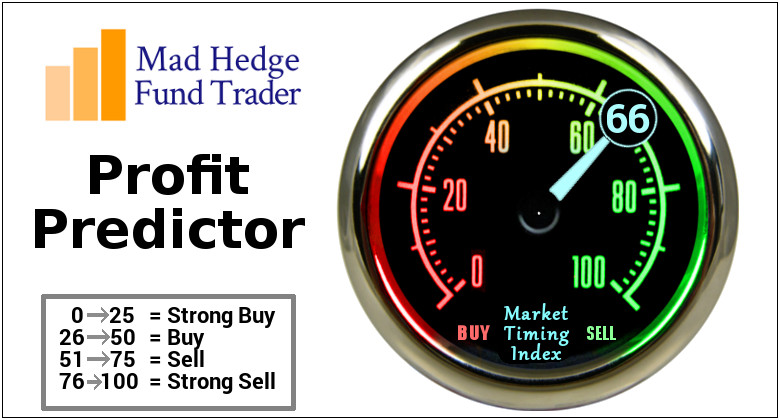

Below please find subscribers’ Q&A for the Mad Hedge Fund Trader December 4 Global Strategy Webinar broadcast from Silicon Valley, CA with my guest and co-host Bill Davis of the Mad Day Trader. Keep those questions coming!
Q: How do you see the markets playing out in 2020?
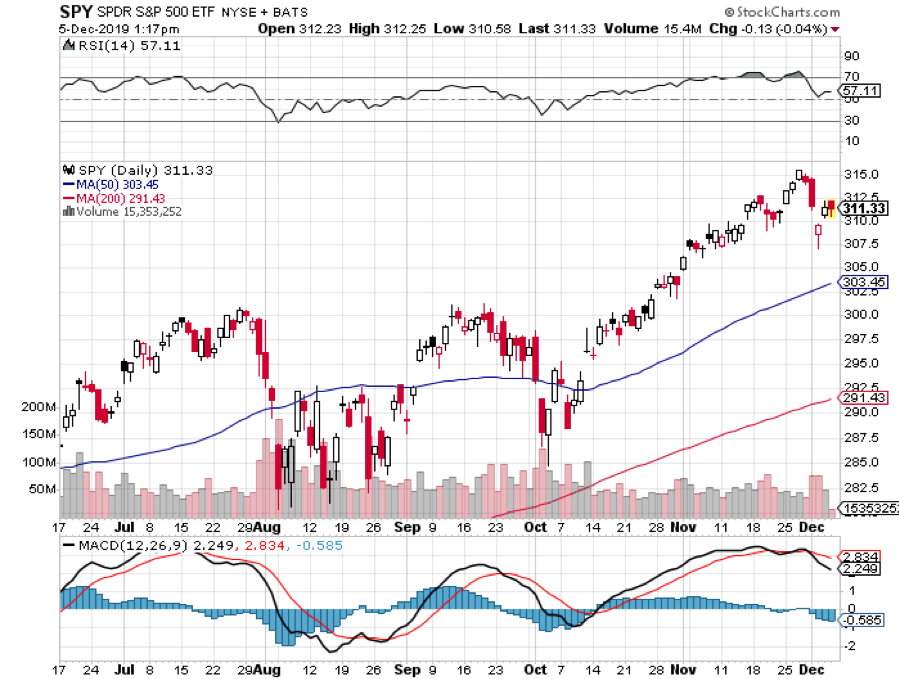
A: Well, I’m looking at small single-digit positive returns with a lot of volatility. Much of this year’s performance—30% in the S&P 500 (SPY), up 56% for the Mad Hedge Fund Trader—has already been pulled forward from 2020, thanks to super low interest rates and massive deficit spending. So, the more money we make now, the less money we make next year.
Q: How deep will the next recession be?
A: I’m looking for two quarters of small negative numbers like -0.1% or -0.2%, and then it’s off to the races again. That’s when the Golden Age of the Next Roaring Twenties starts, which I have already written a book about (click here).
And it’s possible we may not even see any negative numbers on a quarterly basis; we may just get close to zero, threatening it without actually breaking it. Of course, you could still get a 20% correction in the overall stock market if they only THINK we are going into recession, which has happened many times in the last 10 years.
Q: Are you expecting a market crash?
A: No; I do expect a meaningful pullback but frankly, right now, I do not see the conditions in place for that. None of the traditional causes of recessions, high-interest rates or high oil prices, are evident yet. The biggest threat to the market right now is the 2020 presidential election. And we are at a 14-year high in stock valuations.
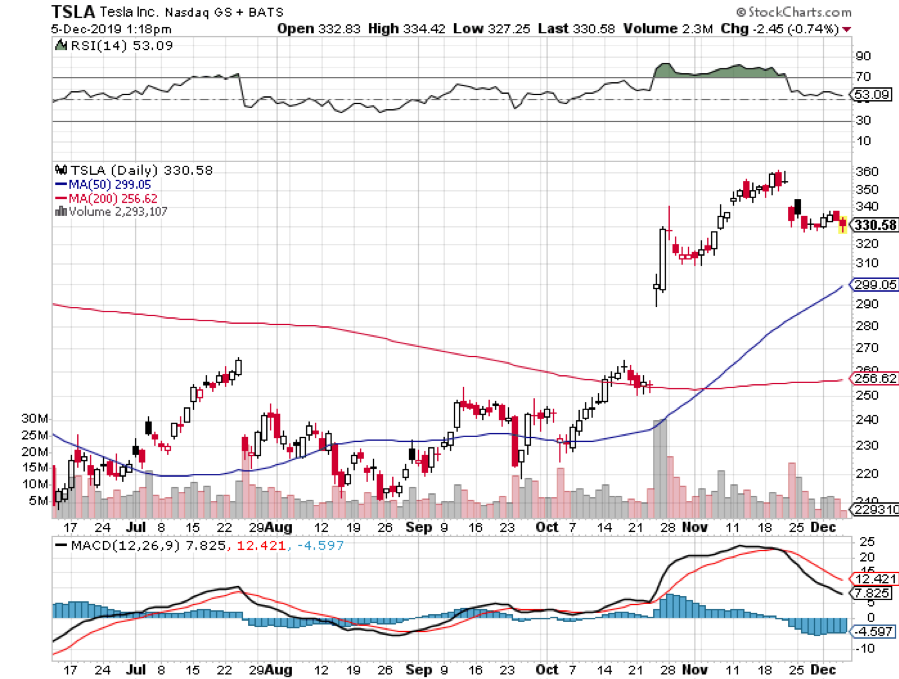
Q: How bad will it get for car makers, and will the Tesla (TSLA) plant in Germany affect sales for European cars?
A: European carmakers have already been badly affected by Tesla, with Tesla taking over practically the entire luxury end of the market—that’s why companies like Mercedes, Audi and BMW are doing so badly with their shares, and they’re so far behind it’s unlikely they’ll ever catch up. The Berlin factory, I believe, is a battery factory, and after that, there will be a vehicle production factory, probably somewhere in eastern Europe where the cost basis is much lower.
Q: Double Line Capital’s CEO Jeff Gundlach says the US will get crushed in the next recession? Do you agree with him?
A: Well, my first advice to you is never take stock advice from a bond trader. Jeff Gundlach makes these spectacular forecasts, but the timing can be terrible. He can be wrong for 9 months before they finally turn. So, you can go out of business trading off of Jeff Gundlach’s stock advice, though his bond advice is valuable.
Q: Do you have any good recommendations for dividend stocks?
A: Yes, look at the entire cellphone towers REIT sector. That will be a growth sector next year with 5G rolling out and they have very high dividend yields. We’re going to get a significant increase in the number of cell towers thanks to 5G, and there are REITs specifically dedicated to cellphone towers. An example is Crown Castle (CCI), which has a generous 3.45% dividend yield.
Q: Are we in the final stages of a blow-off top for the stock market?
A: Yes, but blow-off tops can continue for many months, so don’t rush to sell short. However, next time the VIX gets down to 11, start buying six-month call options on the Volatility Index (VIX) at the $20 strike price. Go far out in the calendar to minimize time decay and far out of the money on strike prices to maximize your bang per buck.
Q: Gold had a nice day on Monday—is this the start of a reversal from the selling pressure?
A: No, as long as the market is pushing to new highs, which it seems to be doing—you don’t want to be anywhere near gold; wait for a better opening lower down.
Q: Are you sending Trade Alerts out on the Mad Hedge Biotech & Healthcare letter?
A: Not in the form that we see in Global Trading Dispatch or the Mad Hedge Technology Letter. Essentially, everything we’ve put out so far has been a long term buy. Most people know nothing about these sectors and we’re trying to get them into buyable names. So far, we’ve issued “BUYS” for 20 different companies; all of them have gone straight up. So, it’s really more of a long term buy-in hold situation. Since we’re in the very early days of the boom in biotech and healthcare stocks, you don’t want to leave money on the table with short term trade alerts for call spreads when there is a double or triple in the stock at hand. We are doing call spreads in the main market where most stocks are already at all-time highs in order to limit our risk.
Q: Fidelity just said that 50% of baby boomers who manage their own portfolio should rebalance it. What do you think is the best way to optimize my portfolio, as a baby boomer born in 1954?
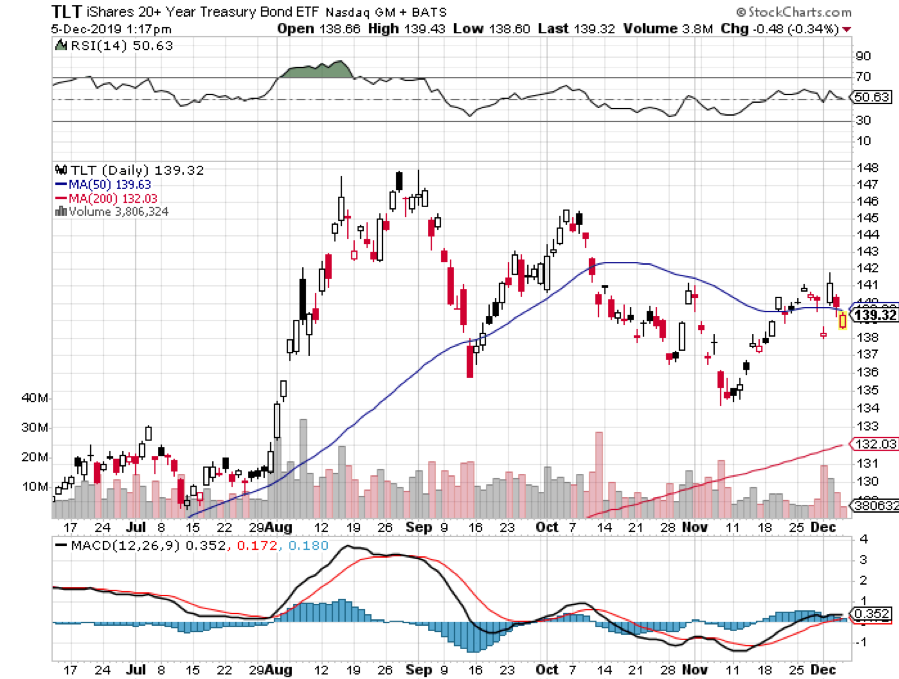
A: You should always rebalance every year, especially when you get enormous moves in single sectors. The interesting thing this year is that everything went up, so you may not need to rebalance that much. When I say rebalance, I’m referring to rebalancing your weightings of stocks vs bonds. If you’re over 50, you want to have roughly a 50/50 ratio on those. That would suggest pairing back some of your equity weightings, increasing your bond weighting because stocks (SPY) (30% total return) have risen a lot more than bonds (TLT) (19% total return) this year.
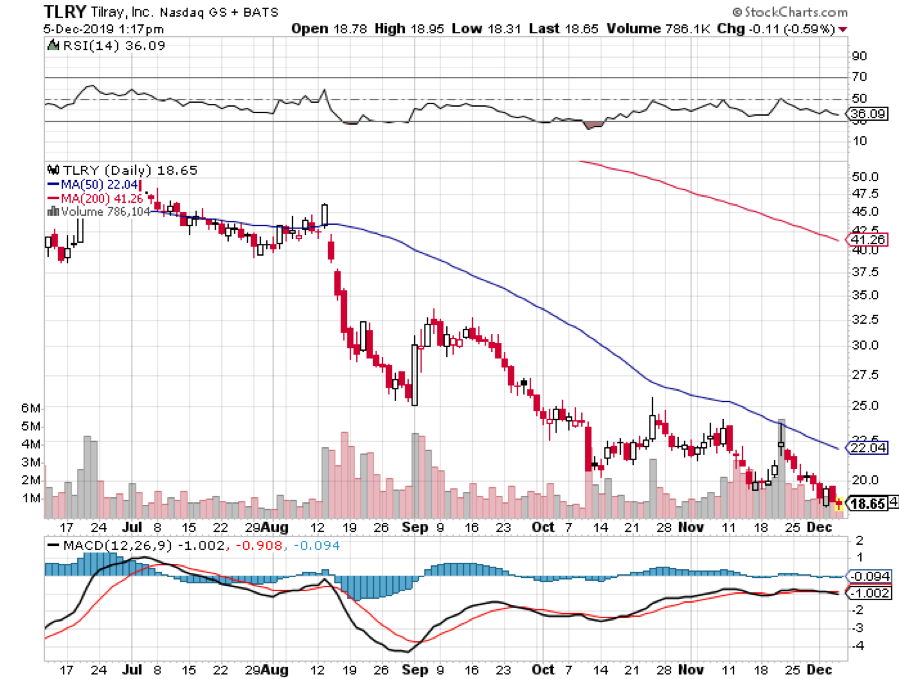
Q: Marijuana stock Tilray (TLRY) has just had a pitiful year going from $100 to $20 and missed earnings targets for 4 for straight quarters. Could this go to zero?
A: Yes; after all, how hard is it to grow a weed? I never bought the story on the whole marijuana sector, not only because they are not allowed to participate in the financial sector. It’s an all-cash business; you hear about people moving around suitcases full of $100 bills doing deals in Oakland and Denver. I believe anybody can do this. My real estate agent is quitting his business to go into cannabis farming. Additionally, they’re getting a lot of competition from the black market where everybody used to buy their marijuana because it’s tax-free. There’s about a 40% price difference between the tax-paying legal form of marijuana and the tax-free black market where people used to get their marijuana. There’s no great value added there. It’s not like they’re designing a 96 stack microprocessor.
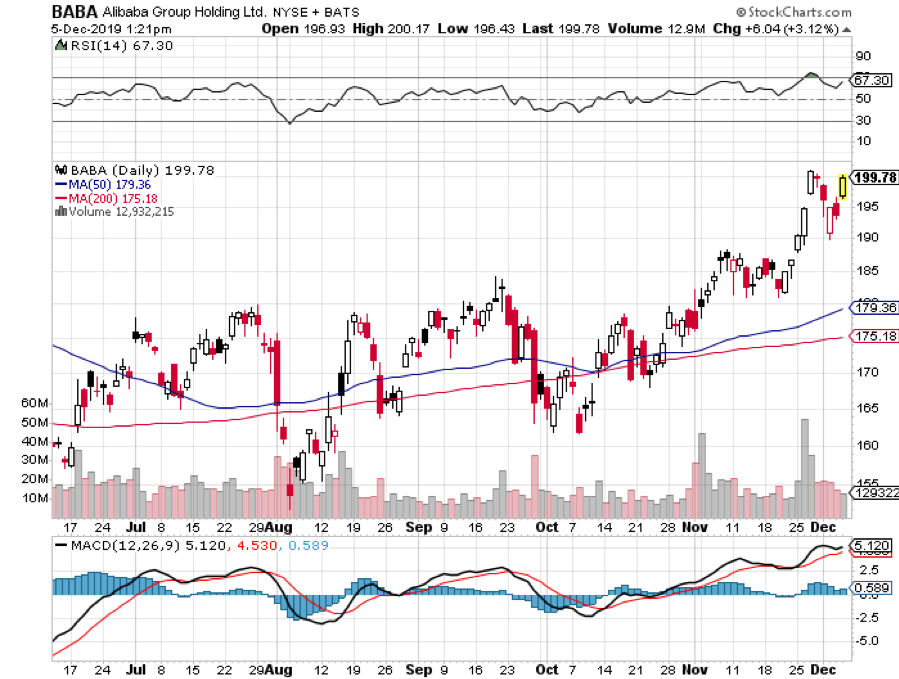
Q: What do you think about Ali Baba (BABA), the Chinese internet giant?
A: I love it long term. Short term, it will be subject to trade war gyration; so use the big dips to buy into it because long term we come out of this.

Mad Hedge Technology Letter
December 6, 2019
Fiat Lux
Featured Trade:
(AUGMENTED REALITY IS HEATING UP),
(AAPL), (LITE), (QCOM), (NVDA), (ADSK), (FB), (MSFT), (SNAP)
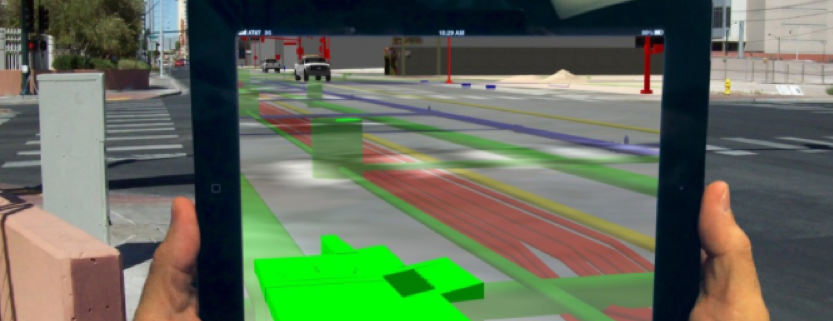
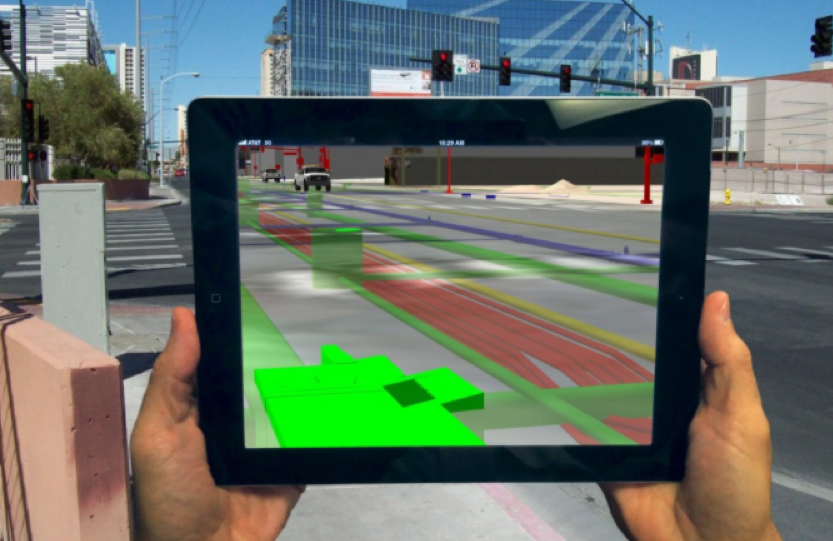
First, what is augmented reality for all the newbies?
Augmented reality is an interactive experience of a real-world environment where the objects that reside in the real world are enhanced by computer-generated perceptual information, sometimes across multiple sensory modalities.
Augmented reality (AR) went rival in 2016 when the Pokemon Go mania captivated everyone from children to adults.
No sooner than 2021, the AR addressable market is poised to mushroom to $83 billion - a sizeable increase from the $350 million in 2018.
Much like machine learning, corporations are learning to marry up this technology with their existing products supercharging the performance.
Ulta Beauty, for example, has acquired AR and artificial intelligence start-ups to help customers digitally test the final appearance of makeup before users purchase the product.
That is just one micro example of what can and will be achieved.
Looking deeper into the guts, Qualcomm (QCOM) is hellbent on making their chips a critical part of the puzzle.
The company is better known for a telecom and a semiconductor play, not often lumped in with a list of AR stocks.
Qualcomm is strategically positioned to capitalize on the integration of augmented reality in mainstream corporate business embedding their chips into the devices.
Maximizing Qualcomm’s future role in the industry, the company announced in 2018 that it would be developing a chipset specifically for AR and VR applications.
This broad-based solution will make it easier for other developers to bring new glasses to the marketplace.
Autodesk (ADSK) is one of my favorite software stocks and a best of breed of industry design.
They sell 3D rendering software to designers and creators by offering a platform in which they can transform 2D designs into digital models that are both interactive and immersive, creating compelling experiences for end-users.
Autodesk has an array of powerful software suites to augment virtually any application, such as 3ds Max, a 3D modeling program; Maya LT game development software; its automotive modeling program VRED; and Forge, a development platform for cloud-based design.
Facebook (FB) has been piling capital into AR for years.
CEO Mark Zuckerberg wants to create an alternative profit-driver and is desperate to wean his brainchild from the digital ad circus.
One example is Facebook’s Portal TV and its Spark AR which is the platform responsible for mobile augmented reality experiences on Facebook, Messenger, and Instagram.
It supplies the virtual effects for consumers to play around with, but it is yet to be seen if consumers gravitate towards this product.
Lumentum (LITE) is the leader in 3D-sensing markets developing cloud and 5G wireless network deployments.
They manufacture 3D sensor lasers that can be used with smartphones to turn handsets into a sort of radar. Sensors are clearly a huge input in how AR functions along with the chips.
CEO of Apple (AAPL) Tim Cook put it best when he earlier said, “I do think that a significant portion of the population of developed countries, and eventually all countries, will have AR experiences every day, almost like eating three meals a day, it will become that much a part of you.”
He said that in 2016 and AR has yet to mushroom into the game-changing sector initially thought partly because the roll-out of 5G is taking longer than first expected.
Apple consumers will need to then adopt a 5G device or phone to really get the AR party started and that won’t happen until the backend of next year.
My initial channel checks hint that the Cupertino firm is planning a 5.4-inch model, two 6.1-inch devices, and one 6.7-inch phone, all of which will support 5G connectivity.
I surmise that Apple’s two premium devices will feature “world-facing” 3D sensing, a technology that could help Apple boost its augmented-reality capabilities and support other feature improvements on its priciest devices.
Apple has had a big hand in Lumentum's growth and will continue to buy their sensors, but other key component suppliers will get contracts such as Finisar, a manufacturer of optical communication components and subsystems.
Apple planned to debut AR glasses by 2020, but the rollout is now delayed until 2022.
They are clearly on the back foot with Microsoft (MSFT) further along in the process.
Microsoft already has a second iteration of its AR headset, HoloLens, and is compatible with several apps and has integration with Azure as well.
The head start of 2 years could really make a meaningful impact and might be hard for Apple to recover.
Facebook isn’t the only social media company going full steam into AR, Snap (SNAP) recently unveiled its newest spectacles, which feature AR elements.
Another application of AR is autonomous driving with Nvidia working on improving the driving experience by fusing AR with artificial intelligence.
Nvidia (NVDA) is already thinking about the next generation of AR technologies with varifocal displays, which improve the clarity of an object for a user.
It will take time to transform our relationship with AR, the infrastructure is still getting built out and many people just don’t have a device that will allow us to tap into the technology.
Investors must know that AR-related stocks will start to appreciate from the anticipation of full sale adoption and there could be a killer app that forces the mainstream user to take notice.
Until then, companies jockey for position and hope to be the ones that take the lion’s share of the revenue once the technology goes into overdrive.

“If you think you deserve a raise, you should just ask.” – Said CEO of Microsoft Satya Nadella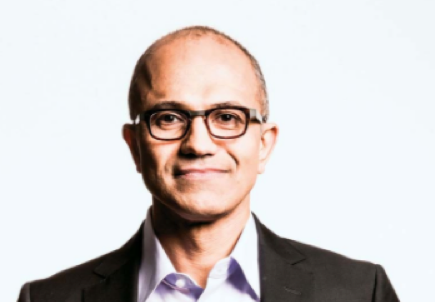
While the Diary of a Mad Hedge Fund Trader focuses on investment over a one week to a six-month time frame, Mad Day Trader, provided by Bill Davis, will exploit money-making opportunities over a brief ten minute to three-day window. It is ideally suited for day traders, but can also be used by long-term investors to improve market timing for entry and exit points. Read more
Global Market Comments
December 5, 2019
Fiat Lux
Featured Trade:
(MY 20 RULES FOR TRADING IN 2020)
Mad Hedge Biotech & Healthcare Letter
December 5, 2019
Fiat Lux
Featured Trade:
(WHY 1 + 1 = 4 WITH THE BRISTOL MYERS/CELGENE MERGER),
(BMY), (CELG), (AMGN)
