My next global strategy webinar will be held live from Silicon Valley on Wednesday, May 9, at 12:00 PM EST.
Co-hosting the show will Mad Day Trader?Bill Davis.
I'll be giving you my updated outlook on stocks, bonds, commodities, currencies, precious metal, and real estate.
The goal is to find the cheapest assets in the world to buy, the most expensive to sell short, and the appropriate securities with which to take these positions.
I will also be opining on recent political events around the world and the investment implications therein.
I usually include some charts to highlight the most interesting new developments in the capital markets. There will be a live chat window with which you can pose your own questions.
The webinar will last 45 minutes to an hour. International readers who are unable to participate in the webinar live will find it posted on my website within a few hours.
I look forward to hearing from you.
To register for the webinar, please click on the link we emailed you entitled, "Next Bi-Weekly Webinar - May 9, 2018" or click here.
https://www.madhedgefundtrader.com/wp-content/uploads/2018/04/John-Thomas.jpg337369MHFTRhttps://madhedgefundtrader.com/wp-content/uploads/2019/05/cropped-mad-hedge-logo-transparent-192x192_f9578834168ba24df3eb53916a12c882.pngMHFTR2018-05-04 01:07:262018-05-04 01:07:26Don't Miss the May 9 Global Strategy Webinar
I am constantly on the lookout for ten baggers, stocks that have the potential to rise tenfold over the long term.
Look at the great long-term track records compiled by the most outstanding money managers, and they always have a handful of these that account for the bulk of their outperformance, or alpha, as it is known in the industry.
I've found another live one for you.
Elon Musk's Space X is so forcefully pushing forward rocket technology that he is setting up one of the great investment opportunities of the century.
In the past decade his start up has accomplished more breakthroughs in advanced rocket technology than seen in the last half century, since the golden age of the Apollo space program.
As a result, we are now on the threshold of another great leap forward into space. Musk's ultimate goal is to make mankind an "interplanetary species".
There is only one catch.
Space X is not yet a public company, being owned by a handful of fortunate insiders and venture capital firms. But you should get a shot at the brass ring someday.
The rocket launch and satellite industry is the biggest business you have never heard of, accounting for $200 billion a year in sales globally. This is probably because there are no pure stock market plays.
Only two major companies are public, Boeing (BA) and Lockheed Martin (LMT), and their rocket businesses are overwhelmed by other aerospace lines.
The high value added product here is satellite design and construction, with rocket launches completing the job.
Once dominated by the US, the market for launches has long since been ceded to foreign competitors. The business is now captured by Europe (the Arianne 5), China (the Long March 5), and Russia (the Angara A5).
Until recently, American rocket makers were unable to compete because decades of generous government contracts enabled costs to spiral wildly out of control.
Whenever I move from the private to the governmental sphere, I am always horrified by the gross indifference to costs. This is the world of the $10,000 coffee maker and the $20,000 toilet seat.
Until 2010, there was only a single US company building rockets, the United Launch Alliance (ULA), a joint venture of Boeing and Lockheed Martin. ULA builds the aging Delta IV and Atlas V rockets.
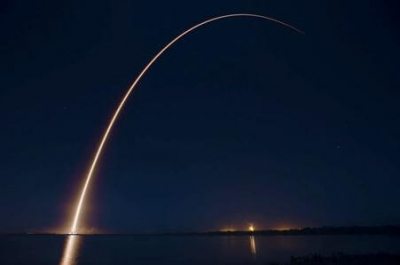
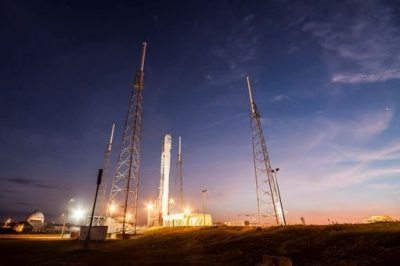
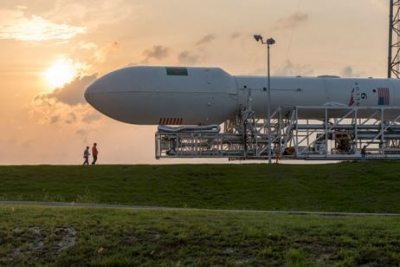
The vehicles are launched from Cape Canaveral, Florida and Vandenberg Air Force Base in California, one of which I had the privilege to witness. They look like huge roman candles that just keep on going, until they disappear into the blackness of space.
Enter Space X.
Extreme entrepreneur Elon Musk has shown a keen interest in space travel throughout his life. The sale of his interest in PayPal, his invention, to Ebay (EBAY) in 2002 for $165 million, gave him the means to do something about it.
He then discovered Tom Mueller, a childhood rocket genius from remote Idaho who built the largest ever amateur liquid fueled vehicle, with 13,000 pounds of thrust. Musk teamed up with Mueller to found Space X in 2002.
A decade of grinding hard work, bold experimentation, and heart rending testing ensued, made vastly more difficult by the 2008 Great Recession.
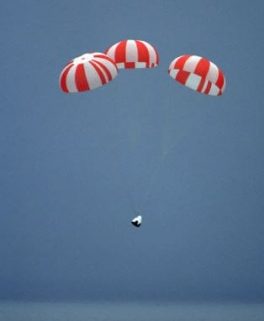
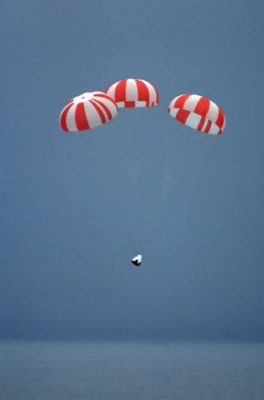
Space X's Falcon 9 first flew in June, 2010, and successfully orbited earth. In December, 2010 it launched the Dragon space capsule and recovered it at sea. It was the first private company ever to accomplish this feat.
Dragon successfully docked with the International Space Station (ISS) in May, 2012. NASA has since provided $440 million to Space X for further Dragon development.
The result was the launch of the Dragon V2 (no doubt another historical reference) in May, 2014, large enough to carry seven astronauts.
Then Musk really upped his game by successfully pulling off the first ever landing of a booster rocket on a platform at sea in April, 2016. This is crucial for his plan to dramatically cutting the cost of space travel.
Commit all these names to memory. You are going to hear a lot about them.
Musk's spectacular success with Space X can be traced to several different innovations.
He has taken the Silicon Valley hyper competitive ethos and financial model and applied it to the aerospace industry, the home of the bloated bureaucracy, the no bid contract, and the agonizingly long time frame.
For example, his initial avionics budget for the early Falcon 1 rocket was $10,000, and was spent on off-the-shelf consumer electronics. It turns out that their quality had improved so much in recent years they met military standards.
But no one ever bothered to test them. $10,000 wouldn't have covered the food at the design meetings at Boeing or Lockheed-Martin, which would have stretched over years.
Similarly, Musk sent out the specs for a third party valve actuator no more complicated than a garage door opener, and a $120,000, one-year bid came back. He ended up building it in house for $3,000. Musk now tries to build as many parts in house as possible, giving it additional design and competitive advantages.
This tightwad, full speed ahead and damn the torpedoes philosophy overrides every part that goes into Space X rockets.
Amazingly, the company is using 3-D printers to make rocket parts, instead of having each one custom made.
Machines guided by computers carve rocket engines out of a single block of inconel nickel-chromium super alloy, foregoing the need for conventional welding, a frequent cause of engine failures.
Space X is using every launch to simultaneously test dozens of new parts on every flight, a huge cost saver that involves extra risks that NASA would never take. It also uses parts that are interchangeable of all its rocket types, another substantial cost saver.
Space X has effectively combined three nine engine Falcon 9 rockets to create the 27 engine Falcon Heavy, the world's largest operational rocket. It has a load capacity of a staggering 53 metric tons, the same as a fully loaded Boeing 737 can carry. It has half the thrust of the gargantuan Saturn V moon rocket that last flew in 1973.
Musk is able to capture synergies among his three companies not available to any competitor. Space X gets the manufacturing efficiency of a mass production car maker.
Tesla Motors has access to the futuristic space age technology of a rocket maker. Solar City (SCTY) provides cheap solar energy to all of the above.
And herein lies the play.
As a result of all these efforts, Space X today can deliver what ULA does for 76% less money with vastly superior technology and capability. Specifically, its Falcon Heavy can deliver a 116,600 pound payload into low earth orbit for only $90 million, compared to the $380 million price tag for a ULA Delta IV 57, 156 pound launch.
In other words, Space X can deliver cargo to space for $772 a pound, compared to the $7,515 a pound ULA charges the US government. That's a hell of a price advantage.
You would wonder when the free enterprise system is going to kick in and why Space X doesn't already own this market.
But selling rockets are not the same as shifting iPhones, laptops, watches, or cars. There is a large overlap with the national defense of every country involved.
Many of the satellites launches are military in nature and top secret. As the cargoes are so valuable, costing tens of millions of dollars each, reliability and long track records are big issues.
Enter the wonderful world of Washington DC politics. ULA constructs its Delta IV rocket in Decatur, Alabama, the home state of Senator Richard Shelby, the powerful head of the Banking, Finance, and Urban Affairs Committee.
The first Delta rocket was launched in 1960, and much of its original ancient designs persist in the modern variants. It is a major job creator in the state.
Shelby has criticized President Obama's attempt to privatize and modernize the rocket business as a "faith based initiative." ULA is a major contributor to Shelby's campaigns.
ULA has no rocket engine of its own. So it buys engines from Russia, complete with blue prints, hardly a reliable supplier. Magically, the engines have so far been exempted from the economic and trade sanctions enforced by the US against Russia for its invasion of Ukraine.
ULA has since signed a contract with Amazon's Jeff Bezos owned Blue Origin, which is also attempting to develop a private rocket business, but is miles behind Space X.
Musk testified in front of congress in 2014 about the viability of Space X rockets as a financially attractive, cost saving option. His goal is to break the ULA monopoly and get the US government to buy American. You wouldn't think this is such a tough job, but it is.
Musk has since sued the US Air Force to open up the bidding.
Elon became a US citizen in 2002 primarily to qualify for bidding on government rocket contracts, addressing national security concerns.
NASA did hold open bidding to build a space capsule to ferry astronauts to the International Space Station. Boeing won a $4.2 billion contract, while Space X received only $2.6 billion, despite superior technology and a lower price.
It is all part of a 50 year plan than Musk confidently outlined to a venture capital friend of mine two decades ago. So far, everything has played out as predicted.
The Holy Grail for the space industry has long been the building of reusable rockets, thought by many industry veterans to be impossible.
Imagine what the economics of the airline business would be if you threw away the airplane after every flight? It would cost $1 million for one person to fly from San Francisco to Los Angeles.
This is how the launch business has been conducted since the inception of the industry in the 1950's.
Space X is on the verge of accomplishing exactly that. It will do so by using its Super Draco engines and thrusters to land rockets at a platform at sea. Then you just reload propellant and relaunch.
The concept has so far been successfully tested to an altitude of 1,000 meters (click here).
Attempts to do this from a live launch have so far failed (click here for the video where they almost made it and second video), but Musk predicts a 50% chance of success in the next test this coming December.
Pull this off, and launch costs will plummet to pennies on the dollar. If Space X can chop payload costs to under $100, compared to ULA's $7,515, that is a savings that even Richard Shelby can't cover up.
Talk about disruptive innovation with a turbocharger!
The company is building its own spaceport in Brownsville, Texas that will be able to launch multiple rockets a day.
The Hawthorne, CA factory (where I charge my own Tesla S-1 when in LA) now has the capacity to build 20 rockets a year. This will eventually be ramped up to hundreds.
Space X is the only organization that offers a launch price list on its website, similar to how Amazon sells its books (click here for that link). The Falcon 9 will carry 28,930 pounds of cargo into low earth orbit for only $60.2 million. Sounds like a bargain to me.
Space X currently has $5 billion in contracts to fly over 50 missions for a variety of private and governmental entities, making the company cash flow positive. This includes a $1.6 billion NASA contract to supply the (ISS).
This no doubt includes an assortment of tax breaks, which Musk has proven adept at harvesting. Elon has been a quick learner with the ways of Washington.
Customers have included the Thai telecommunications firm, Rupert Murdock's Sky News Japan, an Israeli telecommunications group, and the US Air Force.
So when do we mere mortals get to buy the stock? Musk estimates at 12 flights a year the company will earn a 10% return on capital, making it worth $4-5 billion.
The current exponential growth in broadband will lead to a similar growth in satellite orders, and therefore rocket launches. So the commercial future of the company looks especially bright.
However, Musk is in no rush to go public. A permanent, viable, and sustainable colony on Mars has always been a fundamental goal of Space X. It would be a huge distraction for a publicly managed company. That makes it a tough sell to investors in the public markets.
You can well imagine that the next recession would bring cries from shareholders for cost cutting that would put the Mars program at the top of any list of projects to go on the chopping block. So Musk prefers to wait until the Mars project is well established before entertaining an IPO.
Musk expects to launch a trip to Mars by 2025 and establish a colony that will eventually grow to 80,000. Tickets will be sold for $500,000.
There are other considerations. Many employee and early venture capital investors wish to realize their gains and move on. Public ownership would also give the company extra ammunition for cutting through Washington red tape. These factors point to an IPO that is earlier than later.
On the other hand, Musk may not care. The last net worth estimate I saw for him was $13 billion. If his three companies increase in value by ten times over the next decade, as I expect, that would increase his wealth to $130 billion, making him the richest person in the world.
If an IPO does come, investors should jump in with both boots. While the value of the firm may have already increased tenfold by then, there may be another tenfold gain to come. Get on the Elon Musk train before it leaves the station.
To describe Elon as a larger than life figure would be something of an understatement. Musk is the person on which the fictional playboy/industrialist/technology genius, Tony Stark, in the Iron Man movies has been based.
In the released Tomorrowland Disney movie, a Tesla supercharging station features prominently. Elon takes all this in in good humor, lending a Tesla roadster to the film producers.
Musk has said he wishes to die on Mars, but not on impact. Perhaps it would be the ideal retirement for him, say around 2045, when he will be 75.
To visit the Space X website, please click here. It offers very cool videos of rocket launches and a discussion with Elon Musk on the need for a Mars mission.
Catching a Dragon by the Tail
This Could Be the Stock Performance
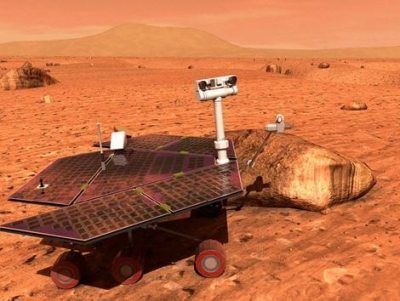
Is Mars the Next Hot Retirement Spot?
https://www.madhedgefundtrader.com/wp-content/uploads/2015/05/Capsule-Re-entry-Parashutes-e1432763072757.jpg400264Mad Hedge Fund Traderhttps://madhedgefundtrader.com/wp-content/uploads/2019/05/cropped-mad-hedge-logo-transparent-192x192_f9578834168ba24df3eb53916a12c882.pngMad Hedge Fund Trader2018-05-04 01:06:522018-05-04 01:06:52Will Space X Be Your Next Ten Bagger?
"The longer you wait to fire someone, the longer it has been since you should have fired them," said Elon Musk, founder and CEO of Space X and Tesla Motors.
https://www.madhedgefundtrader.com/wp-content/uploads/2015/05/Fortune-Cooke-Youre-Fired-e1432762960406.jpg196300Mad Hedge Fund Traderhttps://madhedgefundtrader.com/wp-content/uploads/2019/05/cropped-mad-hedge-logo-transparent-192x192_f9578834168ba24df3eb53916a12c882.pngMad Hedge Fund Trader2018-05-04 01:05:022018-05-04 01:05:02May 4, 2018 - Quote of the Day
While the Diary of a Mad Hedge Fund Trader focuses on investment over a one week to six-month time frame, Mad Day Trader, provided by Bill Davis, will exploit money-making opportunities over a brief ten minute to three day window. It is ideally suited for day traders, but can also be used by long-term investors to improve market timing for entry and exit points. Read more
https://madhedgefundtrader.com/wp-content/uploads/2019/05/cropped-mad-hedge-logo-transparent-192x192_f9578834168ba24df3eb53916a12c882.png00Mad Hedge Fund Traderhttps://madhedgefundtrader.com/wp-content/uploads/2019/05/cropped-mad-hedge-logo-transparent-192x192_f9578834168ba24df3eb53916a12c882.pngMad Hedge Fund Trader2018-05-03 08:35:022018-05-03 08:35:02May 3, 2018 - MDT Pro Tips A.M.
Everyone who has been reading this letter for the past decade (yes, there are quite a few of you), know that I am a fundamentalist first and a technician second.
Of course, you need to use both, as those who mistakenly leave one tool in the bag reliably underperform indexes.
The one-liner here is that I use fundamentals to identify broad, long-term, even epochal trends, and technicals for the short-term timing of my Trade Alerts.
Do both well, and you will prosper mightily.
Strategists often like to cloak themselves in the fundamental or technical mantels alone. But parse their words carefully, and the best fundamentalists talk about support and resistance levels, while the ace technicians refer to the latest economic data points.
The reality is that the best of the best are using both all the time. The differential titles have more to do with marketing purposes than anything else.
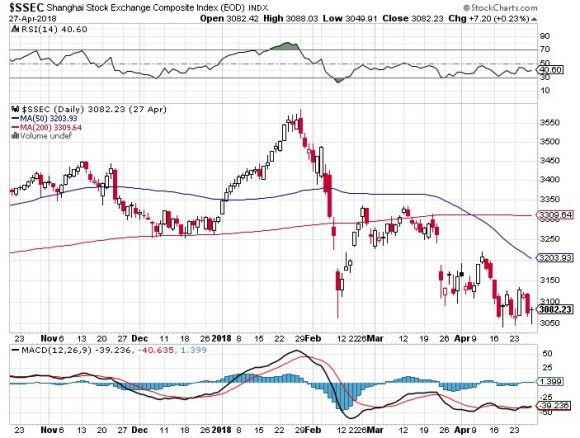
Having said all that, you better take a good, hard look at the chart below for the Shanghai Stock Exchange Composite Index ($SSEC). The 2016 low has held and the long-term uptrend lives.
My bet is that it resolves to the upside. All it would be doing then is coming in line with the rest of the global equity markets, including those of many emerging markets.
Since the last top, the earnings multiple of Chinese companies has plunged, from 35 times to a mere 15 times. This means that the 6.5% a year growing economy (China) is trading at a lower multiple than the 2.3% a year growing one (the U.S.). The big question among strategists since 2009 has been how far these valuations would diverge.
If I am right, then you can expect a rally of at least 25% in the Shanghai market soon, and more in peripheral markets, such as Hong Kong (EWH) and in single Chinese names. My bet is that it starts in August, when the current correction ends and we resume the year-end ramp-up.
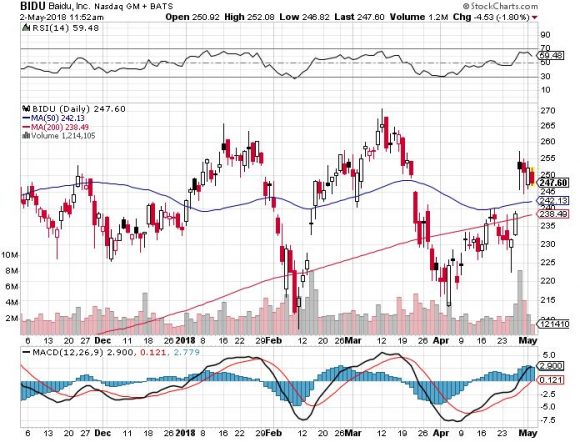
You should place a laser-like focus on the Chinese Internet sector, so you won't go wrong picking up some Baidu (BIDU) around $180, if you can get it (click here for my original recommendation to buy the stock at $12 nine years ago).
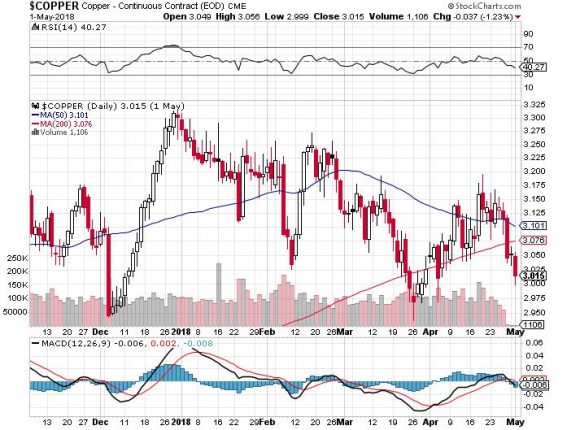
If you are looking for further confirmation of the coming bull move in China across asset classes, please peruse the chart below for copper. The red metal has one of the closest correlations out there with the fate of the Middle Kingdom's economy and stock markets. It appears to be breaking out of a major five-year downtrend as well.
The other nice thing about this scenario is that it provides more fodder for my expectation of another global bull market move in the fall, when you can expect major indexes to tack on another 10% by year-end.
Jim Chanos, watch your back!
https://www.madhedgefundtrader.com/wp-content/uploads/2018/05/Man-in-China-story-2-image-6.jpg225336MHFTRhttps://madhedgefundtrader.com/wp-content/uploads/2019/05/cropped-mad-hedge-logo-transparent-192x192_f9578834168ba24df3eb53916a12c882.pngMHFTR2018-05-03 01:06:152018-05-03 01:06:15Don't Be Short China Here
Do not believe half-truths that go against economic convention.
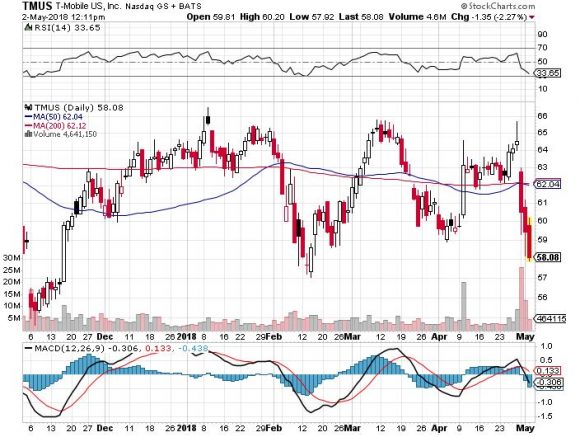
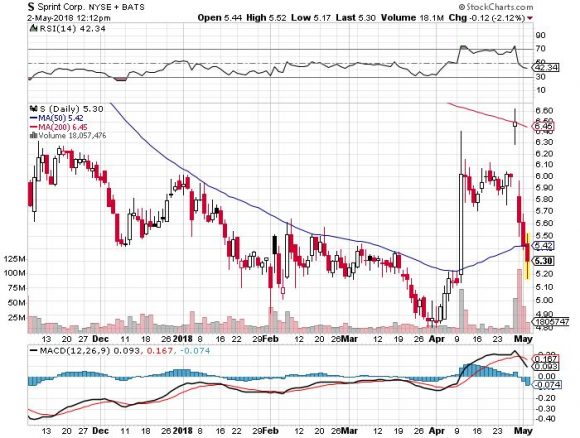
This was the case when T-Mobile (TMUS) CEO John Legere and Sprint (S) CEO Marcelo Claure popped up on live TV promoting affordability, elevated competition, and massive 5G infrastructure investments if the two companies joined forces in a $26.5 billion deal.
This was a case of smoke and mirrors. The speculative claim of adding 3 million workers and investing $40 billion into 5G development is just a line pandering toward President Trump's nationalistic tendencies.
They want the deal to move forward any way possible.
Jack Ma, founder and executive chairman of Alibaba (BABA), met President Trump at Trump Towers before his term commenced and promised to add 1 million jobs in order to curry favor with the new order.
Where are those jobs?
If this merger came to fruition, market players would shrink from 4 to 3 - a newly reformulated T-Mobile plus Verizon (VZ) and AT&T (T).
Pure economics dictate that shrinking competition by 25% would create pricing leverage for the leftover trio.
Industry consolidation is usually met with accelerated profit drivers because companies can get away with reckless price increases without offering more goods and services.
Being at the vanguard of the 4G movement, America overwhelmingly benefited from lucid synergistic applications that fueled domestic job growth and economic gains.
Japanese and German players were hit hard from missing out in leading the new wave of wireless technology.
T-Mobile and Sprint wish to be insiders of this revolutionary technology and this is their way in.
In the past, T-Mobile jumped onto the scene with aggressively twisting its business model to fight tooth and nail with Verizon and AT&T.
It was moderately successful.
T-Mobile even offered affordable plans without contracts offering customers optionality and advantageous pricing.
It was able to take market share from Sprint, which is the monumental laggard in this group and the butt of jokes in this foursome.
The average cost of wireless has slid 19% in the past five years, and traditional wireless Internet companies are sweating bullets as the future is murky at best.
The bold strategy to merge these two wireless firms derives from an urgent need to combat harsh competition from the two titans Verizon and AT&T.
The merger is in serious threat of being shot down by the Department of Justice (DOJ) on antitrust grounds.
History is littered with companies that became complacent and toppled because of monopolistic positions.
Case in point, the predominant force in the American and global economy was the American automotive industry and Detroit in the 1950s.
Detroit had the highest income and highest rate of home ownership out of any major American city at that time.
Flint, Michigan, oozed prosperity, and the top three car manufacturers boasted magnanimous employee benefits and a tight knit union.
During this era of success, 50% of American cars were made by GM and 80% of cars were American made.
The car industry could do no wrong.
This would mark the peak of American automotive dominance, as local companies failed to innovate, preferring stop-gap measures such as installing add-ons such as power steering, sound systems, and air conditioning instead of properly developing the next generation of models.
American companies declined to revolutionize the expensive system put in place that could produce new models because of the absence of competition and were making too much money to justify alterations.
It's expensive to make cars but neglecting reinvestment yielded future mediocrity to the detriment of the whole city of Detroit.
The tech mentality is the polar opposite with most tech firms reinvesting the lion's share of operational profit, if any, back into product improvement.
Sprint got burned because it skimped on investment. It is in a difficult predicament dependent on T-Mobile to haul it out of a precarious position.
GM, Ford, and Chrysler met their match when Toyota imported a vastly more efficient way of production and the rest is history.
Detroit is a ghastly remnant of what it used to be with half the population escaping to greener pastures.
A carbon copy scenario is playing out in the mobile wireless space and allowing a merger would suppress any real competition.
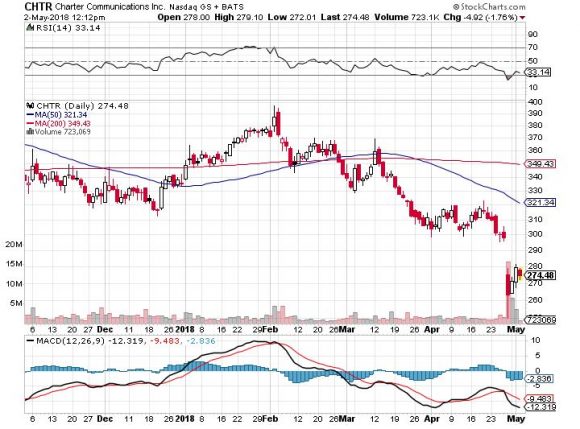
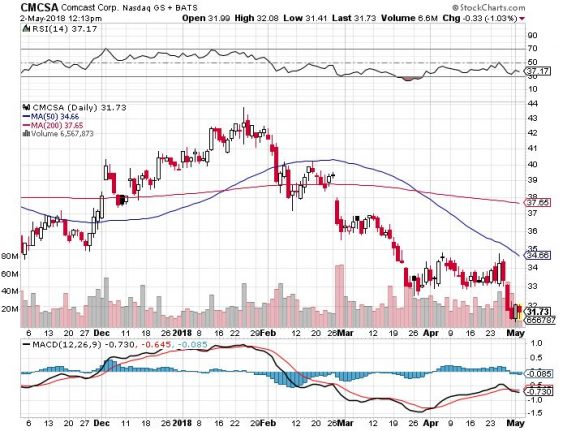
To add confusion to the mix, fresh competition is growing on the fringes desiring to disrupt this industry sooner than later by cable providers such as Charter (CHTR) and Comcast (CMCSA) entering the fray offering mobile phone plans.
Google also offers a mobile phone plan through the Google Fi division.
The fusion of wireless, broadband, and video is attracting competition from other spheres of the business world.
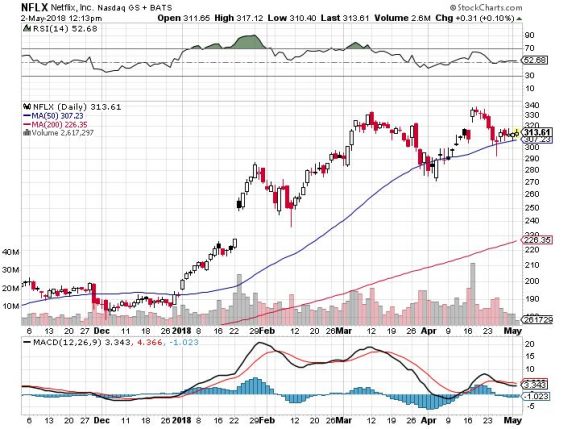
The paranoia served in doses originates from the Netflix (NFLX) threat that vies for the same entertainment dollars and eyeballs.
Remember that AT&T is in the midst of merging with Time Warner Cable, which is the second largest cable company behind Comcast.
The top two in the bunch - AT&T and Verizon - are under attack from online streaming business models, and the Time Warner merger is a direct response to this threat.
There are a lot of moving parts to this situation.
AT&T hopes to leverage new video content to extract digital ad revenue capturing margin gains.
Legere and Claure put on their fearmongering hats as they argued that this deal has national security implications and losing out to Chinese innovation is not an option.
This argument is ironic considering T-Mobile is a German company and Sprint is owned by the Japanese.
Sprint have been burning cash for years and this move would ensure the businesses survives.
Sprint's crippling debt puts it in an unenviable position and this merger is an all or nothing gamble.
Sprint has not invested in its network and is miles behind the other three.
AT&T has outspent Sprint by more than $90 billion in the past 10 years.
This is the last chance saloon for Sprint whose stock price has halved in the past four years.
However, T-Mobile sits on its perch as a healthier rival that would do fine on a stand-alone basis.
Consolidation of this great magnitude never pans out for the consumer as users' interests get moved down the pecking order.
Wireless stocks were taken out and beaten behind the wood shed on the announcement of this news as the lack of clarity moving forward marked a perfect time to sell.
There will be many twists and turns in this saga and any capital put to use now will be dead money while this imbroglio works itself out.
If the deal doesn't die a slow death and finds a way through, the approval process will be drawn out and cumbersome.
The ambitious deadline of early 2019 seems highly unrealistic even with the most optimistic guesses.
The outsized winner from a deal would be AT&T, Verizon, and the newly formed T-Mobile and Sprint operation.
If this new wave of consolidation becomes reality, pricing pressure on the business model would ease for the remaining players, particularly allowing more breathing room for the leaders.
Stay away from this sector until the light can be seen at the end of the tunnel.
"I can calculate the motions of heavenly bodies, but never the madness of crowds," said Sir Isaac Newton, the inventor of calculus and discoverer of Newton's Laws, who lost his entire fortune in a 17th century investment scam called "the South Sea Bubble."
https://www.madhedgefundtrader.com/wp-content/uploads/2018/05/Issac-Newton-quote-of-the-day.jpg137129MHFTRhttps://madhedgefundtrader.com/wp-content/uploads/2019/05/cropped-mad-hedge-logo-transparent-192x192_f9578834168ba24df3eb53916a12c882.pngMHFTR2018-05-03 01:05:102018-05-03 01:05:10May 3, 2018 - Quote of the Day
While the Diary of a Mad Hedge Fund Trader focuses on investment over a one week to six-month time frame, Mad Day Trader, provided by Bill Davis, will exploit money-making opportunities over a brief ten minute to three day window. It is ideally suited for day traders, but can also be used by long-term investors to improve market timing for entry and exit points. Read more
https://madhedgefundtrader.com/wp-content/uploads/2019/05/cropped-mad-hedge-logo-transparent-192x192_f9578834168ba24df3eb53916a12c882.png00Mad Hedge Fund Traderhttps://madhedgefundtrader.com/wp-content/uploads/2019/05/cropped-mad-hedge-logo-transparent-192x192_f9578834168ba24df3eb53916a12c882.pngMad Hedge Fund Trader2018-05-02 08:33:532018-05-02 08:33:53May 2, 2018 - MDT Pro Tips A.M.
Legal Disclaimer
There is a very high degree of risk involved in trading. Past results are not indicative of future returns. MadHedgeFundTrader.com and all individuals affiliated with this site assume no responsibilities for your trading and investment results. The indicators, strategies, columns, articles and all other features are for educational purposes only and should not be construed as investment advice. Information for futures trading observations are obtained from sources believed to be reliable, but we do not warrant its completeness or accuracy, or warrant any results from the use of the information. Your use of the trading observations is entirely at your own risk and it is your sole responsibility to evaluate the accuracy, completeness and usefulness of the information. You must assess the risk of any trade with your broker and make your own independent decisions regarding any securities mentioned herein. Affiliates of MadHedgeFundTrader.com may have a position or effect transactions in the securities described herein (or options thereon) and/or otherwise employ trading strategies that may be consistent or inconsistent with the provided strategies.