• support@madhedgefundtrader.com
  • Member Login
Mad Hedge Fund Trader
  • Home
  • About
  • Store
  • Luncheons
  • Testimonials
  • Contact Us
  • Click to open the search input field Click to open the search input field Search
  • Menu Menu
Arthur Henry

Notice to Military Subscribers

Diary, Newsletter, Research

To the dozens of subscribers in Afghanistan and the surrounding ships at sea, thank you for your service!

I think it is very wise to use your free time to read my letter and learn about financial markets in preparation for an entry into the financial services when you muster out.

Nobody is going to call you a baby killer and shun you, as they did when I returned from Southeast Asia four decades ago. In fact, employers have been given fantastic tax breaks and other incentives to hire you.

I have but one request. No more subscriptions with .mil addresses, please. The Defense Department, the CIA, the NSA, Homeland Security, and the FBI do not look kindly on private newsletters entering the military network, even the investment kind.

If you think civilian spam filters are tough, watch out for the military kind! And no, I promise that there are no secret messages embedded with stock tips. "BUY" really does mean "BUY." "Sel" means "Sell" too.

If I did not know the higher ups at these agencies, as well as the Joint Chiefs of Staff, I might be bouncing off the walls in a cell at Guantanamo by now wearing an orange jumpsuit.

It also helps that many of the mid-level officers at these organizations have made a fortune with their meager government retirement funds following my advice. All I can say is that if the Baghdad Stock Exchange ever becomes liquid, I'm going to own it.

Where would you guess the greatest concentration of readers of The Diary of a Mad Hedge Fund Trader is found? New York? Nope. London? Wrong. Chicago? Not even close. Try a ten-mile radius centered around Langley, Virginia, by a large margin.

The funny thing is, half of the subscribing names coming in are Russian. I haven't quite figured that one out yet. Did we hire the entire KGB at the end of the cold war? If we did, it was a great move. Those guys were good. That includes you, Yuri.

So keep up the good work, and fight the good fight. But please, only subscribe to my letter with personal Gmail, Yahoo, or Hotmail addresses. That way my life can become a lot more boring.

Oh, and by the way, Langley, you're behind on your bill. Please pay up, pronto, and I don't want to hear whining about any damn budget cuts!

I Want My Mad Hedge Fund Trader!

https://www.madhedgefundtrader.com/wp-content/uploads/2017/06/army-cig-e1498672458898.jpg 393 557 Arthur Henry https://madhedgefundtrader.com/wp-content/uploads/2019/05/cropped-mad-hedge-logo-transparent-192x192_f9578834168ba24df3eb53916a12c882.png Arthur Henry2018-03-02 01:06:372018-03-02 01:06:37Notice to Military Subscribers
Arthur Henry

March 2, 2018

Tech Letter

Mad Hedge Technology Letter
March 2, 2018
Fiat Lux

Featured Trade:
(WHEN WILL THE GOVERNMENT HAVE TO KILL A FANG?),
(FB), (AAPL), (NFLX), (GOOGL), (AMZN), (TWTR)

??
https://madhedgefundtrader.com/wp-content/uploads/2019/05/cropped-mad-hedge-logo-transparent-192x192_f9578834168ba24df3eb53916a12c882.png 0 0 Arthur Henry https://madhedgefundtrader.com/wp-content/uploads/2019/05/cropped-mad-hedge-logo-transparent-192x192_f9578834168ba24df3eb53916a12c882.png Arthur Henry2018-03-02 01:06:072018-03-02 01:06:07March 2, 2018
Arthur Henry

When Will the Government Have to Kill a FANG?

Tech Letter

By now, we all have major over weightings of FANG's in our retirement portfolios. And the greatest threat to those holdings is the prospect of imminent government regulation.

The prospect of government involvement in the FANG's should therefore be more of just passing interest to us.

The relationship between large cap tech companies and the US government is not exactly a match made in heaven.

The hot button political topic of the day is how Russia used Facebook (FB) to influence the US presidential election. (FB) in effect lowered the drawbridge to allow our foreign enemies to come flooding in, and no one noticed until it was too late.

In fact, to say that government and tech are constantly butting heads would be an understatement. However, not all governments are created the same.

China's government has built a formidable moat around their tech industry, granting priority only to local firms and shutting out the rest. Notice that Alphabet (GOOGL) closed its offices in China five years ago.

Europeans have stuck with the school teacher approach by punishing their pupils individually. But the school itself has bigger sway in the grand scheme of things.

Broad based guidelines from the European Commission were handed down today dictating that Google (GOOGL), Facebook, and Twitter (TWTR) have one hour to remove unsavory content from their platforms, or else.

Keep in mind, these new protocols are "voluntary" and follow a series of other "voluntary" self-regulating precepts.

FANG's are still not accountable for anything posted on their platform and are thus insulated from liability. The notion that FANG's will self-police their own platform still pervades through official channels.

Fining FANG's appear authoritative enough to diverse political constituencies, but cash isn't a problem for FANG's. Each one is a mere slap on the wrist.

Preventing a FANG's unstoppable business model is the only solution and that will never happen.

Obviously, the E.U. have a sluggish grasp of how Fang's actually work.

FANG's are an entirely American made creation. Government, by and large, subscribing to the wonders of dynamic market forces, allowed the contest to play out in the trenches and not behind the scenes.

America's hyper competitive business model is also a graveyard littered with once promising tech companies, like MySpace, Napster, and Blackberry's (BB) mobile phone division.

The hope is that FANG model will continue to naturally evolve and self-regulate.

The big takeaway from government is that regulating big tech is a complicated issue. And government will deflect responsibility if pressured into destroying a Fang.

In essence, the net benefit of keeping the FANG's around could be greater than the net cost of getting rid of them for a sovereign nation, especially the consumer.

Today, FANG's are untouchable in cloud services, social media, search capability, e-commerce, advertising, tablets and mobile. The modern economy can't function without them.

Google and Facebook are observing and tracking every user's move, and that feedback is following through back to their reservoir of big data.

The colossal data profile they possess on each individual deduces users' hobbies, purchases, search trends, browsing patterns, location history, and loads more, even sexual orientation.

This probing system refines their hyper-targeting model, which has many unintended consequences, such as the ability to weaponize parts of the platform by rogue elements.

Fixing this problem is challenging and it's possible there are no good fixes out there at all. Jack Dorsey pleaded to users today to give suggestions on making Twitter a better user experience.

He knows the increased pace of weaponization on his platform will ultimately come back to haunt him as the CEO.

FANG's apply user data as inputs for evolving Artificial Intelligence (AI) consisting of a collection of filters. This check lists controls the content that pops up on to your screen based on the structure of finely tuned algorithms.

Google and Facebook (FB) offer the highest quality hyper-targeting in the world and advertisers pay for that quality.

If a negative unintended consequence transpires from a rogue algorithm, the FANG's have proved adept at paying lip service to the right actors to stave off the heat for another day. Kicking the can down the road seems to be their long-term strategy.

Complicating the mess is the fact that 100% of the blame cannot be directly pinned on an unknowing FANG if a team of nefarious hackers cause a ruckus from their computers in some distant land.

The fundamental idea of profit through data privacy and accumulation violently conflicts with the FANG's core business aspirations: hyper-targeted advertising based on increasingly intrusive personal surveillance. They will not change themselves if it means hindering their profitability.

Who would?

One challenge that the American government must hurdle is understanding the magnitude of the situation at hand. Do our politicians understand how to instill more algorithmic accountability and instill privacy policy transparency?

Effectively, playing Tech God is a slippery slope to go down. It's easier said than done, and there are many moving parts to this game. American big government is not ready to destroy a FANG in the land of free enterprise.

You can kiss the nine-year equity bull market good-bye if the government actually kills off Facebook or a Google!

The consensus view is the FANG's will continue to increase our standard of living.

Accelerating additional hyper-targeting, greater algorithmic favoritism, squashing competition and widespread erosion of adjacent industries. And most importantly for investors - higher profits and share prices.

Consumers have benefited immensely from all these free services. It's the competition that's complaining because they aren't FANG's themselves. Life must feel very unfair if you don't have the same tools as FANG companies.

Amazon was clever enough to take profits from their Amazon Web Services (AWS) division to bolster their loss-making e-commerce division. In the process, they crushed American brick and mortar retail.

Shareholders call this genius, while competitors and politicians call this a breach of anti-trust.

Any regulatory blow back that results in a dip of share prices should therefore be bought once the dust settles.

That day could be sometime in the far future, but there will be many twists and turns until we arrive there.

Investors need to ask themselves, does the government have the authority and the determination to ruin a FANG? The answer is no.

What the government is telling investors is they will dabble with the bare minimum of token regulation, but aren't ready to drop the guillotine on large cap tech. The long-term secular growth story is still intact albeit with occasional regulatory friction.

Every dip will be bought by investors queued up for years patiently waiting for an entry point, and the shares upside will be tapered by occasional regulatory headlines.

Regulation will never amount to more than that.

https://madhedgefundtrader.com/wp-content/uploads/2019/05/cropped-mad-hedge-logo-transparent-192x192_f9578834168ba24df3eb53916a12c882.png 0 0 Arthur Henry https://madhedgefundtrader.com/wp-content/uploads/2019/05/cropped-mad-hedge-logo-transparent-192x192_f9578834168ba24df3eb53916a12c882.png Arthur Henry2018-03-02 01:05:422018-03-02 01:05:42When Will the Government Have to Kill a FANG?
Arthur Henry

Tech Trade Alert - (AAPL) March 1, 2018 BUY

Tech Letter

When John identifies a strategic exit point, he will send you an alert with specific trade information as to what security to sell, when to sell it, and at what price. Most often, it will be to TAKE PROFITS, but, on rare occasions, it will be to exercise a STOP LOSS at a predetermined price to adhere to strict risk management discipline. Read more

https://www.madhedgefundtrader.com/wp-content/uploads/2016/02/Alert-e1457452190575.jpg 135 150 Arthur Henry https://madhedgefundtrader.com/wp-content/uploads/2019/05/cropped-mad-hedge-logo-transparent-192x192_f9578834168ba24df3eb53916a12c882.png Arthur Henry2018-03-01 15:44:192018-03-01 15:44:19Tech Trade Alert - (AAPL) March 1, 2018 BUY
Arthur Henry

Trade Alert - (AAPL) March 1, 2018 BUY

Trade Alert

When John identifies a strategic exit point, he will send you an alert with specific trade information as to what security to sell, when to sell it, and at what price. Most often, it will be to TAKE PROFITS, but, on rare occasions, it will be to exercise a STOP LOSS at a predetermined price to adhere to strict risk management discipline. Read more

https://www.madhedgefundtrader.com/wp-content/uploads/2016/02/Alert-e1457452190575.jpg 135 150 Arthur Henry https://madhedgefundtrader.com/wp-content/uploads/2019/05/cropped-mad-hedge-logo-transparent-192x192_f9578834168ba24df3eb53916a12c882.png Arthur Henry2018-03-01 15:41:192018-03-01 15:41:19Trade Alert - (AAPL) March 1, 2018 BUY
DougD

March 1, 2018 - MDT Pro Tips A.M.

MDT Alert

While the Diary of a Mad Hedge Fund Trader focuses on investment over a one week to six-month time frame, Mad Day Trader, provided by Bill Davis, will exploit money-making opportunities over a brief ten minute to three day window. It is ideally suited for day traders, but can also be used by long-term investors to improve market timing for entry and exit points. Read more

https://madhedgefundtrader.com/wp-content/uploads/2019/05/cropped-mad-hedge-logo-transparent-192x192_f9578834168ba24df3eb53916a12c882.png 0 0 DougD https://madhedgefundtrader.com/wp-content/uploads/2019/05/cropped-mad-hedge-logo-transparent-192x192_f9578834168ba24df3eb53916a12c882.png DougD2018-03-01 09:18:512018-03-01 09:18:51March 1, 2018 - MDT Pro Tips A.M.
Arthur Henry

March 1, 2018

Diary

Global Market Comments
March 1, 2018
Fiat Lux

Featured Trade:
(THE BLOCKBUSTER READ IN THE HEDGE FUND COMMUNITY),
(BECOME MY FACEBOOK FRIEND)
(HOW TO EXECUTE A VERTICAL BULL CALL SPREAD)
(AAPL)

https://madhedgefundtrader.com/wp-content/uploads/2019/05/cropped-mad-hedge-logo-transparent-192x192_f9578834168ba24df3eb53916a12c882.png 0 0 Arthur Henry https://madhedgefundtrader.com/wp-content/uploads/2019/05/cropped-mad-hedge-logo-transparent-192x192_f9578834168ba24df3eb53916a12c882.png Arthur Henry2018-03-01 01:09:162018-03-01 01:09:16March 1, 2018
Arthur Henry

Become My Facebook Friend

Diary, Newsletter

If you would like to get a free headline service from The Diary of the Mad Hedge Fund Trader, then please join my 1,956 close and intimate friends on Facebook.

Every day we are posting headlines along with summaries of the stories on our Facebook page. As soon as you open your own Facebook page, you will receive our latest headlines as newsfeeds.

Paid subscribers who want to read the full research piece can then click through to it on our main site.

To "friend me", please go to my Facebook page by clicking here.


https://www.madhedgefundtrader.com/wp-content/uploads/2017/11/john-thomas-hat.jpg 367 244 Arthur Henry https://madhedgefundtrader.com/wp-content/uploads/2019/05/cropped-mad-hedge-logo-transparent-192x192_f9578834168ba24df3eb53916a12c882.png Arthur Henry2018-03-01 01:07:272018-03-01 01:07:27Become My Facebook Friend
Arthur Henry

The FANGs' Path to Online Banking

Tech Letter

Yu'e Bao or "leftover treasure" in English has caught the attention of over 400 million Chinese investors.

This money market fund has exponentially grown into a $250 billion fund by the end of 2017, and is now the largest money market fund in the world!

This product isn't offered by Bank of China or another giant state-owned bank or financial enterprise, but Alibaba's (BABA) Ant Financial (gotta love those Chinese names).

Assets under management are up 100% YOY and it now accounts for a quarter of China's money-market mutual fund industry in just one fund.

These inflows coincide with the sudden migration into mobile payments. Common folk are comfortable with investing their life savings in these short-term instruments with a too big to fail, larger than life firm like Alibaba.

Yu'e Bao derives its funds from Alipay users, Alibaba's digital third-party platform, that allows consumers to pay for everything in life from theater tickets to utility bills.

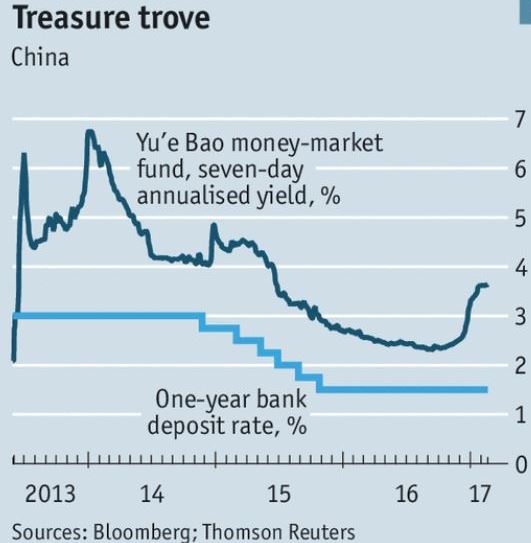
Service is unified on a holistic graphic interface and users can easily divert their cash into this fund with a few screen taps on their app. Yu'e Bao's ROI offer a 7-day annualized yield of 4.02%, down from the introductory annualized rate of 6.9% around the launch in 2013.

Yu'e Bao's short-term yield outmuscles the 1.5% interest rate on one-year Chinese bank deposits and the 3.6% yield on 10-year Chinese government debt.

Weak banking regulation has spawned a mammoth FinTech industry in the Middle Kingdom. Only one yuan (16 cents) is enough to create an account and considerable retail flow has rushed in.

China has catapulted ahead of the rest of the world emerging as the leader of global FinTech (financial technology) innovation. The pace, sophistication, and scale of development of China's FinTech has surpassed the level in any other developed countries.

The country's digital metamorphosis has enhanced e-commerce, payment systems, and connected logistical services. The Chinese discretionary spender for the past decade has been the deepest and most reliable lever of global growth.

Mobile third-party payments in China, 90% cornered by Tencent's Wechat and Alibaba's Alipay, are estimated to reach a lofty $6 trillion in revenue by 2019, more than 50 times that of the US.

These omnipresent payment systems are now deeply embedded into the fabric of Chinese society. Its commonplace to witness homeless people on Shanghai subways waving around a scannable image for Wechat or Alipay money transfers instead of physical cash.

Even in rural farmlands, shabby convenience stores prioritize digital currency and sometimes don't accept paper currency at all. Yes, China is beating the US to a cashless society.

Digitization is changing the competitive balance, and global banks must embrace large-scale disruption caused by big tech platforms.

Banks in China regard these companies as potential collaborators resulting in a net positive long-term infusion of enhanced products and services.

Agreements have been forged between the Bank of China with Tencent, and the China Construction Bank has linked up with Alibaba.

China has incorporated the technical power of AI and machine learning into its Fintech platforms at every opportunity. Robo-advisors are also making inroads, creating a bespoke financial program for the individual.

This trend has so far failed to go viral in America, where individuals still prefer plastic cards or even paper cash. E-commerce clocked in a paltry 9.1% of total US retail sales in the third quarter of 2017.

Even though most of us have our heads buried deep in our smartphone virtual world, Americans are still programmed to whip out debit or credit cards at every opportunity.

Chinese that visit America carp endlessly about America's archaic payment system.

Ultimately, American payment systems are ripe for digital disruption.
The American consumer will ultimately cause severe damage to MasterCard (MA), Visa (V), and American Express who are happy with current status quo.

The lack of innovation in the US Fintech sector is a failure in the otherwise fabulous technological leadership of the US. American smartphones should already be a fertile digital wallet, not just a niche market.

Savvy Jack Dorsey even invented a firm based on this inefficiency, exploiting the lack of proficiency in domestic FinTech with Square (SQ).

American big tech will gradually utilize China's FintTech model and extrapolate it with "American personality". It is much more of a two-way street now than before with cutting edge ideas flowing both ways.

The next leg up after digital wallet penetration of FinTech are money market funds on tech platforms. In effect, the Chinese innovation of this industry has allowed more variations of potential financing for the ambitious Chinese, and the same trends will gradually appear on Yankee shores.

Ironically enough, Amazon's (AMZN) land grab in the field is more prevalent in China, as artificially low financing and juicier scale justify this strategy.

The scaling premium also explains why corporate China's early adopter advantage is so effective because not many countries boast a 1.3-billion-person consumer market.

Soon, Americans will wake up to the reality that American FinTech must advance or foreign firms will rush in.

Mediocrity is not good enough.

iPhones and Android consumers could direct savings into tech money market funds with compounding yield all on a single digital platform.

Tech companies could deploy some of the repatriated cash to invest in some fledgling FinTech expertise to smoothly execute this new endeavor.

Consequently, a successfully created money market fund on a tech platform would enlarge the already substantial cash hoard these firms have. Not only will the large tech get bigger, but the big will get absolutely massive.

The determining factor is financial regulation. Capitol Hill has drawn a large swath of mighty Silicon Valley tech titans to testify because they are stepping on too many toes lately.

A scheme to hijack the digital payments market and dominate the mutual fund industry will cause unyielding push back in Washington. Especially, when the Amazon death star continues pillaging select industries of their choosing and eliminating brick and mortar jobs by the millions.

JP Morgan (JPM), who has the largest institutional money market fund in the country, and retail stalwarts like Blackrock and Vanguard will be sweating profusely too if mega tech starts probing around its turf.

Alibaba is also coming for their bacon too with the failed purchase of payment transfer service, Moneygram International (MGI) temporarily shutting out Jack Ma from a foothold in the American payment system industry. How long will it take before they are allowed in?

The momentum for these financial instruments is robust as FinTech integrates deeper into consumer life. The global cash glut from a decade of cheap financing is causing profit hungry investors to starve for high yield vehicles.

The stability and clean balance sheets of tech giants give them ample chance to successfully execute. So why can't they also become banks? Would you buy an Apple, Amazon, or Google money market fund if they offered a 4-7% annualized yield?

I believe most Americans would.


??

https://madhedgefundtrader.com/wp-content/uploads/2019/05/cropped-mad-hedge-logo-transparent-192x192_f9578834168ba24df3eb53916a12c882.png 0 0 Arthur Henry https://madhedgefundtrader.com/wp-content/uploads/2019/05/cropped-mad-hedge-logo-transparent-192x192_f9578834168ba24df3eb53916a12c882.png Arthur Henry2018-03-01 01:06:102018-03-01 01:06:10The FANGs' Path to Online Banking
Arthur Henry

March 1, 2018

Diary

Mad Hedge Technology Letter
March 1, 2018
Fiat Lux

Featured Trade:
(THE FANGS??? PATH TO ONLINE BANKING),
(SQ), (V), (MC), (AXP), (JPM)

??
https://madhedgefundtrader.com/wp-content/uploads/2019/05/cropped-mad-hedge-logo-transparent-192x192_f9578834168ba24df3eb53916a12c882.png 0 0 Arthur Henry https://madhedgefundtrader.com/wp-content/uploads/2019/05/cropped-mad-hedge-logo-transparent-192x192_f9578834168ba24df3eb53916a12c882.png Arthur Henry2018-02-28 19:47:302018-02-28 19:47:30March 1, 2018
Page 1367 of 2232«‹13651366136713681369›»

Legal Disclaimer

There is a very high degree of risk involved in trading. Past results are not indicative of future returns. MadHedgeFundTrader.com and all individuals affiliated with this site assume no responsibilities for your trading and investment results. The indicators, strategies, columns, articles and all other features are for educational purposes only and should not be construed as investment advice. Information for futures trading observations are obtained from sources believed to be reliable, but we do not warrant its completeness or accuracy, or warrant any results from the use of the information. Your use of the trading observations is entirely at your own risk and it is your sole responsibility to evaluate the accuracy, completeness and usefulness of the information. You must assess the risk of any trade with your broker and make your own independent decisions regarding any securities mentioned herein. Affiliates of MadHedgeFundTrader.com may have a position or effect transactions in the securities described herein (or options thereon) and/or otherwise employ trading strategies that may be consistent or inconsistent with the provided strategies.

Copyright © 2026. Mad Hedge Fund Trader. All Rights Reserved. support@madhedgefundtrader.com
Scroll to top