
• support@madhedgefundtrader.com
  • Member Login
Mad Hedge Fund Trader
  • Home
  • About
  • Store
  • Luncheons
  • Testimonials
  • Contact Us
  • Click to open the search input field Click to open the search input field Search
  • Menu Menu
april@madhedgefundtrader.com

April 30 Biweekly Strategy Webinar Q&A

Diary, Homepage Posts, Newsletter

Below, please find subscribers’ Q&A for the April 30 Mad Hedge Fund Trader Global Strategy Webinar, broadcast from Incline Village, NV.

Q: Why is the Australian dollar not moving against the US dollar as much as the other currencies?

A: Australia is too closely tied to the Chinese economy (FXI), which is now weak. When the Chinese economy slows, Australia slows. Australia is basically a call option on the Chinese economy. So they're not getting the ballistic moves that we've seen in, say, the Euro and the British pound, which are up about 20%. Live by the sword, die by the sword. If you rely on China as your largest customer for your export commodities, you have to take the good and the bad.

Q: I see we had a terrible GDP print on the economy this morning, down 0.3%. When are we officially in a recession?

A: Well, the classical definition of a recession is two back-to-back quarters of negative GDP growth. We now have one in the bank. One to go. And this quarter is almost certain to be much worse than the last quarter, because the tariffs basically brought all international trade to a complete halt. On top of that, you have all of the damage to the economy done by the DOGE cuts in government spending. Approximately 80% of the US states, mostly in the Midwest and South,  are very highly dependent on Washington spending for a healthy economy, and they are going to really get hit hard. So the question now is not “do we get a recession?”, but “how long and how deep will it be?” Two quarters, three quarters, four quarters? We have no idea. Even if trade deals do get negotiated, those usually take years to complete and even longer to implement. It just leaves a giant question mark over the economy in the meantime.

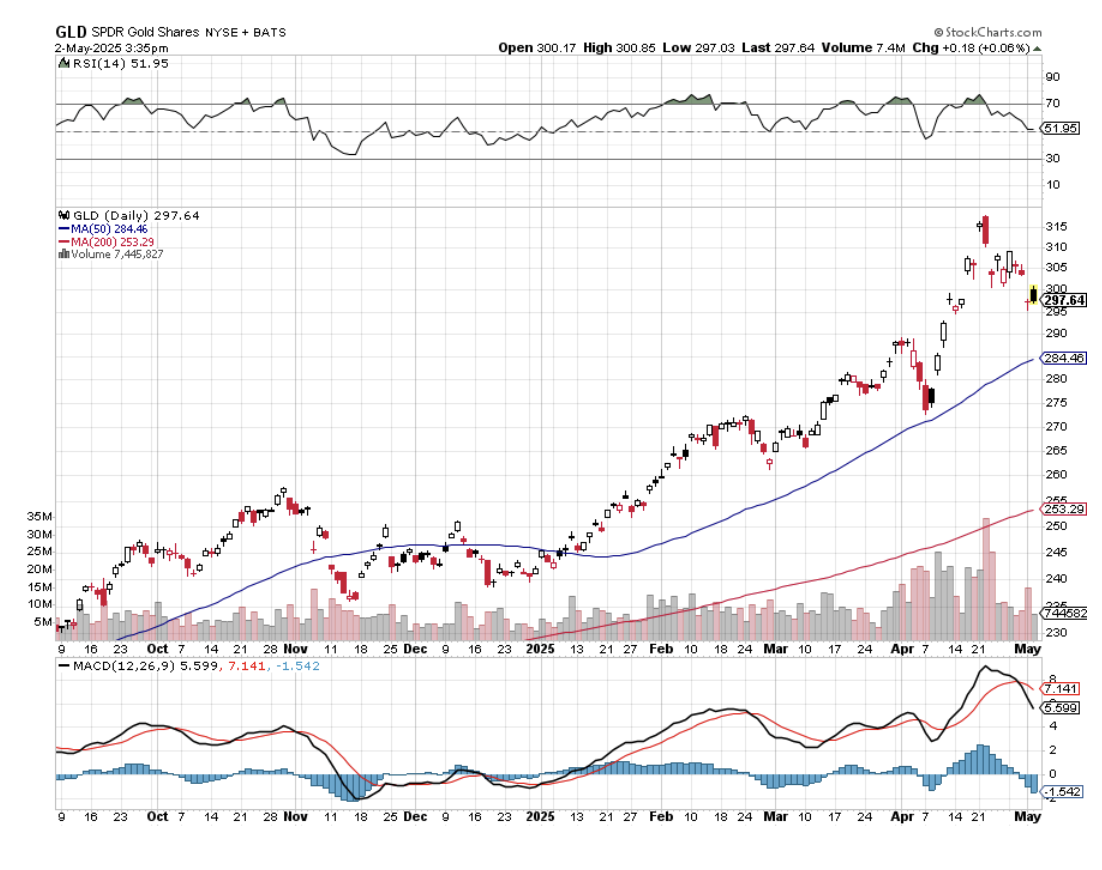
Q: Is SPDR Gold Trust (GLD) the best way to play gold, or is physical better?

A: I always go for the (GLD) because you get 24-hour settlement and free custody. With physical gold, you have to take delivery, shipping is expensive, and insurance is more expensive. Plus, then you have to put it in a vault. Private vaults have a bad habit of going bankrupt and disappearing with your gold. You keep it in the house, and then if the house burns down, all your gold is gone there. Plus, it can get stolen. There's also a very wide dealing spread between bid and offer on physical gold coins or bars; usually it's at least 10%, often more. So I often prefer the ease of trading with the GLD, which owns futures on physical gold, which is held in London, England. So that is my call on that.

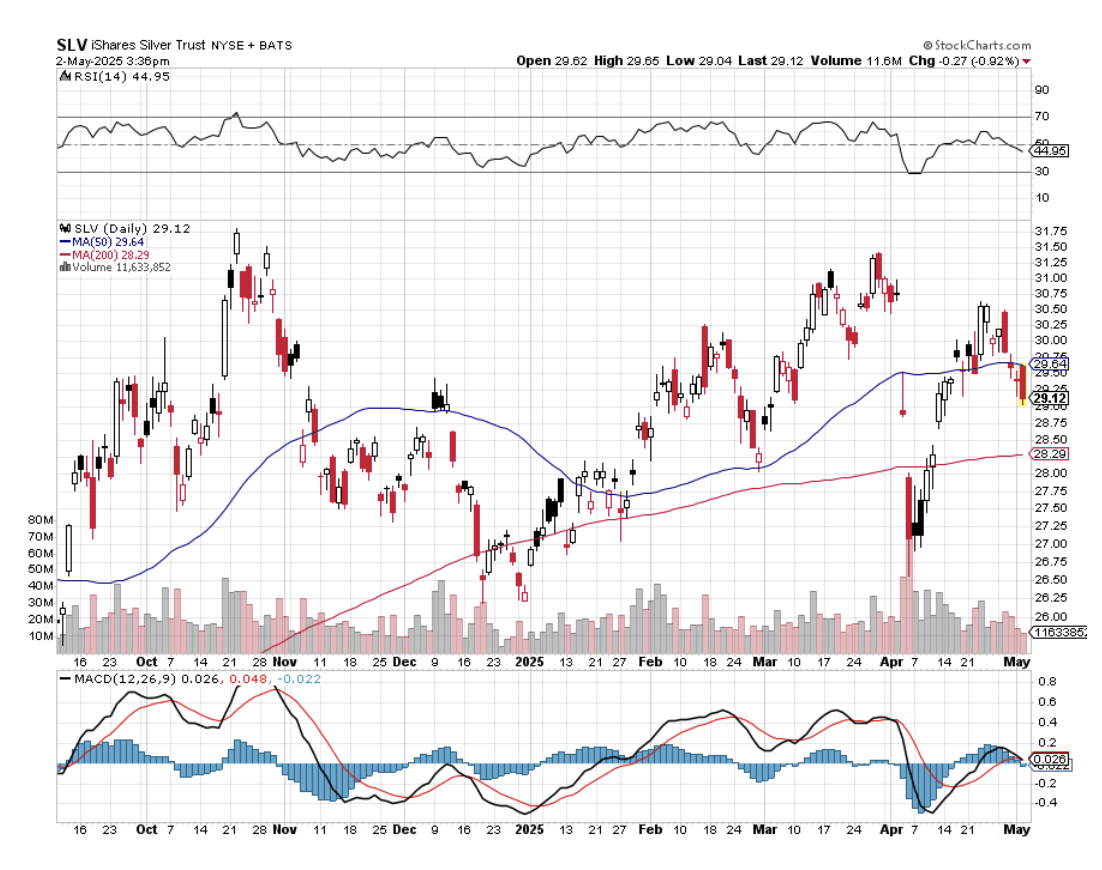
Q: Is ProShares Ultra Silver (AGQ) the leveraged silver play?

A: It absolutely is, but beware: (AGQ) is only good for short, sharp rises because the contango and the storage operating costs of any 2x are very, very high—like 10% a year. So, good if you're doing a day trade, not good for a one-year hold. Then you're just better off buying silver (SLV).

Q: What is more important with the Fed's mandate—unemployment or fear of inflation?

A: That's an easy one. Historically, the number one priority at the Fed has been inflation. That is their job to maintain the full faith and credit of the U.S. Dollar, and inflation erodes the value, or at least the purchasing power of the US dollar, so that has always historically been the priority. Until we see inflation figures fall, I think the chance of them cutting interest rates is zero, and we may not see actual falls until the end of the year, because the next influence on prices is up because of the trade war. The trade war is raising prices everywhere, all at the same time. So that will at least add 1 or 2% to inflation first before it starts to fall. You can imagine how if we get a 6% inflation rate, there's no way in the world the Fed can cut rates, at least for a year, until we get a new Fed governor. So that has always historically been the priority.

Q: Do you think the 10-year yield is going down to 5%?

A: You know, we're really in a no-man's-land here. Recession fears will drive rates down as they did yesterday. I haven't even had a chance to see where the bond market is this morning because. So, rates are rising on a recessionary GDP, which is the worst possible outcome. Rates should be falling on a recessionary GDP print. Of course, Washington’s efforts to undermine the U.S. dollar aren't helping. Threatening to withhold taxes on interest payments to foreign owners is what caused the 10% down move in bonds in one week—the worst move in the bond market in 25 years. So, the mere fact that they're even thinking about doing something like that scares foreign investors, not only from the bond market, but all US investments period. And certainly, we've seen some absolutely massive stock selling from them.

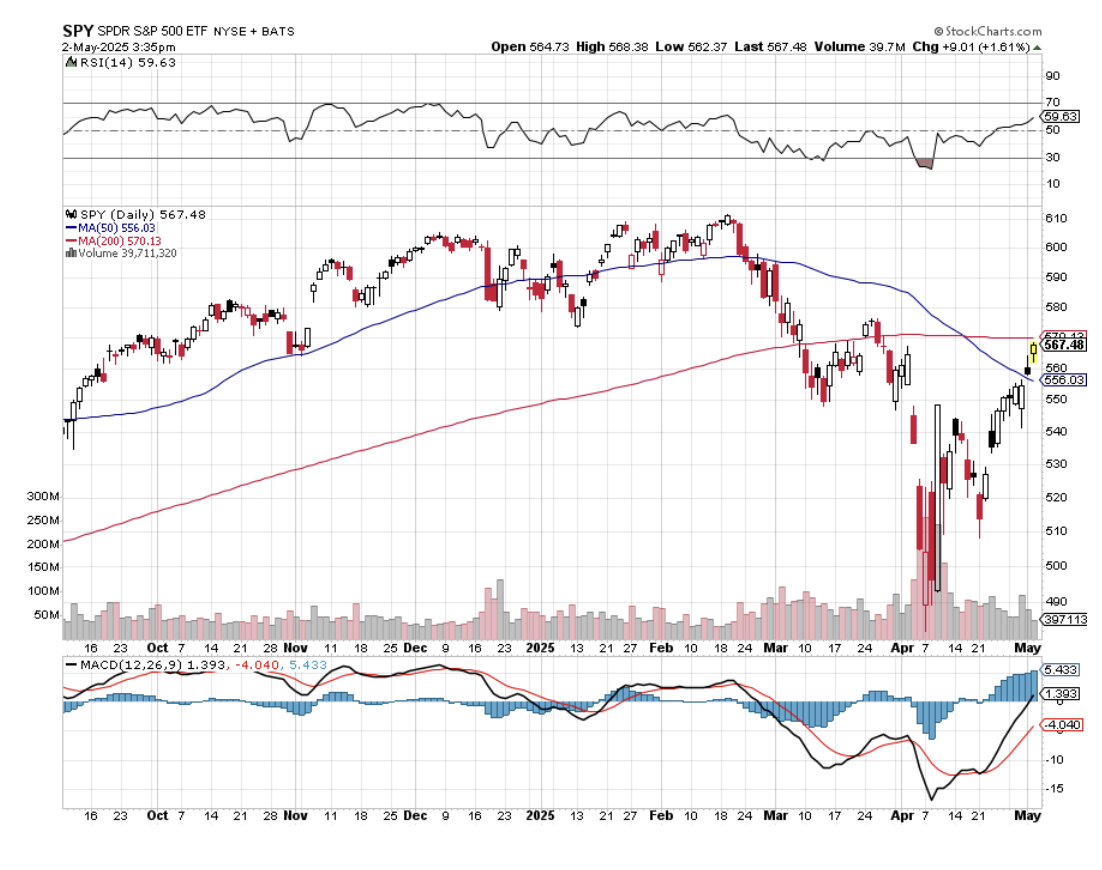
Q: Why won't the market go down to 4,000 in the S&P 500?

A: Absolutely, it could; that is definitely within range. That would put us down 30% from the February highs, it just depends on how long the recession lasts. If you just get a two-quarter shallow recession, we could bounce off 4800 for the (SPX) until we come out. If the recession continues for several quarters, and it's looking like it will, then 4,000 is definitely within range. So, it's all about the economy. And remember, stocks are expensive. They don't get cheap until we get a PE multiple of 16, and even then, that alone, just a multiple shrinkage would take us down to 4,000.

Q: Would it be a good idea to buy the S&P 500 (SPY) as it falls?

A: I'm getting emails from readers asking if it's time to buy Nvidia (NVDA) or time to buy Tesla (TSLA). What I've noticed is that investors are constantly fighting the last battle. They're always looking for what worked last time, and that does not succeed as an investment strategy. As long as I'm selling rallies, I'm not even thinking about what to buy on the bottom. The world could look completely different on the other side. The MAG-7 may not be the leadership in the future, especially with the Trump administration trying to dismantle four out of seven companies through antitrust, and the rest are tied up in the trade wars. So, tech is still expensive relative to the main market, and we're going to need to look for new leaders. My picks are going to be mining shares, gold, and banking. Those are the ones I'm looking to buy on dips, but right now, cash is king unless you want to play on the short side. Being paid 4.3% to stay away sounds pretty good to me, especially when your neighbors have 30% losses. You know, I've heard of people having all of their retirement funds in just two stocks: Nvidia and Tesla, and they're getting wiped out. So, you don't want to become one of them.

Q: After a tremendous run in Gold, is Silver a better risk-reward right now?

A: I would say yes, it is. Silver has been lagging gold all year because central banks, the most consistent buyers for the past decade,  buy gold—they don't buy silver. But what we may be in store for here now is a prolonged sideways move in gold while the technicals catch up with it. And in the meantime, the money goes elsewhere into silver and Bitcoin. That's my bet.

Q: Is Apple (APPL) a no-touch now?

A: I’d say yes. The trade war is changing by the day, and Apple probably does more international trade than any other company in the world. Also, Apple gets hit with recessions like everybody else. There was a big front run to buy Apple products ahead of tariffs—my company bought all its computer and telephone needs for the whole year ahead of the tariffs. We're not buying anything else this year. And I would imagine millions more are planning to do the same, so you could get some really big hits in Apple earnings going forward.

Q: Should I sell my August Proshares Short S&P 500 (SH) LEAPS?

A: No, I would keep them. If the (SPX) IS trading between 5,000 to 5,800, your $4-$42 SH LEAPS should expire at max profit in August, so I'm hanging on to mine. Next time we take a run at 5,000, you should be able to get out of your SH LEAPS at 80% to 90% of the max profit.

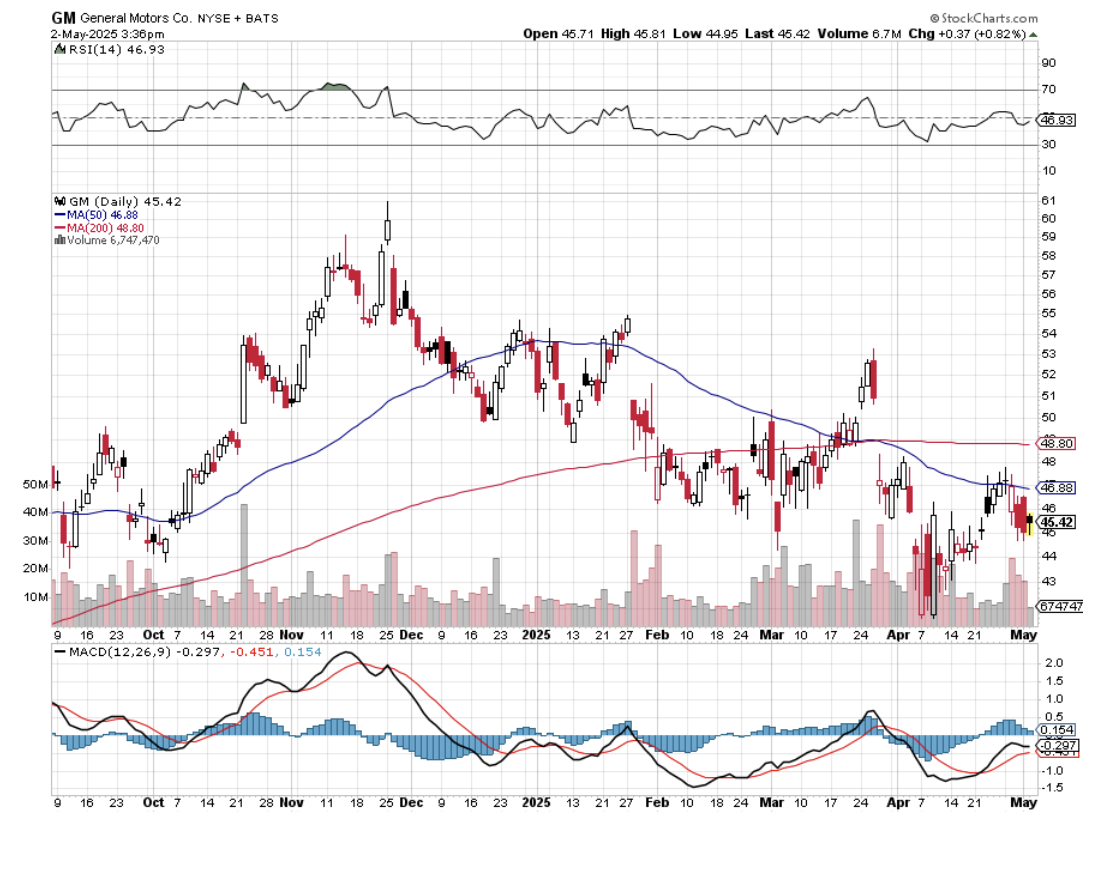
Q: What car company stock will do the best in a high-tariff global economy?

A: Tesla (TSLA), because 100% of their cars are made in the US with 90% US parts (the screens come from Panasonic in Japan). Their foreign components are only about 10%, so they can eat that. For General Motors (GM), it's more like 30% of all components are made abroad, and they can't eat that; their profit margins are too low. (GM) expects to lose $5 billion because of tariffs. By the way, the profit margins on Tesla have fallen dramatically from 30% down to 10% in two years, so it's not like they're in great shape either. Also, Tesla hasn’t had a CEO for ten months, which is why the board is looking for a replacement.

Q: Is it a good time to buy the dip in oil (USO)?

A: Absolutely not. Oil is the most sensitive sector to recessions, because if you can't sell oil, you have to store it, very expensively. It costs 30 to 40% a year to store oil—that's the contango; and once all the storage is full, then you have to cap wells, which then damages the long-term production of the wells. I think at some point you will expect an announcement from Washington to refill the Strategic Petroleum Reserve, which was basically sold by Biden at $100 a barrel. You can now get it back for $60. That may not be a bad idea if you're going to have a strategic petroleum reserve. What's better is just to quit using oil completely, which we were on trend to do.

Q: Will interest rates drop by year-end?

A: They may drop by year-end once unemployment runs up to 5% or 6% —which is likely to happen in a recession—and inflation starts to decline, even if it declines from a higher level. Even if they don't cut by year end, they'll still cut in a year when the president can appoint a new Fed governor. What the Trump really needs to do is appoint Janet Yellen as the Fed governor. She kept interest rates near zero for practically all of her term. We need another Yellen monetary policy.

Q: The job market here seems to be slowing quite fast. Is there any way this will rebound and stave off recession?

A: No, there is not. Companies are going to be looking to cut costs as fast as they can to offset the shrinkage in sales, but also to help cope with tariffs. So no, the job market is actually surprisingly strong now. That means future data releases are probably going to get a lot worse. In April, we saw job gains in Health care, adding 51,000 jobs. Other sectors posting gains included transportation and warehousing (29,000), financial activities (14,000), and social assistance. I highly doubt any of these sectors will show gains next month.

Q: What about nuclear energy plays?

A: I like them, partly because people are buying stocks like Cameco Corp (CCJ) as a flight to safety commodity play, like they're buying gold, silver, and copper. But also, this administration is supposed to be deregulation-friendly, and the only thing holding back nuclear (at least new modular reactors) is regulation. That and the fact that no one wants to live next door to a nuclear power plant, for some strange reason.

Q: What do I think about natural gas (UNG)?

A: Don't touch. Don't buy the dip. All energy plays look terrible right here, going into recession.

Q: What are your thoughts on manufacturing returning to the U.S? And how will that affect the stock market?

A:  I think there's zero chance that any manufacturing returns to the U.S. Companies would rather just shut down than operate money-losing businesses. You know, if your labor cost goes from $5 to $75 an hour, there's no chance anyone can make money doing that, and no shareholders are going to want to touch that stock. That is the basic flaw in having a government where no one is actually running a manufacturing business anywhere in the government. They don't know how things are actually made. They're all real estate or financial people.

To watch a replay of this webinar with all the charts, bells, whistles, and classic rock music, just log in to www.madhedgefundtrader.com , go to MY ACCOUNT, click on GLOBAL TRADING DISPATCH, then WEBINARS, and all the webinars from the last 12 years are there in all their glory.

Good Luck and Good Trading

John Thomas
CEO & Publisher
The Diary of a Mad Hedge Fund Trader


https://www.madhedgefundtrader.com/wp-content/uploads/2025/05/John-thomas-wine.png 802 774 april@madhedgefundtrader.com https://madhedgefundtrader.com/wp-content/uploads/2019/05/cropped-mad-hedge-logo-transparent-192x192_f9578834168ba24df3eb53916a12c882.png april@madhedgefundtrader.com2025-05-02 09:02:482025-05-02 17:05:18April 30 Biweekly Strategy Webinar Q&A
april@madhedgefundtrader.com

May 1, 2025

Biotech Letter

Mad Hedge Biotech and Healthcare Letter
May 1, 2025
Fiat Lux


Featured Trade:

(TELEHEALTH'S NEW WEIGHT CLASS)

(HIMS), (NVO)

https://madhedgefundtrader.com/wp-content/uploads/2019/05/cropped-mad-hedge-logo-transparent-192x192_f9578834168ba24df3eb53916a12c882.png 0 0 april@madhedgefundtrader.com https://madhedgefundtrader.com/wp-content/uploads/2019/05/cropped-mad-hedge-logo-transparent-192x192_f9578834168ba24df3eb53916a12c882.png april@madhedgefundtrader.com2025-05-01 12:02:152025-05-01 12:35:39May 1, 2025
april@madhedgefundtrader.com

Telehealth's New Weight Class

Biotech Letter

Clinging to Mount Everest at 20,000 feet, fingers numb and oxygen tank hissing like an annoyed cobra, I had an epiphany that would later serve me well on Wall Street: the most promising paths aren't always the obvious ones — they're the routes that quietly keep you alive while everyone else is busy with their cameras and guided tours.

That same principle is quietly guiding Hims & Hers Health (HIMS) right now.

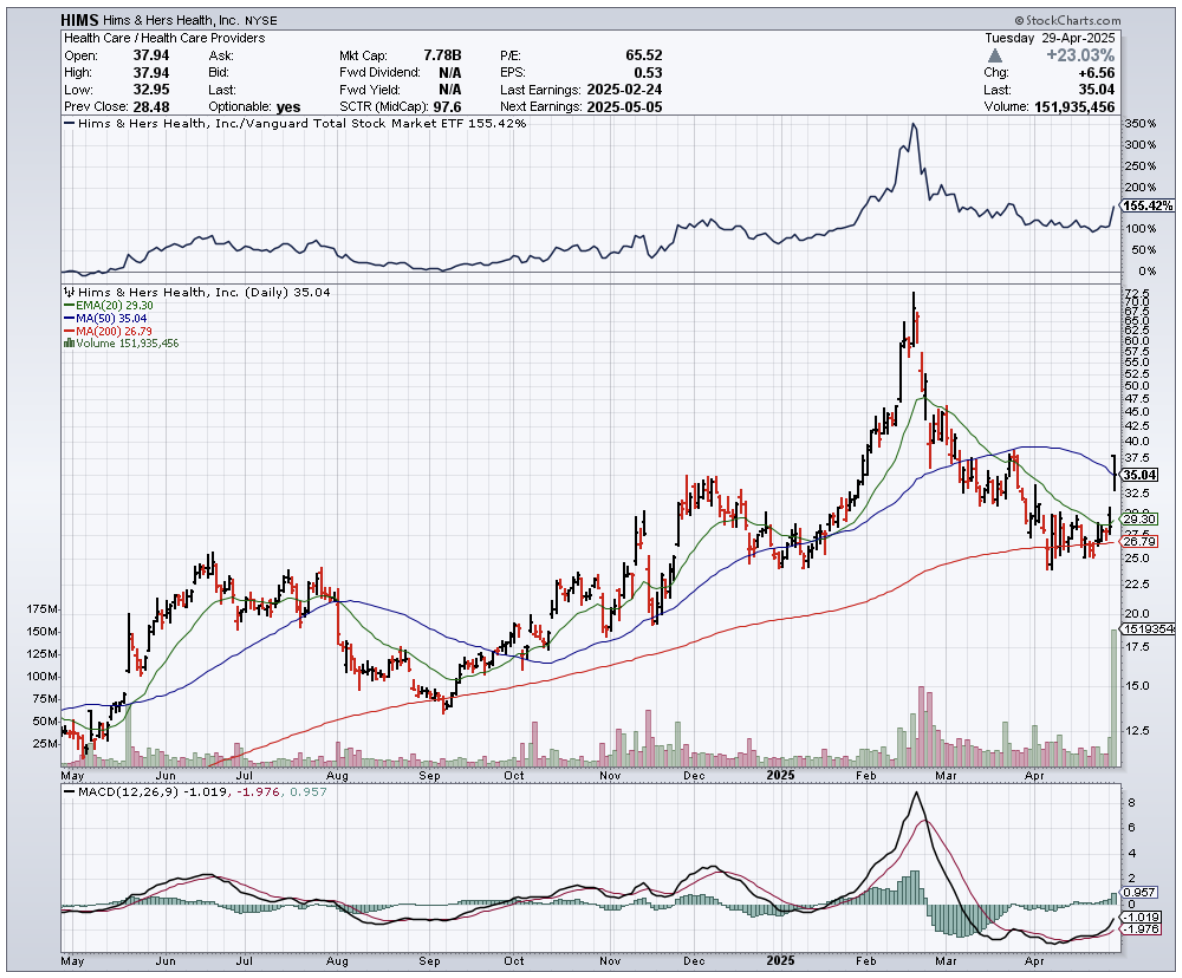
While the market obsesses over their new Wegovy partnership with Novo Nordisk (NVO), sending HIMS stock jumping 25% to $35, savvy investors should look deeper.

The company isn't suddenly becoming a weight-loss play — they're eliminating doubt and positioning themselves at the center of healthcare's digital transformation.

This reminds me of a pattern I've observed across decades of tracking successful businesses and leaders. The most effective ones don't chase trends. Instead, they position themselves to win regardless of which way the wind blows.

I witnessed this firsthand during a memorable interview with Deng Xiaoping back in the late 70s. Despite the chaotic economic landscape he inherited, his focus remained steadfastly on fundamentals rather than fleeting opportunities.

That's precisely the Hims playbook with these GLP-1 partnerships.

Fascinatingly, they're charging $599 monthly for Wegovy — $100 more than Novo's direct offering.

In my decades managing hedge fund portfolios, I've learned that pricing power is the ultimate business aphrodisiac. It signals you have something people genuinely value enough to pay a premium for.

Wall Street, in its infinite wisdom, is once again squinting at the wrong spreadsheet.

Hims projects $2.35 billion in 2025 revenue, with $725 million from weight management alone — a forecast that completely excluded branded GLP-1s. Their core business in sexual health, dermatology, and mental wellness already generates $1.2 billion annually.

That's 83% of revenue from decidedly non-injectable sources!

Their growth figures are impressive, too: 60% projected sales growth and 70% adjusted EBITDA growth. Yet HIMS trades at just 3.5x 2025 revenue estimates.

If I pitched you a company growing this fast in any other sector at that multiple, you'd think I was selling oceanfront property in Nebraska.

But what truly separates Hims from competitors is retention. Their internal data shows 70% patient retention after 12 weeks, compared to 42% in standard clinical settings. Their users interact with providers three times more frequently in the first month and five times more over three months.

That's not marginally better — it's an entirely different universe of care.

Like those guerrilla fighters I once interviewed in Southeast Asia, who held territory against superior forces by knowing the terrain better — Hims isn’t just in the healthcare war, they know exactly where to strike.

The stock previously touched $70 after posting 95% year-over-year growth in Q4. It retreated on fears about GLP-1 access that were largely imaginary.

Now it's climbing again on news that merely confirms what company executives already knew: their business model doesn't hinge on any single medication.

This situation reminds me of trading Japanese equities in the late '80s—watching rational people make irrational decisions based on incomplete information. The market is simultaneously overvaluing the importance of GLP-1s while undervaluing Hims' overall growth trajectory.

With $300 million in projected 2025 adjusted EBITDA (13% margins), expanding to 20% as they scale, HIMS at 27x EBITDA represents the kind of opportunity that makes me sit up straighter in my ergonomic chair. That multiple would make perfect sense for a company growing at half this rate.

What's more telling than spreadsheets, though, is customer loyalty. During my years managing portfolios worth more than some small nations' GDPs, I developed a simple litmus test: if a company disappeared tomorrow, would its customers feel inconvenienced or devastated?

Hims has clearly crossed into "devastated" territory for its growing user base - the kind of emotional moat that Warren Buffett probably dreams about between bites of his McDonald's breakfast.

For those hunting increasingly endangered species - growth with reasonable valuation, momentum with sustainable model, actual substance beneath the hype - HIMS offers a compelling specimen. These GLP-1 deals aren't the main story; they're just the latest chapter in a much longer narrative about healthcare's digital transformation.

And if there’s one thing I’ve learned from diving shipwrecks in Truk Lagoon to decoding market trends from Tokyo to New York — it’s that the journey tells you more than any single milestone ever could.

This one looks increasingly profitable for those with the patience to stay the course.


https://madhedgefundtrader.com/wp-content/uploads/2019/05/cropped-mad-hedge-logo-transparent-192x192_f9578834168ba24df3eb53916a12c882.png 0 0 april@madhedgefundtrader.com https://madhedgefundtrader.com/wp-content/uploads/2019/05/cropped-mad-hedge-logo-transparent-192x192_f9578834168ba24df3eb53916a12c882.png april@madhedgefundtrader.com2025-05-01 12:00:162025-05-01 12:35:28Telehealth's New Weight Class
april@madhedgefundtrader.com

Trade Alert - (PLTR) May 1, 2025 - STOP LOSS - SELL

Tech Alert

When John identifies a strategic exit point, he will send you an alert with specific trade information as to what security to sell, when to sell it, and at what price. Most often, it will be to TAKE PROFITS, but, on rare occasions, it will be to exercise a STOP LOSS at a predetermined price to adhere to strict risk management discipline. Read more

https://www.madhedgefundtrader.com/wp-content/uploads/2016/02/Alert-e1457452190575.jpg 135 150 april@madhedgefundtrader.com https://madhedgefundtrader.com/wp-content/uploads/2019/05/cropped-mad-hedge-logo-transparent-192x192_f9578834168ba24df3eb53916a12c882.png april@madhedgefundtrader.com2025-05-01 10:05:142025-05-01 10:05:14Trade Alert - (PLTR) May 1, 2025 - STOP LOSS - SELL
april@madhedgefundtrader.com

May 1, 2025

Diary, Newsletter, Summary

Global Market Comments
May 1, 2025
Fiat Lux


Featured Trade:

(THE SEVEN WORST FINANCIAL MISTAKES THAT RETIREES MAKE)

https://madhedgefundtrader.com/wp-content/uploads/2019/05/cropped-mad-hedge-logo-transparent-192x192_f9578834168ba24df3eb53916a12c882.png 0 0 april@madhedgefundtrader.com https://madhedgefundtrader.com/wp-content/uploads/2019/05/cropped-mad-hedge-logo-transparent-192x192_f9578834168ba24df3eb53916a12c882.png april@madhedgefundtrader.com2025-05-01 09:04:482025-05-01 12:33:33May 1, 2025
Douglas Davenport

THIS AI STOCK ISN’T SEXY ANYMORE — AND THAT’S WHY I LOVE IT

Mad Hedge AI

(CRM)

I've seen enough tech bubbles pop to know that when the air starts hissing out, most investors hit the exits faster than a cat at a dog park. But that's often when the real fortunes get made — hidden behind a wall of boring fundamentals and (gasp!) actual profitability.

Welcome to the curious case of Salesforce (CRM).

Lately, Salesforce has been wobbling around like your buddy who insisted he "was fine" after a third spin on the teacup ride. CRM shares are down about 15% since January, mirroring the broader tech malaise. Checking your portfolio these days feels like opening a mystery Tupperware from the back of the fridge: you know it won't be good.

But before you bolt, let's peel back the layers.

The days of Salesforce dazzling us with steroidal growth numbers are fading in the rearview, along with our "lockdown" ambitions to learn Italian or master sourdough. Last quarter, Salesforce delivered 8% revenue growth to $10 billion. Respectable for most, sure. But for Salesforce? That's like seeing Usain Bolt clock a 12-minute mile.

The AI-fueled growth story, once hotter than a sidewalk in July, has cooled considerably. Analysts have moved from "rabid optimism" to "meh" faster than you can say "pivot." But here’s the twist: Salesforce might be shedding its adolescent growth phase in favor of something the market could crave even more — a cash flow machine with expanding margins.

Last quarter, Salesforce posted $2.78 in non-GAAP EPS, comfortably topping guidance. Think of it like promising your friend you'll be there at 8:00—and showing up at 7:45 with coffee and donuts. CRM is growing up, and growing up, my friends, can be lucrative.

The company ended the quarter with $14 billion in cash and $8.4 billion in debt. That’s the corporate equivalent of having an umbrella, raincoat, and a canoe ready for a 20% chance of showers. In uncertain times, that kind of balance sheet isn't just nice—it's a lifeboat.

Across its sprawling empire, Salesforce showed steady progress. Slack revenue growth accelerated to 11%, which is impressive for an acquisition some had already written off. Tableau, meanwhile, lumbered along at 3% growth, the corporate equivalent of, "Well, the teacher made the test really hard."

Guidance for the first quarter? Up to 7% revenue growth. For the full year? Up to 8%. Oh, and Q1 will get dinged by the leap year—proving that in 2025, even something as archaic as the Gregorian calendar can mess with earnings.

Management is also trying to reframe the story around AI agents. Customers using Agentforce are reportedly handling 30-60% of service cases with AI. The jury’s still out on whether this is a rocket booster or just a shiny hood ornament. But it does make customer retention stickier than a melted lollipop in a toddler's hand.

At around 24x earnings, Salesforce isn't dirt cheap, but it's not living in the stratosphere either. Consensus forecasts call for an acceleration back to high-single-digit growth over the next five years. Personally, I'm more skeptical of those forecasts than I am of "fat-free" cookie labels.

Decelerating growth is the natural gravity of mature companies — it's not "if," it's "when." That said, I see Salesforce sustaining 35%-40% net margins. If so, fair value multiples could float between 18x to 22x earnings over time. That pencils out to solid double-digit annual returns, even without multiple expansion. Any multiple boost would be like finding a $20 bill in your ski jacket next winter — sweet, but not essential.

Risks? Of course. Revenue misses could trigger tantrums worthy of a three-year-old denied ice cream. Generative AI could also disrupt the field, though history suggests incumbents like Salesforce tend to survive — and even thrive — through tech revolutions.

In short: Salesforce has graduated from growth wunderkind to cash flow powerhouse. It may no longer be the life of the tech stock party, but when the glitter fades, it's the companies with real earnings and loyal customers that still have seats at the table.

Remember, bubbles come and go. Balance sheets and bored markets? That’s where fortunes are built. Bet smart — bet boring.


https://madhedgefundtrader.com/wp-content/uploads/2019/05/cropped-mad-hedge-logo-transparent-192x192_f9578834168ba24df3eb53916a12c882.png 0 0 Douglas Davenport https://madhedgefundtrader.com/wp-content/uploads/2019/05/cropped-mad-hedge-logo-transparent-192x192_f9578834168ba24df3eb53916a12c882.png Douglas Davenport2025-04-30 16:34:542025-04-30 16:34:54THIS AI STOCK ISN’T SEXY ANYMORE — AND THAT’S WHY I LOVE IT
april@madhedgefundtrader.com

April 30, 2025

Tech Letter

Mad Hedge Technology Letter
April 30, 2025
Fiat Lux


Featured Trade:

(HUMANOIDS TO THE RESCUE OR NOT)
(TSLA)

https://madhedgefundtrader.com/wp-content/uploads/2019/05/cropped-mad-hedge-logo-transparent-192x192_f9578834168ba24df3eb53916a12c882.png 0 0 april@madhedgefundtrader.com https://madhedgefundtrader.com/wp-content/uploads/2019/05/cropped-mad-hedge-logo-transparent-192x192_f9578834168ba24df3eb53916a12c882.png april@madhedgefundtrader.com2025-04-30 14:04:142025-04-30 14:01:20April 30, 2025
april@madhedgefundtrader.com

Humanoids To The Rescue Or Not

Tech Letter

Dr. Doom Nouriel Roubini needs to lay off the fear porn – I’m not taking the bait this time. Sorry Roubs!

Roubini is sounding the alarm bells on humanoid robots, but I think it is more of a case of fear-mongering than anything else.

After all, like most economists, Roubini isn’t a trader, he is an academic who sits behind the scenes and goes after those juicy sound bites that the media need to publish stories.

He wasn’t taking profits in great tech trades like when I captured profits on Netflix just the other day.

His idea goes like this…

He thinks the big breakthrough right now is the evolution of humanoid robots that essentially follow individual workers on the factory floor, on a construction site, even a chef in a restaurant, or a housekeeper. It's terrifying, but it's happening in the next literally year or two.

For this level of transformation in one year, I believe the percentage chance of this coming to fruition is less than 2%.

My understanding of the humanoids is that the software will take 10 years to figure out the nuances.

Roubini — known as Dr. Doom for his bleak economic forecasts — said human jobs will be lost to humanoids.

Instead, an LLM (large language model) learns about everything in the world, the entire internet follows your job or my job or anybody else's job in a few months, then learns everything that a construction worker, factory worker, or any other service worker can do, and then can replace them. And I think that it's going to be a revolution — it's going to affect blue-collar jobs like we've never, ever seen before.

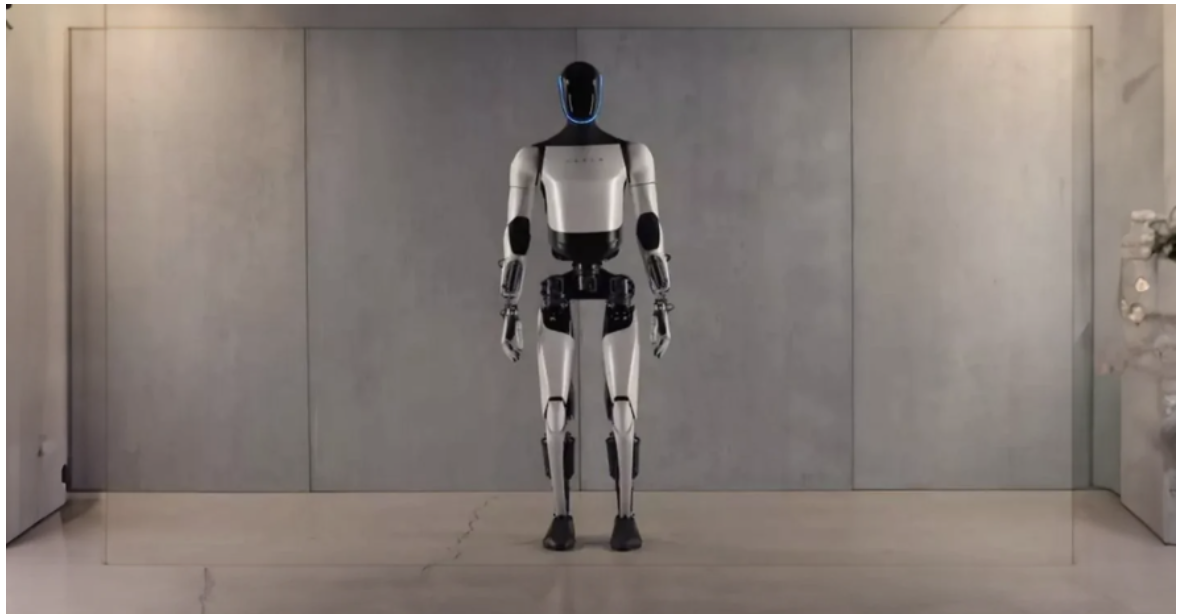
The humanoid robot market could reach $7 trillion by 2050, Citi research recently found. Those robots — such as Tesla's (TSLA) Optimus — may be able to do everything from clean your home to fold your laundry. The robots could create job loss as routine tasks get automated.

There is a higher likelihood that this humanoid from Tesla will be used as staging to convince investors to buy more tech stocks.

Tech companies have a huge problem on their hands and there hasn’t been a lot of great brain activity to find a real solution.

Venture capitalists have been lamenting the lack of real innovation in tech products like Mark Andreesen and Peter Thiel.

The humanoid is here to get investors to buy more tech stocks in companies that aren’t innovating.

Tech companies are cutting staff to beat earnings and that isn’t a sign for top notch growth.

Investors need to separate the fluff from reality.

The reality is that big tech companies still make enormous amounts of profit, but have failed miserably in finding something new.

Apple CEO Tim Cook is still figuring out what to do next after selling iPhones to Chinese people.

The humanoid operating on AI software might give tech stocks an extra 6-month cushion before investors pull the rug.

Enjoy the bull market while it lasts. I executed a bullish trade in Dell which is part of the AI story.

AI stocks will go higher and humanoid stocks will too – not because they will make money, but because investors still buy the hype. 


https://madhedgefundtrader.com/wp-content/uploads/2019/05/cropped-mad-hedge-logo-transparent-192x192_f9578834168ba24df3eb53916a12c882.png 0 0 april@madhedgefundtrader.com https://madhedgefundtrader.com/wp-content/uploads/2019/05/cropped-mad-hedge-logo-transparent-192x192_f9578834168ba24df3eb53916a12c882.png april@madhedgefundtrader.com2025-04-30 14:02:142025-04-30 14:01:26Humanoids To The Rescue Or Not
april@madhedgefundtrader.com

April 30, 2025

Jacque's Post


(THE STOCK MARKET IS HEADED HIGHER NEXT YEAR ACCORDING TO THIS SIGNAL)


April 30, 2025


Hello everyone


Have you ever heard of the Zweig Breadth Thrust?

Well, last Thursday, April 24, it was signalled.

And yes, that’s a good thing. 

The Zweig Breadth Thrust was developed by legendary investor Martin Zweig.  He published a major stock market newsletter in the 1970’s.  He is perhaps best known for predicting Black Monday in 1987, when stocks lost over 20% in one day.

He developed the Zweig Breadth Thrust after realizing that a shift from widespread selling to buying in 10 days or less had led to significant gains over the following year.

The Zweig Breadth Thrust triggered on April 24 is just the 20th since 1945, according to Carson Investment Research.  The last time we saw one was near the S&P 500’s low in November 2022.

In the past, the benchmark S&P 500 has produced gains 100% of the time one year later, with an average and median return of over 23%.

Zweig Breadth Thrusts are uncommon because they require a period of extremely broad selling immediately followed by extremely broad buying.

The measure is calculated by dividing a moving average of the number of NYSE stocks advancing by the total number of advancing plus declining stocks.

Initially, a ratio of 0.659 was considered a buy signal, while 0.366 was a sell signal.  However, the indicator’s buy signal has since been modified to be when the 10-day exponential moving average of stocks rises above 61.5% after being below 40% within the past two weeks

The S&P 500 has historically delivered robust returns after a Zweig Breadth Thrust.

Not only was the S&P 500 up one year later by an average of nearly 24% following every previous occurrence, but it has also delivered impressive short- and intermediate-term results.

The average historical return over the following one, three, and six months is 5%, 8%, and 15%, with a 95%, 79%, and 100% success rate.

But the lesson here is to be cautious.  Rightfully so, this signal is one to respect.  But remember that stocks have retested and even made new lows in the past following them, including in 2023, when we got two signals, one in spring and the other in the fall.

Investors have plenty to be concerned about.  Inflation, unemployment numbers are rising, and a decelerating (GDP).  And then there is the muddy tariff landscape on top of that, which can influence people’s spending habits. 

In short, a Zweig Breadth Thrust doesn’t mean we have escaped the bear just yet.  Stocks often require back-filling of gains, meaning a retest or new low isn’t out of the question.

Nevertheless, the returns associated with a Zweig Breadth Thrust are undeniably encouraging for long-term investors with horizons longer than six months or one year.


BITCOIN TARGETS ACCORDING TO AN ARK STUDY

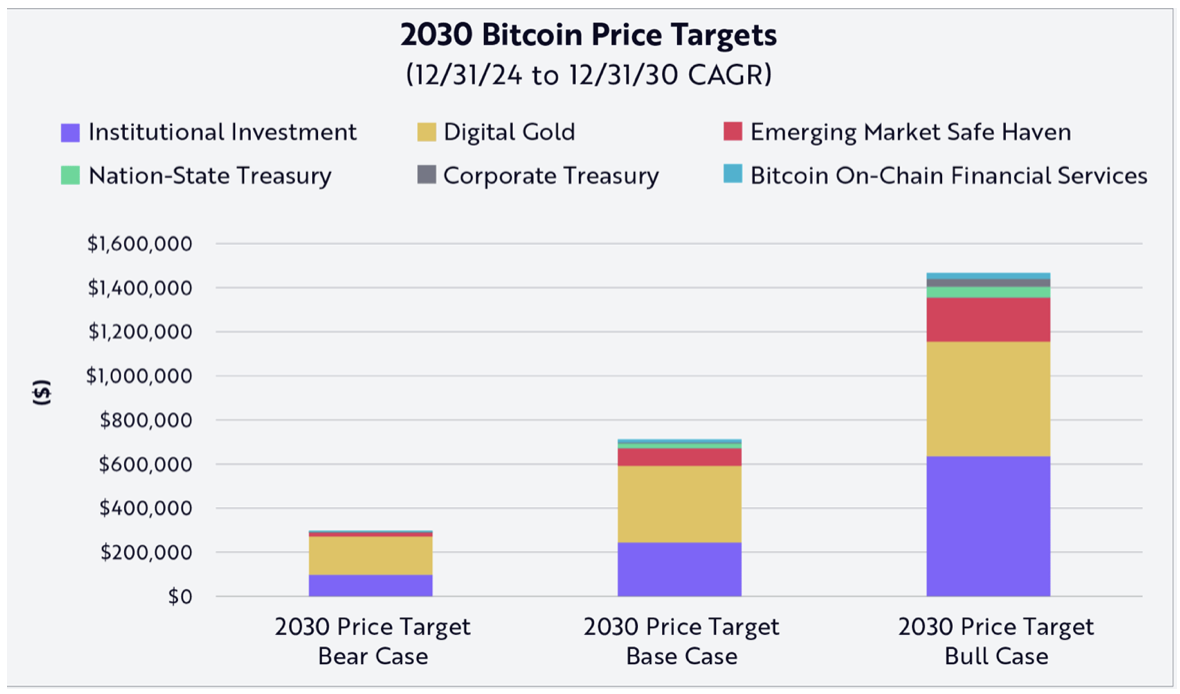
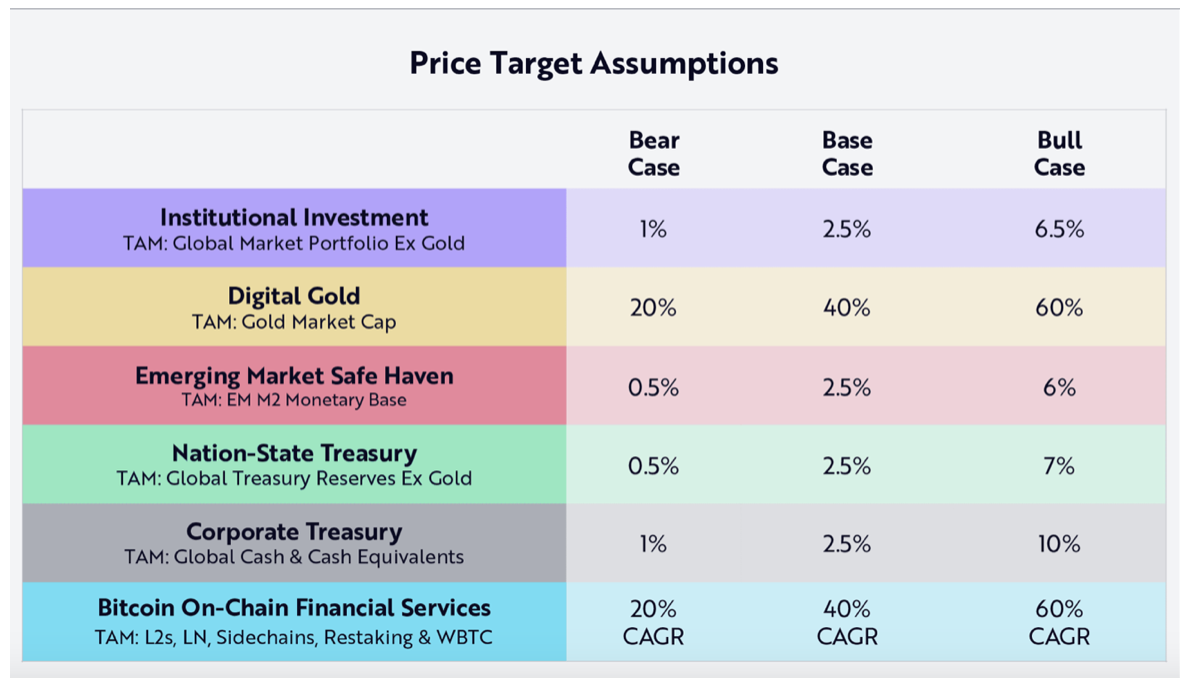
An ARK study sees Bitcoin hitting up to $2.4 million by 2030, driven by institutional inflows, nation-state adoption, and growing on-chain utility.

The analysis by the firm highlights institutional investment — spot Bitcoin ETFs in particular — as the biggest driver in the bull case, contributing 43% of total capital inflows.


ARK Invest believes that Bitcoin’s future price targets are justified by its increasing role as a global financial asset that is receiving capital inflows from numerous avenues.  It’s being considered a store of value, especially in developing countries where citizens face inflation and currency devaluation.

The spread of nation-state adoption, starting with nations such as El Salvador and Bhutan, also recently announced by President Donald Trump in the U.S., reinforces the bull case ARK is assuming.

Furthermore, growing corporate adoption of Bitcoin and the growth of on-chain financial services such as the Lightning Network and WBTC are further boosting the capital potential of Bitcoin.  These dynamics, Ark says, lend their forecast structural validity.

Wrapped Bitcoin (WBTC) is an Ethereum token that is intended to represent Bitcoin (BTC) on the Ethereum blockchain.  It is not Bitcoin, but rather a separate ERC-20 token that’s designed to track Bitcoin’s value.

The journey to 2030 through this vehicle will be full of peaks and troughs – put BITCOIN in the bottom drawer and leave it alone.


Cheers

Jacquie

https://madhedgefundtrader.com/wp-content/uploads/2019/05/cropped-mad-hedge-logo-transparent-192x192_f9578834168ba24df3eb53916a12c882.png 0 0 april@madhedgefundtrader.com https://madhedgefundtrader.com/wp-content/uploads/2019/05/cropped-mad-hedge-logo-transparent-192x192_f9578834168ba24df3eb53916a12c882.png april@madhedgefundtrader.com2025-04-30 12:00:402025-04-30 11:40:24April 30, 2025
april@madhedgefundtrader.com

Trade Alert - (TSLA) April 30, 2025 - TAKE PROFITS - SELL

Trade Alert

When John identifies a strategic exit point, he will send you an alert with specific trade information as to what security to sell, when to sell it, and at what price. Most often, it will be to TAKE PROFITS, but on rare occasions, it will be to exercise a STOP LOSS at a predetermined price to adhere to strict risk management discipline. Read more

https://www.madhedgefundtrader.com/wp-content/uploads/2016/02/Alert-e1457452190575.jpg 135 150 april@madhedgefundtrader.com https://madhedgefundtrader.com/wp-content/uploads/2019/05/cropped-mad-hedge-logo-transparent-192x192_f9578834168ba24df3eb53916a12c882.png april@madhedgefundtrader.com2025-04-30 11:14:592025-04-30 11:14:59Trade Alert - (TSLA) April 30, 2025 - TAKE PROFITS - SELL
Page 165 of 2232«‹163164165166167›»

Legal Disclaimer

There is a very high degree of risk involved in trading. Past results are not indicative of future returns. MadHedgeFundTrader.com and all individuals affiliated with this site assume no responsibilities for your trading and investment results. The indicators, strategies, columns, articles and all other features are for educational purposes only and should not be construed as investment advice. Information for futures trading observations are obtained from sources believed to be reliable, but we do not warrant its completeness or accuracy, or warrant any results from the use of the information. Your use of the trading observations is entirely at your own risk and it is your sole responsibility to evaluate the accuracy, completeness and usefulness of the information. You must assess the risk of any trade with your broker and make your own independent decisions regarding any securities mentioned herein. Affiliates of MadHedgeFundTrader.com may have a position or effect transactions in the securities described herein (or options thereon) and/or otherwise employ trading strategies that may be consistent or inconsistent with the provided strategies.

Copyright © 2026. Mad Hedge Fund Trader. All Rights Reserved. support@madhedgefundtrader.com
Scroll to top