• support@madhedgefundtrader.com
  • Member Login
Mad Hedge Fund Trader
  • Home
  • About
  • Store
  • Luncheons
  • Testimonials
  • Contact Us
  • Click to open the search input field Click to open the search input field Search
  • Menu Menu
DougD

Coffee With the Treasury Secretary

Newsletter

I knew that Treasury Secretary Tim Geithner was early for our meeting at the San Francisco Mark Hopkins Hotel, as the line of silver Secret Service GM Suburbans was illegally occupying some of the most prime parking places on Nob Hill. I?m glad they changed the color. I was getting tired of the perpetual black. Perhaps it?s an unknown leading economic indicator?
As the agent pawed through my briefcase, I asked if death threats against the president were still up 400%. He said there was a big jump when Obama first came into office, but threats have since petered out, although they are still running much higher than the George W. Bush days. ?People dislike change,? he said. ?So true,? I replied.

The 50-year-old Geithner was fit and trim as always, and probably could still squeeze into his old high school graduation suit if he still had it, a goal that has so far eluded me. That?s what jogging every day of the year gets you, no matter how crushing the schedule or how crucial the priorities. The two Secret Service agents who accompanied him this morning on his run from the Oakland Bay Bridge to the Marina Green and back are also probably up to an Olympic standard of fitness. But he had also noticeably greyed since our last meeting.

I always catch Tim when he stops in San Francisco on his way to China. I knew him in Tokyo during the late eighties when he was the young, up and coming, hotshot economic attach? at the embassy there. I spoke to him briefly in Japanese just to see if he was still up to snuff. He was. He also speaks Chinese, which I imagine will be a requirement for every future Treasury Secretary, as they own $1 trillion of our national debt.

Without any prompting he launched straight into his canned campaign stump speech. When Obama came into office the economy was shrinking at a -9% annualized rate and shedding 600,000 jobs a month. Today it is growing at 2% and adding jobs. Exports are up 34% since 2009, and private investment is rapidly increasing. Real estate is still tough, but is showing signs of life.

We moved on to Europe, and I asked him if the Treasury had any plans to participate in a Spanish bailout, where the real estate and construction collapse has been far worse than our own. He pointed out that Europe was a rich continent and had plenty of resources to solve its own problems. He then backed up a bit and wryly said, ?Let me evade that question differently.?

The Federal Reserve was intervening where it could in the most cost effective way, such as through the provision of $400 billion in swap lines which are guaranteed by the European Central Bank. That will create a safety cushion between Europe and the rest of the world. A precipitous move towards austerity will only prolong the length and depth of their recession.

I asked how he personally felt when he first stepped in to oversee a financial system that was in complete collapse, with classic bank runs and frozen financial markets. Instead of sitting back and ordering a raft of study groups or waiting for recalcitrant Republicans to join him, Obama took immediate, decisive action, pushing through the stimulus bill and bailing out AIG and General Motors. He confided in me that he was not at all confident that the emergency rescue plan would work, but told the president that it was certainly better than all the other alternatives.

The bailouts were very controversial, highly divisive, but a necessary evil. The passage of the TARP in 2008 was in fact the last bipartisan bill to pass congress. Although the initial estimate of the cost ran into the trillions of dollars, the government will end up making a $20 billion profit from all of the programs. Geithner wants to unload the remaining holdings as soon as possible, while still maximizing taxpayer value. ?We didn?t save the banks for the benefit of the banks, we saved them for ourselves,? he asserted.

Geithner didn?t believe the repeal of Glass-Steagle in 1998 caused the financial crisis, which separated the banking and securities industries. The real trigger was a huge off balance sheet financial system that grew up outside the established regulatory framework and eventually accounted for half of all the credit in the US. It also didn?t help that many existing banking regulations were not enforced by a hands-off Bush administration. The end result was vastly excessive leverage understood by few.

The reforms enacted by Dodd-Frank are intended to force a reduction in leverage so that any future mistakes the banks make do not pose a systemic threat to the financial system. Instead of future bailouts there will be orderly liquidations. If you need proof of the effectiveness of the new rules, look no further than the immense resources the financial industry is pouring into having them overturned.

He said we were right to be concerned about the upcoming ?fiscal cliff,? the tax increases and spending cuts that automatically kick in at year end, which Geithner believes could shave a massive 3.5% off of GDP. He thinks that some sort of agreement around the Simpson-Bowles framework will be reached, similar to the deal that was almost done last summer. Back then, the two sides were much closer than people realize.

While the administration was laying some foundations behind the scenes, congress was not yet ready to clinch an agreement. ?We don?t need to solve all of America?s problems for the next 100 years in six weeks, but we can create a framework for progress,? he averred. While the deficits in Medicare and Medicaid were unsustainable, that was no excuse to drastically cut education and infrastructure spending today.

We spent a lot of time talking about China, which we have both been studying for decades. His goals there were to level the playing field for US companies and help the country move towards a more domestically oriented, less export dependent economy. Since 2009, US exports to the Middle Kingdom have doubled. Its trade surplus has fallen from 8% of GDP to 3%. Currency pressure has eased with a 13% appreciation of the Yuan against the US dollar. But major issues remain in intellectual property rights and tariffs. American consumer goods cost double in Shanghai than they do at home.

The Treasury has undertaken 36 anti-dumping complaints against China, such as in tires, solar, and wind power, compared to none by the previous administration. If China wants to participate in the global trade system they have to play by the rules.
Much of The Middle Kingdom?s strength is not as strong as it seems. A huge demographic headwind will hit the country soon, thanks to the 30-year-old ?one child? policy. China?s productivity is a tiny fraction of America?s.

Geithner has already made known his intention to leave after the end of Obama?s current term. It?s hard to say what he?ll do next. I don?t see him soiling his hands by joining a major bank board, as past Treasury Secretaries have done. My guess is that he will end up on the board of Apple or Google.

As the Secretary scurried out the door to his next appointment, I asked if he would ever consider making a run for public office. ?Not a chance,? he shot back. ?Not even the president of Dartmouth College?? I persisted. ?No way,? he affirmed. I suspect there is an unhappy and undeserved grade of C- hidden somewhere in his distant past.

On my way out the Secret Service agent told me that when he did my background check, he found that I had been in their system since the Ford administration in 1976, well before he was born. I said ?Yes, that Alexander Hamilton was a hell of a guy, a real party animal,? referring to our nation?s first Treasury Secretary. He thanked me for my service and shook my hand. It was the nicest thing anyone said to me all day.

With that, I disappeared out the door and jumped on a moving cable car down nearly vertical California Street on my way home. I knew I would have to backpack three hours up a steep mountain to digest the implications of what Geithner had said.

Such my life has become.


https://www.madhedgefundtrader.com/wp-content/uploads/2012/04/tim-geithner.jpg 240 320 DougD https://madhedgefundtrader.com/wp-content/uploads/2019/05/cropped-mad-hedge-logo-transparent-192x192_f9578834168ba24df3eb53916a12c882.png DougD2012-04-29 23:02:182012-04-29 23:02:18Coffee With the Treasury Secretary
DougD

April 30, 2012 - Quote of the Day

Quote of the Day

?At some point in 2011, knuckles are going to be turning white, and we'll see whatever rabbits Ben Bernanke is going to have to pull out of his hat,? said David Rosenberg of Gluskin, Sheff & Associates

https://www.madhedgefundtrader.com/wp-content/uploads/2012/04/roller.jpg 408 400 DougD https://madhedgefundtrader.com/wp-content/uploads/2019/05/cropped-mad-hedge-logo-transparent-192x192_f9578834168ba24df3eb53916a12c882.png DougD2012-04-29 23:01:082012-04-29 23:01:08April 30, 2012 - Quote of the Day
DougD

No More QE3

Newsletter

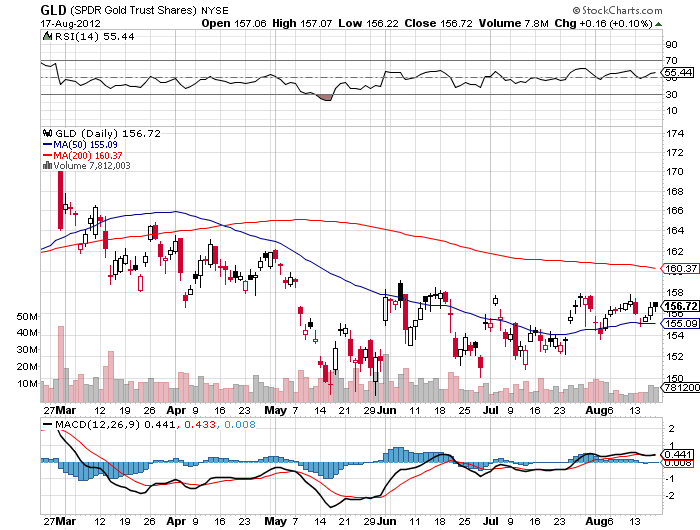
That was the judgment of the markets in the wake of the Federal Reserve?s latest economic forecast released today for at least two minutes. The asset classes most dependent on further monetary easing, like gold (GLD), silver (SLV), the Euro (FXE), and the yen (FXY), saw dramatic, sudden selloffs, and then recovered losses almost as fast. Blinked and you missed all the action. The big head turner was in gold, which should have been down $50 yesterday with Bernanke cutting the fundamental argument for owning the yellow metal off at the knees.

The belief in the Bernanke put is now so overwhelming that it overrides all other considerations. It flies in the face of a torrent of economic data that has turned overwhelmingly negative for the past month. Just yesterday, March durables showed a shocking 4.2% decline, in part driven by a 48% fall in domestic aircraft deliveries. So what does the market do? It takes Boeing (BA) up 5%.

This morning, weekly jobless claims posted their third week over 385,000, a hugely negative leading indicator for the economy. So the Dow rallies 100 points. The data show that the winter real estate bounce clearly ground to a halt in March, but Pulte Homes (PHM), the weakest of the homebuilders, runs 22% into indifferent earnings.

April has been a frustrating month for me of correctly predicting what is going to happen and then the relevant stock or asset class doing the exact opposite to what they should. Excess liquidity trumps everything. I think what is happing is that stocks are popping, regardless of the actual earnings for the mere fact that the report is out of the way, not because of any great improvement in business. I read the Boeing earnings report three times to see what the big deal was. All I found was a 2% increase in annual forecast earnings per share thanks to a reduction in reserves for litigation costs. That hardly justifies the price action.

There is one thing in common with most of these earnings reports. Companies reduce their guidance so far that they become impossible not to beat. Then the report comes out as a big upside surprise, which enthrall the shills in the media. What gets lost in the jumble is that the YOY gains in earnings are minimal at best and are often created by special accounting provisions. They are a shadow of the real YOY improvements we saw last year.

The end result of this shell came is a market with falling earnings, rising multiples, and trading volumes that are down a lot from just a year ago. Warning: this does not last forever. When the market disintegrates into hedge funds, high frequency traders, and day traders buying and selling to each other, nobody makes any money over time.

I believe in the Bernanke put. Ben Bernanke is playing the market like a fiddle, quite successfully so. But it only kicks in with the S&P 500 at 1,100, or down some 20% from here. That?s where he exercised it last September, when markets were in meltdown mode and posing a real threat to the economy.

That means investors at these levels are willing to risk 20% in the indexes, or 40% in individual names, before the Fed rides to the rescue. Only institutions with the longest possible time frames, like long only index funds and pension funds can afford to take such a view.

Risk markets are a constant tug of war between fact and belief, and right now belief is winning. But that is all part of show business. I am so incensed that I am going to complain to Treasury Secretary Tim Geithner in person. I have a private meeting with him in downtown San Francisco in two hours. I?ll let you know what he says on Monday. Oops, gotta go.


?Oops, Time to Mention QE3 Again


https://www.madhedgefundtrader.com/wp-content/uploads/2012/04/bernanke-time-is-up.jpg 299 399 DougD https://madhedgefundtrader.com/wp-content/uploads/2019/05/cropped-mad-hedge-logo-transparent-192x192_f9578834168ba24df3eb53916a12c882.png DougD2012-04-26 23:03:512012-04-26 23:03:51No More QE3
DougD

The Tax Rate Fallacy

Diary

When anyone starts lecturing you that the US has the highest tax rate in the industrialized world, just turn around, walk away, and pretend you never heard of them. This person is either ignorant about this country's taxation system, or is deliberately trying to deceive or mislead you.

According to a report released by the Internal Revenue Service, America's tax collection agency, the top 400 individual tax returns filed in 2009 reported an average gross income of $358 million each. The average amount of tax paid by these individuals came to under 17%, less than half the maximum Federal rate of 35%, which kicks in on annual income over $372,950 (click here for the 2009 tax tables). This explains why Warren Buffet pays a much lower tax rate than his secretary. It really is true that in America, only the poor people pay taxes.

Look at any international comparison of taxes to GDP, and one can always find the United States at the bottom of the table. Low American taxes is one of the main reasons why I moved my company here from England 18 years ago. Take a look at the Fortune 500, where one third of the largest companies pay no tax at all, and many that dominate the top of the list, like the oil majors, pay only token amounts. However, if any politician wants to pander to voters during election time on a tax cutting platform he will only bluster on about ?tax rates?, not actual taxes paid.

What the US has that other countries lack is the 100,000 pages of the Internal Revenue Code. It is a 99 year accumulation of deductions, accelerated depreciation rates, tax credits, and other tax breaks that are the end product of intensive lobbying efforts and bribes by special interest groups, corporations, unions, and even religious groups.

Take a look at the oil industry again. The oil depletion allowance permits drillers to deduct a substantial portion of the cost of a new well in the first year (click here for its fascinating history). When I first got into the oil and gas business a decade ago, after reading the relevant sections of the tax code, I couldn't understand why everyone wasn't drilling for Texas tea. The total value of this one tax break to the industry is estimated at $55 billion a year. This explains why we have had three presidents from Texas in the last 50 years. Some of this money ends up in campaign donations.

I have a very simple solution to the country's budget deficit problem. Hit the reset button. Eliminate the Internal Revenue Code. Just set it on fire or send it to the recycling bin. Keep the existing progressive, hockey stick tax rates on income, but eliminate all deductions. And I mean everything; deductions for dependents, home mortgage interest, medical expenses, the works. The oil depletion allowance other corporate loopholes are worth at least $150 billion a year in lost federal revenues. There are no sacred cows. My revised Form 1040 would be a postcard that would have only five lines on it:

Name
Social Security number
Income
Tax Rate
Tax Due

The budget deficit would disappear overnight. Government spending would shrink dramatically, because you could ditch most of the 100,000 who work for the IRS. Some 1.3 million auditors, CPA's, tax attorneys, and bookkeepers would have to hit the road in search of new work too. The amount of money that is wasted on tax collection in this country is truly staggering. This is not some pie in the sky concept. This is how taxation already works in most countries, and they seem to get along just fine.
In fact, the whole scheme might even pay for itself.


I Don't See Any Jobs For Former IRS Agents, Do You?

https://www.madhedgefundtrader.com/wp-content/uploads/2012/04/irs.jpg 320 213 DougD https://madhedgefundtrader.com/wp-content/uploads/2019/05/cropped-mad-hedge-logo-transparent-192x192_f9578834168ba24df3eb53916a12c882.png DougD2012-04-26 23:02:292012-04-26 23:02:29The Tax Rate Fallacy
DougD

April 27, 2012 - Quote of the Day

Quote of the Day

?This year is going to be about chasing pennies and nickels in the bond market. Volatility is going to be very low. I expect the ten year bond to end up at a 2% yield,? said Mike Pond, co-head of US interest rate policy at Barclays Bank.

https://www.madhedgefundtrader.com/wp-content/uploads/2012/04/chasing.jpg 271 400 DougD https://madhedgefundtrader.com/wp-content/uploads/2019/05/cropped-mad-hedge-logo-transparent-192x192_f9578834168ba24df3eb53916a12c882.png DougD2012-04-26 23:01:562012-04-26 23:01:56April 27, 2012 - Quote of the Day
DougD

A Snapshot of America?s Native Indian Economy

Diary

When I was remodeling my 160 year old London house, the chimney was in desperate need of attention. After the bricklayer crawled up the fireplace, he found a yellowed and somewhat singed envelope addressed to Santa Claus. Thinking it was placed there by my kids, he handed it over to me. In it was a letter dated Christmas, 1910 asking for a Red Indian suit.

Europeans have long had a fascination with our Native Americans. So in preparation for my upcoming European strategy luncheon tour I thought I would get myself up to date about our earliest North American residents.

Business is booming these days on Indian reservations, or it isn?t, depending on where they live. Of the country?s 565 reservations, some 239 have moved into the casino business and the cash flow has followed. In 2010, Indian gaming reaped some $26.7 billion in revenues, or some $9,275 per indigenous native. That is a stunning 44% of America?s total casino revenues.

Some, like the Pequot tribe?s massive Foxwood operation just two hours from New York City, now the world?s largest casino, once had money raining down upon it. But the casino grew so large that it entirely occupied the diminutive Connecticut reservation allocated to it by an obscure 17th century.

During the salad days, the profits were so enormous that an annual $250,000 stipend was paid to each officially registered tribal member. A poker boom helped. No surprise that the tribe grew from 167 to 665 members during the last 30 years. Today, the operation is burdened with $2.5 billion in debt, thanks to some bad investments and an ill-timed expansion.

Casinos in more rural locations in the far west distant from population centers have fared less well. Those that contracted out for professional management from Las Vegas and Atlantic City firms, like Harrah?s, MGM, and Caesars, earn a modest living. But the reservations attempting local management on their own fall victim to inefficiencies, incompetence, corruption, over hiring of locals, and outright theft. Believe it or not, it is possible to lose money in the casino business, and some have had to shut down.

Overbuilding is another problem. It Northern New Mexico you can find several casinos within five miles of each other competing for the same customer. Most of their clients (read losers) are in fact local tribal members, the same individuals these houses are intended to help.

The 326 tribes that avoided the casino industry do so at the cost of a big hit to their standard of living. That explains why Native American median household income reaches only $35,062, compared to $50,046 for the US as a whole. Many, like the numerous Hopi, shun it because of their religion.

Without gambling there are few economic opportunities on the reservations. The parched conditions of the west limit farming. Unemployment runs as high as 80% on some reservations, such as the White Mountain Apaches. As a result, a high proportion of the country?s 2.9 million Native Americans are wards of the federal government, living on food stamps and other government handouts.

That?s not how it was supposed to be. The first modern reservation was set up for the Navajo tribe in 1851 at a baking hell hole on the Pecos River, with the intention of enforcing a primitive form of apartheid to insure their survival. Today, they are the most populous tribe, with 160,000, owning the largest reservation, at 24,000 square miles, mostly in Arizona.

Those who signed treaties early survived, which gave them status as an independent nation but ceded all matters regarding defense to the federal government. In fact the Iroquois, Sioux, and the Chippewa separately declared war on Germany during WWII. Some even issue their own passports. Those that didn?t had to settle for much smaller reservations, or got wiped out.

In 1975, congress passed the Indian Self-Determination Act, which devolved power from the government to the tribes. Florida?s Seminole tribe won the right to open a casino in court in 1981, which was confirmed by the Supreme Court in 1987. After that, it was off to the races, with Indian bingo parlors sprouting across the country.

During the 19th century Indian wars when hundreds of thousands died, the practice was to attack a wagon train, kill all the men, marry the women, and adopt the children. As a result, I am descended from three different tribes, the Delaware, Sioux, and the Cherokee, as are about a quarter of native Californians my age. So I tried to cash in on government largess by applying for tribal scholarships to go to college.

It was to no avail. Only those who can trace their lineage to a 1941 Bureau of Indian Affairs census and are one eighth Native American can qualify. When whites married Indians 150 years ago, the common practice was to baptize them and give western names, making their origins untraceable. They were also pretty casual with marriage records in the Wild West. Jumping over a broom didn?t exactly make it into the courthouse records. But we still have many of the wedding photos and know who they are.

I never did find out if that little boy got his Red Indian suit for Christmas, but I hope he did.


So, Should I Double Down?


https://www.madhedgefundtrader.com/wp-content/uploads/2012/04/indians-095a.jpg 390 312 DougD https://madhedgefundtrader.com/wp-content/uploads/2019/05/cropped-mad-hedge-logo-transparent-192x192_f9578834168ba24df3eb53916a12c882.png DougD2012-04-25 23:03:062012-04-25 23:03:06A Snapshot of America?s Native Indian Economy
DougD

Business is Booming at Ruff Times

Diary

Following Howard Ruff for the last 35 years has always been eye opening, if not entertaining. The irascible Mormon is the publisher of Ruff Times (http://www.rufftimes.com? ), one of the oldest investment letters in the business, and one of the original worshipers of hard assets.

The great thing about the end of the world crowd is that all of their trades are going gangbusters now and we?re all still here. Talk about a win-win! He says that any investment denominated in dollars is a mistake, which is in a long term down trend, along with all paper assets. Silver (SLV) is his first choice, which will outperform gold, and eventually top $100 from the current $27. His personal target for the barbarous relic (GLD) is $2,300, but that might prove conservative.

With the Chinese building 100 nuclear power plants over the next ten years, uranium (CCJ) has great potential. Equities may never come back from their lost decade. Don?t buy ETF?s because they are just another form of paper, and may not actually own the gold or silver they claim. The government is laying the foundation for a massive inflation which will begin soon.

Howard has long been considered card carrying member of the lunatic fringe of the investment world, sticking with hard assets throughout their 20 year bear market during the eighties and nineties, and annually predicting the demise of the federal government. Maybe it?s a case of a broken clock being right twice a day, but in recent years I find myself agreeing with Howard more and more. Whether that means I?m now a lunatic too, only time will tell.


https://www.madhedgefundtrader.com/wp-content/uploads/2012/04/3.jpg 271 459 DougD https://madhedgefundtrader.com/wp-content/uploads/2019/05/cropped-mad-hedge-logo-transparent-192x192_f9578834168ba24df3eb53916a12c882.png DougD2012-04-25 23:02:062012-04-25 23:02:06Business is Booming at Ruff Times
DougD

April 26, 2012 - Quote of the Day

Quote of the Day

?The old yardsticks don?t seem to be working anymore,? said Art Cashin, a strategist at UBS.

https://www.madhedgefundtrader.com/wp-content/uploads/2012/04/1.jpg 400 400 DougD https://madhedgefundtrader.com/wp-content/uploads/2019/05/cropped-mad-hedge-logo-transparent-192x192_f9578834168ba24df3eb53916a12c882.png DougD2012-04-25 23:01:512012-04-25 23:01:51April 26, 2012 - Quote of the Day
DougD

Why Dr. Copper is Looking Ill

Newsletter

Traders like to refer to the red metal as Dr. Copper because it is the only one that has a PhD in economics. This year it has been proving its credentials as a great predictor of future economic activity once again.

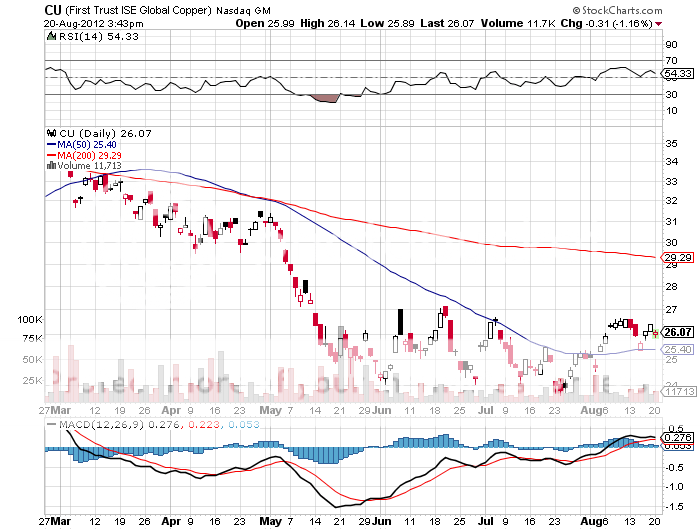
Copper has been leading the downside charge for all risk assets since it peaked on February 10. After looking at the latest trade data for the red metal, it is clear that it has a lot more bleeding to do. This does not bode well for risk assets anywhere.

The harsh truth is that copper stockpiles in China, which accounts for 40% of global consumption, are the highest in history. Estimates for the size of current stockpiles in country run as high as 3 million tonnes, with a stunning 918,000 tonnes coming in during the last six months. Consumption totaled only 1 million tonnes in Q1, 2012, and could fall to as low as 1.7 million tonnes over the remaining three quarters. The mismatch is huge, and makes the current price of $3.64 a pound look pretty expensive.

This imbalance is occurring in the face of a slowing Chinese economy. Only yesterday, the Chinese purchasing managers index for April came in at 49.1, well below the boom/bust level. Residential real estate, the largest consumer of copper in the Middle Kingdom, has clearly been in a bear market since last year.

The grim outlook is expected to make a serious dent into the profits of major producers, BHP Billiton (BHP), Freeport McMoRan (FCX), Rio Tinto (RIO), and Anglo American (AAUKY.PK), and Xstrata (XTA.L).

If the risk off scenario continues through the summer, then a $3.25 downside target is a chip shot. Remember that the 2009 low was positively subterranean $1.25 a pound. Bring in a real summer slowdown, and lower prices are within reach. Professionals will be selling the futures on any decent rally. Individuals can sell (CU) on market, are buy near money puts.


https://madhedgefundtrader.com/wp-content/uploads/2019/05/cropped-mad-hedge-logo-transparent-192x192_f9578834168ba24df3eb53916a12c882.png 0 0 DougD https://madhedgefundtrader.com/wp-content/uploads/2019/05/cropped-mad-hedge-logo-transparent-192x192_f9578834168ba24df3eb53916a12c882.png DougD2012-04-24 23:04:442012-04-24 23:04:44Why Dr. Copper is Looking Ill
DougD

Vietnam Has Been Hot

Diary

Vietnam has delivered one of the top performing stock markets so far in 2012. Take a look at the Market Vectors Vietnam ETF (VNM). The venture invests in companies that get 50% or more of their earnings from that country, with an anticipated 37% exposure in finance, and 19% in energy. This will get you easily tradable exposure in the country where China does its offshoring.

Vietnam was also one of the top performing stock markets in 2009. It was a real basket case in 2008, when zero growth and a 25% inflation rate took the main stock market index down 78%, from 1,160 to 250. This is definitely your E-ticket ride.

Vietnam is a classic emerging market play with a turbocharger. It offers lower labor costs than China, a growing middle class, and has been the target of large scale foreign direct investment. General Electric (GE) recently built a wind turbine factory there. You always want to follow the big, smart money. Its new membership in the World Trade Organization is definitely going to be a help. As my old friend, Carl Van Horn, the head of investment at JP Morgan taught me, watch direct investment, because the stock markets always follow.

It also helps a lot that the country has one of the world?s more favorable demographic pyramids. That means it has a high percentage of young, free spending workers and relatively few older social service demanding retirees. That is partially because we killed so many off during 1960-1972.
I still set off metal detectors and my scars itch at night when the weather is turning, thanks to my last encounter with the Vietnamese, so it is with some trepidation that I revisit this enigmatic country. Throw this one into the hopper of ten year long plays you only buy on big dips, and go there on a long vacation. If we get a summer swoon in global risk assets as I expect, this would be a good name to pick up.

The green shoots are real. But watch out for the old land mines.


Pass Me a ?BUY? Ticket Please

https://www.madhedgefundtrader.com/wp-content/uploads/2012/04/viet.jpg 240 320 DougD https://madhedgefundtrader.com/wp-content/uploads/2019/05/cropped-mad-hedge-logo-transparent-192x192_f9578834168ba24df3eb53916a12c882.png DougD2012-04-24 23:03:542012-04-24 23:03:54Vietnam Has Been Hot
Page 2026 of 2203«‹20242025202620272028›»

tastytrade, Inc. (“tastytrade”) has entered into a Marketing Agreement with Mad Hedge Fund Trader (“Marketing Agent”) whereby tastytrade pays compensation to Marketing Agent to recommend tastytrade’s brokerage services. The existence of this Marketing Agreement should not be deemed as an endorsement or recommendation of Marketing Agent by tastytrade and/or any of its affiliated companies. Neither tastytrade nor any of its affiliated companies is responsible for the privacy practices of Marketing Agent or this website. tastytrade does not warrant the accuracy or content of the products or services offered by Marketing Agent or this website. Marketing Agent is independent and is not an affiliate of tastytrade. 

Legal Disclaimer

There is a very high degree of risk involved in trading. Past results are not indicative of future returns. MadHedgeFundTrader.com and all individuals affiliated with this site assume no responsibilities for your trading and investment results. The indicators, strategies, columns, articles and all other features are for educational purposes only and should not be construed as investment advice. Information for futures trading observations are obtained from sources believed to be reliable, but we do not warrant its completeness or accuracy, or warrant any results from the use of the information. Your use of the trading observations is entirely at your own risk and it is your sole responsibility to evaluate the accuracy, completeness and usefulness of the information. You must assess the risk of any trade with your broker and make your own independent decisions regarding any securities mentioned herein. Affiliates of MadHedgeFundTrader.com may have a position or effect transactions in the securities described herein (or options thereon) and/or otherwise employ trading strategies that may be consistent or inconsistent with the provided strategies.

Copyright © 2026. Mad Hedge Fund Trader. All Rights Reserved. support@madhedgefundtrader.com
Scroll to top