?Who knew the blockbuster this year would be a horror show,? said Tony Crescenzi, market strategist and portfolio manager at bond giant, PIMCO.


?Who knew the blockbuster this year would be a horror show,? said Tony Crescenzi, market strategist and portfolio manager at bond giant, PIMCO.

?Take 200 round trips to Australia, and you really start to rack up the miles,? said Tom Stoker, and automotive sales analyst who just surpassed 10 million frequent flier points on United Airlines. It makes my own 1 million miles seem puny by comparison.

First there was your grade point average, then your SAT score, followed by GMAT and LSAT scores, and finally your FICO. Now there is a new metric with which you will be judged, your ?Influencer? score.
A new breed of marketing research firms are using data from social media sites, like Facebook, Linkedin, and Twitter, to rank members according to their ability to spur their friends to action. Companies like Klout, Peer Index, and Twitter Grader are using complex algorithms to mine their data and rank members. This is far more than just a simple listing of ?friends.?
Scores range from 1-100, with a major league socializer achieving a 40 ranking, and someone like Bono or Martha Steward coming in at a godlike 100. These scores will be made public and could have a major impact on you career prospects, your credit rating, and even your sex life. I can hear this conversation coming already: ?Thanks for the invitation to the opera, honey, but I have a better offer from an 80 to go to the Giants game.?
Do you like your new BMW, American Express card, or Rolex watch and are talking about it with your friends? Advertisers are willing to pay big bucks to get to know you. Last year, Virgin America airline offered free tickets to Los Angeles and San Francisco to highly ranked influencers, while Audi made available special discounts for a new car. Las Vegas casinos are giving away weekends with complimentary show tickets and generous room service tabs.
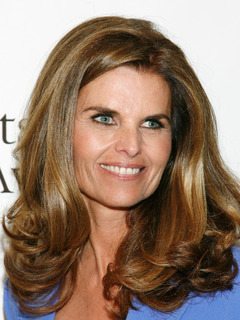
I have to tell you that I am looking forward to the new system. I just passed 1,200 likes on Facebook and have a massive Twitter following. My website gets 30,000 hits a day and is read in 125 countries, so I should score pretty highly.? I understand that Maria Shriver has recently become available. Hey, Maria! Want to check out my 90? I?ll even fire my cleaning lady!
Will a 90 Tickle Your Fancy?

?I?m long tear gas after the Athens experience. They are going to need that tear gas in Rome and Madrid at some point,? said Steve Cortez at Veracruz Research.

During my college days, one of my math professors used to repeat a truism: ?Statistics are like a bikini; what they reveal are fascinating, but what they conceal is essential.? That has increasingly becoming the case with US economic data, which are leading investors astray with their faulty guidance.
It turns out that most government data releases contain a seasonal adjustment factor that includes a five-year look back. The problem arises when the 2008 figures from the global financial meltdown are averaged in, which includes a panoply of once in a century spikes. Think job losses at 700,000 a month and a shrinking GDP at an annualized -9% rate.
Those data points are skewing today?s releases in unfortunate ways. They are making the economy appear stronger from September to February, and weaker than it should be from March to August. What this does is reinforce an existing historical trend that weakens stocks every spring, only to rally them back in the fall, which has been in force for over 100 years.
My theory is that this dates back to the agricultural foundations of our nation. Farmers were always at maximum distress during the late summer when their borrowing to pay for seed, fertilizer, and labor was at a maximum, just before the harvest. This is why stock market crashes always happen in September and October.
In recent years, bailouts from the Federal Reserve have reinforced the two red herrings above. Being human, they react to four or five months of unrelenting market stress crying ?Uncle? just when the kids are headed back to school. In August 2010 Bernanke sprung QE2 on the market, and in September 2011 he launched his ?twist? policy, or ?QE light?. In both cases these actions led to 6-8 month global rallies in all risk assets.
What all of this does is explain why ?sell in May and go away? has worked so well for the past four years. Using the five-year timetable, it looks like we will see a repeat of this seasonality in 2013. After that, when everyone comes to believe that the trend is a certainty, it will fail. May bears will get run over by a stampede of bulls in 2014 as the statistical aberrations fade away. It will be then that the shortcomings of a bikini become most apparent.
Conceals More Than It Reveals
They are really rocking the market today, with the Dow up nearly 200 points off the back of a non-disastrous Chinese GDP growth figure of 7.7%. However, there is a serious disconnect going on in our markets which suggests to me that our own party may be about to end.
Yesterday?s blockbuster weekly jobless claim took applications for unemployment benefits down to a four-year low of 350,000. But if you ignore this, you have an unending series of data reports that shows an economy clearly decelerating to a growth rate of 1% per annum or less. That is one-seventh China?s rate.
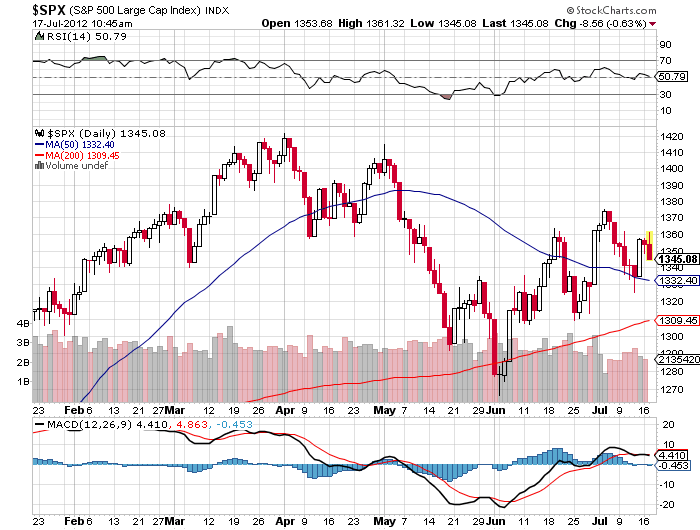
And yet, you have an S&P 500 with a top end range that is a mere 3% within the high for the year. You don?t need a PhD in math from MIT to understand that rising stock prices and falling growth are an anomaly that can?t last and can only end in tears.
I think this is happening for a couple of reasons. Many traders are awaiting Q2, 2012 earnings reports and are willing to give companies the benefit of the doubt until they are out. Stocks are at the historic low end of valuation ranges. Many institutions are still underweight, and willing to use dips to pick up some bargains. This is why this summer has been a short seller?s nightmare, volatility has fallen through the floor, and many hedge funds have bailed for the duration.
I also think that many institutions are waiting for the Federal Reserve to announce QE III at their end of July meeting, thus powering the market to new yearly highs. I?m betting that they will be sorely disappointed. Ben Bernanke has so few bullets left to protect the economy that he will wait until the Indians are circling the wagons and unleashing a barrage of arrows, before he takes action. Quantitative easing is meant to be a safety net, not a stepladder from which to boost ever-higher asset prices. The Fed?s failure to deliver could give us the trigger we need to break to new lows in August.
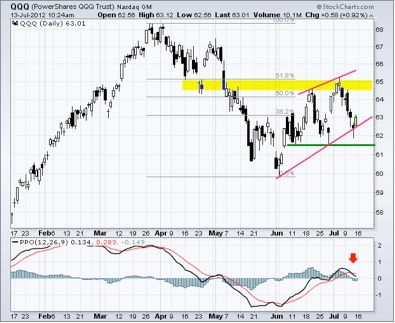
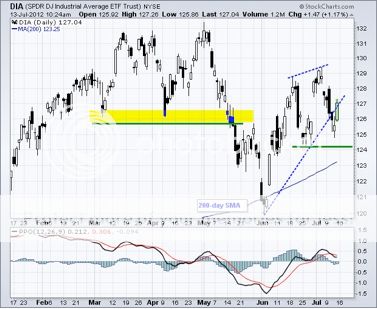
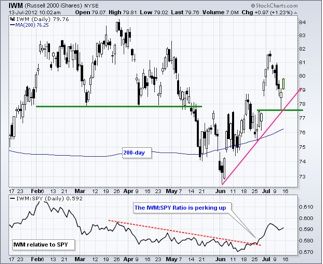
Take a look at the charts below to see how clearly defined the recent channels and ranges are. Next time the SPX approaches 1,370, I might think about going short, taking out some downside insurance, selling out of the money calls, and generally getting yourself into a risk off posture. If you don?t, your summer could turn into a giant rainstorm.

This Party is Nearly Over
Location: 48 degrees, 02.12 minutes North, 043 degrees, 42.08 minutes East, or 1,421 nautical miles ENE of New York.
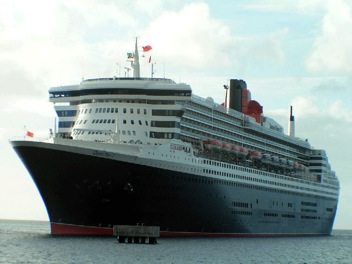
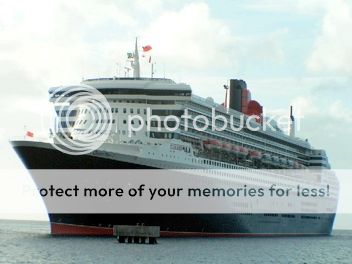
The Queen Mary 2 is currently plowing its way through a massive fog bank a thousand miles thick, sounding the foghorn every two minutes. Visibility is less than 100 yards, and the waves are a rough 12 feet high. The captain has closed the outside decks for fear of losing a passenger overboard. The weather has disrupted our satellite link, and our Internet is down. So here I write.
One hour out of New York, and a passenger suffered a heart attack. So the captain turned the ship around and headed back to the harbor, where the New Jersey search and rescue sent out a launch to pick up the unfortunate man and his spouse. That meant we could pass under the Verrazano Bridge three times, on each occasion deftly clearing the span by a mere ten feet. Talk about inauspicious beginnings.
The ship is truly gigantic. You must allow 20 minutes to get anywhere, 5 minutes to walk there and 15 minutes to get lost. When launched a decade ago, it was the largest cruise ship every built at 148,900 tons, nearly double the size of the now decommissioned Queen Elizabeth II. It whisks up to 3,000 passengers and 1,325 crew across the seas in the utmost luxury at a steady 21.5 knots. You could water ski behind this leviathan of a vessel, if only the crew permitted it.
As a 40 year guest of Cunard and the highest paying customer on the ship, I managed to bag the Sandringham Suite, possible the most luxurious publicly available oceangoing accommodation ever created. The 2,200 square foot, two floor, two bedroom, three bathroom, Q1 class apartment on decks nine and ten includes a formal dining room, kitchen, his and her closets, a small gym, and 1,000 square feet of rear facing teak deck.
All of this was a bargain for $56,000, or about the same as renting the presidential suite at the San Francisco Ritz for a week at $10,000 a night, except at the end you wake up in England five pounds heavier. Not that I noticed, though. By the afternoon, the two complimentary bottles of Dom Perignon Champagne were already headed for the recycling bin.
The suite came staffed with two full time butlers, Peter and Henry, who were an endless font of fascinating information about the ship. During one unfortunate cruise, eight senior citizens passed away. The morgue held only six, so the extra two were stashed in the meat locker for the duration of the voyage.
I asked if the Cunard they ever performed burials at sea in these circumstances. They said they used to. But a few years back an elderly billionaire ?Mr. Smith? checked into a deluxe Q1 cabin with a hot young ?Mrs. Smith?, and then promptly expired. The grieving widow requested he be buried mid-Atlantic with the traditional yard of sail and a cannonball. When the ship docked at Southampton, the much older real ?Mrs. Smith? appeared to claim the body, and sued the company when informed of his current disposition. So, no more burials at sea.
Yes, the ship did hit a whale once, which stuck to the bulbous bow. When it landed in Portugal, Cunard was fined for commercial fishing without a license. The unlucky cetacean?s skeleton is now in a Lisbon maritime museum. Apparently this company gets sued a lot.
Of course, the memory of the sinking of the Titanic is ever present. There is a history display down on deck 2 and you can even have your photo taken in front of a backdrop of the grand staircase of the ill fated ship. When we passed 10,000 feet over the wreck at 48 degrees, 38.50 minutes North, 50 degrees, 00.11 minutes West one day out of New York, the Queen Mary 2 let out three long blasts of its horn in memory of the lost. Cunard took over the Titanic?s White Star Line during the Great Depression and is therefore the inheritor of this legacy.
Peter is now at the door with my dinner, so I will continue on another post.

?It?s a bit like looking for gold in a minefield,? said Fidelity International?s China Special Situation Fund manager, Anthony Bolton, amid widespread accounting fraud in the country.

As a potentially profitable opportunity presents itself, John will send you an alert with specific trade information as to what should be bought, when to buy it, and at what price. Read more
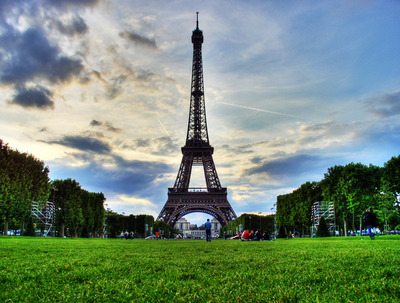
Come join me for lunch for the Mad Hedge Fund Trader?s Global Strategy Update, which I will be conducting in Paris on Tuesday, July 17, 2012. A three course lunch will be followed by a PowerPoint presentation and an extended question and answer period.
I?ll be giving you my up to date view on stocks, bonds, foreign currencies commodities, precious metals, and real estate. And to keep you in suspense, I?ll be throwing a few surprises out there too. Enough charts, tables, graphs, and statistics will be thrown at you to keep your ears ringing for a week. Tickets are available for $259.
I?ll be arriving an hour early and leaving late in case anyone wants to have a one on one discussion, or just sit around and chew the fat about the financial markets.
The lunch will be held at a prestigious private club in the City of Light?s central Opera district, the details of which will be emailed to you with your purchase confirmation.
I look forward to meeting you, and thank you for supporting my research. To purchase tickets for the luncheons, please go to my online store at http://madhedgefundradio.com/ and click on ?LUNCHEONS?.