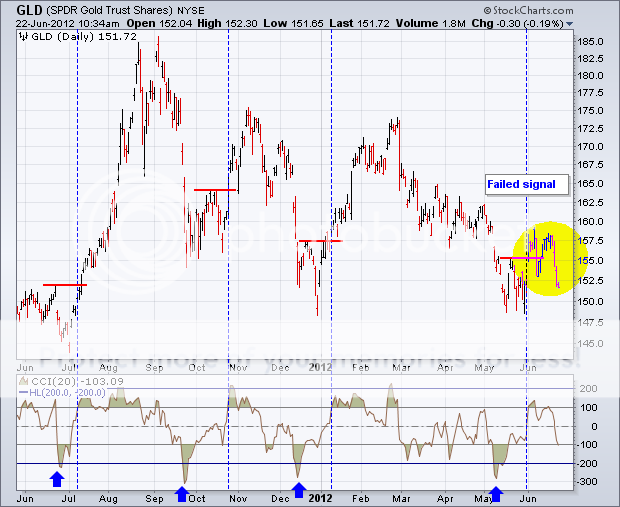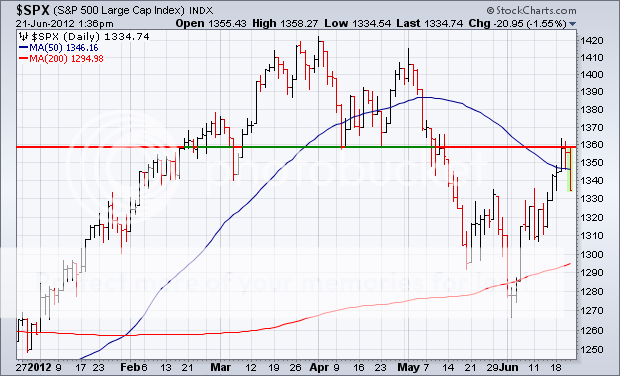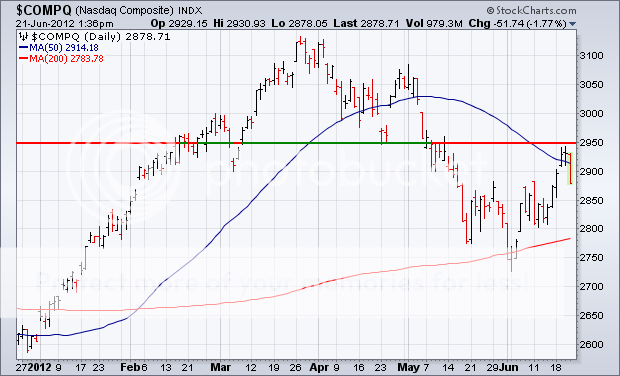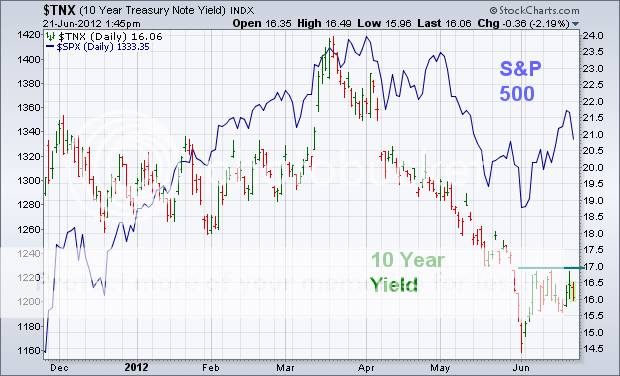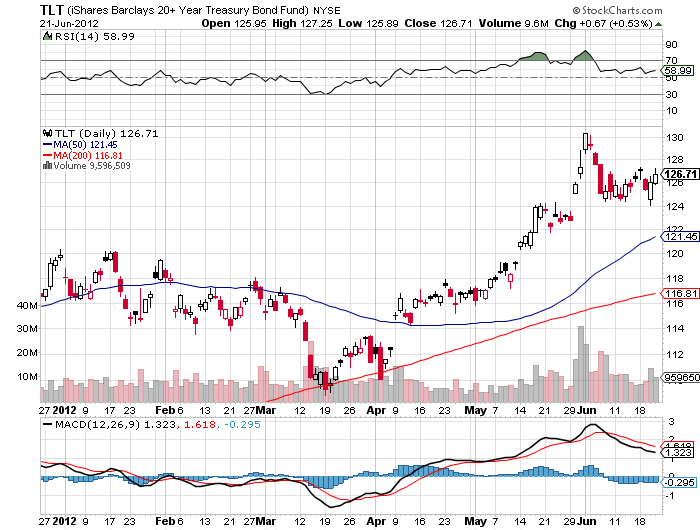
The 'Oracle of Omaha' expounded at length today on why he despises the barbarous relic. The sage doesn't really care about the yellow metal, whatever the price. He sees it primarily as a bet on fear.
If investors are more afraid in a year than they are today, then you make money. If they aren't, then you lose money. If you took all the gold in the world, it would form a cube 67 feet on a side, worth $7 trillion. For that same amount of money, you could own other assets with far greater productive power, including:
*All the farmland in the US, about 1 billion acres, which is worth $2.5 trillion.
*Seven Apple?s (AAPL), the largest capitalized company in the world.
*You would still have $2 trillion in walking around money left over.
Instead of producing any income or dividends, gold just sits there and shines, letting you feel like you are King Midas.
I don't know. With the stock market peaking around here, and oil trading at $105/barrel, a bet on fear looks pretty good to me right now. I'm still sticking with my long term forecast of the old inflation adjusted high of $2,300/ounce. But we may have to visit $1,500 on the way there first.
?What the wise man does in the beginning the fool does in the end,? said oracle of Omaha, Warren Buffett.
https://www.madhedgefundtrader.com/wp-content/uploads/2012/03/0922_warren-buffett2.jpg360318DougDhttps://madhedgefundtrader.com/wp-content/uploads/2019/05/cropped-mad-hedge-logo-transparent-192x192_f9578834168ba24df3eb53916a12c882.pngDougD2012-03-15 23:01:492012-03-15 23:01:49March 16, 2012 - Quote of the Day
With global quantitative easing now getting long in the tooth, I think the party is about to end for the Treasury bond market. For the last four months, this market has been stuck in a tedious, narrow range, with ten year paper stuck between a 1.90% - 2.10% yield. Trading bonds has been as exciting as watching paint dry, with only professionals able to engineer profitable round trips. The charts below show that we have at last broken out of that range.
Private US investors and foreign central banks are not going to be able to make up the shortfall in bond buying once the Fed and the ECB exit the stage. The big problem is that the bond market these days is very much like a Ponzi scheme. Unless there is a steady inflow of new suckers, the entire plan collapses like a house of cards.
I can?t tell you how many hedge funds are itching to short Treasury bonds. Thousands jumped in too early last year only to get their fingers burned, myself included.
The ideal instrument for the individual investor to get involved in this market is with is the ProShares Ultra Short 20+ Treasury ETF (TBT). I have included a three year chart below to show you what the long grinding bottom looked like. The only surprise is that it took this long to turn up, given the strength we have seen in risk assets since October.
Keep in mind that the cost of admission to play this game is high. A 200% short bond position means that you are short the coupon twice. For a 30 year bond with a 3.4% yield, that adds a cost of carry of 6.8%. Add in another 1.2% for management fees, expenses, and other hidden costs, and you really need Treasury bonds to fall 8% year just to break even in the ETF. You won?t ever see the interest and fees deducted. It just feeds directly into the ETF price. On top of that, you can expect some tracking error. That?s why it is best to catch only the short term pops in this security, much like you have seen this week.
Of course, I hate buying anything that has just popped 10%. You know me, I am not a chaser. Ideally, the long awaited 5% correction in stocks will create a rally in bonds and a selloff in the (TBT) that could provide a prudent entry point.
If this really is the end of the 30 year bull market, there is a lot of room on the upside for the (TBT). Take 30 year yields back to last year?s high of 4.2%, and the (TBT) nearly doubles to $40. If the markets want to finally pay attention to our large and ballooning budget deficits, now over 100% of GDP, it could deliver a multiple of that.
Is the Fat Lady Singing for the Treasury Market?
00DougDhttps://madhedgefundtrader.com/wp-content/uploads/2019/05/cropped-mad-hedge-logo-transparent-192x192_f9578834168ba24df3eb53916a12c882.pngDougD2012-03-14 23:03:262012-03-14 23:03:26Is the Fat Lady Singing for the Treasury Bond Market?
If you want to delve into the case against the long term future of US Treasury bonds in all their darkness, take a look at Foreign Affairs, the establishment bimonthly journal read by academics, intelligence agencies, and politicians alike, which I am sure you all have sitting on your nightstands. In a well-researched and thought out article penned by Roger C. Altman and Richard N. Haas, the road to ruin ahead of us is clearly laid out.
The US has no history of excessive debt, except during WWII, when it briefly exceeded 100% of GDP. That abruptly changed in 2001, when George W. Bush took office. In short order, the new president implemented massive tax cuts, provided expanded Medicare benefits for seniors, and launched two wars, causing budgets deficits to explode at the fastest rate in history. To accomplish this, strict ?pay as you go? rules enforced by the previous Clinton administration were scrapped. The net net was to double the national debt to $10.5 trillion in a mere eight years.
Another $4.5 trillion in Keynesian reflationary deficit spending by president Obama since then has taken matters from bad to worse. The Congressional Budget Office is now forecasting that, with the current spending trajectory and THE 2010 tax compromise, total debt will reach $23 trillion by 2020, or some 160% of today?s GDP, 1.6 times the WWII peak.
By then, the Treasury will have to pay a staggering $5 trillion a year just to roll over maturing debt. What?s more, these figures greatly understate the severity of the problem. They do not include another $9 trillion in debts guaranteed by the federal government, such as bonds issued by home mortgage providers, Fannie Mae and Freddie Mac. State and local governments owe another $3 trillion. Double interest rates, a certainty if commodity price inflation continues unabated, and our debt service burden doubles as well.
It is unlikely that the warring parties in Congress will kiss and make up anytime soon, especially if we get another split congress after the November election. It is therefore likely that the capital markets will emerge as the sole source of any fiscal discipline, with the return of the ?bond vigilantes? to US shores after their prolonged sojourn in Europe. They have already made their predatory presence known in the profligate nations of Europe, and they are expected to arrive here eventually.
Such forces have not been at play in Washington since the early 1980?s, when bond yields reached 13%, and homeowners paid 18% for mortgages. Since foreign investors hold 50% of our debt, policy responses will not be dictated by the US, but by the Mandarins in Beijing and Tokyo. They could enforce a cut back in defense spending from the current annual $700 billion. They might even demand a retreat from our $150 billion a year commitments in Iraq and Afghanistan.
Personally, I think the US will never recover from the debt explosions engineered by Bush and by ?deficits don?t count? vice president Chaney. The outcome has permanently lowered standards of living for middle class Americans and reduced influence on the global stage.
But don?t get mad about our national debt debacle, get even. Make a killing profiting from the coming collapse of the US Treasury market through buying the leveraged short Treasury bond ETF, the (TBT). Just pick your entry point carefully so you don?t get shaken out in a correction.
Looks Like I Can?t Afford the Next War
00DougDhttps://madhedgefundtrader.com/wp-content/uploads/2019/05/cropped-mad-hedge-logo-transparent-192x192_f9578834168ba24df3eb53916a12c882.pngDougD2012-03-14 23:02:452012-03-14 23:02:45The Structural Bear Case for Treasury Bonds
?At these prices, bonds should have warning labels on them,? said Doug Kass of Seabreeze Partners.
https://www.madhedgefundtrader.com/wp-content/uploads/2012/03/hazard.jpg212400DougDhttps://madhedgefundtrader.com/wp-content/uploads/2019/05/cropped-mad-hedge-logo-transparent-192x192_f9578834168ba24df3eb53916a12c882.pngDougD2012-03-14 23:01:142012-03-14 23:01:14March 15, 2012 - Quote of the Day
As a potentially profitable opportunity presents itself, John will send you an alert with specific trade information as to what should be bought, when to buy it, and at what price. Read more
https://www.madhedgefundtrader.com/wp-content/uploads/2011/10/slider-05-trader-alert.jpg316600Mad Hedge Fund Traderhttps://madhedgefundtrader.com/wp-content/uploads/2019/05/cropped-mad-hedge-logo-transparent-192x192_f9578834168ba24df3eb53916a12c882.pngMad Hedge Fund Trader2012-03-14 11:01:532012-03-14 11:01:53Trade Alert (AAPL 2 of 2) - March 14, 2012
As a potentially profitable opportunity presents itself, John will send you an alert with specific trade information as to what should be bought, when to buy it, and at what price. Read more
00Mad Hedge Fund Traderhttps://madhedgefundtrader.com/wp-content/uploads/2019/05/cropped-mad-hedge-logo-transparent-192x192_f9578834168ba24df3eb53916a12c882.pngMad Hedge Fund Trader2012-03-14 11:01:432012-03-14 11:01:43Trade Alert (AAPL 1 of 2) - March 14, 2012
Due to overwhelming demand, I have improved and expanded my 2012 schedule of strategy luncheons. The Phoenix lunch got moved to Scottsdale to access a more stylish hotel. The French said they would start mailing me frog legs if I didn?t come to France, so my European Tour now includes a Paris lunch.
The Swiss threatened to they would cancel my invitation to the Davos conference next year, so I have added a seminar in Zermatt. But you will have to climb the Matterhorn to get there. Don?t forget your pitons, crampons, karabiners, ropes, and GPS in case you get buried in an avalanche. I don?t mind visiting the Alps again. Last year, my short in the Swiss franc was my best performing trade, so it should be considerably cheaper this time around.
April 20 San Francisco
May 3 Scottsdale
June 11 Beverly Hills
June 29 Chicago
July 5 New York
July 6-13 Queen Mary II
New York to Southampton
July 16 London
July 17 Paris
July 18 Frankfurt
July 27 Zermatt
October 26 San Francisco
November 8 Orlando
January 3, 2013 Chicago
My inbox was clogged with responses to my ?Golden Age? for the 2020?s piece yesterday, particularly my forecast that the US was moving towards complete energy independence. This will be the most important change to the global economy for the next 20 years. So I shall go into more depth.
The energy research house, Raymond James, put out an estimate this morning that domestic American oil production (USO) would rise from 5.6 million barrels a day to 9.1 million by 2015. That means its share of total consumption will leap from 28% to 46% of our total 20 million barrels a day habit. These are game changing numbers.
Names like the Eagle Ford, Haynesville, and the Bakken Shale, once obscure references on geological maps, are now a major force in the country?s energy picture. Ten years ago North Dakota was suffering from depopulation. Now, itinerate oil workers must brave -40 degree winter temperatures in their recreational vehicles pursuing their $150,000 a year jobs.
The value of this extra 3.5 million barrels/day works out to $134 billion a year at current prices (3.5 million X 365 X $105). That will drop America?s trade deficit by nearly 25% over the next three years, and almost wipe out our current account surplus. Needless to say, this is a hugely dollar positive development.
This 3.5 million barrels will also offset much of the growth in China?s oil demand for the next three years. Fewer oil exports to the US also vastly expand the standby production capacity of Saudi Arabia.
If you want proof of the impact this will have on the economy, look no further that the coal (KOL) and rail stocks (UNP) which have been falling in a rising market. Power plant conversion from coal to natural gas (UNG) is accelerating at a dramatic pace. That leaves China as the remaining buyer, and their economy is slowing.
It all makes the current price of oil at $105 look a little rich. As with the last oil spike three years ago, this one is occurring in the face of a supply glut. Cushing, Oklahoma is awash in Texas tea, and the Strategic Petroleum Reserve stashed away in salt domes in Texas and Louisiana is at its maximum capacity of 727 barrels. It is concerns about war with Iran, fanned by elections in both countries that have taken prices up from $75 in the fall.
My oil industry friends tell me this fear premium has added $30-$40 to the price of crude. This is why I have been advising readers to sell short oil price spikes to $110. The current run up isn?t going to take us to the $150 high that we saw in the last cycle. It is also why I am keeping oil companies with major onshore domestic assets, like Exxon Mobile (XOM) and Occidental Petroleum (OXY), in my long term model portfolio.
https://madhedgefundtrader.com/wp-content/uploads/2019/05/cropped-mad-hedge-logo-transparent-192x192_f9578834168ba24df3eb53916a12c882.png00DougDhttps://madhedgefundtrader.com/wp-content/uploads/2019/05/cropped-mad-hedge-logo-transparent-192x192_f9578834168ba24df3eb53916a12c882.pngDougD2012-03-13 23:03:112012-03-13 23:03:11US Headed Towards Energy Independence
Long time readers of this letter are well aware of my advice to hold cash in the Chinese Yuan ETF (CYB) for the past four years. Those who followed my advice profited nicely.
The Yuan to you and me is known domestically in China as the ?renminbi?, or people?s currency. China has a quasi-fixed exchange rate against the US dollar that limits movement to just a couple of percent a year.
Since the People?s Bank of China removed a decade long dollar peg in 2005, it allowed a very gradual rise in this band of 2-3% a year. That is a vastly superior return compared to the zero interest Americans currently earn from money market funds, cash management accounts, or through buying Treasury notes with up to two year maturities.
This week, rumors roiled the marketplace that the government might slow, or even stop, this drip by drip appreciation. The trigger was a shocking $$31.5 billion February trade deficit, the largest monthly figure since 1998, primarily caused by the recession in Europe, its largest export market. The (CYB) reacted by plunging nearly 1% overnight.
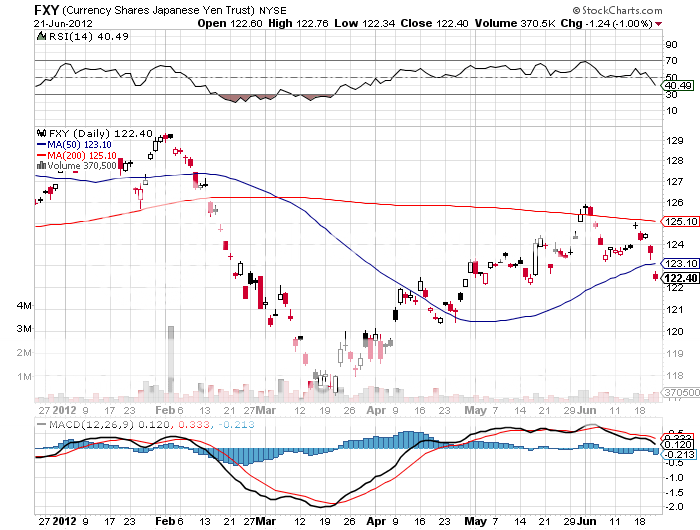
One thing is certain. A free floating Yuan would be at least 50% higher than it is today, and possibly 100%. I can say this in confidence having watched the Japanese yen appreciate from ?360 to the dollar to ?75 while running a trade surplus of similar magnitude for the past 40 years, an increase of almost 400%.
In fact, the desire to prevent foreign hedge funds and speculators from making a killing in the market is a not a small factor in Beijing?s thinking to keep its currency artificially undervalued. The Chinese Central bank governor, Zhou Xiaochuan, says he won?t entertain a revaluation for the foreseeable future. He is no doubt thinking about the millions of Chinese workers who would lose their jobs if their exporting employers? razor thin profit margins are vaporized by a stronger currency.
The Americans say they need a stronger Yuan now. And now the matter has become a campaign issue, with candidate Mitt Romney saying he would label China a ?currency manipulator? on day one in office, not a nice thing to say to the country that is supposed to fund the bulk of his promised tax cuts. Obama has responded in kind, filing a WTO complaint on Chinese export restrictions of rare earth metals essential for our manufacture of electric cars.
I think you could see continued weakness in the Yuan as long as Europe is in the penalty box, slowing the Middle Kingdom?s economic growth. But this is merely a short term dip in a long term trend.
Buy the Yuan ETF on weakness. Just think of it as a cash management tool with an attached lottery ticket. If the Chinese continue to stonewall liberalization of their currency, you will get the token 2%-4% annual revaluation the swaps have been discounting. Given the massive $250 billion annual trade surplus the Middle Kingdom is now running with the US, the chances of a prolonged fall in the Yuan against the dollar are minimal. If they cave, then you could be in for a home run.
Is China a Good Parking Place for Cash?
https://madhedgefundtrader.com/wp-content/uploads/2019/05/cropped-mad-hedge-logo-transparent-192x192_f9578834168ba24df3eb53916a12c882.png00DougDhttps://madhedgefundtrader.com/wp-content/uploads/2019/05/cropped-mad-hedge-logo-transparent-192x192_f9578834168ba24df3eb53916a12c882.pngDougD2012-03-13 23:02:212012-03-13 23:02:21The Chinese Yuan Takes a Hit
Legal Disclaimer
There is a very high degree of risk involved in trading. Past results are not indicative of future returns. MadHedgeFundTrader.com and all individuals affiliated with this site assume no responsibilities for your trading and investment results. The indicators, strategies, columns, articles and all other features are for educational purposes only and should not be construed as investment advice. Information for futures trading observations are obtained from sources believed to be reliable, but we do not warrant its completeness or accuracy, or warrant any results from the use of the information. Your use of the trading observations is entirely at your own risk and it is your sole responsibility to evaluate the accuracy, completeness and usefulness of the information. You must assess the risk of any trade with your broker and make your own independent decisions regarding any securities mentioned herein. Affiliates of MadHedgeFundTrader.com may have a position or effect transactions in the securities described herein (or options thereon) and/or otherwise employ trading strategies that may be consistent or inconsistent with the provided strategies.