

"The greatest glory in living lies not in never falling, but in rising every time we fall." said the great American novelist, Earnest Hemingway.


"The greatest glory in living lies not in never falling, but in rising every time we fall." said the great American novelist, Earnest Hemingway.

(TSLA), (DOCU), (HOOD), (COIN), (NVDA), (MSFT), (GOOGL), (AMZN), (RDDT), (ALAB)
Silicon Valley's buzzing with all things AI these days, but hold on a sec – venture capitalists are keeping their checkbooks under lock and key. This quarter, they tossed $36.6 billion at startups, which sounds like a lot of cash. But here's the shocker: that's a near 30% dive compared to last year.
Remember, 2023 was already a funding desert for startups, and it seems 2024 might be even tougher. So, what's going on here?
Well, the economy's a dumpster fire right now, leading investors to get cold feet about IPOs. Everyone's counting their pennies like we're back in the Depression Era. Even those venture capitalists are guarding their cash like it's gold bullion.
With stubborn inflation hanging around like a bad smell, a recession seems more likely than a Tesla (TSLA) stock split.
It's a rough climate for companies across the board – from old-timers like DocuSign (DOCU), who are probably kicking themselves for not selling out during the boom, to those crypto enthusiasts at Coinbase (COIN)...let's just say the party's winding down.
Meanwhile, those lucky founders, the ones who cashed out before everything went south, are hunkering down like they're preparing for a blizzard. No way they're going back for more investment right now – those valuations are going to be brutal.
In fact, companies like Robinhood (HOOD), the guys who cater to those meme-stock-loving investors, are probably feeling the heat as the cash dries up. This is definitely not a great time to be in that business.
But hey, they're not alone – the entire startup world is feeling the squeeze. In fact, things aren't just tough, they're downright catastrophic. It's like we're all on the Titanic, and the band just keeps playing.
Sure, Reddit (RDDT) and a few others (who even are Astera Labs (ALAB)?) barely got their lifeboats launched, but the rest of the year is looking grimmer than a Silicon Valley winter. Honestly, I can count the potential IPOs on two hands. It makes sense – those venture firms haven't seen a decent payout in ages. Nobody's throwing good money after bad in this climate
But hold on, there's a flicker of hope.
Global venture funding isn't a total disaster zone – yet. While the numbers look similar to last year, that $96 billion went to wayyyy fewer companies.
There's a clear divide happening: those hot AI startups are swimming in cash, while the rest are scrambling for change just to stay afloat.
The startup world might be on life support, but AI companies are living their best lives. Just ask Cohere – those guys scored a mind-blowing $5 billion. Their insane funding round proves that investors are going all-in on AI, even as they slam the brakes on everything else.
Cohere's success isn't a fluke. Tons of AI startups are pulling in major funding.
Anthropic scored a cool $580 million in 2023, with big names like Spark Capital and Google Ventures backing them. That put their valuation at a sweet $4.1 billion – not bad for an AI startup.
Adept AI Labs, the ones focused on AI that can learn on the fly, landed $350 million in early 2024, led by Sequoia Capital. Those Andreessen Horowitz guys are in on the action, too.
Meanwhile, fancy language processing is Inflection AI's game, and they convinced investors to toss them $225 million in late 2023. Tiger Global Management clearly thinks they're onto something big.
As for healthcare + AI? That's a recipe for serious cash. Hearth.AI pulled in $180 million in 2024 – Khosla Ventures is leading the charge, with Founders Fund and Bessemer Venture Partners also betting big.
This unique position also means tech giants like Nvidia (NVDA), Microsoft (MSFT), Alphabet (GOOGL), and Amazon (AMZN) are driving the AI boom.
Nvidia continues to be the king of those fancy GPUs that make all those AI models tick.
Microsoft's not about to be left in the dust – they're sneaking AI into everything they own, from their cloud stuff to that boring old Office suite.
Alphabet (aka Google) likes to think they practically invented AI, and their fancy lab, DeepMind, is constantly churning out the next big thing.
And let's not forget Amazon – those guys are obsessed with staying ahead, pushing AI hard with their cloud business, AWS. Want robot helpers? They've probably got an option for that — maybe one that cleans your house while you're at the golf course.
More importantly, these giants have the money and the brainpower, fueling the hot little startups lucky enough to catch their eye. That means the money well for these AI startups won’t dry up anytime soon.
What do these mean for us? Well, I think this mess is a wake-up call: it's time to get picky. Ditch those sinking ships and take a look at the AI companies that are making all the headlines (and all the money). The rest of the startup world might be going up in flames, but AI has proven that it is in its own little oasis, a bubble bursting with opportunity. Don’t get left behind.

Mad Hedge Technology Letter
April 5, 2024
Fiat Lux
Featured Trade:
(DELL IS NOT A DINOSAUR ANYMORE)
(DELL), (AMD), (NVDA)
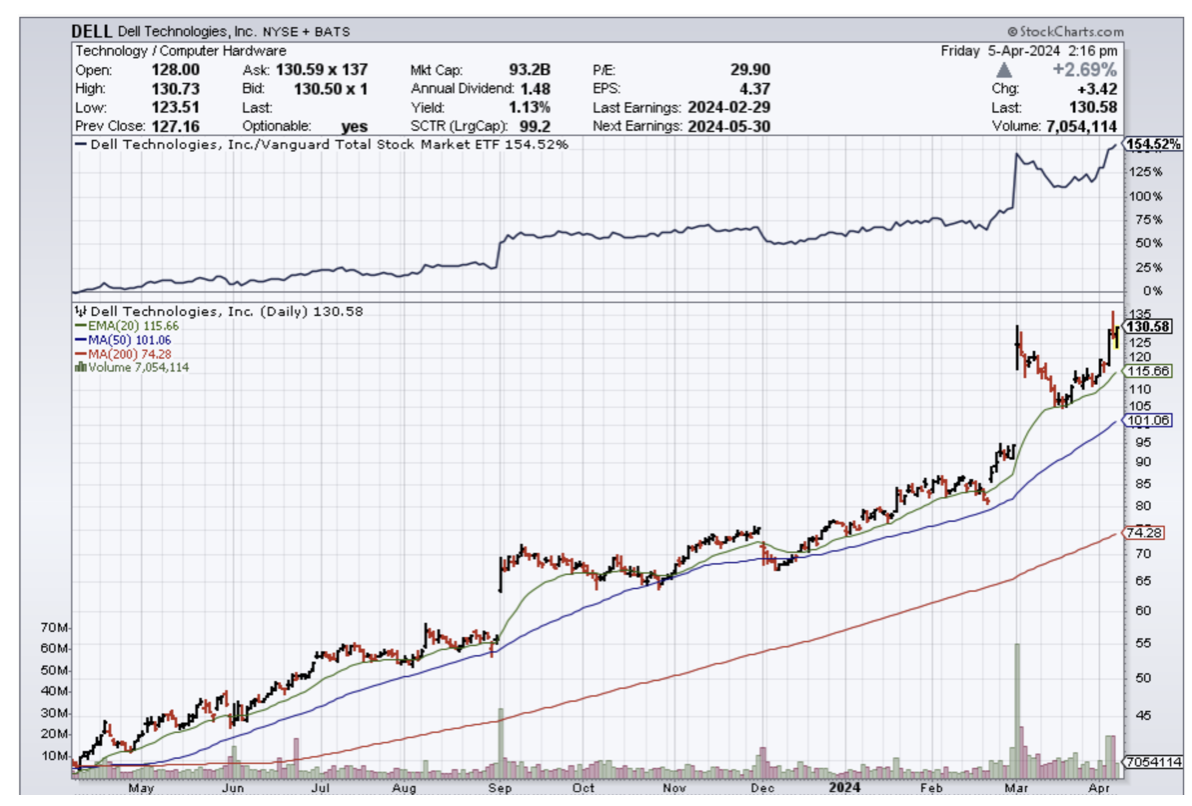
Investors are looking through any bad part of Dell’s business because they have faith in the AI narrative.
Dell is one of those legacy companies that produce a great deal of enterprise products.
The stock went nowhere for a long time but now it is different.
Mixed into their earnings story was a torrent of negative numbers like the company's net revenue was down 14% year over year in 2024 and down 11% in Q4.
A weak PC market isn't helping its numbers. And the drop in revenue led to a 10% drop in full-year operating income.
Dell stock nevertheless has crushed in the short term to churn out all-time highs.
Investors are solely focused on Dell’s potential with artificial intelligence (AI).
Peeling back the numbers, Dell suddenly has a massive backlog of orders for its AI-optimized servers.
They are finally relevant after so many years out to pasture.
Dell is driven in particular by strong demand for AI servers powered by Nvidia H100 chips.
The company said at the time that its backlog of orders for AI servers at quarter end had reached $2.9 billion, up from $1.6 billion in the previous quarter and $800 million two quarters earlier.
Dell also said that it has a pipeline of interest in AI servers that is “multiples” of its current backlog.
And the company said at the time that there is additional demand for servers powered by AMD’s (AMD) pending MI300 GPU and for the next generation of Nvidia (NVDA) chips.
One still on the horizon is the emergence of AI PCs, which should start shipping later this year from Dell and other PC makers.
Management revealed that by the end of January 2025, one of every five PCs Dell sells will be capable of running AI workloads. They also estimate that the total could double by the end of 2026.
Another business that could see an AI-driven improvement is enterprise storage, which accounted for about 20% of overall revenue in the latest quarter. That business was down 10% in the most recent quarter from the year-earlier period.
Dell's management said that it had $800 million in shipments for AI-optimized servers in Q4 alone which is greater than the $500 million they did last quarter.
There will be many winners and losers in this Game of Thrones tech sub-industry of AI.
Tech firms will go from boom to bust with some even going boom based on pure potential.
That’s how much money is flowing into this segment of tech right now.
Many companies are counting on cloud computing platforms to provide AI expertise and power, but Dell's business is betting on AI-equipped on-premise servers.
These servers make sense for big entities that need on-site installation.
I am not talking about the single guy working from home in his little studio apartment.
I do believe there is a use case for multiple types of set-ups and Dell spearheading the enterprise-style large on-premise servers will be suitable for large corporations that need high amounts of storage capacity.
AI on-site data servers aren’t for everyone, but it has the stock raring to go for the rest of 2024.
Buy the Dell story on big dips until the AI bubble pops.
“We want to make money when people use our devices, not when they buy our devices.” – Said Founder of Amazon Jeff Bezos

(SUMMARY OF JOHN’S APRIL 3, 2024 WEBINAR)
April 5, 2024
Hello everyone.
TITLE
The Three Margarita Webinar
PERFORMANCE
April – 2.00% MTD
Average annualized return: +51.40 for 16 years.
Trailing one-year return: +46.58%
PORTFOLIO
Risk On
(FCX) 4/$37-$40 call spread 10%.
(XOM) 4/$100-$105 call spread 10%.
(OXY) 4/$59-$62 call spread 10%.
(WPM) 4/$39-$42 call spread 10%.
(TSLA) 4/$140-$150 call spread 10%.
(GLD) 4/$194-$197 call spread 10%.
Risk Off
No positions.
THE METHOD TO MY MADNESS
We are now moving out of big tech into commodities, precious metals and energy.
Technology will have a “time correction”.
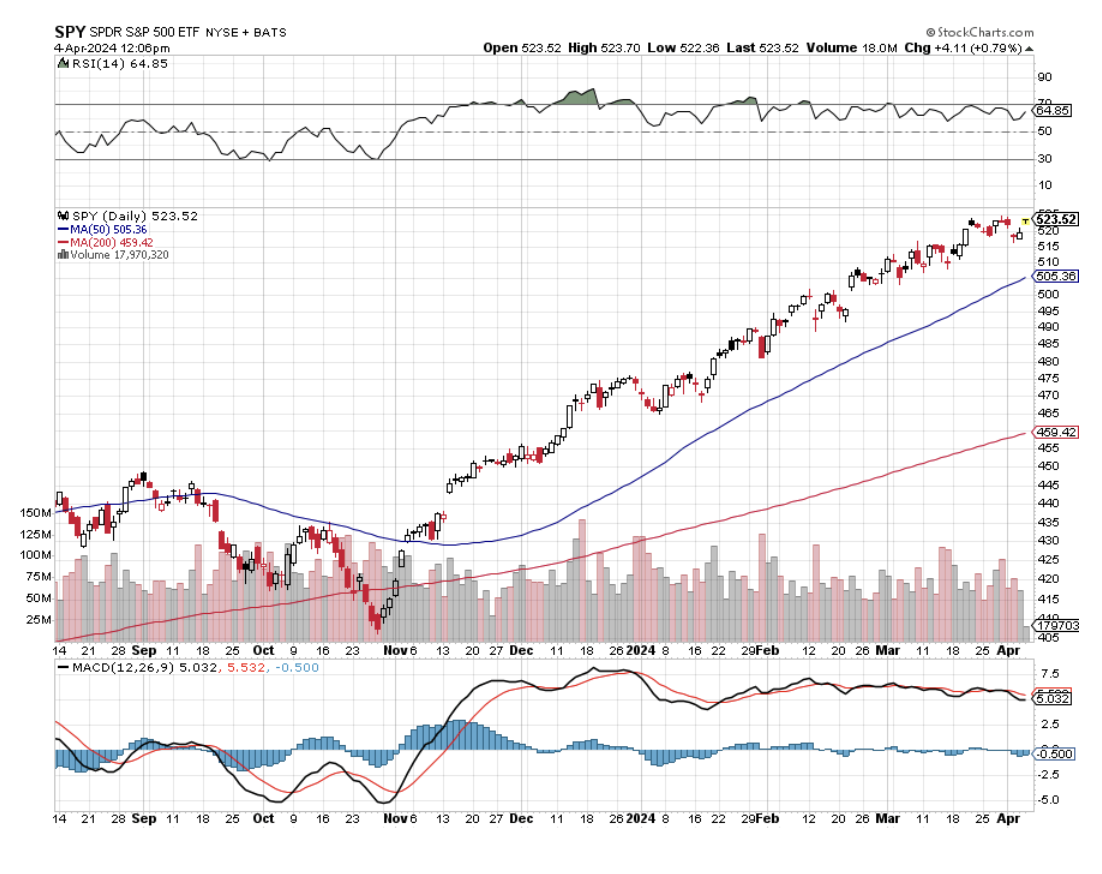
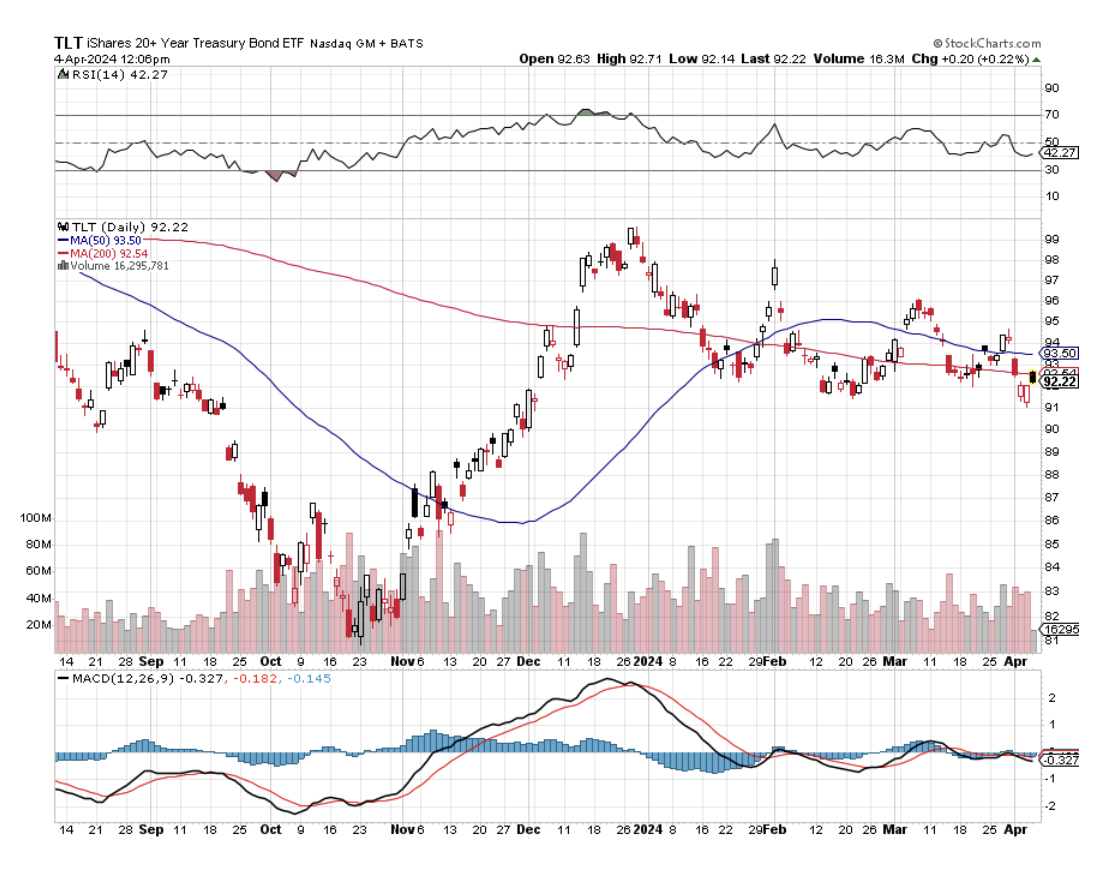
Bonds and other falling interest plays are being blindsided by a heating economy.
All economic data is globally slowing, except for the US, with the only good economy in the world.
US $ approaches multiyear high on rising rates.
Buy stocks and bonds but only after substantial dips.
WHY ARE COMMODITIES SO HOT
Traders are not chasing big tech. Instead, they are rotating into laggard sectors.
Commodities, precious metals, and energy have not moved for a year.
Traders are betting on the falling interest rate narrative.
These sectors are also great plays on a recovering global economy, and a falling dollar, pressured by rising US debt, now at $35 trillion.
THE GLOBAL ECONOMY – A ONE-HIT WONDER
ADP show 184,000 private sector job gains in March.
Fed Chair Jay Powell promises three interest rate cuts this year – 25 basis points each.
PCE comes in hot at 0.3% for February, and 2.8% YOY.
ISM Manufacturing PMI soars, reaching an 18-month high.
The final read of the Q2 US GDP is revised up, to a 3.4% annual rate.
Leading economic indicators rise for the first time in two years according to the Conference Board.
Fed to dial back quantitative tightening, or QT from the current $120 billion a month.
STOCKS – COMMODITIES LOVEFEST
It’s been four years since the COVID low, and stocks have averaged a 25% a year return since then.
China bans AMD and Intel processors, for government use in retaliation for the ban on high-performing NVIDIA chips.
Boeing CEO resigns. David Calhoun learned the hard way that you can’t cost-cut your way to prosperity.
Chipotle announces a 50:1 stock split, prompting a 3.5% rally in the stock.
Shell is moving into the charging business, which has much higher margins than selling gasoline.
Reddit deal blows out, in the first big IPO of 2024 – up 35% at the opening.
BONDS – SLAP IN THE FACE
Rising inflation and heating economy cut bond support off at the knees.
Higher for longer seems to be the new Fed mantra.
However, Jay Powell still promising three rate cuts this year, but they will be closer to year-end.
So, bonds will remain weak but may only have $2 of downside left.
US National Debt is rising by $1 trillion every 100 days.
FOREIGN CURRENCIES – US DOLLAR POWERS ON
Japanese yen hits a new 34-year low at 151.97 to the US$ with the Bank of Japan suggesting that interest rates will stay lower for longer.
Last week the central bank raised rates for the first time in 17 years. Japanese stocks applauded.
Chinese Yuan crashes, suffering worst day in two months.
Declining exports, collapsing foreign investment, minimal population growth, it all adds up to a weaker Chinese currency.
It’s the bitter fruit of 40 years of one child-only policy. Avoid (FXI).
Eventual falling interest rates guarantee a falling dollar for 2024.
ENERGY & COMMODITIES – NEW HIGHS FOR THE YEAR
A global commodity rally has dragged oil up.
US continues to dominate markets with 13 million barrels/day production.
In the meantime, coal has plunged from 50% to 19% of US electricity output in 20 years.
Electrification of the US economy will continue to be a driving theme.
The Uranium shortage is getting extreme, with yellow cake up 112% in a year. Owners of abandoned mines are restarting operations to capitalize on the rising demand for nuclear fuel.
AI is finding New Copper Deposits.
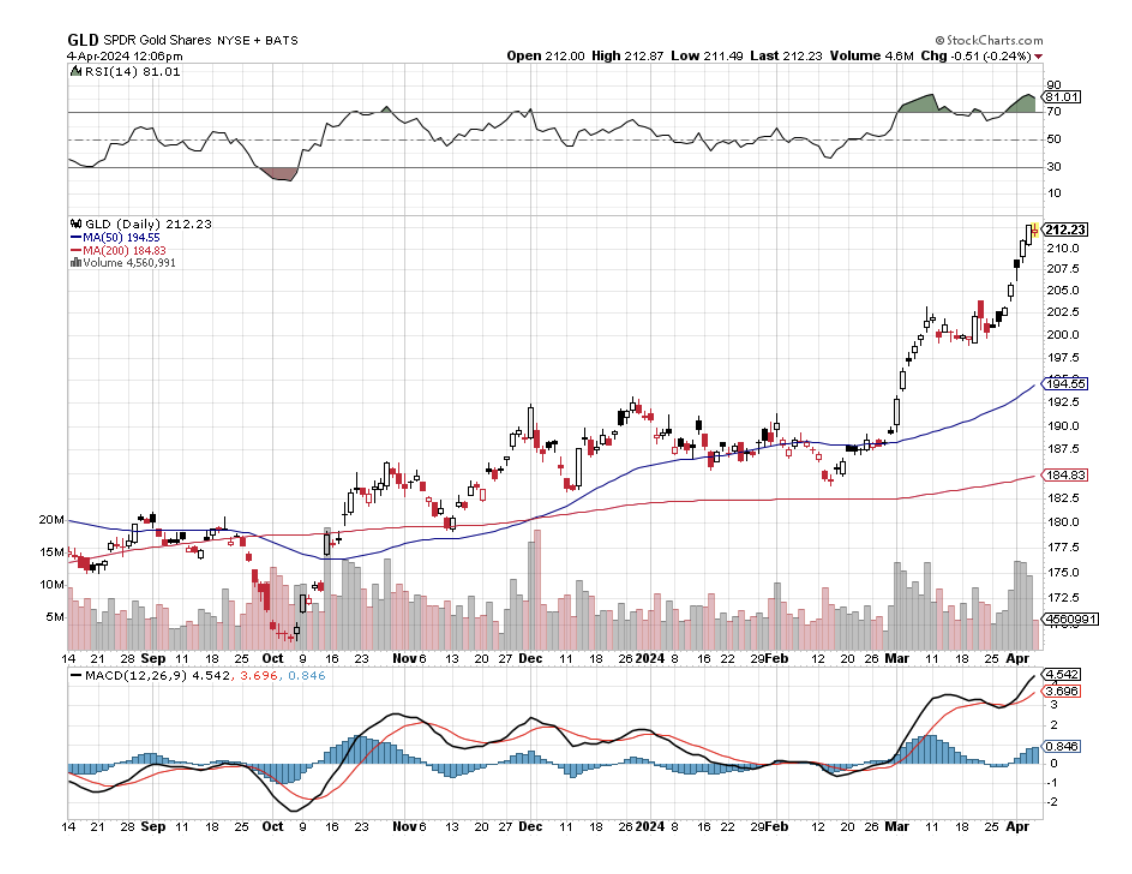
PRECIOUS METALS – NEW ALL-TIME HIGHS
Precious metals have a great week on flight to safety.
Gold looking forward to falling interest rates later in 2024.
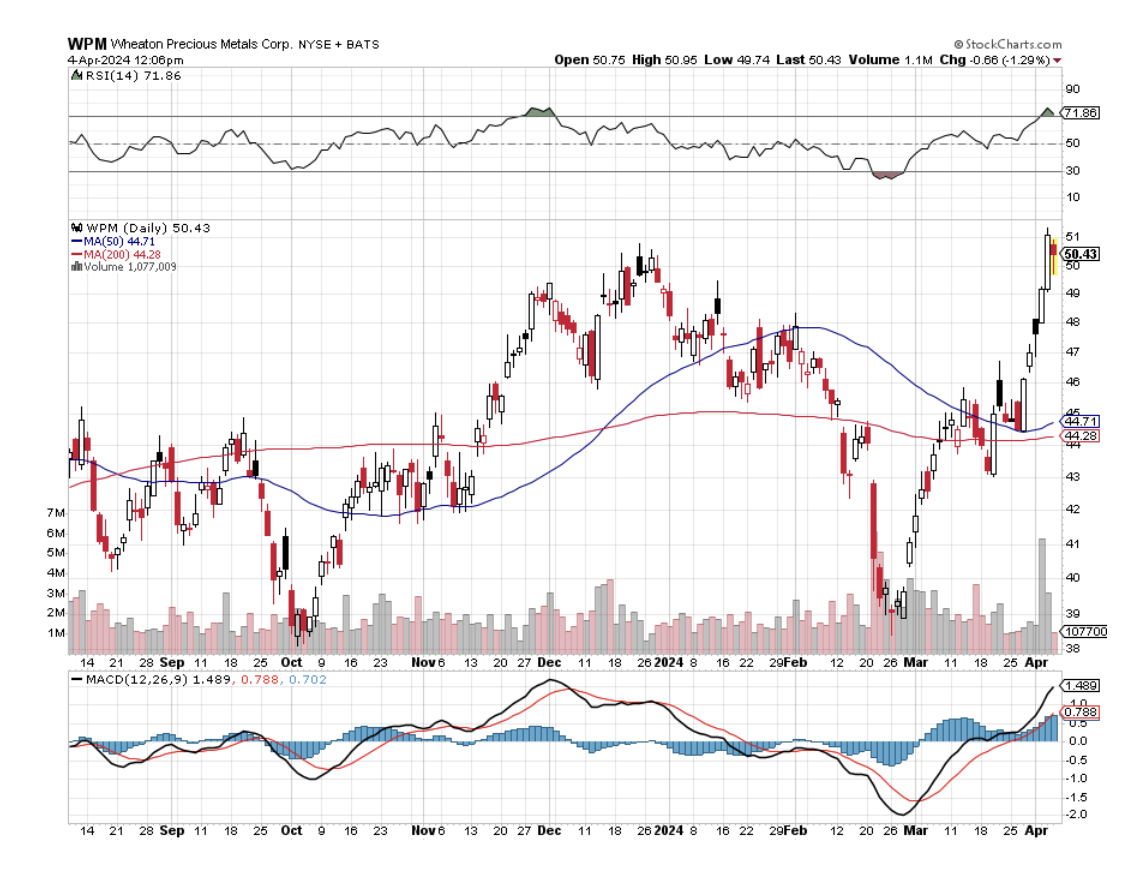
Miners are playing catch-up.
Investors are picking up gold as a hedge for 2024 volatility.
Gold headed for $3,000 by 2025.
Silver will also rally.
Russia and China are also stockpiling gold to sidestep international sanctions.
REAL ESTATE- HOTTEST SPRING IN YEARS
Existing home sales soar 9.7% in February to 4.38 million units.
A still low 2.9-month supply at the current sales pace.
Median prices are up 5.7% from the year before to $384,500.
US Construction spending falls 0.3% in February according to the Commerce Department.
Construction spending increased 10.7% year-on-year in February.
New Home Sales drop 0.3% in February in a surprising decline at a 662,000 annual rate on a signed contract basis.
A spike in mortgage rates to 7.0% gets the blame.
There was a 7.5% drop in the prices of new homes sold to $405,000.
TRADE SHEET
Stocks – buy any dips.
Bonds – buy dips.
Commodities – buy dips.
Currencies – sell dollar rallies, buy currencies.
Precious metals - buy dips.
Energy – buy dips.
Volatility – buy $12.
Real Estate – buy dips.
RECORDING OF JACQUIE’S POST-MARCH MONTHLY ZOOM MEETING
Apologies for any errors. I was still jet lagged when I held this meeting.
https://www.madhedgefundtrader.com/jp-meeting-replay-march-2024/

Cheers,
Jacquie
Global Market Comments
April 5, 2024
Fiat Lux
Featured Trade:
(APRIL 3 BIWEEKLY STRATEGY WEBINAR Q&A),
(TSLA), (TLT), (GOLD), (GLD), (WPM), (NVDA), (OXY), (XOM)

Below please find subscribers’ Q&A for the April 3 Mad Hedge Fund Trader Global Strategy Webinar, broadcast from Key West, Florida.
Q: What’s going on with gold (GLD)?
A: Well it’s simple; gold hasn’t moved in a year and people want to rotate out of big tech into something that hasn’t moved. Gold has a great long-term story if interest rates fall and if central banks continue to accumulate gold. We could go up quite a lot from here; my goal right now is 3,000/oz by the end of next year.
Q: Are ETFs or single stocks a better buy right now?
A: ETFs are baskets, tend to have high fees, and tend to move at half the rate of single stocks. Single stocks can go up a lot faster and have a lot more risk. So if I have a strong feeling about a particular asset class like gold or silver, I'll go ahead and buy single stock names directly like Barrick Gold (GOLD) and Wheaton Precious Metals (WPM) because I know I’ll get a multiple of the performance of a basket of gold companies.
Q: Ford Motor Co. (F) seems like a better play than Tesla (TSLA) this year. What is your opinion?
A: You’re absolutely wrong, Tesla is a fantastic buy down here, once the EV nuclear winter ends. Tesla could rise a multiple from here—Ford probably not so much. Notice also that GM saw sales fall by 1.5% in the first quarter of this year. Tesla just has the technology; Ford and GM don’t. The long-term outlook for the ICE companies is grim. They have millions invested in internal combustion engine factories, which very soon will be worth nothing more than scrap metal.
Q: Do you have a long-term target on the downside for Tesla (TSLA)?
A: Well I’m currently long the April $140-$150 vertical bull call debit spread that expires in 10 days. To get a price lower than $140, you need to get drastically worse news, which I don't think we’ll get. I think we’re bottoming out right around here; Tesla’s already down 62% from an all-time high. During the pandemic, it dropped 80%.
Q: What is the chance that inflation returns, and what happens if it does?
A: Interest rates rise, and the Fed postpones interest rate cuts even further. However, I don’t think that’s going to happen, because technology and artificial intelligence are having such a huge deflationary impact on the economy that any bad news about inflation will be short-term, and we are in a long-term trend going down.
Q: How does falling Fed QT affect interest rates?
A: It causes them to go down because it means the Fed is selling less of its bond holdings into the market. This means they’re taking less money out of the financial system, meaning liquidity is increasing, which is good for all risk assets. I think the stock market has noticed this by going up almost every day so far this year. So, just as quantitative easing was great for the economy and the stock market, the quantitative tightening was terrible, and the fact that they’re ending it is good for all risk assets.
Q: Where do you see the price rising for iShares 20+ Year Treasury Bond ETF (TLT)?
A: 110 by the end of the year, but we might have another $1.00 or $2.00 of downside first. If you get down to $90 or so, I’ll be knocking out the trade alerts to buy call spreads as fast as I can write them. But first let’s let (TLT) find its new level, and interest rates find their new high.
Q: What is a barbell?
A: A barbell is where we have overweight sections in two parts of the market; one is technology and one is domestic recovery plays. We have nothing in most sectors in between. That’s what we’ve been doing for years, and it works pretty well because you always have something that’s going up. That’s why it’s called a barbell.
Q: If you were doing a new LEAP on Wheaton Precious Metals (WPM), what would you do?
A: I would do an at-the-money, which at this point would be June 2025 $50-$53 verticals bull call spread LEAPS, and I would go out at least a year, probably a year and a half because we’ve just had a very big run in Wheaton Precious Metals—about 25%. LEAPS are things you do at market bottoms, not at market tops. A reversal can be very expensive—they can literally go to zero on you.
Q: What do you think will be the next asset class investors will rotate into after commodities?
A: Big technology. We’re going to be going back and forth between the two sectors probably for years. So, I think tech needs a time correction of several months, where commodities and precious metals and energy will run free, and eventually, they’ll get overbought and want to take a rest, and then everyone rotates back into big tech. In the meantime, big tech and AI are moving forward with their technology.
Q: Why has Carnival Corp (CCL) had such a terrible stock performance, even though they’re having record sales and full ships?
A: They have huge amounts of debt leftover from the pandemic, which they got both from the government and the private sector. If they hadn’t done that, they’d have gone bankrupt, and it’s going to take a long time to pay off all that debt, even though it was at interest rates that were quite low. Plus, if they have to refinance any of that, that can get expensive too because the old loans are at zero or 1%, and the new loans are going to be like 6%, 7%, or 8%. So that has been a drag on Carnival Cruise Lines.
Q: What is a time correction?
A: A time correction is when the stock goes sideways for a period of time without going anywhere because nobody wants to sell it, everyone is bullish, and they’re willing to wait for the next leg up in the bull market. In the meantime, money rotates into other stocks that are moving, like commodities, precious metals, and energy.
Q: Should we take profits off of Barrick Gold (GOLD) after the recent runup, or does it have some more room to go into the upside?
A: Only if you’re a short-term trader do you want to take advantage of the recent run-up in Barrick Gold. I, however, think the stock could go up another $10 or $20 by the end of the year. I am quite happy to hold on. In fact, on any dips or weak days, I am adding to my position, not looking to run it down.
Q: What do you expect for oil prices?
A: I think we go to the top of the multi-year $62-$95 range and I’m going to run my longs in (XOM) and (OXY) until then.
Q: What do you think of Ken Griffin’s criticism of the US national debt growing at such a fast pace?
A: I’ve been hearing about the national debt for my entire life, since I was 3 years old and my grandfather would lecture me about the national debt, back when it was a pittance compared to what it is now. The fact is, growing national debt seems to have zero impact on any risk asset whatsoever. Stocks are at all-time highs, real estate is at all-time highs and rising, and the dollar is at all-time highs when rising debt was supposed to crush the dollar. The actual fact is that 80% of all the national debt was run up by Republican presidents, so to see Republicans complain about rising debt, especially our most recent president who increased it by $10 trillion is somewhat ironic. The fact s that the national debt is the result of four big tax cuts for billionaires that took place under Kennedy (1960), Reagan (1984), Bush (2002), and Trump (2017), so it’s also ironic that billionaires like Griffin and Paul Tudor Jones are complaining the loudest. They all sound like Cassandras—warning that the sky is falling, but it never seems to happen. In the meantime, I would buy bonds, because they’re not worried about national debt either.
Q: Can Bitcoin go higher after the halving in April?
A: No, the halving is in the price. All of the Bitcoin marketers have been selling you Bitcoin based on that halving for a year now. So the actual halving is going to be a classic “buy the rumor, sell the news” type move.
Q: What do you consider a dip?
A: It’s different for every stock depending on its volatility. It could be 5% for a boring stock, or 20% for something like Nvidia (NVDA).
Q: Does commercial real estate present a systematic risk to the financial markets?
A: No, commercial real estate is only 5% of the loan portfolios of the big banks, and maybe 1% of that will go under. It’s just a normal year of losses for the banks. As for regional banks, they’re the ones that will get hit; they’ll have to do deals to get bought up by the big banks. This is why I think we’re in the process of going from 4,000 banks in the United States to only 6.
Q: Is $100/barrel for oil back in play?
A: No, but $95 is, which is why I went long ExxonMobil (XOM) and Occidental Petroleum (OXY). So, it’s kind of late to get involved here on this trade, but if you are long oil, I would keep it and squeeze the last bit of juice out of those lemons.
To watch a replay of this webinar with all the charts, bells, whistles, and classic rock music, just log in to www.madhedgefundtrader.com, go to MY ACCOUNT, select your subscription (GLOBAL TRADING DISPATCH, TECHNOLOGY LETTER, or Jacquie's Post), then WEBINARS, and all the webinars from the last 12 years are there in all their glory.
Good Luck and Stay Healthy,
John Thomas
CEO & Publisher
The Diary of a Mad Hedge Fund Trader

“When less experienced investors are panicking, seasoned investors see opportunities,” said legendary value investor Ron Baron.


When John identifies a strategic exit point, he will send you an alert with specific trade information as to what security to sell, when to sell it, and at what price. Most often, it will be to TAKE PROFITS, but, on rare occasions, it will be to exercise a STOP LOSS at a predetermined price to adhere to strict risk management discipline. Read more

