
Mad Hedge Technology Letter
December 13, 2023
Fiat Lux
Featured Trade:
(RIVIAN SPEEDS UP)
(RIVN), (TSLA)

Mad Hedge Technology Letter
December 13, 2023
Fiat Lux
Featured Trade:
(RIVIAN SPEEDS UP)
(RIVN), (TSLA)
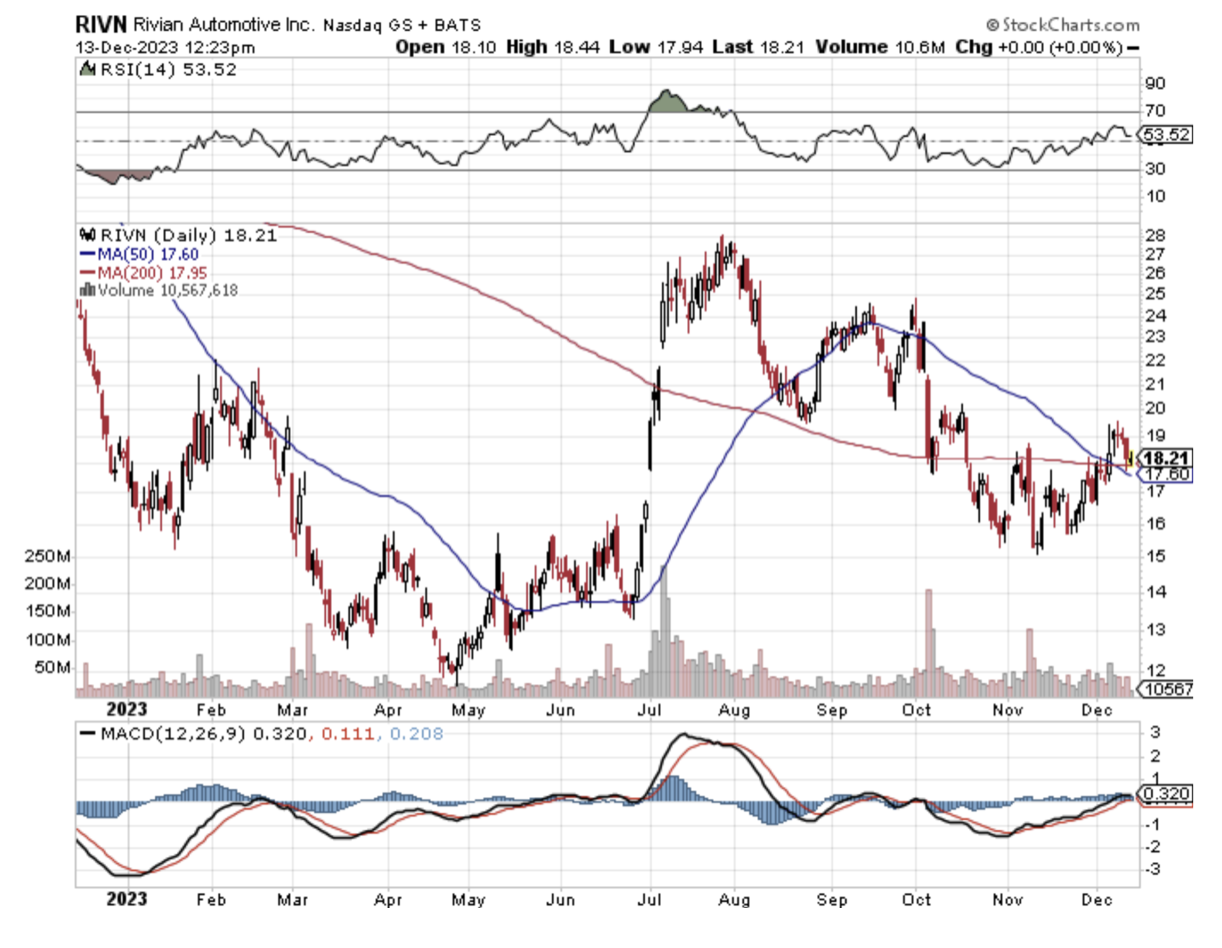
One company I am quite bullish on is EV maker Rivian (RIVN).
They make great cars, but they also lose money by the fistful.
How bad is it?
Rivian lost $1.19 a share in Q3, less than feared, while revenue jumped 149% $1.34 billion.
The EV startup produced 16,304 vehicles and delivered 15,564 vehicles in the third quarter. Meanwhile, Rivian booked a loss of $30,648 per vehicle delivered in Q3, down from a loss of $139,277 per unit delivered a year ago.
Going from losing $140,000 to $30,000 is a big jump and these are eye-popping losses.
The more important takeaway is that big investors are sticking with RIVN as the cash burn improves.
The real hard work is reducing the loss for each car to zero because many variables are working against RIVN.
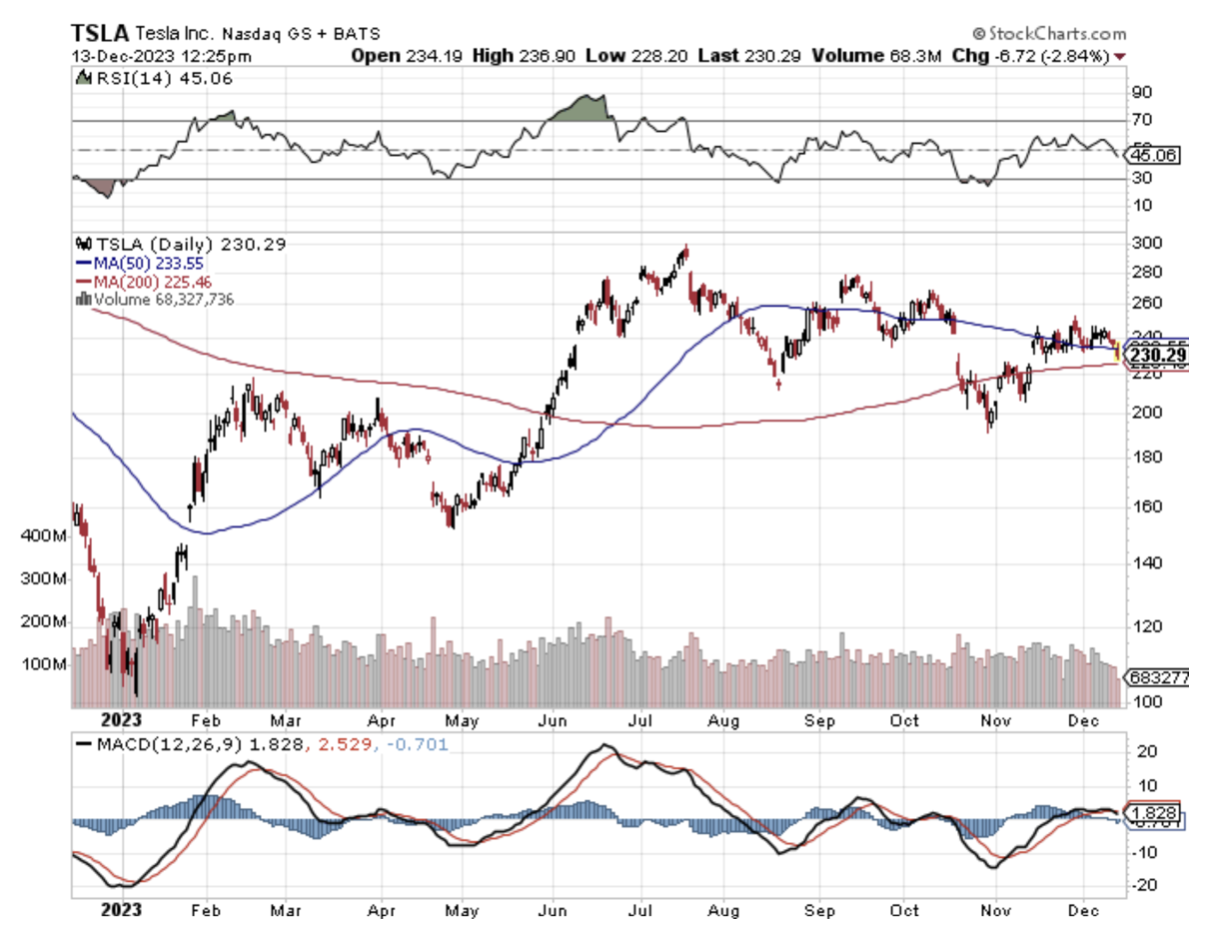
Then there is the competition and by that I mean Tesla’s Cybertruck.
RIVN shares surged the day after Tesla began initial deliveries of its Cybertruck.
The company also announced it will allow more customers beyond — Amazon (AMZN), which remains a key buyer — to purchase its commercial electric vans.
Rivian raised its 2023 production guidance to 54,000 electric vehicles, up from 52,000 in August.
The company tied the hike to "progress experienced on our production lines, the ramp of in-house motor line and the supply chain outlook."
Tesla offers three trims of the Cybertruck, with the rear-wheel drive version starting at $60,990 with a 250-mile range. The base model will be available in 2025, according to Tesla's website.
The all-wheel drive version has a starting price of $79,990 with 340 miles of range. Tesla is also offering a top-end trim, called the Cyberbeast, starting at $99,990 with a 320-mile range. Both the all-wheel drive version and the Cyberbeast have 2024 deliveries.
Four years ago, Tesla announced the price would start at $39,900 with Chief Executive Elon Musk previously saying he wanted to price the base model under $50,000.
Originally, Tesla and Musk stated the tri-motor Cybertruck would have 500 miles of range with the dual-motor model managing 300 miles and the base rear-wheel version getting 250 miles per charge.
Tesla’s Cybertruck has an eccentric design that could turn off a lot of buyers and funnel them into interest for a RIVN.
Not only is the design extreme, but Musk is asking for more than the $50,000 he first quoted.
RIVN is cheap, to begin with, but it will be able to compete with Tesla’s Cybertruck in price and quality.
Supply-chain issues have hampered the entire industry. Rivian has also had problems of its own complicate its launch.
Rivian is not likely to be profitable for a while it scales out manufacturing.
RIVN burns around $1 billion in cash per quarter, and yet the company is still nowhere near hitting the mass production rates which would achieve a more competitive cost structure.
Another painful bottleneck is the sizable increases in the cost of key metals, including lithium, nickel, aluminum, and cobalt.
Even though they lose $4 billion per year, investors are patient with this company.
Patience stems from the fact that RIVNs are great cars and surely will improve the product.
If RIVNs start to fall in quality then I would expect a massive exodus from the shares which will hit the price of shares.
Until that narrative is broken, I believe RIVN will be bought on dips.

(THIS SELF-DRIVING CAR TECHNOLOGY STOCK WILL REAP REWARDS FOR ITS INVESTORS)
December 13, 2023
Hello everyone,
Ever heard of Innoviz Technologies (INVZ)?
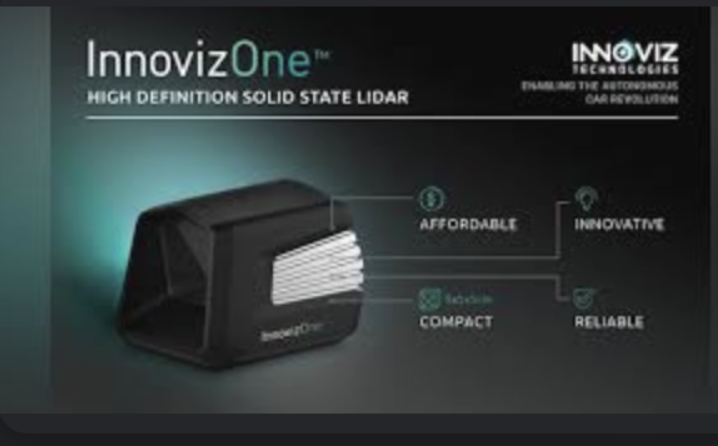
It’s an Israeli firm, which is listed on the Nasdaq, and it makes sensors and automotive software that are key to enabling driverless cars. The company’s LiDAR (“light detection and ranging”) sensors are used by autonomous vehicles to navigate their surroundings without human intervention.
This is one to sink some funds into. Analysts at three investment banks are arguing that this stock could rise over 400% in the next 12 months.
The company has several major partnerships in the pipeline, including with luxury carmaker BMW which uses Innoviz’s sensors in its advanced driver assistance system for the 7 Series sedan.
Innoviz has also said it has partnerships with Volkswagen and an unnamed major Asian automaker, representing nearly $7 billion in potential revenue over the next decade.
Wall Street has a bullish outlook on this stock.
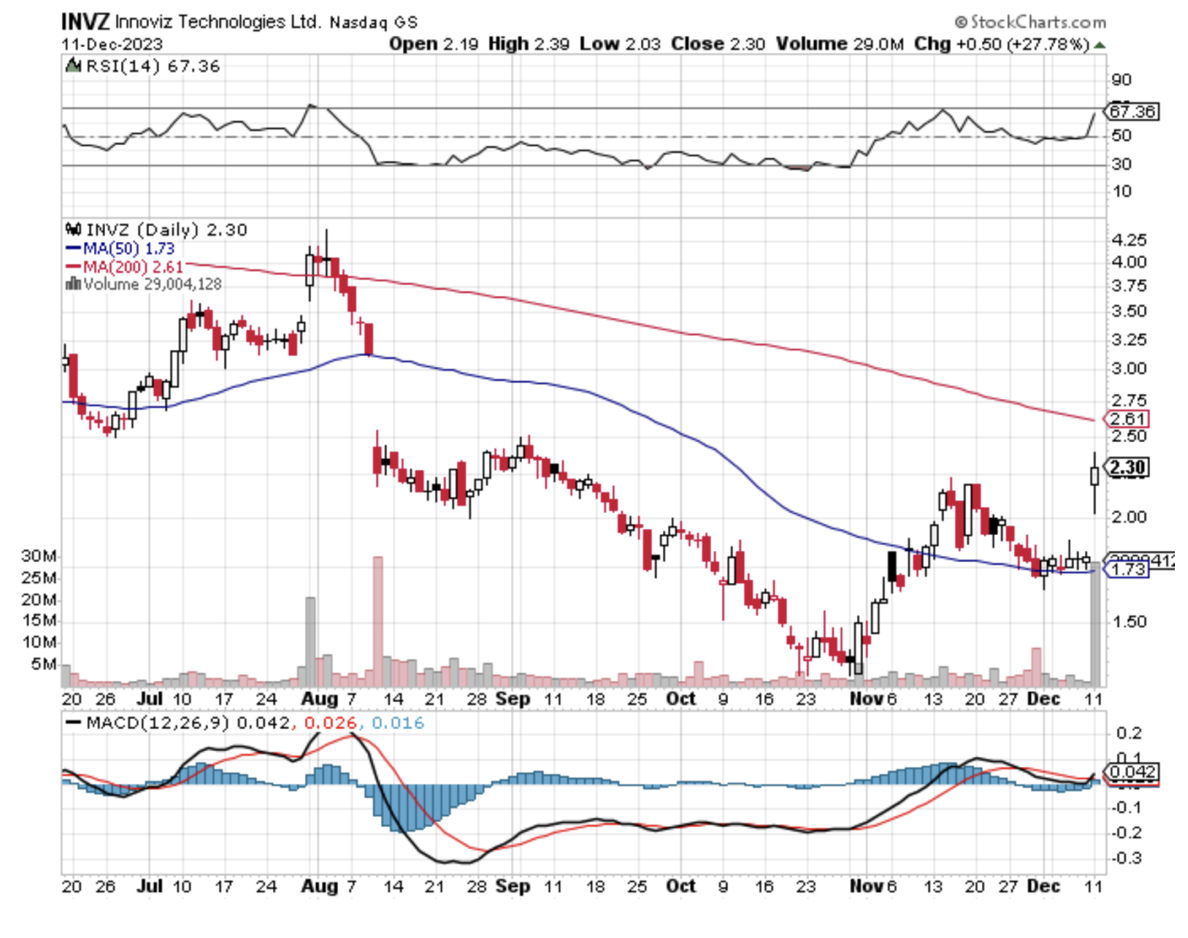
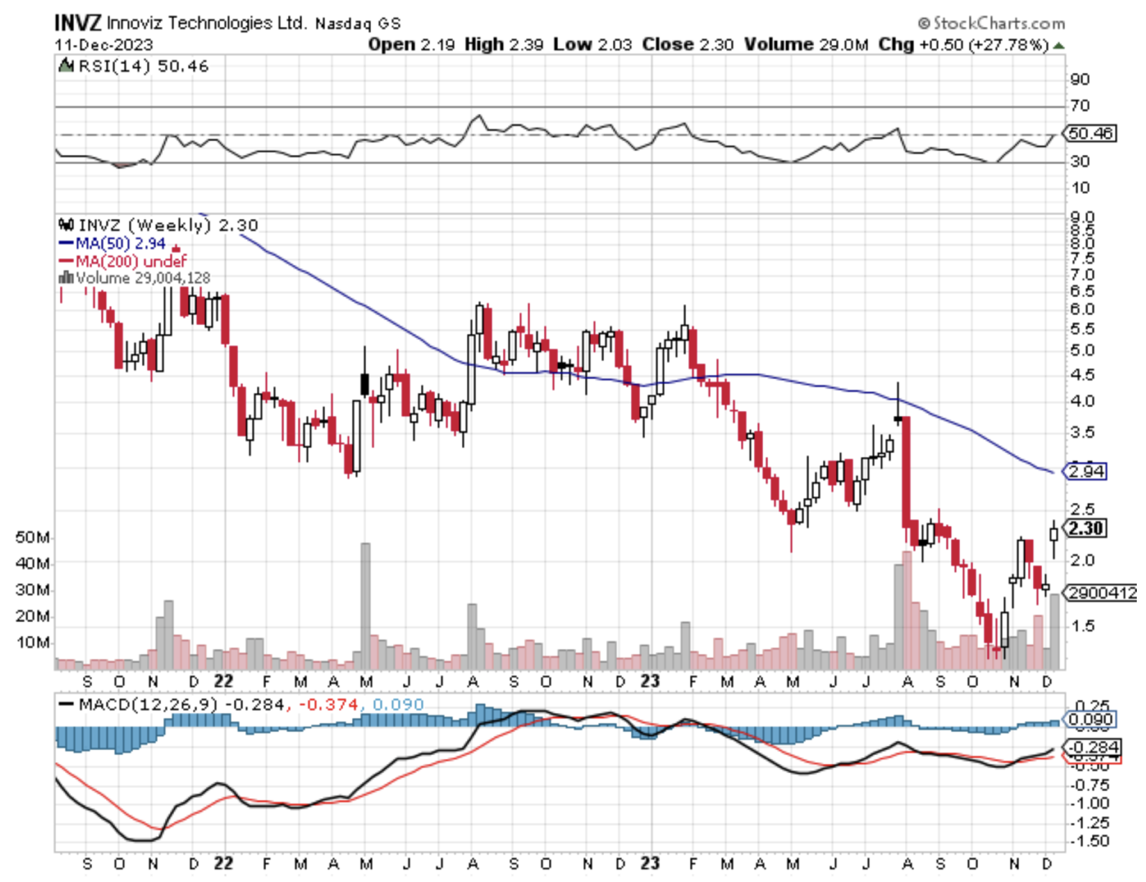
JP Morgan has the highest price target on Wall Street at $13, implying over 626% returns from current levels. The company’s stock currently trades at $2.20
JPMorgan analysts, Samik Chatterjee and Joseph Cardoso note that they expect the combination of numerous wins, large volume wins, a balance of LiDAR costs and performance, and the ability to support highway autonomy at high speeds to position Innoviz to ramp revenues well through the end of the decade, while cost discipline should drive profitability.
German investment bank Berenberg also sees big potential at the firm, giving it a $12 price target, representing a 570% upside.
The bank’s analyst believes Innoviz is the best-positioned LiDAR player, with around 15% global market share based on expected production volumes.
Analysts at WestPark Capital also expect Innoviz shares to rise by more than 450% to $10 a share over the next 12 months.
Although bullish, other Wall Street brokers are more moderate on the upside for Innoviz shares.
Cantor Fitzgerald analysts expect the stock to rise to $6 a share, which still represents a 235% upside from current levels.
Meanwhile, Rosenblatt analysts believe another top 10 global automaker will select Innoviz for an autonomous driving system by the end of the year. They expect shares to rise 173% to $5.
While optimistic about the self-driving opportunity, analysts do caution that there are risks around competing technologies and regulations that could slow adoption.
High-profile short-seller Citron Research has also backed the company by disclosing a long position in the stock. Citron said Innoviz has over $5 billion in “committed contracts” with most of their customers.
Innoviz posted revenue of $3.5 million for the third quarter, beating Wall Street’s expectations.
The company said the strong result was driven by higher sales volumes of its InnovizTwo sensor and additional non-recurring engineering (NRE) revenue. NRE refers to customers’ upfront cash payments during the development and testing phases.
A stock worth some attention.
Daily Chart
Weekly chart



Cheers,
Jacquie
Global Market Comments
December 13, 2023
Fiat Lux
Featured Trade:
(JACQUIE MUNRO JANUARY 9, 2024 BRISBANE AUSTRALIA STRATEGY LUNCHEON)
(THE MAD HEDGE DECEMBER 5-7 TRADERS & INVESTORS SUMMIT VIDEOS ARE UP!)

The Mad Hedge Summit videos from the December 5-7 confab are now available. Listen to 24 speakers opine on the best strategies, tactics, and instruments to use in these volatile markets. It is a true smorgasbord of investment strategies. Find the best one to suit your own goals.
The product discounts offered last week are still valid. Start, stop, and pause the videos at your leisure. Best of all, access to the videos is FREE. Access them all by clicking here, click on WATCH REPLAY below the picture of your desired speaker.


Mad Hedge Biotech and Healthcare Letter
December 12, 2023
Fiat Lux
Featured Trade:
(A REBOUNDING BLUE CHIP)
(PFE), (LLY), (NVO), (RHHBY), (AZN), (SGEN), (VKTX), (TERN), (GPCR), (ALT)
In the maelstrom of 2023, Pfizer (PFE) found itself navigating through a tempest, much to the dismay of shareholders. The aftermath? A harrowing -40% total return loss, leaving shareholders reeling.
This downturn followed Pfizer's COVID-19 vaccine triumph, a success story that lost its sheen as global government demand for the vaccine and Paxlovid antiviral dwindled.
Looking back, Pfizer's narrative in 2023 could rival a Shakespearean tragedy. The demand dip for its COVID arsenal was just the beginning; a cascade of other factors compounded the company's misfortunes.
Take, for instance, the controversial $43 billion acquisition of Seagen (SGEN) in March. While this move aimed for cancer treatment breakthroughs, it was widely seen as a Hail Mary, signaling gaps in Pfizer's drug pipeline.
I estimate this strategy might have slashed shareholder value by at least 10%, given the immediate financial aftermath of the merger.
Then, adding to the woes, Pfizer's Nash County production facility in North Carolina faced devastation by a tornado in July.
It seemed as though, for Pfizer in 2023, trouble came not just in droves but in torrents.
The final blow? The discontinuation of the twice-daily dose development for Danuglipron, Pfizer's weight-loss drug candidate.
This decision casts a shadow over the prospects of its once-a-day dosage, still in trials, and simultaneously cracks open the door for other biotech players in the oral weight-loss drug arena.
Meanwhile, the company also aimed to join the race for obesity treatment innovation. In this arena, injectable weight-loss drugs from Eli Lilly (LLY) and Novo Nordisk (NVO) have set the stage, and now, the demand for oral solutions is burgeoning.
Pfizer once pegged this market's potential at an eye-watering $90 billion a year — a target that has not gone unnoticed by keen biotechs.
Yet, with Pfizer stepping back from its Danuglipron project due to adverse side effects, it finds itself trailing in this race. In comparison, Lilly and Novo are forging ahead with their products, turning Pfizer's stumble into a potential windfall for other biotech firms.
Notably, the biotech sector is witnessing a flurry of activity in response to Pfizer’s failed attempt.
Firms like Viking Therapeutics (VKTX), Terns Pharmaceuticals (TERN), Structure Therapeutics (GPCR), and Altimmune (ALT) have seen their share prices soar following their own positive trial results or strategic announcements.
The diverse approaches these biotechs are employing in their anti-obesity drug development have piqued investors’ interest.
In effect, speculation is rife about which one might emerge as a desirable acquisition target for Pfizer — and this speculation isn't without basis.
I previously shared that Roche Holding (RHHBY) recently acquired Carmot Therapeutics for $2.7 billion, and AstraZeneca (AZN) entered a licensing agreement with Eccogene.
With a history of significant acquisitions, Pfizer might well consider a similar path to address its challenges in the weight-loss pill sector.
Pfizer's journey through 2023 was a series of unfortunate events, to say the least. As we look to the future, questions about potential challenges in 2024 loom.
While major acquisitions seem unlikely in the wake of the Seagen deal, shareholder sentiment is fragile. The immediate risks for Pfizer include the possibility of a 2024 recession impacting sales and a generally bearish stock market, potentially keeping share prices around the $30 mark.
Historically, however, Pfizer has stood as a bastion of strength during recessions and bear markets.
Looking longer term, the specter of Medicare drug price negotiations looms large, threatening to dampen growth investor sentiment.
This challenge isn't unique to Pfizer; it's a cloud hovering over all of Big Pharma.
Yet, despite these formidable challenges, there's a sense that Pfizer's tumultuous 2023 journey might be approaching a pivotal turning point. Investor sentiment is at a nadir, marred by negative press and shareholder dissatisfaction, painting Pfizer as a stock currently out of favor.
As we look ahead into 2024, a cautious optimism emerges. Should Pfizer return to operational normalcy and continue to reduce its reliance on COVID-related sales — now a smaller part of its business — the company could reassert itself as a prime value and dividend player in the Big Pharma space.
For the resilient investor willing to delve into a bruised yet potentially rebounding blue-chip, Pfizer merits a closer examination. After a year where Murphy's Law seemed the only law, Pfizer stands as a beacon of resilience and a potential phoenix in the biotech and healthcare sector.
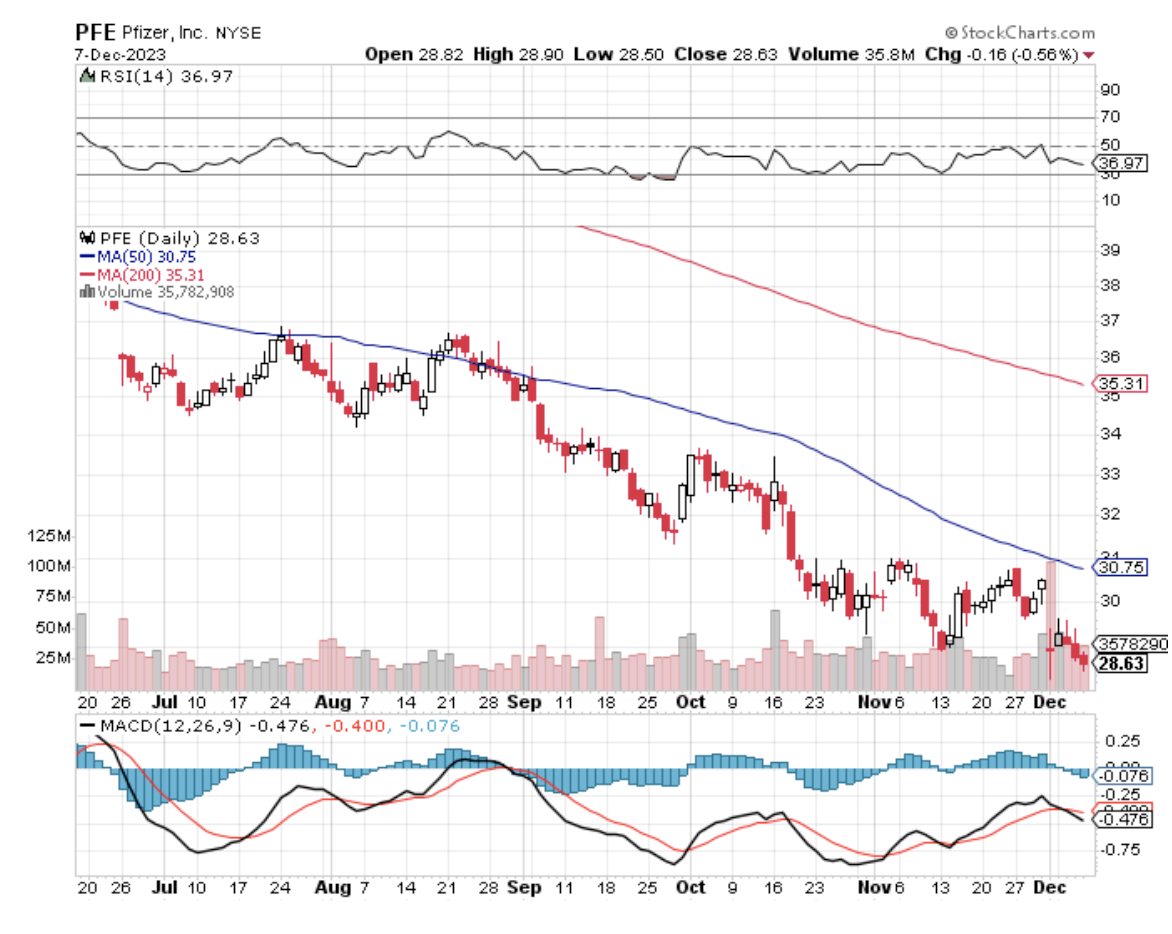

When John identifies a strategic exit point, he will send you an alert with specific trade information as to what security to sell, when to sell it, and at what price. Most often, it will be to TAKE PROFITS, but, on rare occasions, it will be to exercise a STOP LOSS at a predetermined price to adhere to strict risk management discipline. Read more
Global Market Comments
December 12, 2023
Fiat Lux
Featured Trade:
(CONTANGO IN THE VIX EXPLAINED ONE MORE TIME),
(UVXY), (VIX), (SPY)
(QUANTITATIVE EASING EXPLAINED TO A 12-YEAR-OLD),
(TESTIMONIAL)

I know you spend all day trolling the Internet for the most entertaining video on YouTube every day. What, you don’t? I’m shocked, shocked. That’s OK, so I’ve done it for you.
Click on the link below to watch a six-minute animation explaining quantitative easing to a 12-year-old, using cute little cuddly figures.
Was Ben Bernanke a plumber who was called to fix a pipe only to break it more? Does he have a cute beard? Is he trying to blow up the entire world economy?
Since the video has gone viral, some 5.7 million viewers found out by watching by clicking here.

