Mad Hedge Technology Letter
August 23, 2023
Fiat Lux
Featured Trade:
(LOSING THE EDGE)
(PTON), (NVDA), (MSFT)


Mad Hedge Technology Letter
August 23, 2023
Fiat Lux
Featured Trade:
(LOSING THE EDGE)
(PTON), (NVDA), (MSFT)
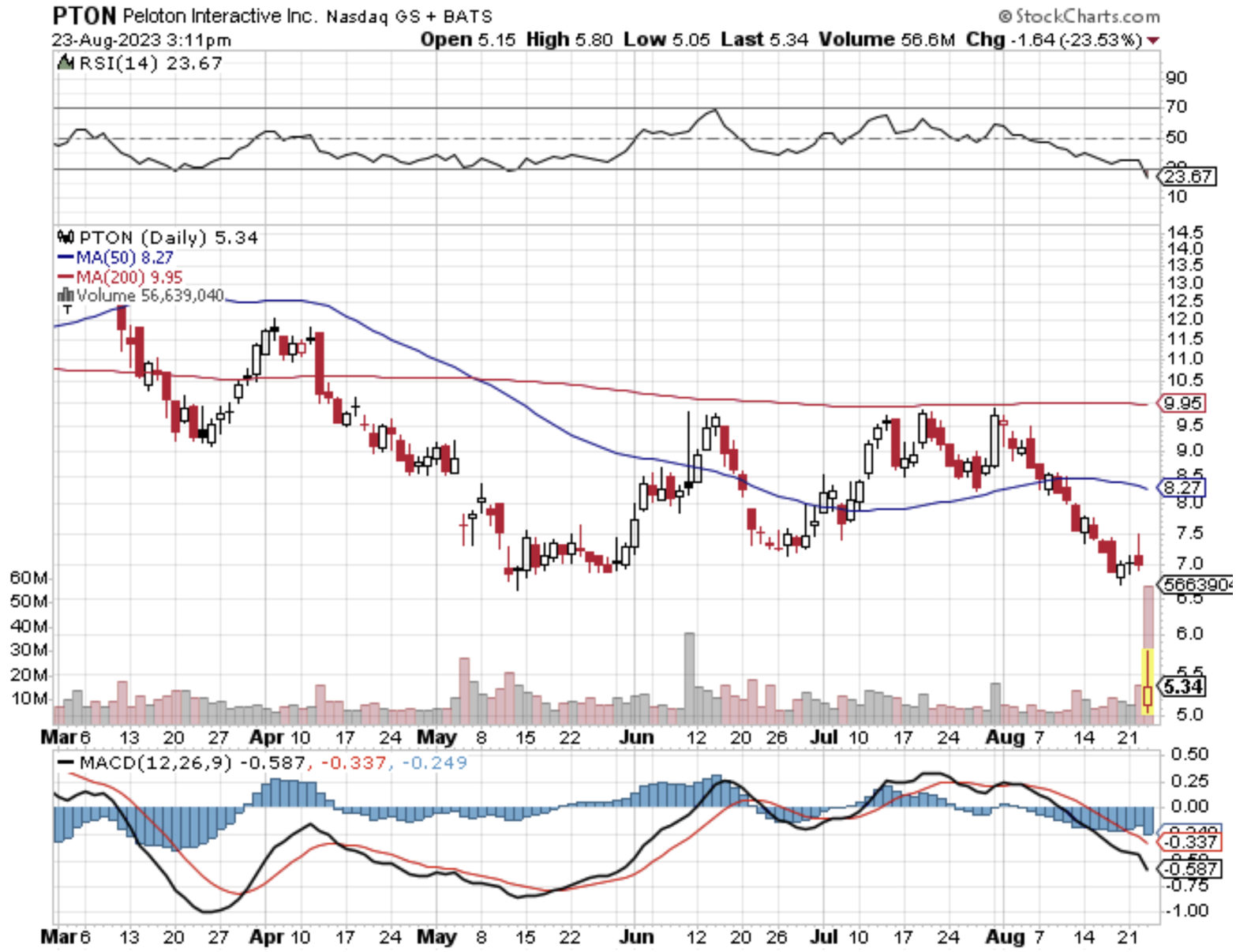
It’s looking like mission impossible for Peloton (PTON) who, if some might remember, was the darling of the lockdowns a few years ago.
This is really a story of making hay while the sun is shining because the sun has decided to tuck itself behind clouds indefinitely to the chagrin of PTON.
I have posted a few negative critiques of PTON because it’s accurate to distill the company down to an iPad on a stationary bike which charges for an expensive subscription.
The fact is once the world opened up, people stopped using PTON products and happily decided to go back to their old routines like visiting fully serviced gyms or exercising outside.
Even the consumers who decided to quit working out altogether are most likely traveling the world spending their PTON subscription money at a pizza joint in Italy.
The downdraft all came to a head today when PTON dropped yet another disastrous earnings report and their stock is down 23% at the time of this writing.
They whined about the decline in paying subscribers and said the cost of an equipment recall was denting its profit.
The fitness-equipment company cautioned that it expected to have negative cash flow in each of the next two quarters as it keeps fighting high inventory levels, and another sequential drop in subscribers.
Chief Executive Barry McCarthy played down the crashing stock price by explaining that the stock market isn’t in sync with the actual business and doubled down by emphasizing the company has its best days ahead of itself.
The New York company also said it is back to purchasing more bike and tread inventory, as it is in a more normalized inventory position than a year ago.
Peloton has struggled with its pricing strategy and recently further lowered the prices for its treadmill and rower by about 14% and 6%, respectively.
Peloton had told investors that it was looking to stem losses and start generating cash flow from its operations after slashing jobs and restructuring its business.
In the latest quarter, the company reported a negative cash flow of $74 million, weighed down by a legal settlement.
Peloton expects to end the September quarter with paying connected fitness subscribers of 2.95 million to 2.96 million, down from three million as of the end of the June quarter.
It has already received about 750,000 requests for replacement seat posts, ahead of internal expectations, and has been able to fulfill 340,000 of them.
Revenue for the fiscal fourth quarter ended June 30 fell 5% to $642.1 million.
Peloton’s average monthly connected fitness churn was 1.4% in the quarter, increasing from a 1.1% churn in the prior quarter, as a result of the company’s bike-seat-post recall.
This cautionary tale dovetails accurately with my wider thesis of smaller brand-named tech companies losing the war against the tech behemoths.
One little misstep and the inner problems are magnified and PTON has numerous issues under the hood of the car.
The CEO hyping up the company is a fool’s game because the writing is on the wall for this product.
There is no competitive advantage in their product and I believe subscriptions and hardware will continue to fall off a cliff.
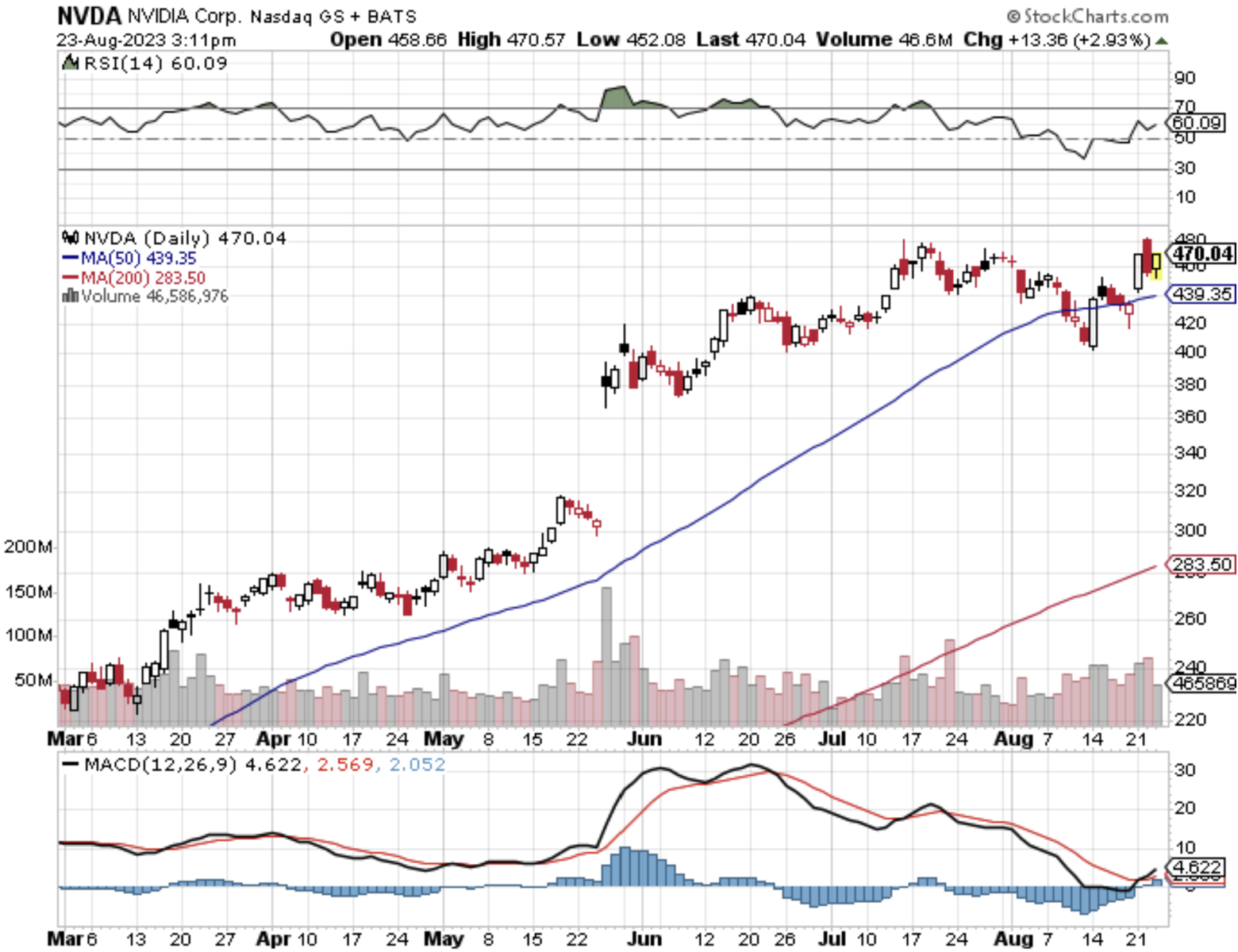
Investors should head to higher water and look at premium names like Nvidia or Microsoft.
These types of companies possess strategic footholds in the leading technologies in the world and I can’t say the same for PTON.
PTON will continue to trend into the dustbin of history and don’t get fooled into this stock reversing any time soon.
Avoid this stock like the plague.

"The rich invest in time, the poor invest in money." – Said American Investor Warren Buffett


In recent years, artificial intelligence (AI) has made remarkable strides across various industries, revolutionizing the way businesses operate and the services they offer. One such area where AI is rapidly gaining prominence is in the field of financial advisory services. As technology evolves and AI capabilities continue to advance, it's becoming increasingly evident that your next financial advisor could very well be an AI. This transformation has the potential to reshape how individuals and institutions approach financial planning, investment strategies, and wealth management.
The Rise of AI in Financial Advisory
Traditional financial advisory services have long been associated with human advisors who offer personalized recommendations based on their expertise and market insights. However, this model is now being challenged by AI-powered platforms that have the ability to process vast amounts of data, identify patterns, and generate tailored investment strategies in a fraction of the time it would take a human advisor.
AI's entry into financial advisory brings several advantages to the table. First, AI-driven platforms can analyze an extensive range of data sources, including market trends, historical performance, economic indicators, and even social media sentiment. This holistic approach ensures that the advice provided is not only well-informed but also takes into account a broader spectrum of information that human advisors might overlook.
Second, AI's speed and efficiency enable real-time decision-making. Market conditions can change rapidly, and AI algorithms can swiftly adjust investment portfolios and strategies to capitalize on emerging opportunities or mitigate risks. This agility is particularly advantageous in volatile markets where timely responses are crucial.
Customization and Personalization
One of the most significant benefits of AI-driven financial advisory is its capacity to deliver highly personalized recommendations. AI algorithms can take into account an individual's financial goals, risk tolerance, investment preferences, and even life events. This level of customization ensures that the advice offered aligns closely with each investor's unique circumstances.
Furthermore, AI's ability to continuously learn and adapt means that the advice provided becomes more refined over time. As an AI advisor gains insights into an individual's behavior and responses to different investment strategies, it can fine-tune its recommendations to achieve better outcomes.
Risk Management and Behavioral Bias
Human emotions often play a significant role in financial decision-making, and they can lead to biases and errors that affect investment performance. AI advisors are immune to these emotional fluctuations, making them ideal for maintaining a disciplined and rational approach to investing. By adhering to a predetermined set of rules and strategies, AI can help mitigate the impact of behavioral biases that often hinder human investors.
Furthermore, AI's advanced risk management capabilities can provide investors with a clearer understanding of the potential risks associated with their investment choices. Through sophisticated modeling and scenario analysis, AI can simulate various market conditions and their effects on investment portfolios, empowering investors to make informed decisions while minimizing uncertainties.
Transparency and Accessibility
AI-powered financial advisory services also bring transparency and accessibility to a new level. Human advisors might sometimes lack transparency in disclosing their fees or explaining the rationale behind their recommendations. AI algorithms, on the other hand, operate based on predefined rules and data-driven insights, making their decision-making process more transparent and understandable.
Additionally, the accessibility of AI-driven advisory services is unprecedented. Investors can access their AI advisor 24/7 through various platforms, such as web applications and mobile apps. This accessibility eliminates the constraints of traditional working hours and geographical locations, allowing investors to manage their finances conveniently and efficiently.
Challenges and Ethical Considerations
While the prospects of AI-driven financial advisory are promising, several challenges and ethical considerations must be addressed. One concern is the potential for overreliance on AI recommendations without fully understanding the underlying strategies. Investors must ensure they have a basic understanding of how the AI advisor operates to make well-informed decisions.
Data security and privacy are also critical issues. AI advisors require access to sensitive financial information, which raises concerns about data breaches and unauthorized access. Developers of AI platforms must implement robust security measures to protect user data.
Conclusion
The convergence of AI and financial advisory services represents a fundamental shift in how individuals and institutions manage their investments. The capabilities of AI to analyze vast amounts of data, provide personalized recommendations, and manage risks in real time are transforming the landscape of finance. While challenges and ethical considerations persist, the potential benefits of having an AI as your financial advisor are too significant to ignore. As technology continues to evolve, embracing AI-driven financial advisory could redefine how we approach wealth management and secure our financial futures. Your next financial advisor could indeed be an AI, offering you insights and strategies tailored to your needs with unprecedented efficiency and precision.
 Midjourney prompt “Your Next Financial Advisor Could Be an AI”
Global Market Comments
August 23, 2023
Fiat Lux
Featured Trades:
(COFFEE WITH RAY KURZWEIL), (GOOG)

CLICK HERE to download today's position sheet.
Mad Hedge Biotech and Healthcare Letter
August 22, 2023
Fiat Lux
Featured Trade:
(A BARGAIN HUNTER'S GUIDE)
(PFE)
The winds of change are blowing in the financial markets, teetering on the cusp of a new bull era. The trajectory of the S&P 500 stirs heated debates; some market seers assert the bull has already charged, while others counter that the index must first conquer its zenith.
Regardless of the stance, savvy investors stand poised, curating their ideal catalogs of stocks for purchase, with Pfizer (PFE) at a tumultuous intersection.
Pfizer wrestles with remarkable dips in yearly revenue and earnings. The shadow of imminent patent expirations over key drugs looms large, posing a serious challenge to future profits. However, a closer examination of Pfizer's situation reveals threads of optimism and inventive vision.
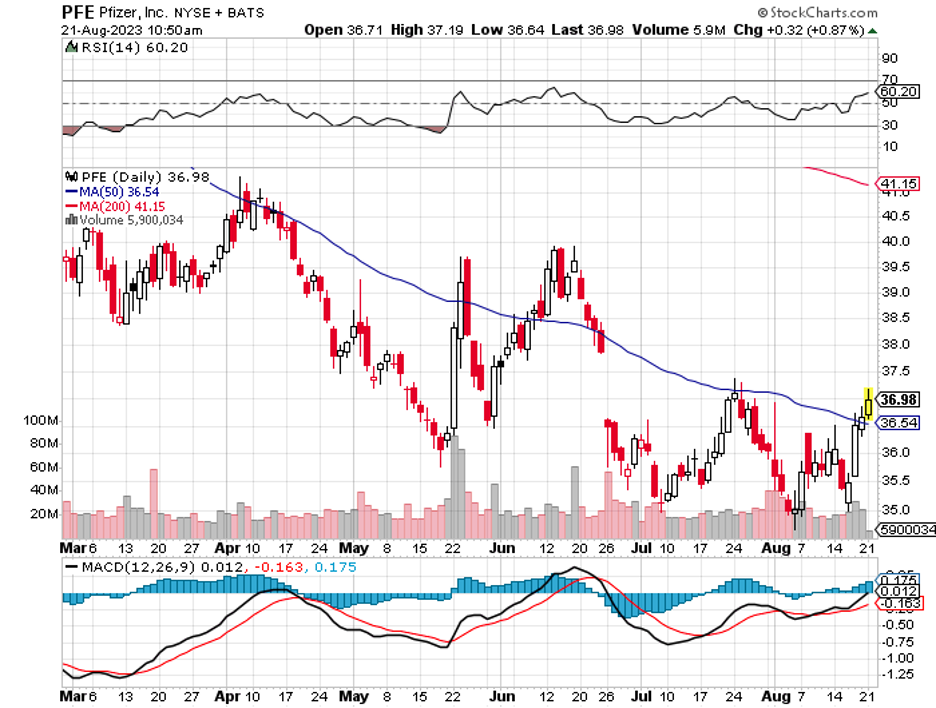
Its sturdy dividend yield is an example of resilience, and Pfizer's future sparkles with upcoming product debuts, potential harbingers of a revenue revival. Trading at a pivotal support level, a detailed look at the stock's historical patterns suggests glimmers of a lucrative long-term acquisition opportunity.
For Q2 2023, Pfizer unveiled revenues of $12.73 billion, a staggering 54% reduction, a decline of $15 billion year-over-year. This abrupt decline can be attributed to shrinking global returns from Paxlovid and Comirnaty, intertwined with a significant foreign exchange impact.
Paxlovid's revenue plummeted by 98% or $8 billion, mainly due to a pause in U.S. sales and reduced contractual deliveries in various global markets. Comirnaty also suffered, with revenue plunging 82% or $7.3 billion, primarily because of softened demand and contractual pullbacks.
Amid this storm, however, a beacon of growth gleams.
Excluding Comirnaty and Paxlovid, a 5% operational growth emerged, gathering $537 million. This growth is spurred by fresh entrants like Nurtec ODT/Vydura and Oxbryta, which raked in $247 million and $77 million, respectively, and boosted by the Vyndaqel family's robust 43% rise. Some products, such as Inflectra and Ibrance, faced contractions, revealing a varied performance landscape.
Despite subdued quarterly outcomes, the broader earnings picture radiates a potent positive trend. Pfizer's 4.6% dividend yield remains hearty, reflecting the company's strong financial base, even as challenges arise.
This resilience springs from upcoming product launches, positioned to infuse an additional $20 billion by 2030, potentially offsetting the impending patent cliff.
Innovations like Litfulo for alopecia areata and the respiratory syncytial virus vaccine, Abrysvo, echo Pfizer's dedication to medical breakthroughs. Furthermore, prospective drugs like Elrexfio and etrasimod shine on the regulatory horizon, further boosting the anticipation of revenue fortification.
Pfizer's ambitions include projected business development activities, potentially adding $25 billion in revenue by 2030.
The forthcoming acquisition of Seagen, planned for completion by early 2024, could pump over $10 billion into Pfizer's coffers, complemented by Seagen's impressive cancer drug roster.
Strategic procurements like Arena Pharmaceuticals, Biohaven, and Global Blood Therapeutics emphasize Pfizer's commitment to future revenue growth.
Moreover, Pfizer's stock trajectory paints a bullish long-term panorama.
Historically, between 1999 and 2009, a bull flag pattern emerged, only to be interrupted by global turmoil.
A significant revival post-2009 heralded a new era, culminating in a peak of $57.95, set against global recovery, strategic mergers, cost efficiencies, and Pfizer's pivotal role in the COVID-19 fight.
The recent decline appears normal, and the stock is nearing a sturdy support range of $30-$35. This range, examined alongside historical patterns, seems an ideal foundation for the coming years.
Understandably, sharp revenue declines could shake investor faith and obstruct Pfizer's progress, but a keen analysis suggests underlying resilience.
Investors must tread with awareness of inherent risks, from commercial success uncertainty to global economic volatility. Nevertheless, Pfizer's narrative of undervalued potential and its robust financial standing and strategic positioning offer a compelling investment prospect.
Current levels signal opportunities for buying, with room to increase holdings if the price further softens.
In conclusion, Pfizer's recent trials, from revenue falls to patent cliffs, mask an underlying resilience and forward-thinking prowess that hints at a potential resurgence.
The stock, settling near a robust support zone, conveys signs of price reversals and long-term promise. Though risks remain, the combination of financial acumen, strategic growth plans, and anticipation of new product launches make Pfizer an intriguing investment opportunity.
Investors looking for growth and stability in the pharmaceutical sector would do well to consider Pfizer as a part of their portfolio, bearing in mind the importance of vigilance in the face of potential challenges.
Global Market Comments
August 22, 2023
Fiat Lux
Featured Trades:
(WHY YOU MUST AVOID ALL EV PLAYS EXCEPT TESLA),
(TSLA), (GM)

CLICK HERE to download today's position sheet.

“The car business is hell,” said founder Elon Musk, when announcing he would sleep in the Fremont Tesla factory until Model S production reached 2,500 units a week.

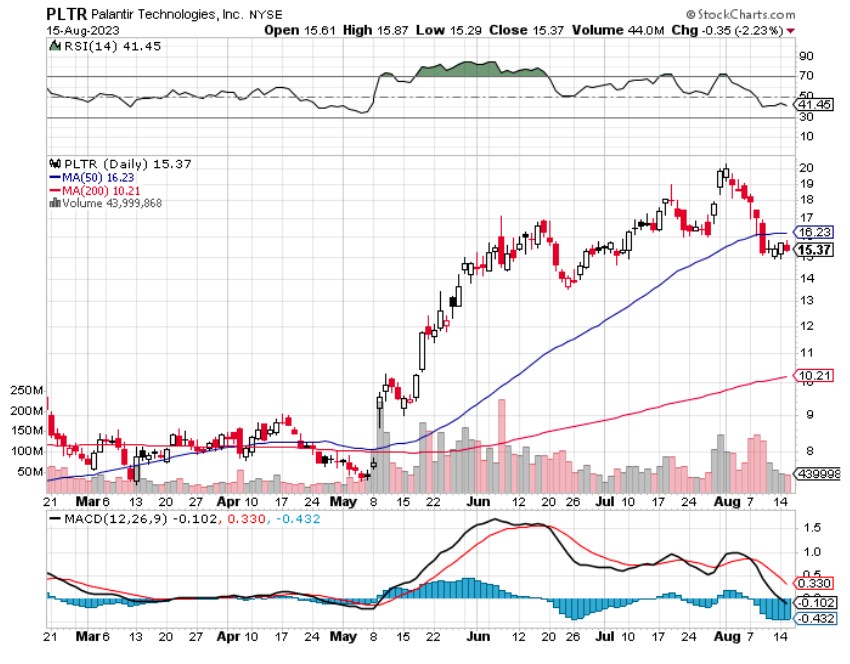
(PLTR), (GOOGL), (MSFT), (NVDA)
It's time to grab your magnifying glass and take a closer look at a story that's emerging from the shadows of the tech giants.
We're all too familiar with the A-list celebrities of the artificial intelligence (AI) world, namely Alphabet (GOOGL), Microsoft (MSFT), and Nvidia (NVDA). These are the names that echo in every conversation about AI breakthroughs.
But is there someone else knocking on the door of innovation? A name that's only just beginning to stir the echoes?
Let's talk about Palantir Technologies (PLTR).
Now, I must confess, Palantir isn't new to the game. Nearly 20 years old and famous for its U.S. Government contracts and connections to Silicon Valley's Peter Thiel, the big-data analytics firm has been flexing its AI muscles for quite some time.
Yet, it's only in the last three years since going public that Palantir's stock has danced to the highs and lows of Wall Street's fickle tune.
Remember that rocket ship known as Palantir's stock, shooting up by an astonishing 130% in just over a quarter? That was something to watch.
But let's not just gawk at the numbers; we need to ask: Does Palantir deserve the fanfare? Is it time to crown this company as one of the market's best AI stocks?
I don't toss crowns around lightly, so let's dig into the specifics.
Palantir's second-quarter revenue grew a respectable 13% YoY to $533 million, just a hair above the high end of management's guidance. And while a 13% increase might not set the world on fire, it’s good to take a pause and appreciate the masterpiece in the margins.
Operating expenses? A mere 1% rise in Q2, leading Palantir to the golden gates of profitability.
Here's the kicker: Palantir reported its third consecutive quarter with $0.01 in earnings per share (EPS) based on generally accepted accounting principles (GAAP). A mere penny, you say? Ah, but remember, the journey to towering profits always starts at ground level.
Was this a bad quarter for Palantir? Far from it. Still, before we christen AI as the ultimate game-changer, let's face the reality that Palantir could be posting higher growth. The crown will have to wait.
What has me leaning forward in my seat, however, is the company's consistent profitability and free cash flow. A GAAP profitable record for the third quarter in a row and a whopping $285 million in adjusted free cash flow in the first half of 2023, marking a 213% YoY growth, are figures you can't simply shrug off.
Let's revisit Palantir's Artificial Intelligence Platform (AIP), a subject I have been following and will urge you to watch closely in the coming months.
The world of large language models (LLMs) is no longer a future concept; it's a current reality. Integrating with Palantir's Foundry applications, AIP isn't just technical jargon but a practical step into untapped potential.
Foundry's value lies in its practicality and adaptability. Whether for a seasoned data analyst or a novice explorer, Foundry delivers various analytical tools.
Rather than painting it as a Swiss army knife or turbo engine, it's worth considering Foundry as a tailored solution for different data needs. It offers table-based scrutiny, geospatial pattern recognition, time series dissections, scenario simulations, and more.
In a business environment awash with data, Foundry stands as a robust tool that ensures no essential information escapes notice.
Now, moving to AIP's integration within Foundry, it's more than a vibrant addition; it's a strategic enhancement. AIP augments Foundry's capabilities, not just boosting its existing functions but adding a whole new layer of opportunity.
Imagine it as a software update for a craftsman's toolbox, one that is attentive to the precise requirements of modern data analysis.
This combination isn't about fanciful upgrades; it's about empowering users in practical ways. With AIP integrated right into Foundry, users can tap into additional features and capabilities with minimal fuss. It's not merely a novelty; it's a strategic move by Palantir to stay ahead of the curve.
In 2023, where artificial intelligence has transitioned from buzzword to business necessity, Palantir's alignment of AIP and Foundry isn't just innovation for innovation's sake. It's a calculated play, one that is in tune with market demands and technological progress.
Already active across 100 enterprises and under discussion with another 300 firms, this platform is making significant inroads. The numbers are an early indication of Palantir's short-term and long-term growth prospects.
Palantir's stock, trading at 16 times price to sales (P/S), might seem a premium compared to its competition, but there is robust justification for the demand that AIP is generating.
Coupled with Palantir's unwavering stand on profitability and liquidity, the convergence of AIP and Foundry adds an analytical depth that is both refreshing and relevant.
Investors seeking sustainable growth might find Palantir's technological foresight and fiscal responsibility an inviting combination. After all, this may just be a story that's only beginning to tell itself.