
Global Market Comments
September 20, 2020
Fiat Lux
SPECIAL EARLY RETIREMENT ISSUE
Featured Trade:
(HOW TO JOIN THE EARLY RETIREMENT STAMPEDE)


Global Market Comments
September 20, 2020
Fiat Lux
SPECIAL EARLY RETIREMENT ISSUE
Featured Trade:
(HOW TO JOIN THE EARLY RETIREMENT STAMPEDE)
Mad Hedge Technology Letter
September 9, 2020
Fiat Lux
Featured Trade:
(WHAT’S DRIVING THE NASDAQ?)
(SFTBY)

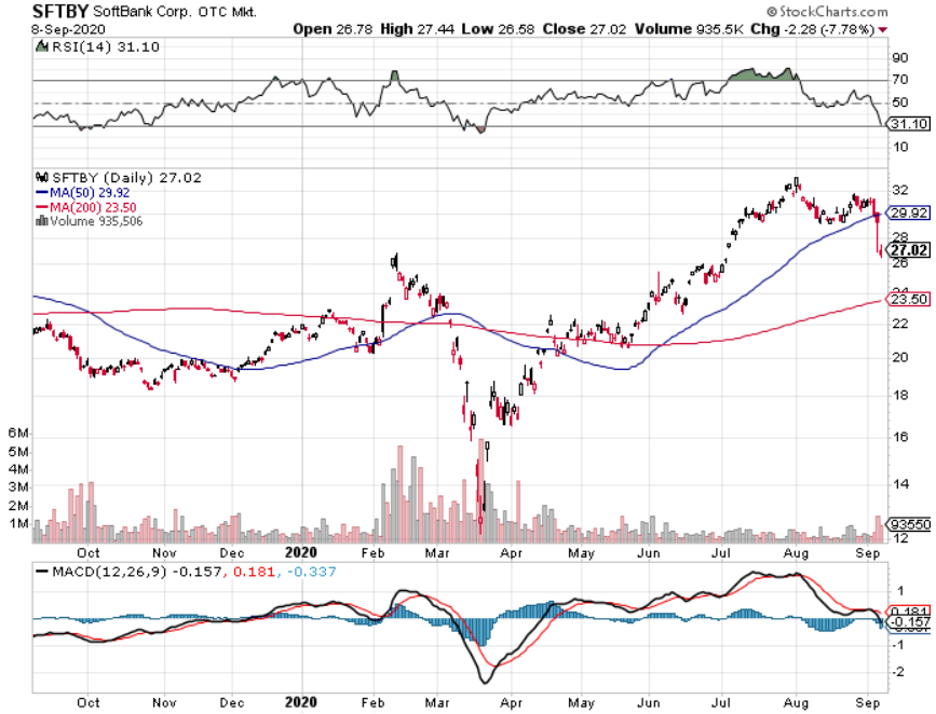
Softbank’s CEO Masayoshi Son is playing with fire by snapping up more than $50 billion of call option exposure.
These call options are directly targeted at tech stocks which Son has an absolute fascination with.
The heavy purchasing of stock options has been the main catalyst in tech stock’s heading into bubble territory pushing prices up to outrageous highs.
Cornering the options market could lead to Softbank taking major write-downs if this high-risk strategy blows up in their face.
Remember that markets usually fall at a faster pace than vice-versa because of the nature of liquidity drying up and an avalanche of forced selling through stop-losses orders.
To add fuel to the fire, we have the U.S. Central Bank that is creating a false sense of security by buying junk bonds and supporting asset prices with broad-based asset purchases, and the lack of real opportunities in the tech market is forcing traders to leverage up multiple times just to spin a profit.
This all sounds eerily similar to Long-Term Capital Management L.P. (LTCM), doesn’t it?
Call option bets on technology stocks are now the narrative driving the broader market as we are unequivocally detached from reality at this point.
A worst-case scenario is a full-fledged rise in the systemic risk if a sell-off, which we are in the midst of, triggers a nasty and chaotic unwinding of bullish positions with indiscriminate selling.
The revealing of Softbank’s high stakes strategy appears to be the variable rocking the market.
Once these call options are deployed, Softbank is out of bullets and there is no incremental amount of capital to support the next leg up, meaning a “taking profits” pivot is the next order on the menu.
I believe regulators will take a look at the recent price action with Tesla at one point rising 75% in the past month alone. Are U.S. regulators prepared for the new normal to allow tech stocks like Amazon to rise 40% per day or drop 80% in one day? Markets cannot function with that level of volatility.
Clearly, Softbank’s heft in trading is moving markets and almost to the point of market manipulation which is cause for another concern.
The point is that this isn’t sustainable and the coming fall after unrealized gains are all taken off the table could slam the market with volatility so bad that it will make the 2008 recession look like a 1% pullback.
It is hard to know where this finally ends as the Fed is implicitly funding cheap money strategies that allow hedge funds to bet the ranch.
Now, this is bet the ranch and multiply that by ten. That’s the feeling I am getting from the price action lately.
Are we heading into hedge funds borrowing trillions of dollars and putting on 10s of trillions in highly leveraged directional bets?
That’s a scary thought.
If the brazenness gets to that level, it could finally be the straw that broke the camel's back for the U.S. financial system.
At the bare minimum, that day is certainly creeping closer.
One thing I can tell you is that Japanese investors are scared to death with these revelations.
Softbank is a massive conglomerate in Japan with many retail traders owning pieces of it.
Granted, Softbank could make it out of this with $10 billion in profits, but could also lose more than that and become a system risk in the Japanese financial system.
If it is found out that there are multiple hedge funds mimicking Softbank’s tens of billions call options strategy, we are headed into the eye of the storm and volatility is about to shoot through the roof.
Traders who aren’t used to 10% swings in daily pricing should sit this one out on the sidelines for the time being.
Yesterday alone, Softbank took a $10 billion loss on their positions.
Each day, Son’s nerves must be jangling.
Only he and his confidantes know the math of the positions, but if big losses mount, it could force him to cut losses if equity markets keep crashing.
The knock-on effects could be contagion around other parts of the global markets catalyzing yet another financial crisis on top of the current economic crisis.
Is the incremental trader willing to help out Son’s bet by buying the dip?
I would say the recent volatility should scare away traders in the short term boding ill for Softbank. The plain the vanilla buy the dip strategy is looking tenuous at best these days.
Where did this out of the blue trading strategy come from?
The company has recently indicated investing in U.S. markets: SoftBank announced in August that it would start a new unit for public investments with $555 million in capital.
The purchases are also notable given how much cash SoftBank has been raising this year. Last month, the company announced that it would sell more than one million shares in its Japanese mobile carrier affiliate SoftBank Corp., worth 1.47 trillion yen (nearly $14 billion) signaling this wave of call option buying has been in the works for a while.
That asset sale came on top of plans the firm announced in March to raise some 4.5 trillion yen ($42 billion) by selling assets.
SoftBank said last month that it believed it was "necessary to expand cash reserves ... to ensure flexible options to respond to changes in the market environment."
Prior to Monday's fall, SoftBank's stock was up about a third this year. It was a stunning turnaround for the company, which was embarrassed by a massive write-down on the disastrous WeWork bet last year.
This appears to be revenge and redemption wrapped into one.
In May, SoftBank reported an annual operating loss of 1.36 trillion yen ($12.7 billion) driven by massive write-downs in the Vision Fund.
What a world we live in!
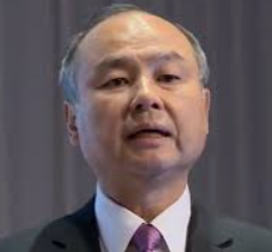
“Don't chase a girl, let the girl chase you.” – Said Founder and CEO of Softbank Masayoshi Son
While the Diary of a Mad Hedge Fund Trader focuses on investment over a one week to a six-month time frame, Mad Day Trader, provided by Bill Davis, will exploit money-making opportunities over a brief ten minute to three-day window. It is ideally suited for day traders, but can also be used by long-term investors to improve market timing for entry and exit points. Read more
Global Market Comments
September 9, 2020
Fiat Lux
Featured Trade:


When John identifies a strategic exit point, he will send you an alert with specific trade information as to what security to sell, when to sell it, and at what price. Most often, it will be to TAKE PROFITS, but, on rare occasions, it will be to exercise a STOP LOSS at a predetermined price to adhere to strict risk management discipline. Read more
Mark your calendars because the world is about to find out whether the leading candidates of the COVID-19 vaccine race will be effective as early as October.
Other than saving lives in this pandemic, also hinged on the results is over $100 billion in investors’ money – an amount that reflects just how much value the stock market is putting on the COVID-19 vaccine candidates under development today.
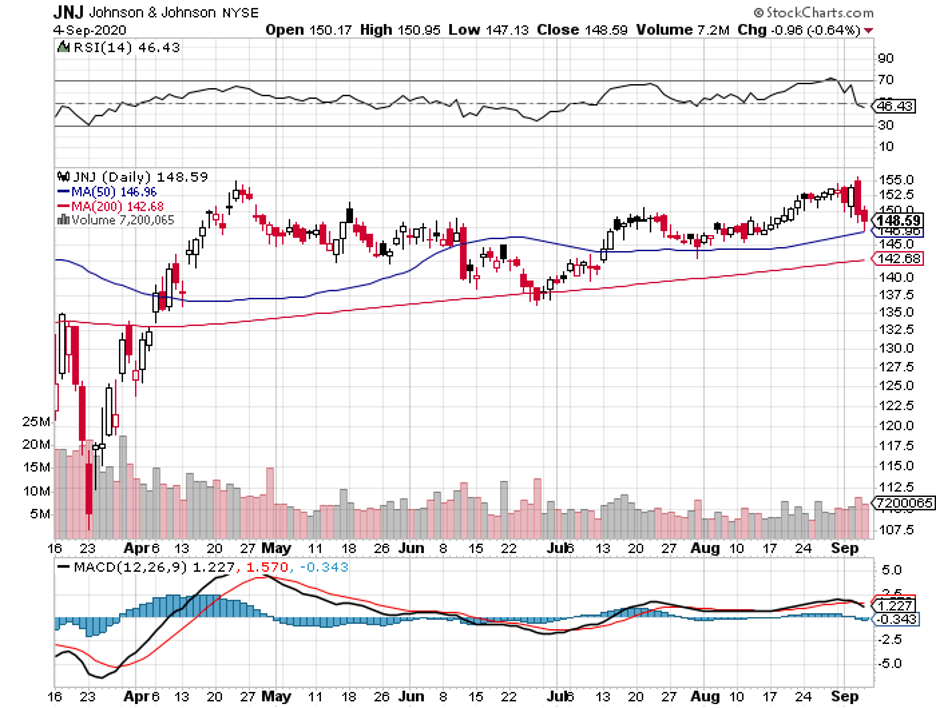
One of the leading companies in the race is Johnson & Johnson (JNJ).
With a market capitalization of almost $400 billion, many believe that this biopharmaceutical giant will soon be hailed as the king of the coronavirus stock list.
What we know so far is that JNJ’s subsidiary, called Janssen Vaccines, is set to launch a massive-scale Phase 3 study of its COVID-19 vaccine candidate, A26.COV2-S, this September.
The company’s study, which will be randomized, double-blind, and placebo-controlled, is expected to involve approximately 60,000 participants suffering from moderate to severe cases of COVID-19.
The move to include 60,000 participants is seen as a competitive advantage for JNJ because this is double the usual late-stage volunteer number.
For comparison, Moderna’s (MRNA) mRNA-1273 as well as Pfizer (PFE) and BioNTech’s (BNTX) BNT162b2 will only target a maximum of 30,000 patients each in their trials.
On top of the more expansive trial coverage, JNJ has another advantage that could help it pull ahead of the pack.
During the preclinical testing of Ad26.COV2-S on primates, the vaccine candidate showed that a single dose could be enough to fight off the virus.
In contrast, the candidates from other COVID-19 vaccine developers like AstraZeneca (AZN), Pfizer, and Moderna require two doses to trigger a similar response.
While the well-being of every man, woman, and child hangs on the success of the COVID-19 trials, concerns have been raised that the assessment for these candidates might be compromised because of the upcoming US presidential election.
However, the leading COVID-19 developers assured people that it won’t be the case.
Apart from JNJ, Pfizer, Moderna, AstraZeneca, other vaccine makers like GlaxoSmithKline (GSK), Sanofi (SNY), and Regeneron (REGN) plan to issue statements that no candidate will be submitted without extensive data on its efficacy and safety.
Most investors are focused on the COVID-19 stocks these days, and who can blame them?
Sales of the vaccines in 2021 alone could reach $20 billion per company. This is massive profit even for Big Pharma standards.
In fact, this amount is higher than the projected sales of today’s current top-selling drug, Humira from AbbVie (ABBV), which is expected to clock roughly $19.6 billion in the same period.
However, the COVID-19 vaccines will only be profitable for as long as there is a pandemic. If this disease becomes a non-recurring sickness, then the vaccines will no longer be as profitable in the long run.
This is why it’s crucial to review the core operations of a company and determine its capacity to keep generating revenue and profits while also maintaining a strong balance sheet and returning value to its investors.
JNJ is a great example of this type of business.
Outside its COVID-19 efforts, the company has been diversifying its portfolio. Its latest move is the $6.5 billion acquisition of Momenta Pharmaceuticals (MNTA), marking the biopharmaceutical titan’s expansion into the immunology sector.
One of the most significant assets JNJ acquired from this deal is Nipocalimab, which is an incredibly promising first-in-class autoimmune disease treatment.
This drug could be the answer to rare and life-threatening blood disorders, such as hemolytic disease, which affects newborns and babies. To date, there are roughly 195 million individuals suffering from this condition worldwide.
Throughout its history, JNJ has proven itself to be a stable company even in the most unstable market conditions.
It has a reliable growth record and a healthy cash flow, which would be valuable in acquiring bolt-on companies, creating new drugs, and boosting the dividend every year.
JNJ has managed to increase dividends annually for 58 years now, with its most recent dividend raise reaching 6.3% just last April. Its stock currently yields 2.7%.
More importantly, JNJ offers an impressive biotechnology pipeline. With an incredible history of over 130 years, this stock is definitely one for keeps.
When John identifies a strategic exit point, he will send you an alert with specific trade information as to what security to sell, when to sell it, and at what price. Most often, it will be to TAKE PROFITS, but, on rare occasions, it will be to exercise a STOP LOSS at a predetermined price to adhere to strict risk management discipline. Read more
While the Diary of a Mad Hedge Fund Trader focuses on investment over a one week to a six-month time frame, Mad Day Trader, provided by Bill Davis, will exploit money-making opportunities over a brief ten minute to three-day window. It is ideally suited for day traders, but can also be used by long-term investors to improve market timing for entry and exit points. Read more