• support@madhedgefundtrader.com
  • Member Login
  • Register for our December Summit
Mad Hedge Fund Trader
  • Home
  • About
  • Store
  • Luncheons
  • Testimonials
  • Contact Us
  • Click to open the search input field Click to open the search input field Search
  • Menu Menu

Tag Archive for: (AMZN)

april@madhedgefundtrader.com

The Place To Be

Tech Letter

Dealing with the Cloud works, and for every relevant tech company, this division serves as the pipeline to the CEO position.

If this isn’t the case for a tech company, then there’s something egregiously wrong with them!

Take Andy Jassy, the mastermind behind Amazon’s (AMZN) lucrative cloud computing division and the man who succeeded company founder Jeff Bezos.

He was rewarded with this important position based on his performance in the cloud and faced the daunting proposition of following Bezos as CEO.  

Bezos incorporated Amazon almost 30 years ago.

Jassy developed a highly profitable and market-leading business, Amazon Web Services, that runs data centers serving a wide range of corporate computing needs.

Cloud 101

If you've been living under a rock for the past few years, the cloud phenomenon hasn't passed you by and you still have time to cash in.

You want to hitch your wagon to cloud-based investments in any way, shape, or form.

Amazon leads the cloud industry it created.

It still maintains more than 30% of the cloud market. Microsoft would need to gain a lot of ground to even come close to this jewel of a business.

Amazon relies on AWS to underpin the rest of its businesses and that is why AWS contributes most of Amazon's total operating income.

Total revenue for just the AWS division would operate as a healthy stand-alone tech company if need be.

The future is about the cloud.

These days, the average investor probably hears about the cloud a dozen times a day.

If you work in Silicon Valley, you can quadruple that figure.

So, before we get deep into the weeds with this letter on cloud services, cloud fundamentals, cloud plays, and cloud Trade Alerts, let's get into the basics of what the cloud actually is.

Think of this as a cloud primer.

It's important to understand the cloud, both its strengths and limitations.

Giant companies that have it figured out, such as Salesforce (CRM) and Zscaler (ZS), are some of the fastest-growing companies in the world.

Understand the cloud and you will readily identify its bottlenecks and bulges that can lead to extreme investment opportunities. And that is where I come in.

Cloud storage refers to the online space where you can store data. It resides across multiple remote servers housed inside massive data centers all over the country, some as large as football fields, often in rural areas where land, labor, and electricity are cheap.

They are built using virtualization technology, which means that storage space spans many different servers and multiple locations. If this sounds crazy, remember that the original Department of Defense packet-switching design was intended to make the system atomic bomb-proof.

As a user, you can access any single server at any one time anywhere in the world. These servers are owned, maintained, and operated by giant third-party companies such as Amazon, Microsoft, and Alphabet (GOOGL), which may or may not charge a fee for using them.

The most important features of cloud storage are:

1) It is a service provided by an external provider.

2) All data is stored outside your computer residing inside an in-house network.

3) A simple Internet connection will allow you to access your data at any time from anywhere.

4) Because of all these features, sharing data with others is vastly easier, and you can even work with multiple people online at the same time, making it the perfect, collaborative vehicle for our globalized world.

Once you start using the cloud to store a company's data, the benefits are many.

No Maintenance

Many companies, regardless of their size, prefer to store data inside in-house servers and data centers.

However, these require constant 24-hour-a-day maintenance, so the company has to employ a large in-house IT staff to manage them - a costly proposition.

Thanks to cloud storage, businesses can save costs on maintenance since their servers are now the headache of third-party providers.

Instead, they can focus resources on the core aspects of their business where they can add the most value, without worrying about managing the IT staff of prima donnas.

Greater Flexibility

Today's employees want to have a better work/life balance and this goal can be best achieved by letting them work remotely which effectively happened because of the public health situation. Increasingly, workers are bending their jobs to fit their lifestyles, and that is certainly the case here at Mad Hedge Fund Trader.

How else can I send off a Trade Alert while hanging from the face of a Swiss Alp?

Cloud storage services, such as Google Drive, offer exactly this kind of flexibility for employees.

With data stored online, it's easy for employees to log into a cloud portal, work on the data they need to, and then log off when they're done. This way a single project can be worked on by a global team, the work handed off from time zone to time zone until it's done.

It also makes them work more efficiently, saving money for penny-pinching entrepreneurs.

Better Collaboration and Communication

In today's business environment, it's common practice for employees to collaborate and communicate with co-workers located around the world.

For example, they may have to work on the same client proposal together or provide feedback on training documents. Cloud-based tools from DocuSign, Dropbox, and Google Drive make collaboration and document management a piece of cake.

These products, which all offer free entry-level versions, allow users to access the latest versions of any document so they can stay on top of real-time changes which can help businesses to better manage workflow, regardless of geographical location.

Data Protection

Another important reason to move to the cloud is for better protection of your data, especially in the event of a natural disaster. Hurricane Sandy wreaked havoc on local data centers in New York City, forcing many websites to shut down their operations for days.

And we haven’t talked about the ransomware attacks by Eastern Europeans on energy company Colonial Pipeline and meat producer JBS Foods.

The cloud simply routes traffic around problem areas as if, yes, they have just been destroyed by a nuclear attack.

It's best to move data to the cloud, to avoid such disruptions because there your data will be stored in multiple locations.

This redundancy makes it so that even if one area is affected, your operations don't have to capitulate, and data remains accessible no matter what happens. It's a system called deduplication.

Lower Overhead

The cloud can save businesses a lot of money.

By outsourcing data storage to cloud providers, businesses save on capital and maintenance costs, money that in turn can be used to expand the business. Setting up an in-house data center requires tens of thousands of dollars in investment, and that's not to mention the maintenance costs it carries.

Plus, considering the security, reduced lag, up-time, and controlled environments that providers such as Amazon's AWS have, creating an in-house data center seems about as contemporary as a buggy whip, a corset, or a Model T.

The cloud is where you want to be.


https://madhedgefundtrader.com/wp-content/uploads/2019/05/cropped-mad-hedge-logo-transparent-192x192_f9578834168ba24df3eb53916a12c882.png 0 0 april@madhedgefundtrader.com https://madhedgefundtrader.com/wp-content/uploads/2019/05/cropped-mad-hedge-logo-transparent-192x192_f9578834168ba24df3eb53916a12c882.png april@madhedgefundtrader.com2023-12-01 14:02:292023-12-01 11:13:43The Place To Be
april@madhedgefundtrader.com

November 14, 2023

Diary, Newsletter, Summary

Global Market Comments
November 14, 2023
Fiat Lux

Featured Trade:

(WHY YOU WILL LOSE YOU JOB IN THE NEXT FIVE YEARS, AND WHAT TO DO ABOUT IT),
(INTU), (AMZN), (GOOGL), (TSLA), (BLK), (HRB)

https://madhedgefundtrader.com/wp-content/uploads/2019/05/cropped-mad-hedge-logo-transparent-192x192_f9578834168ba24df3eb53916a12c882.png 0 0 april@madhedgefundtrader.com https://madhedgefundtrader.com/wp-content/uploads/2019/05/cropped-mad-hedge-logo-transparent-192x192_f9578834168ba24df3eb53916a12c882.png april@madhedgefundtrader.com2023-11-14 09:04:302023-11-14 12:14:23November 14, 2023
MHFTR

Why You Will Lose Your Job in the Next Five Years, and What to do About it

Diary, Newsletter, Research

Yes, it’s happening.

And if you lose your job to AI in five years you will be one of the lucky ones.

It’s possible that your job is already gone, they just haven’t told you yet.

The shocking conclusion I am getting from dozens of research fronts is that artificial intelligence and automation are accelerating far faster than anyone realizes.

It is all extraordinarily disruptive.

This will cause corporate profits to rocket and share prices to soar but at the price of higher nationwide political instability.

A big leap took place at the beginning of the year when suddenly it appeared that everything got a lot smarter.

My local Safeway has started using self-checkout scanners to enable customers to avoid the long lines still operated by humans.

I hate them because I can never get them to scan pineapples correctly.

Soon, Amazon (AMZN) opened a supermarket in Seattle where there is no checkout stand at all. You simply just pick up whatever products you want, and it will scan them all on the way out to the parking lot.

Once the software is perfected (it is self-learning), and the consumers are educated, 5 million checkout clerks will be joining the unemployment lines.
 
Uber has been testing self-driving taxis in Phoenix, AZ, with sometimes humorous results. It seems that other human-driven cars like crashing into them. There has been one fatality so far when the human safety driver was caught texting.

When they figure this out, probably in two years, 180,000 taxi drivers and 600,000 Uber and Lyft drivers will have to hit the road.

Some 3 million truck drivers will be right behind them.

Notice that I am only a couple of paragraphs into this peace and already 8,780,000 jobs are about to imminently disappear out of a total of 150 million in the US.

Two decades from now, only vintage car collectors or the very poor will be driving their cars if Tesla (TSLA) has anything to do with it.

I let my Model X drive me around most of the time. It has reaction time, night vision, and a 360-degree radar system that are far better than my 71-year-old senses.

However, all new Teslas now come equipped with the hardware to use it. They are all only one surprise overnight software upgrade away from the future.

And it's not just the low-end high school dropout jobs that are being thrown in the dustbin of history.

Automation is now rapidly moving up the value chain.

A rising share of online news is machine-generated and is targeting you based on your browsing history. You just didn’t know it.

It was a major influence in the last election.

Blackrock (BLK), the largest fund manager in the country, has announced that it is laying off dozens of stock analysts and turning to algorithms to manage its vast $8.6 trillion in assets under management.

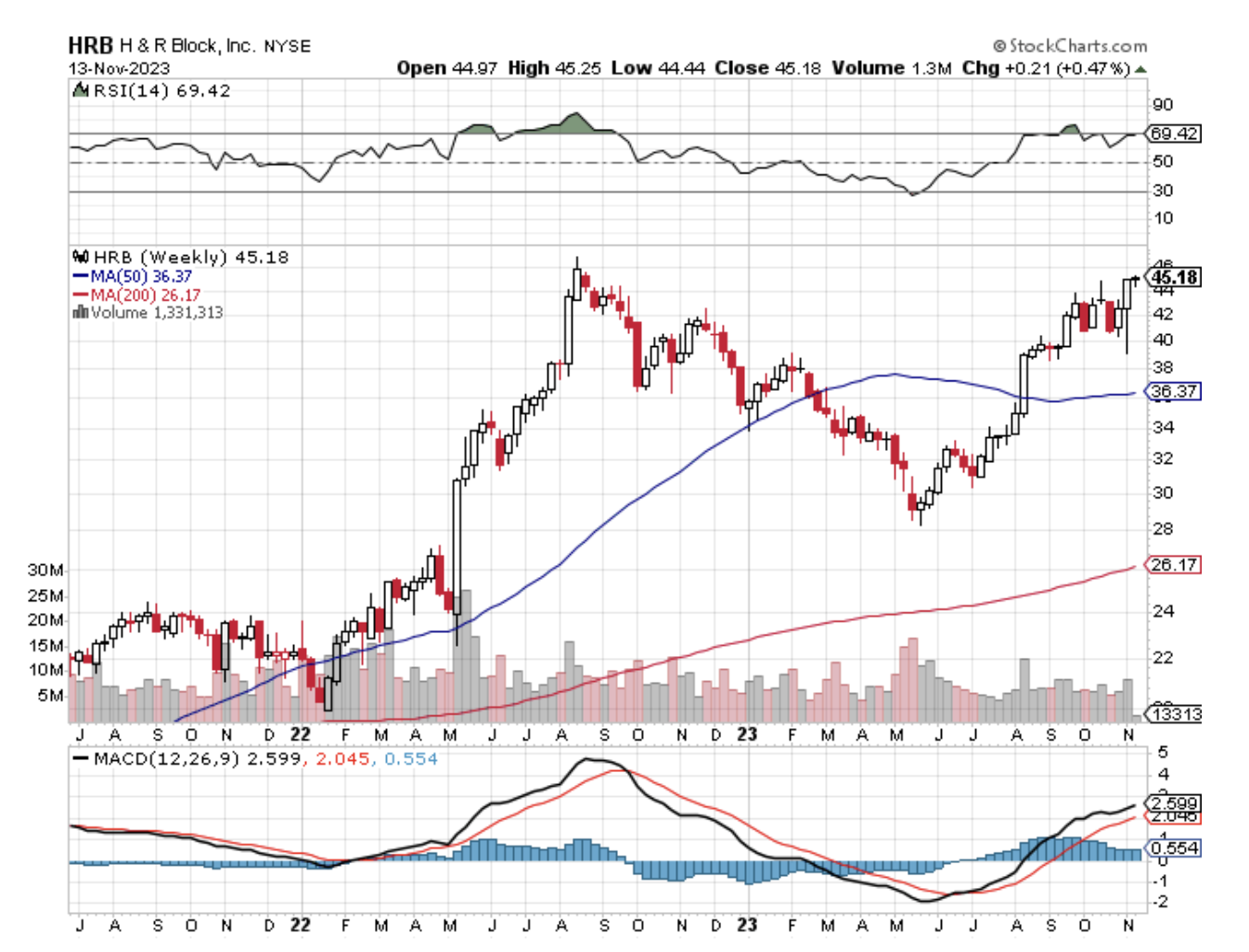
As the April 15 tax deadline relentlessly approaches, you are probably totally unaware that an algorithm prepared your return, particularly if you use a low-end service like H & R Block (HRB) or Intuit’s (INTU) TurboTax.

Because of the simultaneous convergence of multiple technologies, half of all current jobs will likely disappear over the next 20 years.

If this sounds alarming, don’t worry.

We’ve been through all of this before.

From 1900 to 1950 farmers fell from 40% to 2% of the labor force. The food output of that 2% has tripled over the last 60 years, thanks to improved seed varieties and farming methods.

The remaining 38% didn’t starve.

They retrained for the emerging growth industries of the day, automobiles, aircraft, and radio.

But there had to be a lot of pain along the way.

More recently, some 30% of all job descriptions listed on the Department of Labor website today didn’t exist 20 years ago.

Yes, disruption happens fast.

And here’s where it gets personal.

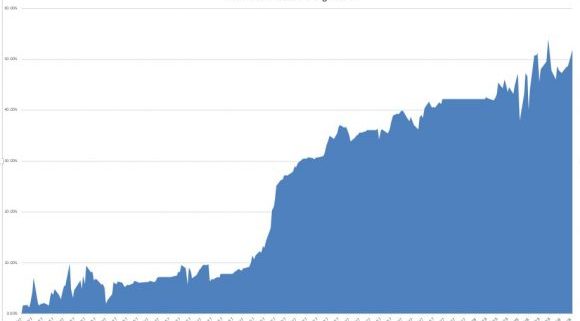
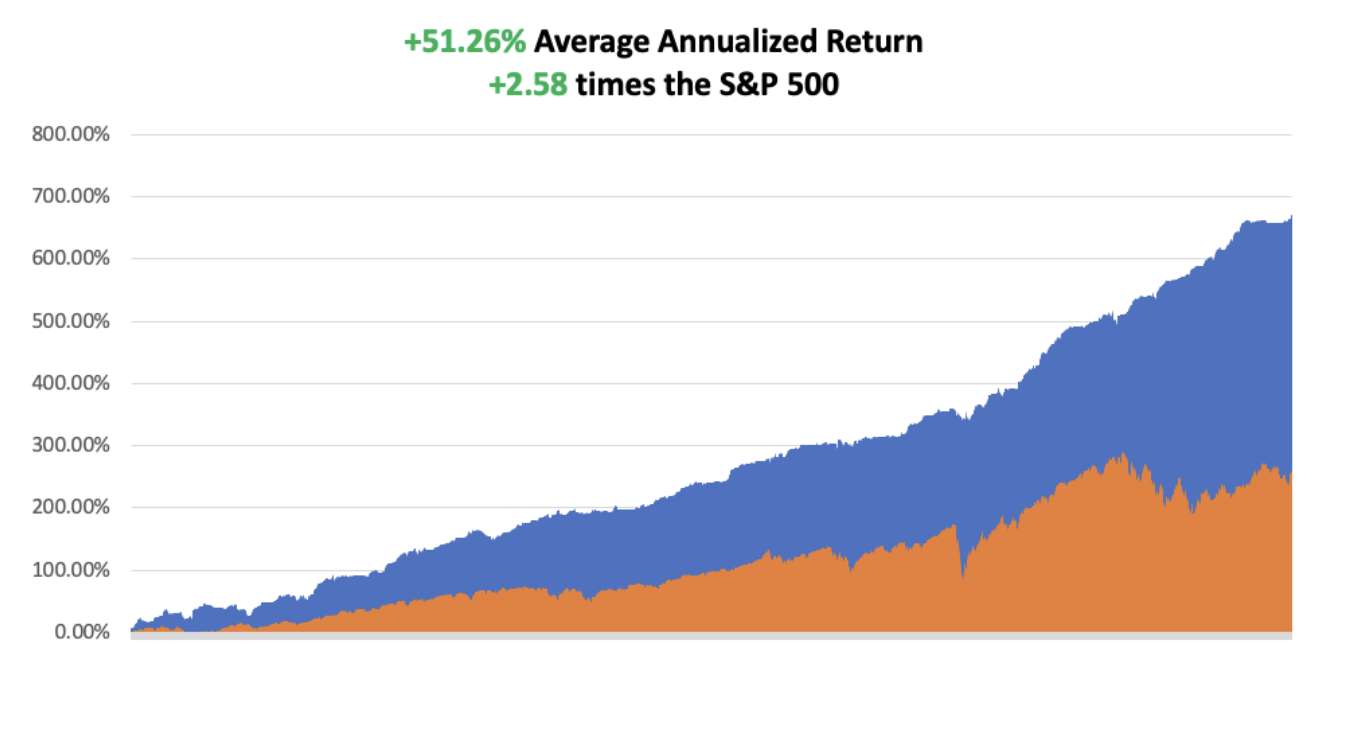
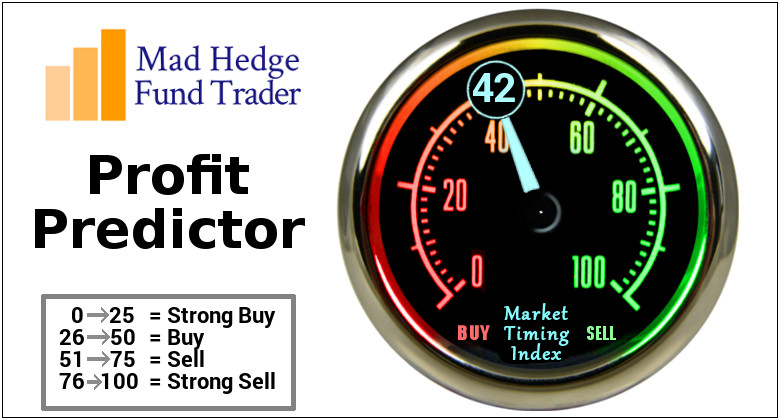
Since I implemented an AI-driven, self-learning Mad Hedge Market Timing algorithm to assist me in my own Trade Alert service six months ago, MY PERFORMANCE HAS ROCKETED, FROM A 21% ANNUAL RATE TO 51%!

As a result, YOU have been crying all the way to the bank!

The proof is all in the numbers (see chart below).

Those trading without the tailwind of algorithms today suddenly find the world a very surprising and confusing place.

They lose money too.

The investment implications of all of this are nothing less than mind-boggling.

Wages are almost always the largest cost for any business, especially the labor-intensive ones like retailing, fast food, and restaurants.

Reduce your largest expense by 90% or more, and the drop through to the bottom line will be enormous.

Stock markets have already noticed.

Maybe this is why price-earnings multiples are trading at a multi-decade high of 19.5X.

Perhaps, the markets know something that we mere humans don’t?

It also is the largest budgetary item in any government-supplied service.

I bet that half of the country’s 7 million teaching jobs will be gone in a decade, taken over by much cheaper online programs.

Today, my kids do their homework on their iPhones, complete class projects on Google Docs, and get a report card that is updated and emailed to me daily.

They’re probably to last generation to ever go to a physical school.

(That’s life. Just as the cost of driving them to school every day becomes free, they don’t have to go anymore).

You can always adopt a “King Canute” strategy and order the tide not to rise.

Or, you can rapidly adapt, as I did.

The choice is yours.


https://www.madhedgefundtrader.com/wp-content/uploads/2018/03/12-month-story-2-1-e1521668829556.jpg 349 580 MHFTR https://madhedgefundtrader.com/wp-content/uploads/2019/05/cropped-mad-hedge-logo-transparent-192x192_f9578834168ba24df3eb53916a12c882.png MHFTR2023-11-14 09:02:152023-11-14 12:13:57Why You Will Lose Your Job in the Next Five Years, and What to do About it
Mad Hedge Fund Trader

November 13, 2023

Tech Letter

Mad Hedge Technology Letter
November 13, 2023
Fiat Lux

Featured Trade:

(RIDE THE NVIDIA AND AMD ROLLER COASTER)
(NVDA), (AMD), (ORCL), (GOOGL), (AMZN)

https://madhedgefundtrader.com/wp-content/uploads/2019/05/cropped-mad-hedge-logo-transparent-192x192_f9578834168ba24df3eb53916a12c882.png 0 0 Mad Hedge Fund Trader https://madhedgefundtrader.com/wp-content/uploads/2019/05/cropped-mad-hedge-logo-transparent-192x192_f9578834168ba24df3eb53916a12c882.png Mad Hedge Fund Trader2023-11-13 14:04:242023-11-13 16:20:10November 13, 2023
Mad Hedge Fund Trader

Ride the Nvidia and AMD Roller Coaster

Tech Letter

It’s scary when the best chip company in the world rolls out new products.

It’s scary because others can’t compete and they get left further behind.

It’s scary because the high level of technology facilitates another new wave of technological expertise in other companies from the software and hardware side.

These new products are almost always faster, more efficient, and better than the previous products catalyzing a snowball effect that lifts everybody’s revenue.

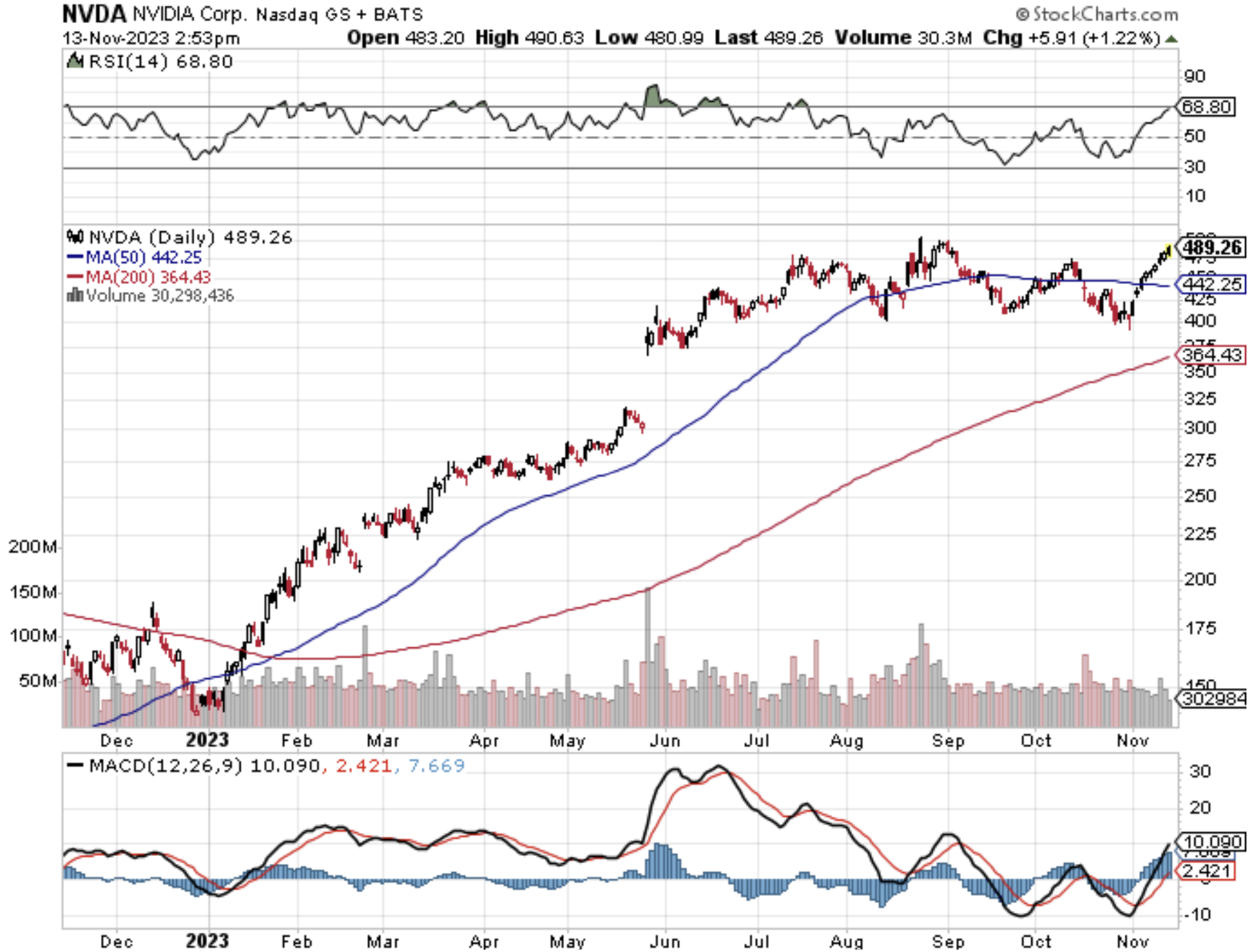
This type of outstanding performance of late is the reason that made Nvidia (NVDA) into the world’s most valuable chipmaker and they have announced they are updating its H100 artificial intelligence processor, adding more capabilities to a product that has fueled its dominance in the AI computing market.

The new model, called the H200, will get the ability to use high-bandwidth memory, or HBM3e, allowing it to better cope with the large data sets needed for developing and implementing AI.

Amazon’s AWS, Alphabet’s Google (GOOGL) Cloud and Oracle’s (ORCL) Cloud Infrastructure have all committed to using the new chip starting next year.

Winning orders is easy with the outsized brand recognition and type of game changing product on offer.

The current version of the Nvidia processor is already experiencing accelerated demand.

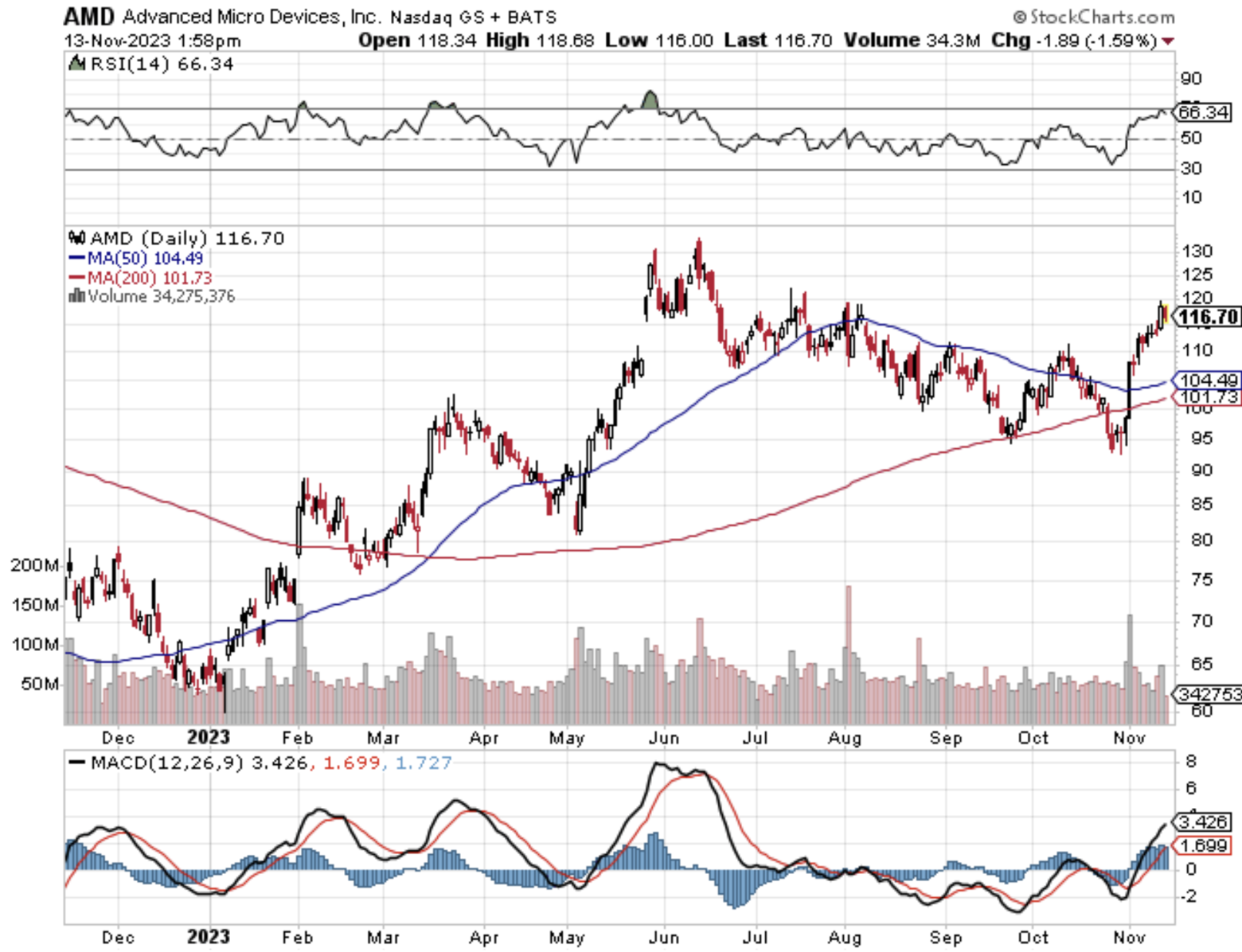
But the product is facing stiffer competition: Advanced Micro Devices (AMD) is bringing its rival MI300 chip to market in the fourth quarter, and Intel Corp. claims that its Gaudi 2 model is faster than the H100.

AMD is another chip company that readers should feel comfortable diversifying into if they don’t feel comfortable putting all eggs into the Nvidia basket.

AMD’s stock is surging towards old highs around $125 and should overtake that soon after the nice rally in the 2nd half of the year.

With the new product, Nvidia is trying to keep up with the size of data sets used to create AI models and services.

Adding the enhanced memory capability will make the H200 much faster at bombarding software synthesizing data.

Large computer makers and cloud service providers are expected to start using the H200 in the second quarter of 2024.

Nvidia got its start making graphics cards for gamers, but its powerful processors have now won a following among data center operators.

That division has gone from being a side business to the company’s biggest moneymaker in less than five years.

Nvidia’s graphics chips helped pioneer an approach called parallel computing, where a massive number of relatively simple calculations are handled at the same time.

That’s allowed it win major orders from data center companies, at the expense of traditional processors supplied by Intel.

The growth helped turn Nvidia into the poster child for AI computing earlier this year — and sent its market valuation soaring.

Nvidia is like a freight train that has left the station.

The stock is up 9 straight days as we cruise into its earnings report on November 21st.

It’s hard to see this earnings report being nothing short of spectacular and Nvidia have become famous for forecasting the unthinkable.

They then go and surpass a high bar and push the envelope further so it’s not a bad idea to buy NVDA before the earnings report.

The speed at which they come out with products is astounding and now being able to boast the best server chip in the tech enterprise community, it just represents yet another powerful part of their stunning array of tech arsenal.

$600 per share is a no-brainer for Nvidia and that will be surpassed in 2024.


https://madhedgefundtrader.com/wp-content/uploads/2019/05/cropped-mad-hedge-logo-transparent-192x192_f9578834168ba24df3eb53916a12c882.png 0 0 Mad Hedge Fund Trader https://madhedgefundtrader.com/wp-content/uploads/2019/05/cropped-mad-hedge-logo-transparent-192x192_f9578834168ba24df3eb53916a12c882.png Mad Hedge Fund Trader2023-11-13 14:02:452023-11-13 16:33:10Ride the Nvidia and AMD Roller Coaster
april@madhedgefundtrader.com

October 30, 2023

Diary, Newsletter, Summary

Global Market Comments
October 30, 2023
Fiat Lux

Featured Trade:

(MARKET OUTLOOK FOR THE WEEK AHEAD, or THE TRAPPED MARKET)
(TSLA), (NVDA), (GOOGL), (AMZN), (NLY)

https://madhedgefundtrader.com/wp-content/uploads/2019/05/cropped-mad-hedge-logo-transparent-192x192_f9578834168ba24df3eb53916a12c882.png 0 0 april@madhedgefundtrader.com https://madhedgefundtrader.com/wp-content/uploads/2019/05/cropped-mad-hedge-logo-transparent-192x192_f9578834168ba24df3eb53916a12c882.png april@madhedgefundtrader.com2023-10-30 09:04:262023-10-30 12:27:08October 30, 2023
april@madhedgefundtrader.com

The Market Outlook for the Week Ahead, or The Trapped Market


Diary, Newsletter

I should have stayed in Ukraine.

At least that way I would know which direction the fire was coming from, the east. Back here in the US markets, the fire seemed to be coming from every direction all at once.

Good news was bad news and bad news even worse. An S&P 500 down 2.5% certainly left a bruise. The geopolitical outlook in the idle East is getting worse by the day.

But where others find nothing but despair, I see opportunity. Despite all the doom and gloom, all the elements of a yearend rally are setting up nicely. And it could be a sharp one as the time for it to play out is ever shrinking.

Hedge fund quantitative, momentum, and systemic shorts are at all-time highs, creating lots of buying power. AI has gone silent. Key earnings events will be done with the Apple announcement on Thursday, November 2. Ten-year bonds have repeatedly tried but failed to break the 5.00% yield.

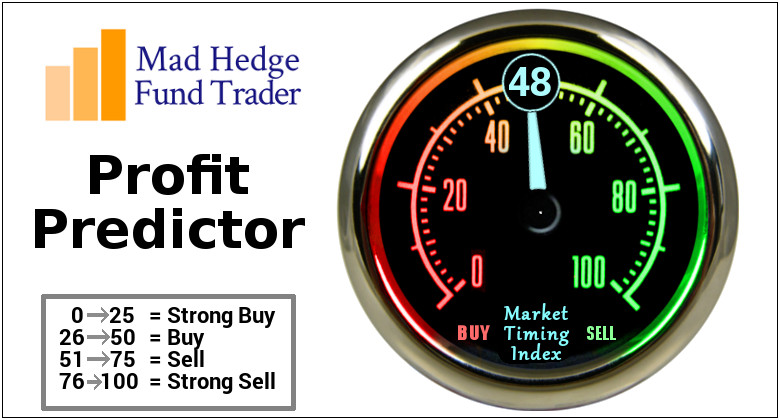
Major tech stocks like (TSLA), (NVDA), (GOOGL), and (AMZN) have seen 20% corrections. The Mad Hedge AI Market Timing Index is unable to close below $20 and has been chopping a lot of wood under $30. If a new House speaker cuts a deal to avoid a government shutdown before November 17, it could be off to the races.

The smart thing to do here is to build up a list of stocks higher leverage to falling interest rates. All stocks benefit from falling rates but some much more than others.

One of my favorites is Annaly Capital Management (NLY), one of the largest mortgage real estate investment trusts (REITS). The company borrows money, primarily via short-term repurchase agreements, and reinvests the proceeds in asset-backed securities.

The company’s shares are unusually sensitive to rising overnight interest rates, and its shares are down 50% in a year. A monster rally in the stock is brewing. Oh, and it has a 17% dividend, which will likely get cut but still remain extremely high.

Finally, I want to bid a sad farewell to my old friend and fellow iconoclast Byron Wien. Byron was late of Blackstone and much earlier from Morgan Stanley.

Byron was famed for his “Ten Surprises” which he published each New Year and with which I used to assist him in the early years. This was a list of possible developments which, if they occurred, would have a disproportionate effect on the market.

Byron was 90 and will be missed. One of his favorite pieces of advice was to never retire and Byron was working right up until last week.

Hmmmm. Sounds like good advice to me.

So far in October, we are up +3.56%. My 2023 year-to-date performance is still at an eye-popping +64.36%. The S&P 500 (SPY) is up +7.89% so far in 2023. My trailing one-year return reached +74.44% versus +8.09% for the S&P 500.

That brings my 15-year total return to +661.55%. My average annualized return has fallen back to +47.89%, some 2.81 times the S&P 500 over the same period.

Some 44 of my 49 trades this year have been profitable.

Car Payment Delinquencies Hit Record Rate, with repossessions rising. With interest rate hikes making newer loans more expensive, millions of car owners are struggling to afford their payments. It’s a clear indication of distress at a time when the economy is sending mixed signals, particularly about the health of consumer spending. Usually, a recession indicator but not this time.

US Government Wraps up Fiscal 2023 with a $1.7 Trillion Deficit, up 23% from the previous year, which ended on October 31. It’s a major reason why bonds have been under such pressure since July. But the purchasing power of the total US national debt of $32 trillion fell by $260 billion last year, thanks to the torrid 8.1% inflation rate.

US Core PCE Jumps 0.3% in September, the most in four months. It’s the Fed’s favorite inflation indicator. Drugs, travel, and used cars saw the big price increases. Resilient household demand paired with a pickup in inflation underscores momentum heading into the fourth quarter

Ukraine War has Become a Big Generator at US Defense Companies. Companies such as Lockheed Martin (LMT), General Dynamics (GD), and others expect that existing orders for hundreds of thousands of artillery rounds, hundreds of Patriot missile interceptors, and a surge in orders for armored vehicles expected in the months ahead will underpin their results in coming quarters. Buy the sector on dips

Don’t Expect a Real Estate Crash Anytime Soon, with supplies at 40-year lows. Yes, 8% mortgages are a buzz kill, but 95% of homeowners with mortgages date back to the 3.0% era. No one wants to give up their free lunch. If you’re a mortgage originator, it’s another story.

Existing Home Sales Hit 13-Year Low at 1.13 million, down 8% YOY. The Median Home Price was up 2.8% to $394,300. This is 17% of the peak rate we saw in 2021 when overnight rates were still zero.

Pending Home Sales Rise 1.1% in September to 72.6, but are down 13% YOY. On a signed contract basis. But the absolute level is the lowest in two years. High mortgage rates are the buzz kill. Affordability is at a record low.

Adjustable Rate Mortgages Make a Big Comeback, with 5/1 ARMS costing only 6.99% compared to 8.0% for the conventional 30-year fixed, a 23-year high. Mortgage originations are now down 22% YOY.

US Economy Red Hot at 4.9% Growth Rate, the highest in two years. Unfortunately, the stock market sees a major slowdown in the current quarter. Consumer spending was the big driver.

Tech Selloff has Taken NVIDIA down to a 25 Times Earnings Multiple, the same as Walmart and Target, despite 50% earnings growth for the foreseeable future. This is just at the start of an AI super cycle. Get ready to start loading the boat.

My Ten-Year View

When we come out the other side of the recession, we will be perfectly poised to launch into my new American Golden Age, or the next Roaring Twenties. The economy decarbonizing and technology hyper accelerating, creating enormous investment opportunities. The Dow Average will rise by 800% to 240,000 or more in the coming decade. The new America will be far more efficient and profitable than the old.

Dow 240,000 here we come!

On Monday, October 30 at 8:30 AM EST, the Dallas Fed Manufacturing Index is out.

On Tuesday, October 31 at 2:30 PM, the S&P Case Shiller National Home Price Index is released.

On Wednesday, November 1 at 8:30 AM, the JOLTS Job Openings Report is published.

On Thursday, November 2 at 8:30 AM, the Weekly Jobless Claims are announced.

On Friday, November 3 at 2:30 PM, the October Nonfarm Payroll Report is published. At 2:00 PM the Baker Hughes Rig Count is printed.

As for me
, one of the benefits of being married to a British Airways stewardess in the 1970s was unlimited free travel around the world. Ceylon, the Seychelles, and Kenya were no problem.

Usually, you rode in first class, which was half empty, as the British Empire was then rapidly fading. Or you could fly in the cockpit where, on long flights, the pilot usually put the plane on autopilot and went to sleep on the floor, asking me to watch the controls.

That’s how I got to fly a range of larger commercial aircraft, from a Vickers Viscount VC-10 to a Boeing 747. Nothing beats flying a jumbo jet over the North Pole on a clear day, where the unlimited view ahead is nothing less than stunning.

When gold peaked in 1979 at $900 an ounce, up from $34, The Economist magazine asked me to fly from Japan to South Africa and write about the barbarous relic. That I did with great enthusiasm, bringing along my new wife, Kyoko.

Sure enough, as soon as I arrived, I noticed long lines of South Africans cashing in their Krugerands, which they had been saving up for years in the event of a black takeover.

There was only one problem. My wife was Japanese.

While under the complicated apartheid system, the Chinese were relegated to second class status along with Indians, Japanese were treated as “honorary whites” as Japan did an immense amount of trade with the country.

The confusion came when nobody could tell the difference between Chinese and Japanese, not even me. As a result, we were treated as outcasts everywhere he went. There was only one hotel in the country that would take us, the Carlton in Johannesburg, where John and Yoko Lennon stayed earlier that year.

That meant we could only take day trips from Joberg. We traveled up to Pretoria, the national capital, to take in the sights there. For lunch, we went to the best restaurant in town. Not knowing what to do, they placed us in an empty corner and ignored us for 45 minutes. Finally, we were brought some menus.

The Economist asked me to check out the townships where blacks were confined behind high barbed wire fences in communities of 50,000. I was given a contact in the African National Conference, then a terrorist organization. Its leader, Nelson Mandela, had spent decades rotting away in an island prison.

My contact agreed to smuggle us in. While blacks were allowed to leave the townships for work, whites were not permitted in under any circumstances.

So, we were somewhat nonplussed Kyoko and I were asked to climb into the trunk of an old Mercedes. Really? We made it through the gates and into the center of the compound. On getting out of the trunk, we both burst into nervous laughter.

Some honeymoon!

After meeting the leadership, we were assigned no less than 11 bodyguards as whites in the townships were killed on sight. The favored method was to take a bicycle spoke and sever your spinal cord.

We drove the compound inspecting plywood shanties with corrugated iron roofs, brightly painted and packed shoulder to shoulder. The earth was dry and dusty. People were friendly, waving as we drove past. I interviewed several. Then we were smuggled out the same way we came in and hastily dropped on a corner in the city.

Apartheid ended in 1990 when the ANC took control of the country, electing Nelson Mandela as president. A massive white flight ensued which brought people like Elon Musk’s family to Canada and then to Silicon Valley.

Everyone feared the blacks would rise up and slaughter the white population.

It never happened.

Today, South Africa offers one of the more interesting investment opportunities on the continent. The end of apartheid took a great weight off the shoulders of the country’s economy. Check out the (EZA), which nearly tripled off of the 2020 bottom.

Kyoko passed away in 2002 at age 50.

Stay Healthy,

John Thomas
CEO & Publisher
The Diary of a Mad Hedge Fund Trader


https://madhedgefundtrader.com/wp-content/uploads/2019/05/cropped-mad-hedge-logo-transparent-192x192_f9578834168ba24df3eb53916a12c882.png 0 0 april@madhedgefundtrader.com https://madhedgefundtrader.com/wp-content/uploads/2019/05/cropped-mad-hedge-logo-transparent-192x192_f9578834168ba24df3eb53916a12c882.png april@madhedgefundtrader.com2023-10-30 09:02:072023-10-30 12:26:49The Market Outlook for the Week Ahead, or The Trapped Market

april@madhedgefundtrader.com

October 20, 2023

Diary, Newsletter, Summary

Global Market Comments
October 20, 2023
Fiat Lux

Featured Trade:

(TESTIMONIAL)
(OCTOBER 18 BIWEEKLY STRATEGY WEBINAR Q&A),
(LMT), (MS), (GOOG), (NVDA), (TSLA), (MSFT), (AMZN), (APPL), (META), (FXI), (RIVN), (NFLX)

https://madhedgefundtrader.com/wp-content/uploads/2019/05/cropped-mad-hedge-logo-transparent-192x192_f9578834168ba24df3eb53916a12c882.png 0 0 april@madhedgefundtrader.com https://madhedgefundtrader.com/wp-content/uploads/2019/05/cropped-mad-hedge-logo-transparent-192x192_f9578834168ba24df3eb53916a12c882.png april@madhedgefundtrader.com2023-10-20 09:06:072023-10-20 08:32:31October 20, 2023
april@madhedgefundtrader.com

October 18 Biweekly Strategy Webinar Q&A

Diary, Newsletter

Below please find subscribers’ Q&A for the October 18 Mad Hedge Fund Trader Global Strategy Webinar, broadcast from London England.

Q: Is Nvidia (NVDA) a buy at the current price?

A: Absolutely, if your view is more than, say, a month. This stock will easily be $1,000 in the next year or two. They have such a huge moat on their business, and the high-end chips that are banned in China are only a tiny fraction of their overall business—they’re still allowed to sell small and medium-sized chips.

Q: Where do you see bond yields peaking out?

A: My pet target is 5.2% on a spike. We may get there in a few weeks or months. The position we have breaks even at 5.15% in 21 trading days. So any kind of rally on that position becomes profitable—even a one-day rally.

Q: Are you hitting Israel next?

A: No, I covered the Middle Eastern wars for 10 years starting with the ‘73 Yom Kippur wars, and I got sick of it. They’re using the same arguments to justify their positions that they were 50 years ago. In fact, the disputes have been going on for hundreds of years. So, I moved on to other more interesting wars like Ukraine. There are plenty of newbies cutting their teeth as war correspondents in Gaza now—I'll leave it to them.

Q: Are the results for all of the newsletters or just for one?

A: Those alerts that I send out personally are the results for the Mad Hedge Global Trading Dispatch. All of the other services (we have six now) have their own trade histories which we don’t publish, as it’s too much of an account job effort to update six independent track records. People know whether they’re making money or not—that's good enough for me. That’s how we’re set up; we’re a staff-light operation so that we can keep the prices low.

Q: What do you expect for Tesla (TSLA) earnings today?

A: I never make same-day earnings calls, but I would expect they’d be good. They would be less than they were in the past because the price wars are cutting into margins, but they’re gaining market shares at everybody else’s expense, which makes (TSLA) a “BUY”. In fact, if you look at the charts, it seems to be moving sideways into an upside breakout.

Q: Is it too late to buy military?

A: No, I’d be buying any of the big military stocks like Lockheed Martin (LMT), because the increase in demand for weapons is not a short-term thing—it is a more or less permanent thing which will go out decades. Also, they all already have massive government contracts to rebuild our own weapons. Most people don't realize that almost every weapons system in the United States is more than 50 years old. The reason is we quit investing in conventional weapons because we all thought the next war would be cyber. Well, Russia got absolutely nowhere on cyber—they made a few weak attempts to shut down Ukraine and couldn't even break into Elon Musk’s Skylink system, which all of Ukraine is running on.

Q: Why is Morgan Stanley (MS) doing so poorly?

A: All the financials are getting hit because of the collapsing bond market. Once the bond market finds a bottom you want to be buying financials with both hands.

Q: When the market recovers, which sector will lead?

A: Technology. The Magnificent Seven will lead. There’s safety in size. Google/Alphabet (GOOG), Nvidia (NVDA), Tesla (TSLA), Microsoft (MSFT), Amazon (AMZN), Apple (APPL), Facebook/Meta (META). They’re already leading now, so if you have those positions, I’d keep them. If you don’t, you should start picking them up.

Q: Is Rivian (RIVN) a buy at this level?

A: Absolutely. Amazon, which owns 25% of the company, just hit 10,000 Rivian delivery vans. I’ve seen them in California, they’re completely silent—very interesting cars. It’s just a question of how quickly they can produce them.

Q: Why is there a market drop today?

A: It’s the bond market. The first thing you look at every day is the bond market—if it's doing crappy, everything sells off. 

Q: Do you still suggest 90-day T-bills at this point?

A: We may end up getting a stock buying opportunity into the year-end. Even if we have to wait for a yearend rally, you get paid every day for 90-day T-bills, and you can sell them at any time and get interest up to the day you sell them because they’re discount bonds that appreciate every day to reflect the yield. It’s a great way to park money, and most brokers will let you buy stocks against your 90-day T-bill position. So say you want to go fully invested in stocks—you could do that while selling your 90-day T-bills the same day. Most brokers will let you do that, worst case charging you one day of margin.

Q: Do you think China is using the Hamas attack on Israel to distract the US?

A: No, China wouldn’t want to get involved in this. Iran has its fingerprints all over it. Iran supplied all the missiles used to attack Israel, and if the Israelis turn around and attack Iran by destroying all of their nuclear and missile-making facilities, I would not be surprised one bit. That may be what Biden is really doing over there—trying to convince the Israelis not to escalate the war.

Q: What are the chances of a US default on November 17 (TLT)?

A: So far on all of these government shutdowns, the US Treasury has been able to come up with magic tricks to keep from defaulting; but if the default is long enough, even they will have to stop paying interest to bondholders, which will increase the debt burden of the US government because a lower credit rating will cause it to pay higher interest rates. Why people think this is a great strategy is beyond me.

Q: Gasoline is down and oil is up—what’s going on?

A: That’s usually driven by the crack spread—the availability of gasoline from refineries in the US, so I wouldn’t use that as any kind of indicator.

Q: Do you think China (FXI) is shifting priorities away from economic growth to military strength?

A: No I don’t, they would love to have economic growth if they could, and in fact, their central bank has been stimulating their economy, and it's working; that’s how this morning’s report got back up to 5%. At the end of the day, they just want peace. All this military stuff—they’re just bluffing and posturing, which is really all they’ve ever done, at least since the Korean War. They weren’t even big participants in the Vietnam War, so China doesn’t worry me at all; there are bigger things to worry about. But they definitely have hit a wall in economic growth, and a big part of that is Covid, and a big part of that is a shrinking population—a shortage of workers, and a shortage of workers who can support older parents.

Q: Will there be an oil embargo against Israel? The US and Europe by OPEC countries?

A: No. The Middle Eastern governments know what's really going on here, even though what they may say in public is completely different. The fact is that Hamas started this war, and none of these other countries want Hamas in their countries because they know that the first thing they'll do is overthrow the local government. Effectively, Hamas doesn’t exist anymore either—they've really all been killed, so you just have to give some time for things to cool down out there, and of course, the US is working overtime to keep the situation from escalating, but we can only try—we can’t enforce this thing. One question I've been getting from a lot of people lately is: will the US send troops to Israel or to Gaza? The answer is no—we were in Iraq and Afghanistan for 20 years! We’re in no hurry to get back into a new war, especially a new 20-year war, and that would not be in our own interest. By the way, Israel can amply defend itself; they have the best military in the Middle East by far, largely supported by the United States. For me, the big mystery is how intelligence in Israel missed this attack. They were just completely asleep at the switch, and some day in the future there will be an investigation about this, but don’t expect it from the current government.

Q: Why won’t Egypt and Jordan take the Palestinian refugees?

A: They are both poor countries. Neither of them is oil-rich, and Egypt especially has a horrendous population problem—they are in fact the world's second largest food importer after China. They have 110 million people to feed and not enough production locally to do that, so it isn’t easy to take in 2 million Palestinians. If you don't believe me, go to Cairo—it's just incredibly crowded. With a population of 10 million you can't go anywhere, so where are they going to put 2 million more people? So this is a difficult problem, there's no easy fix depending on what side you’re on.

To watch a replay of this webinar with all the charts, bells, whistles, and classic rock music, just log in to www.madhedgefundtrader.com, go to MY ACCOUNT, select your subscription (GLOBAL TRADING DISPATCH, TECHNOLOGY LETTER, or Jacquie's Post), then click on WEBINARS, and all the webinars from the last 12 years are there in all their glory.

Good Luck and Good Trading.

John Thomas
CEO & Publisher
The Diary of a Mad Hedge Fund Trader


2021 Mount Rose Summit Nevada


https://madhedgefundtrader.com/wp-content/uploads/2019/05/cropped-mad-hedge-logo-transparent-192x192_f9578834168ba24df3eb53916a12c882.png 0 0 april@madhedgefundtrader.com https://madhedgefundtrader.com/wp-content/uploads/2019/05/cropped-mad-hedge-logo-transparent-192x192_f9578834168ba24df3eb53916a12c882.png april@madhedgefundtrader.com2023-10-20 09:02:062023-10-20 08:32:53October 18 Biweekly Strategy Webinar Q&A
april@madhedgefundtrader.com

Go Straight To The Top With The Cloud

Tech Letter

Dealing with the Cloud works and for every relevant tech company, this division serves as the pipeline to the CEO position.

If this isn’t the case for a tech company, then there’s something egregiously wrong with them!

Take Andy Jassy, the mastermind behind Amazon’s (AMZN) lucrative cloud computing division and was the man who succeeded company founder Jeff Bezos.

He was rewarded this important position based on his performance in the cloud and faces a daunting proposition of following Bezos as CEO.  

Bezos incorporated Amazon almost 30 years ago.

Jassy developed a highly profitable and market-leading business, Amazon Web Services, that runs data centers serving a wide range of corporate computing needs.

Cloud 101

If you've been living under a rock the past few years, the cloud phenomenon hasn't passed you by and you still have time to cash in.

You want to hitch your wagon to cloud-based investments in any way, shape, or form.

Amazon leads the cloud industry it created.

It still maintains more than 30% of the cloud market. Microsoft would need to gain a lot of ground to even come close to this jewel of a business.

Amazon relies on AWS to underpin the rest of its businesses and that is why AWS contributes most of Amazon's total operating income.

Total revenue for just the AWS division would operate as a healthy stand-alone tech company if need be.

The future is about the cloud.

These days, the average investor probably hears about the cloud a dozen times a day.

If you work in Silicon Valley, you can quadruple that figure.

So, before we get deep into the weeds with this letter on cloud services, cloud fundamentals, cloud plays, and cloud Trade Alerts, let's get into the basics of what the cloud actually is.

Think of this as a cloud primer.

It's important to understand the cloud, both its strengths and limitations.

Giant companies that have it figured out, such as Salesforce (CRM) and Zscaler (ZS), are some of the fastest-growing companies in the world.

Understand the cloud and you will readily identify its bottlenecks and bulges that can lead to extreme investment opportunities. And that is where I come in.

Cloud storage refers to the online space where you can store data. It resides across multiple remote servers housed inside massive data centers all over the country, some as large as football fields, often in rural areas where land, labor, and electricity are cheap.

They are built using virtualization technology, which means that storage space spans across many different servers and multiple locations. If this sounds crazy, remember that the original Department of Defense packet-switching design was intended to make the system atomic bomb-proof.

As a user, you can access any single server at any one time anywhere in the world. These servers are owned, maintained, and operated by giant third-party companies such as Amazon, Microsoft, and Alphabet (GOOGL), which may or may not charge a fee for using them.

The most important features of cloud storage are:

1) It is a service provided by an external provider.

2) All data is stored outside your computer residing inside an in-house network.

3) A simple Internet connection will allow you to access your data at anytime from anywhere.

4) Because of all these features, sharing data with others is vastly easier, and you can even work with multiple people online at the same time, making it the perfect, collaborative vehicle for our globalized world.

Once you start using the cloud to store a company's data, the benefits are many.

No Maintenance

Many companies, regardless of their size, prefer to store data inside in-house servers and data centers.

However, these require constant 24-hour-a-day maintenance, so the company has to employ a large in-house IT staff to manage them - a costly proposition.

Thanks to cloud storage, businesses can save costs on maintenance since their servers are now the headache of third-party providers.

Instead, they can focus resources on the core aspects of their business where they can add the most value, without worrying about managing IT staff of prima donnas.

Greater Flexibility

Today's employees want to have a better work/life balance and this goal can be best achieved by letting them working remotely which effectively happened because of the public health situation. Increasingly, workers are bending their jobs to fit their lifestyles, and that is certainly the case here at Mad Hedge Fund Trader.

How else can I send off a Trade Alert while hanging from the face of a Swiss Alp?

Cloud storage services, such as Google Drive, offer exactly this kind of flexibility for employees.

With data stored online, it's easy for employees to log into a cloud portal, work on the data they need to, and then log off when they're done. This way a single project can be worked on by a global team, the work handed off from time zone to time zone until it's done.

It also makes them work more efficiently, saving money for penny-pinching entrepreneurs.

Better Collaboration and Communication

In today's business environment, it's common practice for employees to collaborate and communicate with co-workers located around the world.

For example, they may have to work on the same client proposal together or provide feedback on training documents. Cloud-based tools from DocuSign, Dropbox, and Google Drive make collaboration and document management a piece of cake.

These products, which all offer free entry-level versions, allow users to access the latest versions of any document so they can stay on top of real-time changes which can help businesses to better manage workflow, regardless of geographical location.

Data Protection

Another important reason to move to the cloud is for better protection of your data, especially in the event of a natural disaster. Hurricane Sandy wreaked havoc on local data centers in New York City, forcing many websites to shut down their operations for days.

And we haven’t talked about the ransomware attacks by Eastern Europeans on energy company Colonial Pipeline and meat producer JBS Foods.

The cloud simply routes traffic around problem areas as if, yes, they have just been destroyed by a nuclear attack.

It's best to move data to the cloud, to avoid such disruptions because there your data will be stored in multiple locations.

This redundancy makes it so that even if one area is affected, your operations don't have to capitulate, and data remains accessible no matter what happens. It's a system called deduplication.

Lower Overhead

The cloud can save businesses a lot of money.

By outsourcing data storage to cloud providers, businesses save on capital and maintenance costs, money that in turn can be used to expand the business. Setting up an in-house data center requires tens of thousands of dollars in investment, and that's not to mention the maintenance costs it carries.

Plus, considering the security, reduced lag, up-time and controlled environments that providers such as Amazon's AWS have, creating an in-house data center seems about as contemporary as a buggy whip, a corset, or a Model T.

The cloud is where you want to be.
 

https://madhedgefundtrader.com/wp-content/uploads/2019/05/cropped-mad-hedge-logo-transparent-192x192_f9578834168ba24df3eb53916a12c882.png 0 0 april@madhedgefundtrader.com https://madhedgefundtrader.com/wp-content/uploads/2019/05/cropped-mad-hedge-logo-transparent-192x192_f9578834168ba24df3eb53916a12c882.png april@madhedgefundtrader.com2023-10-16 20:02:232023-10-16 16:41:40Go Straight To The Top With The Cloud
Page 12 of 102«‹1011121314›»

tastytrade, Inc. (“tastytrade”) has entered into a Marketing Agreement with Mad Hedge Fund Trader (“Marketing Agent”) whereby tastytrade pays compensation to Marketing Agent to recommend tastytrade’s brokerage services. The existence of this Marketing Agreement should not be deemed as an endorsement or recommendation of Marketing Agent by tastytrade and/or any of its affiliated companies. Neither tastytrade nor any of its affiliated companies is responsible for the privacy practices of Marketing Agent or this website. tastytrade does not warrant the accuracy or content of the products or services offered by Marketing Agent or this website. Marketing Agent is independent and is not an affiliate of tastytrade. 

Legal Disclaimer

There is a very high degree of risk involved in trading. Past results are not indicative of future returns. MadHedgeFundTrader.com and all individuals affiliated with this site assume no responsibilities for your trading and investment results. The indicators, strategies, columns, articles and all other features are for educational purposes only and should not be construed as investment advice. Information for futures trading observations are obtained from sources believed to be reliable, but we do not warrant its completeness or accuracy, or warrant any results from the use of the information. Your use of the trading observations is entirely at your own risk and it is your sole responsibility to evaluate the accuracy, completeness and usefulness of the information. You must assess the risk of any trade with your broker and make your own independent decisions regarding any securities mentioned herein. Affiliates of MadHedgeFundTrader.com may have a position or effect transactions in the securities described herein (or options thereon) and/or otherwise employ trading strategies that may be consistent or inconsistent with the provided strategies.

Copyright © 2025. Mad Hedge Fund Trader. All Rights Reserved. support@madhedgefundtrader.com
Scroll to top