• support@madhedgefundtrader.com
  • Member Login
Mad Hedge Fund Trader
  • Home
  • About
  • Store
  • Luncheons
  • Testimonials
  • Contact Us
  • Click to open the search input field Click to open the search input field Search
  • Menu Menu

Tag Archive for: (BIIB)

Mad Hedge Fund Trader

Another Player Joins the Alzheimer's Disease Drug Race

Biotech Letter

Over 5.8 million people in the United States live with Alzheimer’s disease, and there are at least 487,000 new cases recorded every year.

Sadly, there has been no new treatment approved for this condition since 2003.

It isn’t for the lack of trying though.

In fact, large-cap biotechnology companies like Pfizer (PFE), H Lundbeck A/S (HLUYY), and Eli Lilly (LLY) have tried their hands at coming up with a drug to treat Alzheimer’s disease.

Unfortunately, none of them succeeded.

Amid the failure of these industry giants to develop a cure, a small-cap biotechnology company based in Austin, Texas has emerged with a potential answer to the problem.

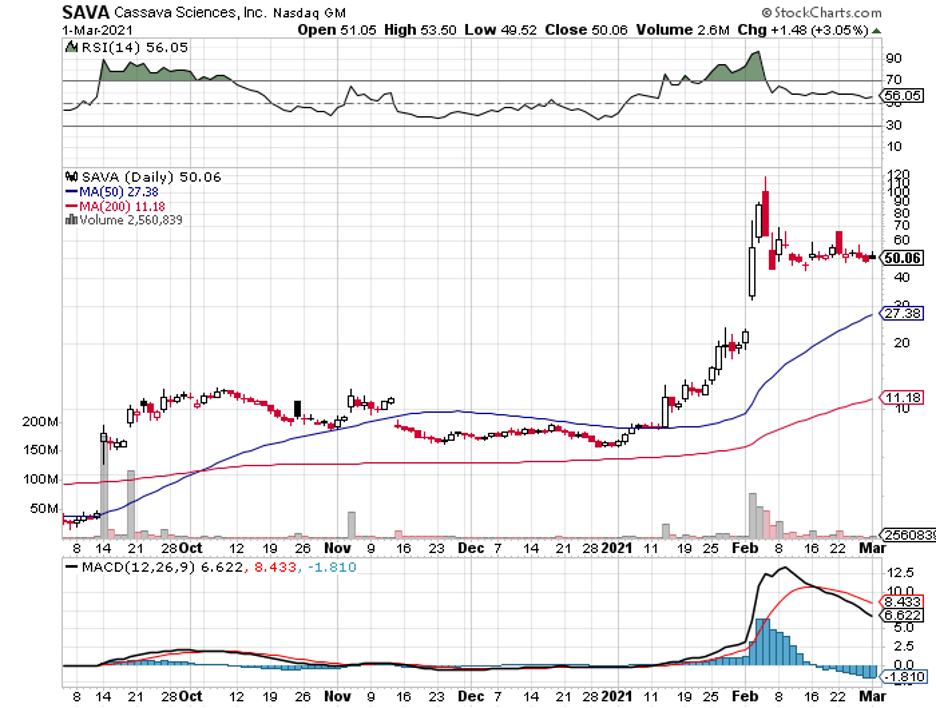
Cassava Sciences (SAVA), which has a market capitalization of $2 billion, is offering investors a different direction—and its efforts haven’t gone unnoticed.

Over the past 12 months, Cassava stock rose by a whopping 668%.

The overwhelming interest in the stock is understandable.

In February, Cassava released promising reports about its own Alzheimer’s drug candidate, Simufilam.

Patients who took Simufilam for six months showed 10% improvement on their cognition tests, while their dementia-related behavior improved by 29%.

The next stage would be for Cassava to go through Phase 3 of the study for Simufilam.

Interestingly, the success of Simufilam’s trials has not only benefited Cassava but also several smaller biotechnology companies working on Alzheimer’s disease treatments.

Specifically, Anavex Life Sciences (AVXL), which only has a market capitalization of almost $900 million, gained an impressive 129.4% boost. 

Meanwhile, Cortexyme (CRTX), which has a market capitalization of $1.07 billion, rose by 57.8% this year following the positive data release.

While Cassava’s results are definitely worth looking into, it’s critical to understand the limits of the data the company has provided the public thus far.

My caution against Cassava at this point is not based on the belief that its Alzheimer’s disease program will fail.

Rather, I’m wary of the stock because its value right now is heavily based on the misunderstood perception that Simufilam has already succeeded.

Looking at the current data from the company, I believe that the skyrocketing price at this point remains unjustified.

It’s important to keep in mind that the FDA will not grant approval to a drug unless it shows satisfactory effectiveness in Phase 3 clinical trial.

A fairly recent example of a cautionary tale is the fanfare generated by Biogen (BIIB) when it released promising data for its own Alzheimer’s drug, Aducanumab.

However, this isn’t to say that Simufilam won’t make it, or that it will experience the same issues faced by Biogen.

This simply means that valuing this stock requires a more sober assessment. It’s challenging to determine its actual value right now with all the speculative fever surrounding it.

Remember, clinical trials for Alzheimer’s disease would set a company back roughly $1.8 billion on average.

It also typically takes more than four years to complete. At this point, Cassava only has approximately $94.3 million in cash.

This means it would need to either land a development partner to help shoulder the expenses or sell additional stock to come up with additional funds.

The Alzheimer’s drug market is massive, which is a clear indicator of the dire need in this space because there remain no reliable drugs available.

On the low end of the estimate, the global Alzheimer’s drug sales is projected to be $3.5 billion back in 2018.

On the high end, the number could reach $4.9 billion in 2013 to over $13.3 billion by 2023.

What are the prospects of an effective Alzheimer’s disease drug? Let’s go back to Biogen.

Its Aducanumab, which never managed to release impressive data, still estimated peak sales of roughly $4.2 billion.

Back of the envelope math says that an approved, safe, and effective treatment would undoubtedly generate blockbuster multi-billion dollar sales.

After all, large-cap companies pay a premium for exclusive rights to promising drugs.

To use an approved exclusive drug as an example, let’s take a look at the September 2020 deal between Immunomedics and Gilead Sciences (GILD).

Prior to the deal, Immunomedics developed an exclusive and promising chemotherapy drug called Trodelvy.

Like Aducanumab, that treatment was valued to rake in $4 to $5 billion in peak sales.

Seeing the potential, Gilead Sciences bought out Immunomedics to get Trodelvy.

The deal? It was worth $21 billion, or approximately 100x where Cassava trades when 2021 started.

Although it’s difficult to determine how much Cassava would eventually be valued, the sales for its Alzheimer’s drug should project better numbers than the regularly doubted Aducanumab.

The bottomline is this: Cassava is a promising stock that offers an Alzheimer’s disease drug candidate that reported better results than what the big players in the industry achieved so far.

Investors should expect volatility from this company in the next few months or even years as it enters a crucial stage: the Phase 3 trials, otherwise known as the drug development graveyard.
cassava


https://madhedgefundtrader.com/wp-content/uploads/2019/05/cropped-mad-hedge-logo-transparent-192x192_f9578834168ba24df3eb53916a12c882.png 0 0 Mad Hedge Fund Trader https://madhedgefundtrader.com/wp-content/uploads/2019/05/cropped-mad-hedge-logo-transparent-192x192_f9578834168ba24df3eb53916a12c882.png Mad Hedge Fund Trader2021-03-02 15:00:272021-03-04 21:42:27Another Player Joins the Alzheimer's Disease Drug Race
Mad Hedge Fund Trader

January 14, 2021

Biotech Letter

Mad Hedge Biotech & Healthcare Letter
January 14, 2021
Fiat Lux

FEATURED TRADE:

(ARE THESE THE NEW NEUROSCIENCE TRAILBLAZERS?)
(LLY), (BIIB), (MRNA), (DNA)

https://madhedgefundtrader.com/wp-content/uploads/2019/05/cropped-mad-hedge-logo-transparent-192x192_f9578834168ba24df3eb53916a12c882.png 0 0 Mad Hedge Fund Trader https://madhedgefundtrader.com/wp-content/uploads/2019/05/cropped-mad-hedge-logo-transparent-192x192_f9578834168ba24df3eb53916a12c882.png Mad Hedge Fund Trader2021-01-14 14:02:392021-01-14 16:32:55January 14, 2021
Mad Hedge Fund Trader

Are These The New Neuroscience Trailblazers?

Biotech Letter

Aducanumab isn’t going gently into the night.

Positive data from Eli Lilly (LLY) breathed renewed interest in the efforts to find a cure for Alzheimer’s disease, the most common form of dementia and the sixth leading cause of death among Americans.

With 1 in 10 people aged 65 and older suffering from this condition, it’s no wonder that Big Pharma has invested so much in searching for a treatment.

Lilly’s candidate, Trailblazer-ALZ 2, is in its Phase 2 trials. Results showed that the progression of moderate Alzheimer’s disease among patients who took the drug showed a 32% decline compared to a placebo.

In a sector riven by failure and with a potential target market as lucrative as $30 billion annually, investors welcomed Lilly’s news with enthusiasm.

If successful, Trailblazer-ALZ 2 could reach $5 billion in peak sales. As expected, the results boosted Lilly’s stock, with it rising by 14% from $166 to $190.

While the Lilly study is promising, it involved only 272 patients.

This is easily dwarfed by Biogen’s (BIIB) efforts to find a cure for Alzheimer’s. As of last count, the giant biotechnology company’s previous trial for its own drug, Aducanumab, involved over 3,200 patients.

More importantly, Lilly’s Trailblazer-ALZ 2 is projected to hit the market in 2025, while Biogen’s Aducanumab is “ready to go.”

Aducanumab is a monthly infusion designed as a long-term treatment for generally healthy individuals who are beginning to show symptoms of Alzheimer’s disease.

Although this treatment has yet to be approved, the FDA is said to be in favor of its approval.

Outside the US, Biogen has also filed for potential approval in Japan and Europe. All approvals could come by early to mid-2021. 

If approved, Aducanumab is expected to reach $12 billion in peak sales.

While this plan is still up in the air, the $12 billion in sales alone could easily justify the entire company’s current valuation.

Despite the uncertainty, Biogen remains promising thanks to the high potential of the existing drugs in its roster and its R&D unit.

In terms of pipeline, the company has at least 30 active clinical programs. Eight of which are already in Phase 3 and filed, including Aducanumab.

In recent years, Biogen has been focusing on expanding its neuroscience segment.

With over $28 billion potential market size, it no longer comes as a surprise why Biogen is pouring in cash in this particular sector.

Bolstering its efforts in the neuroscience segment, Biogen has recently invested in the Series A round of Atalanta Therapeutics, a Boston-based pioneering neurodegenerative diseases biotechnology company founded in 2018.

Attracted by Atalanta’s research on siRNA, which are molecules that can “silence” genes in the brain, Biogen and another biotechnology bigwig, Genentech (DNA), invested a combined $110 million to get a piece of the action.

Specifically, Biogen signed up to collaborate with Atalanta on treatments for Huntington’s along with several other central nervous system disorders.

As for Genentech, the $73.9 billion valued company’s deal with Atalanta covers Alzheimer’s and Parkinson’s.

In both agreements, Atalanta gets upfront payments, milestones, and royalties.

What we know so far is that Atalanta’s siRNA can silence Huntington's disease gene for at least six months. It can also alleviate symptoms affecting the spinal cords, but this part of the research has only been done on nonhuman primates.

Biogen, which has a market capitalization of $41.15 billion, has seen its share price fluctuate dramatically due to concerns over its Alzheimer’s drug.

The company withstood significant volatility in 2020, experiencing over 40% price swings in both directions. This is primarily because of the ups and downs of its Aducanumab trials, which heavily swayed the opinion of market participants.

Moving forward, I expect Biogen to have a massive year this 2021.

That’s the upside of this stock.

Even at its midpoint and if major treatments like Aducanumab fail to gain approval, I still anticipate a respectable year for this biotechnology company. That kind of security is worth paying attention to, and it can also signal its capacity to drive strong rewards.

Biogen has been shunned in the past year due to its volatility.

After all, who would want to invest in an unpredictable drug like Aducanumab when there are major stock indices and newcomers like Moderna (MRNA) making record-breaking highs?

For investors willing to look beneath the surface though, Biogen offers so much more than what meets the eye.

aducanumab

https://madhedgefundtrader.com/wp-content/uploads/2019/05/cropped-mad-hedge-logo-transparent-192x192_f9578834168ba24df3eb53916a12c882.png 0 0 Mad Hedge Fund Trader https://madhedgefundtrader.com/wp-content/uploads/2019/05/cropped-mad-hedge-logo-transparent-192x192_f9578834168ba24df3eb53916a12c882.png Mad Hedge Fund Trader2021-01-14 14:00:372021-01-16 20:46:59Are These The New Neuroscience Trailblazers?
Mad Hedge Fund Trader

December 30, 2020

Diary, Newsletter, Summary

Global Market Comments
December 30, 2020
Fiat Lux

Featured Trade:

(WILL SYNBIO SAVE OR DESTROY THE WORLD?),
(XLV), (XPH), (XBI), (IMB), (GOOG), (AAPL), (CSCO), (BIIB)

https://madhedgefundtrader.com/wp-content/uploads/2019/05/cropped-mad-hedge-logo-transparent-192x192_f9578834168ba24df3eb53916a12c882.png 0 0 Mad Hedge Fund Trader https://madhedgefundtrader.com/wp-content/uploads/2019/05/cropped-mad-hedge-logo-transparent-192x192_f9578834168ba24df3eb53916a12c882.png Mad Hedge Fund Trader2020-12-30 10:04:032020-12-30 12:48:49December 30, 2020
Mad Hedge Fund Trader

November 13, 2020

Diary, Newsletter, Summary

Global Market Comments
November 13, 2020
Fiat Lux

Featured Trade:

(NOVEMBER 11 BIWEEKLY STRATEGY WEBINAR Q&A),
(AMZN), (TSLA), (FB), (AAPL), (ROKU), (UUP), (ITB), (TLT), (TBT), (FXI), (SPY), (BIDU), (TCTZF), ($NATGAS), (DIS) (AMD), (IP), (BIIB), (VRTX)

https://madhedgefundtrader.com/wp-content/uploads/2019/05/cropped-mad-hedge-logo-transparent-192x192_f9578834168ba24df3eb53916a12c882.png 0 0 Mad Hedge Fund Trader https://madhedgefundtrader.com/wp-content/uploads/2019/05/cropped-mad-hedge-logo-transparent-192x192_f9578834168ba24df3eb53916a12c882.png Mad Hedge Fund Trader2020-11-13 11:04:592020-11-13 13:00:07November 13, 2020
Mad Hedge Fund Trader

November 5, 2020

Biotech Letter

Mad Hedge Biotech & Healthcare Letter
November 5, 2020
Fiat Lux

FEATURED TRADE:

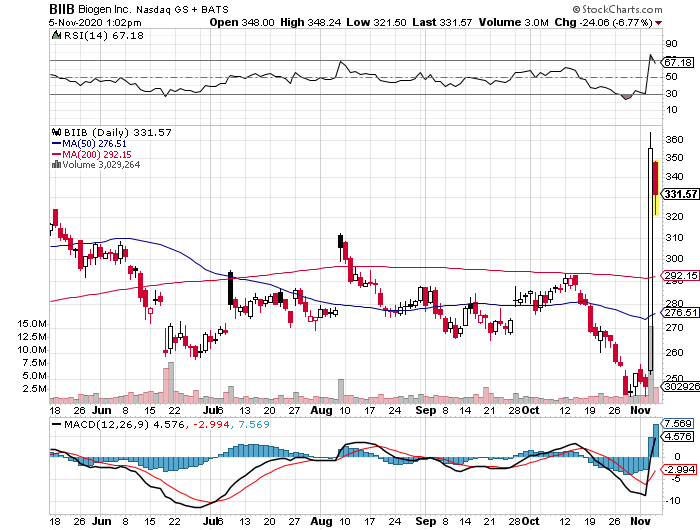
(IT’S GO TIME FOR BIOGEN’S ALZHEIMER’S DRUG)
(BIIB), (LLY), (AXSM), (MYL)

https://madhedgefundtrader.com/wp-content/uploads/2019/05/cropped-mad-hedge-logo-transparent-192x192_f9578834168ba24df3eb53916a12c882.png 0 0 Mad Hedge Fund Trader https://madhedgefundtrader.com/wp-content/uploads/2019/05/cropped-mad-hedge-logo-transparent-192x192_f9578834168ba24df3eb53916a12c882.png Mad Hedge Fund Trader2020-11-05 13:02:142020-11-05 13:30:49November 5, 2020
Mad Hedge Fund Trader

It’s Go Time for Biogen's Alzheimer's Drug

Biotech Letter

Investing in beaten-up stocks in this period of uncertainty demands nerves of steel.

In fact, some biotechnology and healthcare stocks have been left for dead in recent months. Meanwhile, there are others that continue to deliver amidst the ongoing pandemic.

One of them is Biogen (BIIB).

Biogen has been consistently tagged as a high-risk-high-reward stock even before the COVID-19 pandemic started.

However, people seem to miss the fact that the company has relatively low debt and a surprisingly positive free cash flow in the past years.

Since 2019, the banner headline for Biogen has been its experimental Alzheimer’s disease treatment Aducanumab.

Recently, Biogen released promising progress following its decision to submit the Alzheimer’s candidate for a priority review to the FDA. It has also been accepted for review by European health regulators. 

Although this move appears risky, the goal is to accelerate FDA’s timeline for Aducanumab.

That is, Biogen’s decision to submit the drug for approval earlier than expected also pushes the decision to an earlier date, which is March 7, 2021.

If approved, then Aducanumab will be the first-ever approved drug for Alzheimer’s disease.

The road to this point was not easy though. Biogen went through a series of failed trials and even a brief period of giving up on the project before the company gave the effort another chance.

Looking at the market opportunity for this sector, Biogen’s about-face no longer comes as a surprise.

For decades now, companies have been looking into ways to at least slow the progress of the condition, treat the symptoms, and offer faster ways to diagnose it.

There is currently no cure for this disease, which is ranked as the sixth leading cause of death in the country and accounts for approximately 2 million deaths globally.

Given that this disease takes years to progress, it means tens of millions of patients live with the condition on a daily basis -- and this sector comprise the target niche for Aducanumab.

In the United States alone, over 5 million people are diagnosed with Alzheimer’s disease annually and this number is projected to increase to nearly triple by 2050.

With all the treatments geared towards Alzheimer’s disease, sales for these products were estimated at $3.5 billion in 2018. This cost is expected to hit a 7.2% compound growth rate yearly until 2030.

If successful, Aducanumab can reach peak sales somewhere between $10 billion and $20 billion.

For context, the annual sales of Biogen today is only under $15 billion.

This underscores the significance of Aducanumab for the company as the drug can more than double its total earnings and even its market capitalization. It can also offer a 3x to 4x jump in Biogen’s share price.

Apart from Biogen, other big names working on an Alzheimer’s treatment are Eli Lilly (LLY) and Axsome Therapeutics (AXSM).

Outside Biogen’s work on Aducanumab, the company also has an impressive asset portfolio.

Its second quarter earnings results for 2020 showed that revenues from its multiple sclerosis drug segment contributed significantly to the company’s profits, with Ocrevus raking in $2.3 billion for the period.

The newly acquired rare spinal muscular atrophy disease drug Spinraza also performed well, reporting approximately $2 billion in annual sales.

Even its embattled multiple sclerosis treatment Tecfidera, which has been facing patent exclusivity issues with generic companies like Mylan (MYL), reported an increase from its notable $1 billion in revenue for the first quarter of the year to $1.2 billion in the second quarter.

Finally, Biogen has been working on expanding its biosimilar segment to increase its competitive advantage particularly for its drugs that are nearing the end of their patent exclusivity.

Amid the pandemic, Biogen’s revenue was up by 1% to hit $3.5 billion in the first quarter of 2020 and increased by 2% to reach $3.7 billion in the second quarter.

The company’s financial results also rose by approximately $100 million in the first three months of this challenging year.

However, a widely known caveat not only for Biogen but also for a number of biotechnology companies is the volatility of the stocks.

There is no one-size-fits-all formula for investing in beaten-up stocks. It comes with zero guarantees that their past performances would make a repeat either.

The strategy for these things though is quite basic. Make sure to look at businesses that offer sufficient bandwidth to bounce back once things normalize and the effects of the pandemic start to ease.

Looking at its overall performance, Biogen has achieved an impressively strong financial position despite the setbacks along the way. The company even offers room for growth regardless of the performance of its much-awaited Aducanumab.

biogen alzheimer's

https://madhedgefundtrader.com/wp-content/uploads/2019/05/cropped-mad-hedge-logo-transparent-192x192_f9578834168ba24df3eb53916a12c882.png 0 0 Mad Hedge Fund Trader https://madhedgefundtrader.com/wp-content/uploads/2019/05/cropped-mad-hedge-logo-transparent-192x192_f9578834168ba24df3eb53916a12c882.png Mad Hedge Fund Trader2020-11-05 13:00:132020-11-06 00:06:31It’s Go Time for Biogen's Alzheimer's Drug
Mad Hedge Fund Trader

September 29, 2020

Biotech Letter

Mad Hedge Biotech & Healthcare Letter
September 29, 2020
Fiat Lux

(WHY THE PANDEMIC ISN’T STOPPING ELI LILLY’S WINNING STREAK)
(LLY), (PFE), (MRNA), (AZN), (GILD), (INCY), (REGN), (NVO), (BIIB)

https://madhedgefundtrader.com/wp-content/uploads/2019/05/cropped-mad-hedge-logo-transparent-192x192_f9578834168ba24df3eb53916a12c882.png 0 0 Mad Hedge Fund Trader https://madhedgefundtrader.com/wp-content/uploads/2019/05/cropped-mad-hedge-logo-transparent-192x192_f9578834168ba24df3eb53916a12c882.png Mad Hedge Fund Trader2020-09-29 12:02:002020-09-29 13:23:32September 29, 2020
Mad Hedge Fund Trader

Why the Pandemic Isn't Stopping Eli Lilly's Winning Streak

Biotech Letter

Vaccine developers have taken center stage on Wall Street since the pandemic started, with companies like Pfizer (PFE), Moderna (MRNA), and AstraZeneca (AZN) enjoying soaring share prices for months now.

One of the primary reasons for this popularity is the US government’s Operation Warp Speed, which poured $11 billion into its chosen COVID-19 vaccine programs.

Realistically, the cold, hard truth is that a COVID-19 vaccine will not be the panacea for this deadly virus.

While the vaccine developers are rushing to complete their clinical trials, more people continue to die from COVID-19.

With almost a million deaths and over 30 million cases recorded to date, the need for treatments is more pressing than ever.

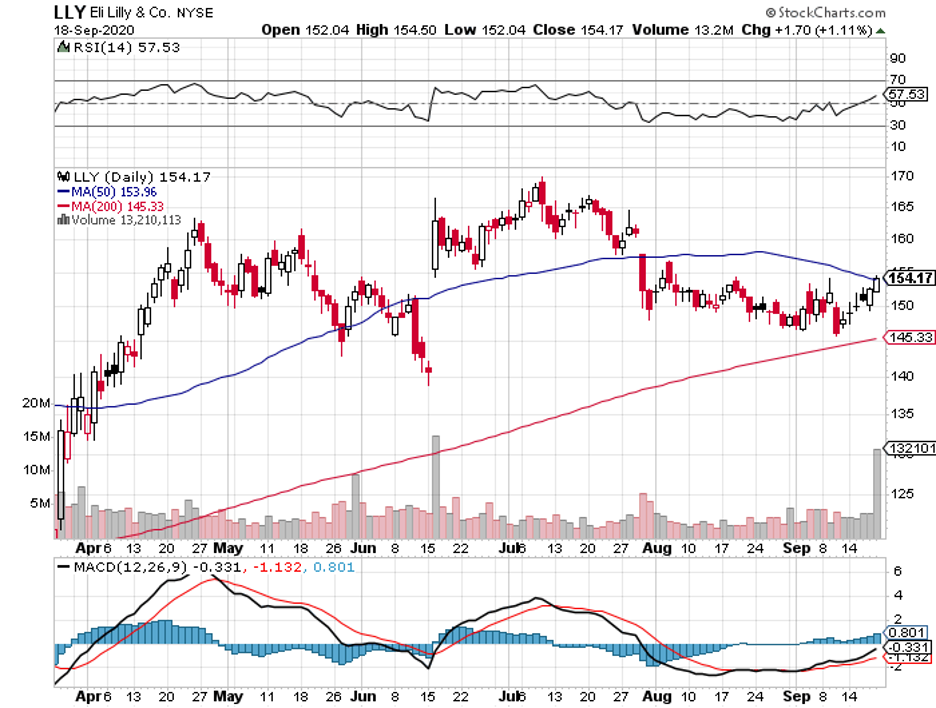
Among the companies working on COVID-19 treatments, one name has been quietly making headway: Eli Lilly (LLY).

So far, the company has two potential treatments that can cure COVID-19 patients.

One is its rheumatoid arthritis drug Olumiant, which the company developed with biotechnology firm Incyte (INCY).

Results showed that the treatment can lessen the days patients stay in hospitals when combined with Gilead Sciences’ (GILD) Remdesivir. Not only that, the combination also reduced the severity of the disease and allowed for less-intensive hospital care.

Once all the results have been tested and validated, Eli Lilly will seek an emergency authorization from the FDA.

Aside from Eli Lilly and Gilead Sciences, Pfizer is also working on a potential COVID-19 treatment. Although not much is known about the New York biopharmaceutical giant’s version of the antiviral drug, the target approval date is set in the second half of 2021.

Riding on the momentum of its successful Olumiant trials, Eli Lilly is working to extend its winning streak by being one of the first to develop a preventive COVID-19 treatment specifically designed for elderly patients.

Eli Lilly is developing the potent monoclonal antibody treatment, called LY-CoV555, with AbCellera. The Phase 3 trials conducted in nursing homes were launched in August and the company expects the results to be available by March 2021.

While using monoclonal antibody treatment is groundbreaking technology, Eli Lilly is not alone in the field.

The company faces considerable competition from other healthcare giants like AstraZeneca and Regeneron (REGN).

Nonetheless, the antibody market is massive enough for sharing, with this market estimated to rake in as much as $10 billion annually.

Conservatively speaking and assuming that Eli Lilly fails to attract major market share, there’s still a decent chance that the sales of LY-CoV555 can go beyond $1 billion every year starting 2022.

 Outside its COVID-19 programs, Eli Lilly is a dominant player in the diabetes market, with Trulicity leading the charge along with up and coming products like Humalog, Jardiance, Basaglar, and Humulin.

The company is expected to attract at least 13.8% of the market share this year, ranking second only to Novo Nordisk (NVO) and its 30.7% hold of the sector.

In the second quarter earnings report this year, Trulicity sales showed a 20% year-over-year jump to reach $1.2 billion in that period.

This is an impressive performance as investors expect the diabetes drug to surpass its 2019 sales of $4.1 billion.

Although Trulicity delivers substantial sales, it is remarkable that Eli Lilly is not overly reliant on the drug.

In fact, the diabetes drug’s total revenue only accounts for less than one-fifth of the company’s overall sales.

To boost its presence in the diabetes market, Eli Lilly added another potential blockbuster in its pipeline: Tirzepatide.

This drug is projected to become “best-in-class for lowering glucose, weight loss, and cardiovascular risk.”

To date, Tirzepatide is undergoing Phase 3 trials to test it on diabetes, obesity, and heart disease. It is also queued in Phase 2 trials for the liver disease NASH.

The potential of Tirzepatide is hinged not only in being a diabetes drug but more importantly, as an obesity drug.

If successful, Tirzepatide is estimated to hit peak sales of $10 billion annually, with the number trailing by 2025 to record $3.7 billion.

Another potential moneymaker for Eli Lilly is Verzenio, which showed an impressive 56% increase in sales in the second quarter to contribute $208.6 million.

In a bid to expand its oncology pipeline, Eli Lilly is looking into adding a new indication for Verzenio as well.

The company recently released the promising results for the oral tablet as an early-stage breast cancer treatment.

If successful, this drug will be in direct competition against an industry leader, Pfizer’s Ibrance.

In terms of its neurology pipeline, Eli Lilly has also been active in developing its own Alzheimer’s program.

While most of the treatments are still in the early stages, the success of Biogen’s (BIIB) Aducanumab could provide a much-needed boost for Eli Lilly’s own Alzheimer’s candidates.

Eli Lilly offers an extensive product line that goes beyond its COVID-19 programs, underscoring the company’s resilience even during the pandemic.

After dominating in the diabetes sector, the company focused its efforts on becoming one of the top players in the oncology, immunology, and neurology fields.

Consequently, Eli Lilly has been consistent in posting first-rate earnings and revenue growth since 2017.

Eli Lilly markets treatments for life-threatening and chronic conditions, with the company owning the rights to products with consistently growing sales. It also has the ability to continuously boost its revenue stream thanks to its rich pipeline and strategic collaborations.

The COVID-19 pandemic may have negatively affected sectors of Eli Lilly’s business this year, but the company holds the qualities that make it a solid long-term investment.


Eli lilly

https://madhedgefundtrader.com/wp-content/uploads/2019/05/cropped-mad-hedge-logo-transparent-192x192_f9578834168ba24df3eb53916a12c882.png 0 0 Mad Hedge Fund Trader https://madhedgefundtrader.com/wp-content/uploads/2019/05/cropped-mad-hedge-logo-transparent-192x192_f9578834168ba24df3eb53916a12c882.png Mad Hedge Fund Trader2020-09-29 12:00:592020-09-30 16:23:33Why the Pandemic Isn't Stopping Eli Lilly's Winning Streak
Mad Hedge Fund Trader

July 16, 2020

Biotech Letter

Mad Hedge Biotech & Healthcare Letter
July 16, 2020
Fiat Lux

Featured Trade:

(BIOGEN’S LONG TERM UPSWING HAS BEGUN),
(BIIB), (SGMO), (RHHBY)

https://madhedgefundtrader.com/wp-content/uploads/2019/05/cropped-mad-hedge-logo-transparent-192x192_f9578834168ba24df3eb53916a12c882.png 0 0 Mad Hedge Fund Trader https://madhedgefundtrader.com/wp-content/uploads/2019/05/cropped-mad-hedge-logo-transparent-192x192_f9578834168ba24df3eb53916a12c882.png Mad Hedge Fund Trader2020-07-16 11:02:192020-07-16 12:45:18July 16, 2020
Page 9 of 13«‹7891011›»

tastytrade, Inc. (“tastytrade”) has entered into a Marketing Agreement with Mad Hedge Fund Trader (“Marketing Agent”) whereby tastytrade pays compensation to Marketing Agent to recommend tastytrade’s brokerage services. The existence of this Marketing Agreement should not be deemed as an endorsement or recommendation of Marketing Agent by tastytrade and/or any of its affiliated companies. Neither tastytrade nor any of its affiliated companies is responsible for the privacy practices of Marketing Agent or this website. tastytrade does not warrant the accuracy or content of the products or services offered by Marketing Agent or this website. Marketing Agent is independent and is not an affiliate of tastytrade. 

Legal Disclaimer

There is a very high degree of risk involved in trading. Past results are not indicative of future returns. MadHedgeFundTrader.com and all individuals affiliated with this site assume no responsibilities for your trading and investment results. The indicators, strategies, columns, articles and all other features are for educational purposes only and should not be construed as investment advice. Information for futures trading observations are obtained from sources believed to be reliable, but we do not warrant its completeness or accuracy, or warrant any results from the use of the information. Your use of the trading observations is entirely at your own risk and it is your sole responsibility to evaluate the accuracy, completeness and usefulness of the information. You must assess the risk of any trade with your broker and make your own independent decisions regarding any securities mentioned herein. Affiliates of MadHedgeFundTrader.com may have a position or effect transactions in the securities described herein (or options thereon) and/or otherwise employ trading strategies that may be consistent or inconsistent with the provided strategies.

Copyright © 2026. Mad Hedge Fund Trader. All Rights Reserved. support@madhedgefundtrader.com
Scroll to top