Looking for a financial to add to your tech-heavy portfolio?
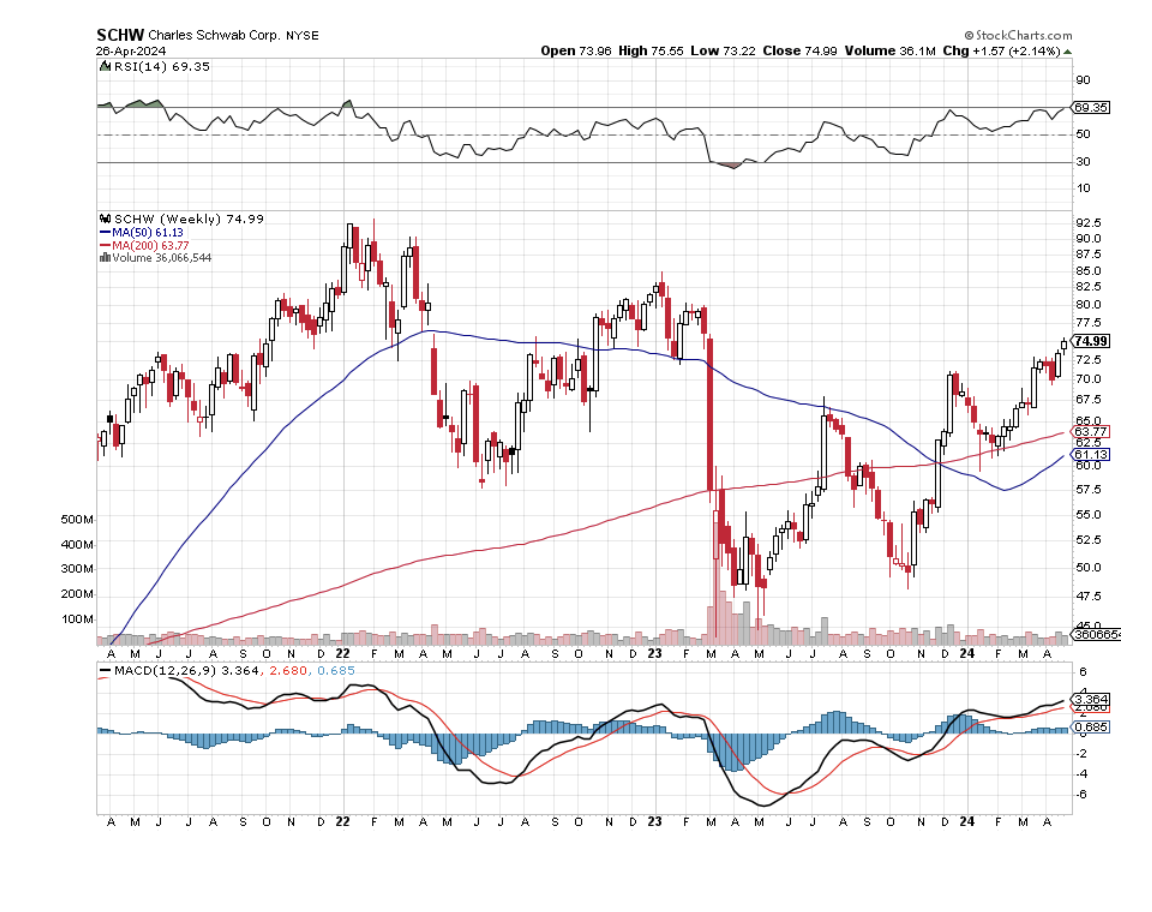
I think the nimble investor can pick up shares of online broker Charles Schwab (SCHW) and gain an outsized return.
That’s assuming that the current correction in the stock market remains in single digits, and doesn’t explode into a full-blown bear market.
There are many things that can go right with (SCHW).
Of the major online brokers, Charles Schwab pays the highest tax rate. With the least amount of international business, it is unable to hide billions of dollars tax-free offshore, as do (GS), (MS), (BAC), and (C).
It therefore pays the highest tax rate of the major financials and will be the most to benefit from any tax cut, if and when that ever happens.
Big funds have been soaking up the stock all year.
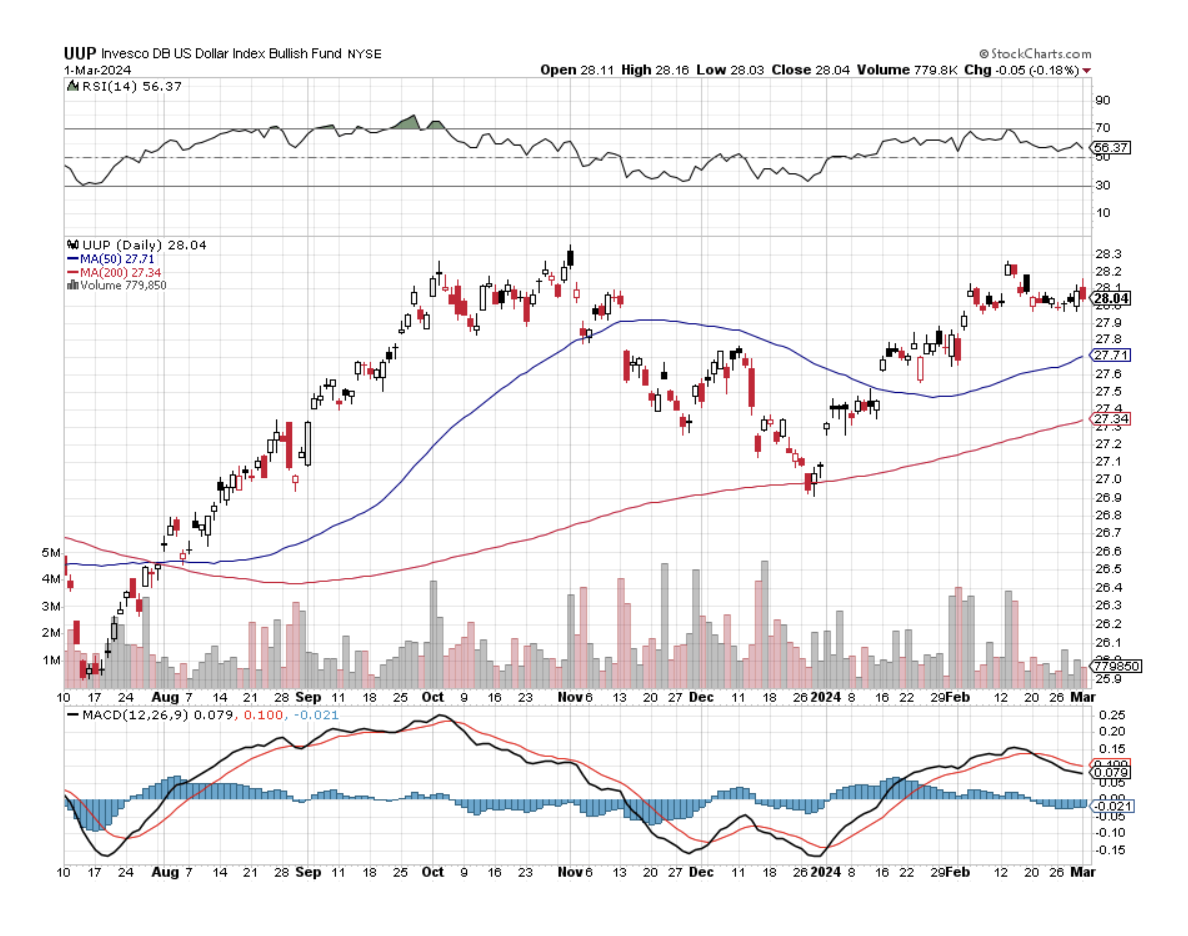
That leads to the second play. With the smallest amount of international earnings, the company will suffer the least from a coming weak US dollar.
With 90-day US Treasury bill ticking at 5.39% this morning, the greenback will almost certainly remain strong for a few more months. Once the cuts start, look out below.
Since financials are the one sector most sensitive to interest rates, (SCHW) should do well when rates fall.
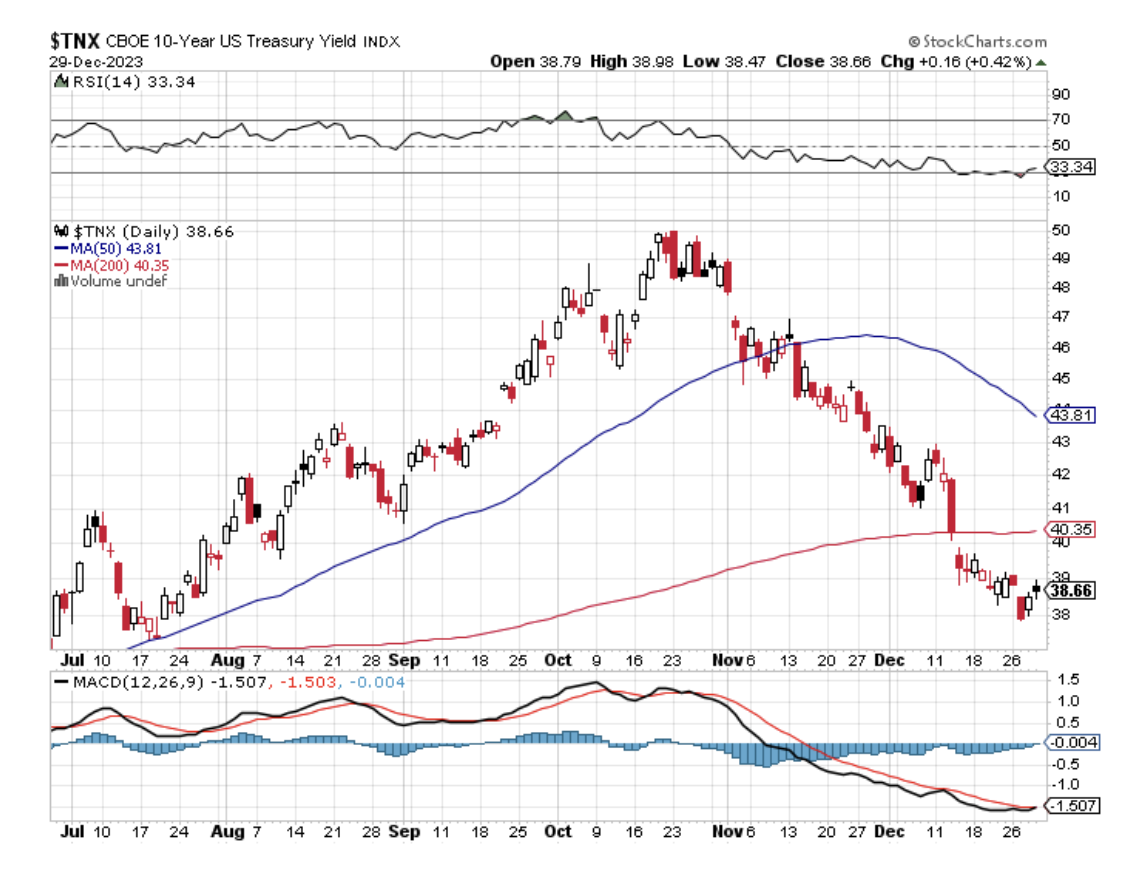
At a 4.70% ten-year yield, we are closer to the bottom in all fixed-income yields than the 2020 top at 0.32%.
Personally, I don’t think the ten-year will go any lower than 5.10% in this cycle.
Here is the fourth reason to pick up some (SCHW).
When my New American Golden Age resumes, stock markets will rise threefold and volumes will explode.
The retail investor will make a long-awaited return to investing in equities.
Ever wonder why your online brokers keep disappearing?
Why TradeMonster get taken over by Option House, which then was swallowed by E-Trade?
It’s the major players making bets that financials will become the top-performing sector of the next decade. Always follow the big money.
This makes Charles Schwab a takeover target.
And if Schwab doesn’t get bought out, it will benefit from reason number six, a huge concentration of the industry that will finally allow commissions to RISE instead of fall, as they have over the last four decades.
Reduced competition always leads to higher profits. If you’re not convinced look no further than the airline business.
Charles Schwab originally sprang from a well-written newsletter from the 1960s and is now both a bank and brokerage firm, based in San Francisco, California.
It was founded in 1971 by Charles R. Schwab and was one of the earliest discount brokerage houses. It is now one of the largest brokerage firms in the United States.
The company provides services for individuals and institutions that are investing online.
(SCHW) offers an electronic trading platform for the trade of common stocks, preferred stocks, futures contracts, exchange-traded funds, options, mutual funds, and fixed-income investments.
It also provides margin lending and cash management services. The company also provides services through registered investment advisers.
It is not cheap, with a price-earnings multiple of 31, but it does offer a dividend of 1.33%.
This is a market that is all about expensive stocks getting more expensive, which cheap stocks (retail) get cheaper.
(SCHW) total market capitalization stood at $110 billion at the end of trading yesterday.
Of course, there’s the seventh reason to buy the shares of Charles Schwab.
I have the box next to the one owned by (SCHW) founder and CEO Charles Schwab himself at the San Francesco Opera House.
At the intermission for the season opener for Puccini’s Turondot, I asked him what he thought about the price of his shares here.
All he would say was “I’m not selling”, and gave me a wink.
The last time I bet on a wink like that, I got a double in the shares.
That’s good enough for me.
https://www.madhedgefundtrader.com/wp-content/uploads/2024/05/charles-schwab.png6421096april@madhedgefundtrader.comhttps://madhedgefundtrader.com/wp-content/uploads/2019/05/cropped-mad-hedge-logo-transparent-192x192_f9578834168ba24df3eb53916a12c882.pngapril@madhedgefundtrader.com2024-05-01 09:06:592024-05-01 10:57:12Seven Reasons to Buy Charles Schwab
(MARKET OUTLOOK FOR THE WEEK AHEAD, or WHO NEEDS THE FED?
(AAPL), (TSLA), (AAPL), (GOOGL), (MSFT), (MSFT), (BRK/B), (BA), (JPM), (BA), (C), (SNOW), (NVDA)
I have to tell you that this has been a really good week to be John Thomas.
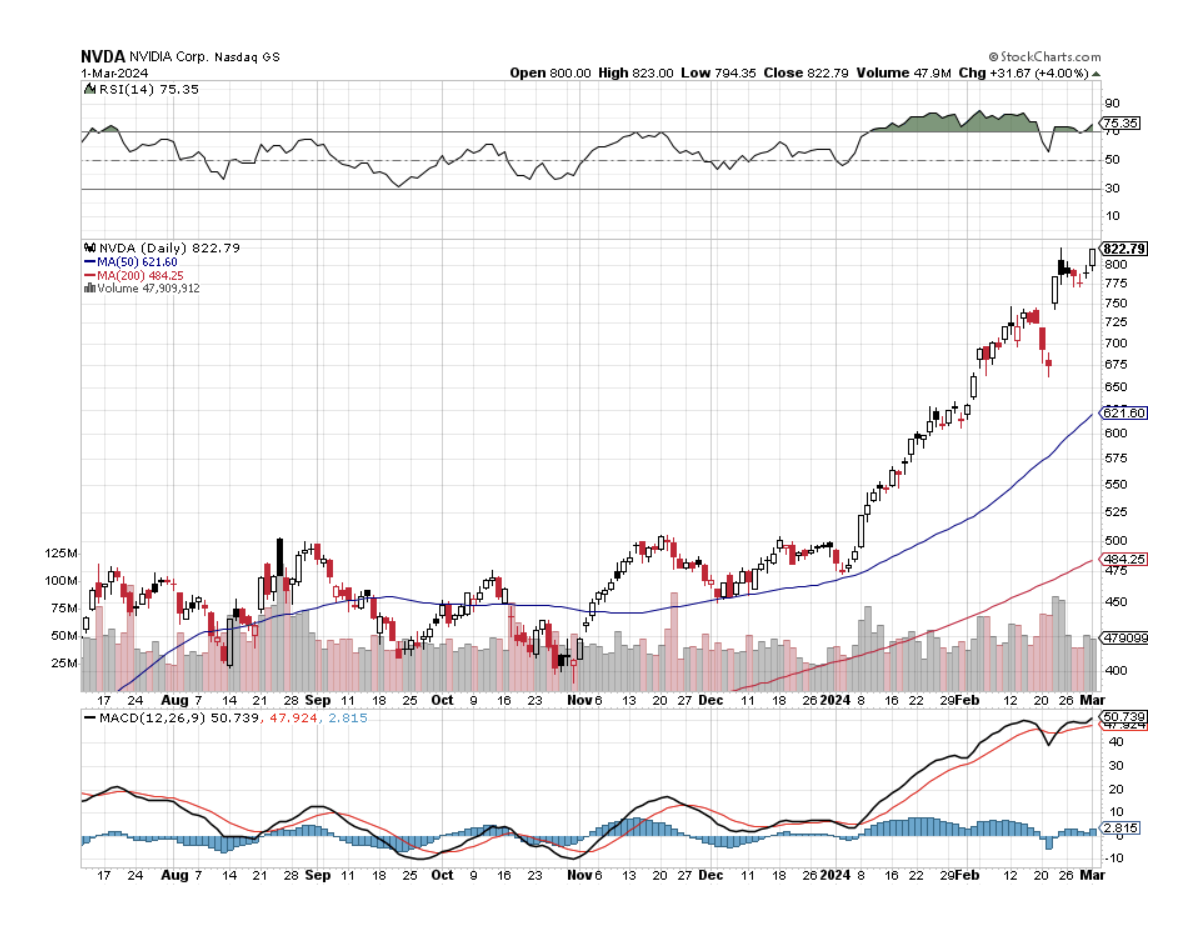
The accolades have been pouring in. During February, my followers have made the most money in their lives, including myself. NVIDIA (NVDA), up 110% in four months, is now the largest position in everyone’s portfolios, if not because of my prodding, then through capital appreciation alone.
Institutions limited to keeping single holdings to 5% or 10% got away with delaying their rebalancing as long as possible.
Is it 1995 for 2,000? I vote for the former, meaning that the current melt-up could have five more years to run with occasional breaks.
Exploding corporate profits and rocketing share capitalizations have replaced the Federal Reserve as a new endless source of liquidity, as I knew it would.
Who needs the Fed? Who needs interest rate cuts?
Best of all, this new source of super liquidity isn’t at the whim of a single man, nor subject to politics of any kind. It has in fact become its own self-fulfilling prophecy.
Dow 240,000 here we come, as I have been endlessly repeating for years!
It says a lot that hedge funds, the “smart money,” are heavily overweight the Magnificent Seven, while retail mutual funds, the “dumb money” are underweight. The technology they are overweight is mostly in Apple, that great backward-looking company. This implies that to catch up mutual funds are going to have to buy hundreds of billions of Mag Seven stocks and sell their Apple to pay for the move.
The largest single source of demand for stocks will be the $1.25 trillion in corporate buybacks. What will they buy? Apple (AAPL), Alphabet (GOOGL), and Microsoft (MSFT), the three largest purchasers of their own stocks.
When the leader of the fastest-growing, best-performing company with the top-performing stock speaks, you have to pay attention. The next $1 trillion build-out in AI infrastructure is here, says NVIDIA CEO Jensen Huang, now one of the richest men in the world.
Have a good week! I’ll be spending my time shoveling snow.
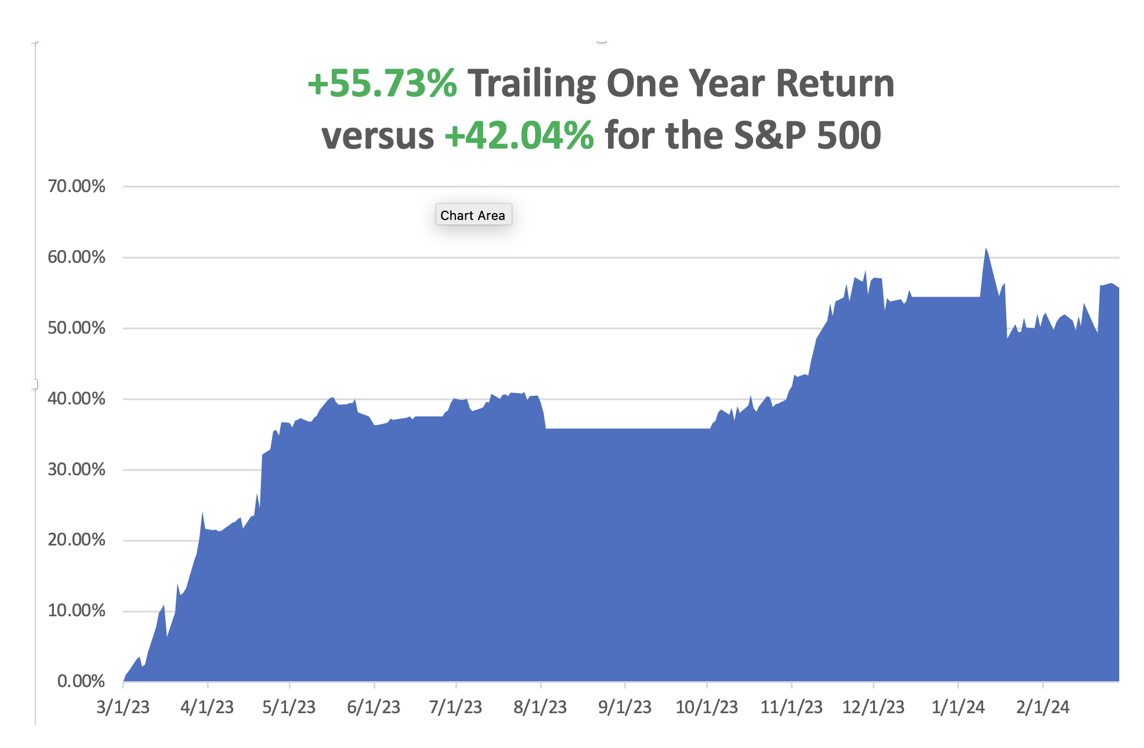
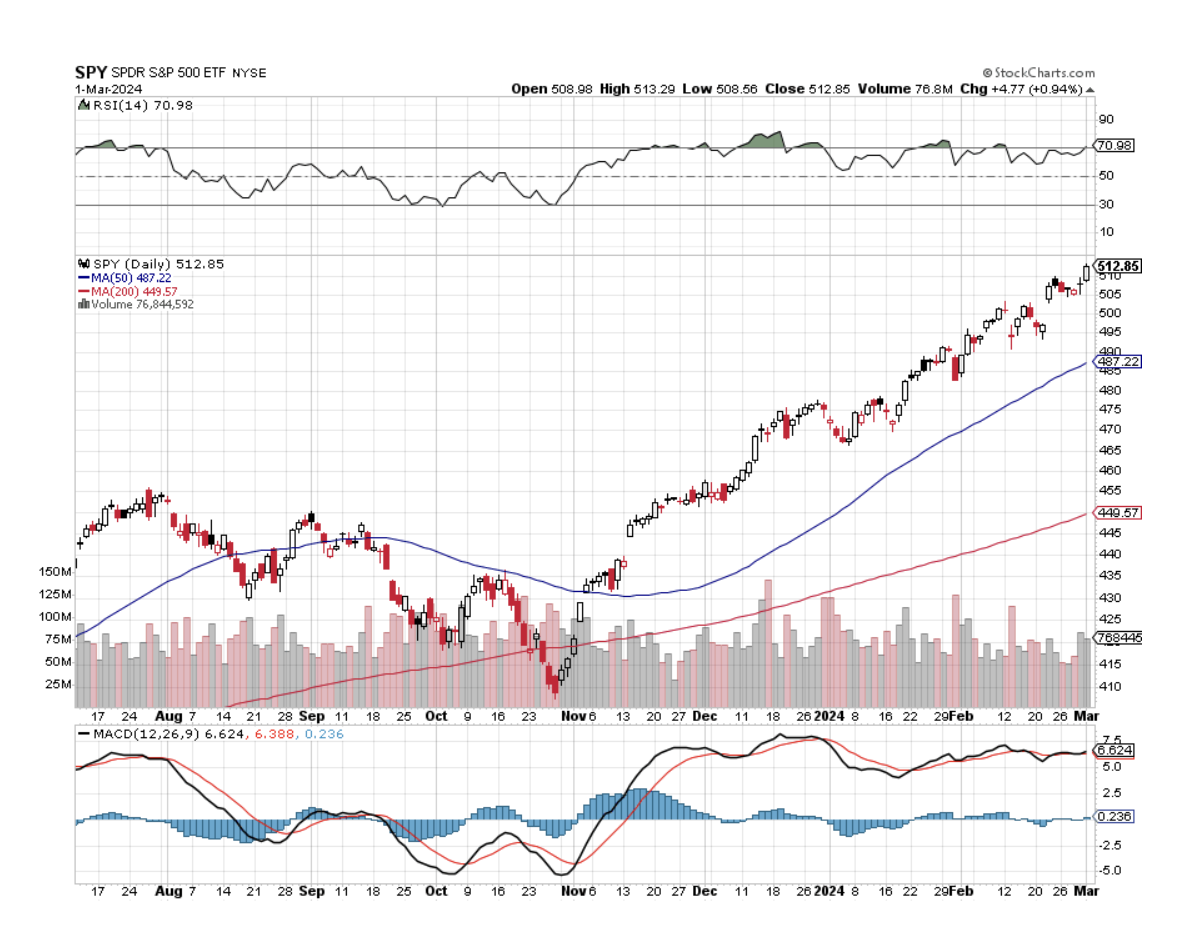
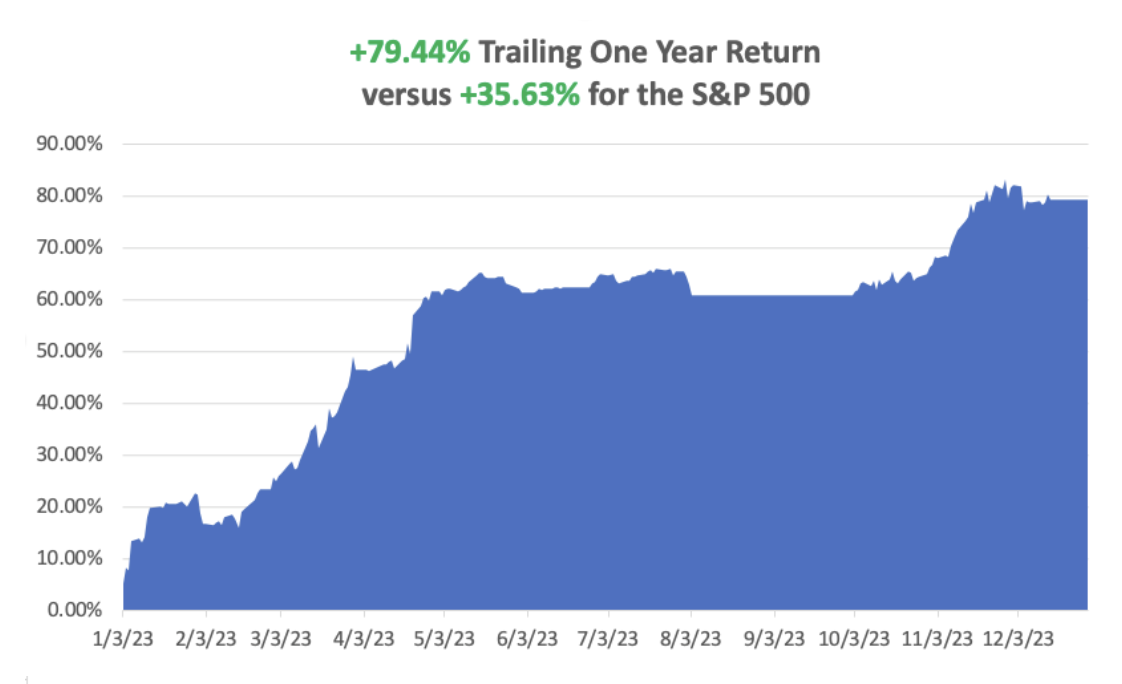
In February, we closed up +7.42%. My 2024 year-to-date performance is at +3.14%.The S&P 500 (SPY) is up +7.33%so far in 2024. My trailing one-year return reached +55.73% versus +42.04%for the S&P 500.
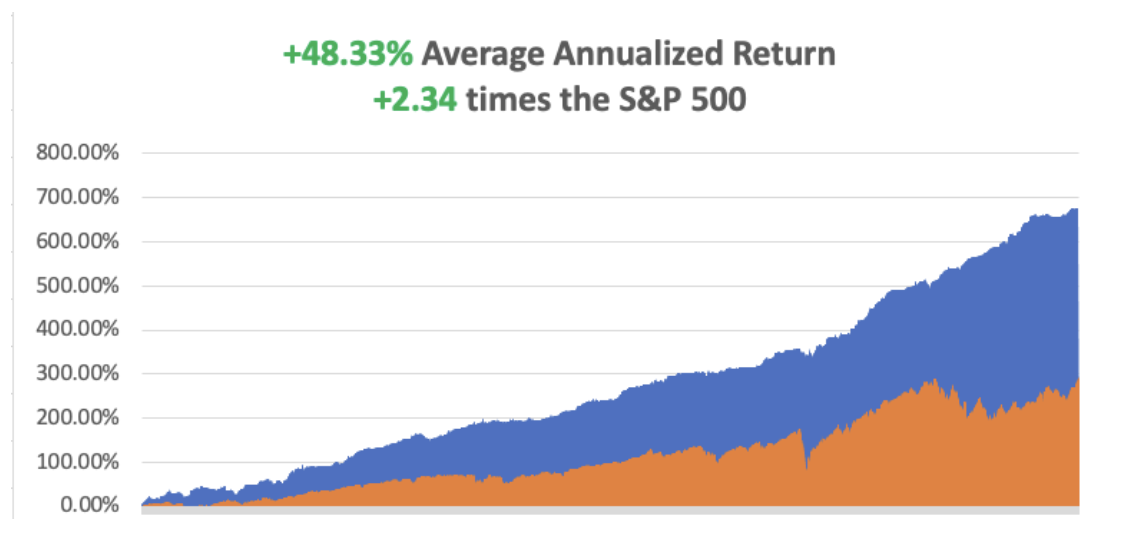
That brings my 15-year total return to +679.77%.My average annualized return has recovered to +51.30%.
Some 63 of my 70 trades last year were profitable in 2023. Some 9 of 13 trades have been profitable so far in 2024.
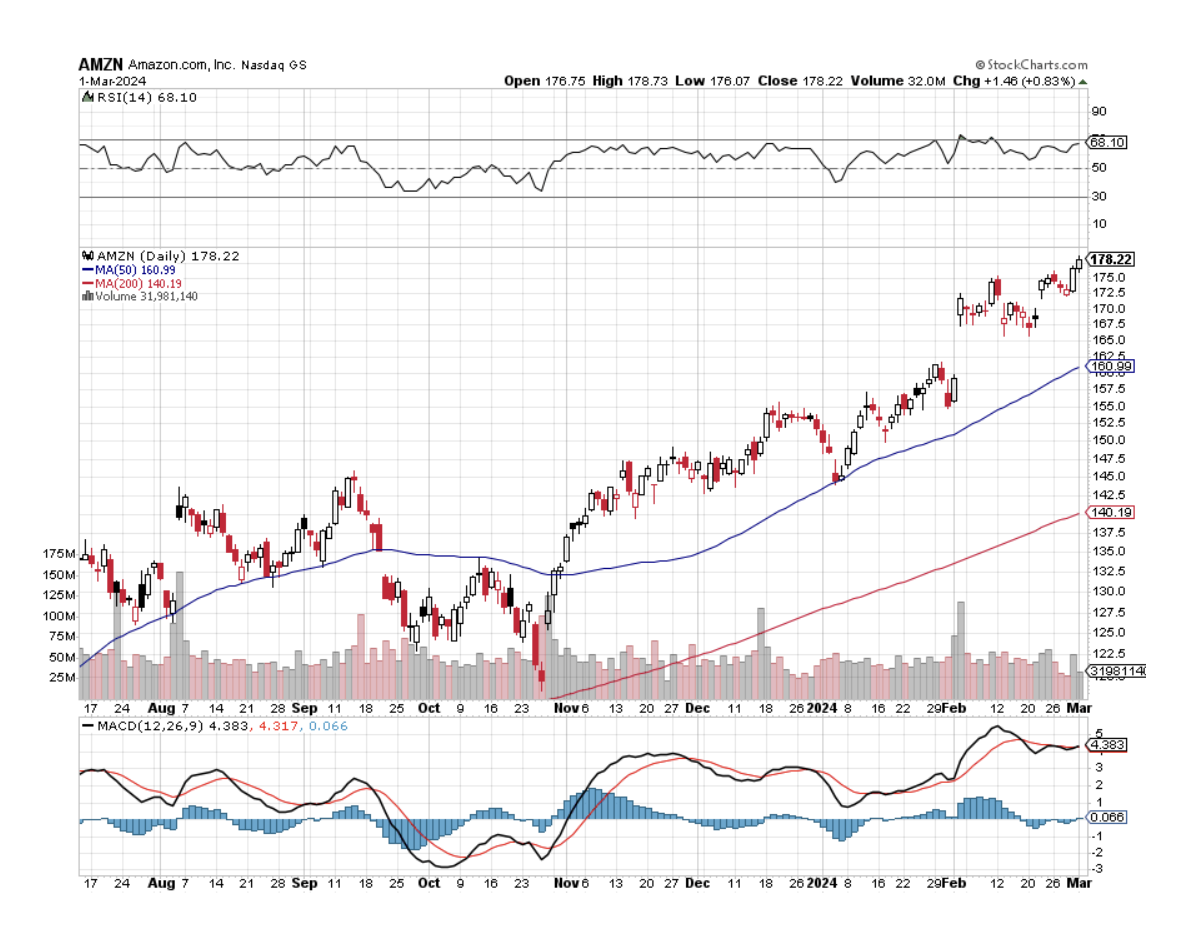
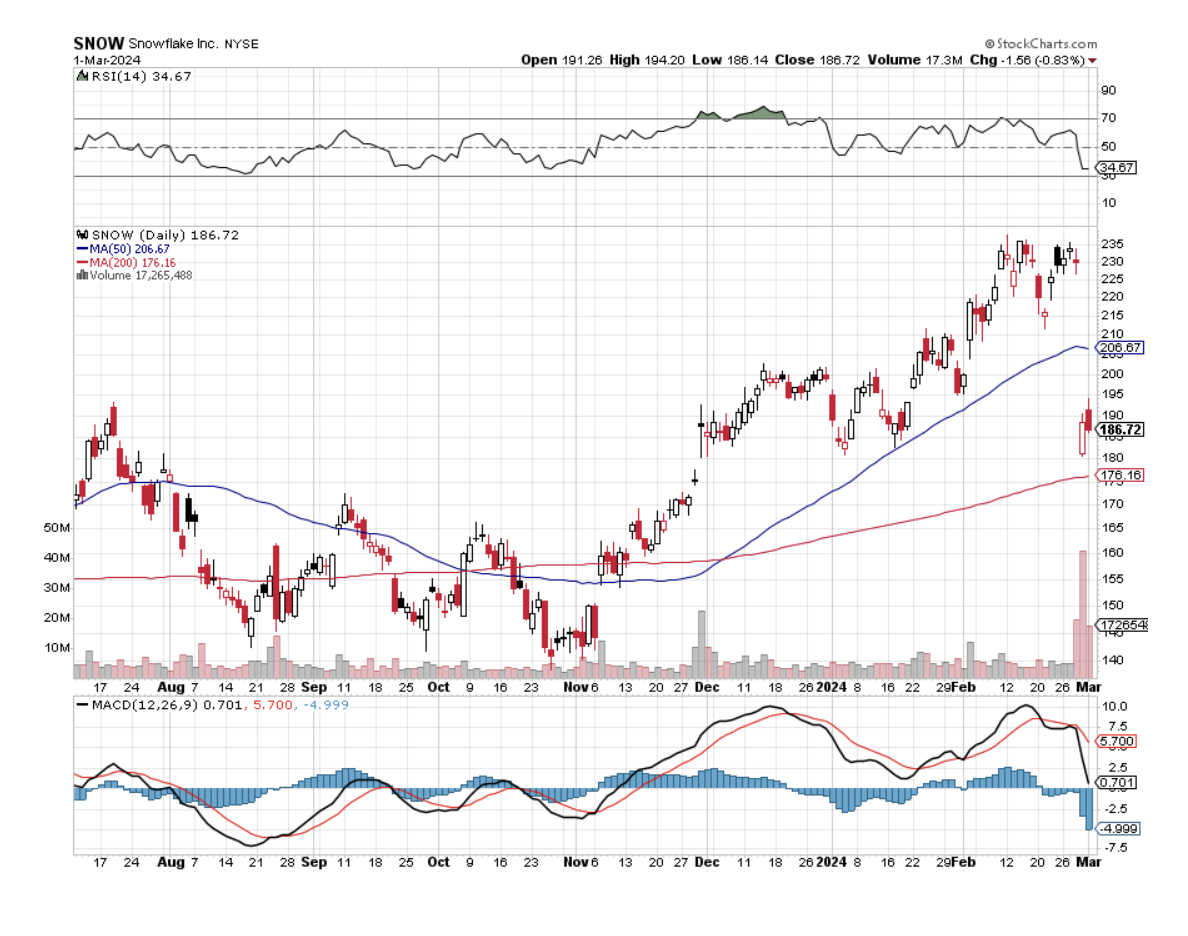
I used the ballistic move-in (NVDA) to take profits in my double long there. I am maintaining a single long in (AMZN) and Snowflake (SNOW) and am 80% in cash given the elevated level of the markets.
Core PCE Comes in Cool, at 2.8%, as expected. The personal consumption expenditures price index excluding food and energy costs increased 0.4% for the month and 2.8% from a year ago, as expected. Stocks and bonds liked it, but the US dollar hated it.
Snowflake Crashes, down 20%, on weak guidance. CEO Frank Slootman is retiring. This is the third company he has taken public and it’s time to retire. He will stay on as chairman. This is one of the best cloud plays out there, and now you have a chance to buy it close to the October bottom. Buy (SNOW) on dips.
Weekly Jobless Claims Pop, up 13,000 to 215,000. However, continuing claims, which run a week behind, rose to just above 1.9 million, a gain of 45,000 and higher than the FactSet estimate of 1.88 million.
Apple Pulls the Plug on EV Project, wrong product at the wrong time. AI is where the action is. We may have to wait until the summer for this company when it starts to discount the next-generation iPhone release in the fall. Tesla can now sleep easy. Avoid (AAPL) and buy (TSLA) on dips.
Berkshire Hathaway to Top $1 Trillion in a Year, up from the current $900 billion, according to UBS analyst Brian Meredith. I think that’s a low target. Buy (BRK/B) on dips.
Boeing Hit by Damning Report, faulting the company for ineffective procedures and a breakdown in communications between senior management and other members of staff, according to an FAA report. The report is the latest to find fault with safety at Boeing, which suffered its latest blow when a panel covering an unused door flew off during an Alaska Airlines flight on Jan. 5. Buy (BA) on dips.
Warren Buffet Says Their Nothing to Buy, in his annual letter to shareholders. The few targets left are few and far between and heavily picked over. (BRK/B) has also lost the advice of its principal mentor, Charlie Munger at the age of 99. Last year Berkshire acquired Dairy Queen and Berkshire Energy. But with $905 billion in assets, those will hardly move the needle on his incredible track record. The 93-year-old Buffet has outperformed the S&P 500 by 141:1 since 1964.
CEO Jamie Diamond Sell $150 Million in (JPM) Shares, cashing in on the historic “BUY” he had at the 2009 market bottom. He earned a 36X gain on that trade. (JPM) remains the “must-own” bank for most institutional investors.
New Home Sales Weaken, curbed by frigid weather, but demand for new construction remains underpinned by a persistent shortage of previously owned homes. New home sales increased 1.5% to a seasonally adjusted annual rate of 661,000 units in January. Economists had forecast new home sales rising to a rate of 680,000 units.
Another Regional Bank is in Trouble. Commercial real estate lender New York Community Bancorp said it discovered “material weaknesses” in how it tracks loan risks, wrote down the value of companies acquired years ago, and replaced its leadership to grapple with the turmoil. The stock plunged. Expect this to be a recurring problem. The US banking system is in the process of consolidating from 4,236 banks to six. Buy (JPM), (BA), and (C) on dips.
Millennials are Becoming the Richest Generation in History. The so-called greatest generation — those typically born from 1928 to 1945 — and baby boomers — born between 1946 and 1964 — will hand over the reins to those born from 1981 to 1996 when they pass on their property- and equity-rich assets. In the U.S. alone, the shift would see $90 trillion of assets move between generations.
My Ten-Year View
When we come out the other side of the recession, we will be perfectly poised to launch into my new American Golden Age or the next Roaring Twenties. The economy decarbonizing and technology hyper accelerating, creating enormous investment opportunities. The Dow Average will rise by 800% to 240,000 or more in the coming decade. The new America will be far more efficient and profitable than the old.
Dow 240,000 here we come!
On Monday, March 4, nothing of note is announced.
On Tuesday, March 5 at 8:30 AM EST, ISM Services are released.
On Wednesday, March 6 at 2:00 PM, the Jolts Job Openings Report is published
On Thursday, March 7 at 8:30 AM, the Weekly Jobless Claims are announced.
On Friday, March 8 at 2:30 PM, the Nonfarm Payroll Report for February is published. At 2:00 PM the Baker Hughes Rig Count is printed.
As for me, I’ve found a new series on Amazon Prime called 1883. It is definitely NOT PG rated, nor is it for the faint of heart. But it does remind me of my own cowboy days.
When General Custer was slaughtered during his last stand at the Little Big Horn in 1876 in Montana, my ancestors spotted a great buying opportunity. They usedthe ensuing panic to pick up 50,000 acres near the Wyoming border for ten cents an acre.
Growing up as the oldest of seven kids, my parents never missed an opportunity to farm me out with relatives. That’s how I ended up with my cousins near Broadus, Montana for the summer of 1966.
When I got off the Greyhound bus in nearby Sheridan, I went into a bar to call my uncle. The bartender asked his name and when I told him “Carlat”he gave me a strange look.
It turned out that my uncle had killed someone in a gunfight in the street out front a few months earlier, which was later ruled self-defense. It was the last public gunfight seen in the state, and my uncle hasn’t been seen in town since.
I was later picked up in a beat-up Ford truck and driven for two hours down a dirt road to a log cabin. There was no electricity, just kerosene lanterns, and a propane-powered refrigerator.
Welcome to the 19th century!
I was hired as a cowboy, lived in a bunk house with the rest of the ranch hands, and was paid the pricely sum of a dollar an hour. I became popular by reading the other cowboys' newspapers and their mail since they were all illiterate. Every three days we slaughtered a cow to feed everyone on the ranch. I ate steak for breakfast, lunch, and dinner.
On weekends, my cousins and I searched for Indian arrowheads on horseback, which we found by the shoe box full. Occasionally we got lucky finding an old rusted Winchester or Colt revolver just lying out on the range, a remnant of the famous battle 90 years before. I carried my own six-shooter to help reduce the local rattlesnake population.
I really learned the meaning of work and developed callouses on my hands in no time. I had to rescue cows trapped in the mud (stick a burr under their tail and make them mad), round up lost ones, and sawed miles of fence posts. When it came time to artificially inseminate the cows with superior semen imported from Scotland, it was my job to hold them still. It was all heady stuff for a 15-year-old.
The highlight of the summer was participating in the Sheridan Rodeo. With my uncle being one of the largest cattle owners in the area, I had my pick of events. So, I ended up racing a chariot made from an old oil drum, team roping (I had to pull the cow down to the ground), and riding a Brahman bull. I still have a scar on my left elbow from where a bull slashed me, the horn pigment clearly visible.
I hated to leave when I had to go home and back to school. But I did hear that the winters in Montana are pretty tough.
It was later discovered that the entire 50,000 acres was sitting on a giant coal seam 50 feet thick. You just knocked off the topsoil and backed up the truck. My cousins became millionaires. They built a modern four-bedroom house closer to town with every amenity, even a big-screen TV. My cousin also built a massive vintage car collection.
During the 2000s, their well water was poisoned by a neighbor’s fracking for natural gas, and water had to be hauled in by truck at great expense. In the end, my cousin was killed when the engine of the classic car he was restoring fell on top of him when the rafter above him snapped.
It all gave me a window into a lifestyle that was then fading fast. It’s an experience I’ll never forget.
Good Luck and Good Trading,
John Thomas
CEO & Publisher
The Diary of a Mad Hedge Fund Trader
https://www.madhedgefundtrader.com/wp-content/uploads/2024/03/john-thomas-and-daughter.png838664april@madhedgefundtrader.comhttps://madhedgefundtrader.com/wp-content/uploads/2019/05/cropped-mad-hedge-logo-transparent-192x192_f9578834168ba24df3eb53916a12c882.pngapril@madhedgefundtrader.com2024-03-04 09:02:182024-03-04 11:21:52The Market Outlook for the Week Ahead, or Who Needs the Fed?
Tech is at it again and I mean artificial intelligence doing the dirty jobs for senior executives.
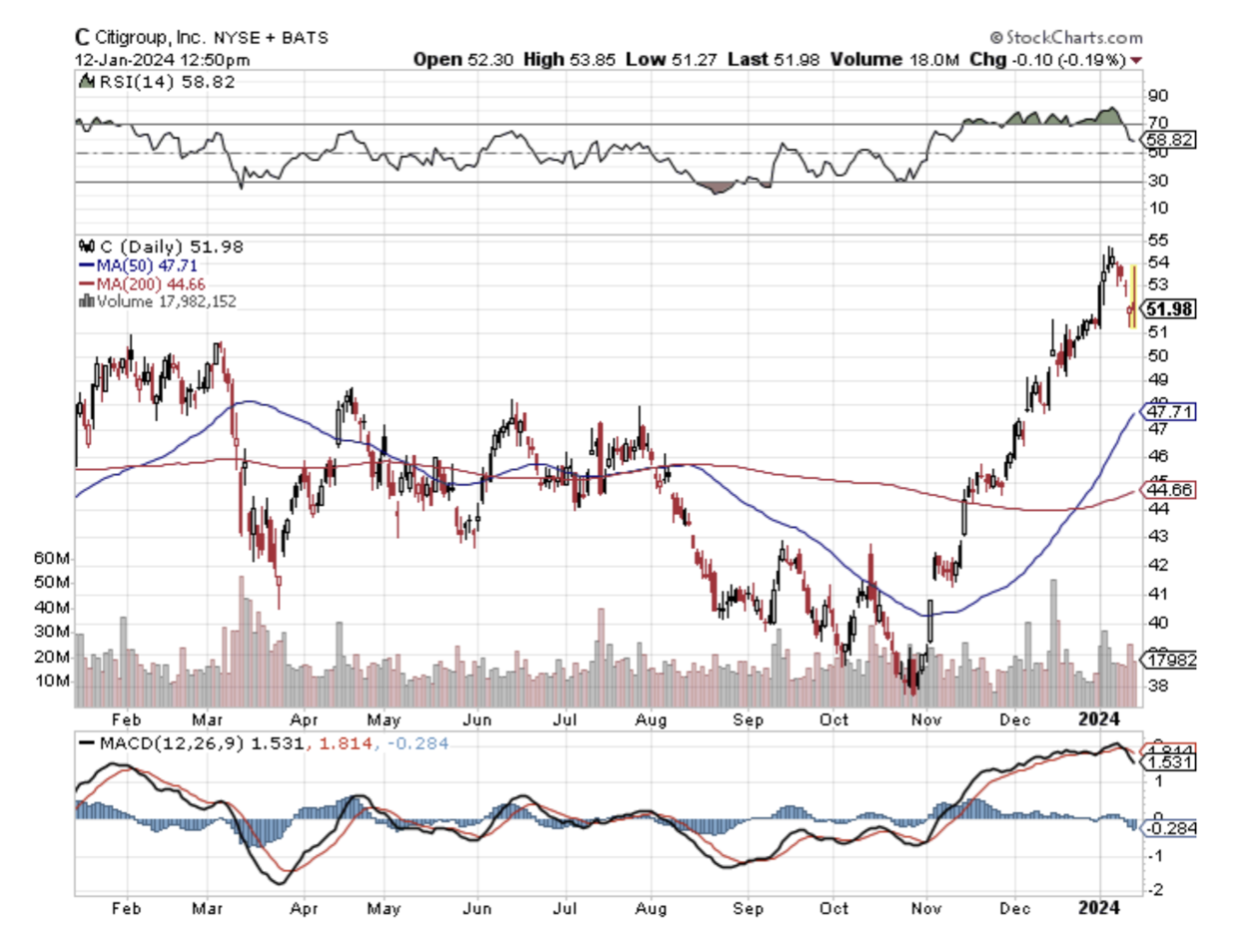
Citigroup (C) CEO Jane Fraser is doing the extreme by slashing a big portion of the staff and a reason to feel very comfortable about this is the upcoming implementation of generative AI into the company.
The New York bank said that it expects to eliminate 20,000 positions by 2026, which will save it $2.5 billion. It also intends to shed another 40,000 when it lists its Mexican consumer unit Banamex in an initial public offering.
Each year moving forward, investment banks need less humans, because software is replacing the need.
Gone are the moments when finance degrees were the hottest commodity, now it is all about generative AI.
That would leave Citigroup with 180,000 workers, which would likely make it the smallest of the big four banks in the US and reduce the overall size of its workforce by 25%. It ended in 2023 with 240,000.
Eventually, generative artificial intelligence (AI) could replace the equivalent of 300 million full-time jobs, a report by investment bank Goldman Sachs says.
It could replace a quarter of work tasks in the US and Europe but may also mean new jobs and a productivity boom.
And it could eventually increase the total annual value of goods and services produced globally by 7%.
Generative AI, able to create content indistinguishable from human work, is "a major advancement", the report says.
Silicon Valley is keen to promote investment in AI in not only the United States but in a way that will ultimately drive productivity gains across the global economy.
AI will complement the way bankers work, not disrupting it - making finance jobs better, rather than taking them away.
The report notes AI's impact will vary across different sectors - 46% of tasks in administrative and 44% in legal professions could be automated but only 6% in construction and 4% in maintenance, it says.
The first layoffs began in November 2023, affecting senior managers. Those cuts amounted to roughly 10% of senior manager roles or approximately 300 managers
The disclosure came on a day when Citigroup reported a net loss of $1.8 billion in the fourth quarter resulting from an FDIC assessment of $1.7 billion and other charges and reserves it previously disclosed.
Senior managers are mostly all bark and no bite these days as their work tasks have become irrelevant.
I believe the entire front office staff will be reduced to a pittance soon and by that, I mean single-digit staff.
According to research cited by the report, 60% of workers are in occupations that did not exist in 1940.
However, other research suggests technological change since the 1980s has displaced workers faster than it has created jobs.
The job cuts are part of an internal restructuring that Fraser has called the "most consequential" change to how Citigroup operates in nearly two decades.
Lower wage expense and higher output is a perfect recipe for higher share prices and that is exactly what we will get from Citigroup.
It’s not a surprise that C is investing aggressively in technology and IT.
The playbook is out there and employing a bare-bones staff is the new Silicon Valley and banks are applying the same model too.
Investment banks are the new tech company as every company is forced to become a tech company.
https://madhedgefundtrader.com/wp-content/uploads/2019/05/cropped-mad-hedge-logo-transparent-192x192_f9578834168ba24df3eb53916a12c882.png00april@madhedgefundtrader.comhttps://madhedgefundtrader.com/wp-content/uploads/2019/05/cropped-mad-hedge-logo-transparent-192x192_f9578834168ba24df3eb53916a12c882.pngapril@madhedgefundtrader.com2024-01-12 14:02:022024-01-12 14:48:19Finance Turns To AI
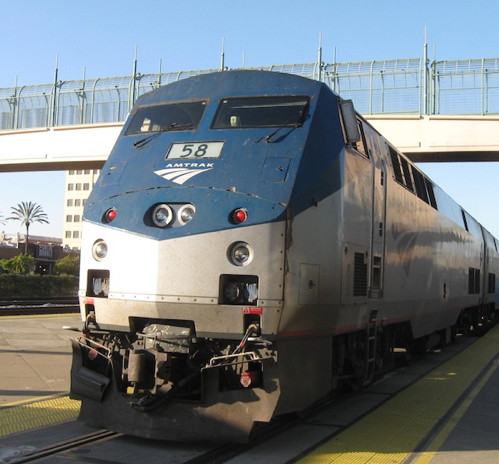
I am once again writing this report from a first-class sleeping cabin on Amtrak’s legendary California Zephyr.
By day, I have a comfortable seat next to a panoramic window. At night, they fold into two bunk beds, a single and a double. There is a shower, but only Houdini can navigate it.
I am anything but Houdini, so I foray downstairs to use the larger public hot showers. They are divine.
We are now pulling away from Chicago’s Union Station, leaving its hurried commuters, buskers, panhandlers, and majestic great halls behind. I love this building as a monument to American exceptionalism.
I am headed for Emeryville, California, just across the bay from San Francisco, some 2,121.6 miles away. That gives me only 56 hours to complete this report.
I tip my porter, Raymond, $100 in advance to ensure everything goes well during the long adventure and keep me up to date with the onboard gossip. The rolling and pitching of the car is causing my fingers to dance all over the keyboard. Microsoft’s Spellchecker can catch most of the mistakes, but not all of them.
Chicago’s Union Station
As both broadband and cell phone coverage are unavailable along most of the route, I have to rely on frenzied Internet searches during stops at major stations along the way, like Omaha, Salt Lake City, and Reno, to Google obscure data points and download the latest charts.
You know those cool maps in the Verizon stores that show the vast coverage of their cell phone networks? They are complete BS.
Who knew that 95% of America is off the grid? That explains so much about our country today.
I have posted many of my better photos from the trip below, although there is only so much you can do from a moving train and an iPhone 15 Pro.
Here is the bottom line which I have been warning you about for months. In 2024 we will probably top the 70.44% we made last year, but you are going to have to navigate the reefs, shoals, hurricanes, and the odd banking crisis. Do it and you can laugh all the way to the bank. I will be there to assist you in navigating every step.
The first half of 2024 will be all about trading, making bets on when the Fed starts cutting interest rates. Technology will continue their meteoric melt-up. In the second half, I expect the cuts to actually take place and markets to go straight up. Domestic industrials, commodities, financials, energy foreign markets, and currencies will lead.
And here is my fundamental thesis for 2024. After the Fed kept rates too low for too long and then raised them too much, it will then panic and lower them again too fast to avoid a recession. In other words, a mistake-prone Jay Powell will keep making mistakes. That sounds like a good bet to me.
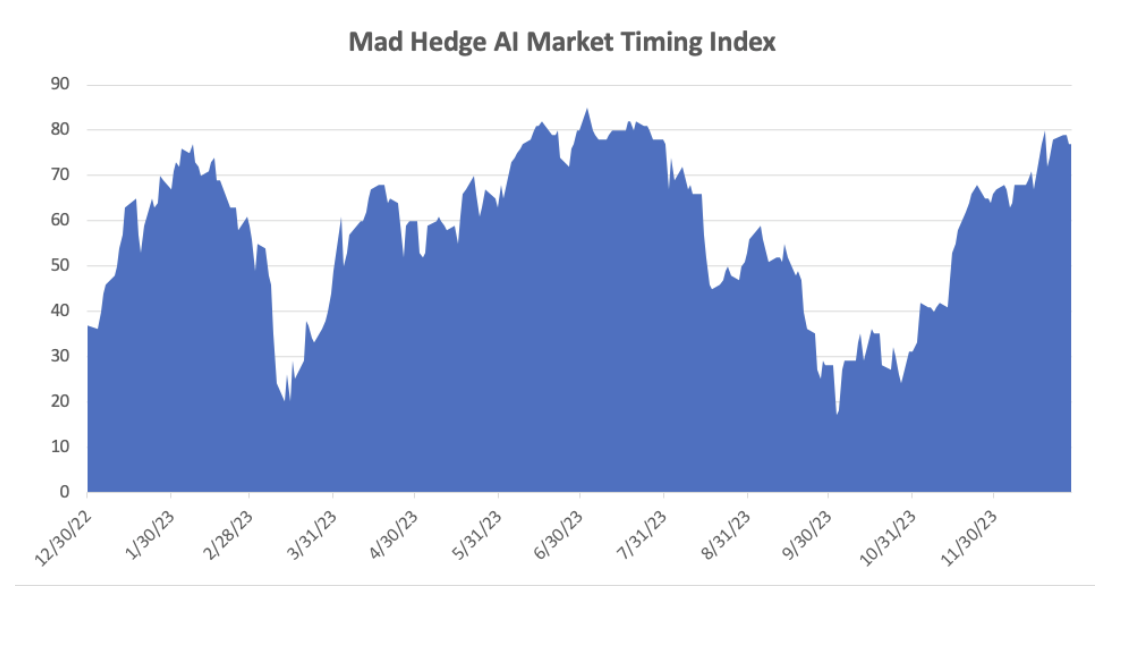
Keep in mind that the Mad Hedge AI Market Timing Index is at the absolute top end of its historic range the three-month likelihood of you making money on a trade is essentially zero. But adhere to the recommendations I make in this report today and you should be up about 30% in a year.
Let me give you a list of the challenges I see financial markets facing in the coming year:
The Ten Key Variables for 2024
1) When will the Fed pivot?
2) When will quantitative tightening end?
3) How soon will the Russians give up on Ukraine?
4) When will the rotation from technology to domestic value plays happen?
5)How much of falling interest rates will translate into higher gold prices?
6) When will the structural commodities boom get a second wind?
7) How fast will the US dollar fall?
8) How quickly will lower interest rates feed into a hotter real estate market?
9) How fast can the Chinese economy bounce back from Covid-19?
10) When does the next bull market in energy begin?
2023 was a terrible year for economists who largely got it wrong. Many will be driving Uber cabs from January.
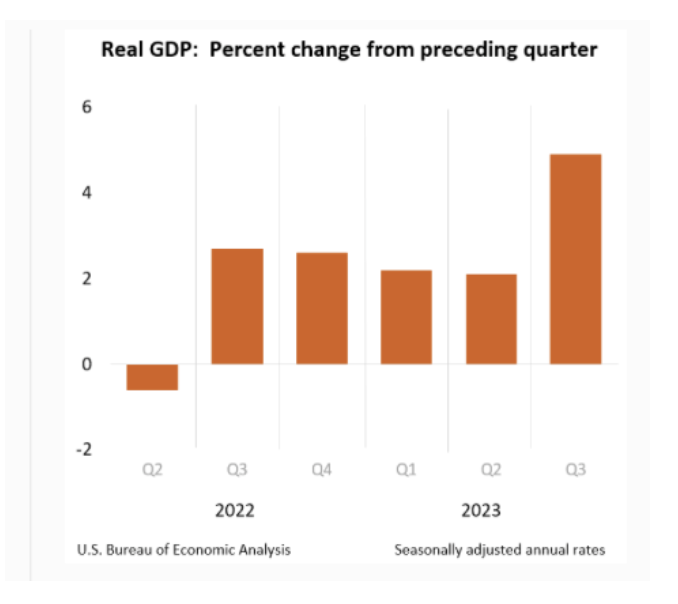
The economy is clearly slowing now from the red-hot 5.2% GDP growth rate we saw in Q3 to a much more modest 2.0% rate in Q4. We’ll get the first read on the end of January.
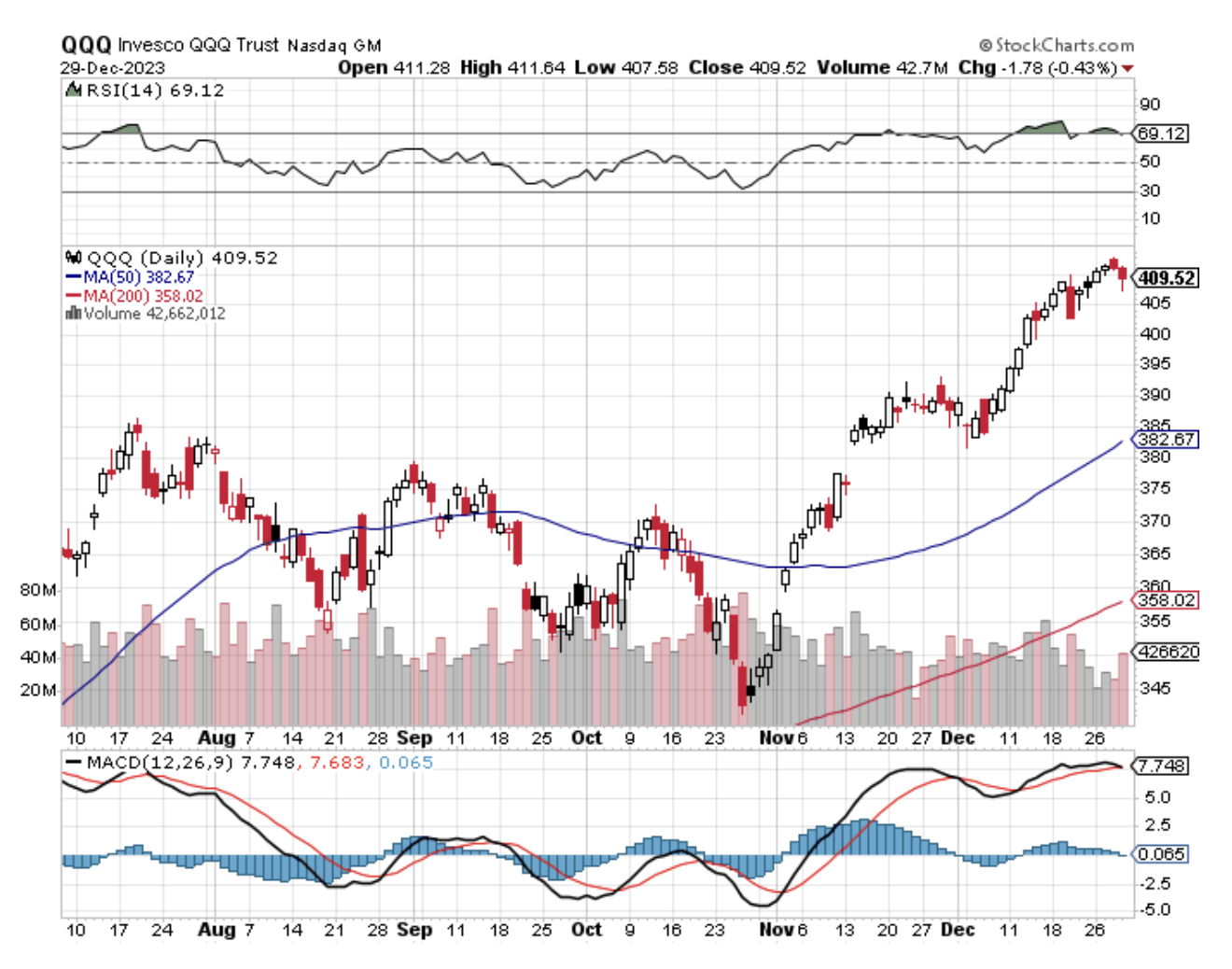
Any more than that and the Fed will panic and bring interest rate cuts dramatically forward to head off a recession. That is clearly what technology stocks were discounting with a melt-up of Biblical proportions, some 19% in the last two months, or $65 in the (QQQ)’s.
Anywhere you look, the data is softening, save for employment, which is holding up incredibly well at a 3.7% headline Unemployment Rate. The labor shortage may be the result of more workers dying from COVID-19 than we understand. Far more are working from home not showing up in the data. And many young people have just disappeared off the grid (they’re in the vans you see on the freeways).
The big picture view of what’s going on here is that after 15 years of turmoil caused by the 2008 financial crisis, pandemic, ultra-low interest rates, and excessive stimulus, we may finally be returning to normal. That means long-term average growth and inflation rates of 3.0% each.
As I travel around the world speaking with investors, I notice that they all have one thing in common. They underestimate the impact of technology, the rate at which it is accelerating, its deflationary impact on the economy, and the positive influence they have on all stocks, not just tech ones. And the farther I get away from Silicon Valley the poorer the understanding.
Since my job is to make your life incredibly easy, I am going to simplify my equity strategy for 2024.
It's all about falling interest rates.
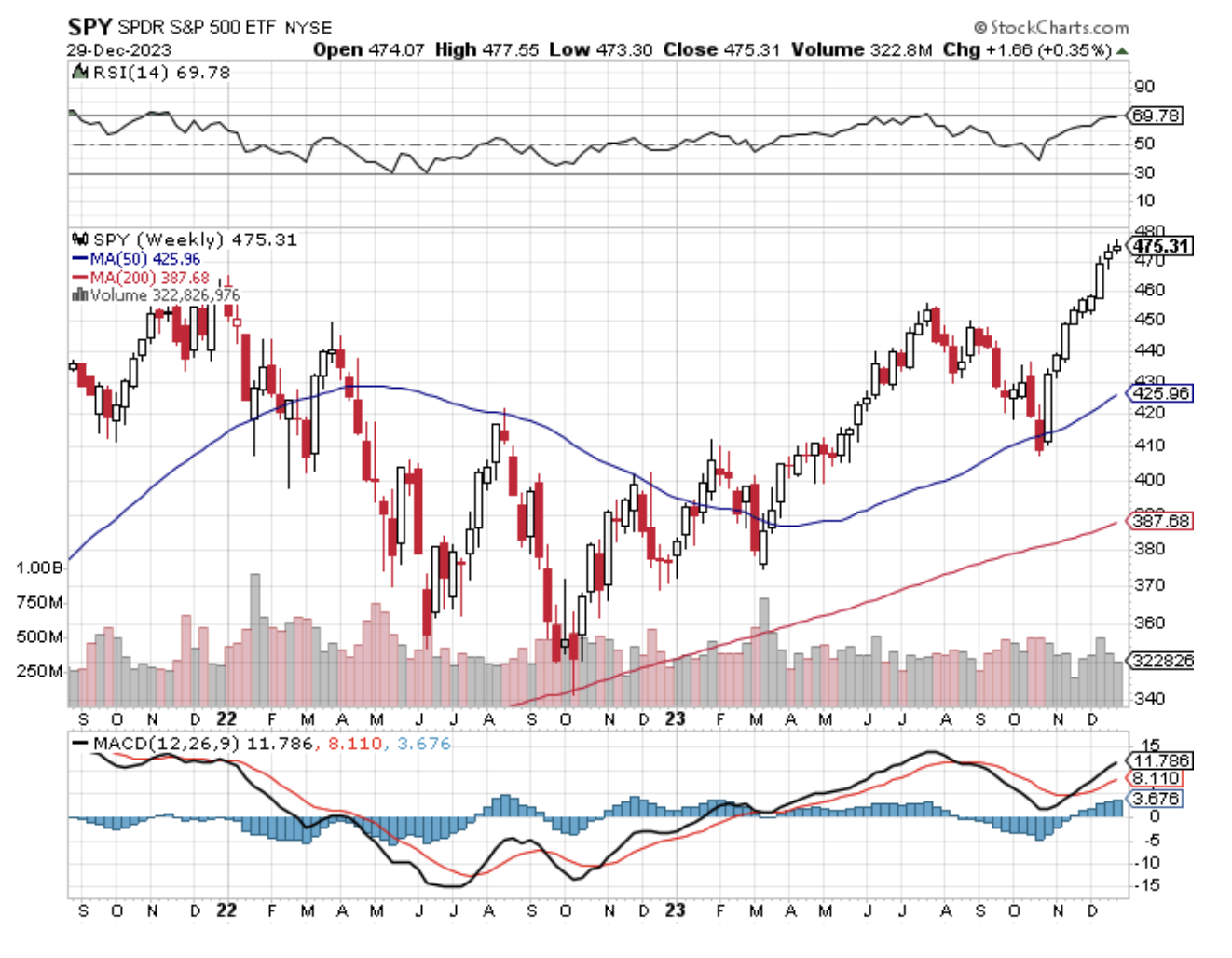
You should pay attention. In my January 4, 2023 Annual Asset Class Review (click here), I predicted the S&P 500 would hit $4,800 by year-end end. Here we are at $4,752.
I didn’t nail the market move because I am omniscient, possess a crystal ball, or know a secret Yaqui Indian chant. I have spent the last 30 years living in Silicon Valley and have a front-row seat to the hyper-accelerating technology here.
Since the time of the Roman Empire advancing technology has been highly deflationary (can I get you a deal on a chariot!). Now is no different, which meant that the Federal Reserve would have to stop raising interest rates in the first half of the year.
The predictions of a decade-long battle with rising prices like we saw in the seventies and eighties proved so much bunk, alarmism, and clickbait. In fact, the last 25 basis point rate rise took place on July 26, taking up from an overnight rate of 5.25% to 5.5%. That rendered the hard landing forecasts for the economy nonsense.
When interest rates are as high as they are now, you only look at trades and investments that can benefit from falling interest rates. All stocks actually benefit from cheaper money, but some much more than others.
In the first half, that will be technology plays like Apple (AAPL), (Microsoft (MSFT), Amazon (AMZN), Alphabet (GOOGL), Meta (META), and NVIDIA (NVDA). Much of this move was pulled forward into the end of 2023 so this sector may flatline for a while.
In the second half, value plays will take the leadership like banks, (JPM), (BAC), (C), financials (MS), (GS), homebuilders (KBH), (LEN), (PHM), industrials (X), capital goods (CAT), (DE), and commodities (FCX). Everything is going to new all-time highs. My Dow average of 120,000 by the end of the decade is only one more triple away and is now looking very conservative.
That means we now have at hand a generational opportunity to get into the fastest-growing sectors of the US economy at bargain prices. I’m talking Cadillacs at KIA prices. Corporate profits powered by accelerating technology, artificial intelligence, and capital spending will rise by large multiples. Every contemporary earnings forecast will come up short and have to be upgraded. 2024 will be a year of never-ending upgrades.
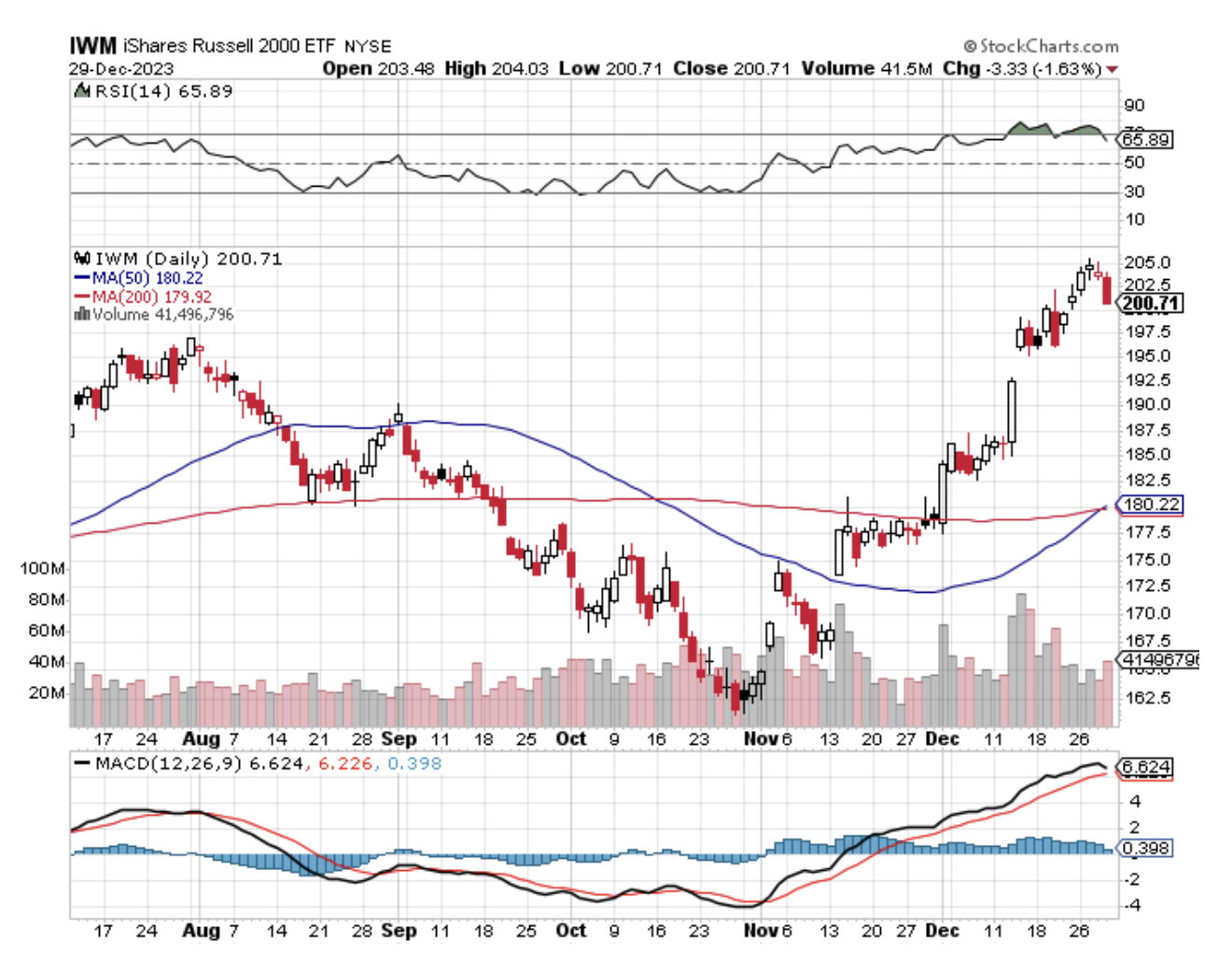
After crossing a long, hot desert small-cap stocks can finally see water. That’s because they are the most leveraged, undercapitalized, and at the mercy of interest rates and the economic cycle. They always deliver the most heart-rending declines going into recessions. Guess what happens now with the economy headed for a soft landing? They lead to the upside, with some forecasts for the Russell 2000 going as high as a ballistic 50%.
Another category of its own, Biotech & Health Care which is now despised, should do well on its own as technology and breakthroughs are bringing new discoveries. Artificial intelligence is discovering new drugs at an incredible pace and then telling you how to cheaply manufacture them. My top three picks there are Eli Lily (ELI), Abbvie (ABBV), and Merck (MRK).
There is another equity subclass that we haven’t visited in about a decade, and that would be emerging markets (EEM). After ten years of punishment from a strong dollar, (EEM) has been forgotten as an investment allocation. We are now in a position where the (EEM) is likely to outperform US markets in 2024, and perhaps for the rest of the decade. The drivers here are falling interest rates, a cheaper dollar, a reigniting global economy, and a new commodity boom.
Block out time on your calendars, because whenever the Volatility Index (VIX) tops $20, up from the current $12, I am going pedal to the metal, and full firewall forward (a pilot term), and your inboxes will be flooded with new trade alerts.
What is my yearend prediction for the S&P 500 for 2024. We should reach $5,500, a gain of 14.58%. You heard it here first.
Amtrak needs to fill every seat in the dining car to get everyone fed on time, so you never know who you will share a table with for breakfast, lunch, and dinner.
There was the Vietnam Vet Phantom Jet Pilot who now refused to fly because he was treated so badly at airports. A young couple desperately eloping from Omaha could only afford seats as far as Salt Lake City. After they sat up all night, I paid for their breakfast.
A retired British couple was circumnavigating the entire US in a month on a “See America Pass.” Mennonites returning home by train because their religion forbade automobiles or airplanes.
The old bond trade is dead.
Long live the new bond trade!
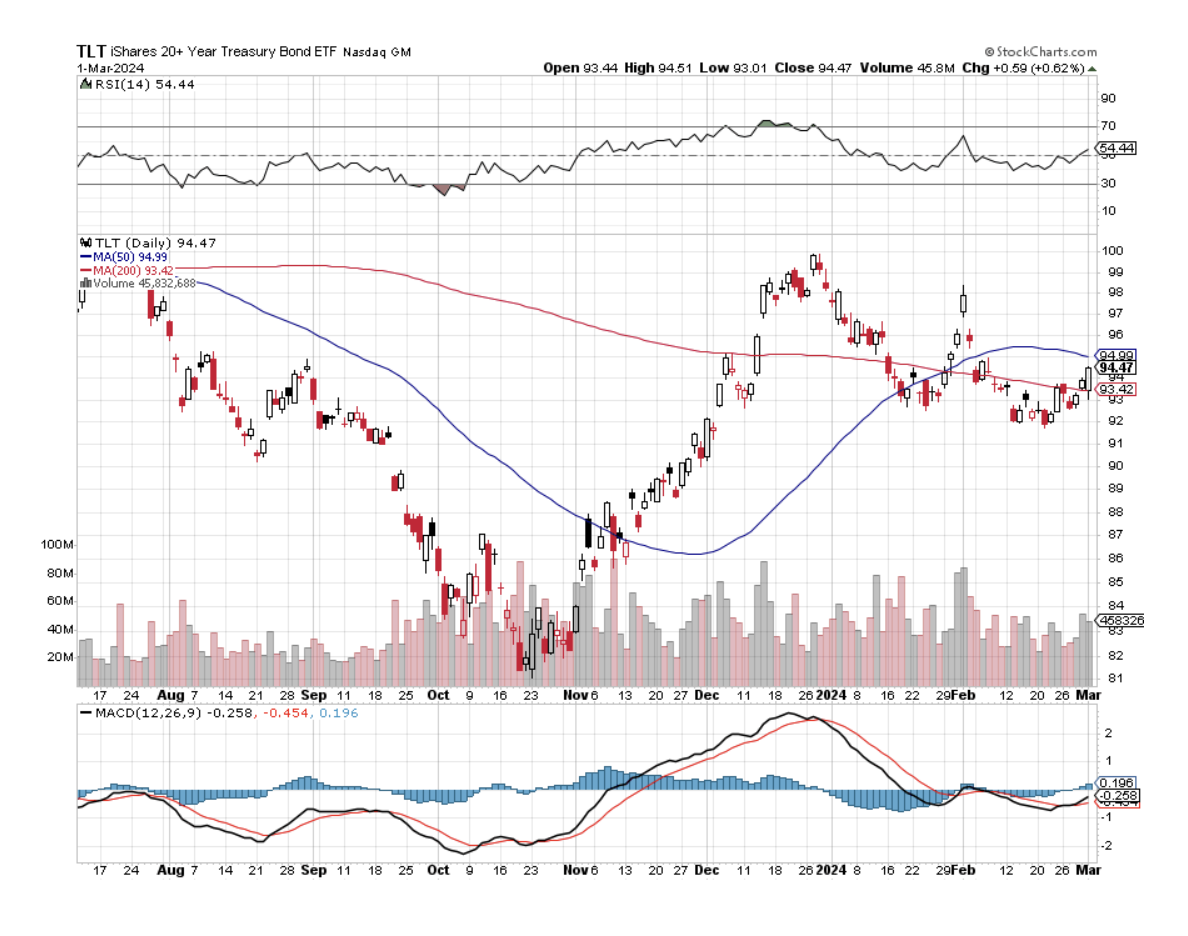
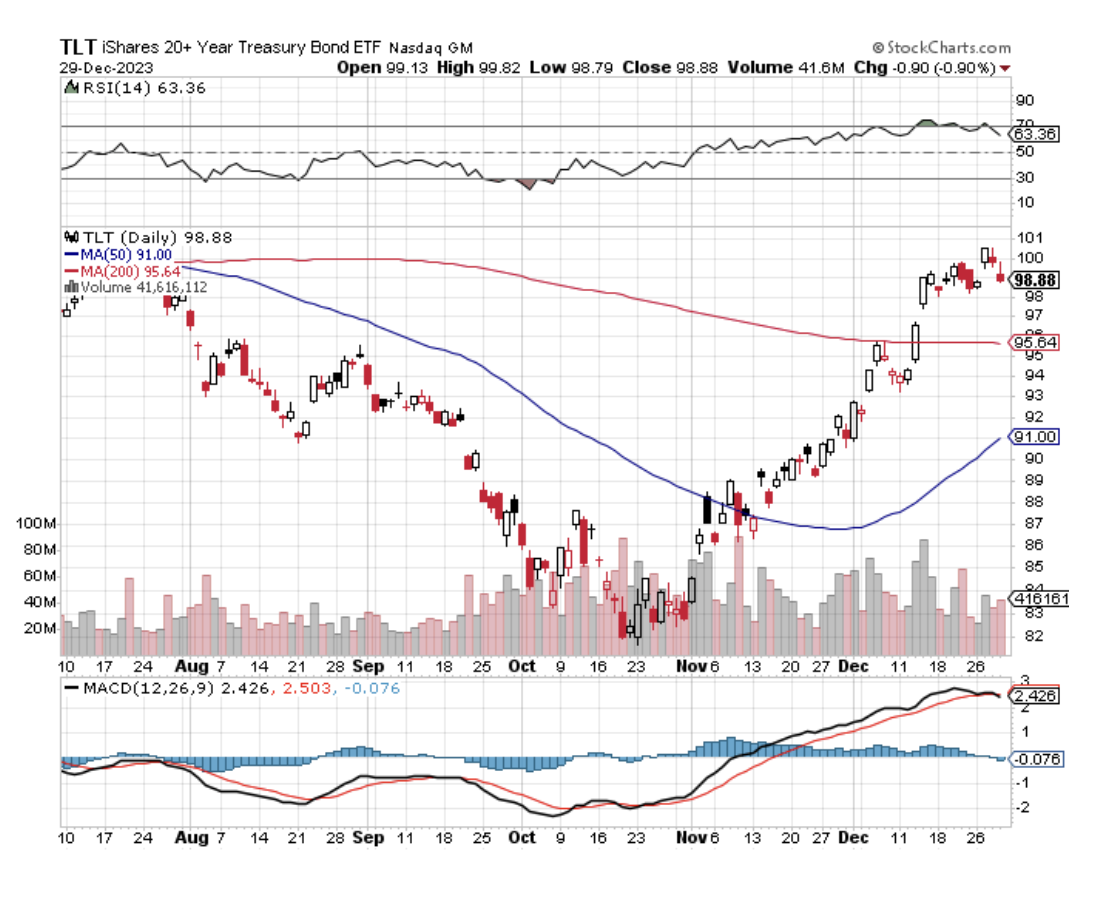
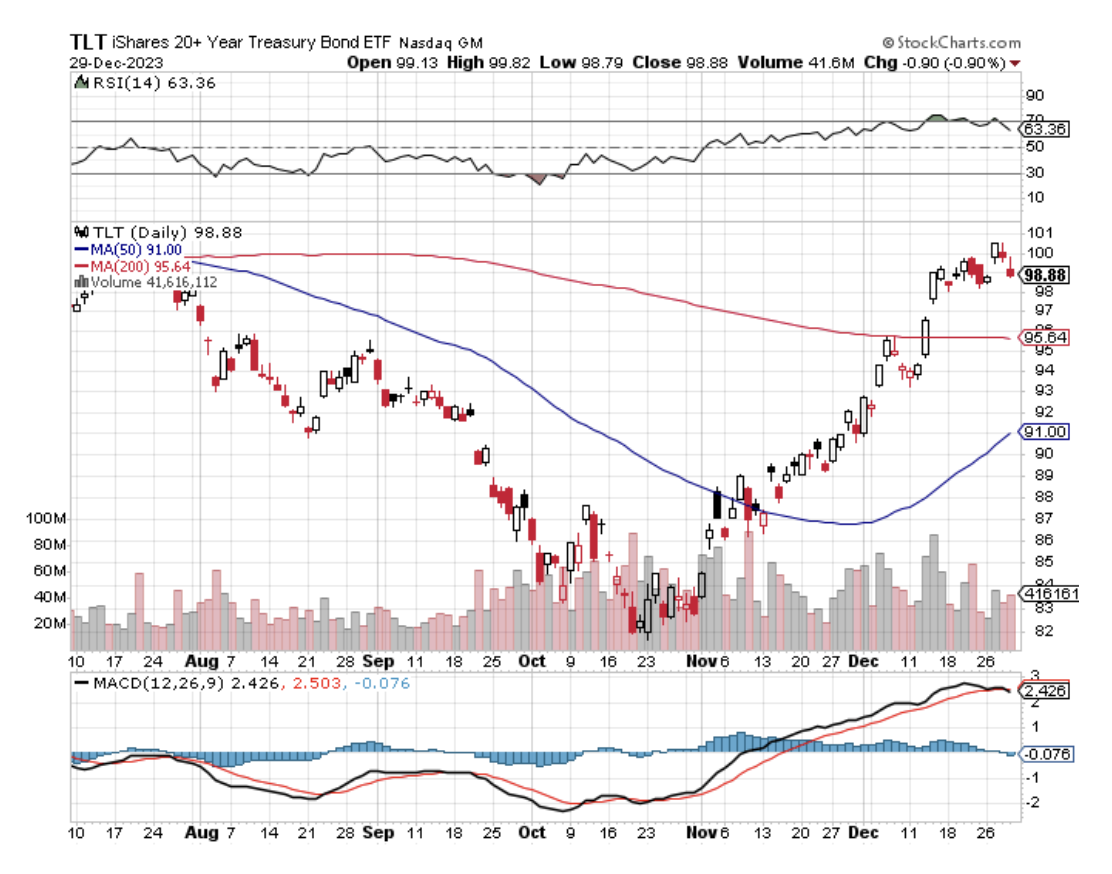
After selling short bonds (TLT) from $180 all the way down to $82, I flipped to the long side on October 17. The next week, bonds saw their biggest rally in history, making instant millionaires out of several of my followers. The (TLT) has since rocketed from $82 to an eye-popping $100, a 22% gain.
In a heartbeat, we went from super bear to hyper bull.
I am looking for the Fed to cut interest rates by 1.00% in 2024 but won’t begin until the second half of the year. All of the first half bond gains were pulled forward into 2023 so I am looking for long periods of narrow trading ranges. By June, economic weakness will be so obvious that a dramatic Fed rate-cutting policy will ensue.
In addition, the Fed will end its quantitative tightening program by June, which is currently sucking $90 billion a month out of the economy. That’s a lot of bond-selling that suddenly ends.
I’m looking for $120 in the (TLT) sometime in 2024, with a possible stretch to $130. Use every five-point dip to load up on shares in the (TLT) ETF, calls, call spreads, and one-year LEAPS. This trade is going to work fast. It is the low-hanging fruit of 2024.
We are never going back to the 0.32% yields, and $165 prices we saw in the last bond peak. But you can still make a lot of money in a run-up from $82 to $120, as many happy bondholders are now discovering.
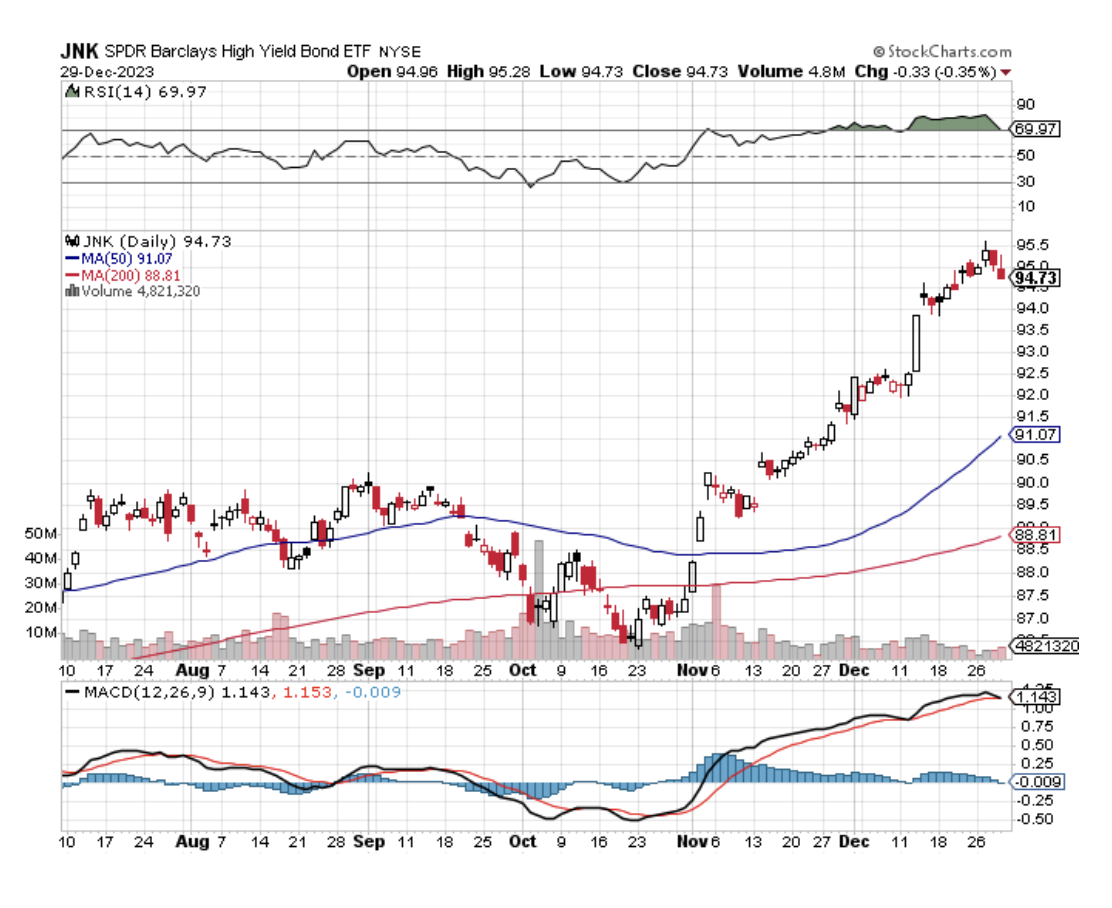
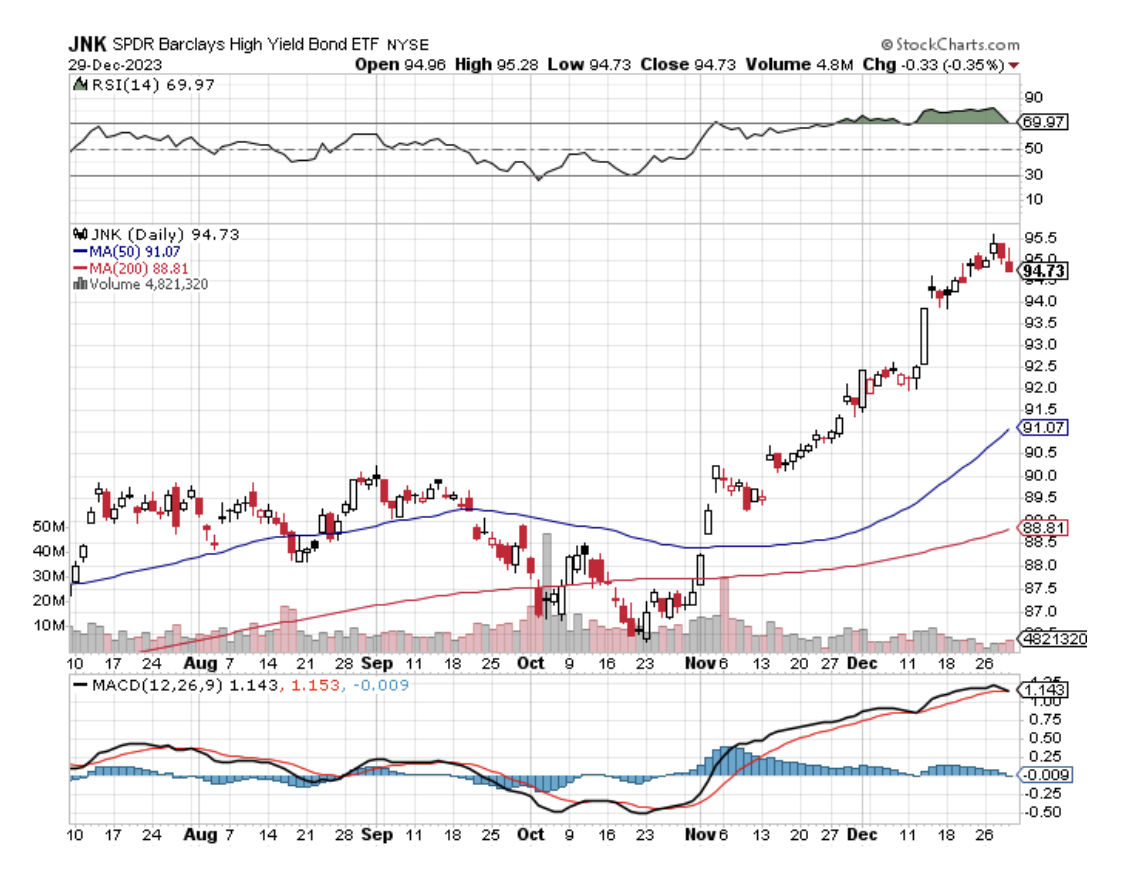
It isn’t just bonds that are going up. The entire interest rate space is doing well including junk bonds (JNK), municipal bonds (MUB), REITS (NLY), preferred stock, and convertible bonds.
With a major yield advantage over the rest of the world for the last decade, the US dollar has been on an absolute tear. After all, the world’s strongest economy begets the world’s strongest currency.
That is about to end.
If your primary assumption is that US interest rates will see a sharp decline sometime in 2024, then the outlook for the greenback is terrible.
Currencies are driven by interest rate differentials and the buck is soon going to see the fastest shrinking yield premium in the forex markets.
That shines a great bright light on the foreign currency ETFs. You could do well buying the Australian Dollar (FXA), Euro (FXE), Japanese yen (FXE), and British Pound (FXB). I’d pass on the Chinese yuan (CYB) right now until their Covid shutdowns end.
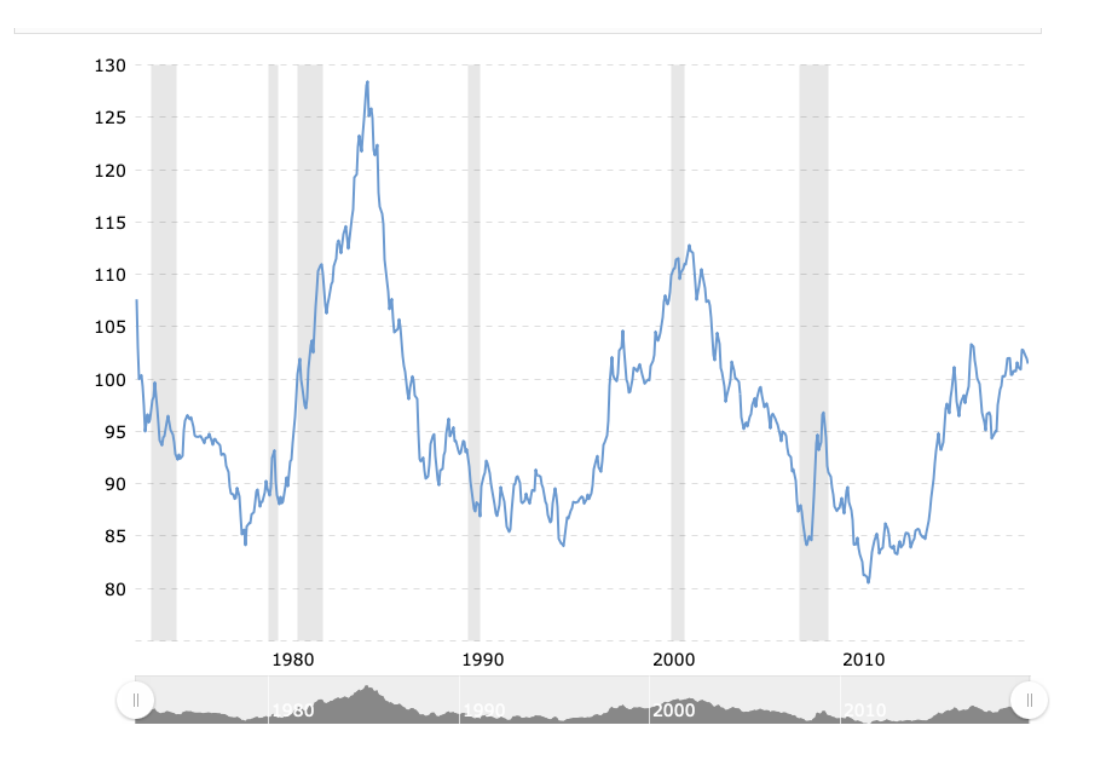
Look at the 50-year chart of the US dollar index below and you’ll see that a 13-year uptrend in the buck is rolling over and will lead to a 5-10-year down move. Draw your weapons.
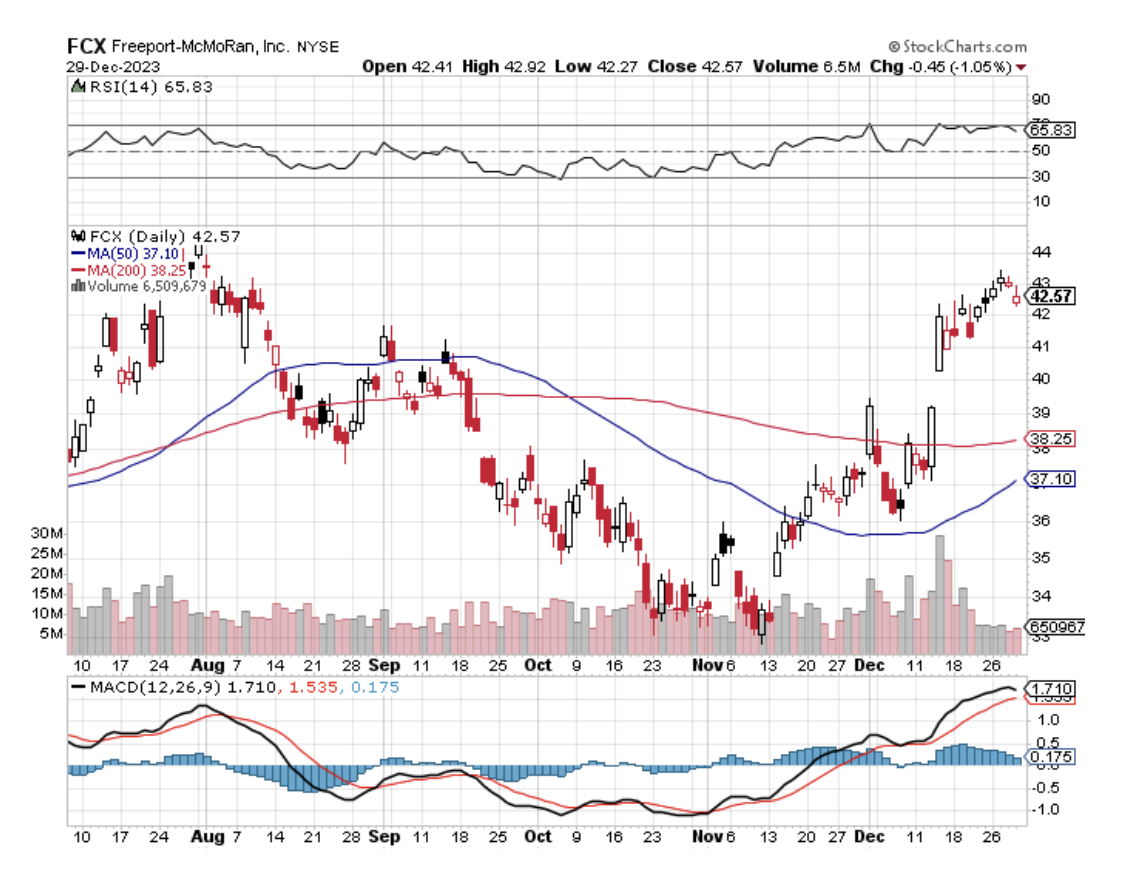
5) Commodities (FCX), (VALE), (DBA)
Commodities are the high beta players in the financial markets. That’s because the cost of being wrong is so much higher. Get on the losing side of commodities and you will be bled dry by storage costs, interest expenses, contangos, and zero demand.
Commodities have one great attribute. They predict recessions and recoveries earlier than any other asset class. When they peaked in March of 2022, they were screaming loud and clear that a recession would hit in early 2023. By reversing on a dime on November 13, 2023, they also told us that a rip-roaring recovery would begin in 2024.
You saw this in every important play in the sector, including Broken Hill (BHP), Peabody Energy (BTU), and Freeport McMoRan (FCX). And who but me noticed that Alcoa Aluminum (AA) was up an incredible 50% in December? Maybe you can’t teach an old dog new tricks, but the old tricks work pretty darn well!
The heady days of the 2011 commodity bubble top are about to replay. Now that this sector is convinced of a substantially weaker US dollar and lower inflation, it is once more a favorite target of traders. China will finally rejoin the global economy as a growth engine in 2024 but at only half its previous growth rate. It will be replaced by India, which is turning into the new China and is now the most populous country in the world.
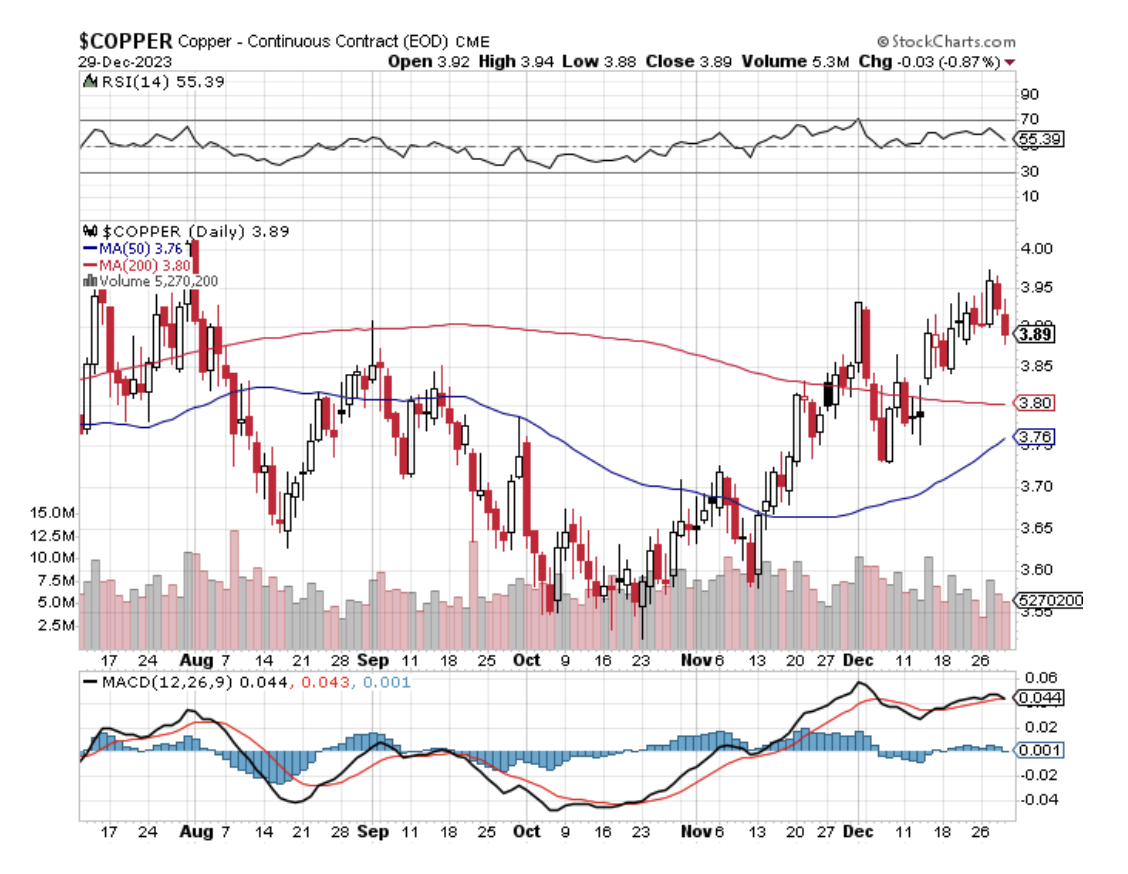
And here’s another big new driver. Each electric vehicle requires 200 pounds of copper and production is expected to rise from 2 million units a year to 20 million by 2030. Annual copper production will have to increase three-fold in a decade to accommodate this increase, no easy task or prices will have to rise.
The great thing about commodities is that it takes a decade to bring new supply online, unlike stocks and bonds, which can merely be created by an entry in an Excel spreadsheet. As a result, they always run far higher than you can imagine.
Accumulate all commodities on dips.
Snow Angel on the Continental Divide
6) Energy (DIG), (RIG), (USO), (DUG), (UNG), (USO), (XLE), (AMLP)
Energy was the top-performing sector of 2023 until it wasn’t.
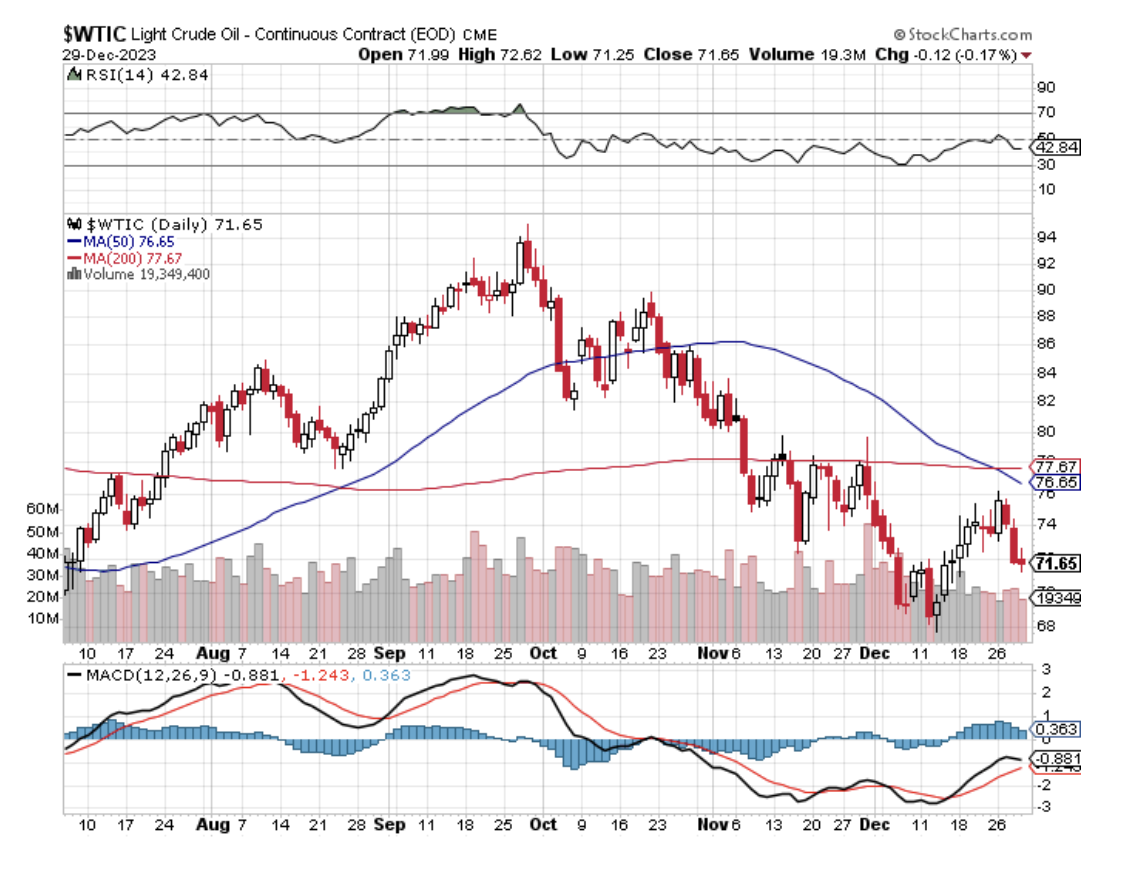
We got a nice boost to $90 a barrel from the Gaza War. But that faded rapidly as there was never an actual supply disruption, just the threats of one. Saudi production has been cut back so far, some 5 million barrels a day, that it risks budget shortfalls if it reduces any more. In the meantime, US fracking production has taken off like a rocket.
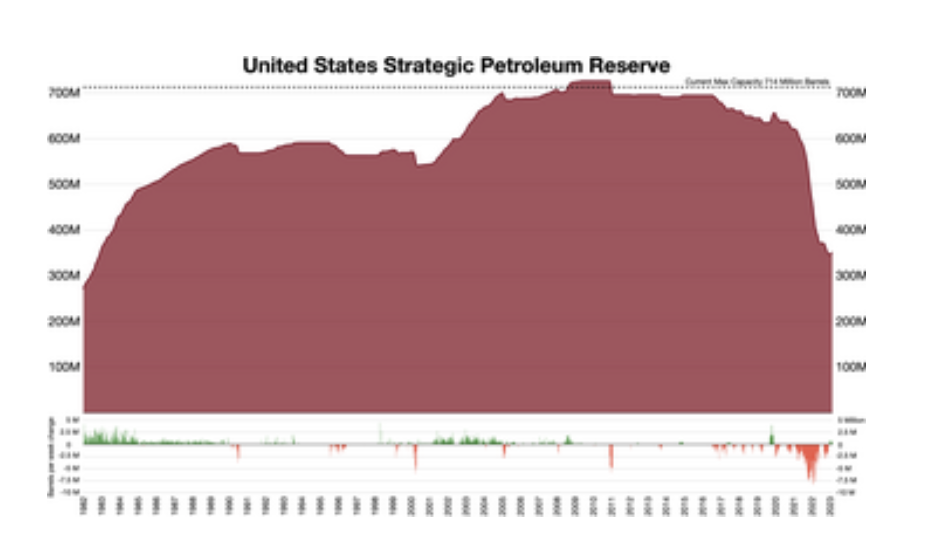
In the meantime, Joe Biden is sitting on the bid in an effort to refill the Strategic Petroleum Reserves that was drawn down from 723 to 350 million barrels during the last price spike.
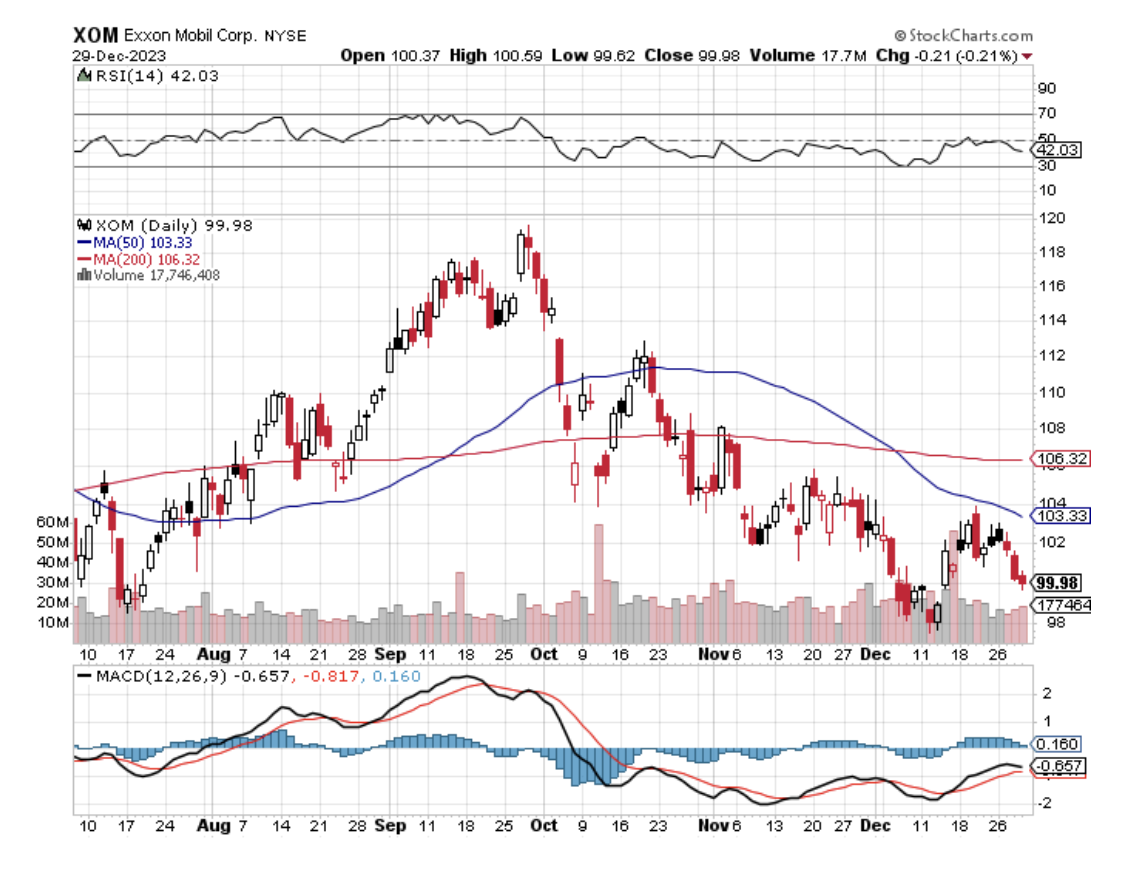
The trade here is to buy any energy plays when Texas tea approaches $70 and take profits at $95. Your first picks should be ExxonMobile (XOM), Occidental Petroleum (OXY) where Warren Buffet has a 27% stake, Diamondback Energy (FANG), and Devon Energy (DVN).
The really big energy play for 2024 will be in natural gas (UNG), which was slaughtered in 2023. The problem here was not a shortage of demand because China would take all we could deliver. It was in our ability to deliver, hobbled by the lack of gasification facilities needed to export. One even blew up.
In 2024 several new export facilities came online and the damaged one was repaired. That should send prices soaring. Natural gas prices now at a throw-away $2.00 per MM BTU could make it to $8.00 in the next 12 months. That takes the (UNG) from $5.00 to $15.00 (because of the contango).
Buy (UNG) LEAPS (Long Term Equity Anticipation Securities) right now.
Remember, you will be trading an asset class that is eventually on its way to zero sooner than you think. However, you could have several doublings on the way to zero. This is one of those times. And you also have a huge 35% contango headwind working against you all the time.
They call this commodity the “widow maker” for a good reason.
The real tell here is that energy companies are bailing on their own industry. Instead of reinvesting profits back into their future exploration and development, as they have for the last century, they are paying out more in dividends and share buybacks.
Take the money and run. Trade, don’t marry this asset class.
There is the additional challenge in that the bulk of US investors, especially environmentally friendly ESG funds, are now banned from investing in legacy carbon-based stocks. That means permanently cheap valuations and share prices for the energy industry.
Energy now counts for only 5% of the S&P 500. Twenty years ago, it boasted a 15% weighting.
The gradual shutdown of the industry makes the supply/demand situation infinitely more volatile.
To understand better how oil might behave in 2024, I’ll be studying US hay consumption from 1900-1920. That was when the horse population fell from 100 million to 6 million, all replaced by gasoline-powered cars and trucks.
The internal combustion engine is about to suffer the same fate.
The train has added extra engines at Denver, so now we may begin the long laboring climb up the Eastern slope of the Rocky Mountains.
On a steep curve, we pass along an antiquated freight train of hopper cars filled with large boulders.
The porter tells me this train is welded to the tracks to create a windbreak. Once, a gust howled out of the pass so swiftly, that it blew a passenger train over on its side. In the snow-filled canyons, we saw a family of three moose, a huge herd of elk, and another group of wild mustangs. The engineer informs us that a rare bald eagle is flying along the left side of the train. It’s a good omen for the coming year. We also see countless abandoned 19th-century gold mines and broken-down wooden trestles leading to huge piles of tailings, and relics of previous precious metals booms. So, it is timely here to speak about the future of precious metals.
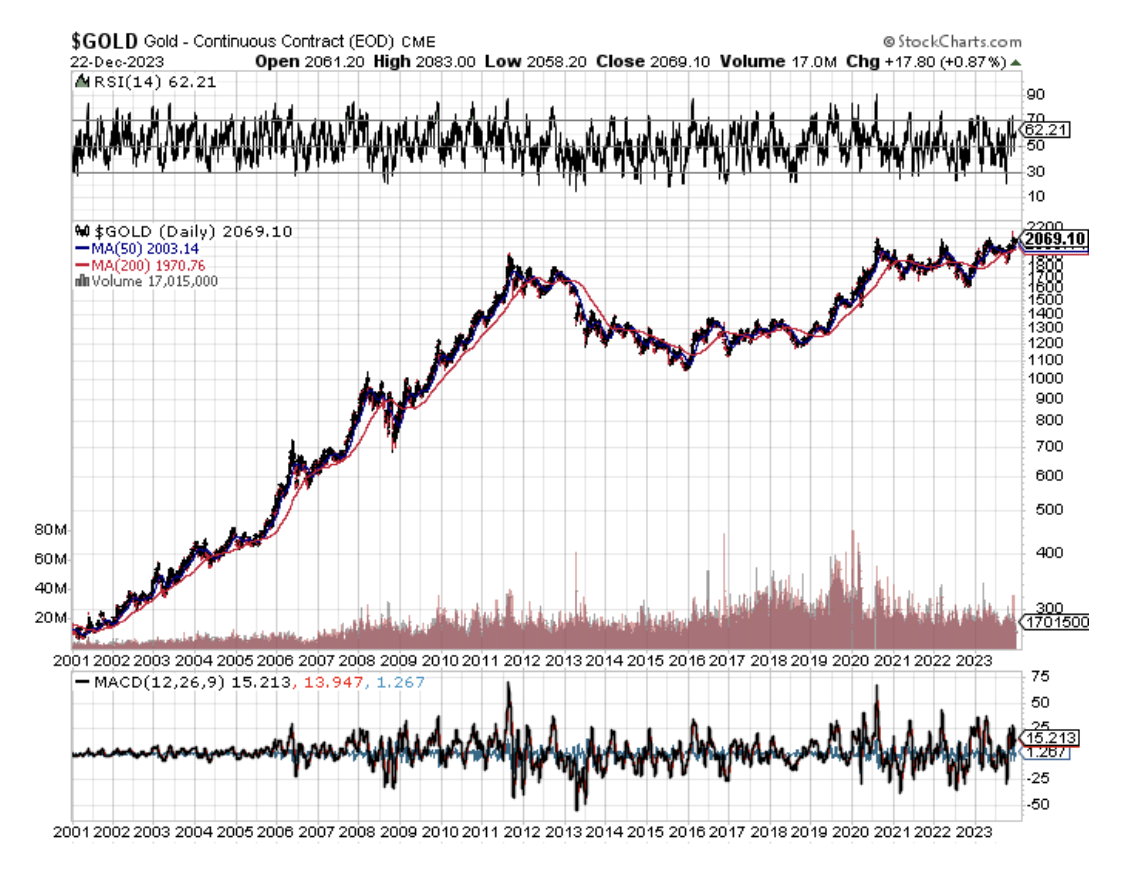
Here it’s important to look at the long view on gold. The barbarous relic tends to have good and bad decades. During the 2000’s the price of the yellow metal rose tenfold, from $200 to $2,000. The 2010s were very boring when gold was unchanged. Gold is doing well this decade, already up 40%, and a double or triple is in the cards.
2023 should have been a terrible year for precious metals. With inflation soaring, stocks volatile, and interest rates soaring, gold had every reason to collapse. Instead, it was up on the year, thanks to a heroic $325, 17.8%% rally in the last two months.
The reason is falling interest rates, which reduce the opportunity costs of owning gold. The yellow metal doesn’t pay a dividend, costs money to store and insure, and delivery is an expensive pain in the butt.
Chart formations are looking very encouraging with a massive upside breakout in place. So, buy gold on dips if you have a stick of courage on you, which you must if you read this newsletter.
Of course, the best investors never buy gold during a bull market. They Hoover up gold miners, which rise four times faster, like Barrack Gold (GOLD), Newmont Mining (NEM), and the basket play Van Eck Vectors Gold Miners ETF (GDX).
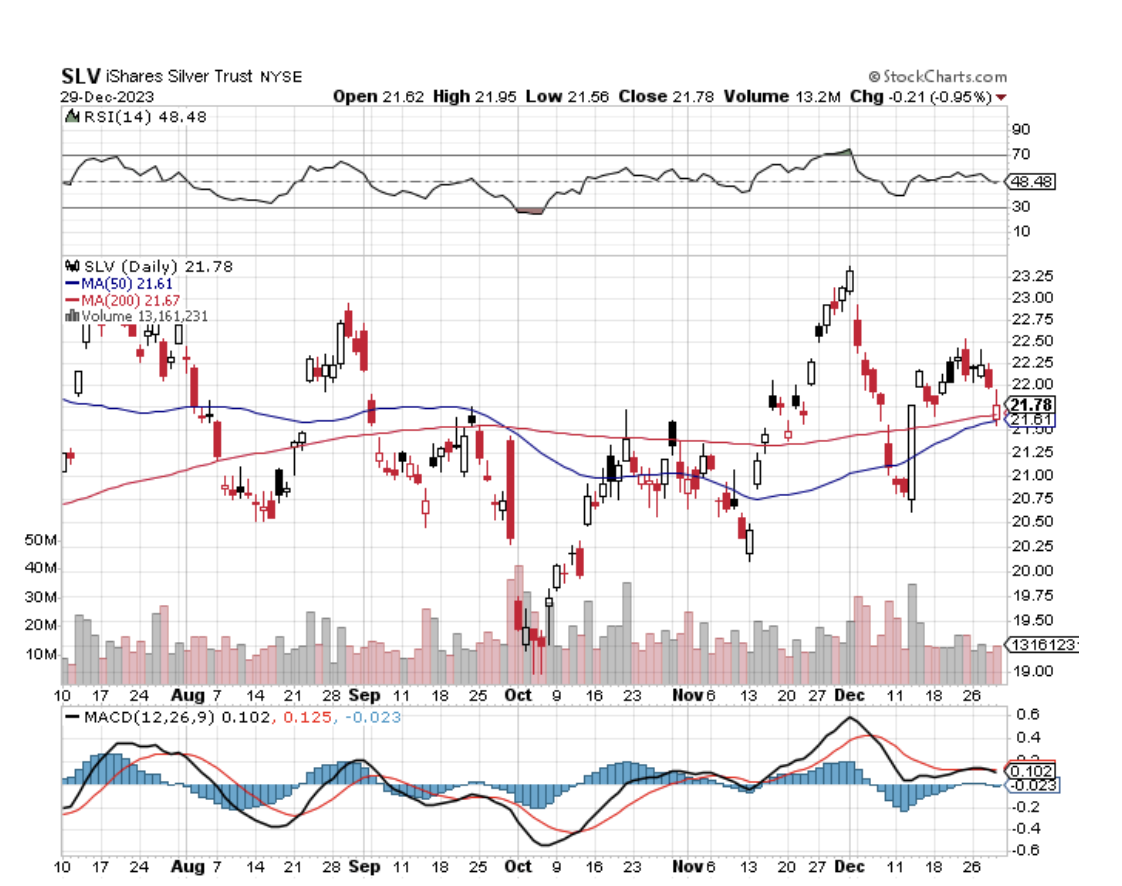
Higher beta silver (SLV) will be the better bet, as it already has been because it plays a major role in the decarbonization of America. There isn’t a solar panel or electric vehicle out there without some silver in them and the growth numbers are positively exponential. Keep buying (SLV), (SLH), and (WPM) on dips.
Crossing the Great Nevada Desert Near Area 51
8) Real Estate (ITB), (LEN), (KBH), (PHM)
The majestic snow-covered Rocky Mountains are behind me. There is now a paucity of scenery, with the endless ocean of sagebrush and salt flats of Northern Nevada outside my window, so there is nothing else to do but write.
My apologies in advance to readers in Wells, Elko, Battle Mountain, and Winnemucca, Nevada. It is a route long traversed by roving bands of Indians, itinerant fur traders, the Pony Express, my own immigrant forebearers in wagon trains, the Transcontinental Railroad, the Lincoln Highway, and finally US Interstate 80, which was built for the 1960 Winter Olympics at Squaw Valley. Passing by shantytowns and the forlorn communities of the high desert, I am prompted to comment on the state of the US real estate market. Those tormented by the shrinking number of real estate transactions over the past two years take solace. The past excesses have been unwound and we are now on the launching pad for another decade-long bull market.
There is a generational structural shortage of supply with housing which won’t come back into balance until the 2030’s. You don’t have a real estate crash when we are short 10 million homes.
The reasons, of course, are demographic. There are only three numbers you need to know in the housing market for the next ten years: there are 80 million baby boomers, 65 million Generation Xers who follow them, and 86 million in the generation after that, the Millennials.
The 76 million baby boomers (between ages 62 and 79) have been unloading dwellings to the 72 million Gen Xers (between age 41 and 56) since prices peaked in 2007. But there are not enough of the latter, and three decades of falling real incomes mean that they only earn a fraction of what their parents made. That’s what caused the financial crisis. That has created the present shortage of housing, both for ownership and rentals.
There is a happy ending to this story.
The 72 million Millennials now aged 25-40 are now the dominant buyers in the market. They are transitioning from 30% to 70% of all new buyers of homes. They are also just entering the peak spending years of middle age, which is great for everyone. Hot on their heels are 68 million Gen Z, which are now 12 to 27 years old.
The Great Millennial Migration to the suburbs and Middle America has just begun. Thanks to the pandemic and Zoom, many are never returning to the cities. That has prompted massive numbers to move from the coasts to the American heartland.
That’s why Boise, Idaho was the top-performing real estate market in 2023, followed by Phoenix, Arizona. Personally, I like Reno, Nevada, where Apple, Google, Amazon, and Tesla are building factories as fast as they can, just a four-hour drive from Silicon Valley.
As a result, the price of single-family homes should continue to rise during the 2020s, as they did during the 1970s and the 1990s when identical demographic forces were at play.
This will happen in the context of a labor shortfall, rising wages, and improving standards of living.
Increasing rents are accelerating this trend. Renters now pay 35% of their gross income, compared to only 18% for owners, and less, when multiple deductions and tax subsidies are considered. Rents are now rising faster than home prices.
Remember, too, that the US will not have built any new houses in large numbers in 17 years. The 50% of small home builders that went under during the Financial Crisis never came back.
We are still operating at only half of the 2007 peak rate. Thanks to the Great Recession, the construction of five million new homes has gone missing in action.
There is a new factor at work. We are all now prisoners of the 2.75% 30-year fixed-rate mortgages we all obtained over the past five years. If we sell and try to move, a new mortgage will cost double today. If you borrow at a 2.75% 30-year fixed rate, and the long-term inflation rate is 3%, then, over time, you will get your house for free. That’s why nobody is selling, and prices have barely fallen.
This winds down in 2024 as the Fed realizes its many errors and sharply lowers interest rates. Home prices will explode…. again.
Quite honestly, of all the asset classes mentioned in this report, purchasing your abode is probably the single best investment you can make now after you throw in all the tax breaks. It’s also a great inflation play.
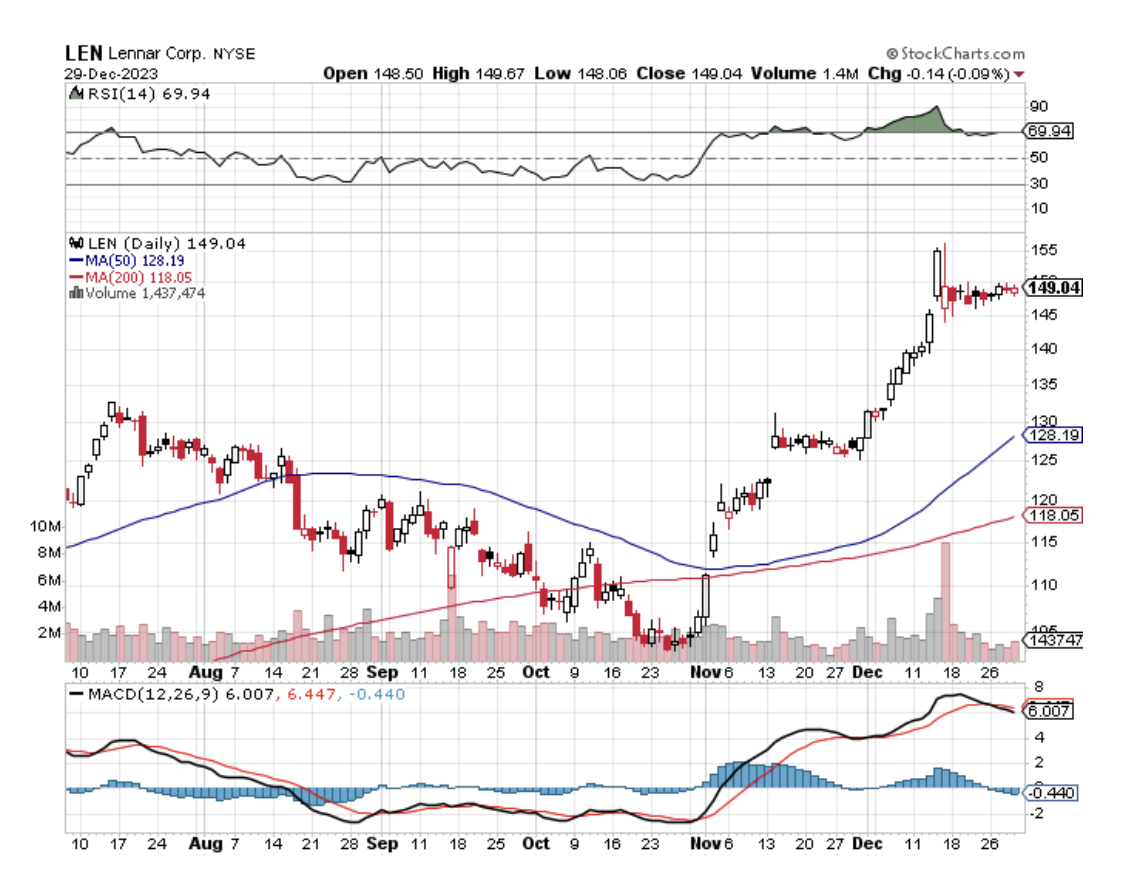
That means the major homebuilders like Lennar (LEN), Pulte Homes (PHM), and KB Homes (KBH) are a buy on the dip. But don’t forget to sell your home by the 2030s when the next demographic headwind resumes. That’s when you should unload your home to a Millennial or Gen Xer and move into a cheap rental.
A second-hand RV would be better.
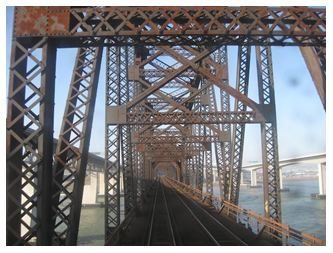
Crossing the Bridge to Home Sweet Home
9) Postscript
We have pulled into the station at Truckee amid a howling blizzard.
My loyal staff have made the ten-mile trek from my estate at Incline Village to welcome me to California with a couple of hot breakfast burritos and a chilled bottle of Dom Perignon Champagne, which has been resting in a nearby snowbank. I am thankfully spared from taking my last meal with Amtrak.
After that, it was over legendary Donner Pass, and then all downhill from the Sierras, across the Central Valley, and into the Sacramento River Delta.
Well, that’s all for now. We’ve just passed what was left of the Pacific mothball fleet moored near the Benicia Bridge (2,000 ships down to six in 50 years). The pressure increase caused by a 7,200-foot descent from Donner Pass has crushed my plastic water bottle. Nice science experiment!
The Golden Gate Bridge and the soaring spire of Salesforce Tower are just coming into view across San Francisco Bay.
A storm has blown through, leaving the air crystal clear and the bay as flat as glass. It is time for me to unplug my MacBook Pro and iPhone 15 Pro, pick up my various adapters, and pack up.
We arrive in Emeryville 45 minutes early. With any luck, I can squeeze in a ten-mile night hike up Grizzly Peak and still get home in time to watch the ball drop in New York’s Times Square on TV.
I reach the ridge just in time to catch a spectacular pastel sunset over the Pacific Ocean. The omens are there. It is going to be another good year.
I’ll shoot you a Trade Alert whenever I see a window open at a sweet spot on any of the dozens of trades described above, which should be soon.
Good luck and good trading in 2024!
John Thomas
The Mad Hedge Fund Trader
The Omens Are Good for 2024!
https://www.madhedgefundtrader.com/wp-content/uploads/2019/01/Chicago-union-station.png375499Mad Hedge Fund Traderhttps://madhedgefundtrader.com/wp-content/uploads/2019/05/cropped-mad-hedge-logo-transparent-192x192_f9578834168ba24df3eb53916a12c882.pngMad Hedge Fund Trader2024-01-03 09:00:452024-01-03 10:56:532024 Annual Asset Class Review
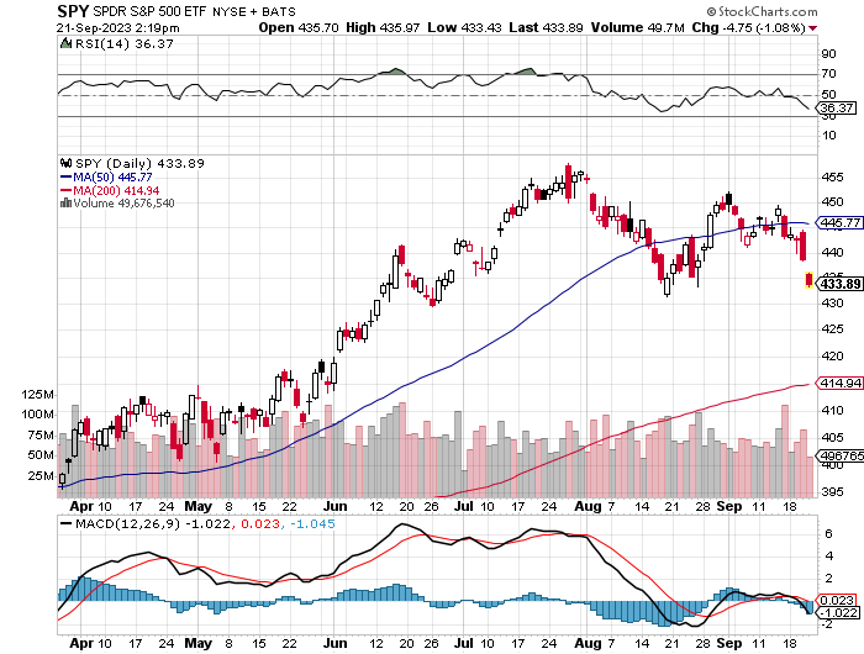
Below please find subscribers’ Q&A for the September 20 Mad Hedge Fund Trader Global Strategy Webinar, broadcast from Silicon Valley, CA.
Q: How do we know when interest rates have peaked?
A: Well, that's easy—the Fed announces it and they start cutting interest rates. The first hint of that is they don’t raise interest rates when they have the opportunity to do so. That will be today as it was in July. So we’re at the top now, and they’ll probably go sideways for 6 months or even longer before they start cutting. Markets will start to discount this 6-9 months in advance, or about now.
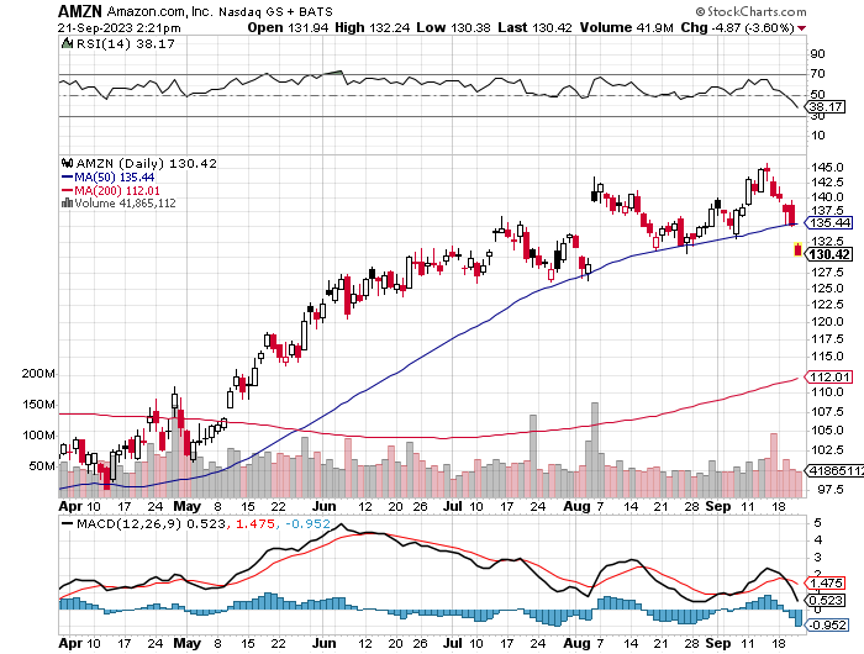
Q: Year-end target for the S&P 500? What about Amazon (AMZN)?
A: 5,000. For the (SPX). For Amazon, I think we could easily tack on another 20-25%.
Q: Does the Mad Hedge Global Trading Dispatch include tech trade alerts?
A: It does, but only the higher quality, lower risk trades. Pure Tech traders are a much higher-risk bunch of people, and they want more aggressive trade alerts in smaller companies. As for me, with Global Trading Dispatch I try to stick to a 90% success rate, and the only way to do that is to avoid tech when it flatlines and not try to catch any falling knives.
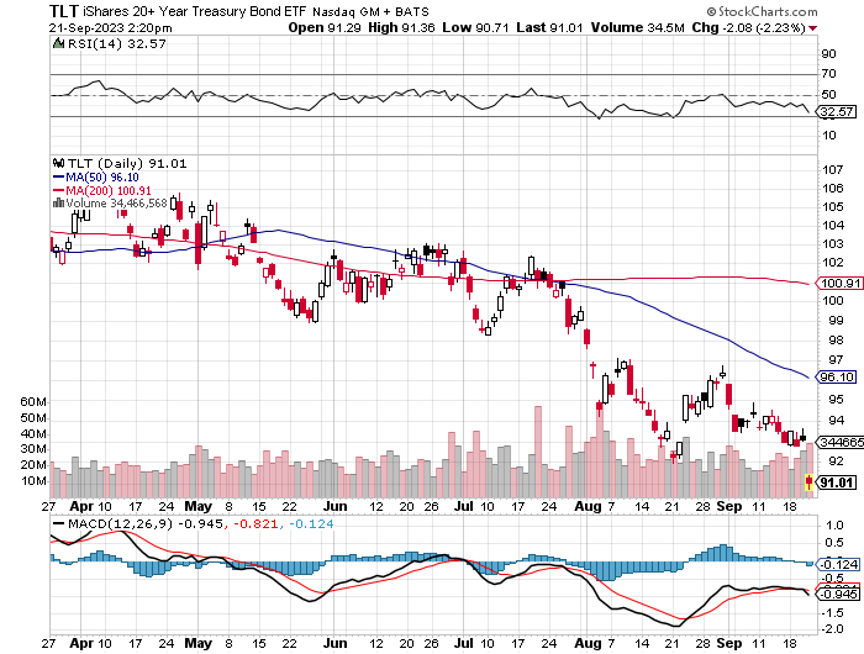
Q: Any hope of recovery for the iShares 20 Plus Year Treasury Bond ETF (TLT)?
A: Yes; as I said, the Fed will start cutting interest rates next year, and markets discount 6-9 months in advance, so that gives us 3 months for our January 2024 $100/$105 call spreads to expire at max profit. So yes, it is entirely possible, if not likely, that we will see those numbers by January.
Q: Can you help me jump the line for a Cybertruck from Tesla (TSLA)?
A: Well, if I was going to help anyone get a Cybertruck, it would be me! And I can't get one. Back in the old days, Tesla people would fall down on their knees crying “thank you!” when you bought one of their cars. Now, I think I’m number 2 million on the waiting list. You’re on your own on that one.
Q: Is Disney (DIS) a good LEAP stock?
A: No, Disney has some major problems with their streaming business, and the parks have maxed out. That is why the stock seems immune to good news—unless you know something I don’t. So go for it if you’re ready for that risk.
Q: What is your fact-finding trip to Ukraine all about?
A: Nothing beats research on the ground for finding out what really happened. Second, Ukraine got a lot of aid from other countries when the war started, but it’s since run out and we know that hospitals and orphanages in Ukraine are in trouble and running out of money. So, nothing beats showing up with US dollar cash in that situation. So that is why I’m going. This’ll be my eighth war. I guess the war correspondent in me never left. I’ll also be escorting American doctors to Ukrainian hospitals who don’t know how to do this. There’s more to life than just making money.
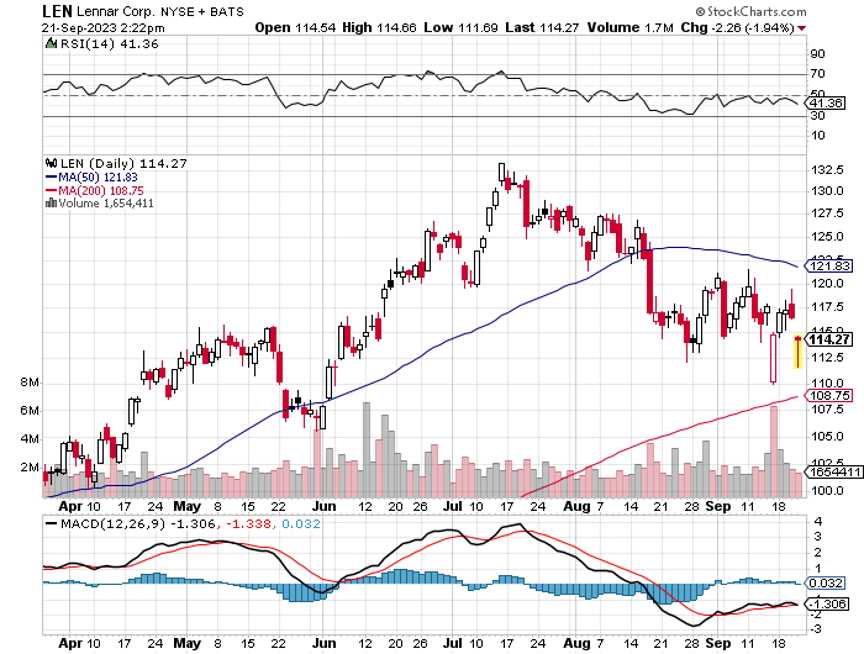
Q: Should I buy the dip in homebuilders like Lennar Homes (LEN), D.R. Horton (DHI), and KB Homes (KBH)?
A: Absolutely, yes—with both hands. Who does better with a falling interest rate cycle than home builders who have to depend on falling mortgage rates for business to boom once again. So yes, any dip in this sector and I would be loading the boat. The next declining interest rate cycle could last 5 or 10 years.
Q: Will the United Auto Workers strikes cause inflation to rocket and feed into higher inflation figures?
A: No, not really. Union membership has declined by 75% over the last 40 years. The UAW itself has declined from 1.6 million members to 400,000, and they really have become too small to affect the general economy. What they will do is accelerate existing trends, like people dumping their ice cars and moving to Tesla and other EV manufacturers. This is sort of like a gift for Tesla, and that's why the stock was up 10% last week. Also, in the long, long run, if they force the car companies to move to Mexico and cut the same deals that Elon Musk got, then it reduces inflation.
Q: Does the recent increase in Chinese ships and warplanes near Taiwan change anything?
A: No, it just shows us how weak the economy in China is. It’s effectively in recession even though they refuse to admit it, and therefore they have to create more distractions. The Chinese have been bluffing on Taiwan for 70 years—why stop now?
Q: What is a good time to buy banks?
A: I would start scaling into (JPM), (BAC), and (C) now. They will be a major beneficiary of an economic recovery next year and falling interest rates; and the prices down here are good. They’re one of the worst performers so far this year—one of the few cheap sectors left in the market.
Q: Should I buy Tesla (TSLA) here?
A: The thing here that I’m telling my professional money managers is: scale in on a one-month basis. Figure out how much you want to buy, and then buy 1/30th of that amount every day for a month. Then, you’ll scale in, you won’t get the absolute bottom but you’ll get some kind of bottom, and when a turnaround happens, then it goes up 50% or 100%. That’s the way to play Tesla. A lot of the professional money managers and investment advisors who follow me have a problem; they’re getting tons of new customers based on their performance this year. So yes, what do you do when you get money after a great run? You can only scale in.
Q: Is oil (USO) topping and going back to 70 a barrel?
A: I think yes. We saw the run from $70 to $95; it looks like it’ll probably hit $100. After that, Saudi Arabia will start bringing supply back on. What they did is create an artificial short squeeze in oil by taking 5 million barrels off the market with Russia—that got prices up. Any higher than that, and high oil starts to adversely affect Saudi Arabia’s foreign investments. So yes, they do back off when we get over 100; they’re very happy with $100/barrel, as is the American oil industry. So, I’m inclined to take profits if you did the oil trade in June.
Q: Would you buy iShares 20 Plus Year Treasury Bond ETF (TLT) now?
A: No, I’ve been holding back because it seems to want to have a capitulation; that’s why it’s not rallying off the 93 level—it’s been bouncing on the bottom. Some piece of bad news, some kind of high inflation, could trigger a capitulation, which would take us down another 5 points—that's where you buy it. Then, all of a sudden something like a 2024 $85/$90 bull call spread is offering you 100% return one year out.
Q: Do you recommend 4-week T-bills?
A: No, I recommend 4-month T-bills. Those expire in January and take advantage of the cash squeeze in the financial system you always get in New Years. Returns on 4-month T-bills are much higher than 3 month, 2 month, or 1 month. I just bought some before this meeting because I’m not going to do a lot of trading this month, and I got a 5.48% yield. For me to do a trade now, it has to have a very low-risk 20% return. That’s what I need to beat T-bills at 5.48%, which have zero risk and a guaranteed return of money. You need the extra 15% return on a 1-month trade to justify the risk that individual stocks have.
Q: Will the Australian dollar (FXA) stay weak as long as China is weak?
A: Yes, and the flip side is also true: Will the Australian dollar be strong when China recovers? Absolutely. I still see 1 to 1 against the US dollar for the long term.
Q: Why is everyone pouring into short-term options?
A: They’re buying lottery tickets. A lot of people are in the markets not to invest, but to gamble. They have gambling addictions quite often, and nothing beats the instant gratification of a same-day win, even though 80% of the same-day options expire worthless. So, enter that market with caution.
Q: After artificial intelligence destroys 90% of jobs, won’t there be nobody left to buy stocks since stocks won’t go up solely on institutional buying?
A: While AI will destroy a lot of jobs, it’s creating even more jobs—that has always been the case with technology from day one. However, you do get mismatches from the time a job is destroyed to when a new one is created. There are also mismatches in skill levels and that can create turmoil in the economy. Look at the United Auto strike, which is hell-bent on stopping technology and automation—stopping any kind of technology they can. Technology in the long term always destroys jobs, but it also creates more jobs, just moving them from old economies into new industries. I’m sure the same thing went on with the hay and leather industries 120 years ago when we moved from horses to internal combustion cars.
Q: If companies go to a four-day workweek, how will that affect stocks?
A: It’ll probably make them go up. When people go to four-day work weeks, productivity goes up and companies get more output for their dollar of labor costs. That’s why it’s happening and why it’s so popular. People who work at home and get to play with their kids on weekends will work for less money—that is a proven fact.
Q: Any thoughts on when we will see the United States Natural Gas Fund (UNG) turn upward?
A: This winter. (UNG) is priced for perfection, sitting around here at the $7 level. The slightest surprise like a cold winter, for example, which we may get (at least in California we will), and then the thing will spike up.
To watch a replay of this webinar with all the charts, bells, whistles, and classic rock music, just log in to www.madhedgefundtrader.com, go to MY ACCOUNT, click on GLOBAL TRADING DISPATCH, then WEBINARS, and all the webinars from the last 12 years are there in all their glory.
Good Luck and Stay Healthy,
John Thomas
CEO & Publisher
The Diary of a Mad Hedge Fund Trader
2018 On the HMS Victory in Plymouth, England
https://madhedgefundtrader.com/wp-content/uploads/2019/05/cropped-mad-hedge-logo-transparent-192x192_f9578834168ba24df3eb53916a12c882.png00Mad Hedge Fund Traderhttps://madhedgefundtrader.com/wp-content/uploads/2019/05/cropped-mad-hedge-logo-transparent-192x192_f9578834168ba24df3eb53916a12c882.pngMad Hedge Fund Trader2023-09-22 09:02:552023-09-22 13:38:26September 20 Biweekly Strategy Webinar Q&A
https://madhedgefundtrader.com/wp-content/uploads/2019/05/cropped-mad-hedge-logo-transparent-192x192_f9578834168ba24df3eb53916a12c882.png00Mad Hedge Fund Traderhttps://madhedgefundtrader.com/wp-content/uploads/2019/05/cropped-mad-hedge-logo-transparent-192x192_f9578834168ba24df3eb53916a12c882.pngMad Hedge Fund Trader2023-05-22 09:04:282023-05-22 15:47:04May 22, 2023
Legal Disclaimer
There is a very high degree of risk involved in trading. Past results are not indicative of future returns. MadHedgeFundTrader.com and all individuals affiliated with this site assume no responsibilities for your trading and investment results. The indicators, strategies, columns, articles and all other features are for educational purposes only and should not be construed as investment advice. Information for futures trading observations are obtained from sources believed to be reliable, but we do not warrant its completeness or accuracy, or warrant any results from the use of the information. Your use of the trading observations is entirely at your own risk and it is your sole responsibility to evaluate the accuracy, completeness and usefulness of the information. You must assess the risk of any trade with your broker and make your own independent decisions regarding any securities mentioned herein. Affiliates of MadHedgeFundTrader.com may have a position or effect transactions in the securities described herein (or options thereon) and/or otherwise employ trading strategies that may be consistent or inconsistent with the provided strategies.