
• support@madhedgefundtrader.com
  • Member Login
Mad Hedge Fund Trader
  • Home
  • About
  • Store
  • Luncheons
  • Testimonials
  • Contact Us
  • Click to open the search input field Click to open the search input field Search
  • Menu Menu

Tag Archive for: (CRWD)

Mad Hedge Fund Trader

Why the FANGs are Breaking Into Your Home

Tech Letter

The house is the new smartphone and I will tell you why.

The projected market growth of 18% in smart home technology sales according to Acumen Researching and Consulting will deliver opportunities to shape and prioritize this sector.  

The revenues up for grabs from the smart home mean that internet of things’ (IoT) companies will create systems that mesh together with the bare minimum human participation, meaning that tech will have a dramatic influence in our daily lives.

I get several moans and groans a day that the Mad Hedge Technology Letter only shines the spotlight on the FANGs.

But it is hard not to when it comes to the future of the home.

Just look at recent M&A activity.

Automation and connected smart appliances have consumed Amazon by recently acquiring Eero, producer of routers for apartments, houses, and multi-story homes, and after already paying $1 billion to acquire Ring, a doorbell-camera startup. It had also bought Blink, a smart camera maker in 2017.

Google hasn’t shied away either by investing in smart home products pocketing Nest, a firm producing smart home products, for $3.2 billion.

Nest took a few years to sort out its production phase but finally managed to launch new temperature sensors, a video doorbell, and an outdoor smart camera.

What are the trending IoT products now?

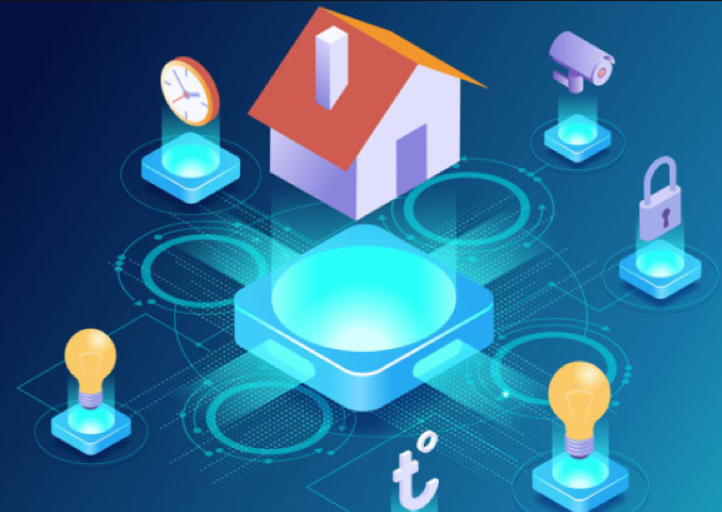
The flavors of the day are smart lights, security, entertainment systems, and temperature control.

They are the low hanging fruit of the smart home industry – a de facto gateway into this world.

Most of these smart devices operate with voice assistants, but because of the nature of competition, certain products are aligned with certain ecosystems and compatibility issues will persist until the competition flushes itself out.

A layman’s example would be Apple’s Homekit dovetailing nicely with Apple’s Siri.

Companies are in the first innings of the product iteration cycle and the variations of smart home products are endless stemming from showers that remember preferred water temperature and flow rates or climate-control systems that change in real-time to suit the user.

Security of home networks and connected devices are still a controversial question mark because the receiver of this type of data has the keys to the most intimate details of personal lives.

Even avid technologists are hesitant to dive in and put up smart home products all over the house, and most are being cautious.

In fact, privacy issues are the most distinct headwind to fresh adoption rates.

Many people simply aren’t willing to make the jump yet until they are more convinced of its use case.

Even with all the reservations, an alternative global shipment company believes smart home devices will post 24% in growth next year.

For the smart home device believers, this cohort averages 6 smart home devices per household and will certainly rise to 7 or 8 by the end of 2020. 

Popular items include the Amazon Echo, Google Home, and Apple (AAPL) HomePod.

Smart speakers are already present in 36% of American homes and rising.

Consumers are also worried about technology invading their daily lives along with allowing artificial intelligence to dominate personal decision making.

Others have concluded that items such as smart microwaves are a waste of money and are unneeded when analog devices function admirably.

Another legitimate reason is that the software and technology involve a perceived steep learning curve to operate which many people do not have the patience for.

And some are just burnt out by the volume of technology thrown in our faces.

Who wants to operate 50 apps on their phone to control their smart home devices when there are other pressing needs in life?

Companies with skin in the game are Alarm.com (ALRM), ADT (ADT), Arlo Technologies (ARLO) and Resideo Technologies (REZI) and they will be outsized winners if they can solve many of the industries lingering issues.

The value thesis in the case of home automation companies is that they are financially efficient, time-effective, boost wellness and will be easy to use.

About 11% of U.S. broadband households have smart thermostats and Nest’s smart thermostat is the most popular.

Networked security cameras by Arlo are in 10% of homes.

Video doorbells from Amazon.com (AMZN), Google are in 8% of homes and help deter theft of e-commerce packages.

Smart light bulbs and lighting are at 8% market share while smart door locks are at 7% penetration.

There are several second derivates bet on this as well.

The most common user interface for the smart home is apps on a smartphone or tablet and voice commands to smart speakers are second.

The conundrum of installation complexities leads to the demand of professional installers.

This demand has delivered opportunities for companies like Comcast's (CMCSA) Xfinity and Vivint.

Electronics retailer Best Buy (BBY) has stepped up its footprint in this market as well.

Another stock play would be cybersecurity companies because they will win contracts protecting the software that smart home products rely on.

Hackers are getting more sophisticated and a private cybersecurity company Firewalla can track where data is flowing to and from your devices.

Firewalla management recommends buying devices from reputable home automation companies like Amazon and Google because they have more accountability and are of higher quality.

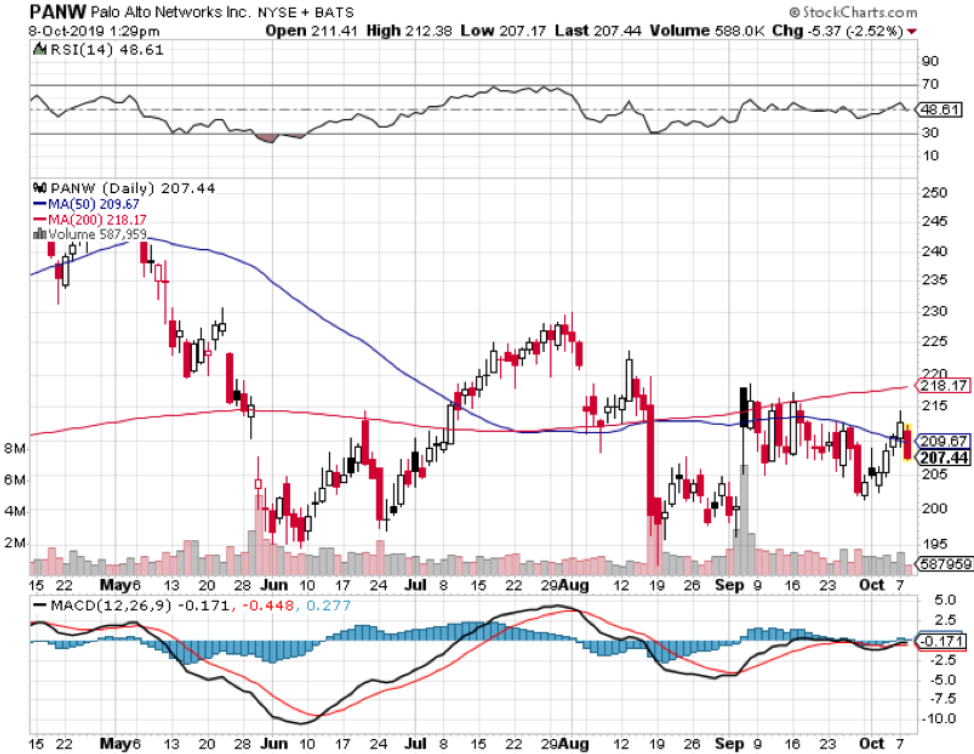
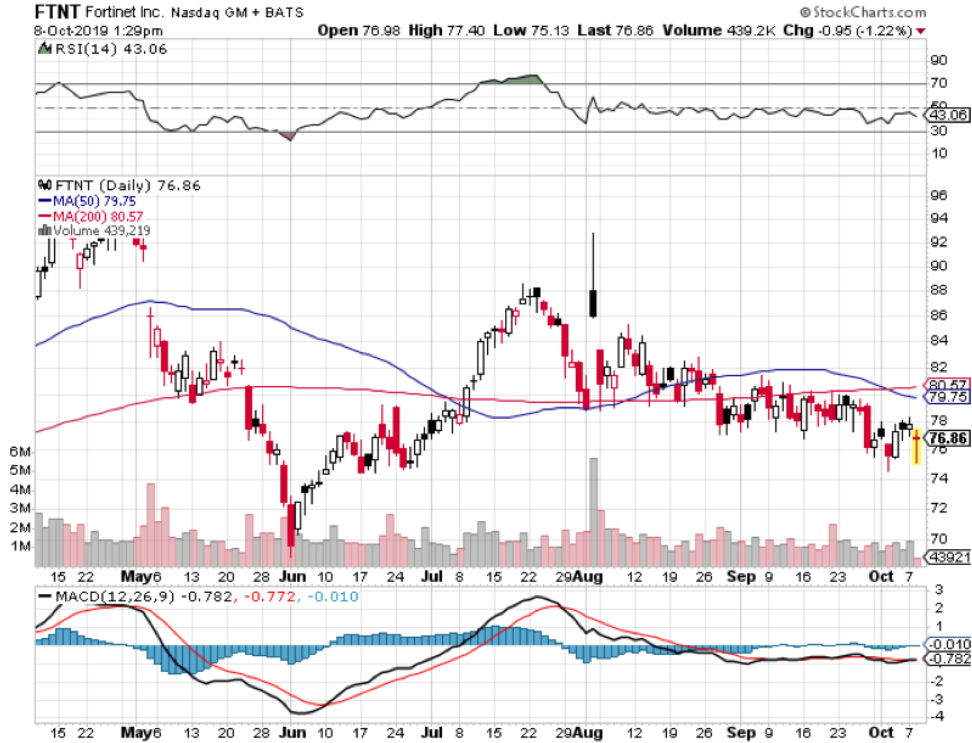
There will be a huge onramp of cybersecurity contracts doled out to the likes of Palo Alto Networks, Inc. (PANW), CrowdStrike Holdings, Inc. (CRWD), Fortinet, Inc. (FTNT), and Cisco Systems, Inc. (CSCO).

We are in the first mile of a marathon and smart home product manufacturers, cybersecurity companies, 5G internet, and semiconductor companies will all benefit from the broad-based integration of these next-generation home consumer products.
https://www.madhedgefundtrader.com/wp-content/uploads/2019/12/smart-home.png 512 722 Mad Hedge Fund Trader https://madhedgefundtrader.com/wp-content/uploads/2019/05/cropped-mad-hedge-logo-transparent-192x192_f9578834168ba24df3eb53916a12c882.png Mad Hedge Fund Trader2019-12-13 06:02:172020-05-11 13:04:53Why the FANGs are Breaking Into Your Home
Mad Hedge Fund Trader

October 9, 2019

Tech Letter

Mad Hedge Technology Letter
October 9, 2019
Fiat Lux

Featured Trade:

(WHAT’S BEHIND THE CHINESE TECH BLACKLIST)
(FTNT), (PANW), (CRWD), (CYBR)

https://madhedgefundtrader.com/wp-content/uploads/2019/05/cropped-mad-hedge-logo-transparent-192x192_f9578834168ba24df3eb53916a12c882.png 0 0 Mad Hedge Fund Trader https://madhedgefundtrader.com/wp-content/uploads/2019/05/cropped-mad-hedge-logo-transparent-192x192_f9578834168ba24df3eb53916a12c882.png Mad Hedge Fund Trader2019-10-09 09:04:072019-10-09 09:44:01October 9, 2019
Mad Hedge Fund Trader

What's Behind the Chinese Tech Blacklist

Tech Letter

The administration banning 8 Chinese tech companies screams one thing – American cybersecurity will become more important than ever before.

Interestingly enough, most of the entry list included Chinese own version of cybersecurity companies which usually participate in heavy-handed censorship including facial recognition startups Sensetime, Megvii and Yitu, video surveillance specialists Hikvision and Dahua Technology, iFlyTek, Xiamen Meiya Pico Information Co and Yixin Science and Technology Co.

All of these companies have “borrowed” American source code while applying American designed semiconductors to create a business aiding the interests and model of the Chinese Communist Party.

As the stakes become higher, American companies too will have to grow cybersecurity budgets, and instead of budgeting for mass authoritarian censorship, American companies will need to spend to protect the technology and networks they develop from getting pillaged from totalitarian regimes.

If American tech companies renege on the Faustian bargain of doing business in China for their technology, then it will force the Chinese to acquire this sensitive technology by any means possible and that doesn’t involve sitting on the emperor’s chair in Beijing.

What does this mean for the broader trade war?

Even if we get a mini deal, it won’t address that the main guts of the trade conflict entails killing off Chinese tech in the way we know it now.

Being able to agree on some sort of enforceable mechanism is a pipe dream, even if an enforceable mechanism is agreed on, who will enforce the enforceable mechanism?

That’s how tricky it is for corporates doing business in China and now the NBA (National Basketball Association) has received a small sampling of the trade war with one innocuous quote by Houston Rockets General Manager Daryl Morey who tweeted then deleted his democratic support for the Hong Kong freedom movement.

The ban of these 8 Chinese companies means they will no longer be able to purchase U.S.-made technology parts to use as inputs of a censorship business model that goes against democratic values.

The trigger for the blacklist was the way these technologies were used to imprison ethnic Muslim minorities in Chinese Xinjiang province paving the way for China to lash out again against the U.S for the ban.

Not only has China applied the technology to Chinese nationals, they have exported this technology to African states and are allowed access to the data which could theoretically be exploited for additional economic and political gain about which they essentially have no qualms.

Chinese foreign ministry spokesman Geng Shuang has characterized this move as “interfering in China’s internal affairs” and as you probably believe, he expressed great unsatisfaction with this move as Chinese and American delegations plan to meet shortly to hash out their differences.

The 8 banned companies will need to source alternative tech in the same way that Huawei Technologies has done.

Huawei was banned this past April under national security premises blocking access to US-made software for its handsets and devices, such as Google’s Android operating system and Microsoft’s Windows.

This will hurt certain semiconductor manufacturers like Nvidia who sell artificial intelligence chips for video surveillance to Hikvision and semiconductor stocks have sold off hard on this news.

Washington’s move has laid bare the fierce struggle for technology supremacy and America’s refusal to allow Chinese technology companies to reign supreme off of ill-gotten intellectual property and American semiconductor chips.

It could be the final straw in corporate America funding China to take down itself or at least another step to disengaging with the Sino cash cow.

And this new episode is almost guaranteed to usher in a flight of capital to American cybersecurity companies as Chinese hackers open up a new frontier to hack the best of America’s intellectual property.

I envision the likes of Palo Alto Networks, Inc. (PANW), Fortinet, Inc. (FTNT), CrowdStrike Holdings, Inc. (CRWD), and CyberArk Software Ltd. (CYBR) as good long term buy and holds that offer quality exposure to the cybersecurity story and the future growth of it.


https://madhedgefundtrader.com/wp-content/uploads/2019/05/cropped-mad-hedge-logo-transparent-192x192_f9578834168ba24df3eb53916a12c882.png 0 0 Mad Hedge Fund Trader https://madhedgefundtrader.com/wp-content/uploads/2019/05/cropped-mad-hedge-logo-transparent-192x192_f9578834168ba24df3eb53916a12c882.png Mad Hedge Fund Trader2019-10-09 09:02:002020-05-11 13:26:10What's Behind the Chinese Tech Blacklist
Page 4 of 41234

Legal Disclaimer

There is a very high degree of risk involved in trading. Past results are not indicative of future returns. MadHedgeFundTrader.com and all individuals affiliated with this site assume no responsibilities for your trading and investment results. The indicators, strategies, columns, articles and all other features are for educational purposes only and should not be construed as investment advice. Information for futures trading observations are obtained from sources believed to be reliable, but we do not warrant its completeness or accuracy, or warrant any results from the use of the information. Your use of the trading observations is entirely at your own risk and it is your sole responsibility to evaluate the accuracy, completeness and usefulness of the information. You must assess the risk of any trade with your broker and make your own independent decisions regarding any securities mentioned herein. Affiliates of MadHedgeFundTrader.com may have a position or effect transactions in the securities described herein (or options thereon) and/or otherwise employ trading strategies that may be consistent or inconsistent with the provided strategies.

Copyright © 2026. Mad Hedge Fund Trader. All Rights Reserved. support@madhedgefundtrader.com
Scroll to top