Global Market Comments
August 20, 2018
Fiat Lux
Featured Trade:
(THE MARKET OUTLOOK FOR THE WEEK AHEAD, or
IS THE TRADE WAR ON OR OFF?),
(AAPL), (UUP), (EEM), (NFLX), (TSLA), (GOOGL), (SOYB),
(SOME SAGE ADVICE ABOUT ASSET ALLOCATION)

Global Market Comments
August 20, 2018
Fiat Lux
Featured Trade:
(THE MARKET OUTLOOK FOR THE WEEK AHEAD, or
IS THE TRADE WAR ON OR OFF?),
(AAPL), (UUP), (EEM), (NFLX), (TSLA), (GOOGL), (SOYB),
(SOME SAGE ADVICE ABOUT ASSET ALLOCATION)
Is the trade war on or off? Trillions of dollars in cash flow and investment depend on the answer to the question.
Traders and investors can be forgiven for being confused. It was only a week ago that a doubling of duties on Turkish imports were threatened because of an American pastor locked up there two years ago, triggering a stock meltdown.
Then, on Wednesday night presidential economic advisor Larry Kudlow hinted that he would meet with a Chinese trade delegation, prompting a 400-point Dow melt-up. Please note that except for Apple (AAPL), technology stocks did not participate in the rally one iota.
In the meantime, Apple continued its relentless march to my $220 target for $2018, so you might think about taking some money off the table. The market capitalization now stands at a staggering $1.05 trillion, the largest in the world.
It vindicates my call that at any time the administration could suddenly declare victory in the trade war, prompting a major stock market rally, regardless of the outcome.
So what happens next. Expect the trade talks to fail, or not happen at all. Market meltdowns will be followed by melt-up, then meltdowns again. Certainly, that's what the soybean (SOYB) market believes, that new canary in the coal mine for our global trade wars. It barely moved this week.
Hey, if trading were easy it would pay the federal minimum wage rate of $7.25 an hour, so quit your complaining!
As if trade wars were the only thing to worry about these days.
There is a mass protest underway at Alphabet (GOOGL) over the company's proposal to re-enter the China market. No one wants to assist the Middle Kingdom's harsh censorship regime, and some 1,000 employees have already signed a petition to this effect.
Emerging markets (EEM) continue to get pounded by trade wars and a strong U.S. dollar (UUP), which has the effect of increasing their companies' local currency debt.
Elon Musk continues his slow motion public nervous breakdown, cutting Tesla's stock at the knees down to $305. I hope you all took my advice last week to unload the stock at $380.
Netflix (NFLX) shares are undergoing a serious pullback now that it is in between upgrade launches, and the trade wars and strong dollar eat into international subscriber growth, about 80% of the total. Don't forget to buy this dip.
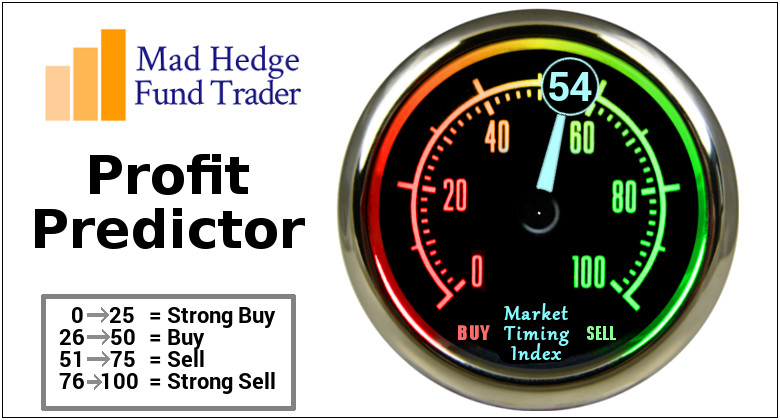
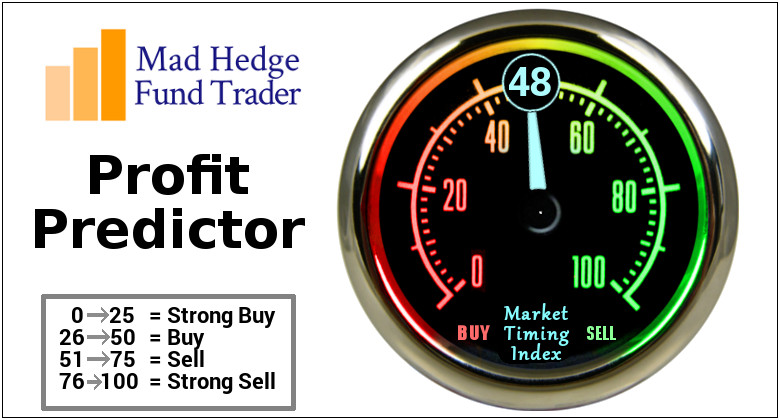
With the Mad Hedge Market Timing Index stuck dead on 50, I am not inclined to reach for trades here. A reading of 50 gives you the perfect "do nothing" indicator.
As is always the case when I return from vacation my first few trades are a rude awakening. August is now showing a modest return of 0.23%. My 2018 year-to-date performance has clawed its way up to 25.03% and my nine-year return appreciated to 302.61%. The Averaged Annualized Return stands at 34.91%. The more narrowly focused Mad Hedge Technology Fund Trade Alert performance is annualizing now at an impressive 32.24%.
This coming week housing statistics will give the most important insights on the state of the economy.
On Monday, August 20, there will be nothing of note to report. It will just be another boring summer day.
On Tuesday, August 21, same thing.
On Wednesday, August 22 at 9:15 AM, we learn July Existing Home Sales. Will the rot continue? Weekly EIA Petroleum Inventory Statistics are out at 10:30 AM. The Fed Minutes from the meeting six weeks ago are out at 2:00 PM EST.
Thursday, August 23 leads with the Weekly Jobless Claims at 8:30 AM EST, which saw a fall of 12,000 last week to 212,000. Also announced are July New Home Sales. The two-day Jackson Hole Symposium of central bankers starts in the morning.
On Friday, August 24 at 8:30 AM EST, we get July Durable Goods. Then the Baker Hughes Rig Count is announced at 1:00 PM EST.
As for me, it is back to school week for me, so I will be making the rounds with the new teachers at two schools. I have to confess that at my age I have trouble distinguishing between the students and the teachers.
Finally, a sad farewell to Aretha Franklin, the Queen of soul, who provided me with a half century of listening pleasure. When I was young, I couldn't afford to go see her, and when I got old I didn't have the time. Isn't life lived backward?
Good luck and good trading.


Global Market Comments
July 2, 2018
Fiat Lux
Featured Trade:
(THE MARKET OUTLOOK FOR THE WEEK AHEAD, OR THE FUTURE IS HAPPENING FAST),
(HOG), (TLT), (ROM), (MU), (NVDA), (LRCX),
(SPY), (AMZN), (NFLX), (EEM), (UUP), (WBA),
(THE WORST TRADE IN HISTORY), (AAPL)
I feel like I'm living life in fast forward these days.
First we got a slap across the face with a wet mackerel on Monday with a 328 plunge in the Dow Average on yet another trade war escalation.
Harley Davidson (HOG) said it was moving a factory out of the country to bypass new European duties imposed in response to ours. If Harley is doing this you can bet there are 10,000 other companies thinking about it.
And even though robust economic growth should assure us that we remain in a new bear market for bonds, traders think otherwise. A 10-year Treasury bond (TLT) yield at 2.81% says that we're already in the next recession, we just don't know it yet.
As always happens with the ebb and flow of the trade war, technology got hammered. My favorite early retirement vehicle, the ProShares Ultra Technology 2X ETF (ROM), plunged some 11.19% to an even $100. Chip stocks such as Micron Technology (MU) and Lam Research (LRCX) get particularly hurt as China buys 80% of their processors from the U.S.
In the meantime, Tesla (TSLA) continues its phoenixlike rise from the ashes yet again, burning the shorts for the umpteenth time. The shares are now taking another run at a new all-time high. You would think people would learn but they don't. Einstein's definition of insanity is repeating the same thing over and over again and expecting a different result.
While bearish analysts predicted the imminent demise of the company, I saw a steady stream of trucks delivering new Tesla 3s from the Fremont factory while driving back from Los Angeles last weekend. Nothing beats on-the-ground research.
I'm sorry, but there is definite disconnect from reality with this company. The most hated company in America has produced the fifth best performing stock in over the past eight years, up more than 2,000%. I guess that's what happens when you disrupt big oil, Detroit, the U.S. dealer network, and the entire advertising industry all at the same time.
Interestingly, we caught three of the five best performers early on, including Tesla, NVIDIA (NVDA), and Netflix (NFLX).
Emerging markets (EEM) continue their death spiral, pummeled by the twin threats of trade wars and a soaring dollar (UUP). Most big emerging companies have their debt in dollars.
Sometimes you have to forget what you know to make money, and that has certainly been the case for me with emerging countries, where I spent a large part of my life.
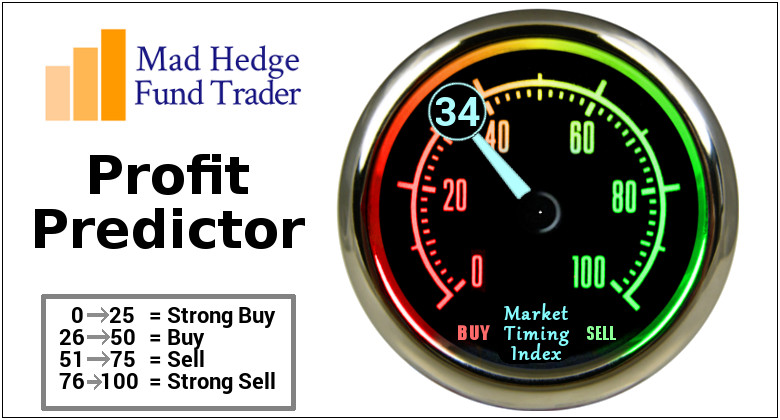
The future is happening fast. Amazon (AMZN) single-handedly demolished the drug sector when it announced its takeover of online pharmacy company PillPack. The traditional brick-and-mortar retail pharmacy sector lost $9 billion in market capitalization just on the announcement. Walgreens (WBA) alone dropped a gut churning 10%.
If anyone can slash America's bloated health care bill it is Jeff Bezos. Just ask any former bookseller or toy maker.
And for a final middle finger salute to investors, the president said he wants to withdraw from the World Trade Organization, which the U.S. itself created after WWII. That means the United Nations is next on the chopping block.
America is rapidly becoming rogue nation No. 1, the next failed state. And failed states don't have great stock markets. Just check out the Somalia Stock Exchange.
They net of all of this is that the rest of the global economy is rolling over like the Bismarck, while the U.S. remains a sole beacon of strength. That's not good when half of S&P 500 earnings come from abroad.
However, that strength is based on a temporary one-time-only stimulus from massive deficit spending and corporate tax cuts that runs out of juice next year.
So keep tap dancing on the edge of the Grand Canyon. We'll miss you when you're gone. And before you ask, the best hedge in this kind of market is cash, which has huge option value that almost no one recognizes.
Despite all the chaos, uncertainty, and massive headline risk, I managed to tiptoe between the raindrops, keeping the Mad Hedge Fund Trader Alert Service performance just short of a new all-time high.
I closed out the month of June at a healthy 4.45%, my 2018 year-to-date performance rose to 24.82% and my 8 1/2-year return catapulted to 301.29%. The Averaged Annualized Return stands at 35.10%. The more narrowly focused Mad Hedge Technology Fund Trade Alert performance is annualizing now at an impressive 38.69%.
This coming holiday shortened week will be all about the jobs, jobs, jobs. Also, the Fed will raise interest rates by 25 basis points on Wednesday to an overnight rate of 2.00%.
On Monday, July 2, at 9:45 AM, the May PMI Manufacturing Index is out.
On Tuesday, July 3, at 10:00 AM, the May Factory Orders are published.
On Wednesday, July 4, U.S. markets are closed for Independence Day. I will be watching the fireworks display over New York's Hudson River from the top of a Midtown Manhattan skyscraper.
Thursday, July 5, sees a huge bunching up of data thanks to the Fourth of July. It leads with the ADP Employment Report for private sector jobs at 8:15 AM EST. The Weekly Jobless Claims follow at 8:30 AM EST, which saw a rise of 9,000 last week to 227,000. Also announced is the all-important 25 basis point interest rate rise from the Federal Reserve and the FOMC Minutes at 2:00 PM, a reading of what was discussed at the last Fed meeting.
On Friday, July 6 at 8:30 AM EST, we get the June Nonfarm Payroll Report. Then the Baker Hughes Rig Count is announced at 1:00 PM EST. I will be sipping a glass of champagne as I board the Queen Mary 2 at the Brooklyn Cruise Terminal. I look forward to all those who signed up for my Seminar at Sea.
As for me, I will be hurriedly packing for the 2018 Mad Hedge European Tour.
Unfortunately, traveling in the grand style of the 19th century Belle Epoque involves bringing 200 pounds of luggage.
Now where are those darn black dress socks? And why am I missing a stud for my formal shirt?
Good Luck and Good Trading.


Time to Get Off the Merry-Go-Round
Global Market Comments
May 25, 2018
Fiat Lux
Featured Trade:
(FRIDAY, AUGUST 3, 2018, AMSTERDAM, THE NETHERLANDS GLOBAL STRATEGY DINNER),
(MAY 23 BIWEEKLY STRATEGY WEBINAR Q&A),
(TLT), (SPY), (TSLA), (EEM), (USO), (NVDA),
(GILD), (GE), (PIN), (GLD), (XOM), (FCX), (VIX)

Below please find subscribers' Q&A for the Mad Hedge Fund Trader May 23 Global Strategy Webinar with my guest and co-host Bill Davis of the Mad Day Trader.
As usual, every asset class long and short was covered. You are certainly an inquisitive lot, and keep those questions coming!
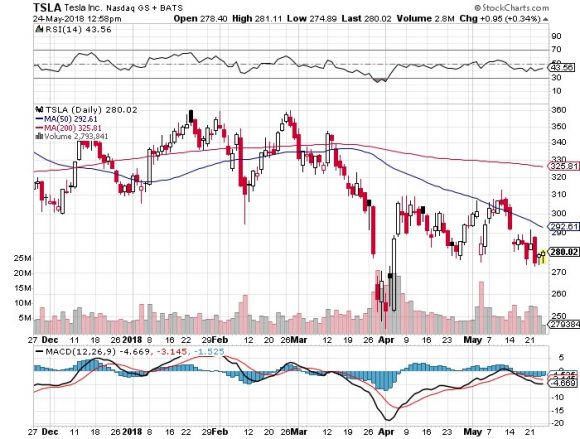
Q: Would you short Tesla here?
A: Tesla (TSLA) is on the verge of making the big leap to mass production, so they're in somewhat of an in-between time from a profit point of view, and the burden of proof is on them. Elon Musk is notorious for squeezing shorts. I would not want to bet him.
Musk has been successfully squeezing shorts for 10 years now, from the time the stock was at $16.50 all the way up to $392. So, I would not short Tesla. Buy the car but don't play in the stock; it's really a venture capital play that happens to have a stock listing because so many people are willing to back his vision of a carbon-free economy.
Q: What is your takeaway on the China trade war situation?
A: The Chinese said "no," and that is positive for economic growth. Anything that enhances international trade is good for growth and good for the stock market; anything that damages international trade is bad for corporate earnings and bad for the stock market. So, the China win in the trade war is essentially positive, but I don't think we'll see that reflected in stock prices until the end of the year.
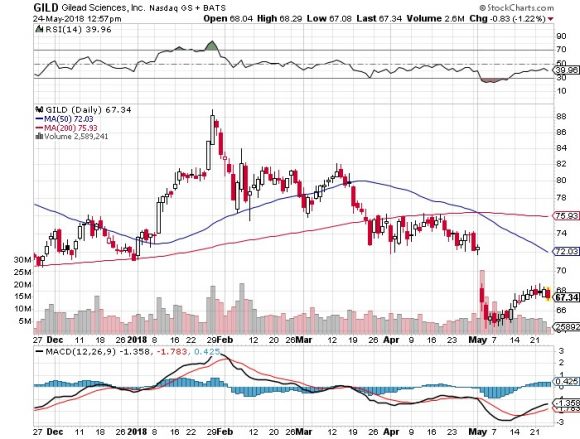
Q: What do you think about Gilead Sciences?
A: I don't really want to touch Gilead (GILD), or the entire sector, for that matter. We shouldn't be seeing such a poor performance at this point in the market. Health care has been dead for a long time, and you would have expected a rally based purely on fundamentals; they are delivering good earnings, it's just not reflected in the price action of the stocks. I think with no new money going into the market, there's nothing to push up other sectors; it's really become a "technology on and off" market. Health care doesn't fit anywhere in that world.
Q: Do you still like Nvidia?
A: I love Nvidia (NVDA). The chip sector still has another year to go. Nvidia has the high value-added product, and I'm looking for $300 dollars a share sometime this year/next year. The reason the stock hasn't really been moving is that it's over-owned; too many people know about the Nvidia story, which continues to go "gangbusters," so to speak. The chairman has also put out negative comments on short-term inventories, which have been a drag.
Q: Treasuries (TLT) are over 3%. Will they go over 3.5% by then end of this year?
A: I would say yes. Since that is only 50 basis points away from the current market, I would say it's a pretty good bet. So, if you get any good entry points you can do LEAPS going out to next year, betting that Treasuries will not only be below $116 by the end of the year, but they'll probably be below 110. And that would give you a very good high return LEAP with a yield of 50% in the next, say 8 months. By the way, if the Treasury yield rises to 4% that takes the (TLT) down to $98!
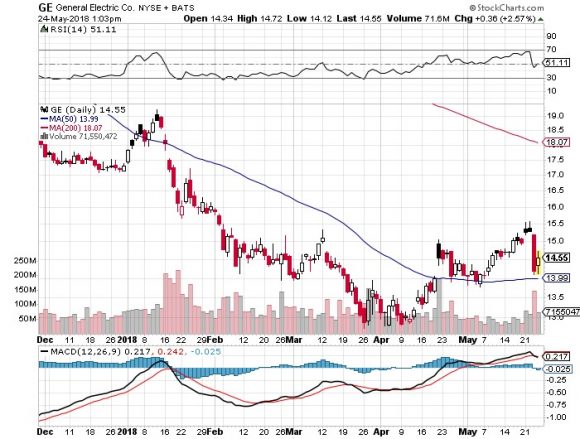
Q: Any chance General Electric will be acquired this year?
A: Absolutely not. General Electric (GE) worth far more if you break it up into individual pieces and sell them. Some parts are very profitable like jet engines and Baker Hughes, while other parts, like their medical insurance exposure, are awful.
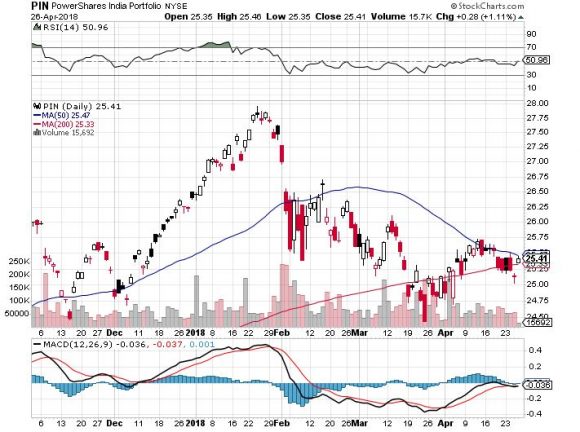
Q: What do you see about the India ETF?
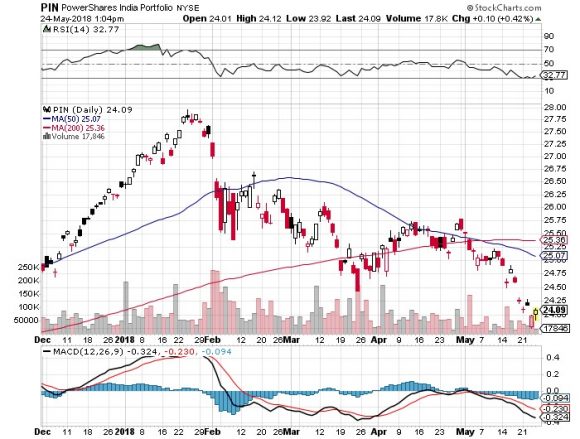
A: The one I follow is the PowerShares India Portfolio ETF (PIN) and we love it long term. Short term, they can take some pain with the rest of the emerging markets.
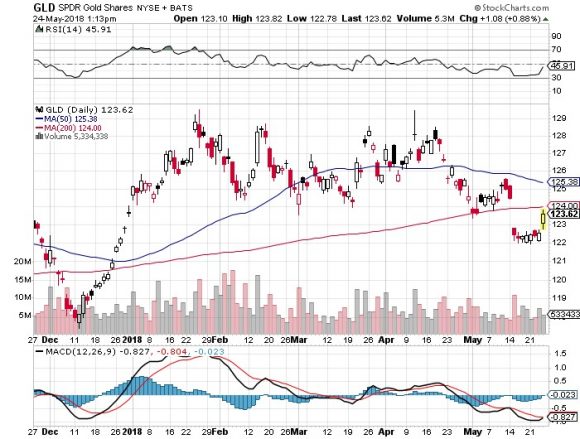
Q: What should I do with my January 2019 Gold calls?
A: I would sell them. It's not worth hanging on to here with too many other better things to do in stocks.
Q: Would you continue to hold ExxonMobile?
A: I would not. If you were lucky enough to get in at the bottom on ExxonMobile (XOM). I would be taking profits here. I'm not sure how long this energy rally will last, especially if the global economic slowdown continues.
Q: Is Freeport-McMoRan (FCX) a buy?
A: Yes, but only buy the dip in the recent range, so you don't get stopped out when the price goes against you. Commodities are the best performing asset class this year and that should continue.
Q: How high is oil (USO) headed?
A: I think we're probably peaking out short of $80 a barrel currently unless we get a major geopolitical event. Then it could go up to $100 very quickly and trigger a recession.
Q: Are you looking to buy the Volatility Index here?
A: Buy the next dip, but the trick with (VIX) is buying after it sits on a bottom for about five days. You also want to buy it when stocks (SPY) are at the top of a range, like yesterday.
Q: How long do you think the market will be range-bound for?
A: My bet is at least three months, and possibly four or five. We should start to anticipate the outcome of the midterm congressional elections in September/October; that's when you get your upside breakout.
Q: Is Gold (GLD) not worth buying since Bitcoin has taken over market share from Gold buyers?
A: Essentially, yes. That's probably why you're not getting these big spikes in Gold like you're used to. Instead, you're getting them in Bitcoin. Bitcoin is clearly stealing Gold's thunder. That's a major reason why we haven't been chasing Gold this year.
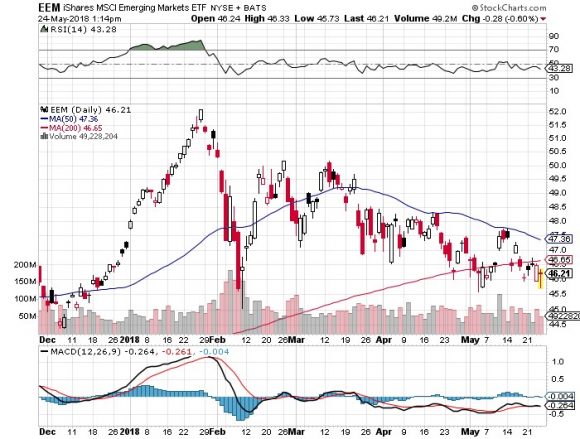
Q: After the emerging market sell-off, is it a good time to go in?
A: No, I think the emerging market (EEM) sell-off is being created by rising interest rates and a strong dollar. I don't see that ending anytime soon. In a year let's take another look in emerging markets. By then overnight Fed funds should be at 2.50% to 2.75%.
Global Market Comments
May 15, 2018
Fiat Lux
Featured Trade:
(FRIDAY, JUNE 15, 2018, DENVER, CO, GLOBAL STRATEGY LUNCHEON)
(GET READY FOR THE COMING GOLDEN AGE),
(SPY), (INDU), (FXE), (FXY), (UNG), (EEM), (USO),
(TLT), (NSANY), (TSLA)
I believe that the global economy is setting up for a new golden age reminiscent of the one the United States enjoyed during the 1950s, and which I still remember fondly.
This is not some pie in the sky prediction. It simply assumes a continuation of existing trends in demographics, technology, politics, and economics. The implications for your investment portfolio will be huge.
What I call "intergenerational arbitrage" will be the principal impetus. The main reason that we are now enduring two "lost decades" of economic growth is that 80 million baby boomers are retiring to be followed by only 65 million "Gen Xers."
When the majority of the population is in retirement mode, it means that there are fewer buyers of real estate, home appliances, and "RISK ON" assets such as equities, and more buyers of assisted living facilities, health care, and "RISK OFF" assets such as bonds.
The net result of this is slower economic growth, higher budget deficits, a weak currency, and registered investment advisors who have distilled their practices down to only municipal bond sales.
Fast forward six years when the reverse happens and the baby boomers are out of the economy, worried about whether their diapers get changed on time or if their favorite flavor of Ensure is in stock at the nursing home.
That is when you have 65 million Gen Xers being chased by 85 million of the "millennial" generation trying to buy their assets.
By then we will not have built new homes in appreciable numbers for 20 years and a severe scarcity of housing hits. Residential real estate prices will soar. Labor shortages will force wage hikes.
The middle-class standard of living will reverse a then 40-year decline. Annual GDP growth will return from the current subdued 2% rate to near the torrid 4% seen during the 1990s.
The stock market rockets in this scenario. Share prices may rise very gradually for the rest of the teens as long as tepid 2% growth persists. A 5% annual gain takes the Dow to 28,000 by 2019.
After that, after a brief dip, we could see the same fourfold return we saw during the Clinton administration, taking the Dow to 100,000 by 2030. If I'm wrong, it will hit 200,000 instead.
Emerging stock markets (EEM) with much higher growth rates do far better.
This is not just a demographic story. The next 20 years should bring a fundamental restructuring of our energy infrastructure as well.
The 100-year supply of natural gas (UNG) we have recently discovered through the new "fracking" technology will finally make it to end users, replacing coal (KOL) and oil (USO). Fracking applied to oilfields is also unlocking vast new supplies.
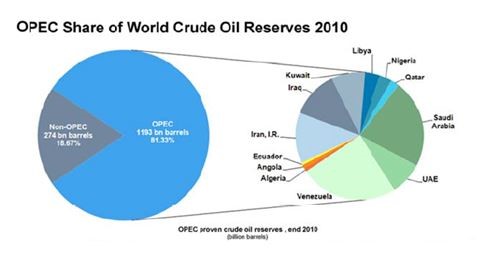
Since 1995, the United States Geological Survey estimate of recoverable reserves has ballooned from 150 million barrels to 8 billion. OPEC's share of global reserves is collapsing.
This is all happening while automobile efficiencies are rapidly improving and the use of public transportation soars.
Mileage for the average U.S. car has jumped from 23 to 24.7 miles per gallon in the past couple of years, and the administration is targeting 50 mpg by 2025. Total gasoline consumption is now at a five-year low.
Alternative energy technologies will also contribute in an important way in states such as California, accounting for 30% of total electric power generation by 2020, and 50% by 2030.
I now have an all-electric garage, with a Nissan Leaf (NSANY) for local errands and a Tesla Model S-1 (TSLA) for longer trips, allowing me to disappear from the gasoline market completely. Millions will follow. The net result of all of this is lower energy prices for everyone.
It will also flip the U.S. from a net importer to an exporter of energy, with hugely positive implications for America's balance of payments. Eliminating our largest import and adding an important export is very dollar bullish for the long term.
That sets up a multiyear short for the world's big energy consuming currencies, especially the Japanese yen (FXY) and the Euro (FXE). A strong greenback further reinforces the bull case for stocks.
Accelerating technology will bring another continuing positive. Of course, it's great to have new toys to play with on the weekends, send out Facebook photos to the family, and edit your own home videos.
But at the enterprise level this is enabling speedy improvements in productivity that are filtering down to every business in the U.S., lowering costs everywhere.
This is why corporate earnings have been outperforming the economy as a whole by a large margin.
Profit margins are at an all-time high. Living near booming Silicon Valley, I can tell you that there are thousands of new technologies and business models that you have never heard of under development.
When the winners emerge, they will have a big cross-leveraged effect on economy.
New health care breakthroughs will make serious disease a thing of the past, which are also being spearheaded in the San Francisco Bay area.
This is because the Golden State thumbed its nose at the federal government 10 years ago when the stem cell research ban was implemented. It raised $3 billion through a bond issue to fund its own research, even though it couldn't afford it.
I tell my kids they will never be afflicted by my maladies. When they get cancer in 20 years they will just go down to Wal-Mart and buy a bottle of cancer pills for $5, and it will be gone by Friday.
What is this worth to the global economy? Oh, about $2 trillion a year, or 4% of GDP. Who is overwhelmingly in the driver's seat on these innovations? The USA.
There is a political element to the new golden age as well. Gridlock in Washington can't last forever. Eventually, one side or another will prevail with a clear majority.
This will allow the government to push through needed long-term structural reforms, the solution of which everyone agrees on now, but for which nobody wants to be blamed.
That means raising the retirement age from 66 to 70 where it belongs and means-testing recipients. Billionaires don't need the maximum $30,156 annual supplement. Nor do I.
The ending of our foreign wars and the elimination of extravagant unneeded weapons systems cuts defense spending from $800 billion a year to $400 billion, or back to the 2000, pre-9/11 level. Guess what happens when we cut defense spending? So does everyone else.
I can tell you from personal experience that staying friendly with someone is far cheaper than blowing them up.
A Pax Americana would ensue.
That means China will have to defend its own oil supply, instead of relying on us to do it for them. That's why they have recently bought a second used aircraft carrier. The Middle East is now their headache.
The national debt then comes under control, and we don't end up like Greece.
The long-awaited Treasury bond (TLT) crash never happens. The Fed has already told us as much by indicating that the Federal Reserve will only raise interest rates at an infinitesimally slow rate of 25 basis points a quarter.
Sure, this is all very long-term, over-the-horizon stuff. You can expect the financial markets to start discounting a few years hence, even though the main drivers won't kick in for another decade.
But some individual industries and companies will start to discount this rosy scenario now.
Perhaps this is what the nonstop rally in stocks since 2009 has been trying to tell us.
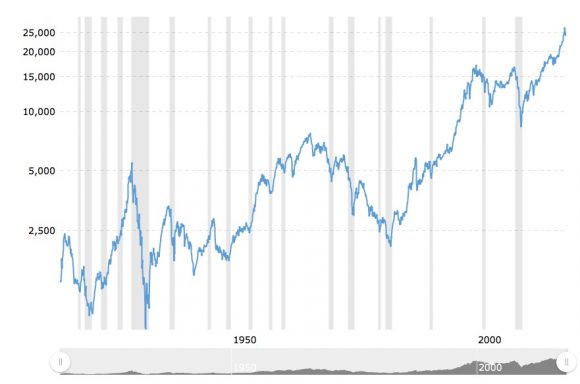
Dow Average 1908-2018
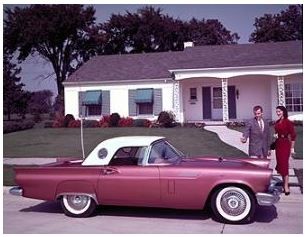
Another American Golden Age is Coming
Featured Trade:
Below please find subscribers Q&A for the Mad Hedge Fund Trader April Global Strategy Webinar with my guest co-host Mike Pisani of Smart Option Trading.
As usual, every asset class long and short was covered. You are certainly an inquisitive lot, and keep those questions coming!
Q: Are you out of Alphabet (GOOGL) and Microsoft (MSFT)?
A. I'm out of Alphabet and I'm in Microsoft, but only for the very short term. I'm waiting for another big meltdown day to go back and buy everything back because I think the FANGs and technology in general are still in a secular bull market.
Q. Are Advanced Micro Devices (AMD) and NVIDIA (NVDA) affected by the underperformance of Bitcoin?
A. They are. Bitcoin has been an important part of the chip story for the last two years because mining, or the creation of bitcoins, creates enormous demand for chips to do the processing. I think selling in bitcoin is over for the time being. You had a $25 billion in capital gains taxes that had to be paid by April 15.
People were paying those bills by selling their bitcoins. That's over now, and bitcoin is rallied about 30% since Tax Day because of that. So, yes, bitcoin is getting so big that it is starting to affect the chip sector meaningfully. That is another reason why we see secular long-term growth in the entire chip sector.
Mike Pisani: Interesting take on bitcoin today, and I've been with you on it. I think the worst of it is over; it's going to go. Today is the largest volume day we've seen on it so far. We're up over 15,500 contracts traded.
Q: If you're 100% cash, is now a good time to commit funds to the equity market?
A. Franz, I would say nein. Absolutely not. 2009 was the time to commit funds to the equity market. If you're 100% cash now I would stay out for the next six months. We may get a good entry point over the summer or the fall. I'll let you know when that happens because I will be jumping back in myself.
But right now, a week ahead of the worst six months of equity investment of the year, I would stay away and do research instead. Read your Mad Hedge Fund Trader letters. Build a list of names that you're going to buy on the next meltdown and practice buying meltdowns with your practice account, which doesn't use real money.
There's a lot of things you can get ready to do for the next leg up in the bull market, but buying right now, NO! I would put that in the category of, "Is it time to start shorting bonds question?" that we got a few minutes ago.
Q: Why did tech stocks sell off when they have great earnings results?
A: It's called, "Buy the rumor, sell the news." So many people already own the stocks and were expecting good earnings that there was no surprise when they were announced. These are some of the most over-owned stocks in history.
Everybody in the world owns them. Many people have multiple weightings in them, so when we enter a high-risk macro environment, which we have now, you want to get rid of the most over-owned stocks. That is exactly why all of these stocks that have had great runs are selling off, even though they have great earnings report.
Q: Are financials a good play here with interest rates rising though 3%?
A. Normally I would say yes. However, the macro background for the general market are so negative they are overwhelming any positive fundamentals specific to individual sectors like banks and stocks like Citigroup (C). By the way, financials all reported great results and got killed, so that is why I bailed out of my (C) position this morning at around cost. If you throw the best news in the world on a stock and it won't go up, it's time to get out of there.
Q: Would an unleveraged inverse ETF like the ProShares Short S&P 500 ETF (SH) be good at a spike even now?
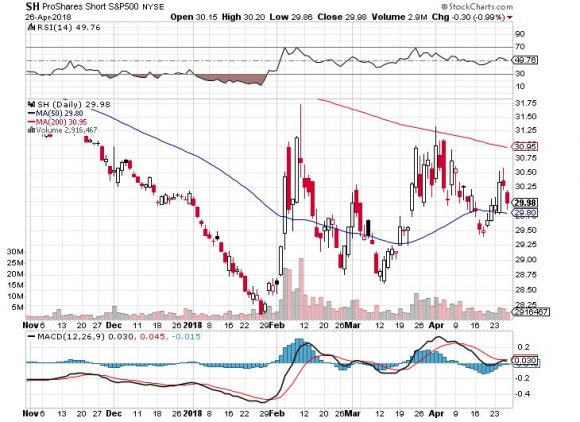
A. Yes, but when I say spike up better expect at least 20 (SPY) points or 1,000 Dow points. All these downside ETFs are great but you've got to get in at the right price. You know as they say in trading school, the profit is always made on the "BUY" and not on the "SELL."
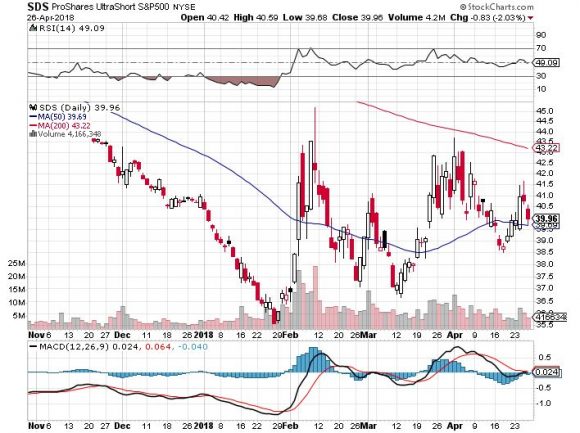
So, if you can get on one of these super spikes up on the short side that is a great trade. So is the ProShares Ultra Short ETF (SDS) if you want to do the 2X leverage short fund. We've recently started doing this every month. We've been shorting (SPY)s and buying (VIX) on every one of these spikes up, and it's been working like a charm.
Q: Here's the best question of the day. Your timing has been perfect says Mary in Chicago, Ill.
A: Well, I'll take that kind of question all day long. Thank you very much. You're too nice to do that.
Q: Richard is asking would you buy an NVIDIA (NVDA) LEAP?
A: I would wait for meltdown days. Remember this is a market that gives you lots of meltdown days. Just wait for the next presidential tweet and you might get another 600-700-point dip in the markets. Those are the days you buy LEAPS. You don't have to get buy writing Trade Alerts like I do. You can just enter a limit order in your account. Put it as a stupidly low level to "BUY" and you may get hit. And that's where you really make the big money in this kind of market.
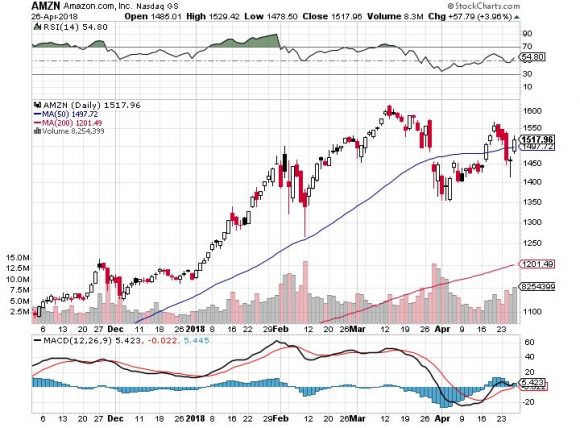
Q: Is there a good one- or two-month trade in Amazon?
A: Yeah, Paul, with this volatility you can pick a big winner like Amazon and you know to buy the 250-point dips and sell the rallies. These ranges are so wide now that even a beginner can make money. So, I would say you have to wait until after tomorrow on Amazon and let them get their earnings out. We know they're going to be great. They're doing home deliveries now to your car.
Q: Can long bond interest rates go up to 4%, and if that happens what would the market do?
A: Yes, they can go up to 4%, and I expect them to probably do that next year. What will it do to the market? Answer: Cause a bear market and a recession. Is that answer clear enough? My bet is that interest rates cap in this cycle much lower than they did in past cycles, maybe 4%-5%. We have been used to zero cost of money for so long that a move to 4% would be like stabbing somebody in the chest. People are much less able to deal with rising rates than they ever have been in the past, so watch this space.
Q: Should I buy the ProShares Ultra Short Treasury ETF (TBT) or the iShares 20+ Year Treasury Bond Fund (TLT)?
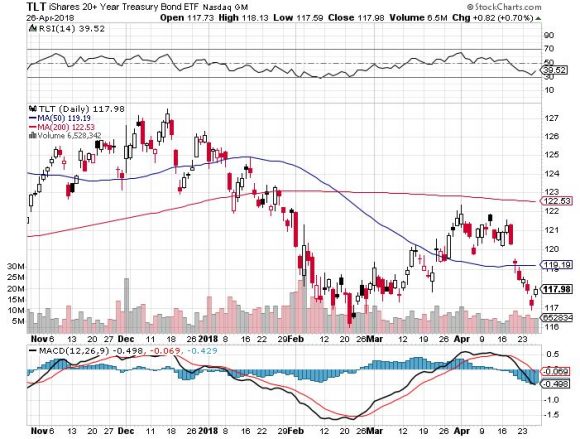
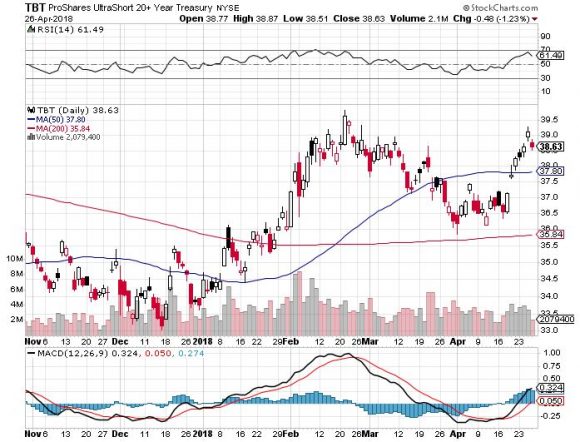
A: Brad, it's really is a leverage question for you. The (TLT) is 1X; the TBT is 2X, so I would be taking profits on the (TBT) here and then buying a couple of points lower. Or if you want to keep it for the long term you can but remember the cost of carry on the TBT is around 7% a year.
Q: Yves in Paris, France is asking: What possible scenario will you see material wage growth that could lead to higher inflation?
A: We're starting to see that now with the ultra-low unemployment rates. People are having great difficulty hiring anyone in technology. But at the minimum wage level there seems to be plenty of supply. The other possibility is that the cost of everything else goes up but wages, because technology is replacing jobs so fast there may never be any increase in wages.
So, we will get inflation, but nothing like the inflation we saw in the past driven by rising wages, commodity prices, oil prices, and interest rates. Yes, money is a commodity, which can add quite a lot to the cost of leveraged companies like airlines, REITs, and so on.
Q: Will rising interest rates force the US dollar up?
A. The answer is yes! It has been a long time coming, but if rates continue to rise from here, you can expect that to lead to a continuously rising dollar and falling foreign currencies, and that will become a major drag on the economy and corporate earnings going forward.
Q: When is a good time to buy TIPS?
A: Just like your Treasury bond short, I would buy Treasury Inflation Protected Securities (TIPS) on the next rally in bond prices (TLT) and dip in yields. That will give you a decent entry point. That said, TIPS have been a horrible performer for the last 10 years because there has just been no inflation. A lot of people just keep TIPS as a hedge in their portfolio and it just costs them money every year.
Q: Which could blow up, Brad wants to know, TBT or TLT?
A: The easy answer there is probably neither. But if I had to pick between the two, the (TBT) would be the one to blow up because it's a 2X and has a lot less liquidity. So, I can't image in what world has (TBT) blowing up, but then I don't watch zombie TV shows either.
Q: I think US equities are expensive. Are emerging markets (EEM) or Europe (HEDJ) a better bet for the rest of the year?
A: I would say yes. Because if interest rates here in the US go higher that means a stronger dollar. That means a weaker US stock market. Because US companies are punished by a rising dollar. And European and Asian companies benefit from a rising dollar and falling home currencies, so that makes Europe the first choice of any of the global markets.
Q: Does oil going to $100 have a chance of bringing down the US economy?
A: Absolutely yes. If oil prices don't start to slow down, they will start having a big impact on the economy because that means rising prices for any energy consumer, which is you and me.
With no ability to offset that by rising prices of your products that would put a squeeze on any oil consuming industry, which is why things like the transports and consumer staples have been performing so poorly. If we get to $100, then you're really looking at a full-on recession and bear market for stocks. By bear market I mean down 25% or more in stocks.
Q: How do you see the India ETF?
A: We like it. India is the No. 1 pick of any hedge fund investor in emerging markets, and the ETF you can buy there is the PowerShares India Portfolio ETF (PIN).