When I closed out my position in Freeport McMoRan (FCX) near its max profit earlier this year, I received a hurried email from a reader if he should still keep the stock. I replied very quickly:
“Hell, yes!”
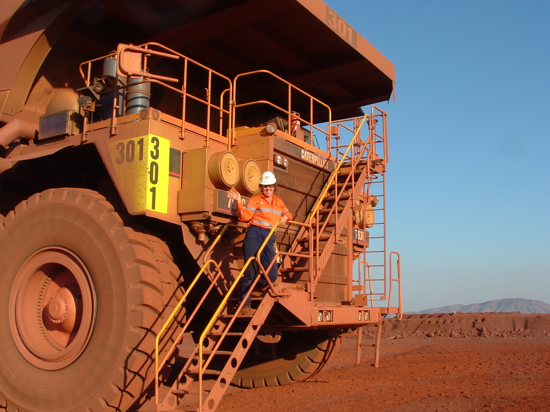
When I toured Australia a couple of years ago, I couldn’t help but notice a surprising number of fresh-faced young people driving luxury Ferraris, Lamborghinis, and Porsches.
I remarked to my Aussie friend that there must be a lot of indulgent parents in The Lucky Country these days. “It’s not the parents who are buying these cars,” he remarked, “It’s the kids.”
He went on to explain that the mining boom had driven wages for skilled labor to spectacular levels. Workers in their early twenties could earn as much as $200,000 a year, with generous benefits.
The big resource companies flew them by private jet a thousand miles to remote locations where they toiled at four-week on, four-week off schedules.
This was creating social problems, as it is tough for parents to manage offspring who make far more than they do.
The Next Great Commodity Boom has started and, in fact, we are already years into a prolonged supercycle that could stretch into the 2030s.
China, the world’s largest consumer of commodities, is currently stimulating its economy on multiple fronts, to break the back of a Covid hangover.
Those include generous corporate tax breaks, relaxed reserve requirements, government bailouts of financial institutions, and interest rate cuts. Get triggers like the impending moderation of its trade war with the US and it will be off to the races once more for the entire sector.
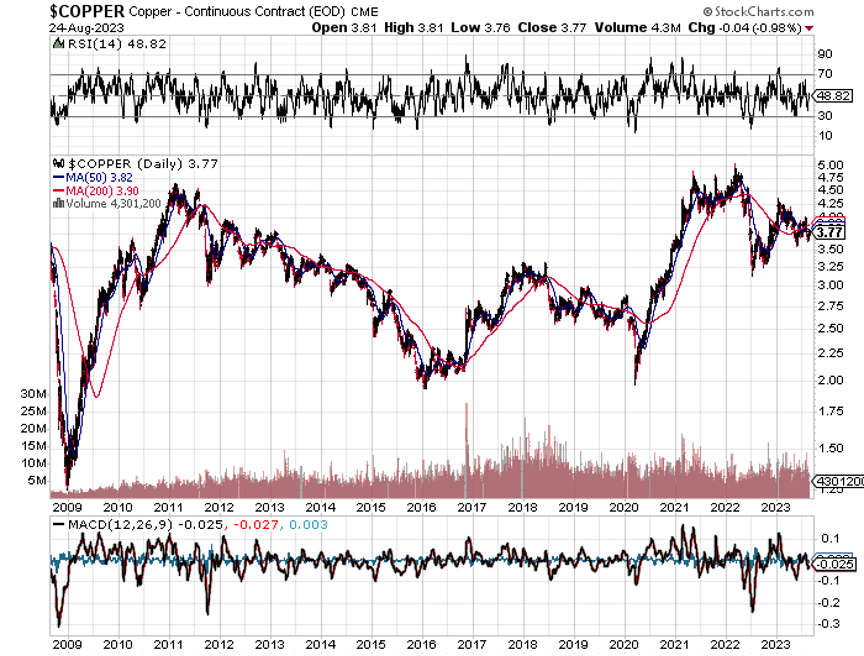
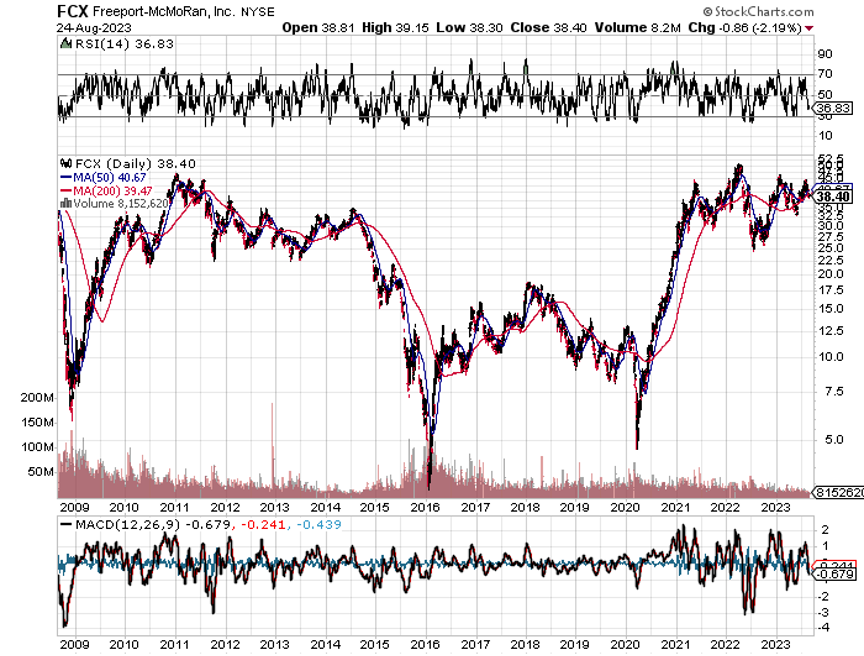
The last bear market in commodities was certainly punishing. From the 2011 peaks, copper (COPX) shed 65%, gold (GLD) gave back 47%, and iron ore was cut by 78%. One research house estimated that some $150 billion in resource projects in Australia were suspended or cancelled.
Budgeted capital spending during 2012-2015 was slashed by a blood-curdling 30%. Contract negotiations for price breaks demanded by end consumers broke out like a bad case of chicken pox.
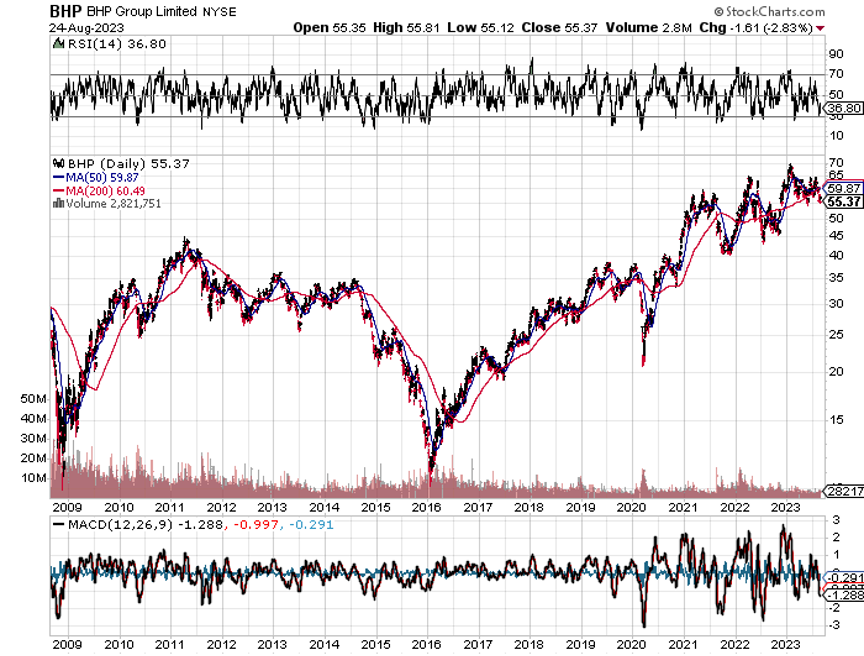
The shellacking was reflected in the major producer shares, like BHP Billiton (BHP), Freeport McMoRan (FCX), and Rio Tinto (RIO), with prices down by half or more. Write-downs of asset values became epidemic at many of these firms.
The selloff was especially punishing for the gold miners, with lead firm Barrack Gold (GOLD) seeing its stock down by nearly 80% at one point, lower than the darkest days of the 2008-9 stock market crash.
You also saw the bloodshed in the currencies of commodity-producing countries. The Australian dollar led the retreat, falling 30%. The South African Rand has also taken it on the nose, off 30%. In Canada, the Loonie got cooked.
The impact of China cannot be underestimated. In 2012, it consumed 11.7% of the planet’s oil, 40% of its copper, 46% of its iron ore, 46% of its aluminum, and 50% of its coal. It is much smaller than that today, with its annual growth rate dropping by more than half, from 13.7% to 3.50% today.
What happens to commodity prices when China recovers even a fraction of the heady growth rates of yore? It boggles the mind.
The rise of emerging market standards of living will also provide a boost to hard asset prices. As China goes, so does its satellite trading partners, who rely on the Middle Kingdom as their largest customer. Many are also major commodity exporters themselves, like Chile (ECH), Brazil (EWZ), and Indonesia (IDX), who are looking to come back big time.
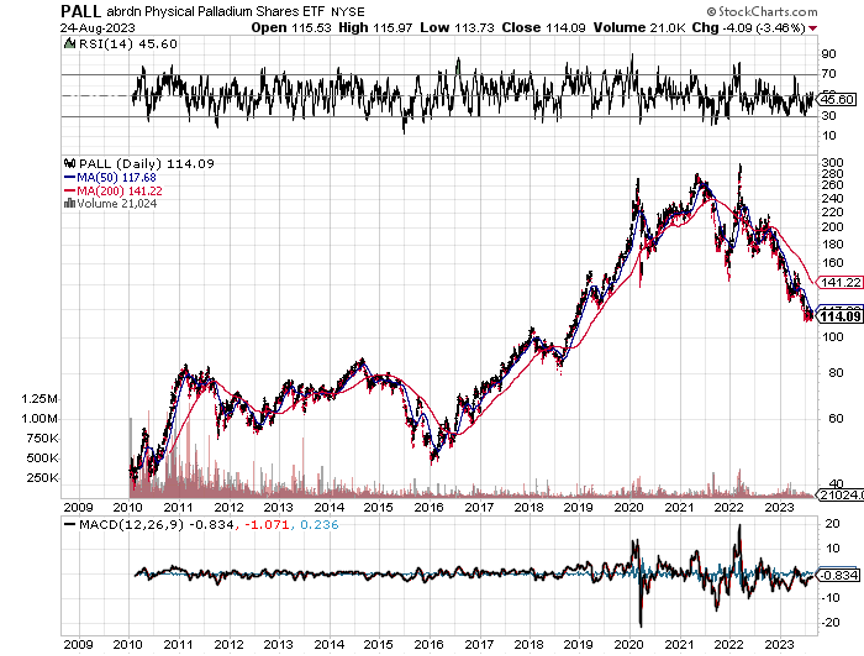
As a result, Western hedge funds will soon be moving money out of paper assets, like stocks and bonds, into hard ones, such as gold, silver (SIL), palladium (PALL), platinum (PPLT), and copper.
A massive US stock market rally has sent managers in search of any investment that can’t be created with a printing press. Look at the best-performing sectors this year and they are dominated by the commodity space.
The bulls may be right for as long as a decade thanks to the cruel arithmetic of the commodities cycle. These are your classic textbook inelastic markets.
Mines often take 10-15 years to progress from conception to production. Deposits need to be mapped, plans drafted, permits obtained, infrastructure built, capital raised, and bribes paid in certain countries. By the time they come online, prices have peaked, drowning investors in red ink.
So a 1% rise in demand can trigger a price rise of 50% or more. There are not a lot of substitutes for iron ore. Hedge funds then throw gasoline on the fire with excess leverage and high-frequency trading. That gives us higher highs, to be followed by lower lows.
I am old enough to have lived through a couple of these cycles now, so it is all old news for me. The previous bull legs of supercycles ran from 1870-1913 and 1945-1973. The current one started for the whole range of commodities in 2016. Before that, it was down from seven years.
While the present one is short in terms of years, no one can deny how business cycles will be greatly accelerated by the end of the pandemic.
Some new factors are weighing on miners that didn’t plague them in the past. Reregulation of the US banking system is forced several large players, like JP Morgan (JPM) and Goldman Sachs (GS) to pull out of the industry completely. That impairs trading liquidity and widens spreads— developments that can only accelerate upside price moves.
The prospect of falling US interest rates is also attracting capital. That reduces the opportunity cost of staying in raw metals, which pay neither interest nor dividends.
The future is bright for the resource industry. While the gains in Chinese demand are smaller than they have been in the past, they are off of a much larger base. In 20 years, Chinese GDP has soared from $1 trillion to $14.5 trillion.
Some 20 million people a year are still moving from the countryside to the coastal cities in search of a better standard of living and improved prospects for their children.
That is the good news. The bad news is that it looks like the headaches of Australian parents of juvenile high earners may persist for a lot longer than they wish.
Buy all commodities on dips for the next several years.
https://www.madhedgefundtrader.com/wp-content/uploads/2019/09/john-and-girls.png322345Mad Hedge Fund Traderhttps://madhedgefundtrader.com/wp-content/uploads/2019/05/cropped-mad-hedge-logo-transparent-192x192_f9578834168ba24df3eb53916a12c882.pngMad Hedge Fund Trader2023-08-25 09:02:392023-08-25 13:41:06The Next Commodity Supercycle Has Already Started
It’s not often that I learn a new word, at least in English anyway. Anyone who has read all 4,000 pages of John Steinbeck, where you are sent running for your Funk & Wagnalls on every page, shouldn’t be surprised too often. Steinbeck spent two winters house-sitting at Lake Tahoe where he memorized the dictionary cover to cover. But, last week I was.
The word in question is “disinversion.”
Disinversion happens in two ways. When bond yields fall and short yields fall much faster, you get good disinversion and stocks usually rise. This is what I expect to happen in 2024 and is why I am loading the boat with falling interest plays like banks (JPM), precious metals (WPM), commodities (FCX), energy (OXY), and REITS (CCI).
However, stock markets are insecure things, afraid of their own shadows, always shrinking from a fight, and constantly looking for new reasons to worry. Now they are also losing sleep over disinversion.
Disinversion also takes place when short rates are falling but bond yields are rising. When that happens the real estate market gets slaughtered but sky-high mortgage rates, the economy collapses and stocks fall. The good news is that bad disinversion only happens about 10% of the time.
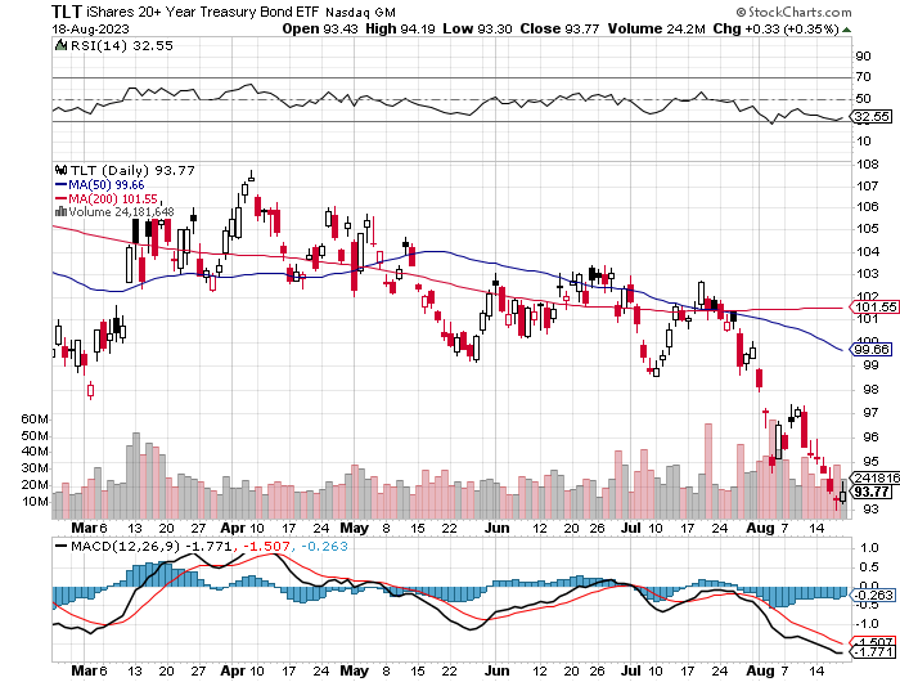
However, a rising number of bond analysts are raising the alarm that we may be in for a dose of the bad kind of disinversion before the good kind kicks in. That could trigger a capitulation in the bond market that could take the ten-year US Treasury bond yield from the current 4.25% yield to 5.0% or even higher, and take the (TLT) down to a low of $90, or even $85. Stocks would drop 10%.
That would be a nightmare for 2024 LEAPS holder, no matter how brief it may be.
It doesn’t help that the government is borrowing now at a record pace, some $109 billion last week alone. That is why the (TLT) is probing one-year lows.
But whether bonds are inverting, disinverting, converting, or perverting, I’ll be buying two-year bond (LEAPS) if that happens. A 100% return in two years on a government bond risk sounds like a petty good deal to me, even if they are now rated only AA+, thanks to you know who. However you look at it, there is one heck of a bond trade setting up.
We may get our answer at 10:05 AM EST on Friday, August 25.
That’s when Jay Powell, the governor of the Federal Reserve, is due to be the keynote speaker at the meeting of global central bankers at Jackson Hole. Will this mark the bottom in bond prices and the top in yields?
Last year, Jay’s mumblings lasted only eight minutes and warned of “pain to come.” Pain we got, but for only two months. After that, it was nine months of pleasure in the form of straight-up stock prices.
Will Jay Powell Drop a Bomb Next Week?
Only Jay Powell knows for sure.
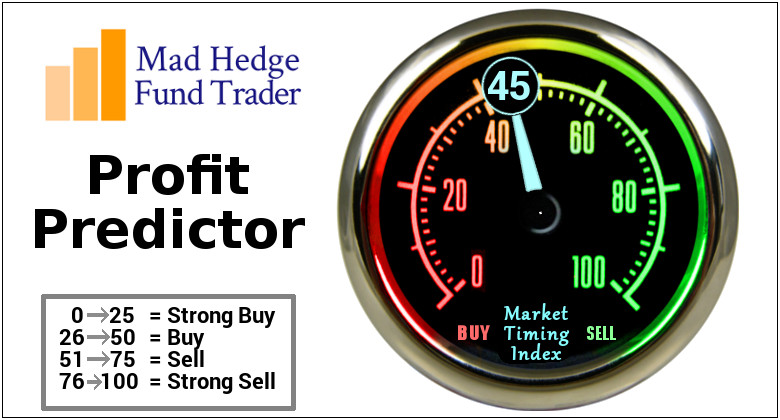
In the meantime, stocks will remain as dead as a doorknob and moribund, if not catatonic. Volatility ($VIX) will hug the $15 level, the “A” Team traders will remain at the Hamptons, and the number of new trades alerts emanating from me will remain precisely at zero.
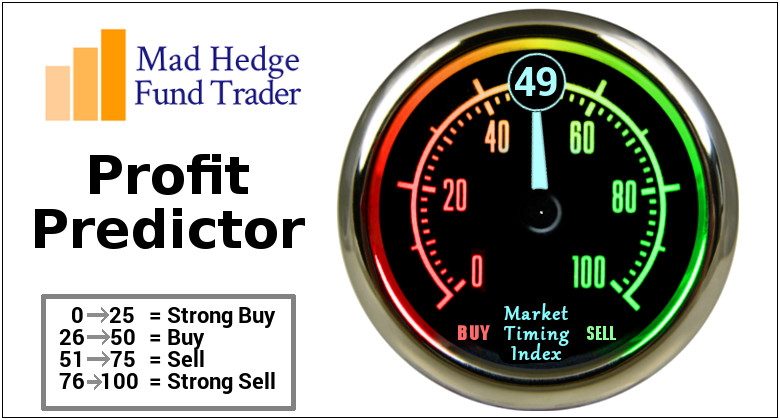
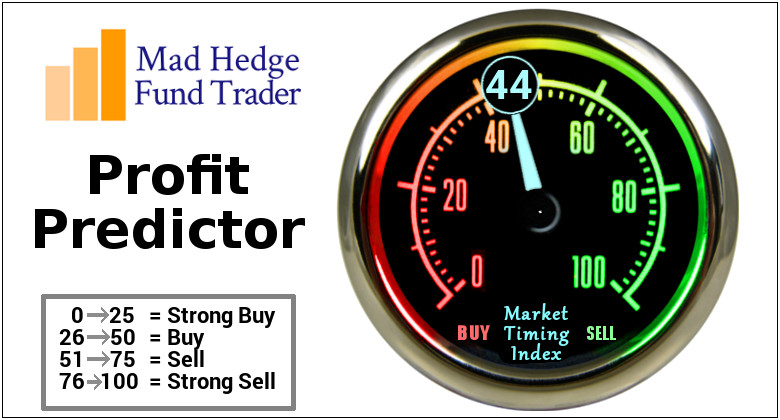
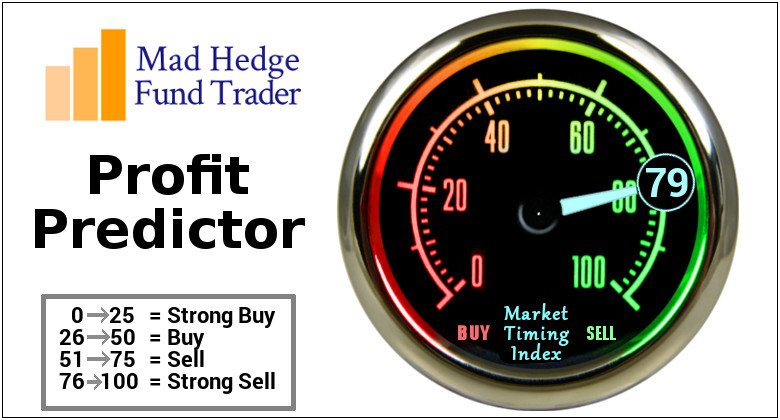
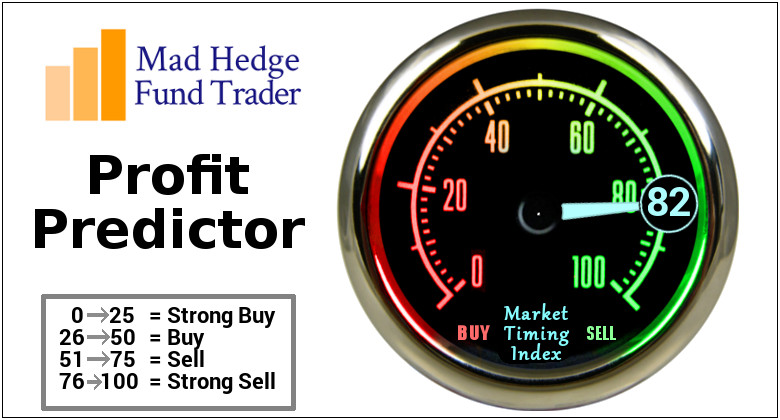
There never is a profit trading when the Mad Hedge AI Market Timing Index vacillates around 50, as it is doing now. Sometimes you just get paid to wait, especially when 90-day T-bills are paying a healthy 5.25%.
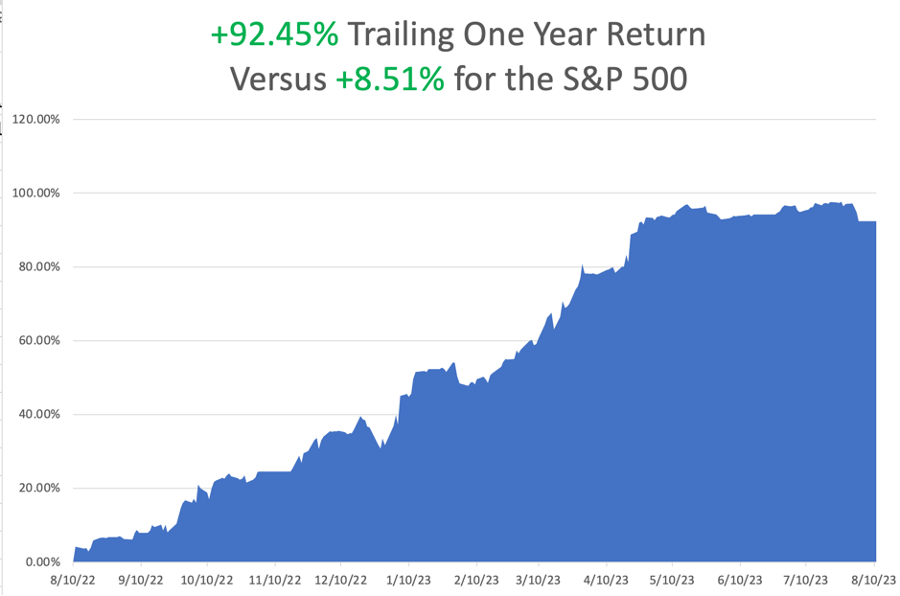
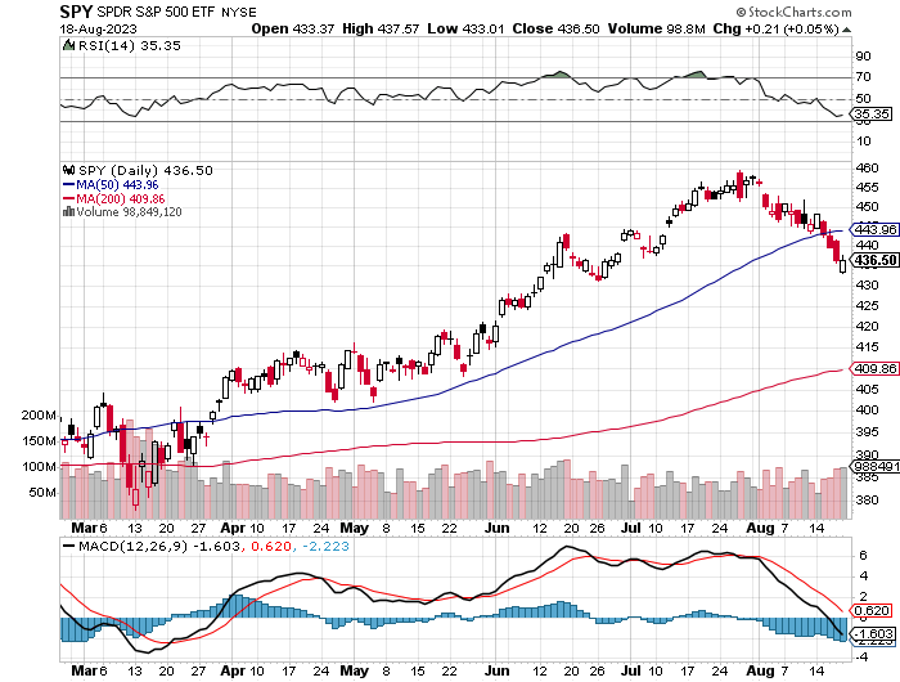
So far in August, we are down -4.70%. My 2023 year-to-date performance is still at an eye-popping +60.80%. The S&P 500 (SPY) is up +17.10% so far in 2023. My trailing one-year return reached +92.45% versus +8.45% for the S&P 500.
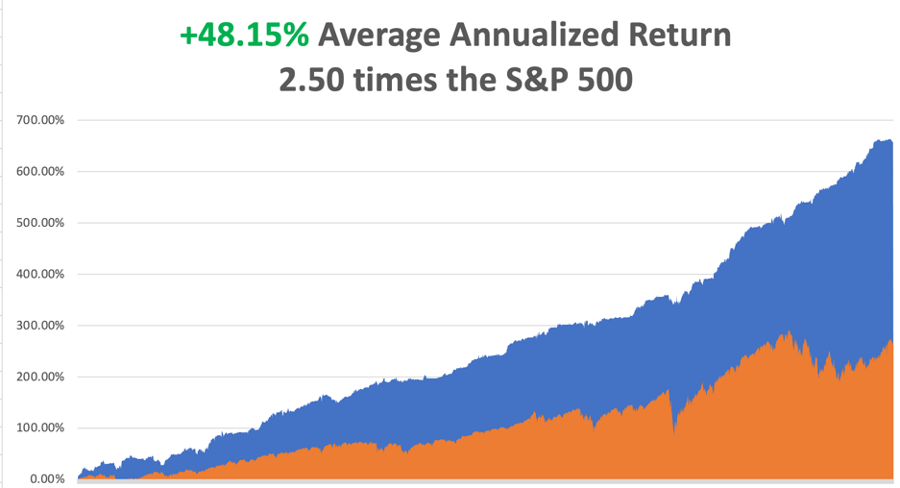
That brings my 15-year total return to +657.99%. My average annualized return has fallen back to +48.15%, another new high, some 2.50 times the S&P 500 over the same period.
Some 41 of my 46 trades this year have been profitable.
My Ten-Year View
When we come out the other side of the recession, we will be perfectly poised to launch into my new American Golden Age, or the next Roaring Twenties. The economy decarbonizing and technology hyper-accelerating, creating enormous investment opportunities. The Dow Average will rise by 800% to 240,000 or more in the coming decade. The new America will be far more efficient and profitable than the old.
Dow 240,000 here we come!
On Monday, August 21, BHP (BHP) and Zoom (ZM) announce earnings.
On Tuesday, August 22 at 7:00 AM EST, Existing Homes Sales for July are released.
On Wednesday, August 23 at 2:30 PM EST, the New Homes Sales are published.
On Thursday, August 24 at 8:30 AM EST, the Weekly Jobless Claims are announced. So are US Durable Goods.
On Friday, August 25 at 7:00 AM, Fed Governor Jay Powell gives his keynote speech at the Jackson Hole Central Bankers Conference. At 2:00 PM, the Baker Hughes Rig Count is printed.
As for me, I am often told that I am the most interesting man people ever met, sometimes daily. I had the good fortune to know someone far more interesting than myself.
When I was 14, I decided to start earning merit badges if I was ever going to become an Eagle Scout. I decided to begin with an easy one, Reading Merit Badge, where you only had to read four books and write one review. I loved reading, so “Piece of cake,” I thought.
I was directed to Kent Cullers, a high school kid who had been blind since birth. During the late 1940s, the medical community thought it would be a great idea to give newborns pure oxygen. It was months before it was discovered that the procedure caused the clouding of corneas and total blindness in infants.
Kent was one of these kids.
It turned out that everyone in the troop already had Reading Merit Badge and that Kent had exhausted our supply of readers. Fresh meat was needed.
So, I rode my bicycle over to Kent’s house and started reading. It was all science fiction. America’s Space Program had ignited a science fiction boom and writers like Isaac Asimov, Jules Verne, Arthur C. Clark, and H.G. Welles were in huge demand. Star Trek came out the following year, in 1966. That was the year I became an Eagle Scout.
It only took a week for me to blow through the first four books. In the end, I read hundreds to Kent. Kent didn’t just listen to me read. He explained the implications of what I was reading (got to watch out for those non-carbon-based life forms).
Having listened to thousands of books on the subject, Kent gave me a first-class education and I credit him with moving me towards a career in science. Kent is also the reason why I got an 800 SAT score in Math.
When we got tired of reading, we played around with Kent’s radio. His dad was a physicist and had bought him a state-of-the-art high-powered short-wave radio. I always found Kent’s house from the 50-foot-tall radio antenna.
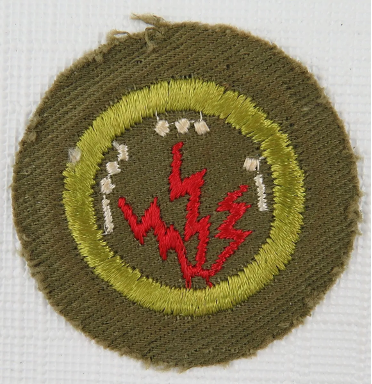
That led to another merit badge, one for Radio, where I had to transmit in Morse Code at five words a minute. Kent could do 50. On the badge below, the Morse Code says “BSA.” In those days, when you made a new contact, you traded addresses and sent each other postcards.
Kent had postcards with colorful call signs from more than 100 countries plastered all over his wall. One of our regular correspondents was the president of the Palo Alto High School Radio Club, Steve Wozniak, who later went on to co-found Apple (AAPL) with Steve Jobs.
It was a sad day in 1999 when the US Navy retired Morse Code and replaced it with satellites and digital communication far faster than any human could send. However, it is still used as beacon identifiers at US airfields.
Kent’s great ambition was to become an astronomer. I asked how he would become an astronomer when he couldn’t see anything. He responded that Galileo, the inventor of the telescope, was blind in his later years.
I replied, “Good point.”
Kent went on to get a PhD in Physics from UC Berkeley, no mean accomplishment. He lobbied heavily for the creation of SETI, or the Search for Extra-Terrestrial Intelligence, once an arm of NASA. He became its first director in 1985 and worked there for 20 years.
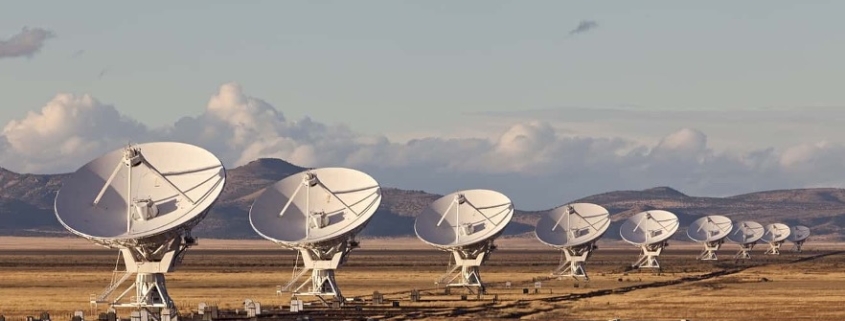
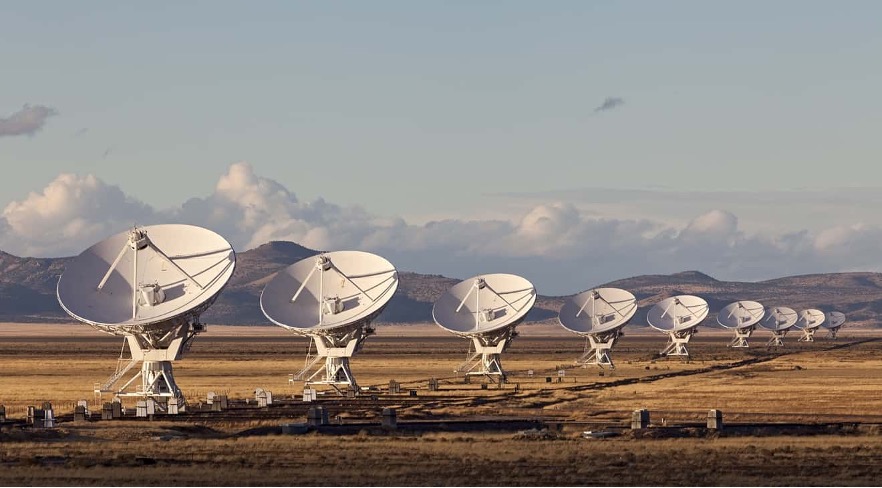
In the 1987 movie Contact, written by Carl Sagan and starring Jodie Foster, Kent’s character is played by Matthew McConaughey. The movie was filmed at the Very Large Array in western New Mexico. The algorithms Kent developed there are still in widespread use today.
Out here in the West, aliens are a big deal, ever since that weather balloon crashed in Roswell, New Mexico in 1947. In fact, it was a spy balloon meant to overfly and photograph Russia, but it blew back on the US, thus its top secret status.
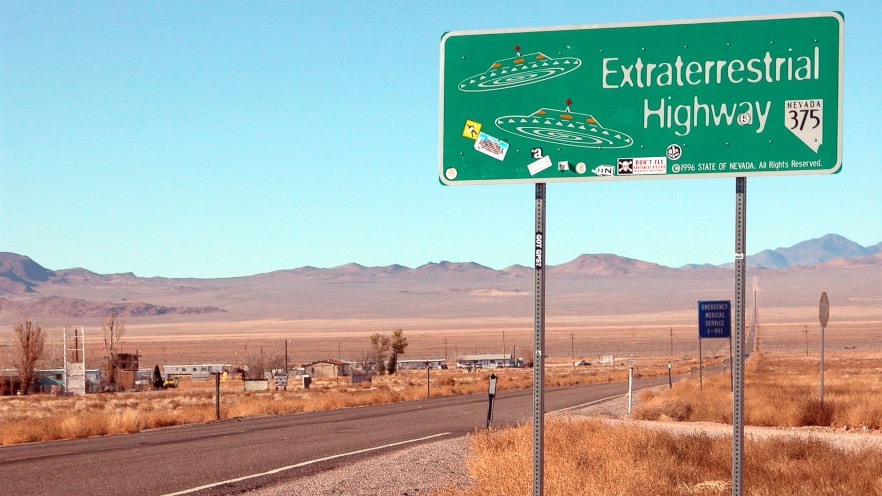
When people learn I used to work at Area 51, I am constantly asked if I have seen any spaceships. The road there, Nevada State Route 375, is called the Extra Terrestrial Highway. Who says we don’t have a sense of humor in Nevada?
After devoting his entire life to searching, Kent gave me the inside story on searching for aliens. We will never meet them but we will talk to them. That’s because the acceleration needed to get to a high enough speed to reach outer space would tear apart a human body. On the other hand, radio waves travel effortlessly at the speed of light.
Sadly, Kent passed away in 2021 at the age of 72. Kent, ever the optimist, had his body cryogenically frozen in Hawaii where he will remain until the technology evolves to wake him up. Minor planet 35056 Cullers is named in his honor.
There are no movies being made about my life…. yet. But there are a couple of scripts out there under development.
Watch this space.
Good Luck and Good Trading,
John Thomas
CEO & Publisher
The Diary of a Mad Hedge Fund Trader
Dr. Kent Cullers
New Mexico Very Large Array
Reading Merit Badge
Radio Merit Badge
https://www.madhedgefundtrader.com/wp-content/uploads/2023/08/array.jpg488882Mad Hedge Fund Traderhttps://madhedgefundtrader.com/wp-content/uploads/2019/05/cropped-mad-hedge-logo-transparent-192x192_f9578834168ba24df3eb53916a12c882.pngMad Hedge Fund Trader2023-08-21 09:02:002023-08-21 12:53:10The Market Outlook for the Week Ahead, or Learning a New Word
Below please find subscribers’ Q&A for the August 16 Mad Hedge Fund Trader Global Strategy Webinar, broadcast from Silicon Valley, CA.
Q: Did you hear that Michael Burry was putting on a big short (the guy who made a fortune shorting housing in 2009)?
A: Yes, I heard that, but I never, ever trade-off of those kinds of comments. First of all, I think he’s wrong; and often, what happens in those situations is you hear about them going into the trade, but you never hear about them getting out, which might be tomorrow or next week. Also, there’s a nasty habit of big hedge fund managers telling you the opposite of what they’re actually doing. We hear big hedge fund traders like Bill Ackman getting super bearish at market bottoms, and then a few months later learn that they were buying with both hands, as was the case with the pandemic bottom. Be careful about other people’s opinions—they can be hazardous to your wealth. Just look at the data and the facts. That’s what I do.
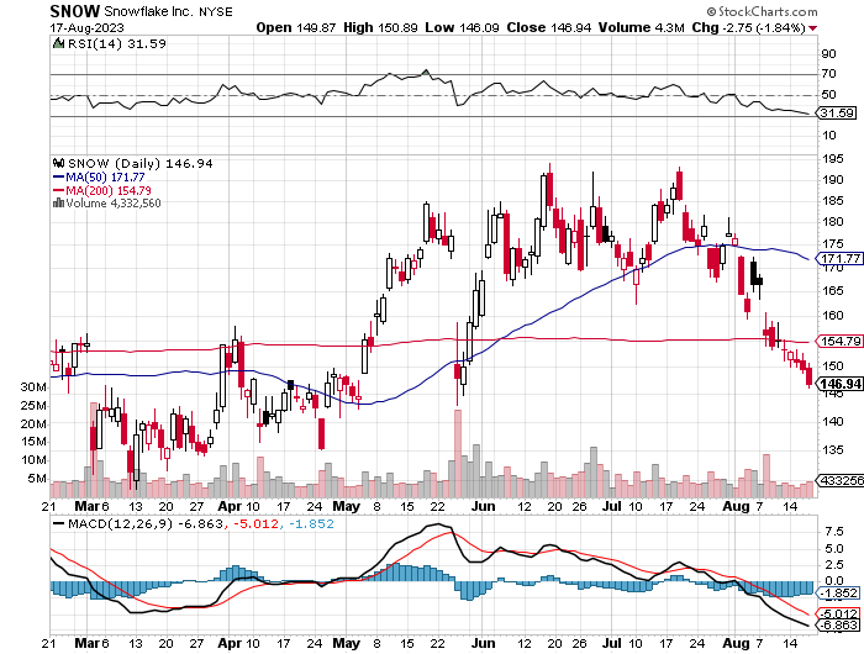
Q: Would you buy Snowflake (SNOW) around current prices?
A: Yes—first of all Snowflake is a Warren Buffet favorite, which I always tend to follow. However, Warren can wait 5 years for a stock to work, and you can’t. So, I would wait for a bigger dip before getting into SNOW. So far, we are down 25% from the recent peak. One thing’s for sure, cybersecurity is a long-term winner, as seen by the ballistic move in Palo Alto Networks (PANW) since we started recommending it about 8 years ago.
Q: Why are US consumers so strong, and will that hold up for the rest of 2023?
A: US consumers are so strong because they banked so much money during 10 years of QE and all the pandemic stimulus, that they have a lot saved. They are now happy to spend to make up for the spending they couldn’t do during the pandemic. They’re basically in spending catch-up mode or revenge spending.
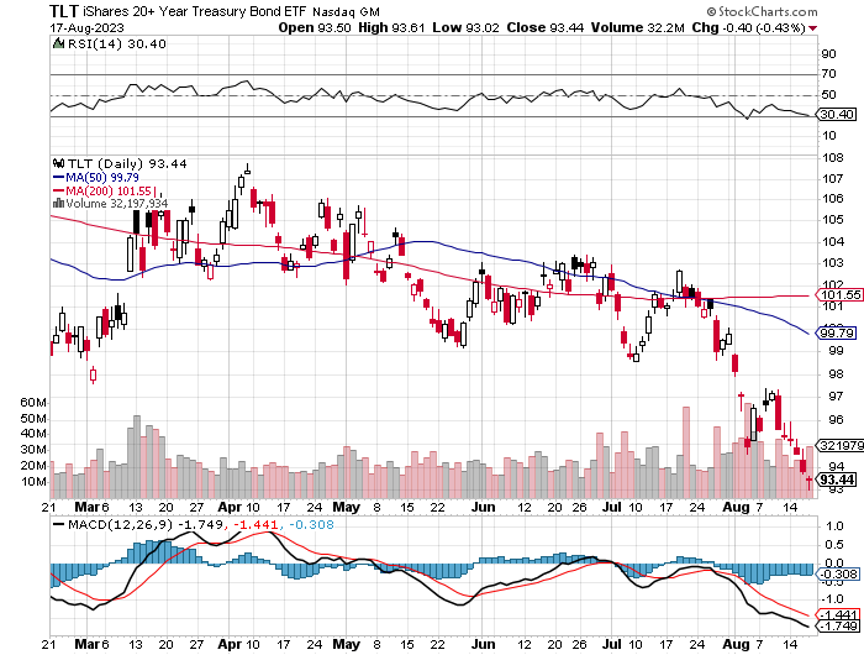
Q: How far do you see the iShares 20 Plus Year Treasury Bond ETF (TLT) go?
A: My worst-case scenario has it going to $90 down from $94—that’s a yield of about 4.50%. And that's where a lot of bond investors see fair value, and will start piling in. But as long as the momentum is against it, I’m not touching it. As soon as I am convinced there is a real bottom in the (TLT), I’m going to jump in with both hands and buy long-term LEAPS, where you can get a 100% or 200% return pretty quickly.
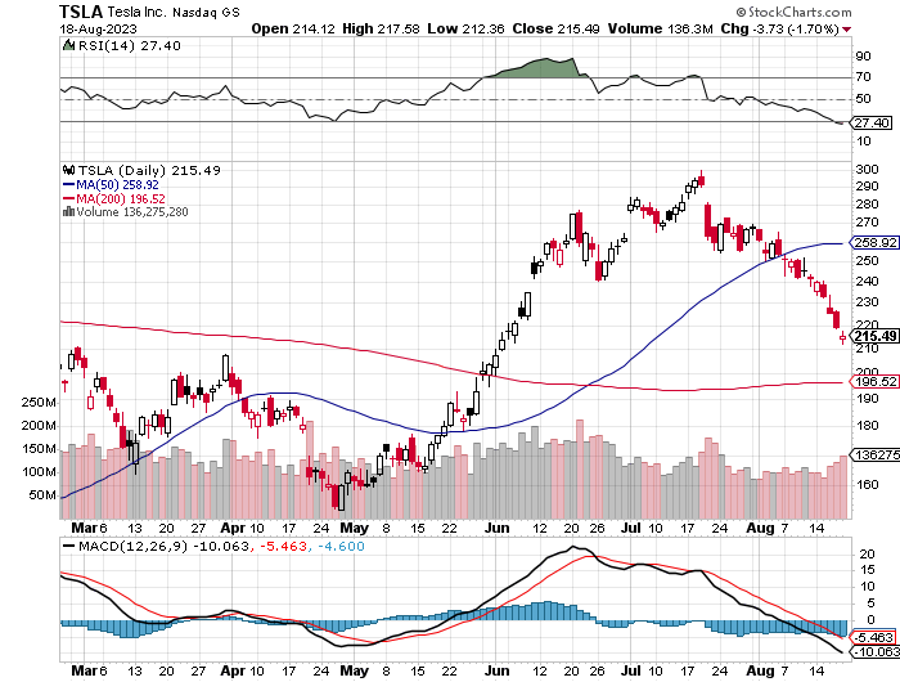
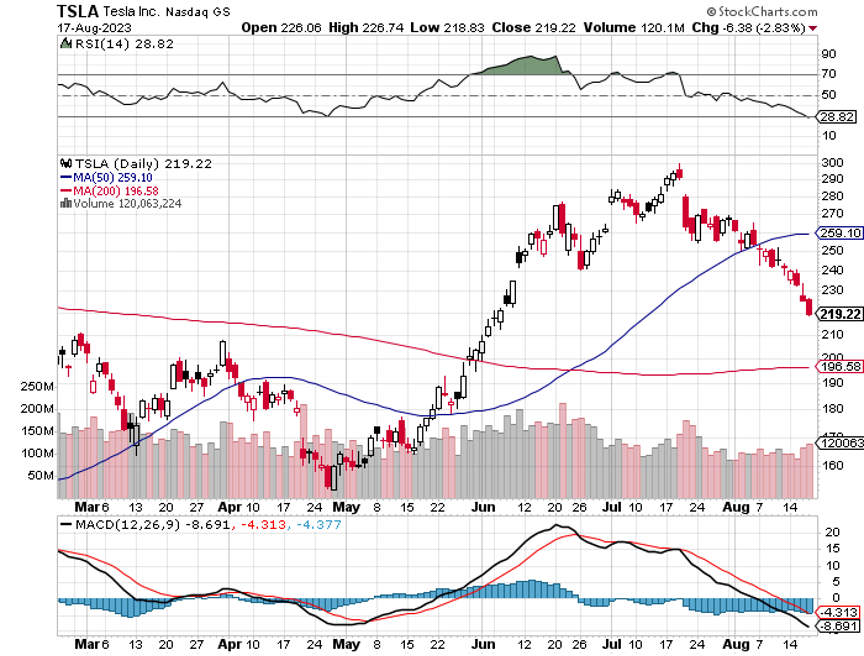
Q: Time to buy the Tesla (TSLA) dip?
A: We’re getting close. My guess is you might get a spike down to $200 from the recent $300 high. That’s also going to be LEAPS territory for us because the long-term outlook for this company is spectacular.
Q: What do you think of Freeport McMoRan (FCX), Silver (WPM), and United States Natural Gas Fund (UNG)?
A: I think they are all strong buys; I have LEAPS out on all of them. I think we start to get a big move in the 4th quarter of this year that’ll go well into next year—so big money just sitting on the table begging for you to take it.
Q: What are we to make of the crash of the Chinese Yuan?
A: The Chinese economy is weak and looks like it’s getting weaker. They still have a pandemic hangover. We don’t know what their real pandemic numbers are—they adopted our pandemic policy 2 years after we did, and they’re suffering as a result. They also insist on using their own vaccine, Sinovac, for nationalist reasons which is only 30% effective. But, when the Chinese economy does come back on stream, that’ll be the gasoline on the fire for the global economy, and that’s why we like commodities, industrials, energy, and so on.
Q: What does an 8% mortgage rate mean for the housing sector?
A: It is a disaster. I don’t think prices will drop very much—it’ll just cease all new buying because nobody qualifies for an 8% mortgage. They are going to either be only cash buyers out there or people waiting for the next drop in interest rates, and we’re already seeing that with the mortgage rate at 7.24%. If we do get a move up to 8%, it’ll just be a short-term spike that won’t last very long.
A: Yes, absolutely. Since people can’t afford to buy houses, they are renting until they can, which pushes rental prices up and adds to the inflation numbers.
Q: When do you think the tech sector will rebound? It’s had a really bad three weeks.
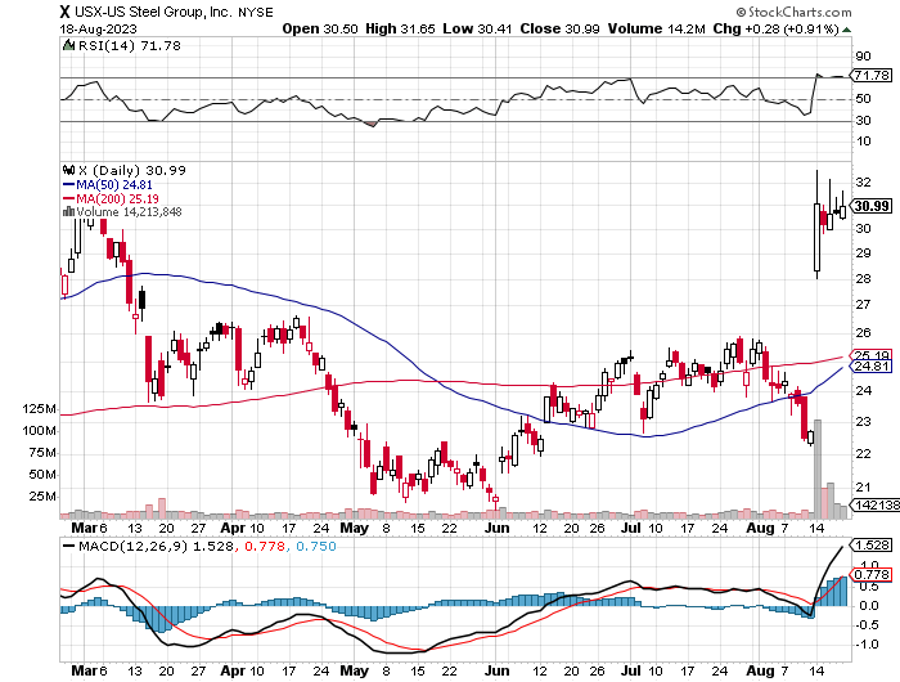
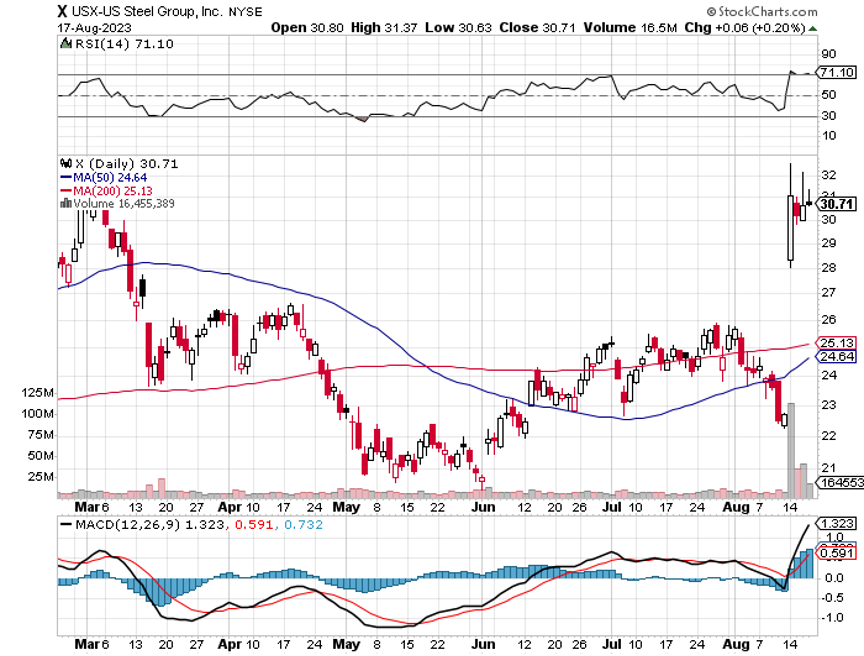
A: End of August or sometime in September. I think. When people come back from the beach, they’re going to look at the long-term future of these companies and think “holy smokes,” why don’t I own more of these?” And we may even be doing LEAPS at high prices, which I almost never do, but the growth rate in tech next year is looking to be spectacular, and I think if we do a conservative at-the-money, we should at least double our money in a few months, similar to how US Steel (X) LEAPS did.
Q: Is Amazon (AMZN) a buy? They’re starting to develop their pharmacy rather well.
A: Yes, Amazon is on the buy list—it’s already up 50% this year. Jassy, the new CEO, is doing a great job. They also have a massive investment in AI which they can monetize anytime they want, and online pharmacies are a great place to start. They’ve been talking about doing that for at least 10 years.
Q: Are gold (GLD), wheat (WEAT), and precious metals a buy?
A: Yes, those are all strong buys on the dip.
Q: What about Tesla (TSLA) LEAPS?
A: Yes Tesla is definitely a LEAPS candidate $30 down from where it is now.
Q: What about Crown Castle International (CCI)?
A: CCI took a major hit from Verizon, canceling a contract with them (which is their biggest customer), so I want to wait for that to digest before I do anything yet. However, we are definitely approaching “BUY” territory; I think the yield is up to about 6.5% now.
Q: Should I take profits on the next jump up in United States Steel Corporation (X)?
A: Yes, it’s not worth hanging on 16 more months to maturity when there’s only 30% of the profit left. And, if all the takeover bids fail for some reason, the stock goes back to $20, and then your LEAPS becomes worthless. So, I would take profits; 100% profit in 2 months is nothing to turn up your nose at.
Q: How confident are you in (TLT) going to $110 by the end of the year?
A: Very confident; by then we will start seeing more hints of Fed interest rate cuts, inflation should be lower, and Goldman Sachs is in fact forecasting that the first rate cut will happen in March. So you’ll certainly start discounting that in the (TLT) by December. We could see the high in yields and the low in prices at the central bankers conference in Jackson Hole next week.
Q: What do you think about cruise lines and hotels right now?
A: The business is great, they’re all packed. However, during the pandemic, these sectors had to take on massive amounts of debt to keep from going under when their ships were tied up with zero revenue for two years; same with the hotels. So, the balance sheets are terrible in all of these areas including airlines. That’s why I’ve been avoiding them, too many better plays. Don’t go away from your core trades looking for trouble.
Q: When do we finally start seeing the Fed stop raising rates?
A: I think they already have; I think the most recent rate rise was the last one. If I’m wrong, they’ll do one more quarter—it’s totally dependent on the numbers.
Q: Won’t falling rates be bullish for bonds and gold?
A: Yes, that's why we’re buying them; but I’m waiting on the bond LEAPS—I want to see a firm bottom before getting back in there. 2024 will be all about falling interest rates plays.
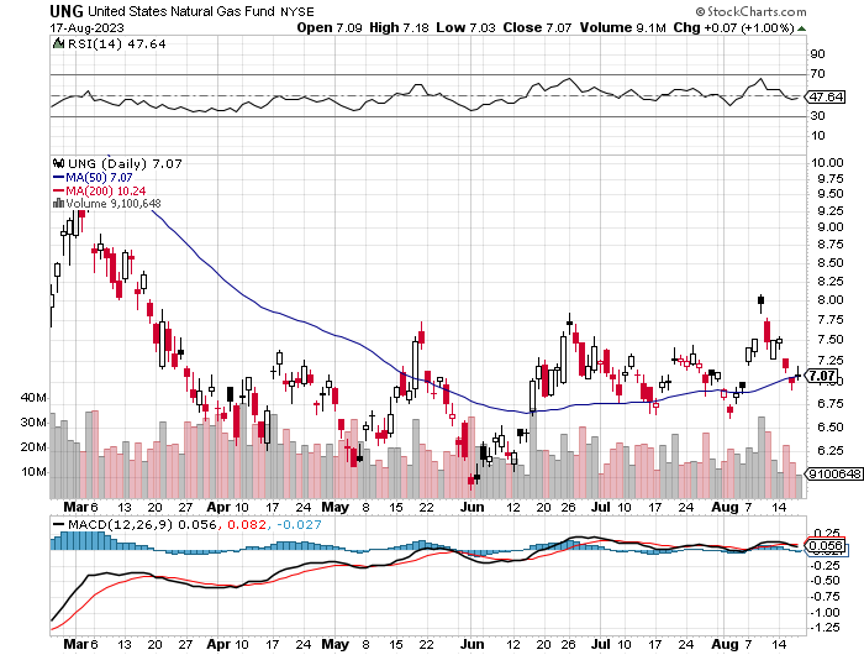
Q: What’s causing the volatility in the United States Natural Gas Fund (UNG)?
A: A Strike in Australia, collapsing supplies in Europe (where prices are up 40%), and expectation of a global economic recovery in China. Ultimately, it’ll be China that takes this thing up to $10, $12, or $14 for the UNG, but you need them to recover first. That’ll probably happen next year, which is why we have the two-year LEAPS on there.
Q: With junk (JNK), have we seen the high rates?
A: Yes. If not, we’re very close, so it’s worth starting to scale in here.
Q: Should I short Home Depot (HD), as US consumers are holding back on home upgrades?
A: No, you should not short anything because you’re going against a long-term bull market trend that probably continues for another 10 years. So, any shorts should be measured in days and not weeks.
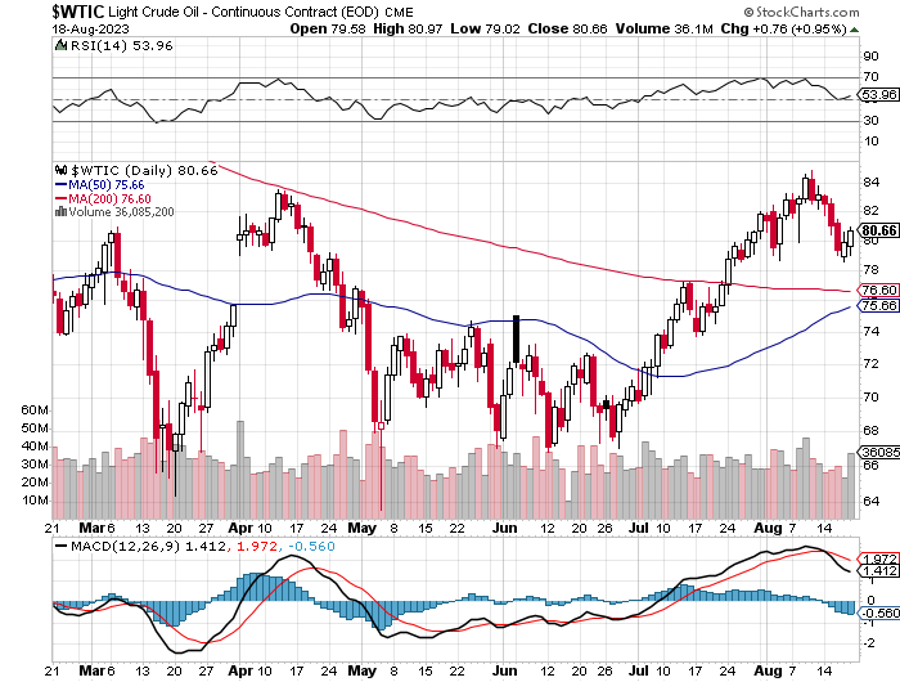
Q: Should I start chasing oil, because it’s been on quite a run, and should I buy Exxon (XOM)?
A: Yes, if we get an economic recovery next year, oil goes over 100 easily and will take all the oil companies up with it.
Q: Is (UNG) a domestic or foreign gas ETF?
A: It’s mostly domestic, and it’s a mix of the top natural gas producers in the US.
Q: Are the BRIC countries going to bring down the dollar?
A: You’ve got to be out of your mind. Would you rather store your money in China and Indonesia or the US? That’s your choice. I know there’s a lot of internet conspiracy theories out there—I get about a question a day on this. It’s Never going to happen; not in my lifetime. But it does attract internet traffic, which is the purpose of putting out these ridiculous stories like a BRIC-engineered digital currency replacing the dollar as a reserve currency. It’s just clickbait.
Q: Why is there a short squeeze in copper?
A: EV production is going from 2 million to 10 million a year in 2030, and every EV needs 200 pounds of copper. By the way, there are now 527 EV models on the market, but only one company makes money doing this, and that’s Tesla (TSLA).
Q: We’ve been waiting for a recession in the US for years, and US consumers are still going strong. What gives? I want rates to drop so I can invest in real estate again.
A: Well, yes. This recession has been predicted for 2 years. The problem is we have a certain political party telling us every day that the economy is the worst it’s ever been when, in actuality, the health of the economy is amazingly strong, and certainly the strongest economy in the world. So, I don't think we get a real recession until well into the 2030s because of massive technological development and a huge demographic tailwind—that’s an absolute winning combination, last seen in the 1990s. Plus, now we have AI accelerating everything. So, look at the numbers; don’t listen to opinions. Opinions can be fatal to your wealth.
Q: Does the use of an adjustable-rate loan make sense for the purchase of a second home?
A: Yes, it does. During the great interest rate spike of the 1980s, I bought my home in New York with an adjustable-rate loan. The initial interest rate was 18%, but when rates dropped to 11%, the value of the home tripled. Not a bad trade—and I bet the same kind of opportunity is out there now, provided you can get another adjustable-rate loan. By the way, in Europe, they only have adjustable-rate loans. The 30-year fixed anomaly only exists in the US and Canada because you have the US government as the unlimited buyer of last resort for 30-year fixed mortgages.
Q: Thoughts on other steel companies and aluminum?
A: I like them all. The country needs 200,000 miles of new long-distance transmission lines to accommodate the electrification of the economy, and those are all made out of aluminum except for the last mile—most people don’t know that. Buy Alcoa (AA).
To watch a replay of this webinar with all the charts, bells, whistles, and classic rock music, just log in to www.madhedgefundtrader.com , go to MY ACCOUNT, click on GLOBAL TRADING DISPATCH, then WEBINARS, and all the webinars from the last 12 years are there in all their glory.
Good Luck and Stay Healthy
John Thomas
CEO & Publisher
The Diary of a Mad Hedge Fund Trader
https://www.madhedgefundtrader.com/wp-content/uploads/2023/08/john-thomas-fountain.jpg411308Mad Hedge Fund Traderhttps://madhedgefundtrader.com/wp-content/uploads/2019/05/cropped-mad-hedge-logo-transparent-192x192_f9578834168ba24df3eb53916a12c882.pngMad Hedge Fund Trader2023-08-18 09:02:532023-08-18 19:14:59August 16, 2023 Biweekly Strategy Webinar Q&A
Large parts of the UK economy are shutting down today, including the entire rail system, due to extreme heat. The temperature in London today is expected to top a record 107 degrees. Much of Britain’s infrastructure is simply not designed to operate at these temperatures.
France is worse, with temperatures there reaching 113 degrees. It will not be the last time that temps get this high. As for Southern Italy, it has become uninhabitable by humans at 116 degrees.
That brings the prospect that weather forecasts may become a much more important aspect of stock market predictions than they have in the past. Just like we have to now include new covid cases and deaths as part of our daily calculation, so might the high temperature of this day.
The temperature has in effect become a new economic indicator.
As for me, I am high in the Alps at 7,000 feet where it is a much more comfortable 80 degrees. The rivers are roaring below me with record glacier melts, tar on the roads is melting, and it is too hot to hike. With ice disappearing, there is talk of the Matterhorn breaking apart.
But at least I can catch up on my paperwork. The trouble is, so is everyone else and my Internet speed has slowed from 45 megabytes per second to an unusable 10.
Below is an email I received from British Rail which I rode only last week.
Dear Customer,
You may be aware that Network Rail has urged people across the country to only travel if absolutely necessary on Monday 18 and Tuesday 19 July. This comes as a result of the extreme heat forecast for these two days.
On Monday and Tuesday, temperatures are expected to reach up to 42°C in London and the surrounding area, and the mid-30s in the western parts of our network. As rail temperatures can be up to 20°C higher than the air around them, there is a risk of them buckling in the extreme heat.
As a result, Network Rail will introduce speed restrictions across the network to minimize the force on the tracks and reduce the chance of buckling. These speed restrictions will, in turn, make journeys longer and we will introduce a reduced service on Monday and Tuesday in a bid to give our customers certainty on what will run.
The speed restrictions will particularly affect our mainline services, with long-distance services to Exeter, Salisbury, Bournemouth, Weymouth, Southampton, and Portsmouth most likely to be impacted.
Service changes are likely to appear in journey planners at short notice, so anyone who chooses to travel despite the warnings on Monday or Tuesday is urged to check their journey before setting off and to expect last-minute delays and cancellations.
If you have no choice but to travel, you are urged to carry water with you, cover up, and wear sunscreen when traveling. Find out more about traveling in hot weather here.
If you choose to delay your travel, please note that the original ticket restrictions will still apply. If you are using an Advance Purchase ticket, please travel as close to the original departure time as possible or make use of Book With Confidence.
Thank you for your patience and understanding.
Yours sincerely,
South Western Railway
https://www.madhedgefundtrader.com/wp-content/uploads/2022/07/1yr-july1822.jpg331441Mad Hedge Fund Traderhttps://madhedgefundtrader.com/wp-content/uploads/2019/05/cropped-mad-hedge-logo-transparent-192x192_f9578834168ba24df3eb53916a12c882.pngMad Hedge Fund Trader2023-08-16 09:02:082023-08-16 11:33:16My New Economic Indicator
Recently, I have been touting a 2022 track record of +84.63%.
I have a confession to make.
I lied.
In actual fact, my performance was far higher than that. In reality, I generated a multiple of that +84.63% figure.
That is because my published performance is only for my front-month short-term trade alerts. It does not include the LEAPS recommendations (Long Term Equity Anticipation Securities) issued in 2022, the details of which I include below.
LEAPS have the identical structure as a front month vertical bull call debit spread. The only difference is that while front-month call spreads have expiration dates of less than 30 days, LEAPS go out to 18-30 months.
LEAPS also have strike prices far out of-the-money instead of deep in-the-money, giving you infinitely more upside leverage. LEAPS are actually synthetic futures contracts on the underlying stock.
Of the 12 LEAPS executed in 2022, eight made money and four lost. But the successful trades win big, up to 1,260% in the case of NVDIA (NVDA). With the losers, you only write off the money you put up.
And you still have 18 months until expiration for my four losers, ample time for them to turn around and make money. In the case of my biggest loser for Rivian (RIVN), Tesla launched an unprecedented EV price way shortly after I added this position. Never take on Tesla in a price war. Black swans happen.
Of course, timing is everything in this business. I only add LEAPS during major market selloffs as the leverage is so great, over 20X in some cases, of which there were four in 2022.
If you would like to receive more extensive coverage of my LEAPS service, please sign up for the Mad Hedge Concierge Service where you can excess a separate website devoted entirely to LEAPS. Be aware that the Concierge Service is by application only, has a limited number of places, and there is usually a waiting list.
Given the numbers below, it is easy to understand why most professional full-time traders only invest their personal retirement funds in LEAPS.
John Thomas
CEO & Publisher
The Diary of a Mad Hedge Fund Trader
The Sweet Taste of LEAPS
https://www.madhedgefundtrader.com/wp-content/uploads/2023/06/john-thomas-red-wine.jpg292317Mad Hedge Fund Traderhttps://madhedgefundtrader.com/wp-content/uploads/2019/05/cropped-mad-hedge-logo-transparent-192x192_f9578834168ba24df3eb53916a12c882.pngMad Hedge Fund Trader2023-06-29 09:02:042023-06-29 12:30:12My 2022 LEAPS Track Record
https://madhedgefundtrader.com/wp-content/uploads/2019/05/cropped-mad-hedge-logo-transparent-192x192_f9578834168ba24df3eb53916a12c882.png00Mad Hedge Fund Traderhttps://madhedgefundtrader.com/wp-content/uploads/2019/05/cropped-mad-hedge-logo-transparent-192x192_f9578834168ba24df3eb53916a12c882.pngMad Hedge Fund Trader2023-06-20 09:04:002023-06-20 14:05:54June 20, 2023
Legal Disclaimer
There is a very high degree of risk involved in trading. Past results are not indicative of future returns. MadHedgeFundTrader.com and all individuals affiliated with this site assume no responsibilities for your trading and investment results. The indicators, strategies, columns, articles and all other features are for educational purposes only and should not be construed as investment advice. Information for futures trading observations are obtained from sources believed to be reliable, but we do not warrant its completeness or accuracy, or warrant any results from the use of the information. Your use of the trading observations is entirely at your own risk and it is your sole responsibility to evaluate the accuracy, completeness and usefulness of the information. You must assess the risk of any trade with your broker and make your own independent decisions regarding any securities mentioned herein. Affiliates of MadHedgeFundTrader.com may have a position or effect transactions in the securities described herein (or options thereon) and/or otherwise employ trading strategies that may be consistent or inconsistent with the provided strategies.