It now appears that the ?Alibaba? correction (BABA) is at hand.
I warned you, pleaded with you, and begged you about this yesterday, and on May 8 (click here for ?Will Alibaba Blow Up the Market?).
The longer the company postponed the mother of all IPO?s, the higher the prices flew, until we finally got a print at the absolute apex of the market. Now, it?s time to pay the piper.
The development is part of a broader move out of riskier, higher beta stocks into safe, large caps that has been underway for several weeks now. Those traders who are ahead want to protect their years. Those who aren?t are screwed anyway, so don?t bother returning their phone calls.
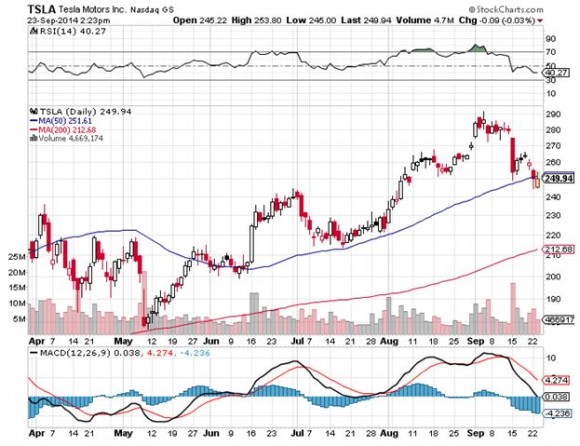
Look no further than my favorite, Tesla (TSLA), which topped out on September 3, along with the rest of the MoMo high technology, biotechnology and Internet names.
Still love the cars, though.
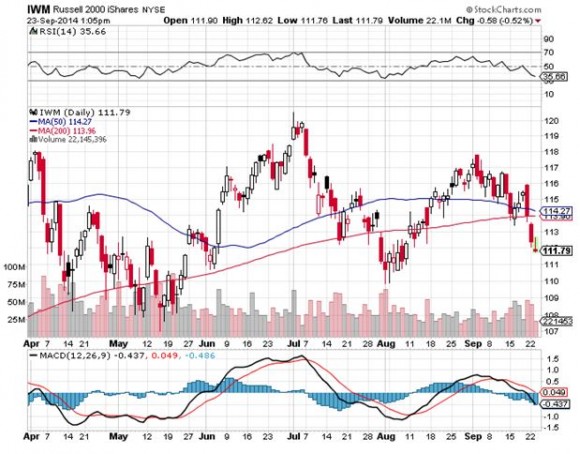
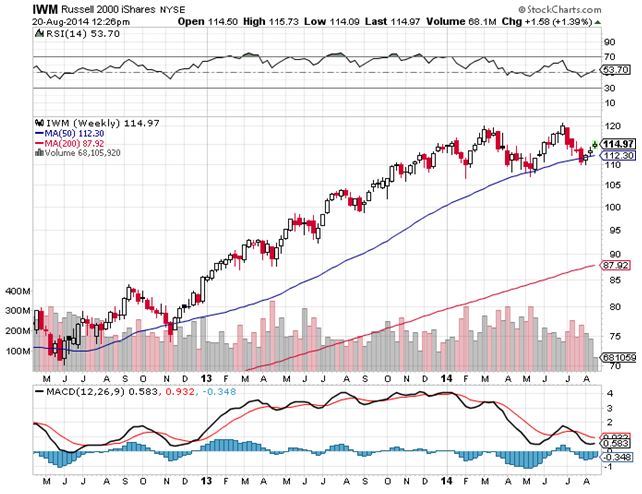
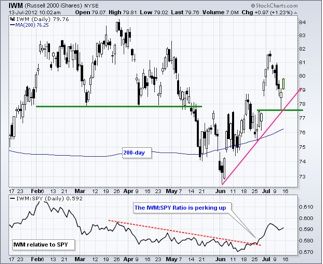
The (IWM) has really been sucking hind teat all year, falling by 3% year to date compared to an 8% gain in the S&P 500.
Yesterday, the sushi really hit the fan when the 50-day moving average pierced the 200-day moving average for the first time since August, 2011. Known as a much dreaded ?death cross,? this is the technical equivalent of slitting both wrists and thrashing about in shark-invested waters, heralding more declines to come.
Let me list the reasons why this is the sector traders love to hate when markets move from ?RISK ON? to ?RISK OFF?:
*Since small companies borrow more than large companies, they are far more sensitive to rising interest rates. Guess what? Rates have been rocketing this month.
*Since small companies are more leveraged (indebted) than big ones, they are more sensitive to a slowing economy.
*Small companies don?t have the international diversification of their bigger brethren, and therefore have less of a financial cushion to fall back on.
*The (IWM) has roughly 1.5 times the volatility of the S&P 500, making a short position here fantastic downside protection for a broader based portfolio of stocks. So you get a lot of selling here, as managers try to lock in performance for fiscal years that start ending as early as October 31.
*Did I mention that the stock market is at one of its most overbought levels in history, the worst since 1928? Bearish sentiment is at only 13%, the lowest since 1987. These are more reason to sell, as if you needed any.
My readers have made tons of money over the years playing the (IWM) on the short side. It?s time for another visit to the trough. I?m not finishing my year early.
Not yet, anyway.
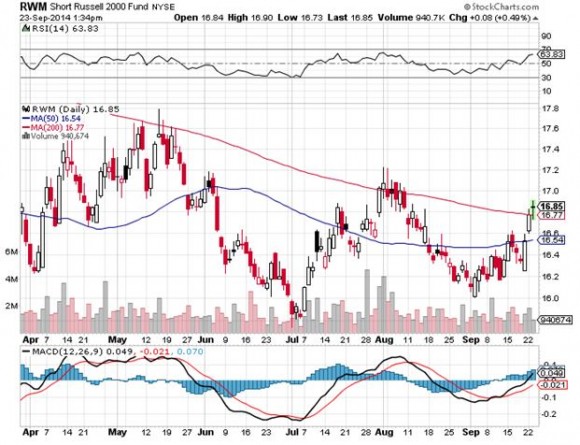
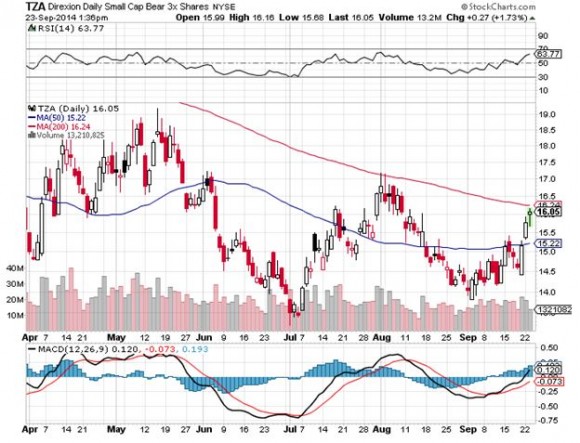
If you can?t trade options, then buy the Short Russell 2000 Fund ETF (RWM) as a 1X play, or the Direxion Daily Small Cap Bear 3X ETF (TZA) for a 3X trade. However, 3X ETF?s of any kind are for intra day traders only.
Time to Bail on a Burning House
https://www.madhedgefundtrader.com/wp-content/uploads/2014/04/Burning-Building-e1430840521423.jpg308400Mad Hedge Fund Traderhttps://madhedgefundtrader.com/wp-content/uploads/2019/05/cropped-mad-hedge-logo-transparent-192x192_f9578834168ba24df3eb53916a12c882.pngMad Hedge Fund Trader2014-09-24 01:05:532014-09-24 01:05:53Time to Bail on the Small Caps
Many commentators are warning of a top, a bubble and Armageddon to come in the stock market. There has not been a 10% correction in the indexes since the debt ceiling crisis three years ago.
But I think that we are just getting started.
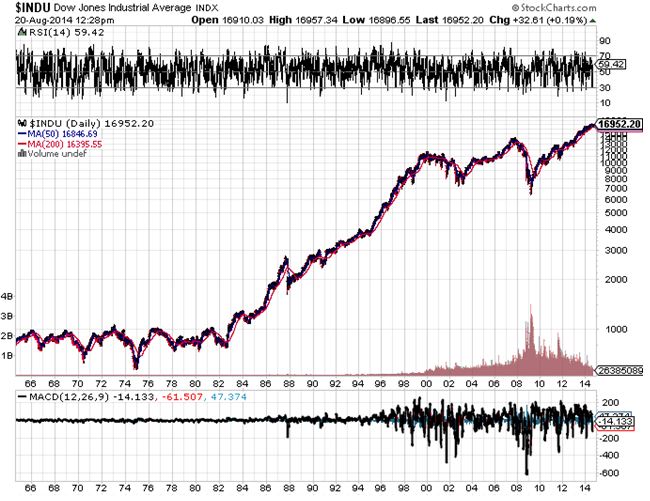
Share prices have the rocket fuel for the Dow average to make it to 18,000 by the end of 2014, and possibly 100,000 by 2025. To understand why, you have to focus on major long-term structural changes occurring in the global economy which at this point only a handful for strategists can see, and then, only faintly.
The evidence couldn?t be more undeniable. The major stock indexes have repeatedly broken out to new all time highs in 2014. The more volatile and economically sensitive Russell 2000 small cap index has left it in the big caps dust.
Inflows to equity mutual funds have been the most prolific since 2008. It all paints a picture of a run up (SPX) to and of 2,100 by year-end, which by the way, has been my own forecast all year. Perma bears be damned!
Betting on the Federal Reserve?s fears of a replay of 1937, when premature tightening tipped the US economy into the second leg of the Great Depression, has been a huge winner for me for years now. It means that it is willing to err on the side of over stimulation, by a lot.
With wages growth stagnant for decades, and many commodity prices and precious metals down 30% or more year to date, the Fed certainly has a free pass on the inflation front to do so. Corporate earnings are also helping, consistently surprising to the upside.
However, I think the market is trying to tell us infinitely more than what appeared in yesterday?s headlines, or what flew by in the last tweet or text. There is something deeper going on here beyond the noise of the daily data releases. Asset prices are acting like there is a major structural change underway in the world economy, which so far has remained invisible to all except the market.
Yes, there are a few professionals out there who can see imminent momentous change within their own narrow industries. But no one has yet aggregated all these changes together, so I?ll take a whack at it.
Here are ten theories for you to contemplate.
1) There is more Peace Dividend to Pay - Is it possible that the markets have not yet fully discounted America?s victory in the Cold War? That the payout was interrupted by the dotcom and housing crashes, and that it is now resuming?
Yes, we priced in a chunk with the run up in the Dow average from 2,500 to 11,000 during the 1990?s. But could there be more to go? After all, 22 years since the fall of the Soviet Union and the US still faces no industrial strength enemy, and there are none on the horizon either.
At the very least, this reality should be enough to chop our current defense spending by half, and eliminate most of our budget deficit. Much of the defense establishment agrees with me. They?d rather be spending money on inexpensive, high value, targeted programs, like cyber warfare and drones, rather than the costly, politically inspired, heavy metal weapons systems of old.
2) Obama Care Works ? With the House of Representatives voting to repeal the President?s health care plan for the 50th time, and closing down the government for 16 days in protest, conservative antipathy towards Obamacare couldn?t be more clear. But what if, instead of doubling health care costs as the right has claimed, it drops them by half? What if the plan does add 0.5% to annual GDP and creates 2 million jobs?
This, after all, was the original plan. Health care is expensive in the US because of the lack of competition, and Obamacare delivers that in spades for the first time. Of course there were going to be teething problems. After all, the government is trying to create 50 Amazons overnight at once. It took 20 years for my former Morgan Stanley colleague, Jeff Bezos, to create just one.
The early evidence shows that the competitive health insurance exchanges the plan sets up are delivering price reductions of 30% to 50% in New York and California. I walked into Costco the other day and was offered a plan for $235 a month with an $8,000 deductable, just so I could avoid the penalties for the uninsured. The best offer I previously received from Blue Cross of California was $3,500 a month, typical for an elderly white male like myself.
If this, in turn, solves the health care and Social Security crisis, it will do a lot to wipe out that ?uncertainty? you hear so much about. The predictions of the eventual insolvency of the United States, a perennial Internet conspiracy favorite, also go down the drain.
3) Another Technology Revolution ? Are we on the verge of another great technology breakthrough like the one we saw during the dotcom boom, when PC?s, the Internet, and the World Wide Web simultaneously came together to supercharge corporate earnings for a decade? What if the cost of treating cancer drops from $100,000 to $200, as my friend, Dr. Michio Kaku, believes. What if new Apples and Googles (GOOG) continue to appear out of nowhere?
If you lived in San Francisco and were barraged by venture capital pitches on a daily basis, as I am, you would think this new Golden Age is going to start any minute. There are a thousand innovations percolating out there.
The only question is whether the lead industry will be communications, health care, energy, or all three. Ride your bike south of Market Street someday and see how much research capacity is being built now, the size of a small city. It is awe-inspiring.
4) The Real Cost of Energy Collapses ? We all know about the new 100-year supply of natural gas discovered under our feet that will turn us into Saudi America. But there are 100 additional ways that energy supply is improving and demand is falling.
Conservation will be huge, as will grid and utility modernization. What if Tesla?s (TSLA) Elon Musk is able to deliver a $40,000 electric car with a 300-mile range in three years, as he has promised? This will be a game changer. His track record so far is pretty good.
This is the man so brimming with confidence that he just bought James Bond?s submarine car for $1 million (see the cool modified Lotus in The Spy Who Loved Me). Falling energy costs mean that the profitability of virtually every listed company goes through the roof.
It is likely that if Iran ever does make good on its threat to close the Straights of Hormuz, no one will care. Some 80% of that oil, and soon to be 100%, goes to China, and that will be their problem, not ours.
5) Productivity Accelerates ? By relentlessly introducing new technologies and cutting costs, corporate profitability has soared for the past 30 years. Pessimists now say things can?t get any better. But what if they do?
As I tell guests at my strategy luncheons, this is not a mean reverting data series. Having invested in the machine that took your labor force from 1,000 to 100, what if the next one brings it to 10? Guess which country is about to lose millions of jobs from offshoring and new technology? China. Just talk to any European CEO about their new ?American Strategy.?
6) Interest Rates Stay Low for Another Decade ? If wages stay in check, oil prices fall, and commodity places stay low, then the Fed has absolutely no reason to substantially raise interest rates for another ten years, no matter what the economy does. The next demographic push that creates a worker shortage and higher wages doesn?t start until the early 2020?s.
Sure, the Fed will probably normalize overnight rates back to 2% by next year, as the safety net for the economy is no longer needed. But rates could remain historically very low for quite a long time. This savings immediately drops to the bottom line of any borrower, be they individual, corporate, or government.
In fact, looking at the main causes of the recessions for the last 50 years?a spike in interest rates or a sudden cut off in oil supplies, and absolutely none are visible on the horizon, for now.
7) Shinzo Abe Saves Japan ? The conventional wisdom is that the new government in Japan is resorting to a last desperate act to save their economy that will fail, and that a complete collapse of their over leveraged financial system will result.
But what if Abe gets his necessary reforms through and the country regains its powerhouse status. If Japan?s $6 trillion economy, the world?s third largest, bounces back from a 1% to a 4% GDP growth rate, there will be positive implications for all of us.
8) Europe Gets Its Act Together ? It seems that all we ever hear about from the continent is debt crisis and stagnation and a political system so fragmented that no one can do anything about it. But what if new leadership emerges and takes the initiative to coalesce and solidify Europe?
That would involve creating a single Ministry of Finance, issuing pan Euro bonds, and a European Central Bank with teeth and courage. Their economic problems would disappear and growth would double. As part of my consulting arrangements with governments there, I have been recommending these measures for years, and everyone agrees. All that is missing is the political will to carry them out.
9) The Dollar Stays Strong ? With America?s debt to GDP now over 100% and rising, many analysts believe it is just a matter of time before we see a major crash in the dollar. This is only the continuation of a 220-year-old trend.
What if it goes up instead? Energy independence means we will no longer ship $250 billion a year to the Middle East to pay for oil imports. CEO?s in Europe and Asia are stumbling over each other to find ways to get capital into the US to take advantage of a stronger economy. Higher growth rates mean the feared American deficits start shrinking on their own, with no action from congress whatsoever. This is all long-term dollar positive.
10) Multiples Keep Expanding ? Most strategists believe that the S&P 500 is fairly valued at 1,983 with a price earnings multiple of 15 times, dead in the middle of its historic 9-22 range. But if any of my theories above unfold, then much higher multiples are justified. If they all unfold, then investors wouldn?t hesitate to pay a 25 multiple for American stocks, as their future outlook is so unremittingly positive.
You may say this sounds crazy, and you?d be right. But remember, twice in the last 25 years we have seen market multiples skyrocket to 100. Japanese share valuations reached that nosebleed summit in 1989, and American Dotcom stocks did so in 2000. And they reached those numbers with fundamentals far less substantial than we are facing now. Just take multiples on today?s market up from 15X to 20X, and the Dow should be worth 26,000.
Sure, all of the above represents a pie in the sky best-case scenario. Some, or none, of them may actually play out in the real world. But the ones that do occur will have a super-leveraged effect on each other. The net impact will be US GDP growth easily leaps back from today?s feeble 2% to the virile 4% or more that we grew comfortable with during the fifties, sixties, and eighties.
That growth rate will solve America?s Social Security, Medicare, and deficit problems in fairly short order, without any action by the government.
Needless to say, all of the above is hugely positive for the stock market. It brings forecasts for a Dow 18,000 by the end of 2014, and 100,000 by 2025 out of the realm of fantasy. It kind of makes today?s stock prices look dirt-cheap.
Maybe that?s what the market is trying to tell us, if we only had the patience and the foresight to listen.
This doesn?t mean that you need to rush out and buy more stocks today. Some of these trends will take a decade or more to play out. Better entry points will no doubt present themselves. But the writing is on the wall for higher equity prices, not just in the US, but globally.
I can tell you from the vast expanse of my own 45 years in the prediction business, I have learned one thing. All that is forecast never happens, and all that happens was never forecast.
I?m still waiting for my flying car, although the Tesla S-1 comes close.
My Tesla S-1
https://www.madhedgefundtrader.com/wp-content/uploads/2013/05/JT-with-Tesla-e1427723768460.jpg227400Mad Hedge Fund Traderhttps://madhedgefundtrader.com/wp-content/uploads/2019/05/cropped-mad-hedge-logo-transparent-192x192_f9578834168ba24df3eb53916a12c882.pngMad Hedge Fund Trader2014-08-21 01:03:432014-08-21 01:03:43Why US Stocks Are Dirt Cheap
War threatens in the Ukraine. Iraq is blowing up. Rebels are turning our own, highly advanced weapons against us. Israel invades Gaza. Ebola virus has hit the US. Oh, and two hurricanes are hitting Hawaii for the first time in 22 years.
Should I panic and sell everything I own? Is it time to stockpile canned food, water and ammo? Is the world about to end?
I think not.
In fact the opposite is coming true. The best entry point for risk assets in a year is setting up. If you missed 2014 so far, here is a chance to do it all over again.
It is an old trading nostrum that you should buy when there is blood in the streets. I had a friend who reliably bought every coup d? etat in Thailand during the seventies and eighties, and he made a fortune, retiring to one of the country?s idyllic islands off the coast of Phuket. In fact, I think he bought the whole island.
Now we have blood in multiple streets in multiple places, thankfully, this time, it is not ours.
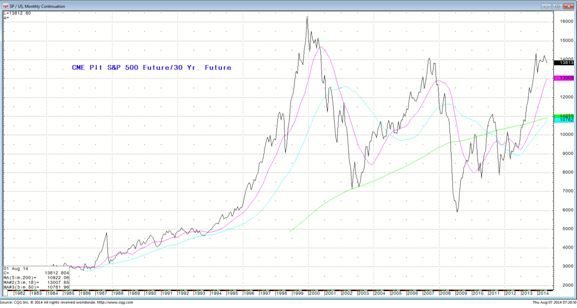
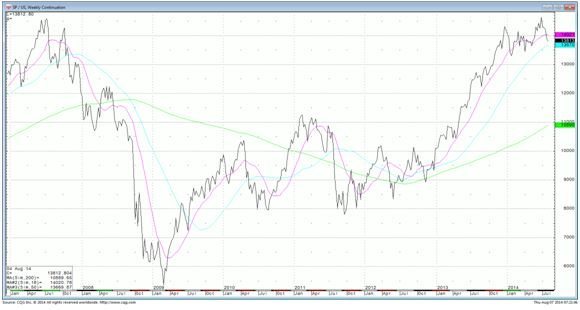
I had Mad Day Trader, Jim Parker, do some technical work for me. He tracked the S&P 500/30 year Treasury spread for the past 30 years and produced the charts below. This is an indicator of overboughtness of one market compared to another that reliably peaks every decade.
And guess what? It is peaking. This tells you that any mean reversion is about to unleash an onslaught of bond selling and stock buying.
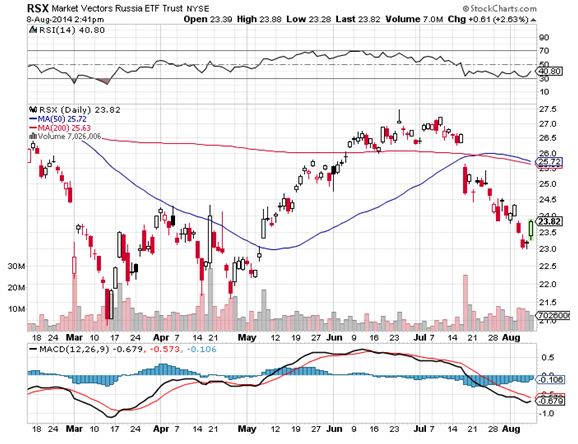
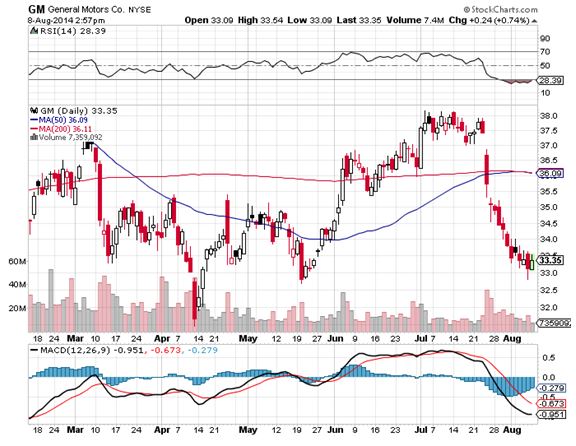
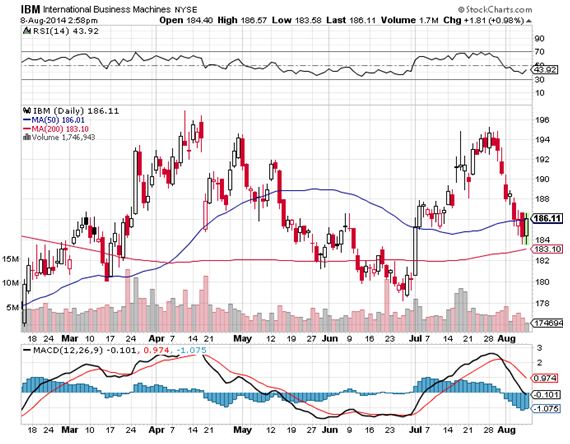
There is a whole raft of other positive things going on. Several good stocks have double bottomed off of ?stupid cheap? levels, like IBM (IBM), Ebay (EBAY), General Motors (GM), Tupperware (TUP), and Yum Brands (YUM). Both the Russian ruble and stock market are bouncing hard today.
There is another fascinating thing happening in the oil markets. This is the first time in history where a new Middle Eastern war caused oil price to collapse instead of skyrocket. This is all a testament to the new American independence in energy.
Hint: this is great news for US stocks.
If you asked me a month ago what would be my dream scenario for the rest of the year, I would have said an 8% correction in August to load the boat for a big yearend rally. Heavens to Betsy and wholly moley, but that appears to be what we are getting.
It puts followers of my Trade Alert service in a particularly strong position. As of today, they are up 24% during 2014 in a market that is down -0.3%. Replay the year again, and that gets followers up 50% or more by the end of December.
Here is my own shopping list of what to buy when we hit the final bottom, which is probably only a few percent away:
Longs
JP Morgan (JPM) Apple (AAPL) Google (GOOG) General Motors (GM) Freeport McMoRan (FCX) Corn (CORN) Russell 2000 (IWM) S&P 500 (SPY)
Shorts
Euro (FXE), (EUO) Yen (FXE), (YCS)
No, Not This Time
https://www.madhedgefundtrader.com/wp-content/uploads/2014/08/Gun-Ammunition-War-Room.jpg280438Mad Hedge Fund Traderhttps://madhedgefundtrader.com/wp-content/uploads/2019/05/cropped-mad-hedge-logo-transparent-192x192_f9578834168ba24df3eb53916a12c882.pngMad Hedge Fund Trader2014-08-11 01:05:382014-08-11 01:05:38Is the Turnaround at Hand, and Ten Stocks to Buy at the Bottom?
Feed the ducks while they are quacking. That is one of the oldest nostrums heard on Wall Street, and feed them they have, to the point of absolute gluttony.
This year we have seen the market for new initial public offerings for newly listed companies explode to life. There have been 46 so far in 2014, some 26 from the biotechnology area alone. Last Friday, there were an astounding seven in one day. When the demand is there, investment bankers are more than happy to run the printing presses overtime to meet it, creating new stock as fast as they can.
This morning saw the debut of King Digital Entertainment (KING), maker of the kid?s digital game ?Candy Crush?. Much to the chagrin of the bankers and the existing shareholders, the stock immediately traded down -10%. You know that when you see huge, dancing lollypops on the floor of the New York Stock Exchange, it is time to get out of the market, post haste.
It all seems frighteningly familiar, like d?j? vu all over again. The last time things were this hot was in April of 2000. Then, an onslaught of IPO?s put in the top for NASDAQ, igniting the great Dotcom crash. Share prices have yet to recover those heady levels a decade and a half later.
Looking at the quality and quantity of the new companies being floated, with minimal earnings, sky high multiples, and market capitalizations in the tens of billions of dollars, a similar outcome is assured. Wall Street never fails to kill the golden goose. There is no limit on greed.
As a result, the IPO market is threatening to take the main market down with it. The number of short-term indicators that I am seeing roll over and die is nothing less than astounding. At the very least, I think we are in for the kind of 5%-7% correction of the sort that we saw in January and February. I?ll give you two big ones.
The scary tell here is the strength of the bond market (TLT), which just broke out to a new seven-month high. Today?s Treasury five-year bond auction went like a house on fire. Stocks and bonds rarely go up in unison, and bonds usually end up being right.
Another is the elevating bottom in the volatility Index (VIX). During November and December, the (VIX) put in rock solid bottoms at the $12 level. After the January dump, the support rose to $14. This means that investors are now more nervous, willing to pay a premium for downside protection, and intend to unload shares at the first sign of trouble. As much fun as rising bottoms can be, you never want to see them in volatility if you own stocks.
The only question is whether they can hold the market up until Friday, March 28, the month end on Monday, March 31, or the new start to the quarter on Tuesday, April 1.
So how best to participate in the coming debacle? Cut back any leveraged long positions that you have. If you want to keep your stocks for tax or other reasons, then write front month call options against them, known as ?buy writes.?
Use the good days to lay on positions in long dated put options for the S&P 500 (SPY), the NASDAQ (QQQ), and the Russell 2000 (IWM). Long dating heads off the time decay problem, reducing the volatility of your position, and helps preserve capital.
Traders can also buy volatility through the iPath S&P 500 VIX Short Term Futures ETN (VXX), an exchange traded note, which rises when stocks fall.
The set up here for the iPath S&P 500 VIX Short Term Futures ETN (VXX) is a no brainer. If we get the modest weakness that we saw in early March, the (VXX) should rise 10% from current levels to the $48 handle. If we get a January replay, that is worth 20% for the (VXX), potentially boosting it to $55. If we finally get the long overdue 10% correction, the (VXX) should rocket by 30% or more.
If the selloff decides to wait a few more days or weeks you can afford to be patient. Since this is an ETN, and not an option play, a flat lining or rising market isn?t going to cost you much money. The February low in the (VXX) at $42.25 looks pretty safe to me in a rising volatility environment. A revisit would only cost us pennies.
Take your pick, but all paths seam to lead skyward for the (VXX), sooner or later.
The Time to Trade Volatility is Here
https://www.madhedgefundtrader.com/wp-content/uploads/2014/03/Girl-on-Pogo-Stick.jpg380330Mad Hedge Fund Traderhttps://madhedgefundtrader.com/wp-content/uploads/2019/05/cropped-mad-hedge-logo-transparent-192x192_f9578834168ba24df3eb53916a12c882.pngMad Hedge Fund Trader2014-03-27 09:21:512014-03-27 09:21:51Will Candy Crush Crush the Market?
A few years ago, I went to a charity fundraiser at San Francisco?s priciest jewelry store, Shreve & Co. The well-heeled masters of the universe bid for dates with the local high society beauties, dripping in diamonds and Channel No. 5. Well fueled with champagne, I jumped into a spirited bidding war over one of the Bay Area?s premier hotties, whom shall remain nameless. Suffice to say, she has a sports stadium named after her.
The bids soared to $12,000, $13,000, $14,000. After all, it was for a good cause, Pari Livermore?s California State Parks Foundation. But when it hit $12,400, I suddenly developed lockjaw. Later, the sheepish winner with a severe case of buyer?s remorse came to me and offered his date back to me for $14,000.? I said ?no thanks.? $13,000, $12,000, $11,000? I passed.
The current altitude of the stock market reminds me of that evening. If you rode gold (GLD) from $800 to $1,920, oil, from $35 to $149, and the (DIG) from $20 to $60, why sweat trying to eke out a few more basis points, especially when the risk/reward ratio sucks so badly, as it does now?
I realize that many of you are not hedge fund managers, and that running a prop desk, mutual fund, 401k, pension fund, or day trading account has its own demands. But let me quote what my favorite Chinese general, Deng Xiaoping, once told me: ?There is a time to fish, and a time to hang your nets out to dry.? That?s why my cash position has steadily been rising over the last few weeks.
At least then I?ll have plenty of dry powder for when the window of opportunity reopens for business. So while I?m mending my nets, I?ll be building new lists of trades for you to strap on when the sun, moon, and stars align once again.
As for that date? She eventually married one of California premier technology titans, an established billionaire in his own right, and now has two cute kids. It?s all part of life?s rich mosaic. And sorry, I?m not saying who because gentlemen don?t talk.
https://www.madhedgefundtrader.com/wp-content/uploads/2013/04/Shreve-Co..jpg378431Mad Hedge Fund Traderhttps://madhedgefundtrader.com/wp-content/uploads/2019/05/cropped-mad-hedge-logo-transparent-192x192_f9578834168ba24df3eb53916a12c882.pngMad Hedge Fund Trader2013-04-16 01:33:032013-04-16 01:33:03Bidding for the Stars
The S&P 500 is now at 1,564, and most strategist forecasts for the end of 2013 hover around 1,550-1,600, plus or minus some spare change. So the next nine months are going to be incredibly boring. Or they won?t.
Even in a bull market, one expects to see pullbacks of at least one third of the recent gain. Apply that logic towards the 224 points the (SPX) has tacked on since the November low, and that adds up to a 74 point, or a 4.7% correction down to 1,490.
There is massive liquidity in the system, many individuals and institutions are underweight, and interest rates are still at incredibly low levels. It also appears that every foreign financial disaster results in more money getting sent to the US for safety.
Usually, the (SPX) never rises more than 9% above the 200 day moving average without hitting a correction. This year is different. I can?t remember the last time the index spent this much time at that level without a pullback.
We are therefore likely to see a rolling type market top that unfolds over the next several months. That is in contrast to a spike top, which you can spot on a chart without your glasses from 20 feet away. These tops can be devilishly difficult to trade, with the limits defined more by time than price.
If you want to see what such a rolling top looks like, take a peak at the chart for my old friend, Dr. Copper, that great prognosticator of future economic activity. He put in such a rolling top during the first eight months of 2011, and has been trying to recover ever since, to no avail.
This no doubt reflects the slowing economy and the building copper inventories in China, where the red metal is widely used as a monetary instrument. China, in effect, is on a copper standard. It is rare to see the (SPX) going up and copper dropping like, well, a bar of copper.
While the broader indexes are likely to deliver a rolling top, that is not the case with individual sectors and stocks. That means you can use these individual spikes to assist in your timing of the overall market. You need to watch the market leaders like a hawk, such as the financials and the transports. If Bank of America (BAC) and United Continental Group (UAL), suddenly crash and burn, you can bet the rest of the market won?t be far behind. This is one of the reasons why I have these two names in my model-trading portfolio, on which you should maintain your laser focus.
The consumer discretionary and retail sectors are two additional pathfinder sectors that are the most economically sensitive in the market, which also make great canaries in the coalmine. As long as consumers are packing MacDonald?s (MCD), Home Depot (HD), and Target (TGT), or burning up their Comcast (CMCSA) broadband connections buying stuff from Amazon (AMZN), you won?t see appreciable market weakness. Earnings disappointments at these businesses, which could start in three weeks, are another great precursor of market trouble.
Finally, there is another class of stocks that may lead the charge on the downside, and that is small caps. Look at the chart below for the ETF for the Russell 2000 (IWM). Small companies are always hardest hit in any slowdown because they are more highly leveraged and have less access to external financing, like bank loans and equity floatations. I made a bundle last year shorting the (IWM) into the ?Sell in May? market meltdown, and plan to do so again this year.
Of course, timing is everything, and I?ll tell you what worries me the most. The overdependence of this bull market on the largess of the Federal Reserve cannot be underestimated. Any hint that quantitative easing is about to join the dustbin of history will take the market with it.
The conventional wisdom is that our esteemed central bank won?t embark on this path until year-end. What if it surprises us with a June tightening? The bull market would die of an instant heart attack. What would trigger this? A blowout monthly nonfarm payroll number approaching 300,000, which would quickly take the headline unemployment rate close to the Fed?s publicly announced 6.5% target. With the economy perhaps growing at a 3% rate this quarter, such a development might be only a handful of Friday?s away.
So how is the genius, aggressive hedge fund trader going to deal with these opaque markets? Bet that the market is going to stay in a broad range for a few more months. We aren?t going to the moon, nor are we going to crash. We are more likely to die of ice than fire. That?s what the volatility markets (VIX) are telling us.
There are several ways to play this kind of market. If you have a plain vanilla stock portfolio, you should be executing ?buy writes? against your existing holdings to take in extra premium income. With the bull move five months old, call options are trading at historically rich levels. This low risk, high return strategy involves selling short call options against existing stock positions. If your stock gets called away, you just say ?thank you very much? and buy it back on the way down.
For the more aggressive, you can add naked short sales of deep out of the money calls one month out. You don?t get rich with a strategy like this, but you earn a living.
You might also buy some deep out-of-the-money index puts for pennies. They are now trading near the cheapest prices in history. One market hiccup, and these things double very quickly.
Hmmm. Doesn?t Look Like Ben Bernanke
https://www.madhedgefundtrader.com/wp-content/uploads/2013/03/Gorilla.jpg203181Mad Hedge Fund Traderhttps://madhedgefundtrader.com/wp-content/uploads/2019/05/cropped-mad-hedge-logo-transparent-192x192_f9578834168ba24df3eb53916a12c882.pngMad Hedge Fund Trader2013-03-26 09:15:452013-03-26 09:15:45Here Comes the Rolling Top
That was the questions traders were scratching their heads and asking this morning in the wake of this morning?s shocking Q4, 2012 GDP figure.
While most analysis were expecting the government to report a more robust 1%-2% number we got negative -0.1%, the worst since 2009. With growth flipping from a positive 3.1% figure in Q3 many thought that a Dow down 500 points was in the cards. Instead we pared back a modest 44 points. What gives?
Ahhh, the devil is in the details. The main culprit was in defense spending, down a mind numbing 22.2%, the worst since the wind down of the Vietnam War in 1972. I remember it like it was yesterday. In fact, government spending was weak across the board as a quasi shut down in advance of the fiscal cliff brought spending to a grinding halt.
In the end, the fiscal cliff never happened. But the downshift shows you how severe such a slowdown would be, if we ever go over the cliff sometime in the future.
There were other one off factors. Hurricane Sandy put a dent into the economies of the US east coast, especially in the transportation sector. The effects of last summer?s drought, which triggered a serious shrinkage in a broad swath of the agricultural sector, were also felt.
What traders instead decided to focus on were the impressive strength of the private sector. Business investment rocketed 8.4%, while consumer spending jumped by 2.2%. It all confirms my theory that the passage of the presidential election broke the dam for private economy, and got people off their behinds once all the negativity and uncertainty was gone. Businesses suddenly began investing and hiring, while consumers stepped up consuming.
What this data tells us is that there will be a sizable postponement of growth from Q4 into Q1, 2013. The Pentagon will ramp up spending once again in the knowledge their budget is secure, at least for the time being. In the meantime, the private sector continues on fire. Q1 could well turn out to be a monster quarter. This is what the unremitting rise in share prices is shouting at us.
In the end, traders don?t really care what the GDP is. In fact, most can?t even spell it. The focus of the street is on the future, not the past. And the data promises to improve.
This morning we saw private sector job growth of 182,000 from the ADP. If Thursday morning delivers another five year low in jobless claims, the market will be primed for a hot January nonfarm payroll on Friday. It?s become ?a glass is half full, glass three quarters full? kind of market. Is either goes up, or up more.
Not Happening Here, Baby
https://www.madhedgefundtrader.com/wp-content/uploads/2013/01/Headline.jpg336281Mad Hedge Fund Traderhttps://madhedgefundtrader.com/wp-content/uploads/2019/05/cropped-mad-hedge-logo-transparent-192x192_f9578834168ba24df3eb53916a12c882.pngMad Hedge Fund Trader2013-01-31 09:45:372013-01-31 09:45:37Where?s the Crash?
I have been relying on David Hale as my de facto global macro economist for decades, and I never miss an opportunity to get his updated views. The challenge is in writing down David?s eye popping, out of consensus ideas fast enough, because he spits them out in such a rapid-fire succession.
Since David is an independent economic advisor to many of the world's government?s, largest banks, and investment firms, I thought his views would be of riveting interest. It was with great pleasure that I joined him for lunch at the Federal Reserve Bank of San Francisco to discuss the outlook for Asia.
David sees the US economy growing by 2.5% in 2013, China by 8.5%, but for much of Europe to remain in recession. He sees the best growth opportunities in Southeast Asia, which delivered stellar results last year.
The Philippines grew by 6.6% and has the best long-term outlook of all. Some 600,000 now work there in the call center and support business, and the industry is growing at a breakneck pace. Personal consumption is flying, and the government is about to launch a major infrastructure program. Heaven knows they need it, as I recall the roads there are absolutely deplorable. The ETF (EPHE) was on fire last year, up some 56%, making it one of the best performing single country funds.
Indonesia (IDX) expanded by 6.1% in 2012, making a killing on energy and commodity exports to China and Japan. Its ETF was unchanged last year, but could be ready for take off. Thailand (THD) scored a 5.5% gain in its GDP, boosted by flood reconstruction, taking its ETF northward by 38%. Malaysia?s economy (EWM) expanded by 5.3%.
David has seen the same dramatic improvement that I have in the economic data from China over the last three months. This is in response to a moderate stimulus budget which they started to implement in the summer. Residential housing, which has been a major drag on the economy for the past year, is now starting to trend up. Liberalization of real estate lending is in the cards.
While the Middle Kingdom lost 20 million jobs during the 2008 crash, almost none disappeared in the latest slowdown. This year, Chinese consumption will exceed that of the US for the first time in history, at $470 billion compared to $403 billion.
The fight against corruption has emerged as a major domestic issue. Some 25% of all the luxury spending in China is though to be for gifts (bribes) to government officials. Mid level Mandarins caught wearing $50,000 watches are now getting fired.
David made some far out predictions that were real zingers. Population growth is grinding to a halt throughout Asia. It is already well below the replacement rate in Japan and South Korea, which will soon be joined by China. This will eventually lead to labor shortages in Asia, and bring to an end the cheap labor regime, which has driven their economies for the past 100 years. The Chinese work force will shrink from five times ours to only three times.
Their cost advantage then goes out the window. The upshot for us is that perhaps half of the 6 million jobs that America lost to China over the last 20 years will come back. Many items can now be bought cheaper in Chicago than they can in Shanghai.
China will still become far and away the world?s largest economy in our lifetimes. In 1700, Asia accounted for 58% of world GDP. Some 250 years of wars pulled that figure down to 15% by 1950. It is on track to recover to 50% by 2050.
To learn more about David Hale and the extensive list of services he offers, please visit the site of David Hale Global Economics at http://www.davidhaleweb.com.
https://www.madhedgefundtrader.com/wp-content/uploads/2013/01/David-Hale.jpg335308Mad Hedge Fund Traderhttps://madhedgefundtrader.com/wp-content/uploads/2019/05/cropped-mad-hedge-logo-transparent-192x192_f9578834168ba24df3eb53916a12c882.pngMad Hedge Fund Trader2013-01-10 10:02:482013-01-10 10:02:48Economist David Hale Says the Action will be in Southeast Asia
A couple of alleged Tweets, a few rumored phone calls, and what have we got? $2 trillion in new global stock market capitalization in hours. That was the bottom line after the purported communication between the staffs of Germany?s Angela Merkel, France?s Jean Francois Hollande, and ECB president Mario Draghi. But is the creation of this immense new wealth, which would alone rank as 10th in terms of GDP after France, justified?
If the intention was to punish hedge funds, the goal was certainly accomplished. The plaintive bleatings in email and text messages I received from hedge fund friends back home has been overwhelming. It was clear from the price action, straight line moves with no pullbacks, that the pain trade was definitely on. Pre-Thursday, the consensus wisdom was that market would crash into the August doldrums in the face of global economic data that was deteriorating by the day. Such is the price of betting against central banks that I highlighted in my recent trope ?Why Ben Bernanke Hates Me? (click here at http://madhedgefundradio.com).
Leading research houses seemed to be in an arms race with government institutions to see who could cut growth forecasts the fastest. They were all egged on by US Q2 corporate earnings reports, that were highly fudged and indifferent at best, with the most honest wisdom provided by the shocker from Apple (AAPL).
However, in the financial markets that are more often driven by emotion than information, politics trump fundamentals every day. With the street heavily positioned on the short side, the conditions for a snap back rally were ripe. This is why I had no positions at all for 10 days, and no equity holdings for over a month. Rather than chase the market on the downside, I waited for it to come to me, which is usually the best thing to do.
I have always believed that Europe has the ability and the resources to solve its problems at any time. To read my advice to the German government in detail, please refer to my report from Frankfurt, which I will write in the next couple of days, when I get some time.
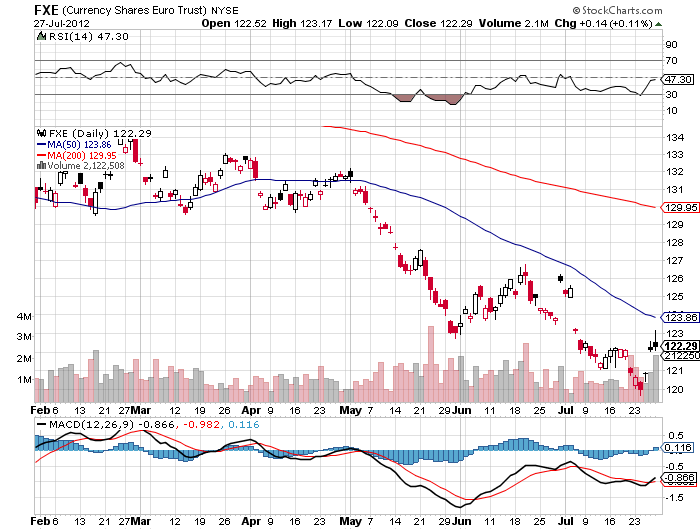
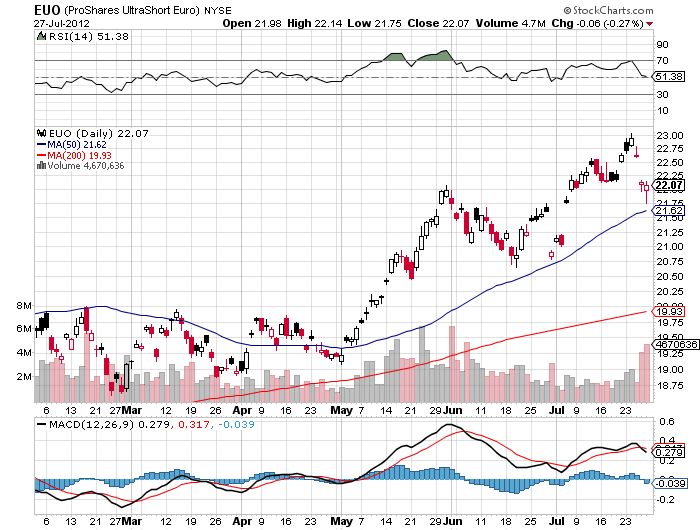
All that is required is for Europe to make some unpleasant admissions of truths, and adopt some policies and institutions that have already been proven to work in the US. These are hard things to do politically, but that can be done. Make the politicians earn their pay for a change, I say. This is what makes the short game in Europe so risky, and why I have recently been so wimpy on my short Euro (FXE), (EUO) recommendations (in the reports, but without trade alerts).
Words are cheap, and their true value will become apparent when it comes time for Mario Draghi to deliver. If he does so quickly, we could see a ?RISK ON?, rally that could last until the end of the year and possibly take the S&P 500 up to 1,500. If he doesn?t, the August crash scenario down to 1,200 is back on the table, but no more. That table loses another leg if Ben Bernanke fails to deliver QE3 on Wednesday.
If all of this leaves you confused and befuddled, then welcome to the club. There are times when markets are just not forecastable, when the number of large variables and unknowns are too great to even make an intelligent guess at outcomes, and this is one of them. That?s why I am still 70% in cash, limiting my ?RISK ON? exposure to small, profitable positions in short Treasury and short yen call spreads. That?s down from 100% I had just last Wednesday.
I think I?ll go climb that Alp over there.
The Pain Trade is on for Hedge Funds
https://madhedgefundtrader.com/wp-content/uploads/2019/05/cropped-mad-hedge-logo-transparent-192x192_f9578834168ba24df3eb53916a12c882.png00DougDhttps://madhedgefundtrader.com/wp-content/uploads/2019/05/cropped-mad-hedge-logo-transparent-192x192_f9578834168ba24df3eb53916a12c882.pngDougD2012-07-30 22:46:492012-07-30 22:46:49Mr. Mario?s Big Bluff
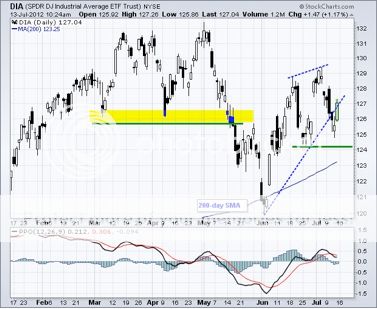
They are really rocking the market today, with the Dow up nearly 200 points off the back of a non-disastrous Chinese GDP growth figure of 7.7%. However, there is a serious disconnect going on in our markets which suggests to me that our own party may be about to end.
Yesterday?s blockbuster weekly jobless claim took applications for unemployment benefits down to a four-year low of 350,000. But if you ignore this, you have an unending series of data reports that shows an economy clearly decelerating to a growth rate of 1% per annum or less. That is one-seventh China?s rate.
And yet, you have an S&P 500 with a top end range that is a mere 3% within the high for the year. You don?t need a PhD in math from MIT to understand that rising stock prices and falling growth are an anomaly that can?t last and can only end in tears.
I think this is happening for a couple of reasons. Many traders are awaiting Q2, 2012 earnings reports and are willing to give companies the benefit of the doubt until they are out. Stocks are at the historic low end of valuation ranges. Many institutions are still underweight, and willing to use dips to pick up some bargains. This is why this summer has been a short seller?s nightmare, volatility has fallen through the floor, and many hedge funds have bailed for the duration.
I also think that many institutions are waiting for the Federal Reserve to announce QE III at their end of July meeting, thus powering the market to new yearly highs. I?m betting that they will be sorely disappointed. Ben Bernanke has so few bullets left to protect the economy that he will wait until the Indians are circling the wagons and unleashing a barrage of arrows, before he takes action. Quantitative easing is meant to be a safety net, not a stepladder from which to boost ever-higher asset prices. The Fed?s failure to deliver could give us the trigger we need to break to new lows in August.
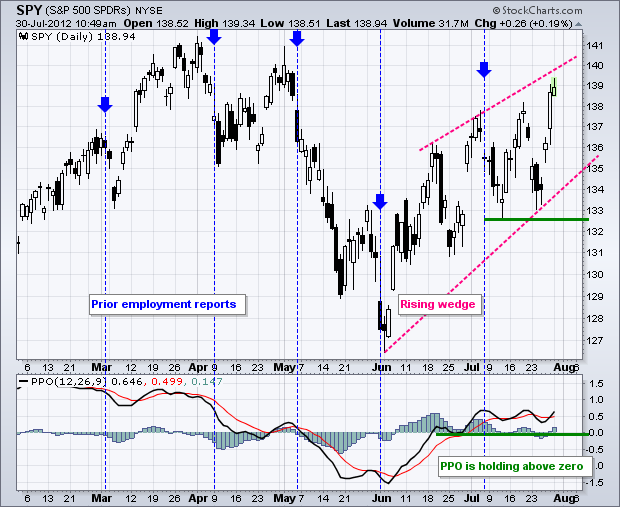
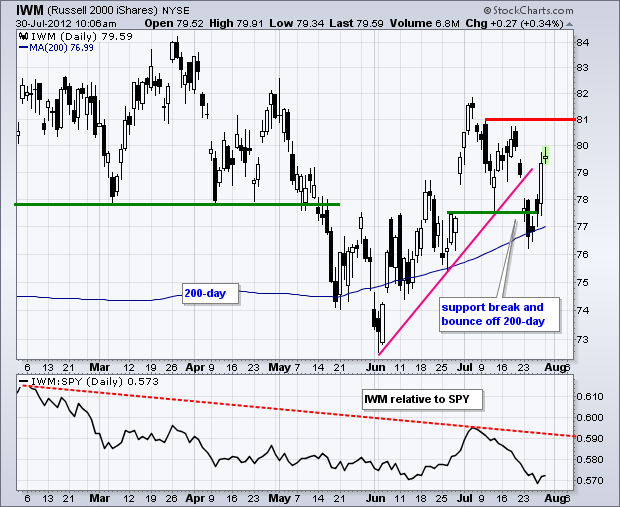
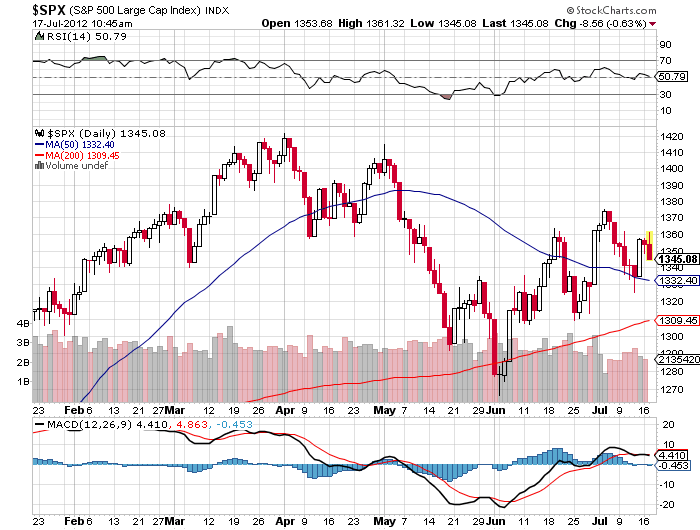
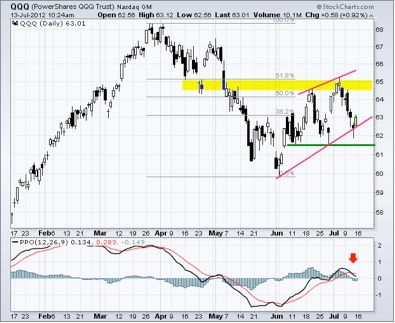
Take a look at the charts below to see how clearly defined the recent channels and ranges are. Next time the SPX approaches 1,370, I might think about going short, taking out some downside insurance, selling out of the money calls, and generally getting yourself into a risk off posture. If you don?t, your summer could turn into a giant rainstorm.
This Party is Nearly Over
https://madhedgefundtrader.com/wp-content/uploads/2019/05/cropped-mad-hedge-logo-transparent-192x192_f9578834168ba24df3eb53916a12c882.png00DougDhttps://madhedgefundtrader.com/wp-content/uploads/2019/05/cropped-mad-hedge-logo-transparent-192x192_f9578834168ba24df3eb53916a12c882.pngDougD2012-07-16 23:04:502012-07-16 23:04:50This Party is About to End
Legal Disclaimer
There is a very high degree of risk involved in trading. Past results are not indicative of future returns. MadHedgeFundTrader.com and all individuals affiliated with this site assume no responsibilities for your trading and investment results. The indicators, strategies, columns, articles and all other features are for educational purposes only and should not be construed as investment advice. Information for futures trading observations are obtained from sources believed to be reliable, but we do not warrant its completeness or accuracy, or warrant any results from the use of the information. Your use of the trading observations is entirely at your own risk and it is your sole responsibility to evaluate the accuracy, completeness and usefulness of the information. You must assess the risk of any trade with your broker and make your own independent decisions regarding any securities mentioned herein. Affiliates of MadHedgeFundTrader.com may have a position or effect transactions in the securities described herein (or options thereon) and/or otherwise employ trading strategies that may be consistent or inconsistent with the provided strategies.