Featured Trade:
(DON'T MISS THE MAY 9 GLOBAL STRATEGY WEBINAR),
(A DAY IN THE LIFE OF THE MAD HEDGE FUND TRADER),
(SPY), (TLT), (TBT), (FXE),(GLD), (GDX), (USO),
(AMLP), (STBX), (NFLX), (DIS), (AAPL), (GM)
The cloud segment of technology is hotter than hot, and as this sector starts to trade at a big premium, investors will have to look further down the chain of command to find a reasonable deal.
An up-and-coming cloud service Box (BOX) has gone undiscovered and is in position to seize a larger share of the cloud market moving forward.
The firm is led by CEO Aaron Levie who dropped out of my old alma mater USC in 2005 to start a cloud company with acting CFO and childhood friend Dylan Smith.
Last quarter was record-setting for Box, and it had a number of significant six- and seven-digit deals. Keep in mind Box's revenues are paltry compared to the behemoths that run this industry.
The platform has seen gradual success from all corners of the business world with various businesses from insurance claims processors to wealth advisors who use Box as a back-end platform.
Health care is another industry deploying the Box platform to aid and develop cloud services for patients.
In a general sense, the beauty of the cloud is the propensity to adapt to any company that is willing to go digital.
Even though many legacy companies are not natively digital, the cloud can twist and contort to fit the customers' needs.
Levie raised some compelling arguments for the continued tech momentum stating that imminent regulation in Europe through General Data Protection Regulation (GDPR) will act as a "broader tailwind in compliance and security efforts."
Box also announced a "readiness (GDPR) package" revealing that tech companies have been planning for the regulation overhaul up to 18 months in advance.
Even though mass media sensationalism would lead investors to believe the threat of regulation is about to blindside this whole sector, the unrest has been bubbling up for quite some time allowing tech companies ample time to get their houses in order.
Box actually sees the genesis of GDPR as a critical part of the cloud adoption process.
As dinosaur systems become outdated, a sense of safety reinforced by strong cybersecurity protection, strong privacy rules, and content compliance will nudge companies to head for the cloud like a drunk sailor to a pub.
Legacy platforms are the most susceptible to cyber-criminals and rogue hackers.
The analog defense is no match for sophisticated cyber-espionage, and GDPR will be another "driving force" behind the macro-migration shift to the cloud, just based on the security aspect alone.
Another pearl of wisdom offered by Box is that the bulk of clients requiring cloud products are integrating Microsoft Office 365.
This software acts as a lynchpin to any cloud service.
I must confess that I am writing this story on Microsoft Office 365 now, and most businesses cannot function without the dizzying array of Excel, PowerPoint, and Word.
Box has a strong relationship with Microsoft and has incisive insight into the synergies the cloud industry spins off.
The integration of Office 365 has complemented the Azure cloud with tighter cohesiveness.
The school of thought is the collective cloud industry is a $50 billion per year market and growing, offering smaller firms healthy growth levers to advance at the same time that the Microsofts (MSFT) and Amazons (AMZN) overperform.
At the Sohn Investment Conference in New York, Chamath Palihapitiya, a venture capitalist and former Facebook executive, extolled Box as a great way to play Artificial Intelligence (AI).
The shares spiked almost 13% upon his adulation.
A recent completed survey showed 66% of business leaders feel the pace of digitization must pick up in their own offices.
The speed of innovation is something that keeps most CEOs up at night. Wake up tomorrow and it is possible their core products could be outdated or disrupted by a new Amazon threat.
That is the world we live in now.
Only 42% of CIOs admitted they have a digital strategy. And of those digital strategies, they are mostly digital second or third, not digital first, blueprints.
In the same PricewaterhouseCoopers (PwC) survey, companies conceded that only 40% of IT teams are able to pursue the newest innovations with adopting specific operational needs in mind.
The micro-environment harbors the same bullishness as the macro-factors.
Box is hitting all the right notes.
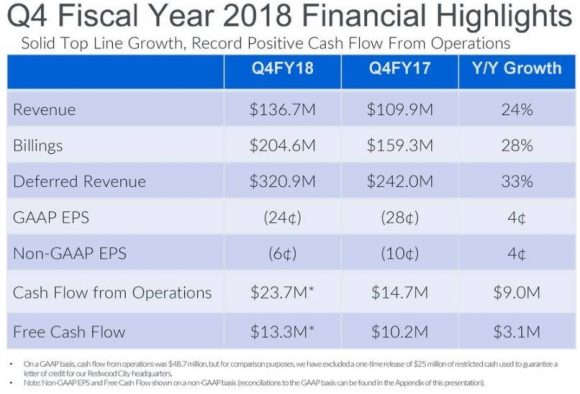
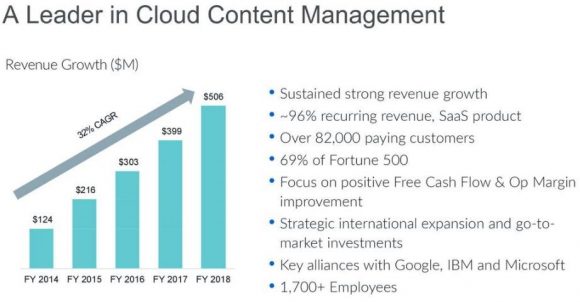
Revenue is advancing at a 24% per year clip, and annual revenue surpassed the half a billion mark.
Box has indicated it expects to cross the $1 billion annual revenue threshold sometime in mid- to late 2021, giving the company more than three years to double revenue.
Recent reports support Box's growth trajectory.
About 60% of revenue derives from firms that employ more than 2,000 workers, highlighting Box's propensity to emphasize enterprise cloud development instead of small individual users.
Working with larger companies gives Box the opportunity to cross-sell more powerful add-ons, delivering a net expansion rate of 14%.
Migrating to a new cloud platform is incredibly sticky boosting retention rates. Box's churn rate is flourishing with a best of breed 4% per year. The key to expediting cloud success is quickening its pace of new product rollout.
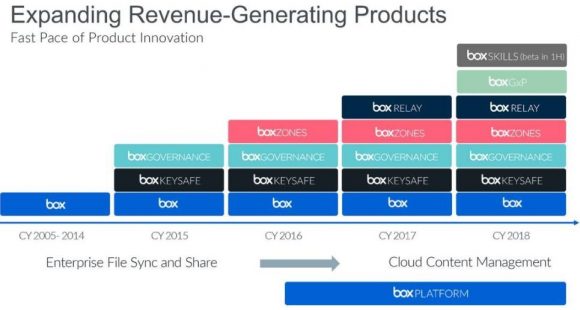
Box attempts to give exactly what customers need with a spate of new concoctions.
Box GxP is a new product calibrated around life science companies. The Box GxP compliance is up to date with FDA regulations. And, Box has the ability to retire legacy ECM (Enterprise Content Management) systems.
This new service has experienced solid traction around the world as we head toward a world where legacy software becomes obsolete.
The second new offering is Box Skills, still in beta mode, which is a part of Box's artificial intelligence strategy.
Box is platform neutral allowing in-house architecture to support partnerships with Google, Microsoft, Amazon, and IBM to nail down third-party cloud tools that Box customers need.
Box Skills is a framework that brings the best machine learning innovation to content securely stored in Box.
This is managed through artificial intelligence, which automatically contextualizes images through detection protocols. Text recognition is automated for the benefit of the user, too.
Audio intelligence renders text transcripts and detects topics that can be searched in Box to locate an audio file by words or topic.
Video intelligence offers transcription, topic detection, and facial recognition allowing users to jump around video files in a non-linear fashion.
Palihapitiya effectively gave Box a free commercial to the tech investing world. His bull thesis for Box squarely centers around its AI innovations, specifically Box Skills.
The last new service to market is Box Transform, which is the advanced consulting arm of Box.
The goal of Transform is to arrange a concierge-like Box advisor that can help companies accelerate digital transformation throughout an organization while unlocking efficiencies and productivity for employees.
This service originated from Box's consulting advanced professional services team and will give Box another growth lever. Companies such as Red Hat and Intel have made the consultant- and support-side of the business a robust part of their organizations.
Impeding growth is the cutthroat competition in this space with Amazon, Microsoft, and Google (GOOGL).
However, margins remain strong at 75.5% last quarter, and Box expects margins to slightly dip around 74% this year.
Box has found a warm welcome for its newer products, deriving almost 70% of its new deals from fresh cloud offerings.
Partners are also a big source of new deals comprising more than half the deals over $100,000.
Specifically, IBM (IBM) made up a swath of its larger deals. In a sense, competitors are not really competitors.
They are frenemies. They compete against each other yet innovate and do deals together.
The core growth is supplemented by existing customers that are the best source of extra marginal revenue.
In short, once firms are firmly lodged on a platform, they buy everything on that platform.
Enter a supermarket, and odds are if goods are purchased, the receipt will be from the entered supermarket.
Box is entirely leveraged toward mid-sized and large enterprise business. That is where it makes its money.
The emphasis on large players boosts the ACV (Average Contract Value), which is regarded as a sacrosanct metric for Box.
The amount of data created in 2017 was more data created in the past 5,000 years. In the next five years, data volume with grow by 800%.
Box has continually positioned itself as the firm that can extract a staggering amount of unrealized value locked away in the nooks and crannies of legacy models.
Box is a great long-term hold as these diminutive cloud assets become more valuable by the day.
"Television won't be able to hold onto any market it captures after the first six months. People will soon get tired of staring at a plywood box every night." - said Darryl F. Zanuck, co-founder of Twentieth Century-Fox Film Corp.
https://www.madhedgefundtrader.com/wp-content/uploads/2018/04/Expanding-revenue-image-4-e1524688537435.jpg310580MHFTRhttps://madhedgefundtrader.com/wp-content/uploads/2019/05/cropped-mad-hedge-logo-transparent-192x192_f9578834168ba24df3eb53916a12c882.pngMHFTR2018-04-26 01:05:382018-04-26 01:05:38The Small AI Play You've Never Heard of
Alphabet (GOOGL) did a great job alleviating fears that large-cap tech would be dragged through the mud and fading earnings would dishearten investors.
The major takeaways from the recent deluge of tech earnings are large-cap tech is getting better at what they do best, and the biggest are getting decisively bigger.
Of the 26% rise to $31.1 billion in Alphabet's quarterly revenue, more than $26 billion was concentrated around its mammoth digital ad revenue business.
Alphabet, even though rebranded to express a diverse portfolio of assets, is still very much reliant on its ad revenue to carry the load made possible by Google search.
Its "other bets" category failed to impact the bottom line with loss-making speculative projects such as Nest Labs in charge of mounting a battle against Amazon's (AMZN) Alexa.
The quandary in this battle is the margins Alphabet will surrender to seize a portion of the future smart home market.
What we are seeing is a case of strength fueling further strength.
Alphabet did a lot to smooth over fears that government regulation would put a dent in its business model, asserting that it has been preparing for the new EU privacy rules for "18 months" and its search ad business will not be materially affected by these new standards.
CFO Ruth Porat emphasized the shift to mobile, as mobile growth is leading the charge due to Internet users' migration to mobile platforms.
Google search remains an unrivaled product that transcends culture, language, and society at optimal levels.
Sure, there are other online search engines out there, but the accuracy of results pale in comparison to the preeminent first-class operation at Google search.
Alphabet does not divulge revenue details about its cloud unit. However, the cloud unit is dropped into the "other revenues" category, which also includes hardware sales and posted close to $4.4 billion, up 36% YOY.
Although the cloud segment will never dwarf its premier digital ad segment, if Alphabet can ameliorate its cloud engine into a $10 billion per quarter segment, investors would dance in the streets with delight.
Another problem with the FANGs is that they are one-trick ponies. And if those ponies ever got locked up in the barn, it would spell imminent disaster.
Apple (AAPL) is trying its best to diversify away from the iconic product with which consumers identify.
The iPhone company is ramping up its services and subscription business to combat waning iPhone demand.
Alphabet is charging hard into the autonomous ride-sharing business seizing a leadership position.
Netflix (NFLX) is doubling down on what it already does great - create top-level original content.
This was after it shed its DVD business in the early stages after CEO Reed Hastings identified its imminent implosion.
Tech companies habitually display flexibility and nimbleness of which big corporations dream.
One of the few negatives in an otherwise solid earnings report was the TAC (traffic acquisition costs) reported at $6.28 billion, which make up 24% of total revenue.
An escalation of TAC as a percentage of revenue is certainly a risk factor for the digital ad business. But nibbling away at margins is not the end of the world, and the digital ad business will remain highly profitable moving forward.
TAC comprised 22% of revenue in Q1 2017, and the rise in costs reflects that mobile ads are priced at a premium.
Google noted that TAC will experience further pricing pressure because of the great leap toward mobile devices, but the pace of price increases will recede.
The increased cost of luring new eyeballs will not diminish FANGs' earnings report buttressed by secular trends that pervade Silicon Valley's platforms.
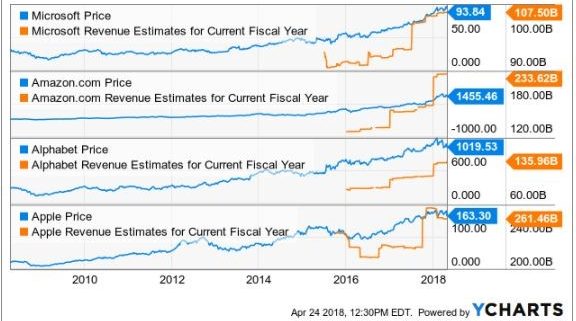
The year of the cloud has positive implications for Alphabet. It ranks No. 3 in the cloud industry behind Microsoft (MSFT) and Amazon.
Amazon and Microsoft announce earnings later this week. The robust cloud segments should easily reaffirm the bullish sentiment in tech stocks.
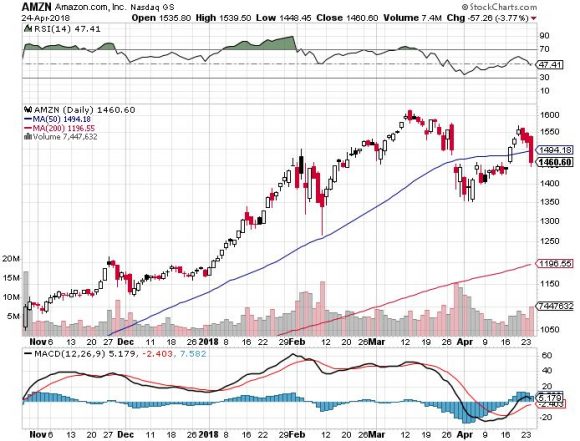
Amazon's earnings call could provide clarity on the bizarre backbiting emanating from the White House, even though Jeff Bezos rarely frequents the earnings call.
A thinly veiled or bold response would comfort investors because rumors of tech peaking would add immediate downside pressure to equities.
The wider-reaching short-term problem is the macro headwinds that could knock over tech's position on top of the equity pedestal and bring it back down to reality in a war of diplomatic rhetoric and international tariffs.
Google, Facebook, and Netflix are the least affected FANGs because they have been locked out of the Chinese market for years.
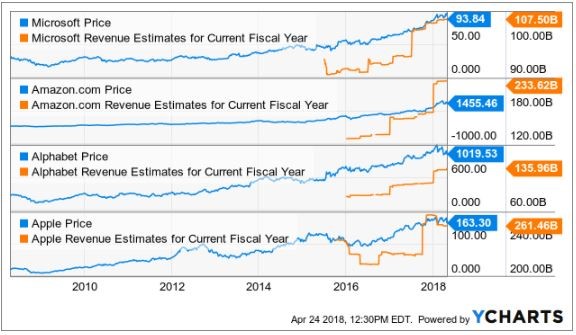
The Amazon Web Services (AWS) cloud arm of Amazon blew past cloud revenue estimates of 42% last quarter by registering a 45% jump in revenue.
Microsoft reiterated that immense cloud growth permeating through the industry, expanding 99% QOQ.
I expect repeat performances from the best cloud plays in the industry.
Any cloud firm growing under 20% is not even worth a look since the bull case for cloud revenue revolves around a minimum of 20% growth QOQ.
Amazon still boasts around 30% market share in the cloud space with Microsoft staking 15% but gaining each quarter.
AWS growth has been stunted for the past nine quarters as competition and cybersecurity costs related to patches erode margins.
Above all else, the one company that investors can pinpoint with margin problems is Amazon, which abandoned margin strength for market share years ago and that investors approved in droves.
AWS is the key driver of profits that allows Amazon to fund its e-commerce business.
Cloud adoption is still in the early stages.
Microsoft Azure and Google have a chance to catch up to AWS. There will be ample opportunity for these players to leverage existing infrastructure and expertise to rival AWS's strength.
As the recent IPO performance suggests, there is nothing hotter than this narrow sliver of tech, and this is all happening with numerous companies losing vast amounts of money such as Dropbox (DBX) and Box (BOX).
Microsoft has been inching toward gross profits of $8 billion per quarter and has been profitable for years.
And now it has a hyper-expanding cloud division to boot.
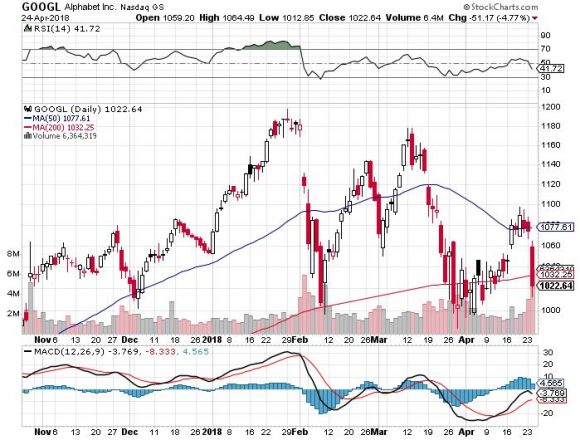
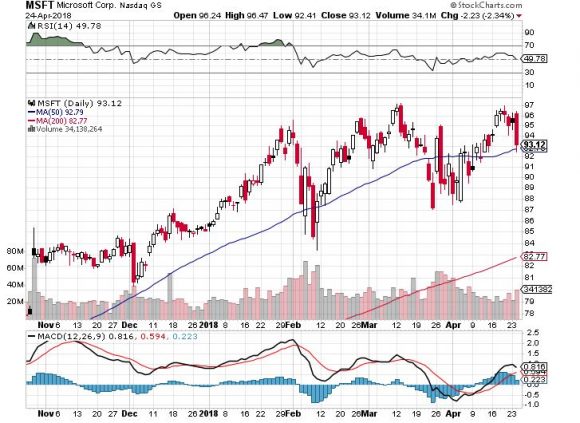
Any macro sell-off that pulls down Microsoft to around the $90 level or if Alphabet dips below $1,000, these would be great entry points into the core pillars of the equity market.
If tech goes, so will everything else.
If it plays its cards right, Microsoft Azure has the tools in place to overtake AWS.
Shorting cloud companies is a difficult proposition because the leg ups are legendary.
If traders are looking for any tech shorts to pile into, then focus on the legacy companies that lack a cloud growth driver.
Another cue would be a company that has not completed the resuscitation process yet, such as Western Digital (WDC) whose shares have traded sideways for the past year.
But for now, as the 10-year interest rate shoots past 3%, investors should bide their time as cheaper entry points will shortly appear.
"Technology is a word that describes something that doesn't work yet." - said British author Douglas Adams.
https://www.madhedgefundtrader.com/wp-content/uploads/2018/04/FANG-Y-Charts-image-4.jpg335576MHFTRhttps://madhedgefundtrader.com/wp-content/uploads/2019/05/cropped-mad-hedge-logo-transparent-192x192_f9578834168ba24df3eb53916a12c882.pngMHFTR2018-04-25 01:05:312018-04-25 01:05:31FANGs Deliver on Earnings, But Fail on Price Action
The first batch of earnings numbers are trickling in, and on the whole, so far so good.
A spectacular earnings season will further cement tech's position at the vanguard of the greatest bull market in history.
The bull case for technology revolves around two figures indicating "RISK ON" or "RISK OFF".
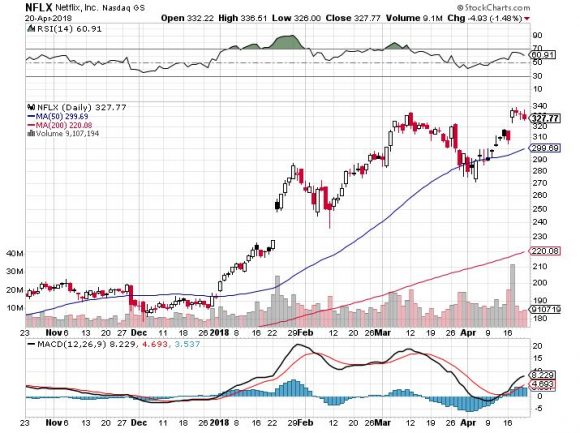
The first set of numbers from Netflix (NFLX) emanated sheer perfection.
Netflix has gambled on its international audience to drive its growth and unceasing creation of premium content to reach these lofty targets set forth.
It worked.
Consensus was that domestic subscription growth had peaked, and Netflix would have to lean on overseas expansion to beat earnings estimates.
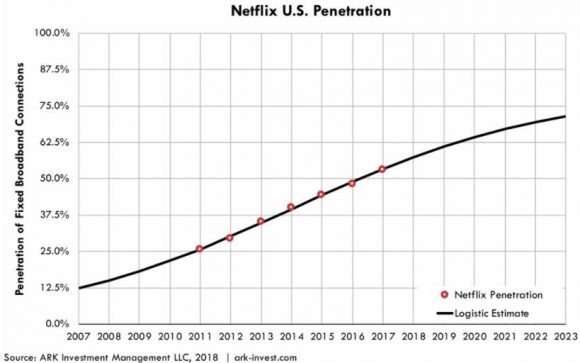
American subscription growth knocked it out of the ballpark, beating expectations by 480,000 subscriptions. The street expected only 1.48 million new adds. The 1.96 million shows the American online streamer is resilient, and the migration toward cord-cutting is happening faster than initially thought.
International adds were pristine, beating the 5.02 million estimates by 440,000 million new subscribers.
Content is king as Netflix has proved time and time again (we notice that here at Mad Hedge Fund Trader, too). Netflix plans to fork out about 700 original series in 2018.
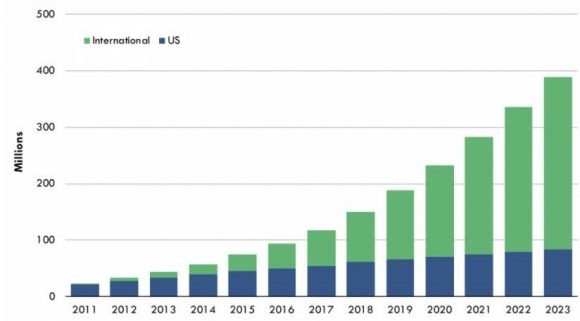
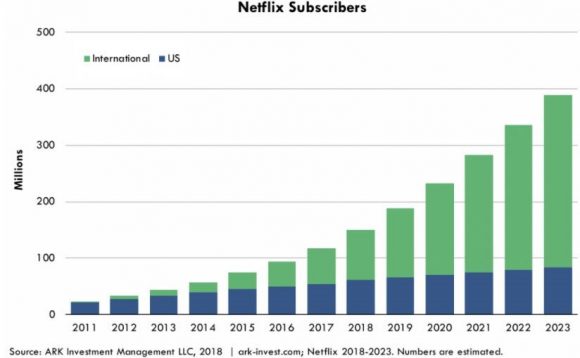
By 2023, Netflix could grow its subscriber base to close to 400 million. The potential for international advancement is immense considering foreign companies are playing catch-up and cannot compete with the level of Netflix's content.
The earnings report coincided with Netflix announcing a forceful push into Europe, doubling its allocated content-related investments to $1 billion.
All of Netflix's estimates take into consideration that it is shut out of the Chinese market. Ironically, the Netflix of China, named iQIYI (IQ), just recently went public on the Nasdaq.
Amazon Web Services (AWS), the cloud-arm of Amazon (AMZN), revenue numbers are the other numbers that are near and dear to the pulsating heartbeat of the bull market.
Jeff Bezos, Amazon's CEO, penned a letter to shareholders that Amazon prime subscribers blew past the 100 million mark.
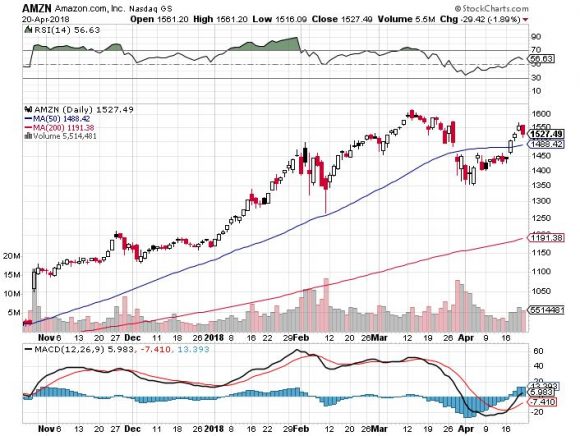
The positive foreshadowing augurs nicely for Amazon to surprise to the upside when it reports earnings next week on April 26.
Expect more of the same from cloud companies that are overperforming.
The few glitches in tech are minor. It is mindful to stay on the right side of the tracks and not venture into marginal names that haven't proved themselves.
For instance, Oracle (ORCL) had a good, not great, earnings report but shares still cratered after CEO Safra Catz dissatisfied analysts with weak cloud forecasts of just 19%-23% growth.
The street was looking for cloud guidance over 24%. Oracle is still being punished for its legacy tech segments.
The chip sector got pummeled after several chip manufacturers announced weak supply order from Apple.
This is hardly a surprise with Apple slightly missing iPhone estimates last quarter by 1%.
Chip stocks such as Lam Research (LRCX), Micron (MU), and Applied Materials (AMAT) look like affordable bargains. They should be seriously considered after share prices stabilize buttressed by support levels.
The outsized problem is that hardware suppliers have headline risks because of large cap tech's preference toward vertically integrating.
Along with price efficiencies, vertically integration aids design aspects and streamline product production time horizons.
This is not the end of chips.
Consumers need the silicon to generate and extract all the data coming to market.
Particularly, Apple (AAPL) went over its skis trying to push expensive smartphones to a saturated market when all the rip-roaring growth is at the low end of the market.
Apple still managed to sell more than 77 million iPhones, but the trade war rhetoric will deter Chinese consumers from purchasing American tech products. Until now, Apple has counted on China as its best growth prospect. The administration had other ideas.
Any noteworthy Apple supplier has gotten punched in the nose, but crucially, investors must stay out of the SMALLER chip players that rely on narrow revenue sources to keep them afloat.
Bigger chip companies can withstand the shedding of a few revenue sources but not Cirrus Logic (CRUS).
(CRUS) shares have been beaten mercilessly the past year sliding from $68 to a horrifying $37.74 today.
(CRUS) produces audio amplifier chips used in iPhone devices, and weak iPhone X guidance is the cue to bail out of this name.
The company extracts more than 75% of its revenues by selling audio chips used in iPhone devices. Ouch!
Last quarter saw horrific performance, stomaching a 7.7% decline in revenues due to tepid demand for smartphones in Q4 2017.
Cirrus Logic provided an underwhelming outlook, and it is not the only one to be beaten into submission behind the woodshed.
Apple has signaled to its suppliers that it will view production in a different way.
Imagination Technologies, a U.K. company, was informed that its graphic chips are not needed after 2018.
Dialog Semiconductor, another U.K.- based operation, shared the same destiny, as its power management chip was cut out of the production process, sacrificing 74% of revenue.
To top it all off, Apple just announced it plans to manufacture its own MicroLED screens in Silicon Valley, expunging its alliance with Samsung, Sharp, and LG, which traditionally yield smartphone screens for Apple. And Apple plans to make its own chips, phasing out Intel's chips in Apple's MacBook by 2020.
Qorvo (QRVO), Apple's radio frequency chips manufacturer, also can be painted with the same brush.
Apple was responsible for 34% of the company's total revenues in 2017.
Weak iPhone guidance set off a chain reaction, and the trembles were most felt at the bottom feeder group.
Put Infineon Technologies (IFNNY) in the same egg basket as Qorvo and Cirrus Logic. This company installs its cellular basebands in iPhones.
FANG has split into two.
Netflix and Amazon continue producing sublime earnings reports, and Apple and Facebook have hit a relative wall.
It will be interesting if the government's harsh rhetoric toward Amazon amounts to anything.
One domino that could fall is Amazon's lukewarm relationship with the US Postal Service.
Logistics is something the Chinese Amazon's JD.com (JD) and Alibaba (BABA) have successfully adopted. Look for Amazon to do the same.
However, I will say it is unfair that most tech companies are measured against Netflix and Amazon, even for Apple, which earned almost $50 billion in profits in 2017.
It is insane that companies tied to a company that prints money are reprimanded by the market.
But that highlights investors' pedantic fascination with pandemic growth, cloud, and big data.
Making money is irrelevant today. Investors should be laser-like focused on the best growth in tech such as Amazon, Netflix, Lam Research, Nvidia (NVDA), and Microsoft (MSFT), which know how to deliver the perfect cocktail of results that delight investors.
"$500? Fully subsidized? With a plan? That is the most expensive phone in the world. And it doesn't appeal to business customers because it doesn't have a keyboard. Which makes it not a very good email machine." - said former CEO of Microsoft Steve Ballmer on the introduction of the first iPhone.
https://www.madhedgefundtrader.com/wp-content/uploads/2018/04/Netflix-subscribers-image-3-e1524260691579.jpg358580MHFTRhttps://madhedgefundtrader.com/wp-content/uploads/2019/05/cropped-mad-hedge-logo-transparent-192x192_f9578834168ba24df3eb53916a12c882.pngMHFTR2018-04-23 01:05:542018-04-23 01:05:54How Netflix Can Double Again
Below please find subscribers' Q&A for the Mad Hedge Fund Trader April Global Strategy Webinar with my guest co-host Bill Davis of the Mad Day Trader.
As usual, every asset class long and short was covered. You are certainly an inquisitive lot, and keep those questions coming!
Q: Many of your April positions are now profitable. Is there any reason to close out before expiration?
A: No one ever got fired for taking a profit. If you feel like you have enough in hand - like 50% of the maximum potential profit in the position, which we do have in more than half of our current positions - go ahead and take it.
I'll probably run all of our April expirations into expiration day because they are very deep in the money. Also, because of the higher volatility and because of higher implied volatility on individual stock options, you're being paid a lot more to run these into expiration than you ever have been before, so that is another benefit.
Of course, one good reason to take profits now is to roll into another position, and when we find them, that may be exactly what we do.
Q: What do you think will be the impact of the US hitting Syria with missiles?
A: Initially, probably a 3-, 4-, or 500-point drop, and then a very rapid recovery. While the Russians have threatened to shoot down our missiles, in actual fact they can't hit the broad side of a barn. When Russians fired their cruise missiles at Syrian targets, half of them landed in Iran.
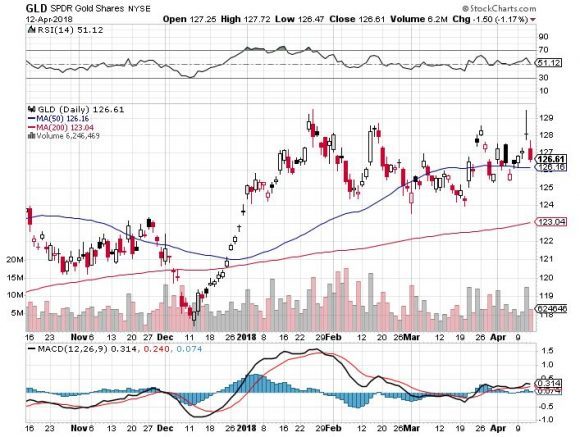
At the end of the day, it doesn't really impact the US economy, but you will see a big move in gold, which we're already starting to see, and which is why we're long in gold - as a hedge against all our other positions against this kind of geopolitical event.
Q: Will 2018 be a bull market or a bear market?
A: We are still in a bull market, but we may see only half the returns of last year - in other words we'll get a 10% profit in stocks this year instead of a 20% profit, which means it has to rise 12% from here to hit that 10% up by year-end.
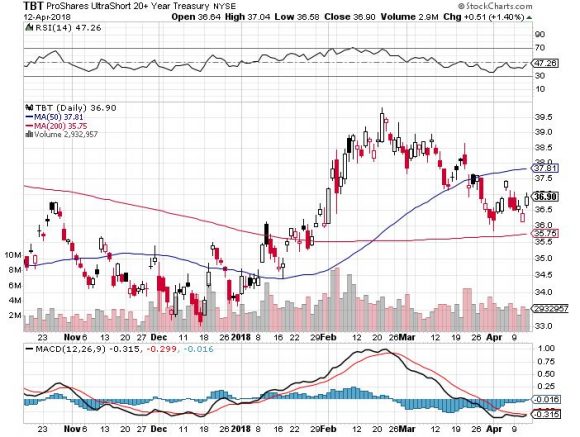
Q: What is your take on the ProShares Ultra Short 20+ Year Treasury Bond Fund (TBT)?
A: I am a big buyer here. I think that interest rates (TLT) are going to move down sharply for the rest of the year. The (TBT) here, in the mid $30s, is a great entry point - I would be buying it right now.
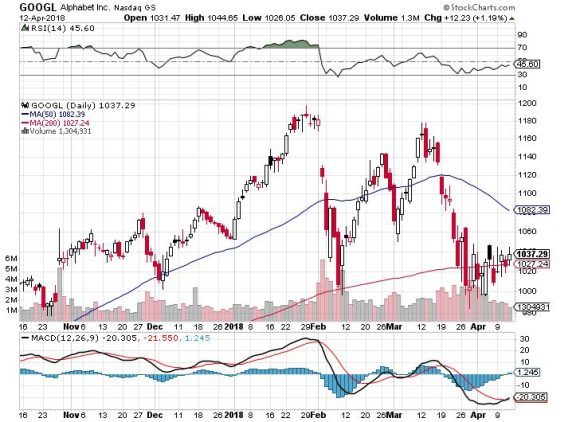
Q: How do you expect Google (GOOGL) to trade when the spread is so wide?
A: It will go up. Google is probably the best-quality technology company in the market, after Facebook (FB). We'll get some money moving out of Facebook into Google for exactly that reason; Google is Facebook without the political risk, the regulatory risk, and the security risks.
Q: Are any positions still a buy now?
A: All of them are buys now. But, do not chase the market on any conditions whatsoever. The market has an endless supply of sudden shocks coming out of Washington, which will give you that down-400-points-day. That is the day you jump in and buy. When you're buying on a 400-down-day, the risk reward is much better than buying on a 400-point up day.
Q: What is "sell in May and go away?"
A: It means take profits in all your positions in May when markets start to face historical headwinds for six months and either A) Wait for another major crash in the market (at the very least we'll get another test of the bottom of the recent range), or B) Just stay away completely; go spend all the money you made in the first half of 2018.
Q: Paul Ryan (the Republican Speaker of the House) resigned today; is he setting up for a presidential run against Trump in 2020?
A: I would say yes. Paul Ryan has been on the short list of presidential candidates for a long time. And Ryan may also be looking to leave Washington before the new Robert Mueller situation gets really unpleasant.
Q: What reaction do you expect if Trump resigns or is impeached?
A: I have Watergate to look back to; the stock market sold off 45% going into the Nixon resignation. It's a different world now, and there were a lot more things going wrong with the US economy in 1975 than there are now, like oil shocks, Vietnam, race riots, and recessions.
I would expect to get a decline, much less than that - maybe only a couple 1,000 points (or 10% or so), and then a strong Snapback Rally after that. We, in effect, have been discounting a Trump impeachment ever since he got in office. Thus far, the market has ignored it; now it's ignoring it a lot less.
Q: Thoughts on Micron Technology (MU), Lam Research (LRCX), and Nvidia (NVDA)?
A: It's all the same story: a UBS analyst who had never covered the chip sector before initiated coverage and issued a negative report on Micron Technology, which triggered a 10% sell-off in Micron, and 5% drops in every other chip company.
He took down maybe 20 different stocks based on the argument that the historically volatile chip cycle is ending now, and prices will fall through the end of the year. I think UBS is completely wrong, that the chip cycle has another 6 to 12 months to go before prices weaken.
All the research we've done through the Mad Hedge Technology Letter shows that UBS is entirely off base and that prices still remain quite strong. The chip shortage still lives! That makes the entire chip sector a buy here.
Q: Can Trump bring an antitrust action against Amazon?
A: No, no chance whatsoever. It is all political bluff. If you look at any definition of antitrust, is the consumer being harmed by Amazon (AMZN)?
Absolutely not - if they're getting the lowest prices and they're getting products delivered to their door for free, the consumer is not being harmed by lower prices.
Second is market share; normally, antitrust cases are brought when market shares get up to 70 or 80%. That's what we had with Microsoft (MSFT) in the 1990s and IBM (IBM) in the 1980s. The largest share Amazon has in any single market is 4%, so no there is basis whatsoever.
By the way, no president has ever attacked a private company on a daily basis for personal reasons like this one. Thank the president for giving us a great entry point for a stock that has basically gone up every day for two years. It's a rare opportunity.
Q: How will the trade war end?
A: I think the model for the China trade war is the US steel tariffs, where we announced tariffs against the entire world, and then exempted 75% of the world, declaring victory. That's exactly what's going to happen with China: We'll announce massive tariffs, do nothing for a while, and then negotiate modest token tariffs within a few areas. The US will declare victory, and the stock market rallies 2,000 points. That's why I have been adding risk almost every day for the last two weeks.
Q: Would you be buying ExonMobil (XOM) here, hoping for an oil breakout?
A: No, I think it's much more likely that oil is peaking out here, especially given the slowing economic data and a huge onslaught in supply from US fracking. We're getting big increases now in fracking numbers - that is very bad for prices a couple of months out. The only reason oil is this high is because Iran-sponsored Houthi rebels have been firing missiles at Saudi Arabia, which are completely harmless. In the old days, this would have caused oil to spike $50.
Q: Would you be selling stock into the rally (SPY), (QQQ)?
A: Not yet. I think the market has more to go on the upside, but you can still expect a lot of inter-day volatility depending on what comes out of Washington.
Q: Do you ever use stops on your option spreads?
A: I use mental stops. They don't take stop losses on call spreads and put spreads, and if they did they would absolutely take you to the cleaners. These are positions you never want to execute on market orders, which is what stop losses do. You always want to be working the middle of the spread. So, I use my mental stop. And when we do send out stop loss trade alerts, that's exactly where they're coming from.
Q: Will the Middle East uncertainty raise the price of oil?
A: Yes, if the Cold War with Iran turns hot, you could expect oil to go up $10 or $20 dollars higher, fairly quickly, regardless of what the fundamentals are. It's tough to be blowing up oil supplies as a great push on oil prices. But that's a big "if."
Hello from the Italian Riviera!
https://www.madhedgefundtrader.com/wp-content/uploads/2018/04/John-Italian-Riviera-story-2-image-4-e1523567901524.jpg225300MHFTRhttps://madhedgefundtrader.com/wp-content/uploads/2019/05/cropped-mad-hedge-logo-transparent-192x192_f9578834168ba24df3eb53916a12c882.pngMHFTR2018-04-13 01:06:552018-04-13 01:06:55April 11 Global Strategy Webinar Q&A
Legal Disclaimer
There is a very high degree of risk involved in trading. Past results are not indicative of future returns. MadHedgeFundTrader.com and all individuals affiliated with this site assume no responsibilities for your trading and investment results. The indicators, strategies, columns, articles and all other features are for educational purposes only and should not be construed as investment advice. Information for futures trading observations are obtained from sources believed to be reliable, but we do not warrant its completeness or accuracy, or warrant any results from the use of the information. Your use of the trading observations is entirely at your own risk and it is your sole responsibility to evaluate the accuracy, completeness and usefulness of the information. You must assess the risk of any trade with your broker and make your own independent decisions regarding any securities mentioned herein. Affiliates of MadHedgeFundTrader.com may have a position or effect transactions in the securities described herein (or options thereon) and/or otherwise employ trading strategies that may be consistent or inconsistent with the provided strategies.