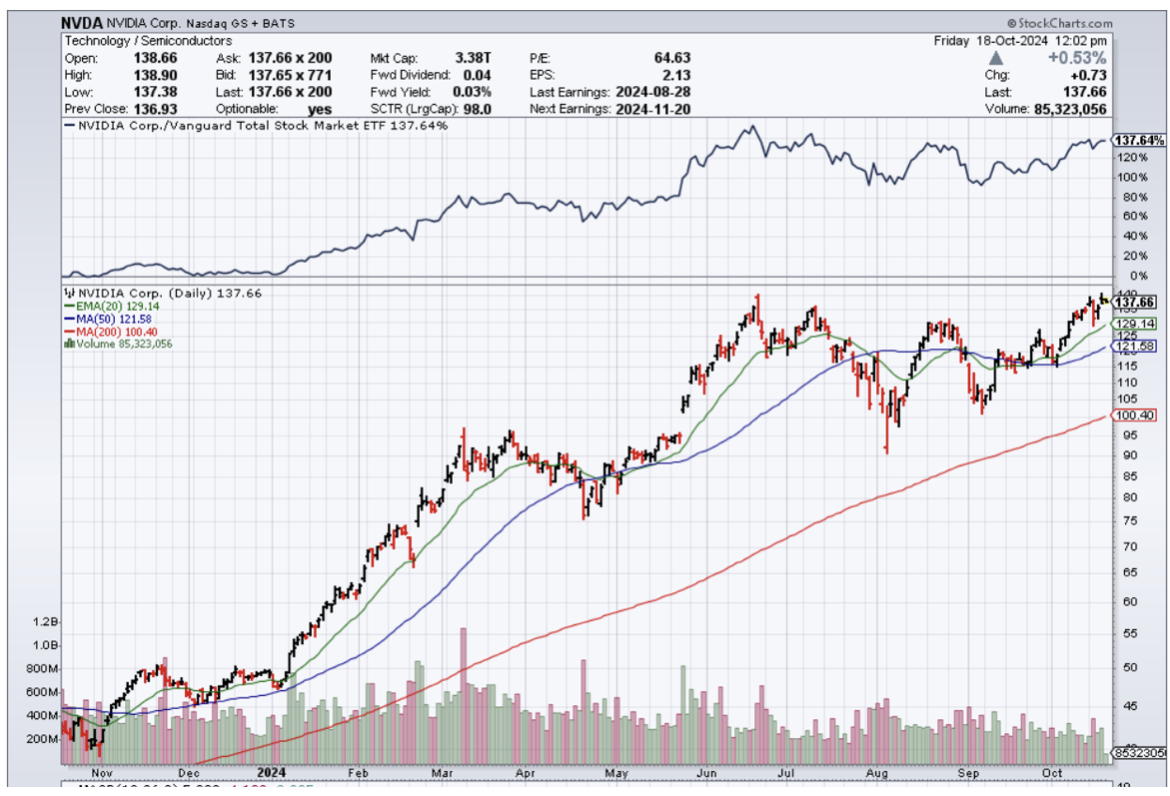
The hottest part of the tech industry is the build-out of the AI infrastructure.
Millions of data centers are needed equipped with high-speed chips to facilitate the miracle that is artificial intelligence.
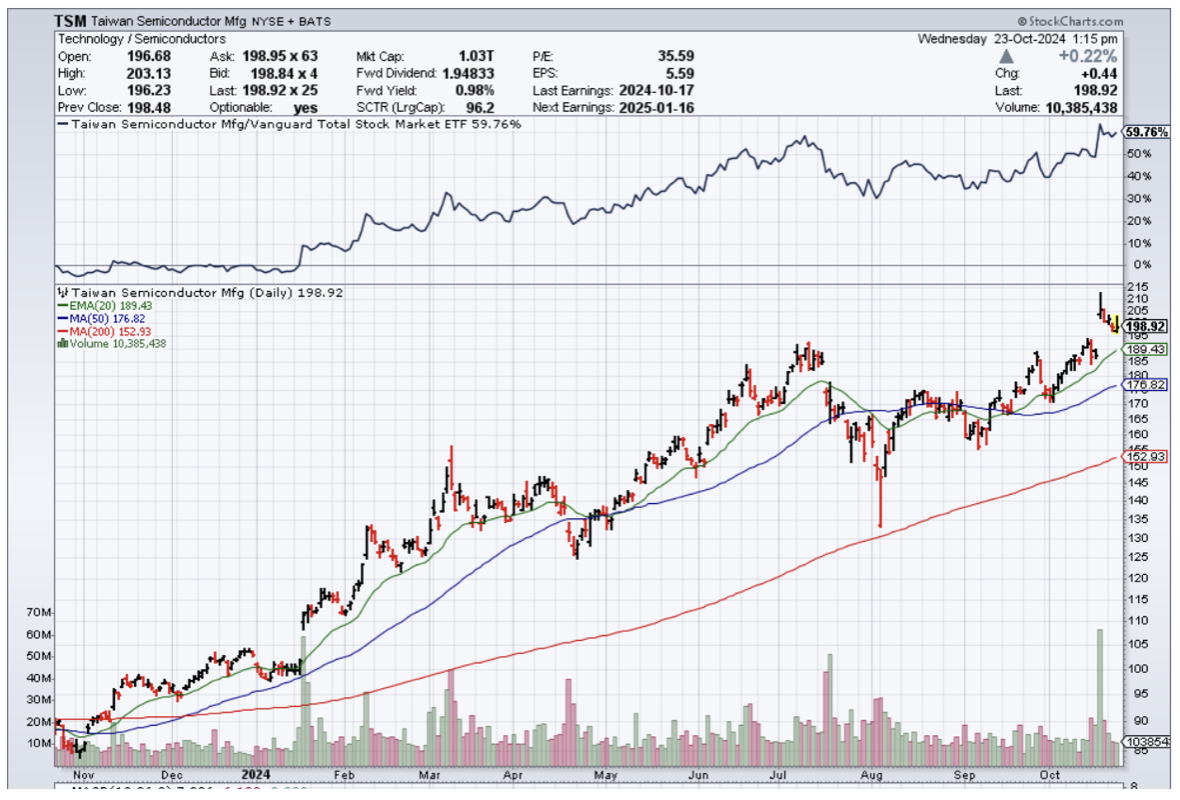
One of the leading companies right in the heat of the battle is Taiwan Semiconductor Manufacturing (TSM).
Why is TSM so important?
Nvidia (NVDA) outsources the manufacturing of its chip designs; TSM is the one doing the building, and that will mean a highly strategic position in AI moving forward.
TSM's other customers include several tech heavyweights like Advanced Micro Devices and Apple.
TSM has carved out a solid advantage in producing leading-edge logic chips used in advanced computing technologies such as AI and 5G mobile networks.
TSM is the world leader in manufacturing these specialized semiconductor chips, with an estimated 90% share of this market.
A key factor in TSM's market dominance is customer demand for chips using its three-nanometer (nm) semiconductor manufacturing process. Referred to as 3nm, this technology creates chips with greater microprocessor speed, lower energy consumption, and exceptional computational power without increasing chip size.
This 3nm tech looks like a game-changer for TSM. The process produces better chips than its older 7nm technology, which was once responsible for over a third of the company's revenue a mere three years ago. Just last year, TSM's 3nm-related revenue was a tiny 6% of third-quarter sales. But the rapid rise of AI drove 3nm income to reach 20% of quarter three revenue this year.
As 3nm-manufactured chips become more widely adopted, TSM's market share in this sector is expected to grow. This is because TSM's 3nm process generates higher yields and power efficiencies compared to those made by such competitors as Samsung.
TSM's 3nm strengths position the firm for revenue growth in the coming years. The market for the technology is forecast to skyrocket from $1.4 billion in 2023 to $26.5 billion by 2032.
With its 3nm process taking off, TSM experienced strong sales in the third quarter as revenue rose 36% year over year to $23.5 billion.
TSM's long-term sales potential looks to get a boost from the expansion of its chip fabrication facilities. Because leading-edge logic chips are needed for advanced computing, the U.S. government is incentivizing TSM to build semiconductor factories in the United States.
The underlying stock has delivered a 92% performance in the first 10 months of the year.
They certainly didn’t get left behind by the success of Nvidia, and I believe as we move forward, their strategic importance to the industry will grow and fortify.
I don’t believe that there is any slowdown in the pipeline coming any time soon.
The rhetoric from the AI chip management has been bragging about the over-demand and undersupply of chips.
This has created a massive surge in the profits for AI chip firms.
In the short term, the only negative that comes to mind would be that chip firms could be the victim of their own success reflected in overheated stock price trends.
We are due for a pullback, and that would certainly constitute as a buy-the-dip moment.
We have not seen the best of TSM yet, the best is yet to come.
https://madhedgefundtrader.com/wp-content/uploads/2019/05/cropped-mad-hedge-logo-transparent-192x192_f9578834168ba24df3eb53916a12c882.png00april@madhedgefundtrader.comhttps://madhedgefundtrader.com/wp-content/uploads/2019/05/cropped-mad-hedge-logo-transparent-192x192_f9578834168ba24df3eb53916a12c882.pngapril@madhedgefundtrader.com2024-10-23 14:02:402024-10-23 14:12:01Another Gem In The Chip Industry
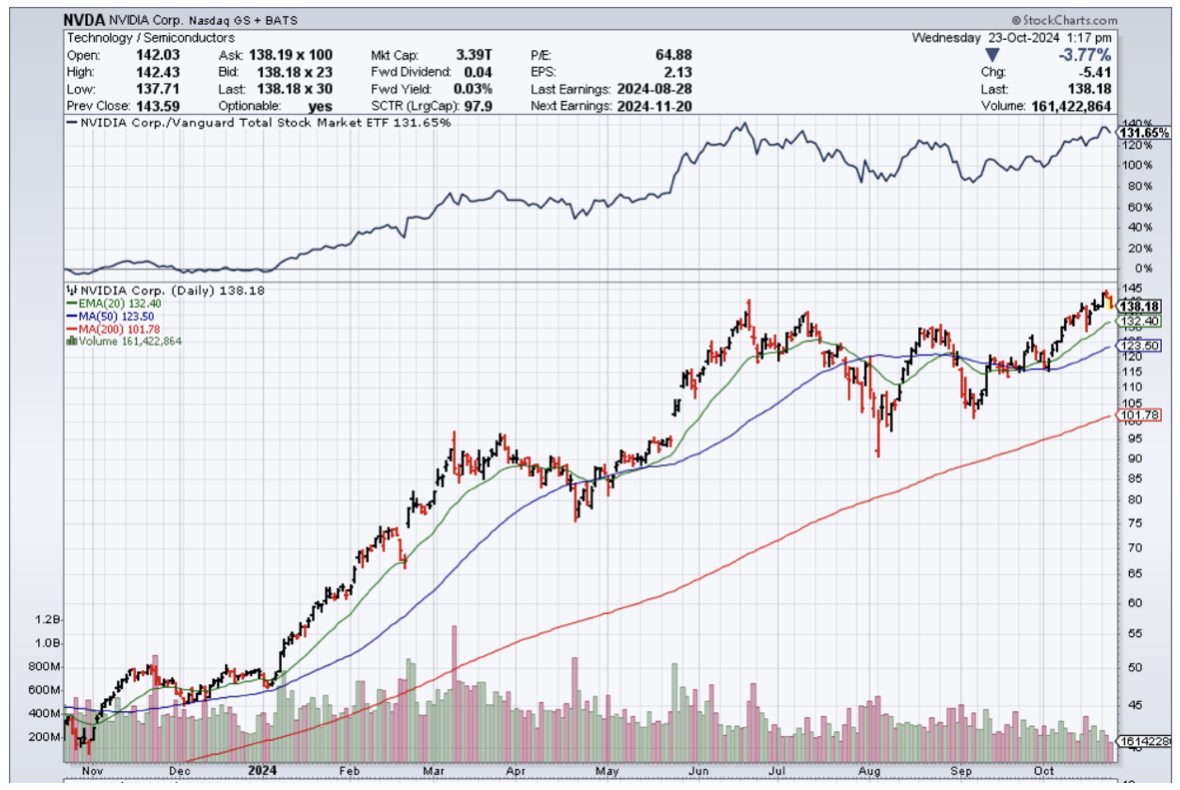
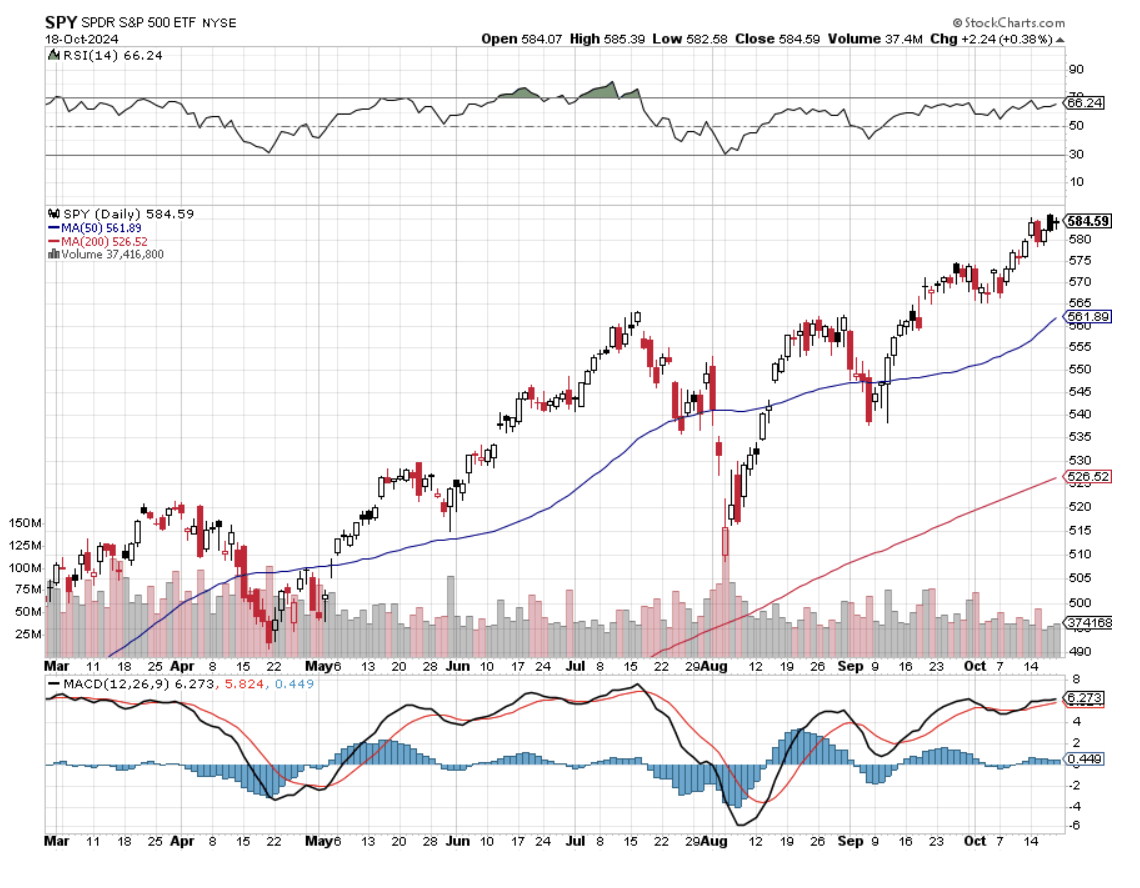
We are now nearly three months into an almost straight-up move in the stock market, and money managers everywhere are scratching their heads. We are now only 136 points or 2.32% from my yearend (SPX) target of 6,000, which is starting to look pretty conservative. The price-earnings multiple for the S&P 500 is now 21X, the Magnificent Seven 28X, and NVIDIA 65X.
I’ve seen all this before.
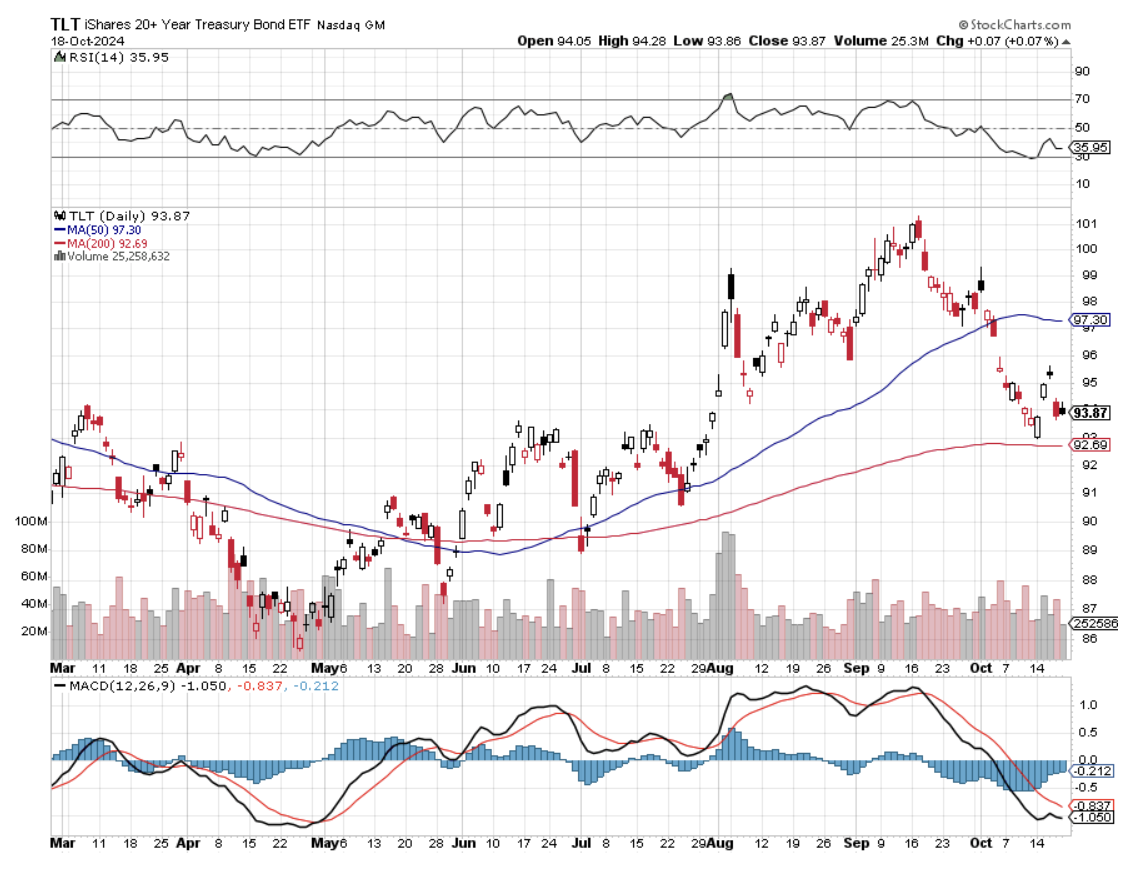
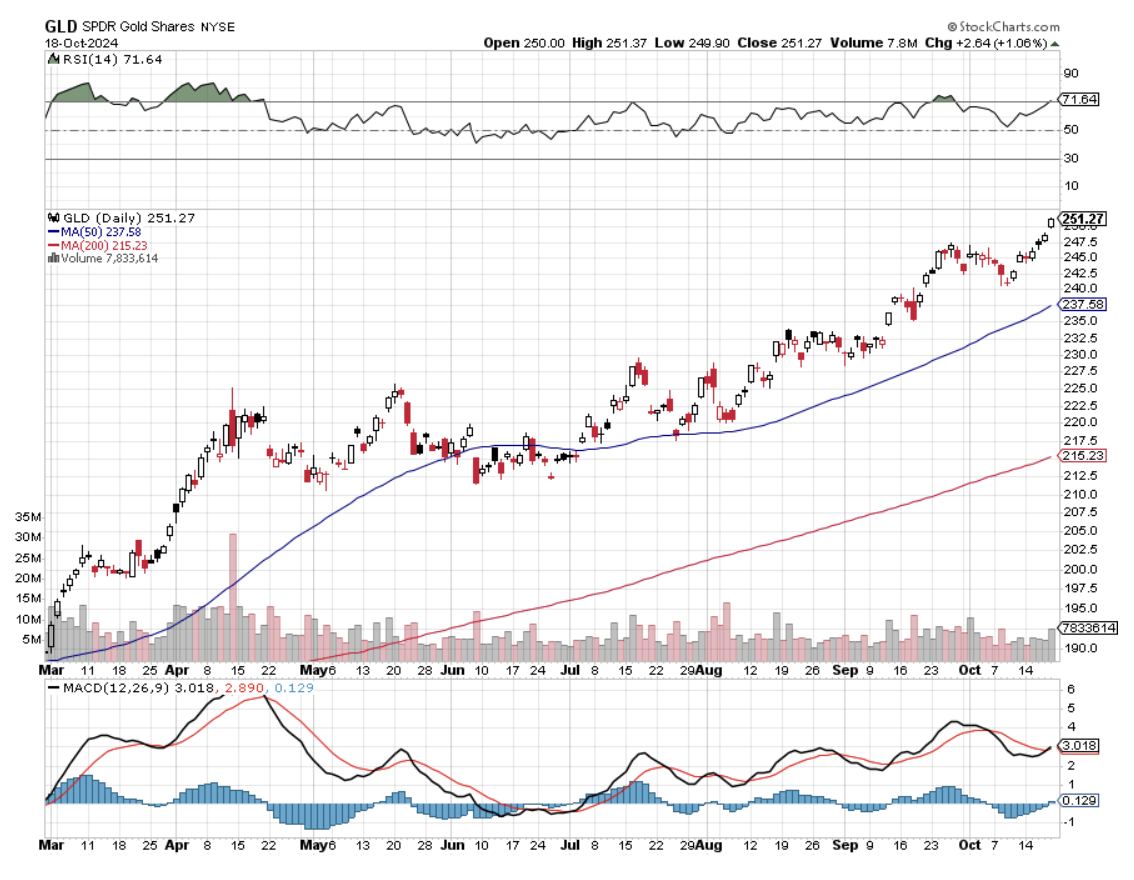
We are about as close to a perfect Goldilocks scenario as we can get. Interest rates and inflation are falling. A 3% GDP growth rate means the US has the strongest major economy and is the envy of the world. We have entered the euphoria stage of the current market move in almost all asset glasses. Gold (GLD) has gone up almost every day. Some big tech remains on fire. Energy prices are in free fall. Even bonds (TLT) are trying to put in a bottom.
Complacence is running rampant.
So, how the heck do we trade a market like this? You play the laggard trade.
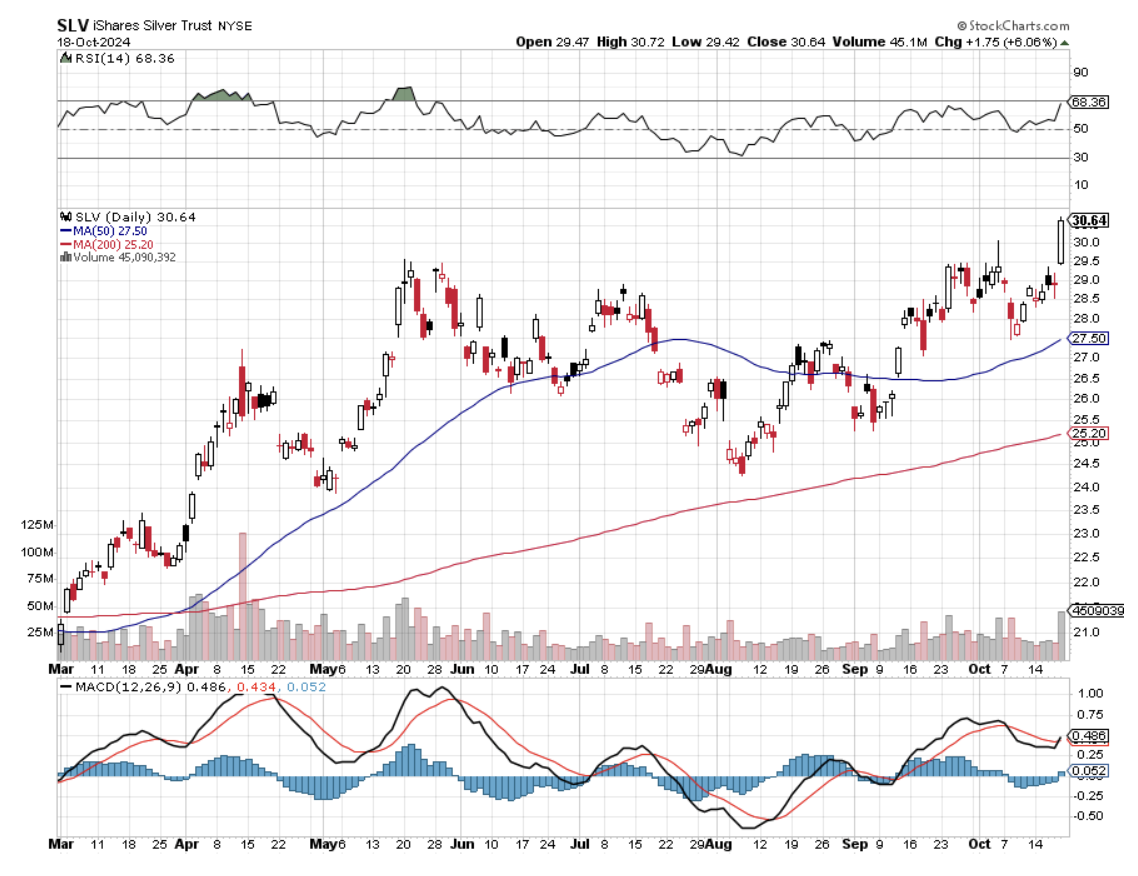
The biggest risk to the gold trade is that it has gone up 40% in a year. So, what do you do? The response by traders has been to move into lagging silver (SLV) (AGQ), which has been on a tear since September.
Had enough with the Mag Seven? Then, rotate in the sub $1 trillion part of the market with Broadcom (AVGO), ASML Holdings NV (ASML), Micron Technology (MU), and Lam Research (LRCX).
Tired of watching your DH Horton (DHI) go up every day? Then, flip into smaller homebuilders like Pulte Homes (PHM) and Lennar (LEN).
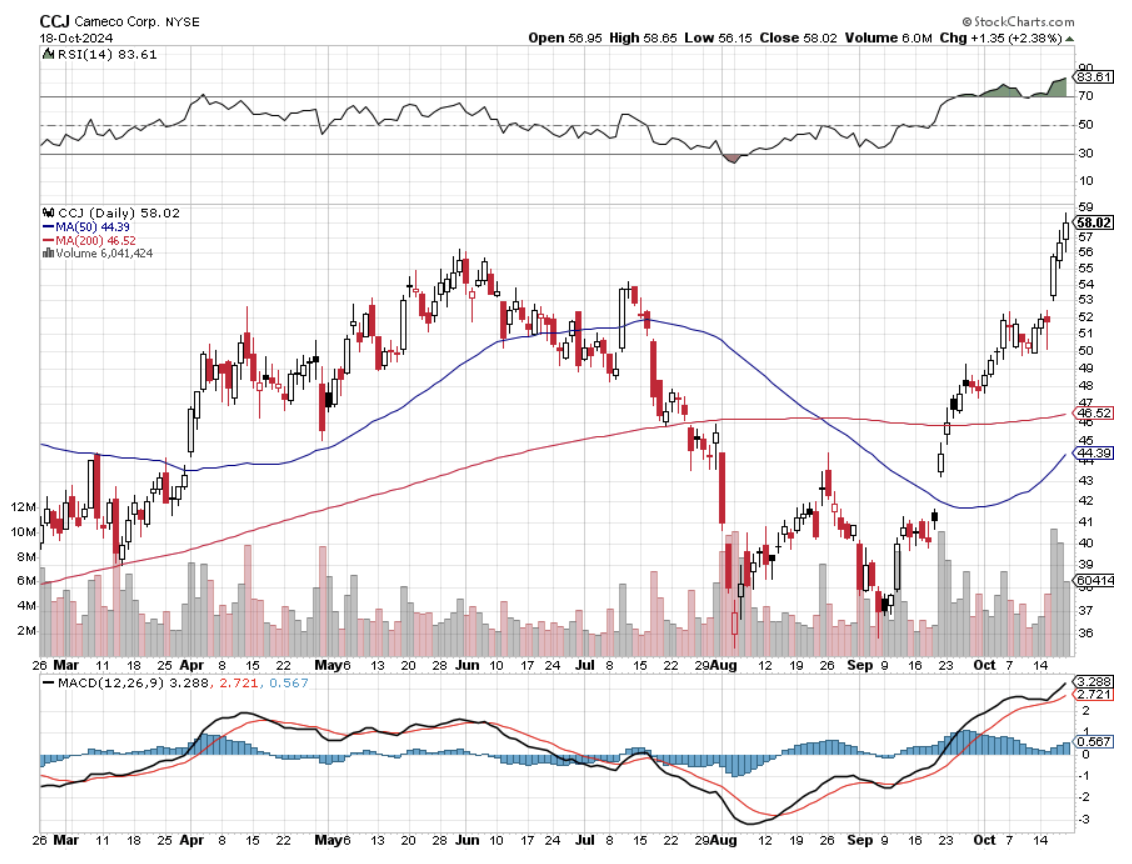
And then there is the biggest laggard of all, the nuclear trade, which is just crawling out of a 40-year penalty box. With news that Amazon (AMZN) was planning to order up to eight Small Modular Reactors to power its AI efforts, all uranium plays continue to go ballistic. The proliferation of power-hungry data centers is driving the greatest growth of power needs since WWII and the Manhattan Project.
Fortunately, I got in early. This is a trend that could become the next NVIDIA, as the public stocks involved are coming off such a low base. I have personally interviewed the founders and examined Nuscale’s plans with a fine tooth come and consider them genius. The company is, far and away, the overwhelming leader in the sector. The puzzle for the pros who understand the technology is why it took so long. Buy (CCJ), (VST), (CEG), (BWXT), and (OKLO) on dips.
It's like everything is racing towards a key, even with an unknown outcome. There happens to be a big one coming up: the US presidential elections on November 6.
Speaking of elections, I took the time to participate in the first day of voting in Nevada on Saturday, October 19, at the Incline Village Public Library. I waited in line for two hours in a brisk and breezy 40 degrees. I wore my Marine Corps cap and Ukraine Army ID just to confuse people. Some got so tired of waiting in the cold that they went home, retrieved their mail-in ballots, and returned to the polls to drop them off.
I looked back on the line, and women outnumbered the men by three to one. Where did all these women come from? There used to be such a shortage of women at Lake Tahoe that it was impossible to get a date. Hunting, fishing, long-distance backpacking, and skiing weren’t used to attract such large numbers of the female gender. Maybe now they do? But now they’re driving up in Mercedes AMG’s and Range Rovers.
When I finally arrived at the front of the line, I was asked to sign an agreement with my finger, acknowledging that I knew it was illegal to vote twice. The poll worker noticed my ID. When I explained what it was in the Cyrillic alphabet, she burst into tears, apologized, and said she had goosebumps all over.
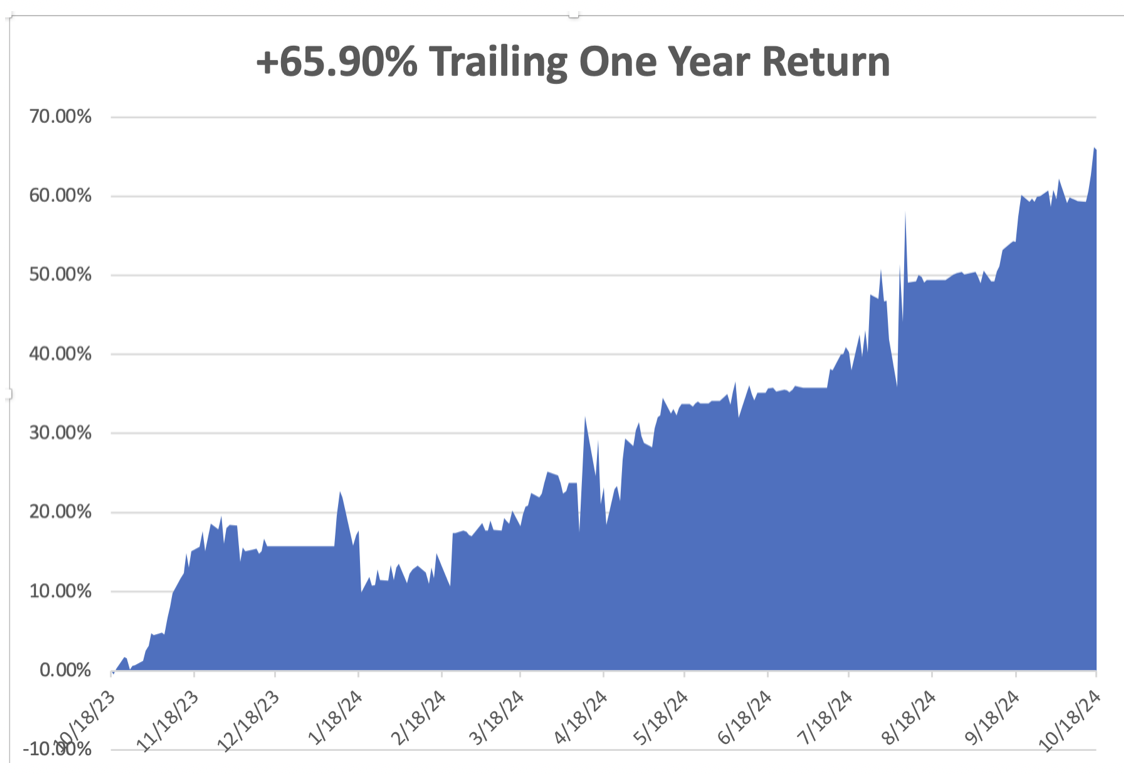
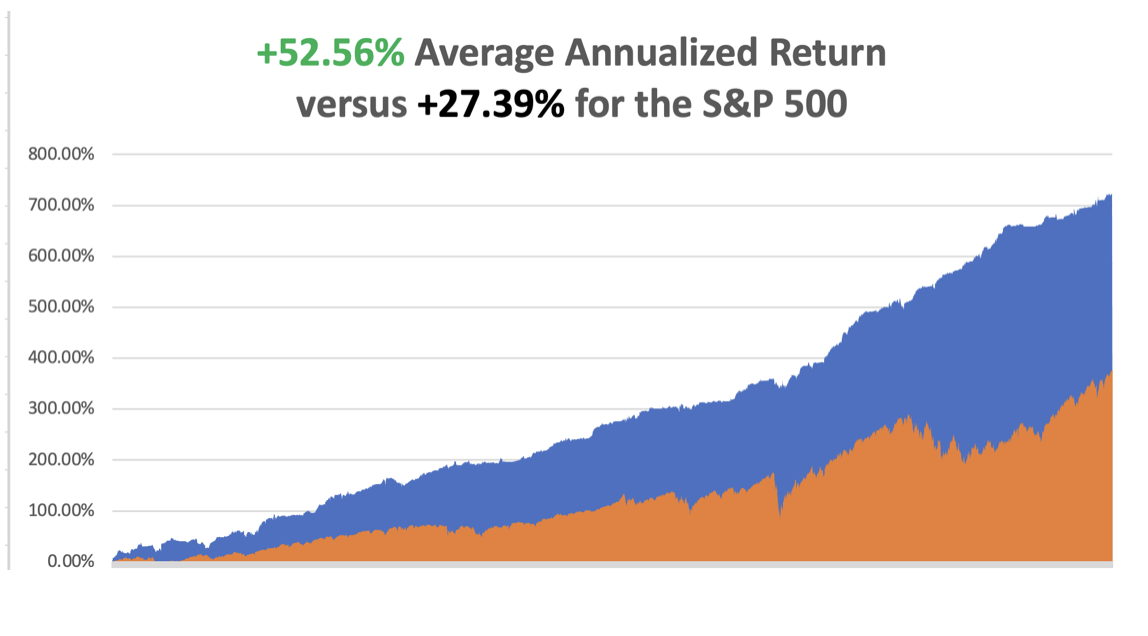
It was another blockbuster week, up over 6%. So far in October, we have gained +4.89%.My 2024 year-to-date performance is at +50.13%.The S&P 500 (SPY) is up +22.43%so far in 2024. My trailing one-year return reached a nosebleed +65.90. That brings my 16-year total return to +726.76%.My average annualized return has recovered to +52.56%.
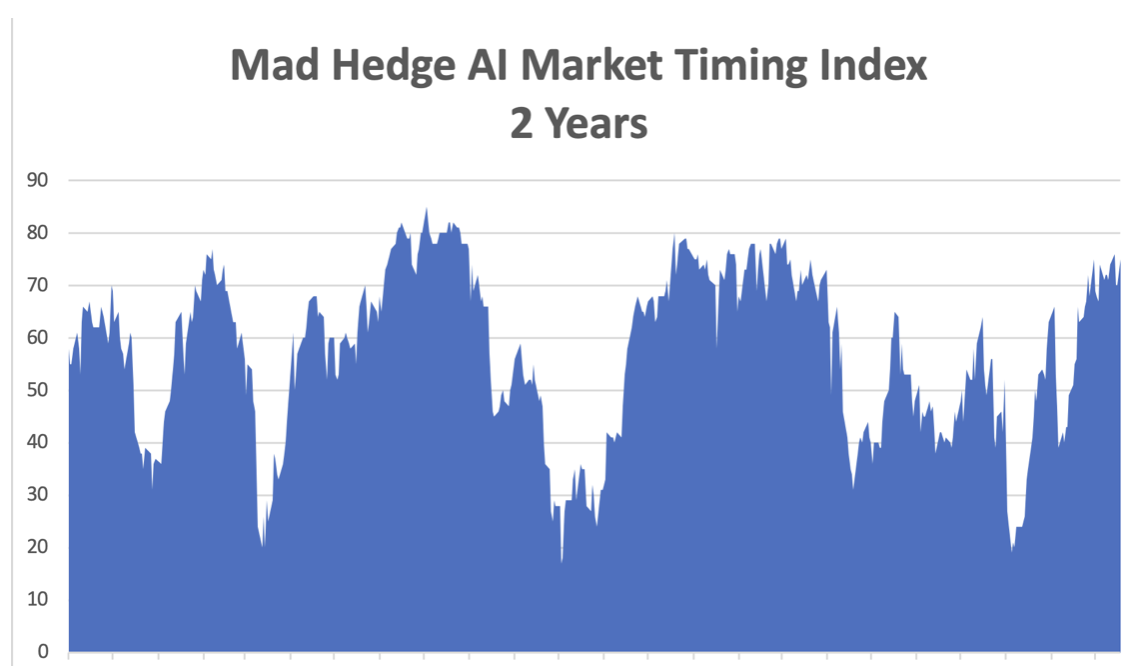
With my Mad Hedge Market Timing Index at the 70 handles for the first time in five months, I am remaining cautious with a 70% cash and 30% long. I look for a small profit in (TSLA) to reduce risk. Two of my positions expired at their maximum profit point for (NEM) and (DHI) on Friday, October 18 options expiration.
Some 63 of my 70 round trips, or 90%, were profitable in 2023. Some 60 of 80 trades have been profitable so far in 2024, and several of those losses were really break-even. Some 16 out of the last 19 trade alerts were profitable. That is a success rate of +75.00%.
Try beating that anywhere.
Risk Adjusted Basis
Current Capital at Risk
Risk On
(TSLA) 11/$165-$175 call spread 10.00%
(JPM) 11/$195-$205 call spread10.00%
(GLD) 11/230-$235 call spread 10.00%
Risk Off
NO POSITIONS 0.00%
Total Net Position 30.00%
Total Aggregate Position 30.00%
Netflix Soars on Blockbuster Earnings, up 11% at the opening on a 5 million gain in subscribers. The company posted earnings per share of $5.40 for the period ended Sept. 30, higher than the $5.12 LSEG consensus estimate.
Crucially, Netflix saw momentum in its ad-supported membership tier, which surged 35% quarter over quarter. The streaming wars are over, and (NFLX) won. Buy (NFLX) on dips.
Silver is Ready to Break Out to the Upside after a year-long-range trade. The white metal is a predictor of a healthy recovery and a solar rebound. It’s a long overdue catch-up with (GLD). Buy (AGQ) on dips.
Apple China Sales Jump 20% on the new iPhone 16 launch. Both Apple and Huawei's (HWT.UL) latest smartphones went on sale in China on Sept. 20, underscoring intensifying competition in the world's biggest smartphone market, where the U.S. firm has been losing market share in recent quarters to domestic rivals. Buy (AAPL) on dips.
Taiwan Semiconductor Soars on Spectacular Earnings, dragging up the rest of the chip sector with it. The world's largest contract chipmaker raised its expectation for annual revenue growth and said sales from AI chips would account for mid-teen percentage of its full-year revenue. U.S.-listed TSMC shares rose nearly 9%, and if gains hold, the company's market capitalization would cross $1 trillion. Buy (NVDA) on dips.
Weekly Jobless Claims Fall. Initial claims for state unemployment benefits dropped 19,000 last week to a seasonally adjusted 241,000 for the week ended Oct. 12, the Labor Department said on Thursday. Economists polled by Reuters had forecast 260,000 claims for the latest week. Claims jumped to more than a one-year high in the prior week, attributed to Helene, which devastated Florida and large swathes of the U.S. Southeast in late September.
Morgan Stanley Announces Blowout Earnings, fueling a 32% profit jump for the third quarter. Revenue from the trading business rose 13%. That followed gains recorded by its biggest rivals as the market business lifted fortunes across the industry, and a steady rebound in investment banking fees increased dealmaking. The wealth unit generated revenue of $7.27 billion, higher than analysts’ expectations, with $64 billion in net new assets. The unit boosted its pretax margin to 28%, driven by growth in fee-based assets. Buy (MS) on dips.
Global EV Sales Up 30% in September, with the largest gains in China. Gains in the U.S. market have been lagging in anticipation of the Nov. 5 election. Chinese carmakers are seeking to grow their sales in the EU despite import duties of up to 45% and amid cooling global demand for electric cars. Chinese and European automakers were going head-to-head at the Paris Car Show on Monday. Buy (TSLA) on dips.
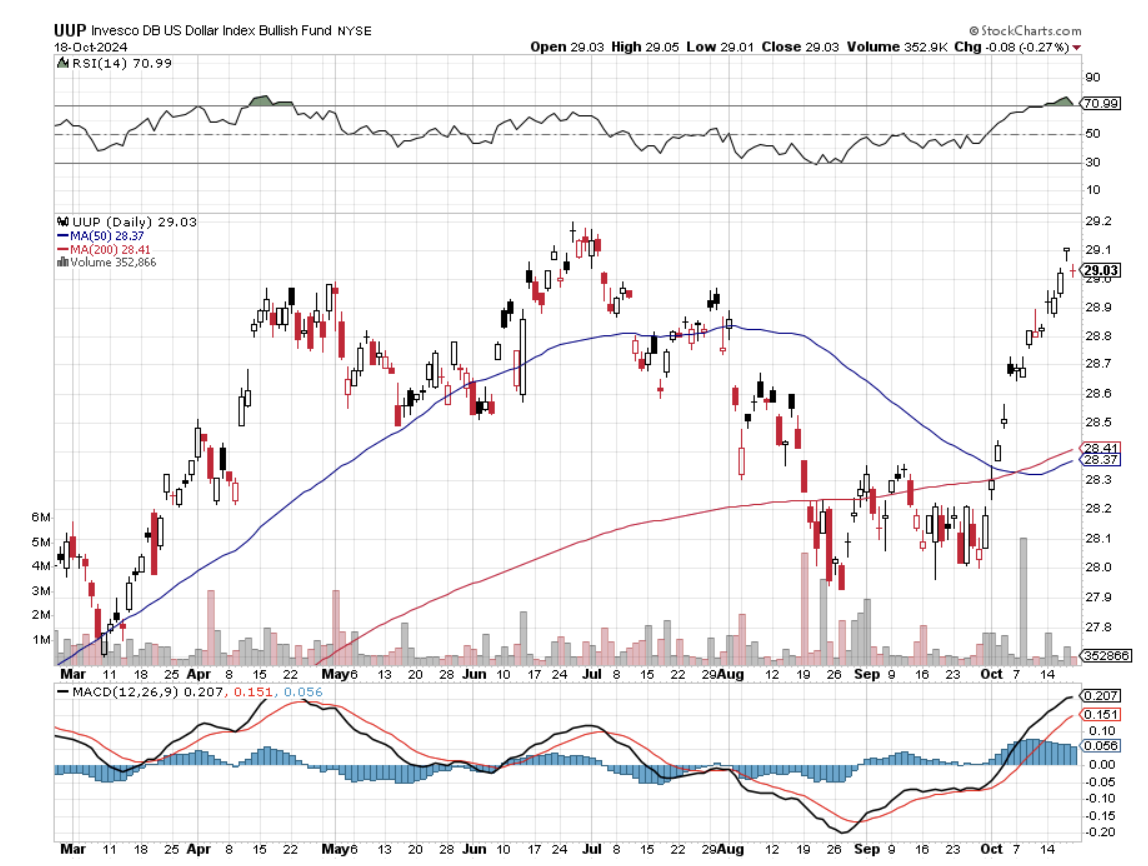
Dollar Hits Two Month High on rising US interest rates. Ten-year US Treasuries have risen from 3.55% to 4.12% since the September Nonfarm Payroll Report. A string of U.S. data has shown the economy to be resilient and slowing only modestly, while inflation in September rose slightly more than expected, leading traders to trim bets on large rate cuts from the Fed. Buy all foreign currencies on dips (FXA), (FXE), (FXB), (FXY).
S&P 500 Value Gain Hits $50 Trillion, since the 1982 bottom, which I remember well and is up 50X. The index hit a record high Wednesday and is trading Thursday at around 5770, up 21% so far in 2024. The index’s value is up sixfold since it stood at $8 trillion at year-end 2008, near the depth of the bear market during the financial crisis.
JP Morgan Delivers Blowout Earnings. Its stock, trading around $223, was on course for its biggest daily percentage gain in 1-1/2 years.
(JPM)'s investment-banking fees surged 31%, doubling guidance of 15% last month. Equities propelled trading revenue up 8%, exceeding an earlier 2% forecast. These earnings are consistent with the soft-landing narrative of modest U.S. economic growth. Buy (JPM) on dips.
My Ten-Year View
When we come out the other side of the recession, we will be perfectly poised to launch into my new American Golden Age or the next Roaring Twenties. The economy is decarbonizing, and technology hyper accelerating, creating enormous investment opportunities. The Dow Average will rise by 600% to 240,000 or more in the coming decade. The new America will be far more efficient and profitable than the old.
Dow 240,000, here we come!
On Monday, October 21 at 8:30 AM EST, nothing of note takes placeis out. On Tuesday, October 22 at 6:00 AM, the Richmond Fed Manufacturing Index is out.
On Wednesday, October 23 at 11:00 AM, the Existing Home Sales is printed.
On Thursday, October 24 at 8:30 AM, the Weekly Jobless Claims are announced. We also get New Homes Sales.
On Friday, October 25 at 8:30 AM, the US Durable Goods Orders are announced. At 2:00 PM, the Baker Hughes Rig Count is printed.
As for me, I am headed out for early voting in Nevada this morning. It’s been a year since I came back from Ukraine badly wounded, so I thought I would recall my recollections from that time.
You know you’re headed into a war zone the moment you board the train in Krakow, Poland. There are only women and children headed for Kiev, plus a few old men like me. Men of military age have been barred from leaving the country since the Russians Invaded. That leaves about 8 million to travel to Ukraine from Western Europe to visit spouses and loved ones.
After a 15-hour train ride, I arrived at Kiev’s magnificent Art Deco station. I was met by my translator and guide, Alicia, who escorted me to the city’s finest hotel, the Premier Palace on T. Shevchenka Blvd. The hotel, built in 1909, is an important historic site as it was where the Czarist general surrendered Kiev to the Bolsheviks in 1919. No one in the hotel could tell me what happened to the general afterward.
Staying in the best hotel in a city run by Oligarchs does have its distractions. Thanks to the war, occupancy was about 10%. That didn’t keep away four heavily armed bodyguards from the lobby 24/7. Breakfast was well populated by foreign arms merchants. And for some reason, there are always a lot of beautiful women hanging around with nothing to do.
The population is definitely getting war-weary. Nightly air raids across the country and constant bombings take their emotional toll. Kiev’s Metro system is the world’s deepest and, at two cents a ride, the cheapest. It’s where the government hid out during the early days of the war. They perform a dual function as bomb shelters when the missile attacks become particularly heavy.
My Look Out Ukraine has duly announced every incoming Russian missile and its targeted neighborhood. The buzzing app kept me awake at night, so I turned it off. Let the missiles land where they may. For this reason, I reserved a south-facing suite and kept the curtains drawn to protect against flying glass.
The sound of the attacks was unmistakable. The anti-aircraft drones started with a pop, pop, pop until they hit a big 1,000-pound incoming Russian cruise missile, then you heard a big kaboom! Disarmed missiles that were duds are placed all over the city and are amply decorated with colorful comments about Putin.
The extent of the Russian scourge has been breathtaking, with an epic resource grab. The most important resource is people to make up for a Russian population growth that has been plunging for the last century. The Russians depopulated their occupied territory, sending adults to Siberia and children to orphanages to turn them into Russians. If this all sounds medieval, it is. Some 19,000 Ukrainian children have gone missing since the war started.
Everyone has their own atrocity story, almost too gruesome to repeat here. Suffice it to say that every Ukrainian knows these stories and will fight to the death to avoid the unthinkable happening to them. There will be no surrender.
It will be a long war.
Touring the children’s hospital in Kiev is one of the toughest jobs I ever undertook. Kids are there shredded by shrapnel, crushed by falling walls, and newly orphaned. I did what I could to deliver advanced technology and $10,000 in cash, but their medical system is so backward, maybe 30 years behind our own, that it couldn’t be employed. Still, the few smiles I was able to inspire made the trip worth it. This is the children’s hospital that was bombed a few months ago.
The hospital is also taking the overflow of patients from the military hospitals. One foreign volunteer from Sweden was severely banged up, a mortar shell landing yards behind him. He had enough shrapnel in him, some 250 pieces, to light up an ultrasound and had already been undergoing operations for months. It was amazing he was still alive.
To get to the heavy fighting, I had to take another train ride a further 15 hours east. You really get a sense of how far Hitler overreached in Russia in WWII. After traveling by train for 30 hours to get to Kherson, Stalingrad, where the German tide was turned, is another 700 miles east!
I shared a cabin with Oleg, a man of about 50 who ran a car rental business in Kiev with 200 vehicles. When the invasion started, he abandoned the business and fled the country with his family because they had three military-aged sons. He now works at a minimum-wage job in Norway and never expects to do better.
What the West doesn’t understand is that Ukraine is not only fighting the Russians but a Great Depression as well. Some tens of thousands of businesses have gone under because people save during war and also because 20% of their customer base has fled.
I visited several villages where the inhabitants had been completely wiped out. Only their pet dogs remained alive, which roved in feral starving packs. For this reason, my major issued me my own AK47. Seeing me heavily armed also gave the peasants a greater sense of security.
It’s been a long time since I’ve held an AK, which is a marvelous weapon. It’s it’s like riding a bicycle. Once you learned, you never forget.
I’ve covered a lot of wars in my lifetime, but this is the first fought by Millennials. They post their kills on their Facebook pages. Every army unit has a GoFundMe account where doners can buy them drones, mine sweepers, and other equipment.
Everyone is on their smartphones all day long, killing time, and units receive orders this way. But go too close to the front, and the Russians will track your signal and call in an artillery strike. The army had to ban new Facebook postings from the front for exactly this reason.
Ukraine has been rightly criticized for rampant corruption, which dates back to the Soviet era. Several ministers were rightly fired for skimming off government arms contracts to deal with this. When I tried to give $10,000 to the Children’s Hospital, they refused to take it. They insisted I send a wire transfer to a dedicated account to create a paper trail and avoid sticky fingers.
I will recall more memories from my war in Ukraine in future letters, but only if I have the heart to do so. They will also be permanently posted on the home page at www.madhedfefundtrader.com under the tab “War Diary”.
Donating $10,000 to the Children’s Hospital
On the Front at Crimea with a Dud Russian Missile
A Gift or Piroshkis from Local Peasants
One of 2,000 Destroyed Russian Tanks
The Battle of Kherson with my Unit
This Blown Bridge Blocked the Russians from Entering Kiev
Good Luck and Good Trading,
John Thomas
CEO & Publisher
The Diary of a Mad Hedge Fund Trader
https://madhedgefundtrader.com/wp-content/uploads/2019/05/cropped-mad-hedge-logo-transparent-192x192_f9578834168ba24df3eb53916a12c882.png00april@madhedgefundtrader.comhttps://madhedgefundtrader.com/wp-content/uploads/2019/05/cropped-mad-hedge-logo-transparent-192x192_f9578834168ba24df3eb53916a12c882.pngapril@madhedgefundtrader.com2024-10-21 09:02:412024-10-21 12:00:25The Market Outlook for the Week Ahead, or Complacence is Running Rampant
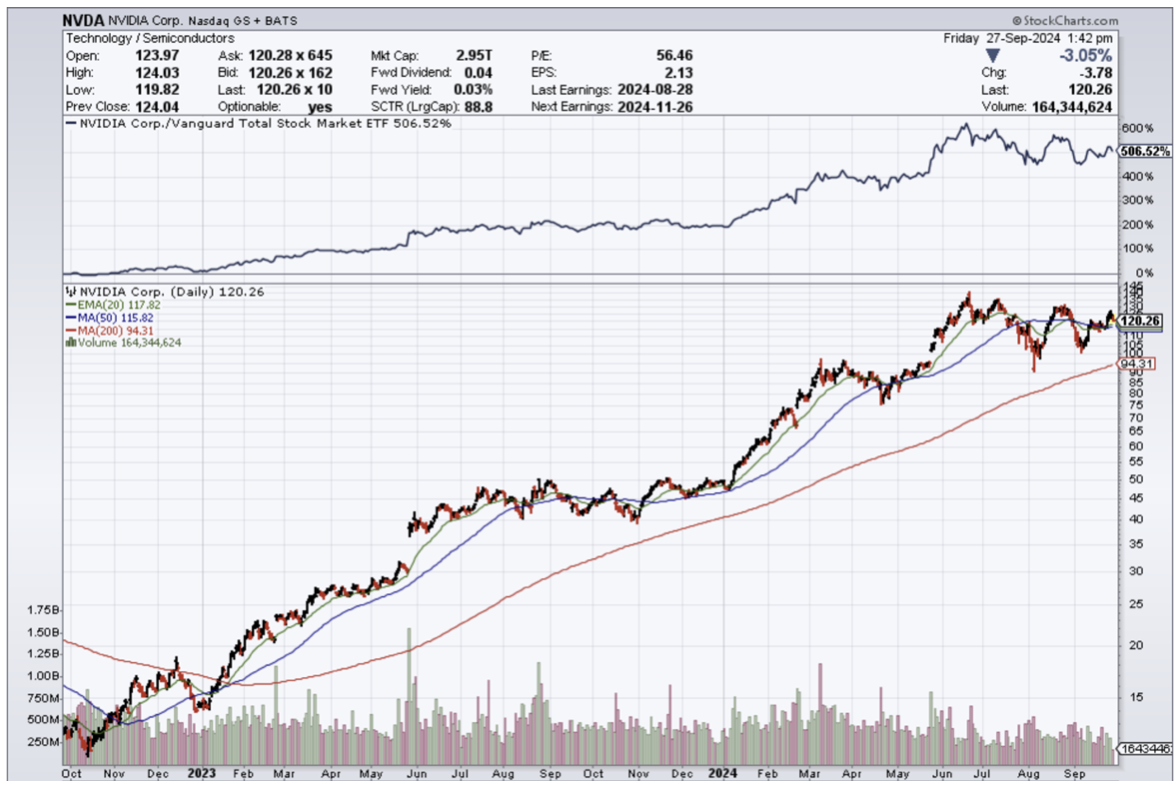
If you thought that AI chips had reached the high water mark, then you are entirely wrong.
Nvidia has been one of the only games in town, and that is a strong sign of a first-mover advantage.
In fact, the ecosystem could benefit if several chip companies could rise to the occasion to infuse that extra bit of supply.
Nvidia is on record, saying they can’t meet demand.
Well, we have finally reached the next phase of the AI chip story, and that is the next company stepping up to the plate.
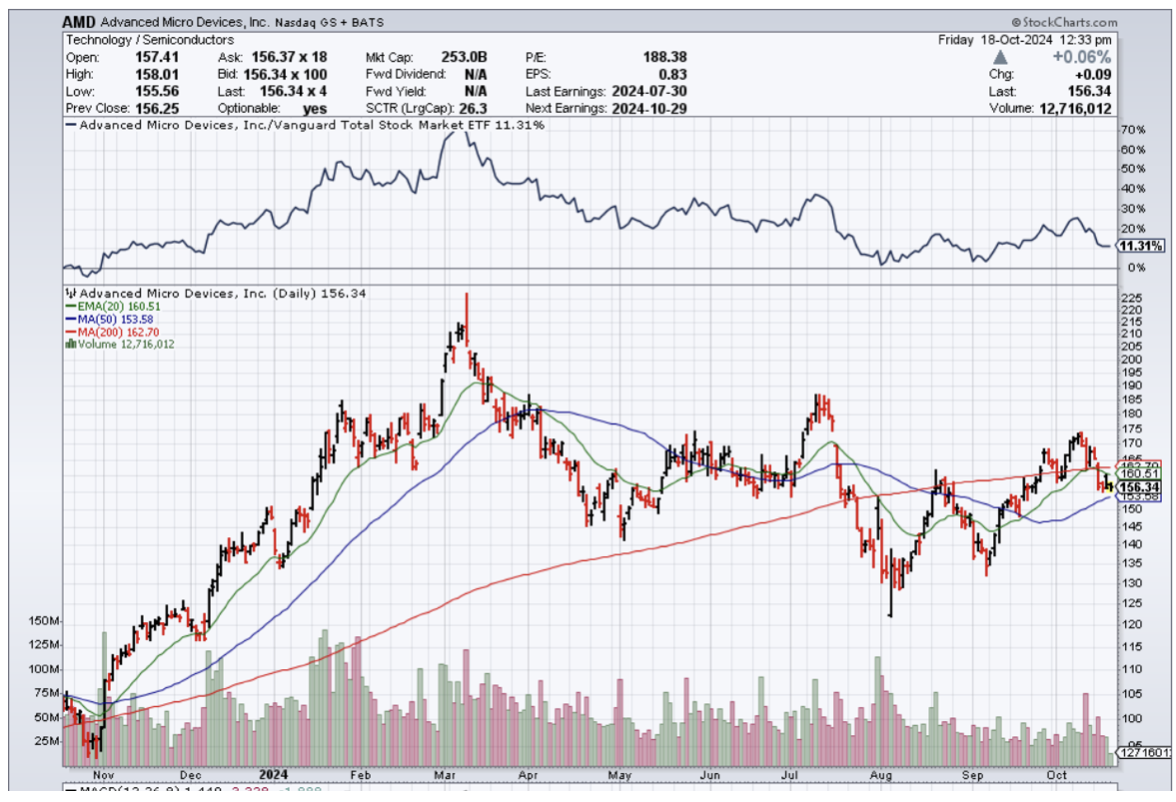
AMD (AMD) has been working furiously to get into the AI GPU game, and it appears as if their harvest is just around the corner.
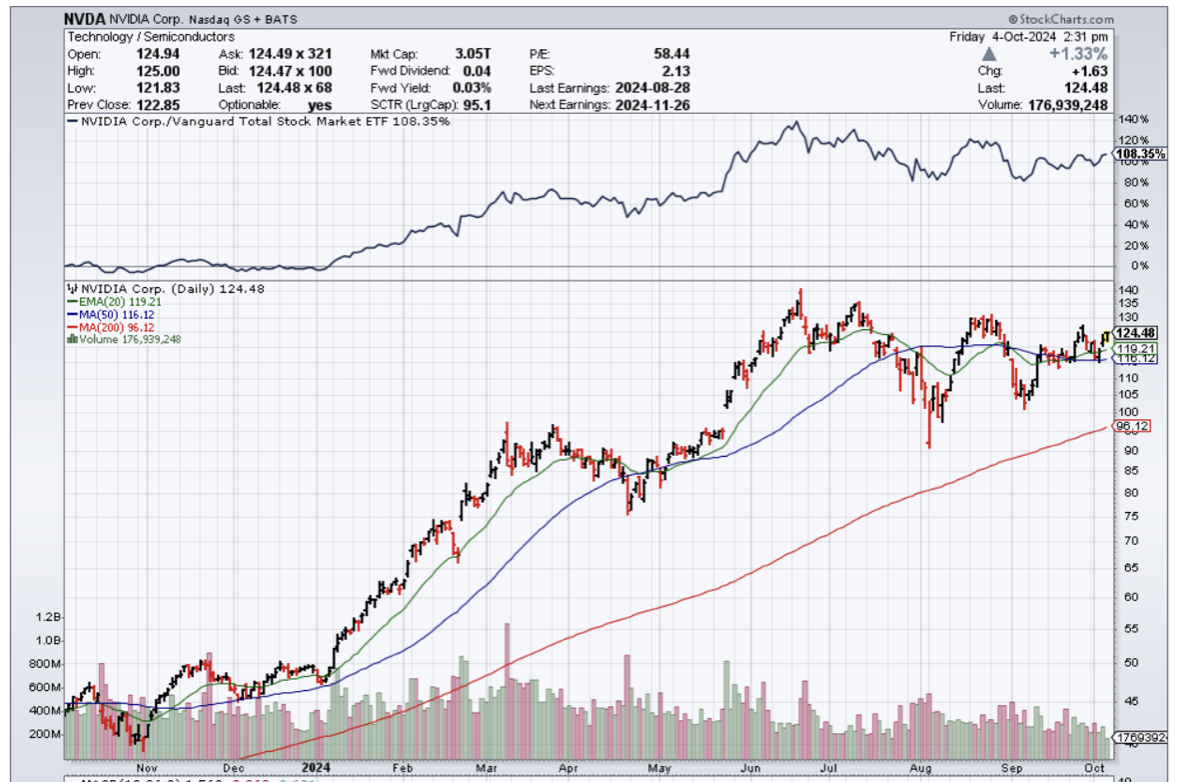
For the past 18 months, Nvidia (NVDA) has dominated the GPU industry with a ball-busting market share of up to 98%.
Nvidia's H100 GPU set the benchmark for AI training and AI inference.
The H100 is still a sizzling product today, and Nvidia continues to struggle with supply constraints because demand is so high from leading AI companies like OpenAI, Amazon, Microsoft, and more.
Those supply challenges have opened the door for competitors like Advanced Micro Devices to swoop out of nowhere. The company announced its own data center GPU called the MI300X at the end of 2023, which was specifically designed to compete with the H100. So far, it has lured in some of Nvidia's top customers, including Microsoft, Oracle, and Meta Platforms.
AMD forecasts the MI300 series will propel its GPU revenue to a record $4.5 billion in 2024 - an estimate that has already been raised twice.
Nvidia still is the champion - it started shipping its new H200 GPU earlier this year, which is capable of performing AI inference at nearly twice the speed of the H100.
Nvidia is now focused on its latest Blackwell chip architecture, which paves the way for the biggest leap in performance so far. The new GB200 NVL72 system is capable of performing AI inference at a whopping 30x the pace of the equivalent H100 system.
AMD is preparing to ship another new GPU next year called the MI350X, offering a staggering leap in performance of 35x compared to CDNA 3 chips like the original MI300X.
Advanced Micro Devices has explicitly said the MI350X will compete directly with Nvidia's Blackwell chips.
Nvidia plans to ramp up shipments of Blackwell GPUs during its fiscal 2025 fourth quarter.
A 114% increase year over year in data center revenue is what it looks like on the balance sheet for AMD.
Developing artificial intelligence (AI) software wouldn't be possible without data centers and the powerful graphics processing chips (GPUs) inside them.
This is where we stand – at the beginning of an AI-induced supercycle in technology stocks.
AMD is clearly the 2nd horse in the race that will pick up market share on Nvidia.
This could easily turn into a duopoly of GPU chip companies, and readers would be ignorant to not apply this knowledge a trading regimen.
Wait for a substantial dip to buy into AMD shares.
You’ll regret it if you don’t, especially long-term.
Unshackling the restraints on human labor – that is where tech is headed.
I’m talking about AI.
Robots aren’t able to perform complicated tasks and that is the holy grail of AI.
If headway is made just on this one issue then the sky is the limit.
Profits are then unlimited and the world will change into something we could have never imagined.
If stakes weren’t high enough, the next explosive leg up in tech shares is now centered on this concept.
There is only so much balance sheet maneuvering can add to the bottom line.
Magnificent 7 stocks who are experts are juicing up the balance sheet will gradually run out of levers to pull.
Technology stocks demand that management move the needle along because the alternative is that the company will get left behind.
When the Department of Defense commenced its robotics challenge in 2015, the stated goal was to develop ground robots that can aid in disaster recovery with the help of human operators.
Nearly a decade later, generative AI is accelerating that learning curve, pushing human-like machines to pick up new tasks in real-time.
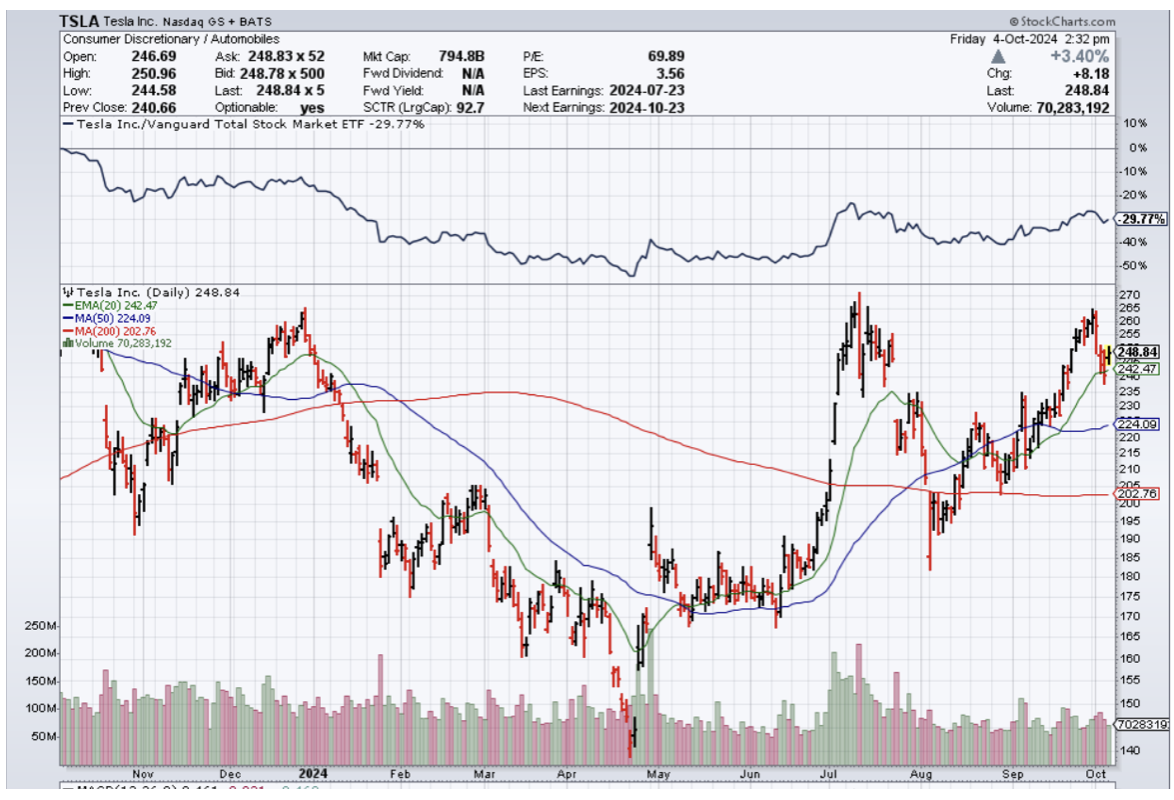
And just recently, Tesla (TSLA) presented an updated version of its Optimus robot at Tesla’s Investor Day and showed it roaming a factory floor. CEO Elon Musk touted the robot’s potential, saying it had the ability to push the company’s market cap to $25 trillion.
Humanoids that can adapt to existing environments have long been seen as the ultimate test if they can work alongside humans in spaces built for them.
Nvidia (NVDA) is driving rapid development through an ecosystem built specifically for humanoids. It combines high-powered chips that process data at high speeds with a digital world that allows users to train robots on skills applied in the real world.
Just this past summer, Nvidia unveiled “NIM Microservices,” a visual training ground that allows generative AI models to visually interpret their surroundings in 3D.
Nvidia’s ecosystem now enables robots to train using text and speech input, in addition to live demonstrations.
Humanoids have already begun taking their first steps into reality. Musk has said two Optimus robots are working at Tesla’s Fremont factory, and he expects a few thousand to be deployed by next year. Amazon (AMZN) has partnered with Oregon-based Agility to utilize its Digit robot at a test facility. Apptronik is working with Mercedes-Benz to integrate Apollo into its manufacturing line.
The goal is to adapt humanoid for the future which will allow them to operate beyond industrial use. They could become as ubiquitous if companies are able to scale and bring costs down to $10,000 per machine.
Technology is still in the stage of calculating how they bring the expenses under control.
It is not very cost-effective if a company needs to spend 5 times the actual cost of running the AI division on retrofitting the environment for a humanoid and resetting the language models for different tasks.
Much of these technical aspects are being worked out, and these companies are inching their way closer to a day when companies might be able to work fully without a human worker or alongside a minimum amount of workers.
Tesla is a company long-term that needs to be looked at and this assumption is solely based on their robotics and humanoid business. It is highly plausible that Elon Musk is at peace with sacrificing his EV business in the medium time as long as moving up the value chain to become the leader of what is next which is looking more like robotics using AI.
Musk is skating to where the puck is next and that is where the future will be.
https://madhedgefundtrader.com/wp-content/uploads/2019/05/cropped-mad-hedge-logo-transparent-192x192_f9578834168ba24df3eb53916a12c882.png00april@madhedgefundtrader.comhttps://madhedgefundtrader.com/wp-content/uploads/2019/05/cropped-mad-hedge-logo-transparent-192x192_f9578834168ba24df3eb53916a12c882.pngapril@madhedgefundtrader.com2024-10-04 14:02:442024-10-04 15:46:30Tech Wants To Get Rid Of Labor Costs
I have been pounding on the table urging my readers to buy chip stocks.
Why?
Because chip stocks will carry the Nasdaq to higher highs.
Jump on the bandwagon while you can.
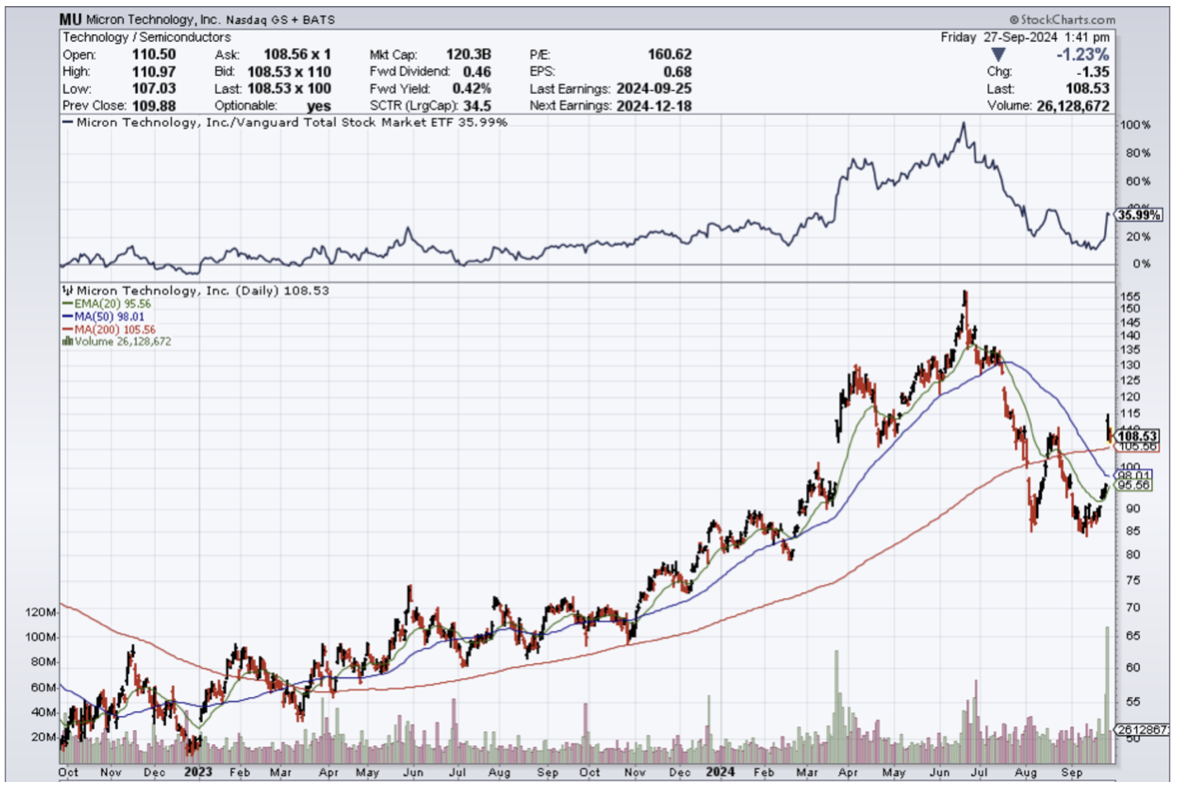
My thesis was validated when Micron stock (MU) jumped over 17% yesterday and is up over 20% for the week.
That type of stock appreciation isn’t as widely found in the tech sector anymore now that much of the tech sector is deadweight.
The sub-sector that isn’t dead weight is chips and specifically the AI chips which Micron is part of.
So when we talk about growth, you won’t hear stuff like earnings or revenue growing in the single digits.
We hear numbers more similar to revenue growing at 90% or 100% or even 300% in some cases.
The outperformance in growth is helping these stocks reach greater heights and this is just the beginning.
The commentary has been widespread that AI data spend on chips is going through the roof.
Micron’s management told us they raised guidance because of a more favorable pricing environment as well as robust demand for Micron's memory chips used in data centers to power artificial intelligence.
Executives now expect the market for high-bandwidth memory (HBM) chips used in AI data centers to increase to $25 billion in 2025, up from $5 billion this year — and heightened demand for its HBM chips to bring in multiple billions of dollars next year.
Micron is the first chipmaker to report quarterly results this earnings season and their stellar earnings bode well for the rest of its peers.
The company reported revenue of $7.75 billion — 93% higher than last year.
Micron distinguishes itself by partnering with, rather than competing against, industry superpower Nvidia (NVDA). Micron supplies memory chips for Nvidia’s hotly demanded GPUs.
The company is also set to benefit from a bill awaiting signature from President Joe Biden that would loosen environmental requirements for microchip projects funded by the CHIPS and Science Act. Micron is one of the biggest beneficiaries of CHIPS Act funding, and the Building Chips in America Act passed by the US House of Representatives Monday would allow it to access funding for its projects in Idaho and New York faster.
It is quite transparent that these companies cannot make enough chips in the short term and tech companies are throwing money at them to try to produce the supply that is required for the AI build-out.
Whatever you think of how many AI chips will be needed to deploy AI in full capacity - the real number will dwarf that.
The energy generation needed to power this new technology is so immense that it could even raise the temperature of the earth a few degrees from the sheer energy it will emit.
We are at the beginning of the AI revolution and the chips are currently the best way to play it.
I am bullish chip companies who produces AI chips.
https://madhedgefundtrader.com/wp-content/uploads/2019/05/cropped-mad-hedge-logo-transparent-192x192_f9578834168ba24df3eb53916a12c882.png00april@madhedgefundtrader.comhttps://madhedgefundtrader.com/wp-content/uploads/2019/05/cropped-mad-hedge-logo-transparent-192x192_f9578834168ba24df3eb53916a12c882.pngapril@madhedgefundtrader.com2024-09-27 14:02:442024-09-27 14:52:18Chips Shine Through Again
There is a very high degree of risk involved in trading. Past results are not indicative of future returns. MadHedgeFundTrader.com and all individuals affiliated with this site assume no responsibilities for your trading and investment results. The indicators, strategies, columns, articles and all other features are for educational purposes only and should not be construed as investment advice. Information for futures trading observations are obtained from sources believed to be reliable, but we do not warrant its completeness or accuracy, or warrant any results from the use of the information. Your use of the trading observations is entirely at your own risk and it is your sole responsibility to evaluate the accuracy, completeness and usefulness of the information. You must assess the risk of any trade with your broker and make your own independent decisions regarding any securities mentioned herein. Affiliates of MadHedgeFundTrader.com may have a position or effect transactions in the securities described herein (or options thereon) and/or otherwise employ trading strategies that may be consistent or inconsistent with the provided strategies.