
• support@madhedgefundtrader.com
  • Member Login
Mad Hedge Fund Trader
  • Home
  • About
  • Store
  • Luncheons
  • Testimonials
  • Contact Us
  • Click to open the search input field Click to open the search input field Search
  • Menu Menu

Tag Archive for: (SLV)

Mad Hedge Fund Trader

2015 Annual Asset Class Review

Newsletter

Zephyr

I am once again writing this report from a first class sleeping cabin on Amtrak?s California Zephyr. By day, I have two comfortable seats facing each other next to a broad window. At night, they fold into bunk beds, a single and a double. There is a shower, but only Houdini could get in and out of it.

We are now pulling away from Chicago?s Union Station, leaving its hurried commuters, buskers, panhandlers, and majestic great halls behind. I am headed for Emeryville, California, just across the bay from San Francisco. That gives me only 56 hours to complete this report.

I tip my porter, Raymond, $100 in advance to make sure everything goes well during the long adventure, and to keep me up to date with the onboard gossip.

The rolling and pitching of the car is causing my fingers to dance all over the keyboard. Spellchecker can catch most of the mistakes, but not all of them. Thank goodness for small algorithms.


station

As both broadband and cell phone coverage are unavailable along most of the route, I have to rely on frenzied searches during stops at major stations along the way to chase down data points.

You know those cool maps in the Verizon stores that show the vast coverage of their cell phone networks? They are complete BS. Who knew that 95% of America is off the grid? That explains a lot about our politics today. I have posted many of my better photos from the trip below, although there is only so much you can do from a moving train and an iPhone.

After making the rounds with strategists, portfolio managers, and hedge fund traders, I can confirm that 2014 was one of the toughest to trade for careers lasting 30, 40, or 50 years. Yet again, the stay at home index players have defeated the best and the brightest.

With the Dow gaining a modest 8% in 2014, and S&P 500 up a more virile 14.2%, this was a year of endless frustration. Volatility fell to the floor, staying at a monotonous 12% for seven boring consecutive months. Most hedge funds lagged the index by miles.

My Trade Alert Service, hauled in an astounding 30.3% profit, at the high was up 42.7%, and has become the talk of the hedge fund industry. That was double the S&P 500 index gain.

If you think I spend too much time absorbing conspiracy theories from the Internet, let me give you a list of the challenges I see financial markets facing in the coming year:


JT & conductor

The Ten Highlights of 2015

1) Stocks will finish 2015 higher, almost certainly more than the previous year, somewhere in the 10-15% range. Cheap energy, ultra low interest rates, and 3-4% GDP growth, will expand multiples. It?s Goldilocks with a turbocharger.

2) Performance this year will be back-end loaded into the fourth quarter, as it was in 2014. The path forward became so clear, that some of 2015?s performance was pulled forward into November, 2014.

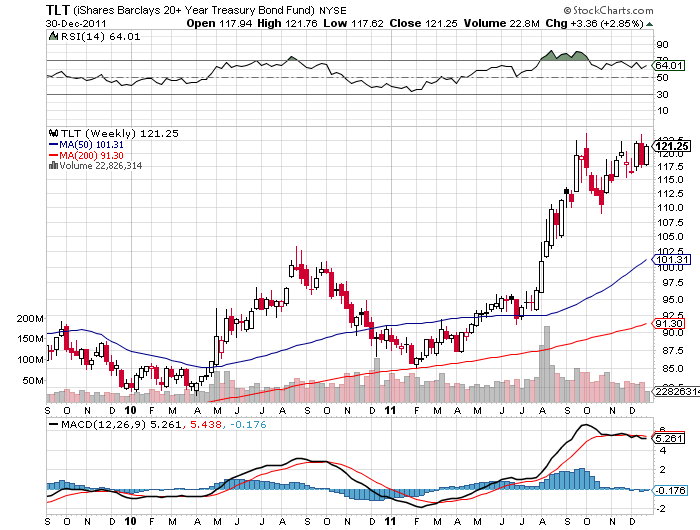
3) The Treasury bond market will modestly grind down, anticipating the inevitable rate rise from the Federal Reserve.

4) The yen will lose another 10%-20% against the dollar.

5) The Euro will fall another 10%, doing its best to hit parity with the greenback, with the assistance of beleaguered continental governments.

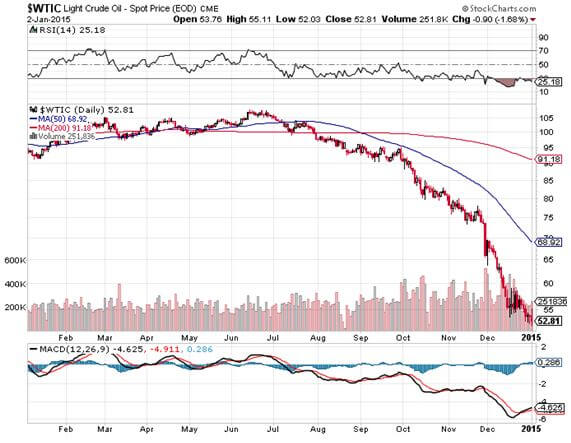
6) Oil stays in a $50-$80 range, showering the economy with hundreds of billions of dollars worth of de facto tax cuts.

7) Gold finally bottoms at $1,000 after one more final flush, then rallies (My jeweler was right, again).

8) Commodities finally bottom out, thanks to new found strength in the global economy, and begin a modest recovery.

9) Residential real estate has made its big recovery, and will grind up slowly from here.

10) After a tumultuous 2014, international political surprises disappear, the primary instigators of trouble becalmed by collapsed oil revenues.


windmills

The Thumbnail Portfolio

Equities - Long. A rising but low volatility year takes the S&P 500 up to 2,350. This year we really will get another 10% correction. Technology, biotech, energy, solar, and financials lead.

Bonds - Short. Down for the entire year with long periods of stagnation.

Foreign Currencies - Short. The US dollar maintains its bull trend, especially against the Yen and the Euro.

Commodities - Long. A China recovery takes them up eventually.

Precious Metals - Stand aside. We get the final capitulation selloff, then a rally.

Agriculture - Long. Up, because we can?t keep getting perfect weather forever.

Real estate - Long. Multifamily up, commercial up, single family homes sideways to up small.


farmland

1) The Economy - Fortress America

This year, it?s all about oil, whether it stays low, shoots back up, or falls lower. The global crude market is so big, so diverse, and subject to so many variables, that it is essentially unpredictable.

No one has an edge, not the major producers, consumers, or the myriad middlemen. For proof, look at how the crash hit so many ?experts? out of the blue.

This means that most economic forecasts for the coming year are on the low side, as they tend to be insular and only examine their own back yard, with most predictions still carrying a 2% handle.

I think the US will come in at the 3%-4% range, and the global recovery spawns a cross leveraged, hockey stick effect to the upside. This will be the best performance in a decade. Most company earnings forecasts are low as well.

There is one big positive that we can count on in the New Year. Corporate earnings will probably come in at $130 a share for the S&P 500, a gain of 10% over the previous year. During the last five years, we have seen the most dramatic increase in earnings in history, taking them to all-time highs.

This is set to continue. Furthermore, this growth will be front end loaded into Q1. The ?tell? was the blistering 5% growth rate we saw in Q3, 2014.

Cost cutting through layoffs is reaching an end, as there is no one left to fire. That leaves hyper accelerating technology and dramatically lower energy costs the remaining sources of margin increases, which will continue their inexorable improvements. Think of more machines and software replacing people.

You know all of those hundreds of billions raised from technology IPO?s in 2014. Most of that is getting plowed right back into new start ups, accelerating the rate of technology improvements even further, and the productivity gains that come with it.

You can count on demographics to be a major drag on this economy for the rest of the decade. Big spenders, those in the 46-50 age group, don?t return in large numbers until 2022.

But this negative will be offset by a plethora of positives, like technology, global expansion, and the lingering effects of Ben Bernanke?s massive five year quantitative easing. A time to pay the piper for all of this largess will come. But it could be a decade off.

I believe that the US has entered a period of long-term structural unemployment similar to what Germany saw in the 1990?s. Yes, we may grind down to 5%, but no lower than that. Keep close tabs on the weekly jobless claims that come out at 8:30 AM Eastern every Thursday for a good read as to whether the financial markets will head in a ?RISK ON? or ?RISK OFF? direction.

Most of the disaster scenarios predicted for the economy this year were based on the one off black swans that never amounted to anything, like the Ebola virus, ISIS, and the Ukraine.

Being continually afraid is expensive.


Moose on Snowy MountainA Rocky Mountain Moose Family


2) Equities (SPX), (QQQ), (AAPL), (XLF), (BAC), (EEM),(EWZ), (RSX), (PIN), (FXI), (TUR), (EWY), (EWT), (IDX)

With the economy going gangbusters, and corporate earnings reaching $130 a share, those with a traditional ?buy and hold? approach to the stock market will do alright, provided they are willing to sleep through some gut churning volatility. A Costco sized bottle of Jack Daniels and some tranquillizers might help too.

Earnings multiples will increase as well, as much as 10%, from the current 17X to 18.5X, thanks to a prolonged zero interest rate regime from the Fed, a massive tax cut in the form of cheap oil, unemployment at a ten year low, and a paucity of attractive alternative investments.

This is not an outrageous expectation, given the 10-22 earnings multiple range that we have enjoyed during the last 30 years. If anything, it is amazing how low multiples are, given the strong tailwinds the economy is enjoying.

The market currently trades around fair value, and no market in history ever peaked out here. An overshoot to the upside, often a big one, is mandatory.
After all, my friend, Janet Yellen, is paying you to buy stock with cheap money, so why not?

This is how the S&P 500 will claw its way up to 2,350 by yearend, a gain of about 12.2% from here. Throw in dividends, and you should pick up 14.2% on your stock investments in 2015.

This does not represent a new view for me. It is simply a continuation of the strategy I outlined again in October, 2014 (click here for ?Why US Stocks Are Dirt Cheap?).

Technology will be the top-performing sector once again this year. They will be joined by consumer cyclicals (XLV), industrials (XLI), and financials (XLF).

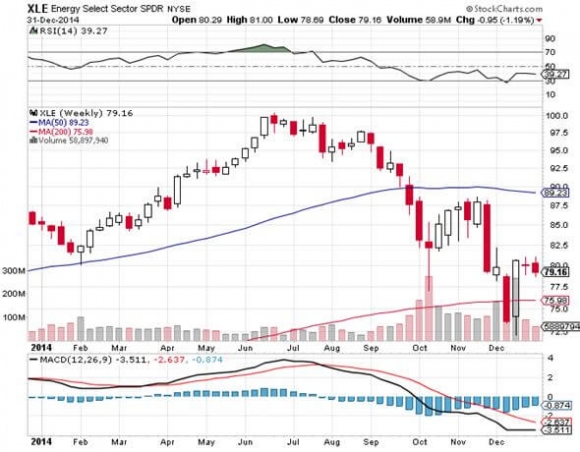
The new members in the ?Stocks of the Month Club? will come from newly discounted and now high yielding stocks in the energy sector (XLE).

There is also a rare opportunity to buy solar stocks on the cheap after they have been unfairly dragged down by cheap oil like Solar City (SCTY) and the solar basket ETF (TAN). Revenues are rocketing and costs are falling.

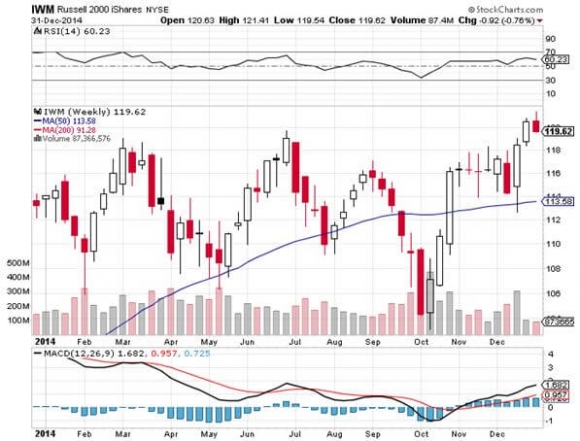
After spending a year in the penalty box, look for small cap stocks to outperform. These are the biggest beneficiaries of cheap energy and low interest rates, and also have minimal exposure to the weak European and Asian markets.

Share prices will deliver anything but a straight-line move. We finally got our 10% correction in 2014, after a three-year hiatus. Expect a couple more in 2015. The higher prices rise, the more common these will become.

We will start with a grinding, protesting rally that takes us up to new highs, as the market climbs the proverbial wall of worry. Then we will suffer a heart stopping summer selloff, followed by another aggressive yearend rally.

Cheap money creates a huge incentive for companies to buy back their own stock. They divert money from their $3 trillion cash hoard, which earns nothing, retire shares paying dividends of 3% or more, and boost earnings per share without creating any new business. Call it financial engineering, but the market loves it.

Companies are also retiring stock through takeovers, some $2 trillion worth last year. Expect more of this to continue in the New Year, with a major focus on energy. Certainly, every hedge fund and activist investor out there is undergoing a crash course on oil fundamentals. After a 13-year bull market in energy, the industry is ripe for a cleanout.

This is happening in the face of both an individual and institutional base that is woefully underweight equities.

The net net of all of this is to create a systemic shortage of US equities. That makes possible simultaneous rising prices and earnings multiples that have taken us to investor heaven.
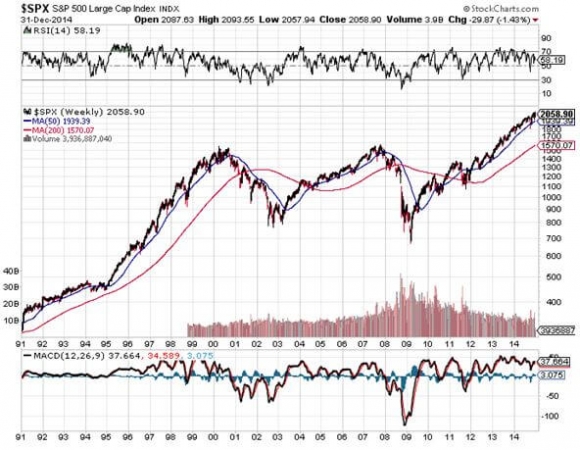
 

SPX 12-31-14

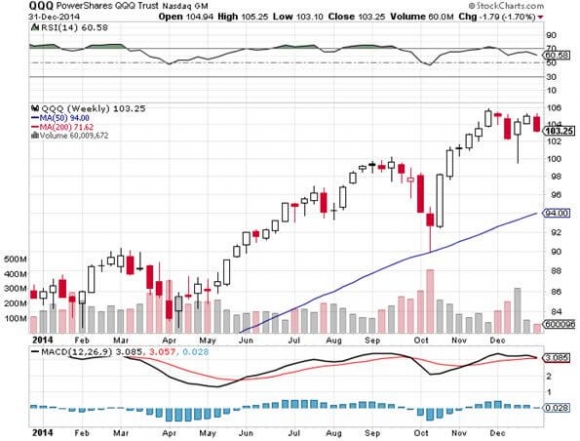
QQQ 12-31-14

IWM 12-31-14

XLE 12-31-14

snowy hillsFrozen Headwaters of the Colorado River


3) Bonds ?(TLT), (TBT), (JNK), (PHB), (HYG), (PCY), (MUB), (HCP), (KMP), (LINE)

Amtrak needs to fill every seat in the dining car, so you never know who you will get paired with.

There was the Vietnam vet Phantom jet pilot who now refused to fly because he was treated so badly at airports. A young couple desperate to get out of Omaha could only afford seats as far as Salt Lake City, sitting up all night. I paid for their breakfast.

A retired British couple was circumnavigating the entire US in a month on a ?See America Pass.? Mennonites returning home by train because their religion forbade airplanes.

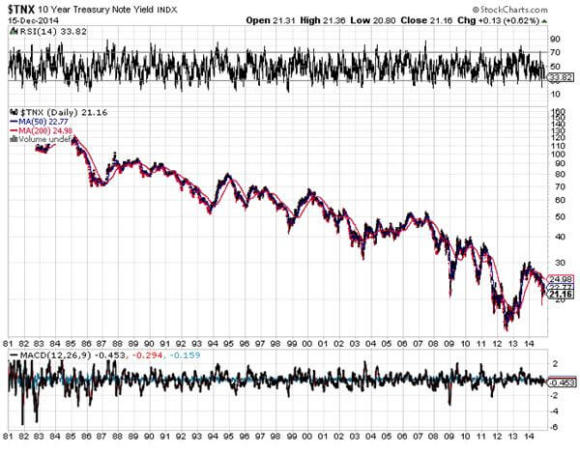
If you told me that US GDP growth was 5%, unemployment was at a ten year low at 5.8%, and energy prices had just halved, I would have pegged the ten-year Treasury bond yield at 6.0%. Yet here we are at 2.10%.

Virtually every hedge fund manager and institutional investor got bonds wrong last year, expecting rates to rise. I was among them, but that is no excuse. At least I have good company.

You might as well take your traditional economic books and throw them in the trash. Apologies to John Maynard Keynes, John Kenneth Galbraith, and Paul Samuelson.

The reasons for the debacle are myriad, but global deflation is the big one. With ten year German bunds yielding a paltry 50 basis points, and Japanese bonds paying a paltry 30 basis points, US Treasuries are looking like a bargain.

To this, you can add the greater institutional bond holding requirements of Dodd-Frank, a balancing US budget deficit, a virile US dollar, the commodity price collapse, and an enormous embedded preference for investors to keep buying whatever worked yesterday.

For more depth on the perennial strength of bonds, please click here for ?Ten Reasons Why I?m Wrong on Bonds?.

Bond investors today get an unbelievable bad deal. If they hang on to the longer maturities, they will get back only 80 cents worth of purchasing power at maturity for every dollar they invest.

But institutions and individuals will grudgingly lock in these appalling returns because they believe that the potential losses in any other asset class will be worse. The problem is that driving eighty miles per hour while only looking in the rear view mirror can be hazardous to your financial health.

While much of the current political debate centers around excessive government borrowing, the markets are telling us the exact opposite. A 2%, ten-year yield is proof to me that there is a Treasury bond shortage, and that the government is not borrowing too much money, but not enough.

There is another factor supporting bonds that no one is looking at. The concentration of wealth with the 1% has a side effect of pouring money into bonds and keeping it there. Their goal is asset protection and nothing else.

These people never sell for tax reasons, so the money stays there for generations. It is not recycled into the rest of the economy, as conservative economists insist. As this class controls the bulk of investable assets, this forestalls any real bond market crash, possibly for decades.

So what will 2015 bring us? I think that the erroneous forecast of higher yields I made last year will finally occur this year, and we will start to chip away at the bond market bubble?s granite edifice. I am not looking for a free fall in price and a spike up in rates, just a move to a new higher trading range.

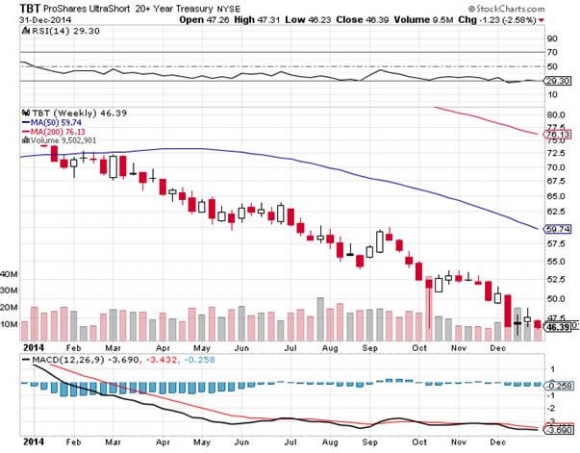
The high and low for ten year paper for the past nine months has been 1.86% to 3.05%. We could ratchet back up to the top end of that range, but not much higher than that. This would enable the inverse Treasury bond bear ETF (TBT) to reverse its dismal 2014 performance, taking it from $46 back up to $76.

You might have to wait for your grandchildren to start trading before we see a return of 12% Treasuries, last seen in the early eighties. I probably won?t live that long.

Reaching for yield will continue to be a popular strategy among many investors, which is typical at market tops. That focuses buying on junk bonds (JNK) and (HYG), REITS (HCP), and master limited partnerships (KMP), (LINE).

There is also emerging market sovereign debt to consider (PCY). At least there, you have the tailwinds of long term strong economies, little outstanding debt, appreciating currencies, and higher interest rates than those found at home. This asset class was hammered last year, so we are now facing a rare entry point. However, keep in mind, that if you reach too far, your fingers get chopped off.

There is a good case for sticking with munis. No matter what anyone says, taxes are going up, and when they do, this will increase tax free muni values. So if you hate paying taxes, go ahead and buy this exempt paper, but only with the expectation of holding it to maturity. Liquidity could get pretty thin along the way, and mark to markets could be shocking. Be sure to consult with a local financial advisor to max out the state, county, and city tax benefits.
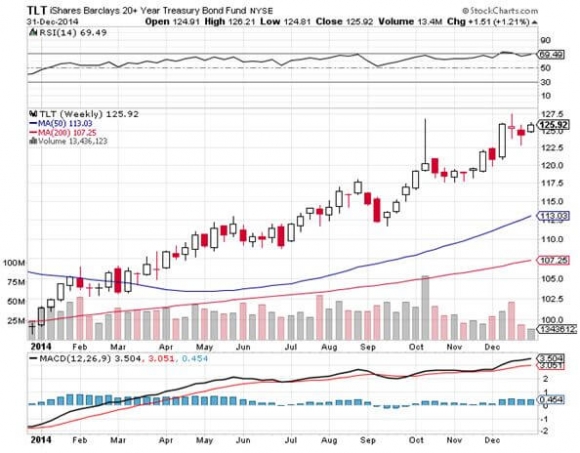
 

TLT 12-31-14

TBT 12-31-14

MennonitesA Visit to the 19th Century


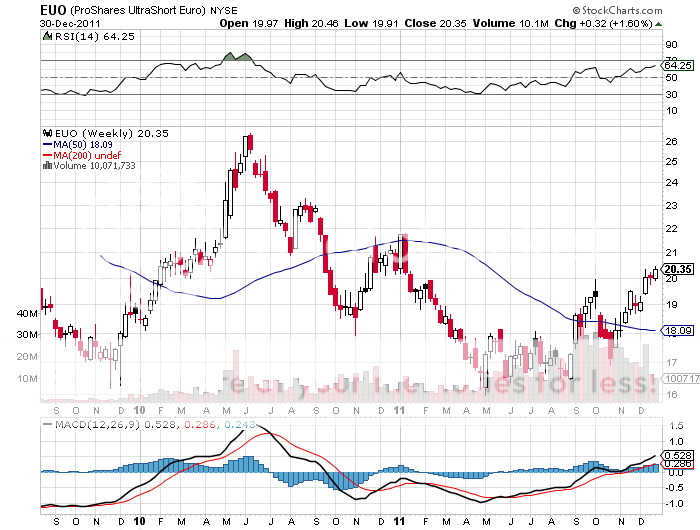
4) Foreign Currencies (FXE), (EUO), (FXC), (FXA), (YCS), (FXY), (CYB)

There are only three things you need to know about trading foreign currencies in 2015: the dollar, the dollar, and the dollar. The decade long bull market in the greenback continues.

The chip shot here is still to play the Japanese yen from the short side. Japan?s Ministry of Finance is now, far and away, the most ambitious central bank hell bent on crushing the yen to rescue its dying economy.

The problems in the Land of the Rising Sun are almost too numerous to count: the world?s highest debt to GDP ratio, a horrific demographic problem, flagging export competitiveness against neighboring China and South Korea, and the world?s lowest developed country economic growth rate.

The dramatic sell off we saw in the Japanese currency since December, 2012 is the beginning of what I believe will be a multi decade, move down. Look for ?125 to the dollar sometime in 2015, and ?150 further down the road. I have many friends in Japan looking for and overshoot to ?200. Take every 3% pullback in the greenback as a gift to sell again.

With the US having the world?s strongest major economy, its central bank is, therefore, most likely to raise interest rates first. That translates into a strong dollar, as interest rate differentials are far and away the biggest decider of the direction in currencies. So the dollar will remain strong against the Australian and Canadian dollars as well.

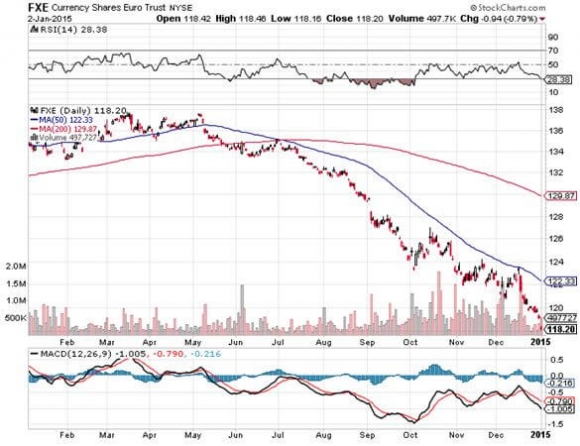
The Euro looks almost as bad. While European Central Bank president, Mario Draghi, has talked a lot about monetary easing, he now appears on the verge of taking decisive action.

Recurring financial crisis on the continent is forcing him into a massive round of Fed style quantitative easing through the buying of bonds issued by countless European entities. The eventual goal is to push the Euro down to parity with the buck and beyond.

For a sleeper, use the next plunge in emerging markets to buy the Chinese Yuan ETF (CYB) for your back book, but don?t expect more than single digit returns. The Middle Kingdom will move heaven and earth in order to keep its appreciation modest to maintain their crucial export competitiveness.
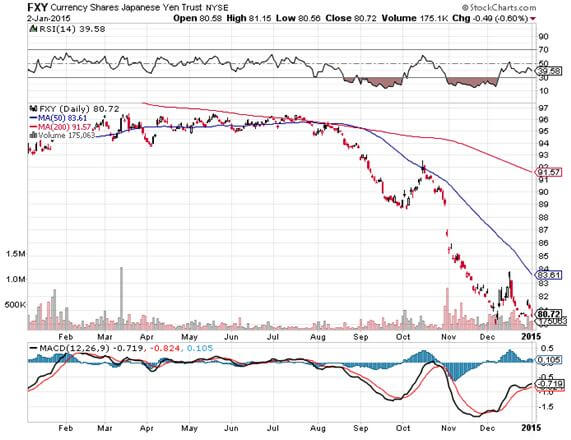
 

FXY 1-2-15

FXE 1-5-15

CYB 1-2-15

mountains

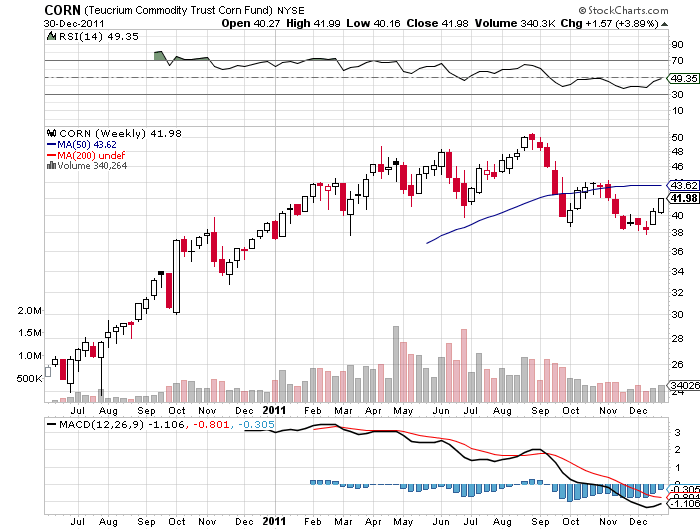
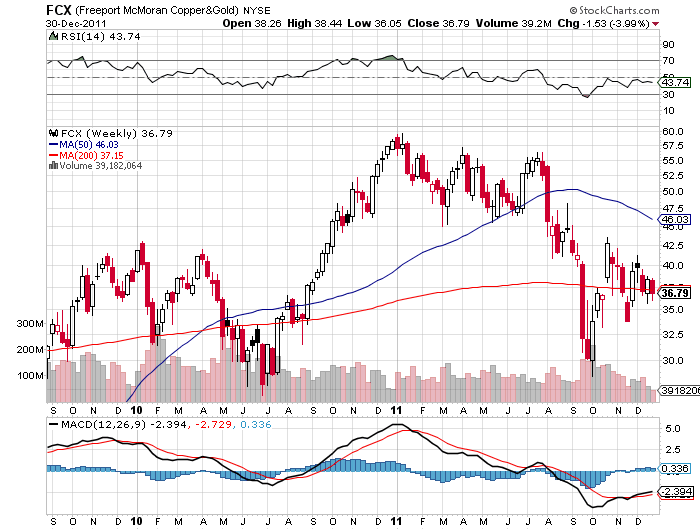
5) Commodities (FCX), (VALE), (MOO), (DBA), (MOS), (MON), (AGU), (POT), (PHO), (FIW), (CORN), (WEAT), (SOYB), (JJG)

There isn?t a strategist out there not giving thanks for not loading up on commodities in 2014, the preeminent investment disaster of 2015. Those who did are now looking for jobs on Craig?s List.

2014 was the year that overwhelming supply met flagging demand, both in Europe and Asia. Blame China, the big swing factor in the global commodity.

The Middle Kingdom is currently changing drivers of its economy, from foreign exports to domestic consumption. This will be a multi decade process, and they have $4 trillion in reserves to finance it.

It will still demand prodigious amounts of imported commodities, especially, oil, copper, iron ore, and coal, all of which we sell. But not as much as in the past. The derivative equity plays here, Freeport McMoRan (FCX) and Companhia Vale do Rio Doce (VALE), have all taken an absolute pasting.

The food commodities were certainly the asset class to forget about in 2014, as perfect weather conditions and over planting produced record crops for the second year in a row, demolishing prices. The associated equity plays took the swan dive with them.

However, the ags are still a tremendous long term Malthusian play. The harsh reality here is that the world is making people faster than the food to feed them, the global population jumping from 7 billion to 9 billion by 2050.

Half of that increase comes in countries unable to feed themselves today, largely in the Middle East. The idea here is to use any substantial weakness, as we are seeing now, to build long positions that will double again if global warming returns in the summer, or if the Chinese get hungry.

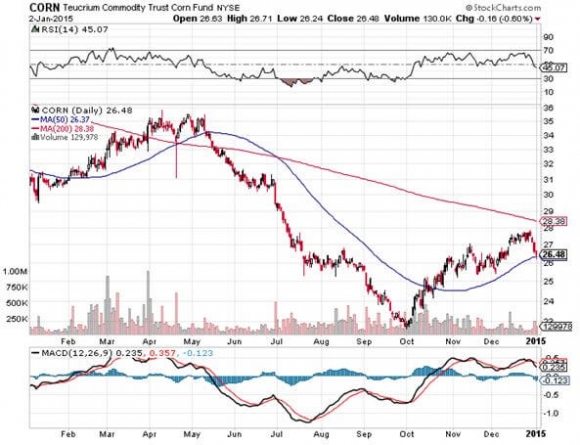
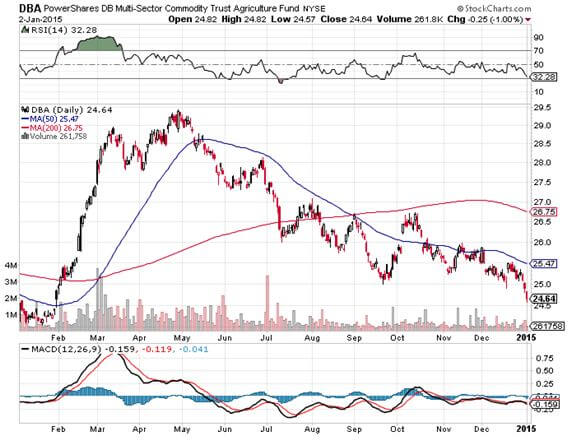
The easy entry points here are with the corn (CORN), wheat (WEAT), and soybeans (SOYB) ETF?s. You can also play through (MOO) and (DBA), and the stocks Mosaic (MOS), Monsanto (MON), Potash (POT), and Agrium (AGU).

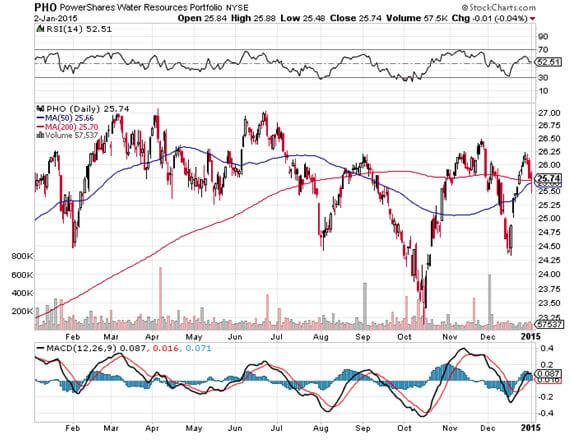
The grain ETF (JJG) is another handy fund. Though an unconventional commodity play, the impending shortage of water will make the energy crisis look like a cakewalk. You can participate in this most liquid of assets with the ETF?s (PHO) and (FIW).


CORN 1-2-15

DBA 1-2-15

PHO 1-2-15

JT snow angelSnow Angel on the Continental Divide


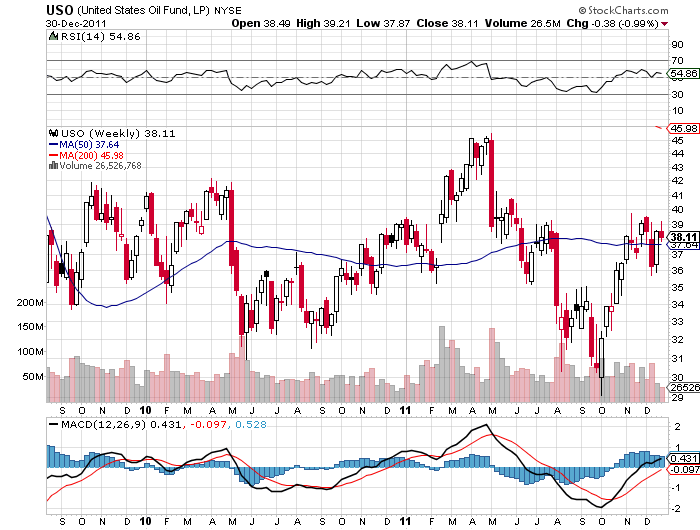
6) Energy (DIG), (RIG), (USO), (DUG), (DIG), (UNG), (USO), (OXY), (XLE), (X)

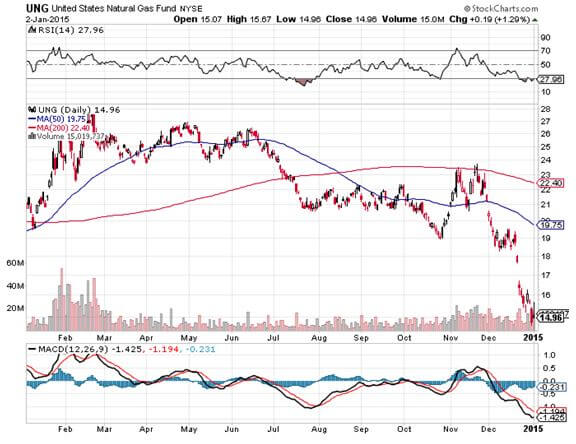
Yikes! What a disaster! Energy in 2014 suffered price drops of biblical proportions. Oil lost the $30 risk premium it has enjoyed for the last ten years. Natural gas got hammered. Coal disappeared down a black hole.

Energy prices did this in the face of an American economy that is absolutely rampaging, its largest consumer.

Our train has moved over to a siding to permit a freight train to pass, as it has priority on the Amtrak system. Three Burlington Northern engines are heaving to pull over 100 black, brand new tank cars, each carrying 30,000 gallons of oil from the fracking fields in North Dakota.

There is another tank car train right behind it. No wonder Warren Buffett tap dances to work every day, as he owns the road. US Steel (X) also does the two-step, since they provide immense amounts of steel to build these massive cars.

The US energy boom sparked by fracking will be the biggest factor altering the American economic landscape for the next two decades. It will flip us from a net energy importer to an exporter within two years, allowing a faster than expected reduction in military spending in the Middle East.

Cheaper energy will bestow new found competitiveness on US companies that will enable them to claw back millions of jobs from China in dozens of industries. This will end our structural unemployment faster than demographic realities would otherwise permit.

We have a major new factor this year in considering the price of energy. Peace in the Middle East, especially with Iran, always threatened to chop $30 off the price of Texas tea. But it was a pie-in-the-sky hope. Now there are active negotiations underway in Geneva for Iran to curtail or end its nuclear program. This could be one of the black swans of 2015, and would be hugely positive for risk assets everywhere.

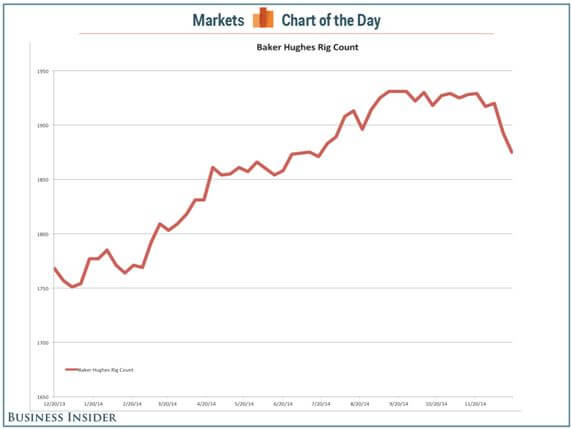
Enjoy cheap oil while it lasts because it won?t last forever. American rig counts are already falling off a cliff and will eventually engineer a price recovery.

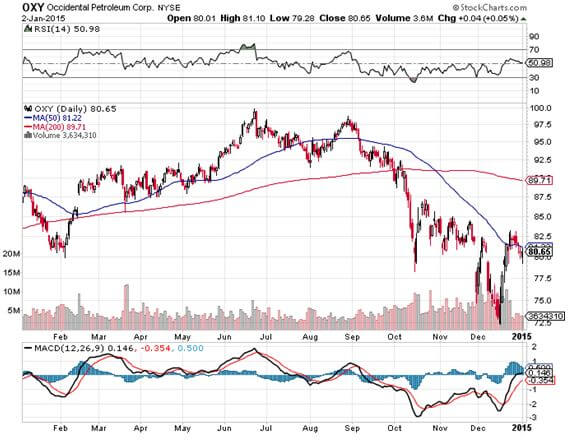
Add the energies of oil (DIG), Cheniere Energy (LNG), the energy sector ETF (XLE), Conoco Phillips (COP), and Occidental Petroleum (OXY). Skip natural gas (UNG) price plays and only go after volume plays, because the discovery of a new 100-year supply from ?fracking? and horizontal drilling in shale formations is going to overhang this subsector for a very long time.

It is a basic law of economics that cheaper prices bring greater demand and growing volumes, which have to be transported. However, major reforms are required in Washington before use of this molecule goes mainstream.

These could be your big trades of 2015, but expect to endure some pain first.


Baker Hughes Rig Count

WTIC 1-2-15

UNG 1-2-15

OXY 1-2-15

Train

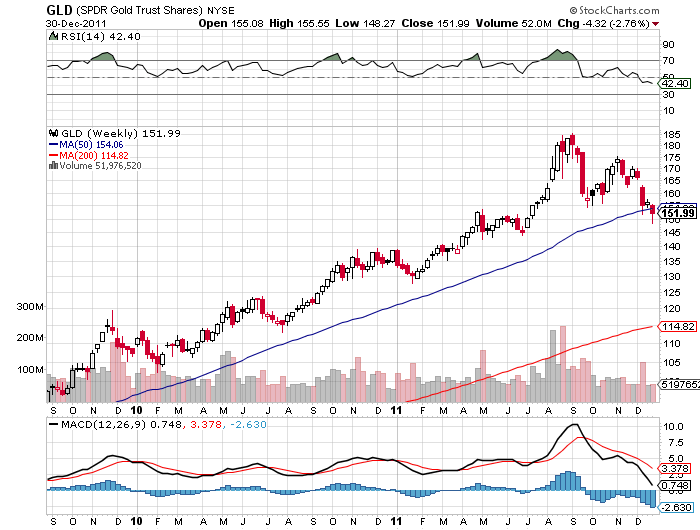
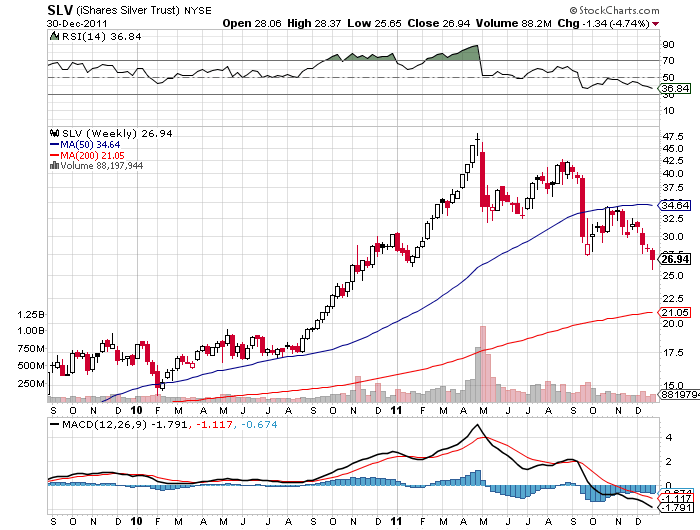
7) Precious Metals (GLD), (DGP), (SLV), (PPTL), (PALL)

The train has added extra engines at Denver, so now we may begin the long laboring climb up the Eastern slope of the Rocky Mountains.

On a steep curve, we pass along an antiquated freight train of hopper cars filled with large boulders. The porter tells me this train is welded to the tracks to create a windbreak. Once, a gust howled out of the pass so swiftly that it blew a train over on to its side.

In the snow filled canyons we sight a family of three moose, a huge herd of elk, and another group of wild mustangs. The engineer informs us that a rare bald eagle is flying along the left side of the train. It?s a good omen for the coming year. We also see countless abandoned gold mines and the broken down wooden trestles leading to them, so it is timely here to speak about precious metals.

As long as the world is clamoring for paper assets like stocks and bonds, gold is just another shiny rock. After all, who needs an insurance policy if you are going to live forever?

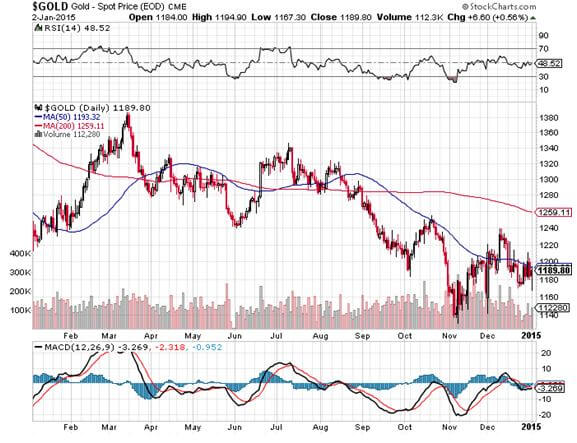
We have already broken $1,200 once, and a test of $1,000 seems in the cards before a turnaround ensues. There are more hedge fund redemptions and stop losses to go. The bear case has the barbarous relic plunging all the way down to $700.

But the long-term bull case is still there. Someday, we are going to have to pay the piper for the $4.5 trillion expansion in the Fed?s balance sheet over the past five years, and inflation will return. Gold is not dead; it is just resting. I believe that the monetary expansion arguments to buy gold prompted by massive quantitative easing are still valid.

If you forgot to buy gold at $35, $300, or $800, another entry point is setting up for those who, so far, have missed the gravy train. The precious metals have to work off a severely, decade old overbought condition before we make substantial new highs. Remember, this is the asset class that takes the escalator up and the elevator down, and sometimes the window.

If the institutional world devotes just 5% of their assets to a weighting in gold, and an emerging market central bank bidding war for gold reserves continues, it has to fly to at least $2,300, the inflation adjusted all-time high, or more.

This is why emerging market central banks step in as large buyers every time we probe lower prices. For me, that pegs the range for 2015 at $1,000-$1,400. ETF players can look at the 1X (GLD) or the 2X leveraged gold (DGP).

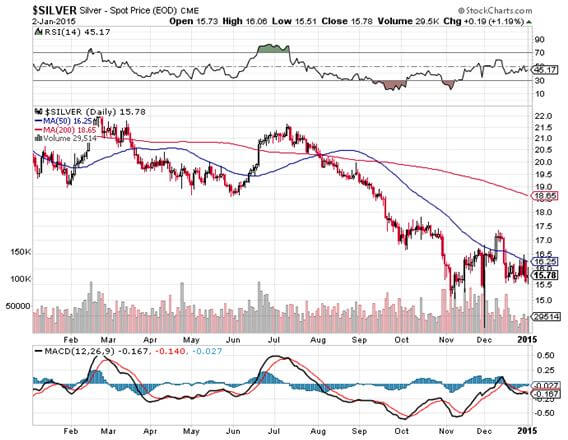
I would also be using the next bout of weakness to pick up the high beta, more volatile precious metal, silver (SLV), which I think could hit $50 once more, and eventually $100.

What will be the metals to own in 2015? Palladium (PALL) and platinum (PPLT), which have their own auto related long term fundamentals working on their behalf, would be something to consider on a dip. With US auto production at 17 million units a year and climbing, up from a 9 million low in 2009, any inventory problems will easily get sorted out.


GOLD 1-2-15

SILVER 1-2-15

sunsetWould You Believe This is a Blue State?

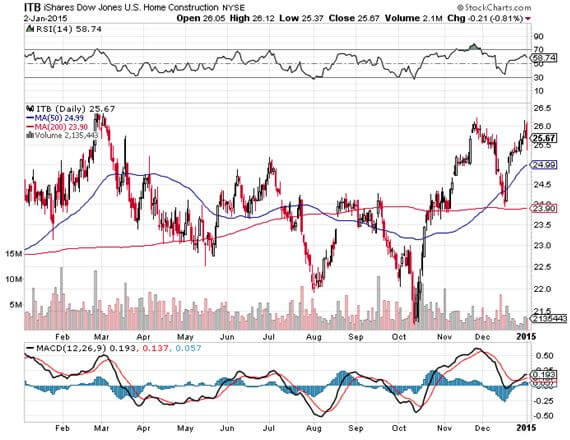
8) Real Estate (ITB)

The majestic snow covered Rocky Mountains are behind me. There is now a paucity of scenery, with the endless ocean of sagebrush and salt flats of Northern Nevada outside my window, so there is nothing else to do but write. My apologies to readers in Wells, Elko, Battle Mountain, and Winnemucca, Nevada.

It is a route long traversed by roving banks of Indians, itinerant fur traders, the Pony Express, my own immigrant forebears in wagon trains, the transcontinental railroad, the Lincoln Highway, and finally US Interstate 80.

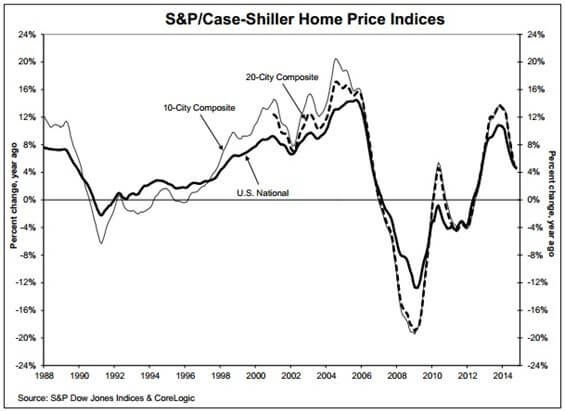
There is no doubt that there is a long-term recovery in real estate underway. We are probably 8 years into an 18-year run at the next peak in 2024.

But the big money has been made here over the past two years, with some red hot markets, like San Francisco, soaring. If you live within commuting distance of Apple (AAPL), Google (GOOG), or Facebook (FB) headquarters in California, you are looking at multiple offers, bidding wars, and prices at all time highs.

From here on, I expect a slow grind up well into the 2020?s. If you live in the rest of the country, we are talking about small, single digit gains. The consequence of pernicious deflation is that home prices appreciate at a glacial pace. At least, it has stopped going down, which has been great news for the financial industry.

There are only three numbers you need to know in the housing market: there are 80 million baby boomers, 65 million Generation Xer?s who follow them, and 85 million in the generation after that, the Millennials.

The boomers have been unloading dwellings to the Gen Xer?s since prices peaked in 2007. But there are not enough of the latter, and three decades of falling real incomes mean that they only earn a fraction of what their parents made.

If they have prospered, banks won?t lend to them. Brokers used to say that their market was all about ?location, location, location?. Now it is ?financing, financing, financing?. Banks have gone back to the old standard of only lending money to people who don?t need it.

Consider the coming changes that will affect this market. The home mortgage deduction is unlikely to survive any real attempt to balance the budget. And why should renters be subsidizing homeowners anyway? Nor is the government likely to spend billions keeping Fannie Mae and Freddie Mac alive, which now account for 95% of home mortgages.

That means the home loan market will be privatized, leading to mortgage rates higher than today. It is already bereft of government subsidies, so loans of this size are priced at premiums. This also means that the fixed rate 30-year loan will go the way of the dodo, as banks seek to offload duration risk to consumers. This happened long ago in the rest of the developed world.

There is a happy ending to this story. By 2022 the Millennials will start to kick in as the dominant buyers in the market. Some 85 million Millennials will be chasing the homes of only 65 Gen Xer?s, causing housing shortages and rising prices.

This will happen in the context of a labor shortfall and rising standards of living. Remember too, that by then, the US will not have built any new houses in large numbers in 15 years.

The best-case scenario for residential real estate is that it gradually moves up for another decade, unless you live in Cupertino or Mountain View. We won?t see sustainable double-digit gains in home prices until America returns to the Golden Age in the 2020?s, when it goes hyperbolic.

But expect to put up your first-born child as collateral, and bring your entire extended family in as cosigners if you want to get a bank loan.

That makes a home purchase now particularly attractive for the long term, to live in, and not to speculate with. This is especially true if you lock up today?s giveaway interest rates with a 30 year fixed rate loan. At 3.3% this is less than the long-term inflation rate.

You will boast about it to your grandchildren, as my grandparents once did to me.


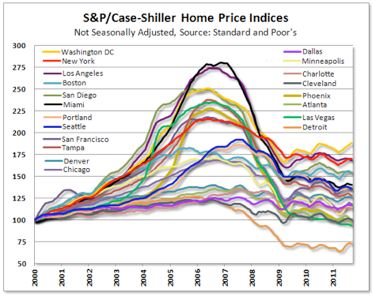
Case-Shiller Home Prices Indices

ITB 1-2-15

BridgeCrossing the Bridge to Home Sweet Home

9) Postscript

We have pulled into the station at Truckee in the midst of a howling blizzard.

My loyal staff have made the 20 mile trek from my beachfront estate at Incline Village to welcome me to California with a couple of hot breakfast burritos and a chilled bottle of Dom Perignon Champagne, which has been resting in a nearby snowbank. I am thankfully spared from taking my last meal with Amtrak.

Well, that?s all for now. We?ve just passed the Pacific mothball fleet moored in the Sacramento River Delta and we?re crossing the Benicia Bridge. The pressure increase caused by an 8,200 foot descent from Donner Pass has crushed my water bottle. The Golden Gate Bridge and the soaring spire of the Transamerica Building are just around the next bend across San Francisco Bay.

A storm has blown through, leaving the air crystal clear and the bay as flat as glass. It is time for me to unplug my Macbook Pro and iPhone 6, pick up my various adapters, and pack up.

We arrive in Emeryville 45 minutes early. With any luck, I can squeeze in a ten mile night hike up Grizzly Peak and still get home in time to watch the season opener for Downton Abbey season five. I reach the ridge just in time to catch a spectacular pastel sunset over the Pacific Ocean. The omens are there. It is going to be another good year.

I?ll shoot you a Trade Alert whenever I see a window open on any of the trades above.

Good trading in 2015!

John Thomas
The Mad Hedge Fund Trader


JT at workThe Omens Are Good for 2015!

https://www.madhedgefundtrader.com/wp-content/uploads/2013/01/Zephyr.jpg 342 451 Mad Hedge Fund Trader https://madhedgefundtrader.com/wp-content/uploads/2019/05/cropped-mad-hedge-logo-transparent-192x192_f9578834168ba24df3eb53916a12c882.png Mad Hedge Fund Trader2015-01-06 01:02:142015-01-06 01:02:142015 Annual Asset Class Review
Mad Hedge Fund Trader

End of the Commodity Super Cycle

Diary, Newsletter, Research

When the Trade Alerts quit working. I stop sending them out. That?s my trading strategy right now. It?s as simple as that.

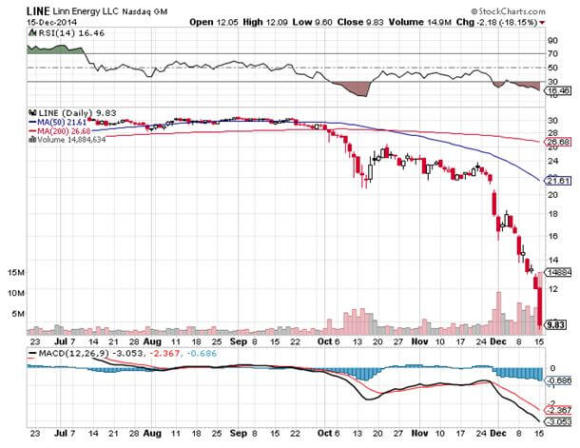
So when I received a dozen emails this morning asking if it is time to double up on Linn Energy (LINE), I shot back ?Not yet!? There is no point until oil puts in a convincing bottom, and that may be 2015 business.

Traders have been watching in complete awe the rapid decent the price of Linn Energy, which is emerging as the most despised asset of 2014, after commodity producer Russia (RSX).

But it is becoming increasingly apparent that the collapse of prices for the many commodities is part of a much larger, longer-term macro trend.

(LINN) is doing the best impersonation of a company going chapter 11 I have ever seen, without actually going through with it. Only last Thursday, it paid out a dividend, which at today?s low, works out to a mind numbing 30% yield.

I tried calling the company, but they aren?t picking up, as they are inundated with inquires from investors. Search the Internet, and you find absolutely nothing. What you do find are the following reasons not to buy Linn Energy today:

1) Falling oil revenue is causing Venezuela to go bankrupt.
2) Large layoffs have started in the US oil industry.
3) The Houston real estate industry has gone zero bid.
4) Midwestern banks are either calling in oil patch loans, or not renewing them.
5) Hedge Funds have gone catatonic, their hands tied until new investor funds come in during the New Year.
6) Every oil storage facility in the world is now filled to the brim, including many of the largest tankers.

Let me tell you how insanely cheap (LINN) has gotten. In 2009, when the financial system was imploding and the global economy was thought to be entering a prolonged Great Depression, oil dropped to $30, and (LINN) to $7.50. Today, the US economy is booming, interest rates are scraping the bottom, employment is at an eight year high, and (LINE) hit $9.70, down $70 in six months.

Go figure.

My colleague, Mad Day Trader, Jim Parker, says this could all end on Thursday, when the front month oil futures contract expires. It could.

It isn?t just the oil that is hurting. So are the rest of the precious and semi precious metals (SLV), (PPLT), (PALL), base metals (CU), (BHP), oil (USO), and food (CORN), (WEAT), (SOYB), (DBA).

Many senior hedge fund managers are now implementing strategies assuming that the commodity super cycle, which ran like a horse with the bit between its teeth for ten years, is over, done, and kaput.

Former George Soros partner, hedge fund legend Paul Tudor Jones, has been leading the intellectual charge since last year for this concept. Many major funds have joined him.

Launching at the end of 2001, when gold, silver, copper, iron ore, and other base metals, hit bottom after a 21 year bear market, it is looking like the sector reached a multi decade peak in 2011.

Commodities have long been a leading source of profits for investors of every persuasion. During the 1970?s, when president Richard Nixon took the US off of the gold standard and inflation soared into double digits, commodities were everybody?s best friend. Then, Federal Reserve governor, Paul Volker, killed them off en masse by raising the federal funds rate up to a nosebleed 18.5%.

Commodities died a long slow and painful death. I joined Morgan Stanley about that time with the mandate to build an international equities business from scratch. In those days, the most commonly traded foreign securities were gold stocks. For years, I watched long-suffering clients buy every dip until they no longer ceased to exist.

The managing director responsible for covering the copper industry was steadily moved to ever smaller offices, first near the elevators, then the men?s room, and finally out of the building completely. He retired early when the industry consolidated into just two companies, and there was no one left to cover. It was heartbreaking to watch. Warning: we could be in for a repeat.

After two decades of downsizing, rationalization, and bankruptcies, the supply of most commodities shrank to a shadow of its former self by 2000. Then, China suddenly showed up as a voracious consumer of everything. It was off to the races, and hedge fund managers were sent scurrying to look up long forgotten ticker symbols and futures contracts.

By then commodities promoters, especially the gold bugs, had become a pretty scruffy lot. They would show up at conferences with dirt under their fingernails, wearing threadbare shirts and suits that looked like they came from the Salvation Army. As prices steadily rose, the Brioni suits started making appearances, followed by Turnbull & Asser shirts and Gucci loafers.

There was a crucial aspect of the bull case for commodities that made it particularly compelling. While you can simply create more stocks and bonds by running a printing press, or these days, creating digital entries on excel spreadsheets, that is definitely not the case with commodities. To discover deposits, raise the capital, get permits and licenses, pay the bribes, build the infrastructure, and dig the mines and pits for most commodities, takes 5-15 years.

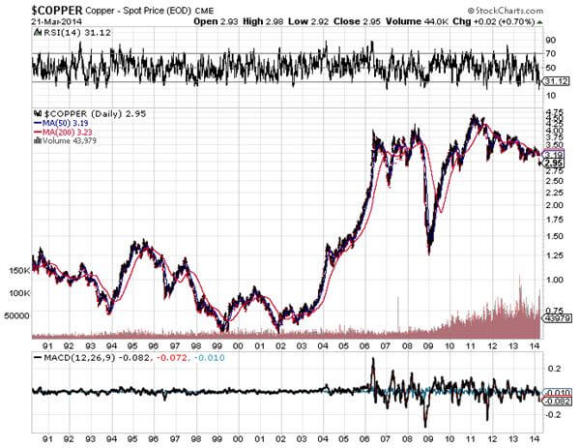
So while demand may soar, supply comes on at a snail pace. Because these markets were so illiquid, a 1% rise in demand would easily crease price hikes of 50%, 100%, and more. That is exactly what happened. Gold soared from $250 to $1,922. This is what a hedge fund manager will tell us is the perfect asymmetric trade. Silver rocketed from $2 to $50. Copper leapt from 80 cents a pound to $4.50. Everyone instantly became commodities experts. An underweight position in the sector left most managers in the dust.

Some 14 years later and now what are we seeing? Many of the gigantic projects that started showing up on drawing boards in 2001 are coming on stream. In the meantime, slowing economic growth in China means their appetite has become less than endless.

Supply and demand fell out of balance. The infinitesimal change in demand that delivered red-hot price gains in the 2000?s is now producing equally impressive price declines. And therein lies the problem. Click here for my piece on the mothballing of brand new Australian iron ore projects, ?BHP Cuts Bode Ill for the Global Economy?.

But this time it may be different. In my discussions with the senior Chinese leadership over the years, there has been one recurring theme. They would love to have America?s service economy.

I always tell them that they have a real beef with their ancient ancestors. When they migrated out of Africa 50,000 years ago, they stopped moving the people exactly where the natural resources aren?t. If they had only continued a little farther across the Bering Straights to North America, they would be drowning in resources, as we are in the US.

By upgrading their economy from a manufacturing, to a services based economy, the Chinese will substantially change the makeup of their GDP growth. Added value will come in the form of intellectual capital, which creates patents, trademarks, copyrights, and brands. The raw material is brainpower, which China already has plenty of.

There will no longer be any need to import massive amounts of commodities from abroad. If I am right, this would explain why prices for many commodities have fallen further that a Middle Kingdom economy growing at a 7.5% annual rate would suggest. This is the heart of the argument that the commodities super cycle is over.

If so, the implications for global assets prices are huge. It is great news for equities, especially for big commod
ity importing countries like the US, Japan, and Europe. This may be why we are seeing such straight line, one way moves up in global equity markets this year.

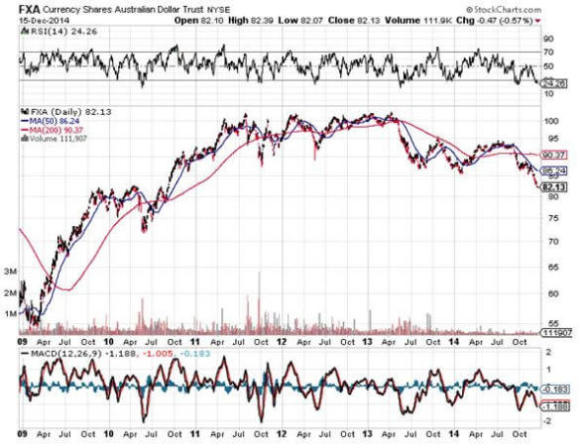
It is very bad news for commodity exporting countries, like Australia, South America, and the Middle East. This is why a large short position in the Australian dollar is a core position in Tudor-Jones? portfolio. Take a look at the chart for Aussie against the US dollar (FXA) since 2013, and it looks like it has come down with a severe case of Montezuma?s revenge.

The Aussie could hit 80 cents, and eventually 75 cents to the greenback before the crying ends. Australians better pay for their foreign vacations fast before prices go through the roof. It also explains why the route has carried on across such a broad, seemingly unconnected range of commodities.

In the end, my friend at Morgan Stanley had the last laugh.

When the commodity super cycle began, there was almost no one around still working who knew the industry as he did. He was hired by a big hedge fund and earned a $25 million performance bonus in the first year out. And he ended up with the biggest damn office in the whole company, a corner one with a spectacular view of midtown Manhattan.

He is now retired for good, working on his short game at Pebble Beach.

Good for you, John.


LINE 12-15-14

TNX 12-15-14

COPPER 3-21-14

FXA 12-15-14

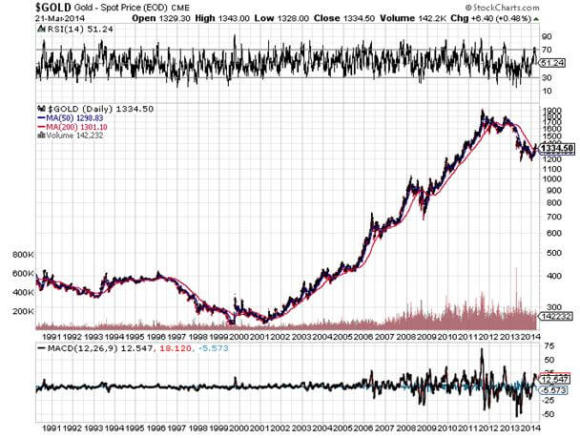
GOLD 3-21-14

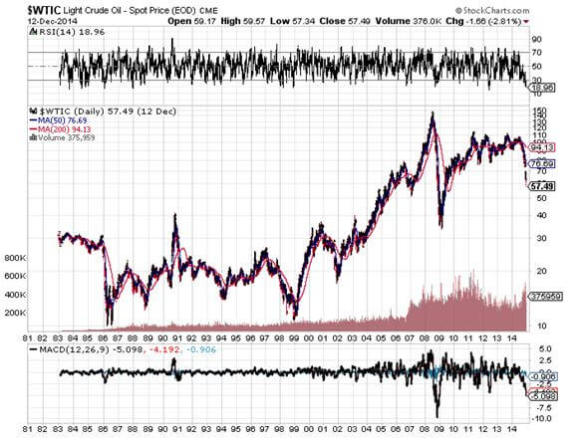
WTIC 12-12-14


Gold Coins

Not as Shiny as it Once Was

https://www.madhedgefundtrader.com/wp-content/uploads/2014/12/Gold-Coins.jpg 391 380 Mad Hedge Fund Trader https://madhedgefundtrader.com/wp-content/uploads/2019/05/cropped-mad-hedge-logo-transparent-192x192_f9578834168ba24df3eb53916a12c882.png Mad Hedge Fund Trader2014-12-16 01:03:502014-12-16 01:03:50End of the Commodity Super Cycle
Mad Hedge Fund Trader

She Speaks!

Diary, Newsletter, Research

Like a deer frozen in a car?s onrushing headlights, markets have been comatose awaiting Federal Reserve governor Janet Yellen?s decision on monetary policy and interest rates.

Interest rates are unchanged. Quantitative easing gets cut by $15 billion next month, and then goes to zero. Most importantly the key ?considerable period? language stayed in the FOMC statements, meaning that interest rates are staying lower for longer.

Personally, I don?t think she?s raising interest rates until 2016. The number of dissenters increased from one to two, but then both of them (Fisher and Plosser) are lame ducks. And, oh yes, the composition of the 2015 Fed will be the most dovish in history.

The latest data points made this a no brainer, what with the August nonfarm payroll coming in at a weak 142,000, and this morning?s CPI plunging to a deflationary -0.20% for the first time since the crash.

Of course, you already knew all of this if you have been reading the Mad Hedge Fund Trader. You knew it three months ago, six months ago, and even a year ago, before Janet Yellen was appointed as America?s chief central banker. Such is the benefit of lunching with her for five years while she was president of the San Francisco Fed.

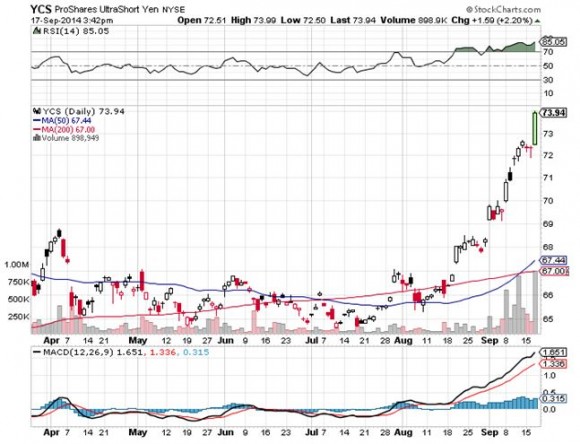
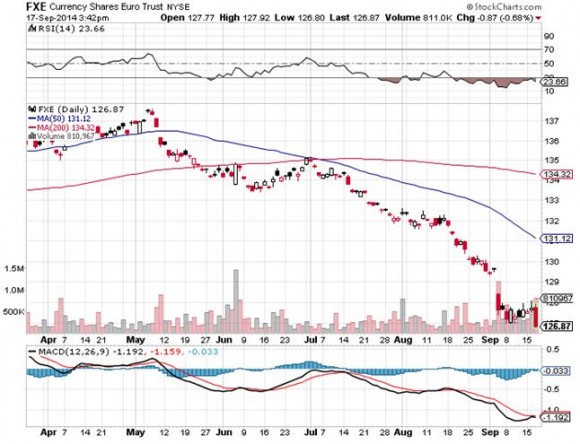
The markets reacted predictably, with the Euro (FXE), (EUO), and the yen (FXY), (YCS) hitting new multiyear lows, Treasury bonds (TLT), (TBT) breaking down, and precious metals (GLD), (SLV) taking it on the kisser.

What Janet did not do was give us an entry point for an equity Trade Alert (SPY), with the indexes close to unchanged on the day. The high frequency trader?s front ran the entire move yesterday.

Virtually all asset classes are now sitting at the end of extreme moves, up for the dollar (UUP) and stocks, and down for the euro, yen, gold, silver, the ags, bonds and oil. It?s not a good place to dabble.

Putting on a trade here is a coin toss. And when you?re up 30.36% on the year, you don?t do coin tosses. At this time of the year, protecting gains is more important than chasing marginal gains, which people probably won?t believe anyway.

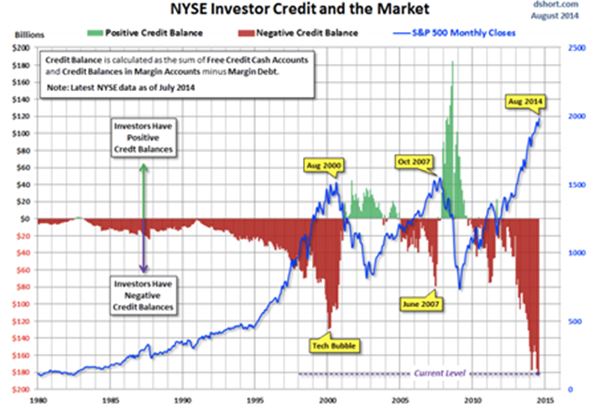
If you want to understand my uncharacteristic cautiousness, take a look at the chart below sent by a hedge fund buddy of mine. It shows that investor credit at all time highs are pushing to nosebleed altitudes. Not good, not good. Oops! Did somebody just say ?Flash Crash??

This is not to say that I?m bearish, I?m just looking for a better entry point, especially as the Q????????? 3 quarter end looms. I?ve gotten spoiled this year. Maybe the Scottish election results, the Alibaba IPO, or the midterm congressional elections will give us one. Buying here at a new all time high doesn?t qualify.

It?s time to maintain your discipline.

Sorry, no more pearls of wisdom today. I?ve come down with the flu.

Apparently, this year?s flu shot doesn?t cover the virulent Portland, Oregon variety. Was it the designer coffee that did it, the vintage clothes, or those giant doughnuts dripping with sugar?

Back to the aspirin, the antibiotics, the vitamin ?C?, and a chant taught to me by a Cherokee medicine man.


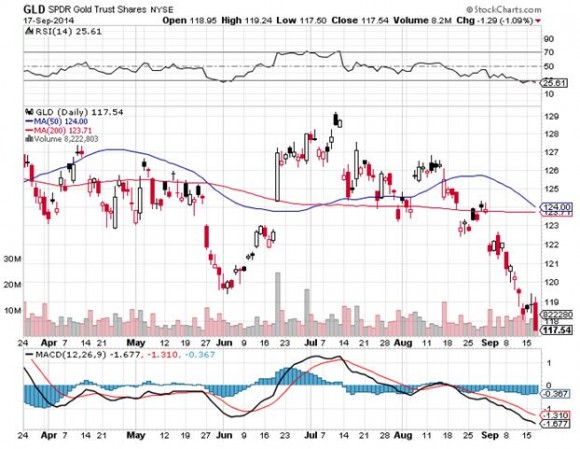
GLD 9-17-14

YCS 9-17-14

FXE 9-17-14

NYSE Investor Credit and the Market

John Thomas

https://www.madhedgefundtrader.com/wp-content/uploads/2014/09/John-Thomas5-e1410989501597.jpg 400 266 Mad Hedge Fund Trader https://madhedgefundtrader.com/wp-content/uploads/2019/05/cropped-mad-hedge-logo-transparent-192x192_f9578834168ba24df3eb53916a12c882.png Mad Hedge Fund Trader2014-09-18 01:04:402014-09-18 01:04:40She Speaks!
Mad Hedge Fund Trader

Revisiting the First Silver Bubble

Diary, Newsletter

With smoke still rising from the ruins of the recent silver crash, I thought I'd touch base with a wizened and grizzled old veteran who still remembers the last time a bubble popped for the white metal. That would be Mike Robertson, who runs Robertson Wealth Management, one of the largest and most successful registered investment advisors in the country.

Mike is the last surviving silver broker to the Hunt Brothers, who in 1979-80 were major players in the run up in the 'poor man's gold' from $11 to a staggering $50 an ounce in a very short time. At the peak, their aggregate position was thought to exceed 100 million ounces.

Nelson Bunker Hunt and William Herbert Hunt were the sons of the legendary HL Hunt, one of the original East Texas oil wildcatters, and heirs to one of the largest fortunes of the day. Shortly after president Richard Nixon took the US off the gold standard in 1971, the two brothers became deeply concerned about financial viability of the United States government. To protect their assets they began accumulating silver through coins, bars, the silver refiner, Asarco, and even antique tea sets, and when they opened, silver contracts on the futures markets.

The brothers? interest in silver was well known for years, and prices gradually rose. But when inflation soared into double digits, a giant spotlight was thrown upon them, and the race was on. Mike was then a junior broker at the Houston office of Bache & Co., in which the Hunts held a minority stake, and handled a large part of their business.?The turnover in silver contracts exploded. Mike confesses to waking up some mornings, turning on the radio to hear silver limit up, and then not bothering to go to work because he knew there would be no trades.

The price of silver ran up so high that it became a political problem. Several officials at the CFTC were rumored to be getting killed on their silver shorts. Eastman Kodak (EK), whose black and white film made them one of the largest silver consumers in the country, was thought to be borrowing silver from the Treasury to stay in business.

The Carter administration took a dim view of the Hunt Brothers' activities, especially considering their funding of the ultra-conservative John Birch Society. The Feds viewed it as a conspiratorial attempt to undermine the US government. It was time to pay the piper.

The CFTC raised margin rates to 100%. The Hunts were accused of market manipulation and ordered to unwind their position. They were subpoenaed by Congress to testify about their motives. After a decade of litigation, Bunker received a lifetime ban from the commodities markets, a $10 million fine, and was forced into a Chapter 11 bankruptcy.

Mike saw commissions worth $14 million in today's money go unpaid. In the end, he was only left with a Rolex watch, his broker's license, and a silver Mercedes. He still ardently believes today that the Hunts got a raw deal, and that their only crime was to be right about the long term attractiveness of silver as an inflation hedge.

Nelson made one of the great asset allocation calls of all time and was punished severely for it. There never was any intention to manipulate markets. As far as he knew, the Hunts never paid more than the $20 handle for silver, and that all of the buying that took it up to $50 was nothing more than retail froth.

Through the lens of 20/20 hindsight, Mike views the entire experience as a morality tale, a warning of what happens when you step on the toes of the wrong people.

And what does the old silver trader think of prices today? Mike saw the current collapse coming from a mile off. He thinks silver is showing all the signs of a broken market, and doesn't want to touch it until it revisits the $20's. But the white metal's inflation fighting qualities are still as true as ever, and it is only a matter of time before prices once again take another long run to the upside.

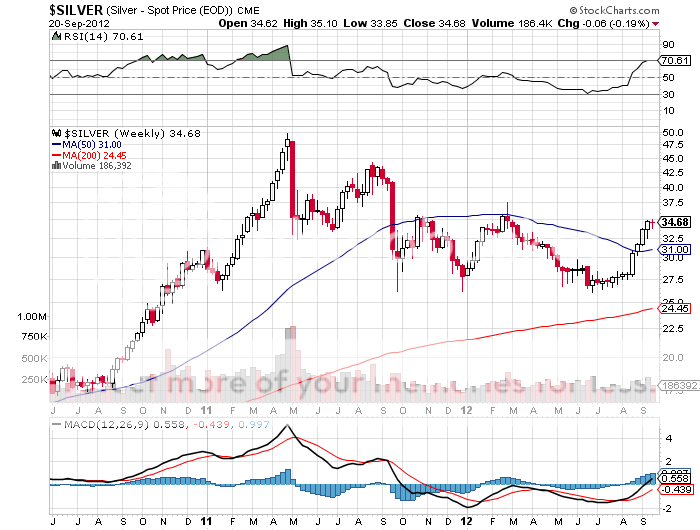
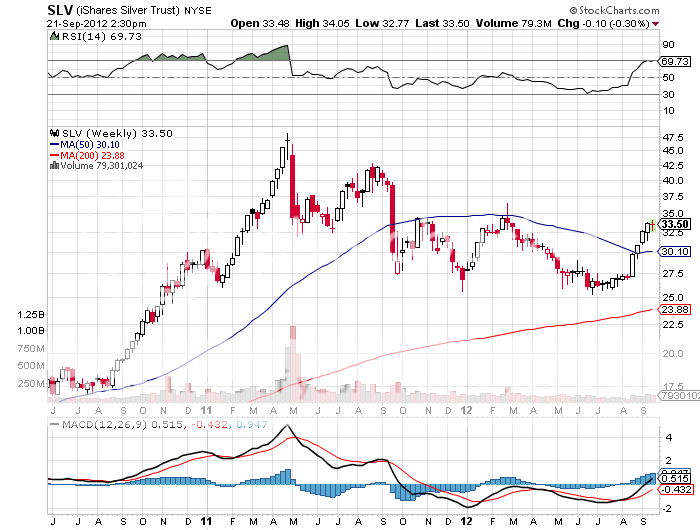
SLV 10-18-13

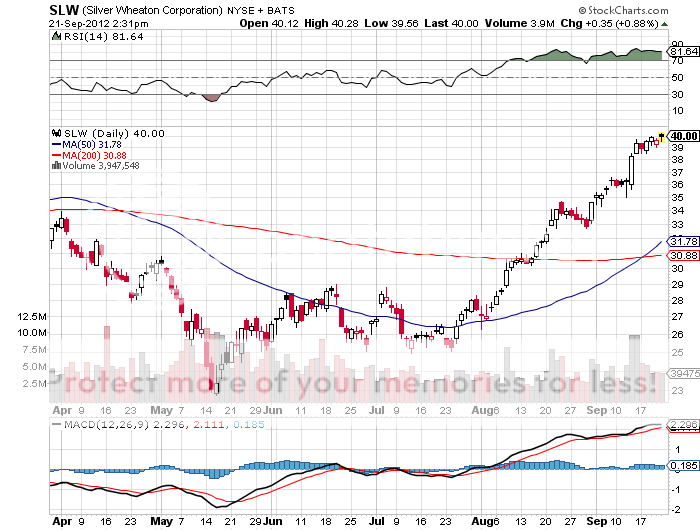
SLW 10-18-13

Nelson Bunker Hunt

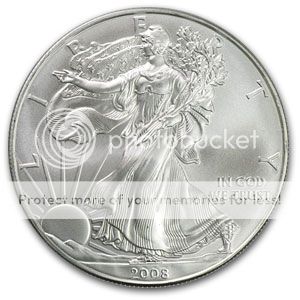
Silver DollarSilver is Still a Great Inflation Hedge

https://www.madhedgefundtrader.com/wp-content/uploads/2013/05/Nelson-Bunker-Hunt.jpg 321 248 Mad Hedge Fund Trader https://madhedgefundtrader.com/wp-content/uploads/2019/05/cropped-mad-hedge-logo-transparent-192x192_f9578834168ba24df3eb53916a12c882.png Mad Hedge Fund Trader2013-10-21 01:03:582013-10-21 01:03:58Revisiting the First Silver Bubble
Mad Hedge Fund Trader

Gold: Next Stop $1,250!

Newsletter

Sometimes, the best trades are the ones you don?t do. I actually wrote up a Trade Alert to buy gold on Thursday, figuring that it would bounce the first time it hit my downside target of $1,500.

But then I scanned the entire hard asset landscape, and saw that everything was selling off huge; silver (SLV), platinum (PPLT), palladium (PALL), oil (USO), copper (CU), and iron ore. I took a long nap. When I woke up, I decided that there was something much bigger going on here, and the urge to buy the barbarous relic suddenly vaporized. I sent the Trade Alert to my recycle bin.

The selloff that ensued on Friday was of Biblical proportions, with the yellow metal taking an unbelievable $86, 5.5% swan dive. They say this is the commodity that takes the stairs up and the elevator down, and that was no more true than today.

I have been pounding the table trying to get readers out of gold since early December. It is clear what is going on here. The world is dumping hard assets of every description and pouring the money into paper ones. Commodities you can drop on your foot are getting dumped, and generous premiums are being paid for anything that can be created with a printing press. It?s as simple as that.

This is why you are having both bonds and stocks going up at the same time, a rare event in capital markets. In effect, everything is now a bond, both the wide array of fixed income securities that are getting chased, along with dividend yielding stocks. This is why a wide swath of technology stocks, like Apple (AAPL), are not participating in the game.

I called around to some of the leading technical analysts to see how much pain gold was in for. The tidings were grim. The 200-week moving average at $1,433 looks like a chip shot. If that doesn?t hold, then $1,300 is in the cards. My favorite target is the old October, 2009 breakout level where the Reserve Bank of India came in out of the blue and bought 200 tonnes of the sparkly stuff, punching it through to a new all time high. The previous resistance should now become support. This is the number my jeweler favors.

To make matters particularly fiendish for traders, we may see a breakdown well into the $1,400?s that sucks in tons of capitulation sellers, then a big bounce before a downtrend resumes. It is a scenario that will be enough to test even the most devoted of gold bugs.

At risk is nothing less than the end of a bull market that is entering its 12th year. The shares of gold miners suggest that the demise of gold is already a foregone conclusion. The index for this group (GDM) has breached major support once again and is looking for a new four year low. Since this index usually correlates very highly with the barbarous relic, the writing is on the wall.

There are a host of reasons why the yellow metal has suddenly become so unloved. The largest holder of the gold ETF (GLD), John Paulson, is getting big redemptions in his hedge fund, forcing him to sell. This is why the selling is so apparent in the paper gold markets, like the ETF?s, but not in the physical bars and coins.

India has suddenly seen its currency, the rupee, drop against the greenback. That reduces the buying power of the world?s largest gold importer. With years of pernicious deflation ahead of us, who needs a traditional inflation hedge like the yellow metal anyway?

The hyper quantitative easing announced by the BOJ last week has created an entire new class of gold liquidators. Gold has actually risen dramatically in yen (FXY) terms over the past five months, so retail jewelers across Japan have had to expand business hours to accommodate long lines of eager sellers. The overflow is hitting the international markets big time.

Here is the final nail in the coffin for gold. Gold has had a dozen reasons to rally over the past six months. Those include the European monetary crisis, the Italian elections, the Spanish elections, the Cyprus bank account seizures, sequestration, the fiscal cliff, Ben Bernanke?s QE3, the Japanese ultra QE, rising capital gains taxes, and even the reelection of president Obama. It has utterly failed to do so.

Any trader long in the tooth, such as myself, will tell you that if a market can?t rally on repeated fabulous news, then you sell the daylights out of it. That is what we got with gold, in spades, on Friday.

GOLD 4-11-13

GLD 4-12-13

SLV 4-12-13

GDX 4-12-13

Market Down

https://www.madhedgefundtrader.com/wp-content/uploads/2013/04/Market-Down.jpg 415 564 Mad Hedge Fund Trader https://madhedgefundtrader.com/wp-content/uploads/2019/05/cropped-mad-hedge-logo-transparent-192x192_f9578834168ba24df3eb53916a12c882.png Mad Hedge Fund Trader2013-04-15 09:24:352013-04-15 09:24:35Gold: Next Stop $1,250!
DougD

Don't Miss the Big Show in Silver.

Newsletter

Those transfixed by gold blasting through the $1,750 level have been missing the real action in silver. The white metal has soared 34% to $34 since the beginning of the year, compared to only a 14% move for the barbaric relic, an outperformance of 2.4 to one. I have been a raging bull on the precious metals space since early August. Silver gives you additional diversification into the space with that extra bit of spice on the volatility side.

It is nothing less than owning gold with a turbocharger. Silver gives you a nice double play. Its qualities as a precious metal are giving it a major boost from the flight from the dollar, a certainty since Ben Bernanke proclaimed QE3.? It is also an industrial commodity, which unlike gold, is consumed, and therefore gives you a call on the recovering economy. Most of the silver mined in history has been burned, used in chemical processes, is sitting at the dump, or in people?s teeth in graveyards around the world.

If you don?t think this move is real, check out the shares of the silver producers. Coeur D Alene Mines (CDE) has rocketed by a gob smacking 92% in less than three months, while Silver Wheaton (SLW), and Hecla Mining (HL) have also done almost as well.

Until the shock value of the magnitude of this QE3 are fully digested by the market, the white metal should continue to appreciate. Should the ?RISK ON? move continue, $40 an ounce is on the table by early next year.

Players here should entertain calls or call spreads on the silver ETF (SLV). Those who like to live life dangerously can look at the triple leveraged long silver ETF (AGQ). If you are in the futures market, you trade a 5,000 ounce contract on the COMEX, which offers 8.8 times leverage on an initial maintenance requirement of $18,900.

https://madhedgefundtrader.com/wp-content/uploads/2019/05/cropped-mad-hedge-logo-transparent-192x192_f9578834168ba24df3eb53916a12c882.png 0 0 DougD https://madhedgefundtrader.com/wp-content/uploads/2019/05/cropped-mad-hedge-logo-transparent-192x192_f9578834168ba24df3eb53916a12c882.png DougD2012-09-23 23:16:342012-09-23 23:16:34Don't Miss the Big Show in Silver.
DougD

Buy the Big Dip in Gold.

Newsletter

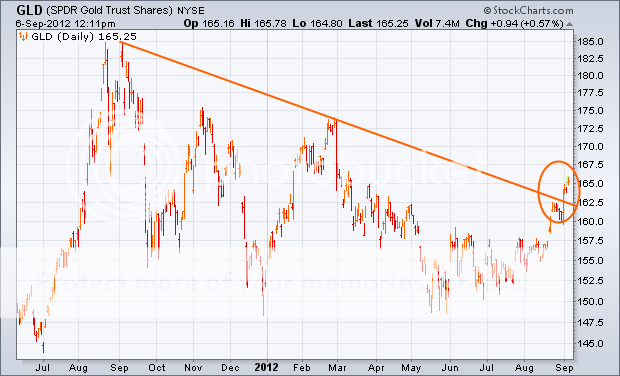
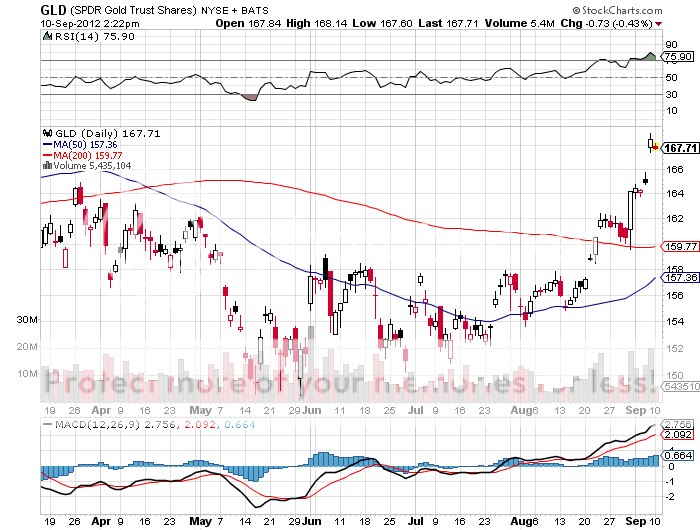
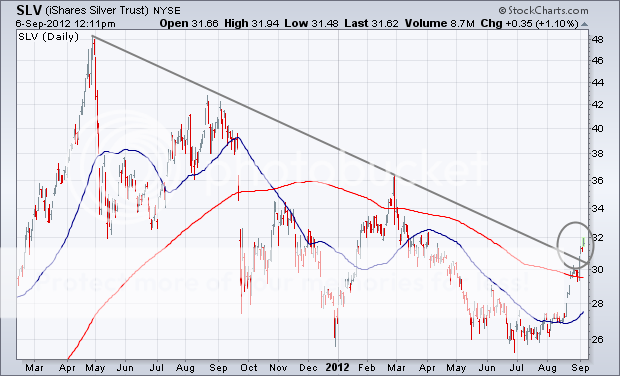
Look at the charts for the barbarous relic below and you can only come to one possible conclusion. If the Federal Reserve disappoints on Thursday, just a little bit, even by a smidgeon, and does not deliver QE3 and gold sells off big, you should jump in and by the stuff like crazy.

All of the charts for gold and the derivative plays are showing major breakouts to the upside. This is true for spot gold and the ETF (GLD), which broke a major downtrend line last week. It is the case for the gold miners ETF (GDX). It is also the reality for silver, the silver ETF (SLV), and the silver miners (SIL).

The entire precious metals space has been floated since the prospect of further quantitative easing from the world?s central banks started in earnest on May 15. Since then, it has been prudent and profitable to buy every dip.

European Central Bank president Mario Draghi did the heavy lifting in mid-July by promising to ?Do whatever it takes to rescue the Euro? (read: huge quantitative easing). He then put his money where his mouth was last week by announcing an unlimited bond-buying program.

Assorted dovish Federal Reserve governors have done their bit by talking up the prospect of further monetary easing. China threw in its ten cents by announcing a $150 billion reflationary budget on Friday. Even the Bank of Japan has been heard murmuring about additional money printing. It all has the smell of an international coordinated effort to reflate the global economy.

Where exactly do you get back in? The sweet spot in the (GLD) will be the 200 day moving average at $159.66, which fell at the end of August. That is down $7.94 in (GLD), or $79.40 in the spot market from here.


Would you Consider a Long-Term Relationship?


https://www.madhedgefundtrader.com/wp-content/uploads/2012/09/bond.jpg 300 400 DougD https://madhedgefundtrader.com/wp-content/uploads/2019/05/cropped-mad-hedge-logo-transparent-192x192_f9578834168ba24df3eb53916a12c882.png DougD2012-09-10 23:46:422012-09-10 23:46:42Buy the Big Dip in Gold.
DougD

My Tactical View of the Market

Newsletter

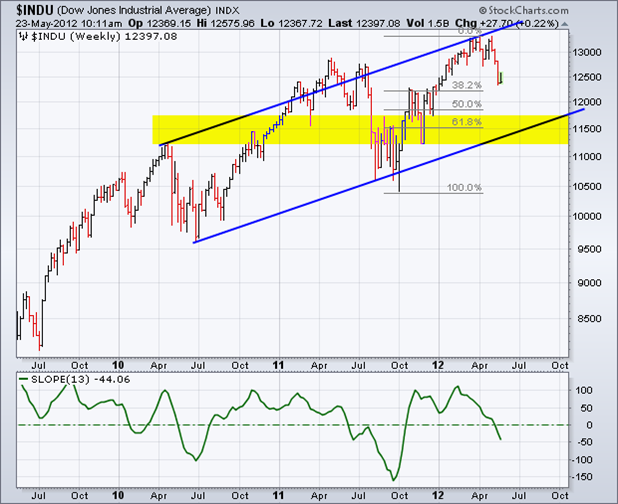
The easy money has been made on the short side this year for a whole range of asset classes. While we will probably see lower lows from here, the risk/reward ratio for taking short positions in (SPX), (IWM), (FXE), (FXY), (GLD), (SLV), (USO), and (CU) are less favorable than they were two months ago.

Of course, the ultimate arbiter will be the news play and the economic data releases. It they continue to worsen as they have done, you can expect a brief rally in the (SPX) up to the 1,340-1,360 range before the downtrend resumes. First, we will revisit the old low for the move at 1,290. Then 1,250 cries out for attention, which would leave us dead unchanged on the year. Lining up next in the sites is 1,200. But to get that low, probably by August, we would need to see something dramatic out of Europe, which we may well get. For the Russell 2000, look to sell it at the old support range of $78-80, which now becomes overhead resistance, to target $72 on the downside.

Don?t underestimate the devastating impact the Facebook (FB) debacle will have on the overall market. Retail investors lost $6 billion on the deal after institutional investors were given the heads up on the impending disaster and stayed away in droves. The media has plenty of blood on its hands on this one. The day before the pricing, one noted Cable TV network reported that the deal was oversubscribed in Asia by 30:1. Morgan Stanley reached for the extra dollars, increasing the size, and boosting the price by 15%. It all came to tears.

Expect investigations, subpoenas, congressional hearings, prosecutions, multi million out of court settlements, thousands of lawsuits, and many careers ended ?to spend more time with families.? Horrible thought of the day: Apply Apple?s (AAPL) 8X multiple, which is growing at 100% a year, to Facebook, which is not, and you get a (FB) share price of $5. None of this exactly inspires confidence in the stock market.


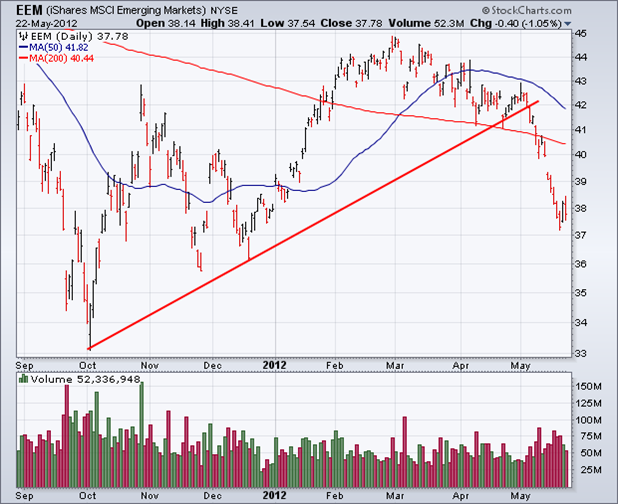
Notice that emerging markets have really been sucking hind teat this year, dragged down by falling commodity prices, a slowing China, and a general ?RISK OFF? mood. This is probably the first sector you want to go back in at the summer bottom to take advantages of their higher upside betas.


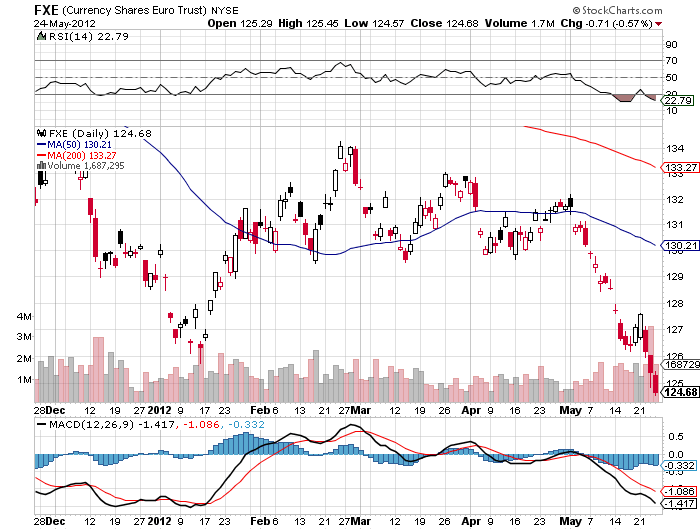
The Euro went through the old 2012 low at $1.260 like a hot knife through butter. On the breach, a lot of momentum programs automatically kicked in and doubled up their short positions. That is what has taken us all the way down to the high $124 handle in the cash. Let?s see how the market digests this breakdown. The commitment of traders report out on Friday should be exciting, as we already have all-time highs in short positions in the beleaguered European currency.

The problem is that any good news whispers or accidental tweets on the sovereign debt crisis could trigger ferocious short covering and gap openings which the continental traders will get a head start on. So again, this is not the low risk trade that it was months ago.

Still, the 2010 lows at $1.18 are now on the menu. I would sell all the ?good news? rallies from here two cents higher. Aggressive traders might consider selling penny rallies, like the one we got today. Notice that the Euro is rallying into the US close every day. This is caused by American traders covering shorts, not wishing to run them into any overnight surprises.

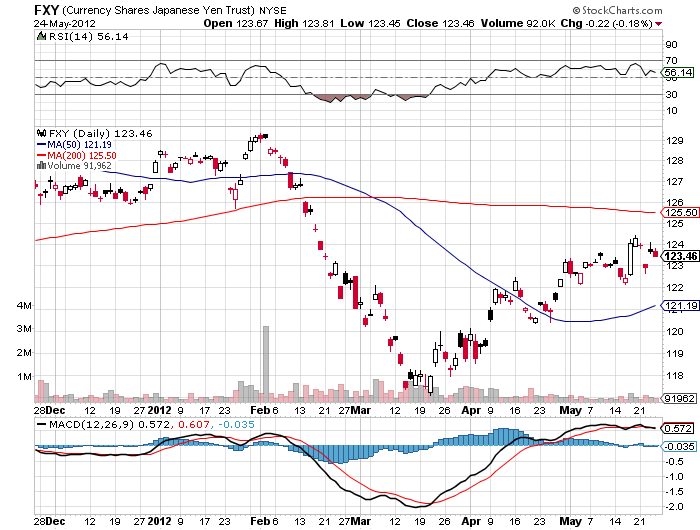
The Japanese yen seems to be stagnating here once again, now that the Bank of Japan has passed on another opportunity to exercise more much needed quantitative easing. Therefore, I will use the next dip to get out of my September put options at a small loss. There is a better use of capital and bigger fish to fry these days.

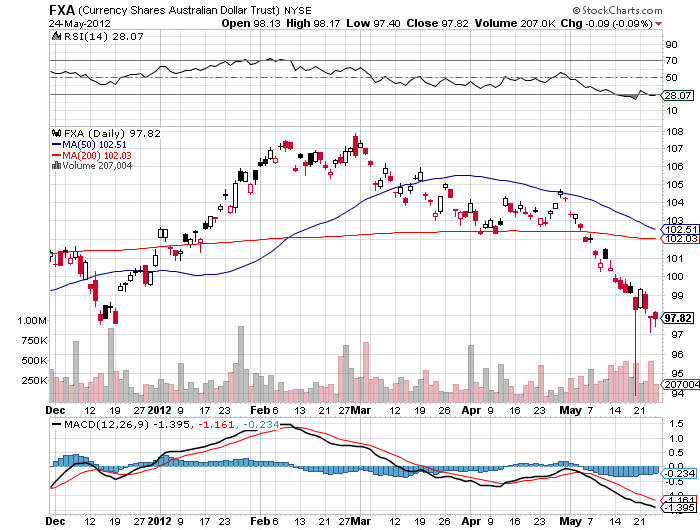
The Australian dollar has been far and away the world?s worst major currency this year, falling from $110 all the way down to $94 on a spike. It now languishes at $97. I long ago stopped singing ?Waltzing Matilda? in the shower. I hope all my Ausie friends took my advice at the beginning of the year and paid for their European and American vacations while their currency was still dear. We could see as low as $90 in the months to come.


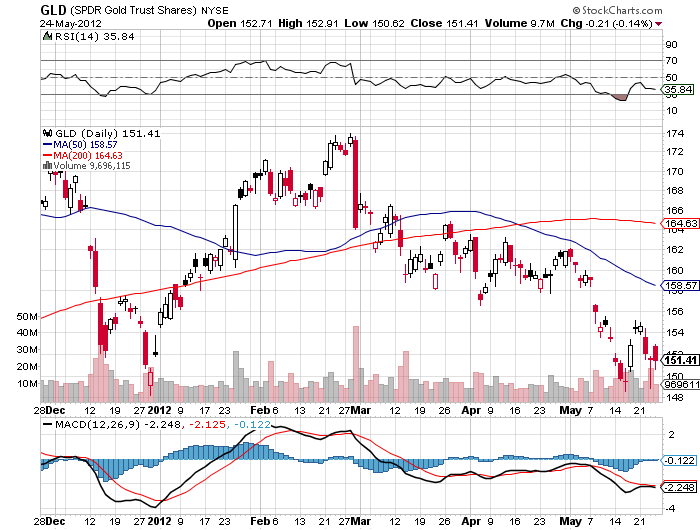
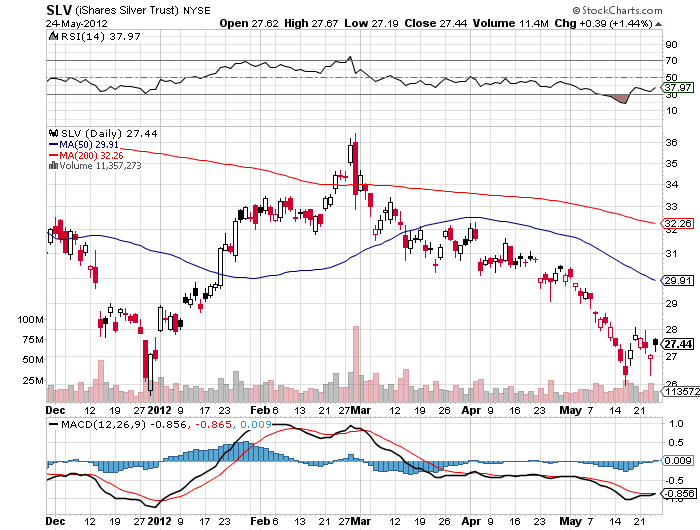
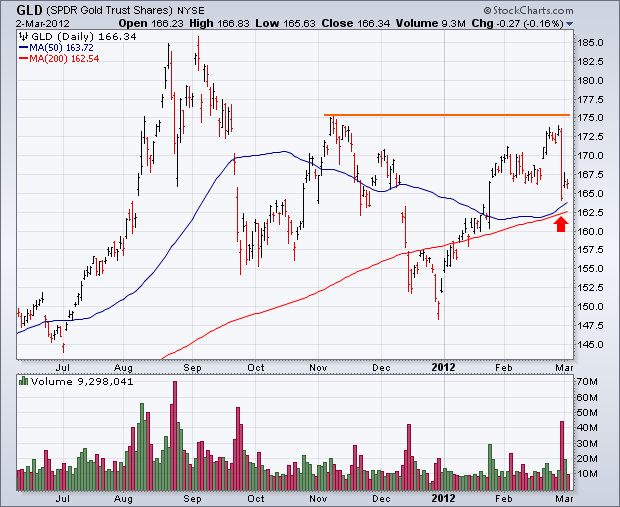
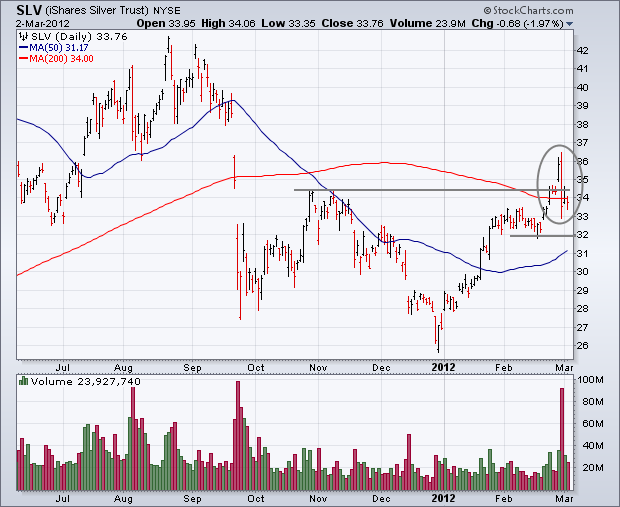
Gold (GLD) and silver (SLV) still look week, as this week?s failed rally attests. The strength of the Indian rupee still has the barbarous relic high priced for the world?s largest buyer, and this will continue to weigh on dollar based owners. But we are also reaching the tag ends of this move down from $1,922. Speculative short positions are at a multi-year low. It would take something pretty dramatic to get me to sell short gold again. For the time being, I am targeting gold at $1,500 on the downside, $1,450 in an extreme case, and $25 in silver.


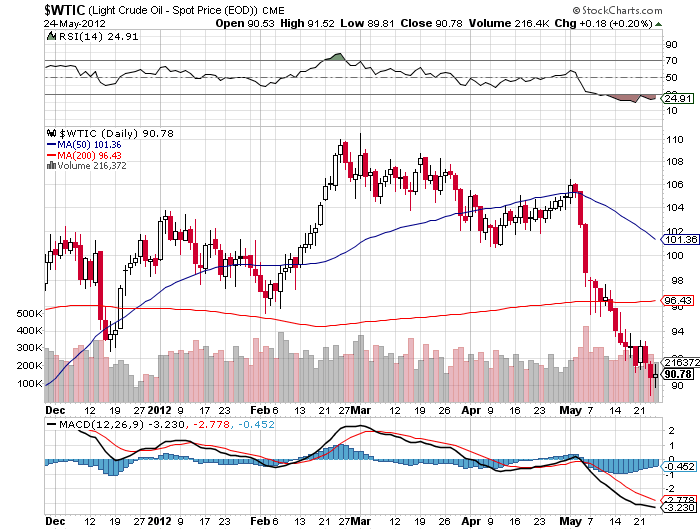
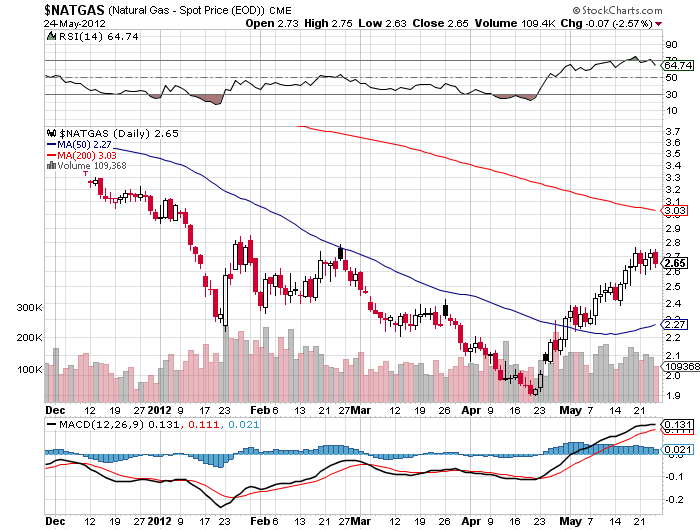
We are well into the move south for oil, which peaked just at the March 1 Iranian elections just short of $110/barrel. The market now seems to be targeting $87 for the short term. The global economic slowdown is the clear culprit here. But in the US, we are starting to see a clear drag on oil prices caused by the insanely low price of natural gas. You can see this clearly on the charts below where gas has been rising while Texas tea has been plunging. Utilities and industry are switching over to the cleaner burning ultra cheap fuel source as fast as they can. As a result, greenhouse gas emissions are falling faster in the US than any other developed country, according to the Paris based International Energy Agency. Sell any $4 rally in crude and keep a tight stop.


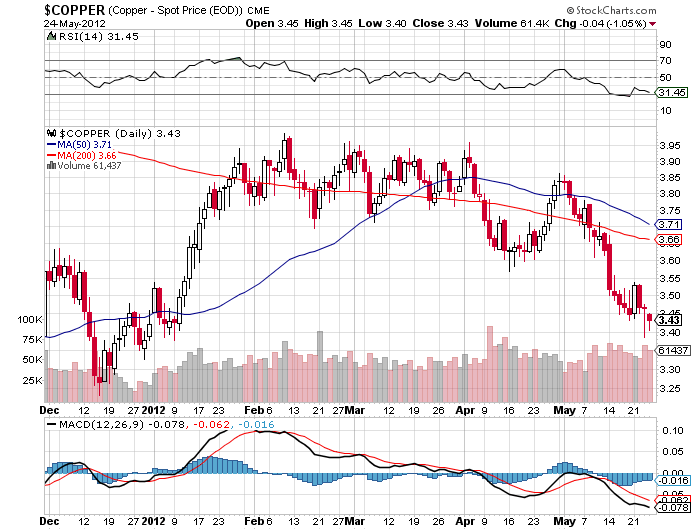
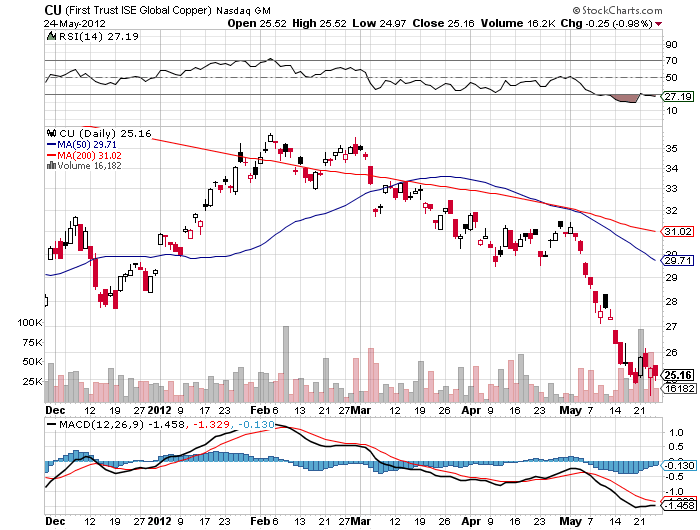
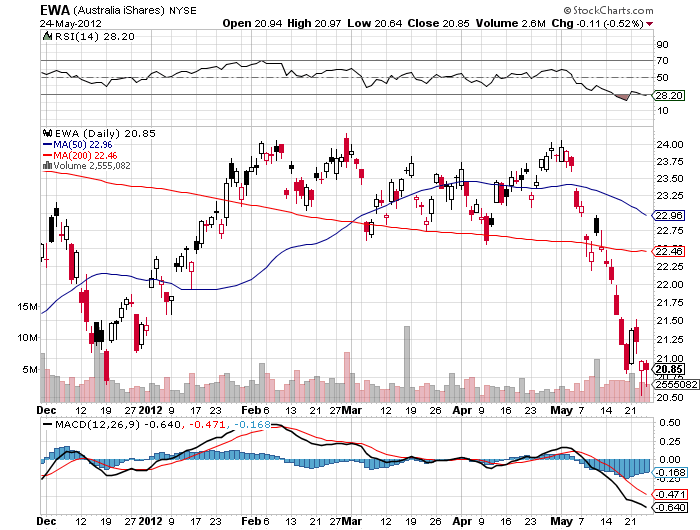
When China catches cold, copper gets pneumonia. So does Australia (FXA), (EWA), for that matter. The China slowdown will most likely continue on into the summer, knocking the wind out of the red metal. If copper manages to rally back up to $3.60, grab it with both hands and throw it out the window. Cover when you hear a loud splat. That works out to about $26.50 in the ETF (CU).


It all points to a highly choppy and volatile ?RISK ON? rally that could last a week or two. It will be a time when you wish you took your mother in law?s advice to get a real job by becoming a cardiologist or plastic surgeon. Do you want to know when I want to reestablish my shorts? If you get a modestly positive nonfarm payroll on at 8:30 am on Friday, June 1, that could deliver a nice two day rally that would be ideal to sell into.


https://madhedgefundtrader.com/wp-content/uploads/2019/05/cropped-mad-hedge-logo-transparent-192x192_f9578834168ba24df3eb53916a12c882.png 0 0 DougD https://madhedgefundtrader.com/wp-content/uploads/2019/05/cropped-mad-hedge-logo-transparent-192x192_f9578834168ba24df3eb53916a12c882.png DougD2012-05-24 23:03:212012-05-24 23:03:21My Tactical View of the Market
DougD

Is Quantitative Easing Over?

Diary

That is certainly the conclusion of the financial markets. When Federal Reserve chairman, Ben Bernanke, failed to mention the magic words in his House Humphrey Hawkins testimony on Wednesday, risk assets were sent into a tailspin. Gold suffered a $100 move plunge in hours, the futures market seeing an almost instantaneous liquidation of $1.3 billion worth of contracts. Silver dropped 10%. Oil gave up $3 in a heartbeat.

What was truly impressive was the collapse of the Treasury bond market, which saw yields for the ten year leap from 1.92% to 2.05%. When a single order to sell 100,000 bond futures contracts worth $10 billion hit the market, many thought that a major firm had committed a grievous ?fat finger? error. But the ?cancel and correct? never came, and the trade stood. Clearly, a major hedge fund was betting that the 30 year bull market in bonds had peaked and moved to add some serious downside exposure.

The reason that I missed the extent of the serious rally in risk assets this year is that the current wave of quantitative easing was so paltry. One ?500 billion tranche in December followed by a second on February 29 is only a fraction of the tsunami sized liquidity the Fed?s previous QE1 and QE2 unleashed on the markets.

In any case, most of this cash stayed in Europe, with the banks bidding up sovereign bonds in a frenzied manner to captures a massive positive carry. Italian ten year yields collapsed from over 8% to under 5% in weeks. As expected, none of the dosh made it into the real economy where it could do some actual good. But traders have developed a Pavlovian response to the words ?quantitative easing?, which instantly triggers a rush of buying of all assets everywhere, as it has done in past cycles.

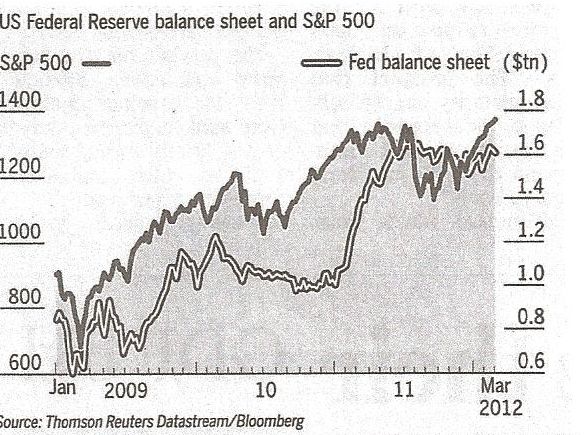
Never mind that the big liquidity surge wasn?t actually there. If you don?t believe me, take a look at the chart below showing the growth of the Fed balance sheet and its correlation with the S&P 500. When US central bank launched QE1 in early 2008, its assets soared from $600 billion to an amazing $1.7 trillion. Since mid-December when the ECB initiated its LTRO, it has climbed from $1.4 trillion to $1.8 trillion, a modest $400 billion, and represents only a recovery of its June 2010 high. That is only 36% of the earlier balance sheet expansion.

Since the onset of quantitative easing five years ago, this aggressive monetary policy tool has created anywhere from $3 trillion to $10 trillion in broader global liquidity. If you take away the punch bowl, the effect on risk assets could be dire. For a preview, take a look at what happened when we were in between QE waves from the end of the last Fed program in June to the European foreign language sequel in December. The S&P 500 collapsed by 25%, gold surrendered $400, and silver cratered nearly 50%, and $40 evaporated off of the price of oil.

I never believed that the Fed would follow up with a QE3, and I am sticking to my guns. None of the money from earlier easings made it into the sectors of the economy that they were attempting to target, like housing and construction. All it did was create bubbles in liquid and fungible global asset prices.

I think the Fed has figured this out by now. If a policy fails twice, then why repeat it a third time? If quantitative easing is truly well and done for good, how will the risk markets respond when they figure this out? The mother of all hangovers could be a safe bet.

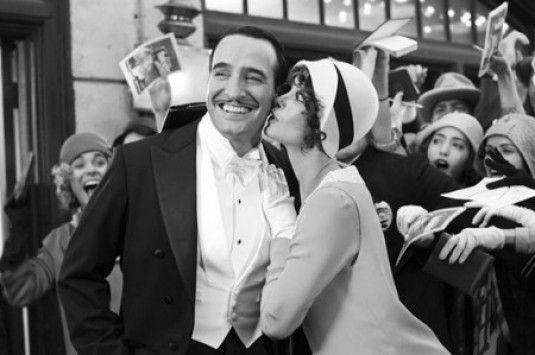
Since we?re talking about Europe, good job on the Oscars, France! With Jean du Jardin in ?The Artist?, you won best picture and best actor. It is perhaps ironic that it was for a silent film. Is The Academy trying to tell you something, or what? Sorry, but I can?t resist a good cheap shot, especially when a foreigner takes away the prizes from California?s most illustrious industry. If my amphibious followers want to throw rotten tomatoes at me in person, please buy tickets to my July 17 Paris strategy lunch by clicking here.


Well Said, France!


https://madhedgefundtrader.com/wp-content/uploads/2019/05/cropped-mad-hedge-logo-transparent-192x192_f9578834168ba24df3eb53916a12c882.png 0 0 DougD https://madhedgefundtrader.com/wp-content/uploads/2019/05/cropped-mad-hedge-logo-transparent-192x192_f9578834168ba24df3eb53916a12c882.png DougD2012-03-04 23:03:422012-03-04 23:03:42Is Quantitative Easing Over?
DougD

2012 Annual Asset Class Review

Diary

I am writing this report from a first class cabin on Amtrak?s California Zephyr en route from Chicago to San Francisco. The majestic snow covered Rocky Mountains are behind me. There is now a paucity of scenery, with the endless ocean of sage brush and salt flats of Northern Nevada outside my window, so there is nothing else to do but to write. My apologies to readers in Wells, Elko, Battle Mountain, and Winnemucca. It is a route long traversed by roving banks of Indians, itinerant fur traders, the Pony Express, my immigrant forebears in wagon trains, the transcontinental railroad, the Lincoln Highway, and finally US Interstate 80.

After making the rounds with strategists, portfolio managers, and hedge fund traders, I can confirm that 2011 was the most hellacious in careers lasting 30, 40, or 50 years. With the S&P 500 up 0.4% 2011, following a roaring 0.04% decline in 2010, the average hedge fund was up a pitiful 1%, and thousands lost money.

It is said that those who ignore history are doomed to repeat it. I am sorry to tell you that we are about to endure 2011 all over again. You can count on another 12 months of high volatility, gap moves at the opening, tape bombs, a lot of buying of rumors and selling of news, promises and disappointments from governments, and American markets being held hostage to developments overseas.

If you lost money in 2011, you will probably do so again in 2012, and should consider changing your line of work. It takes a special kind of person to make money in markets like these; someone who thrives on raw data and ignores the hype and the spin, who invests based on facts and not beliefs, and who thinks all things can happen at all times.? In other words, you need somebody like me, as my 40% return last year will attest. Those who don?t think they are up to it might consider pursuing that long delayed ambition to open a trendy restaurant, the thoughtful antique store, or finally get their golf score down to 80.

If you think I spend too much time absorbing conspiracy theories from the Internet, let me give you a list of the challenges I see financial markets facing in the coming year:

*Long term structural issues will overwhelm short term positives.

*Corporate profits continue to grow, but at a much slower rate, reaching diminishing returns.

*2009 stimulus spending is a distant memory, and there will be no replays.

*Bush tax cuts expire, creating a 1% drag on GDP.

*An epochal downsizing continues by state and local governments, chopping another 2-3% off of GDP.

*A recession in Europe further reduces American growth by 1%.

*Expect an actual default out of the continent in 2012, certainly from Greece, possibly also from Portugal and Ireland.

*There will be no QE3, since QE2 never filtered down to the real economy. There is little the Fed can do to help us.

*Huge demographic headwinds bring another leg down in the residential real estate market.

*The first baby boomer hit 65 last year and it is now time to pay the piper on entitlements.

*The new hot button social issue will become ?senior homelessness,? as millions retire without a cent in the bank and are unable to find jobs.

*Falling home prices bring secondary banking crisis, but this time there will be no TARP and no bail outs

*Gridlock in Washington prevents any real government solution, and there is nothing they can do anyway.

*Candidates from both parties will attempt to convince us that their opponents are crooks, thieves, idiots, or ideologues, and largely succeed. That will leave the rest of us confused and puzzled, and less likely to invest or hire.

*Unemployment remains stuck at an 8-9% level, then ratchets up to 15%. The real, U-6 rate soars to 25%.

Now let me give you a list of possible surprise positives, which may mitigate the list of negatives above.

*American multinationals continue to squeeze more blood out of a turnip and post stellar earnings increases yet again.

*China successfully slams the breaks on the real estate market without cutting the rest of the economy off at the knees and engineers a soft landing with 7%-8% GDP growth.

*Europe somehow pulls a new treaty out of its hat that addresses its structural financial and monetary shortfalls a decade ahead of schedule.

*Through some miracle, the American consumer keeps spending at the expense of a declining savings rate. There is evidence that this has been going on since October.

The Election Will Not Be Good for Risk Assets

So, let me summarize what your 2012 will look like. The ?RISK ON? trade that started on October 4 will spill into the new year, driven by value players loading up on cheap multinationals, chased by frantically short covering hedge funds, hitting a peak sometime in Q1. The S&P 500 could reach 1,350. In Q2 and Q3 traders will have to deal with flocks of black swans, giving 4-7 months of the ?RISK OFF? trade. We should rally into Q4 as markets discount the end of the election cycle. It really makes no difference who wins. The mere disappearance of electioneering will be positive for risk takers.

I Said ?Black Swans,? Not Crows!

The Thumbnail Portfolio

Equities-A ?V? shaped year, up, down, then up again
Bonds-Treasuries grind towards new 60 year peaks, then an eventual collapse
Currencies-dollar up and Euro and Australian, Canadian and New Zealand dollars down
Commodities-Look to buy for a long term hold mid-year
Precious Metals-take a longer rest, then up again
Real estate-multifamily up, single family down, commercial sideways

1) The Economy-The Second Lost Decade Continues

I am sticking with a 2% growth forecast for 2012. I see the huge list of negatives above that add up to at least a 5% drag on the economy. There is only one positive that we can really count on. Corporate earnings will probably come in at $105 a share for the S&P 500 this year, a gain of 15% over the previous year, and a double off the 2008 lows. During the last three years we have seen the most dramatic increase in earnings in history, taking them to all-time highs, no matter how much management complains about over regulation.

Can the magic continue? I think not. Slowing economies in China and Europe will fail to deliver the stellar gains seen in 2011, which account for half the profits of many large multinationals.? A global economy that grew at 4.1% in 2010 and 2.5% in 2011 will probably eke out only a subdued 1.5% in 2012. A strong dollar will further eat into foreign revenues.

Cost cutting through layoffs is reaching an end as there is no one left to fire. Growing companies can?t delay new hires forever. That leaves technology as the sole remaining source of margin increases, which will continue its inexorable improvements. So corporate earnings will rise again in 2012, but possibly only by 5%-10%? to $105-$110 for the $S&P 500. Hint: technology will be the top performing sector in the market in 2012, with Apple (AAPL) taking the lead.

Deleveraging will remain a dominant factor affecting the economy for another 5-8 years. Much of the hyper growth we witnessed over the past 30 years, possibly half, was borrowed from the future through excessive credit, and it is now time to pay the piper. We are still at the beginning of a second lost decade. Don?t expect a robust GDP while governments, corporations, and individuals are sucking money out of the economy. This lines up nicely with my 2% target.

Forget about employment. The news will always be bad. I believe that the US has entered a period of long term structural unemployment similar to what Germany saw in the 1990?s. Yes, we may grind down to 8% before the election. But the next big move in this closely watched indicator is up, possible as high as 15%. Keep close tabs on the weekly jobless claims that come out at 8:30 AM Eastern every Thursday for a good read of the financial markets to head in a ?RISK ON? or ?RISK OFF? direction.

Equities: No Place for Old Men

2) Equities? (SPX), (QQQQ), (AAPL), (XLF), (BAC), (EEM),(EWZ), (RSX), (PIN), (FXI), (TUR), (EWY), (EWT), (IDX)

With a GDP growing at a feeble 2% in 2012, and corporate earnings topping out at $105-$110 a share, those with a traditional buy and old approach to the stock market will fare better taking this year off. While earnings are growing, multiples will shrink from 13 to 12, multiple? for the indexes unchanged. It is also possible that the economy will never meet the textbook definition of a recession, that of two back to back quarters of negative GDP numbers.? But the market will think the economy is going into recession and behave accordingly. ?Double dip? will get dusted off one again. Remember how ?Sell in May and Go Away? has worked so well for the past three years? This year you may want to sell in January.

I am looking for some new liquidity from value players and additional short covering to spill over into the New Year, possibly taking us up to 1,325-$1,350. If we get that high, take it as a gift, as the big hedge funds will be very happy to pile on the leveraged shorts at the top of a multiyear range.

A continuing stream of positive economic data will also help. Since we don?t have the ?oomph? offered by the tax compromise and QE2 a year ago, look for equities to peak much earlier than the April 29 apex we saw in 2011. The trigger for this deluge could be a sudden spike in jobless claims as the temporary Christmas hires are fired combined with economic data that cools coming off a hot Q4.

Let me tell you why the value players up here don?t get it. A 2% growth rate doesn?t justify the 10-22 price earnings multiple range that we have enjoyed during the last 30 years. At best it can support an 8-16 range, or maybe even the 6-15 range that prevailed when I first started on Wall Street 40 years ago. That makes the current 13 multiple look cheap according to old models, but expensive in the new paradigm.

When the guys in the white coats show up to drag away the value managers, they will be screaming that ?They were cheap,? all the way to the insane asylum. What these hapless souls didn?t grasp was that we are only four years into a secular, decade long downtrend in PE multiples, the bottom for which is anyone?s guess.

After that, the way should be clear for a 25% swoon down to 1,000, which will happen sometime in Q2 or Q3. That will be caused by a ton of new short selling triggered by the break of the 2011 low at 1,070, which then get stopped out on the upside. The heating up of trouble with Iran is another unpredictable variable, which is really just a pretext for attacking Syria, their only ally. How will the market decline in the face of growing earnings? That is exactly what markets did in 2011, once the fear trade was posted on the mast for all to see?

Crash, we won?t, and this is what my Armageddon friends don?t get. To break to new lows, you need sellers, and lots of them. Those were in abundance in 2008, when the bear market caught many completely by surprise, everyone was leveraged to the hilt, and risk controls provided all the security of wet tissue paper.

This time around it?s different. Prime brokers now require a pound of flesh as collateral, especially in the wake of the MF Global Bankruptcy, and leverage as almost an extinct species. In the meantime, individuals have been decamping from stocks en masse, with equity mutual fund sales over the past three year hitting $400 billion, compared to $800 billion in bond fund purchases. That will leave hedge funds the only players at an (SPX) of 1,000, who will be loath to run big shorts at multiyear bottoms. You can?t have a crash if there is no one left to sell.

That gives us the juice to rally into Q4, just as the presidential election is coming to an end. It really makes no difference who wins, as long as one doesn?t get control all three branches of government. My money is on Obama, who has the highest approval rate in history with unemployment at 8.6%. The mere fact that the election is over will lift a cloud of uncertainty overhanging risk assets. It will be a real stretch to hope that stock markets will close unchanged in 2012, as we did in 2011. My expectation is for a single digit loss for 2012.

This Could? be the Big Trade of 2012

Equities will be no place for old men

3) Bonds?? (TBT), (JNK), (PHB), (HYG), (PCY)

The single worst call by myself and the hedge fund industry at large this year was that massive borrowing by the Federal government would cause the Treasury bond market to collapse. Not only did it fail to do so, it blasted through to new 60 year highs, sending ten year yields to 1.80%, which adjusted for inflation is a real negative yield of -1.5% a year.

Investors today will get back 80 cents worth of purchasing power at maturity for every dollar they invest. But institutions and individuals will grudgingly lock in these appalling returns because they believe that the losses in any other asset class will be much greater.

What I underestimated was the absolute perniciousness of today?s deflation. The price for everything you want to sell is continuing a relentless fall, including your home and your labor.? The cost of the things you need to buy, like food, energy, health care, and education, is rocketing. Globalization is the fat on the fire. I call this ?The New Inflation?. This goes a long way in explaining the causes behind a 30 year decline in the middle class standard of living.

The other thing I miscalculated on was how rapid contagion fears spread from Europe. When the world gets into trouble, everyone picks up their marbles and goes home. For the financial markets, that translates into massive buying of the core ?flight to safety? assets of the US dollar and Treasury bonds.

While much of the current political debate centers around excessive government borrowing, the markets are telling us the exact opposite. A 1.80%, ten year yield is proof to me that there is a Treasury bond shortage, and that the government is not borrowing too much money, but not enough. Given the choice between what a politician wants me to believe and the harsh judgment of the marketplace, I will take the latter every time.

So what will 2012 bring us? More of the same. For a start, we have seen a substantial ?RISK ON? rally for the past three months where equities tacked on a virile 20% gain. Bond yields have ticked up barely 30 basis points from the lows, not believing in the longevity of this rally for one nanosecond. That tells me that the next equity sell off could see Treasury yields punch through to new lows, possibly down to 1.60%. Given even a modest recession, bond yields could touch 1%.

Surveying the rocky landscape that lies ahead of me, I expect to get five months of ?RISK ON? conditions and a turbulent and volatile seven months of ?RISK OFF?. This augers very well for a continuation of the bull market in Treasuries at least until August.

This scenario does not presage a good year for the riskiest corner of the fixed income asset class - junk bonds, whose default rates are not coming in anywhere near where they were predicted just a few months ago. Don?t get enticed by the siren song of high yields by the junk ETF?s, like (JNK), (PHB), and the (HYG). There will be better buying opportunities down the road.

As for municipal bonds, we are seeing only the opening act of a decade of fiscal woes by local government. Still, there is a good case for sticking with munis. No matter what anyone says, taxes are going up, and when they do, this will increase muni values. The continued bull market in Treasuries will do the same.

So if you hate paying taxes, go ahead and buy this exempt paper, but only with the expectation of holding it to maturity. Liquidity could get pretty thin along the way. Be sure to consult with a local financial advisor to max out the state, county, and city tax benefits. And thank Meredith Whitney for creating the greatest buying opportunity in history for muni bonds a year ago.

Perhaps the best place to live in bond world is in emerging market debt, where you can participate via the (PCY). At least there, you have the tailwinds of strong economies, little outstanding debt, appreciating currencies, and already high interest rates. But don?t buy here. This is something you want to pick up at the nadir of a ?RISK OFF? cycle, when the dollar and Treasury markets are peaking.

(FXC)

The Fat Lady Will Have to Wait to Sing for the Treasury Market

4) Foreign Currencies (FXE), (EUO), (FXC), (FXA), (YCS), (FXY), (CYB)

Any trader will tell you to never bet against the trend, and the overwhelming direction for the US dollar for the last 220 years has been down. The only question is how far, how fast. Going short the currency of the world?s largest borrower, running the greatest trade and current account deficits in history, with a diminishing long term growth rate is a no brainer.

But once it became every hedge fund trader?s free lunch, and positions became so lopsided against the buck, a reversal was inevitable. We seem to be solidly in one of those periodic bear market corrections, which began in March and could continue for several more months, or even years.

The big driver of the currency markets is interest rate differentials. With US interest rates safely at zero, and the rest of the world chopping theirs as fast as they can, this will provide a very strong tailwind for the greenback for much of 2012. Use rallies to sell short the Euro (FXE), (EUO), the Canadian dollar (FXC), the high beta Australian dollar (FXA), and the lagging New Zealand dollar (BNZ). Australians could see a print of 85 cents before the bloodletting is over, and should pay for their upcoming imports and foreign vacations now, while their currency is still dear.

The Euro presents a particular quandary for foreign exchange traders, with a never ending sovereign debt crisis causing its death through a thousand cuts. Just look at Greece, with a budget deficit of 13% of GDP against the 3% it promised on admission to the once exclusive club. But this is not exactly new news, and traders have already built shorts to all-time records. Still, the next crisis in confidence could easily take the Euro to $1.25, and new momentum driven shorts could take us to the $1.17?s.

As far as the Japanese yen is concerned, I am going to stay away. How the world?s worst economy has managed to maintain the planet?s strongest currency is beyond me. The problems in the Land of the Rising Sun are almost too numerous to count: the world?s highest debt to GDP ratio, a horrific demographic problem, flagging export competitiveness against neighboring China and South Korea, and the world?s lowest developed country economic growth rate. But until someone provides me with a convincing explanation, or until the yen decisively reverses, I?ll pass. Let hedge fund manager, Kyle Bass, figure this one out.

For a sleeper, use the next plunge in emerging markets to buy the Chinese Yuan ETF (CYB) for your back book, but don?t expect more than single digit returns. The Middle Kingdom will move heaven and earth to in order to keep its appreciation modest to maintain their crucial export competitiveness.
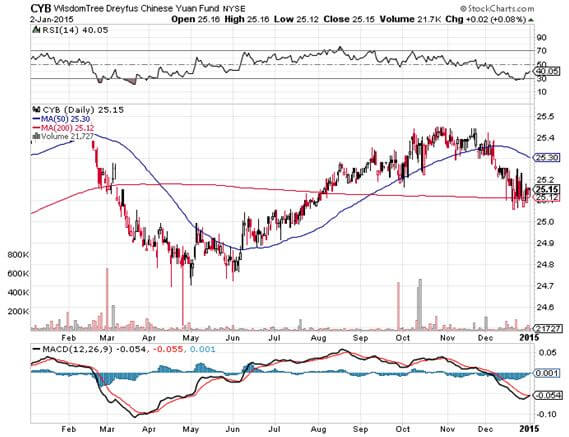
Suddenly, Everyone Loves Uncle Buck

5) Commodities (FCX), (VALE), (DIG), (RIG), (JOY), (KOL), (CCJ), (FSLR), (USO), (DUG), (DIG), (UNG), (JJG), (MOO), (DBA), (MOS), (MON), (AGU), (POT), (CCJ), (NLR), (PHO), (FIW), (CORN), (WEAT), (SOYB)

This is my favorite asset class for the next decade, as investors increasingly catch on to the secular move out of paper assets into hard ones. Don?t buy anything that can be manufactured with a printing press. Focus instead on assets that are in short supply, are enjoying an exponential growth in demand, and take five years to bring new supply online. The Malthusian argument on population growth also applies to commodities; hyperbolic demand inevitably overwhelms linear supply growth.

Of course, we?re already nine years into what is probably a 30 year secular bull market for commodities and these things are no longer as cheap as they once were. You?ll never buy copper again at 85 cents a pound, versus today?s $3.40. You are going to have to allow these things to breathe. Ultimately, this is a demographic play that cashes in on rising standards of living in the biggest and highest growth emerging markets. You can start with the traditional base commodities of copper and iron ore.

The derivative equity plays here are Freeport McMoRan (FCX) and Companhia Vale do Rio Doce (VALE). Add the energies of oil (DIG), coal (KOL), uranium (NLR), and the equities Transocean (RIG), Joy Global (JOY), and Cameco (CCJ).

As much as I love the long term case for hard commodities, I am not expecting any action in the immediate future. Commodities will remain a no go area until it is clear whether China?s economy will suffer a soft or a hard landing, or continues to remain airborne. Use this year?s big ?RISK OFF? trade to acquire serious positions. If markets rally into year end, you might catch a quick 50% gain in the more volatile securities.

Oil has in fact become the new global de facto currency, and probably $30 of the current $100 price reflects monetary demand, and another $30 representing a Middle Eastern risk premium. Strip out these factors, and oil should be trading at $40.? That will help it grind to $100 sometime in early 2012, and we could spike as high as $120. After that, the ?RISK OFF? trade could take it back down to the $75 we saw in September.

Skip natural gas (UNG), because the discovery of a new 100 year supply from ?fracking? and horizontal drilling in shale formations is going to overhang this subsector for a very long time. Major reforms are required in Washington before use of this molecule goes mainstream.

The food commodities are also a great long term Malthusian play, with corn (CORN), wheat (WEAT), and soybeans (SOYB) coming off the back of great returns in 2010. These can be played through the futures or the ETF?s (MOO) and (DBA), and the stocks Mosaic (MOS), Monsanto (MON), Potash (POT), and Agrium (AGU). The grain ETF (JJG) is another handy play. Though an unconventional commodity play, the impending shortage of water will make the energy crisis look like a cake walk. You can participate in this most liquid of asset with the ETF?s (PHO) and (FIW).

Here is Your Lead Contract for ?RISK ON?

Meet Your New Currency

5) Precious Metals??? (GLD), (DGP), (SLV), (PTM), (PALL)

Let?s face it, gold is not a hard asset anymore, it?s a paper one. Since hedge funds and high frequency traders moved into this space, the barbarous relic has been tracking one for one with the S&P 500 and other risk assets.

The chip shot here is $1,500 on the downside, once the remaining hedge fund redemptions and other hot money are cleared out. If we have a real recession this year, $1,050 might be doable. Remember, the speculative frenzy is as great as it was in 1979, which saw the beginning of a 75% plunge in the yellow metal.

But the long term bull case is still there. Obama has not suddenly become a paragon of fiscal restraint. Bernanke has not morphed into a tightwad. When I pull a dollar bill out of my wallet, it?s as limp as ever.

If you forgot to buy gold at $35, $300, or $800, another entry point is setting up for those who, so far, have missed the gravy train. The precious metals have to work off a severely overbought condition before we make substantial new highs. Remember, this is the asset class that takes the escalator up and the elevator down, and sometimes the window.

If the institutional world devotes just 5% of their assets to a weighting in gold, and an emerging market central bank bidding war for gold reserves continues, it has to fly to at least $2,300, the inflation adjusted all-time high, or more. ETF players can look at the 1X (GLD) or the 2X leveraged gold (DGP). But you should only go into these as part of a broader ?RISK ON? move.
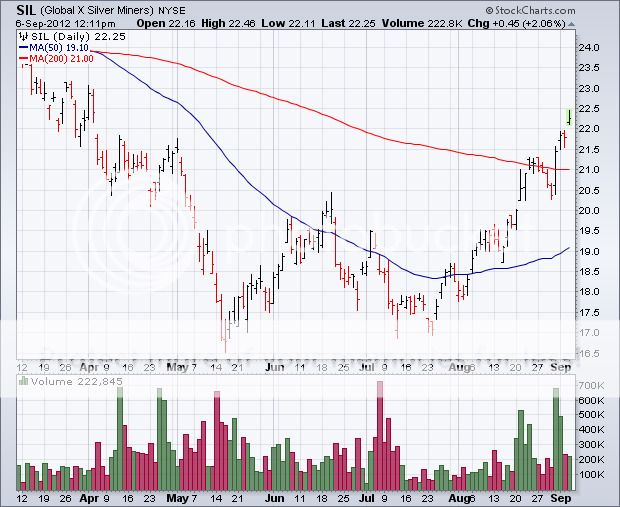
I would also be using the next bout of weakness to pick up the high beta, more volatile precious metal,+ silver (SLV), which I think could hit $50 once more. Palladium (PALL) and platinum (PPLT), which have their own auto related long term fundamentals working on their behalf would also be something to consider on a dip.
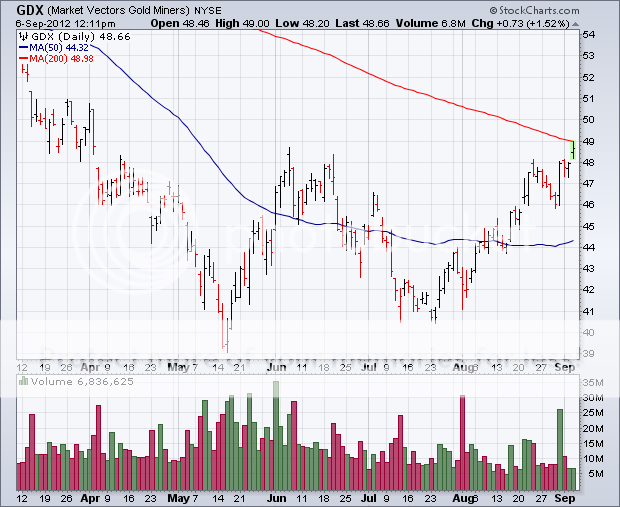
Here?s a Nice Busted Bubble

6) Real Estate

There is no point in spending much time on this most unloved of asset classes, so I?ll keep it brief. There are only three numbers you need to know in the housing market: there are 80 million baby boomers, 65 million Generation Xer?s who follow them, and 85 million in the generation after that, the Millennials.

The boomers have been desperately trying to unload dwellings to the Gen Xer?s since prices peaked in 2007. But there are not enough of them, and three decades of falling real incomes mean that they only earn a fraction of what their parents made. If they have prospered, banks won?t lend to them.
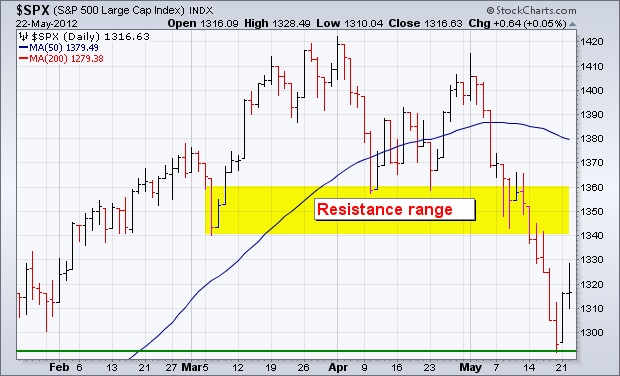
Now consider the coming changes that will affect this market. The home mortgage deduction is unlikely to survive any attempt to balance the budget. And why should renters be subsidizing homeowners anyway? Nor is the government likely to spend billions keeping Fannie Mae and Freddie Mac alive, which now account for 95% of home mortgages.

That means the home loan market will be privatized, leading to mortgages rates 200 basis points higher than today. If this sounds extreme, look no further than the jumbo market for proof. It is already bereft of government subsidy, and loans here are now priced at premiums of this size. This also means that the fixed rate 30 year loan will disappear, as banks seek to offload duration risk to consumers. This happened long ago in the rest of the developed world.

There is a happy ending to this story. By 2025 the Millennials will start to kick in as the dominant buyers in the market. Some 85 million Millennials will be chasing the homes of only 65 Gen Xer?s, causing housing shortages and rising prices. This will happen in the context of a labor shortfall and rising standards of living. In fact, the mid 2020?s could bring a repeat of our last golden age, the 1950?s.

The best case scenario for residential real estate is that it bounces along a bottom for another decade. The worst case is that it falls another 25% from here. Only buy a home if your wife is nagging you about living in that cardboard box under the freeway overpass. But expect to put up your first born child as collateral, and bring in your entire extended family in as cosigners if you want to get a bank loan. Then pray that the price starts to go up in 15 years. Rent, don?t buy.

Rent, Don?t Buy

Well, that?s all for now. We?ve just passed the Pacific mothball fleet and we?re crossing the Benicia Bridge, where the Sacramento River pours into San Francisco Bay. The pressure drop caused by an 8,000 foot descent from Donner Pass has crushed my water bottle. The Golden Gate and the soaring spire of the Transamerica building are just around the next bend. So it is time for me to unglug my laptop and pack up.

I?ll shoot you a trade alert whenever I see a window open on any of the trades above. Good trading in 2012!

https://madhedgefundtrader.com/wp-content/uploads/2019/05/cropped-mad-hedge-logo-transparent-192x192_f9578834168ba24df3eb53916a12c882.png 0 0 DougD https://madhedgefundtrader.com/wp-content/uploads/2019/05/cropped-mad-hedge-logo-transparent-192x192_f9578834168ba24df3eb53916a12c882.png DougD2012-01-02 21:00:542012-01-02 21:00:542012 Annual Asset Class Review
Page 18 of 19«‹16171819›

Legal Disclaimer

There is a very high degree of risk involved in trading. Past results are not indicative of future returns. MadHedgeFundTrader.com and all individuals affiliated with this site assume no responsibilities for your trading and investment results. The indicators, strategies, columns, articles and all other features are for educational purposes only and should not be construed as investment advice. Information for futures trading observations are obtained from sources believed to be reliable, but we do not warrant its completeness or accuracy, or warrant any results from the use of the information. Your use of the trading observations is entirely at your own risk and it is your sole responsibility to evaluate the accuracy, completeness and usefulness of the information. You must assess the risk of any trade with your broker and make your own independent decisions regarding any securities mentioned herein. Affiliates of MadHedgeFundTrader.com may have a position or effect transactions in the securities described herein (or options thereon) and/or otherwise employ trading strategies that may be consistent or inconsistent with the provided strategies.

Copyright © 2026. Mad Hedge Fund Trader. All Rights Reserved. support@madhedgefundtrader.com
Scroll to top