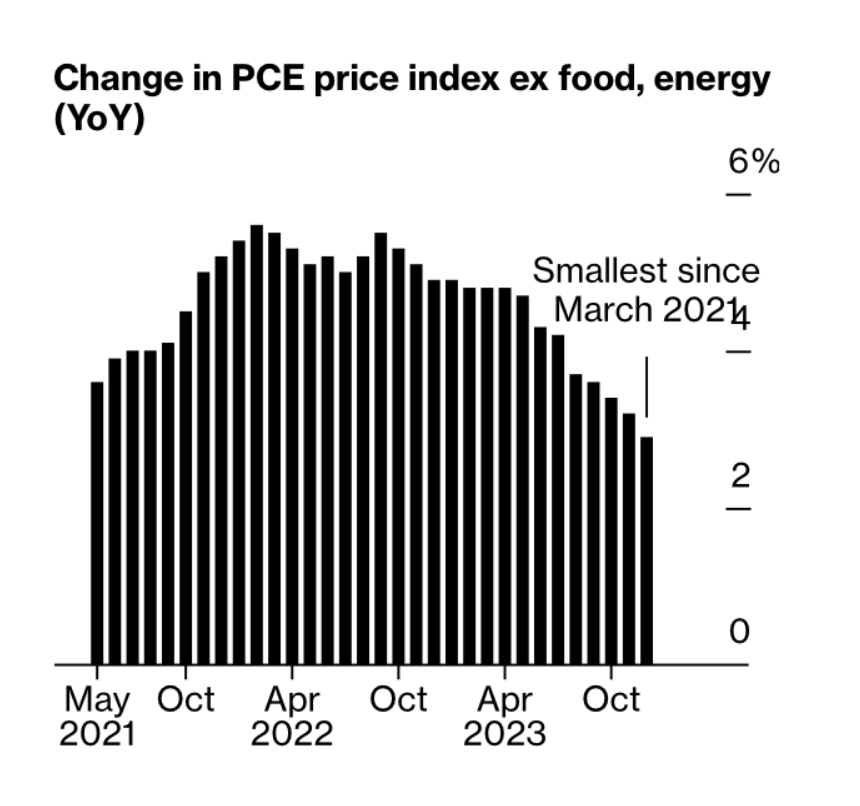
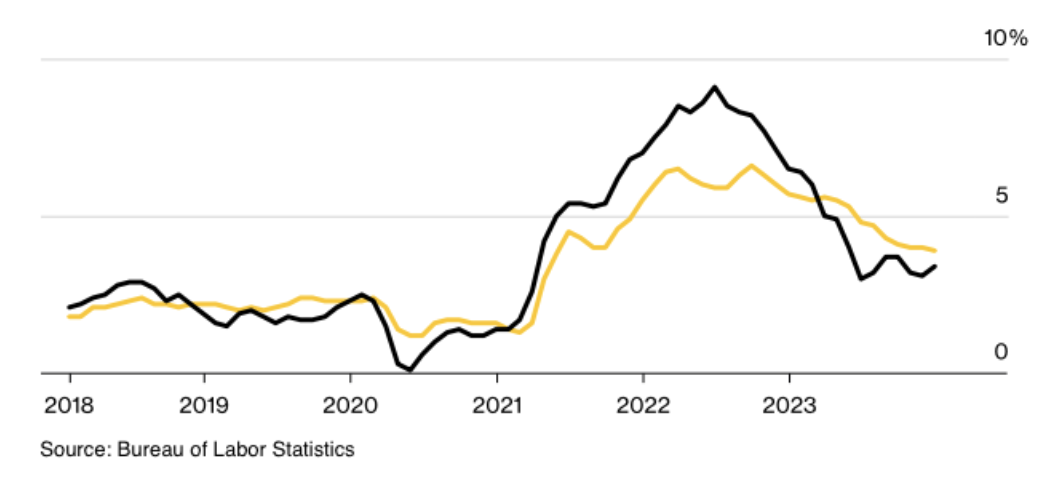
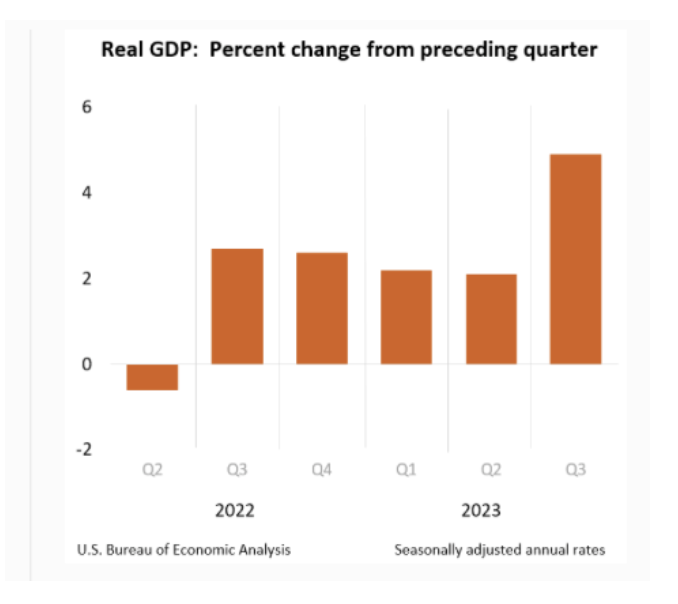
Inflation is dramatically falling, with Core PCE down to an amazing 2.6% YOY rate in December. At the same time, GDP growth came in at an incredible 3.3% in Q4 and 2.5% for all of 2023. The long-term average is 3.0%. It’s about as close to a Goldilocks scenario as we’ll ever get.
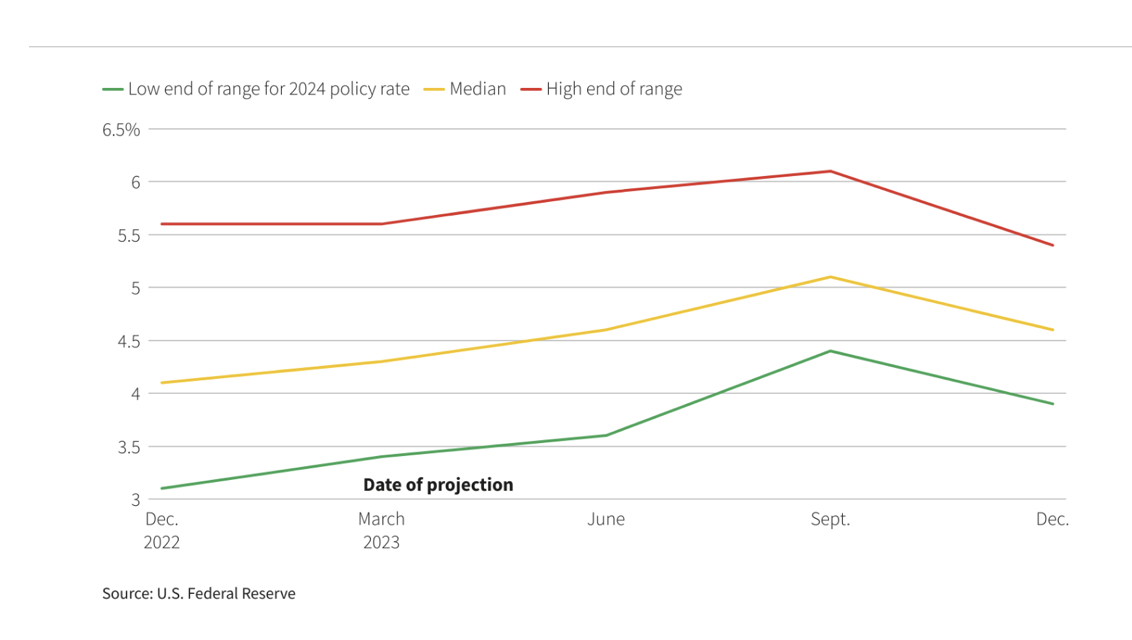
The problem arises when the economy gets TOO healthy right when the Fed is considering its first interest rate CUTS in four years. That could lead our nation’s central bank to postpone cuts or not to announce them at all.
That would suddenly put the three-month-old bull market on ice, perhaps indefinitely, which has given us one of the worst whipsaw markets I have ever seen. Sector leadership has changed three times so far in 2024. First, there was the AI 5, (MSFT), (META), (GOOGL), (AMZN), and (NVDA). Next came stocks that benefit the most from falling interest rates, financials, precious metals, base metals, industrials, bonds, and foreign currencies.
To say this would be a tough market to trade would be an understatement, evidenced by my multiple stop losses this month. The remedy for this is to shrink your portfolio, sit back, and wait for the market to tell you what to do. I have to say that with the Volatility Index ($VIX) camped out at the $12 handle, options are not offering a lot for you to chew on either.
If you are looking for any further proof that technology is accelerating far faster than we can understand, I shall recall for your edification my last weekend.
After my youngest went off to college, I had to get her headboard refinished because she spent two years in bed looking at her computer while enrolled in high school during COVID-19. She had completely worn the finish off but got all A’s.
So I went to Yelp to look for a furniture restoration business. I clicked on one restorer who had good reviews and lots of pictures, described the job, and included pictures. Within 60 seconds, I received not one bid for the job but four, as Yelp had put the job out for bid across its entire network. One offered to do the job the next day for $100.
Learning how easy it is to refinish furniture, I put a second job out for bid, a small beat-up desk which I picked up at an estate sale for $20. I learned that this was a 100-year-old Craftsman desk highly sought after by collectors worth $2,500. Absolutely, yes, it was worth the $750 cost of a total stripped-down restoration.
I’m thinking “poor furniture restorers”, but what they are losing in the price, they make up in volume. Their craft is in fact a dying one and they can charge whatever they want.
And now you know why I go to estate sales.
What kind of homework is my daughter getting these days? As a Computer Science major at the University of California, she was handed a box of calculators smashed with a hammer. Over a weekend, she was required to invent a tool that identified the good chips from the bad, write code to reprogram the chips, and then glue the good calculators back together.
By Sunday afternoon she had a box full of working but somewhat ugly calculators, thanks to my donation of Gorilla Glue. And this for a sophomore! Needless to say, I didn’t see much of my daughter last weekend, except when she came downstairs to do her laundry.
Next week, they have to fix cell phones.
Gulp! I doubt I could even get into the UC today, even though I graduated Magna Cum Laude 50 years ago. Such is life with college students.
Watch out! The future is happening fast!
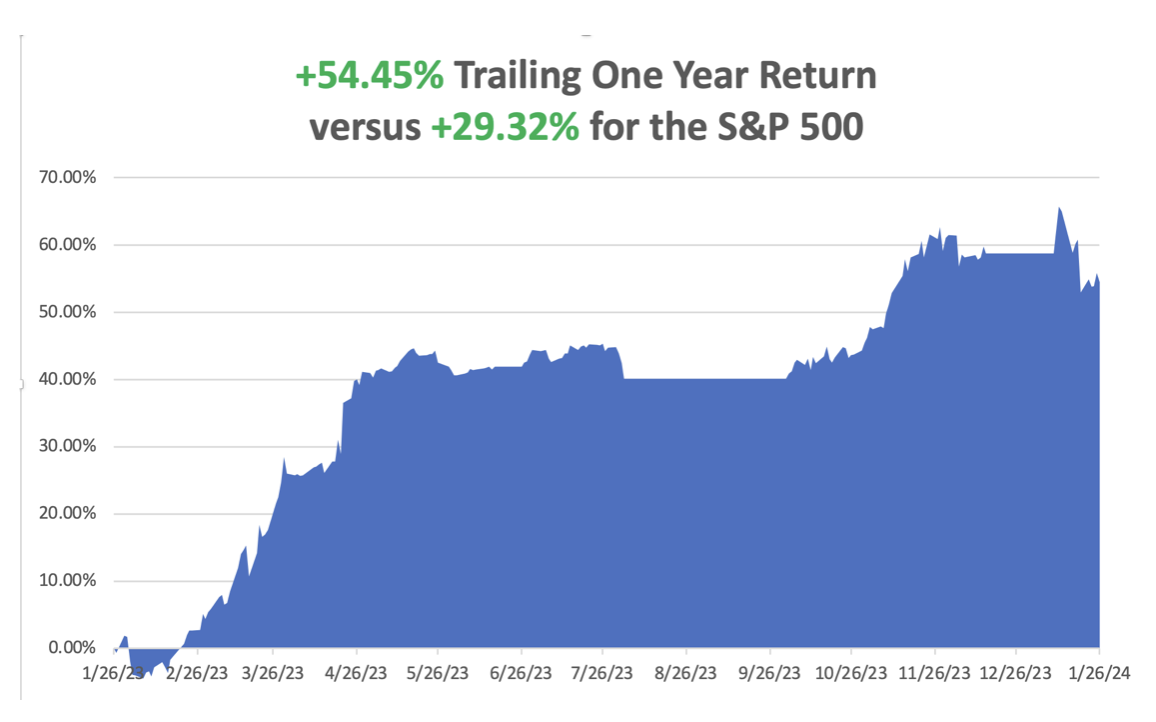
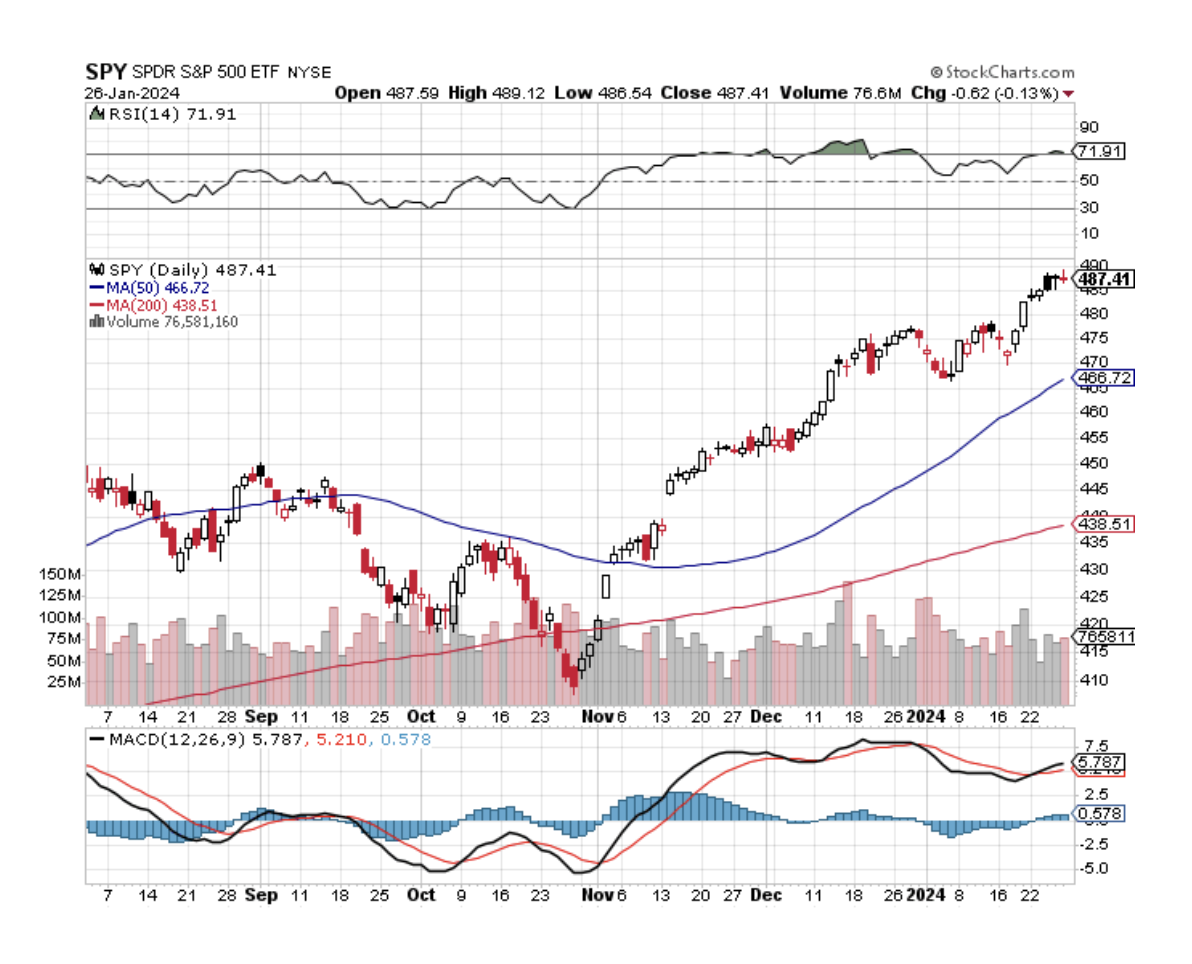
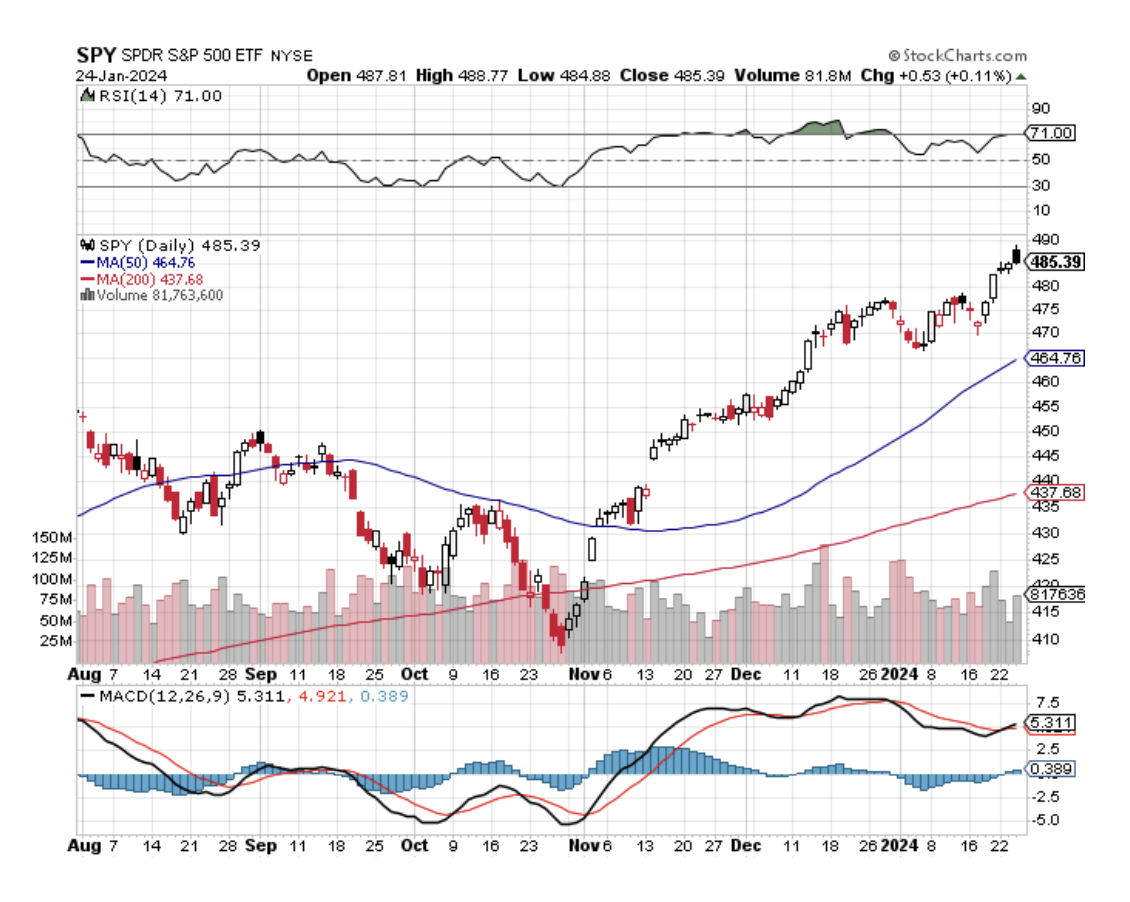
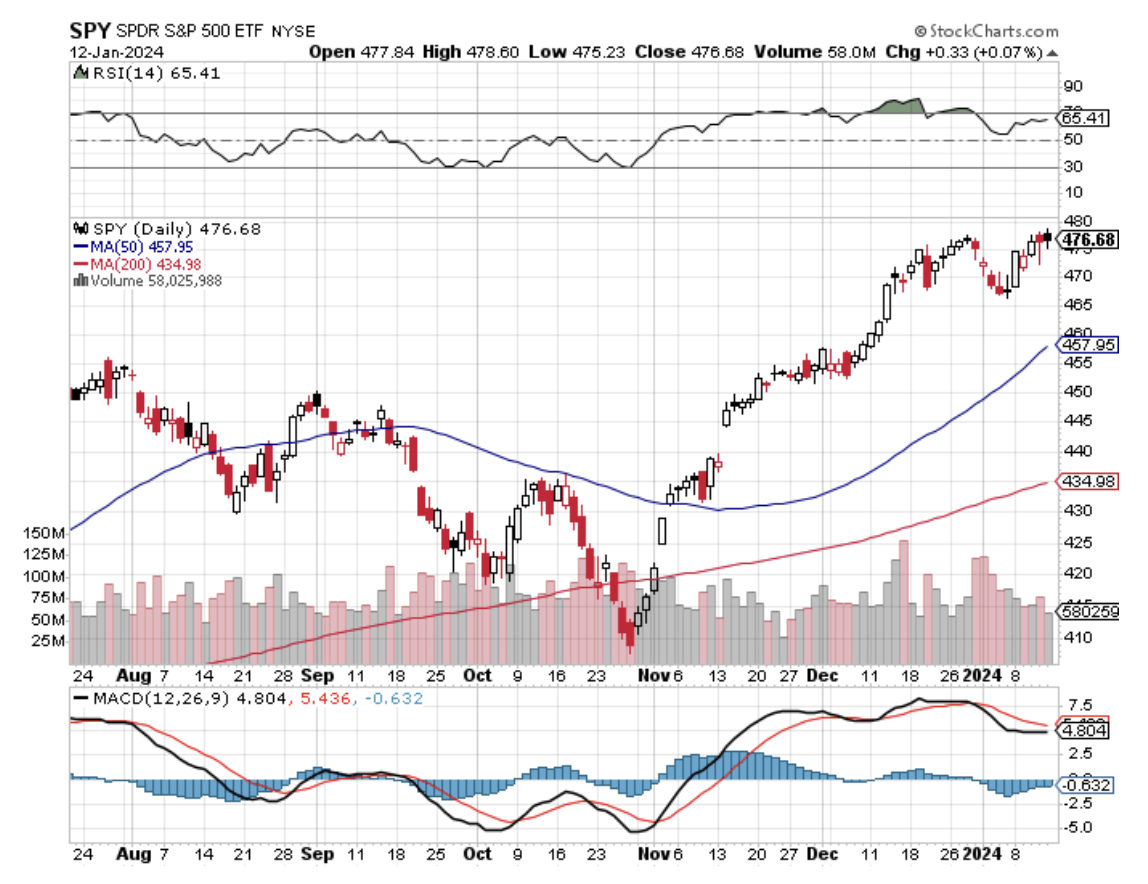
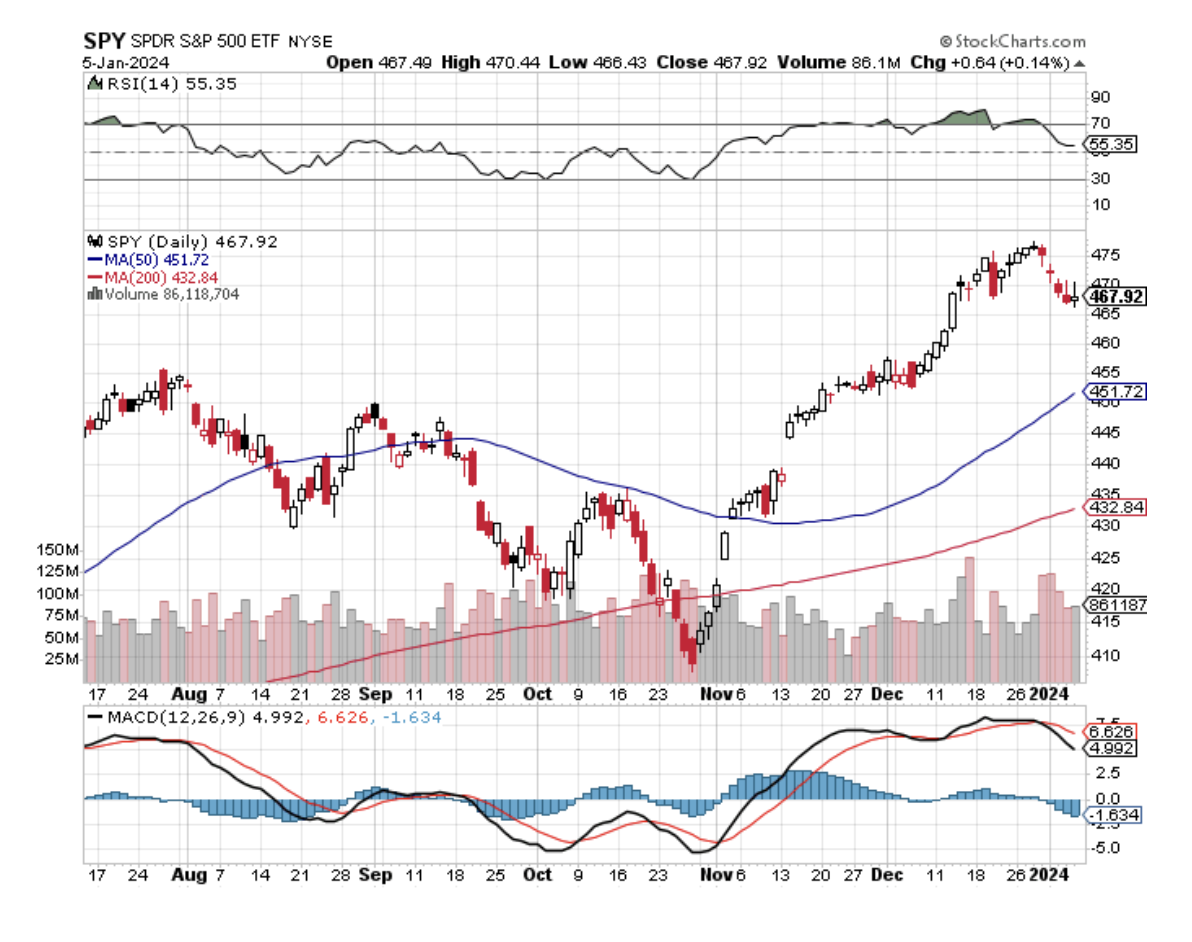
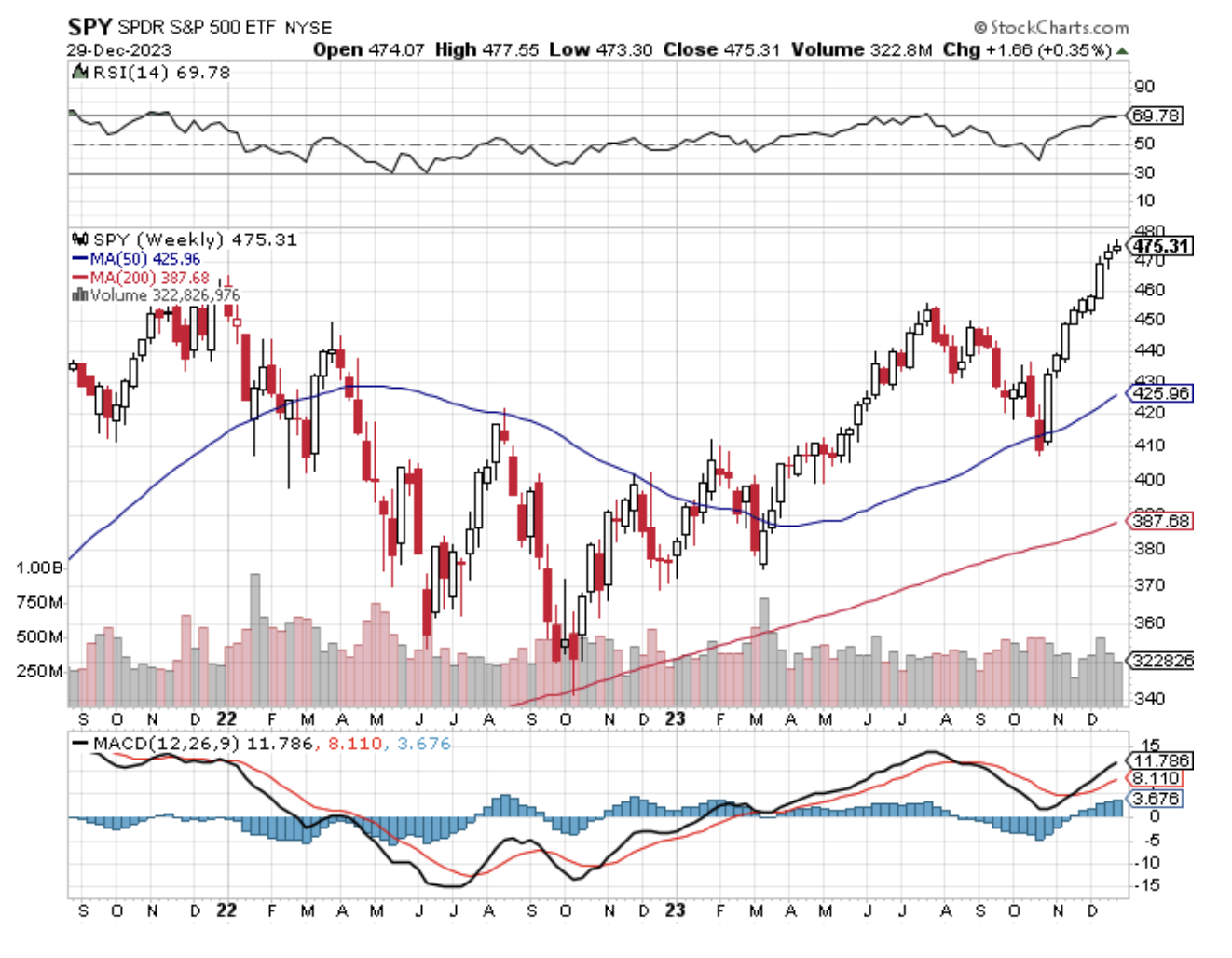
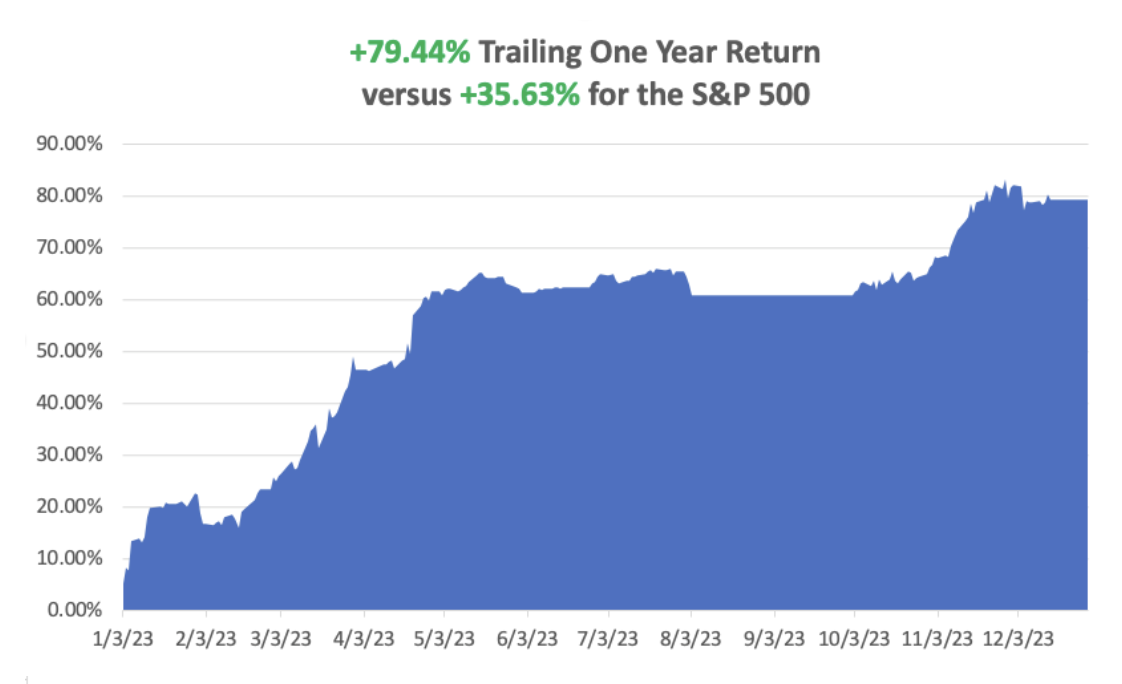
So far in January, we are down -4.33%. My 2024 year-to-date performance is also at -4.33%.The S&P 500 (SPY) is up +1.14%so far in 2024. My trailing one-year return reached +54.54% versus +21.14%for the S&P 500.
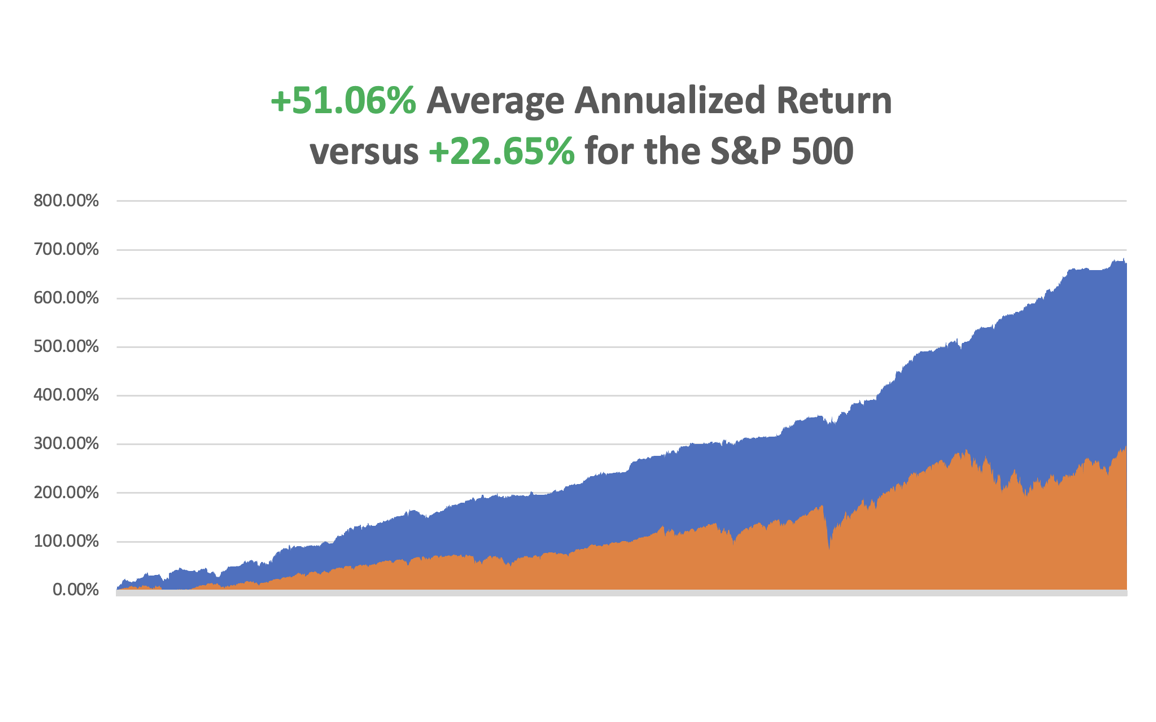
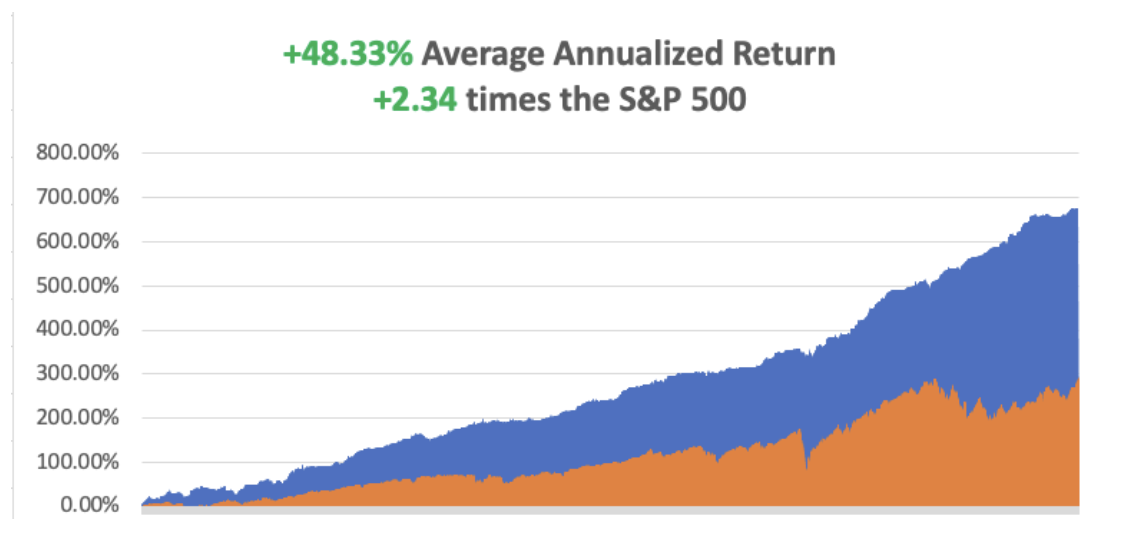
That brings my 15-year total return to +672.30%. My average annualized return has retreated to +51.06%.
Some 63 of my 70 trades last year were profitable in 2023.
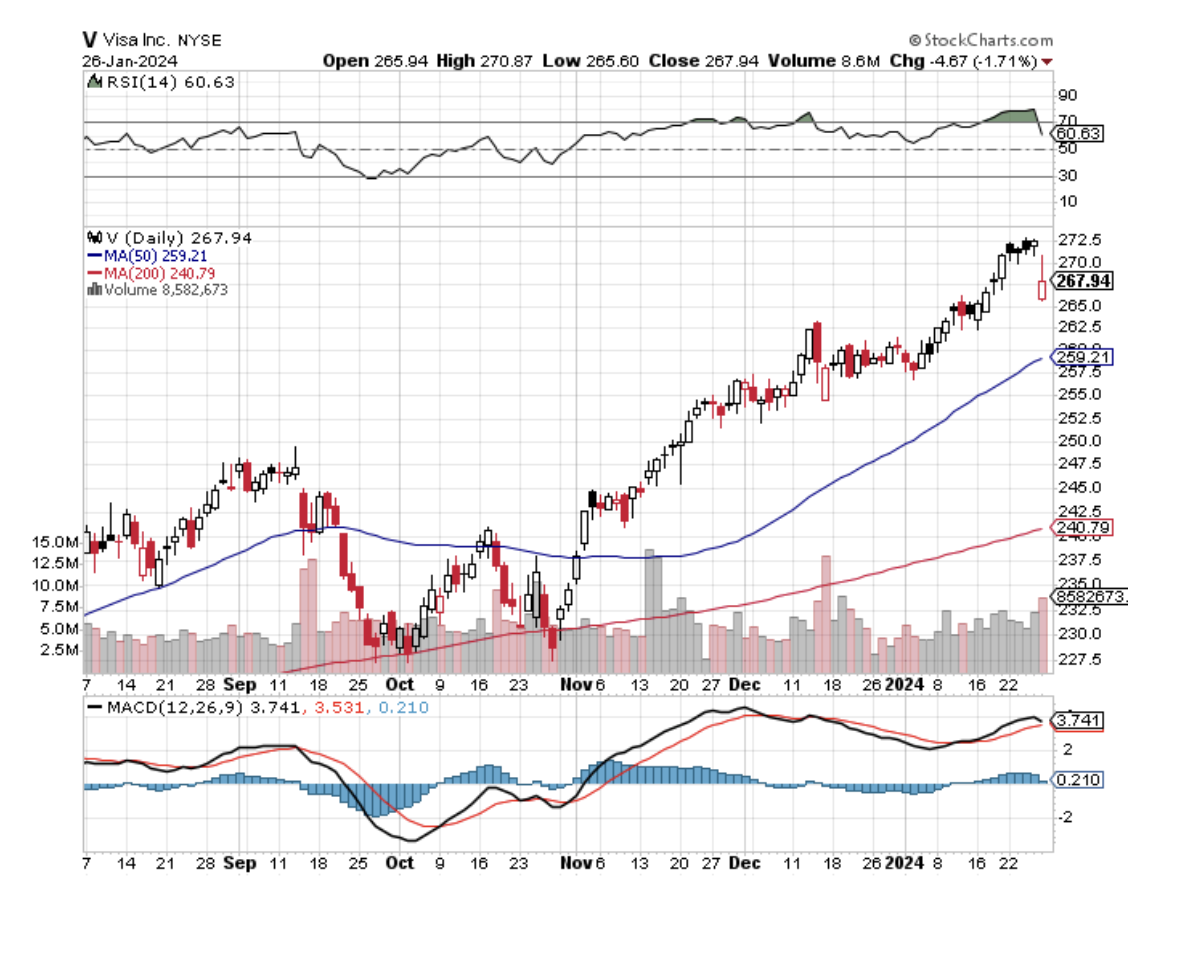
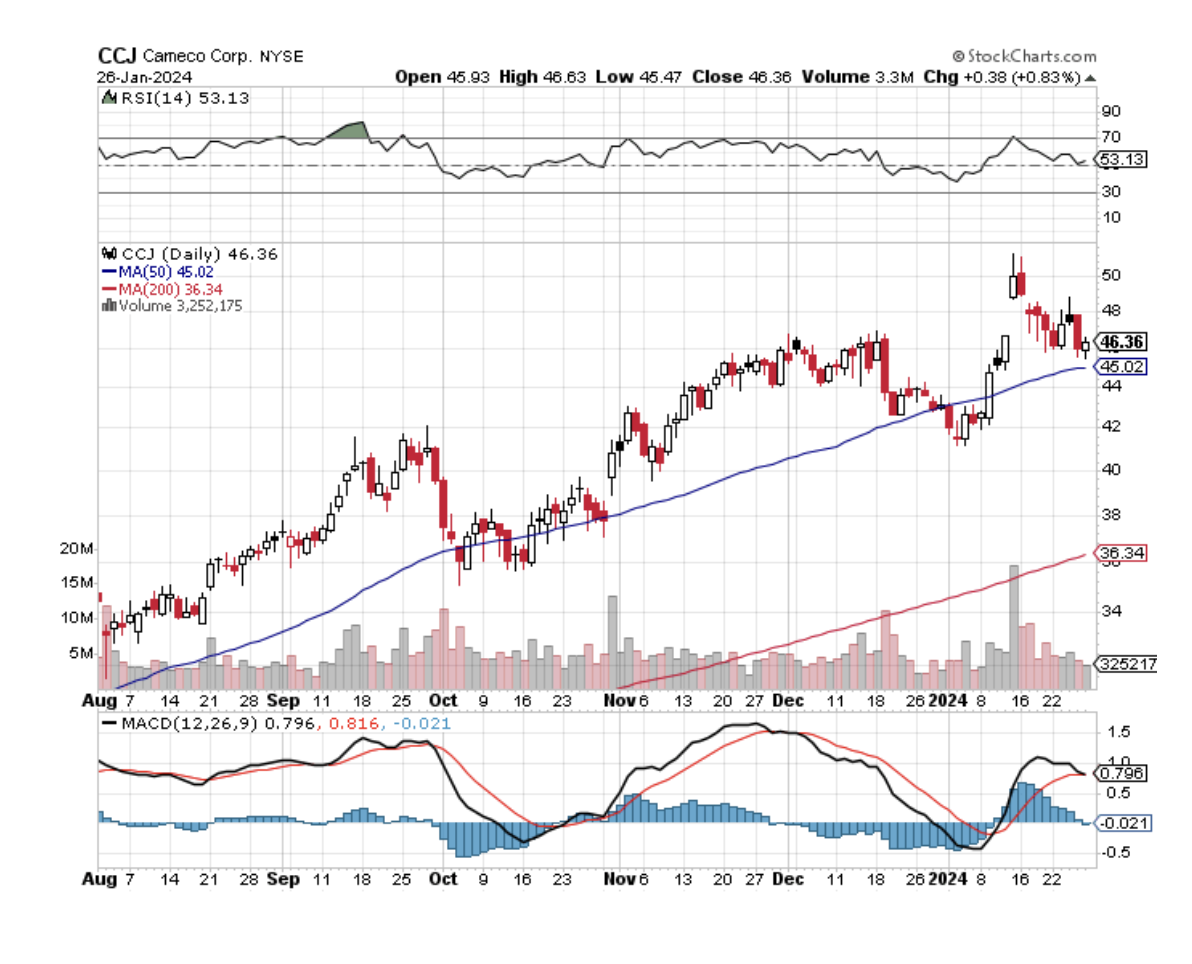
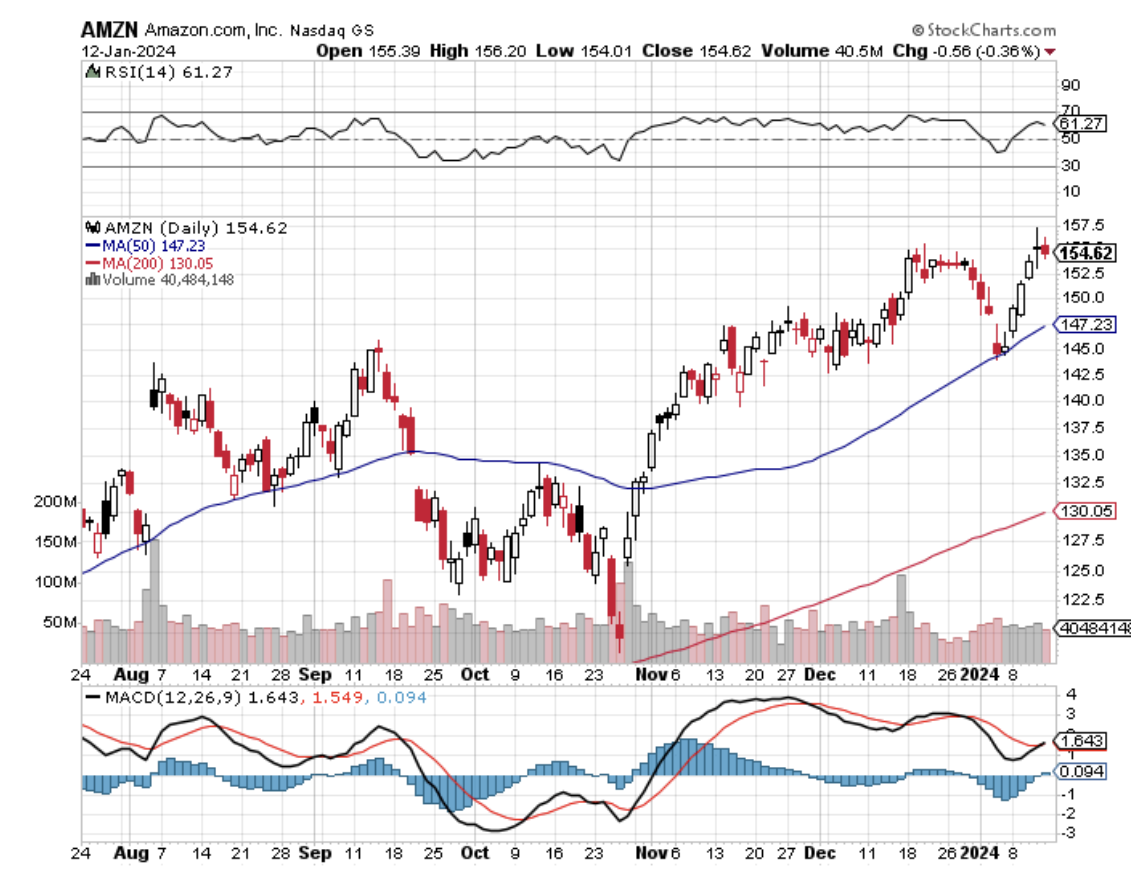
I am maintaining longs in (MSFT), (AMZN), (V), (PANW), and (CCJ).
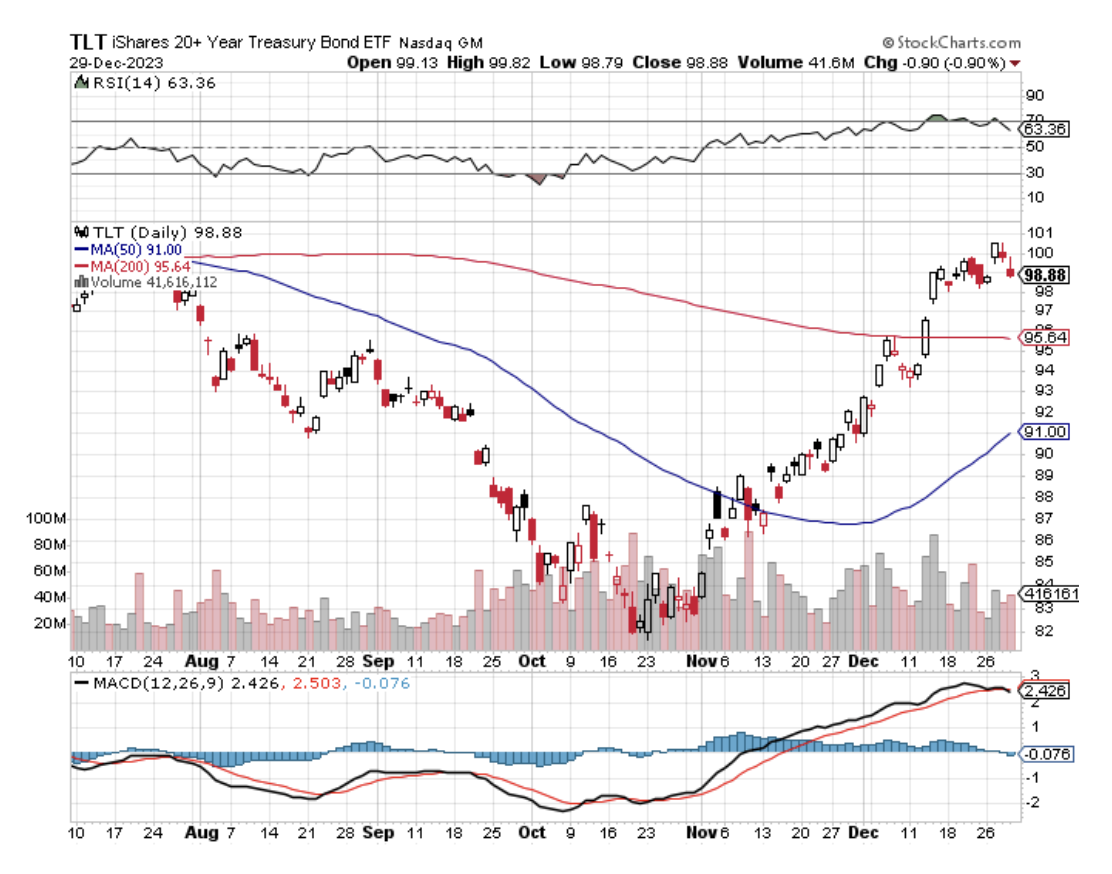
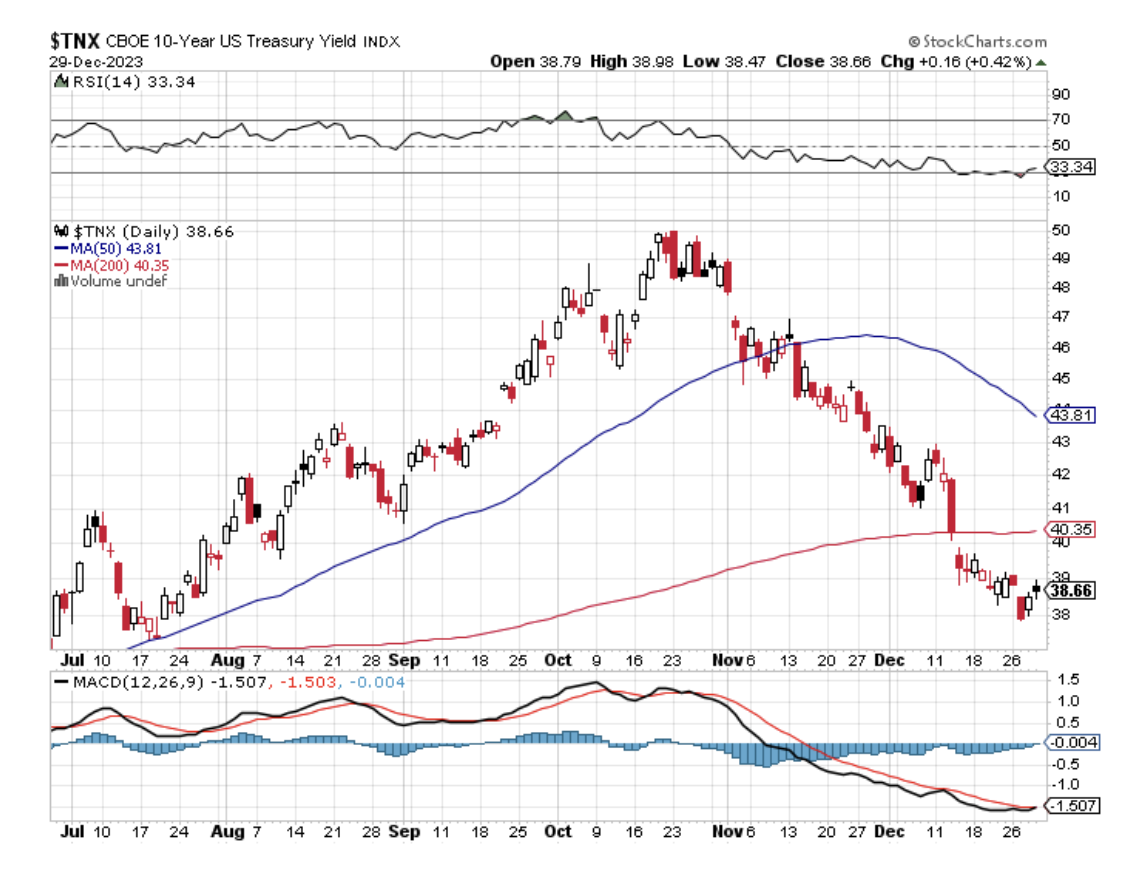
US GDP Rocketed by 2.5% in 2023, cementing its position as the strongest major economy in the world. Q4 came in at a hot 3.3%. We’re going from soft landing to no landing at all. Unfortunately, the report also put our bond trade to sleep.
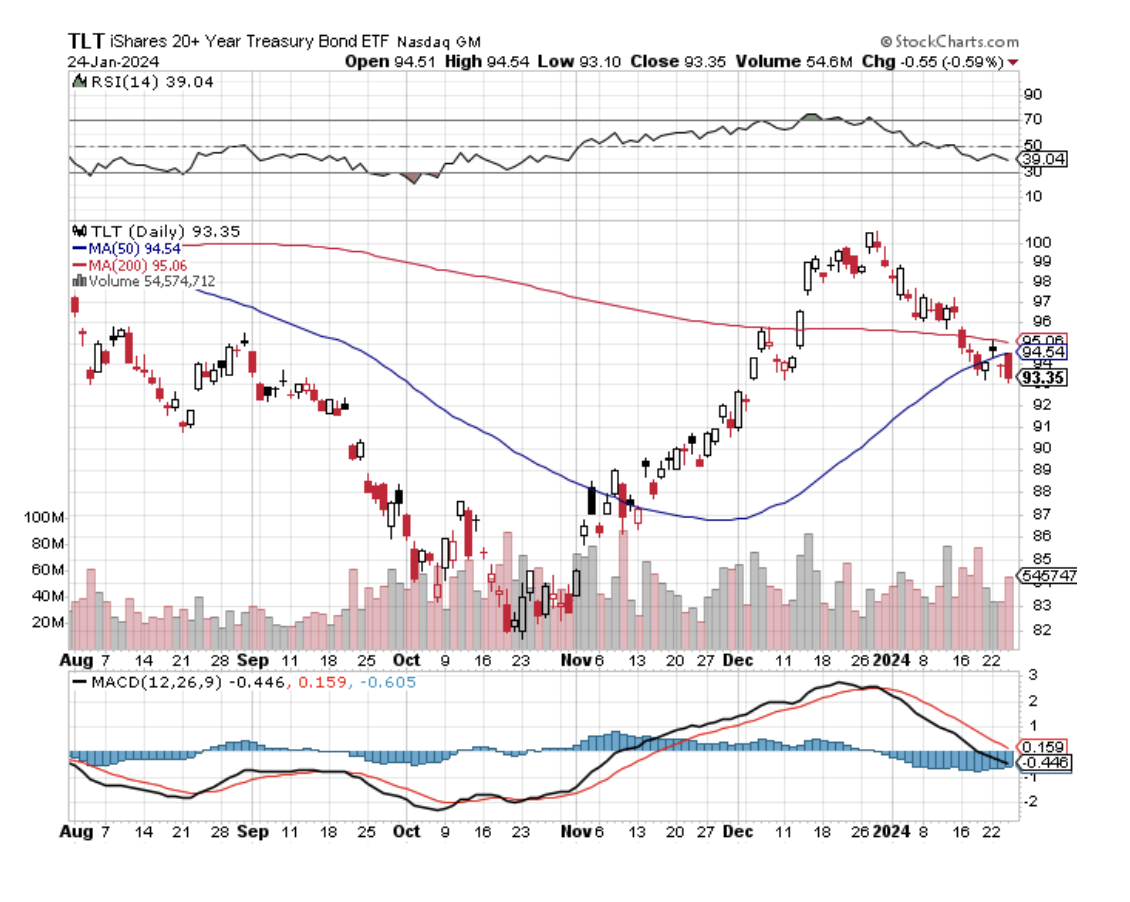
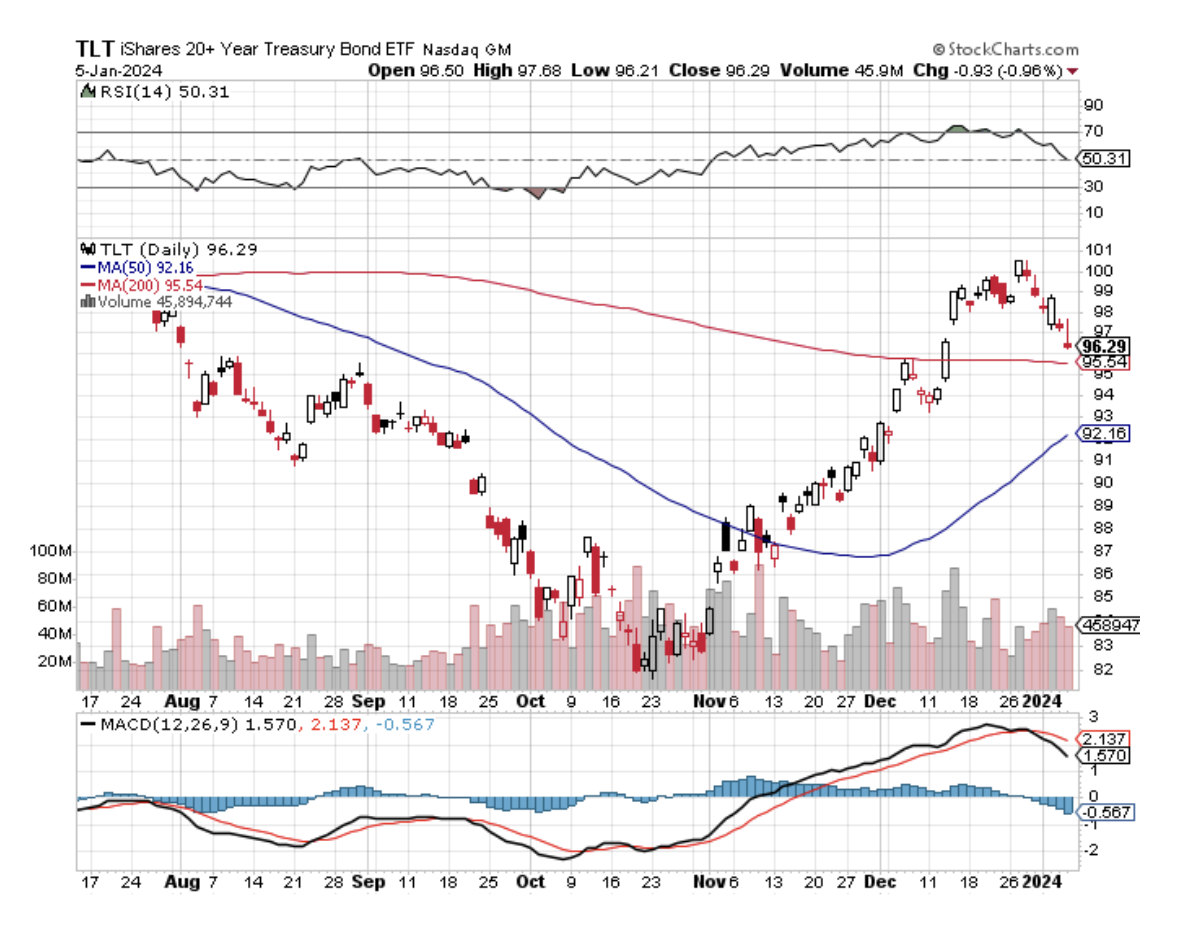
Inflation Falls, with the Core PCE index easing to 2.9% last month, the lowest since 2021. That’s in the face of consumer spending posting the biggest back-to-back increase in nearly a year. This is very positive for bond bulls. Buy (TLT) LEAPS on dips.
The Roaring Twenties are Back, says investment guru and old friend Ed Yardeni. He draws parallels with the runaway stock prices that followed the 1918 Spanish flu pandemic, which killed millions. Of course, you had a 10:1 margin during the twenties which made speculation much easier. Are same-day options any worse?
New Homes Sales Recover, on a falling interest rate push, up 8.0% to 664,000. Sales, however, can be volatile on a month-to-month basis. Sales increased 4.4% on a year-on-year basis in December.
Netflix Soars on Big Subscriber Beat, up 8.6% on an add of 13 million new subscribers. It moved solidly into more sports content with the World Wrestling Entertainment deal. Buy (NFLX) on dips, which clearly won the streaming wars. I can’t get enough of The Rock, who is a genuinely nice guy.
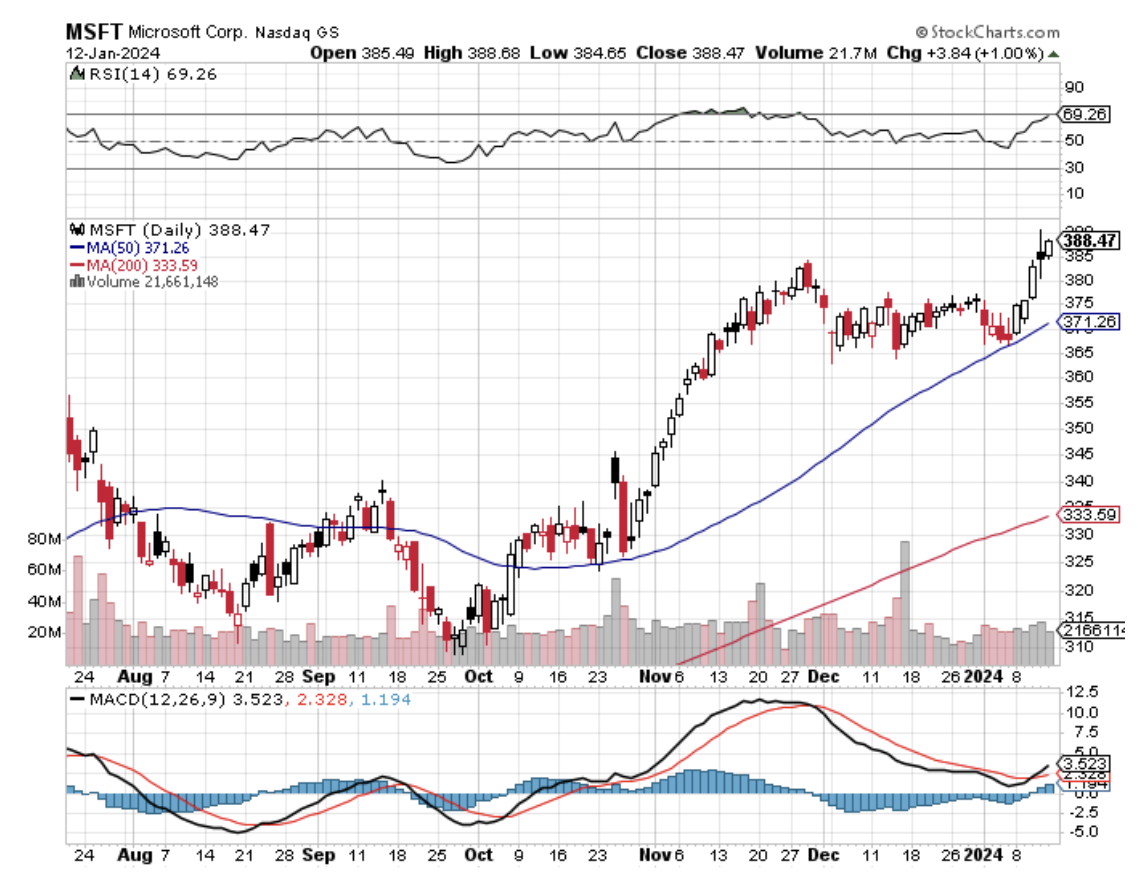
Microsoft Tops $3 Trillion Valuation, cementing its hold on the AI lead. (MSFT) has been a top Mad hedge holding for years which we are currently long. Buy (MSFT) on dips which may have another $100 in it this year.
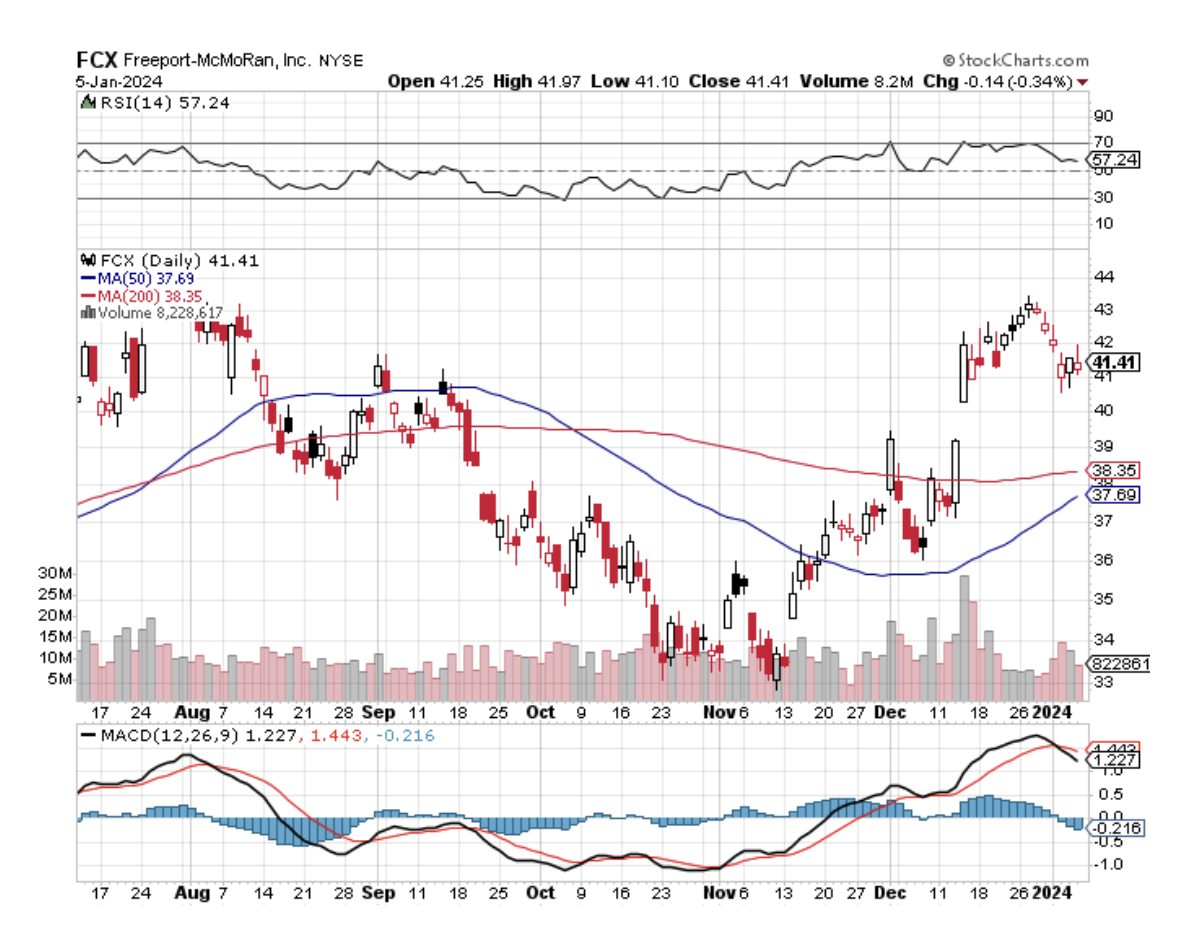
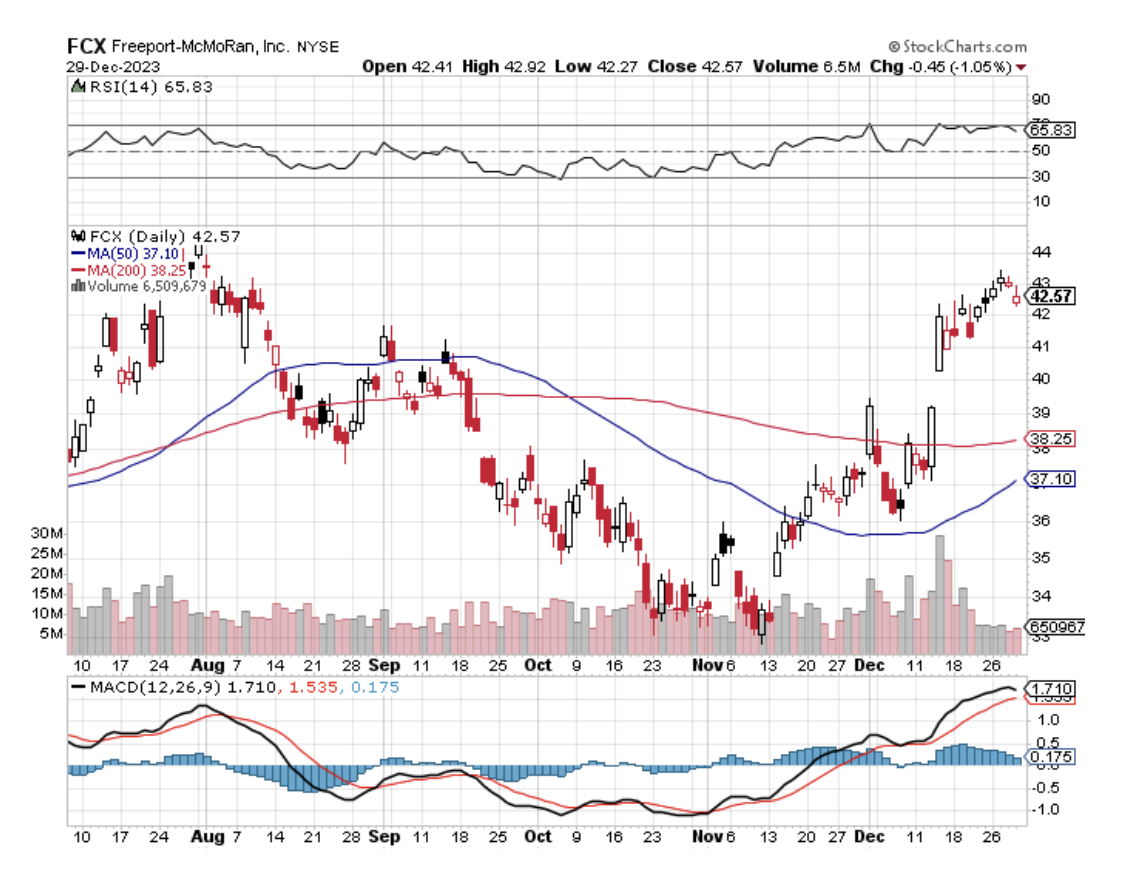
Freeport McMoRan Kills it, with an earnings upside blowout, taking the stock up 5%. CEO Richard Adkerson, a long-time Mad Hedge subscriber, says any problems are short-term. Political problems in Chile and Peru are an issue, which generates 40% of the world’s copper. Electrification of the US economy will continue to be a driving theme.
Mortgage Rates Plunge to 8-Month Low. The average fixed-rate 30-year mortgage fell to 6.60% as of Thursday from 6.66% the week prior, Freddie Mac said in its weekly report on home loan borrowing costs. The next Golden Age of Housing is here.
China Markets Dive, on news that the central bank was forced into the currency markets to support the yuan. Stock markets didn’t like it a bit, down 2.7% on the day. Overseas funds have sold roughly $1.6 billion in Chinese equities so far this year, with investor confidence bruised by signs of a slowdown in the world's second-largest economy. Offshore yuan tomorrow-next forwards jumped to a more than two-month high of 4.25 points late on Monday, reflecting signs of tighter liquidity conditions. Avoid China (FXI) like some stale egg foo young.
“Oppenheimer” Sweeps the Oscars, with a record 13 nominations. It’s a movie where I knew half the characters in real life from my work at the Nuclear Test site in Nevada. It was another opportunity to discuss advanced nuclear physics over dinner with my kids. Click here for the full list. The winners will be announced on March 10.
My Ten-Year View
When we come out the other side of the recession, we will be perfectly poised to launch into my new American Golden Age or the next Roaring Twenties. The economy decarbonizing and technology hyper accelerating, creating enormous investment opportunities. The Dow Average will rise by 800% to 240,000 or more in the coming decade. The new America will be far more efficient and profitable than the old.
Dow 240,000 here we come!
On Monday, January 29, the Dallas Fed Manufacturing Index was announced.
On Tuesday, January 30 at 8:30 AM EST,the S&P Case Shiller National Home Price Index is released. We also get the JOLTS Job Openings Report.
On Wednesday, January 31 at 2:00 PM, the ADP Private Jobs Opening Report is published. The Federal Reserve announces its interest rate decision.
On Thursday, February 1 at 8:30 AM, the Weekly Jobless Claims are announced.
On Friday, February 2 at 2:30 PM, the December Nonfarm Payroll Report and Unemployment Rate is published. At 2:00 PM the Baker Hughes Rig Count is printed.
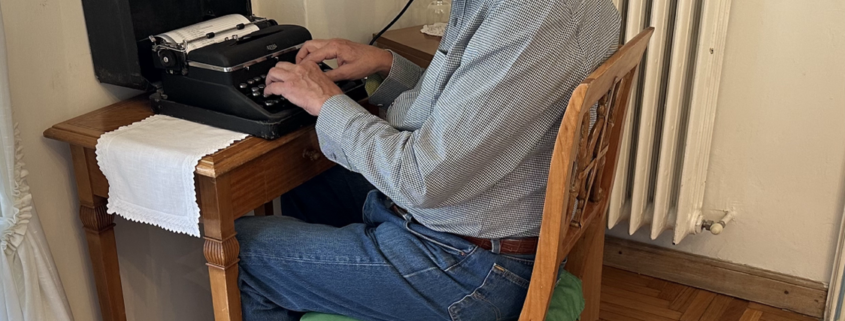
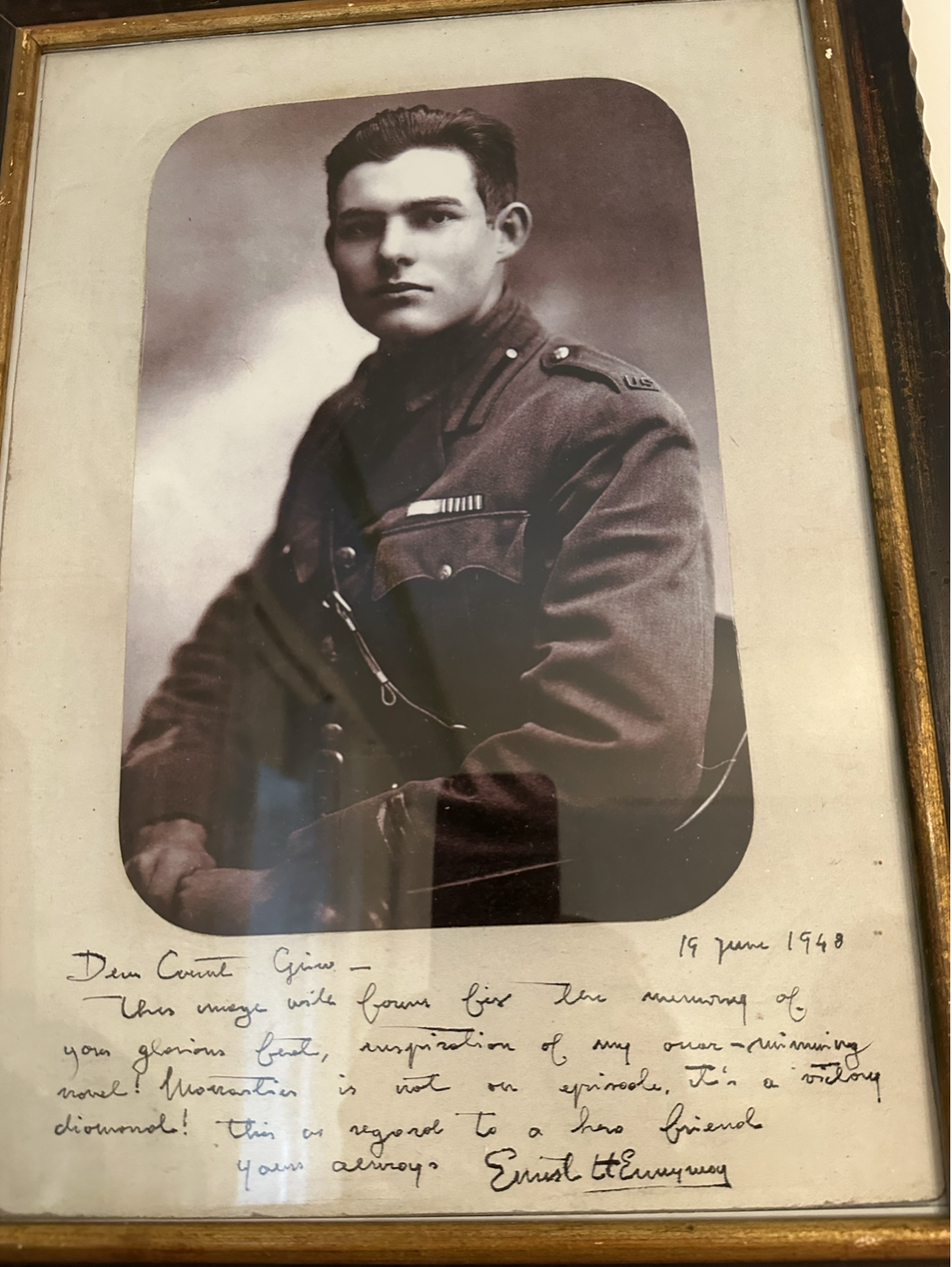
As for me, I received calls from six readers last week saying I remind them of Ernest Hemingway. This, no doubt, was the result of Ken Burns’ excellent documentary about the Nobel prize-winning writer on PBS last week.
It is no accident.
My grandfather drove for the Italian Red Cross on the Alpine front during WWI, where Hemingway got his start, so we had a connection right there.
Since I read Hemingway’s books in my mid-teens I decided I wanted to be him and became a war correspondent. In those days, you traveled by ship a lot, leaving ample time to finish off his complete work.
I visited his homes in Key West, Florida, and Ketchum, Idaho. His Cuban residence is high on my list, now that Castro is gone. His home in Cuba is on the menu.
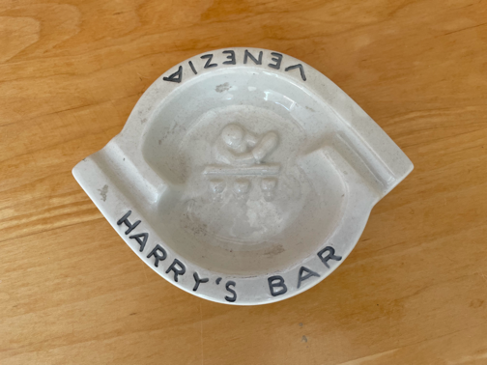
I used to stay in the Hemingway Suite at the Ritz Hotel on Place Vendome in Paris where he lived during WWII. I had drinks at the Hemingway Bar downstairs where war correspondent Ernest shot a German colonel in the face at point-blank range. I still have the ashtrays.
Harry’s Bar in Venice, a Hemingway favorite, was a regular stopping-off point for me. I have those ashtrays too.
I even dated his granddaughter from his first wife, Hadley, the movie star Mariel Hemingway, before she got married, and when she was still being pursued by Robert de Niro and Woody Allen. Some genes skip generations and she was a dead ringer for her grandfather. She was the only Playboy centerfold I ever went out with. We still keep in touch.
So, I’ll spend the weekend watching Farewell to Arms….again, after I finish my writing.
Oh, and if you visit the Ritz Hotel today, you’ll find the ashtrays are now glued to the tables.
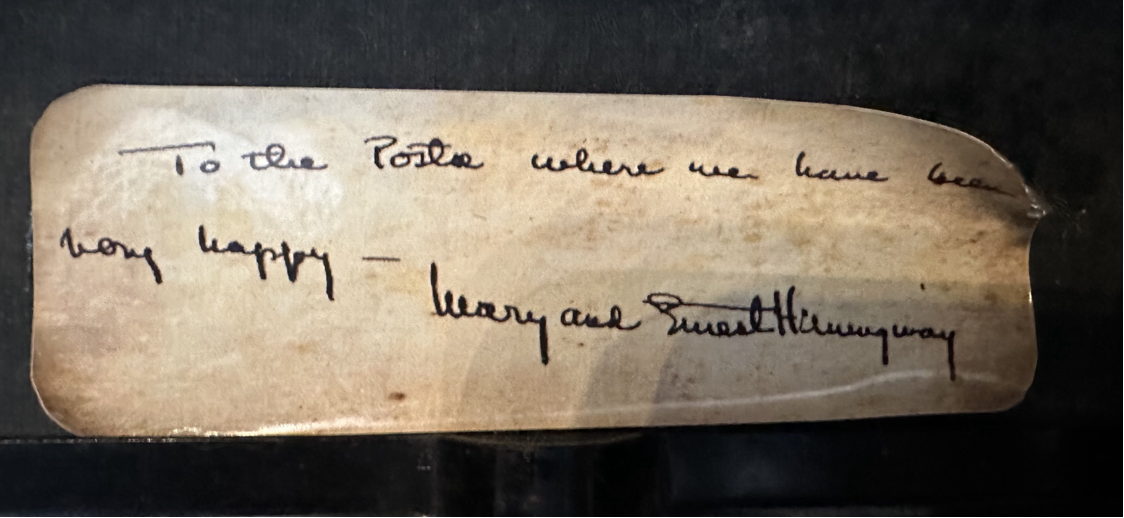
As for last summer, stayed in the Hemingway suite at the Hotel Post in Cortina d’Ampezzo Italy where he stayed in the 1950s to finish a book. Maybe some inspiration will rub off on me.
Good Luck and Good Trading,
John Thomas
CEO & Publisher
The Diary of a Mad Hedge Fund Trader
https://www.madhedgefundtrader.com/wp-content/uploads/2024/01/John-thomas-typewriter.png11861124april@madhedgefundtrader.comhttps://madhedgefundtrader.com/wp-content/uploads/2019/05/cropped-mad-hedge-logo-transparent-192x192_f9578834168ba24df3eb53916a12c882.pngapril@madhedgefundtrader.com2024-01-29 09:02:312024-01-29 10:29:05The Market Outlook for the Week Ahead, or Too Much of a Good Thing?
Below please find subscribers’ Q&A for the January 24 Mad Hedge Fund Trader Global Strategy Webinar, broadcast from Silicon Valley, CA.
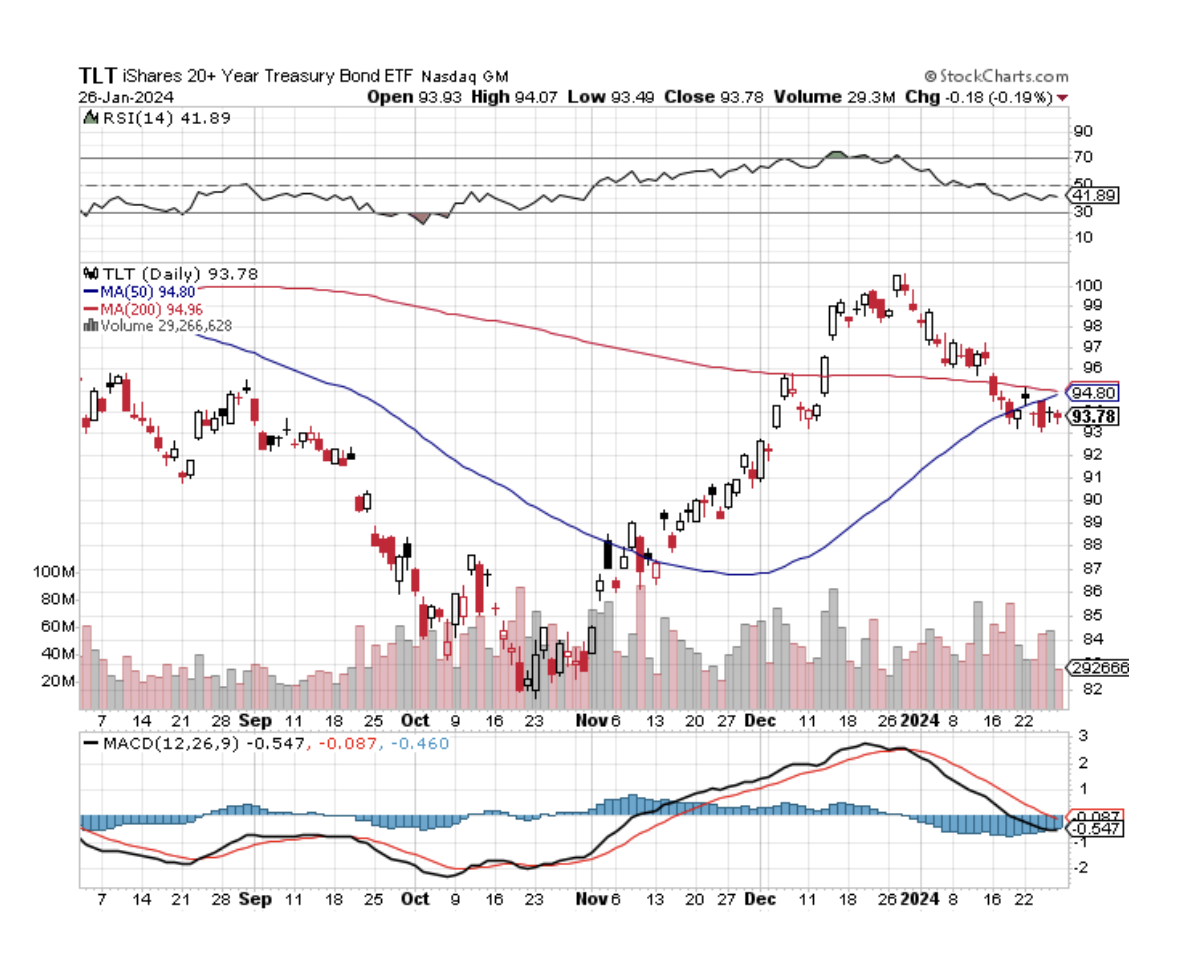
Q: Will you stop out of (TLT) if it breaches the $93 level?
A: Yes, and I'm actually hoping it will do that because that sets up some really great two-year LEAPS for the (TLT) going out long-term. It's trying to hold in here at the bottom. It's been in the $93 handle for several days now, so we'll just watch.
Q: There seems to be negativity all over the place, but markets continue upwards. What are the chances of a black swan this year, and what do you think it might be?
A: Well, there always is a possibility of a black swan. That's why we do risk control and risk management all the time because black swans are by definition unpredictable. The reason people are negative is that they don't own more stocks, and they keep going straight up, at least the tech ones do. Money managers always look dumber not owning a market that's going up than owning a market that's going down and losing money with everybody else. It's just the way investor psychology works.
Q: Do you expect small caps (IWM) to outperform the S&P 500 (SPY) this year?
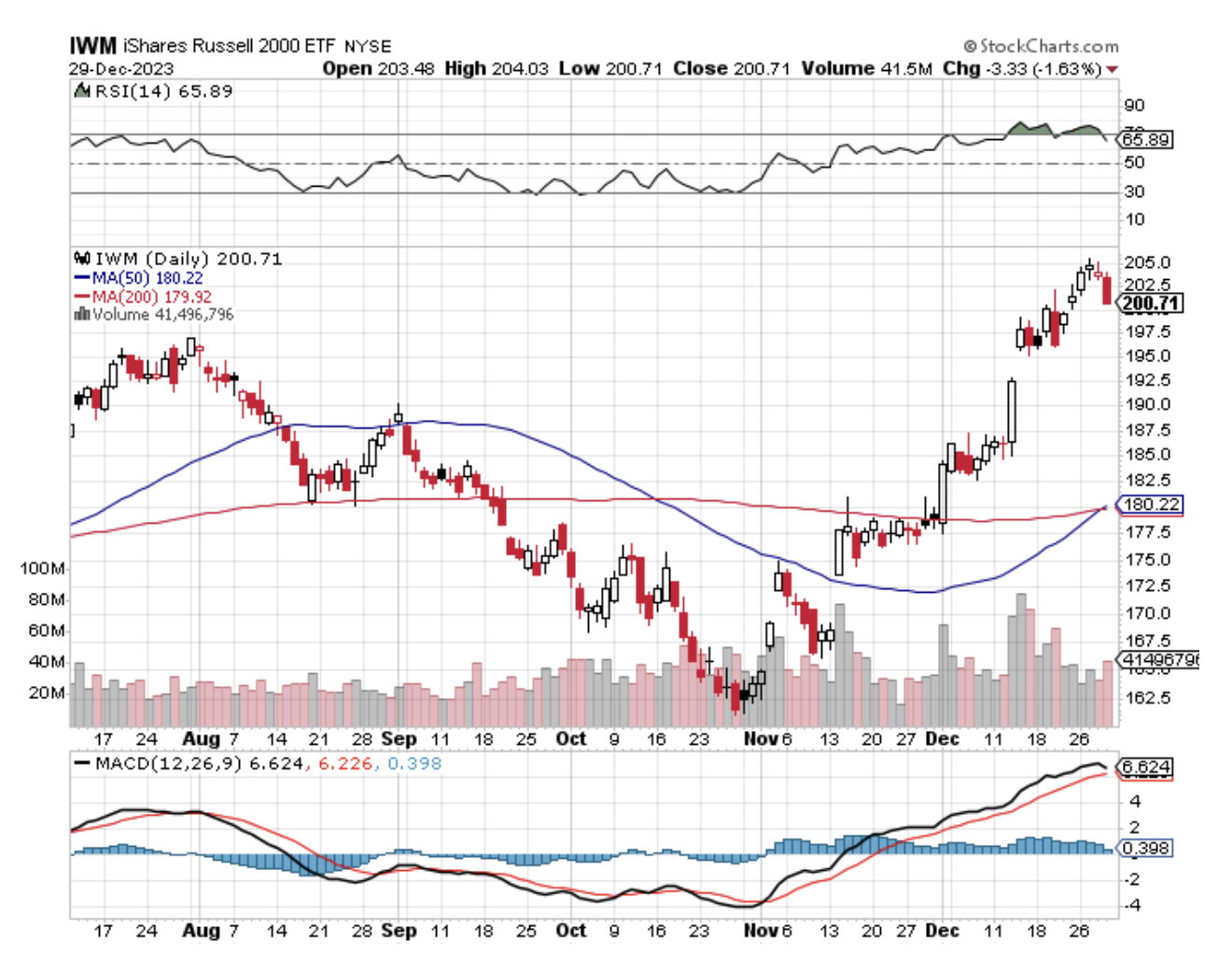
A: Yes I do, but it'll be a second half of the year game. They really need the big drops in interest rates to get earnings moving.
Q: Would Boeing (BA) be good for a LEAPS?
A: Yes, it would, but I would go out to the maximum maturity, say two to two and a half years, and you may get a double on your money on that. Basically, there are only two airplane manufacturers in the world that have a monopoly (or a duopoly to be technically correct) and Boeing is one of them. So love them or hate them, you still have to buy their airplanes; look no further than Alaska Airlines (ALK) and United (UAL), which have had to cancel literally tens of thousands of flights because they don't have enough airplanes. They had to ground all their 737 maxes.
Q: With all the shooting going on in the Middle East, why isn't oil higher?
A: It's all about China (FXI). As long as China is in a recession which seems to be getting worse, oil demand falls. China is the world's largest importer of oil by a large margin. They're also taking all the natural gas that the US will produce, and that is a big drag on prices. That will end when China starts to recover, and we did get a major stimulus package out of the Chinese government this week.
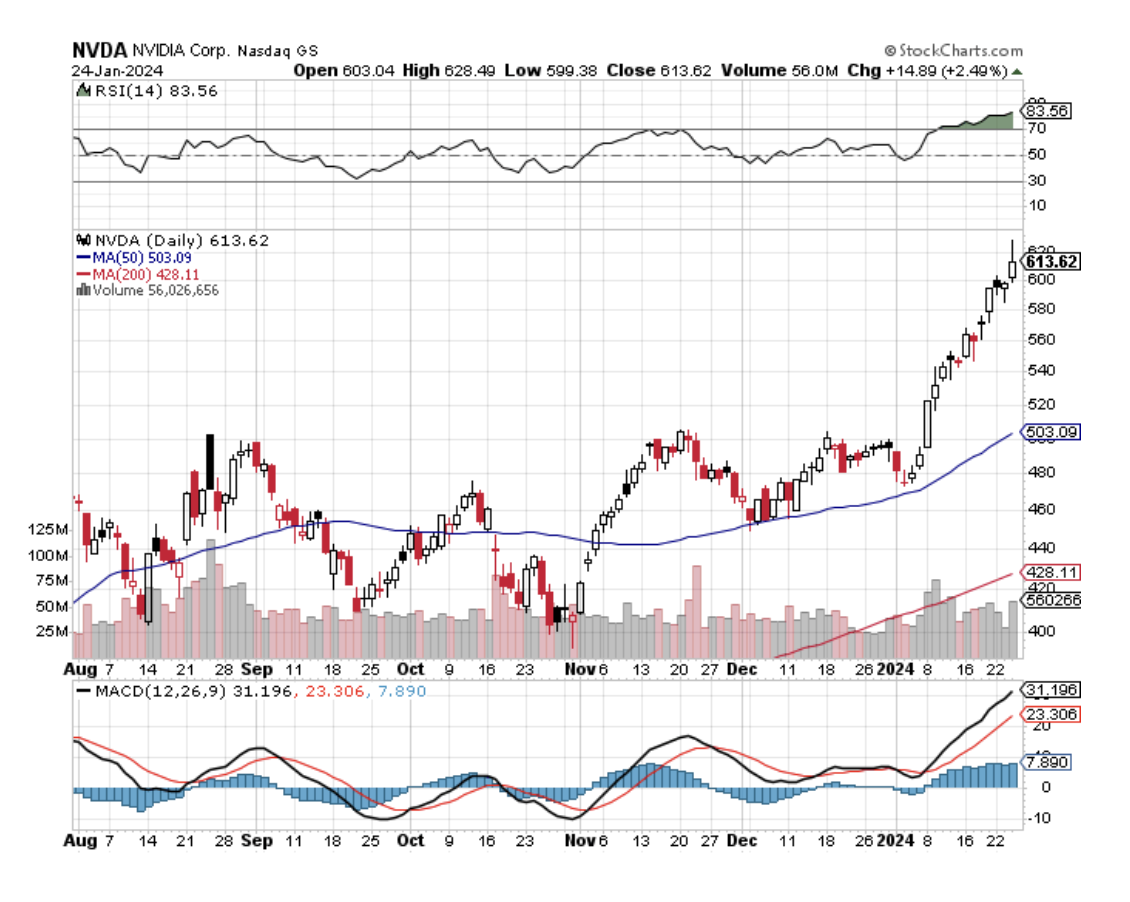
Q: What about NVIDIA (NVDA)? It's gone up so much. I'm up 300% since my cost. Should I sell now and take profits or just run the long?
A: This whole group, which I now call the AI 5—Microsoft (MSFT), Google (GOOGL), Amazon (AMZN), NVIDIA (NVDA), and Meta (META) could drop 20% at any time and then go on to new highs, and that's exactly what happened in the fall. We had a 20% drop in everything and then it just shot off to the races. So as long as you can handle a 20% decline in these stocks, and if you're a long-term investor, then you should keep them. Because the risk is you'll take profits, generate a big tax bill, and then won't be able to get back in at the next low, and you'll end up missing the next $1,000 point move. If you're the trader of the century like me, you can do that. But for your average garden variety trading at-home investor, I would say keep what's winning—keep the AI 5.
Q: Thanks John,Igot a double on your (UNG) LEAPS that you put out over Christmas. It's since given back much of the gains. Do you see another big rally in (UNG) this year?
A: Yes, that was a 2-year LEAPS I put out. It doubled in 2 weeks, and I do see a bigger recovery in the second half of the year once the Chinese economy starts to recover. Their marginal first choice for new energy supplies is American natural gas; it's not oil from the Middle East. They're trying to clean up their atmosphere as much as we are, so look for another big demand spike for (UNG) later in the year.
Q: Why has the dollar (UUP) been so strong?
A: Rising interest rates. Currencies are all about interest rates and where the next interest rate move is going to be. Money always pours into the currency that has the next rise in interest rates. That's been the US dollar for all of this year so far.
Q: Will the election have an effect on the market?
A: Absolutely not. Nobody cares about the election. If you're an election junkie, you may stay glued to your TV. I'm not interested myself. I don't expect any changes in the economy to take place this year, and that's all investors and money managers really care about—is how they will do by the end of this year. So you're better off watching sports on ESPN is all I can tell you. Oh yes, and this is supposed to be a record year for disinformation about elections and candidates. Another reason to not bother with the election this year. Go watch the Jack Reacher series. At least there you can keep track of the body count.
Q: Is it a good time to buy a home right now?
A: Yes, if you have cash. It is still too expensive to borrow money to buy a home with 30-year mortgages at 6.5% and 5/1 ARMs at 6% or even 5.5%, but if you have cash, it is a great time to buy a house because what is the next move? Interest rates go down. Suddenly everybody in the world can afford houses and they now want to buy your house. So very rapid price rises are coming for the housing market once the rates start to fall, which could be March, could be June, depending on how Jerome Powell feels that morning.
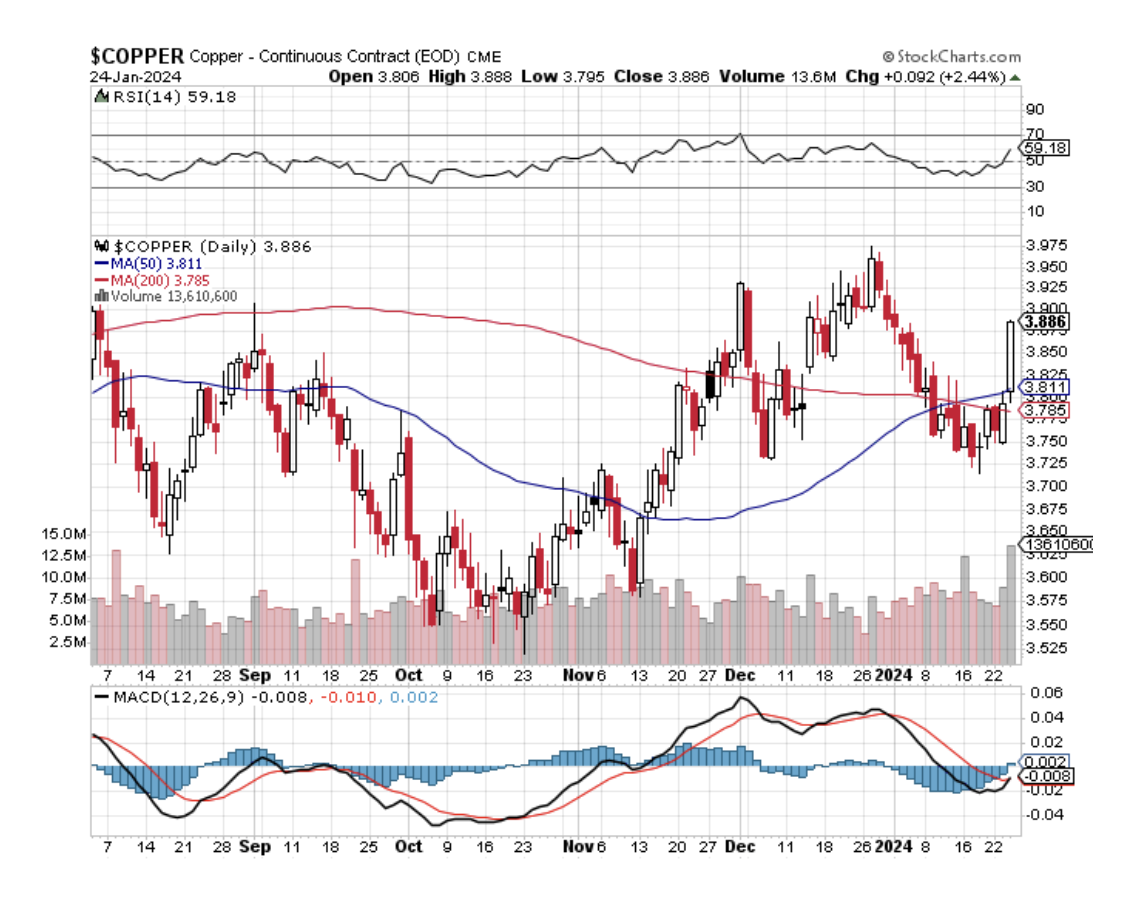
Q: With EV sales up 50% last year (TSLA), why has copper been so weak?
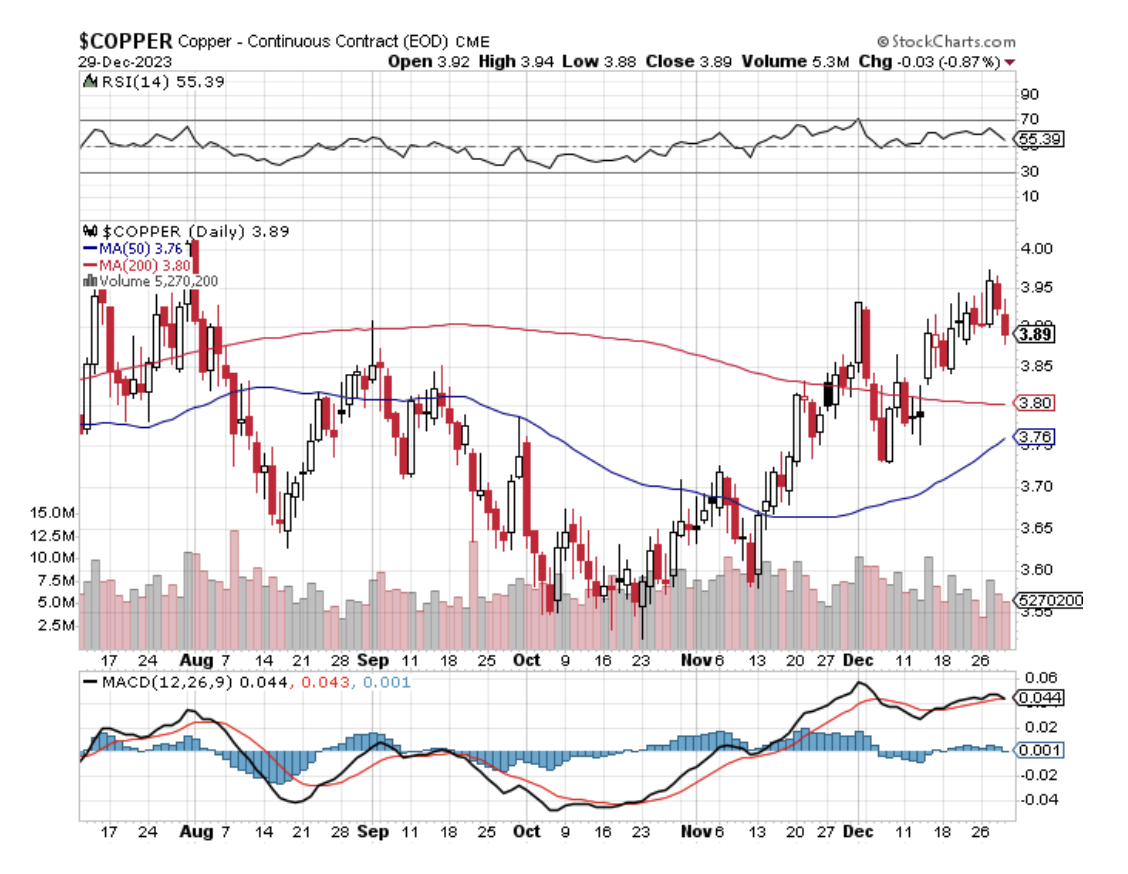
A: The old high price of copper was based on continuing 50% per year increases in EV sales for the indefinite future. In fact, we got a 50% increase last year and forecasts for 10% growth only this year, so that's a big part of it. Also, backing out the Chinese construction demand gives copper a huge hit. New construction in China is essentially at zero and will be at zero for quite some time because of the real estate crisis there. Some people in China are looking at prices on their homes down 80%, which sounds like a repeat of our 2008 financial crisis. So that is another major drag on copper.
Q: Is it a good time to “buy wrights”?
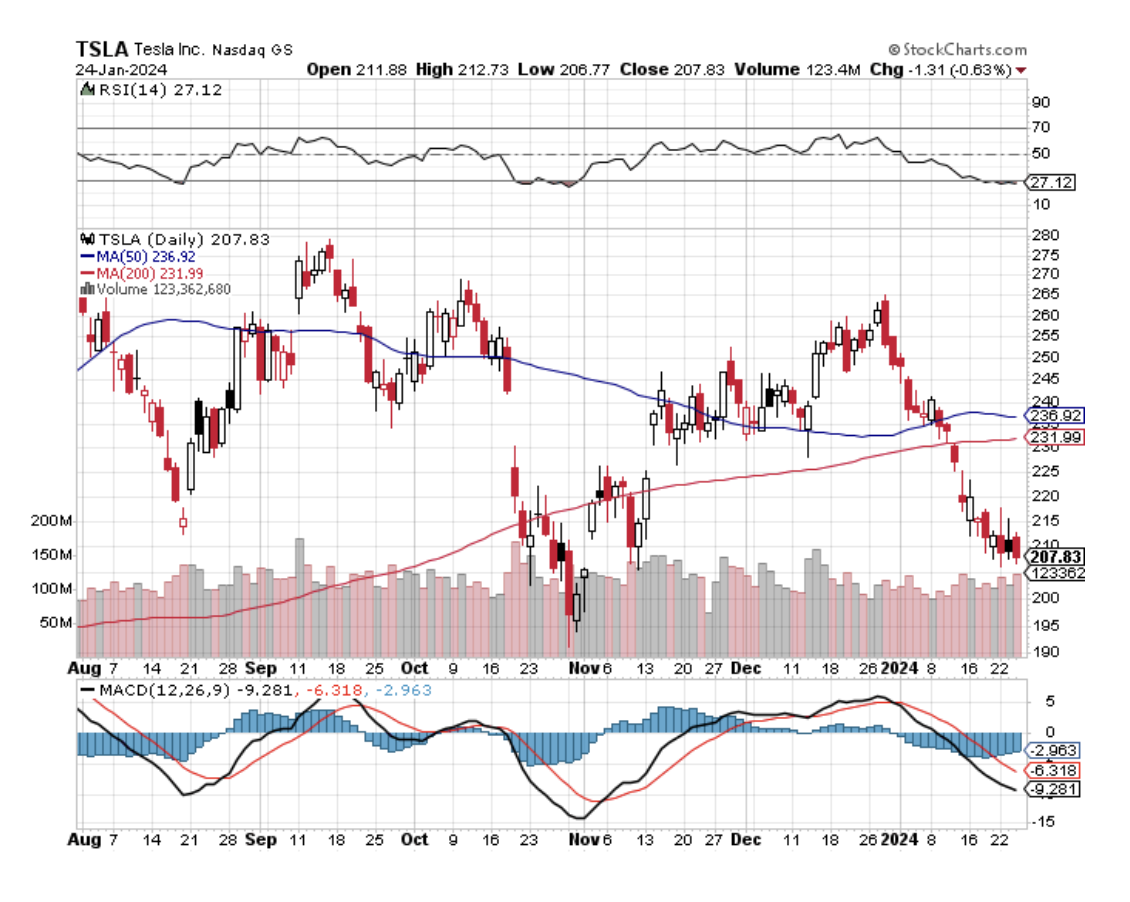
A: Absolutely yes. If you read today's newsletter, it tells you how to do a buy write, and you do “buy rights” on the most expensive stocks. For example, NVIDIA (NVDA) at $600 today—you can get $8 for the February $650 calls, which you sell short against your stock ownership at $600, or you can go out to March 15th and you can get $19 for the March $650 calls. That will reduce your average cost for the shares by $19, so actually (NVDA) is, in fact, one of the best stocks to do this in, because it has the highest implied volatility of any options, second to Tesla (TSLA), it turns out.
Q: How did you predict the S&P 500 so accurately last year? You got within a point, pretty amazing.
A: All I can say is 55 years of practice helps! And I am a bit of a contrarian person; so when everybody said the market was going to go down, I said, “How about new all-time highs?” But also the answer to all questions really is people are wildly underestimating the impact of technology and AI, which continues to surprise the upside and will keep doing so for the next decade. That is the driver of all asset prices everywhere right now, and people will figure that out in probably about 5 years.
Q: Crown Castle Inc. (CCI), is that a good one to watch, with renewed interest in REITS?
A: Absolutely yes, and it's also a great interest-rate play. It had a horrible selloff going into October and has since made back all of those losses. We actually had a LEAPS in (CCI), which is now making money.
To watch a replay of this webinar with all the charts, bells, whistles, and classic rock music, just log in to www.madhedgefundtrader.com, go to MY ACCOUNT, click on GLOBAL TRADING DISPATCH, then WEBINARS, and all the webinars from the last 12 years are there in all their glory.
Good Luck and Stay Healthy.
John Thomas
CEO & Publisher
The Diary of a Mad Hedge Fund Trader
(MARKET OUTLOOK FOR THE WEEK AHEAD, or WHAT WILL KILL THIS MARKET)
(MSFT), (BA), (AMZN), (DAL), (V), (PANW), (CCJ), (TLT), (NVDA), (META), (TSLA), (GOOGL)
What if Goldilocks decided to hang around for a while? I’ve always been in favor of a long-term relationship.
It could be weeks. It could be months.
Certainly, the widely predicted New Year selloff has failed to materialize.
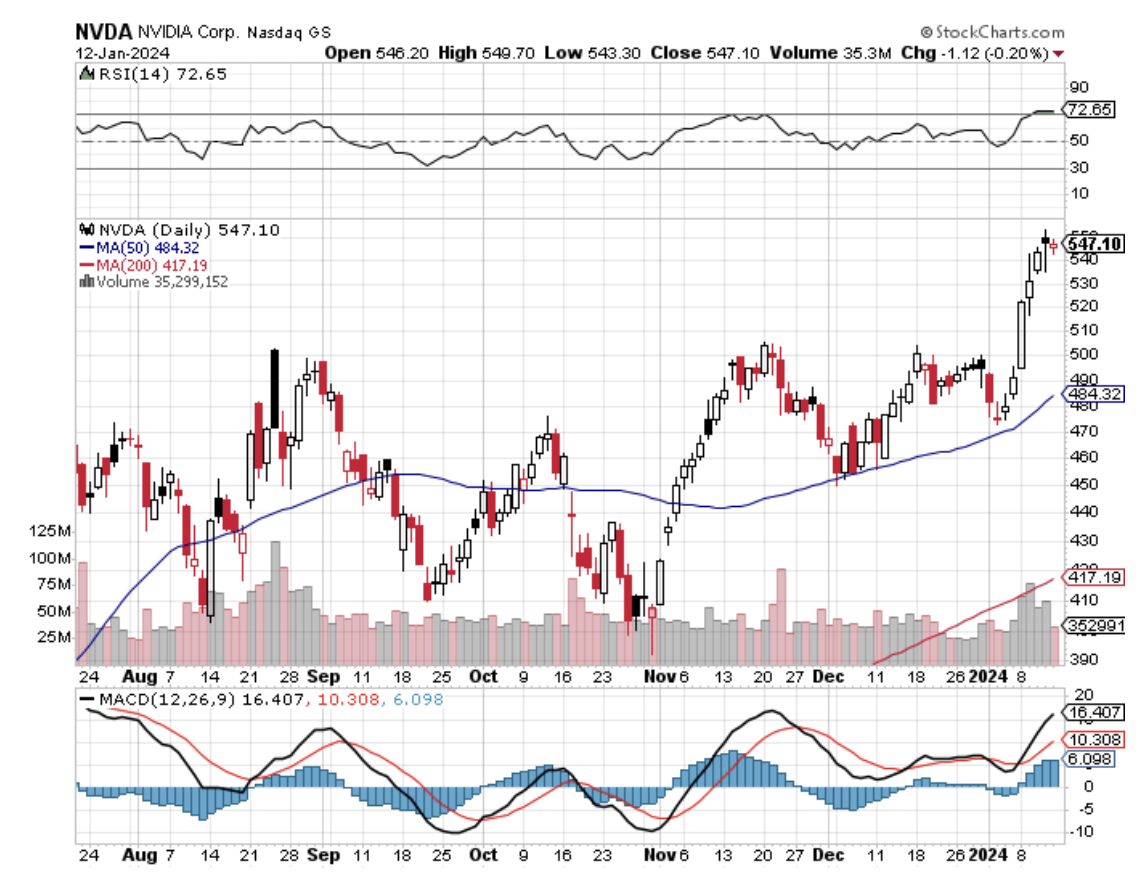
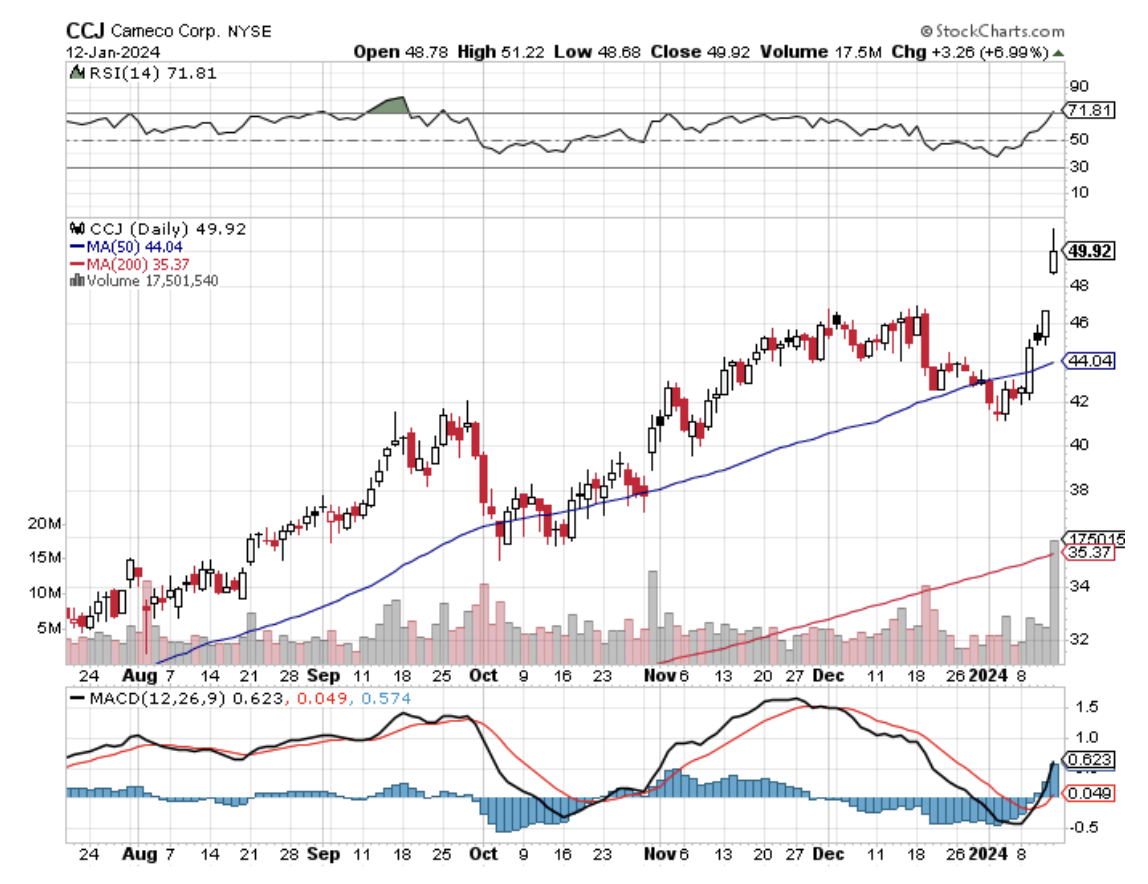
Failure to fall after the first week of 2024 has delivered a rally almost as ferocious as the one that launched in October. (NVDIA) up 15% in a week? Good thing I have a double position. Cameco (CCJ) up 25%? The market action was so positive that it rushed me into a rare 100% fully invested portfolio.
Which all begs the question of what WILL eventually kill this market. After all, nothing goes up forever.
It's very simple.
If the coming Fed interest rate cuts become so certain that companies start aggressively investing for the recovery NOW, there could be a problem. The headline Unemployment Rate never falls, inflation reaccelerates, and even the idea of interest rate cuts gets pushed off until 2025. That would thrust a dagger through the heart of the current rally post haste, which has been interest rate-driven from day one.
If there’s anyone who will save our bacon from this dire scenario, it is the legion of dour analysts out there who are perpetually behind the curve with their ultra-conservative earnings forecasts. That is scaring companies from expanding too quickly and is why every announcement delivers an upside surprise. That alone could provide enough of a drag on the economy to keep the Goldilocks scenario on track.
Watch Out Above!
If that is the case, then the ten positions I added last week to achieve a rare 100% invested portfolio should do pretty well, which has a strong technology bent. In the AI-dominated world, data is king. Let’s see who owns the data.
Microsoft (MSFT) – knows every keystroke you have executed since you bought your first PC in 1990.
Google (GOOGL) – knows every search you have performed since 2005 plus every YouTube video you have watched, even the X-rated ones (oops!).
Tesla (TSLA) – knows every function your car has performed since 2010 and has 12 videos of where you have been (double oops!).
Meta (META)– knows every keystroke you have performed on your social media accounts.
If all of this sounds scary, it should be. But it also means that while these stocks may be expensive relative to 2023 earnings, they are still in the bargain basement regarding 2024 and 2025 earnings. Buy everything on dips. Investors are adding to what they already own because it’s been working big time, including me.
On a completely different topic, Uranium is going nuclear again. Yellow cake, the fuel used by nuclear power plants, has seen prices up 45% since May. Before the Ukraine war, Russia produced 50% of the world’s nuclear fuel. Now it is banned due to sanctions. The US has announced the creation of a nuclear fuel stockpile.
Congress is about to vote on a ban on Russian fuel. France just announced the addition of 14 large nuclear plants. Oh, and it’s green.
Uranium prices endured a long nuclear winter starting with the Three Mile Island accident in 1979, followed by Chernobyl in 1986, and Fukushima in 2011. That time is now over, thanks to more advanced reactor designs and better risk control.
I used to collect Czech uranium glass, which emits a very low level of gamma radiation and glows in the dark under ultraviolet light. Time to collect some of Canadian uranium miner Cameco (CCJ) also … again.
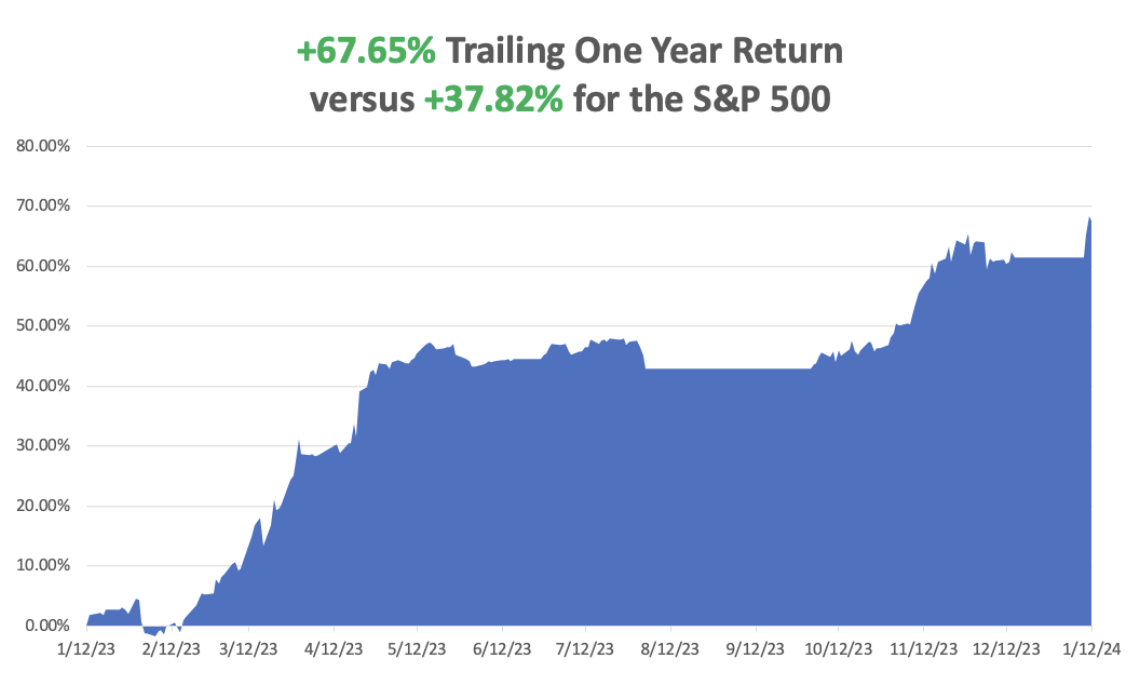
So far in January, we are up +6.19% with a 100% invested position. My 2024 year-to-date performance is also at +6.19%.The S&P 500 (SPY) is down -0.07%so far in 2024. My trailing one-year return reached +67.65% versus +37.82%for the S&P 500.
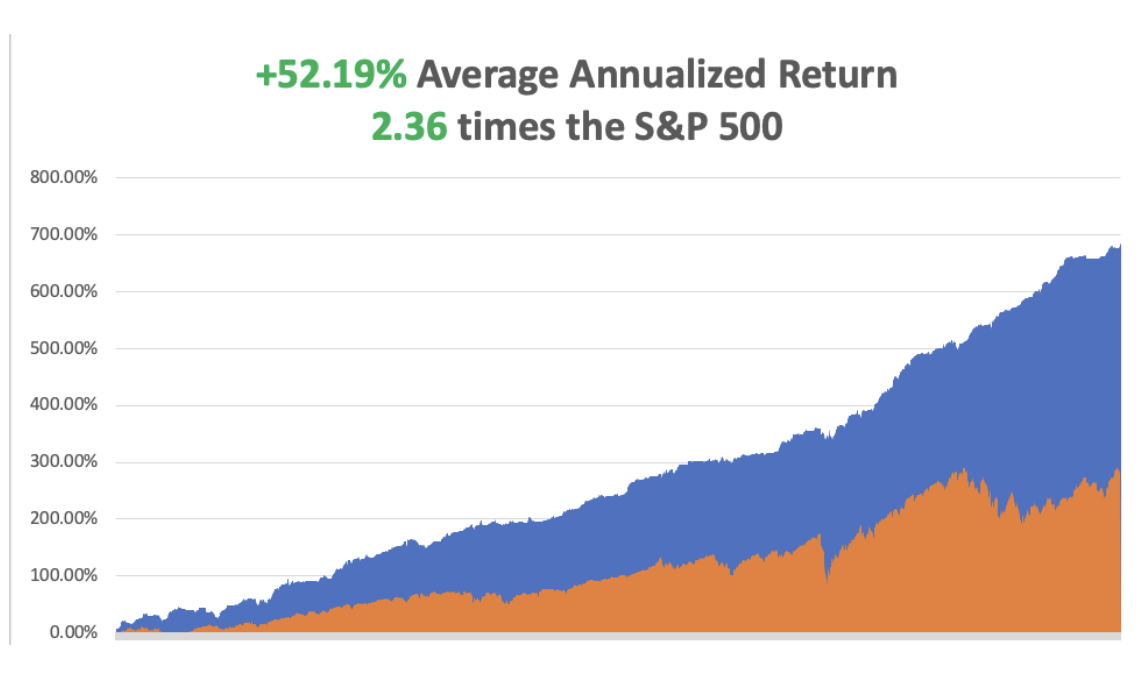
That brings my 15-year total return to +682.82%. My average annualized return has exploded to +52.19%,another new high.
Some 63 of my 70 trades last year were profitable in 2023.
I am going into 2024 with longs in (MSFT), (BA), (AMZN), (DAL), (V), (PANW), (CCJ), (TLT), and a double long in (NVDA).
FAA Grounds the Boeing 737 Max….Again, after a huge chunk of the fuselage fell off on a passenger flight which made an emergency landing in Portland. Dozens of the troubled aircraft were grounded. The move affects about 171 planes worldwide. The 737 Max is by far Boeing’s most popular aircraft and its biggest source of revenue. United Airlines is the biggest operator of the type followed by Alaska. Use any major dips to buy (BA) stock, which is facing a golden age.
NVIDIA Ramps Up its Graphics Cards. Nvidia is playing up its strength in consumer GPUs for so-called “local” AI that can run on a PC or laptop from home or an office. The new chip can be used to generate images on Adobe Photoshop’s Firefly generator to remove backgrounds in video calls, or even make games that use AI to generate dialogue. Buy (NVDA) on dips, as I did this last week.
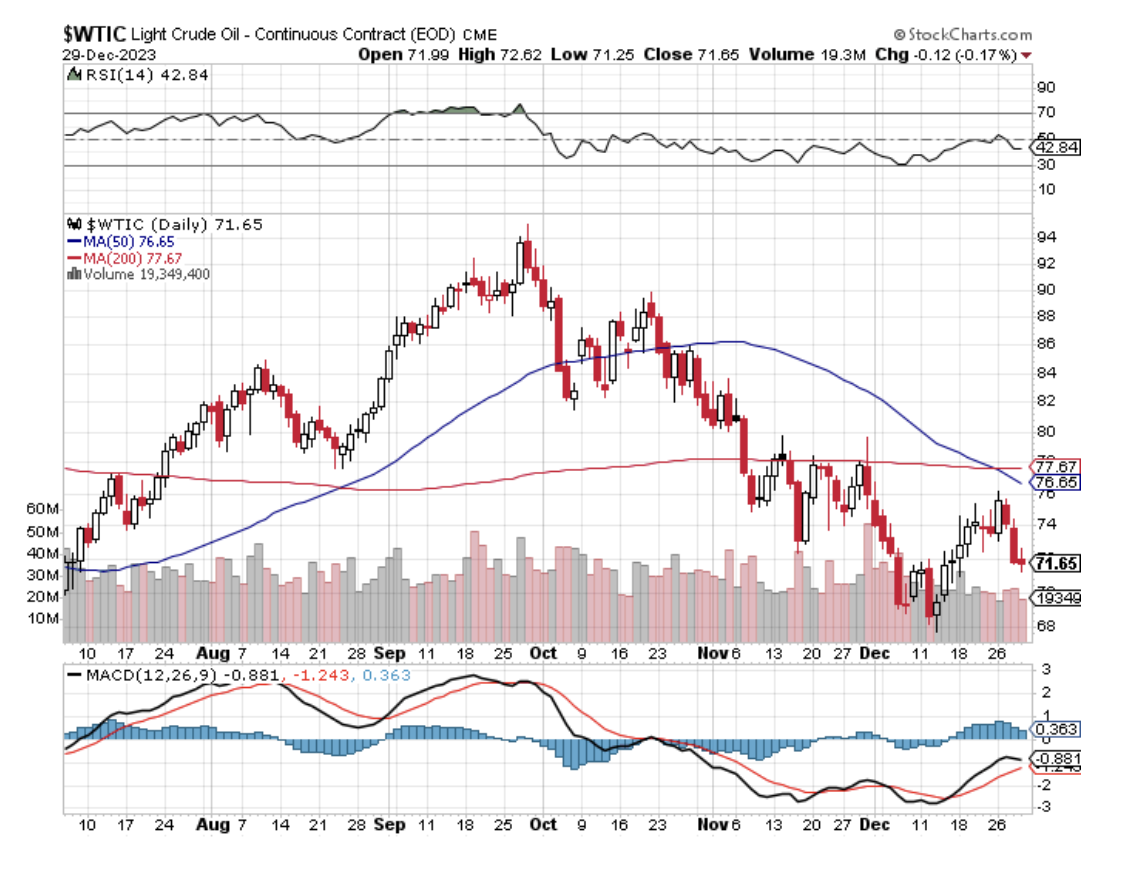
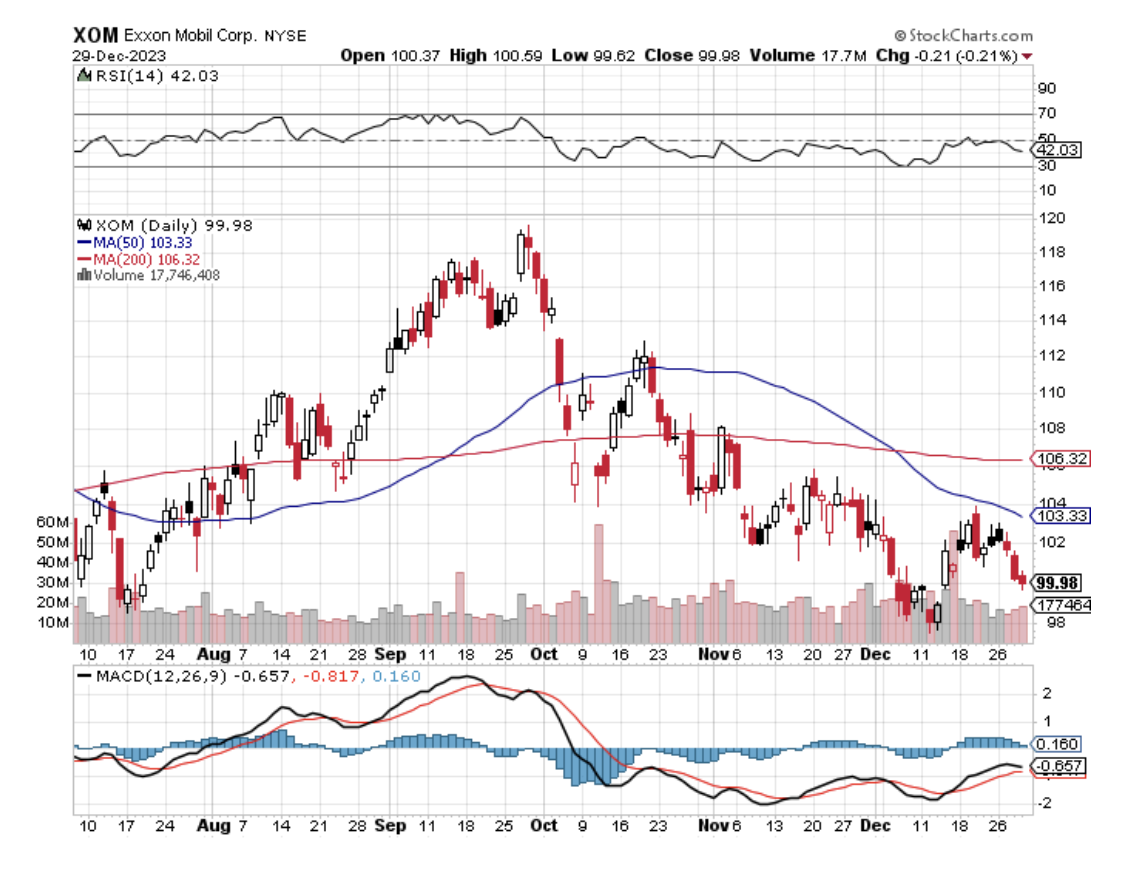
Energy Prices Collapse Again, with Texas tea diving 4% to $70 on Saudi price cuts. This is despite steady buying from the US government for the SPR. The kingdom is moving to shortcut cheating by lesser OPEC members, as it usually does. If you throw good news in the market and it fails to go up, you sell it. Avoid (USO), (XOM), and (OXY).
Natural Gas Goes Ballistic, up 50% in three weeks. The 2026 $8-9 LEAPS I recommended over Christmas have already doubled. Expansion of export facilities to China is the reason, for accommodating more demand. BUY (UNG) on dips.
Mortgage Demand Soars by 10% in the first week of the year, and the next leg in the bull market for residential housing begins anew. Applications to refinance a home loan jumped 19% from the previous week and were 30% higher than the same week one year ago.
Consumer Price Index Flies, coming in at 0.3% for December instead of the anticipated 0.2%, a 3.4% annual rate. Fed rate cuts just got pushed back from March to June, where they belong. Used car and apparel prices get the blame. Car insurance was up a shocking 20% YOY. Go figure.
Bitcoin ETF’s SEC Approved, after a ten-year wait, potentially marking a market top. The SEC is still warning about market risks, even if the ETF sellers don’t. During the last crypto spike, there was an absence of cheap quality growth stocks. Now there is an abundance. Bitcoin prospered when we had a cash surplus and asset shortage. Now we have the opposite.
Global EV and Hybrid Sales Jump by 31% in 2023, compared to only 10% for internal combustion driven cars. Global sales of fully electric and plug-in hybrid vehicles (PHEVs) rose 31% in 2023, down from 60% growth in 2022, according to market research firm Rho Motion. For 2024, there are forecasts of global EV sales growth of between 25% and 30%. That’s really quite amazing given the weak 2023 global economy.
Microsoft Tops Apple, as the world’s most valuable publicly traded company, with a $3 trillion market cap. A huge lead in AI and a growing storage presence with Azure are the reasons. I’m long (MSFT) lower down.
US Budget Deficit Tops $500 Billion in Q1, starting October 1, 2023. But the frenetic price action, up a mind-blowing $19 in 2 ½ months proves the government isn’t borrowing too much money, it isn’t borrowing enough! There is a severe bond shortage in the marketplace. Never argue with Mr. Market as he is always right. Buy the (TLT) on dips, as I have.
Tesla to Halt Production in Germany, thanks to soaring shipping costs in the Red Sea. Tesla has been selling Berlin-made Model Ys to China via the Suez Canal. Shipping costs have doubled to $5,000 per container since October.
My Ten-Year View
When we come out the other side of the recession, we will be perfectly poised to launch into my new American Golden Age or the next Roaring Twenties. The economy decarbonizing and technology hyper-accelerating, creating enormous investment opportunities. The Dow Average will rise by 800% to 240,000 or more in the coming decade. The new America will be far more efficient and profitable than the old.
Dow 240,000 here we come!
On Monday, January 15, markets are closed for Martin Luther King Day.
On Tuesday, January 16 at 8:30 AM EST,the New York Empire State Manufacturing Index will be released.
On Wednesday, January 17 at 2:00 PM, the Retail Sales are published.
On Thursday, January 18 at 8:30 AM, the Weekly Jobless Claims are announced. We also get the Building Permits for December.
On Friday, January 19 at 2:30 PM, the December University of Michigan Consumer Sentiment is published. At 2:00 PM, the Baker Hughes Rig Count is printed.
Uranium Glass
As for me, when you make millions of dollars for your clients, you get a lot of pretty interesting invitations. $5,000 cases of wine, lunches on superyachts, free tickets to the Olympics, and dates with movie stars (Hi, Cybil!).
So it was in that spirit that I made my way down to the beachside community of Oxnard, California just north of famed Malibu to meet long-term Mad Hedge follower, Richard Zeiler.
Richard is a man after my own heart, plowing his investment profits into vintage aircraft, specifically a 1929 Travel Air D-4-D.
At the height of the Roaring Twenties (which by the way we are now repeating), flappers danced the night away doing the Charleston and the bathtub gin flowed like water. Anything was possible, and the stock market soared.
In 1925, Clyde Cessna, Lloyd Stearman, and Walter Beech got together and founded the Travel Air Manufacturing Company in Wichita, Kansas. Their first order was to build ten biplanes to carry the US mail for $125,000.
The plane proved hugely successful, and Travel Air eventually manufactured 1,800 planes, making it the first large-scale general aviation plane built in the US. Then, in 1929, the stock market crashed, the Great Depression ensued, aircraft orders collapsed, and Travel Air disappeared in the waves of mergers and bankruptcies that followed.
A decade later, WWII broke out and Wichita produced the tens of thousands of the small planes used to train the pilots who won the war. They flew B-17 and B-25 bombers and P51 Mustangs, all of which I’ve flown myself. The name Travel Air was consigned to the history books.
Enter my friend Richard Zeiler. Richard started flying support missions during the Vietnam War and retired 20 years later as an Army Lieutenant Colonel. A successful investor, he was able to pursue his first love, restoring vintage aircraft.
Starting with a broken down 1929 Travel Air D4D wreck, he spent years begging, borrowing, and trading parts he found on the Internet and at air shows. Eventually, he bought 20 Travel Air airframes just to make one whole airplane, including the one used in the 1930 Academy Award-winning WWI movie “Hells Angels.”
By 2018, he returned it to pristine flying condition. The modernized plane has a 300 hp engine, carries 62 gallons of fuel, and can fly 550 miles in five hours, which is far longer than my own bladder range.
Richard then spent years attending air shows, producing movies, and even scattering the ashes of loved ones over the Pacific Ocean. He also made the 50-hour round trip to the annual air show in Oshkosh, Wisconsin. I have volunteered to copilot on a future trip.
Richard now claims over 5,000 hours flying tailwheel aircraft, probably more than anyone else in the world. Believe it or not, I am also one of the few living tailwheel-qualified pilots in the country left. Yes, antiques are flying antiques!
As for me, my flying career also goes back to the Vietnam era as well. As a war correspondent in Laos and Cambodia, I used to hold Swiss-made Pilatus Porter airplanes straight and level while my Air America pilot friend was looking for drop zones on the map, dodging bullets all the way.
I later obtained a proper British commercial pilot license over the bucolic English countryside, trained by a retired Battle of Britain Spitfire pilot. His favorite trick was to turn off the fuel and tell me that a German Messerschmidt had just shot out my engine and that I had to land immediately. He only turned the gas back on at 200 feet when my approach looked good. We did this more than 200 times.
By the time I moved back to the States and converted to a US commercial license, the FAA examiner was amazed at how well I could do emergency landings. Later, I added on additional licenses for instrument flying, night flying, and aerobatics.
Thanks to the largesse of Morgan Stanley during the 1980s, I had my own private twin-engine Cessna 421 in Europe for ten years at their expense where I clocked another 2,000 hours of flying time. That job had me landing on private golf courses so I could sell stocks to the Arab Prince owners. By 1990, I knew every landing strip in Europe and the Persian Gulf like the back of my hand.
So, when the first Gulf War broke out the following year, the US Marine Corps came calling at my London home. They asked if I wanted to serve my country and I answered, “Hell, yes!” So, they drafted me as a combat pilot to fly support missions in Saudi Arabia.
I only got shot down once and escaped with a crushed L5 disk. It turns out that I crash better than anyone else I know. That’s important because they don’t let you practice crashing in flight school. It’s too expensive.
My last few flying years have been more sedentary, flying as a volunteer spotter pilot in a Cessna-172 for Cal Fire during the state’s runaway wildfires. As long as you stay upwind, there’s no smoke. The problem is that these days, there is almost nowhere in California that isn’t smokey. By the way, there are 2,000 other pilots on the volunteer list.
Eventually, I flew over 50 prewar and vintage aircraft, everything from a 1932 De Havilland Tiger Moth to a Russian MiG 29 fighter.
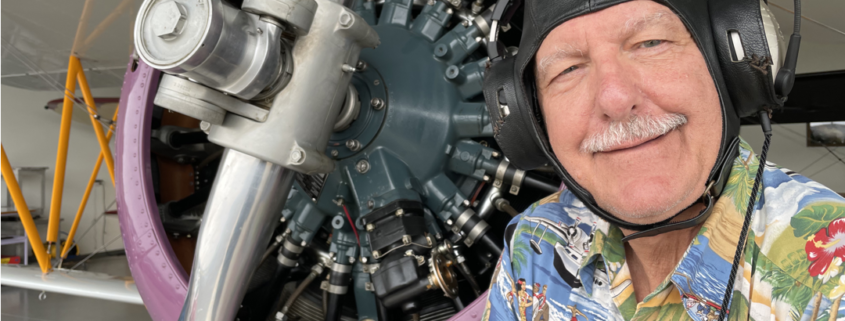
It was a clear, balmy day when I was escorted to the Travel Air’s hanger at Oxnard Airport. I carefully prechecked the aircraft and rotated the prop to circulate oil through the engine before firing it up. That reduced the wear and tear on the moving parts.
As they teach you in flight school, better to be on the ground wishing you could fly than be in the air wishing you were on the ground!
I donned my leather flying helmet, plugged in my headphones, received a clearance from the tower, and was good to go. I put on max power and was airborne in less than 100 yards. How do you tell if a pilot is happy? He has engine oil all over his teeth. After all, these are open-cockpit planes.
I made for the Malibu coast and thought it would be fun to buzz the local surfers at wave top level. I got a lot of cheers in return from my fellow thrill seekers.
After a half hour of low flying over elegant sailboats and looking for whales, I flew over the cornfields and flower farms of remote Ventura County and returned to Oxnard. I haven’t flown in a biplane in a while and that second wing really put up some drag. So, I had to give a burst of power on short finals to make the numbers. A taxi back to the hangar and my work there was done.
There are old pilots and there are bold pilots, but there are no old, bold pilots. I can attest to that.
Richard’s goal is to establish a new Southern California aviation museum at Oxnard airport. He created a non-profit 501 (3)(c), the Travel Air Aircraft Company, Inc. to achieve that goal, which has a very responsible and well-known board of directors. He has already assembled three other 1929 and 1930 Travel Air biplanes as part of the display.
The museum’s goal is to provide education, job training, restoration, maintenance, sightseeing rides, film production, and special events. All donations are tax-deductible. To make a donation, please email the president of the museum, my friend Richard Conrad at rconrad6110@gmail.com
Who knows, you might even get a ride in a nearly 100-year-old aircraft as part of a donation.
To watch the video of my joyride, please click here.
Where I Go My Kids Go
Good Luck and Good Trading,
John Thomas
CEO & Publisher
The Diary of a Mad Hedge Fund Trader
https://www.madhedgefundtrader.com/wp-content/uploads/2024/01/Joh-Thomas-pilot.png8121080april@madhedgefundtrader.comhttps://madhedgefundtrader.com/wp-content/uploads/2019/05/cropped-mad-hedge-logo-transparent-192x192_f9578834168ba24df3eb53916a12c882.pngapril@madhedgefundtrader.com2024-01-16 09:02:062024-01-16 11:43:18The Market Outlook for the Week Ahead, or What Will Kill this Market
During 2023, the market spent the entire year climbing the proverbial wall of worry. The question is how much we have to give back from deferred tax selling from the profitable 2023 trades before 2024 can start anew.
It could be weeks. It could be months.
Last year was the Year of the Magnificent Seven. So far this year, it is looking like the Year of the Magnificent 493, when everything else goes up.
Which brings me to the most important topic of the day.
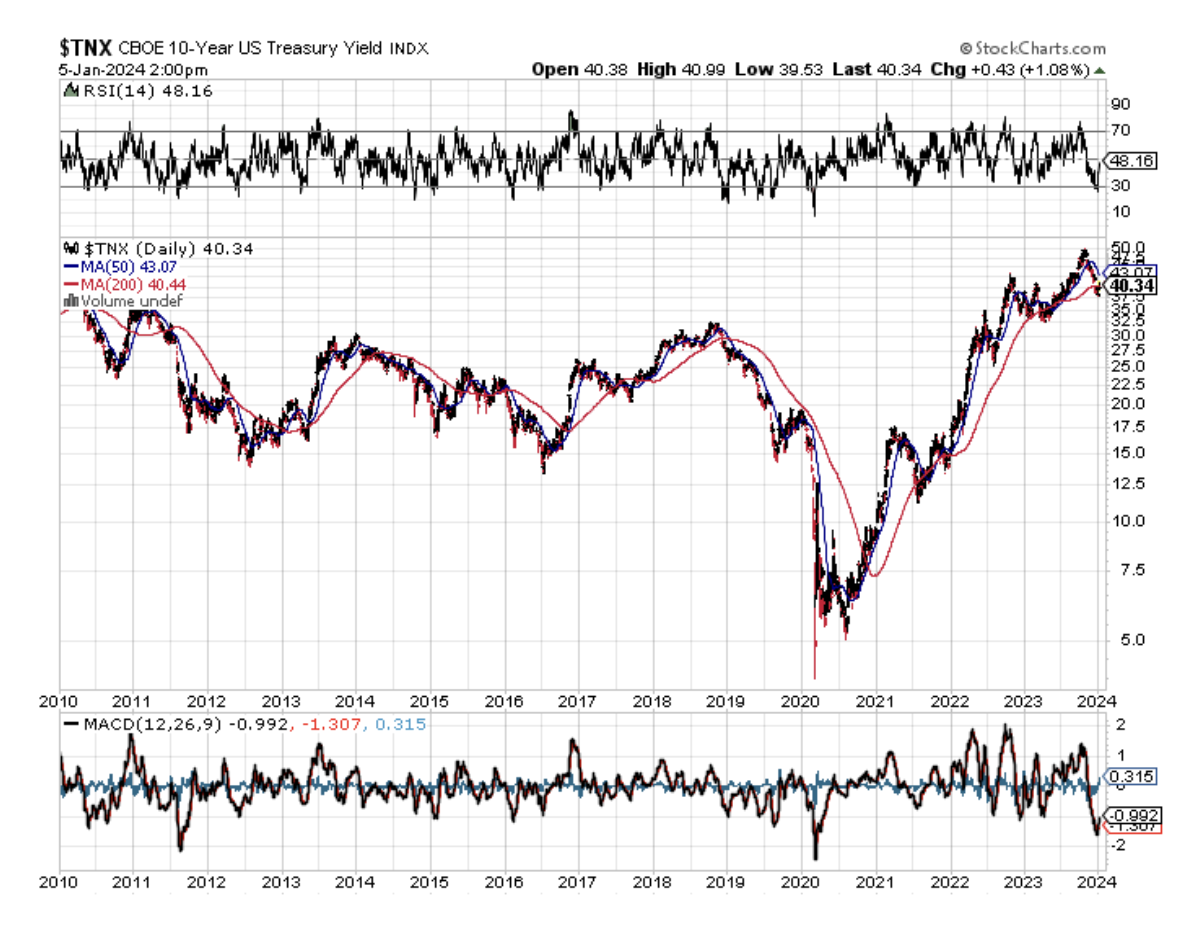
The best trade out there this year may be the most boring one of all, the ten-year US Treasury notes, now yielding 4.10%.
Let’s say the Federal Reserve delivers on its promise to cut interest rates three times in 2024 from 5.5% taking the overnight rate down to 4.75%. The futures markets are giving us a 70% probability this will start in March, but I think that Jay Powell will want to torture us for a few extra months until June to make sure inflation is well and truly dead.
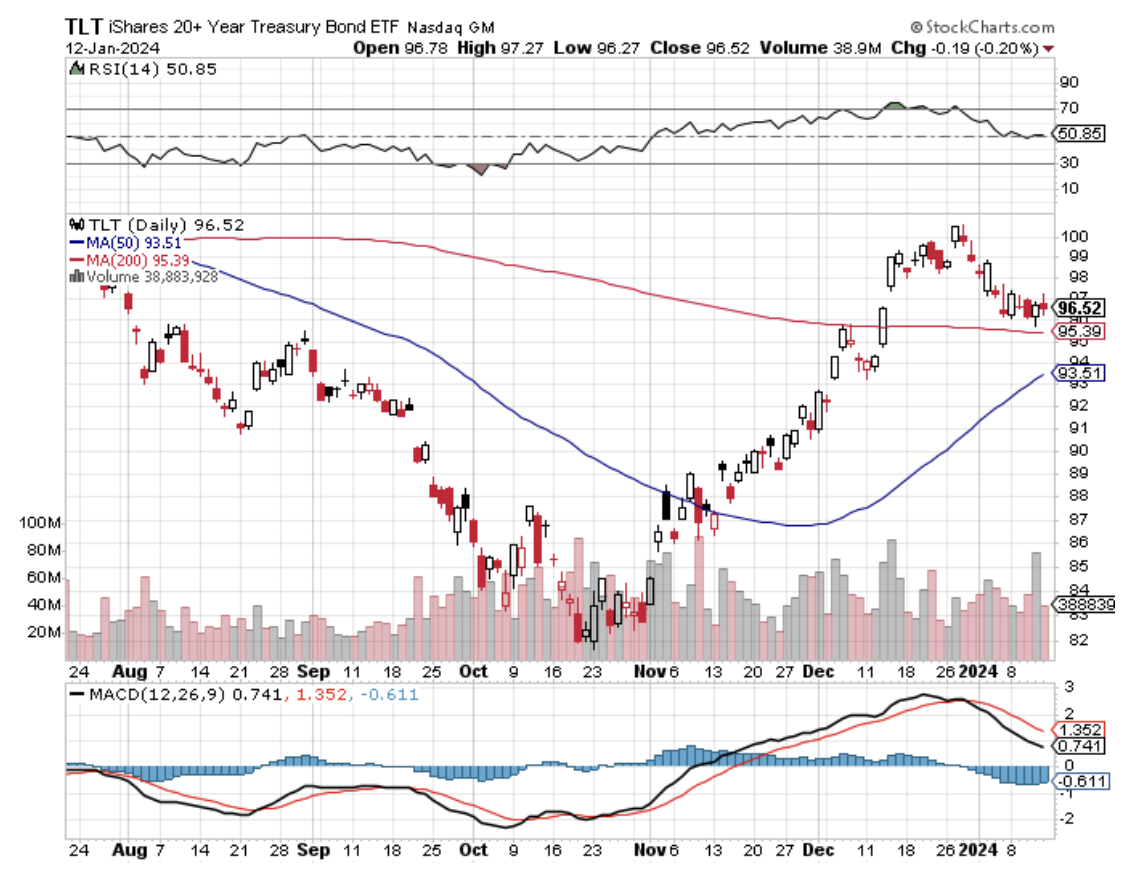
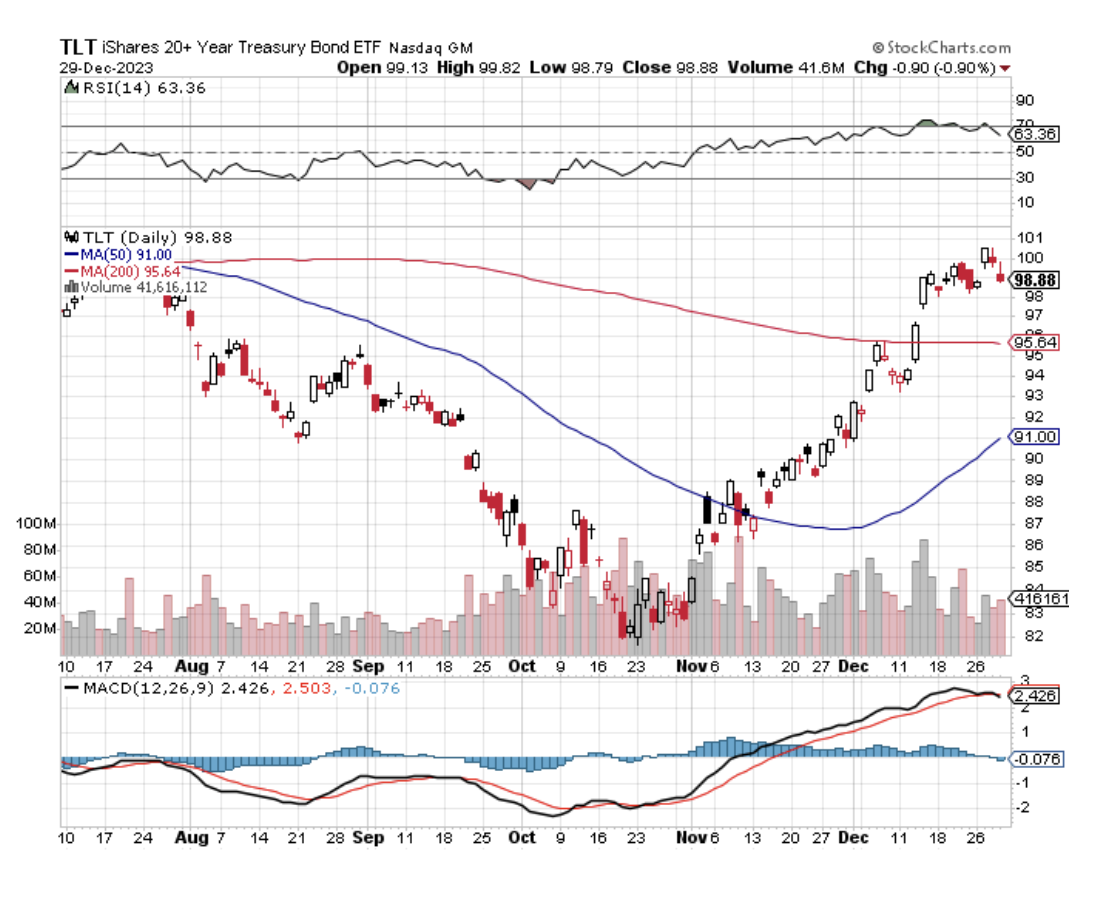
In that case, bond prices (TLT) should rise at least from $96 to $110 by the end of the year, taking the yield down from 4.10% today to 3.60% Add in the current 4.10% yield and that should give you a very low-risk total return for the year of 18% or better.
But what if the 2024 yearend liquidity surge discounts the 3 additional interest rate cuts to take place in 2025? That could add another $10 to this trade, taking the total return for the year up to 28%. Most investors will take an annual return of 28% all day long.
There is in fact a better way to do this.
Don’t buy the (TLT), which has high management and administration costs and wide dealing spreads that probably top 2% a year.Bypass all of that through buying the ten-year US Treasury note directly from your broker. That’s easy to do, has minimal commissions and the bonds trade like water.
After all, the US government has a unique talent for issuing bonds and there are already trillions of dollars’ worth outstanding. That shifts the 2% take of the (TLT) from Wall Street into your pocket.
It gets better.
What are the chances that another pandemic will occur in the next decade? I’d say about 50/50. After all, with a global population of 8 billion and rising, international travel and trade reaccelerating, pandemic risks are rising once again.
If you don’t believe me, just try and get an Airbnb (ABNB) in Florence, Italy, the epicenter of the last breakout in Europe. There are hardly any Italians left in Florence because they can’t compete with tourists on housing costs and can’t afford to live there anymore. So it is now more important to hedge your portfolio from pandemic risks.
It just so happens that there is a way you can do this: buy ten-year US Treasury notes. What happened with the last pandemic (see chart below)? The (TLT) doubled in value from $80 to $165, taking yields from 5.0% all the way down to 0.32%. Back then, investors were worried about return OF capital, not return ON capital, for which the US government has a perfect record.
It turns out that bonds will not only hedge all of your stocks from pandemic risks, but ALL INVESTMENTS OF EVERY KIND, including commodities, the dollar, precious metals, energy, and even your own home.
And with a 4.1% yield, bonds offer an insurance policy that pays you to own it.
Ten-year US Treasury notes are also the perfect position to have during times of inflation. Falling inflation enables more Fed rate cuts, which automatically increase the value of the notes….by a lot.
How do I know inflation is falling? Because I went bowling last week in Incline Village, Nevada. The establishment is under new ownership. They gutted the place, fired all the staff, and remodeled it in a cool sixties motif. Then they hired two people to run the place.
All payments have to take place online, even for video games, where you also now have to reserve your lanes. As a result, instead of casually walking in to take a lane, you have to book them two weeks in advance. The place is always full.
Cut costs, and soaring revenues, you want to own this bowling alley, as you do for the Magnificent 493. This is going on across the entire US economy, like it or not. This is highly deflationary.
Hedge funds are piling into the ten-year US Treasury note trade in record numbers because you only see a low-risk, high-return setup like this once every decade or so.
My bet is that there are maybe four points of downside risk in this trade against a potential gain of 28 points. That’s a risk/reward ratio of 7:1.
I Like it!
I just thought you’d like to know.
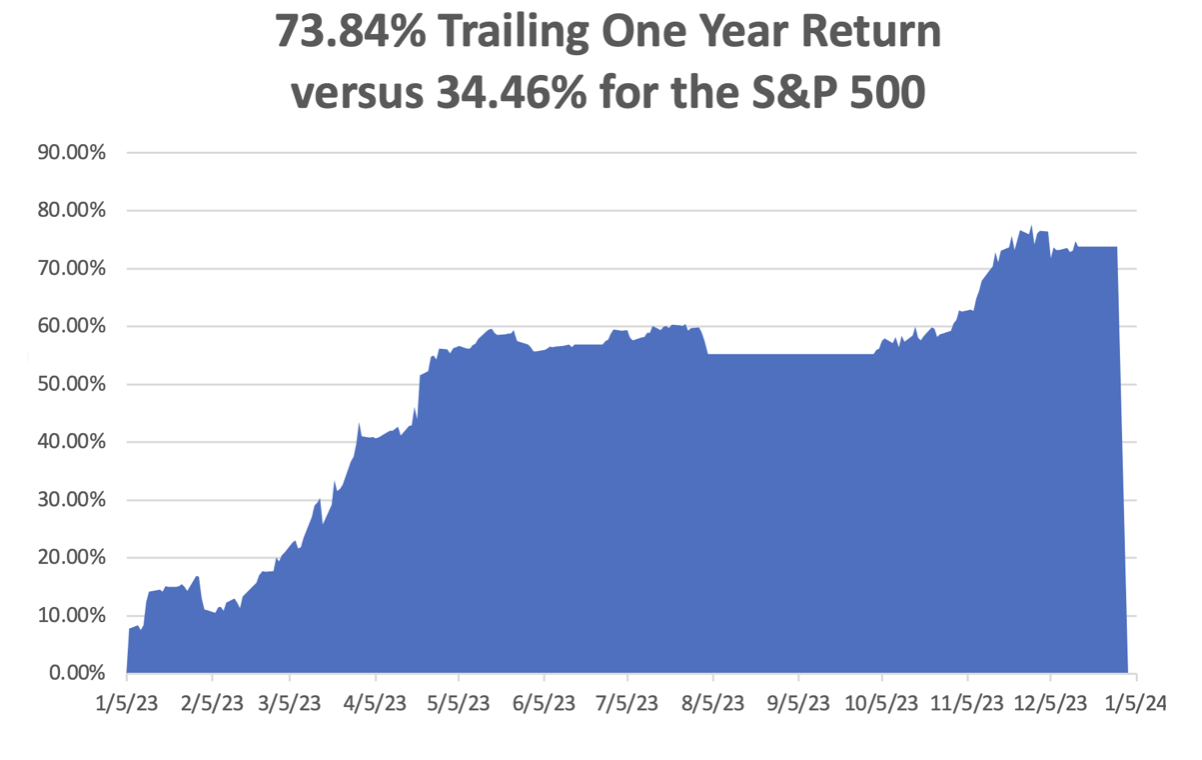
So far in January, we are up 0% since I have done no trades and have a 100% cash position. My 2024 year-to-date performance is also at 0%.The S&P 500 (SPY) is down -2.51%so far in 2024. My trailing one-year return reached +73.94% versus +34.46%for the S&P 500.
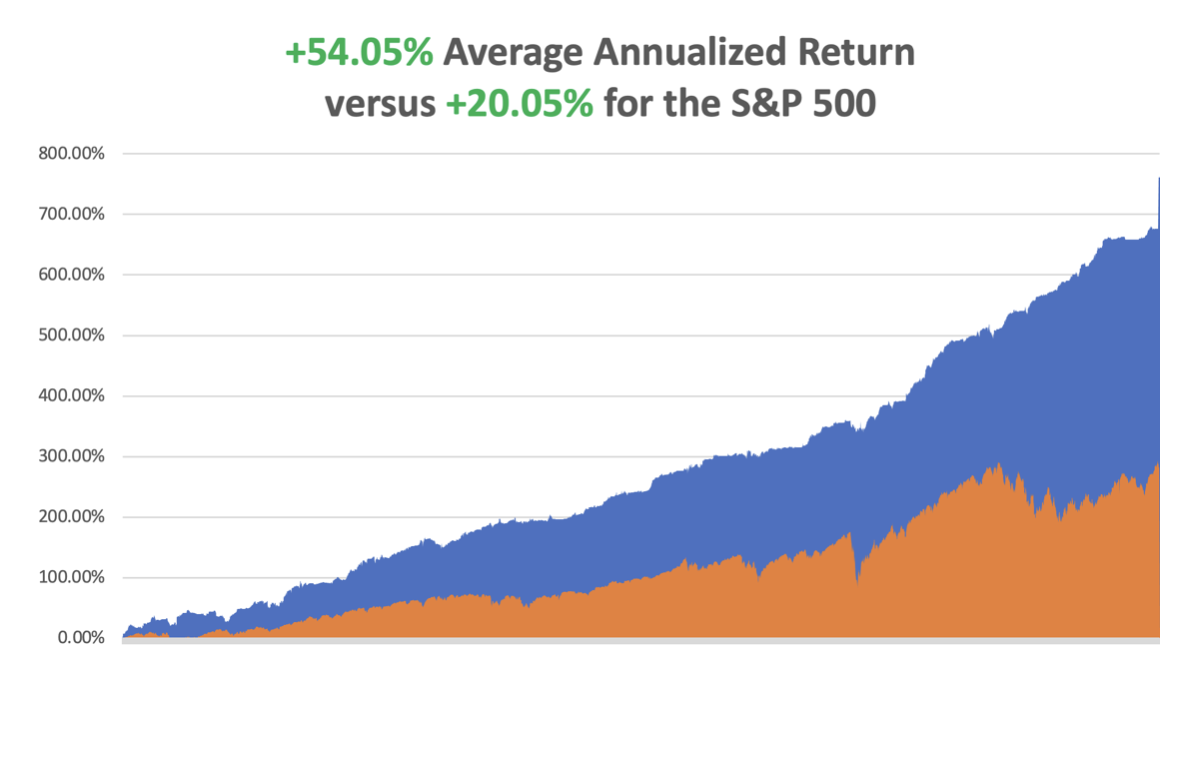
My 15-year total return is +676.63% and my average annualized return is +54.05%.
Some 63 of my 70 trades last year were profitable in 2023.
Did We Just See Another 2009 Bottom? If so, we could be looking at rising stocks for another 13 years, making my own Dow 120,000 forecast look conservative. Certainly, the fundamentals are there, as long as we don’t get another pandemic or 100 other things go wrong.
The Nonfarm Payroll Report Sizzles, at 216,000, better than expected. The headline Unemployment Rate maintained a near 50-year low at 3.7%. December’s payroll gains were driven by three categories: Education/health, leisure/hospitality, and government. The overall level of leisure/hospitality jobs remains below the pre-pandemic high, showing that some parts of the job market are still normalizing after the COVID-19 shock.
JOLTS Falls in December, nudging lower to 8.79 million, about in line with the Dow Jones estimate for 8.8 million and the lowest level since March 2021.The ratio of job openings to available workers fell to 1.4 to 1, still elevated but down sharply from the 2 to 1 level that had been prevalent in 2022.
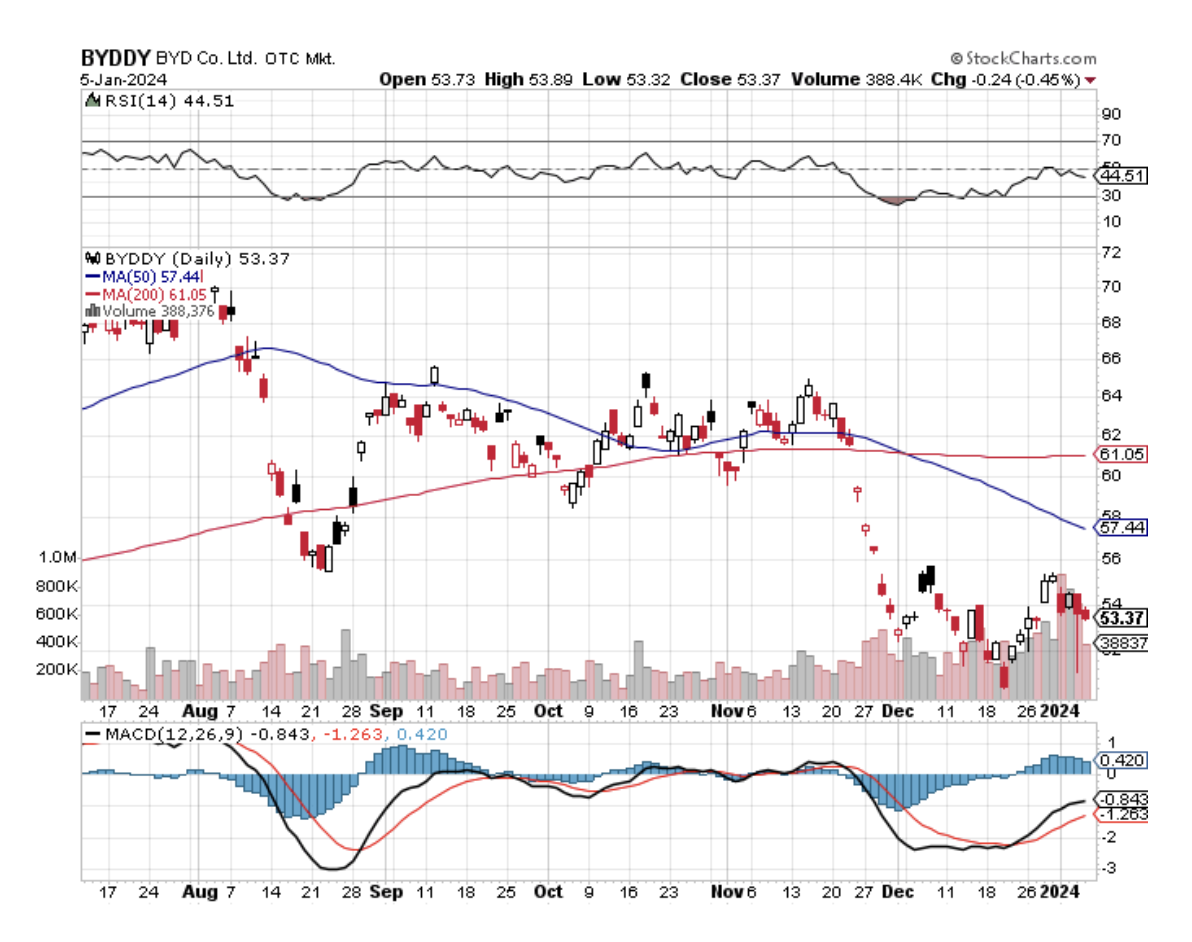
Weekly Jobless Claims Dropped to 202,000, a two-month low. pointing to underlying labor market strength even as demand for workers is easing. With the report from the Labor Department on Thursday also showing the number of people on unemployment rolls remained elevated towards the end of December, financial markets continued to anticipate that the Federal Reserve would start cutting interest rates in March. Tesla (TSLA) is Still the World’s Largest EV Maker. BYD (BYDDY) delivered 1.57 million EVs in 2023 compared to 1.8 million for Tesla (TSLA). BYD, which I visited in China 12 years ago when Warren Buffet bought a stake in it, is building factories in Europe, Latin America, and across Asia as part of a broader effort to expand sales across these continents, and its cars and buses are popping up in cities all over the world. They could never meet quality standards in the US. They offer a cheaper, lower margin, lesser quality product, but that is all that is needed in many emerging markets.
Copper (FCX) to Rise 75% in 2024, say industry analysts. Copper is headed for a price spurt over the next two years, as mining supply disruptions coincide with higher demand for the metal. Rising demand driven by the green energy transition and a decline in the U.S. dollar strength come the second half of 2024 will fuel support for copper prices. I’m going to keep telling you this until you buy more copper.
The Auto Business is Booming, at 15.6 million units delivered in 2023, a four-year high. Ford (F) saw a 7.6% increase in sales. Also a sign of a strong economy. The company’s F series pickup trucks remain the best-selling vehicle in America.
Pending Home Sales were Unchanged in November, despite record 30-year fixed-rate mortgages at 8.0%. The underlying real estate is far stronger than people realize. Mortgage rates are now solidly in the mid-6% range, but the supply of homes for sale is still very low. REMAX CEO Nick Baily says the market is short 4.5 to 5 million homes which will take a decade to build.
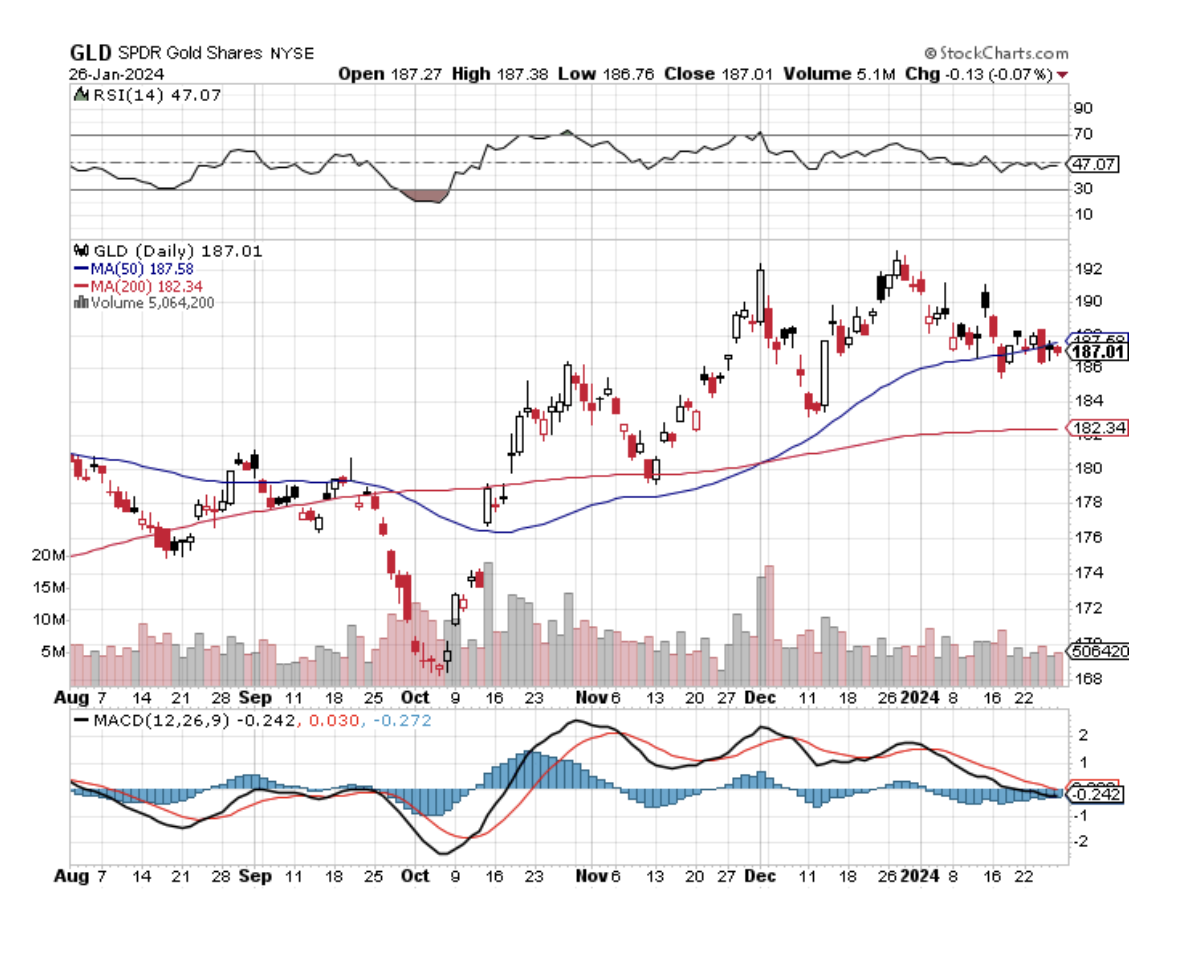
Gold (GLD) to Hit New High in 2024, with fundamentals of a dovish pivot in U.S. interest rates, continued geopolitical risk, and central bank buying is expected to support the market after a volatile 2023. Spot gold posted a 13% annual rise in 2023, its best year since 2020, trading around $2,060 per ounce. Nippon Steel Buys US Steel (X) for $55 a Share, or $14.9 billion. That is double the next competing offer from Cleveland Cliffs (CLF). In clearly what is a trophy purchase, the buyer will honor all existing union deals. That certainly puts my December 2025 $20-$23 LEAPS issued last June at its maximum profit of 132%. Sell now if you still have it. There is only downside risk from here.
Home Prices Hit New All-Time Highs, according to S&P Case Shiller, up 0.6% in October and 4.8% YOY. That is nine consecutive months of gains. A 30-year fixed rate mortgage down to 6.7% is a help. Detroit had the biggest increase at 8.1%, followed by San Diego with 7.2% and New York with 7.1%. Portland, Oregon, was the only one of the 20 cities where prices fell year over year. A decade-long bull market has begun.
Core PCE Dives to a 3.2% YOY Rate. Headline Personal Consumption Expectation fell to only 2.6%, closing in on the Fed’s 2.0% target. It’s no longer a question of if the Fed will cut interest rates, but how much and how fast.
My Ten-Year View
When we come out the other side of the recession, we will be perfectly poised to launch into my new American Golden Age or the next Roaring Twenties. The economy decarbonizing and technology hyper accelerating, creating enormous investment opportunities. The Dow Average will rise by 800% to 240,000 or more in the coming decade. The new America will be far more efficient and profitable than the old.
Dow 240,000 here we come!
On Monday, January 8, at 8:30 AM EST, the Consumer Inflation Expectations are out, one of the Fed’s favorite inflation reads.
On Tuesday, January 9 at 8:30 AM,the NFIB Business Optimism Index will be released.
On Wednesday, January 10 at 2:00 PM, the MBA Mortgage Applications will be published.
On Thursday, January 11 at 8:30 AM the Weekly Jobless Claims are announced. We also get the Consumer Price Index for December.
On Friday, January 12 at 2:30 PM, the December Producer Price Index is published. At 2:00 PM the Baker Hughes Rig Count is printed.
As for me, when I drove up to visit my pharmacist in Incline Village, Nevada, I warned him in advance that I had a question he never had heard before: How good is 80-year-old morphine?
He stood back and eyed me suspiciously. Then I explained in detail.
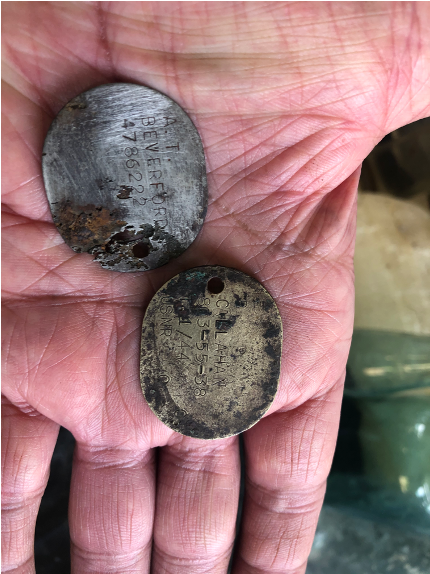
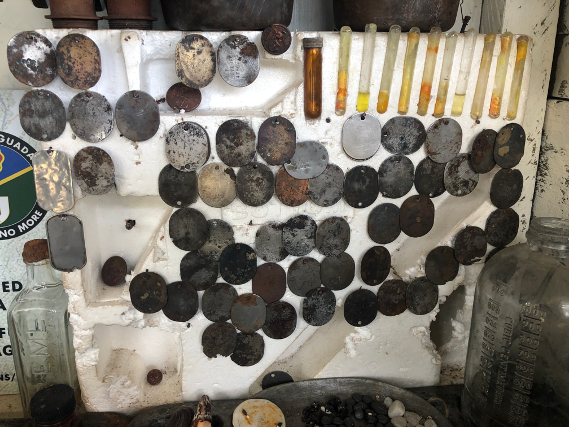
Two years ago, I led an expedition to the South Pacific Solomon Island of Guadalcanal for the US Marine Corps Historical Division (click here for the link). My mission was to recover physical remains and dog tags from the missing in action there from the epic 1942 battle.
Between 1942 and 1944, nearly four hundred Marines vanished in the jungles, seas, and skies of Guadalcanal. They were the victims of enemy ambushes and friendly fire, hard fighting, malaria, dysentery, and poor planning.
They were buried in field graves, in cemeteries as unknowns, if not at all left out in the open where they fell. They were classified as “missing,” “not recovered,” and “presumed dead.”
I managed to accomplish this by hiring an army of kids who knew where the most productive battlefields were, offering a reward of $10 a dog tag, a king's ransom in one of the poorest countries in the world. I recovered about 30 rusted, barely legible oval steel tags.
They also brought me unexploded Japanese hand grenades (please don’t drop), live mortar shells, lots of US 50 caliber and Japanese 7.7 mm Arisaka ammo, and the odd human jawbone, nationality undetermined.
I also chased down a lot of rumors.
There was said to be a fully intact Japanese zero fighter in flying condition hidden in a container at the port for sale to the highest bidder. No luck there.
There was also a just discovered intact B-17 Flying Fortress bomber that crash-landed on a mountain peak with a crew of 11. But that required a four-hour mosquito-infested jungle climb and I figured it wasn’t worth the malaria.
Then, one kid said he knew the location of a Japanese hospital. He led me down a steep, crumbling coral ravine, up a canyon, and into a dark cave. And there it was, a Japanese field hospital untouched since the day it was abandoned in 1943.
The skeletons of Japanese soldiers in decayed but full uniform lay in cots where they died. There was a pile of skeletons in the back of the cave. Rusted bottles of Japanese drugs were strewn about, and yellowed glass sachets of morphine were scattered everywhere. I slowly backed out, fearing a cave-in.
It was creepy.
I sent my finds to the Marine Corps at Quantico, Virginia, who traced and returned them to the families. Often the survivors were the children, or even grandchildren of the MIA’s. What came back were stories of pain and loss that had finally reached closure after eight decades.
Wandering about the island, I often ran into Japanese groups with the same goals as mine. My Japanese is still fluent enough to carry on a decent friendly conversation with the grandchildren of their veterans. It turned out I knew far more about their loved ones than they did. After all, it was our side that wrote the history. They were very grateful.
How many MIAs were they looking for? 30,000! Every year they found hundreds of skeletons and cremated them in a ceremony, one of which I was invited to. The ashes were returned to giant bronze urns at Yasakuni Ginja in Tokyo, the final resting place of hundreds of thousands of their own.
My pharmacist friend thought the morphine I discovered had lost half of its potency. Would he take it himself? No way!
As for me, I was a lucky one. My dad made it back from Guadalcanal, although the malaria and post-traumatic stress bothered him for years. And you never wanted to get in a fight with him….ever.
I can work here and make money in the stock market all day long. But my efforts on Guadalcanal were infinitely more rewarding. I’ll return as soon as I get the chance, now that I know where to look.
True MIA’s, the Ultimate Sacrifice
My Collection of Dog Tags and Morphine
My Army of Scavengers
Dad on Guadalcanal (lower right)
Good Luck and Good Trading,
John Thomas
CEO & Publisher
The Diary of a Mad Hedge Fund Trader
https://www.madhedgefundtrader.com/wp-content/uploads/2023/01/john-thomas-incline-bowling.jpg338254april@madhedgefundtrader.comhttps://madhedgefundtrader.com/wp-content/uploads/2019/05/cropped-mad-hedge-logo-transparent-192x192_f9578834168ba24df3eb53916a12c882.pngapril@madhedgefundtrader.com2024-01-08 09:02:552024-01-08 10:45:55The Market Outlook for the Week Ahead, or Here is the Trade of the Year
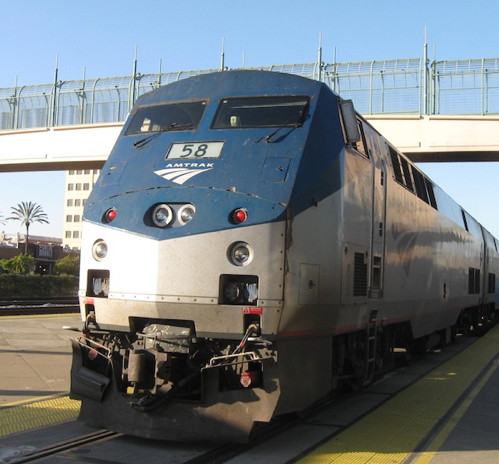
I am once again writing this report from a first-class sleeping cabin on Amtrak’s legendary California Zephyr.
By day, I have a comfortable seat next to a panoramic window. At night, they fold into two bunk beds, a single and a double. There is a shower, but only Houdini can navigate it.
I am anything but Houdini, so I foray downstairs to use the larger public hot showers. They are divine.
We are now pulling away from Chicago’s Union Station, leaving its hurried commuters, buskers, panhandlers, and majestic great halls behind. I love this building as a monument to American exceptionalism.
I am headed for Emeryville, California, just across the bay from San Francisco, some 2,121.6 miles away. That gives me only 56 hours to complete this report.
I tip my porter, Raymond, $100 in advance to ensure everything goes well during the long adventure and keep me up to date with the onboard gossip. The rolling and pitching of the car is causing my fingers to dance all over the keyboard. Microsoft’s Spellchecker can catch most of the mistakes, but not all of them.
Chicago’s Union Station
As both broadband and cell phone coverage are unavailable along most of the route, I have to rely on frenzied Internet searches during stops at major stations along the way, like Omaha, Salt Lake City, and Reno, to Google obscure data points and download the latest charts.
You know those cool maps in the Verizon stores that show the vast coverage of their cell phone networks? They are complete BS.
Who knew that 95% of America is off the grid? That explains so much about our country today.
I have posted many of my better photos from the trip below, although there is only so much you can do from a moving train and an iPhone 15 Pro.
Here is the bottom line which I have been warning you about for months. In 2024 we will probably top the 70.44% we made last year, but you are going to have to navigate the reefs, shoals, hurricanes, and the odd banking crisis. Do it and you can laugh all the way to the bank. I will be there to assist you in navigating every step.
The first half of 2024 will be all about trading, making bets on when the Fed starts cutting interest rates. Technology will continue their meteoric melt-up. In the second half, I expect the cuts to actually take place and markets to go straight up. Domestic industrials, commodities, financials, energy foreign markets, and currencies will lead.
And here is my fundamental thesis for 2024. After the Fed kept rates too low for too long and then raised them too much, it will then panic and lower them again too fast to avoid a recession. In other words, a mistake-prone Jay Powell will keep making mistakes. That sounds like a good bet to me.
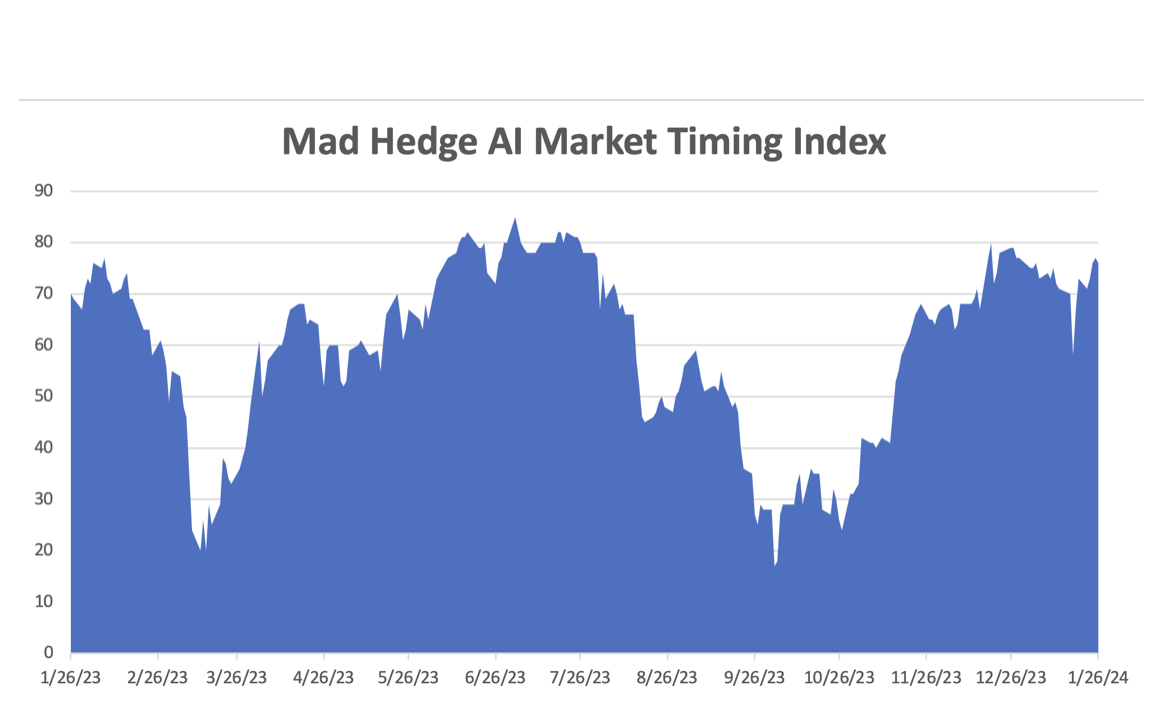
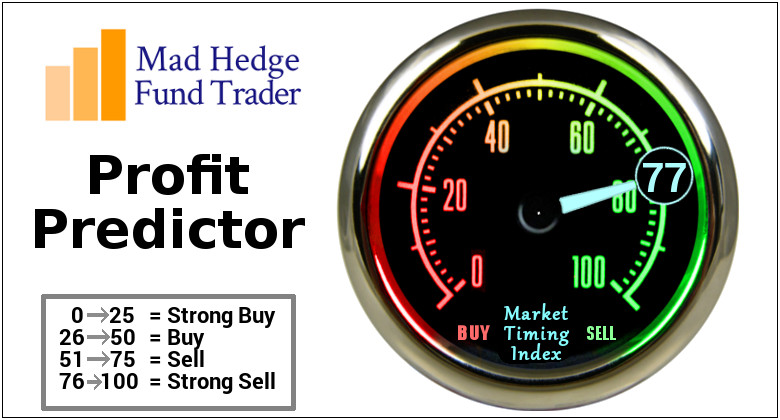
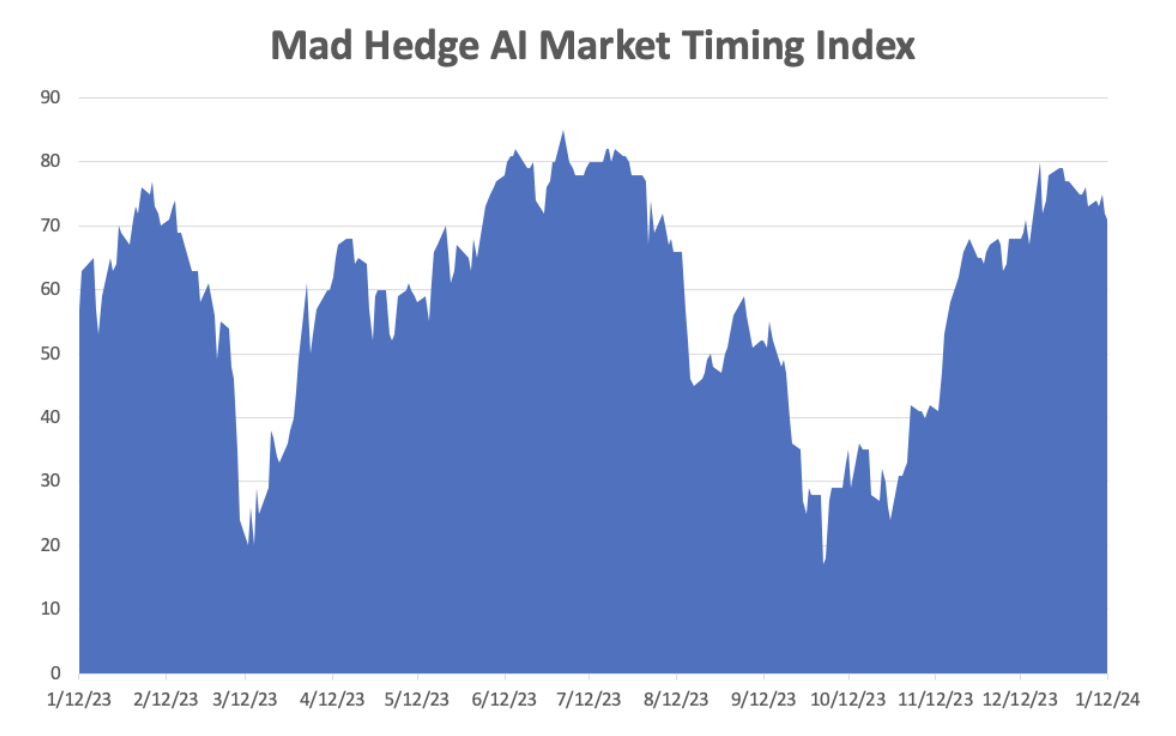
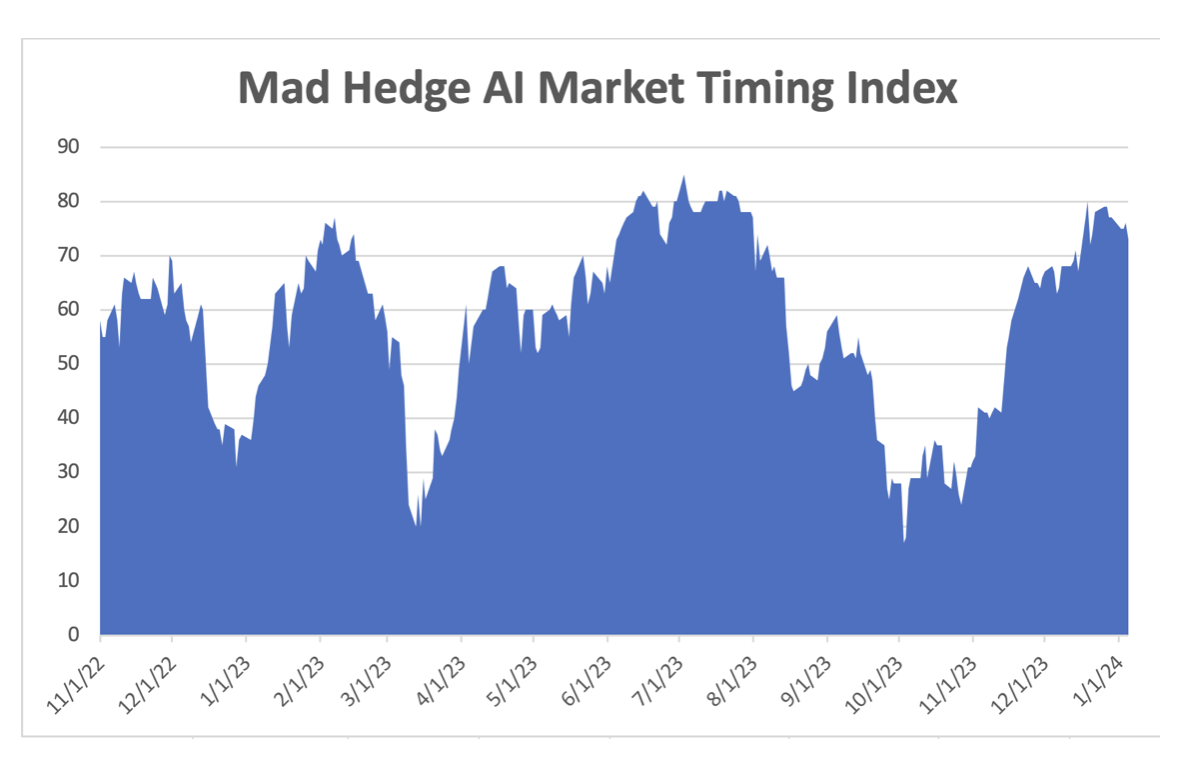
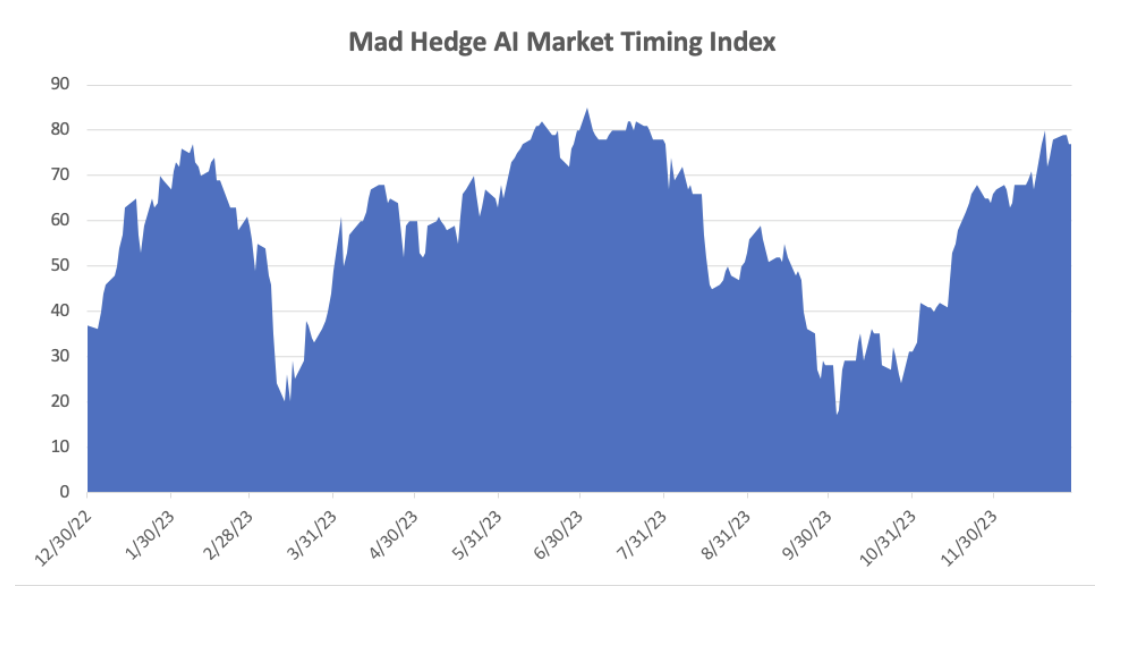
Keep in mind that the Mad Hedge AI Market Timing Index is at the absolute top end of its historic range the three-month likelihood of you making money on a trade is essentially zero. But adhere to the recommendations I make in this report today and you should be up about 30% in a year.
Let me give you a list of the challenges I see financial markets facing in the coming year:
The Ten Key Variables for 2024
1) When will the Fed pivot?
2) When will quantitative tightening end?
3) How soon will the Russians give up on Ukraine?
4) When will the rotation from technology to domestic value plays happen?
5)How much of falling interest rates will translate into higher gold prices?
6) When will the structural commodities boom get a second wind?
7) How fast will the US dollar fall?
8) How quickly will lower interest rates feed into a hotter real estate market?
9) How fast can the Chinese economy bounce back from Covid-19?
10) When does the next bull market in energy begin?
2023 was a terrible year for economists who largely got it wrong. Many will be driving Uber cabs from January.
The economy is clearly slowing now from the red-hot 5.2% GDP growth rate we saw in Q3 to a much more modest 2.0% rate in Q4. We’ll get the first read on the end of January.
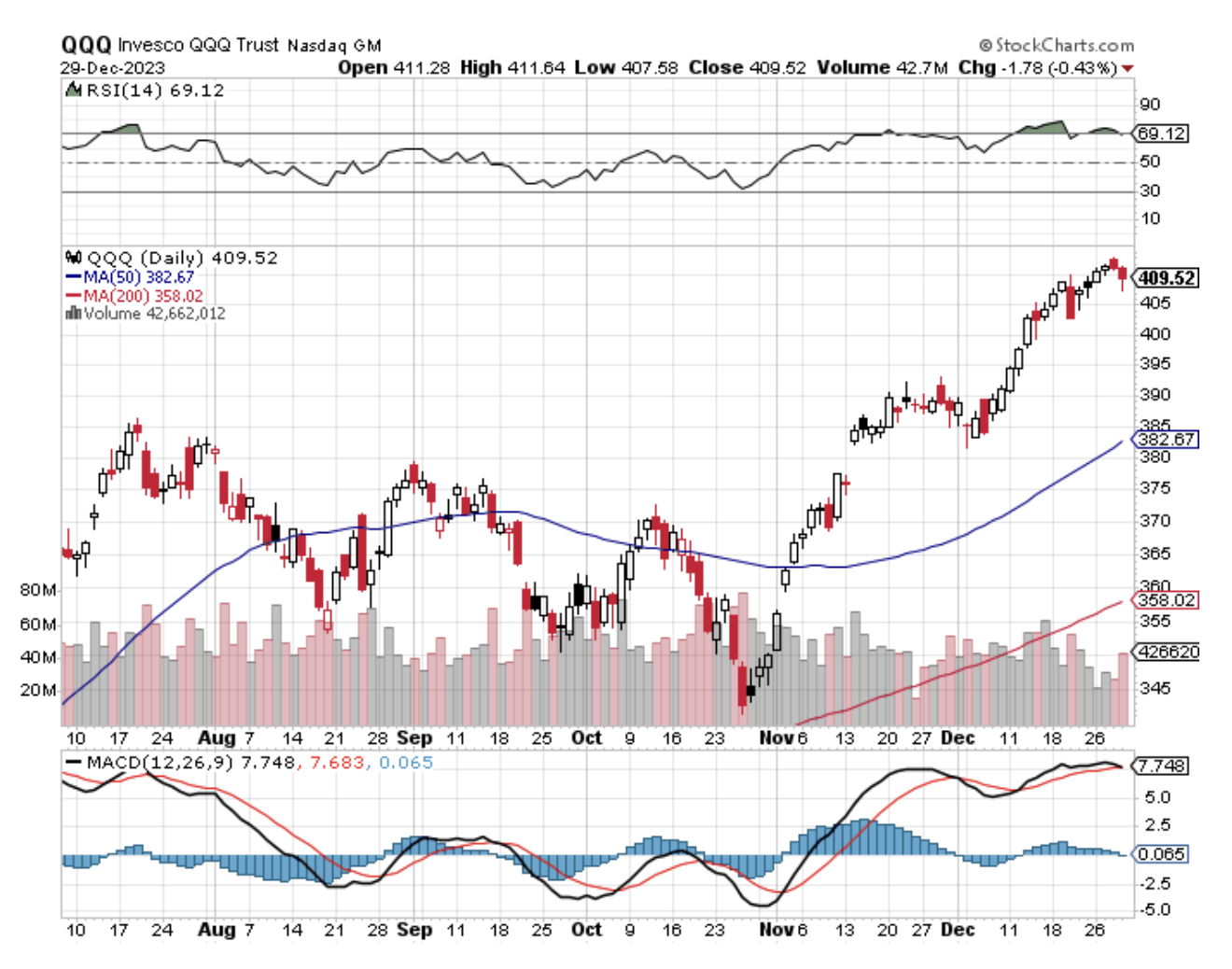
Any more than that and the Fed will panic and bring interest rate cuts dramatically forward to head off a recession. That is clearly what technology stocks were discounting with a melt-up of Biblical proportions, some 19% in the last two months, or $65 in the (QQQ)’s.
Anywhere you look, the data is softening, save for employment, which is holding up incredibly well at a 3.7% headline Unemployment Rate. The labor shortage may be the result of more workers dying from COVID-19 than we understand. Far more are working from home not showing up in the data. And many young people have just disappeared off the grid (they’re in the vans you see on the freeways).
The big picture view of what’s going on here is that after 15 years of turmoil caused by the 2008 financial crisis, pandemic, ultra-low interest rates, and excessive stimulus, we may finally be returning to normal. That means long-term average growth and inflation rates of 3.0% each.
As I travel around the world speaking with investors, I notice that they all have one thing in common. They underestimate the impact of technology, the rate at which it is accelerating, its deflationary impact on the economy, and the positive influence they have on all stocks, not just tech ones. And the farther I get away from Silicon Valley the poorer the understanding.
Since my job is to make your life incredibly easy, I am going to simplify my equity strategy for 2024.
It's all about falling interest rates.
You should pay attention. In my January 4, 2023 Annual Asset Class Review (click here), I predicted the S&P 500 would hit $4,800 by year-end end. Here we are at $4,752.
I didn’t nail the market move because I am omniscient, possess a crystal ball, or know a secret Yaqui Indian chant. I have spent the last 30 years living in Silicon Valley and have a front-row seat to the hyper-accelerating technology here.
Since the time of the Roman Empire advancing technology has been highly deflationary (can I get you a deal on a chariot!). Now is no different, which meant that the Federal Reserve would have to stop raising interest rates in the first half of the year.
The predictions of a decade-long battle with rising prices like we saw in the seventies and eighties proved so much bunk, alarmism, and clickbait. In fact, the last 25 basis point rate rise took place on July 26, taking up from an overnight rate of 5.25% to 5.5%. That rendered the hard landing forecasts for the economy nonsense.
When interest rates are as high as they are now, you only look at trades and investments that can benefit from falling interest rates. All stocks actually benefit from cheaper money, but some much more than others.
In the first half, that will be technology plays like Apple (AAPL), (Microsoft (MSFT), Amazon (AMZN), Alphabet (GOOGL), Meta (META), and NVIDIA (NVDA). Much of this move was pulled forward into the end of 2023 so this sector may flatline for a while.
In the second half, value plays will take the leadership like banks, (JPM), (BAC), (C), financials (MS), (GS), homebuilders (KBH), (LEN), (PHM), industrials (X), capital goods (CAT), (DE), and commodities (FCX). Everything is going to new all-time highs. My Dow average of 120,000 by the end of the decade is only one more triple away and is now looking very conservative.
That means we now have at hand a generational opportunity to get into the fastest-growing sectors of the US economy at bargain prices. I’m talking Cadillacs at KIA prices. Corporate profits powered by accelerating technology, artificial intelligence, and capital spending will rise by large multiples. Every contemporary earnings forecast will come up short and have to be upgraded. 2024 will be a year of never-ending upgrades.
After crossing a long, hot desert small-cap stocks can finally see water. That’s because they are the most leveraged, undercapitalized, and at the mercy of interest rates and the economic cycle. They always deliver the most heart-rending declines going into recessions. Guess what happens now with the economy headed for a soft landing? They lead to the upside, with some forecasts for the Russell 2000 going as high as a ballistic 50%.
Another category of its own, Biotech & Health Care which is now despised, should do well on its own as technology and breakthroughs are bringing new discoveries. Artificial intelligence is discovering new drugs at an incredible pace and then telling you how to cheaply manufacture them. My top three picks there are Eli Lily (ELI), Abbvie (ABBV), and Merck (MRK).
There is another equity subclass that we haven’t visited in about a decade, and that would be emerging markets (EEM). After ten years of punishment from a strong dollar, (EEM) has been forgotten as an investment allocation. We are now in a position where the (EEM) is likely to outperform US markets in 2024, and perhaps for the rest of the decade. The drivers here are falling interest rates, a cheaper dollar, a reigniting global economy, and a new commodity boom.
Block out time on your calendars, because whenever the Volatility Index (VIX) tops $20, up from the current $12, I am going pedal to the metal, and full firewall forward (a pilot term), and your inboxes will be flooded with new trade alerts.
What is my yearend prediction for the S&P 500 for 2024. We should reach $5,500, a gain of 14.58%. You heard it here first.
Amtrak needs to fill every seat in the dining car to get everyone fed on time, so you never know who you will share a table with for breakfast, lunch, and dinner.
There was the Vietnam Vet Phantom Jet Pilot who now refused to fly because he was treated so badly at airports. A young couple desperately eloping from Omaha could only afford seats as far as Salt Lake City. After they sat up all night, I paid for their breakfast.
A retired British couple was circumnavigating the entire US in a month on a “See America Pass.” Mennonites returning home by train because their religion forbade automobiles or airplanes.
The old bond trade is dead.
Long live the new bond trade!
After selling short bonds (TLT) from $180 all the way down to $82, I flipped to the long side on October 17. The next week, bonds saw their biggest rally in history, making instant millionaires out of several of my followers. The (TLT) has since rocketed from $82 to an eye-popping $100, a 22% gain.
In a heartbeat, we went from super bear to hyper bull.
I am looking for the Fed to cut interest rates by 1.00% in 2024 but won’t begin until the second half of the year. All of the first half bond gains were pulled forward into 2023 so I am looking for long periods of narrow trading ranges. By June, economic weakness will be so obvious that a dramatic Fed rate-cutting policy will ensue.
In addition, the Fed will end its quantitative tightening program by June, which is currently sucking $90 billion a month out of the economy. That’s a lot of bond-selling that suddenly ends.
I’m looking for $120 in the (TLT) sometime in 2024, with a possible stretch to $130. Use every five-point dip to load up on shares in the (TLT) ETF, calls, call spreads, and one-year LEAPS. This trade is going to work fast. It is the low-hanging fruit of 2024.
We are never going back to the 0.32% yields, and $165 prices we saw in the last bond peak. But you can still make a lot of money in a run-up from $82 to $120, as many happy bondholders are now discovering.
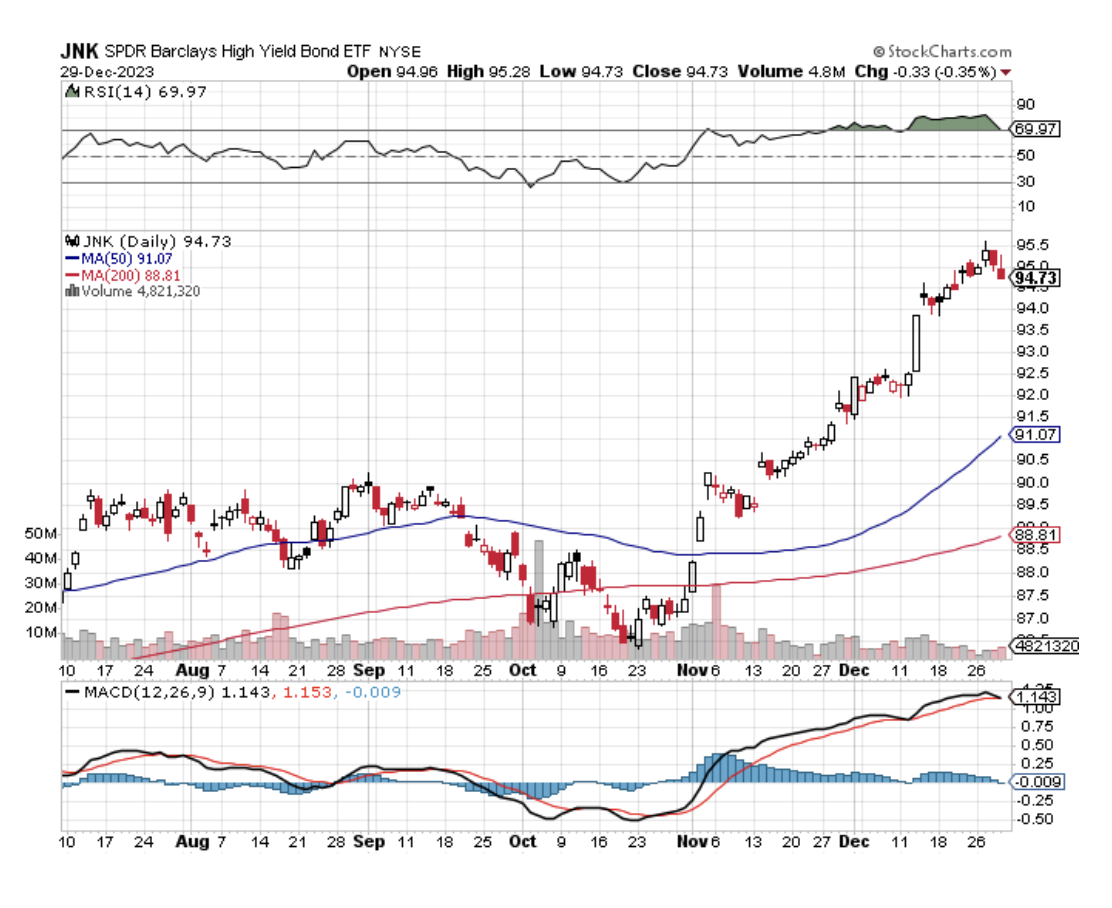
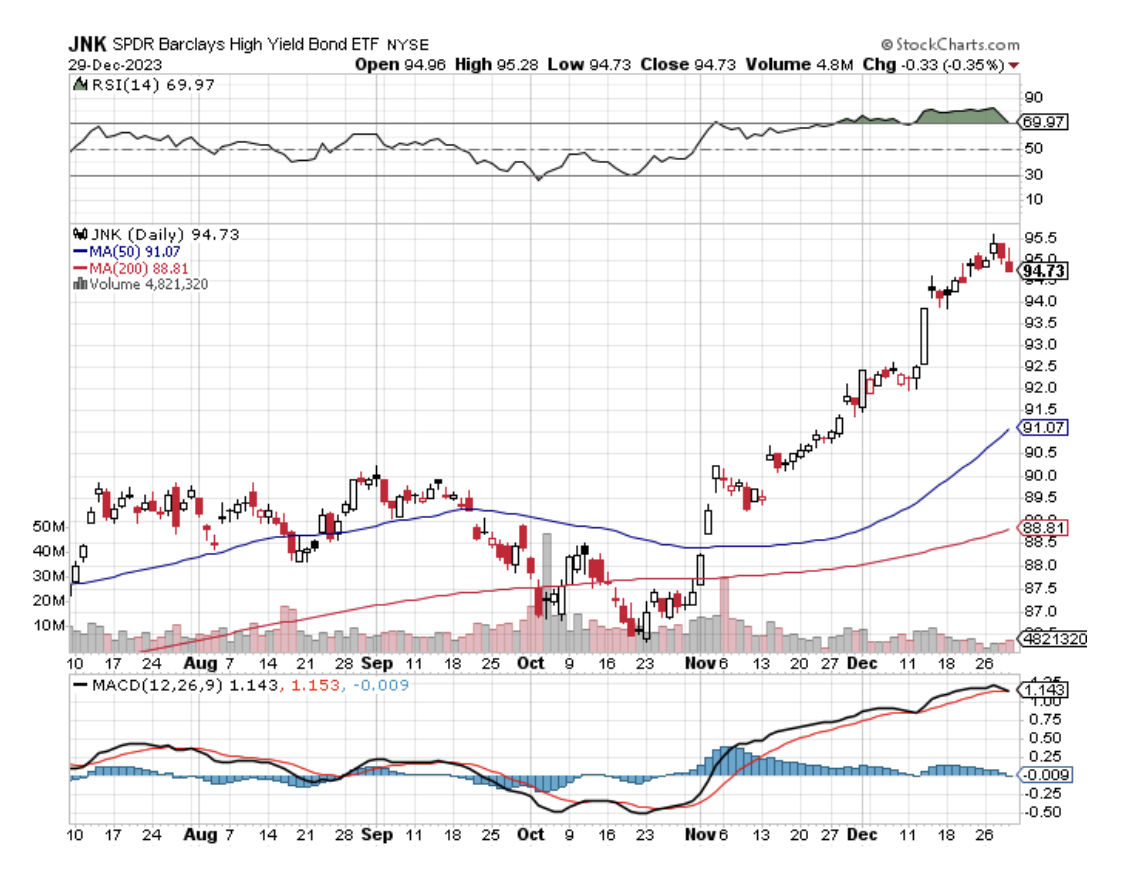
It isn’t just bonds that are going up. The entire interest rate space is doing well including junk bonds (JNK), municipal bonds (MUB), REITS (NLY), preferred stock, and convertible bonds.
With a major yield advantage over the rest of the world for the last decade, the US dollar has been on an absolute tear. After all, the world’s strongest economy begets the world’s strongest currency.
That is about to end.
If your primary assumption is that US interest rates will see a sharp decline sometime in 2024, then the outlook for the greenback is terrible.
Currencies are driven by interest rate differentials and the buck is soon going to see the fastest shrinking yield premium in the forex markets.
That shines a great bright light on the foreign currency ETFs. You could do well buying the Australian Dollar (FXA), Euro (FXE), Japanese yen (FXE), and British Pound (FXB). I’d pass on the Chinese yuan (CYB) right now until their Covid shutdowns end.
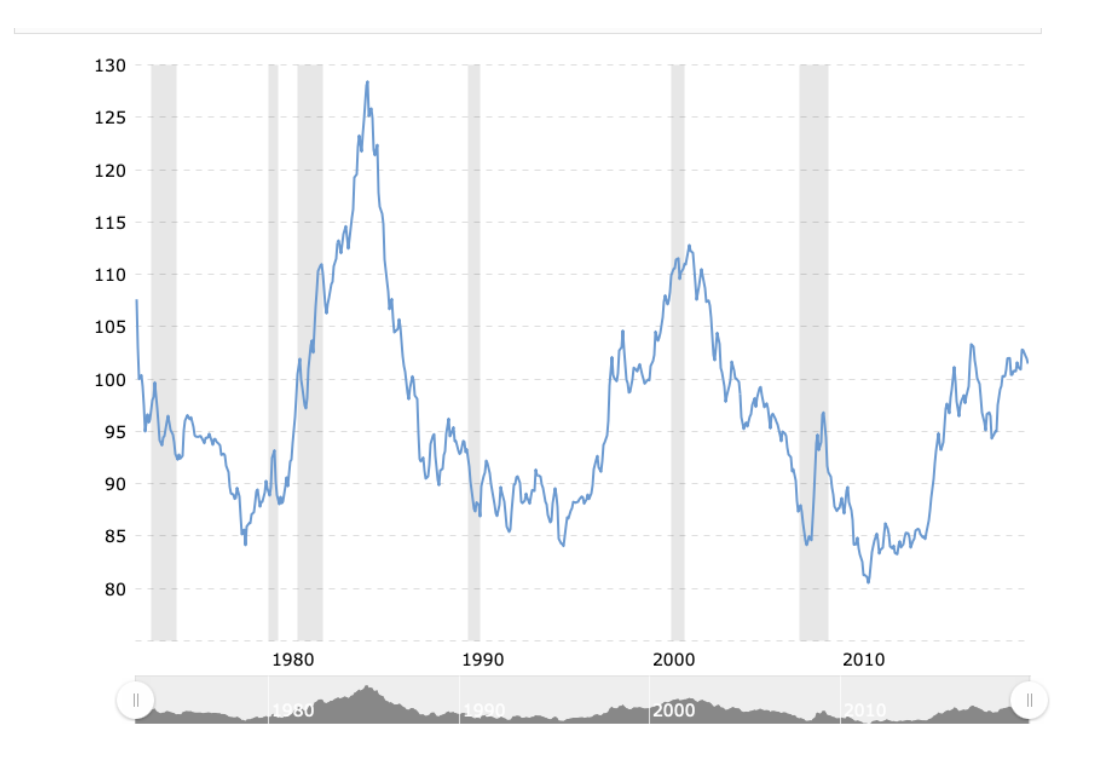
Look at the 50-year chart of the US dollar index below and you’ll see that a 13-year uptrend in the buck is rolling over and will lead to a 5-10-year down move. Draw your weapons.
5) Commodities (FCX), (VALE), (DBA)
Commodities are the high beta players in the financial markets. That’s because the cost of being wrong is so much higher. Get on the losing side of commodities and you will be bled dry by storage costs, interest expenses, contangos, and zero demand.
Commodities have one great attribute. They predict recessions and recoveries earlier than any other asset class. When they peaked in March of 2022, they were screaming loud and clear that a recession would hit in early 2023. By reversing on a dime on November 13, 2023, they also told us that a rip-roaring recovery would begin in 2024.
You saw this in every important play in the sector, including Broken Hill (BHP), Peabody Energy (BTU), and Freeport McMoRan (FCX). And who but me noticed that Alcoa Aluminum (AA) was up an incredible 50% in December? Maybe you can’t teach an old dog new tricks, but the old tricks work pretty darn well!
The heady days of the 2011 commodity bubble top are about to replay. Now that this sector is convinced of a substantially weaker US dollar and lower inflation, it is once more a favorite target of traders. China will finally rejoin the global economy as a growth engine in 2024 but at only half its previous growth rate. It will be replaced by India, which is turning into the new China and is now the most populous country in the world.
And here’s another big new driver. Each electric vehicle requires 200 pounds of copper and production is expected to rise from 2 million units a year to 20 million by 2030. Annual copper production will have to increase three-fold in a decade to accommodate this increase, no easy task or prices will have to rise.
The great thing about commodities is that it takes a decade to bring new supply online, unlike stocks and bonds, which can merely be created by an entry in an Excel spreadsheet. As a result, they always run far higher than you can imagine.
Accumulate all commodities on dips.
Snow Angel on the Continental Divide
6) Energy (DIG), (RIG), (USO), (DUG), (UNG), (USO), (XLE), (AMLP)
Energy was the top-performing sector of 2023 until it wasn’t.
We got a nice boost to $90 a barrel from the Gaza War. But that faded rapidly as there was never an actual supply disruption, just the threats of one. Saudi production has been cut back so far, some 5 million barrels a day, that it risks budget shortfalls if it reduces any more. In the meantime, US fracking production has taken off like a rocket.
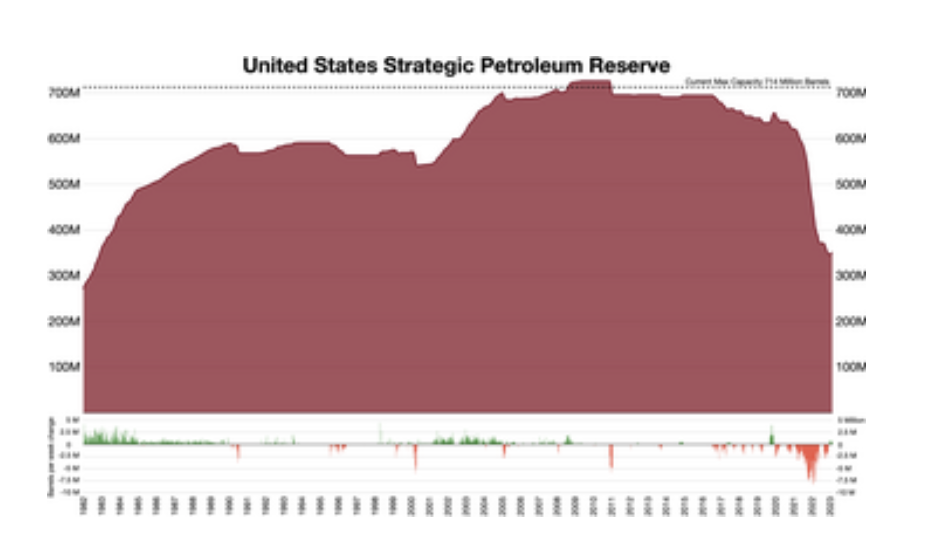
In the meantime, Joe Biden is sitting on the bid in an effort to refill the Strategic Petroleum Reserves that was drawn down from 723 to 350 million barrels during the last price spike.
The trade here is to buy any energy plays when Texas tea approaches $70 and take profits at $95. Your first picks should be ExxonMobile (XOM), Occidental Petroleum (OXY) where Warren Buffet has a 27% stake, Diamondback Energy (FANG), and Devon Energy (DVN).
The really big energy play for 2024 will be in natural gas (UNG), which was slaughtered in 2023. The problem here was not a shortage of demand because China would take all we could deliver. It was in our ability to deliver, hobbled by the lack of gasification facilities needed to export. One even blew up.
In 2024 several new export facilities came online and the damaged one was repaired. That should send prices soaring. Natural gas prices now at a throw-away $2.00 per MM BTU could make it to $8.00 in the next 12 months. That takes the (UNG) from $5.00 to $15.00 (because of the contango).
Buy (UNG) LEAPS (Long Term Equity Anticipation Securities) right now.
Remember, you will be trading an asset class that is eventually on its way to zero sooner than you think. However, you could have several doublings on the way to zero. This is one of those times. And you also have a huge 35% contango headwind working against you all the time.
They call this commodity the “widow maker” for a good reason.
The real tell here is that energy companies are bailing on their own industry. Instead of reinvesting profits back into their future exploration and development, as they have for the last century, they are paying out more in dividends and share buybacks.
Take the money and run. Trade, don’t marry this asset class.
There is the additional challenge in that the bulk of US investors, especially environmentally friendly ESG funds, are now banned from investing in legacy carbon-based stocks. That means permanently cheap valuations and share prices for the energy industry.
Energy now counts for only 5% of the S&P 500. Twenty years ago, it boasted a 15% weighting.
The gradual shutdown of the industry makes the supply/demand situation infinitely more volatile.
To understand better how oil might behave in 2024, I’ll be studying US hay consumption from 1900-1920. That was when the horse population fell from 100 million to 6 million, all replaced by gasoline-powered cars and trucks.
The internal combustion engine is about to suffer the same fate.
The train has added extra engines at Denver, so now we may begin the long laboring climb up the Eastern slope of the Rocky Mountains.
On a steep curve, we pass along an antiquated freight train of hopper cars filled with large boulders.
The porter tells me this train is welded to the tracks to create a windbreak. Once, a gust howled out of the pass so swiftly, that it blew a passenger train over on its side. In the snow-filled canyons, we saw a family of three moose, a huge herd of elk, and another group of wild mustangs. The engineer informs us that a rare bald eagle is flying along the left side of the train. It’s a good omen for the coming year. We also see countless abandoned 19th-century gold mines and broken-down wooden trestles leading to huge piles of tailings, and relics of previous precious metals booms. So, it is timely here to speak about the future of precious metals.
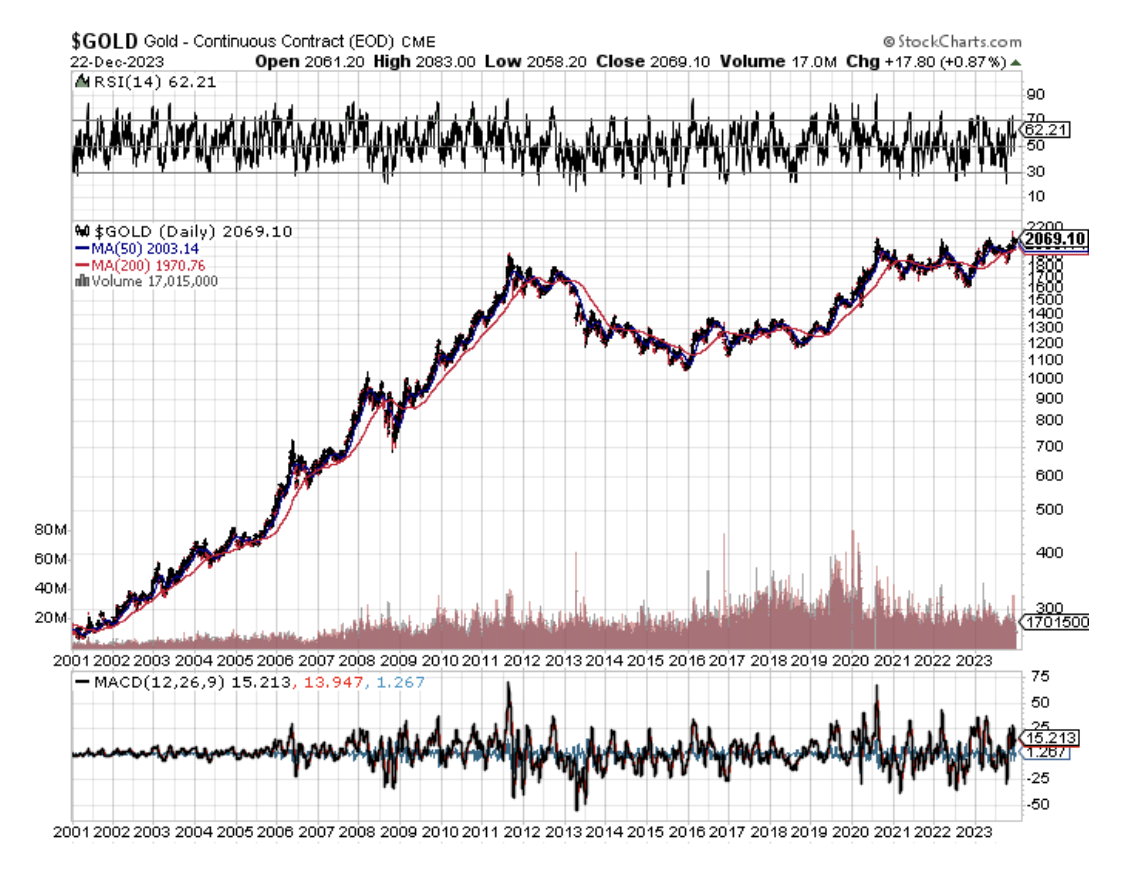
Here it’s important to look at the long view on gold. The barbarous relic tends to have good and bad decades. During the 2000’s the price of the yellow metal rose tenfold, from $200 to $2,000. The 2010s were very boring when gold was unchanged. Gold is doing well this decade, already up 40%, and a double or triple is in the cards.
2023 should have been a terrible year for precious metals. With inflation soaring, stocks volatile, and interest rates soaring, gold had every reason to collapse. Instead, it was up on the year, thanks to a heroic $325, 17.8%% rally in the last two months.
The reason is falling interest rates, which reduce the opportunity costs of owning gold. The yellow metal doesn’t pay a dividend, costs money to store and insure, and delivery is an expensive pain in the butt.
Chart formations are looking very encouraging with a massive upside breakout in place. So, buy gold on dips if you have a stick of courage on you, which you must if you read this newsletter.
Of course, the best investors never buy gold during a bull market. They Hoover up gold miners, which rise four times faster, like Barrack Gold (GOLD), Newmont Mining (NEM), and the basket play Van Eck Vectors Gold Miners ETF (GDX).
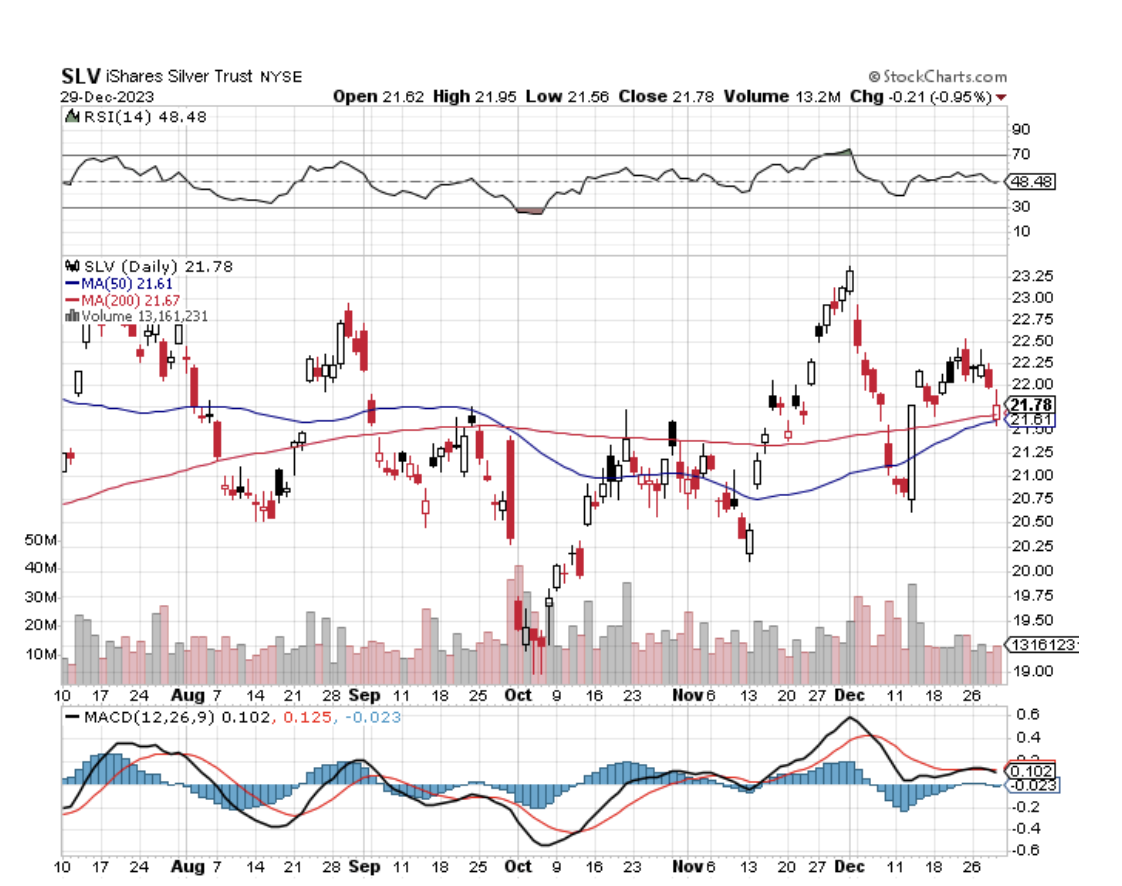
Higher beta silver (SLV) will be the better bet, as it already has been because it plays a major role in the decarbonization of America. There isn’t a solar panel or electric vehicle out there without some silver in them and the growth numbers are positively exponential. Keep buying (SLV), (SLH), and (WPM) on dips.
Crossing the Great Nevada Desert Near Area 51
8) Real Estate (ITB), (LEN), (KBH), (PHM)
The majestic snow-covered Rocky Mountains are behind me. There is now a paucity of scenery, with the endless ocean of sagebrush and salt flats of Northern Nevada outside my window, so there is nothing else to do but write.
My apologies in advance to readers in Wells, Elko, Battle Mountain, and Winnemucca, Nevada. It is a route long traversed by roving bands of Indians, itinerant fur traders, the Pony Express, my own immigrant forebearers in wagon trains, the Transcontinental Railroad, the Lincoln Highway, and finally US Interstate 80, which was built for the 1960 Winter Olympics at Squaw Valley. Passing by shantytowns and the forlorn communities of the high desert, I am prompted to comment on the state of the US real estate market. Those tormented by the shrinking number of real estate transactions over the past two years take solace. The past excesses have been unwound and we are now on the launching pad for another decade-long bull market.
There is a generational structural shortage of supply with housing which won’t come back into balance until the 2030’s. You don’t have a real estate crash when we are short 10 million homes.
The reasons, of course, are demographic. There are only three numbers you need to know in the housing market for the next ten years: there are 80 million baby boomers, 65 million Generation Xers who follow them, and 86 million in the generation after that, the Millennials.
The 76 million baby boomers (between ages 62 and 79) have been unloading dwellings to the 72 million Gen Xers (between age 41 and 56) since prices peaked in 2007. But there are not enough of the latter, and three decades of falling real incomes mean that they only earn a fraction of what their parents made. That’s what caused the financial crisis. That has created the present shortage of housing, both for ownership and rentals.
There is a happy ending to this story.
The 72 million Millennials now aged 25-40 are now the dominant buyers in the market. They are transitioning from 30% to 70% of all new buyers of homes. They are also just entering the peak spending years of middle age, which is great for everyone. Hot on their heels are 68 million Gen Z, which are now 12 to 27 years old.
The Great Millennial Migration to the suburbs and Middle America has just begun. Thanks to the pandemic and Zoom, many are never returning to the cities. That has prompted massive numbers to move from the coasts to the American heartland.
That’s why Boise, Idaho was the top-performing real estate market in 2023, followed by Phoenix, Arizona. Personally, I like Reno, Nevada, where Apple, Google, Amazon, and Tesla are building factories as fast as they can, just a four-hour drive from Silicon Valley.
As a result, the price of single-family homes should continue to rise during the 2020s, as they did during the 1970s and the 1990s when identical demographic forces were at play.
This will happen in the context of a labor shortfall, rising wages, and improving standards of living.
Increasing rents are accelerating this trend. Renters now pay 35% of their gross income, compared to only 18% for owners, and less, when multiple deductions and tax subsidies are considered. Rents are now rising faster than home prices.
Remember, too, that the US will not have built any new houses in large numbers in 17 years. The 50% of small home builders that went under during the Financial Crisis never came back.
We are still operating at only half of the 2007 peak rate. Thanks to the Great Recession, the construction of five million new homes has gone missing in action.
There is a new factor at work. We are all now prisoners of the 2.75% 30-year fixed-rate mortgages we all obtained over the past five years. If we sell and try to move, a new mortgage will cost double today. If you borrow at a 2.75% 30-year fixed rate, and the long-term inflation rate is 3%, then, over time, you will get your house for free. That’s why nobody is selling, and prices have barely fallen.
This winds down in 2024 as the Fed realizes its many errors and sharply lowers interest rates. Home prices will explode…. again.
Quite honestly, of all the asset classes mentioned in this report, purchasing your abode is probably the single best investment you can make now after you throw in all the tax breaks. It’s also a great inflation play.
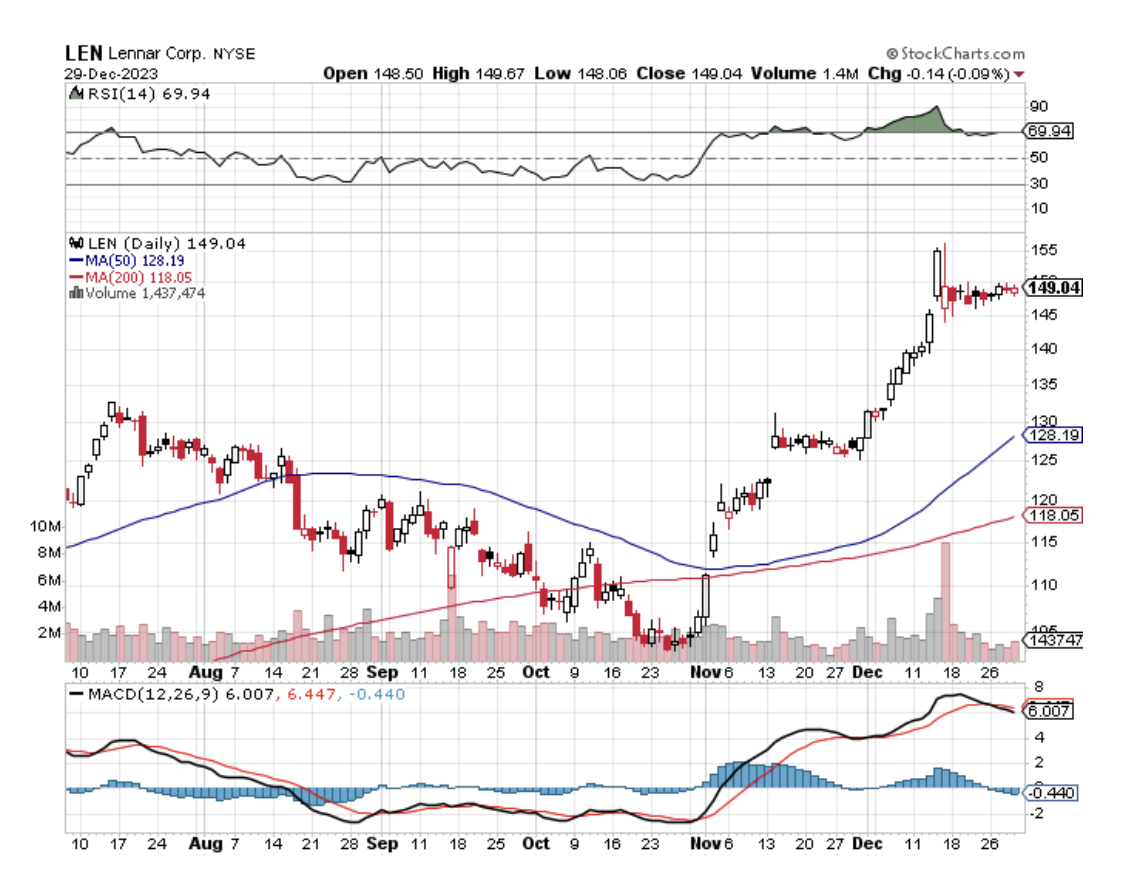
That means the major homebuilders like Lennar (LEN), Pulte Homes (PHM), and KB Homes (KBH) are a buy on the dip. But don’t forget to sell your home by the 2030s when the next demographic headwind resumes. That’s when you should unload your home to a Millennial or Gen Xer and move into a cheap rental.
A second-hand RV would be better.
Crossing the Bridge to Home Sweet Home
9) Postscript
We have pulled into the station at Truckee amid a howling blizzard.
My loyal staff have made the ten-mile trek from my estate at Incline Village to welcome me to California with a couple of hot breakfast burritos and a chilled bottle of Dom Perignon Champagne, which has been resting in a nearby snowbank. I am thankfully spared from taking my last meal with Amtrak.
After that, it was over legendary Donner Pass, and then all downhill from the Sierras, across the Central Valley, and into the Sacramento River Delta.
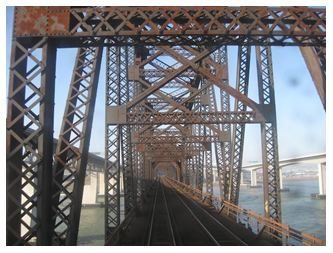
Well, that’s all for now. We’ve just passed what was left of the Pacific mothball fleet moored near the Benicia Bridge (2,000 ships down to six in 50 years). The pressure increase caused by a 7,200-foot descent from Donner Pass has crushed my plastic water bottle. Nice science experiment!
The Golden Gate Bridge and the soaring spire of Salesforce Tower are just coming into view across San Francisco Bay.
A storm has blown through, leaving the air crystal clear and the bay as flat as glass. It is time for me to unplug my MacBook Pro and iPhone 15 Pro, pick up my various adapters, and pack up.
We arrive in Emeryville 45 minutes early. With any luck, I can squeeze in a ten-mile night hike up Grizzly Peak and still get home in time to watch the ball drop in New York’s Times Square on TV.
I reach the ridge just in time to catch a spectacular pastel sunset over the Pacific Ocean. The omens are there. It is going to be another good year.
I’ll shoot you a Trade Alert whenever I see a window open at a sweet spot on any of the dozens of trades described above, which should be soon.
Good luck and good trading in 2024!
John Thomas
The Mad Hedge Fund Trader
The Omens Are Good for 2024!
https://www.madhedgefundtrader.com/wp-content/uploads/2019/01/Chicago-union-station.png375499Mad Hedge Fund Traderhttps://madhedgefundtrader.com/wp-content/uploads/2019/05/cropped-mad-hedge-logo-transparent-192x192_f9578834168ba24df3eb53916a12c882.pngMad Hedge Fund Trader2024-01-03 09:00:452024-01-03 10:56:532024 Annual Asset Class Review
There is a very high degree of risk involved in trading. Past results are not indicative of future returns. MadHedgeFundTrader.com and all individuals affiliated with this site assume no responsibilities for your trading and investment results. The indicators, strategies, columns, articles and all other features are for educational purposes only and should not be construed as investment advice. Information for futures trading observations are obtained from sources believed to be reliable, but we do not warrant its completeness or accuracy, or warrant any results from the use of the information. Your use of the trading observations is entirely at your own risk and it is your sole responsibility to evaluate the accuracy, completeness and usefulness of the information. You must assess the risk of any trade with your broker and make your own independent decisions regarding any securities mentioned herein. Affiliates of MadHedgeFundTrader.com may have a position or effect transactions in the securities described herein (or options thereon) and/or otherwise employ trading strategies that may be consistent or inconsistent with the provided strategies.