Global Market Comments
July 13, 2021
Fiat Lux
Featured Trade:
(WHY SOLID-STATE BATTERIES ARE THE “NEXT BIG THING”)
(TSLA), (QS)

Global Market Comments
July 13, 2021
Fiat Lux
Featured Trade:
(WHY SOLID-STATE BATTERIES ARE THE “NEXT BIG THING”)
(TSLA), (QS)

Global Market Comments
July 7, 2021
Fiat Lux
Featured Trade:
(JUNE 30 BIWEEKLY STRATEGY WEBINAR Q&A),
(QQQ), (BRKB), (GOOG), (NVDA), (FB), (TSLA), (JPM), (BAC), (C), (GS), (MS), (NASD), ((X), (FCX), (AMZN), (MSFT), (AAPL), (FCX)

Global Market Comments
June 23, 2021
Fiat Lux
Featured Trade:
(WHY YOU MISSED THE TECHNOLOGY BOOM AND WHAT TO DO ABOUT IT NOW),
(AAPL), (AMZN), (MSFT), (NVDA), (TSLA), (WFC), (FB)

I often review the portfolios of new concierge subscribers looking for fundamental flaws in their investment approach and it is not unusual for me to find some real disasters.
The Armageddon scenario was quite popular a decade ago. You know, the philosophy that said that the Dow ($INDU) was plunging to 3,000, the US government would default on its debt (TLT), and gold (GLD) was rocketing to $50,000 an ounce?
Those who stuck with the deeply flawed analysis that led to those flawed conclusions saw their retirement funds turn to ashes.
Traditional value investors also fell into a trap. By focusing only on stocks with bargain basement earnings multiples, low price to book values, and high visible cash flows, they shut themselves out of technology stocks, far and away the fastest-growing sector of the economy.
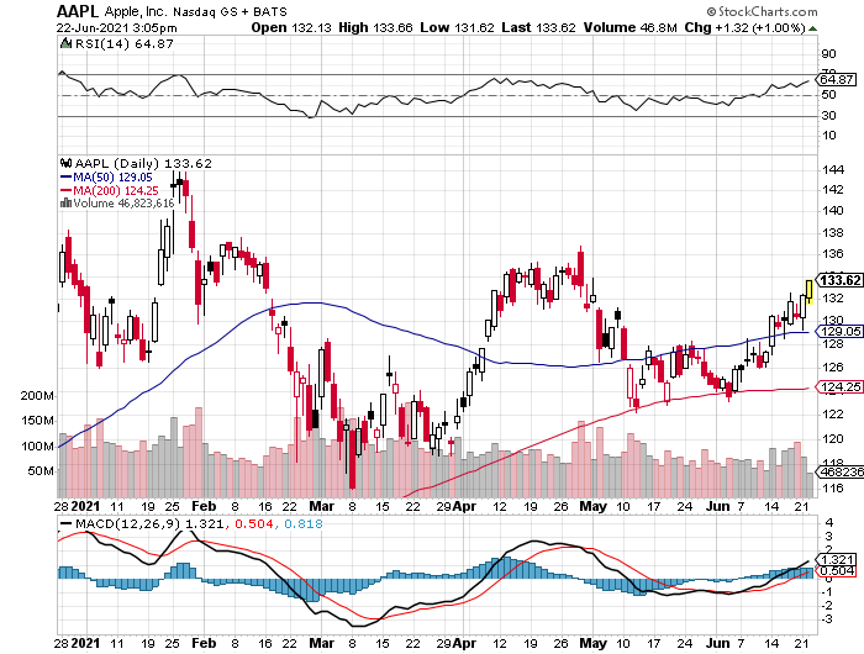
If they are lucky, they picked up shares in Apple a few years ago when the earnings multiple was still down at ten. But even the Giant of Cupertino hasn’t been that cheap for years.
And here is the problem. Tech stocks defy analysis because traditional valuation measures don’t apply to them.
Let’s start with the easiest metric of all, that of sales. How do you measure the value of sales when a company gives away most of its services for free?
Take Google (GOOG) for example. I bet you all use it. How many of you have actually paid money to Google to use their search function? I would venture none.
What would you pay Google for search if you had to? What is it worth to you to have an instant global search function? Probably at least $100 a year. I would pay $10,000 as I use it all day long. With 92.05% of the global search market comprising 2 billion users, that means $200 billion a year of potential Google revenues are invisible.
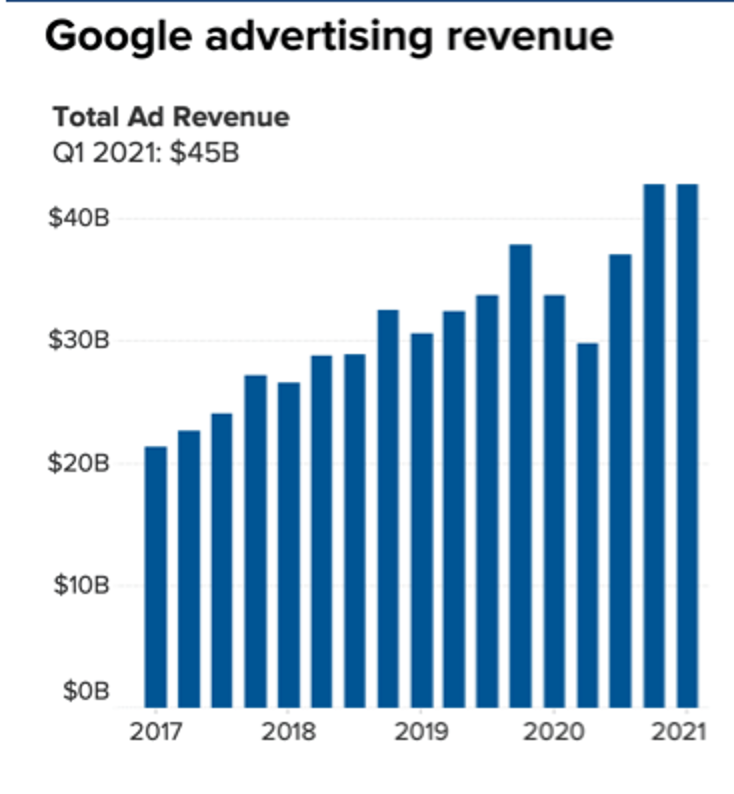
Yes, the company makes a chunk of this back by charging advertisers access to these search users, generating some $55.31 Billion in revenues and $17.93 billion in net income in the most recent quarter.
But much of the increased value of this company is passed on to shareholders not through rising profits or dividend payments but through an ever-rising share price. If you’re looking for dividends, Google doesn’t exist. It is also very convenient that unrealized capital gains are tax-free until the shares are sold, which may be never.
I’ll tell you another valuation measure that investors have completely missed, that of community. The most successful companies don’t have just customers who buy stuff, they have a community of members who actively participate in a common vision, which is then monetized. There are countless communities out there now making fortunes, you just have to know how to spot them.
Facebook (FB) has created the largest community of people who are willing to share personal information. This permits the creation of affinity groups centered around specific interests, from your local kids’ school activities to municipality emergency alerts, to your preferred political party.
This creates a gigantic network effect that increases the value of Facebook. Each person who joins (FB) makes it worth more, raising the value of the shares, even though they haven’t paid it a penny. Again, it’s advertisers who are footing your tab.
Tesla (TSLA) has one million customers willing to lend it $400 billion for free in the form of deposits on future car purchases because they also share in the vision of a carbon-free economy. When you add together the costs of initial purchase, fuel, and maintenance savings, a new Tesla Model 3 is now cheaper than a conventional gasoline-powered car over its entire life.
REI, a privately held company, actively cultivates buyers of outdoor equipment, teaches them how to use it, then organizes trips. It will then pursue you to the ends of the earth with seasonal discount sales. Whole Foods (WFC), now owned by Amazon (AMZN), does the same in the healthy eating field.
If you spend a lot of your free time in these two stores, as I do, The United States is composed entirely of healthy, athletic, good-looking, and long-lived, intelligent people.
There is another company you know well that has grown mightily thanks to the community effect. That would be the Diary of a Mad Hedge Fund Trader, one of the fastest-growing online financial services firms of the past decade. What is the value of our community? To give you a hint, the price of my Global Trading Dispatch has soared from $29 a month to $3,000 a year.
We have succeeded not because we are good at selling newsletters, but because we have built a global community of like-minded investors with a common shared vision around the world, that of making money through astute trading and investment.
We produce daily research services covering global financial markets, like Global Trading Dispatch, the Mad Hedge Technology Letter, and the Mad Hedge Biotech & Healthcare Letter. We teach you how to monetize this information with our books like Stocks to Buy for the Coming Roaring Twenties and the Mad Hedge Options Training Course.
We then urge you to action with our Trade Alerts. If you want more hands-on support, you can upgrade to the Concierge Service. You can also meet me in person to discuss your personal portfolios and my Global Strategy Luncheons.
The luncheons are great because long-term Mad Hedge veterans trade notes on how best to use the service and inform me on where to make improvements. It’s a blast.
The letter is self-correcting. When we make a mistake, readers let us know in 60 seconds and we can shoot out a correction immediately. The services evolve on a daily basis.
It all comes together to enable customers to make up to 20% to 100% a year on their retirement funds. And guess what? The more money they make, the more products and services they buy from me. This is why I have so many followers who have been with me for a decade or more. And some of my best ideas come from my own subscribers.
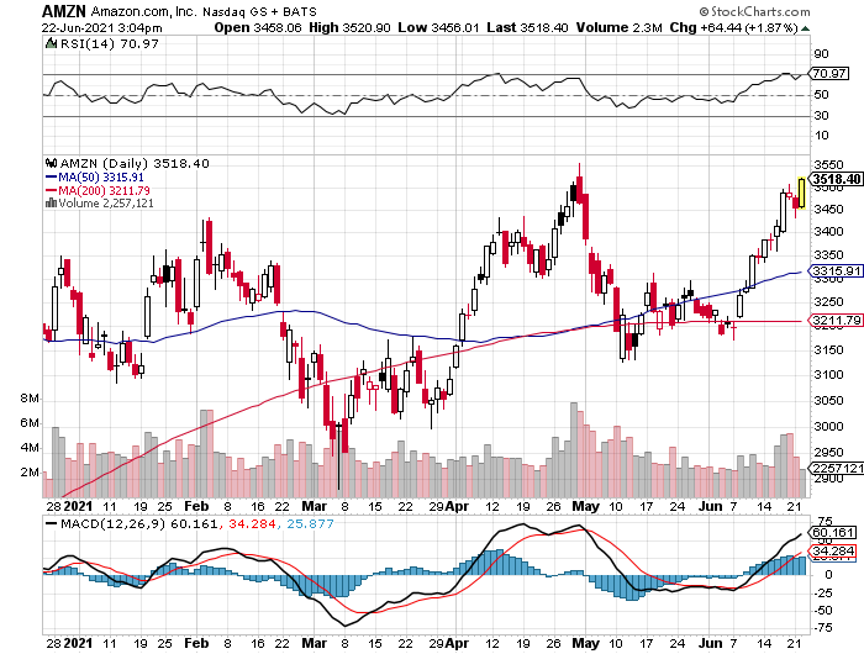
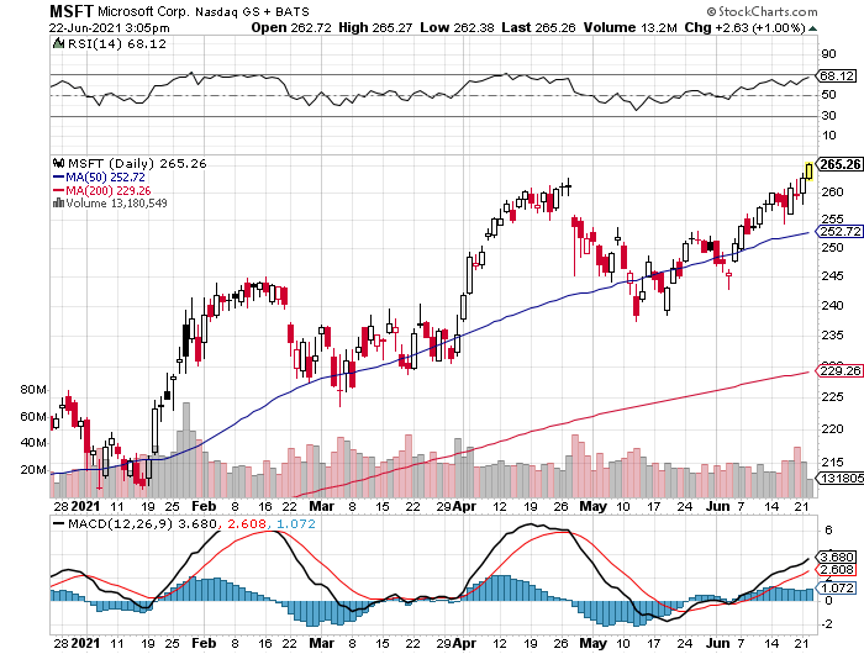
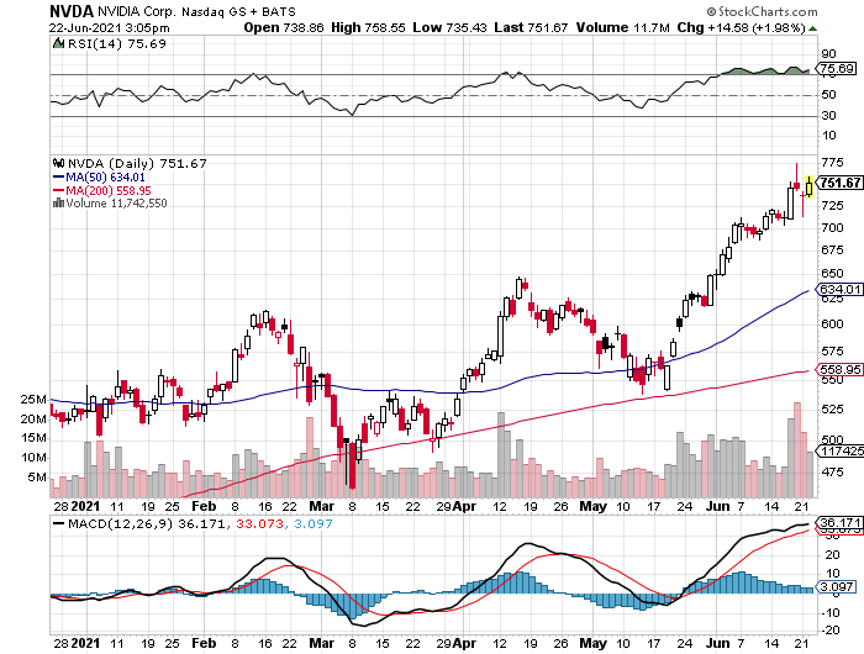
So, if you missed technology now what should you do about it? Recognize what the new game is and get involved. Microsoft (MSFT) with the fastest-growing cloud business offers good value here. Amazon looks like it will eventually hit my $5,000 target. You want to be buying graphics card and AI company NVIDIA (NVDA) on every 10% dip. It’s going to $1,000.
You can buy the breakouts now to get involved or patiently wait until the 10% selloff that usually follows blowout quarterly earnings.
My guess is that tech stocks still have to double in value before their market capitalization of 26% matches their 50% share of US profits. And the technologies are ever hyper-accelerating. That leaves a lot of upside even for the new entrants.


Mad Hedge Biotech & Healthcare Letter
June 22, 2021
Fiat Lux
FEATURED TRADE:
(PRIMED FOR DOMINANCE)
(TDOC), (AMZN), (AMWL), (WMT), (CVS), (ARKK), (TSLA)

While growth stocks have already begun clawing their way back following the losses they suffered earlier this year, there are still former market favorites struggling to bounce back.
One of them is Teladoc Health (TDOC).
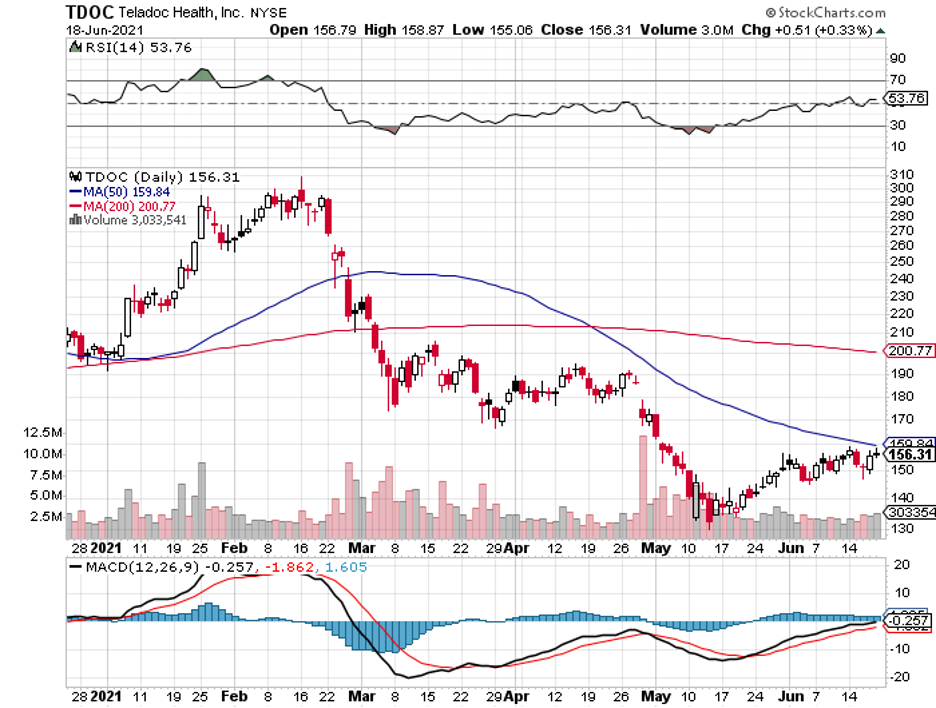
To date, Teladoc is still trading at roughly 40% below its previous highs.
While this can be frustrating for its investors, the current situation might just be an opportune time to add this stock to your portfolio.
Teladoc emerged as the leader in virtual care in 2020 by being at the right place at the right time when the pandemic struck. That year, the company’s revenue rose by a whopping 145% compared to its 2019 performance.
These days though, the stock has lost half of its value. Although that’s definitely a head-scratcher, Teladoc’s 51.5 million paid memberships in the United States alone still make it the most dominant force in this industry.
For a long-term investor, the situation presents a compelling opportunity.
Teladoc is a growing business that’s expanding both in the US and globally. While penetrating more markets would happen over time, the basic footprint has been established. This offers Teladoc much-needed exposure to a massive addressable market.
The global market for telemedicine is estimated to expand from $49.9 billion in 2019 to a jaw-dropping $459.8 billion by 2030.
In North America, which holds roughly 34.4% of the market share in 2020, the telemedicine market generated $19.23 billion during the pandemic.
Taking into consideration Teladoc’s revenue of $967.4 million for its US segments in 2020, it becomes clear that the company is only getting started, as this comprised only 5% of the market size.
If the company maintains its momentum, then the next 10 years would be an incredible journey for Teladoc investors.
Despite the disappointing share price performance of Teladoc in the past months, the company’s actual business has sustained its growth.
Revenue continues to rapidly rise, showing off a 151% growth in the first quarter of 2021.
This impressive growth has prompted Teladoc to boost its full-year revenue guidance to $2 billion, which indicates an 80% year-over-year gain.
Impressive growth has been observed all around, with access fee revenue going up 183% while visit fees climbed 24%.
Considering the size of the market, it no longer comes as a surprise that Teladoc is facing competitive threats.
Amazon (AMZN) and Amwell (AMWL) have recently entered the virtual care market. Even Walmart (WMT) and CVS (CVS) have been working on toppling Teladoc as well.
Despite the competition, Teladoc remains ahead of the pact thanks to its continuous efforts to innovate.
For example, the latest innovation from Teladoc is Primary360.
This product is designed to take virtual healthcare to the next level. It offers personalized service at the patient level. Here’s a preview of how it works.
Traditionally, patients go to their doctors when they discover a health problem. This is a reactive way of dealing with health. In contrast, Primary360 is proactive.
That is, the product monitors the patients individually from annual checkups to ongoing treatments to manage chronic conditions. Through closely monitoring the patients, Teladoc is able to perform earlier diagnoses of potential diseases and help doctors reach better outcomes for treatments.
To better picture the long-term rewards of this company, it’s good to keep in mind that Teladoc is actually the second biggest holding of Cathie Wood’s ARK Innovation ETF (ARKK), next only to Tesla (TSLA).
Teladoc Health emerged as one of the most popular pandemic plays in 2020.
While the stock tumbled when vaccines hit the market, its projected growth trajectory remains promising. In fact, Teladoc’s revenue growth is anticipated to skyrocket over the remainder of this decade, with telemedicine estimated to reach roughly half a trillion dollars by 2030.
For investors on the lookout for long-term plays, Teladoc Health's tumble has presented a good opportunity to add it to your portfolio.

Mad Hedge Technology Letter
June 16, 2021
Fiat Lux
Featured Trade:
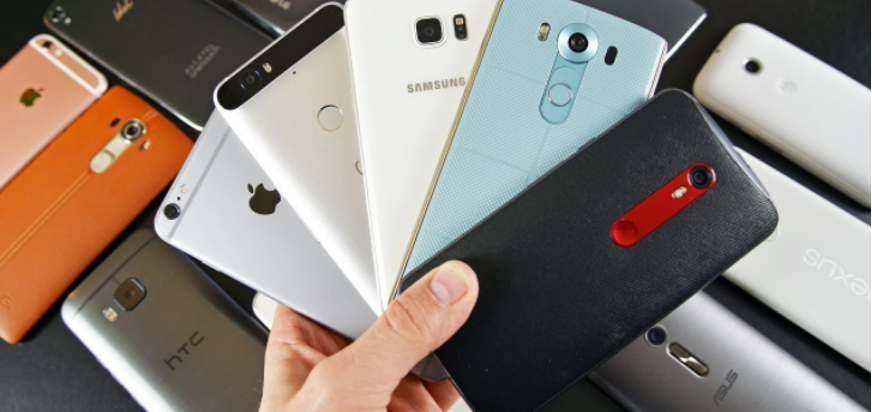
(SMARTPHONES AREN’T GOING AWAY)
(AMZN), (TSLA), (FB), (GOOGL), (AAPL), (NFLX)

The United States has long been the world leader in science and technology, but lately, they are falling asleep at the wheel.
At a psychological level, the feeling of threat has led to all sorts of unintended consequences, and it has been no accident we are seeing at a trade war.
The one key ingredient that has been missing is sustained investment in our research enterprise.
Without relentless investment into scientific and technological leadership, don’t expect any new breakthroughs, and the stagnation of US technology is evident in the evolution of a product that goes on sale to the consumer.
What happened to 5G? It’s been hyped for the past 3 years, but people have felt no need to upgrade for the spotty 5G that is available.
What happened to automated cars?
I thought by now, we would be able to get around with our flying cars.
What we do have are bigger iPads, faster iMacs, and the Microsoft Surface which is a tablet with an attachable keyboard.
I wouldn’t call that success.
But what the pandemic did was allow these big tech firms to get away without innovating, and I am not talking about the incremental innovation that makes a Model 3 Tesla 4% better than the prior iteration.
The hype of 10 years of digital transformation into one year has been profusely disseminated but misunderstood.
I can tell you that we didn’t experience 10 years of digital development pulled forward into 1 year.
That definitely was not the case over the past 15 months.
More accurately said, we had 10 years of expandable margin opportunities squeezed into one and the biggest beneficiary of this is the balance sheet of big tech.
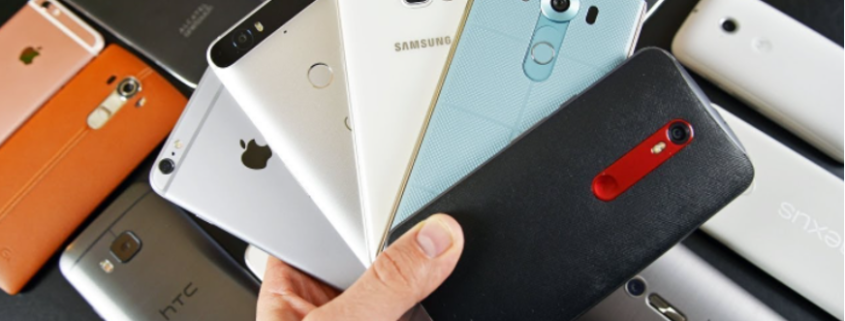
What we did was give a reason for tech to not ditch this over-reliance on the smartphone which is going strong into its 13th year.
It was 2007 when Steve Jobs delivered us the iPhone and by 2008, many consumers were using it.
In 2021, the iPhone and variants still have a stranglehold on human life and the way business models are put together.
That won’t go away because of the pandemic and now these big tech behemoths have no reason to dip too far into capital expenditures.
Not only that, but they are also cutting back spend on office space and business travel too while sneakily reducing salaries of remote employees who move to cheaper cities.
In fact, the pandemic will elongate the smartphone dynasty, and any other meaningful tech has been put back on the backburner for the time being.
Then there are companies like Uber that are busy sorting out its decimated ride-sharing business before they can even dream about flying uber cars.
So, I am not surprised that the House Science Committee is taking up two bipartisan bills to try to push the agenda forward.
The need to act is best captured by two data points. First, as much as 85% of America’s long-term economic growth is due to advances in science and technology. There’s a direct connection between investment in research and development and job growth in the U.S.
Second, China increased public R&D by 56% between 2011 and 2016, but U.S. investment in the same period fell by 12% in absolute terms. China has likely surpassed the U.S. in total R&D spending and — through both investment and cyber theft — is working to overtake the U.S. as the global leader in science and technology.
America’s continued scientific leadership requires a comprehensive and strategic approach to research and development that provides long-term increased investment and stability across the research ecosystem. And it must focus on evolving technologies that are crucial to our national and economic security, like semiconductors and quantum sciences.
Now that the U.S. government has identified this issue as a national security issue, money will be thrown at the problem, but don’t expect anything to change tomorrow.
We are still a way off from forcing big tech to change their profit models and that will happen when they need to keep up with the next big thing.
There is no big next thing yet.
Until then, expect more incremental progress from your smartphone and Tesla.
It’s certainly not a bad situation to wield a smartphone that is 4% better each year or drive a Tesla that performs just a bit better as well.
Effectively, these enormous and profitable revenue models will stay in place and investors have no reason to worry about big tech moving forward.
This benefits the likes of Amazon, Tesla, Facebook, Google, Apple, and Netflix.
The only risk to U.S. tech is a threat that the U.S. government is absorbing themselves. What a great industry to be in.
Net-net, this is a great win for big tech and I don’t expect anything to drastically change, but get ready for a lot more digital ads in your daily consumption of digital content and more of the same products.

Mad Hedge Technology Letter
June 11, 2021
Fiat Lux
Featured Trade:
(DON’T FALL INTO THE LORDSTOWN TRAP)
(RIDE), (NKLA), (VLDR), (TSLA)

Lordstown Motors Inc. (RIDE), an EV startup that recently went public, lacks the money to build a debut pickup truck and might go out of business if funding dries up in the next 12 months.
That’s what you get if you go for the “cheap” tech that offers some pipedream of fantasy managed by charlatans.
The company believes that its current level of cash and cash equivalents are not sufficient to complete the development of its electric vehicles and launch the Endurance pickup.
Investors should have seen this coming from a million miles away.
Lordstown went public through a SPAC and numerous have gone through upheaval as analysts critique their business practices.
Some, like Nikola Corp. (NKLA) and Velodyne Lidar Inc. (VLDR), have had their founders ousted.
Lordstown now has balance sheet problems.
In the filing, Lordstown said it has approximately $587 million in cash and an accumulated deficit of $259.7 million as of March 31, after reporting a first-quarter net loss of $125.2 million.
Going public gifted RIDE $675 million, but the company has burned through that quickly.
Let’s run down the list of red flags I have seen pop up at this supposed EV producer.
The company has no revenue and no sellable product, and they have most likely misled investors on both its demand and production capabilities.
The company has consistently pointed to its book of 100,000 pre-orders as proof of insatiable demand for its proposed EV truck.
Lordstown recently announced a 14,000-truck deal from E Squared Energy, supposedly representing $735 million in sales.
But E Squared is based out of a small residential apartment in Texas that doesn’t operate a vehicle fleet.
Another 1,000-truck, $52.5 million order comes from a 2-person startup that operates out of a Regus virtual office with a mailing address at a UPS Store.
Lordstown has thrived off the notion that the faster the pre-orders arrive, the greater investors’ confidence would be in the company and the faster funds would flow in and subsequently lift shares for long enough that management can cash out.
What management has failed to tell us is that these pre-orders are non-binding letters of intent, require $0 as a reservation payment, do not require an actual purchase.
Do I have other gripes about the company?
Yes.
Despite claims that battery packs would be manufactured in-house, the product is definitely not.
Former employees revealed that the company has completed none of its needed testing or validation, including cold-weather testing, durability testing, and Federal Motor Vehicle Safety Standards (FMVSS) testing required by the NHTSA.
Lordstown only went public in October 2020, but in that brief time, executives and directors have unloaded around $28 million in stock.
It seems awfully plausible that management is unloading stock because they think the company will ultimately fail and the stock will go to 0.
The pre-orders representing over $5 billion in future revenue couldn’t be further from the truth.
So basically this is an EV company out of the mold of Nikola that has no product but tout some marketing gimmicks as empirical evidence that should nudge investors to believe they are on the brink of full-out mass production.
It’s possible no company has ever done just on the basis of hyping up their non-binding, zero dollars down pre-orders and RIDE is still living off of these fumes.
Ultimately, the company isn’t even close to producing a car and any capital thrown at it is dead money that will disappear into a black hole.
It’s plausible that this is a sign of froth when marginal tech firms like RIDE can pull off their act for this long.
It almost makes sense as the market-altering retail army funnels capital to spin into meme trades and make a mockery of the real traders who try to treat this seriously let alone value investors.
I doubt that Reddit’s retail army will save RIDE since the word is out of their business practices.
It’s not too far-flung to consider that the same mysticism brought to the EV industry by Elon Musk is being deployed nefariously to excite the incremental investor that RIDE is about to strike it rich with the “next Tesla.”
The truth is that there is only one Tesla and there will be only one Tesla because they thread the needle through the hole popularizing the EV when there was no competition.
And now the conglomerates have closed that gap and are chasing after Tesla, meaning it’s impossible that there could even be another Tesla in 2021.
And by competition, I first mean GM, then the tier after that of Toyota, Ford, and European players who allowed Tesla to take the lead.
I would say that any reader mustn’t believe that charlatans masquerading as the “next Elon Musk” could be just as good as the real thing.
Take these words with a grain of salt.
Capital should not be considered in any of these unless there’s a real product and proof of product success.
And I am not even talking about accelerated earnings reports yet, or consistent outperformance, this is way off of that.
There are some instances where a premium is paid for potential, especially if it will shift the paradigm in the industry, but if it smells like a rat, the rat should prove he isn’t a rat and not vice-versa.


Legal Disclaimer
There is a very high degree of risk involved in trading. Past results are not indicative of future returns. MadHedgeFundTrader.com and all individuals affiliated with this site assume no responsibilities for your trading and investment results. The indicators, strategies, columns, articles and all other features are for educational purposes only and should not be construed as investment advice. Information for futures trading observations are obtained from sources believed to be reliable, but we do not warrant its completeness or accuracy, or warrant any results from the use of the information. Your use of the trading observations is entirely at your own risk and it is your sole responsibility to evaluate the accuracy, completeness and usefulness of the information. You must assess the risk of any trade with your broker and make your own independent decisions regarding any securities mentioned herein. Affiliates of MadHedgeFundTrader.com may have a position or effect transactions in the securities described herein (or options thereon) and/or otherwise employ trading strategies that may be consistent or inconsistent with the provided strategies.