

“It's better to be a pirate than to join the Navy.” – Said Co-Founder of Apple Steve Jobs

“It's better to be a pirate than to join the Navy.” – Said Co-Founder of Apple Steve Jobs
Mad Hedge Technology Letter
May 18, 2020
Fiat Lux
Featured Trade:
(CHINA’S BIG SEMICONDUCTOR PLAY),
(SMH), (SOXX), (DOCU), (AKAM), (NVDA), (AMD), (XLNX)

We received a convincing data point as to why we trade cloud companies and not the semiconductor chips.
The rift between blacklisted telecom equipment giant Huawei Technologies and the U.S. administration has had a dramatic side-effect on the business models of U.S. chip companies.
The U.S. commerce department now will require licenses for sales to Huawei of semiconductors made abroad with U.S. technology signaling more turbulent times ahead.
Huawei is the Chinese smartphone maker and telecom provider who has stolen intellectual property from the West and used mammoth subsidies funded by the Chinese communist party to build itself into one of the premier telecom equipment sellers and number two maker of smartphones in the world.
I seldom issue trade alerts on semiconductor chip companies because I'd rather not compete with the Chinese communist party and their capital funding capacity.
China is hellbent on subsidizing its own chip capacity as many Western chip companies are blocked from doing deals with them.
A recent example is the Chinese communist party injecting $2.25 billion into a Semiconductor Manufacturing International Corp. wafer plant to ramp up development in the sector.
To read about this, click here.
Exploiting the economic freedom and laws of the West has worked out perfectly for Chinese tech enabling them to develop juggernauts like Tencent and Baidu.
In fact, state-sponsored hacking of Western intellectual property is not considered a malicious activity in China.
There is the Chinese notion that everything is fair game in business and war and protecting company secrets falls on the shoulders of the cybersecurity sector.
To read more about the fallout in the West from China’s aggressive trade strategy, click here.
The concept that you should only blame yourself if you allow your secrets to get stolen prevails in China.
The consequences are impactful with U.S. chip companies suffering large drops in revenue without notice.
Leading up to the coronavirus, chip companies experienced a revenue slide of 12% in 2019 to $412 billion largely due to the trade war.
An example is Xilinx Inc. (XLNX) who will fire 7% of its workforce citing lower revenue from Huawei and delayed adoption of superfast 5G networks.
Along with the West getting smacked by the trade war, the ripple effect of increased uncertainty and guide-downs across the semiconductor supply stems from China’s economy being hit even worse than the U.S. economy.
There are no winners here and it will be a hard slog back from the nadir.
Either way, the sabre-rattling doesn’t stop here and each tweet and counterpunch will cause heightened volatility in chip shares.
Then consider that the existence of supply chains will most likely uproot, and we got indication of that type of activity with Taiwan Semiconductor’s (TSM) announcement to build a new chip factory in Phoenix.
To read more about this impactful deal then click here.
This would have never happened during prior administrations where all manufacturing was offshored to China.
As it stands, China has been circumventing existing U.S. law to clampdown chip sales by buying U.S. chips from 3rd party channels.
Once many of the supply chains come back, it will be almost impossible for Chinese to procure those same chips.
The Taiwan semiconductor manufacturing facility in Arizona will ultimately employ 1,600 high-tech workers.
Building is slated for 2021 with production targeted to begin in 2024.
Moving forward, the U.S. administration will make it implausible for many U.S. chip companies to offshore using the reasons of national security and domestic job demand to ensure that many factories are rerouted back to U.S. shores.
The boom and bust nature of chip companies make for treacherous spikes and drops in share prices.
The insane volatility is why I stay away from them as the Mad Hedge Technology Letter mainly opts for short-term options trades.
Nvidia (NVDA) and AMD (AMD) are great individual chip stocks that I would encourage readers to buy and hold.
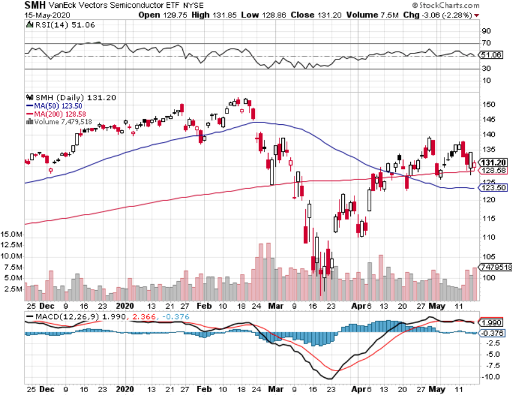
Another option is to just park your money in the semi ETF VanEck Vectors Semiconductor ETF (SMH) or iShares PHLX Semiconductor ETF (SOXX).
On the flip side, cloud stock’s backbone of recurring monthly revenue is just too savory.
The constant cash flow with minimal international risk along with pristine balance sheets is what makes U.S. cloud companies top on the list of trade alert candidates.
That won’t stop anytime soon as the pandemic has offered us more conviction into the moat between cloud stocks and the rest of technology.
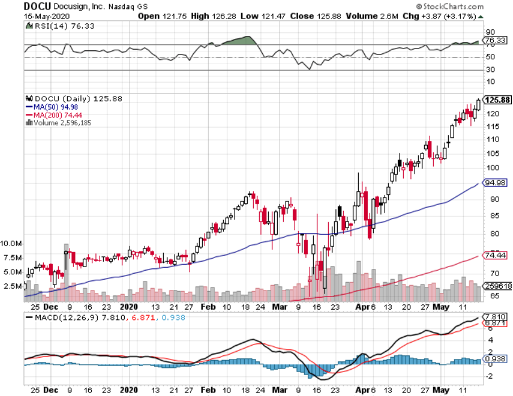
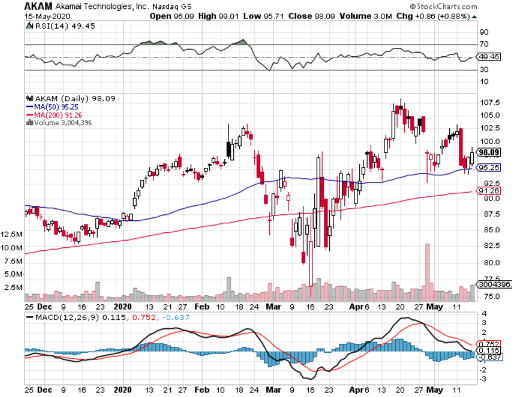
I apologize if I sound like a broken record, but I love my Akamai’s (AKAM) and DocuSign’s (DOCU), they have the growth portfolio that backs up my thesis.
Buy cloud stocks on the dip.
“If you are a big company, a big website, and lots of users come to your website, you will have attacks, and you have to deal with that.” – Said Founder and CEO of Baidu Robin Li

Mad Hedge Technology Letter
May 15, 2020
Fiat Lux
Featured Trade:
(WHY UBER IS BUYING GRUBHUB),
(GRUB), (UBER)


To understand the unintended consequences of the Fed’s helicopter money to U.S. capitalism, we can put a magnifying glass over Uber’s (UBER) recent takeover attempt of Grubhub (GRUB) as what’s in store for not only the tech sector but the wider public markets.
Zombie companies parade around Europe and Japan because of an era of low interest rates and cozy bank relationships that keep these companies from dying out.
To read more about Allianz Economic Advisor Mohamed El-Erian’s take on zombie companies – click here.
It’s not a surprise that Japan and Europe are highly unproductive, and innovation ceases to exist when capital is being tied up in marginal companies with management happy to let capital slosh about without adding extra added value.
I get it that the Fed is trying to “save” the wider U.S. economy by bringing out the bazookas and even by buying junk-graded debt which was once seen as heresy.
But what we have now are inferior companies that will never turn a profit masquerading as real companies that would be on life support if not for cheap capital.
In almost every instance, the only winners are the executive management who pillage the system and cash out when they are allowed to sell their stock.
U.S. Representative for Rhode Island David Cicilline hit the nail on the head when he described the fluid situation by focusing on two of the bad apples, saying “Uber is a notoriously predatory company that has long denied its drivers a living wage. Its attempt to acquire Grubhub — which has a history of exploiting local restaurants through deceptive tactics and extortionate fees — marks a new low in pandemic profiteering.”
Uber is a taxi service that undercompensates its highest expense - the driver, and Grubhub delivers restaurant food but rips off the restaurants in doing it.
I defined exorbitant delivery fees as up to 40% which Grubhub is infamous for charging.
Yes, even with predatory practices, they cannot turn a profit.
Now, in this new normal of coronavirus, it would be a miracle to make any operational headway.
Uber’s attempted market grab is a giant red flag.
My guess is that they are doing this in order to jazz up the balance sheet and concoct some ridiculous new metric showing a pathway to growth.
By adding growth to revenue, Uber would be able to preach “growth” even if it’s of bad quality.
I thought the tech market was done looking through to grow by essentially killing off the “WeWork model.”
However, Uber is going for a model that is one notch above that model and repurposing it as something actually meaningful, which of course, it’s not.
They are already in litigious hell regarding driver’s remuneration, and that will not die down and could even destroy Uber.
Uber has in fact ignored California state orders to reclassify its drivers as employees and have appealed the court’s decision.
The New York state government has validated my theory of these fly-by-night delivery outfits being a net negative for business and society.
The New York City Council compared food ordering apps Grubhub and UberEats to blood-sucking parasites this week before passing emergency legislation aimed at helping struggling restaurants lower delivery costs during a precarious time.
During the state of emergency, a new vote passed capping food ordering and delivery app fees at 15% in delivery fees and 5% “other” takeout order fees.
To read more about this decision by the New York City Council – click here.
This was done to give some power back to the restaurants that have been getting fleeced.
The balance sheet shows the whole story with Uber's net loss totaling more than $8.5 billion in 2019 and in February, they reported a net loss of $1.1 billion in the fourth quarter.
Let me remind readers that Grubhub posted a net income loss of $27.7 million for the last reported quarter as well.
As it turned out, Grubhub rejected Uber’s offer believing it didn’t meet their valuation of the company.
It would appear natural that a predatory company with no competitive advantage would set a market premium that would align with their borderline extortionate ways.
Do not own either one of these companies – there are far better ones out there in tech and no need to scrounge at the bottom of the barrel.
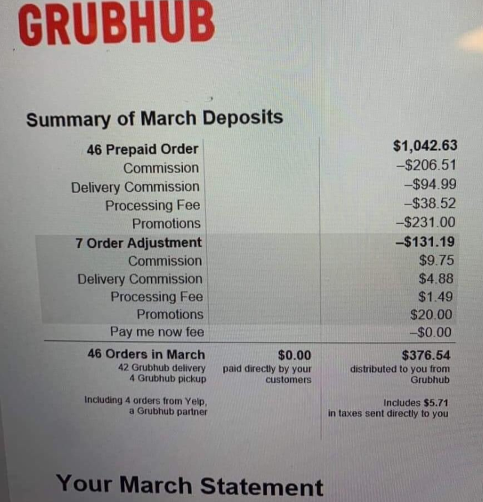
Monthly Grubhub bill for Chicago Pizza Boss During the Epidemic

“My goal was never to make Facebook cool. I am not a cool person.” – Said Co-Founder and CEO of Facebook Mark Zuckerberg
Mad Hedge Technology Letter
May 13, 2020
Fiat Lux
Featured Trade:
(CHEGG IS ANOTHER WINNING “STAY AT HOME” STOCK),
(CHGG)
There certainly will be crippling longer-term implications for the airline industry, hotel chains, and of course hospitality – but I can’t say the same for online learning platform Chegg (CHGG), which is now a great option if you're looking for tech stocks to invest in.
Chegg, is a U.S. education technology company based in Santa Clara, California who has hit pay dirt with this coronavirus epidemic.
Chegg provides digital textbook rentals, online tutoring, and other digital student services.
Schools around the U.S. and the world closed in an effort to slow the spread of the coronavirus as well as protecting our future leaders.
Despite the domestic economy on the verge of reopening, it is unclear when schools will.
Naturally, parents are also afraid to allow their children in a school environment where bacteria and germs act as a giant petri dish.
To read more about how schools are having a heck of a time reopening, click here.
Digital learning was already becoming part of the playbook, as college costs continued to soar unabated.
A rule of thumb in every industry is that a crisis often accelerates the inevitable and that is what I see happening in higher education.
Chegg is a portmanteau of the words chicken and egg and references the founders’ unenviable experience of being unable to obtain a job without experience while being unable to acquire experience without a job like many young graduates complain about.
With that in mind, the founders of Chegg, Aayush Phumbhra, Osman Rashid, and Josh Carlson, aspired to disrupt the textbook industry.
Business grew fast in the early stages – the company adjusted its business model to reflect that of Netflix's then rental-based model, concentrating on renting textbooks to students in 2007.
Eventually, the growth led into a textbook rental partnership with education mainstay Pearson Education.
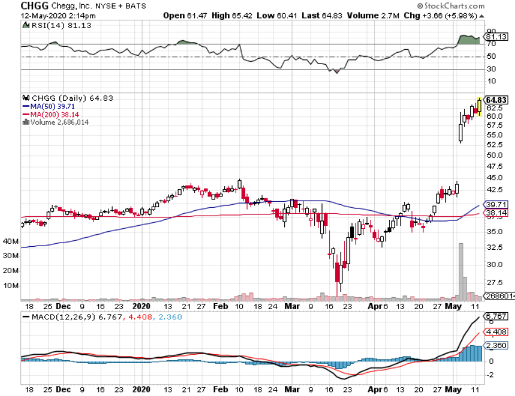
Fast forward to today and Chegg’s stock chart looks like a hockey stick with shares going from $30 to $64 in 2 months.
Chegg’s first quarter revenue jumped 35%, with its services sales up 33% to account for 76% of its total revenue.
The firm also saw the number of Chegg Services subscribers surge 35% to over 3 million for the first time.
And the company forecasted that the momentum it experienced at the end of the first quarter will carry over into Q2, with it calling for its “Q2 subscriber growth to be greater than 45%.”
The substantial increase in engagement from existing subscribers is following through into a meaningful increase in the take rate of the new Chegg Study Pack, much earlier than expected.
Chegg Study Pack is a three-in-one package that bundles together Chegg Study, Chegg Math Solver, and EasyBib Plus. To understand more about the Chegg Study Pack and Chegg’s other online learning products, click here.
Chegg did not provide guidance for the second half of 2020 due to many unknowns such as school start dates, enrollment trends, and whether schools will be taught on-campus, online, or both.
The pain doesn’t stop with the toddler, what about the young adults?
The Graduating Class of 2020 is confronted with the worst hiring climate in history that has seen rescinded internships and evaporating job offers.
These students might back out of the job market completely before they get a sniff and elect to attend graduate school, meaning more online learning in the short-term.
To read about the hardships for fresh graduates, click here.
I am encouraged by Chegg's strong trends 1Q into 2Q and the broader shift of higher education in Chegg's wheelhouse, whether done on or off-campus.
Investors are focused on firms that can grow during semi-apocalyptic conditions, especially ones that seem poised for longer-term expansion within a future-looking industry like Chegg.
Meanwhile, Chegg’s adjusted second quarter earnings are expected to explode to 48% and EPS at $0.34 a share. Overall, the company’s adjusted fiscal year EPS figures are projected to surge to 33% and 22%, respectively.
Shares are overheated for the time being and readers should wait for a significant dip in shares as we approach the summer.
Buy that dip because remote learning is here to stay and first movers like Chegg will have staying power with their sticky products.
With the gains concentrated in biggest names in the Nasdaq, there is a sprinkling of uber growth names of the likes of Chegg, Docusign, Datadog, and Teladoc that are outperforming by an order of magnitude.
The issue I have with smaller cap tech stocks right now is that large cap tech stocks have durability because of balance sheet strength.
If there is a sell-off, investors will migrate further up the food chain, meaning FANGs.
As the FANGs make new highs, they continue to reward long-term investors paying a high premium of a future increase in cash flow.
Lastly, FANGs are the biggest beneficiary of the rerating of the tech market after the unprecedented surge of Fed helicopter money.
Sadly, the smaller caps do not get the lions’ share of the Fed funding funneled into its shares.
The bottom line is that the dreaded coronavirus is mutating from its original version, and this iteration has been reported to affect children.
To read about the virus mutation, please click here.
The reopening of schools is going to be staggered, expensive, unfair, and controversial in the best-case scenario.
It’s impossible to envision that students won’t be given a huge dose of Chegg’s digital learning products and even though not a FANG, the secular tailwinds in Chegg are too powerful to ignore, making it again, one of the good tech stocks to invest in.
I am bullish Chegg (CHGG).

“If you can't make it good, at least make it look good.” – Said Co-Founder of Microsoft Bill Gates
