Mad Hedge Technology Letter
September 10, 2021
Fiat Lux
Featured Trade:
(YOUR GUIDE TO THE METAVERSE)
(RBLX), (FB), (MSFT), (APPL), (AMZN), (EPIC GAMES)


Mad Hedge Technology Letter
September 10, 2021
Fiat Lux
Featured Trade:
(YOUR GUIDE TO THE METAVERSE)
(RBLX), (FB), (MSFT), (APPL), (AMZN), (EPIC GAMES)

People have no idea what the Metaverse is, so I will be the one to fill you in.
What is the Metaverse? Simply put, the Metaverse is the next mega-phase of the internet, a merging of the physical world with XR, AR, and VR that is just beginning to revolutionize.
It is an extensive online world transcending individual tech platforms, where people exist in immersive, shared virtual spaces. Through avatars, people would be able to try on items available in stores or attend concerts with friends, just as they would offline.
On a recent earnings call, Facebook (FB) CEO Mark Zuckerberg detailed the Metaverse: “It's a virtual environment where you can be present with people in digital spaces,” he said. “You can kind of think about this as an embodied internet that you're inside of rather than just looking at. We believe that this is going to be the successor to the mobile internet.”
Does the Metaverse exist anywhere yet? The answer is yes, early versions of it. The closest approximations of it right now include the likes of digital game platforms Roblox (RBLX) and Fortnite.
The internet era was defined by the computer being in the living room and the connection to the internet being occasional.
The shift to mobile computing is defined by moving the computer from the living room to the office and into your pocket and changing access to the internet from occasional to continuous and persistent.
Metaverse is the idea of computing everywhere, ubiquitous, ambient. In a simplified sense, think about the Metaverse as a series of interconnected and persistent simulations.
One could almost describe it as the next internet, web 3.0.
And crypto, or some sort of crypto offspring or cousin of it, will be the coin of this new realm which is why crypto in its form now is so important.
Consider the internet and mobile internet. Over time it disrupted nearly every industry in nearly every geography.
It changed how consumers patronized, business models, products, behaviors. This produces an extraordinary economic opportunity overall.
The same will happen via the Metaverse.
In the future, instead of just doing calls over a phone call, you’ll be able to sit as a hologram on a couch, or I’ll be able to sit as a hologram on your couch, and it’ll actually feel like we’re in the same place even though it is remote.
Sharing space is what humans perceive as closer to something real.
There’s spatial audio in which distance can change the meaning of a sentence.
This has been in the works for years, ever since Zuckerberg bought Oculus in 2014 and Oculus is effectively the gateway to the Metaverse that Zuckerberg wants to spawn.
Other power Silicon Valley elite are also moving forward into the Metaverse for their own objectives. Microsoft (MSFT) CEO Satya Nadella commented at his earnings call, “As the digital and physical worlds converge, we are leading in a new layer of the infrastructure stack, the enterprise Metaverse."
Many Metaverse believers say the economy of the Metaverse will be larger than that of the physical world.
Personally, I believe it will be 100X larger than the physical world’s economies and much more dynamic.
One of the biggest winners of this Metaverse race will be Epic Games —owner of Fortnite —founded by CEO Tim Sweeney.
Epic released "Fortnite" just five years ago. The game now has 350 million registered players, with anywhere from six to 12 million people playing at any given time.
The Metaverse is a great example of a technology that will likely bring huge benefits to people but there will be unintended, unanticipated costs and harms.
Right now, the Metaverse operates with zero regulations, while its previous iteration, the internet, operates with the least number of regulations out of any major industry in 2021.
The bottom line is that every power Silicon Valley has skin in the game such as Facebook, Apple, Amazon, Microsoft, and Netflix after Epic Games, and they will receive another supercharger to accelerating revenue growth.
The revenue growth in the Metaverse for these companies will make what they earn in the physical world look like a pittance.
We are driving to that point in tech development through hell or high water, and like how every company became a tech company to survive, when the Metaverse and an operable iteration of it become good enough for people to transact smoothly, every company will have to become a Metaverse company or die.
This is the future and it’s creeping closer by the day.


Global Market Comments
September 10, 2021
Fiat Lux
Featured Trade:
(SEPTEMBER 8 BIWEEKLY STRATEGY WEBINAR Q&A),
(TLT), (PLTR), (TSLA), (FCX), (PYPL), (TAN), (FSLR), (SPWR), (GBTC),
(ETHE), (BRKB), (USO), (UNG), (HD), (IBM), (SQ), (AA), (UBER), (UROY)

Below please find subscribers’ Q&A for the September 8 Mad Hedge Fund Trader Global Strategy Webinar broadcast from the safety of Silicon Valley.
Q: Do you think we’ll see the under $130 in the United States Treasury Bond Fund (TLT) before January 2022?
A: I don’t think so; I think we could go below $140, maybe below $135. But $130 would be a brand new low in the move and would be a stretch. We basically lost 4 months on this trade due to the countertrend rally, which just ended. I would come out of your (TLT) $130-$135 vertical bear put spreads right here while they still have time value, but keep the $135-$ 140s, the $140-$145’s, and especially the $150-$155’s. The idea was that you just keep averaging up and up until the market turns, and then you make back any loss. We move into accelerated time decay on those deep out of the money put spreads in December, so I would take the money and then offset it with the gains you made in those positions.
Q: Does Palantir (PLTR) look like it’ll hit $100 by year-end?
A: No, the stock has been dead, and management has not been doing anything to promote it. We did get a move up to $45 but it failed. It’s still a great long-term idea as they are growing at 50% a year. Also, they did buy $50 million worth of gold bars as a hedge. But as a short-term trader, Palantir isn’t working. If you have an options position on that I would probably get out of it or roll it forward to 2023.
Q: PayPal (PYPL) is fluctuating up and down with Bitcoin. Do you like PayPal?
A: Absolutely, but it obviously is being dragged down by Bitcoin. It is a temporary down move caused by a one-time-only event in El Salvador. Buy the dip in PayPal. It is a leader in the whole move into a digital financial system.
Q: When is Freeport McMoRan (FCX) likely to move up?
A: As soon as we shift out of the tech trade into the domestic recovery trade, which could be in weeks or months at the latest. We’ll switch from one side of the barbell to the other.
Q: Where do you see Tesla (TSLA)?
A: It keeps going up, so my guess is we top $800 by the end of the year, and maybe $850. The big news here is that Tesla has gone into the chip business, making its own chips in-house which is easy for them to do in Silicon Valley. But it does make them the first global car maker that is also a chip maker, and therefore the stock deserves a higher premium. The stock went up $30 on the news and is great for all Tesla holders. I hope you have the 2023 LEAPS.
Q: Too late to buy Tesla LEAPS?
A: Unless you’re really deep in the money, with something like a $600-$650; but the return on that will only be about 50% in 2 years.
Q: The Biden administration just set a goal of 45% solar by the end of 2050. Which solar stock should I buy here?
A: The problem with solar is as soon as Biden started winning primaries, every solar stock took off like a rocket, figuring he’d win, which he did. All of them went up 6-fold or more as a result of that, then gave up one-third of their gains and are now moving sideways. So if you look at the charts, the classic one to buy here is the Invesco Solar ETF (TAN), a basked of the top solar companies. All of these peaked in February and have been doing sideways “time” corrections since then, which means they eventually want to go higher. The other two that have charts that look like they’re finally starting to break out to the upside are First Solar (FSLR) and SunPower (SPWR) after 8 months of consolidation.
Q: Why is the second half of September almost always bad? Is it due to institutional repositioning?
A: Not really, the cash comes into the market at certain times of the year, like end of the year, beginning of the year, and end of each quarter. September seems like the month where they kind of just run out of money. But there's actually also a historical reason for that. For most of American history, we had an agricultural economy. Farmers were more than half the population, and the period of maximum distress for farmers is September, where they put all the money into seed and fertilizer and labor into the field, but they haven't harvested it yet. So, traditionally, they always did a lot of borrowing in September, which caused a cash squeeze and interest rate spike, and a stock market panic as a result. So that's the history behind weak Septembers and Octobers. Once the farmers get the crops in and sell them, that resolves the cash squeeze, interest rates fall, and it’s straight up for stocks for the rest of the year most of the time.
Q: SPACs (Special Purpose Acquisition Companies) seem to be losing interest. Do you recommend any or stay away?
A: Stay away—they’re all rip-offs and are simply a means by which managers can increase their fees from 2% to 20%. That's what they did with virtually all of them. This will end in tears.
Q: What's your feeling about satellite internet phone service replacing current internet cell service in the future?
A: It’s in the future, but it may be 10 years off in the future. If it happens sooner, it’s because Elon Musk was able to deliver cheap rocket service. He already has 20,000 satellites in the sky for his own Starlink global cell phone service for internet access.
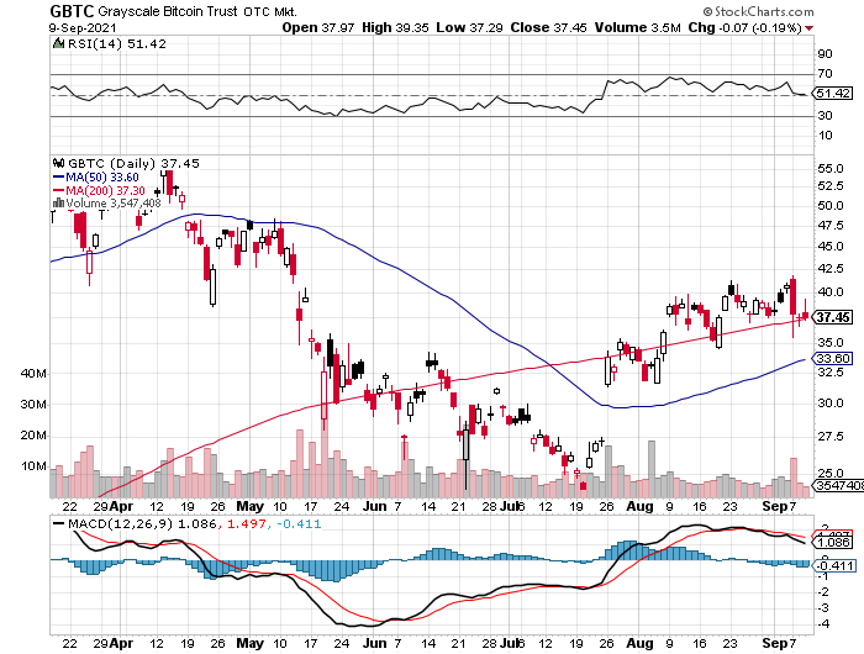
Q: How does one buy a Bitcoin stock?
A: Well first of all, I highly recommend you buy the Mad Hedge Bitcoin Letter, which you can get in our store. But there's also the Greyscale Bitcoin Trust (GBTC) which allows you to buy a Bitcoin proxy very easily. I’ll even honor the discounted $995 price for my Bitcoin Letter for another day by clicking here.
Q: Is Warren Buffet and his value philosophy something I should be following, or is he outdated?
A: I have to say, buying stocks cheap with high cash flow will never go out of style. Currently, Warren’s big holdings are domestic industrials, banks, and Apple. All of those look like they will do well moving forward. Buffet’s Berkshire Hathaway (BRKB) has a built-in barbell element to it and is the subject of one of our LEAPS recommendations which has already been hugely successful.
Q: Is Home Depot (HD) at $330 a bargain?
A: Well, we just had a selloff and it bounced hard, and now we’re waiting for the domestic post delta recovery. It's hard to imagine both Home Depot and Lowes not doing well in this scenario.
Q: What will happen to tech when interest rates rise?
A: My bet is they go sideways to down small until you get another peak in interest rates (the next peak will be at 1.76% in the ten year US Treasury bond, the 2021 high) and once you hit that, then tech will take off like a rocket again, and in the meantime, you play the domestics while interest rates are rising. That is the game and will continue to be the game for a couple of years.
Q: Should I buy IBM (IBM) on a turnaround story?
A: No, I've been waiting for IBM to turn around for 10 years. They just don’t seem to get it. What they do is whenever a division starts to make money, they sell it and get cash like they did with the PC division and this year with its infrastructure business called Kyndryl. So, they’re not leaving any growth for the actual IBM holders.
Q: Do you like Square (SQ) at $256?
A: Yes, and that would be a great 2023 LEAPS candidate. All of the digital settlement payment systems are going to do well in the Bitcoin future. They also own quite a lot of Bitcoin. They are leading the charge into a digitized financial system.
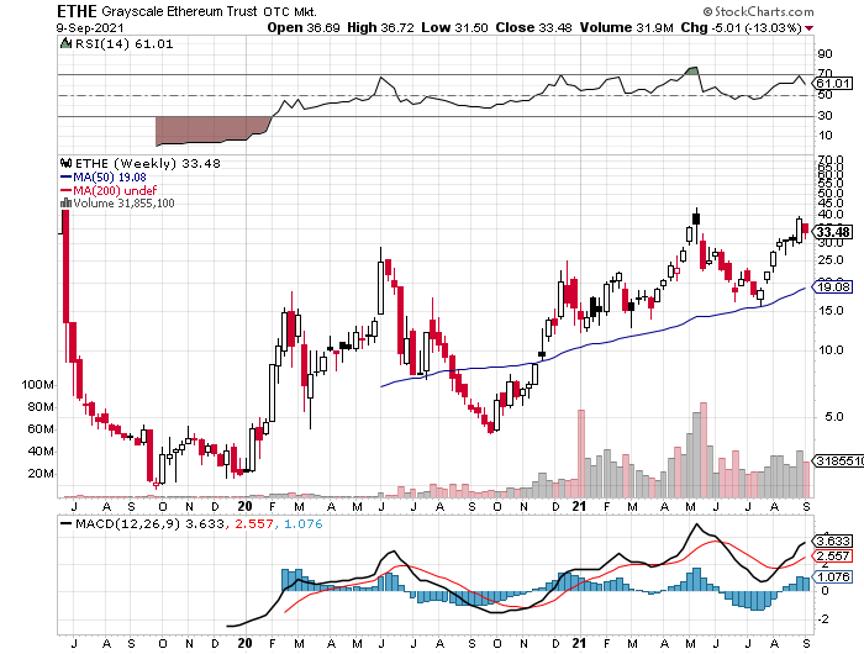
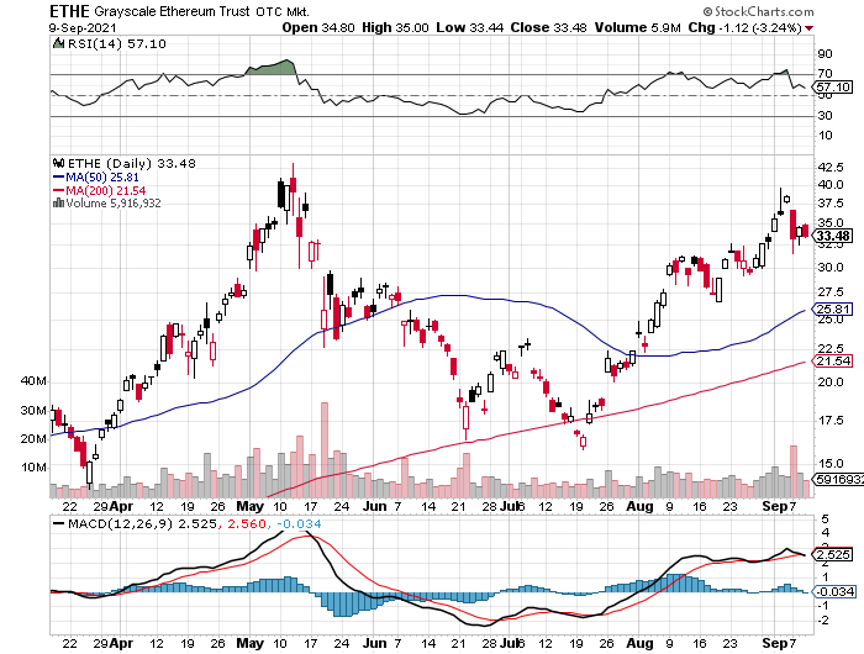
Q: What’s a good Ethereum ETF?
A: The Greyscale Ethereum Trust (ETHE) is just the ticket.
Q: So you avoid energy, meaning oil and gas?
A: Yes, alternative energy we like, but it’s had an enormous run already so after a 7-month time correction it’s probably safe to get into solar. Traditional oil and gas (USO) is in a long-term secular bear market that started 13 years ago and will eventually go to zero. Last year’s visit to negative futures prices is just a start. Since 2020, the energy market weighting has gone from 15% to 2%.
Q: Is Natural Gas the only rational core fuel for the grid?
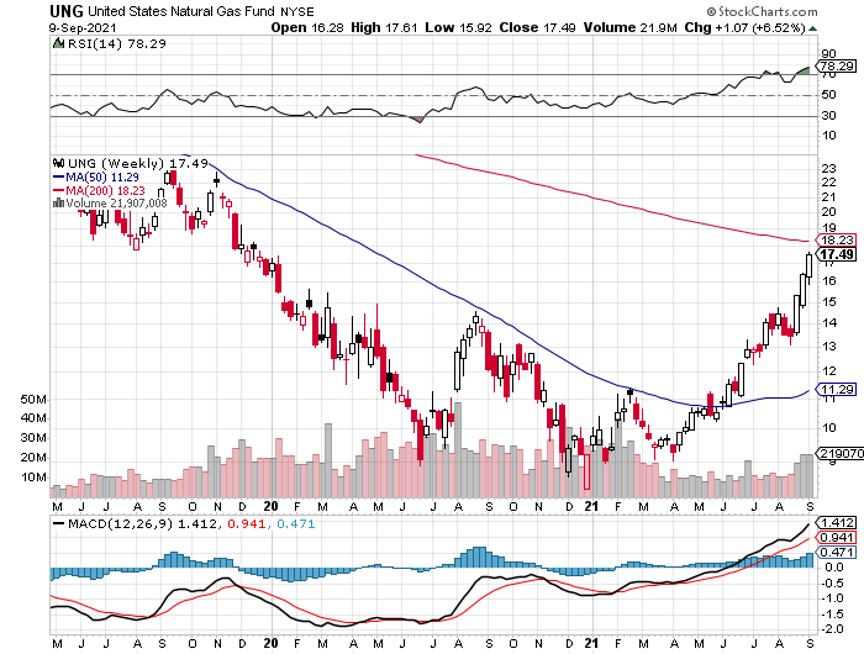
A: No, natural gas (UNG) still produces carbon even though it’s only half the amount of oil. This all gets replaced by solar in the next ten years. That’s why I tell people to stay away from energy like the plague. Would you rather buy natural gas at $4.50/btu or get solar electricity for free? Those are basically going to be the choices in ten years.
Q: Who is the biggest Aluminum producer?
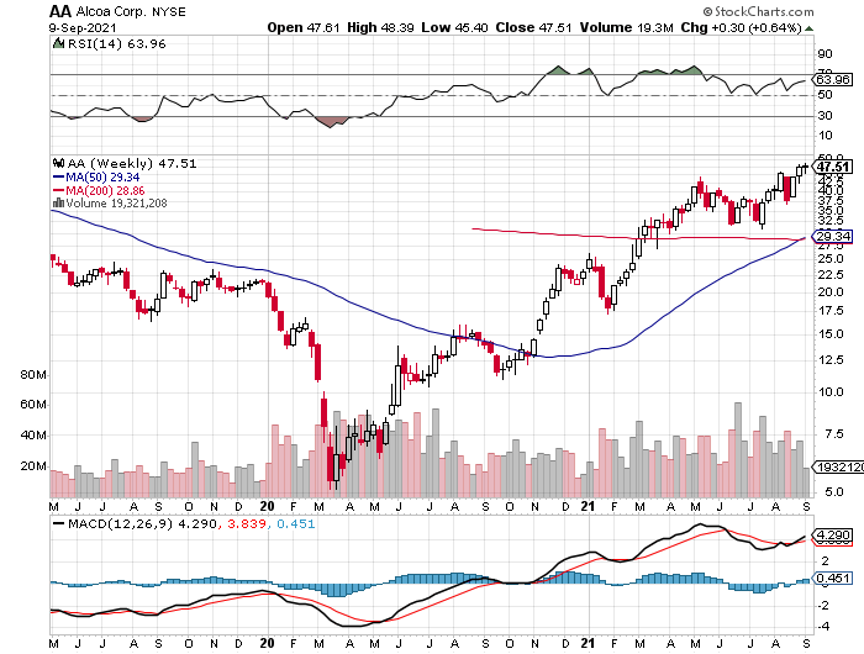
A: Alcoa (AA) which we are a buyer on dips. By the way, if we do have to build 200,000 miles of long-distance transmission lines to cover the electrification of the US energy supply, all of that has to be made of aluminum. You don't use copper for long distances, you use aluminum (aluminum for you Brits).
Q: Would you buy Uber (UBER) at $40 today?
A: Probably, yes; it had a nice 40% correction. However, you are buying into the battle over gig workers—whether they should be treated as full-time or part-time workers. That is going to be a continuing drag on the stock until they win.
Q: What do you think of meme stocks?
A: You're better off buying a lottery ticket. Even with a low payoff, you get a 1:10 chance of winning on a $1 lottery ticket. Meme stocks could double or go to zero with no warning whatsoever—there’s no logic to this market at all.
Q: What do you think of Uranium?
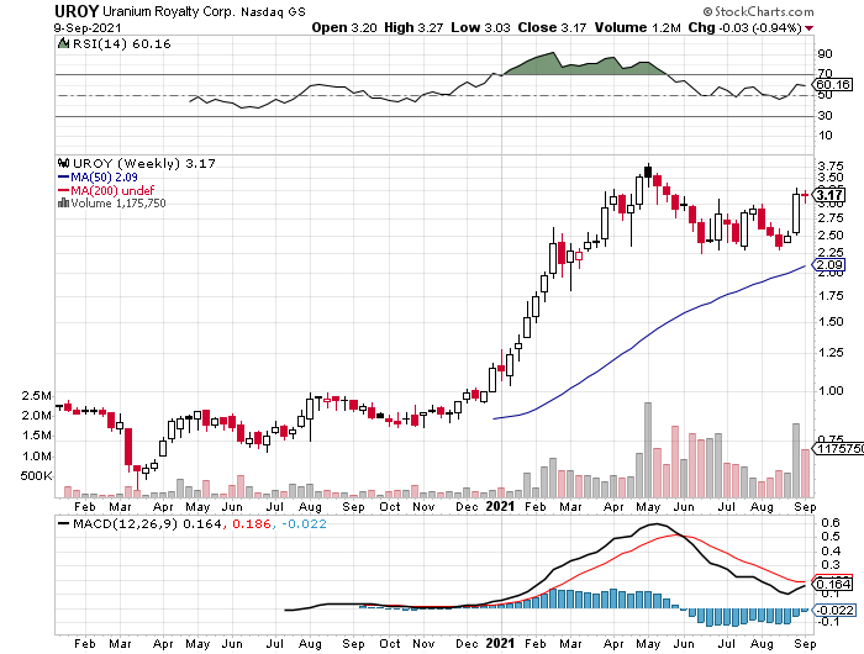
A: Three words come to mind: Chernobyl, Fukushima, and Three Mile Island. I think uranium's time has passed, even though China is building a hundred nuclear power plants. It’s just too expensive to compete against solar on a large scale and impossible to insure. If you still like Uranium though, the Uranium Royalty Corp. (UROY) has had a nice pop recently. But the issue is that nuclear technologies can’t keep up with solar and digital. And they blow up.
To watch a replay of this webinar with all the charts, bells, whistles, and classic rock music, just log in to www.madhedgefundtrader.com, go to MY ACCOUNT, click on GLOBAL TRADING DISPATCH, then WEBINARS, and all the webinars from the last ten years are there in all their glory.
Good Luck and Stay Healthy.
John Thomas
CEO & Publisher
The Diary of a Mad Hedge Fund Trader

Mad Hedge Biotech & Healthcare Letter
September 9, 2021
Fiat Lux
FEATURED TRADE:
(A STOCK FOR BARGAIN HUNTERS)
(SRPT), (MRNA), (BNTX), (FGEN), (ACAD), (RARE), (BLUE), (CRSP), (PFE)

Biotechnology stocks that have fallen by over half since 2021 started are strewn around in the market.
While the share prices of COVID-19 stocks, such as Moderna (MRNA) and BioNTech (BNTX), have skyrocketed, the others in the sector are not as fortunate.
The biotechnology segment has been filled with relative horror stories from previous favorites like FibroGen (FGEN), Acadia Pharmaceuticals (ACAD), and Ultragenyx Pharmaceutical (RARE).
Among the companies hit with disappointing news, the gene therapy sector, which has stocks like bluebird bio (BLUE) and CRISPR Therapeutics (CRSP), appears to be having a tougher time than most.
So, where does this situation leave investors? Where should we look for value?
One tactic that would help value investors take advantage of this abysmal situation is studying Wall Street analysts' moves.
Look at target prices they set for the stocks they cover and then choose the companies trading the farthest below the expected price points.
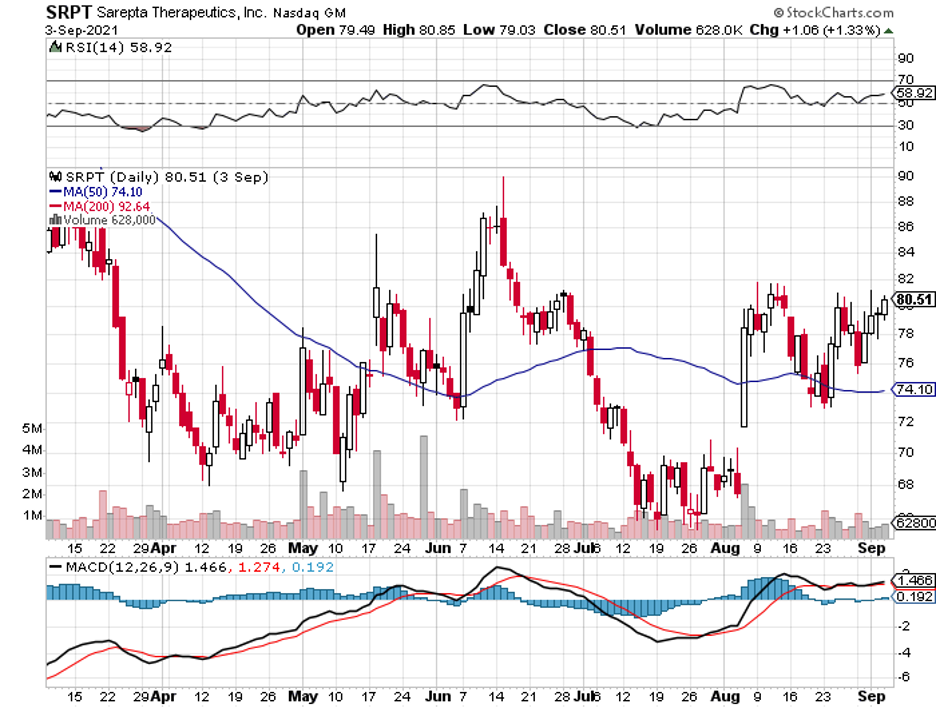
Among the biotechnology stocks struggling these days, one of the names that emerged as a truly promising investment is Sarepta Therapeutics (SRPT).
To say that Sarepta has been experiencing a disappointing year is an understatement. Shares of this company have gone on a 57% heart-stopping plunge since 2021 started.
In fact, this biotech’s nosedive is the third-worst in the midcap or larger stock sector based on the two key exchange-traded funds: iShares Biotechnology ETF (IBB) and SPDR S&P Biotech ETF (XBI).
Despite Sarepta’s abysmal performance, Wall Street still labels the stock a buy.
Sarepta’s decline started in early January when the trial results for its gene therapy for Duchenne muscular dystrophy (DMD) failed to impress investors.
However, the subsequent trial for the same gene therapy, dubbed as SRP-9001, is anticipated to yield better results.
Although the results are expected to be released by late 2022 or early 2023, holding the stock for now is estimated to deliver remarkable profits for patient investors.
At this point, Sarepta stock is trading at roughly $80 per share.
However, experts predict that the next results for SRP-9001 would push the shares to climb to over $200.
DMD, which is a rare degenerative condition characterized by gradual weakening of the muscles, affects about 16,840 people in the US.
So far, the US FDA has only approved a handful of treatments for DMD—three of which are RNA-based drugs developed by Sarepta.
Evidently, the company has a firm grasp of the condition and a proven track record of launching and marketing DMD-centered products.
More importantly, this makes Sarepta a dominant—if not the most dominant—force in the DMD market.
What makes their newest treatment, SRP-9001, different is that it works on DNA. Despite the extended timeline, Sarepta’s candidate remains the frontrunner in this endeavor.
Its closest threat is PF-06939926, an investigational drug from Pfizer (PFE) that uses the same technology as SRP-9001.
At the very least, this competitor is two years away from producing any tangible result.
By the time Pfizer reaches Phase 3, Sarepta’s SRP-9001 has already generated roughly $1 billion in sales.
Apart from the three approved drugs, Sarepta still has 34 drug development programs focused on two niches: RNA and AVV gene therapies. Among them, 7 are already in the clinical stage, including SRP-9001.
If successful, the company will reach $1 billion in revenues by 2023.
Another reason that makes Sarepta an attractive opportunity is its notably intact cash flow backbone—an achievement that’s worth pointing out considering its underwhelming SRP-9001 results.
The company also has an impressive history.
Sarepta has blossomed from its humble beginnings working as a contractor for the Department of Defense on the Ebola virus. Since then, it has developed its pipeline through acquisitions and launching effective treatments for rare diseases.
While Sarepta’s treatments are effective, they cannot cure DMD. They can only slow its progression.
This means continuous and life-long use among patients. For context, one treatment costs an average of $300,000 per patient annually.
Although it lost over 50% of its value, Sarepta still has enough capacity to rebound soon.
The factors that would help the company achieve this include the strong lineup of products generating solid and predictable revenues as well as its promising pipeline.
More importantly, its struggles with SRP-9001 don’t seem enough for the company to scrap the project altogether.
If anything, it proved that Sarepta can explore more potent treatments for DMD by looking into RNA technology—a path that the likes of Moderna and BioNTech have already found success in.
Overall, I think Sarepta still has a lot left in the tank. It operates in one of the most exciting sectors.
It’s worth bearing in mind that the biotech sector is ripe with innovation from companies with the ability to conjure up life-changing treatments—a value perceived as a crucial hallmark for massive gains.
Needless to say, Sarepta’s achievements in the DMD sector and its growth trajectory make it a shoo-in in this category.
Mad Hedge Bitcoin Letter
September 9, 2021
Fiat Lux
Featured Trade:
(BEST WAY TO EARN PASSIVE INCOME IN CRYPTO)
(CELSIUS NETWORK), (BTC), (ETH), (SNX), (CEL), (LINK), (UNI), (AAVE)

So global yields are in the toilet today?
Savings accounts don’t do what they used to do, do they?
How about we try out a certificate of deposit (CD) to harvest some cash?
Are there simply no other interest-bearing vehicles one can park capital in and gain a healthy return?
I would say you are right, but then I would be the fool here and I am certainly not in that line of work. But there is an elixir to the anathema.
Enter the world of crypto-based yield, the place you end up when you realize the banks stopped trying years ago. There are no logos to worship and no slick pitches to fall for, only the tools that actually make your money move.
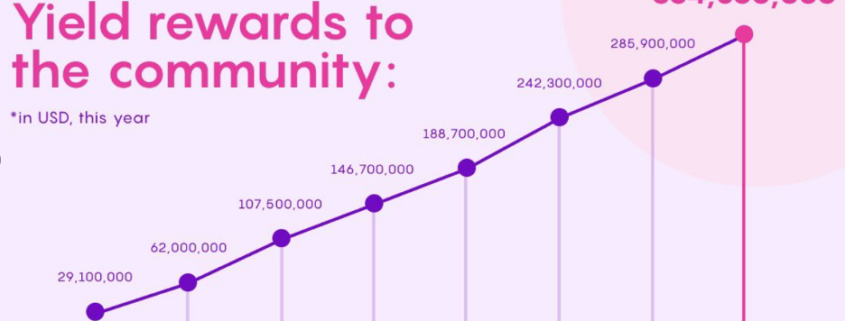
This is a landscape of financial mechanisms built on collateralized lending, decentralized liquidity pools, and blockchain driven demand, designed to offer yields traditional banks would not dare whisper about.
Back in the early 2020s, centralized crypto lenders promised stable, high-yield returns by lending digital assets to traders and institutions.
The model was clear on paper: depositors supplied assets, borrowers posted collateral, and interest payments cycled back to the depositors.
The appeal was obvious, too. Floating rates far above bank offerings, over-collateralized loans that ostensibly reduced default risk, and automated liquidation engines that protected lenders from sharp drawdowns.
But those years also revealed something deeper: crypto yield wasn’t magic; it was mechanics. And mechanics depend entirely on transparency.
Several major lenders that once rode parabolic growth arcs ultimately shut down or restructured following liquidity stress and market drawdowns.
These events carved a permanent lesson into the industry: when yields come from undisclosed leverage, black-box rehypothecation, or concentrated risk, the music eventually stops.
Today’s more mature landscape emphasizes mechanisms rather than miracles:
These systems function best when transparency is verifiable, incentives are aligned, and custody risks are minimized.
They fail when promised APYs float on wishful thinking, opaque balance sheets, or dependence on perpetual bull markets.
For years, the traditional banking business has conditioned us naive folk to accept steep fees and no yield earnings on holdings as the status quo.
I will tell you right now that it’s a load of garbage and nobody should accept these pitiful offers from dinosaur banks.
There is so much more out there that we can access now because of crypto.
But as of 2025, the responsible path isn’t chasing a single platform but understanding the underlying engine.
Evaluating any crypto yield opportunity now requires asking questions like:
You’re not dreaming, crypto yield does exist. But in 2025, the real deal isn’t a single star player but in an entire ecosystem’s hard-earned maturity.
Wake up to a clearer understanding of how crypto yield works, easily convertible into better financial decisions.
Participate not by trusting a brand name, but by understanding the mechanics that make the entire machine run.
If the early 2020s were defined by explosive growth and painful lessons, the mid-2020s are defined by something far more sustainable: clarity.
These days, crypto yield is no longer a deal of a lifetime but a financial primitive. And like any powerful tool, it rewards those who learn how to use it responsibly.

Global Market Comments
September 9, 2021
Fiat Lux
Featured Trade:
(HOW THE “UNDERGROUND” ECONOMY IS EXPLODING)


There is no doubt that the “underground” economy is growing.
No, I’m not talking about violent crime, drug dealing, or prostitution.
Those are all largely driven by demographics which right now are at a low ebb.
I’m referring to the portion of the economy that the government can’t see at all, and therefore is not counted in its daily data releases.
This is a big problem.
Most investors rely on economic data to dictate their trading strategies.
When the data is strong, they aggressively buy stocks, assuming that a healthy economy will boost corporate profits.
When data is weak, we get the flip side and investors bail on equities. They also sell commodities, precious metals, oil, and plow their spare cash into the bond market.
We are now more than halfway through a decade that has delivered unrelentingly low annual GDP growth, around the 2%-2.5% level.
We all know the reasons. Retiring baby boomers, some 85 million of them, are a huge drag on the system, as they save and don’t spend.
Generation Xers do spend, but there are only 58 million of them. And many Millennials are still living in their parents’ basements—broke and unable to land paying jobs in this ultra cost-conscious world.
But what if these numbers were wrong? What if the Feds were missing a big part of the picture?
I believe this is in fact what is happening.
I think the economy is now evolving so fast, thanks to the simultaneous hyper-acceleration of multiple new technologies that the government is unable to keep up.
Further complicating matters is the fact that many new internet services are FREE, and therefore are invisible to government statisticians.
They are, in effect, reading from a playbook that is a decade or more old.
What if the economy was really growing at a 3-4% pace, but we just didn’t know it?
I’ll give you a good example.
The government’s Consumer Price Index is a basket of hundreds of different prices for the things we buy. But the Index rarely changes, while we do.
The figure the Index uses for Internet connections hasn’t changed in ten years.
Gee, do you think that the price of broadband has risen in a decade with the 1,000-fold increase in speeds?
In the early 2000s, you could barely watch a snippet of video on YouTube without your computer freezing up and exploding the local server.
Now, I can download a two-hour movie in High Definition in just 10 seconds on my Xfinity 1 gigabyte per second business line.
And many people now watch movies on their iPhones. I see them in the rush hour traffic and on planes.
I’ll give you another example of the burgeoning black economy: Me.
My business shows up nowhere in the government economic data because it is entirely online. No bricks and mortar here!
Yet, I employ a dozen people, provide services to thousands of individuals, institutions, and governments in 140 countries, and take in millions of dollars in revenues in the process.
I pay a lot of American taxes too.
How many more MEs are out there? I would bet tens of millions.
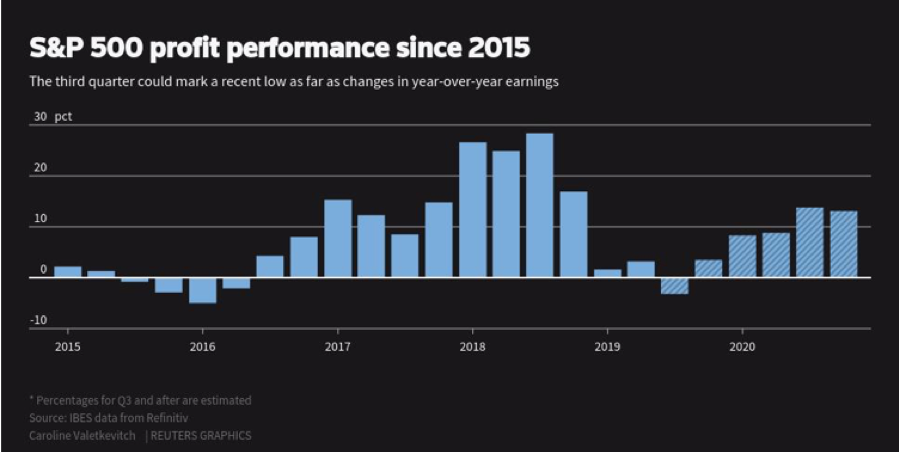
If the government were understating the strength of the economy, what would the stock market look like?
It would keep going up every year like clockwork, as ever-rising profits feed into stronger share prices.
But multiples would never get very high (now at 27 times earnings) because no one believed in the rally, since the economic data was so weak.
That would leave them constantly underweight equities in a bull market.
Stocks would miraculously and eternally climb a wall of worry. Did I mention that the S&P 500 is at another all-time high?
On the other hand, bonds would remain strong as well and interest rates low because so many individuals and corporations were plowing excess, unexpected profits into fixed income securities.
Structural deflation would also give them a big tailwind.
If any of this sounds familiar, please raise your hand.
I have been analyzing economic data for a half-century, so I am used to government statistics being incorrect.
It was a particular problem in emerging economies, like Japan and China, which we're just getting a handle on what comprised their economies for the first time.
But to make this claim about the United States government, which has been counting things for 225 years, is a bit like saying the emperor has no clothes.
Sure, there has always been a lag between the government numbers and reality.
In the old days, they used horses to collect data, and during the Great Depression, numbers were kept on 3” X 5” index cards filled out with fountain pens.
But today, the disconnect is greater than it ever has been by a large margin, thanks to technology.
Is this unbelievable?
Yes, but you better get used to the unbelievable.
As for that bull market in stocks, it just might keep on going longer than anyone thinks.