
Global Market Comments
September 20, 2019
Fiat Lux
Featured Trade:
(SEPTEMBER 18 BIWEEKLY STRATEGY WEBINAR Q&A),
(TLT), (FDX), (FB), (HYG), (JNK), (EEM), (BABA), (JD), (TBT), (FXE), (UUP), (AMZN), (FB), (DIS), (MSFT), (USO), (INDU),
(THE GREAT TRADING GURU SPEAKS)

Below please find subscribers’ Q&A for the Mad Hedge Fund Trader September 18 Global Strategy Webinar broadcast from Silicon Valley, CA with my guest and co-host Bill Davis of the Mad Day Trader. Keep those questions coming!
Q: What would happen to the United States Treasury Bond Fund (TLT) if the Fed does not lower rates?
A: My bet is that it would immediately have a selloff—probably several points—but after that, recession worries will take bond prices up again and yields down. I don’t think we have seen the final lows in interest rates by a long shot. That’s why I bought the (TLT) last week.
Q: Is it good to buy FedEx (FDX) considering the 13% fall today?
A: I use the 3-day rule on these situations. That's how long it takes for the dust to settle from an earnings shock like this and find the real price. The problem with FedEx is that it’s a great early recession predictor. When the number of delivered packages decreases, it’s always an indicator that the economy as a whole is slowing down, which we know has been happening. It’s one of the most cyclical stocks out there, therefore one of the most dangerous. I wouldn’t bother with FedEx right now. Go take a long nap instead.
Q: Would you be a buyer of Facebook (FB) here, given they seem to have weathered all the recent attacks from Washington?
A: Not here in particular, but I would buy it 20% down when it gets to the bottom edge of its upward channel—it still looks like it’s going crazy. They’re literally renting or buying buildings to hire an additional 50,000 people in San Francisco anticipating huge growth of their business, so that’s a better indicator of the future of Facebook than anything.
Q: Will junk bonds be more in demand now that rates are cratering?
A: Junk bonds (HYG), (JNK) are driven more by the stock market than the bond market, as you can see in the huge rally we just had. Junk bonds are great because their default ratios are usually far below that which the interest rate implies, but you really have to trade them like stocks. Think of them as preferred stocks with really high dividends. When the stock market tops, so will junk bonds. Remember in 2008, junk yields got all the way up to 15% compared to today’s 5.6%.
Q: What will happen to emerging markets (EEM) as rates lower?
A: If lower interest rates bring a weaker US dollar, that would be very positive for emerging markets over the long term and they would be a great buy. However, emerging markets will take the hardest hit if we actually do go into a recession. So, I would pass for now.
Q: What are your thoughts on Alibaba (BABA) and JD.com (JD)?
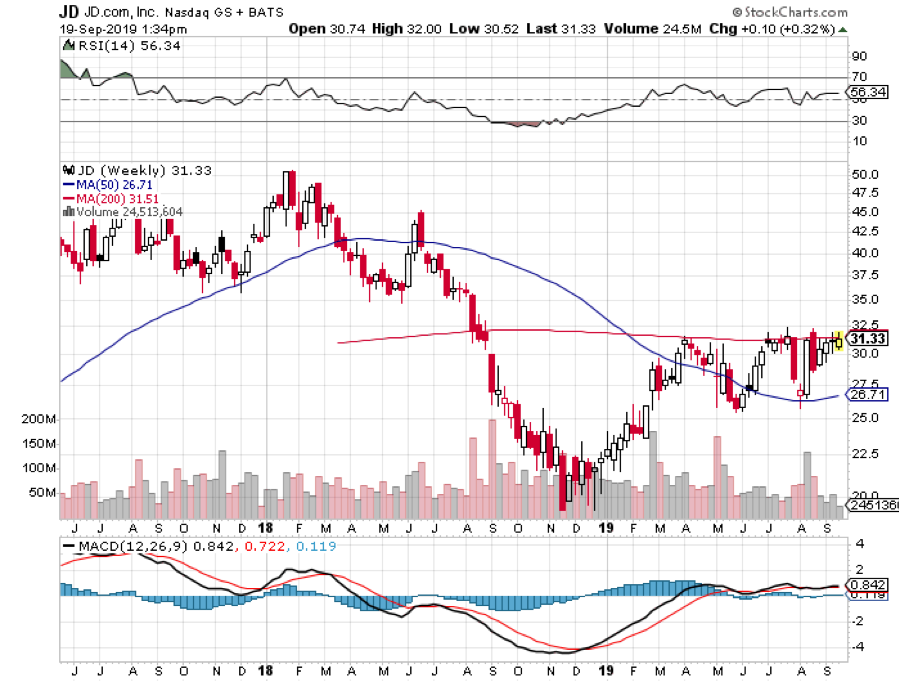
A: They are great for the long term. However, expect a lot of volatility in the short term. As long as the trade war is going on, these are going to be hard to trade until we get a settlement. (JD) is already up 50% this year but is still down 40% from pre trade war levels. These things will all be up 20-30% when that happens. If you can take the heat until then, they would probably be okay for a long-term portfolio globally diversified.
Q: What do you have to say about the ProShares Ultra Short 20+ Year Treasury ETF (TBT)—the short bond ETF?
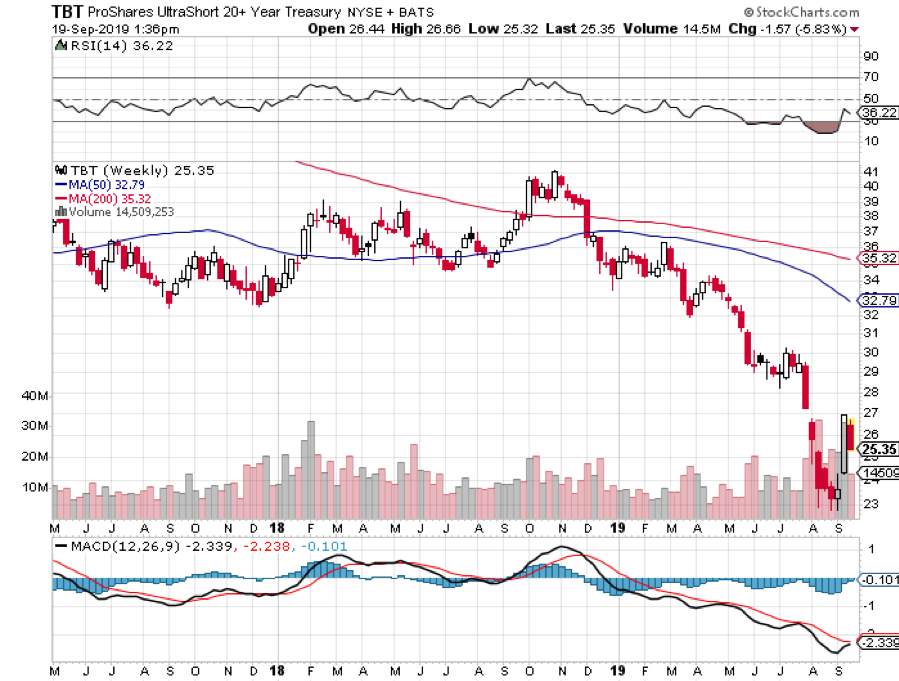
A: If you have a position, I’d be selling now. We just had a massive 20%, 4-point rally from $22 to $27 and now would be a good time to take a profit, or at least get out closer to your cost. The zero interest rates story is not over yet.
Q: Would you short the US dollar?
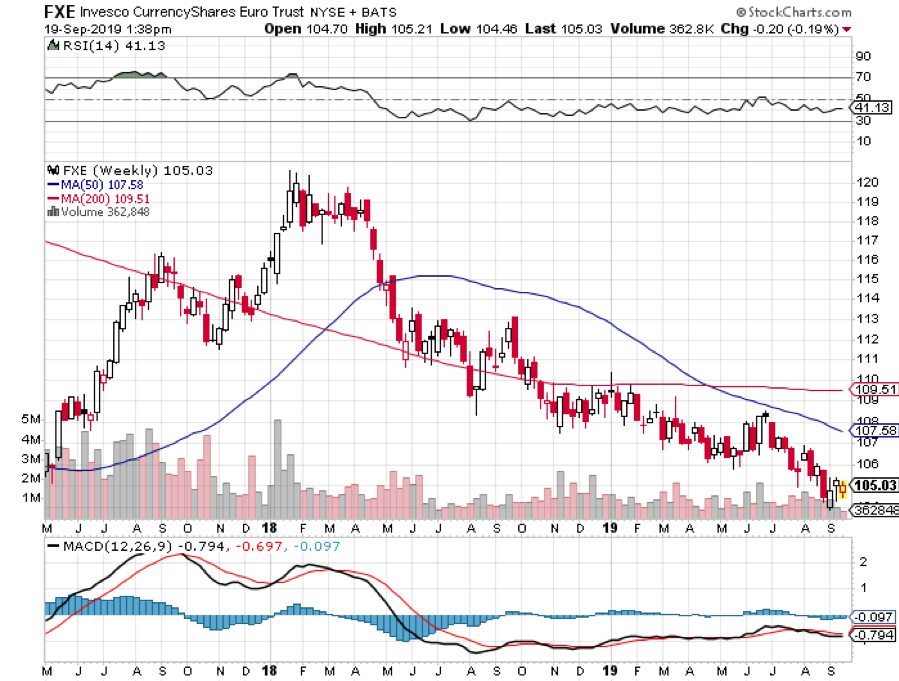
A: I would most likely short it against the euro (FXE), which now has a massive economic stimulus and quantitative easing program coming into play which should be positive for it and negative for the US dollar (UUP). That’s most likely why the euro has stabilized over the last couple of weeks. That said, the dollar has been unexpected high all year despite falling interest rates so I have been avoiding the entire foreign exchange space. I try to stay away from things I don’t understand.
Q: If all our big tech September vertical bull call spreads are in the money, what should we do?
A: You do nothing. They all expire at the Friday close in two trading days. Your broker should automatically use your long call position to cover your short call position and credit your account with the total profit on the following Monday, as well as release the margin for holding that position. After that, we’ll probably wait for another good entry point on all the same names, (AMZN), (FB), (DIS), (MSFT).
Q: If the US fires a cruise missile at Iran, how would the market react?
A: It would selloff pretty big—markets hate wars. And the US wouldn’t send one missile at Iran; it would be more like 100, probably aimed at what little nuclear facilities they have. I doubt that is going to happen. The world has figured out that Trump is a wimp. He talks big but there is never any action or follow through. Inviting the Taliban to Camp David while they were still blowing up our people? Really?
Q: Will the housing market turn on the turbochargers after this dip in rates?
A: It wouldn't turn on the turbochargers, but it might stabilize the market because money is available now at unprecedentedly low interest rates. However, we still have the loss of the SALT deductions—the state and local taxes and real estate taxes that came in with the Trump tax bill. Since then, real estate has been either unchanged or has fallen on both the East and West coast where the highest priced houses are. It’s the most expensive houses that take the loss of the SALT deduction the hardest. Don’t expect any movement in these markets until the SALT deduction comes back, probably in 16 months.
Q: What catalyst do you think would cause a 10% correction in the next 2-3 months?
A: Trump basically saying “screw you” to the Chinese—a tweet saying he’s going to bring another round of tariff increases. That’s worth a minimum of 2,000 points in the Dow Average (INDU), or about 7% percent. Either that or no move in Fed interest rates—that would also create a big selloff. My guess is that and adverse development in the trade war will be what does it. That’s why my positions are so small now.
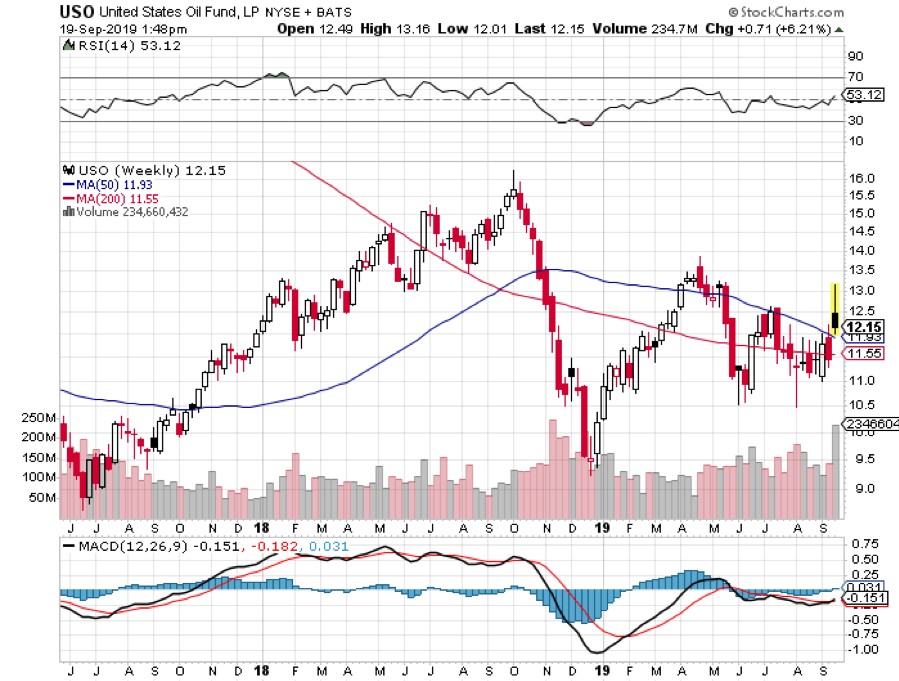
Q: We have a big short position in the United States Oil Fund (USO) now. Are you going to run this into expiration until October $18?
A: Even though oil has already collapsed by 10% since we put this position on last Friday, premiums in oil options are still close to record levels. So, it pays us to hang on for the time decay. The world is still massively oversupplied in oil and the Saudis were able to bring half of the lost production back on in a day. Oil will keep falling unless there is another attack and it is unlikely we will see one again on this scale. And, we only have 20 more days to go to capture the full 14.8% profit.
Good luck and good trading.
John Thomas
CEO & Publisher
Diary of a Mad Hedge Fund Trader
You Can’t Do Enough Research

You never know how far this research is going to go. After all, the Internet is a pretty big thing. Still, I was amused to see that my opinion on crude oil prices was picked up by none other than the Hong Kong-based Asia Times, which I wrote for 50 years ago. Please click here and enjoy.

Global Market Comments
September 19, 2019
Fiat Lux
Featured Trade:
(HOW TO RELIABLY PICK A WINNING OPTIONS TRADE)
Global Market Comments
September 18, 2019
Fiat Lux
Featured Trade:
(HOW TO HANDLE THE FRIDAY, SEPTEMBER 20 OPTIONS EXPIRATION),
(AMZN), (DIS), (FB), (MSFT), (VIX),
(INDUSTRIES YOU WILL NEVER HEAR FROM ME ABOUT)

The focus of this letter is to show people how to make money through investing in fast-growing, highly profitable companies which have stiff, long-term macroeconomic winds at their backs.
That means I ignore a large part of the US economy, possibly as much as 80%, whose time has passed and are headed for the dustbin of history.
According to the Department of Labor's Bureau of Labor Statistics, the seven industries listed below are least likely to generate positive job growth in the next decade.
As most of these stocks are already bombed out, it is way too late to short them. As an investor, you should consider this a “no go” list no matter how low they go. I have added my comments, not all of which should be taken seriously.
1) Realtors - The number of realtors is only down 10% from its 1.3 million peak in 2006. I have always been amazed at how realtors who add so little in value take home so much in fees, still around 6% of the gross sales price. Someone is going to figure out how to break this monopoly.
2) Newspapers - these probably won't exist in five years, as five decades of hurtling technological advances have already shrunk the labor force by 90%. Go online, or go away.
3) Airline employees - This is your worst nightmare of an industry, as management has no idea what interest rates, fuel costs, or the economy will do, which are the largest inputs into their business. Pilots will eventually work for minimum wage just to keep their flight hours up.
4) Big telecom - Can you hear me now? Nobody uses landlines anymore, leaving these companies with giant rusting networks that are costly to maintain. Since cell phone market penetration is 90%, survivors are slugging it out through price competition, cost-cutting, and all that annoying advertising.
5) State and Local Government - With employment still at levels private industry hasn't seen since the seventies, firing state and municipal workers will be the principal method of balancing ailing budgets. Expect class sizes to soar to 80 or go entirely online, to put out your own damn fires, and keep the 9 mm loaded and the back door booby-trapped for home protection.
6) Installation, Maintenance, and Repair - I have explained to my mechanic that the motor in my new electric car has only eleven moving parts, compared to 1,500 in my old clunker, and this won't be good for business. But he just doesn't get it.
The winding down of our wars in the Middle East is about to dump a million more applicants into this sector. The last refuge of the trained blue-collar worker is about to get cleaned out.
7) Bank Tellers - Since the ATM made its debut in 1968, this profession has been on a long downhill slide. Banks have lost so much money in the financial crisis, they can't afford to hire humans anymore.
It hasn't helped that hundreds of banks have closed during the recession, with many survivors merging to cut costs. Your next bank teller may be a Terminator.
Out With the Old

And in With the New
Global Market Comments
September 17, 2019
Fiat Lux
Featured Trade:
(PROFITING FROM AMERICA’S DEMOGRAPHIC COLLAPSE)
Global Market Comments
September 16, 2019
Fiat Lux
Featured Trade:
(MARKET OUTLOOK FOR THE WEEK AHEAD, or CHOPPY WEATHER AHEAD),
(SPY), (TLT), (FB), (GOOGL), (M), (C),
(XOM), (NFLX), (DIS), (FXE), (FXI)

When commercial pilots fly across the US, they often give each other a heads up about dangerous conditions so other can avoid them. “Chop” is a common one, clear air turbulence that appears on no instruments. Usually, a simple altitude change of a few thousand feet is enough to deal with the problem.
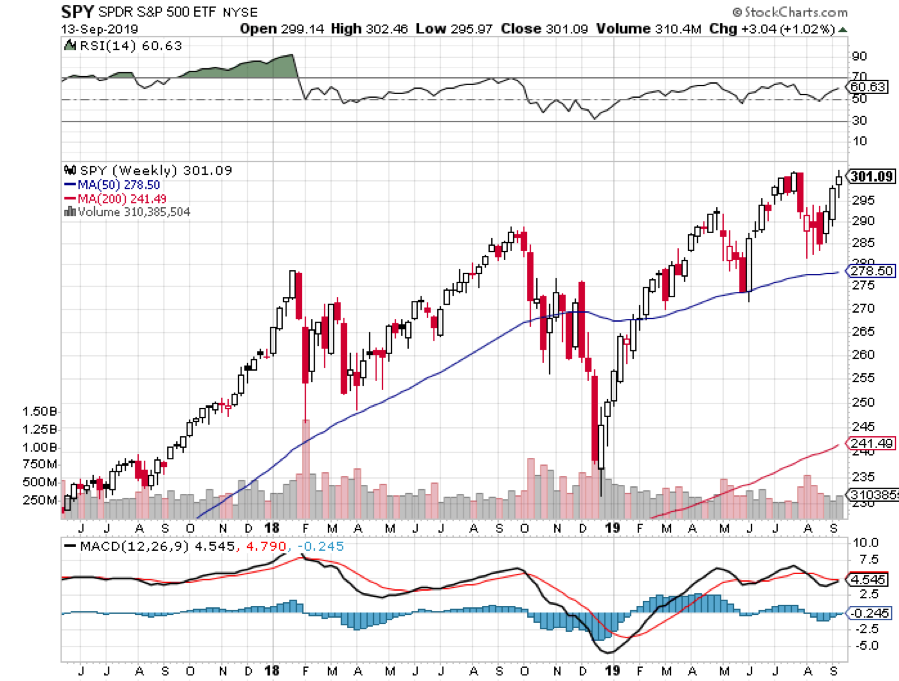
“Chop” is what we traders have had to deal with in the stock market a lot for the past 18 months ever since the trade war with China started. Look at the S&P 500 (SPY) and you see that we have been covering the same ground over and over again, much like trench warfare in WWI. Since April 2018, we have crossed the $270-$290 space no less than six times.
We are just now kissing the upper edge of that band. What happens next depends on your beliefs. If you think the trade war will end in the next month and we don’t go into recession, then the markets will break out to new all-time highs, blasting all the way up to $320. If you don’t, you want to be fading this move, unloading risk, and entertaining short plays.
I’ll let you decide.
As for me, I have been suspicious of this rally since it started the third week of August. It has been led by banks, energy, retailers, and all the other garbage with terrible fundamentals that have been falling for years. In other words, it is pure short covering. There is no net money coming into the market. In the meantime, technology has not fallen, it has ground to a halt awaiting the next flood of capital.
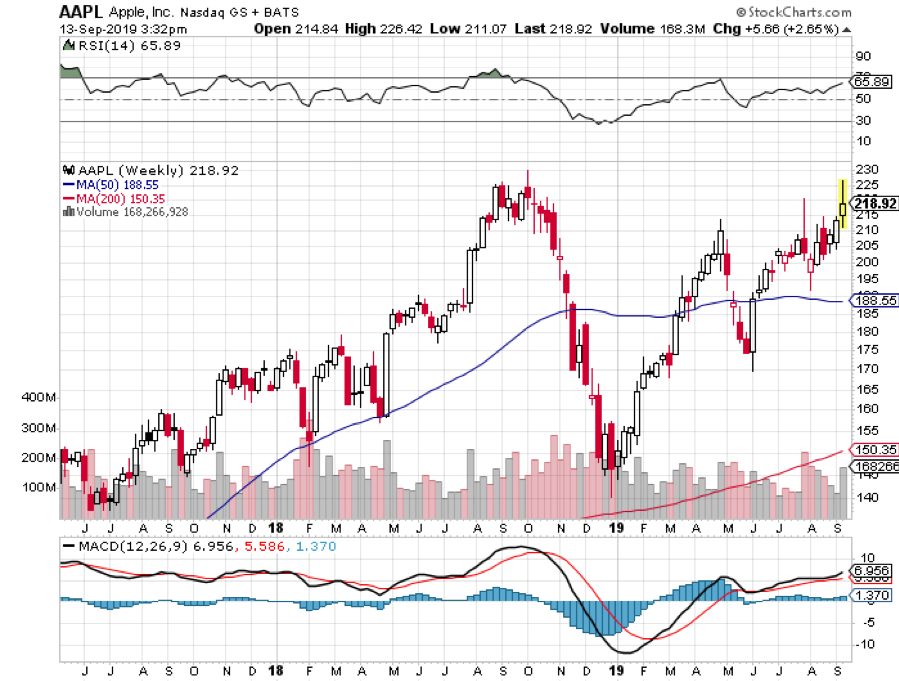
It was Apple (AAPL) day in Silicon Valley, with the world’s largest company rolling out a host of new services and upgrades. The new Apple TV Plus streaming service was the focus, coming out with a $5 a month price, easily undercutting Disney Plus (DIS) at $10 and Netflix (NFLX) at $15.
It is an in-between generation year, so we didn’t get anything big. But with 200 million iPhones needing replacement in coming years (AAPL) is still a good long-term hold. All eyes will be on the share buy backs.
The next antitrust assault on big tech arrived, with Facebook (FB) and Google (GOOGL) now in the sights of 49 US states. This will go nowhere as technology has been leading to lower prices, not higher ones. What is the monopoly value of a service that is given away for free? The choice is very simple: let the US continue to dominate tech, or let China take it over.
Job growth is slowing, and the belief that it has peaked for this cycle is growing. Job openings fell 31,000 in August to 7.2 million according to the Department of Labor. The big loss was in wholesale trade, the big gain in information technology. The economy is moving from old to new.
The John Bolton firing, the national security advisor, crushed oil as the chance of a major Middle Eastern war decline, knocking $1.50 off of Texas Tea. That negotiation with the Taliban didn’t go so well, with them blowing up our people while talking with Mike Pompeo. The risk is that Trump’s next national security advisor could be worse. That’s been the trend. The last national security advisor took money from the Russians.
Europe pulled out all the stops (FXE), renewing a stimulus program with massive quantitative easing. Euro interest rates also to be cut. Eventually, a lot of that money will end up back in the US, the only place in the world with decent investment returns. That's why our stocks are now a few pennies short of a new all-time high.
We saw more of Trump talking up the market ahead of trade talks, with the administration considering half a deal on trade tariffs, while throwing technology under the bus with an intellectual property walkaway. Good for the Midwest, terrible for the west coast.
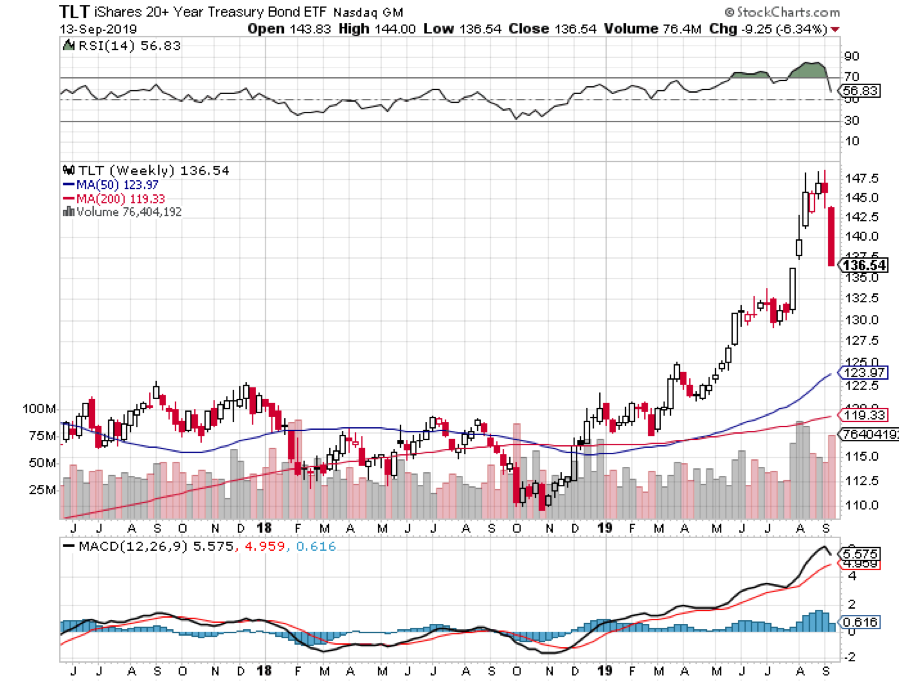
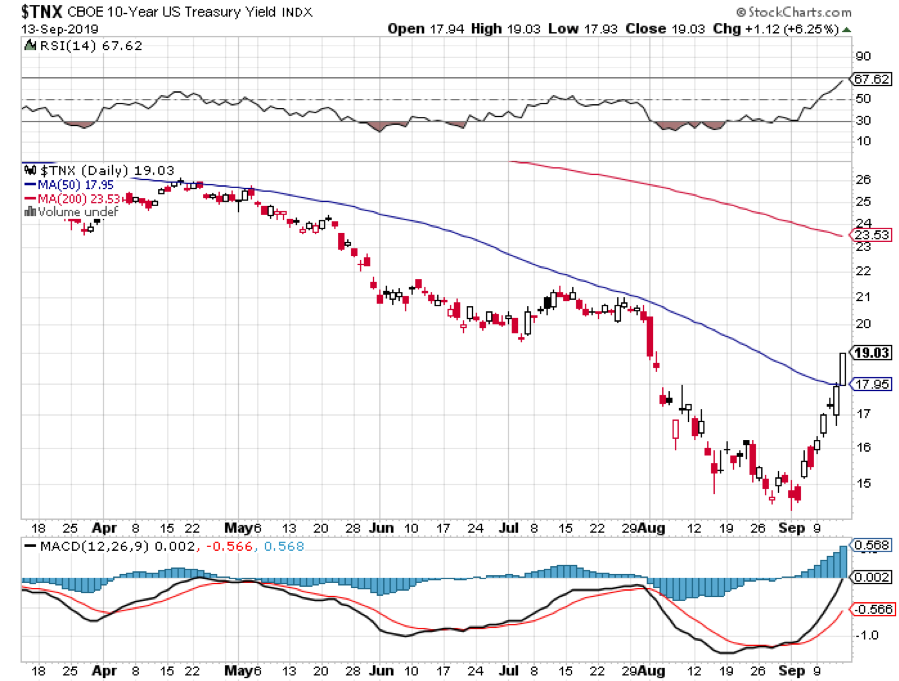
The bond market meltdown continued, with one of the sharpest collapses in history, down 11 points in a week, The ten-year US Treasury bond yield (TLT) has spiked from 1.44% to 1.90% in a week. Hope you got the rate lock on your refi last Friday. Long bonds had become the most overcrowded trade in a decade. Give it a month to digest, then take another run at the highs in prices, lows in yields.
China (FXI) bought ten shiploads of soybeans (SOYB), hoping for a positive outcome in the October trade talks. Or did they make the purchase to start the trade talks in the first place? Who knows? Price spikes 5%, at last! It's why stocks are pushing to new all-time highs.
The budget deficit toped $1 trillion in the first 11 months of fiscal 2019, the highest since the financial crisis. Running deficits this big during peace time with 2% economic growth will leave us with no way to get out of the next recession. It’s setting up the most predictable financial crisis in history, the next one. It’s just a matter of time before the chickens come home to roost. By the time Trump leaves office, the national debt will have increased by $4 trillion, or 20%.
The Mad Hedge Trader Alert Service is treading water in this wildly unpredictable month.
My Global Trading Dispatch stands near an all-time high of 334.99% and my year-to-date remains level at +34.85%. My ten-year average annualized profit bobbed up to +34.35%.
I’ll be running my 40% long in technology stocks into the September 20 options expiration because there is nothing else to do. After watching the bond market crater by 11 points, I could no longer restrain myself and stuck my toe in the water with a small long with yields at 1.90%. I may have to sweat a move to a 2.00% yield, but no more. I break even at 2.10%.
The coming week will be one of the biggest of the year, thanks to the Fed.
On Monday, September 16 at 8:30 AM, the New York Empire State Manufacturing Index is out.
On Tuesday, September 17 at 9:15 AM, the US Industrial Production is published.
On Wednesday, September 18, at 8:30 AM, August Building Permits are released. At 2:30 PM, the Federal Reserve announces its interest rate decision. If they don’t cut look out below?
On Thursday, September 19 at 8:30 AM, the Weekly Jobless Claims are printed. At 10:00 AM, Existing Home Sales are printed.
On Friday, September 20 at 8:30 AM, the Baker Hughes Rig Count is released at 2:00 PM.
As for me, my entire weekend is committed to the Boy Scouts, doing assorted public services projects with the kids, timing a mile run for the Physical Fitness merit badge, and cleaning up San Francisco Bay. Hopefully, I will get some time to review my charts. I usually look at 200 a weekend.
Good luck and good trading.
John Thomas
CEO & Publisher
The Diary of a Mad Hedge Fund Trader

Global Market Comments
September 13, 2019
Fiat Lux
Featured Trade:
(SOME SAGE ADVICE ON ASSET ALLOCATION),
(BREAKFAST WITH BOONE PICKENS)