While the Diary of a Mad Hedge Fund Trader focuses on investment over a one week to a six-month time frame, Mad Day Trader, provided by Bill Davis, will exploit money-making opportunities over a brief ten minute to three-day window. It is ideally suited for day traders, but can also be used by long-term investors to improve market timing for entry and exit points.Read more
https://madhedgefundtrader.com/wp-content/uploads/2019/05/cropped-mad-hedge-logo-transparent-192x192_f9578834168ba24df3eb53916a12c882.png00Mad Hedge Fund Traderhttps://madhedgefundtrader.com/wp-content/uploads/2019/05/cropped-mad-hedge-logo-transparent-192x192_f9578834168ba24df3eb53916a12c882.pngMad Hedge Fund Trader2019-11-18 09:25:462019-11-18 09:25:46November 18, 2019 - MDT Pro Tips A.M.
First, Apple (APPL) collaborates with Goldman Sachs’ (GS) offering of a credit card even giving credit access to subprime borrowers.
And now Google (GOOGL) has its eyes on the banking industry — specifically, it’ll soon offer checking accounts.
In a copycat league where anything and everything is fair game, we are seeing a huge influx of big tech companies vie for the digital wallets of Americans.
The project is aptly named Cache and accounts will be handled by Citibank (C) and a credit union at Stanford.
Google’s spokesman shared with us admitting that Google hopes to “partner deeply with banks and the financial system,” and further added, “If we can help more people do more stuff in a digital way online, it’s good for the internet and good for us.”
I would disagree with the marginal statement that it would be good for us.
Facebook (FB) is now offering a Pay option and how long will it be until Amazon (AMZN), Microsoft (MSFT), and others throw their name into the banking mix.
I believe there will be some monumental failures because it appears that these tech companies won’t offer anything that current bank intuitions aren’t offering already.
Moving forward, the odd that digital banking products will become saturated quickly is high.
Let’s cut to the chase, this is a pure data grab, and not in the vein of offering innovative services that force the consumer down a revolutionary product experience.
As the consumer starts to smarten up, will they happily reveal every single data point possible to these tech companies?
Big tech continues to be adamant that personal data is secure with them, but their track records are pitiful.
Even if Google doesn’t sell “individual data”, there are easy workarounds by just slapping number tags on aggregated data, then aggregated data can be reverse-engineered by extracting specific data with number tags.
The cracks have already started to surface, Co-Founder of Apple Steve Wozniak has already claimed that the credit algorithm for Apple’s Goldman Sach’s credit card is sexist and flawed.
Time is ticking until the first mass data theft as well and let me add that the result of this is usually a slap on the wrist incentivizing bad behavior.
I believe big tech companies should be banned from issuing banking products.
Only 4% of consumers switched banks last year, and a 2017 survey by Bankrate shows that the average American adult keeps the same checking account for around 16 years.
As anti-trust regulation starts to gather more steam, I envision lawmakers snuffing out any and every attempt for big tech to diversify into fintech.
It’s fair to say that Google should have done this 10 years ago when the regulatory issues were nonexistent.
Now they have regulators breathing down their necks.
Let me remind readers that the reason why Facebook abandoned their digital currency Libra was because of the pressure lawmakers applied to every company interesting in working with Facebook’s Libra.
Lawmakers threatened Visa and Mastercard that they would investigate every part of their business, including the parts that have nothing to do with Facebook’s Libra, if they went ahead with the Libra project.
The most telling insight comes from the best tech company Microsoft who has raised the bar in terms of protecting their reputation on data and trust.
They decided to stay away from financial products like the black plague.
Better to stay in their lane than take wild shots that incur unneeded high risks.
When U.S. Senator Mark Warner, a Democrat on the Senate panel that oversees banking, was asked about Google and banking, he quipped, “There ought to be very strict scrutiny.”
Big tech is now on the verge of getting ferociously regulated and that could turn out positive for the big American banks, PayPal (PYPL), Visa (V), Mastercard (MA) and Square (SQ).
I heavily doubt that Google will turn Cache into a meaningful business unless Google offers some jaw-dropping interest rates or elevated points to move the needle.
Google has canceled weekly all-hands meetings because of the tension between staff members and Facebook is also just as dysfunctional at the employee level.
Whoever said it's easy to manage a high-stake, too-big-to-fail tech firm?
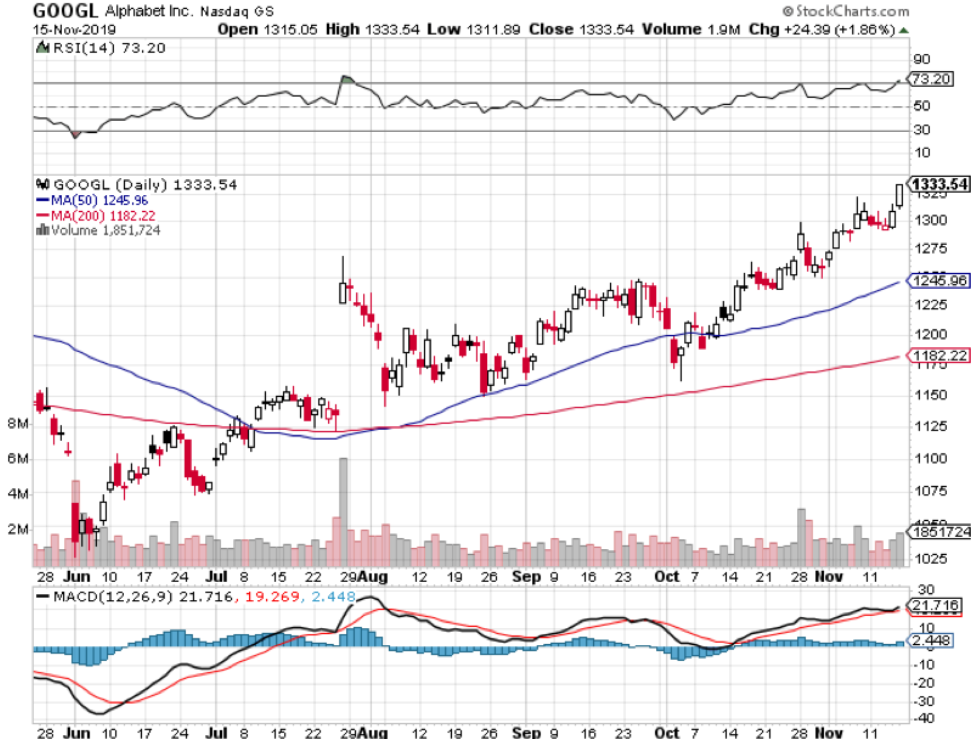
Even with all the negativity, Google is still a cash cow and if regulatory headwinds are 2-3 years off, they are a buy and hold until they are not.
The recent tech rally, after the rotation to value, has seen investors flood into Apple, Microsoft, and Google as de-facto safe haven tech plays.
https://madhedgefundtrader.com/wp-content/uploads/2019/05/cropped-mad-hedge-logo-transparent-192x192_f9578834168ba24df3eb53916a12c882.png00Mad Hedge Fund Traderhttps://madhedgefundtrader.com/wp-content/uploads/2019/05/cropped-mad-hedge-logo-transparent-192x192_f9578834168ba24df3eb53916a12c882.pngMad Hedge Fund Trader2019-11-18 05:32:312020-05-11 12:21:34The FANG's Big Move Into Banking
“I worry that if you regulate for the sake of regulating it, it has a lot of unintended consequences.” – Said CEO of Google Sundar Pichai
https://www.madhedgefundtrader.com/wp-content/uploads/2019/11/pichai.png322356Mad Hedge Fund Traderhttps://madhedgefundtrader.com/wp-content/uploads/2019/05/cropped-mad-hedge-logo-transparent-192x192_f9578834168ba24df3eb53916a12c882.pngMad Hedge Fund Trader2019-11-18 05:30:472019-11-18 05:11:20November 18, 2019 - Quote of the Day
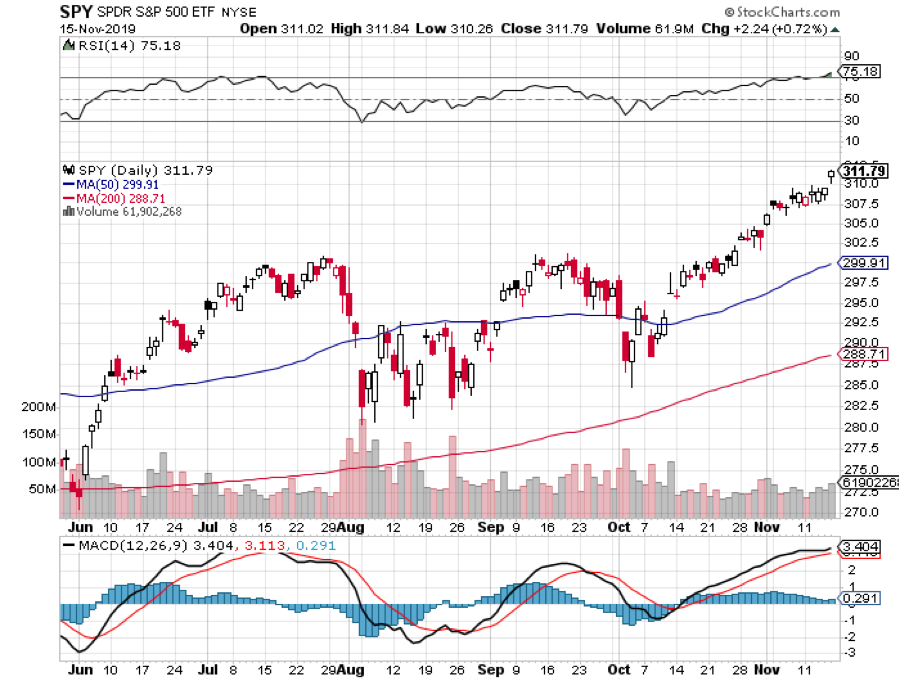
All of a sudden, and without warning, a buying panic has ensued in the stock market, breaking it out of a tedious two-year range.
The many concerns that kept investors out of stocks, like the trade war, interest rates, and a global economic slowdown, were shaken off like water off the back of a wet dog.
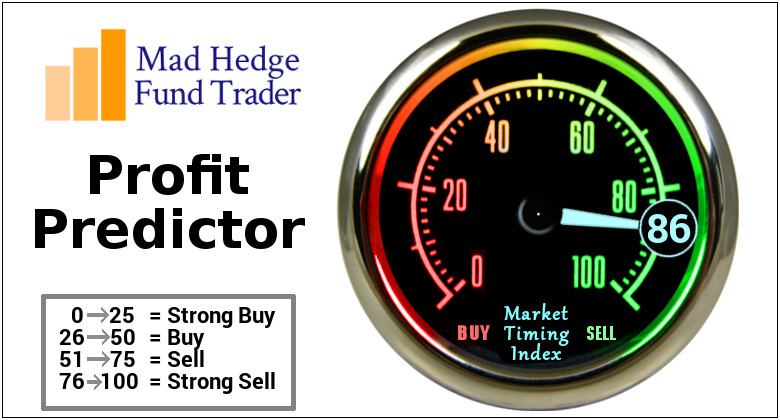
I could see all this coming. Even with my Mad Hedge Market Timing Index at 86, and trading as high as 91, screaming “SELL” I have been ignoring it. It usually has to spend 2-4 weeks at these elevated levels to make a real top anyway. Hedge fund compatriots who were sucked into selling too early by their own inferior in-house algorithms have been stopping out in great pain.
I’ll tell you the people who are really screwed by this move. Those who watched the economic data deteriorate all year, cut their equity allocations to the bone, and only started chasing the market upward once it broke new ground. It is a strategy that can only end in tears.
We here at Mad Hedge Fund Trader did a lot better. Followers of Global Trading Dispatch missed the breakout but bought every major dive of 2019. With double a good year’s performance in hand, we have no need to chase.
The newer Mad Hedge Technology Letter and Mad Hedge Biotechand Healthcare Letter have continued to go long pedal to the metal bringing in double-digit gains for all. Above all, we took profit on no less than four positions on Friday.
Can the market grind higher? Absolutely, yes. The world is awash in cash looking for any kind of return, and US stocks, with a (SPY) 1.81% dividend, are among the world’s highest yielding. In fact, the move could continue until the end of the year.
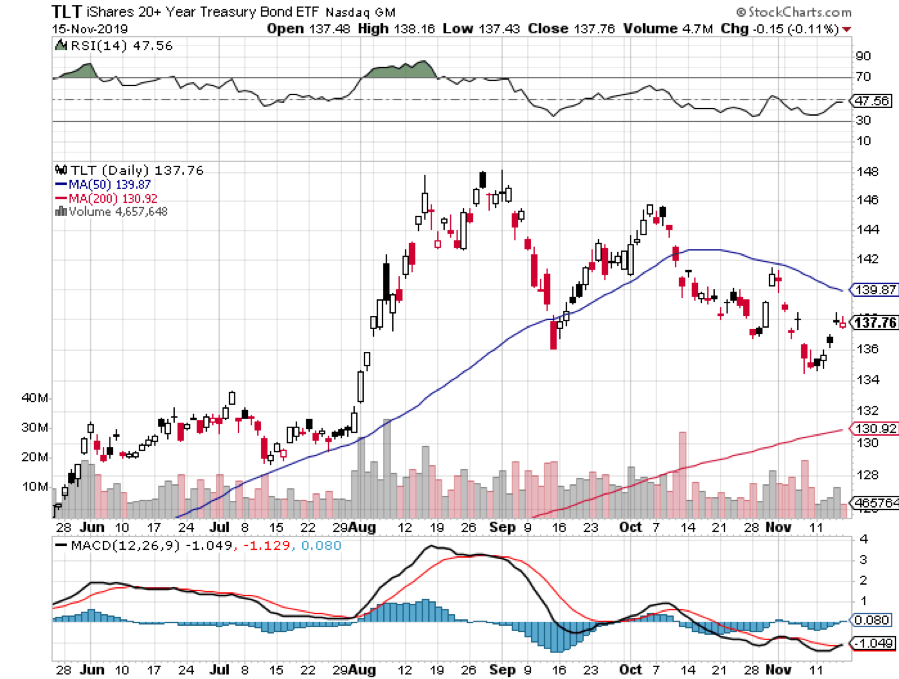
When will I come back in? After we get a substantial dip. Disciplines are useless unless you stick to them. In the meantime, while stocks are going crazy, there is fertile ground to harvest in other asset classes. I bought bonds (TLT) at the bottom last week and they are already performing nicely.
If you remember, I sold short, and then bought oil (USO) in September, taking advantage of a spate of volatility there. Such is the advantage of an all-asset class strategy I have been preaching and teaching for the past 12 years.
There will be no interest rate cuts in 2020, says Fed chairman Jay Powell, reading in between the lines. To do so would undermine our ability to get out of the next recession. We are still way below the 2.0% inflation target in this deflationary world.
The de-inversion of the yield curve is clearly driving stocks, with long term interest rates at last higher than short term ones. The markets are backing the recession out of the forecast. “Fear of missing out” is replacing just fear. Consumer Prices rose faster than expected as tariffs feed into prices, up 0.4% in October. It’s going to take a lot more than that to move the needle on inflation. The YOY rate climbed to 1.8%. Also, US Producer Prices jumped, up 0.4% in October, a six-month high. It’s going to take a lot more than this to start ringing the inflation bell.
Weekly Jobless Claims soared by 14,000 to 225,000. It’s the first big jump in many months. Is the employment top in? Is this the end of the beginning or the beginning of the end?
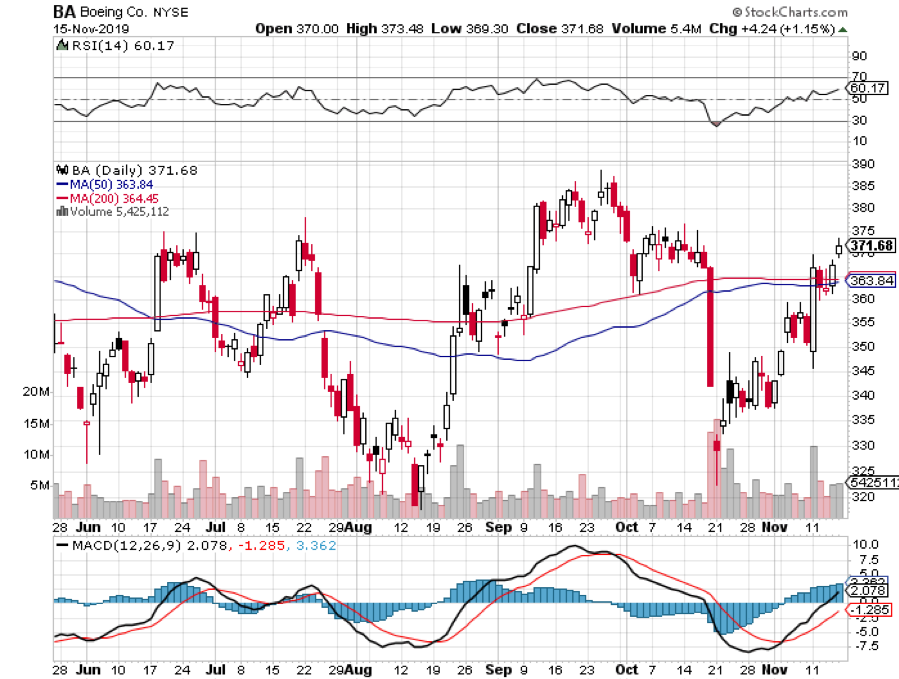
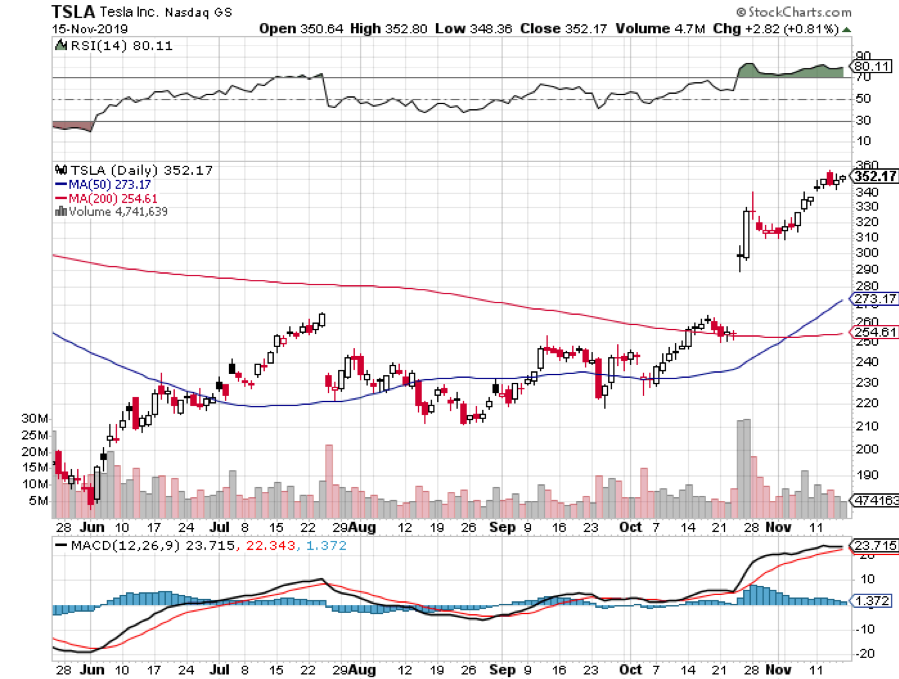
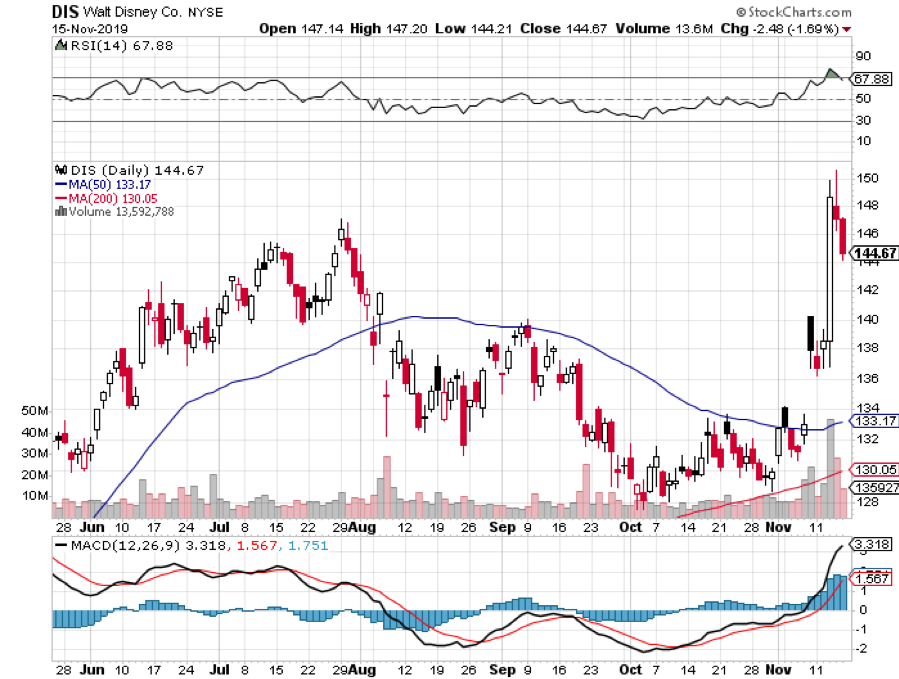
Charles Schwab (SCHW) trading accounts soared 31%, in the wake of the commission cut to zero. What happens when you lower the price? You sell more of them. It’s a classic law of supply and demand. Uber founder dumped stocks, as Travis Kalanick unloads $700 million worth of shares. He’s not selling because he can’t think of new ways to spend the money. It’s not exactly a “BUY” recommendation, is it? Avoid (UBER) like the plague. Apple hit a new all-time high at $264, on three broker upgrades, with the high end reaching $290. The market capitalization tops $1.2 trillion, making it the world’s largest publicly-traded company. It looks like I’m going to have to increase my own target from a conservative $200. I made this prediction when the newsletter started a decade ago and the share traded under $20. People said I was nuts, except Steve Jobs. The Tesla Model 3 returns to “reliable” list, from Consumer Reports. They had been taken off due to pieces falling off new cars and failing transmissions exactly at the 44,000-mile mark. It was all covered by warranty, of course. Looks like Elon is figuring out how to put these things together and stay that way. It follows an onslaught of good news about the company that has wiped out the shorts. Who is last on the quality list now? Cadillac. Buy (TSLA) on dips. US short interest falls 1.6%, to 16.8 billion shares, as hedge funds scramble to limit losses. It’s got to be at least half the current net buying. Disney launched its streaming service, Disney Plus, at $6.99 a month. The site crashed from overwhelming demand. It’s a problem I wish I had. Netflix (NFLX) won’t go under but their growth will be clearly impaired. Let the streaming wars begin! Buy (DIS) on dips. US Productivity plunged sharply, down 0.3% in Q3. It’s completely a result of the trade war-induced freeze on capital spending by US businesses this year. It means we’re eating out seed corn to grow. This was a week for the Mad Hedge Trader Alert Service to stay level. With only one position left, a bargain long in (TLT), not much else was going to happen. My long position in Boeing (BA) expired on Friday at its maximum profit point.
By the way, running out of positions at a market top is a good thing.
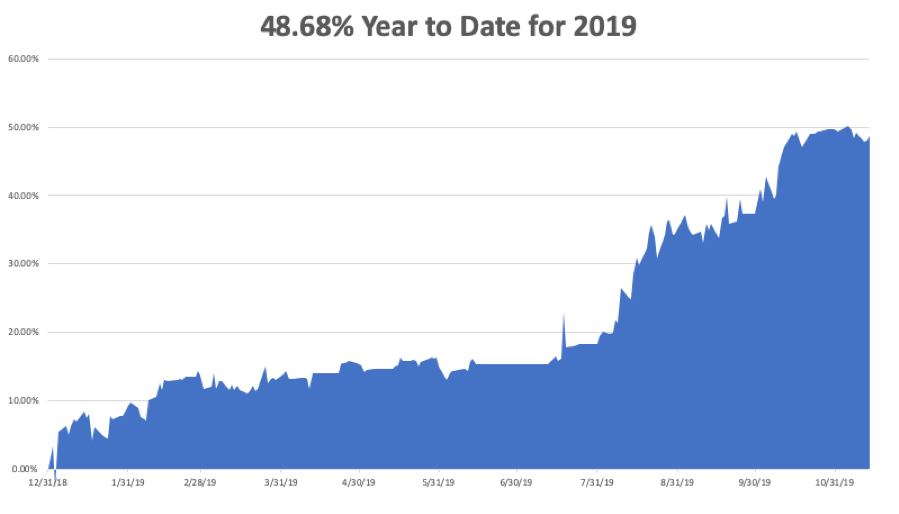
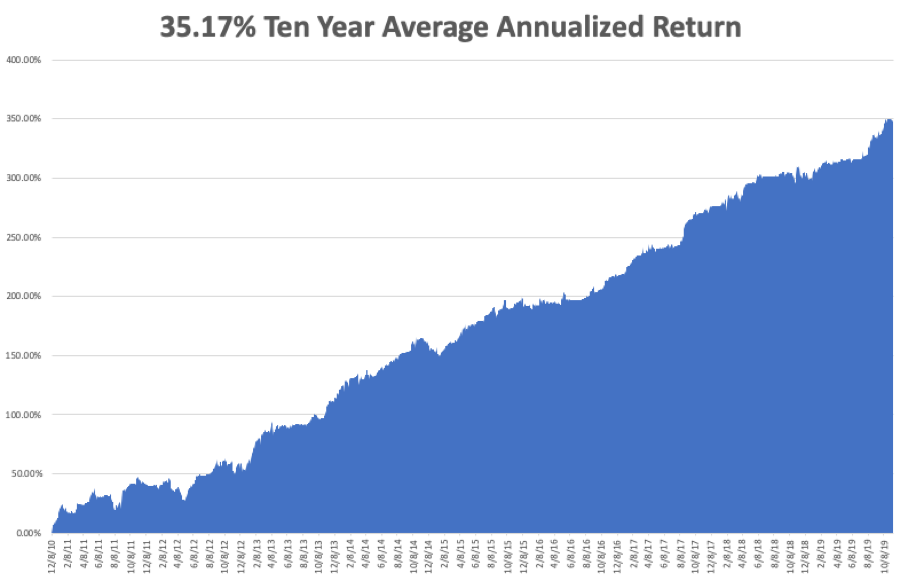
My Global Trading Dispatch performance held steady at +349.38% for the past ten years, pennies short of an all-time high. My 2019 year-to-date leveled out at +48.68%. So far in November, we are down a miniscule -0.31%. My ten-year average annualized profit held steady at +35.17%.
With my Mad Hedge Market Timing Index sitting around the sky-high 86 level, it is firmly in “SELL” territory and at a three-year high. The markets have been up in a straight line for 2 ½ months.
The coming week is pretty non-eventful of the data front after last week’s fireworks. Maybe the stock market will be non-eventful as well.
On Monday, November 18 at 11:00 AM, the US NAHB Housing Market Index for November is out. On Tuesday, November 19 at 9:30 AM, US Housing Starts for October are released.
On Wednesday, November 20 at 2:00 PM, the Fed’s FOMC Minutes for their October meeting are published.
On Thursday, November 7, at 8:30 AM, Weekly Jobless Claims come out. At 11:00 AM the October Existing Home Sales are announced. On Friday, November 8 at 11:00 AM, the University of Michigan Consumer Sentiment is out.
The Baker Hughes Rig Count follows at 2:00 PM.
As for me, I am going to see the latest Harry Potter play on Saturday, Harry Potter and the Cursed Child. It’s a reward for two kids who got straight A’s on their report cards. They seem to be strangely good at math. Maybe the apple doesn’t fall far from the tree.
Good luck and good trading.
John Thomas
CEO & Publisher
The Diary of a Mad Hedge Fund Trader
https://www.madhedgefundtrader.com/wp-content/uploads/2019/11/john-thomas-4.png518483Mad Hedge Fund Traderhttps://madhedgefundtrader.com/wp-content/uploads/2019/05/cropped-mad-hedge-logo-transparent-192x192_f9578834168ba24df3eb53916a12c882.pngMad Hedge Fund Trader2019-11-18 05:02:102020-05-11 13:56:59The Market Outlook for the Week Ahead, or The Melt Up is On
When John identifies a strategic exit point, he will send you an alert with specific trade information as to what security to sell, when to sell it, and at what price. Most often, it will be to TAKE PROFITS, but, on rare occasions, it will be to exercise a STOP LOSS at a predetermined price to adhere to strict risk management discipline.Read more
https://www.madhedgefundtrader.com/wp-content/uploads/2016/02/Alert-e1457452190575.jpg135150Mad Hedge Fund Traderhttps://madhedgefundtrader.com/wp-content/uploads/2019/05/cropped-mad-hedge-logo-transparent-192x192_f9578834168ba24df3eb53916a12c882.pngMad Hedge Fund Trader2019-11-15 15:54:552019-11-15 15:54:55Trade Alert - (ADSK) November 15, 2019 - EXPIRATION-TAKE PROFITS
When John identifies a strategic exit point, he will send you an alert with specific trade information as to what security to sell, when to sell it, and at what price. Most often, it will be to TAKE PROFITS, but, on rare occasions, it will be to exercise a STOP LOSS at a predetermined price to adhere to strict risk management discipline.Read more
https://www.madhedgefundtrader.com/wp-content/uploads/2016/02/Alert-e1457452190575.jpg135150Mad Hedge Fund Traderhttps://madhedgefundtrader.com/wp-content/uploads/2019/05/cropped-mad-hedge-logo-transparent-192x192_f9578834168ba24df3eb53916a12c882.pngMad Hedge Fund Trader2019-11-15 15:40:132019-11-15 15:40:13Trade Alert - (VEEV) November 15, 2019 - EXPIRATION-TAKE PROFITS
When John identifies a strategic exit point, he will send you an alert with specific trade information as to what security to sell, when to sell it, and at what price. Most often, it will be to TAKE PROFITS, but, on rare occasions, it will be to exercise a STOP LOSS at a predetermined price to adhere to strict risk management discipline.Read more
https://www.madhedgefundtrader.com/wp-content/uploads/2016/02/Alert-e1457452190575.jpg135150Mad Hedge Fund Traderhttps://madhedgefundtrader.com/wp-content/uploads/2019/05/cropped-mad-hedge-logo-transparent-192x192_f9578834168ba24df3eb53916a12c882.pngMad Hedge Fund Trader2019-11-15 15:15:462019-11-15 15:15:46Trade Alert - (ADBE) November 15, 2019 - EXPIRATION-TAKE PROFITS
When John identifies a strategic exit point, he will send you an alert with specific trade information as to what security to sell, when to sell it, and at what price. Most often, it will be to TAKE PROFITS, but, on rare occasions, it will be to exercise a STOP LOSS at a predetermined price to adhere to strict risk management discipline.Read more
https://www.madhedgefundtrader.com/wp-content/uploads/2016/02/Alert-e1457452190575.jpg135150Mad Hedge Fund Traderhttps://madhedgefundtrader.com/wp-content/uploads/2019/05/cropped-mad-hedge-logo-transparent-192x192_f9578834168ba24df3eb53916a12c882.pngMad Hedge Fund Trader2019-11-15 14:51:022019-11-15 14:58:42Trade Alert - (BA) November 15, 2019 - EXPIRATION-TAKE PROFITS
Legal Disclaimer
There is a very high degree of risk involved in trading. Past results are not indicative of future returns. MadHedgeFundTrader.com and all individuals affiliated with this site assume no responsibilities for your trading and investment results. The indicators, strategies, columns, articles and all other features are for educational purposes only and should not be construed as investment advice. Information for futures trading observations are obtained from sources believed to be reliable, but we do not warrant its completeness or accuracy, or warrant any results from the use of the information. Your use of the trading observations is entirely at your own risk and it is your sole responsibility to evaluate the accuracy, completeness and usefulness of the information. You must assess the risk of any trade with your broker and make your own independent decisions regarding any securities mentioned herein. Affiliates of MadHedgeFundTrader.com may have a position or effect transactions in the securities described herein (or options thereon) and/or otherwise employ trading strategies that may be consistent or inconsistent with the provided strategies.