Mad Hedge Biotech & Healthcare Letter
November 21, 2019
Fiat Lux
Featured Trade:
(WHY VERTEX HAS BEEN ON FIRE),
(VRTX), (CRSP)


Mad Hedge Biotech & Healthcare Letter
November 21, 2019
Fiat Lux
Featured Trade:
(WHY VERTEX HAS BEEN ON FIRE),
(VRTX), (CRSP)

Vertex Pharmaceuticals Inc. (VRTX) is the unequivocal king of the genetically rare lung condition cystic fibrosis (CF). To further prove its stronghold of the market, the company recently received FDA approval for its fourth CF treatment called Trikafta — five full months ahead of schedule and merely three months following the company’s application.
In a few weeks, the drug will be available in pharmacies, carrying a price tag of $311,000. This puts Trikafta somewhere in the range of another prized Vertex CF treatment, Kalydeco.
Sales of this newest drug is estimated to reach $4.6 billion by 2023 and more than $6.6 billion by 2025, with the drug projected to hit its peak at $10 billion by the second half of 2020. Hence, this latest addition to Vertex’s pipeline practically guarantees the company’s supremacy over the lucrative multi-billion dollar sector for the next decade or so. More importantly, sales from this CF drug could — at the very least — double the annual revenue of Vertex.
The projected earnings of Trikafta places it in the blockbuster tier as early as 2020, with the drug anticipated to be marketed as a treatment with a “whole new level” of efficacy compared to the earlier CF medications released by Vertex. With this new addition, the company can now reach 90% of CF patients in the United States — a huge leap from 50% it’s currently allowed to treat.
However, the launch of Trikafta is a bittersweet deal with Vertex as sales of older treatments are anticipated to weaken. In particular, the company expects Symdeko and Orkambi to eventually fade away from the market as more and more patients opt for the newer and more potent Trikafta.
Despite the impending success of Trikafta, it appears that Vertex has no intention of letting up. Since its CF products have translated into healthy profits in the past four quarters and a whopping $950 million in the third quarter alone, it’s no wonder the company continues to work on new offerings for this market.
Even with the weakening sales of Symdeko, the performance of the CF drugs in the most recent earnings report showed a 21% jump over the same period in 2018. To date, the company has three additional treatments submitted for Phase II trials.
Beyond the CF realm, Vertex has also been looking to expand in other sectors. One of its exciting partnerships is with gene-editing company CRISPR Therapeutics (CRSP). The two companies have been working closely to come up with game-changing treatments that could pioneer therapies for rare conditions like sickle cell disease, Duchenne muscular dystrophy, and beta thalassemia. All three of these orphan designation drugs have the potential to turn into blockbuster treatments.
For 2019, Vertex projects a product revenue somewhere between $3.70 billion to $3.75 billion. Meanwhile, its full-year earnings per share is estimated to be $4.77, which is a 17% increase from last year’s report.
A clear downside of Vertex is the fact that it’s one of the most highly valued stocks in the biotech industry at 31.1 times forward earnings. Nonetheless, a long-term study of the company’s performance would show that the shares are actually grossly undervalued even at their present-day levels. After all, this biotech stock has the potential to triple or even quadruple its yearly revenue over the next five years or so especially if its partnership with CRISPR Therapeutics comes into fruition.
Overall, the growth and profitability profile of Vertex makes it an attractive stock to own. Add to that its promising pipeline, and you have one of the most attractive names in the biotech sector. Hence, now is the ideal time for investors to buy Vertex shares as you can confidently bet on its dominance on the CF market as well as its exciting gene-editing ventures and potential revenue stream.
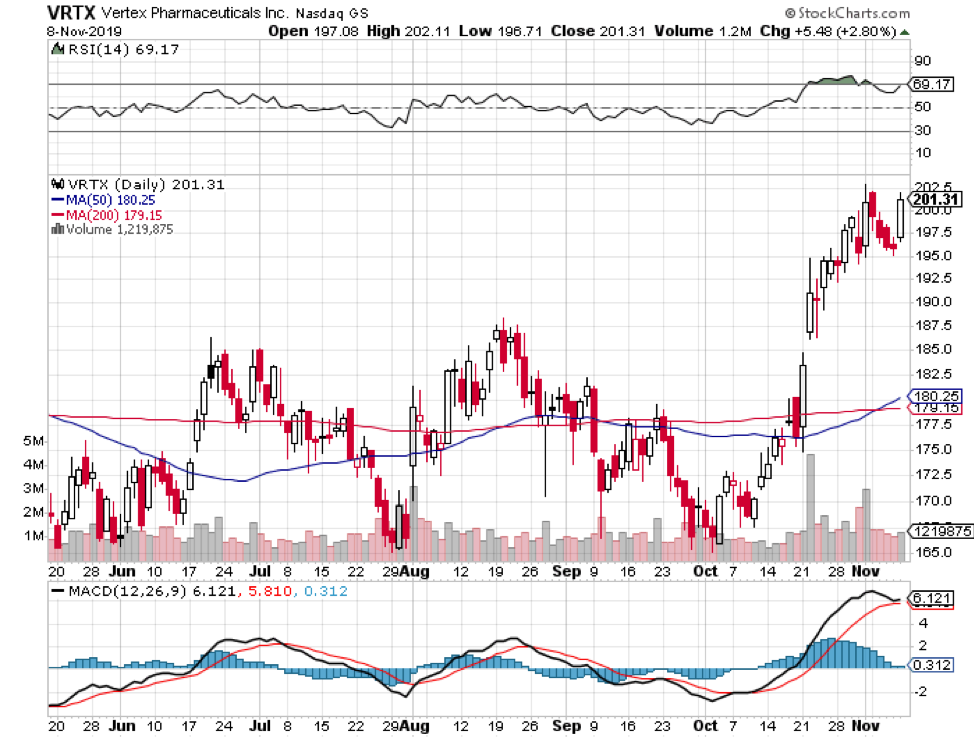
Don’t chase Vertex up here but buy the next substantial dip.
“Humans are vastly underestimated,” said Tesla founder Elon Musk.


When John identifies a strategic exit point, he will send you an alert with specific trade information as to what security to sell, when to sell it, and at what price. Most often, it will be to TAKE PROFITS, but, on rare occasions, it will be to exercise a STOP LOSS at a predetermined price to adhere to strict risk management discipline. Read more
When John identifies a strategic exit point, he will send you an alert with specific trade information as to what security to sell, when to sell it, and at what price. Most often, it will be to TAKE PROFITS, but, on rare occasions, it will be to exercise a STOP LOSS at a predetermined price to adhere to strict risk management discipline. Read more
When John identifies a strategic exit point, he will send you an alert with specific trade information as to what security to sell, when to sell it, and at what price. Most often, it will be to TAKE PROFITS, but, on rare occasions, it will be to exercise a STOP LOSS at a predetermined price to adhere to strict risk management discipline. Read more
While the Diary of a Mad Hedge Fund Trader focuses on investment over a one week to a six-month time frame, Mad Day Trader, provided by Bill Davis, will exploit money-making opportunities over a brief ten minute to three-day window. It is ideally suited for day traders, but can also be used by long-term investors to improve market timing for entry and exit points. Read more
Global Market Comments
November 20, 2019
Fiat Lux
Featured Trade:
(THE GOVERNMENT’S WAR ON MONEY)
(TESTIMONIAL)

Mad Hedge Technology Letter
November 20, 2019
Fiat Lux
Featured Trade:
(MY CURRENT TECHNOLOGY TRADING STRATEGY),
(GOOGL), (MSFT), (APPL), (ADBE), (AKAM), (VEEV), (FTNT), (WKDAY), (TTD)
Some might say that we were due for a revaluation of growth tech stocks.
They have contributed greatly in this nine-year bull market.
Profit-generating software stocks are the order of the day.
Tech has led the overall market higher after projected quarterly earnings growth of -9% came in better than expected at -5%.
We have ebbed and flowed from pricing in a full-out recession in mid-2020 to now believing a recession is further off than first thought.
The pendulum swing ruptured many growth stocks from Workday (WKDAY) to The Trade Desk, Inc. (TTD) plummeting 30%.
We have retraced some of those losses but momentum in share appreciation has shifted to the perceived safer variation of tech stocks.
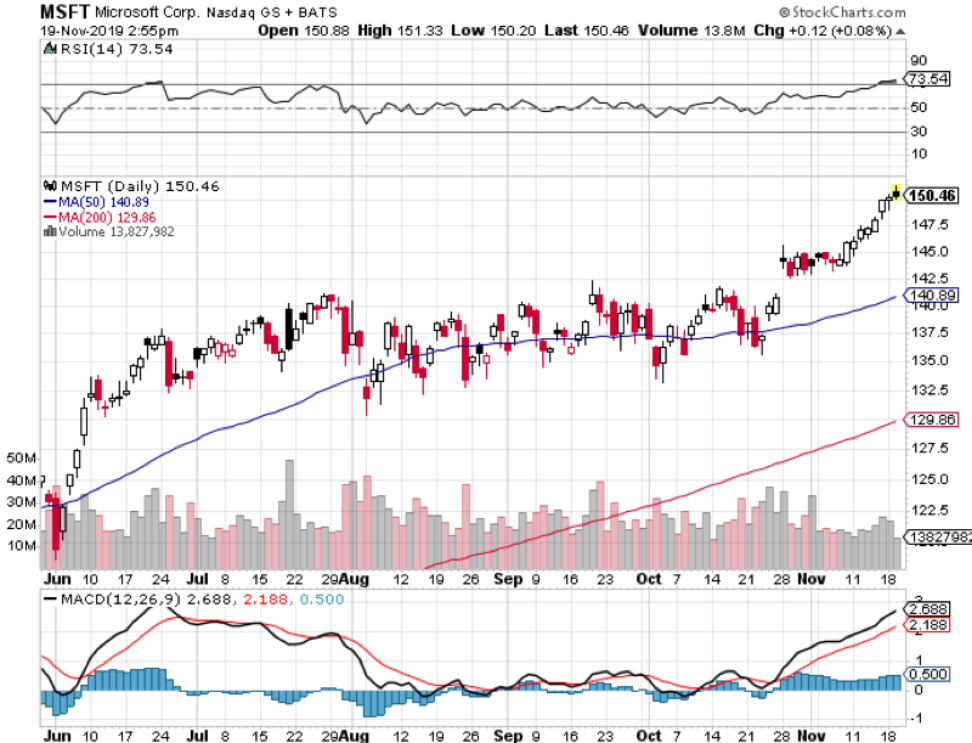
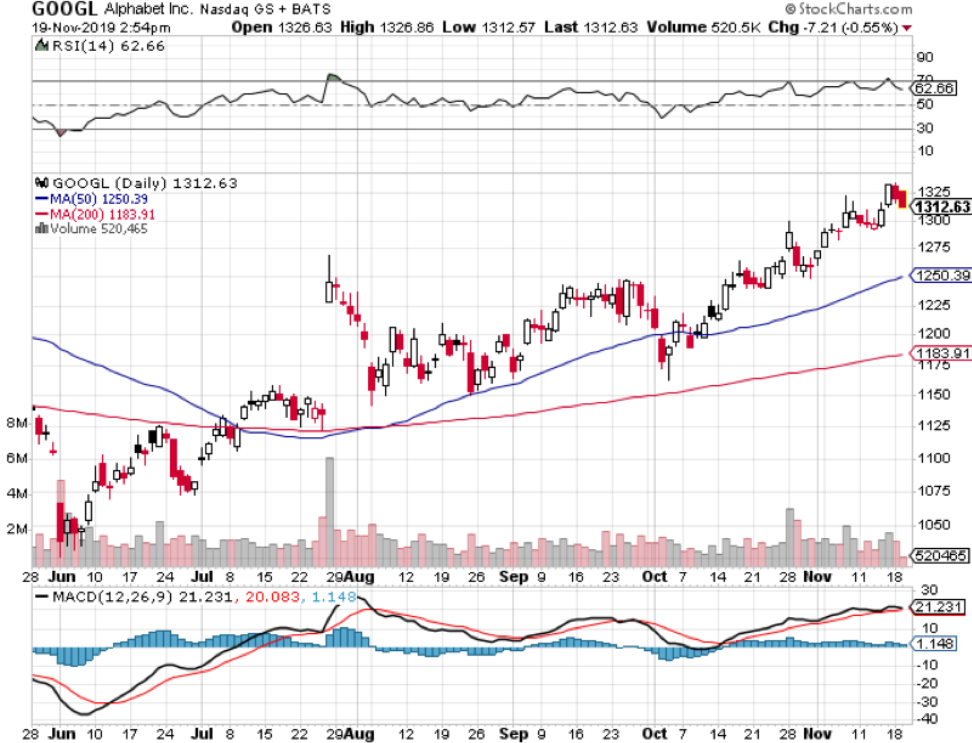
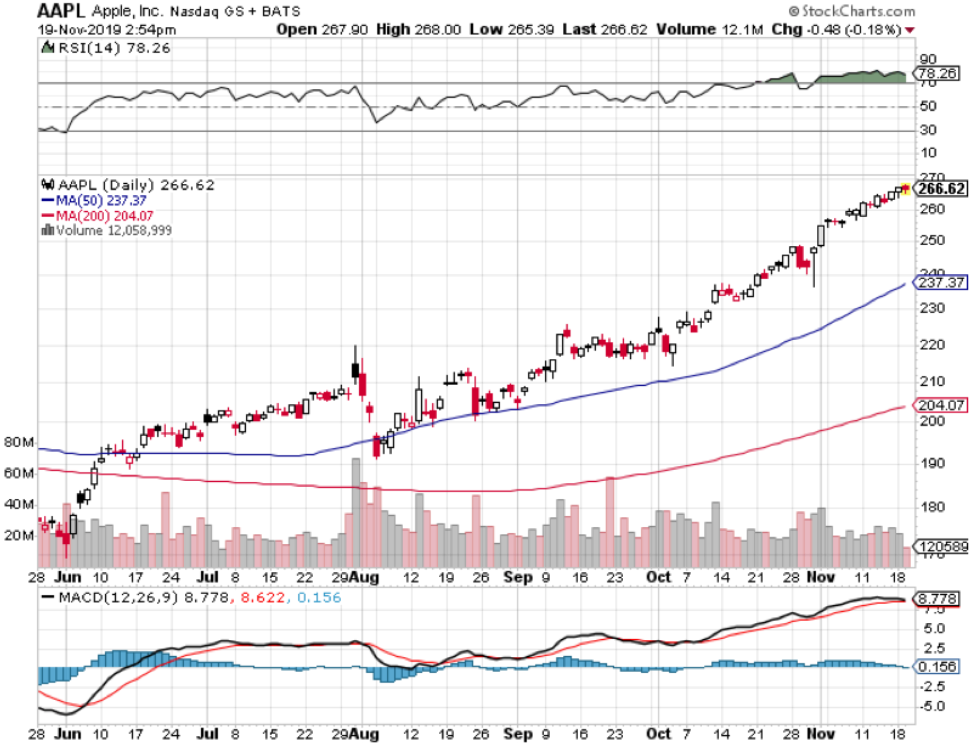
Investors have cut volatility and headed into bulletproof companies of Apple (AAPL), Google (GOOGL), and Microsoft (MSFT).
These companies have significant competitive advantages, Teflon balance sheets, and print money.
The tech markets just about priced in the U.S - China trade war in the fall as broad-based volatility plummeted because of optimism around making a deal.
This, in turn, has boosted chips stocks along with investors front running the 5G revolution and the administration granting Huawei a reprieve was a cherry on top.
The Mad Hedge Technology Letter has taken every dip to initiate new longs in safe trades like software companies Adobe (ADBE) and Veeva Systems (VEEV).
Tech is at the point that all loss-making companies are out of the running for tech alerts because the moment there is a recession scare, these shares drop 10% and often don’t stop until they lose 30%.
Now there is a deeply embedded set of narrow tech leadership by a few dominant tech companies buttressed by a select set of second-tier software stocks.
I would put PayPal (PYPL) and Twitter (TWTR), which I currently have open trades on, in the ranks of the second tier and they should do well as long as economic growth does better than expected.
Their share prices dipped on weak guidance and the bad news appears to have been shaken out of these names.
Professional investors could also be hanging on to meet end-of-year performance targets.
I do expect unique entry points on software stocks that drop after bad future guidance.
Profitability has moved to the fore as the biggest factor in holding a name or not.
Newly minted IPOs have fared even worse showing the markets' waning appetite for loss makers like Uber (UBER) and Lyft (LYFT).
Loss-making companies often tout their ability to change the world and disrupt industry, but that has been discovered as nothing more than a ruse.
They aren’t disrupting the way we change the world. For example, Uber is a dressed-up taxi service and the new CEO has failed to create any new momentum in the unit economics that spectacularly fail by any type of metric.
Even worse for these growth stocks, as the economy starts to falter, there will be even less appetite for them, and even more appetite for safer tech stocks.
A worst-case scenario would see Uber drop to $10 and Lyft to $20.
New all-time highs have crystalized with Google (GOOGL) under the gauntlet of regulation hysteria displaying the domination of these big tech machines.
The ongoing, consistent rotation out of growth and into value hasn’t run its course yet and fortunately, by identifying this important trend, our readers will be well placed to advantageously position themselves going into 2020.
Growth stocks won’t make a comeback anytime soon and deteriorating conditions could trigger renewed synchronized global monetary policy easing and central bank stimulus.
And yes, more negative rates.
I believe Oracle (ORCL), Fortinet (FTNT), Akamai Technologies, Inc. (AKAM) could weather the storm next year.
Tech growth is slowing and trade uncertainty is high, and readers must have a sense of urgency to avoid the losers in this scenario.
U.S. economic growth could slow to 1.3% next year, avoiding a recession, and the lack of enterprise spend will reduce software sales and combine that with peak smartphone growth and it won’t be smooth sailing.
The Mad Hedge Technology Letter has the pulse of the tech market and will show you how to navigate this minefield.