When John identifies a strategic exit point, he will send you an alert with specific trade information as to what security to sell, when to sell it, and at what price. Most often, it will be to TAKE PROFITS, but, on rare occasions, it will be to exercise a STOP LOSS at a predetermined price to adhere to strict risk management discipline.Read more
When John identifies a strategic exit point, he will send you an alert with specific trade information as to what security to sell, when to sell it, and at what price. Most often, it will be to TAKE PROFITS, but, on rare occasions, it will be to exercise a STOP LOSS at a predetermined price to adhere to strict risk management discipline.Read more
While the Diary of a Mad Hedge Fund Trader focuses on investment over a one week to six-month time frame, Mad Day Trader, provided by Bill Davis, will exploit money-making opportunities over a brief ten minute to three day window. It is ideally suited for day traders, but can also be used by long-term investors to improve market timing for entry and exit points.Read more
While the Diary of a Mad Hedge Fund Trader focuses on investment over a one week to six-month time frame, Mad Day Trader, provided by Bill Davis, will exploit money-making opportunities over a brief ten minute to three day window. It is ideally suited for day traders, but can also be used by long-term investors to improve market timing for entry and exit points.Read more
While the Diary of a Mad Hedge Fund Trader focuses on investment over a one week to six-month time frame, Mad Day Trader, provided by Bill Davis, will exploit money-making opportunities over a brief ten minute to three day window. It is ideally suited for day traders, but can also be used by long-term investors to improve market timing for entry and exit points. Read more
Featured Trade:
(DON'T MISS THE APRIL 11 GLOBAL STRATEGY WEBINAR),
(IT'S ALL ABOUT WHAT HAPPENS NEXT),
($INDU), (GOOGL),
(HOW AMERICA'S PLUNGING EDUCATION SURPLUS WILL DAMAGE YOUR PORTFOLIO), (UUP)
My next global strategy webinar will be held live from Silicon Valley on Wednesday, April 11, at 12:00 PM EST.
Co-hosting the show will my friend Jim Kenney from Option Professor.
I'll be giving you my updated outlook on stocks, bonds, commodities, currencies, precious metals, and real estate.
The goal is to find the cheapest assets in the world to buy, the most expensive to sell short, and the appropriate securities with which to take these positions.
I also will be opining on recent political events around the world and the investment implications therein.
I usually include some charts to highlight the most interesting new developments in the capital markets. There will be a live chat window with which you can pose your own questions.
The webinar will last 45 minutes to an hour. International readers who are unable to participate in the webinar live will find it posted on my website within a few hours.
I look forward to hearing from you.
To log into the webinar, please click on the link we emailed you entitled, "Next Bi-Weekly Webinar - April 11, 2018" or click here.
https://www.madhedgefundtrader.com/wp-content/uploads/2018/04/John-Thomas-story-2-e1522965508602.jpg321300MHFTRhttps://madhedgefundtrader.com/wp-content/uploads/2019/05/cropped-mad-hedge-logo-transparent-192x192_f9578834168ba24df3eb53916a12c882.pngMHFTR2018-04-10 01:08:002018-04-10 01:08:00Don't Miss the April 11 Global Strategy Webinar
Stock markets are only in the business of discounting what happens next. I spend so much time anticipating the coming moves in shares that I can't even remember what I had for breakfast.
This is why technical analysis is such a bust as an investment strategy, except on an intraday basis only, as it is entirely founded on historical data. It is 100% backward looking.
So, I'll take you through the same thought experiments that convinced me to adopt a much more aggressive stance toward the markets after spending two months hiding in the weeds.
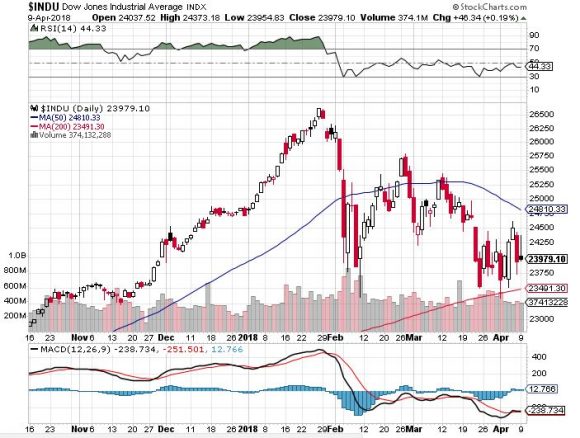
What happens after stocks hit new highs? They hit new lows, as they did on April 1, when the Dow Average plunged to 23,600.
What happens after markets hit new lows? They hit new highs again, supported by the strongest earning reports in history, which begin on Friday, April 13.
What happens after the inflation scare we received in the January Nonfarm Payroll Report with the surprise pop in average hourly earnings?
Inflation non-events, which unfolded with average hourly wages that came in subdued with the February and March Nonfarm Payroll Reports.
What follows a trade war? Trade peace, which is yet to come, but will arrive eventually nevertheless.
All of this points to stock markets that are in the process of putting in the lows for 2018. That means it is time to start ramping up your risk, as I did with three rapid Trade Alerts yesterday.
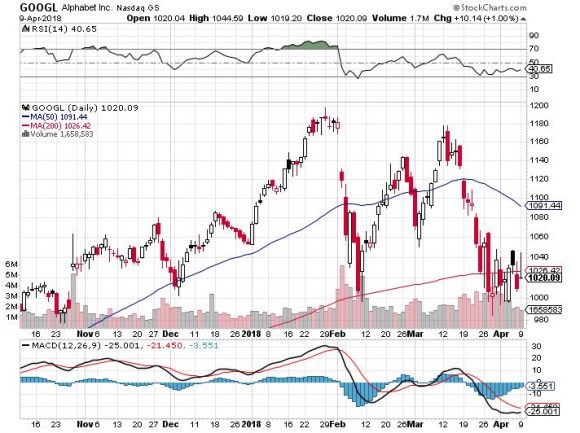
What does this look like on the charts? Alphabet (GOOGL) is a perfect example, which is in the process of putting in a very convincing triple bottom around the $1,000 level, right around the 200-day moving average.
What if I'm wrong?
After all the trade war continues to inflame by the day, the algorithms are still running amok, and the president still has a Twitter account.
What did it today? The Congressional Budget Office forecast of $1 trillion deficits running indefinitely? Or the FBI raids on the offices of the president's personal lawyer?
Then markets will edge down to the next support levels, about 4% lower than the most recently visited bottom, or about 22,600 in the Dow Average.
So, it would seem that the really smart thing to do here is to build options positions that can take that 4% hit, and STILL expire at their maximum profit points.
And this is exactly what I have been doing for the past two weeks: piling on long positions in the best technology stocks, and adding to short positions in bonds.
For fans of LEAPS, long dated out-of-the-money option call spreads one year or more out, this is the best time this year to get involved.
I'll give you an example.
BUY one June 21, 2019 $1,000 call at $145.00
SELL one June 21, 2019 $1,050 call at $120.00
NET COST = $25.00
In the event that (GOOGL) closes over $1,050 on June 21, 2019, or up 3% from today's closing level, the profit on this position would amount to $25.00 from an initial cost of $25.00, or a 100% gain in 14 months.
The only catch is that if the recession comes sooner than expected, the value of this position falls to zero in 14 months.
If you go deeper out-of-the-money with your strike prices, the potential profit rises by a multiple.
You can generate this kind of astronomical return with any of the FANGs assuming no real movement of the stock in a year.
It looks pretty good to me.
You heard it here first.
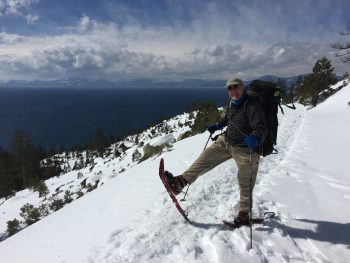
Winter Is Ending
https://www.madhedgefundtrader.com/wp-content/uploads/2018/04/John-skiing-store-2-image-3-e1523312994495.jpg263350MHFTRhttps://madhedgefundtrader.com/wp-content/uploads/2019/05/cropped-mad-hedge-logo-transparent-192x192_f9578834168ba24df3eb53916a12c882.pngMHFTR2018-04-10 01:07:502018-04-10 01:07:50It's All About What Happens Next
For the first time in 40 years, the number of foreign students applying for American colleges and universities is declining.
The drop is particularly noticeable at University of California, Berkeley, where Asian students account for about 10% of incoming freshmen. This is turning the Golden State's education budget upside-down, because foreigners pay almost triple the tuition of in-state residents, some $41,942 a year for the 2018-2019 school year.
Trump's China bashing has been widely reported throughout the Middle Kingdom, scaring away prospective applicants.
Who wants to attend school in a country at war with the homeland - trade or the shooting kind?
So has the upturn in attacks in the US on minorities, be they religious, ethnic, national, or otherwise.
Trump certainly made that attitude crystal with his attempted immigration bans, now blocked by the courts.
Students are worried they will be physically attacked, or deported by an aggressive immigration department. That is if they can even get into the country in the first place.
It isn't just California schools that are getting hit. Institutions of higher learning across the nation are reporting similar drawdowns.
Foreign students are instead applying to British and European schools, or not going abroad at all to save money.
If this sorry trend continues, it will cause substantial damage to the American education system, the US economy as a whole, US influence abroad, and the US dollar (UUP).
Higher education has grown into a gigantic service industry for America, with a massively positive impact on our balance of payments, generating an impact on the world far beyond the dollar amounts involved.
According to the nonprofit Institute of International Education, there are 819,644 foreign students in the US today.
This combined student body pays an average out-of-state tuition of $25,000 a year each totaling some $24 billion. The positive impact on the US balance of payments and the US dollar exchange rate is huge.
China is far and away the dominant origin of these students, accounting for 235,597.
South Korea and India take the No. 2 and No. 3 slots, thanks to the generous scholarships provided by their home governments. Saudi Arabia and Brazil are showing the fastest growth rates.
A fortunate few, backed by endowed chairs and buildings financed by wealthy and eager parents, land places at prestigious universities such as Harvard, Princeton, and Yale.
The top destinations of foreign students are the University of Southern California in Los Angeles, CA, the University of Illinois at Urbana-Champaign, Indiana's Perdue University, and New York University, with each of these claiming 9,000 foreign students.
However, the overwhelming majority enroll in the provinces in a thousand rural state universities and junior colleges of which most of us have never heard.
Many of these schools now have diligent admissions officers scouring the Chinese hinterlands looking for new applicants.
A college degree once was a uniquely American privilege. In 1974 the US led the world, with 24% of the population getting a sheepskin.
Today, it has fallen to 16th, with 28% completing a four-year program, lagging countries such as South Korea, Canada, and Japan.
The financial windfall has enabled once sleepy little schools to build themselves into world-class institutions of higher learning, with 30,000 or more students.
They boast state-of-the-art facilities, much to the joy of local residents and budget-constrained state education officials.
Furthermore, the overwhelming leadership of education industry is steadily Americanizing the global establishment.
I can't tell you how many times over the decades I have run into the Persian Gulf sovereign fund manager who went to Florida State, the Asian CEO who attended Cal State Hayward, or the African finance minister who fondly recalled rooting for the Kansas State Wildcats.
Remember the recently ousted president of Egypt, Mohamed Morsi? He was a former classmate of mine at the University of Southern California. Go Trojans! Do you think he was singing "Fight on For Old SC" in his jail cell?
Those who constantly bemoan the impending fall of the Great American Empire can take heart by merely looking inland at these impressive degree factories. These students are not clamoring to get into universities in Beijing, Moscow, or Tokyo.
Not a few marry and permanently settle in the US, while many others take their American brides home. Saudi Arabia is home to some 50,000 such wives, who had to agree to sharia law and give up driving to obtain resident permits.
It also explains why the dollar is so strong in the face of absolutely gigantic, structural trade deficits.
When a foreign student pays tuition to a US school, it is treated as an export of a service in terms of the US balance of payments, much like a car or an airplane, our country's largest exports.
Rising exports mean that more dollars are staying home and fewer are going abroad, strengthening the value of the greenback.
And $24 billion and change offsets a lot of imports of cheap electronics, clothing, and toys from China.
The US has plenty of capacity to expand this trade in services. More than 70% of foreign students are concentrated in just 200 of the country's 4,000 colleges.
The University of California has blazed a path that many other cash-strapped institutions are certain to follow. During the financial crisis, the world's greatest public university saw two back-to-back 40% budget cuts from Sacramento.
So, it made up the shortfall by bumping up foreign admissions from 5% to 10%, largely from Asia. They must pay $38,000 a year in tuition, compared to $18,000 for in-state residents.
What is the upshot of all of this for the locals? It is now a lot harder to get an "A" in Math at UC Berkeley.
https://www.madhedgefundtrader.com/wp-content/uploads/2018/04/Graduating-picture-story-3-e1523312478250.jpg200300MHFTRhttps://madhedgefundtrader.com/wp-content/uploads/2019/05/cropped-mad-hedge-logo-transparent-192x192_f9578834168ba24df3eb53916a12c882.pngMHFTR2018-04-10 01:06:452018-04-10 01:06:45How America's Plunging Education Surplus Will Damage Your Portfolio
There is a very high degree of risk involved in trading. Past results are not indicative of future returns. MadHedgeFundTrader.com and all individuals affiliated with this site assume no responsibilities for your trading and investment results. The indicators, strategies, columns, articles and all other features are for educational purposes only and should not be construed as investment advice. Information for futures trading observations are obtained from sources believed to be reliable, but we do not warrant its completeness or accuracy, or warrant any results from the use of the information. Your use of the trading observations is entirely at your own risk and it is your sole responsibility to evaluate the accuracy, completeness and usefulness of the information. You must assess the risk of any trade with your broker and make your own independent decisions regarding any securities mentioned herein. Affiliates of MadHedgeFundTrader.com may have a position or effect transactions in the securities described herein (or options thereon) and/or otherwise employ trading strategies that may be consistent or inconsistent with the provided strategies.