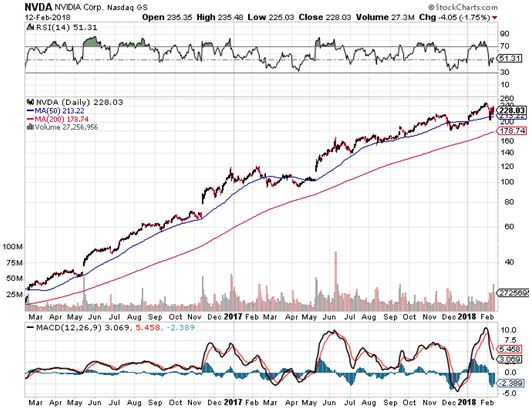
Long term readers of this letter know too well that after tripling from my initial forecast of $68 a share, that the shares of NVIDIA would double again.
After listening to their Q4 earnings call, I now have to confess that I was wrong my in assessment.
It now looks like NVIDIA shares will triple off of the recent $180 low.
From what I heard, the call was nothing less than amazing.
When considering companies limited by imagination, the last one I would anoint is Nvidia (NVDA).
I have been pounding the table for years, pleading with readers to drop everything and get into this battering ram of a stock.
If you didn't, well, you aren't buying at the bottom, but the future potential for Nvidia cannot be understated. Nvidia stands atop a parapet, scoffing at its enemies who simply cannot compare.
Its superior strategic position in GPU (graphics processing units) chips has forced the tech community to adopt its platform as the building blocks of A.I., machine learning, data center, and autonomous car technology.
In fact, Nvidia has only scratched the surface of its potential. The sustained growth story is not only intact but accelerating at a rapid clip.
The first chapter of Nvdia's rise to glory was on the back of e-gaming and the subsequent demand for their GPUs. The most talented gamers require the superior GPU's for faster processing speeds and crisper visuals that aid playing levels.
Casual gamers seem to upgrade their GPU's as well, since many of these participants cut their teeth jostling with their online counterparts 10 hours/day.
The main beneficiary of the GPU gaming upgrade boom is the model NVIDIA Pascal. This chip has the world's most advanced gaming GPU architecture, delivering truly game-changing performance, innovative technologies, and immersive, next-gen virtual reality.
Offering scintillating gameplay, it's a rung up in the gaming world. Additionally, the companies that manufacture gaming consoles are part and parcel in this GPU game of thrones. Sales of the Nintendo Switch provided a boost to Nvidia's Tegra processor revenue, tallying up to $450 million, up 75% YOY.
On a stand-alone basis, Nvidia is knocking the ball out of the park in terms of a pure gaming stock, but it is so much more than that. Nvidia IS the future. This was all apparent in last week's earnings call, which I shall outline below.
Data Centers
Revenue of $606 million was up a staggering 105% YOY, and up 20% QOQ. This over performance reflected strong adoption of Tesla V100 GPUs based on the Volta architecture, which began shipping in Q2 and continued to solidify in Q3 and Q4 2017.
V100's are present in every mainstream computer made by every major company, and have been chosen by every major cloud provider to deliver A.I. and high-performance computing.
Cloud customers adopting the V100 include Alibaba, Amazon Web Services, Baidu, Google, IBM, Microsoft Azure, Oracle and Samsung.
Nvidia perpetuates leadership in the AI training markets where their GPU's remain the platform of choice for training and machine learning networks. Any well-known company looking to A.I. functionality in the data center space relies on Nvidia to carry the load.
Nvidia posted a growing traction in the A.I. inference market where NVIDIA's platform can improve performance and efficiency by many degrees of magnitude over CPU's.
"Inference?" is the technology that puts sophisticated neural networks, trained on powerful GPUs, into use, solving problems for everyday users. Nvidia considers A.I. inference as a cogent new opportunity for the data center GPUs.
Nvidia is also gaining influence for A.I. in a growing number of vertical industries such as transportation, energy, manufacturing, smart cities, and healthcare.
The most poignant data center technology innovation was Tensor Core, a unique feature of the new Volta GPU Architecture. This technology alone can successfully complete rapid deep learning, and it officially increases the throughput of deep learning by 800%.
Autonomous Driving
Nvidia flaunted their leading position in autonomous vehicles with several salient landmarks and new partnerships. A.I. self-driving cars are trending towards moving from deployment to production.
Jensen Huang, the genius who is the CEO of Nvidia, announced that DRIVE Xavier, the world's first autonomous machine processor, will be available for the first time this quarter with more than 9 billion transistors.
DRIVE Xavier is the most complicated system Nvidia has ever delivered to customers. Recently trotted out, NVIDIA Drive is the world's first functional A.I. self-driving platform, enabling automakers to create autonomous vehicles they can operate safely.
This is a necessary component to prove its technology is ready for mass market. Several dynamic collaborations have begun with Uber, which has integrated A.I. video technology for its fleet of self-driving cars and freight trucks.
Production vehicles utilizing NVIDIA drive technology include vehicles from Chariot. Chariot is a privately-owned commuter shuttle service that is currently in the process of being acquired by Ford.
The company's mobile-phone application allows passengers to hop on a shuttle between home and work during commuting hours. Chariot currently operates in several neighborhoods in Silicon Valley and plans to swiftly expand to other locations around the United States. The Chariot fleet expects to be fully functional and possess automation capability by 2020.
Over 320 firms are now using the NVIDIA Drive platform, up 50% YOY, including almost every relevant car maker, truck maker, robo-taxi company, mapping company, car parts manufacturer and start-up in the autonomous vehicle ecosphere.
Nvidia has strategically placed itself on the front line hoping to expedite the roll out of this technology in the form of a massive fleet, servicing the individual. The obsolescence of human drivers is closer than you think.
Autonomous driving is the most significant paradigm shift in the history of the automotive industry. In total, transportation is a $10 trillion industry and I am not exaggerating when I say this will completely reshape our daily lives.
Vehicles will be fully or partly autonomous, depending on the entity. The potential of this market is massive.
The imminent monetization process will commence in 2019 and 2020, but if I had to bet money, I would say widespread profiteering will not occur until 2022.
The first goal is to train a network of autonomous driving capabilities, and this will be aided by creating a platform named NVIDIA GTX that grants everybody the chance to train a neural network promptly.
The inherent development of the A.I. requires top end GPU's, and Nvidia harvests a good portion of the spoils.
The second phase would be development platforms for the cars themselves and all these tasks will be executed by Nvidia Xavier SoC.
A system-on-a-chip (SoC) is a microchip with all the necessary electronic circuits and parts for a given system, such as a smartphone or wearable computer, on a single integrated circuit (IC).
Xavier is the most complex SoC that humankind has ever invented. All previous NVIDIA DRIVE software development carries over and runs with this consolidated architecture.
The prices for Nvidia GPU's split because the mix of solutions are unique. Autonomous vehicles that still have physical drivers will fetch a price between $500 to $1,000 per GPU.
Autonomous vehicles without drivers will command a price of $2,000-$3,000 per GPU. In general, the industry will see large-scale deployment starting FY 2018.
Practically every car produced in 2022 and beyond will have autonomous driving capabilities, requiring copious amounts of Nvidia GPU chips.
Huang repeatedly complains that Nvidia cannot keep up with the insane demand of these new technologies. There will be a persistent GPU shortage for the foreseeable future.
What does the future of AI behold aside from the imminent sensations of autonomous vehicles?
At a basic level, A.I. can be used for many things, such as improving images. For instance, you could reconstruct a photograph using A.I.. You could correct blemishes or parts of the image that haven't been rendered yet. A.I. would be used to fill in the holes, predict the future, and render results.
Let's take it one step further.
Extrapolating this concept to broader designs of everything, say cars, A.I. will be used to generate their designs in the future.
You could draw the first few preliminary scribbles of a car design and based on the inventory, safety, physics, consumer demands and other crucial inputs, the A.I. technology would complete the remaining 90% of the design.
This new type of design technology is called generative design and will revolutionize the way people do business.
My prognosis in the future of developing software is a world where computers can write their own software and this software will be so dense and complex that no human can replicate the task.
Essentially, we will be coaching up data to teach software how to write it's own software through machine learning. And imagine the new business applications introduced by this potential software!
Did I mention that Nvidia is also returning $1.25 billion to shareholders in FY 2019 and receiving another tailwind of high single digit growth in bitcoin mining?
Of course, all of that pales in comparison to the potential big picture profits Nvidia could realize. Jensen Huang has told investors that he expects A.I. to be a $10 billion/year business and autonomous technology to be a $40 billion/year business.
Remember that their most stable segment now is e-gaming GPUs which are only a paltry $3 billion/year in total revenue.
Nvidia could easily triple its business without fulfilling its revenue claims by just partially reaping the fruits of their labor from the A.I., data center, and autonomous vehicle industries. To visit their website please click here.