

“The ancient Egyptians were amazing, but if aliens built the pyramids, they would've left behind a computer or something.” – Said CEO and Founder of Tesla Elon Musk

“The ancient Egyptians were amazing, but if aliens built the pyramids, they would've left behind a computer or something.” – Said CEO and Founder of Tesla Elon Musk

(SUMMARY OF JOHN’S JANUARY 15, 2025, WEBINAR)
January 17, 2025
Hello everyone
TITLE: Welcome to Dullsville
PERFORMANCE
December MTD: +3.26%
Since inception: 751.8%
Average annualized return: +51.62%
2024 final: +75.26%
PORTFOLIO REVIEW
Risk On:
(TSLA) 1/$330-$340 call spread – 10%
(TSLA) 1/$300-$310 call spread- 10%
No risk off positions.
METHOD TO MY MADNESS
John tells us that this could be the year of the 5% correction, and you need to buy everyone.
Expect an OK first half and a weak second half.
All interest rate plays remain pariahs, including gold, silver, homebuilders, bonds, and REITS.
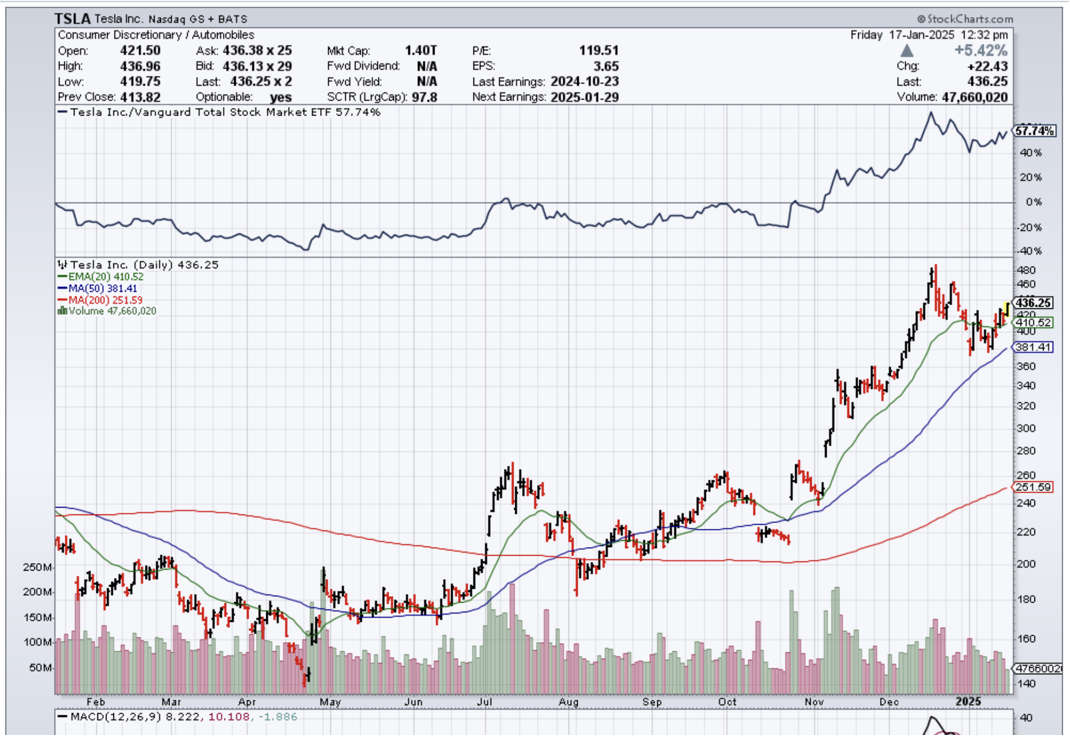
Deregulation and end of antitrust plays will continue to be bought, including banks, brokers, money managers, nuclear, and Tesla.
US dollar rockets at higher rates for longer.
Technology stocks fade on threats to international business and slowing growth sales.
Energy reaches top of recent trading range on a strong economy.
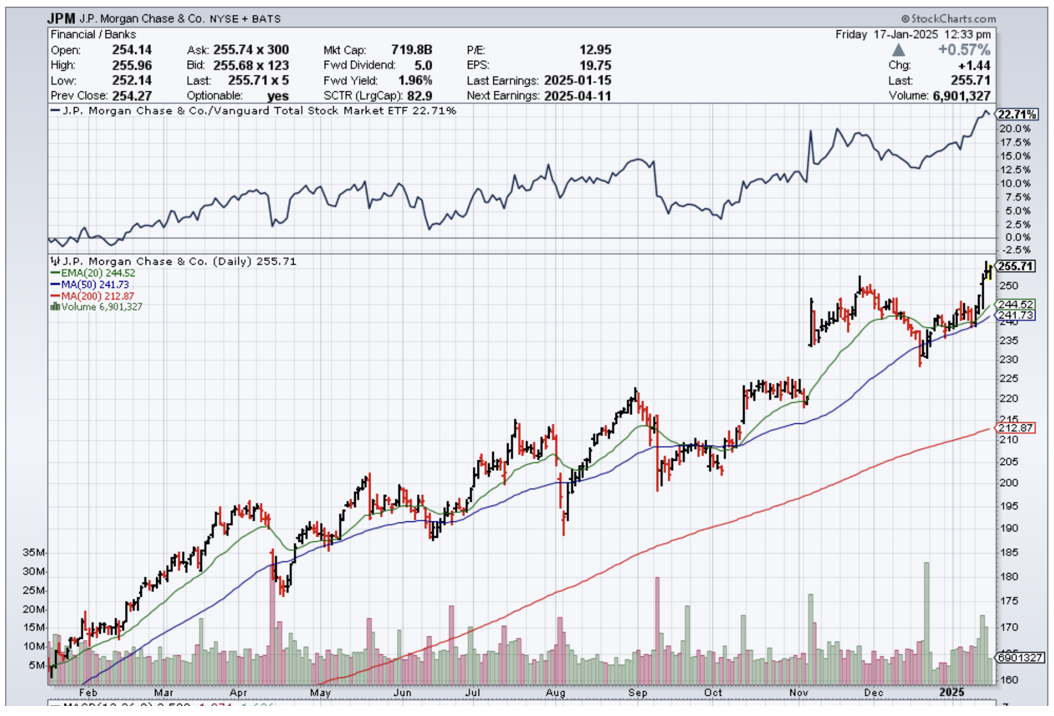
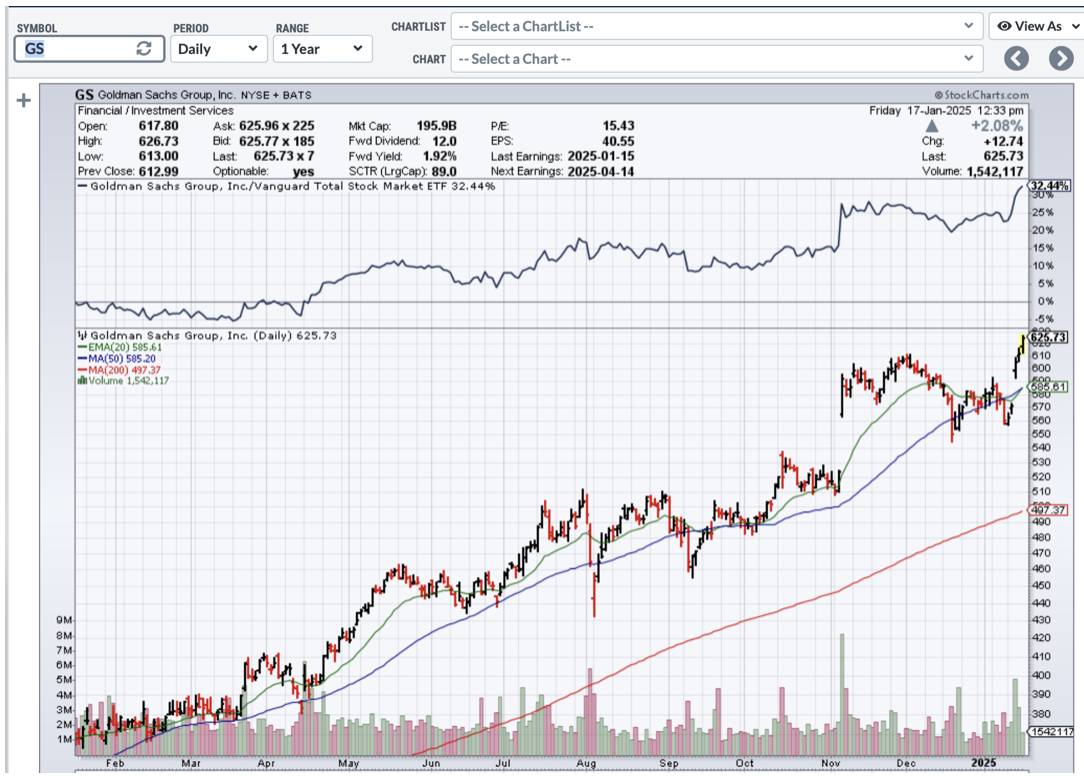
John says to buy financial as the only sure thing this year.
THE GLOBAL ECONOMY – STRONG U.S.
December Nonfarm Payroll comes in hot at 256,000.
Headlines unemployment rate at 4.1%
CPI comes in at six -month low at 3.2% YOY.
JOLTS soars, coming in at 8.0 million, versus an expected 7.7 million.
US Online sales rose by 3% over the holidays.
Services PMI comes in hot at 54.1
Los Angeles fires to cost $230 billion, with only $30 billion covered by insurance. Inflation will rise as the cost of construction, labour, and materials soar.
Tame PPI boosts stocks, with the Producer Price Index rising 3.3% on an annual basis in December 2024.
STOCKS – CORRECTION TIME
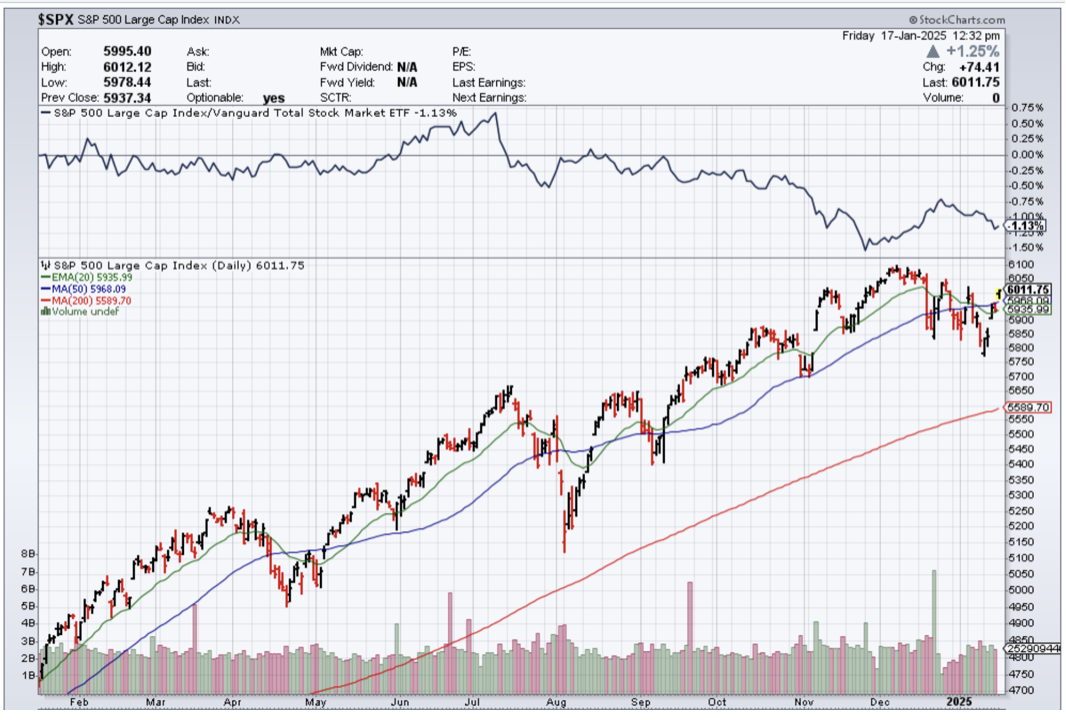
The Trump bump is gone – stock markets have given up all their post-election gains.
John says that bank stocks will be the leaders this year with the MAG7 catching up later.
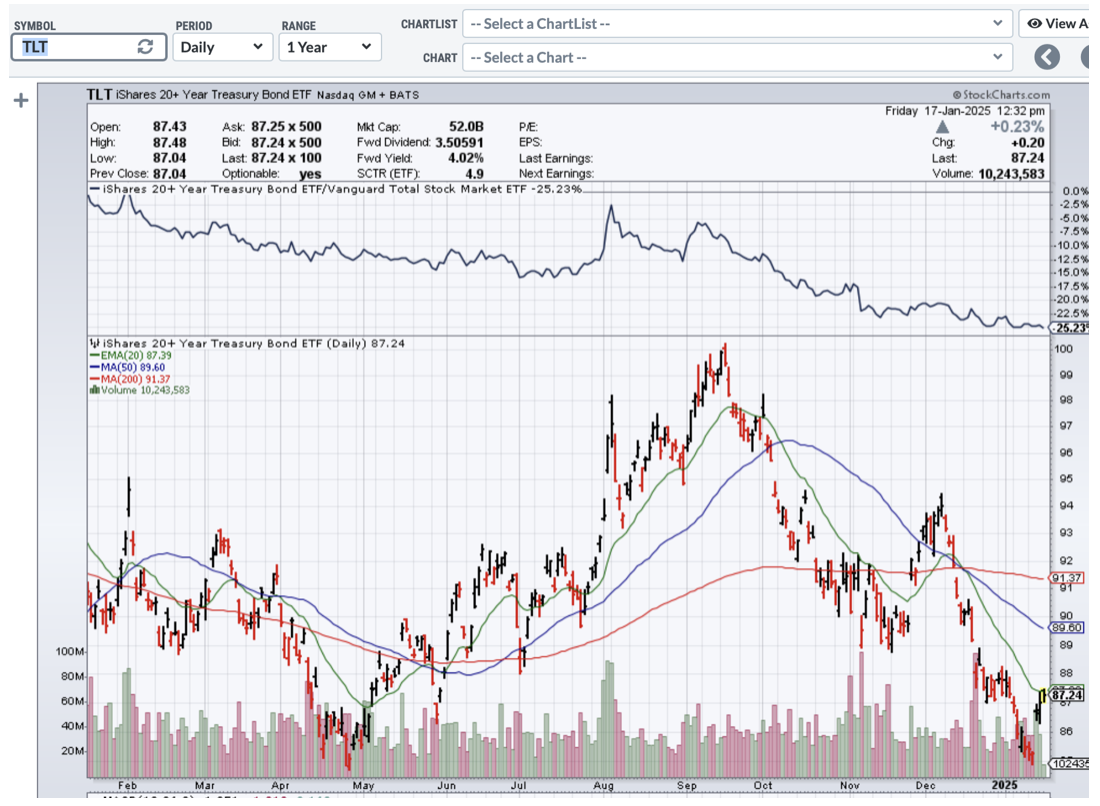
Bonds are now the big market risk. If we break a 10-year Treasury yield of 5.0% and take a run to 5.5%, the 5% stock correction turns into an 11% stock correction.
Technology was hit very hard.
Cleveland Cliffs Ramps up its bid for US Steel, bringing in Nucor as a partner.
$4 Trillion in Asset Management disrupted by Los Angeles fires.
Elon Musk sued by SEC for insider trading. Stock is up $20.
(Financials are good stocks to buy this year – look at the banks).
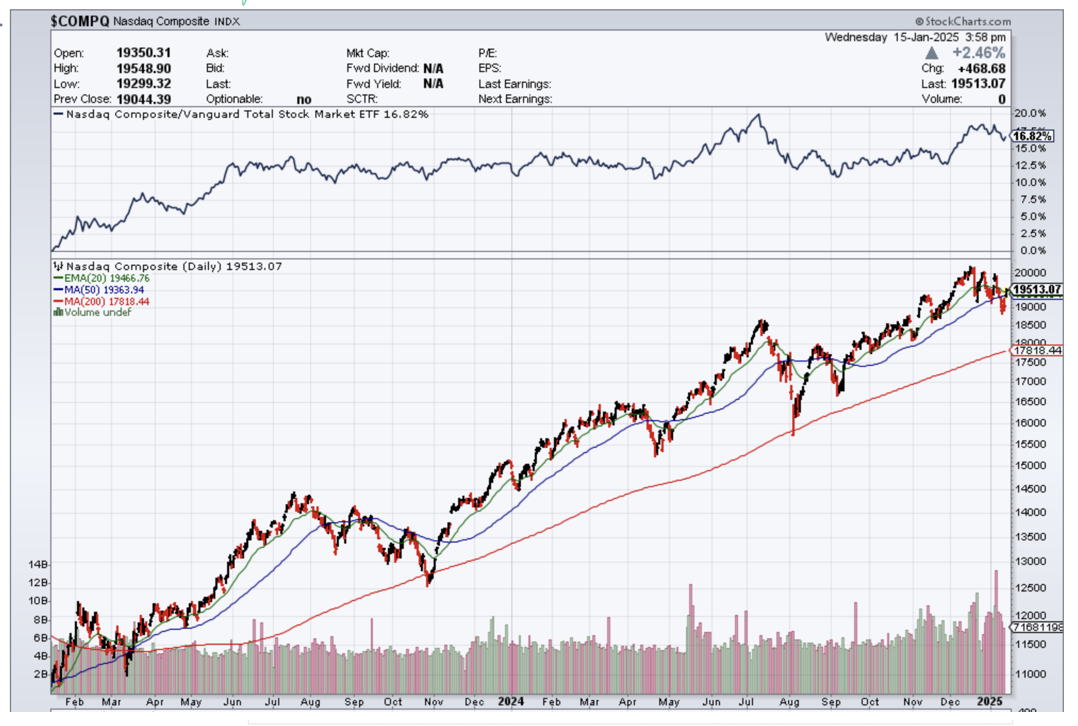
John believes we will get a sideways range for around 6 months in tech and then an upside breakout. Tech boom is just getting started. John doubts whether we get more than a 10% correction. John thinks that the first half of 2025 will be strong and the second half weak.
John’s advice:
Buy 5% dips on (JPM) JPMorgan and 10%-20% dips in (TSLA)Tesla.
Buy 90-day T-bills – 4.4%
Banks/financials: buy in the money LEAPS after a down move. Buy call spreads.
(NFLX)Netflix: buy territory/call spread
(PANW)Palo Alto Networks: buy stock/option
(BLK) BlackRock: Buy or option.
(CCI) Crown Castle International: LEAPS candidate – recovery possible.
2025 will offer a limited number of stocks to trade. Think banks/financials, nuclear energy, and Tesla among a few others.
BONDS – THE BIG MARKET RISK
Bonds hit 14-month lows at a 4.80% yield, as fixed-income dumping continues across the board.
“Higher rates for longer” don’t fit in here anywhere. But there may be a BUY setting up for (TLT) at 5.0%.
Bond yields have rocketed 130 basis points since September.
National debt tops record $36 trillion and could rise another $10 trillion.
TIPS are making a comeback.
FOREIGN CURRENCIES – U.S. dollar surges
Dollar hits two-year high, on rising U.S. interest rates, and higher highs beckon.
Ten-year U.S. Treasuries have risen from 3.55% to 4.80%, a 14-month high.
Higher for longer interest rates mean higher for longer US dollar.
Don’t sell the US dollar until the next recession is on the horizon.
Avoid (FXA), (FXE), (FXB), (FXC), and (FXY).
ENERGY & COMMODITIES – A RALLY AT LAST!
Oil finally rallies, but only to the top of the recent range with the Gaza peace deal back on the table.
China ratchets up the trade war, banning the export of crucial metals essential for all tech applications.
Strategic Petroleum Reserve at multi-year lows, but Biden has stepped in as a buyer.
Blame a weak China, lost OPEC discipline, and overproduction by Iraq.
Avoid the worst-performing asset class in the market.
IEA predicts price declines this year.
Unlimited new drilling and opening of federal lands will crash oil prices.
PRECIOUS METALS – STRUGGLING TO RECOVER
Gold has recovered half of its post-election losses on the central bank and Chinese flight to safety buying.
Interest rates higher for longer is a death knell for precious metals, with gold down 8.3% after November 5.
The opportunity cost of owning gold is about to rise sharply.
Gold has become the only way the average Chinese can save as they can no longer speculate in real estate or copper and don’t trust the Chinese Yuan, so there is support lower down.
Central banks in emerging market countries are continuing to buy gold - $5.3 billion this year.
Avoid (GLD), (SLV), (AGQ), and (WPM).
REAL ESTATE – POOR OUTLOOK
High rates could leave real estate dead in the water for all of 2025.
However, a strong economy is allowing commercial real estate to recover in New York and San Francisco.
LA fires are creating a massive housing shortage there, with 12,000 homes burned. Higher housing prices and rents are a consequence.
Mortgage demand grinds to a halt on 7.17% rates for the 30-year fixed.
TRADE SHEET
STOCKS – buy the next big dip
BONDS- sell rallies
COMMODITIES- stand aside
CURRENCIES – stand aside
PRECIOUS METALS – stand aside
ENERGY – buy nuclear dips
VOLATILITY – sell over $30
REAL ESTATE – stand aside
NEXT STRATEGY WEBINAR
12:00 PM EST Wednesday, January 29, 2025, from Salt Lake City UT.

Cheers
Jacquie
Global Market Comments
January 17, 2025
Fiat Lux
Featured Trades:
(JANUARY 15 BIWEEKLY STRATEGY WEBINAR Q&A),
(GS), (MS), (JPM), (C), (BAC), (TSLA), (HOOD), (COIN), (NVDA), (MUB), (TLT), (JPM), (HD), (LOW), FXI)


Below please find subscribers’ Q&A for the January 15 Mad Hedge Fund Trader Global Strategy Webinar, broadcast from Sarasota, Florida.
Q: What would I recommend right now for my top five stocks?
A: That’s easy. Goldman Sachs (GS), Morgan Stanley (MS), JP Morgan (JPM), Citibank (C), and Bank of America (BAC). There's five right there—the top five financials that are coming out of a decade-long undervaluation. A lot of the regional banks, which are also viable, are still trading to discount the book value, which all the financials used to trade out only a couple of years ago. Of course, JP Morgan's reaching a two-year return of around double, but the news just keeps getting better and better, so buy the dips. Buy every sell-off in financials and you will be a happy camper for the year.
Q: What do you think about Robin Hood (HOOD)?
A: Well, the trouble with Robinhood is it’s very highly dependent on crypto volumes. If you think crypto is going to go higher and volumes will increase, this is a great play. However, you get another 95%, out-of-the-blue selloff in crypto like we had three years ago and Coinbase (COIN) will follow it right back down again. On the last downturn, there were concerns that Coinbase would go under, so if you can hack the volatility, take a shot, but not with my money. I have the largest banks in the country that are about to double again; I would much rather be buying LEAPS in that area and getting anywhere from 100% to 1000% percent returns on a 2-year view—much more attractive risk-reward for me. And they pay a dividend.
Q: How do you define a 5% correction?
A: Well, if you have a $100 stock and it drops $5, that is a 5% correction.
Q: Can you please explain what Tesla 2X leverage actually means and is it a way to trade Tesla as an alternative?
A: I steer people away from the 2Xs because the tracking error is really quite poor. You only get 1.5% of the upside, but 2.5 times the downside over time. These are more day trading vehicles. They take out huge fees, and huge dealing spreads—it's a very expensive way to trade. Far cheaper is just to buy Tesla (TSLA) stock on margin at 2 to 1, and there your tracking error is perfect, your fees are much lower, and you just have the margin interest rate to pay on the position, which is 6% a year or 50 basis points a month. No reason to make the ETF people richer than they already are. They keep coining these products—1x, 2x, 3x long shorts on every one of the high volume stocks, and it sucks a lot of people in, but it's higher risk, lower returns for the amount of money you're risking as far as I'm concerned. So that's the way to do it.
Q: What are your projections for Nvidia (NVDA)?
A: I think not just Nvidia, but all of the big tech is going to be kind of trading in a sideways range for a while, maybe 6 months, and then we get an upside breakout if you get the earnings breakout, which we are all expecting. AI is still in business, and still growing gangbusters. There are always a lot of Cassandra's out there saying that we're going to crash anytime, and I just don't see it. I know a lot of these people, I'm in touch with a lot of the companies, I see Beta releases of all products, the consumer products, and…the slowdown just ain't happening, I'm sorry. And I've been through a lot of these tech booms over the last 40 years, and this is only showing signs of just getting started.
Q: How come Tesla (TSLA) is up and down $30 every couple of days?
A: Number one, it is the most actively traded stock in the market right now. It has implied volatility on the options of 70%, which is really the highest in the market of any individual stock. That just creates immense amounts of trading by options traders, volatility traders, by call writing, and 2x and 3x ETF long and short players. All of the financial engineering and new products that we see all gravitate toward the high volume stocks like Nvidia, Tesla, and Apple because that's where the money is being made. Some days Tesla accounts for 25% of all the market trading. Financial engineers go where the action is, where the volume is, where the customer demand is.
Q: Why do you expect only 5% to 10% corrections if the Fed rate cuts get completely priced out?
A: I don't expect the Fed to keep cutting interest rates. We should get another rate cut this year, and that may be it for the year. If inflation comes back (and of course, all of the new administration’s policies are highly inflationary) it’s just a question of how long it takes for it to hit the system.
Q: Do you believe I should hold all of my municipal bonds (MUB) with 10-year call protection at 4.75%?
A: On a tax-adjusted basis, I would say yes. You know, stock markets may peak and deliver a zero return, and in that situation, muni bonds are very attractive. The nice thing about bonds is that you hold on to maturity—you get 100% of your money back. With stocks, that is not always the case. Stocks you have to trade because the volatility can be tremendous. And in fact, what I do is I keep all of my money in one year Treasury bills. Last time I did this, which was in September, I locked in a one-year return for 5%.
Q: Would you prefer to buy deep in the money and put spreads on top of any rally?
A: Absolutely yes. If this is a real trading year, you not only buy the dips, you sell the rallies. We did almost no real selling last year. We really only did it in June and July because the market essentially went straight up, except for two hickeys. This could be the year of not only call sprints but put spreads as well. You just have to remember to sit down when the music stops playing.
Q: You say buy the dips; what would your dip be in JP Morgan (JPM)?
A: Well lower volatility stocks by definition have smaller drawdowns. JP Morgan (JPM) is one of those, so I'd be very happy to buy a 5% dip in JP Morgan. If it drops more, you double the position on a 10% pullback. Higher volatility stocks like Tesla—I'm really waiting for 10% or 20% corrections. You saw I just bought a 22% correction twice in Tesla with it down 110 points. One of those trades is at max profit right now and the other one has probably made half its money since yesterday. That is the game. The amount of dip you buy is directly related to the volatility of the stock.
Q: Should you let your cash go uninvested?
A: Yes, never let your cash go uninvested just sitting as cash. Your broker will take that money and put it in 90-day T-bills and keep the money for himself. So buy 90-day T-bills as a cash management tool—they're paying about 4.21% right now— and you can always use those as collateral under my positions on margin.
Q: Is Home Depot (HD) a buy on the LA reconstruction story?
A: I would say no, Los Angeles is probably no more than 5% of Home Depot's business—the same with Lowe's (LOW). A single city disaster is not enough to move the stock for more than a few days, and the fact is: Home Depot is mostly dependent on home renovation, which tends not to happen during dead real estate markets because, you know, it takes the flippers out of the market. It really needs lower interest rates to get Home Depot back up to new highs.
Q: Do you expect a big market move at the end of the day when the Fed makes its announcement?
A: The market has basically fully discounted the move on January 28, and if anything happens, there'll probably be a “sell on the news.” So, I expect we could give up a piece of the recent performance on the announcement of the Fed news.
Q: Should we expect trade alerts for LEAPS coming from you?
A: Absolutely, yes. However, LEAPS are something you really only want to do on down moves. If we don't get any, we'll just do the front-month call spreads. You can still make 10%, 20% a month just concentrating on financial call spreads.
Q: What would have happened to our accounts if we kept the (TLT) $82-$85 iShares 20+ Year Treasury Bond ETF (TLT) call spread and it went all the way down to $82?
A: The value of your investment goes to zero. Of course, it was declining at a very slow rate, and the $80: you might have gotten a bounce off the $85 level. But if the inflation number had come in hot, as had all other economic data of the last month, then you could have easily gotten a gap down to $82 and lost your entire investment, because two days is not enough time to expiration to recover that 3-point loss. And that's why I stopped out yesterday.
Q: Didn't David Tepper buy China (FXI)?
A: With both hands last September, yes he did. And my bet is he got out before he got killed. I mean, that's what hedge funds do. He probably got out close to cost, and you likely won't see him promoting China again anytime in the near future.
Q: I have June 530 puts on the S&P 500, should I get rid of them?
A: Yes, I don't see a big crash coming. You probably paid a lot going all the way out to June, and it's probably not worth hanging on to. Put spreads are the better way to go—that cuts your cost by two-thirds and those you only want to put on at market tops.
To watch a replay of this webinar with all the charts, bells, whistles, and classic rock music, just log in to www.madhedgefundtrader.com, go to MY ACCOUNT, click on GLOBAL TRADING DISPATCH, TECHNOLOGY LETTER, or JACQUIE'S POST, then WEBINARS, and all the webinars from the last 12 years are there in all their glory.
Good Luck and Good Trading,
John Thomas
CEO & Publisher
The Diary of a Mad Hedge Fund Trader
"Investing now is like taking a shower while Norman Bates is somewhere in your house," said Jim McTague, a journalist at Barron's.

Mad Hedge Biotech and Healthcare Letter
January 16, 2025
Fiat Lux
Featured Trade:
(THE EYES HAVE IT)
(REGN), (SNY), (PFE), (BMY)

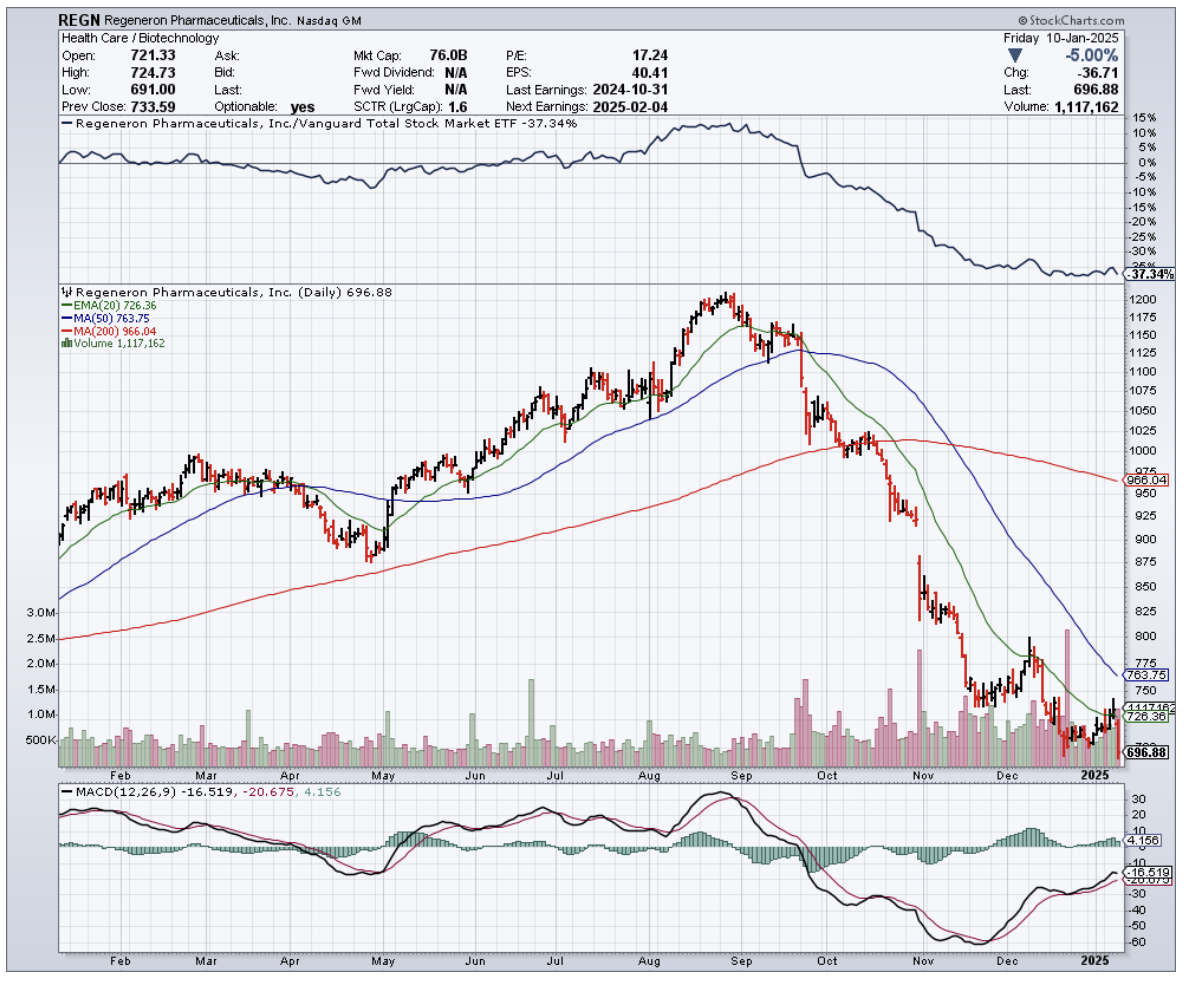
Last week, while waiting for my annual eye exam, I couldn't help but notice the parade of elderly patients shuffling in for their regular Eylea injections. My optometrist tells me these folks show up like clockwork every 4-8 weeks, rain or shine.
That's about to change, and therein lies a multibillion-dollar story.
You see, when Regeneron reported Q3 earnings on Halloween, boy, they sure had some treats for investors. Revenue hit $3.72 billion, up 11% YoY, with EPS coming in at a sweet $11.54.
But here's what really caught my attention: their cost of revenue was $1.762 billion, while R&D and SG&A expenses ran $1.271 billion and $714.4 million respectively.
Net income? A cool $1.34 billion. Not too shabby for a company whose main product is under siege from copycats.
Speaking of copycats, let's talk about Eylea. The original formula saw revenues drop 21% YoY to $1.145 billion – that's what happens when biosimilars crash your party.
This is where it gets interesting though: Eylea HD (think of it as Eylea's muscled-up big brother) jumped from a mere $43 million to $392 million YoY.
Sure, about $40 million of that came from wholesalers stocking up like it's Black Friday at Costco, but still – that's what I call a growth story.
I've been watching Regeneron since they were just a gleam in Wall Street's eye, and they've always had a knack for turning scientific breakthroughs into cold, hard cash.
Take Dupixent, their inflammation blockbuster co-developed with Sanofi (SNY). It just got FDA approval for COPD with an eosinophilic phenotype.
Why does this matter? Because we're talking about a $6 billion market opportunity here, folks.
About 36% of COPD patients have this particular flavor of the disease and trust me, there are more of them than you'd think still wheezing away on their old inhalers.
Want to know what else is cooking in their labs? They're working on antibodies that could make blood clots a thing of the past – think better than Eliquis, which pulls in $10 billion annually for Pfizer (PFE) and Bristol Myers Squibb (BMY). Their secret? Something called Factor XI, which could be a game-changer for the 1 in 5 patients at high risk for bleeding.
And because no self-respecting biotech can resist the siren call of the obesity market, they're also cooking up their own weight loss cocktail. Results won't drop until late 2025, but if they crack the code on keeping weight off AFTER stopping treatment, they'll have something Wegovy and Zepbound can't match.
The financials are rock solid, too: $2.012 billion in cash, $7.785 billion in marketable securities, and current assets of $19.334 billion versus current liabilities of just $3.661 billion.
They've generated $3.158 billion from operations in the first nine months of 2024 alone.
Yes, there's $1.984 billion in long-term debt, but with cash flow like that, it's about as worrying as a paper cut.
I've already started nibbling at Regeneron, and I'm looking to add more if it dips further. After all, this is a company that's proven it can grow revenues at upper single digits year over year while maintaining 25% free cash flow margins - the kind of numbers that make a value investor's heart skip a beat.
Sure, there are risks lurking around every corner – biosimilars nipping at Eylea's heels, Medicare negotiations that could squeeze margins, and clinical trials that might go sideways.
But with multiple growth catalysts and a pipeline that reads like a wish list for modern medicine, Regeneron's got more upside than my daughter's college tuition bills.
As my optometrist likes to say - in the land of the blind, the one-eyed man is king. But in the land of biotech, Regeneron's got a 20/20 vision for what's coming next.
Global Market Comments
January 16, 2025
Fiat Lux
Featured Trades:
(WHY TECHNICAL ANALYSIS IS A DISASTER)
(SPY), (QQQ), (IWM), (VIX)
(TESTIMONIAL)


At my Mad Hedge Miami Beach Luncheon, I heard an amazing piece of information from a guest.
Fidelity recently conducted a study to identify their best-performing clients.
They neatly fell into two groups: people who forgot they had an account at Fidelity and dead people.
It all underlines the futility of trading the markets without true professional guidance, something many aspire to but few actually accomplish.
Of the many thousands of online newsletters and trade mentoring services, I only know of three that actually make money for clients.
Those would be mine and two others, and I’m not talking about who the other two are.
It is an industry filled with professional marketers, charlatans, and conmen.
Let me point out a few harsh lessons learned from this most recent meltdown and the rip-your-face-off rally that followed.
The next five months are ones of historical seasonal market strength.
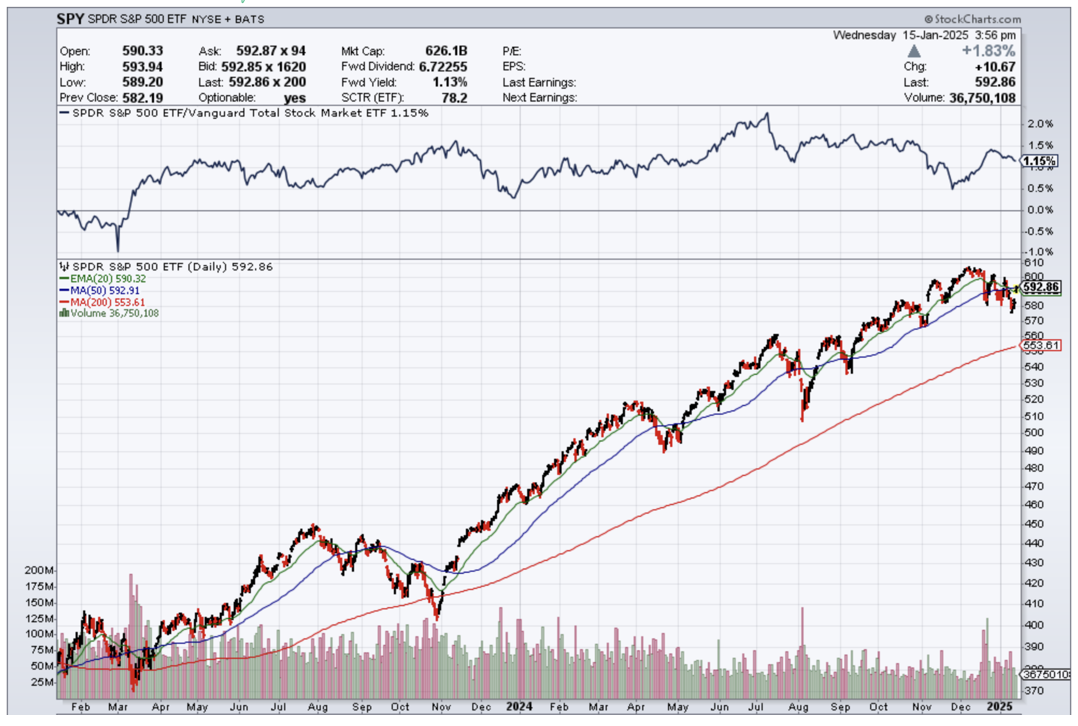
The big lesson learned this summer was the utter uselessness of technical analyses. Usually, these guys are right only 50% of the time. This year, they missed the boat entirely.
The biggest losers?
Algorithms, which used the decisive breakdown of the (SPY) in August to go heavily short.
If you did, you lost your shirt. The market just shed a couple more points, reversed, and then kept going, and going, and going.
This is why technical analysis is utterly useless as an investment strategy. How many hedge funds use a pure technical strategy and a stand-alone basis?
Absolutely none, as it doesn’t make any money.
At best, it is just one of 100 tools you need to trade the market effectively. The shorter the time frame, the more accurate it becomes.
On an intraday basis, technical analysis is actually quite useful.
Leave it for the kids.
This is why I advise portfolio managers and financial advisors to use technical analysis as a means of timing order executions, and nothing more.
Most professionals agree with me.
Technical analysis derives from humans’ preference for looking at pictures instead of engaging in abstract mental processes. A picture is worth 1,000 words, and probably a lot more.
This is why technical analysis appeals to so many young people entering the market for the first time.
Buy a book available for $5 on Amazon, and you can become a Master of the Universe.
Who can resist that?
The problem is that high-frequency traders also bought that same book from Amazon a long time ago and have designed algorithms to frustrate every move of the technical analyst.
Sorry to be the buzz kill, but that is my take on technical analysis.
I have a much better solution than forgetting you have a trading account, or dying.
Take Cunard’s round-the-world cruise.
I have been sailing with Cunard since the 1970s when the original Queen Elizabeth was still afloat.
I’ve lost count of how many Transatlantic voyages I have taken across the pond.
For a mere $16,669 you can spend 117 days circumnavigating the globe with Cunard from Southampton, England in their cheapest inside cabin (click here for the link.)
That includes all the food you can eat for four months.
On the way, you can visit such exotic destinations as Bora Bora, The Seychelles, Reunion, and Moorea.
Not a bad deal.
By the time you get home, you will probably earn enough in your investment account to pay for the entire trip.
Hope you enjoyed your cruise.
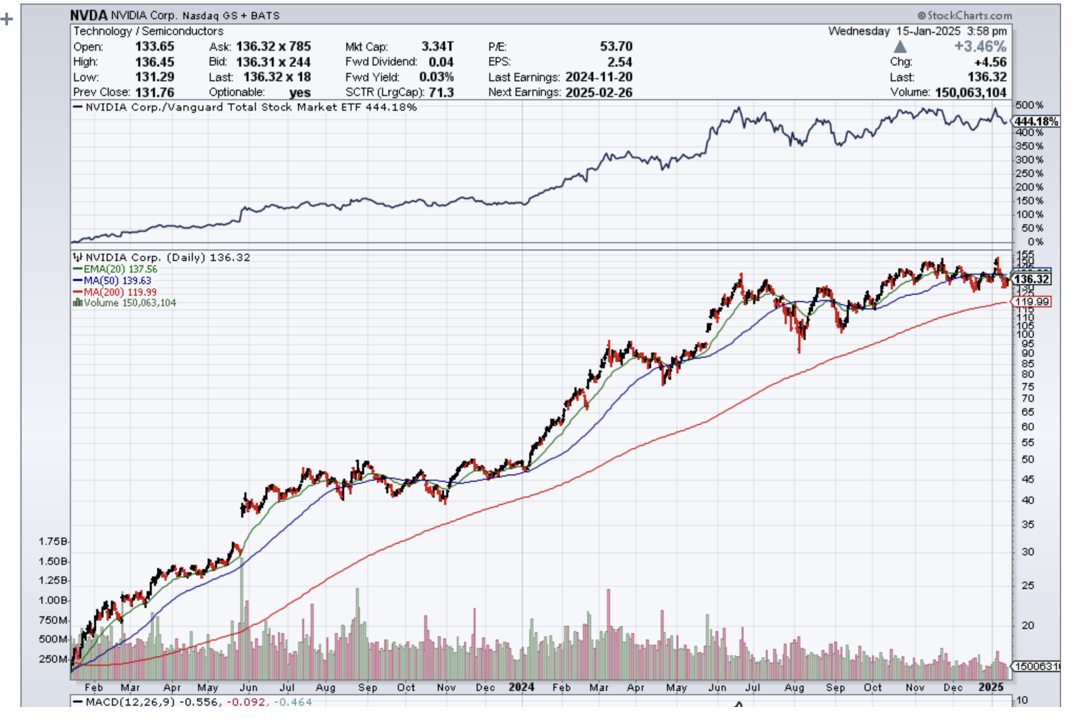


Correction? What Correction?
Learning disabilities, such as dyslexia, dysgraphia, and ADHD, affect millions of people worldwide. These neurodevelopmental differences can create significant challenges in academic settings, the workplace, and everyday life. However, the rise of artificial intelligence (AI) is ushering in a new era of support and empowerment for individuals with learning disabilities. AI-powered tools are breaking down barriers, fostering independence, and unlocking potential that might otherwise remain untapped.
One of the most significant ways AI is transforming the landscape for learners with disabilities is through personalized learning. Traditional education often follows a "one-size-fits-all" approach, which can be particularly challenging for those with learning differences. AI algorithms, however, can analyze individual learning styles, strengths, and weaknesses to create customized learning experiences.
AI is also revolutionizing assistive technology, providing powerful tools that enhance learning and independence.
Early identification of learning disabilities is crucial for providing timely support. AI can play a vital role in this process.
AI is making learning environments more accessible for individuals with disabilities.
AI is not only transforming education but also empowering individuals with learning disabilities in the workplace.
Challenges and Ethical Considerations
While AI offers tremendous potential for supporting individuals with learning disabilities, it's essential to address the challenges and ethical considerations that arise.
The Future of AI and Learning Disabilities
The future of AI in supporting individuals with learning disabilities is bright. As AI technology continues to evolve, we can expect to see even more innovative and impactful applications.
Conclusion
AI is revolutionizing the way we understand and support individuals with learning disabilities. By providing personalized learning experiences, assistive technology, and enhanced accessibility, AI is empowering learners to reach their full potential. As we continue to explore the possibilities of AI, it's crucial to address ethical considerations and ensure that these technologies are used responsibly and equitably. With careful development and implementation, AI can be a powerful force for inclusion and empowerment, creating a world where everyone has the opportunity to thrive.


